Tuesday, October 23, 2018

When All You're Trying To Do

is fleece the rubes, sometimes it doesn't hurt to be honest about it.

There's a sucker born every minute. Whether there are enough suckers at any minute is another matter.

Brown people, amirite?

Happy Days Are Here Again


Trump posted a picture of people waiting in line the night before to get into his rally.  
I've never heard of people camping out so they could vote, however.

I'd been hoping to get some word about voter turnout in Texas; I just didn't think it would come this soon.

Early voting started just yesterday:

It took Harris County, which includes Houston, less than six hours to set a new opening day of early voting record for midterm elections with more than 36,000 votes cast — exceeding the around 26,000 ballots cast there during the 2010 midterms, County Clerk Stan Stanart told the Houston Chronicle.

Dallas County was also flirting with surpassing the first-day turnout of 2016 — an unusual feat since turnout in presidential election years is typically higher.
....

In Travis County, home to Austin, Tax Assessor Collector Bruce Elfant said on Facebook that more than 36,000 people cast early ballots by 4 p.m. Monday, nearly doubling first-day totals from the last midterms in 2014. Tarrant County, which includes Fort Worth, announced exceeding 37,000 votes — around triple the first-day early voting turnout for 2014.
....

Dallas County Judge Clay Jenkins said 42,000-plus people had voted by 4:30 p.m. Monday, and that the county could exceed the first day of early voting turnout for the presidential election in 2016.

Let me add some details to those numbers; and remember, Texas is a notoriously low-voter turnout state.  

After 7 p.m. Monday, 55,384 ballots had been cast in Dallas County, according to the county elections department. That surpasses the 29,217 from the first day of early voting for the last midterm election in 2014. The numbers include mail-in ballots.

The last time voter turnout was high in Texas, Democrats won.   There's a reason Republicans work so hard to suppress the vote, and a reason why Beto O'Rourke alone has spent $6 million in a GOTV effort:

Thousands of people were already camped out at a key early voting location in Houston on Monday morning, hours before voting was even set to begin.

Nearly 2,000 people stood in line outside of the Metropolitan Multi-Service Center on West Gray near River Oaks in a scene that looked more like a Black Friday shopping morning. 
Elsewhere in Texas (we have at least five major metropolitan areas):

In Bexar County, The San Antonio Express News reported that as of 4 p.m. Monday more than 24,000 people had voted in person, compared to 13,436 who voted in person first day in 2014.

Bruce Elfant, Travis County Tax Assessor-Collector and Voter Registrar, reported on Facebook Monday night in-person and mail-in votes for Travis County totaled 47,405, compared to 17,181 first-day in-person and mail-in votes in 2014.


Smaller counties also saw big turnout. Midland County Election Administrator Deborah Land said out of 84,945 registered voters in her county, 3,546 had voted by 4 p.m. Monday — compared to just 756 who voted the first day in 2014.

“We had a line at the elections office all day,” Land said. “Most of the time it was extending down the hallway.”


A brief update:  early voting in Harris County is only available from 8 to 4:30 this week.  It runs 12 hours a day starting next week.  This means a lot of people made a big effort to turnout on the first day of the work week and vote during working hours.

And local NPR reports this morning that the final count for Harris County was over 63,000 votes cast; with mail-in ballots, over 120,000 votes have already been cast in Harris County, on just the first day of voting.  The "gap" between Democratic and Republican voters, on just the first day of voting, is also said to be narrowing.  Obviously that is not good news for Republicans.

Monday, October 22, 2018

The Thing Speaks For Itself

If you can call it speaking.

"Blood in the Face"


That was subtle, compared to this:

“Go into the middle of the caravan, take your cameras and search,” he told a reporter. “John, take your camera, go into the middle and search. You’re going to find MS-13, you’re going to find Middle Eastern, you’re going to find everything.”

In the camera, you will see them.  And what will you see?  Brown people.  That's how you identify MS-13 and "Middle Easterners."  Brown people.  See a brown person, you see the danger.

What more do you need to see?

"Mars Is Heaven!"


I've got a new hobby horse, and it's the colonization of Mars.

The discussion always goes on at the level of experts in technology and space travel and computers, like those assembled by Vox for an article on the subject.  Nobody ever asks a farmer or soil expert, however.

I've been buying a lot of potting soil in recent years, potting lots of plants to put around the house.  I noticed quickly that the best stuff was not like the stuff I used to get:  there's almost no dirt in it.  Instead it's all organic material, practically compost.  And when I plant bushes, and buy the stuff meant to help them root and thrive, it's compost, too.  It ain't "soil."  It's meant to be added to the dirt you're going to be digging in, but it's meant to add something to make the plants thrive:  and that something is, basically, dead plants.  Dead plants, and microbes.

I have a memory from somewhere in my public school education of being taught about top soil:  that the first plants had to grow in basically pulverized rocks, decay, and begin creating top soil.  I remember the history of the Dust Bowl, when the top soil blew way in the middle of the country, in some of the richest farmland on earth.  Rich not because we had a lot of dirt to spare v. the rest of the world, but rich because of the top soil:  because of the centuries of dead plants built up there.  Basically, without top soil, you're trying to grow plants in sand.  Even the cactus and succulent mix in the garden centers is not just a bag of sand.

And yeah, I've heard of hydroponics, but that requires feeding the plants an abundance of fertilizers, and having an abundance of water available.  Mars has precious little of the latter, and if you're going to have to ship in the former, it's not going to make it easier or cheaper to grow plants that will sustain life.  Not to mention the rest of the ecosystem you need for plants.  I have soil additives designed specifically to promote microbe growth in the soil, because plants need those microbes to act in order to grow.  Symbiosis is to biology what simile is to metaphor; a small portion of something much more common and complex  than the concept implies.  I heard a report recently of geneticists studying microbes in the human gut, and ending up thinking its the microbes that tell you to drink a cup of coffee, because they need it for their purposes, and you need the microbes for your purposes.  Perhaps an upended view of things, but a view that upends, too, the top-down approach that assumes, among other things, if we can build the spacesuits and the rocket ships, we can live on Mars.  And it ain't just that  "Mars will be a more hostile environment than the top of Everest or the South Pole,"  Not to put too fine a point on it, but both places on earth have a significant lack of top soil, and yet it would be easier to grow a tree above the tree line than on Mars, and while Antarctica is a desert, it still has more available water than Mars.  And by the way:

 Mars's atmosphere is about 100 times thinner than Earth's. Without a "thermal blanket," Mars can't retain any heat energy. On average, the temperature on Mars is about minus 80 degrees Fahrenheit (minus 60 degrees Celsius). In winter, near the poles temperatures can get down to minus 195 degrees F (minus 125 degrees C). A summer day on Mars may get up to 70 degrees F (20 degrees C) near the equator, but at night the temperature can plummet to about minus 100 degrees F (minus 73 C).

Mount Everest:

The  temperature at the Mt. Everest summit in January is average -33° F (-36° C) and it can drop to -76° F (-60° C) even. The average summit temperature in July is -2° F (-19° C).

Antarctica:

In Antarctica, the average annual temperature ranges from -76 degrees Fahrenheit at the most elevated parts of the interior to 14 degrees along the coast.
So, yeah, any plant growing is going to be in heated conditions; which means you need an energy source, or you need to import.  You'll also need to heat the colony.  Where this energy comes from is anybody's guess.

And no, I don't really think Matt Damon could "science the shit out of this."  Maybe a few plants, but enough to sustain a colony?  With no top soil and water as scarce as hen's teeth?  You might eke out an existence, but who wants to fly to Mars just so they can starve to death?  And by the way, Elon Musk thinks he's living in a science fiction novel from the '50's:

 (Musk contests that, saying that it’ll be adventurous people, not elite ones, who populate Mars.)
First, even adventurous people haven't tried to populate the Antarctic (it would still be easier than living on Mars), and secondly:  there's a reason astronauts are trained so carefully and for so long, and are such dull and technical people, rather than daring adventurers boldly crossing the seas of space.  In space, your life depends on the integrity of your engineered technological environment.  The least problem could be fatal to you and all aboard, and you can't wait for the repairman to fly up and investigate.  If you can't fix it when you find it, you and your fellow astronauts may die.  So a colony on Mars would have to all be experts in the design and operation and repair of all the systems that keep the colonists alive in a world with no breathable atmosphere and average temps colder than Antarctica in the dead of winter.  Anybody who can't fix the problem when they find it dooms the whole colony.  And that's aside from whether you could grow so much as one ear of corn.

Oh, and some of the best plant fertilizer is manure; except you'd have to ship that up to Mars, too.  You'd basically have to take everything with you, and keep taking it up there for as long as people were trying to live there.  You wouldn't have top soil so nutrients (including microbes) to keep the plants alive would be as critical as the engineered living spaces themselves (and how you power those is anybody's guess).  The least disruption in supply would mean death for all involved.  The "adventurous types" would soon be reduced to a life of constant attention to the basics of survival, basics already supplied on earth:  heat, atmosphere, available foodstuff.  A drought may endanger a region, a famine may engulf a country, but the rest of the world survives or even lends aid.  A similar problem on Mars would leave a ghost colony before word could get back to earth and the first ship in response arrive.  And we're destroying earth, but we're going to terraform Mars, because if we do one we can do the other, but we can't do it here?  Whose idea is that?


Hope Springs Eternal


“Many white evangelicals around the country support the Republican agenda wholeheartedly based on this issue of abortion,” Dias said. “But now they’re seeing Beto O’Rourke, someone they’re telling me better represents Jesus, frankly, and the range of ways they saw Jesus caring for the vulnerable people. They said, ‘look, we all voted for Ted Cruz in 2012 and no more.”


Early voting starts today.  If turnout is as strong as it has been in Georgia and Nevada, Christmas may come early this year.

Maybe I'm Wrong

I know I'm hardly the "average voter," but this used to be taken as a sign of American exceptionalism."

“We are going to the United States!” he shouted euphorically. “Nobody is going to stop us!”

And now, because of a fat little xenophobic liar, we are supposed to be afraid of people coming here with a almost nothing but hope?

Is this really what we've become?
No, Apparently not.

Oh, let's just carry it on a bit, and catch up with the morning, and a reminder the President presides over the greatest intelligence gathering services in the world:


Except, no, that's not what's happening:
I'm sure George Soros has something to do with this!

Sunday, October 21, 2018

Sooper Genius

It's not fake news if he says it (it's just fake news that he said it).

It's Still the Same Old Story

Yes, you can find anything on the internet....

You can buy Nerf guns now marketed to 10 year olds designed to resemble a gun put together from disparate parts assembled in a zombie apocalypse so you can shoot the things.  Of course you can buy stickers to put on your car identifying it as a "ZOMBIE APOCALYPSE RESCUE VEHICLE" or something like that.  Apocalypse by some cause (mutant virus created by evil corporation, nuclear holocaust, environmental collapse) has been a source of entertainment since the '50's (yes, Virginia, it's at least that old).  And some people take it much more seriously than the people who design and market toys and car stickers.  Is it any surprise, then, that it's on people's minds not just as entertainment,  or that it may even be attractive?

“Though we tend to think of the apocalypse as negative, the idea may counterintuitively be attractive to some,” he said. “In a world in which life feels uncertain and often unfair, in which people struggle to find a sense of personal purpose, the idea of an apocalyptic ending, though terrifying, can also feel meaningful.”

Meaningful because entertainment always makes catastrophe meaningful.  "From Here to Eternity" shifts from a tawdry tale of men at a Navy base easily bored when they don't have enough to do (or the right women to screw; pardon the jab at poetry, but that's pretty much how the women are presented in that story), that turns redemptive because of the attack on Pearl Harbor.  At the other end of the war, "The Best Years of Our Lives" provides redemption and meaning in recovery from war and return to normal life, a life that would soon explode into the suburbs and Mad Men of the '50's and '60's.  And of course, all those WWII movies that showed John Wayne winning the war singlehandedly, with a rag tag group of Americans including one drawling Southerner, a wise guy from the Bronx, and a handful of other colorful "regional" characters, all meaningful because of the war that has destroyed whole nations but brought meaning to their individual lives, nonetheless.  It's a Hollywood thing (Shakespeare's characters are seldom redeemed in his stories; at best they live happily ever after, but that's all), but then Hollywood has shaped American culture in ways deep and disturbing.

So why wouldn't people think chaos and the end of life as we know it would prove the making of who they are?  We all believe that in times of crisis our true nature rises to the fore, and we are all convinced our true nature would make us the heroes of our own action movies.

“Some are attracted to these ideas because they would be tested and could find their true purpose, maybe even emerge as heroes or people of importance in a new world,” he said. “And some like to imagine the possibility of a simpler life, what might be almost a form of nostalgia.”

(You can read the original article to find out who "he" is there.)  There's nothing really new here.  Ever imagined what you wanted done for your funeral, or who you think would be there?  That's another favorite entertainment trope, letting the deceased see who showed up to mourn, or at least get something to eat.  But you won't be there, and life isn't broken because you die; in fact, it's usually a wound that soon heals over.  It's certainly a stone thrown in the water; the hole closes, the world moves on.  We imagine our true worth will come when we die (probably one the motivations for suicide), but we don't become heroes in apocalypse or disaster:  we end up dead, or wondering how to live without electricity.  I went for three weeks without power after Hurricane Ike.  There was no lawlessness, no looting, no breakdown of civil order, as one might imagine.  But it was hot and dark meant dark, and all my usual pastimes, including work, were cut off for so long it seemed I might lose them forever.  I didn't become a better person, or a hero.  I was just me.   There was nothing redemptive about it, I was just glad when it was over (when the forces of order, the men who came to clear trees from power lines, the men who came later to repair the power lines, had come).   If looters and murderers and rapists had come calling, I doubt I would have become John Wayne in an instant.

I suspect the people who fear a collapse of society do so because they know their power and prestige rests on nothing more than society.  If governments collapse, money becomes useless, and then who is a rich person, and what does "rich" mean?  If your power rests on something so ephemeral, so insubstantial, what could destroy it?  Sure, government and society are substantial, but apocalypse in culture has taught us to think of them as more impermanent than violence.  Most Americans don't have inherited wealth, so they can easily imagine losing what they have.  Because it seems insubstantial, and because entertainment has taught us nothing gold can stay, not even the world as we know it?  Or because it all seems to be based on running as fast as you can to stay in one place, and if that place is gone and there is no place to run to, what then?

O, sinner man, where you gonna run to, all on that day?

That, I think, is the root of the fear of apocalypse.  Our anxiety tells us that what we have can be more easily lost than maintained.

Or maybe, more bluntly, it's just a matter of unenlightened self-interest and the fact that rich people aren't necessarily geniuses:

“A lot of people I see are wealthy and conservative and many of them believe we’re on the right path with this president, and that liberals aren’t understanding of it,” he said. “When I hear the anxiety from these clients, it is about heading to the extreme left.”

Yeah, about that:

In an interview with the Russian outlet Interfax that was flagged and translated by The New York Times and other outlets, [former Soviet Union leader Mikhail] Gorbachev, 87, wondered aloud: “Is it really that hard to understand that rejecting these agreements is, as the people say, not the work of a great mind.”

Gorbachev called Trump’s decision “a mistake” and “very strange.”

“Do they really not understand in Washington what this can lead to?” he asked.

“All agreements aimed at nuclear disarmament and limiting nuclear weapons must be preserved, for the sake of preserving life on earth,” he added, per the Times.
The hero, of course, always survives the apocalypse, and thrives.  Maybe that's the problem.

Friday, October 19, 2018

Can't We All Just Get Along?


Alright, the funniest part about this:


is that these evangelicals sound more like "liberal" Christians than "conservative" Christians.  But there's nothing inherently un-Christian in this:

According to the summary, “A majority of evangelicals said (1) that most people are basically good, (2) that God accepts the worship of all religions, and (3) that Jesus was the first and greatest being created by God the Father. However, all these beliefs are contrary to the historic Christian faith.”
Sounds okay to me, but The State of Theology (is that like ISIS?  Or more Heidegerrean, and so a state of being?) says:

As State of Theology explains, the Bible specifically teaches that people are not universally good by pointing out, “This idea flatly contradicts the Bible, which teaches the radical corruption of every human being and declares that no one does good by nature (Rom. 3:10–12). This is why we need the gospel in the first place—because none of us is good.”

Actually, that's an interpretation from a very conservative branch of Christianity.  It is not the "truth" of Christianity as recognized by all Christians.  Indeed, all Christians agree there are only three things common to them all:  That baptism is in the name of Father, Son, and Holy Spirit, and is a sacrament; that Jesus Christ is Lord; and that God is Creator.  None of those have to do with damnation or salvation.  As for reading Romans, I'd refer you to the work of Krister Stendhal, the Bishop of Stockholm; one can hardly call him a non-Christian because he would argue felicitously against this reading of Paul's writings.

Raw Story apparently got this from Friendly Atheist; it's a link my browser won't allow me to follow, so I'll leave the issue here:  "The State of Theology" has a theological agenda to promote, a very conservative one.  Nothing wrong with that, but that website and its writers don't get to determine whether or not I'm a "correct" enough Christian to claim to be one, or to be declared ignorant of central tenets of Christianity.

Friendly Atheist, in other words, appears to have stepped into a family fight and, not recognizing any of the players or really understanding the terms of the discussion, has chosen a side.  They got played.

The Times, They Are A-changin'....again


So now it's a quasi-proper noun, like "God"?

Oh, and if O'Rourke is really doomed to lose, why is Trump worried?

 
Can we turn Texas into California?  'Cause that'd be cool.  And the more they say Medicare-for-all is "socialized medicine," the more we get to say Medicare is the most socialized medicine program on the planet.  I know Cruz keeps saying that; but it doesn't seem to have hurt O'Rourke a bit (the polls I've seen are all with such tiny counts of respondents I consider them farcical right now.  In ordinary times Cruz's attacks would leave his opponent in the dust.  A less than two-digit lead is still astonishing to me.).

Early voting starts Monday in Texas.  In my 60 years living here, I've never seen as many yard signs as I've seen this year; nor since the state flipped from one-party Democrat to one-party Republican, have I seen so many signs for Democratic candidates. 

If money voted — heck, if yard signs voted — Beto O’Rourke would be well on his way to the United States Senate.

 It all comes down to turnout, and yard signs are just one reason to expect it to be high:

If the astonishing fundraising in this election — by Republican incumbents, on one hand, and Democratic challengers, especially in federal races, on the other — is a portent of voter enthusiasm, then turnout should be higher than normal. If your neighborhood has been swept up in the flocks of yard signs, especially the black-and-white ones for what’s his name, then you might be looking for higher-than-normal local turnout, too.
Voter turnout in Georgia is already high, despite the state's best efforts to suppress votes.  People who put up yard signs aren't waiting for election day so they can miss voting; I expect many of them, like me (and more signs have sprung up in my neighborhood just in the last week), are ready to vote on Monday, if they can.

It’s far too early to read the tea leaves from the early voting returns. Different states and localities have different early voting practices, and there are still 18 days to go before Nov. 6, the first national election day since Donald Trump stunned the country by winning the presidency.

But given the polls of voter enthusiasm, the astronomical fundraising numbers, and the remarkable number of ballots cast in this year’s special elections and primaries, there’s plenty of reason to believe this is going to be a uniquely high turnout midterm election.

University of Florida professor Michael McDonald, who runs the United States Election Project blog, expects that some 45-50 percent of eligible U.S. voters will participate in the midterms—a figure not seen in a midterm election since 1970. In the 2014 midterms, slightly over a third of eligible voters, or 37 percent, cast ballots.

McDonald is basing that prediction in part on the high rates of early voting in states like Georgia, where turnout is three times higher than it was at this time in 2014.

“The initial early voting data we’re seeing is very unusual,” McDonald told TPM. “I’ve never seen anything like this.”

In Georgia, a state that maintains individual-level voting data, black voters are turning out in huge numbers compared to the previous midterm cycle.

Nate Silver, as TPM points out, says not to count on stories of early vote turnout for anything.  And it may be the same voters are showing up early rather than late, meaning there won't be a surge of voters in this midterm.  However, commenters and political scientists still act like the only day that counts is Election Day, and that voters won't decide until they walk in the booth that day, so we really don't have the models for this yet:

It may become easier to read into early voting numbers as more states adapt mechanisms for it, and more voters become accustomed to casting ballots this way. A 2016 Pew Research Center survey documented the steadily growing share of the electorate that relies on “nontraditional voting.”

Funny sidebar:  a guest on "1A" this morning mentioned that Texas had "straight party" voting, meaning you could check one box and vote straight Democrat or Republican.  The host seemed astounded by this, and had to have a full explanation of how it was done.  I've voted in Texas for 45 years, and always considered this normal.  Maybe it's a hold-over from being a one-party state for so long, and maybe eliminating it in 2020 (when it goes away) will be a good thing.  But for old time's sake, I'm probably gonna use it this last time.

Thursday, October 18, 2018

Wag The Dog


The racist xenophobia is lagniappe.

(Adding:  yes, we've been here before.  No, Trump can't use U.S. military troops to enforce immigration laws on the Mexican border.  Back in April he didn't even try to use the National Guard to enforce the immigration laws; they just worked to "support" the Border Guard.  Yes, he is a paranoid xenophobic racist idiot.  He is also the President of the United States.  No, this is not a Hallowe'en movie.  Unfortunately.)

Wednesday, October 17, 2018

"It's money that matters...


...in the U.S.A."/It's money that matters!/Hear what I say!"

“You’ve got one journalist — who knows? Was it an interrogation? Was he assassinated? Were there rogue elements? Who did it?...You’ve got $100 billion worth of arms sales...we cannot alienate our biggest player in the Middle East.”

Donald Trump?  No; Pat Robertson.

Can't let a little thing like ethics get in the way of the $$$$.

"Where your treasure is, there will your heart be, also."--Jesus of Nazareth

The Paradox of Ethics


Real life so seldom makes the point a great thinker was making in the abstract:

“He said that he was a good Catholic male and that he couldn’t in good conscience give me this medication because it’s used for abortions, and he could not prescribe that,” she explained to the Detroit Free Press. “When I divulged to him that the fetus was no longer viable, and that … I needed to progress the situation further, he said, ‘Well, that’s your word and I don’t believe you,’ and he refused to fill it.”

This is a fine example of the "ethical paradox of group loyalty."  The pharmacist is maintaining his identity in his group by denying the person outside of his group access to drugs he alone has the power to dispense.  To quote my previous approach to this topic:

At the individual level [Emerson and Smith note], selfishness is usually considered negative, but at the group level, it is considered moral and just. Indeed, at the group level, it is not called selfishness, but morality, service, sacrifice, or loyalty. Although we are selfish if we always look out for our own individual needs first it is considered wrong and immoral if we do not consider the needs of our family first, ahead of other families. We house our families first, and only if we can spare extra do we help house other families. To do otherwise is considered immoral or, at a minimum, a sad case of misplaced priorities.

The story of Elijah and the widow notwithstanding.

The pharmacist doesn't see himself as selfish, but rather as protecting the needs of his group.  And the story of Elijah and the widow is instructive here.  Asked to make some food for the prophet by the prophet, the widow protests that she only has enough meal and oil for one more meal for she and her son.  But serving the prophet first, she feeds him, herself, and her son for the duration of the drought which has made food so scarce.  Had she not done so, the story clearly implies, she and her son would have starved.  The pharmacist, unlike the widow, thinks of his own interests (his identity in his idea of what is right) first.  Which, frankly, is not even marginally Christian, in the final analysis (the first of all will be last and servant of all; hard to do that when you insist it's your way or the highway).  Ironically, what the pharmacist imagines is an ethical relation between himself and the customer he denies medication to, is actually political:

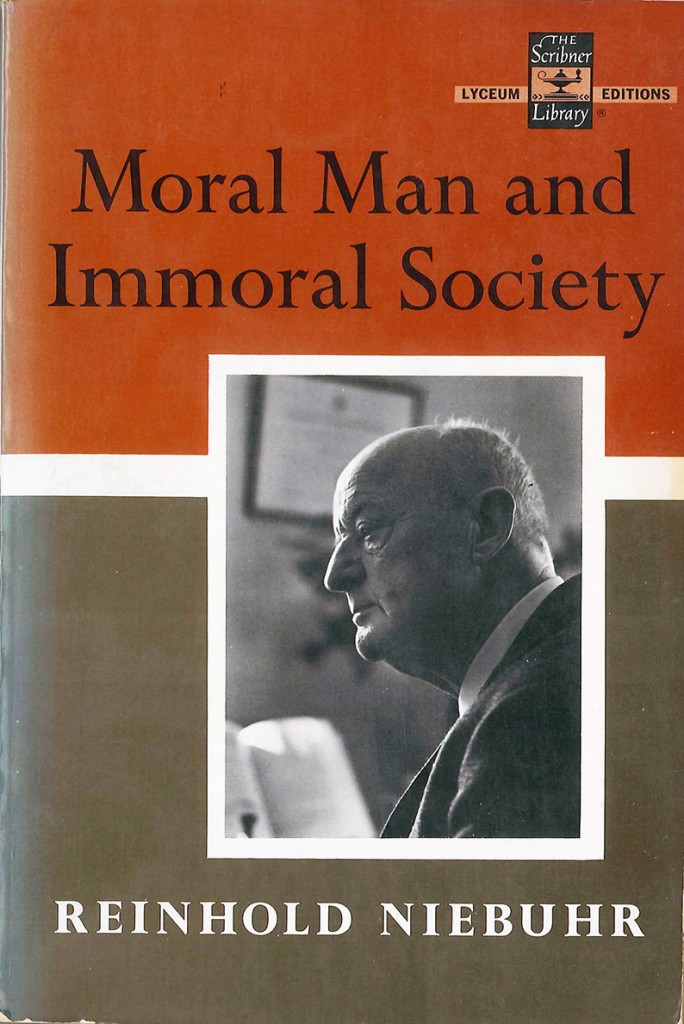
For this reason, relations between groups are always mainly political rather than ethical or moral. As Niebuhr says, "They will always be determined by the proportion of power which each group possesses at least as much as by any rational and moral appraisal of the comparative needs and claims of each group."

The pharmacist has power over the woman, and he wields it to his satisfaction and, he thinks, to his ethical credit.  The paradox is, in behaving ethically as he understands it, he actually behaves selfishly, which is to say:  unethically.

This is the paradox of Reinhold Niebuhr's Moral Man and Immoral Society in a nutshell.  And the problem with allowing pharmacists to decide who to dispense drugs to, and for what reasons.

She Blinded Me With Science!


"Examined at headquarters after a trip of intense strain and weariness, the prisoners all proved to be of a very low, mixed-blooded, and mentally aberrant type."

--H.P. Lovecraft, "The Call of Cthulhu" (1926)

So "faith" is believing what "ain't so." And it is bad because it creates blind adherence to ideas which damage people and then society.

"The American Experience" reviewed, in two hours, the history of eugenics in America, a history that starts with Darwin and creates the word "eugenics" (coined by an American from Greek, the word means "well-bred." Listening to the scholars on the show talk about the desire to secure utopia that eugenics was supposed to deliver, one wishes they would remember Thomas More coined that word from Greek, too. It means "nowhere."), an idea that all too quickly exploded into law and national policy in the 20's and 30's. It rose as church affiliation fell to its lowest point in the century. Trust in God replaced by trust in science. God will not improve the world, but science will. William Jennings Bryant, the man mocked in the movie about the Scopes trial, actually opposed the abuse of people in the name of science. He was a very religious man, not the man of science Darrow was, and yet we still only remember Bryant as a caricature. Although science eventually rejected the idea of eugenics, it didn't reject the reasoning behind it.  And it wasn't science that turned the public against it.

Do you know the story of Carrie Buck? She was in the state foster care system of Virginia, raped by an adult, and made a test case by a prosecutor and a court appointed lawyer who wanted her case to set the law of the land by the Supreme Court. The idea they were promoting was forced sterilization.  Like Mr. Snopes (who was never in any danger of imprisonment), Carrie Buck was simply a pawn in a game of would-be kings. They got her case to the Supreme Court where Oliver Wendell Holmes, the Antonin Scalia of his day, thundered that "Three generations of imbeciles is enough." The opinion opened the floodgates of forced sterilization across the land.  In the 6 years before it, 6,000 Americans were sterilized.  In the six years after, that number was doubled.  Before the practice was finally repudiated decades later, as many as 60,000 had been forcibly sterilized.  The commonest denominator was their social class. They were poor.

The documentary mentions a Hollywood movie from the '30's, in which our heroine, young and photogenic, is forced to undergo sterilization because her family is nothing but criminals, prostitutes, and the impoverished.  She is spared the indignity at the last moment when it turns out, not that that law or science is wrong, but that she's adopted!  No inherited taint!  Thus did society start to reject the laws of eugenics; they shouldn't apply to innocent young beautiful white women.  We held on to the reasoning, we just thought ourselves more careful about applying it.  We didn't crucify mankind on a cross of gold. We sterilized them in the name of science.  Eugenics laws remained on the books long after we rejected their premises. We forgot why we did, but we kept doing it. And we keep the notion alive to this day:

Sen. Lindsey Graham (R-S.C.) weighed in on what a DNA test could potentially reveal about his ancestry on Tuesday’s “Fox & Friends,” awkwardly quipping: “I’ll probably be Iranian. That would be like terrible.” 

Blood determines who you are; and wouldn't it be awkward to have even "one drop" of the wrong blood?

And when did our public fascination with eugenics end? It began to crack in the Great Depression, when the "best" people were poor, too.  Of what good were "good genes" and "pure blood" if you wound up in the bread lines? It became a pseudo-science when the Nazis took this very American science (we did invent it) and our eugenics laws, and turned it into the Holocaust. We repudiated it as quickly as we had embraced it.  Science didn't stop it or correct it in America; horror and humanity did.  Even Gene Roddenberry recognized the power of it, as he posited a "Eugenics War" in his "Star Trek" universe.  It gave rise to one of the Kirk's most famous adversaries ("KHAN!!!!!!"), but it's largely disappeared from the ST canon.  What we don't remember we are doomed to repeat?  Probably Roddenberry thought so.

Interestingly, after WWII American church attendance exploded to levels not seen since the Puritan colonies had made it mandatory. Correlation does not equal causation, but what an interesting set of coincidences it is.

Seems we can put our faith in science to our detriment, too.  Because the basis for the rejection of eugenics is obvious:

Here was a way to use science and some apparent common sense to make the world safer, more rational, and more efficient. This objective measurement scheme would force inefficient judicial institutions to abandon ineffective approaches and help law enforcement and lay citizens alike to know who to hold in suspicion. It would, in short, make the world a better place. The problem was that this approach, in trying to map the coordinates of human nature onto an “objective” matrix, merely reinscribed colonial and imperial racial and sexual logics, as well as an endemic bourgeois hatred of the working classes. Lombroso, of course, didn’t think of it that way. Substituting his best intentions for serious inquiry, he imputed a value system designed to stratify people through biology.
Trust us!  We're scientists!  Besides, we left that all behind in the 30's, right?

Physiognomy was eventually debunked, but its legacy of what Cedric Robinson calls racial thinking has lived on in Silicon Valley’s cultural imaginaries. Lombroso’s theory was, like a great deal currently coming out of the world of tech, an engineering “solution” in search of a problem. It’s no surprise that all types of Victorian theorizing, often translated into more contemporary languages (think “genetics” instead of “racial atavism,” or “evolutionary psychology” and Jordan Petersen’s lobster tales instead of the “feminine sphere” or the “weaker sex”) so animate research and product development that, to quote Virginia Eubanks, the tech industry is “automating inequality.” Physiognomy and related bunk sciences like phrenology have never truly left, and the heavily capitalized project of turning the world into a datafied engineering project means that it is more central than ever before.
The progenitor of eugenics was physiognomy; when that was debunked, eugenics took over.  Eugenics was eventually rejected, but the driving forces behind both attempts at science are still with us, indeed, still present in our science and our faith (trust) in science.  And the real problem is, science never really rejects the premises of "bad" science; it just declares the extremes "pseudo-science," but it keeps the basic reasoning and applies it in new and improved ways:

“Science” here functions as a corrective for those technologists who seek to push possibilities too far. “Better” science and “better” ethics do not ask too much of their technologies. This posits digital physiognomy as overreaching, redeeming the more sober mundanities of biometrics in general.

To talk about phrenology “reappearing” in contemporary technologies misses the fact that its underlying logic never left. To the extent that “science” debunked the most egregious elements of physiognomy, it did so by driving the same premises of deducing character from physical characteristics deeper into the body. Rather than look for a person’s essential nature in their face, research looked for it in DNA, in hormone levels, in imperceptible but nonetheless determinate physical materials. This process, often against the aims of the researchers, has had the predictable effect of re-encoding racial taxonomies in genomic studies, rigidifying sexuality as “genetic,” and legitimating class exploitation as a product of physiological inheritance. The widely derided criminality and the sexuality studies both rely (spuriously) on this type of “legitimate” research to justify their claims.

Just to carry that argument forward to its conclusion:

Most refutations of the criminality study included as part of their argument an explanation that “criminality” is likely driven by a combination of biological and environmental conditions. In particular, testosterone levels have been shown to contribute to the type of “risky” behavior that leads to criminality. This correlation between testosterone and behavior seems to hold across a number of animal species, but animals do not commit crimes. Testosterone levels might be correlated with certain types of behavior, but the biological tells us literally nothing about “crime,” a category of human social organization.

If we’re looking for a real “root cause” of “criminality,” we should look not to biological factors but to politics, which organizes how a society decides what is and is not a crime and how punishment is to be administered. The sort of risk taking and violence associated with testosterone is, after all, just as often lauded or ignored as it is considered dangerous. Politicized attitudes about race, class, and sex tend to determine whether biological factors are seen in one way or another.

Arguing that physiognomy and phrenology were dominant until “of course, science happened” is a misrepresentation. It wasn’t “science” that happened; it was the civil rights movement. The root problem with the recent phrenology and physiognomy studies is their political implications: that they could give a scientific-seeming alibi for monitoring, impoverishing, or incarcerating people, much like earlier social Darwinism helped legitimate racial regimes. If that is the main problem with the “pseudosciences” of phrenology and physiognomy, we need to consider how biometrics in general — routinized facial recognition, gait recognition, and “behavioral” biometrics to list just a few — performs these same core functions.
Or how much of the same core functions of eugenics are still with us as science, even as eugenics is considered a "pseudo-science"?*  What do we trust, and why?

If you watch the PBS documentary, you'll see how much the proponents of eugenics and immigration control, sound exactly like Donald Trump.  You'll see how much hasn't really changed.  A famous actress in the 1920's told the nation that without immigration control, (the control of immigration from central and southern Europe, Catholics rather than the Protestants of northern Europe and Britain.  Now it's Muslims and people from South America.), the nation as they knew it would cease to exist. Everything old is new again.  The past isn't over; it isn't even past.

Link to "Controlled Measures" courtesy of Thought Criminal.

*This issue is actually underscored in the documentary itself.  It begins with Dr. Charles Davenport, who coined the term "eugenics," traveling to England to meet with Francis Galton, cousin to Charles Darwin.  Davenport and Dalton agreed that "survival of the fittest" meant some humans were more fit than others.  This is presented, almost immediately, as a distortion of Darwin's work, rather than the logical extension of it which Galton championed and Darwin approved of.  The connection to evolution and eugenics is maintained, but evolution itself is cleansed of any "genetic" taint.  It turns out eugenics was an orphan, not a descendant!  How convenient, and how trusting.

Tuesday, October 16, 2018

A Picture Is Worth A Thousand Words

This whole "human" thing, it's so hard to do. (Cruz is supposed to be a "world class debater" and a man to be reckoned with in any forum. Heh.) More tweets; what can I do but post them?

This Just In: Water is Wet!

"C'mon...Ted!"


Whataburger started in the '50's in Texas.  In 2001, the Legislature declared it a State Treasure.  When I moved back to Texas after 5 years in the Midwest (Illinois, mostly), I told my then 6 year old daughter that the first thing we were gonna do was get a Whataburger.  In my Texas accent (such as it is), she thought I was saying "Waterburger," a confusion we still laugh about.  She's coming home for a visit soon, and has already demanded we stop at Whataburger on the way home from the airport.  Fortunately, Whataburger is open 24 hours around here.

All by way of trying to explain the mythic status Whataburger has in Texas to those of you who read this and are non-Texans..  It's not the best burger anywhere, but it has captured Texas' heart.  James Avery, the Texas jewelry equivalent of Whataburger, marketed a charm with the Whataburger logo, and sold out of it the first three times it offered it.  You understand, it's something we love.  And who can hold it against Beto that he is seen eating there on lots of videos on the internet?

Ted Cruz has got to be the most tone-deaf politician I've ever seen.

(And Richard Linklater is another Texas treasure; or he should be considered such.  He's having way too much fun with this.)

Mud Wrestling


No, Sen. Warren didn't have to respond to President Trump's "Pocahontas" taunts.  For one reason, now we have this:

“I’m going to take a DNA test,” [Sen. Lindsay] Graham insisted to the Fox News hosts. “I’ve been told that my grandmother is part Cherokee. It may all be just talk, but you’re going to find out in a couple weeks because I’m going to take the this test.”

“You are going to take it!” Fox News host Brian Kilmeade exclaimed.

“I’m taking it and the results are going to be revealed here,” Graham continued. “This is my Trump moment. This is reality TV.”

“I didn’t really think much about it but [Warren is] less than one-tenth of 1 percent, I think I can beat her,” he added.

This is the old days of mulattos and quadroons and octaroons, turned on its head.  The "one-drop" rule made you black because of your ancestors; now it makes you Native American?  The Cherokee Nation is right:

“It doesn’t drill down to whether a person has Cherokee ancestry, for example, or ancestry of any particular tribe. It’s useful to connect yourself with some lineage, determine paternity, but it doesn’t narrow down the scope of who your ancestors were to any identifiable tribe,” Hoskin Jr. said to CNN’s Jake Tapper.

“We need to be clear about what it means to be a Native American and Indian in this country. And it comes down to a legal status that we frankly have fought long and hard for and are very proud of,” he added.

“We have a lot of issues, and we would rather the President of the United States and Senator Warren focus in on things that affect us, housing, health care, clean water, clean air,” he continued. “We don’t think it’s particularly useful to have them in a back and forth about a DNA test, name calling and that sort of thing.”

And we're still debating the application of the "one-drop rule":

“The elephant in the room here is whether DNA testing tells us anything about heritage or ethnicity,” Simon Gravel, an assistant professor of human genetics at McGill University for whom Bustamante served as a postdoctoral adviser.

“My personal opinion is that DNA testing should not be the way in which we determine ethnicity.”

Which explains Trump's response:  first, "who cares?", and then, he'll only believe it if he does the test:

White supremacists do not especially care what their genetic ancestry tests show, if they reveal anything that doesn’t conform with their claimed white heritage. At the same time, these genetic tests may actually be exciting to white supremacists because it gives them a scientific argument for the diversity of the European “race,” which helps them appropriate the language of diversity and multiculturalism for hateful purposes.

This is not a fight the Senator wins:  period.  This is wrestling with the pig:  you get muddy, and the pig likes it.

Adding:  I was looking for this earlier, and only belatedly found it again:

The Cherokee Nation just this week had decided to challenge a recent decision by a federal judge in Texas who declared a law called the Indian Child Welfare Act unconstitutional. The law, which was passed in the 1970s to prevent the forced removal of Native American children from their tribes, gives tribes the right to intervene in adoptions in which non-native parents adopt native children. The federal judge decided earlier in the month that the law was unconstitutional, based on the Fifth Amendment’s equal protection clause—in essence, arguing that Native American families were being given preferential treatment based on race.


This decision hinges on the notion of native identity as racial, Nagle argued, and if upheld, it could set the precedent for other sovereign rights to be stripped. That conceptualization of identity is wrong, she said, because to be a member of a sovereign nation is a cultural and political matter. After all, Nagle notes, DNA tests could never tell anyone which particular tribe their ancestor belonged to, so someone claiming native identity from a test wouldn’t know which tribe to register with.
Consider using genetics to determine whether or not you are "American," or, more directly, "Texan."  It was a bit of a controversy around this state 40 years ago, with a huge increase in migration to the Lone Star State.  "Native Texans" became a designation for the first time in my memory.  It never became so silly or important as membership in a Native American tribe, but there was a certain pride in being a "native Texan," especially if you're family had connections going back to the days of the Republic, as my daughter does through my wife.  If we start deciding who has privileges based on genetics (which is the claim of those who would seek connection to Native American tribes based on DNA), it has real consequences:

Krystal Tsosie, an indigenous geneticist-ethicist at Vanderbilt, said that on a practical level, tribal enrollment matters when it comes to arrangements with the United States government about the tribes’ rights and resources established in treaties. “Access to water, air quality, health care is tied with an individual’s ability to establish ascendancy to an individual Nation,” she said. “External factors that question biologically how we as indigenous individuals call ourselves would be dangerous.”
The other consequence is how it plays into the arguments of white supremacists.  Tie those two together, so that genetics determines certain material benefits, and you have the worst of American racism and racial attitudes run amok.  In one sense, yes, it's a long step from Sen. Warren's claims to racist chaos; on the other hand, why are we even taking sides in this matter?  It doesn't end well no matter what you think of the President, and it rests on some very ugly arguments.