Wednesday, May 25, 2005

Idly putting two and two together....

Juan Cole:

The US military cannot defeat the Sunni Arab guerrilla movement any time soon for so many reasons that they cannot all be listed.

The guerrillas have widespread popular support in the Sunni Arab areas of Iraq, an area with some 4 million persons. Its cities and deserts offer plenty of cover for an unconventional war. Guerrilla movements can succeed if more than 40 percent of the local population supports them. While the guerrillas are a small proportion of Iraqis, they are very popular in the Sunni Arab areas. If you look at it as a regional war, they probably have 80 percent support in their region.

The guerrillas are mainly Iraqi Sunnis with an intelligence or military background, who know where secret weapons depots are containing some 250,000 tons of missing munitions, and who know how to use military strategy and tactics to good effect. They are well-funded and can easily get further funding from Gulf millionnaires any time they like.

The Iraqi guerrillas are given tactical support by foreign jihadi fighters. There are probably only a few hundred of them, but they are disproportionately willing to undertake very dangerous attacks, and to volunteer as suicide bombers.

There are simply too few US troops to fight the guerrillas. There are only about 70,000 US fighting troops in Iraq, they don't have that much person-power superiority over the guerrillas. There are only 10,000 US troops for all of Anbar province, a center of the guerrilla movement with a population of 820,000. A high Iraqi official estimated that there are 40,000 active guerrillas and another 80,000 close supporters of them. The only real explanation for the successes of the guerrillas is that the US military has been consistently underestimating their numbers and abilities. There is no prospect of increasing the number of US troops in Iraq.

The guerillas have enormous advantages, of knowing the local clans and terrain and urban quarters, of knowing Arabic, and of being local Muslims who are sympathetic figures for other Muslims. American audiences often forget that the US troops in Iraq are mostly clueless about what is going on around them, and do not have the knowledge base or skills to conduct effective counter-insurgency. Moreover, as foreign, largely Christian occupiers of an Arab, Muslim, country, they are widely disliked and mistrusted outside Kurdistan.

US military tactics, of replying to attacks with massive force, have alienated ever more Sunni Arabs as time has gone on. Fallujah was initially quiet, until the US military fired on a local demonstration against the stationing of US troops at a school (parents worried about their children being harmed if there was an attack). Mosul was held up as a model region under Gen. Petraeus, but exploded into long-term instability in reaction to the November Fallujah campaign. The Americans have lost effective control everywhere in the Sunni Arab areas. Even a West Baghdad quarter like Adhamiyah is essentially a Baath republic. Fallujah is a shadow of its former self, with 2/3s of its buildings damaged and half its population still refugeees, and is kept from becoming a guerrilla base again only by draconian methods by US troops that make it "the world's largest gated community." The London Times reports that the city's trade is still paralyzed.

The L.A. Times:

WASHINGTON — The U.S. military's plan to pacify Iraq has run into trouble in a place where it urgently needs to succeed.

U.S. officials in Washington and Baghdad agree that Al Anbar province — the vast desert badlands stretching west from the cities of Fallouja and Ramadi to the lawless region abutting the Syrian border — remains the epicenter of the country's deadly insurgency.

Yet U.S. troops and military officials in the embattled province said in recent interviews that they have neither enough combat power nor enough Iraqi military support to mount an effective counterinsurgency against an increasingly sophisticated enemy.

"You can't get all the Marines and train them on a single objective, because usually the objective is bigger than you are," said Maj. Mark Lister, a senior Marine air officer in Al Anbar province. "Basically, we've got all the toys, but not enough boys."

The Pentagon has made training Iraqi troops its top priority since Iraq's national election in late January. But in Al Anbar province, that objective is overshadowed by the more basic mission of trying to keep much of the region out of insurgent hands.

Just three battalions of Marines are stationed in the western part of the province, down from four a few months ago. Marine officials in western Al Anbar say that each of those battalions is smaller by one company than last year, meaning there are approximately 2,100 Marines there now, compared with about 3,600 last year.

Some U.S. military officers in Al Anbar province say that commanders in Baghdad and the Pentagon have denied their repeated requests for more troops.

"[Commanders] can't use the word, but we're withdrawing," said one U.S. military official in Al Anbar province, who asked not to be identified because it is the Pentagon that usually speaks publicly about troop levels. "Slowly, that's what we're doing."

Such reductions are especially problematic because U.S. commanders have determined that it is the western part of the province to which the insurgency's "center of resistance" has shifted. The insurgency's base of operations was once the eastern corridor between Fallouja and Ramadi. Now, Pentagon officials say, it is in villages and cities closer to the Syrian border.

Commanders also believe the insurgency is now made up of a larger percentage of foreign jihadists than the U.S. military previously believed, an indication that there are not enough U.S. and Iraqi troops to patrol miles of desert border.

Some Pentagon officials and experts in counterinsurgency warfare say the troop shortage has hamstrung the U.S. military's ability to effectively fight Iraqi insurgents.


Why stand far off, Lord?
Why hide away in times of trouble?
The wicked in their arrogance hunt down the afflicted:
may their crafty schemes prove their undoing!
The wicked boast of the desires they harbor;
in their greed they curse and revile the Lord.
The wicked in their pride do not seek God;
there is no place for God in any of their schemes.
Their ways are always devious;
your judgments are beyond their grasp,
and they scoff at all their adversaries.
Because they escape misfortune,
they think they will never be shaken.

Arise, Lord, set your hand to the task;
God, do not forget the afflicted.
Why have the wicked rejected you, God,
and said that you will not call them to account?

Lord, you have heard the lament of the humble;
you strengthen their hearts, you give heed to them,
bringing redress to the fatherless and the oppressed,
so that no one on earth may ever again inspire terror.

Psalm 10: 1-6, 12-13, 17-18, REB.

Another Possibility

Coming home tonight, I realized there is another answer to Athenae's question, posted below. Maybe a better one; maybe a clearer one; certainly another one:

The birds they sang
at the break of day
Start again
I heard them say
Don't dwell on what
has passed away
or what is yet to be.
Ah the wars they will
be fought again
The holy dove
She will be caught again
bought and sold
and bought again
the dove is never free.

Ring the bells that still can ring
Forget your perfect offering
There is a crack in everything
That's how the light gets in.

We asked for signs
the signs were sent:
the birth betrayed
the marriage spent
Yeah the widowhood
of every government --
signs for all to see.

I can't run no more
with that lawless crowd
while the killers in high places
say their prayers out loud.
But they've summoned, they've summoned up
a thundercloud
and they're going to hear from me.

Ring the bells that still can ring ...

You can add up the parts
but you won't have the sum
You can strike up the march,
there is no drum
Every heart, every heart
to love will come
but like a refugee.

Ring the bells that still can ring
Forget your perfect offering
There is a crack, a crack in everything
That's how the light gets in.

Ring the bells that still can ring
Forget your perfect offering
There is a crack, a crack in everything
That's how the light gets in.


LEONARD COHEN lyrics - "Anthem"

Tuesday, May 24, 2005

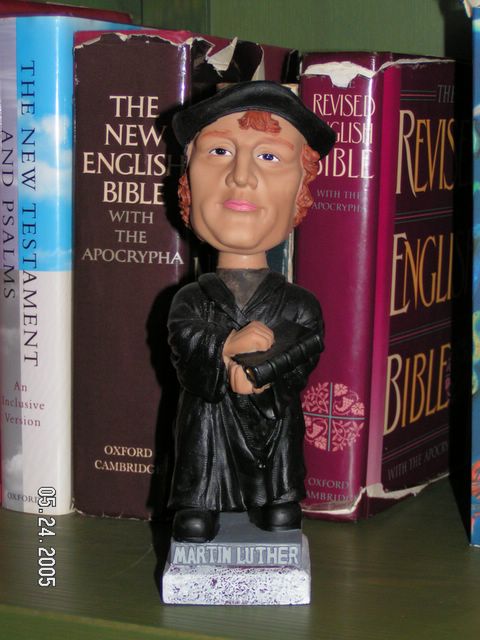
How better to honor a major theologian?


Inspired by the discussion of Kitsch over at Eschaton: my proudest example. Posted by Hello

Oh, what the heck?

"The end of all our exploring...."

But the world is not fair, or happy, it's good. God made it and saw that it was good.

I often read that and wondered, good for me? For you, for the homeless man by the highway? Good for God?

An anthill functioning properly looks to us like a sensible, well-ordered world. I wonder sometimes if God is like that, looking down, seeing things humming along quite smoothly, on the whole.

Meanwhile we rampage and destroy, but it's only visible if you get close enough.

A.
Athenae


Why do we rampage and destroy? Greed, which would be "sin." Or as an inept way to avert chaos? One answer is Hebraic, the other Hellenistic. They are the basic incompatabilities of Western culture.

The Greek "creation myth" is that the Logos (the word, a metaphor/symbol for reason) imposed order on Chaos. This is a powerful image, and one adopted by Christianity. Milton includes it in his retelling of the Hebrew creation story in Paradise Lost. Chaos exists on the outer boundaries of Hell, and Sin and Death have to build a bridge across it to give Satan access to Earth. The idea is also a driving force in Western culture: without ceaseless effort, the forces of chaos, of darkness, of evil, will arise and overthrow the forces of reason, of light, of good. The Greeks were not quite so simplistic as to include those latter categories, but that hasn't prevented later cultures from simplifying the issue down to a mere "either/or." The notion that chaos will always erupt and overcome our best efforts is even the thinking behind "Freedom is not free." Freedom, of course, is a gift of reason. Chaos struggles unceasingly to take our freedom from us.

The end of the Greek myth, by the way, is the fall of the Logos and the triumph of Chaos. Chaos is, you see, the natural state of the cosmos. Reason, logos, can only hold out for so long; it's failure is inevitable. This is a kind of fatalism not unlike that of the Norse myths and the Ragnorok, or even the elegiac tone and themes of Old English literature.

Opposed to that fatalism, that sense that chaos and disorder, if not evil, will eventually triumph, is the Creation story in Chapter 1 of Genesis. Creation is not order established on unstable Chaos. The foundations of the cosmos are not built on ground that will eventually disappear from beneath it. Creation is the act (the speech act, to be particular) of the Creator, and all of Creation is good.

What, then, makes it "bad"? Human activity, it would seem. Even the concept of a "harsh life" is a culturally variable one. Before antibiotics, doctors treated precious little, and offered no real hope for cures from diseases that regularly swept people away. Having gained some measure of control over the material world, we all too naturally assume we should have complete control, and eliminate all things we do not like. But we did that in 19th century America, and belatedly realized, in late 20th century America, that there is more of a web, more of a balance, to creation, than we had realized. Removing one scourge, such as infectious disease that usually killed quickly, we have replaced it with new ones: cancers, AIDS, even Alzheimer's. Does this mean we never should have learned about penicillin? Not at all. But we have made the leap from our ability to cure disease, to our decision that all life should be "good," and "good" has a very elastic, not to say unrealistic, meaning.

Slavery was the norm in human socieities until the 19th century. Does that mean life was not "good" until then? Or won't be "good" until all the things we decide are evil are removed from creation? Some, like slavery, our our own creation. Some, like disease, are; and are not.

Where you decide Creation rests, or begins, determines how you answer questions like: "What is good?" It even determines how you live. It really is all a matter of where you start. As Gustavo Gutierrez says: "I will say that we must begin by contemplating God and doing God's will and that only in a second step are we to think about God. By this I mean that worship of God and the doing of God's will are the necessary conditions for thinking about God. Only if we start in the realm of practice will be be able to develop a discourse about God that is authentic and respectful." And where does that realm of practice begin? "In our dealings with the poor," where "we encounter the Lord,...but this encounter in turn makes our solidarity with the poor more radical and more authentic." (Gustavo Gutierrez, The Truth Shall Make You Free, tr. Matthew J. O'Connell (Maryknoll, NY: Orbis, 1991), p. 3. When we start with worship and doing God's will, when we start by establishing our solidarity with the poor, when our encounter with God makes that solidarity more radical and more authentic, then we can consider the question: "What is good?" Because then we will be on the way to finding an answer, and our question will be justified.

Monday, May 23, 2005

Go into all nations and...preach the political gospel?

Is it too early to say this Administration has gone out on a limb it is now sawing off?
Evangelical leaders are re-examining whether American evangelicalism has suffered from its portrayal as a conservative political movement rather than as a broad religious philosophy rooted in a literal reading of the Bible.

Although evangelical leaders have been among the most prominent spokesmen for conservative causes, “evangelical” and “religious right” are not the same thing. Studies indicate that as many as 40 percent of Americans who call themselves evangelicals are politically moderate or identify with the Democratic Party.

But two recent declarations by evangelical and conservative religious thinkers suggest that evangelicals have become too closely identified with conservative political activism, at the expense of attracting new followers. The declarations are likely to be hot topics of conversation when the Southern Baptist Convention holds its annual meeting next month in Nashville, Tenn.

“Because evangelicals have been portrayed as being very, very limited in their range of societal concerns, there is an element of challenge in the evangelical community to say, ‘Let’s not get caught up in narrow partisan concerns,’” said Mark L. Sargent, provost of Gordon College, a nondenominational Christian institution in Wenham, Mass. “Many evangelicals say they feel very alienated with the partisan rhetoric in the nation.”
That's for the political activists in the audience. Those of us interested in matters ecclesiological (and being constantly told to "act more like the Baptists" by our "church growth experts") find this a bit more interesting:

[Thom S.] Rainer, dean of the Billy Graham School at Southern Baptist Theological Seminary in Louisville, Ky., argues that while the “conservative resurgence” of the last quarter-century has effectively transformed the convention into a theologically purer body, it has failed to attract new followers.

“The Southern Baptist Convention is less evangelistic today than it was in the years preceding the conservative resurgence,” writes Rainer, who found that the denomination’s number of annual baptisms has remained virtually unchanged since the 1950s. “We must conclude that the evangelistic growth of the denomination is stagnant, and that the onset of the conservative resurgence has done nothing to improve this trend.”
The growth, or not, of churches is a hot topic in America today. The dividing line is essentially over the "liberality" or "conservatism" of doctrine. That debate has recently boiled over into "liberal" and "conservative" politics. This may be an indication that the confusion of the terms was not entirely appropriate, which may be a warning to churches on both sides of both issues (doctrine and politics).

Oedipus Wrecks

With thanks to Holden for directing me here:
PRESIDENT BUSH: ....The truth of the matter -- another way we can help is to diversify the agricultural sector, which leads to a subject that we spent some time on, and that is opium and poppies. As you know, there are -- there's too much poppy cultivation in Afghanistan. And I made it very clear to the President that this is -- that we have got to work together to eradicate poppy crop. And the President, not only in this meeting but in other meetings, has been very forthcoming about the desire to eradicate poppy. And as a matter of fact, according to a United Nations' report, there is less poppy today than the previous year.
Freudian analysts around the world have all been simultaneously reduced to spluttering and pointing.

In an hour or so, they'll regain enough self-control to join in a chorus of: "I TOLD YOU SO!"

"Who sinned, this man or his parents?"

So I watched a man tear apart a sign for the first time this morning. Funny to finally see it, since I see the evidence of it daily, but never considered it actually takes the action of someone walking over to someone else's property, and then appropriating it for thier use. But I saw it this morning.

In Houston, the homeless mostly gather along the freeway. The underpasses on the Katy Freeway, which I basically live up and down in my daily excursions around a segment of the SMSA, are the "major intersections," for all intents and purposes. At least they are the best place to snag spare change from car windows, which is about the only way you'll get it in Houston. Most of the people doing this have signs, signs that tell some kind of story ("Homeless." "Hungry." "Travelling to...." "Please help my children."). And almost always, in what seems an almost Reaganesgue gesture (since he introduced the phrase into American civic life by ending every speech with the invocation): "God bless." Sometimes this is done on pieces of cardboard; sometimes on the little plastic yard signs that dot the green space along the freeway. Signs advertising specials and store close outs and opportunities to make money at home. The signs people plant by the hundreds, like mushrooms, and which make you realize it isn't just the highway that's ugly. And that archaeologists centuries from now will think we revered something called Clorox, and that plastic yard signs were totems of immense power, because we made them both so endurable.

Usually I see the homeless with these signs, and think nothing of where they came from, except that its a mark of industrialization that homeless people can lay hands on markers, when presumably all their spare change goes to food or drink or somewhere besides a Marks-A-Lot. And I never even gave a thought to where the signs came from, until I watched the man wrestling one off its metal stand. At first I thought he was trying to pull it up, that the sale was over or something, and his boss had sent him out to remove the ugly little sucker before business began again. But he yanked it loose and carried it away, holding it in front of him to read what it had said. I figured he'd use the blank back later, and find a place to sit for the day. I wondered what the printed sign meant to him; because his action was a sign to me, a sign that nothing has really changed since Roman days in first century Palestine.

The way scholars explain it today, Roman society was shaped rather like a funnel resting on its base. The bulk of the people were spread out equally across the base, but "equally" in this case meant equally impoverished. At the pinnacle of the funnel, which had a point more than an open spout, sat the Emperor, the Caesar, the kaisar. Down from him, in descending order of wealth, was everyone else. It was a very narrow group of wealthy, a very broad group of poor; desperately poor, for the most part. The distribution may be a little broader 2000 years later; but the arrangement hasn't changed much at all. And more and more, especially in America, we still value people based on what they mean to the economy. We still speak, at least in public discourse, of what things cost, and of the economic impact of issues, whether its warfare or child-rearing. On NPR this morning there was a story about school lunches, and completely glossed over in the discussion of what middle-school kids will eat and why, was the idea that school cafeterias now had to bring in revenue, had to generate income. Everything, it seems, is for sale; and as a society we are not only comfortable with that, we expect it as a matter of course.

"Rabbi, why was this man born blind? Who sinned, this man or his parents?" John 9:2, REB. It's an old assumption, and still a prevalent one: if you are poor, it is your fault. The system, or creation itself, is "good." Therefore whatever error creeps in must be your fault. Failure to receive the blessings of creation, failure to be "good," is preached as sin. At least at the lower levels of society; at the upper levels of society, the fault is with the system. The wealthy and powerful can afford to press the system, to demand their needs be satisfied by it, to insist that any error lies with the pastor, the teacher, the school principal, the mayor, the President. But people at the bottom, the people without power: it is not society that fails them, their failure is a result of their own sin. Thus do we arrange a system that comforts the comfortable, and afflicts the powerless.

And so mega churches preach the gospel of prosperity; and don't have much use for people who can't come to them. The UCC churches here in Houston built a public housing project many years ago. It is located, coincidentally, near one of the largest mega-churches in Houston. For a few years that church bought turkeys to give to the residents of the housing project (and others) at Christmas. And because most of the residents didn't have cars, the church delivered the turkeys to them. One year, however, the church stopped delivery. The church decided instead that the people should come to them. They couldn't, of course; and the church wouldn't let our church members pick up the food; which made us realize the mega-church wanted some pro quo for its quid. And so the arrangement ended. The system always makes sure that those who operate it, remain comfortable.

Which is why it is easier for a camel to get through the eye of a needle than for a rich man to enter heaven. That reference to the needle, by the way, is literal. In the Sunday School of my youth, comfortably in the middle-class, we were assured that the "eye of the needle" was a narrow passage way along a well-traveled path, and that overladen camels could not get through it. The message was softened, in other words, to mean "too rich." A camel trying to take too much with it, in other words, would not pass; but we could certainly carry "just enough." A bold distortion, based on an ignorance of the original Greek. The word in Matthew and Luke is "rhaphis," which means a sewing needle. Jesus meant just what he said; and he meant it in precisely this context: "With God, all things are possible."

But we prefer to think that things are only possible with our efforts; or at least, our judgments. We prefer to think the system is fine, that we are the problem; that it's all a matter of self-actualization, or personal development, or internal cleansing, or just better adherence to doctrine. We prefer to think a lot of things, instead of considering the simplicity of the presence of the kingdom, and the goodness of creation. All of creation: male and female; plant and animal and soil and water; rich and poor. It's not a matter of getting ready to live in it. It' s only a matter of living in it. Living in it as it is, not as we have made it. Isaiah railed at God for not being present enough: "O that you would tear open the heavens and come down, so that the mountains would quake at your presence....!" But Isaiah also invited us all to the table, to buy food without money, wine without price. Which is better: to wait for the theophany of the Lord? or to "announce good news to the humble, to bind up the broken hearted, to proclaim liberty to captives, release to those in prison"? That's been the message since at least the 5th century BCE. Does that mean it has never come true? Or just that we have yet to recognize that God really means it, and that we should really proclaim it?

Sunday, May 22, 2005

Trinity Sunday

Genesis 1:26-318

Then God said, "Let us make humankind in our image, according to our likeness; and let them have dominion over the fish of the sea, and over the birds of the air, and over the cattle, and over all the wild animals of the earth, and over every creeping thing that creeps upon the earth." So God created humankind in his image, in the image of God he created them; male and female he created them. God blessed them, and God said to them, ''Be fruitful and multi-ply, and fill the earth and subdue it; and have dominion over the fish of the sea and over the birds of the air and over every living thing that moves upon the earth." God said, "See, I have given you every plant yielding seed that is upon the face of all the earth, and every tree with seed in its fruit; you shall have them for food. And to every beast of the earth, and to every bird of the air, and to everything that creeps on the earth, everything that has the breath of life, I have given every green plant for food." And it was so. God saw everything that he had made, and indeed, it was very good.

The Lorica

I arise today through a mighty strength, the invocation of the Trinity, through belief in the Threeness, through confession of the Oneness of the Creator of creation.

I arise today through the strength of Christ with his Baptism, through the strength of His Crucifixion with His Burial through the strength of His Resurrection with His Ascension, through the strength of His descent for the Judgement of Doom.

I arise today through the strength of the love of Cherubim in obedience of Angels, in the service of the Archangels, in hope of resurrection to meet with reward, in prayers of Patriarchs, in predictions of Prophets, in preachings of Apostles, in faiths of Confessors, in innocence of Holy Virgins, in deeds of righteous men.

I arise today, through the strength of Heaven; light of Sun, brilliance of Moon, splendour of Fire, speed of Lightning, swiftness of Wind, depth of Sea, stability of Earth, firmness of Rock.

I arise today, through God's strength to pilot me: God's might to uphold me, God's wisdom to guide me, God's eye to look before me, God's ear to hear me, God's word to speak for me, God's hand to guard me, God's way to lie before me, God's shield to protect me, God's host to secure me: against snares of devils, against temptations of vices, against inclinations of nature, against everyone who shall wish me ill, afar and anear, alone and in a crowd.

I summon today all these powers between me (and these evils): against every cruel and merciless power that may oppose my body and my soul, against incantations of false prophets, against black laws of heathenry, against false laws of heretics, against craft of idolatry, against spells of witches, smiths and wizards, against every knowledge that endangers man's body and soul.
Christ to protect me today against poisoning, against burning, against drowning, against wounding, so that there may come abundance in reward.

Christ with me, Christ before me, Christ behind me, Christ in me, Christ beneath me, Christ above me, Christ on my right, Christ on my left, Christ in breadth, Christ in length, Christ in height, Christ in the heart of every man who thinks of me, Christ in the mouth of every man who speaks of me, Christ in every eye that sees me, Christ in every ear that hears me.

They doubted

It is one little phrase, found in the Great Commission of Matthew, 28:17:

My rough translation-And when they saw him, they (paid close attention to/held on to/gave themselves to), but they doubted.

In the majority of translations out there, this verse is, more elegantly, translated as: And when they saw him, they worshipped him, but some doubted.

A translation is an interpretation. Throughout our human experience of being in dialogue with Scripture, we have taken the words in Greek and Hebrew, and tried to render faithful translations into other tongues, striving to discern the intent and purpose of the writers, redactors and interpreting communities. Nothing is more basic to a beginning of understanding-we have to be able to read the words before we can begin to understand them, and not everyone can or should spend several years in school learning Koine Greek and Classical Hebrew. So, most people are dependent upon translators. And most translators do their best to acknowledge their preexisting biases and understanding of Scripture before they begin to grind Greek into English (or any other language). Parthenos can be read either as virgin, or as unmarried girl; it definitely makes a difference which word the translators choose to be understood as meant by the writer. On the one hand, we get a miracle-on the other, a socially unacceptable but perfectly natural situation.

I’m an amateur in translating NT Greek, but in this case, I think my translation is the more accurate, based on the rule of simplicity taught me by my Greek professor. You don’t add words to the meaning if they are not there, or, in some cases (which aren’t as common as one would think), clearly implied by traditional usage. The words, oi de edistasan, translate simply as “but they doubted.” There is a distinct word in Greek for “some”: tis. If you want to be picky, it can also mean: anyone, anything, someone, something, any, a certain, several. It isn’t in this Greek text, or in any variants of this text yet discovered. If the author of the text that came to be known as the Euangelion, “good news” or “gospel,” of Matthew had meant that some doubted, “he” could have easily said so. Some certainly did doubt; apparently all of them did.

So, why “some”? Why is it the overwhelming tendency to understand this verse as implying that some of the disciples doubted, but some did not? Is it to posit that at least of few of those knuckle headed disciples had attained a perfect faith? If they could do it, there is certainly hope for the rest of us. This would be my suspicion.

But I still prefer my translation because it takes into account that we journey both in faith and in doubt. In the context of the Great Commission, the risen Christ is giving his authority, to speak of God and to live in God, to the disciples. They, in turn, are to take this authority and their faith and go into the world, sharing this experience of God and offering a new understanding of our relationship with God and with each other. If they had to wait until their faith was perfect, very little would have gotten done. As a side note, the only other time this word for “doubt” is used in the NT is also in Matthew. The context is that of Peter walking out onto the stormy sea. When he doubts, he sinks. But Peter, who comes across as having major impulse control issues in all of the gospels, is so very emblematic of humanity. We plunge ahead in faith and in doubt.

A cornerstone of Weslean theology is that we are “going on to perfection, by faith in grace.” The assumption is that one can achieve perfection in this life. Indeed, one of the traditional ordination questions asked of candidates for ministry is “Are you going on to perfection in this life?” (hint-the correct answer is “yes”). As to what “perfection” means, that is a topic worthy of discussion in its own post. But this understanding of our relationship with God is that we are always striving to be made perfect. I find this an interesting juxtaposition of active and passive verbs. And to me, it has always implied that a relationship with God that perfectly reflects God’s relationship with me is something we all journey towards, in faith that it is desirable and achievable. But it never implies that we park our doubts at the door. We carry them with us, but make the journey anyway. We know that people can’t trot across the surface of the water, but we give it the old college try, for a moment. We realize how ridiculous it is to expect that humanity will ever be at peace in our relationships with each other, but we continue on working for it, occasionally giving our lives for it.

This text from Matthew, in my own translation, acknowledges that our doubts are part and parcel of who we are and they go on the journey with us. Call them baggage, if you like, but I guess I rather think of them as windows of opportunity. Opportunities for God to reach out to us, remind us of God’s presence, and pull us closer.


God of now and then and in between, we give our deepest thanks that you are the God of our hearts and the God of our history. You promised to be with us always, even to the end of time. Remind us that your “always” is past, present, and future. But Lord, even knowing that, we confess that “in the meantime” living is not easy for us, for today some of us are fragile. Some of us are remembering painful moments or feeling alone. Some of us struggle for direction and discernment. Some of us are longing for the past or wishing the future would come quickly. We know you love us but we waver, even as we worship. O God, we knew your faithfulness yesterday. Assure us of your presence today. Empower us to live as your disciples. Amen.

The Houston Bar speaks. Who listens?

I'm a lawyer; in Houston, Texas; and while I didn't participate in this poll (I haven't practiced law for almost 10 years, although I maintain my license and non-pratciting status with the State Bar), I couldn't pass this up.

Via Crooked Timber, from the Daou Report, the Houston Chronicle reports:

Houston Bar Association Judicial Evaluation Poll: overall ratings

Percentages of HBA members who rated judges outstanding, acceptable or poor in the overall rating category, with the number of poll responses in parentheses following the names. Judges who were on the bench for less than six months before Dec. 31, 2004, were not included in the poll. The full report is online at hba.org.

Supreme Court of Texas

Supreme Court of Texas
Judge Outstanding Acceptable Poor
Scott A. Brister (422) 36.9 20.7 42.4
Nathan L. Hecht (327) 40.3 17.4 42.3
Wallace B. Jefferson (270) 53.4 29.7 16.9
Harriet O'Neill (334) 55 30.5 14.5
Priscilla R. Owen (350) 39.5 15.2 45.3
Dale Wainwright (316) 48.7 25.7 25.7

That's the Houston Bar, folks. Not a notorious hotbed of "liberalism" and progressive politics. Lawyers generally respect judges who know the law, and rule the way the law provides. Does this make Owen an "activist" judge? Well, it certainly means her professional peers don't think much of her. Not in Houston, anyway.
N.B. Realized belatedly this is not as clear as ight be. The original is better, but to clarify, the numbers are meant to be read in three categories: "Outstanding," "Acceptable," and "Poor." In those categories, Justice Own recieves the following votes: 39.5% "Outstanding," 15.2% "Acceptable," and 45.2% "Poor." Nathan Hecht has been on the Court since I stopped active practice, and he was not the brightest light or the most respected member of the Court at that time, which also says something about Ms. Owen's qualifications.

"No one likes us, I don't know why....

"We may not be perfect, but heaven knows, we try./All around, even our old friends put us down...."
First lady Laura Bushwas met by protesters as she visited two of Jerusalem's holiest sites Sunday. Mrs. Bush, who is on a Middle Eastern tour meant, in part, to help defuse anti-American sentiment, placed a note in the Western Wall, Judaism's holiest shrine. She wrote the note on the plane to Jerusalem, but told reporters she wanted to keep its contents private.

She then went to the Dome of the Rock, a mosque on a hilltop compound known to Muslims as Haram as-Sharif and to Jews as Temple Mount. Before she entered the mosque, one heckler yelled, "How dare you come in here?" and "Why do you hassle our Muslims?"

....

The first lady was mobbed by protesters and local reporters, and Secret Service agents and guards had to physically hold back the crowd as she approached the wall.

"We give them money, but are they grateful?/No, they're spiteful and they're hateful."--Randy Newman, "Political Science"

Helen Thomas Speaks

It's only too bad she doesn't write for the New York Times. But then, humankind cannot bear very much reality:

One reporter asked McClellan what further, beyond an apology, Newsweek could do.

He had no suggestions except that the magazine should "move forward and do all it can to help repair the damage that has been done by this report."

Sorry, Scott. The damage was done with the unprovoked invasion of Iraq in defiance of all international law.

For some time the administration has been worried enough about its current standing in the world to appoint yet another woman to conduct a "public diplomacy" campaign to repair the U.S. image. The newcomer, Karen Hughes, takes the job after two other women quit.

My suggestion is to allow reporters to go to Guantanamo and Abu Ghraib, as well as the U.S. prisons in Afghanistan, and let them question prisoners about their treatment. Then we may get a truly impartial picture of the situation.

But don't hold your breath on that happening.

Saturday Evening

PSALM 145
My soul, praise the Lord.
As long as I live I shall praise the Lord;
I shall sing psalms to my God all my life long.
Put no trust in princes,
or in any mortal, for they have no power to save.
When they breathe their last breath,
they return to the dust,
and on that day their plans come to nothing.

Happy is he whose helper is the God of Jacob,
whose hope is in the Lord his God,
maker of heaven and earth,
the sea, and all this is in them;
who maintains faithfulness for ever
and deals out justice to the oppressed.
The Lord feeds the hungry
and sets the prisoner free.
The Lord restores sight to the blind
and raises those who are bowed down;
the Lord loves the righteous
and protects the stranger in the land;
the Lord gives support to the fatherless and the widow,
but thwarts the course of the wicked.

The Lord will reign forever, Zion,
your God for all generations.
Praise the Lord.

MAGNIFICAT
My soul magnifies the Lord,
and my spirit rejoices in God my Savior;
Because He has regarded the lowliness of His handmaid;
for behold, henceforth all generations shall call me blessed;
Because He who is mighty has done great things for me,
and Holy is His Name;
And His mercy is from generation to generation on those who fear Him.
He has shown might with His arm,
He has scattered the proud in the conceit of their heart.
He has put down the mighty from their thrones,
and has exalted the lowly.
He has filled the hungry with good things,
and the rich he has sent away empty.
He has given help to Israel, His servant, mindful of His mercy
Even as He spoke to our fathers -
to Abraham and to his posterity forever.

Friday, May 20, 2005

The difference between justice and punishment

Amos 7:1-7:

Thus hath the Lord GOD showed unto me; and, behold, he formed grasshoppers in the beginning of the shooting up of the latter growth; and, lo, it was the latter growth after the king's mowings.

2 And it came to pass, that when they had made an end of eating the grass of the land, then I said, O Lord GOD, forgive, I beseech thee: by whom shall Jacob arise? for he is small.

3 The LORD repented for this: It shall not be, saith the LORD.

4 ¶ Thus hath the Lord GOD showed unto me: and, behold, the Lord GOD called to contend by fire, and it devoured the great deep, and did eat up a part.

5 Then said I, O Lord GOD, cease, I beseech thee: by whom shall Jacob arise? for he is small.

6 The LORD repented for this: This also shall not be, saith the Lord GOD.

7 ¶ Thus he showed me: and, behold, the Lord stood upon a wall made by a plumbline, with a plumbline in his hand.

8 And the LORD said unto me, Amos, what seest thou? And I said, A plumbline. Then said the Lord, Behold, I will set a plumbline in the midst of my people Israel: I will not again pass by them any more:

9 and the high places of Isaac shall be desolate, and the sanctuaries of Israel shall be laid waste; and I will rise against the house of Jerobo'am with the sword.

The Bagram File

"Does not lucidity, the mind's openness upon the true, consist in catching sight of the permanent possibility of war? The state of war suspends morality; it divests the eternal institutions and obligations of their eternity and rescinds ad interim the unconditional imperatives. In advance its shadow falls over the actions of men. War is not only one of the ordeals-the greatest-of which morality lives; it renders morality derisory. The art of foreseeing war and of winning it by every means-politics-is henceforth enjoined as the very exercise of reason. Politics is opposed to morality, as philosophy to naivete."--Emmanuel Levinas
The story of Mr. Dilawar's brutal death at the Bagram Collection Point - and that of another detainee, Habibullah, who died there six days earlier in December 2002 - emerge from a nearly 2,000-page confidential file of the Army's criminal investigation into the case, a copy of which was obtained by The New York Times.

Like a narrative counterpart to the digital images from Abu Ghraib, the Bagram file depicts young, poorly trained soldiers in repeated incidents of abuse. The harsh treatment, which has resulted in criminal charges against seven soldiers, went well beyond the two deaths.

In some instances, testimony shows, it was directed or carried out by interrogators to extract information. In others, it was punishment meted out by military police guards. Sometimes, the torment seems to have been driven by little more than boredom or cruelty, or both.
This, in part, is what it means to be "duped by morality." Not just on the personal level of the individuals involved in this story, but on the level of the entire nation, that still resists responsibility for its actions, resists rising up in disgust and despair, refuses, unlike Nineveh, to repent in sackcloth and ashes for the sins it has committed.

Sergeant Loring, then 27, tried with limited success to wean those interrogators off that approach, which typically involved yelling and throwing chairs. Mr. Leahy said the sergeant "put the brakes on when certain approaches got out of hand." But he could also be dismissive of tactics he considered too soft, several soldiers told investigators, and gave some of the most aggressive interrogators wide latitude. (Efforts to locate Mr. Loring, who has left the military, were unsuccessful.)

"We sometimes developed a rapport with detainees, and Sergeant Loring would sit us down and remind us that these were evil people and talk about 9/11 and they weren't our friends and could not be trusted," Mr. Leahy said.

....

The findings of Mr. Dilawar's autopsy were succinct. He had had some coronary artery disease, the medical examiner reported, but what caused his heart to fail was "blunt force injuries to the lower extremities." Similar injuries contributed to Mr. Habibullah's death.

One of the coroners later translated the assessment at a pre-trial hearing for Specialist Brand, saying the tissue in the young man's legs "had basically been pulpified."

"I've seen similar injuries in an individual run over by a bus," added Lt. Col. Elizabeth Rouse, the coroner, and a major at that time.

....

In late August of last year, shortly before the Army completed its inquiry into the deaths, Sergeant Yonushonis, who was stationed in Germany, went at his own initiative to see an agent of the Criminal Investigation Command. Until then, he had never been interviewed.

"I expected to be contacted at some point by investigators in this case," he said. "I was living a few doors down from the interrogation room, and I had been one of the last to see this detainee alive."

Sergeant Yonushonis described what he had witnessed of the detainee's last interrogation. "I remember being so mad that I had trouble speaking," he said.

He also added a detail that had been overlooked in the investigative file. By the time Mr. Dilawar was taken into his final interrogations, he said, "most of us were convinced that the detainee was innocent."


When the Lord commands,
great houses will be reduced to rubble
and the small houses shattered.

Can horses gallop over rocks?
Can the sea be ploughed with oxen?
Yet you have turned into venom the process of the law,
justice itself you have turned into poison.
Jubilant over a nothing, you boast,
'Have we not won power by our own strength?'
....
Will not the earth quake on account of this?
Will not all who live on it mourn?
The whole earth will surge and seethe like the Nile
and subside like the river of Egypt.

Amos 6:11-13, 8:8.

Thursday, May 19, 2005

"Attack upon 'Christendom' "

We are, the fundamentalists and right wing politicians insist upon reminding us, a 'Christian' nation.

And yet, in all four of the Gospels, I cannot find one instance of Jesus condemning prostitutes; or, for that matter, prostitution. He was, in fact, frequently condemned for spending so much time with them, which hardly showed the proper condemnation of their "profession."

But then, I suppose, Jesus wasn't fighting AIDS.

"Lord, when did we see you?"

This is the kind of thing one reads in seminary. A pity it never makes it beyond the cloistered halls and ivy-covered walls:
To be sure, the established churches need the refreshing influx of new and wider ranges of charismatic experience, but in the long perspective of spiritual growth the individual charistmatic needs the home of the full church in which he or she matures in faith and learns the most important lesson of faith: to love God who gave the gift rather than to love the gift that God gave.--Krister Stendahl, Paul Among Jews and Gentiles (Philadelphia: Fortress Press 1976), p. 123.
Or, for that matter, this:

Nobody can come to grips with the drama of history unless he recognizes that most of the evil in this world is done by people who do it for good purposes. Evil is not that popular. If one gathered together a lot of people and said, "Let us be evil together," it would not go over very well. Thanks be to God!....

Thus the question is not to balance judgment and mercy. Whenever one reads the Bible or theology, what I would call the "who-is-who" question always arises. Who speaks to whom and for whom? The mighty message of God was often heard in a wrong way because one listened in on the wrong message. There are many examples of this. Jesus did say, "Man does not live by bread alone," but he never said that to a hungry person. When he was faced with hungry persons he fed them--4000 or 5000. And he massproduced wine in Cana just to prevent the wedding feast from turning into a fiasco. It was to Satan that he said "Man does not live by bread alone," speaking for and to himself. The church, however, often quoted Jesus in the wrong direction--to the hungry, in defense of the well-fed.

Who speaks to whom? For whom is judgment mercy? That is the question, and unless one understands it, even the most glorious dialectical understanding of theology becomes not only counterproductive but evil. (Stendahl, p. 105-06)
I will tell you know that I have preached this message; and it is not a popular one. As Stendahl points out, "reconciliation" is a beautiful word. "Yet here in the United States we have been poignantly taught that reconciliation may be a word abused by the comfortable and for the "haves." He goes on:

Of course, for him who has and for him who is comfortable, reconciliation is very attractive--the sooner the better, so that we give up as little as possible. That is what reconciliation has come to mean, in stark contrast to the Christian tradition's sign of reconciliation, the cross where Christ gave all in order that reconciliation might be had. Judgment and mercy. We must resist all homogenizing, neutralizing, dialecticizing and balancing acts with these terms. There is little mercy except the chance of repentance for us who sit in judgment; but when judgment comes upon us, there is much mercy for the oppressed.
As the people ask on Judgment Day in Matthew 25: "Lord, when did we see you?" For believers, that is always the fundamental question. Many critics of Christianity on the blogs insist such ideas don't exist, or are never considered by the church. Stendahl is a Lutheran theologian, as "churchly" a thinker as Protestantism can produce. What he says deserves consideration, even application. Pastors here and there manage to get some of this implemented. But churches large and small, and the "Christian church," to the extent such mythical beast even exists, is like an ocean liner: it changes direction very slowly, and is built to insist on and insure stability at all times. Sometimes that is a good design; sometimes it is not. But when dealing with such concepts as mercy and judgment, who wouldn't prefer stability to uncertainty? What we have to look for is not certainty in our doctrine, but adherence to the truth: where ever that truth may lead.

The Ugly American

Why does the Newseek story still have "legs"? Why does Daniel Schorr now intone gravely about the sins of Michael Isikoff? Mr. Schorr, after all, became the center of controversy himself in 1976, when he obtained a copy of the Pike Report on illegal CIA and FBI activities. He got it published despite the committee's decision not to publish the report, and many of his colleagues made him a professional pariah. William S. Paley, then head of CBS, was stopped short of firing Mr. Schorr, who resigned in 1976 after the battle to reveal his source (he refused to) was ended. Well, I can't speak to Mr. Schorr's motivations; but I can speak to his actions, which speak as loudly, if not louder, than his words.

Speak to them as an exemplar of a peculiarity, shall we say, in human nature; one touched on by Levinas' work in phenomenology. To put Levinas in some perspective (without tying us all down too much to an arcane philosophical discussion), his work was a reaction to the work of Husserl, who insisted all human experience (following closely on the heels of David Hume, actually) was personal, and all knowledge, of whatever kind, was known and knowable only in relationship to the self. Levinas, within the terms of phenomenology largely set by Husserl, set out to challenge that essentially(both as essence and as necessity) self-centered doctrine. But like Kant after Hume, Levinas cannot so much replace the fundamental insight, as seek to modify it. So we start with a basic acknowledgement: we are, by nature, selfish creatures. The question then is: is that all there is?

Are we doomed to selfishness, in other words, to seeing everything in the world only in relation to "same" (to use Levinas' term)? Looking at the Newseek controversy, it is easy to conclude that even if we are not, we are certainly prone to it; at least in a country as isolated as America.

In response to the allegation in the Newsweek article, Gen. Richard Myers went to Guantanomo Bay, reviewed the records, and found no evidence to support the 10 line claim in the longer Newsweek article. However, he also had no evidence that the article sparked violence in either Afghanistan or Pakistan.

General Myers also told reporters at the Pentagon Thursday that the U.S. commander in Afghanistan, General Carl Eichenberry, disagrees with the reports that protests in the city of Jalalabad were caused by anger over the alleged Koran incident.

"It is the judgment of our commander in Afghanistan, General Eichenberry, that in fact the violence that we saw in Jalalabad was not necessarily the result of the allegations about disrespect for the Koran, but more tied up in the political process and the reconciliation process that President Karzai and his cabinet are conducting in Afghanistan. He thought it was not at all tied to the article in the magazine," he explained.
The allegation has been that Al Jazeera (the favorite whipping boy of the U.S. Government) translated the article and broadcast it in the two countries, setting off riots in response. It's an appealing idea for only one reason: if news doesn't appear in the American press, it doesn't appear at all.

Of course now we know, if we've heard of this story at all, that reports of Koran desecration are not new. Even NPR has been reporting one the number of detainees and released prisoners who have told stories of desecration of religious objects and of Islam in general during interrogations. There are too many stories to believe them to all be fictional. What Newsweek apparently got wrong, in fact, was that an act of desecration was officially recorded. Given that such acts violate Army regulations, it's no surprise no interrogator would make an official record of it. But why was the story that a Newsweek article sparked riots on the other side of the world ever believed here? Why is it still believed?

At least, in part, because of the issue of "same" and "other." There have been reports of Koran desecration since 2002, but the US press has not paid attention to them. Daniel Schorr did not intone gravely about these violations of Army regulations, no politician spoke on the subject for TV cameras or a reporter's pen, no one in the blogosphere, on the left or the right, thought such actions worthy of much consideration. We are all, for better or worse, parochial. We're more fascinated with what goes on in our own backyard. Reporters are vilified for their laziness, for preferring to sit in climate controlled comfort in the White House taking dictation from Scott McClellan rather than actually investigating stories, and right-wing bloggers are vilified by left-wing bloggers for supporting the troops from the comfort of their keyboards. But left-wing bloggers equally prefer to recount snarky tales of foolish sentences or outrageous opinions posted by their "right-wing" counterparts. And it all goes round and round, and comes out nowhere.

So we are all caught up in the same dynamic: the sense that what we know about is what is most important, and that if we don't know it, it isn't known to anyone, and what happens to us is the only information that can be of any importance. Until Newsweek reports on Koran desecration, then, it doesn't really happen. And if it is already known to the rest of the world, well, it isn't known to us in the U.S. (well, not widely known; after all, if it isn't being discussed ad nauseum by the chattering class, can we really say it is known at all?) And that dynamic stems, not from ignorance, but from the nature of our being. It is same that we know (an epistemological fundamental) and same that we relate our knowledge to. Wholly ignorant of life in Afghanistan or Pakistan, and physically removed from almost any other country except for Canada and Mexico, as well as inclined by our immigrant heritage and culture (the "melting pot" necessitates the disavowal of the "homeland" across the ocean) not to respect, or even acknowledge, other countries, we live in a national "same" that insists all "others" can only be connected to us, or have no existence at all.

This is the crux of the issue: not that the "other" must be known in terms of "same" first, and then finally acknowledged as "other" (Levinas' telos), but that we never make that move. The "other" is never acknowledged as "other" in the first place, except as "enemy." And even "enemy" is known to us only in terms of same, too. They "hate us for our freedom." The "other" that is not enemy, just like the enemy, only has existence to the extent they have a relationship to "same," which is to say, "us." And that relationship means that whatever we do affects them. But we only "do" what we are aware of. Still wholly unaware of what happened or is happening in Gitmo or Abu Ghraib, we continue to pretend that only what we know about has reality, and any stories related by released prisoners and "detainees" has no existence, and therefore no consequence.

And, of course, there is the whole issue that Afghanistan and Pakistan have their own lives, culture, politics, and issues, that may be wholly unrelated to "us." But we can't consider that, either; because that would mean considering that they have lives apart from ours.

This is, of course, also the weltanschaaung of the evangelical Christian who, convinced of his or her damnation, cannot concieve that you are not likewise similarly situated. And, saddled with the obligation to save your soul as well, or theirs is in peril ("Go, ye, into all the world, and make disciples thereof"), they eternally see the world in terms of same and....not yet same. So, on many levels, its a very American thing. But what legitimacy does it have? And what is the alternative? The "ugly American" is the stereotype of an American out of touch with the peoples of the rest of the world, and uncaring about his ignorance. How does the current flap about Newsweek challenge that stereotype at all?

Wednesday, May 18, 2005

"Nothing Gold Can Stay"

Nature's first green is gold,
Her hardest hue to hold.
Her early leaf's a flower;
But only so an hour.
Then leaf subsides to leaf.
So Eden sank to grief,
So dawn goes down to day.
Nothing gold can stay.

--Robert Frost

Via Holden at First Draft, I find this from the Washington Post:

"I don't think we're there yet," [Comptroller General David M.] Walker said. "The American people have to understand where we are and where we're headed."

And where is that? "No republic in the history of the world lasted more than 300 years," Walker said. "Eventually, the crunch comes."

He wasn't talking about filibusters.
Now, of course, there are no "expiration dates" on republics, no "self-destruct" mechanisms that keep them from lasting beyond a date certain. But Benjamin Franklin famously said we had "A Republic; if you can keep it." There is no guarantee we can keep it forever; or not lose it within a generation. It is too early to proclaim the end of life as we know it; but not too early to pay a bit more attention to what is being done in Washington in the name of morality, "compassionate conservatism," and "changing the tone."

Basiliea Tou Theou

The concept of pacifism in a Christian context raises the concept of "just war," an idea originated by Augustine in his apologia for Christianity, The City of God. Augustine was trying to resolve the conflict between the empire of Rome and the empire of God (the basiliea tou theou). It was that conflict, of course, that led to the crucifixion of Christ and the mocking sign: o basileus ton Ioudaion ("King of the Jews"). Augustine wanted to give Roman Christians the ability to keep one foot in each realm, an idea itself that can be criticized as distinctly un-Christian. "Just war" is part of this concept: that one can be a citizen of two realms. But, as Jesus said, you cannot serve two masters. One of them will demand your loyalty above your obligations to the other, and how then do you choose? Who gives you your life? God, or Caesar? To whom do you give it up, if demand is made?

It is the basiliea tou theou that is the stumbling block: the empire of God that is meant to be all-encompassing. Jesus, and Paul after him, proclaimed a complete alternative to the empires of this world. Israel itself found its identity in a covenant with the God of Abraham, a covenant that only belatedly turned into a kingdom, and when that kingdom was taken away from them for their injustice and greed, it was replaced with a kingdom that could never be taken away.

But one that could be abandoned. And the concept of this basiliea is just as controversial now, as it was in first century Palestine. It could be argued, in fact, that the origin of individuality, of the concept of the individual, began there.

Prior to the emergence of Romanticism, the "modern" concept of the individual was all but unknown. "That solitary individual" to whom Kierkegaard dedicates Purity of Heart is a wholly Romantic ideal, but one founded (consciously, in the case of Rouseeau; less explicitly in the case of Kierkegaard, raised in a church started by a conscience tormented former Augustinian monk) on the concept originated by Augustine, in his attempt to explain his conversion to himself, and to the collapsing Roman empire and the citizens of that empire in which he lived. Krister Stendahl has argued quite persausively that "Augustine may well have been one of the first to express the dilemma of the introspective conscience" (and noting that in this Luther was "a truly Augustinian monk"). Krister Stendahl, Paul Among Jews and Gentiles (Philadelphia, Fortress Press 1976), p. 83. Stendahl's essay is aimed at the interpretation of Paul's letters, but the thesis he employs is applicable here: that what we generally consider human nature is not essentially the same throughout the ages. Some of what we cover with that umbrella term may be immutable, but some of what we consider immutable is certainly highly changeable, and has changed over history, and from culture to culture. The "introspective conscience" is Stendahl's aim, and he links it directly to Augustine:
For Paul had not arrived at his view of the Law [Stendahl is concerned with Romans 7:19] by testing and pondering its effect upon his conscience; it was his grappling with the question about the place of the Gentiles in the Church and in the plan of God, with the problem Jews/Gentiles or Jewish Christians/Gentile Christians, which had driven him to that interpretation of the Law which was to beome his in a unique way.....

Yet it was not until Augustine that the Pauline thought about the Law and Justification was applied in a consistent and grand style to a more general and human problem....His Confessions is the first great document in the history of the introspective conscience. The Augustinian line leads into the Middle Ages and reaches its climax in the penitential struggle of an Augustinian monk, Martin Luther, and his interpretation of Paul. (Stendahl, pp. 84-85)
Recognizing this can have a very upsetting effect on one's assumptions about individual actions and the concept of corporate responsibility. Is it even possible to think of oneself as an individual, and yet not think of oneself in terms of an introspective conscience. Stendahl's thesis is that it is not only possible, but that it is precisely how Paul saw himself and the world, and so when he says "Miserable sinner that I am!," it is not a cri de couer or a mea culpa such as we, in a post-Augustinian world, imagine it. No more so than Paul would automatically interpret the act of the prostitute in Luke's anointing story as an outward display of an inward act of conscience. That kind of introspection, which we think so fundamental to "human nature," is not so fundamental at all. It is the result of human thought, of philosophy; of the efforts of a saint of the church.

Which realization makes everything more interesting. So, where, then, do I find my identity? In the introspection of my conscience, my personal place before God? Or in my community, my empire, neighborhood, family, friends? No one, truly, is alone: but our ideal "individuals," be they Thoreau or Byron or Kierkegaard, are all products of Romanticism, and this is the lingering effect of Romanticism, that we still seek to praise the indivdual, be it an action adventure hero or a moral hero, above and apart from any group.

So the basiliea tou theou poses the uncomfortable question: whose side are you on? Is your identity founded in family? "I have come to set a man against his father, a daughter against her mother, a daughter-in-law against her mother-in-law, and a man will find enemies under his own roof." (Matthew 10:34-6, REB). Is your identity in the ruler, the country, the empire? "Pay the emperor what belongs to the emperor, and God what belongs to God!" (Matthew 22:10, SV) [note the Greek here is "kaisar," the obvious root for the German word "Kaiser." We are too prone to think of "Caesar" as a personal name, not a title] Or are you a citizen of the basiliea tou theou?

As Arundhati Roy says: "Radical change will not be negotiated by governments." If the bailiea tou theou is not here and now, then the question has no purpose, and the need to live it, see it, even to proclaim it, is pointless. We do not prepare the way of the Lord; we do not usher in the age, we do not negotiate for its presence at some time in the future, when everyone and all governments are ready. God can truly raise children of Abraham from the stones; God doesn't need us to act. But if we are called into the basiliea, if we are at last invited to "Come, buy grain and eat; come, buy wine and milk, not for money, not for a price," surely we should make that invitation to everyone. And if we hear that invitation, how can we accept it if we do not accept the reality, here and now, of that basiliea? And if we accept the reality of that basiliea, and the invitation into that basiliea, how can we then refuse the law, the comands, of that kaisar, the emperor of this empire? Not the command to be holy, but the command to be humble, to be servants, to live as if the first are indeed last, and the last first.