Translation from the Chinese of Chuang Tzu, by Thomas Merton
Cracking the Safe
For security against robbers who snatch purses, rifle luggage, and crack safes,
One must fasten all property with ropes, lock it up with locks, bolt it with bolts.
This (for property owners) is elementary good sense.
But when a strong thief comes along he picks up the whole lot,
Puts it on his back, and goes away with only one fear:
That ropes, locks, and bolts may give way.
Thus what the world calls good business is only a way
To gather up the loot, pack it, make it secure
In one convenient load for the more enterprising thieves.
Who is there, among those called smart,
Who does not spend his time amassing loot
For a bigger robber than himself?
In the land of Khi, from village to village,
You could hear cocks crowing, dogs barking.
Fishermen cast their nets,
Ploughmen ploughed their wide fields,
Everything was neatly marked out
By boundary lines. For five hundred square miles
There were temples for ancestors, altars
For field-gods and corn-spirits.
Every canton, county, and district
Was run according to the laws and statutes—
Until one morning the Attorney General, Tien Khang Tzu,
Did away with the King and took over the whole state.
Was he content to steal the land? No,
He also took over the laws and statutes at the same time,
And all the lawyers with them, not to mention the police.
They all formed part of the same package.
Of course, people called Khang Tzu a robber,
But the left him alone
To live as happy as the Patriarchs.
No small state would say a word against him,
No large state would make a move in his direction,
So for twelve generations the state of Khi
Belonged to his family. No one interfered
With his inalienable rights.
The invention
Of weights and measures
Makes robbery easier.
Signing contracts, setting seals,
Makes robbery more sure.
Teaching love and duty
Provides a fitting language
With which to prove that robbery
Is really for the general good.
A poor man must swing
For stealing a belt buckle
But if a rich man steals a whole state
He is acclaimed
As statesman of the year.
Hence if you want to hear the very best speeches
On love, duty, justice, etc.,
Listen to statesmen.
But when the creek dries up
Nothing grows in the valley.
When the mound is leveled
The hollow next to it is filled.
And when the statesmen and lawyers
And preachers of duty disappear
There are no more robberies either
And the world is at peace.
Moral: the more you pile up ethical principles
And duties and obligations
To bring everyone in line
The more you gather loot
For a thief like Khang.
By ethical argument
And moral principle
The greatest crimes are eventually shown
To have been necessary, and, in fact,
A signal benefit
To mankind.
Amen
Saturday, June 25, 2005


Friday, June 24, 2005
The Spider and the Fly
The continued presence of Karl Rove in public, after 5 years of private dealings, proves to me that the issue for this Administration has become one of identity, and the only identity they have, politically, is to be in opposition to an "enemy."
America has always functioned with a public identity that "we" were better than "them." It's the necessary concommitant of an immigrant culture: we have to cut ties with the "old country" (and become "Americans") even as we idealize the "old country" and want it preserved in amber (and are appalled at the decay of the society we left behind, as it dared change without our presence; it dared, in other words, to continue without us. There's a question of death here, too. As Derrida asks: "My death; is it possible?" We can't really imagine it, and the fullest experience of death-in-life is the experience of the immigrant, who learns that the culture he left goes on without him, indeed changes like the living thing it is, rather than staying true to the memories the immigrant carries to the "new world."). But that identity, where we sever ties with our memories even as we idolize them, creates a dissonance that is usually resolved by violent contradictions.
Charles Dickens recorded them in Martin Chuzzlewit, where the Americans assure Chuzzlewit that they know better than he the condition of British culture, though none of them have ever visited England, and are equally assured of the superiority of American culture. American identity can only be understood in relation to European culture; the definition based on superiority is a definition of what we are not. Not the whole of American identity, certainly, but the one called on to create a "national identity" whenever the states need to band together to face a common problem.
But the use of this "enemy" is even subtler. It allows some Americans to exploit and denigrate others, all in the name of the "enemy" that would destroy our "American way of life" if the exploitation were not allowed. When slavery collapsed in the American South, it went from de jure to de facto by pitting poor whites against poor blacks. The rich whites, few in number, kept the vast majority of poor whites in check by telling them their real enemy was the even poorer blacks. Racial hatred was easily stirred, and kept alive for generations to serve economic interests. Never forget "it's money that matters/in the USA".
Immigrants were always pitted against citizens, the threat always coming, not from those who controlled the engines of democracy and the economy, but from the poor and dispossessed and marginalized. That, at least, was the consistent story. It was not the military-industrial complex Dwight Eisenhower named and identified that was seen as the threat; that was the shield against the threat of Communism. Always that which is the real threat, which maintains the real power over the lives of ordinary Americans, is explained as the only salvation, the only hope for liberty, freedom, and civilization. And always the threat is portrayed as that which opposes this shield, that which would take it away. In America, that means liberals, progressives, social critics, activists.
This is almost precisely the Pax Romana maintained by the Roman Empire for centuries. It is one of the reasons Jesus of Nazareth was crucified. His followers proclaimed him "savior." But you cannot serve two masters. There can be only one "savior," and in 1st century Palestine, that savior was Caesar.
The American variation depends on memory and fear. We idealize the past, especially the country and culture we left in the past. We came here, by and large, as reformers, seeking to redeem that culture we left, and shocked and saddened together at what "it" has become without us, and convinced that we should not partake of it lest we, too, be corrupted (the root of American "isolationism," which extends beyond political entanglements to spiritual and emotional isolation, as well). So we remember, and we fear; we fear the "outsider" will come and corrupt us, will assail us with the very evil we hoped to escape. Now that such threats are possible in the 20th century (Pearl Harbor; 9/11), we are easily stirred into violence against the "enemies" we are told threaten us.
But now Bush & Rove have run out of enemies. The "insurgents" in Iraq are as ubiquitous as cockroaches, and as hard to eliminate. With no strong opposition to blame failure on, with no domestic "enemy" to blame for foreign policy failure (the "true enemy" must always be domestic, the "fifth column" that undermines us from within, threatens our resolve, endangers our security. The domestic enemy must always, in other words, be reachable, because the foreign enemy is almost always just beyond our grasp, and certainly not close enough to put a face on. This is America, after all; what care we for foreigners?), Bush & Rove are flailing. So they are trying to generate one. As Josh Marshall said: "Don't forget that these statements are meant to outrage you. You're a targeted audience. They're meant to perpetuate a state of maximal polarization in this country -- the state of affairs most suited for vampires like Mr. Rove to suck the nation dry."
The difference is between ontology and teleology. Are you a "good person," who acts on your convictions, who lives as you believe? Or is your goal simply to oppose a politician, to prevent his goals from coming into fruition? The demonization of the other is always teleological: there is always a goal involved. Teleology opposed with teleology leads only to becoming more and more like that which you oppose. Teleology is about what you hope to obtain.
Ontology is about who you are.
Don't let them outrage you. They have built this web of lies. Let them be caught in it.
Addendum: if you prefer a more concrete reason, and supporting what Josh Marshall said.
Wisdom
Keep this philosophy in mind the next time you either hear or are about to repeat a rumor.
In ancient Greece (469 - 399 BC), Socrates was widely lauded for his wisdom. One day the great philosopher came upon an acquaintance who ran up to him excitedly and said, "Socrates, do you know what I just heard about one of your students?"
Before you tell me, I'd like you to pass a little test. It's called the Test of Three."
Three?"
That's right, Socrates continued. "Before you talk to me about my student let's take a moment to test what you're going to say.
The first test is Truth. Have you made absolutely sure that what you are about to tell me is true?"
No," the man said, "actually I just heard about it."
"All right," said Socrates. "So you don't really know if it's true or not.
Now let's try the second test, the test of Goodness. Is what you are about to tell me about my student something good?"
"No, on the contrary..."
"So," Socrates continued, "you want to tell me something bad about him even though you're not certain it's true?"
The man shrugged, a little embarrassed.
Socrates continued. "You may still pass though, because there is a third test - the filter of Usefulness. Is what you want to tell me about my student going to be useful to me?"
No, not really..."
"Well," concluded Socrates, "if what you want to tell me is neither True nor Good nor even Useful, why tell it to me at all?"
The man was defeated and ashamed. This is the reason Socrates was a great philosopher and held in such high esteem.
It also explains why he never found out that Plato was banging his wife.
Job (Book of)
But oh, that God would speak
and open lips to you
and would tell you the secrets of wisdom!
For wisdom is many-sided.
Can you find out the deep things of God?
Can you find out the limit of the Almighty?
It is higher than heaven--what can you do?
Deeper than Sheol--what can you know?
It's measure is longer thatn the earth
and broader than the sea.
If you direct your heart rightly,
you will stretch out your hands toward God.
Surely then you will life up your face without blemish;
you will be secure, and will not fear.
You will forget your misery;
you will remember it as waters that have passed away.
And your life will be brighter than the noonday;
its darkness will be like the morning.
And you will have confidence, because there is hope;
you will be protected and take your rest in safety.
Don't let the barbed wire hit ya....

Godzilla welcomes you to Texas. Last one out, please turn off the light.

Yes, it's barbed wire. Or, as it is pronounced in Texas by non-Yankees: "bob wahr." Probably should have started Texas Kitsch blogging here, but it just seemed sort of un-friendly. So we leave Texas kitsch behind (more or less) with the state shape (the most recognizable in the world, I'm told).

Texas critters
The critters of Texas, in a jigsaw puzzle. Which always puts me in mind of this poem, from the 1860's:
The Devil in Texas
He scattered tarantulas over the roads,
Put thorns on the cactus and horns on the toads,
He sprinkled the sands with millions of ants
So the man who sits down must wear soles on his pants.
He lengthened the horns of the Texas steer,
And added an inch to the jack rabbit's ear;
He put mouths full of teeth in all of the lakes,
And under the rocks he put rattlesnakes.
He hung thorns and brambles on all of the trees,
He mixed up the dust with jiggers and fleas;
The rattlesnake bites you, the scorpion stings,
The mosquito delights you by buzzing his wings.
The heat in the summer's a hundred and ten,
Too hot for the Devil and too hot for men;
And all who remain in that climate soon bear
Cuts, bites, and stings, from their feet to their hair.
He quickened the buck of the bronco steed,
And poisoned the feet of the centipede;
The wild boar roams in the black chaparral;
It's a hell of place that we've got for a hell.
He planted red pepper beside very brook;
The Mexicans use them in all that they cook.
Just dine with a Mexican, then you will shout,
'I've hell on the inside as well as the out!'
This puzzle is actually from one of my favorite places in Austin, Rootin' Ridge Renderings (which will figure prominently if we ever get to Xmas Texas Kitsch blogging. Yes, Virginia, where is Xmas Kitsch! And worse, Texas Xmas Kitsch!). I could name them all, but that would mean taking the pieces out and finding the legend underneath them.
The more obvious ones are: coyotoe; mourning dove (a particular favorite); armadillo; possum (both frequently found in the middle of the road 'round here); the white-tailed deer; the rattlesnake; the grey squirrel; and the roadrunner.
Look carefully, and you'll see that Godzilla, Jr. is making the presentation, too.
Thursday, June 23, 2005
Without Power
I read this at Eschaton yesterday, and only today did it occur to me:
There is no power without resistance.
Without the resistance of a "regular army" or even an organized group that our military can decimate, it has no power. It has the power of destruction: of bombs, missiles, bullets, rockets, death brought about in hundred brutal and technological ways.
But it has no power to impose order on the country. It is a paper tiger.
Without the resistance of an opposition, a party clearly calling for the end to the war and an "exit strategy" in Iraq, George Bush no longer has power over public opinion. Polls indicate support for the war is now below 40% in this country, two years after it started. "Support the troops" is no longer synonymous with "support the war." More and more it means "Bring them home."
Which is the reason Karl Rove was in Manhattan, trying to stir up an opposition.
There is no power without resistance.
There is no power without resistance.
Without the resistance of a "regular army" or even an organized group that our military can decimate, it has no power. It has the power of destruction: of bombs, missiles, bullets, rockets, death brought about in hundred brutal and technological ways.
But it has no power to impose order on the country. It is a paper tiger.
Without the resistance of an opposition, a party clearly calling for the end to the war and an "exit strategy" in Iraq, George Bush no longer has power over public opinion. Polls indicate support for the war is now below 40% in this country, two years after it started. "Support the troops" is no longer synonymous with "support the war." More and more it means "Bring them home."
Which is the reason Karl Rove was in Manhattan, trying to stir up an opposition.
There is no power without resistance.
Wednesday, June 22, 2005
"It is only by living completely in this world that one learns to have faith."-Dietrich Bonhoffer
I stepped forward on a day in May, 19**, raised my right hand, and took an oath that confirmed my willingness to be inducted into service in the Armed Forces of the United States of America. Immediately afterwards, I was shipped away to spend eight weeks learning how to utilize the many devices designed specifically for the taking of a human life in an armed conflict. I had been told that I was signing a legal contract by joining the Army, and I was warned to be quite certain that I knew to what I was committing. I did not.
My service in the military was relatively short and uneventful. I emerged from it thankful that it had been. By the time it was complete, I knew that I would never take that oath if I had it to do all over again.
I’ve given this issue a great deal of thought and it weighs very heavily on my mind. I can only speak for myself as an individual striving to be who God calls me to be and as a citizen of a nation currently at war. I do tend to conflate my understanding of person responsibility with that of social responsibility, but it is in the context of human society and covenential relationships, not specifically in the context of being an American citizen. Now…on to it.
I am greatly attracted to the pacifistic stance. If I was called to make a decision about which stance, pacifistic or just war, was a more perfect way to be a Christian, I would give the nod to pacifism. I would also have to admit that I am not perfect, and that the context in which I am engaged in ethical thinking and action bears far more resemblance to the just war context that Cahill describes as “ relations of citizens and states in the political world.”
I am still at the place of reluctance to embrace the witnessing approach to social responsibility. This is related to the sense that the church, or myself as a pacifist, is a witness to the world without being a part of the world. On the extreme end of this approach are those churches that are sects, not recognizing the world outside of their community as a valid reality in which to know and experience God. There are variations of degrees to which a separation of church and society determine the responsibility of Christians within society. While some remain dedicated to the living of the Kingdom ideal, they feel that they are serving the world through their beliefs and their example, and that, therefore, they should be involved in world affairs, particularly politics. This is their sense of social responsibility.
However, there is still the barrier of the context. While the ultimate goal is the same (as all Christians hope to participate in the Kingdom of God), the context that the witnessing pacifists are in is one that rejects what they see as a compromise of the Kingdom by accepting the standards of the world. As witnessing pacifists present an alternate reality, one that I would embrace with all thankfulness and joy, we still live in the reality that is. Ideally, a witnessing pacifist whose witness does not consist of withdrawing from the world would hope that their alternative reality would shine uncompromisingly on reality as it is and bring about a new reality.
It is similar to Bonhoeffer’s discussion of the ultimate and the penultimate. To simplify to a perhaps inexcusable degree, just war thinkers live in the penultimate; pacifists are trying to live in the ultimate. Some pacifists have taken the radical stance of rejecting the penultimate altogether, others lean more towards a compromise stance which is still extremely radical.
The task of living in the penultimate, however, is to live in such a way that prepares for the ultimate. A question that looms large in my mind is which stance is more preparatory in nature. And in this, despite my personal preference, the paradigm underlying just war thinking is still a candidate.
For Bonhoeffer, the proper action for a Christian is one which takes seriously the commandment to “love your neighbor,” by living covententially, providing for the needs of the other. There is a strand of pacifism that embodies this, according to Cahill, known as Compassionate Pacifism. However, in rejecting all forms of violence, a pacifist places herself in a place wherein lies the potential of being unable to provide for the needs of another, if she is unable to come to the defense of another. Although Bonhoeffer did not specifically mention the use of violence in providing for one’s neighbor, given the context in which he was writing, and the circumstances surrounding his eventual demise, he did not reject it outright.
It is the absolute uncompromising nature of pacifism that prevents me from fully embracing it-not because pacifism should compromise, but because I hold out for the possibility that I might. Although I frankly agree that pacifism is a more perfect approach to discipleship, I can foresee circumstances in which I would feel called to defend another. I simply could not maintain the high standard of discipleship that is required for pacifism, yet.
Although pacifists may legitimately dispute this, particularly in light of the situation we find ourselves in today, I think that just war thinking, when used extremely critically and to its fullest extent, essentially attempts to avert the necessity of armed conflict, and hopefully, change the reality in which we live. My premise as a just war thinker would be that war is never desirable, nor is it ever the best way to achieve a just result. The burden of proof is always on those who would engage in conflict.
I disagree with those who would say that war is ever “an expression of faith in God, loyal discipleship to Jesus Christ, and love for all one’s neighbors.” On this point, I agree with the pacifists. I will agree that the nature of humanity has a tendency towards conflict that must be taken into account within relationships. There are times in which a response to the needs of another occurs within a context of conflict. If there is no alternative with which to meet the needs of another outside of armed conflict, then that is preferable to not trying to meet the needs of another. But let’s not fool ourselves; when we make that decision, we’re reacting from a standpoint of no hope, and we will have much to repent for, especially if we try to tell ourselves that this is what God desires of us.
By accepting the context in which we live, we try to do our best within it. That is what just war thinking is about. The hope is that, through just war thinking, we will engage in fewer wars, not more. We will also have in front of us the price of war as we make the decisions and will perhaps be motivated to seek solutions that will change the context in which we live. War cannot do that. Pacifism tries to do that from the distance of witnessing.
My own approach to just war thinking would involve tightening the criteria. My experience in the military did not expose me to high ethical standards, and I have grave doubts concerning the necessity of a standing army. Preemptive strikes are the embodiment of “do unto others before they do unto you.” Legitimate authority is helpful only in that it stresses the need to place in authority people with empathy, compassion, imagination and the ability to look for hope in a situation rather than be resigned to hopelessness. No authority exists on this earth that I acknowledge as having the right to demand that I help one person by killing another. That is a responsibility I do not abdicate.
What concerns me is that the criteria can become a checklist to justify a war, rather than a check to prevent one. As an extremely reluctant just war thinker, my tendency would always be to err on the side of caution and seek other alternatives. Quite frankly, once a war is deemed justified by use of these criteria, I doubt there is much effort involved in finding alternatives, as all energy is focused on the determined option. I do not believe war is a necessary condition of humanity; I do believe that it is easier than the struggle to heal our brokeness and one overarching aspect of our brokeness is our tendency to take the path of least resistance. Just war thinking is a battle against the path of least resistance, if used conscientiously, consistently and at the highest levels of decision.
My conclusion that I am, however reluctantly, not a pacifist, is based on my teleological goal of acting in such a way as to change this reality in which I live, while I live in it. I acknowledge that pacifism can do this, and I hope that my discussion of the detachment required on a practical basis by a pacifist does not leave the impression that I feel that a pacifist is disengaged or oblivious to the reality that is. Quite the opposite, in fact. It is also based on the knowledge that I do not yet have the ability to manifest the virtues of compassion, mercy, and especially, forgiveness, to the extent that would enable me to live under the standards of discipleship required for a Christian pacifist. Therefore, I will continue to struggle through the moral issues surrounding the decision to react with violence, always attempting to maintain hope in a time and a context in which violence will no longer be a part of where I am.
Would you like fries with that justifiable cause?
I was abruptly pulled away before I could make my already large post on the ethics of pacifism and just war thinking any larger. I would like to continue expanding a little about the criteria and ethics of just war thinking. In yet ANOTHER post to follow, I will discuss further my own personal stance on the issues.
The traditional criteria for just war are not authoritative, but reflect agreement among most just war thinkers. Some have fewer criteria; others have more. According to Joseph Allen, these criteria are: justifiable cause, legitimate authority, last resort, declaration of war aims, proportionality, reasonable chance of success, and right intention. Within each of these criteria are certain issues which need to be examined by a just war thinker.
For example, what constitutes justifiable cause, a valid reason for going to war? Traditionally, they are "to protect people from unjust attack, to restore rights that have wrongly been taken away, and to defend or reestablish a just political order." A defensive war is also traditionally considered to be a just cause, but in the context of "righting a grave wrong or the defense of a fundamental right." Preemptive strike may even be a just cause, if it is to protect people from unjust attack. Allen acknowledges that these are judgements with which there may be disagreement, but claims that this criterion must be determined, or a war cannot be considered just.
Hopefully, those who are making these judgements are fully informed and conscientiously weighing all circumstances! It is also vital that those making the judgements be required to justify them under examination. But someone has to make these judgements, and that someone must be a legitimate authority. According to Bernard T. Adeney, this criterion is foundational because it must necessarily exist before judgements concerning the justness of a war can be made (Adeney, Bernard T. Just War, Political Realism, and Faith. (ATLA Monograph Series, No. 24). The American Theological Library Association and The Scarecrow Press: Metuchen, N.J. 1988.) The emphasis of this criterion is that the one responsible for making these decisions should have the means by which to make them and ensure that they are carried out if they are, indeed justified and if accepted and legal procedures have been followed. This implies trust in the authoritative body or person of a nation, but not blind or unthinking trust. Allen does not mention what the responsibility of a Christian just war thinker is if he or she disagrees with the conclusions of the legitimate authority, which is certainly an issue at this time. As I am personally aquainted with Dr. Allen, I intend to have a discussion with him soon concerning this issue.
Last resort is, as its name implies, a criterion demanding that all other options short of force have been explored or have been rejected as not acceptable. For example, sanctions are a measure short of force to promote change or reform within a nation, but often the argument is that the time involved in implementing them and waiting for an effect is prohibitive when people’s well being within that nation is at stake. Some would also argue that sanctions hurt the very people whose well being we are trying to ensure. Last resort is another judgement call that is certainly subject to disagreement.
Proportionality is the "lesser of two evils" criterion. It "prohibits resort to war if the evil effects of doing so will likely exceed the evil to be prevented (and the good attained) by going to war." A common objection to this criterion from pacifists is that it reduces individual lives to numbers in an equation. It is also objected that there is simply no way to assess this criterion. Allen acknowledges the inadequacy of our ability to judge proportionality, but claims that it is still very important to try. At the least, this keeps the costs of armed force clearly in the forefront of any decisions made concerning war. Reasonable chance of success is an extension of the proportionality criterion, when success is defined as "effectively attaining the war’s just objectives."
Right intention refers both to motive and objectives. In this criterion, the key is that love is the focus of both motive and objective. In other words, according to Allen, "Christians go to war…out of love for their enemies, as well as for the victims involved." And that war is always waged as a means for a just peace.
Obviously, due to their subjective nature, these criteria cannot function as hard and fast rules. Adeney claims that they "give no guidance as to how to evaluate the moral significance of different levels of threat and risk," particularly as regards war in a nuclear era. Rather, these criteria serve as a framework within which to debate the questions of use of force and lend themselves to the goal of ascertaining the nature of a potential or actual conflict and if a proper, or at least acceptable, Christian response is to engage in it.
Just war thinking is teleologically based in that it is focused towards the goal of determining the justness of a war and the proper response to ensure that it remain just. Just war thinking is deontologically based in the sense that a war must meet these criteria before it can be considered just and before a just war Christian would be justified in participating in it. In this sense, just war thinking does seem to function as "an ethical system," as Lisa Cahill claims it does. This presumes that there are circumstances in which, from a just war perspective, a Christian would be compelled to engage in war as "an expression of faith in God, loyal discipleship to Jesus Christ, and love for all one’s neighbors."
There is also a sense in which just war thinking is teleological in seeking to live within the world, acknowledging the reality of conflict and human sin and the covenant we all share as people of God. There is no clear scriptural directive, there is no sociological or biological imperative that enables us to do this. This is why, although there are many rules and guidelines within just war thinking, it is essentially goal oriented. Just war thinking tends to lend itself to a "lesser of two evils" mentality, with the focus on finding actions which lend themselves to the "lesser."
One could make the claim that just war thinking is also virtue oriented, particularly utilizing the virtues of charity and compassion. Just war thinking is about using those virtues in the context of armed conflict. This tends to be more applicable to just war thinking concerning the means of waging war justly, another fascinating aspect of just war thinking that I hope to explore further at some time.
Not really an answer to left rev.'s question, but....
Vietnam put the "domino theory" to rest. Will Iraq retire the "flypaper theory"?
Only humans think survival depends ultimately on violence.
A new classified assessment by the Central Intelligence Agency says Iraq may prove to be an even more effective training ground for Islamic extremists than Afghanistan was in Al Qaeda's early days, because it is serving as a real-world laboratory for urban combat.We continue to refuse to learn from violence. I was watching 2001: A Space Odyssey tonight on Turner Classic Movies. It struck me that the apes in the beginning of the show learned to survive by learning violence. They learned how to use weapons and aggression. This is a peculiarly human idea, that aggression is necessary for survival. Animals are not aggressive. They are plant eaters, or predators; but they are not aggressors.
The assessment, completed last month and circulated among government agencies, was described in recent days by several Congressional and intelligence officials. The officials said it made clear that the war was likely to produce a dangerous legacy by dispersing to other countries Iraqi and foreign combatants more adept and better organized than they were before the conflict.
Congressional and intelligence officials who described the assessment called it a thorough examination that included extensive discussion of the areas that might be particularly prone to infiltration by combatants from Iraq, either Iraqis or foreigners.
They said the assessment had argued that Iraq, since the American invasion of 2003, had in many ways assumed the role played by Afghanistan during the rise of Al Qaeda during the 1980's and 1990's, as a magnet and a proving ground for Islamic extremists from Saudi Arabia and other Islamic countries.
The officials said the report spelled out how the urban nature of the war in Iraq was helping combatants learn how to carry out assassinations, kidnappings, car bombings and other kinds of attacks that were never a staple of the fighting in Afghanistan during the anti-Soviet campaigns of the 1980's. It was during that conflict, primarily rural and conventional, that the United States provided arms to Osama bin Laden and other militants, who later formed Al Qaeda.
The assessment said the central role played by Iraq meant that, for now, most potential terrorists were likely to focus their energies on attacking American forces there, rather than carrying out attacks elsewhere, the officials said. But the officials said Saudi Arabia, Jordan and other countries would soon have to contend with militants who leave Iraq equipped with considerable experience and training.
Only humans think survival depends ultimately on violence.
Tuesday, June 21, 2005
War...HUH..Good God, y'all!
The question is: do Christian ethics allow for war?Rmj, Wandering Aengus
What is the responsibility of a Christian concerning war? The opinions, both historical and current, range from embracing armed conflict in God’s name to denunciation of any violence whatsoever. It is possible to provide evidence from both scripture and tradition to support both viewpoints. There are dedicated adherents on both sides of the issue, but most Christians attempt to find some balance between the reality of our world context, in which wars would seem to be a constant feature, and the reality of our call to discipleship as followers of Christ and seekers after the Kingdom of God, in which violence seems to have no place.
Where these Christians find themselves is in the many faceted issue of just war. Is there any situation that could justify war waged by Christians and what are the criteria for determining its justification? Another aspect of just war is the concern for how a just war must be waged in order to remain just. It seems unreal for Christians to be debating the extent to which they may wage war and still be justified in doing so, but the theory of just war attempts to define this issue and clearly indicate the boundaries of determining if a war is just and determining how to wage war justly.
Have Christians ever been of one mind concerning war? There is reason to speculate that the early church was pacifistic in nature. This would be logical, considering the early church’s preoccupation with imminent eschatology. New Testament writings urge Christians to be aware of their status as a people set apart, called to belong to Jesus Christ. Paul’s remarks in Romans concerning the “marks of a true Christian” are explicit: “If it is possible, so far as it depends on you, live peaceably with all…never avenge yourselves, but leave room for the wrath of God…if your enemy is hungry, feed them; if they are thirsty, give them something to drink…do not be overcome with evil, but overcome evil with good.”
This initial stance seems to have lasted until near the end of the second century as there is no evidence of a single Christian soldier after New Testament times until about A.D. 170. Origin wrote to condemn Christian participation in war. This stance came under criticism from outside Christianity as being hypocritical, as Christians enjoyed the fruits of hard won peace and were kept secure by the Empire’s ability to make war. The response to this criticism claimed that Christians were set apart from the world and performed an “alternate service by improving the moral fiber of society and by praying for the government.”
As long as Christian communities considered themselves to be separate from the world, the pacifistic stance held up, even under persecution. The shift in this stance became prevalent in the wake of Constantine and his actions making Christianity the official religion of the Empire. Suddenly the church was very much a part of the world, and opinions varied widely as to whether or not this was a good thing for the followers of Christ. Fifty years later, Augustine would articulate his theory of “just war” in his great work, The City of God, in the context of being in just relationships with others.
There remained tension between pacifism and just war thinking in the church, but a new attitude was developing in the face of “barbarian invasions” and repeated conquest by belligerent nations. A fusion of the Germanic religion of war and the religion of peace took place. Five hundred years after Augustine articulated the theory of just war, the church became the “church militant” as the crusades began and a new and bloody chapter in the history of Christianity and war was written. War, in fact, became accepted as “part of the necessary condition of society.” Aquinas addressed the issue sparingly, using Augustine as a source, and focusing on the necessity of the justice and order of natural law for the common good, which may require safeguarding.
Regardless of whether or not war is considered to be a “necessary condition of society,” today, it is an unfortunate reality in society today. The three main stances of Christians towards war are crusader, pacifist, and just war thinker. There is a variation known as nonresistance, a form of nonparticipation in armed conflict that preserves the obligation to support the nation in any way short of active violence, that seems to fall somewhere between pacifism and just war thinking.
In so far as concerns the subject of war, pacifists and just-war thinkers share many beliefs. At the very least, both are focused on avoiding violence. What perhaps binds them the closest is the conviction that all people are created by God and are in covenant with God. From both pacifistic and just war stances, this requires a proactive approach to being in relationship that is guided by agape love. The divergence comes in the differing interpretations of what that love is.
For a Christian pacifist, that love is a manifestation of a “practical knowledge of God’s forgiving love and of the generosity towards others that the experience of being both loved and forgiven engenders.” (Cahill, Lisa Sowle. Love Your Enemies: Discipleship, Pacifism, and Just War Theory. Fortress Press: Minneapolis. 1994.) This goes somewhat beyond the “Jesus as model” rationale that Joseph Allen provides (Allen, Joseph L. War: A Primer for Christians. Abingdon Press: Nashville. 1991.), which Cahill states can “make nonviolence wholly a matter of compliance with some extrinsic duty.” Agape love for a pacifist is rather experiencing God’s love so strongly that one cannot help but respond in discipleship which precludes acting towards anyone, regardless of the provocation to self or others, in any way that is not reflective of this love. It is “a commitment to embody communally…the kingdom of God so fully that mercy, forgiveness, and compassion preclude the very contemplation of causing physical harm to another person.” Inherent in this definition is the possibility of suffering the consequences of such a stance; pacifists acknowledge that suffering is inevitable and their own experience of it is also a manifestation of love.
Pacifism is grounded in a virtue ethic. Virtues mentioned repeatedly are compassion, mercy, inclusive love, and forgiveness. According to Cahill, pacifism as discipleship is not a following of a specific set rules that direct a Christian’s life in the Kingdom because “in the New Testament, change never occurs via intentional adherence to a superior moral system, but by conversion to more compassionate and inclusive attitudes.” Nevertheless, it would appear that the “hard sayings” of scripture have, in a sense, become the basis of a divine command ethics that is certainly deontological in nature. It is also not a way to achieve the goal of living in the Kingdom. Pacifist discipleship is a “joyful living out of what has already transpired.” The form of pacifism I have concentrated on, witnessing as opposed to pragmatic, does not seem to be based on teleological ethics. Pragmatic pacifism, on the other hand, is very much grounded in teleological ethics. Joseph Allen goes as far as to call it utilitarianism.
A just war thinker is also deeply concerned about how agape love is to be understood. According to Joseph Allen, “just war thinkers believe that love can obligate us to use force to protect the victims of unjust attack.” As such, war can be justifiable under certain circumstances, and only under certain circumstances. This series of criteria, which has been developed over time, reflects the reluctance of just war thinkers to accept the necessity of resulting to force.
There is more to follow on this topic, but I thought I’d get my $.02 worth in for now…
Monday, June 20, 2005
In advance of a meditation on the Beatitudes...
(and with thanks to janeboatler) Fr. John Dear:
If we do not want to be part of the Pharisaic culture and do want to follow the nonviolent Jesus, we have to get in trouble just as Jesus was constantly in trouble for speaking the truth, loving the wrong people, worshipping the wrong way, and promoting the wrong things, like justice and peace. We have to resist this new American empire, as well as its false spirituality and all those who claim to be Christian yet support the murder of other human beings. We have to repent of the sin of war, put down the sword, practice Gospel nonviolence, and take up the cross of revolutionary nonviolence by loving our enemies and discovering what the spiritual life is all about.Amen.
Just because the culture and the cultural church have joined with the empire and its wars does not mean that we all have to go along with such heresy, or fall into despair as if nothing can be done. It is never too late to try to follow the troublemaking Jesus, to join his practice of revolutionary nonviolence and become authentic Christians. We may find ourselves in trouble, even at the hands of so-called Christians, just as Jesus was in trouble at the hands of the so-called religious leaders of his day. But this very trouble may lead us back to those Beatitude blessings.
And before anybody else gets to say it:
Bob Herbert is exactly right:
Americans do not want to fight this war.
.....
Last week's New York Times/CBS News Poll found that the mounting casualties and continuing turmoil in Iraq have made Americans increasingly pessimistic about the war. A majority said the U.S. should have stayed out of Iraq and only 37 percent approved of the president's handling of the war.
What hasn't changed is the fact that the vast majority of the parents who support the war do not want their children to fight it. A woman in the affluent New York suburb of Ridgewood, N.J., who has a daughter in high school and a younger son, said: "I would not want my children to go. If there wasn't a war it would be different. I support the war and I think we need to be there. But it's not going well. It's becoming like Vietnam. It's a very bad situation. But we can't leave."
I don't know how you win a war that your country doesn't want to fight. We sent too few troops into Iraq in the first place and the number of warm bodies available for Iraq and other military missions going forward is dwindling alarmingly. The Bush crowd may be bellicose, but for most Americans the biggest contribution to the war effort is a bumper sticker that says "support our troops," and maybe a belligerent call to a talk radio station.
The home-front "warriors" who find it so easy to give the thumbs up to war endanger the truly valorous men and women who are actually willing to put on a uniform, pick up a weapon and place their lives on the line.
This is the problem you run into
when you try to set a definition of Christianity as a litmus test:
On the other hand, without them what do you have? I'd say more about it now, but it's late.
By the way, Batman Begins is excellent! Easily the best Batman movie ever made (which, no, is not meant to be damning with faint praise.) Consider it a summer movie for grownups. Especially grownups who have Batman Pez dispensers (on the bright side, the image of being 50 years old and winning the die-cast model of the new Batmobile, with attendant publicity, stayed my hand from even filling out the entry form. I have my limits, and my maturity, to think of. Such as they are. Definitions; somehow, it's all about definitions).
To the Editor:This is, of course, a very convenient definition. But that's the very problem of definitions: their convenience.
John C. Danforth, like many others of late, tries to make the case that the views of self-described "moderate" Christians deserve a place in the arena of ideas. Everyone's ideas deserve a place, but certainly not on the basis he claims.
In modern nomenclature, the term "moderate," when combined with Christian, simply means someone who rejects the trustworthiness of Scripture, and substitutes liberal social activism for the last 2,000 years of Christian faith and teaching.
Liberal social activism is a fine thing, but will never pass for Christianity. Christianity is premised upon Christ, his giving of himself to save us from our own sins of selfishness, and derives from trust in Scripture, not in modern liberalism.
Dave Sloan
Atlanta, June 17, 2005
On the other hand, without them what do you have? I'd say more about it now, but it's late.
By the way, Batman Begins is excellent! Easily the best Batman movie ever made (which, no, is not meant to be damning with faint praise.) Consider it a summer movie for grownups. Especially grownups who have Batman Pez dispensers (on the bright side, the image of being 50 years old and winning the die-cast model of the new Batmobile, with attendant publicity, stayed my hand from even filling out the entry form. I have my limits, and my maturity, to think of. Such as they are. Definitions; somehow, it's all about definitions).
Sunday, June 19, 2005
The Texts for Father's Day
Commentary to follow, later. Feel free to make your own.
Genesis 21:8-21
21:8 The child grew, and was weaned; and Abraham made a great feast on the day that Isaac was weaned.
21:9 But Sarah saw the son of Hagar the Egyptian, whom she had borne to Abraham, playing with her son Isaac.
21:10 So she said to Abraham, "Cast out this slave woman with her son; for the son of this slave woman shall not inherit along with my son Isaac."
21:11 The matter was very distressing to Abraham on account of his son.
21:12 But God said to Abraham, "Do not be distressed because of the boy and because of your slave woman; whatever Sarah says to you, do as she tells you, for it is through Isaac that offspring shall be named for you.
21:13 As for the son of the slave woman, I will make a nation of him also, because he is your offspring."
21:14 So Abraham rose early in the morning, and took bread and a skin of water, and gave it to Hagar, putting it on her shoulder, along with the child, and sent her away. And she departed, and wandered about in the wilderness of Beer-sheba.
21:15 When the water in the skin was gone, she cast the child under one of the bushes.
21:16 Then she went and sat down opposite him a good way off, about the distance of a bowshot; for she said, "Do not let me look on the death of the child." And as she sat opposite him, she lifted up her voice and wept.
21:17 And God heard the voice of the boy; and the angel of God called to Hagar from heaven, and said to her, "What troubles you, Hagar? Do not be afraid; for God has heard the voice of the boy where he is.
21:18 Come, lift up the boy and hold him fast with your hand, for I will make a great nation of him."
21:19 Then God opened her eyes and she saw a well of water. She went, and filled the skin with water, and gave the boy a drink.
21:20 God was with the boy, and he grew up; he lived in the wilderness, and became an expert with the bow.
21:21 He lived in the wilderness of Paran; and his mother got a wife for him from the land of Egypt.
Psalm 86:1-10, 16-17
86:1 Incline your ear, O LORD, and answer me, for I am poor and needy.
86:2 Preserve my life, for I am devoted to you; save your servant who trusts in you. You are my God;
86:3 be gracious to me, O Lord, for to you do I cry all day long.
86:4 Gladden the soul of your servant, for to you, O Lord, I lift up my soul.
86:5 For you, O Lord, are good and forgiving, abounding in steadfast love to all who call on you.
86:6 Give ear, O LORD, to my prayer; listen to my cry of supplication. 86:7 In the day of my trouble I call on you, for you will answer me.
86:8 There is none like you among the gods, O Lord, nor are there any works like yours.
86:9 All the nations you have made shall come and bow down before you, O Lord, and shall glorify your name.
86:10 For you are great and do wondrous things; you alone are God.
86:16 Turn to me and be gracious to me; give your strength to your servant; save the child of your serving girl.
86:17 Show me a sign of your favor, so that those who hate me may see it and be put to shame, because you, LORD, have helped me and comforted me.
Romans 6:1b-11
6:1b Should we continue in sin in order that grace may abound?
6:2 By no means! How can we who died to sin go on living in it?
6:3 Do you not know that all of us who have been baptized into Christ Jesus were baptized into his death?
6:4 Therefore we have been buried with him by baptism into death, so that, just as Christ was raised form the dead by the glory of the Father, so we too might walk in the newness of life.
6:5 For if we have been united with him in a death like his, we will certainly be united with him in a resurrection like his.
6:6 We know that our old self was crucified with him so that the body of sin might be destroyed, and we might no longer be enslaved to sin.
6:7 For whoever has died is freed from sin.
6:8 But if we have died with Christ, we believe that we will also live with him.
6:9 We know that Christ, being raised from the dead, will never die again; death no longer has dominion over him.
6:10 The death he died, he died to sin, once for all; but the life he lives, he lives to God.
6:11 So you also must consider yourselves dead to sin and alive to God in Christ Jesus.
Matthew 10:24-39
10:24 "A disciple is not above the teacher, nor a slave above the master;
10:25 it is enough for the disciple to be like the teacher, and the slave like the master. If they have called the master of the house Beelzebul, how much more will they malign those of his household!
10:26 "So have no fear of them; for nothing is covered up that will not be uncovered, and nothing secret that will not become known.
10:27 What I say to you in the dark, tell in the light; and what you hear whispered, proclaim from the housetops.
10:28 Do not fear those who kill the body but cannot kill the soul; rather fear him who can destroy both soul and body in hell.
10:29 Are not two sparrows sold for a penny? Yet not one of them will fall to the ground apart from your Father.
10:30 And even the hairs of your head are all counted.
10:31 So do not be afraid; you are of more value than many sparrows.
10:32 "Everyone therefore who acknowledges me before others, I also will acknowledge before my Father in heaven;
10:33 but whoever denies me before others, I also will deny before my Father in heaven.
10:34 "Do not think that I have come to bring peace to the earth; I have not come to bring peace, but a sword.
10:35 For I have come to set a man against his father, and a daughter against her mother, and a daughter-in-law against her mother-in-law;
10:36 and one's foes will be members of one's own household.
10:37 Whoever loves father or mother more than me is not worthy of me; and whoever loves son or daughter more than me is not worthy of me;
10:38 and whoever does not take up the cross and follow me is not worthy of me.
10:39 Those who find their life will lose it, and those who lose their life for my sake will find it.
The Rev. John C. Danforth
I'm not sure how I missed this, but: "Amen."
People of faith have the right, and perhaps the obligation, to bring their values to bear in politics. Many conservative Christians approach politics with a certainty that they know God's truth, and that they can advance the kingdom of God through governmental action. So they have developed a political agenda that they believe advances God's kingdom, one that includes efforts to "put God back" into the public square and to pass a constitutional amendment intended to protect marriage from the perceived threat of homosexuality.Still not sure what that support for Clarence Thomas was about, frankly, but it's what he says, not what he did, that matters this time.
Moderate Christians are less certain about when and how our beliefs can be translated into statutory form, not because of a lack of faith in God but because of a healthy acknowledgement of the limitations of human beings. Like conservative Christians, we attend church, read the Bible and say our prayers.
But for us, the only absolute standard of behavior is the commandment to love our neighbors as ourselves. Repeatedly in the Gospels, we find that the Love Commandment takes precedence when it conflicts with laws. We struggle to follow that commandment as we face the realities of everyday living, and we do not agree that our responsibility to live as Christians can be codified by legislators.
When, on television, we see a person in a persistent vegetative state, one who will never recover, we believe that allowing the natural and merciful end to her ordeal is more loving than imposing government power to keep her hooked up to a feeding tube.
When we see an opportunity to save our neighbors' lives through stem cell research, we believe that it is our duty to pursue that research, and to oppose legislation that would impede us from doing so.
We think that efforts to haul references of God into the public square, into schools and courthouses, are far more apt to divide Americans than to advance faith.
Following a Lord who reached out in compassion to all human beings, we oppose amending the Constitution in a way that would humiliate homosexuals.
For us, living the Love Commandment may be at odds with efforts to encapsulate Christianity in a political agenda. We strongly support the separation of church and state, both because that principle is essential to holding together a diverse country, and because the policies of the state always fall short of the demands of faith. Aware that even our most passionate ventures into politics are efforts to carry the treasure of religion in the earthen vessel of government, we proceed in a spirit of humility lacking in our conservative colleagues.
In the decade since I left the Senate, American politics has been characterized by two phenomena: the increased activism of the Christian right, especially in the Republican Party, and the collapse of bipartisan collegiality. I do not think it is a stretch to suggest a relationship between the two. To assert that I am on God's side and you are not, that I know God's will and you do not, and that I will use the power of government to advance my understanding of God's kingdom is certain to produce hostility.
By contrast, moderate Christians see ourselves, literally, as moderators. Far from claiming to possess God's truth, we claim only to be imperfect seekers of the truth. We reject the notion that religion should present a series of wedge issues useful at election time for energizing a political base. We believe it is God's work to practice humility, to wear tolerance on our sleeves, to reach out to those with whom we disagree, and to overcome the meanness we see in today's politics.
For us, religion should be inclusive, and it should seek to bridge the differences that separate people. We do not exclude from worship those whose opinions differ from ours. Following a Lord who sat at the table with tax collectors and sinners, we welcome to the Lord's table all who would come. Following a Lord who cited love of God and love of neighbor as encompassing all the commandments, we reject a political agenda that displaces that love. Christians who hold these convictions ought to add their clear voice of moderation to the debate on religion in politics.
Saturday, June 18, 2005
The Fat Lady is in the wings, bound and gagged....
Sadly, there are indications the Schindlers are behind Jeb Bush's push to investigate Michael Schiavo's actions 15 years ago in another state (does Florida even have jurisdiction in this matter?):
As I said, life is not like Perry Mason. You never find out exactly what happened.
ADDENDUM: Somebody find the Lady, and cut her loose. Doxagora points this out:
Governor Bush, who vehemently fought the court-ordered removal of Ms. Schiavo's feeding tube, said he decided to seek an investigation after speaking with Dr. Jon R. Thogmartin, the medical examiner who conducted the autopsy, on Tuesday, a day before his report was released.Inconsistencies which cannot, of course, ever be resolved.
....
The question of whether Ms. Schiavo's husband purposely delayed seeking help was never a significant issue in the case. A lawyer for Ms. Schiavo's parents, Robert and Mary Schindler, mentioned it after the autopsy report came out on Wednesday and said he had pointed it out in a letter to Dr. Thogmartin shortly after Ms. Schiavo's death, at age 41, on March 31.
.....
The Schindlers' lawyer, David Gibbs, said on Friday that for years they had focused on fighting to prolong their daughter's life, but that the autopsy report rekindled their curiosity about the time inconsistencies.
As I said, life is not like Perry Mason. You never find out exactly what happened.
ADDENDUM: Somebody find the Lady, and cut her loose. Doxagora points this out:
From the summary coroner report (June 13, 2005):
On February 5th 1990 ... a 911 call was made at approximately 0540hrs. Both Mr. Schiavo and Bobby Schindler were present prior to arrival of emergency responders.
Yes, someone's got some 'splaining to do.
Fearlessly upholding the standard of "Better Late Than Never"...
The New York Times editorial board:
The Bush administration says 9/11 changed the rules and required the invention of new kinds of jails and legal procedures. Even if we accept that flawed premise, it is up to Congress to make new rules in a way that upholds American standards. The current setup - in which politically appointed ideologues make the rules behind closed doors - has done immense harm to the nation's image and increased the risk to every American in uniform.This whole business is making me rethink Reinhold Niebuhr's Moral Man and Immoral Society.
A trial "says as much about the society that holds the trial as it does about the individual before it," Commander Swift reminded the Senate. "Our trials in the United States reflect who we are."
The detention camps should meet no less of a standard.
KAR 120C
In some ways, I agree with Jon Stewart. I'm tired of hearing about comparisons between those with whom you disagree politically and Adolf Hitler. As Stewart points out, it demeans Hitler.
George W. Bush is not Hitler, and this is not Nazi Germany. But otherwise, Andrew Greeley is right.
When I was 13, "The Prisoner" hit television as a "summer replacement" series. Years later I would find out that British television studios often made TV series that lasted for a designated run, not until the viewing audience lost interest and the advertisers stopped buying time. It was so good the second summer, when it was run again, I held a microphone to the TV speaker and taped episodes (the days before VCR's, if such a thing is imaginable to some of you). It has been 5 years since I've had a vacation. Today, my substitute vacation arrived: "The Prisoner" DVD Mega-set. Much to my delight, the shows have been "re-mastered" so they don't look or sound almost 40 years old. They look and sound like I remember them.
What does this have to do with Andrew Greeley? Only this much: "The Prisoner" was about a man of conscience, caught in an absurd world, where he could trust no one. His sole determination was to be defiant, and to maintain his integrity. But he was not a dangerous fool. He withheld information for his own reasons, reasons which were never explained (they couldn't have been, by the end, or his reason for existing would have gone with the explanation). He exemplified, in the strangest and most intriguing way possible, moral character.
So now I can spend the summer revisiting a teacher from my childhood. Remembering that lessons can be taught, without cant or banal analogies, or violence or foolishness. Well, some foolishness, but the British kind, the kind that mocks itself as much as the object of its mockery.
Oh, fiddle-faddle. It's summer, and I just intend to enjoy myself. The spectacle of what is actually happening is beginning to penetrate, to become a part of the public discourse. "The Prisoner" was an attempt to get some things into the public discourse, too; things that needed to be said, but couldn't be said. Leo McKern, in one of the episodes I still remember, outlines a vision of the future in which both "sides" in what is obviously the "Cold War" come to realize there is only one side: the side represented by the Village. It's a terrifically sardonic line. Try to imagine it being said today. Try to imagine it even getting on TV today.
That's what "The Prisoner" was, in 1968: something I couldn't imagine would get on TV. It didn't change the world; by itself, what does? Andrew Greeley's column won't change it, either. But candles in the darkness, nonetheless, are better than darkness. And No. 6 finally teaches us that we don't have to go along with the powers that be, whoever they be. A dangerous lesson, if followed without a moral compass. Fortunately, No. 6 always had his.
Be seeing you.
Friday, June 17, 2005
Where's the Fat Lady When You Need Her?
It seems Watertiger and Thersites were right. It's not over.
But it's not the parents of Terri Schiavo this time.
Addendum: already, via Eschaton, more here. Bedlam still looks inviting.
But it's not the parents of Terri Schiavo this time.
Gov. Jeb Bush asked a prosecutor Friday to investigate why Terri Schiavo collapsed 15 years ago, calling into question a gap in time from when her husband found the woman and called 911.I'll retire to Bedlam.....
In a letter he faxed to Pinellas-Pasco County State Attorney Bernie McCabe, Bush said Michael Schiavo testified in a 1992 medical malpractice trial that he found his wife collapsed at 5 a.m. and he said in a 2003 television interview that he found her at about 4:30 a.m. He called 911 at about 5:40 a.m.
"Between 40 and 70 minutes elapsed before the call was made, and I am aware of no explanation for the delay," Bush said. "In light of this new information, I urge you to take a fresh look at this case without any preconceptions as to the outcome.
Addendum: already, via Eschaton, more here. Bedlam still looks inviting.
The War Prayer
The real essence of Twain's famous "War Prayer" is not that war is horrible, or that we should be careful what we ask for, we might get it. It is that we don't want to know what war is like. Remember the outrage over "Fahrenheit 911"? Much of it focussed on Moore's use of film of people in Baghdad before and after the bombs starting falling.
Via Holden, I learned this morning that the U.S. is using "something like" napalm in Iraq, MK77. This comes out because the U.S. lied to the British about using MK77. Interestingly, this information has been available on the U.S. State Department's website. Interestingly, the story comes out in a British newspaper. And while I share Holden's outrage about the use of this incendiary device (it is properly "internationally reviled"), to me, this is the "money quote:"
What is MK77? According to the article, "...an evolution of the napalm used in Vietnam and Korea, [the bombs] carry kerosene-based jet fuel and polystyrene so that, like napalm, the gel sticks to structures and to its victims. The bombs lack stabilising fins, making them far from precise."
The mixture inside is, in fact, napalm. It has no stablizing fins so it can spread the gellied substance over a wider area. Each MK77 canister carries about 75 gallons of napalm. It is understandable why it is "internationally reviled" as a weapon of war. Dropping the name for the military bomb designation is a cheap bit of rhetorical sleight-of-hand. But then again, the U.S. seems to operate under the rubric of "don't ask, don't tell."
And has, at least since the time of Mark Twain.
Via Holden, I learned this morning that the U.S. is using "something like" napalm in Iraq, MK77. This comes out because the U.S. lied to the British about using MK77. Interestingly, this information has been available on the U.S. State Department's website. Interestingly, the story comes out in a British newspaper. And while I share Holden's outrage about the use of this incendiary device (it is properly "internationally reviled"), to me, this is the "money quote:"
Mr Ingram did not explain why the US officials had misled him, but the US and British governments were accused of a cover-up. The Iraq Analysis Group, which campaigned against the war, said the US authorities only admitted the use of the weapons after the evidence from reporters had become irrefutable.I can find only one news reference to MK77, by Indymedia. I can't get that link to work, but I've heard some of Indymedia's servers are down, perhaps permanently. It may be the link went with them. That, however, is all Google has to show. Which leaves me wondering which "reporters" are being referred to in that article.
What is MK77? According to the article, "...an evolution of the napalm used in Vietnam and Korea, [the bombs] carry kerosene-based jet fuel and polystyrene so that, like napalm, the gel sticks to structures and to its victims. The bombs lack stabilising fins, making them far from precise."
The mixture inside is, in fact, napalm. It has no stablizing fins so it can spread the gellied substance over a wider area. Each MK77 canister carries about 75 gallons of napalm. It is understandable why it is "internationally reviled" as a weapon of war. Dropping the name for the military bomb designation is a cheap bit of rhetorical sleight-of-hand. But then again, the U.S. seems to operate under the rubric of "don't ask, don't tell."
And has, at least since the time of Mark Twain.
Texas Kitsch Blogging Goes International! Part 2!

Godzilla wishes to introduce you to German Texas Kitsch.
It doesn't show up clearly here (unfortunately), but the decoration atop the stein is a cowboy boot, and there is a revolver, barrel down, on the lever which lefts the lid. This is a souvenir of the Texas Sesquicentennial from New Braunfels, Texas. It features a German Cowboy riding a very "German" horse. Ever seen "What's Opera, Doc?" At the end Elmer and Bugs ride away on a "Germanic" horse that is all torso on disproportionately short legs. That's the horse on this stein.
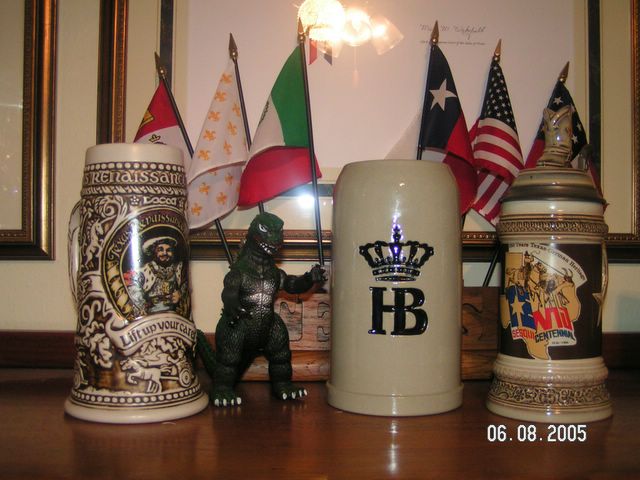
The Gang of Three
True internationalism in Kitsch Blogging. The stein on the far left is from the Texas Renaissance Festival, a celebration of English culture on the Gulf plains of Texas where the climate most closely resembles that of Calcutta. The Hofbrau stein is from Germany. All three are proudly used, from time to time. Just as the Pez dispensers are.
What? We haven't gotten to the Pez dispensers? Sorry, already getting ahead of myself.
Thursday, June 16, 2005
We Report, You Decide
"As someone who knows Iraq, speaks Arabic, and spent seven years in the Middle East, if the Iraqis believe rightly or wrongly that we come only for oil and occupation, they will begin a long, bloody war of attrition. It is how they drove the British out. And remember that, when the Israelites invaded southern Lebanon in 1982, they were greeted by the dispossesed Shiites as liberators, but within a few months, when the Shiites saw that the Israels had come not as liberators but as occupiers, they began to kill them. It was Israel who created Hezbollah, and it was Hezbollah that pushed Israel out of southern Lebanon."Chris Hedges, May, 2003, in a speech to the graduating class of Rockford College, Rockford, Illinois, from Losing Moses on the Freeway (New York: Free Press 2005), p. 95.
Press Secretary Scott McClellan, today:
Q Scott, is the insurgency in Iraq in its last throes?
MR. McCLELLAN: Terry, you have a desperate group of terrorists in Iraq that are doing everything they can to try to derail the transition to democracy. The Iraqi people have made it clear that they want a free and democratic and peaceful future. And that's why we're doing everything we can, along with other countries, to support the Iraqi people as they move forward. The fact that they are making great progress on the political front is significant because that helps defeat the terrorists, because the terrorists don't want to see democracy take hold. They don't want lasting democratic institutions to be put in place. And that's why we are standing with the Iraqi people as they move forward on the political front.
[snip]
Q But the insurgency is in its last throes?
MR. McCLELLAN: The Vice President talked about that the other day -- you have a desperate group of terrorists who recognize how high the stakes are in Iraq. A free Iraq will be a significant blow to their ambitions.
Q But they're killing more Americans, they're killing more Iraqis. That's the last throes?
MR. McCLELLAN: Innocent -- I say innocent civilians. And it doesn't take a lot of people to cause mass damage when you're willing to strap a bomb onto yourself, get in a car and go and attack innocent civilians. That's the kind of people that we're dealing with. That's what I say when we're talking about a determined enemy.
Q Right. What is the evidence that the insurgency is in its last throes?
MR. McCLELLAN: I think I just explained to you the desperation of terrorists and their tactics.
Q What's the evidence on the ground that it's being extinguished?
MR. McCLELLAN: Terry, we're making great progress to defeat the terrorist and regime elements. You're seeing Iraqis now playing more of a role in addressing the security threats that they face. They're working side by side with our coalition forces. They're working on their own. There are a lot of special forces in Iraq that are taking the battle to the enemy in Iraq. And so this is a period when they are in a desperate mode.
Q Well, I'm just wondering what the metric is for measuring the defeat of the insurgency.
MR. McCLELLAN: Well, you can go back and look at the Vice President's remarks. I think he talked about it.
Q Yes. Is there any idea how long a last throe lasts for?
MR. McCLELLAN: Go ahead, Steve.
Also today:
A resolution calling on President Bush to announce an exit strategy from Iraq was introduced in the House today by a bipartisan group of lawmakers, including one who was once so upset about French opposition to the war that he wanted the House cafeterias to change the name "French fries" to "freedom fries."
Two Republicans and two Democrats held a news conference in which they prodded President Bush to announce a withdrawal timetable by the end of the year. Their resolution calls on him to start bringing American troops home by Oct. 1, 2006.
Bloomsday
for Thersites
"Stately, plump Buck Mulligan came from the stairhead, bearing a bowl of lather on which a mirror and a razor lay crossed. A yellow dressinggown, ungirdled, was sustained gently behind him on the mild morning air. He held the bowl aloft and intoned:
--Introibo ad altare Dei."
It's also the birthday of Joyce Carol Oates, named for James Joyce.
I'm looking for my copy of Joyce's Chamber Music. So titled, he said, not for the musical association, but in honor of the sound of his wife in the morning, filling the chamber pot. Some things do become anachronisms, and require interpretation.
Later:
Found it.
Gentle lady, do not singJame Joyce, Chamber Music (London: Grossman, 1971)
Sad songs about the end of love;
Lay aside sweetness and sing
How love that passes through is enough.
Sing about the long deep sleep
Of lovers that are dead and how
In the grave of all love shall sleep.
Love is aweary now.
What is Prayer For?
It depends entirely upon who's asking, and sometimes, even when.
Just a moment ago, I was reading my prayer book, and the words struck me as entirely new.
Sometimes it is just about ritual:
And prayer reminds us God is active in history, just as ritual reminds us that we are surrounded by a cloud of witnesses, throughout space and throughout time.
Just a moment ago, I was reading my prayer book, and the words struck me as entirely new.
Sometimes it is just about ritual:
God, open my lips,/ and my mouth shall declare your praise. Glory be to the Father, and to the Son, and to the Holy Spirit. As it was in the beginning, is now, and ever shall be, world without end. Amen.Sometimes it is just about bathing your mind in words like these, words the world simply does not provide:
ANTIPHONAn invitation the world would do well to emulate, and Christians would do well to listen to:'
(Ordinary): God is kind and full of compassion,
slow to anger, abounding in love.
PSALM 65 (64)Prayer is for oneself; and for others.
Praise is yours, God in Zion.
Now is the moment
to keep our vow,
for you, God, are listening.
All people come to you bringing their shameful deeds.
You free us from guilt,
from overwhelming sin.
Happy are those you invite
and then welcome to your courts.
PSALM 84 (83)
Your temple is my joy, Lord of heaven's might.
I am eager for it,
eager for the courts of God. My flesh, my flesh sings its joy to the living God.
As a sparrow homing,
a swallow seeking a nest to hatch its young,
I am eager for your altars, Lord of heaven's might, My king, my God.
To live with you is joy,
to praise you and never stop. Those you bless with courage
will bless you from their hearts.
When they cross the Valley of Thirst the ground is spaced with springs, with the welcome rain of autumn. They travel the towns to reach
the God of gods in Zion.
Hear me, Lord of might;
hear me, God of Jacob.
God our shield, look,
see the face of your anointed.
One day within your courts
is worth a thousand without.
I would rather stand at God's gate than move among the wicked.
And prayer reminds us God is active in history, just as ritual reminds us that we are surrounded by a cloud of witnesses, throughout space and throughout time.
BENEDICTUS ANTIPHON
(Ordinary): A pure heart create for me, O God; put a steadfast spirit within me.
BENEDICTUS
Praise the Lord, the God of Israel,
who shepherds the people and sets them free.
God raises from David's house
a child with power to save.
Through the holy prophets
God promised in ages past
to save us from enemy hands,
from the grip of all who hate us.
The Lord favored our ancestors
recalling the sacred covenant,
the pledge to our ancestor Abraham,
to free us from our enemies,
so we might worship without fear
and be holy and just all our days.
And you, child, will be called
Prophet of the Most High,
for you will come to prepare
a pathway for the Lord
by teaching the people salvation
through forgiveness of their sin.
Out of God's deepest mercy
a dawn will come from on hight,
light for those shadowed by death,
a guide for our feet on the way to peace.
Glory be to the Father, and to the Son, and to the Holy Spirit. As it was in the beginning, is now, and ever shall be, world without end. Amen.
A pure heart create for me, O God; put a steadfast spirit within me.
Our Father....
Eternal light, you want all creation to live in harmony. Grace us with the instruments of good works, and the desire to use them to build your kingdom among us. We pray this through Christ, and in the Spirit. Amen.
May God bless us and keep us. May God smile upon us and be gracious to us. May God look upon us kindly, and give us peace. Amen.
Let us bless God/and give thanks.
In search of a living faith
It's been a while since I posted anything of substance, and, I figure, why start now? There are some great discussions already going on that I'd like to follow for a while, so I'm making an appeal here instead.
Its related to a topic we've discussed many times before here-spirituality. As part of my ordination journey, I need to be active in a congregation. Some lucky candidates get paid positions on church staffs, but as I'm not particularly good at marketing myself, I haven't been favored with that opportunity since getting out of seminary. Therefore, I went to my senior pastor and lobbied hard for an increasing level of participation on a volunteer basis, preferably in a clear leadership capacity. I was angling for the youth ministry, but as we began discussing how I understood my calling and my previous experiences with youth ministry, it soon emerged that there was a better use for me. Both of us separately had come to the conclusion that our church, which is richly blessed with academics and theologians of all stripes, have a rather outstanding adult education program in areas of Biblical studies and theology (heck, we even offer classes in Biblical Hebrew and Greek). Where we are sadly deficient is in the area of spiritual formation-exploring our personal faith and deepening our relationship with God. There has been an expressed need in the church for some time, but no one was willing to step up and get some programs going.
Well, I expressed my willingness, actually my eagerness, to take on this responsibility, so I am now the Minister of Spiritual Formation (we thought it sounded a little less naughty than Minister of Spiritual Discipline). I am excited and blessed to have this opportunity and the wholehearted support of the staff.
While I have some ideas of where this can go, I'd like to extend to this community a request: if you know of or have had experience of a particularly helpful method of encouraging and nurturing spiritual discipline, tell me about it. If a study has been helpful, let me know the title. If you've often wanted to engage in such an activity before, but haven't, please tell me why and how you think you could be encouraged to walk this path. I'm interested in all aspects of this, and responses needn't be limited to specifically Christian forms of spiritual discipline.
So...please allow me to learn from you and share it with others. Thank you.
Wednesday, June 15, 2005
Not with a bang....
Per NPR earlier this afternoon, Ms. Sciavo had the least amount of brain left that any medical expert interviewed had ever seen in an adult. Alzheimer's patients, it was reported, sometimes get down to 800 grams. Ms. Sciavo, at the time of her death, was below 700, almost to 600. She was blind. She could not feed herself In fact, trying to feed her by mouth would kill her directly, or lead to pneumonia.
No therapy, of course, could have restored neurons.
And in response, through lawyers, Mr. Sciavo points out that this proves he was right all along. The parents insist Ms. Sciavo could have recovered with therapy.
And there the matter ends, like all court cases end. Not with a Perry Mason flourish in which even the defeated admit defeat, and the guilty confess their guilt. No, no such neat bows in real life. The matter ends, not with a bang, but a whimper.
God's peace be upon Michael Sciavo, and upon the parents and siblings of Terri Sciavo.
Signs of the Times
Just noticed this on a (non-denominational) church sign as I was passing:
Give up your small ambitions. Come and save the world.Is it just me, or is this a peculiarly American form of hubris?
Worth Noting
John Conyers, in this interview with Amy Goodman, notes that President Bush is denying that he ever wanted to go to war or use military power against Saddam Hussein, except as a last resort, while the apologists for the "Downing Street Memo" excuse it as: "everybody knew we were going to go to war."
"I started a joke/which started the whole world crying...."
Somehow, over at Eschaton, comments about Dr. Howard Dean turned into a brief discussion of Augustine of Hippo (one never know, do one?). And this got mentioned:
Which led to the good Prior to respond with this:
But already I realize how long this is going to go. So I'll try to make essential connections first, then connect the dots a bit later.
First, the self-consciousness we are all so sure is a part of human nature, is actually just a social construct. It's a way of viewing the world we are taught, as part of our human identity. (The whole concept of identity is a fascinating one. We are all appalled at the thought of men like Socrates engaging in sexual activities with young men or even young boys. While Paul condemned the practice, the Hellenistic Greeks apparently considered it perfectly civilized behavior. Partly because we now identify ourselves as sexual beings, we condemn the alleged actions of Michael Jackson. Sexual scars, we understand, do lasting damage. But is that because of human biology, something immutable? Or because of human society? Is our identity, in other words, a social construct? Or a biological necessity?)
So, per Krister Stendahl, the interiorization of self-consciousness in Western culture begins with Augustine, who taught us to read Paul as the originator of Christian self-consciousness. "Wrteched creature that I am, who is there to rescue me from this state of death?" (Romans 7:24, REB). In Stendhal's reading, that famous statement does not say what we've all been taught it says. That's one point to return to.
Another is the idea of individuality. Prior Aelred is right (as usual) that it does not follow a clear line from Augustine to the present. In many ways, Augustine was ahead of his time. It took the Augustinian monk Martin Luther to put Augustine again at the center of Western consciousness and conscience. We can trace that line, too, with a little help from our friends. And it is no coincidence that a Lutheran seminary student, Søren Kierkegaard, reasserted the primacy of the individual in mid-19th century Denmark. Nor that he did it at the very apogee of Romanticism in Europe. And what is the connection between individualism and community? What are the boundaries there, between Same and other?
Lastly, we can even enter into the conversation about "call" v. "conversion." Stendahl argues that Paul's experience on the road to Damascus is not exactly a conversion at all, as it is not a change from one religion to another (!). And again Augustine is our model: not only was Paul "blameless before the law" as a good Pharisee (something Augustine makes abundantly clear in the Confessions that he was not; blameless, that is), but Augustine went from pagan to Christian (and finally non-Pelagian), while Paul went from Jew (or perhaps Hebrew is less anachronistic) to: the first Jew for Jesus?
We have several places to go with these issues.
Is this the Augustine who went on to become St. Augustine? Interesting that he had a libertine youth before his sudden repentance, especially on the subject of sex. Reminds me of dubya's sudden "born again" moment. - int argc, Smiling ConquerorWhich led me to respond with this:
Where the whole concept of such a 'conversion' began. It later became a staple of frontier American Christianity largely because Luther was an Augustinian monk. Indeed, Krister Stendahl (a Lutheran pastor and scriptural scholar) argues convincingly that Augustine's Confessions is the beginning of the interiorization of self-consciousness in Western thought, which reach its fullest flower in European Romanticism.
Which was, not coincidentally, the age of Soren Kierkegaard, one of the forerunners of Existentialism. Augustine and Romanticism both greatly effected Rousseau, who in turn had a profound influence on German and French Existentialism, and on modern phenomenology.
There is an 'eternal golden braid' that reaches from Paul through Augustine to modern philosophy. (Did I mention the connection to Paul? No? Drat!)
Which led to the good Prior to respond with this:
Augustine's conversion would have been the firstand then this:
If not for St. Paul...
Prior Aelred
I find one of the fascinating things in the West is that Augustine's invention of the individual goes underground until the 12th Century Renaissance (Bernard of Clairvaux, Aelred of Rievaulx) -- Augustine was influential in between, but not the Confessions -- rather his Commentaries, esp on John & the PsalmsAnd since the topic was so intrinsically fascinating, and I didn't want the light of it to go out, I brought it over here (besides, these are my public notebooks. I'm laying out a variety of ideas, trying to see which ones I can develop into something fruitful, or at least worth the attention).
Whence self consciousness, does it wax & wane with community centeredness? Does it relate somehow to introversion & extroversion (do extroverts have souls? ) -- the Enneagram?
Prior Aelred
But already I realize how long this is going to go. So I'll try to make essential connections first, then connect the dots a bit later.
First, the self-consciousness we are all so sure is a part of human nature, is actually just a social construct. It's a way of viewing the world we are taught, as part of our human identity. (The whole concept of identity is a fascinating one. We are all appalled at the thought of men like Socrates engaging in sexual activities with young men or even young boys. While Paul condemned the practice, the Hellenistic Greeks apparently considered it perfectly civilized behavior. Partly because we now identify ourselves as sexual beings, we condemn the alleged actions of Michael Jackson. Sexual scars, we understand, do lasting damage. But is that because of human biology, something immutable? Or because of human society? Is our identity, in other words, a social construct? Or a biological necessity?)
So, per Krister Stendahl, the interiorization of self-consciousness in Western culture begins with Augustine, who taught us to read Paul as the originator of Christian self-consciousness. "Wrteched creature that I am, who is there to rescue me from this state of death?" (Romans 7:24, REB). In Stendhal's reading, that famous statement does not say what we've all been taught it says. That's one point to return to.
Another is the idea of individuality. Prior Aelred is right (as usual) that it does not follow a clear line from Augustine to the present. In many ways, Augustine was ahead of his time. It took the Augustinian monk Martin Luther to put Augustine again at the center of Western consciousness and conscience. We can trace that line, too, with a little help from our friends. And it is no coincidence that a Lutheran seminary student, Søren Kierkegaard, reasserted the primacy of the individual in mid-19th century Denmark. Nor that he did it at the very apogee of Romanticism in Europe. And what is the connection between individualism and community? What are the boundaries there, between Same and other?
Lastly, we can even enter into the conversation about "call" v. "conversion." Stendahl argues that Paul's experience on the road to Damascus is not exactly a conversion at all, as it is not a change from one religion to another (!). And again Augustine is our model: not only was Paul "blameless before the law" as a good Pharisee (something Augustine makes abundantly clear in the Confessions that he was not; blameless, that is), but Augustine went from pagan to Christian (and finally non-Pelagian), while Paul went from Jew (or perhaps Hebrew is less anachronistic) to: the first Jew for Jesus?
We have several places to go with these issues.
Tuesday, June 14, 2005
"So far away from home...."
Apparently it is now official: we are no longer a government of laws, but a government of men. Of old, white men, who want to make sure we are afraid, very afraid:
Sen. John McCain has said: "I think the key to this is to move the judicial process forward so that these individuals will be brought to trial for any crime that they are accused of rather than residing in Guantanamo facility in perpetuity." Secretary Rumsfeld's answer?
So, of course, are serial killers. Who tend to be white males. No word on when we start rounding them up for the safety of American society. Or when we start locking up anyone who might be a pedophile. We have yet, of course, to declare a war on pedophilia, but that's just a technicality.
Attorney General Gonzalez apparently can't be bothered to comment on these legal matters.
"The United States government, let alone the U.S. military, does not want to be in the position of holding suspected terrorists any longer than is absolutely necessary," Rumsfeld said. "But as long as there remains a need to keep terrorists from striking again, a facility will continue to be needed."But wait, as the TV commercials say, there's more.
Sen. John McCain has said: "I think the key to this is to move the judicial process forward so that these individuals will be brought to trial for any crime that they are accused of rather than residing in Guantanamo facility in perpetuity." Secretary Rumsfeld's answer?
"The real problem is not Guantanamo Bay," Rumsfeld said. "The problem is that, to a large extent, we are in unexplored territory with this unconventional and complex struggle against extremism. Traditional doctrines covering criminals and military prisoners do not apply well enough."
"They're not common car thieves," Rumsfeld said of the Guantanamo prisoners. "They're believed to be determined killers."
So, of course, are serial killers. Who tend to be white males. No word on when we start rounding them up for the safety of American society. Or when we start locking up anyone who might be a pedophile. We have yet, of course, to declare a war on pedophilia, but that's just a technicality.
Attorney General Gonzalez apparently can't be bothered to comment on these legal matters.
Strange Fruit
The Senate vote on the resolution to apologize for blocking anti-lynching legislation has me wondering: what is "mere philosophy"?
The pictures from "Without Sanctuary" are, unfortunately, no longer available on the Web. But what was most disturbing about those pictures was not the subject matter: it was the casual way they were passed around, across America, as postcards. People even posed for pictures, and companies would gladly turn these personal photos into cards suitable for mailing home to family and friends, who apparently gratefully received them. And we look at this now and ask: "How could this happen?" And that's when I ask: what is "mere philosophy"?
Something changed, finally, in American culture. Something said "This should not be." And perhaps in revulsion at what we were, we shunned what we had done, covered it up, buried it so we could ignore it. How many people growing up in Oklahoma, for example, learn about the Tulsa race riot of 1921? But how did such things happen, why were they tolerated, and why aren't they tolerated now?
Because of Lyndon Johnson? Because of Civil Rights Laws? Because of the Voting Rights Act? all of those laws and LBJ's mastery of the legislative process were crucial, no doubt; as was Brown v. Board of Education. But from what impulse did those changes spring? Revulsion with lynching, with race riots, with racism? Probably. And where did that revulsion come from? Mere philosophy? LBJ was moved by the experiences of his childhood, but those experiences gave rise to ideas; it was ideas he acted on, not mere experience.
Philosophy and theology are not reducible to originating causes; and they are not reducible to marginalia, either, to the mere explanations after the fact of what people do. If the universe operates on principles of cause and effect, then there is a cause that effects a change of heart, that effects even revulsion at cruelty and no longer accepts it as a necessary concomitant of "civil order." Lynching was celebrated in this country; and then it was reviled. Because of impersonal historical forces, the inexorable workings of Hegel's thesis against antithesis? That is mere philosophy, intellectual rationalization after the fact about events philosophy doesn't wish to grasp. But what caused the change? Why did people decide lynching was not to be celebrated? What resonated to turn people against inhuman treatment and begin to regard the victims as humans?
Not just religious conviction; not just tradition or church teachings or compassion. Something more fundamental than that. Something like "mere philosophy." Something like "mere theology."
The universe is not moving rapidly towards justice. But it does not move at all unless our ideas move us.
"Humankind cannot bear very much reality"--T.S. Eliot
Or, News of the Day:
From Juan Cole (via Holden at First Draft):
And proof, if you needed it, that denial is a powerful force:
Start with American Exceptionalism (it's worked for 200 years):
Above all, in defense of the Administration, don't mention freedom. Because clearly, freedom for "them" means chaos for us. Only we are permitted to know the joys of freedom, because only we can be trusted to be responsible with it.
Whatever "freedom" is.
From Juan Cole (via Holden at First Draft):
Reuters reports, "Iraqi doctors say they are concerned over an increase in Tuberculosis (TB) cases in the southeastern city of Amarah, fueled by a shortage of medicine and poor living conditions." Iraqi governments during the past 50 years had gotten the problem under control in that region.And from the NYT Letters:
My count of dead and wounded for Monday is many times higher than that in the mainstream media, whether the Washington Post or even the wire services. The numbers are arrived at by collating incidents reported in AFP and by Knight Ridder, and adding in incidents and casualties reported in the Baghdad daily, al-Zaman. Bad as things are in Iraq, I still don't think the full tragedy is getting out to the American public.
To the Editor:
You urge Congress to "undo the damage and restore the separation of church and state as a showcase principle" at the Air Force Academy.
Sadly, when I offered an amendment in the House Armed Services Committee to do just that, it was criticized by some of my colleagues as "political correctness." One suggested that the wall separating religion and state is "mythical." Later, when I offered a similar amendment to the Rules Committee, it was defeated by a party-line vote.
These actions suggest that the fault lies not in the Air Force Academy itself; the fault lies in the halls of Congress. That is why I have proposed a bipartisan presidential commission to explore fully how an appropriate balance may be reached between the personal expression of faith and the constitutional separation of religion and state throughout our military.
(Rep.) Steve Israel
Huntington, N.Y., June 11, 2005
And proof, if you needed it, that denial is a powerful force:
Start with American Exceptionalism (it's worked for 200 years):
Add fear-mongering and the opportunity to mention many have been released due to a Supreme Court ruling (but not in accordance with it, so don't mention the ruling itself):
Vice President Dick Cheney strongly defended the American prison at Guantánamo Bay, Cuba, on Monday, saying that it was essential to the administration's efforts to combat terrorism and that detainees there had been treated better by the United States than they could expect to be treated "by virtually any other government on the face of the earth."
To bolster his remarks, made in a speech at the National Press Club, Mr. Cheney added to the administration's previous warnings about the dangers of moving too quickly to free the more than 500 prisoners held at Guantánamo. He provided new details about what he said had been at least 10 released detainees who later turned up on battlefields to try to kill American troops.Conveniently ignore the elephant in the room, and blame complaints on "partisan politics":
Mr. Cheney mentioned the name of Maulvi Abdul Ghaffar, a released Guantánamo prisoner who returned to Afghanistan and became a Taliban commander and was killed last year by Afghan forces. He also cited Mullah Shehzada, who he said returned from the prison to organize a jail break in Afghanistan, and who was killed last year by American forces.
And remember that humankind cannot bear very much reality:
Most of the detainees at Guantánamo were captured during the war in Afghanistan in 2001 and 2002, and many of them have been held there for three years without being charged with any crime. The Senate Judiciary Committee is planning a hearing on Wednesday on the issue.
Mr. Cheney dismissed those who say the prison should be shut down. "My own personal view of it is that those who are most urgently advocating that we shut down Guantánamo probably don't agree with our policies anyway," Mr. Cheney said. He said that detainees at the prison were "properly housed and properly fed," and that their medical and religious needs were being met.
Mr. Cheney did not address a Pentagon inquiry this month that found that some American guards and interrogators had mistreated the Koran, in some cases intentionally.
Which may explain why 6 in 10 Americans want some or all American troops to come home soon.
The vice president's words were echoed in a news conference on Capitol Hill later in the day by Representative Duncan Hunter, a California Republican who is one of the Pentagon's most committed allies.
Mohamed al-Kahtani, believed to have been the planned 20th hijacker in the Sept. 11 terror plot, is held at Guantánamo, and Mr. Hunter said that Mr. Kahtani was eating well and had been given the materials he needed to practice Islam.
"The guy who wanted to drive that plane into the building at the World Trade Center is going to dine tomorrow on lemon fish with two types of vegetables, two types of fruit, and then he will be afforded his taxpayer-funded Koran, taxpayer-funded prayer beads and oil so he can pray, presumably to kill more Americans," Mr. Hunter said.
He added that it was a "myth" that detainees were tortured at Guantánamo.
A growing body of evidence has shown that a significant number of prisoners were subject to interrogations in which they were shackled to the floor for many hours, stripped or forced to urinate and defecate on themselves.
Above all, in defense of the Administration, don't mention freedom. Because clearly, freedom for "them" means chaos for us. Only we are permitted to know the joys of freedom, because only we can be trusted to be responsible with it.
Whatever "freedom" is.
Subscribe to:
Posts (Atom)