It's Sunday, so a sermon seems appropriate. And, appropriately, I've come just now to the sermon I gave on the 16th Sunday after Pentecost in 2001, or a week after the sermon below. Sadly, you can tell I prepared this for presentation, not publication, and in haste. There are some quotes here that I don't believe are originally mine, and I don't have the attribution for them now.
TEXT: JEREMIAH 8:18-19:1; Psalm 79:1-9; 1 TIMOTHY 2:1-7; LUKE 16:1-13
It isn't the days immediately after the event that are the hardest. The shock and grief are hard. Accepting the world as it has become, accepting the violent but irrevocable change, is hard. But the days of shock and grief are not the hardest. The hardest days are deciding when the days of shock and rage and disbelief are over. Andnow comes the time of the healing, the days of deciding what to do next. How do we respond? Whom do we punish? Why should we punish them? Cui bono, the old Latin phrase asks, who benefits? When you begin an investigation into a criminal action, when you are faced with mass destruction and murder on the scale inflicted on this country recently, you start your investigation with a question, and find the culprits with its answer: cui bono? Who benefits? Who would make this effort, and what would be in it for them? But we have to ask a corollary question: cui pene? Who is punished?
For all of the images we have of a bloodthirsty and ~arrior God of the Hebrews, a God who smites the enemies of Israel and threatens the kingdoms around Judah, God never actually punishes another nation. Israel might win a war with God's help, Israel might be led into victorious battle behind God's guidance, but God never actually punishes another nation the way God punishes Israel. There is a reason for this. Israel is the only nation that calls on God by name. Israel is the only nation with a covenant with God. Israel is the only nation that ever hurts God. You always hurt the one you love. And Israel gets punished for it. But cui bono? And cui pene? Who benefits? And who is punished?
The psalm today calls for punishment on the nations: "Pour out your anger on the nations that do not know you, and on the kingdoms that do not call on your name," it asks. And for good reason: "They have given the bodies of your servants to the birds of the air for food, the flesh of your faithful to the wild animals of the earth. They have poured out their blood like water all around Jerusalem, and there was no one to bury them. We have become a taunt to our neighbors, mocked and derided by those around us." Does this begin to sound familiar? Does this begin to sound at all like what we are hearing around our nation, today? But there is a curious thing about this call for vengeance: God never answered it. This Psalm was clearly written after the destruction of the Temple, after the fall of Jerusalem. Last week Jeremiah saw devastation: the fertile ground turned into wilderness, the towns razed to the ground. This Psalm is a response to that destruction, but it's not a lament; it's a cry for vengeance. And God never answered it. God didn't destroy Babylon. A generation or so later, they let the Israelites go home. Nobody wanted Jerusalem anymore, and they slowly rebuilt it. And then the Ptolemys came; and then Alexander the Great; and then the Romans. And so it continued, until the fall of the temple again in 70 C.E., about 35 years after the crucifixion of Jesus. So God did not pour out anger; if anything, God wept.
"Would that my head were a spring of water, my eyes a fountain of tears, that I might weep day and night for the slain of my people I am wounded by my people's wound; I go about in mourning, overcome with horror. Is there no balm in Gilead, no physician there? Why has no new skin grown over their wound?..There is no cure for my grief; I am sick at heart." That isn't Jeremiah talking this time. That's God. God has punished Israel. But cui bono? Who benefits? And cui pene? Who is punished? The talk now is of retribution, of "infinite justice" and prolonged military campaigns. But who benefits? And who is punished? Afghanistan is one of the poorest countries on earth. They are enduring a three year drought. A family might have not more than a flat piece of bread to eat, and count themselves lucky. People are eating
grass; those who can move are fleeing the country, massing at the borders, fearful of the rain of bombs they are sure will come. And now come the days of healing; or do they? What if we did something different? What if we bombed them instead "with butter and flour, with rice, bread, clothing and medicine." It would cost less than conventional arms, pose no threat of casualties, and maybe even get the people thinking we aren't really monsters. Let's offer them full stomachs rather than a blighted future. Let's bomb them with information. Video players and cassettes of world leaders, particularly Islamic leaders, condemning terrorism. Carpet the country with magazines and newspapers showing the horror of terrorism committed by their "guest". Blitz them with laptop computers and VCR's filled with a perspective that is denied them by their government. Saturation bombing with hope will mean that some of it gets through. Send so much that the Taliban can't collect and hide it all." We are the greatest media capital in the world. Why don't we put that to use for something good? "The Taliban are telling their people to prepare for Jihad", for holy war. "Instead, let's give the Afghani people their first good meal in years."
Why not? Cui bono? We do, and they do? Cui pene? Only the evildoers. Because the children of this world are more shrewd in dealing with their own kind than the children of the light. If we act as children of the light, we will outwit them. Think about the parable of the good steward. He is an account manager; he has what we lawyers call a "fiduciary duty." He has to take better care of his master's property than he does of his own. We are just like him, Jesus says. "Anyone who can be trusted in small matters can also be trusted in great." But can we be trusted? What
do we have that is our own? What do we have that we don't confess every Sunday is a blessing from God. "We give Thee but Thine own." Do we really mean it, or do we just sing the words out of habit after the offering? What do we have that is not God's? What have we been given, except the stewardship of the whole creation? God set us up over everything, to tend it, to care for it, to make it fruitful and wonderful. We have a duty, but our duty is to God.
And the master of the parable is not God. He is a child of this world. Because the servant is shrewd, and takes care of himself. His sin is selfishness, and he wallows in it. Do you owe my master 100 jugs of oil? Change your account to show you only owe 50. Do you owe 100 measures of wheat? Lower it to 80. Who benefits? The debtors, and presumably the steward. Maybe they will scratch his back, since he has scratched theirs. Who is punished? The master, who meant to punish his steward; but the master appreciates the irony. He understands: it's money that matters.
That's the real end of the story, the real meaning, the real purpose: for the children of this world, it's money that matters. Not God, not faith, not trust that everything comes from God and God will always provide what you need. It's money that matters. If you have that, you have everything. And of course, when money passes away, your friends who only valued money will welcome you into the eternal homes.
Won't they? But what about the retribution? What about the infinite justice? Why does the steward seem to get away with it? And why is God weeping over what God has done? Cui bono? And cui pene? We all stand inside an economic circle. We all make exchanges, our money for their food, our time for their money. And we all understand how the circle works, that what goes around, is what comes around. Well, if you send around nothing, then in the end there is nothing left for you. If all you ask is "Cui bono?" there is nothing left for you when the cycle finally comes to an end. No money, and no friends to receive you into an eternal home. But the same is true of punishment. If you want to hurt someone, if you want to punish someone, if you want to strike back at someone for what they have done, cui pene? Who is punished?
Because punishment is part of the system of exchange, too. In an economic circle, the money just goes round and round: 'twas mine, 'tis yours, 'twill be hers. Punishment moves in the same circle, and it comes back to you. You punish me, I will punish you; an eye for an eye, a tooth for a tooth, and the cycle can go on for generations. God stopped punishing Israel after the Exile; because even God stood inside the circle. The punishment came back around to God, because of God's love for Israel. Who is punished? Everyone who tries to punish someone else. Who benefits? No one who stands inside the circle.
How, then, do we defeat it? How do we evade this trap? By changing the question. By asking not: "who benefits, but by asking: who can I benefit? And now at last comes the time of the healing, the days of deciding what to do next. Because when you ask "who benefits," you always ask for yourself. But only when you ask: "who can I benefit?" do you begin to leave yourself out of the question. Only when you ask: "who can I benefit?" do you truly start serving God, and not some other master. Only when you ask: "who can I benefit?" do you begin to step outside the circle. And only then, even if you seem to lose, do you truly gain; only then do you go unpunished, even if you seem to be the most persecuted person on earth. And only then the hard work of the healing begins.
Amen.
Sunday, July 24, 2005


Saturday, July 23, 2005
Something is wrong
Lord have mercy. Christ have mercy. Lord have mercy.
While reading an article about the new Robert Oppenheimer biography, American Prometheus, I was struck by an account of the many conversations Oppenheimer had with Secretary of War, Henry Stimson, about various ethical aspects surrounding the research and building of the atomic bomb. The impression is made that concerns about the future of a world crouching under the destructive power of atomic weaponry was as acute as the debate over the morality of its use in the current situation, as it was. But it wasn’t just the potential of smashing atoms that concerned the people making these decisions.
The firebombing of Japan’s major cities caused deaths estimated to exceed 100,000 in Tokyo alone. The experience of firebombing in the European theater had been effective in shock value, but not terribly effective as a strategy to cripple or eliminate German war production, or the will of the German military to fight. The addition of jellied gasoline, or napalm, to the high explosive bombing runs increased the effects in Japan, as did the Japanese style of architecture and urban design. These missions were not secret and details, in so far as war time censorship permitted, were available in newspapers.
According to Oppenheimer’s recollections, Henry Stimson said to him, "that he thought it was appalling that there should be no protest over the air raids which we were conducting against Japan, which in the case of Tokyo led to such extraordinarily heavy loss of life. He didn’t say that such air strikes shouldn’t be carried on, but he did think there was something wrong with a country where no one questioned that…"
Upon reading this, I was reminded of a few conversations I had had with my now deceased father-in-law, a WWII veteran. He served as a radio operator in Northern Africa and participated in the Anzio campaign. Towards the end of the war in Europe, he was assigned to central Germany to take part in the mopping up and occupation. He was aware of the Nazi atrocities and had seen photographic evidence, as well as heard the stories of soldiers who had liberated the camps. His contempt for that regime and the compliant German people was very sharp, although he did remember the sympathy he felt when watching German citizens sifting through the ruins of bombed out cities, looking for food and potable water.
However, even fifty years after the events at Pearl Harbor, his feelings towards the Japanese had not undergone any change. They were sneaky, treacherous yellow bastards. You could never trust one. They were still trying to undermine America through economic means. The use of the Atomic bombs had been a great thing. If they hadn’t been dropped, chances are he would have had to head over to Japan with the rest of his Army group and we would have lost an unconscionable number of soldiers invading and subduing the Japanese homeland.
I always loved and respected my father-in-law, even when I vehemently disagreed with his human calculus. His experience and worldview was very different from mine, but there were so many places we could stand together that it did not handicap our all too brief relationship. He was a conservative man in many ways, but he never voted for a Republican, because they never cared about the "little guys." I am thankful that he passed on before the events of September 11 and the subsequent disintegration of what our country always stood for, as far as he was concerned. I don’t know if he would have viewed the threat of terrorism through the same eyes with which he viewed the Japanese. Perhaps he would have. But, I do not believe for a moment that he would consider the ways and means, by which this administration is conducting this war on a concept acceptable or indicative of the ideals he held.
Agent outings and SCOTUS nominations are political. Torture is wrong. RMJ has often commented on "constitutional crisis," and the potential effects and results if the current administration continues to defy SCOTUS rulings on the issues of Gitmo. The continued stonewalling and defiance of orders to release the latest evidence of atrocities at Abu Grahib is another crisis waiting to happen. What, I wonder, will America do if it comes to the executive branch dismissing the authority of the court and the congress?
I suspect it would trouble Henry Stimson as well. There is something wrong with a country where no one questions this. Something very wrong indeed.
I found this quote from Cornel West, but I am unable to find attribution for it. If anyone knows, please share it with me.
The American democratic experiment is unique in human history, not because we are God's chosen people to lead the world, nor because we are always a force for good in the world, but because of our refusal to acknowledge the deeply racist and imperial roots of our democratic project. We are exceptional because of our denial of the antidemocratic foundation stones of American democracy. No other democratic nation revels so blatantly in such self-deceptive innocence, such self-paralyzing reluctance to confront the night-side of its own history. This sentimental flight from history-or adolescent escape from painful truths
about ourselves-means that even as we grow old, grow big, and grow powerful, we have yet to grow up.
This is the tail wagging the dog
since Atrios has already noted it (you know where his blog is). But this post on Slacktivist is worthy of more than a little consideration. If you haven't read it, you'll probably want to.
And I want to keep it handy so I can come back to it later.
And I want to keep it handy so I can come back to it later.
"THE DAY THE EARTH STOOD STILL"
I've been quiet lately, for no discernible or definable reason. Summertime blues, or simple exhaustion, or a need to just be still. It doesn't matter. I've been busy with other projects, such as scanning all my sermons back into digital form, the better to store them. And I came across this one, the one I wrote just after 9/11. At first I didn't like it, and then I decided I liked it after all; at least the ending, anyway.
TEXT: JEREMIAH 4:11-12,22-28; 1 TIMOTHY 1:12-17; LUKE 15:1-10
When the first plane hit the tower, I heard about it on the radio. No one believed it was possible, so all I heard as a report that a plane had possibly struck one of the towers of the World Trade Center. It was assumed to be a small plane, maybe a Cessna. It was assumed to be an accident.
I don't even remember when I realized it was no accident. The radio news went on as usual. There was nothing unusual about the announcement except the timing. It was something new, not a repeat of headlines I had heard before. But then I turned on the TV. Which is curious, because I never turn the TV on in the morning, never watch the morning news. But by then the second plane had struck the second tower. And this was clearly no accident. And when the video showed what looked like a passenger jet, rather than a small private plane, my heart stopped. I knew then it was a horror beyond any imagining. That's when I first felt the world lurch, and twist to one side, like the ground had suddenly become a bronco determined to unseat me, or had gone from solid to liquid and I was about to fall sideways and drown.
And then the first tower fell. And then the second. And the story came in about the Pentagon. And another plane in Pennsylvania, that might or might not be related. And then all airplanes were grounded. And the earth stood still.
This is what it looked like to Jeremiah, almost 3000 years ago. But it could have been Tuesday morning, in lower Manhattan:
"I looked at the earth, and it was chaos, at the heavens, and their light was gone, at the mountains, and they were reeling, and all the hills rocked to and fro. I looked: no one was there, and all the birds of heaven had taken wing. I looked: the fertile ground was wilderness, its towns all razed to the ground before the Lord, before his fierce anger."
A friend called me the next day. She called at noon. Never in the 20 years I have known here has she ever called me at noon. She asked me if 1 was going to preach on this on Sunday. 1 said she had interrupted me working on the sermon. "Good," she said. "Your people are going to want you to explain it to them. And then you can explain it to me."
Jeremiah tried to explain it. He tried to explain that it was God's judgment, that actions have consequences and that you pay for the evil you do. "My people are foolish," God says, "they know nothing of me; senseless children, lacking all understanding, clever only in wrongdoing, but of right and wrong they know nothing." A group I meet with once a week said these words applied to us, to our nation; that because we had become Godless, had allowed abortions and taken prayer out of schools, this was God's judgment on us. But they didn't really mean it. They were just trying to make sense out of it. They were just trying to give evil some kind of reason.
Some people say it is our loss of innocence. But I don't believe that, either. This
is too cataclysmic, too large, too much, to blame us, to say we were too innocent, too naive, that somehow we had this coming. Nothing we did can ever make us deserve this. And yet we are not innocent. We don't stand outside the circle. "No one does good," the Psalmist says, "no, not one!" But for all that, Psalm 14 is a psalm of comfort. We are not innocent. But nothing we did can ever make us deserve this.
Even Jeremiah sees that. God says to Israel: "Your ways and deeds have brought these things on you; this is your punishment, for your rebellion is deep seated within you." And Jeremiah doesn't say, "Yeah, you're right." He cries: "My anguish, my anguish! I writhe in pain! Oh, the walls of my heart! My heart is beating wildly, I cannot keep silent; for I hear the sound of the trumpet, the alarm of war." He speaks for us. He speaks our pain. A loss of innocence? No. We've lost our illusion.
Like Jeremiah, we've lost the illusion that we are safe. "Ah, Lord God," theprophet cries, "you surely deceived this people...in promising peace while the sword is at our throat!" We've lost the illusion that we are protected. We've lost the illusion that we can never be harmed. We are free to cry out that God has deceived us. And for that very reason we should not keep silent at the sound of the battle cry or the blast of the trumpets, or the sight of the destruction. So many people killed in such a little time. So many people injured and the families left weeping and left wondering: where is God?
God is right here. In the wilderness, with us.
God is our refuge and God is our strength. But that does not mean God protects us from all pain, that God shields us from calamity. God is our ever present help in trouble. But that doesn't mean that God looks down on even one that does good. God looks for the wise. But what do the wise do? They seek after God.
It seems too much, to turn that way. It asks too much, to say that now is the time to be seeking God. But listen to Jeremiah. What is he doing, when he cries for us, when he uses our voice to ask God why we were deceived, why peace was promised when the sword was at our throat, when he hears the sound of the battle cry and his heart beats wildly because he cannot contain his terror and his fear? What is Jeremiah doing if not looking for God in this wilderness that has suddenly been created where once there were people and cities and fertile land? Jeremiah finds himself suddenly in the wilderness and cries out "Oh, Lord God, what have you done?"
Has there been a one of us who has not asked the same thing since Tuesday? Our cities have been razed, the places once filled with people are empty, even the farmland in Pennsylvania has been made a waste, a wilderness. Haven't we heard all of this before? Haven't we seen this all before? Aren't we looking for God, and not expecting to find God here, in all this ruin, in all this destruction, in all this desolation?
And yet, if the parable is true, it is here in the wilderness that we can expect to find God.
When 1 sheep goes astray, you don't leave 99 alone to search for it. Not unless that one is more valuable than all the other 99 together. What sheep could be that valuable, unless that sheep is God? How could one sheep make the possible loss of another 99 worthwhile, unless that sheep represented the kingdom of God? And what else could make us rejoice, and call all our friends together, except to discover the lost kingdom of God?
The kingdoms of the world are kingdoms of power. They are supported by the bow and the sword, by the weapons of war. "I have seen the wicked in great power, and spreading himself like a green bay tree." We all have. We know. The kingdoms of this world are kingdoms of power, supported by the weapons of war. The kingdom of God is a sheep; a sheep we find in the wilderness. "Mark the perfect man, and behold the upright, for the end of that man is peace." A sheep is a peaceful animal, a symbol of a peaceable kingdom. It is not a threat, or menacing; it has no power. And we find it, of all places, in the wilderness. Out in the world, where the wild things are. Where terrorists take over passenger planes and commit suicide with hundreds of unwilling victims, commit war on thousands of unwitting lives. Where skyscrapers collapse into
rubble and kill the occupants and the bystanders and the rescuers. Where people die in farmland trying to wrest control from their would-be killers. All the places where you can't possibly imagine God would be, is precisely where God is found. We only need to look for God. We only need to expect to find God.
If we cry to God and ask God, "why?," we have found God. If we think the meek can't possibly inherit the earth, we find a sheep in the wilderness. If we see the wicked in great power, and spreading like a bay tree, spreading branches out until they even reach our shores, our lives, our families and homes, "Yet he passed away, and, lo, he was not: yea, I sought him, but he could not be found." Instead, we'll find a sheep. Out in the wilderness. Where nothing that needs to be kept safe, should be. Waiting to tell us, "enough." The ways of the wicked, of violence and hatred and revenge, of disaster overtaking disaster until the whole land lies in ruin, is not the way of God. Nor is it the end. Because "the salvation of the righteous is of the Lord: he is their strength in the time of trouble. And the Lord shall help them and deliver them: he shall deliver them from the wicked, and save them because they trust him." Not because the world isn't evil. Not because violence and death and destruction don't occur. Not because
God wasn't there or let it happen, or because we deserved it or brought it on ourselves. But because we too easily find ourselves in the wilderness. That's why it's where God is. As helpless as a lost sheep. Waiting for us.
5000 people. 5000 families. Evil is not reason. It cannot be explained. But God is in the wilderness, waiting for them, waiting for us. God will be with them this day. May we know that God is with us. That though we have troubles, God is our strength. That the Lord will deliver us from the wicked, and save us, because we trust God. Because we trust the sheep, not the weapons of revenge, the tools of hatred, the sound of trumpets or the battle cry of war.
Amen.
Friday, July 22, 2005
In anticipation of Chinese Kitsch Blogging
Photos from China:
The obligatory "Great Wall" picture:

And just a "random" photo:
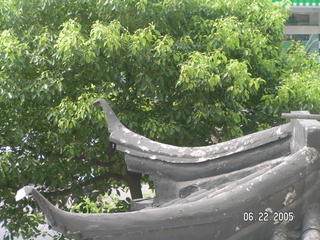
Courtesy of my daughter.
The obligatory "Great Wall" picture:

And just a "random" photo:

Courtesy of my daughter.
Tuesday, July 19, 2005
"O Rose, thou art sick...."
We therefore want to follow this trace of the trace, to take as constitutive for a renewed reflection on religion the very fact of its return, its re-presentation, its calling to us with a voice that we are sure we have heard before. . . . On the one hand, the robust presence in our popular culture of the return of the religious (as a need, in the new vitality of churches and sects, and in the search for different doctrines and practices, the 'fashion' for Eastern religions and so forth) is motivated above all by the sense of impending global threats that appear quite new and without precedent in the history of humanity. It began immediately after the Second World War with the fear of possible atomic war, and now that the new state of international relations makes this threat seem less imminent, there is a growing fear of an uncontrolled proliferation of these same weapons, and more generally an anxiety in the face of the risks to the ecology of the planet, not to mention those associated with the new possibilities of genetic engineering. A no less widespread fear, at least among advanced societies, is that of losing the meaning of existence, of that true and profound boredom which seems inevitably to accompany consumerism. It is above all the radicality of these risks, which seem to threaten the existence of the species and its very 'essence' (it is possible now to modify the genetic code), that evokes and renders contemporary once again that 'too extreme a hypothesis' which for Nietzsche was God. Even that form of the return of the religious expressed in the often violent search for and affirmation of local, ethnic and tribal identities may in the majority of cases be traced back to a rejection of modernization as destructive of the authentic roots of existence.*A lesson from suicide attackers throughout history: you cannot threaten another people's identity, the "authentic roots of [their] existence," and expect to succeed in your efforts. The threats Vattimo lists here apply to all of us, and especially "the profound boredom which seems inevitably to accompany consumerism" afflicts American, where only a spectacular opportunity at consumerism (the release of another Harry Potter book) seems able to stir us from our torpor and pique our interest. The more we press forward with our Western insistence that "modernization is the way!" (and we press that in a myriad of ways), the more we will be met with increasingly violent resistance. They all, it seems to me, stem from the same source, and that source is not "modernity," but neither is the cure either to bash modernity, nor to go deeper into it. We cannot so easily disentangle ourselves from the problems we have created for ourselves, nor so easily condemn any one problem as the one sin we need to set right.
The situation we find ourselves in is an historical one, as well as a philosophical and theological one. Which should make us at least wonder what we are doing, and why.
*Gianni Vattimo, "The Trace of the Trace," Religion, ed. Jacques Derrida and Gianni Vattimo (Stanford University Press, Stanford, 1996), pp. 80-81.
Follow the Money
Seymour Hersh:
What I write is, ‘Are you kidding?’ What I write is that they simply went off the record, off the books on it. In other words, rather than deal with the C.I.A. and money that was appropriated by Congress, they took money -- I can’t -- I don't know from where, one guess would be Iraqi oil money, which we had control of. They took money that had not been appropriated by Congress and put it to work using retired intelligence people and other probably retired military people and others to help generate votes for Allawi. Allawi was running at, oh, 3% or even lower in other polls. 3% during the year. And he improved at the end, because, among other things, the Saudis and the Brits were doing an awful lot right before the election to support him, but nonetheless, in the election, he got 14% or 15%, which was much more than anybody expected.
Ecclesiastes was right
There is nothing new under the sun.
NPR this morning ran several interesting stories. One pointed out that "suicide attacks" go back at least to the "Jews" of first century Judea (Palestine), who would slit the throats of Roman soldiers, knowing they themselves would be killed immediately by other Roman soldiers. It is almost always, as the story points out, the response of the occupied against the force of the occupiers. And while it didn't work against the Romans, it did work once before, against the U.S., when Reagan withdrew U.S. troops from Lebanon after a Marine barracks was attacked.
And then there is the matter of how the British and Londoners were prepared for terrorist attacks. This is part of the explanation for why the British response was not the reflexive "Let's get 'em!" response of America. Get 'em? Get who? And why? And with what results, or consequences? The British seem particularly interested in that question, which makes me wonder just how peculiarly "American" the American response to 9/11 actually was. So far Spain has not declared war on anyone, either.
And lastly, there was this discussion with Stanley Carnow about the death of Gen. William Westmoreland, and Vietnam. What particularly caught my attention was that Westmoreland, and LBJ, Nixon, many American military leaders, per Carnow, all insisted that military might would prevail against the "little brown men in black pajamas." As Carnow points out, we dropped more bombs in Vietnam than in World War II, convinced that we would reach a "breaking point" for the North Vietnamese, that we could raise the cost beyond which our enemy would not go. Ironically, we were the country with a breaking point, as the North Vietnamese were willing to take whatever losses it had to sustain, in order to prevail.
Which is very similar, of course, to the situation we face in Iraq. Our invasion was, in fact, predicated on a more rapid response to our firepower, to the collapse of resistance under "shock and awe," after which all military matters would be simply "mopping up" procedures, so that Bush declared, all too early, "Mission Accomplished."
There is, indeed, nothing new under the sun. And all would seem to be vanity, and striving after emptiness. Even our ability to learn from recent history, to learn anything as a nation from our experiences, doesn't seem to exist at all. Of all the wars of the 20th century in which the U.S. was engaged, only the Second World War ended decisively, and with a victory that ensured no further wars between belligerents was likely to erupt. Despite that dismal record, we have gone on determined to repeat our "success" in that war, and failed miserably every time. And each time we fail, we find another scapegoat, and go out and repeat our mistakes again, to the point that we cannot now even reasonably consider ourselves a government of laws and not of men. The only "success" on that front, is the current grand jury investigation into l'affaire Plame. Compared to the constitutional crisis that none dare recognize over the Supreme Court's ruling on Gitmo (a ruling roundly ignored by the Bush Administration, a rebuke as deliberate and frightening as it would have been had Nixon refused to release the White House tapes on order of the courts), that entire investigation is precisely nothing at all. Even our closest cultural and military allies, the British, show more maturity and judgment as a nation than we do. And a theological and sociological treatise could be written on how long it takes us even to publicly express the true nature of our folly. It is no accident that the analysis of suicide bombers comes now, and not four years ago (although little of the crucial information in that analysis depends on events of the last 45 months).
The sun comes up, and the sun goes down, and hastens back to the place of its rising. And this too, is a vanity, and a striving after emptiness.
Monday, July 18, 2005
A walk with Hanna
I recently find myself with a great deal more time on my hands. Rather than deluge this community with scads of insightful arguments or theses, I have found it to be an excellent opportunity to spend more time with my three, growing, wonderfully high maintenance children.
My ten year old middle daughter has extreme ADHD and some OCD. Surrounded by a thirteen year old sister, with all the wonderful issues that come with that age, and a two and a half year old sister, who demands a lot of time and distraction to prevent her from romping about on the front yard buck naked, my ten year old often has to make the best of it. We have discovered that she does much better if she has uninterrupted periods of undivided attention, but she cannot be penciled into a specific time block.
So, I have begun the habit of taking walks with her in the evening, armed with the digital camera. Like many children with focus problems, a gadget that requires hand eye coordination often brings her into hyper focus, and she is capable of producing some marvelous results. We roam about the neighborhood, taking pictures of whatever catches her eye. Usually, we each take a picture or two (or possibly eight or nine) of the same thing, and then spend some time discussing how we see it from different points of view. Then we work together to determine which shots speak to both of us and she crops and resizes them.
Originally an attempt to help her burn off some excess energy before bedtime routines, the walks have taken on a much larger significance for both of us. Yes, she still bounces and leaps from photo op to photo op. Yes, she still talks incessantly as she zeros in on the shot she wants. Yes, she still fidgits and squirms until she falls off the computer chair at predictable intervals. But she has a very perceptive outlook on what she sees and is capable of expressing that verbally and visually with a calm grace that belies her constantly racing brain.
Her Sunday School teacher once told me that she was such a "distraction," the other children weren’t able to learn. This is the child who asks questions like: "Can God skateboard?" "Why do I have so much trouble getting along with people who are just like me?" "Did the Bible people hatch from Daddies like sea horses do?"(A follow-up question to why isn’t God a Mommy) "When everything is over, does it always begin again, or is there ever a time just to rest?" There is no end to her questions.
I often wonder about my daughter in the same way I wonder about God. Why is she seen as a "problem" to be addressed rather than treasured for the incredible, creative vibrant child she is? Why does my understanding of a God of love and grace seem so threatening and wrong to those whose understanding of God is of power and fear. The things which are of the most importance to us are perhaps also the most subjective. And they take on an importance to our self understanding that shapes us in self fulfilling ways and to often blinds us to the equally valid subjectivity of others. My daughter doesn’t really have that problem yet; one advantage of perpetual motion is that you never become totally vested in one way of thinking or being. My daughter helps me understand what it is truly like to live in the tension of being in two kingdoms. And she thrives in it!
I know its very subjective, but I think my daughter’s pictures are quite lovely. If you are so inclined, please see for yourself:
a walk with Hanna
Saturday, July 16, 2005
Thursday Evening Prayer Service
I couldn't get to this two nights ago. It was the antiphon that caught me; a sentiment I normally associate with Advent. And it just took me away from there....
O God, come to my assistance, make haste to help me. Glory be to the Father, and to the Son, and to the Holy Spirit. As it was in the beginning, is now, and ever shall be, world without end. Amen.
ANTIPHON
(Ordinary): Keep alert, for you do not know when
the time will come.
PSALM 140 (139)
Rescue me, Lord, from the wicked, save me from the violent
They spawn evil in their hearts, starting fights every day.
Their tongues strike like a serpent, their lips hide deadly venom.
Free me, Lord, from their evil, save me from the violent
who plot my downfall.
The arrogant hide their traps,
and set their snares for me, tangling my. path with nets.
But you, Lord, are my God. Listen! I plead with you.
Be the fort that saves me, Lord, my helmet when the battle comes.
Do not side with the wicked, do not let their plots succeed or they will prevail.
They connive to entrap me, let them drown in their venom!
Heap hot coals upon them, plunge them into the deep, never to rise again.
Let liars find no place to rest, let evil stalk the violent and drive them to their ruin.
I know how the Lord acts, judging for the weak, vindicating the poor.
The just honor your name, the innocent live in your sight.
PSALM 62 (61)
My soul waits, silent for God, for God alone, my salvation, alone my rock, my safety, my refuge: I stand secure.
How long will some of you attack tearing others down
as if walls or fences
on the verge of collapse?
You scheme to topple them,
so smug in your lies;
your lips are all blessing,
but murder fills your heart.
Wait, my soul, silent for God,
for God alone, my hope,
alone my rock, my safety,
my refuge: I stand secure.
God is my glory and safety,
my stronghold, my haven.
People, give your hearts to God, trust always! God is our haven.
Mortals are but a breath,
nothing more than a mirage;
set them on the scales,
they prove lighter than mist.
Avoid extortion and fraud,
the hopes the~eed are nothing;
and if you should grow rich,
place no trust in wealth.
TIme and again God said, .Strength and love are mine to give." The Lord repays us all
in light of what we do.
Glory be to the Father, and to the Son, and to the Holy Spirit. As it was in the beginning, is now, and ever shall be, world without end. Amen.
(Ordinary): Keep alert, for you do not know when
the time will come.
READING So those who welcomed his message were baptized. They devoted themselves to the apostles' teaching in fellowship, to the breaking of bread and the prayers.
Awe came upon everyone, because many wonders and signs were being done by the apostles. All who believed were together and had all things in common. They would sell their possessions and goods and distribute the proceeds to all, as any had need. Day by day, they spent much time together in the temple, broke bread at home and ate their food with glad and generous hearts, praising God and having the good
will of all the people. And day by day the Lord added to their number those who were being saved.
(silent reflection)
MAGNIFICAT ANTIPHON
(Ordinary): May the God of peace make you perfect
and holy.
MAGNIFICAT
I acclaim the greatness of the Lord, I delight in God my Savior,
who regarded my humble state. Truly from this day on
all ages will call me blest.
For God, wonderful in power, has used that strength for me. Holy the name of the Lord!
whose mercy embraces the faithful, one generation to the next.
The mighty arm of God scatters the proud in their conceit, pulls tyrants from their thrones, and raises up the humble.
The Lord fills the starving and lets the rich go hungry.
God rescues lowly Israel, recalling the promise of mercy, the promise made to our ancestors, to Abraham's heirs for ever.
Glory be to the Father, and to the Son, and to the Holy Spirit. As it was in the beginning, is now, and ever shall be, world without end. Amen.
(Repeat Magnificat antiphon)
INTERCESSIONS
Our Father. . . .
Generous God, help us to live in unity and generosity. May our possessions not dominate our lives. May we rejoice when needing little and be humbled by our weakness when wanting more. Gather all people together into you, our triune God, forever and ever. Amen.
May God bless us, deliver us from all evil, and bring us to everlasting life. Amen.
Let us bless God! and give thanks.
Friday, July 15, 2005
Harry Potter Watch
Document the heresies.
Or the marketing strategies. Or plots twists, new characters, dead characters, dead ends, tedious developments, plot holes, ponderous symbolism....whatever occurs to you.
(Full Disclosure: I will be up at midnight distributing some 300 copies of this thing. The second time in 3 years. In costume. Please. Kill me. Kill me now.)
Submitted for your approval...
What Atrios links us to, here.
In light of what I said below, about Niebuhr, Blake, and Shearer, this shouldn't be a surprise at all.
Not to say we can't all be disappointed. But the truth is, all outrage is personal. A gap that grows wider and wider among us as we pursue our post-Enlightenment, post-Romantic, "individualism."
"The best lack all convictions, while the worst
Are full of passionate intensity."--Yeats
An ugly fact of 'public' life. One that will only get uglier, as the Internets helps us magnify it.
Thursday, July 14, 2005
Prayer
Relieve Thou, O God, each one
In suffering on land or sea,
In grief or wounded or weeping,
And lead them to the house of Thy peace
This night.
I am weary, weak and cold,
I am weary of traveling land and sea,
I am weary of traversing moorland and billow,
Grant me peace in the nearness of Thy repose,
This night.
Beloved Father of my God,
Accept the caring for my tears;
I would wish reconcilement with Thee,
Through the witness and the ransom
Of Thy Son;
To be resting with Jesus
In the dwelling of peace,
In the paradise of gentleness,
In the fairy-bower
Of mercy.
from the Carmina Gadelica. For Speechless.
"Thus society is in a perpetual state of war."--Reinhold Niebuhr
Harry Shearer:
Reinhold Niebuhr:
First, recognize in Niebuhr's analysis the same reasoning used by the Romantics: that which creates, also destroys. As Blake put it:
O Rose thou art sick.
The invisible worm.
That flies in the night
In the howling storm:
Has found out thy bed
Of crimson joy:
And his dark secret love
Does thy life destroy.
In another context, I've called this the mysterium tremendums that shakes the core of any religious community: that which calls the community together is also that which remains mysterious, unknown, undefined and undefinable. It makes the community tremble because, while it makes the community, it also refuses to identify itself fully to the community. And while the community is called into being by this mysterium tremendum, it can never be sure it is faithfully serving that which calls it, and "there are definite limits in the capacity of ordinary mortals which makes it impossible for them to grant to others what they claim for themselves." You cannot fully cede authority to an authority that is not there, can neither be fully known nor fully apprehended. So you must take some authority for yourself. And that's only part of where the problem begins.
The problem begins with the fact that people need a community to belong to, to gain their identity from. And, as Niebuhr points out, we are limited in our empathy, our ability to rise above our own interests and consider the interest of others. We may act on an individual basis (this is the issue that fired Levinas' imagination: he saw a man dart into traffic to save the life of a child unrelated to the rescuer, and pondered the "why" of that act), but in a group we inevitably act for it, and expect it to act for us. The more the group reflects our self-interest, the more cohesive the group is and the more we yield to it. But the issue always comes back to self-interest: "ideals" like "the American public" sound well and good in our ears, but only when our interests are synonymous with the interests of this amorphous and ill-defined standard. If the standard doesn't affect our immediate well-being, we are content merely to pay lip service to it.
The same analysis applies to congregations. Any pastor who is honest, will admit that in any congregation there is a group convinced that what is in the best interests of that group, is also in the best interests of the congregation. They will cloak themselves in the garment of "the church's best traditions, ideals, practices," even "the will of God." But all of those reasons are the mysterium tremendums that they cannot adequately name, define, or adopt. So they reach for the standard they know: what is best for them. Such are the "limitations of the human mind and imagination [which make]... force an inevitable part of the process of social cohesion. But the same force which guarantees peace also makes for injustice."
We are driven, then, in the most hopeful circumstances, by injustice toward greater justice. "Thus society is in a perpetual state of war. Lacking moral and rational resources to organise its life, without resort to coercion, except in the most immediate and intimate social groups, men remain the victims of the individuals, classes and nations by whose force a momentary coerced unity is achieved, and further conflicts are as certainly created. The fact that the coercive factor in society is both necessary and dangerous complicates the whole task of securing both peace and justice." It is precisely here that Niebuhr's brother, Richard, critiqued him; and I do, too.
But the critique must first take account of the validity of the observation. Human society is not built on grand ideals, nor has it ever achieved anything higher than a stalemate in the struggle of perpetual war for perpetual peace. As I say: no pastor who has spent any time being responsible for a congregation, can have any illusions that he or she has been dealing with implementing, not the highest of ideals, or even the "will of God," but merely the the self-interests of one, or several, groups: trying to turn a small injustice toward a greater goal of justice.
Sometimes you just take it where you can get it.
Despite the admirable cloaking of all this in the garment of "the American public," the White House press corp's anger is based on one thing: Scott McClellan lied to the Whitte House press corps. The President, the Vice President, the Army and Navy football teams, the Secretary of State--all of them can lie to any or all of the planets in the solar system, and hey, that's politics. But, stand at that podium, and lie to those people, and let them eventually find out about it, and, brother, you got trouble.
Reinhold Niebuhr:
While it is possible for intelligence to increase the range of benevolent impulse, and thus prompt a human being to consider the needs and rights of other than those to whom he is bound by organic and physical relationship, there are definite limits in the capacity of ordinary mortals which makes it impossible for them to grant to others what they claim for themselves. Though educators ever since the eighteenth century have given themselves to the fond illusion that justice through voluntary co-operation waited only upon a more universal or a more adequate educational enterprise, there is good reason to believe that the sentiments of benevolence and social goodwill will never be so pure or powerful, and the rational capacity to consider the rights and needs of others in fair competition with our own will never be so fully developed as to create the possibility for the anarchistic millennium which is the social utopia, either explicit or implicit, of all intellectual or religious moralists.Niebuhr had pastored a church by the time he wrote those words. No one who has ever pastored a church can be truly surprised by the press corp's reaction, or by Shearer's analysis.
All social co-operation on a larger scale than the most intimate social group requires a measure of coercion. While no state can maintain its unity purely by coercion neither can it preserve itself without coercion. Where the factor of mutual consent is strongly developed, and where standardised and approximately fair methods of adjudicating and resolving conflicting interests within an organised group have been established, the coercive factor in social life is frequently covert, and becomes apparent only in moments of crisis and in the group's policy toward recalcitrant individuals. Yet it is never absent. Divergence of interest, based upon geographic and functional differences within a society, is bound to create different social philosophies and political attitudes which goodwill and intelligence may partly, but never completely, harmonise. Ultimately, unity within an organised social group, or within a federation of such groups, is created by the ability of a dominant group to impose its will.
....
The limitations of the human mind and imagination, the inability of human beings to transcend their own interests sufficiently to envisage the interests of their fellowmen as clearly as they do their own makes force an inevitable part of the process of social cohesion. But the same force which guarantees peace also makes for injustice. "Power," said Henry Adams, "is poison"; and it is a poison which blinds the eyes of moral insight and lames the will of moral purpose. The individual or the group which organises any society, however social its intentions or pretensions, arrogates an inordinate portion of social privilege to itself.
First, recognize in Niebuhr's analysis the same reasoning used by the Romantics: that which creates, also destroys. As Blake put it:
O Rose thou art sick.
The invisible worm.
That flies in the night
In the howling storm:
Has found out thy bed
Of crimson joy:
And his dark secret love
Does thy life destroy.
In another context, I've called this the mysterium tremendums that shakes the core of any religious community: that which calls the community together is also that which remains mysterious, unknown, undefined and undefinable. It makes the community tremble because, while it makes the community, it also refuses to identify itself fully to the community. And while the community is called into being by this mysterium tremendum, it can never be sure it is faithfully serving that which calls it, and "there are definite limits in the capacity of ordinary mortals which makes it impossible for them to grant to others what they claim for themselves." You cannot fully cede authority to an authority that is not there, can neither be fully known nor fully apprehended. So you must take some authority for yourself. And that's only part of where the problem begins.
The problem begins with the fact that people need a community to belong to, to gain their identity from. And, as Niebuhr points out, we are limited in our empathy, our ability to rise above our own interests and consider the interest of others. We may act on an individual basis (this is the issue that fired Levinas' imagination: he saw a man dart into traffic to save the life of a child unrelated to the rescuer, and pondered the "why" of that act), but in a group we inevitably act for it, and expect it to act for us. The more the group reflects our self-interest, the more cohesive the group is and the more we yield to it. But the issue always comes back to self-interest: "ideals" like "the American public" sound well and good in our ears, but only when our interests are synonymous with the interests of this amorphous and ill-defined standard. If the standard doesn't affect our immediate well-being, we are content merely to pay lip service to it.
The same analysis applies to congregations. Any pastor who is honest, will admit that in any congregation there is a group convinced that what is in the best interests of that group, is also in the best interests of the congregation. They will cloak themselves in the garment of "the church's best traditions, ideals, practices," even "the will of God." But all of those reasons are the mysterium tremendums that they cannot adequately name, define, or adopt. So they reach for the standard they know: what is best for them. Such are the "limitations of the human mind and imagination [which make]... force an inevitable part of the process of social cohesion. But the same force which guarantees peace also makes for injustice."
We are driven, then, in the most hopeful circumstances, by injustice toward greater justice. "Thus society is in a perpetual state of war. Lacking moral and rational resources to organise its life, without resort to coercion, except in the most immediate and intimate social groups, men remain the victims of the individuals, classes and nations by whose force a momentary coerced unity is achieved, and further conflicts are as certainly created. The fact that the coercive factor in society is both necessary and dangerous complicates the whole task of securing both peace and justice." It is precisely here that Niebuhr's brother, Richard, critiqued him; and I do, too.
But the critique must first take account of the validity of the observation. Human society is not built on grand ideals, nor has it ever achieved anything higher than a stalemate in the struggle of perpetual war for perpetual peace. As I say: no pastor who has spent any time being responsible for a congregation, can have any illusions that he or she has been dealing with implementing, not the highest of ideals, or even the "will of God," but merely the the self-interests of one, or several, groups: trying to turn a small injustice toward a greater goal of justice.
Sometimes you just take it where you can get it.
Wednesday, July 13, 2005
Wow. Who knew?
Speaking of the "bandwagon," a little history lesson on who Karl Rove is, courtesy of the Guardian, back in 2004.
A grand jury is now investigating the leak of Plame's name, a federal felony. Rove has denied being its source, and Wilson believes now he may have tried to push the story only after her name had already been published. Rove has yet to appear before the grand jury, but he has retained an expensive Washington lawyer.And, if you are wondering why Bush is suddenly taking a Karl who? position, the Guardian gives us a succinct explanation, too:
It is a dangerous moment for Rove, but he has escaped from a litany of political scandals unscathed, and even enhanced. Bush's other nickname for the Boy Genius is "Turd Blossom" - a Texanism for a flower that blooms from cattle excrement. This year, there should be ample opportunity for him to earn the title.
"I think it's an enormous position of power, and it's hard to overstate. I think he's unique in the modern presidency," says Lou Dubose, a Texan journalist and Rove biographer. Rove's office is tight-lipped about the extent of his duties, but the few un-vetted memoirs to have escaped from this highly disciplined administration have all portrayed him as the single most powerful figure in it, with the (possible) exceptions of the president and vice-president.They may have to drag him kicking and screaming away from the place. But then, I thought that about Nixon, too.
"Karl is enormously powerful, maybe the single most powerful person in the modern, post-Hoover era ever to occupy a political adviser post near the Oval Office," John DiIulio, a former presidential adviser, wrote in a notoriously frank email to a journalist from Esquire magazine, after resigning in 2001. "Little happens on any issue without Karl's OK, and often he supplies such policy substance as the administration puts out."
Grabbing the bandwagon as it passes....
Everyone is jumping on the news about Karl Rove, and it is wildly entertaining. But Dan Froomkin raises what are, I think, the salient points:
And, as Froomkin points out, Rove's lawyer now says Rove is a "subject" of the grand jury's inquiry. Which means he's almost a "target."
Can the White House even distract attention away from this? Not if the White House Press Corps won't play along.
But this brings us back to a question of jurisprudence, and a question of political science: are we a government of laws, or of humans? Do we rule, or are we ruled? How much does our democracy depend on what we say and do, and how much of it is, for want of a better term, "natural"? Because the American public seems to think self-governance is nearly a state of nature; or, at least, American nature.
Bouphonia started me thinking about that question. We'll have to come back to it soon.
There's a possible criminal charge looming.Rove's sleazy political tactics are well documented. But I think he's always relied on the "journalistic ethics" of "anonymous sources" to give him "plausible deniability." But now he's run up against a criminal investigation, something Mr. Rove has never had to dodge before. And he's finding out it isn't that easy to do.
· There's a credibility issue based on all the denials that Rove was involved in any way with the Plame case.
· And there's the context in which this took place: Rove, after all, was attacking a report by Wilson that cast doubt on the administration's case against Saddam Hussein's quest for weapons of mass destruction. The White House was at the time desperately -- and effectively -- waving the media away from any doubts about Bush's rationale for war. But Wilson was ultimately proven right on the issue of WMD, and the White House was ultimately proven wrong.
And, as Froomkin points out, Rove's lawyer now says Rove is a "subject" of the grand jury's inquiry. Which means he's almost a "target."
Can the White House even distract attention away from this? Not if the White House Press Corps won't play along.
But this brings us back to a question of jurisprudence, and a question of political science: are we a government of laws, or of humans? Do we rule, or are we ruled? How much does our democracy depend on what we say and do, and how much of it is, for want of a better term, "natural"? Because the American public seems to think self-governance is nearly a state of nature; or, at least, American nature.
Bouphonia started me thinking about that question. We'll have to come back to it soon.
The voice of thunder
O God of the elements,
O God of the mysteries,
O God of the fountains,
O King of kings!
O King of kings!
Thy joy the joy,
Thy light the light,
Thy war the war,
Thy peace the peace,
Thy peace the peace.
Thy pain the pain,
Thy love the love,
That lasts for aye,
To the end of ends,
To the end of ends.
Thou pourest Thy grace
On those in distress,
On those in straits,
Without stop or stint,
Without stop or stint.
Thou Son of Mary of the Pasch,
Thou Son of Mary of the death,
Thou Son of Mary of the grace,
Who was and shalt be
With ebb and with flow;
Who wast and shalt be
With ebb and with flow!
--from the Carmina Gadelica
Peace
Peace between neighbors
Peace between kindred
Peace between lovers,
In love of the King of life.
Peace between person and person,
Peace between wife and husband,
Peace between woman and children,
The peace of Christ above all peace.
Bless, O Christ, my face,
Let my face bless every thing;
Bless, O Christ, my eye,
Let mine eye bless all it sees.
--from the Carmina Gadelica
Meanwhile, back in London....
The British government understands that the war in Iraq is leading to terrorism in Britain:
And, interestingly, it isn't exclusively a matter of religious belief:
How serious is this? A BBC analysis notes:
And the response continues to be: the only answer to violence, is to quench it with greater violence:
Which is precisely its power; and its value.
The Iraq war is identified by the dossier as a key cause of young Britons turning to terrorism. The analysis says: “It seems that a particularly strong cause of disillusionment among Muslims, including young Muslims, is a perceived ‘double standard’ in the foreign policy of western governments, in particular Britain and the US.
“The perception is that passive ‘oppression’, as demonstrated in British foreign policy, eg non-action on Kashmir and Chechnya, has given way to ‘active oppression’. The war on terror, and in Iraq and Afghanistan, are all seen by a section of British Muslims as having been acts against Islam.”
And, interestingly, it isn't exclusively a matter of religious belief:
Most of the Al-Qaeda recruits tend to be loners “attracted to university clubs based on ethnicity or religion” because of “disillusionment with their current existence”. British-based terrorists are made up of different ethnic groups, according to the documents.Christiane Amanpour's report for CNN was interrupted by an angry Londoner who called her evaluation of the situation "lies" and declared the deaths in England were due to the war in Iraq. (The CNN video link refuses to open on my computer, but the excerpt is available in the introduction to the story on Democracy Now!'s website, here.)
“They range from foreign nationals now naturalised and resident in the UK, arriving mainly from north Africa and the Middle East, to second and third generation British citizens whose forebears mainly originate from Pakistan or Kashmir.
“In addition . . . a significant number come from liberal, non-religious Muslim backgrounds or (are) only converted to Islam in adulthood. These converts include white British nationals and those of West Indian extraction.”
How serious is this? A BBC analysis notes:
In an interview after the war, [British Home Secretary] Mr Clarke declared: "We have to make sure that the occupation of Iraq is not the basis for recruitment of lots of wild young men into extremist terrorist groups all over the Muslim world."
His comments came after the powerful Foreign Affairs committee of MPs reported in July 2003: "Al-Qaeda's stance on Iraq may encourage some misguided individuals to try to commit terrorist acts."
Former Labour minister Clare Short, who resigned over the war, had told the committee in evidence that the invasion had led to a "very large" number of recruits to the al-Qaeda network.
In February of the following year the same committee reported: "The war in Iraq has possibly made terrorist attacks against British nationals and British interests more likely in the short term."
And it was later revealed that, before the war, the Joint Intelligence Committee had also warned that military action against Iraq might "heighten", rather than reduce, the terrorist threat to western interests.
And the response continues to be: the only answer to violence, is to quench it with greater violence:
What the prime minister believes is that the terrorists had, in effect, already declared war on the west.Perhaps it's time to reconsider that course. Perhaps it's time to realize the biggest problem with the "peace of God." That it does, indeed, pass all understanding.
His actions since then, specifically the war on Iraq, have been designed to avert what he says is his greatest fear - the coming together of weapons of mass destruction and terrorism.
In that, he argues, he is left with no other sensible course of action than to meet the threat head on in the determination to win the war on terror, no matter how long it may take.
Which is precisely its power; and its value.
Monday, July 11, 2005
From Bad to Worse
The second half of the interview with Jane Mayer is up on Democracy Now!'s website. In it, Ms. Mayer, the author of the article in the New Yorker mentioned here last week, directly connects the treatment of prisoners in Gitmo to Nazi doctors and human experimentation under the Nazis.
She explains that every interrogation in Gitmo was as carefully monitored as a scientist would monitor an experiment, in order to record all results for later analysis. Nothing, in other words, done in Gitmo was accidental, unreported, or unrecorded. It may not have been pre-authorized, but it was noted, and all of it is known. And I remember again the amazement of historians and others, that the Nazis kept such meticulous records of what the world calls The Holocaust.
Because, in both cases, it was all seen as an experiment.
And this treatment was authorized via the Justice Department. The document making that authorization is classified, and reference to it is always made to justify these "assertive methods."
And I keep reminding myself that the New Yorker has a sterling reputation for fact-checking. And that the Administration has a vested interest in denying stories like this.
Subscribe to:
Posts (Atom)