Thursday, February 11, 2016

Waiting for the Big One

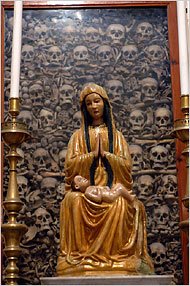
This may just become my preferred image for Lent.

I've been holding onto this post for some time.  Now, thanks to Southern Beale, I have a reason to revise and release it.  I'll start with the original premise, and adjust it below:

These statistics may be completely bogus.  Assuming they aren't, they are quite interesting:

While self-described atheists and agnostics tend to be highly educated, 77 percent of those who describe their religion as “nothing in particular” haven’t finished college. Many of these people, largely white, aren’t necessarily hostile to religion; they’re simply as alienated from their local churches as they are from other institutions, including political parties and labor unions. Almost half of those who claim no religion but consider religion important earn less than $30,000 a year. These struggling, detached, impious whites are a crucial part of Trump’s base.

I don't care about the "Trump's base" part, I care about the "nothing in particular" description of religion.  Here are the "nones" you hear so much about in certain quarters.  "[T]hey’re simply as alienated from their local churches as they are from other institutions, including political parties and labor unions."  "Bowling Alone" is not a new phenomenon; but it has yet to trickle down to the common knowledge of the "knowledgeable" on the interwebs.

Daniel Dennett says the rising disaffection with religion (and presumably religious belief) is caused by the rising information level available due to the internet.  I'm guessing people who make less than $30,000 a year don't make high-speed internet, and the computer to access it, a top priority.  I'm also thinking people who haven't finished college are not, by and large, that concerned with the latest "proof" of atheists espoused by Richard Dawkins or Pharyngula (if they've heard of either person).  Daniel Dennett, of course, is not alienated from institutions; like Dawkins and Pharyngula (and Sam Harris and Bill Maher), he makes his living from an institution, and relies on other institutions to carry his thoughts abroad and make him famous from them.

The gap between Mr. Dennett and his running mates, and the people identified in that quote above couldn't be any wider.  One might say they can't even see each other.

The irony of the quote lies in this:  the founding figure of Christianity lived as, and taught as, one alienated from institutions.  He lived and walked among the ptochoi, the homeless; the invisible.  The Pharisees and Sadducees and scribes in the Gospels are not historically rendered figures but representative, just as the shepherds are:  the former represent the institutions of life in Judea; the latter represents the people alienated from those institutions.  The people Jesus spoke to were not learned and wise, not educated and powerful.  They were quite the opposite.

If the time has truly come that the institution of the Church, in all its forms and guises, is no longer serving the people of God, if it no longer reaches those "struggling, detached, impious" people described as supporters of Donald Trump, the problem for the church isn't political.

It's existential.  It's fundamental.  It's theological and ecclesiological.  It's, pardon the apparent pun:  institutional.  I am not saying it is absolutely the sign of the end of the ecclesia; but if the ecclesia is leaving those people behind, then what, or who, is the body of Christ and the clouds of witness for?

Now, standing alone that's just a critique of the church, and a rather simplistic one.  But let us never forget the church reflects the culture; how else did the Roman church become part of the empire, it's hierarchy reflective of the model of Rome?  Where else did Protestantism come from, but the massive social changes that were already shaking 16th century Europe?  So Southern Beale, in a "coincidence?  I think not" post, tells me this:

Those who don’t vote tend to be younger and less educated, according to the Pew Research Center. More than half of those who sat out the election in 2012 had no more than a high-school diploma and less than $30,000 a year in household income.

Those are the people Sanders has to get to the polls if he hopes not only to win the Democratic nomination, but also to lead troops of the party’s congressional candidates to victory in the general election, establishing the legislative majority his agenda requires.

At least in New Hampshire, though, younger, poorer and less educated people did not turn out in disproportionate numbers for the Democratic primaries, according to exit polling data gathered on behalf of major television networks and the Associated Press in 2008 and on Tuesday.

Nineteen percent of Democratic primary voters — which, as it happens, can include independents under New Hampshire’s rules — in New Hampshire were less than 30 years old, just one percentage point more than in the state’s primary in 2008. Thirty-one percent had less than $50,000 a year in income, compared to 32 percent in 2008. And the share of primary voters without a college degree apparently declined from 46 percent in 2008 to 40 percent on Tuesday.*
To the politics of that let me add that Hillary went to Flint, Michigan to sympathize with the poor there suffering from the abuse of a state government more concerned with money than people.  Sanders, after New Hampshire, went to Harlem to eat lunch at a famous restaurant with the Rev. Al Sharpton.  Which figure seems more concerned with the poor?

But this isn't about politics, it's about the response to politics, politics being how we do business as a national government, as a society.  At least it's part of how we do business (I use the metaphor advisedly).  The other part is how we treat each other simply as human beings in everyday life.  And the rude fact is, especially in these days where the internet is taken as the vox populi, especially by those who spend all their time on it (raises hand guiltily, points finger down toward self), there are a lot of invisible people out there.

Who speaks for them?  Who is speaking to them?  Who is noticing they aren't showing up?  Hillary went to Flint, Michigan:  that's a safe photo op.  Bernie went to Harlem, to a restaurant.  That's an even safer photo op.

When either one of them is seen among the poor, as LBJ and RFK were seen once upon a time, let me know.  We're still afraid of the poor in this country:  in our politics and in our churches.  And nothing about our national condition is going to change until we change our hearts and minds on that subject; until we pay attention to the people we keep invisible.


* and just as in Iowa, the turnout in New Hampshire for Democrats was down from 2008.  Where is that blasted revolution?  Maybe it will take something more than politics to improve things around here.

Wednesday, February 10, 2016

Moral Man and Immoral Society


Thou hast committed fornication. 
But that was in another country and besides, the wench is dead.

--Marlowe, The Jew of Malta

When people complain, with justification mind you, that bankers were not punished for the near destruction of the world financial system, and CIA agents and private contractors were not punished for torture and inhuman treatment of captives, not to mention kidnapping disguised as "extraordinary rendition," I want to say:  Quelle surprise, huh?"

American-trained officers also directed the rape and murder of four American church women in El Salvador early in 1981. The heroic US ambassador who swore that the killers would never get away with their crime, Robert White, was fired days after Ronald Reagan assumed the presidency. Later Secretary of State Alexander Haig suggested that the women might have been killed in “an exchange of fire.” That was a signal to Salvadorans that the United States would help cover up the truth about such killings.

President Reagan steadfastly supported the Salvadoran military despite overwhelming evidence of its crimes. So did Haig and other senior officials in the Reagan administration. It is a parody of justice that their legacy remains honorable while triggermen who did their bidding are demonized.

Writing about one of the former Salvadoran officers now targeted by American justice, two former Reagan administration officials recently asserted, “He was there when the US needed him.” They know. One of them, Edwin Corr, was ambassador to El Salvador at the height of the killing campaign in the mid-1980s. The other, Elliott Abrams, was assistant secretary of state. Their commentary was insightful but did not go far enough.

The Salvadoran justice system has every right to prosecute Salvadoran officers who tortured and murdered during the 1980s. For the United States to feign outrage at their crimes, however, is unfair. Those officers were pawns in a game directed from Washington. True justice would target the people who conceived, blessed, and financed El Salvador’s counterinsurgency campaign. Executioners’ faces are always well hidden, but in this case, they speak English, worked in Washington during the 1980s, and remain respectable cocktail-party guests.

There is, of course, no real prospect that the American masterminds of El Salvador’s killing campaign will be brought to justice in this world. Next best would be for Americans to accept a measure of responsibility as a nation. That might lead us to pause before giving blank checks to regimes we know to be murderous.
On the other hand, at least some of the minions will be held to account.

No more cocktail parties for Col. Morales, eh?  And will the revolution include a national accounting for how we got here?  Or will that have to wait for the next revolution?

"This man's gift and that man's scope": Ash Wednesday 2016


Ash Wednesday is a good day to stop and consider that we need the community of believers, the "clouds of witness," if we are ever to have a gospel.

And that the gospel is never something we take with us away from that community.  The gospel is not something we know in our individual hearts, and which we rescue from the church, the congregation, the people, who are the corruption of it.  If anything corrupts the gospel, it is our selfish certainty that we know the truth, and that the truth has set us free; free from the need to struggle with God, to struggle in the community of faith, to humble ourselves and know God in the other.-The Desert Fathers did not flee into the wilderness to keep their holiness pure from the taint of the congregation.  They went out in humility to find the presence of God in their service.  They set themselves apart from the laity, but not above them, for they were laypersons themselves.  If the hierarchy of the Church has any advantage for us, it is to teach us to be humble before at least one other person, to recognize the spiritual authority of God in the physical presence of at least one person.  It is not an authority of control and superiority; it is an object lesson in humility and how much we truly need each other.

Tuesday, February 09, 2016

Big Mo

The last three presidents who didn't win New Hampshire in the primaries were Clinton, Bush, and Obama.

So in the last 24 years, New Hampshire hasn't picked the winner.

New Hampshire is supposed to be all about "retail" politics.  I heard it again today, in a news story on the radio, as the "reason" why New Hampshire has the first primary, and why that is so important.  Because you can't do that kind of politicking in Texas, and that kind of politicking matters.  Except Donald Trump held big rallies, the kind he could have held in Texas.  And tonight he won New Hampshire decisively.

As I go to sleep, Bernie Sander has a 20 point lead on Hillary Clinton, and so he is the "winner" in New Hampshire.  And yet the AP tells me Sanders gets 13 delegates tonight, and Clinton gets 15?  And people were complaining about the outcome of the Iowa caucus?

So what does "winning" in New Hampshire mean?  Big Mo?  Last guy who claimed that was George H.W. Bush.  In 1980.

In this age of super pacs, the early votes don't even winnow candidates.  What imperative is there for Jeb! to drop out anytime soon?  He's got plenty of money to spend.  So does Cruz, who was bested by Kasich.

Tell me again why we care about Dixville Notch?  Or Iowa, for that matter?

"Because I do not hope to turn...."


I'm going to pluck up a huge chunk of this because it explains why I'm not too excited about Bernie Sanders, and why I grow less excited as I hear more from him (as if that really matters to the world, right?).

Here goes:

“A lot of the Republican candidates are funded by the oil industry?” someone offered.

“Exactly,” Sanders said approvingly. “It’s not very hard to understand.”

The campaign donations don’t hurt. But is it the whole story? People—yes, including many working and middle-class people—enjoy cheap fossil fuels, even if they’re aware that it’s poor for the environment. And the oil and gas industry is a major employer: Consider the 2.7 percent unemployment rate for December in North Dakota, the postcard state for the fracking boom. If congressmen or senators representing North Dakota—or any of the other states enjoying great wealth from the presence of oil, gas, or other fossil fuels under their feet—are looking at a bill to move away from those sources of energy, their opposition isn’t entirely the product of a peek at their campaign coffers. It’s about maintaining and creating working and middle-class jobs for the people they represent, however myopically. For all the control that billionaires and corporate special interests do exert on the political system, the largest special interest is still millions and millions of people who like the securities that they do have and reject the root-and-branch changes a candidate like Sanders proposes.

As Obama’s example has shown, a candidate can promise systemic change, but if the theory for achieving it isn’t airtight—and it rarely is—the disappointment of unmet expectations can be crushing to those who allow themselves to be captivated. That appeal to caution and realism is even more central to Sanders’ chief Democratic rival now than it was Obama’s chief Democratic rival in 2008.

Let me stop right there:  the theory can be as airtight as a sealed space capsule, and it doesn't matter.  Theory doesn't change hearts and minds:  efforts and desires do.  Martin Luther King (a little appreciated leader of change, admired though he is for having "a dream") worked hard with people to practice non-violence in the face of very real and very personal violence.  As he says in his famous Letter:

We had no alternative except to prepare for direct action, whereby we would present our very bodies as a means of laying our case before the conscience of the local and the national community. Mindful of the difficulties involved, we decided to undertake a process of self purification. We began a series of workshops on nonviolence, and we repeatedly asked ourselves: "Are you able to accept blows without retaliating?" "Are you able to endure the ordeal of jail?" We decided to schedule our direct action program for the Easter season, realizing that except for Christmas, this is the main shopping period of the year. Knowing that a strong economic-withdrawal program would be the by product of direct action, we felt that this would be the best time to bring pressure to bear on the merchants for the needed change.

It may be "theory" that engaged those people; but it was their bodies, their effort, their beatings and imprisonment and endurance, that changed the hearts and minds of Americans.  I daresay it was the ugliness of the reaction to passive protesters simply walking the streets of American cities, protesters who were beaten by police, knocked to the ground by water cannons, mauled by police dogs, that began to change the hearts and minds of Americans, that made them realize just how ugly racism is; and that we long before Dr. King announced his "dream."  Frankly, you want to bring change, that's how you do it.  Not by proclaiming yourself the leader of a revolution because you are challenging for the Democratic nomination for President.  You do it by engaging in the hard work of developing followers who want to bring pressure to bear for the needed change, and then getting them to bring that pressure, from the ground up.  That's the effort King was a part of, and that Jane Meyer and Rick Perlstein have chronicled in American right wing politics, and frankly I don't see any one politician running for President who is going to effect change absent such a grass roots effort.

Just ask George McGovern.  Or, for that matter, Barack Obama.  And it's true:  the oil industry does employ A LOT of people; and many of those people don't work for multinational corporations, or the oil companies you think of when you think of "oil companies." "[T]he largest special interest is still millions and millions of people who like the securities that they do have and reject the root-and-branch changes a candidate like Sanders proposes."  How many of those millions and millions are voting in New Hampshire tomorrow, and how many more will vote in November across the country?
Hillary Clinton has limited patience for opponents who speak in terms of political sea changes. She would have hoped that Obama’s inability to bring about a paradigm shift away from gridlocked politics would resign voters to a candidate who’s only ever promised the grind. But here we are again.

Clinton accepts straightforwardly that the battle in the country is between Democrats and Republicans who believe in different things. There is no realignment coming. You cannot disappear powerful special interests, but you can manage them. The important thing is to elect a Democrat—namely, Clinton. Sanders spends little time talking about Democrats, Republicans, or even himself. He speaks in broad, start-from-scratch terms about, say, “creating an economy” that works better than the current one. Clinton speaks of building on what’s already been built over the past seven years and keeping the White House out of Republicans’ hands. Sanders’ economic history of the last 25 years is simple and straightforward: The rich and powerful have gotten richer and more powerful at the expense of everyone else. Clinton’s pitch is that the economy has either been good or bad depending on which party was in control of the presidency.

“[Bill Clinton] inherited a recession,” Clinton said at a Jan. 22 town hall in Manchester, New Hampshire, to a standing-room crowd. “He inherited a quadrupling of our debt in the prior 12 years. … At the end of eight years, we had 23 million new jobs, but most importantly, incomes went up for everybody.”

“Well, unfortunately, along came George W. Bush,” she continued. Boo! “We had a balanced budget and a surplus. We had an economy that had created rising incomes. And they want back to the same old stuff: cut taxes on the wealthy, get out of the way of corporations … and you know what happened: the worst financial crisis since the Great Depression.”

Obama had “done nothing to create the mess he inherited, but it was up to him to fix it,” she said. “And I don’t think he gets the credit he deserves.”

Ir's not exactly a Niebuhrian analysis of original sin and human societies, but Clinton is right.  Her husband wasn't the ideological figure Sanders' supporters long for, but he did more good than harm.  The ideological figure was George W. Bush (more accurately, Dick Cheney) and the people he surrounded himself with.  Andrew Jackson was quite sure of the rightness of his positions, too; but I don't know too many people who think the Trail of Tears was a triumph of single-mindedness and determination.

Which is to say, yes, I'm still an Obama guy, despite all that has happened:

Obama himself, who once envisioned entering the presidency with a mandate for broad change that would translate into a “big bang” of bipartisan legislation on health care, climate change, and financial reform, appears to have gravitated to Clinton’s view of eternal partisan struggle. “The truth is,” Obama told Politico in a recent interview, “in 2007 and 2008, sometimes my supporters and my staff, I think, got too huffy about what were legitimate questions she was raising” about his vision. Obama used to mock what he perceived to be the Clintonian focus on small-ball measures like school uniforms after their own top legislative items were stymied in 1994. Now he’d be lucky to move forward on something anywhere near as sweeping and comprehensive.

That eternal struggle is, in Niebuhrian terms, the struggle of good against evil.  But in Niebuhrian terms it is a struggle taken on with humility, recognizing that your "good" is as likely to turn evil, or even to be evil, as it is to remain purely and wholly good.  Clinton's not exactly a Niebuhr disciple, but at least she doesn't think she's bringing change that will, in itself, be an unalloyed good.  That kind of conviction the Greeks called "hubris."  Today, we usually call it "messianic."  Either way, it's a delusion about the perfection of your intentions.

To return to the analysis:

Bernie Sanders abhors those who look at politics as “stagnant.”

“There was once a time not so many years ago,” he told the students of Concord High School, “where people felt that someone, because the color of their skin was different than mine, that person should not have the right to vote. … It took a very, very long time, and a whole lot of people to say, ‘That is wrong.’ It took a change of consciousness.”

“So the first point I want to make to you,” Sanders leaned in, “and I want you to be thinking about it, is: How does change come?”
The change he's referring to didn't come through the ballot box, or even from the legislative superpowers of LBJ.  It came from the combined efforts of the Civil Rights movement and the President from Texas, who understood the power of bipartisan cooperation.

What powers Sanders and his campaign, even after Obama’s failure to move the country to a sounder political system, is a sense that what’s happening now is untenable. Both in terms of an economy killing all but the rich, and a political system of such dysfunction that its constitutional design has been called into review.

If there is a bipartisan strand of thinking that’s caught fire this cycle, it’s the idea that promises of bipartisan cooperation from the top-down are the most unrealistic promises of all. Though the two parties are so gapingly far apart on policy that they’re not even addressing the same policy questions—one party feels that climate change is the greatest threat to world peace and security today, for example; the other is either agnostic or outright hostile to its very existence—their most surprisingly successful candidates are addressing the same structural question of tenability.
Obviously I'm not a fan of top-down changes in systems.  Maybe it's because I failed at it myself, and learned the lesson that change doesn't come that way.  I like to think it's just because I'm old enough to know better.  But the comparisons of Sanders to Trump are myriad; and there's not that much difference between the appeal of Trump and Cruz, either:

Sen. Ted Cruz offers a near mirror image of Sanders’ theory of change, promising to bludgeon the establishment “Washington cartel” into submission by appealing to the vast grassroots movement he’s sought to build. Donald Trump speaks of “dealmaking,” but his vision has less to do with ushering bipartisan cooperation than with him wielding his own personal strength against the “losers” who oversee the current, broken system.

Pundits, operatives, and other in-the-know types expected more prosaic candidates like Clinton and Jeb Bush to coast to their respective nominations as voters, having witnessed what awaits a president-elect who promised an epochal shift, settled for a more realistic view of the political process. But voters have resigned themselves to a competing realism: that a greater level of political audacity is in order, because what we have right now isn’t working.
On that last sentence:  well, maybe.  We've heard from a little over 200,000 voters in Iowa so far, and there the polls were all off the mark of the results.  It's a bit premature to decide the polls have decided this election slated for November in February, so I'm more inclined to say the voters have resigned themselves to the realism that nothing is really going to change just by going to a caucus or a primary.  After all, 2500 voters turned out for the Iowa Democratic caucuses in 2008, and Barack Obama, a virtually unknown black man with a funny name, garnered 940 votes.  The more familiar, and very white, Clinton and Saunders nearly evenly split less than 1400 votes between them.  I'm not seeing the "greater level of political audacity" just yet.

Still with me?  Time for the big finish:

Sanders’ proposed solution is a long shot, and it is not without its arguable premises. But the fact that he’s the one who’s most up-front about its difficulty is what gives his supporters the impression that his campaign is one worth joining. What Sanders knows, though, is that his own election or defeat in this primary cycle is a minor part in the movement he’s trying to create that needs to last for years and not just to spike during election seasons. That means insisting that people continue to think of big changes in their politics, not small ones—even if they’ve been burned before.
But you see, I don't think Sanders is up front about the difficulties at all.  He think's he's going to spark a revolution, one that will burn with or without him.  I'm not only old enough to remember the McGovern debacle (and the electoral revolution that wasn't after the passage of the 26th Amendment), but also to remember the "revolution" promised by Ross Perot (who yes, was a flake and a flameout, but without him the third party he was supposed to be starting withered away).  Bernie Sanders is a challenging opponent to Hillary Clinton in the Democratic primaries; or he may be, depending on the outcome of the rest of the primaries; but he's not a leader of a movement.

And he's certainly not about to start a fire that won't be put out.  Winning to the White House would unleash a deluge of water on those sparks.

I realize this is my second long post on Sanders as a POTUS candidate.  I thought maybe it was just me, hanging around the "wrong" parts of the intertoobs.  Then again, maybe it isn't just me.    I am weary of the charade that politics is in this country.  It does feel like we've been anticipating New Hampshire's primary since the inauguration in 2013, and if I never hear about Dixville Notch again in this lifetime, it will be too soon.  The "tradition" of Iowa and New Hampshire being first in the nation is not a tradition, it's an aberration.  But it isn't going to change, so there's no use complaining about it.

Even though I just did.

SB's statistic, that Clinton and Sanders voted together 93% of the time when she was in the Senate, is telling.  I read a lot about what a "sellout" Clinton is, and how pure and noble of heart Sanders is; and I'd attribute that to his zealous supporters if Sanders wasn't declaring himself the vanguard of a revolution, language that is either messianic or delusional, depending on your point of view.  Political revolutions really don't have much legitimacy:  the English overthrew their King, then asked him back again; the French did the same, after suffering first the Reign of Terror.  The Russians threw off one dictator in favor of another.  The American Revolution only succeeded when the Constitution was adopted, and we're still fighting over what that "victory" really meant over 200 years later.  But a revolution that will end revolutions, that will upend the political and national culture and usher in the thousand years of peace and prosperity?

Not really in the cards, simply as a practical matter.  The Danes and the Swedes have the government they do because of their culture, not in spite of it.  We are too British to go that route, and every declaration that this time we will succeed in overturning 500 years of American history is merely the foolishness of the young who think history started shortly after they were born.  Would I like to see it happen?  Yes.  But I'd also like to be young and healthy until my dying day, and to pass painlessly and comfortably from this realm.

That's not going to happen, either.

Monday, February 08, 2016

Coincidence?

Oh, probably:

"She borrowed it off one of the Roman soldiery in 'Hail, Caesar.' Seemed to want it for something.  Well, good-bye, all," said the assistant director.

P.G. Wodehouse, "The Juice of an Orange."*

But I'd like to think the Cohen Brothers are serious Wodehouse fans.


*Alright, you need the context:  "The Juice of an Orange" is one of Wodehouse's "Mulliner" stories, told by Mr. Mulliner to the regulars in the bar-parlour of the Angler's Rest.  Some of those stories reflect Wodehouse's experiences in Hollywood in the '30's (or so).  The "she" in the quote above is Hortensia Burwash, prize star of Perfecto-Zizzbaum studios, and she has gone on a rampage because she is displeased with some aspect of her newest movie.  When I read the story again the other night I got to this quote and thought, "Hmmmmmm....."  But I've found absolutely nothing so far to say it wasn't pure coincidence.  Of course, if there's a gorilla, or even an orange, in the film.....

Thursday, February 04, 2016

When in worry, when in doubt


Still wondering after all these years 

"Run in circles, scream and shout."

So here's the latest tempest in a teapot:  Union Theological Seminary needs money, and is willing to sell real estate to get it.

This has inflamed Chris Hedges who, in yet another bid to help people, has written an essay critical of UTS.  This, of course, will comfort the afflicted and afflict the comfortable, because all the people in Harlem affected by the UTS decision will flock to Truthdig to ponder Hedge's invocation of Tillich and Niebuhr and bask in how his righteous written wrath makes life just a little easier for them.

Few of them, I expect, will note how badly Hedges misuses Tillich and Niebuhr, or how much he relies on them as authorities "liberal" Protestants will listen to and be chastened by.  Because this, apparently, is where we are:  worshipping dead white men whose work is over 50 years old, and whose mere mention (name-dropping!) is sufficient to present an argument against the demons today.  Hedges reduces the author of The Irony of American History and The Nature and Destiny of Man *[sic] to a complete misreading of Moral Man and Immoral Society and takes Tillich's warning against idolatry completely out of context, all to make it easier for Hedges to have a whipping boy.

Feh.

Hedges has prompted responses which defend the UTS decision, or at least examine it; but I'm a little more interested in what Hedges actually says, because he seems to imagine himself a prophet; or at least a privileged scold who can stand apart and denounce without denouncing himself:

The wisdom of Tillich and Niebuhr has been borne out in the precipitous decline of the liberal church and the seminaries and divinity schools that train religious scholars and clergy. Faced with shrinking or nonexistent endowments, mounting debts, dwindling memberships, a lack of employment for their graduates and growing irrelevancy in a society that has little use for tepid church piety and the smug arrogance that comes with it, these institutions have fallen into physical and moral decay.
So the liberal idols of Tillich and Niebuhr were the prophets warning of the decline of Jerusalem and Hedges is the Jeremiah (or at least Micah!) who points out the problem is the irrelevancy of a liberal church that practices "tepid piety" and betrays "smug arrogance."

Actually, I think the smug arrogance is his, for imagining he, too, is a liberal Protestant, but not "that kind" of liberal Protestant.  As for the decline, as Mark Hulsether  puts it, Hedges "echo[es] right-wing talking points about the dysfunctions of the Protestant left: fomenting conflicts, exaggerating weaknesses, and presenting dilemmas in the least flattering light."  Hulsether notes:

... let’s grant a steep decline for the sake of argument. Decline to what level? Hedges notes that Catholics, who still have a 21% demographic slice, are “being decimated,” yet this is seven times more people than watched the Democratic Presidential debates. That number, combined with 36 million liberal Protestants (with “growing irrelevancy”), is just a bit below the viewership for the Super Bowl.
Does Hedges, like right-wing Christian leaders, long for a return to an America that never really was?  Maybe to the church as it existed in the early 20th century, when a now UCC church in St. Louis (established before there was a UCC) was the major church of a major city, attended by politicians of the city and the state, with its own china and silver, and cooks employed full time to service all the functions of the privileged in the city.  There was no "decline" then, but neither was there any liberalism to speak of, so perhaps Mr. Hedges would brush my example aside.  Then I'd have to point to the "liberalism" of Dorothy Day and Thomas Merton, and ask how many churches they led, how many followers they had, how much power they exerted in the world.

Or how much power Jesus had, for that matter.

When Tillich called institutions "demonic," he was warning against the idolatry of the institution, against setting it up as "God" and worshipping it as the provider of truth.  When Niebuhr pointed out that institutions are not and cannot be moral, he was opposing the idea that societies could be just without replicating Omelas, where somebody has to lose so many can win.  Niebuhr said we have to live in Omelas, but we have to do it with eyes open and hearts humble.

There isn't much humility in Mr. Hedge's outrage at what UTS has chosen to do, or with the fact that seminaries are in decline from their glory years.  Is this because Protestants are doing it wrong?  Or because change is the only constant in this life, and even the institutions of the church have to change?  Maybe there is physical and moral decay; then again, isn't there always?  Were seminaries and Protestant churches in a prelapsarian state once upon a time?  Or has it always been this way?

According to Hedges it all began in the 1930's, and it's all because liberal churches don't feel the Berne.  Whoops, wait, that's not quite right; but it might as well be:

The liberal church committed suicide when it severed itself from radicalism. Radical Christians led the abolitionist movement, were active in the Anti-Imperialist League, participated in the bloody labor wars, fought for women’s suffrage, formulated the Social Gospel—which included a huge effort to carry out prison reform and provide education to prisoners—and were engines in the civil rights and anti-war movements. Norman Thomas, a longtime leader of the Socialist Party of America, was a Presbyterian minister.
Irony alert:  the reference to Niebuhr Hedges opens his argument with, is a reference to the very work which buried the Social Gospel with a wooden cross pounded into its heart.  Matters are never as simple as writers of diatribes want them to be.

Has the "liberal church severed itself from radicalism"?  Which radicalism would that be?  According to the fundies and evangelicals, it's the replacement of atonement soteriology and "only saved through the blood of Jesus" with a more ecumenical and less soteriological emphasis (and in some cases, as in that of yours truly, rejecting the atonement/blood sacrifice soteriology altogether).  The fundies and evangelicals would find Crossan and Bruggemann and the Jesus Seminar "radical," but that isn't the radical Chris Hedges is worried about.  His radical is political; but that's precisely where his analysis founders.

His radical seeks power, the power to do good as Chris Hedges defines it.  And of course that power is the only power that should matter:

And today with most ministers wary of offending their aging and dwindling flocks—counted on to pay the clergy salary and the bills—this is even truer than when Baldwin was writing.
Today?  TODAY??!!??  What, in the mythical past congregations were happy to pay pastors to offend them, but now they're too old and small to put up with it?

Written by a man who has never held a pulpit, and never will.  Hedges only recently sought ordination in the PCUSA; I don't think he's going to be seeking a pulpit anytime soon, but if he does, I give him six months before they tire of being told how far they have fallen from the ideal Chris Hedges espouses.

Whether, like Dorothy Day or Martin Luther King, Jr., he even tries to live up to it, is another matter. He cites those two luminaries, among others, as "prophets" whom we have lost.  Prophets they were; but what Mr. Hedges forgets is that the prophets did not preach from positions of comfort and ease and privilege.  Easier to condemn the church than to minister to the church and try to guide it back to the gospel you think it should follow.  Even Dr. King's challenge to the church written from the jail in Birmingham expresses more sorrow than it does anger.  Mr. Hedges model is apparently James Baldwin, "who grew up in the church and was briefly a preacher, said he abandoned the pulpit to preach the Gospel. The Gospel, he knew, was not heard most Sundays in Christian houses of worship."  True enough, I would say; but if you don't have the stones to stay in that pulpit and do the hard work of creating a relationship with a congregation so you can teach them the Gospel, so they can hear it, then don't brag about your weakness as if it gives you a privilege.

I have far more respect for the pastors who do that hard work, than for the critics who bail out and proclaim themselves superior because they couldn't do it.  No, don't do that, advises Mr. Hedges; instead, become disciples of the Chris Hedges school of social work:

What remains of the church, if it is to survive as a social and cultural force, will see clergy and congregants leave sanctuaries to work in prisons, schools, labor halls and homeless and women’s shelters, form night basketball leagues and participate in grass-roots movements such as the anti-fracking struggle and the fight to raise the minimum wage. This shift will make it hard to financially maintain the massive and largely empty church edifices, and perhaps even the seminaries, but it will keep the church real and alive. I had a dinner a few months ago with fellow teachers in the prison where I work. We discovered, to our surprise, that every one of us had seminary degrees.
Well and good, for the people who wish to do that.  The old people of the church, presumably, should go off and die, since they won't be capable of doing much of this kind of service.  And what of these people?

While self-described atheists and agnostics tend to be highly educated, 77 percent of those who describe their religion as “nothing in particular” haven’t finished college. Many of these people, largely white, aren’t necessarily hostile to religion; they’re simply as alienated from their local churches as they are from other institutions, including political parties and labor unions. Almost half of those who claim no religion but consider religion important earn less than $30,000 a year. 
Will they be "dis-alienated" if they work in prisons, schools, labor halls, and shelters, and participate in grassroots movements?  Maybe.  But if they aren't interested in that, is the church not interested in them?

The radical work of Dorothy Day and Martin Luther King was to go to the people where they lived, and to live and struggle with them.  It isn't radical work to go to those people and tell them what they must do.  That's just replacing one imperial institution with another, and to the extent Americans are alienated from social institutions like the church, the solution is not to force them into the institution built in your own image.  And here is where the argument gets interesting, as well as wholly unaware:

The church, mirroring the liberal establishment, busied itself with charity, multiculturalism and gender-identity politics at the expense of justice, especially racial and economic justice. It retreated into a narcissistic “how-is-it-with-me” spirituality. Although the mainline church paid lip service to diversity, it never welcomed significant numbers of people of color or the marginalized into their sanctuaries. 
We are speaking of Protestantism, so "the church" is not some entity to which we belong, it is the entity we make up with our faith and presence and struggle to be congregations.  If the church "busied itself with charity, multiculturalism, and gender-identity politics, "that is simply a logical outcome of the Social Gospel Hedges praises.  It is also ordinary people doing the best they can with what they have.  The complaint of the narcissistic philosophy is true, but that's as much a result of the alienation from institutions Putnam wrote about (which Hedges cites approvingly) as it is the logical end of the Romanticism Kierkegaard recognized as the rot in the soul of Christendom.

As for churches paying lip-service to that which they never performed, that is profoundly true.  It is also because people are people,** and church is a voluntary organization (especially for Protestants), and you can't make people truly offer hospitality if they don't choose to.  Would a church be truly radical if it had no building but a prison ministry?  Or if it had a beautiful building open 24/7 to the homeless, the destitute, the immigrant (legal or "illegal"), the faithful and the faithless, the believer and the atheist, and especially everybody who didn't look, act, talk, dress, or love, the way the "members" of the church did?

One would fit Chris Hedges' paradigm; one would fit squarely in the gospel teachings about hospitality.

Which would be more radical?

*Not to mention Leaves from the Notebook of a Tamed Cynic, Niebuhr's semi-autobiography of his days as a pastor.  Then again, that's not a book Hedges would relate his own life experiences to.

**and again, you learn quickly as a pastor that as you stand before the people and condemn them, you condemn yourself, too.  As Jesus said in a parable, it is the humble guest who is brought up to the seat of honor, and the humbled guest who is led away from the place of honor he thinks is reserved for him.

Wednesday, February 03, 2016

I knew I was out of luck

The day the music died.

February 3, 1959.

By rights, I should spend the day drinking whiskey and rye.

Tuesday, February 02, 2016

Nostalgia ain't what it used to be....

One day, I'll get a copy of this poster.

So I've been watching the revived "X-Files" because I watched the original with my daughter (born a year before the show premiered, and she doesn't remember much about it now), and I've binged on it twice now on Netflix.

I want to believe.

And I've read two articles now about the third episode, which aired last night.  One focussed on a transgendered minor character (used more to contrast human v. lizard attitudes about gender; don't ask.  Or do; it was really kinda funny.), the other on nostalgia for the '90's (Youth really is wasted on the young).

Nobody has yet mentioned the homage to the precursor to "X-Files," from the '70's.  Probably because no one old enough to remember "The Night Stalker" wants to admit they're paying that much attention to the new "X-Files."

Except me.  :-)


That's Mulder with the "monster."  Notice the seersucker jacket, the straw hat, the tie, the generally rumpled look.  Notice, too, this "man" becomes a "monster" (actually reverts to his normal form) at night.  Being the monster, he supposedly stalks at night, kinda like celery (c'mon!  Am I that old?).


Darren McGavin as Carl Kolchak, the "Night Stalker."  You gonna tell me that look above is an accident?  The only thing missing was Kolchak's nearly ubiquitous tape recorder and camera.

Kolchak was always taking flash pictures, trying to get pictures of the monster-of-the-week for his newspaper articles.  In the "X-Files" episode Mulder struggles with the "app" on his smartphone, trying to get pictures of the monster.  He walks around with his phone haplessly strobing in the dark, until he accidentally gets a photo of the creature's face.

I'm just sayin'; that episode was much more than a call out to the creature feature episodes of the '90's series.  It was a love letter to weird TV.

You read it here first.

Fair is fair, and fairness compels me to point out that Vulture caught the Kolchak "easter egg", and several other references to X-Files OS (make it happen!  YOU KNOW YOU WANT TO!) episodes, but they missed the biggest Easter Egg of all.

"Jose Chung's 'From Outer Space' " tells the story of an X-file incident from multiple points of view, including overlapping retellings of the same event where the tellings include the same characters and setting, but absolutely nothing else common to each of them. It's an hilarious send-up of "eyewitness" reports that includes Alex Trebek as a Man in Black.

In the were-creature episode, Mulder goes to the cell-phone store where the creature (as a human) is working, after Scully has tracked the creature there.  When Mulder arrives the store is trashed and the creature has fled.  Later Mulder asks the creature what happened at the store, and gets a soft-core porn story with Scully playing the horny female.  Mulder, of course, tells the creature (but not too soon!) that didn't happen; and it didn't.

But the echoes of "Jose Chung" are very clear.


Monday, February 01, 2016

Fun with numbers

Iowa is French?

As I write, these are the results from Iowa:

Clinton  667 votes
Sanders 656 votes

That's with almost 95% reporting.  For the GOP:

Cruz      50,794 votes
Trump   44.561 votes
Rubio    42,294 votes

These votes will change a bit, but it's the numbers that fascinate me.  Essentially the fate of the candidates for the Presidency is "winnowed" by about 200,000 people for the GOP, and less than 1500 for the Democrats.  These results will remove some candidates, and give some others bragging rights and "Big Mo."  Maybe.

What each party does with the results of these caucuses is another matter.  Winners and losers are entirely in the eye of the beholders, and their spin doctors.  Will this break the election "wide open" for some candidate?

Really, why the hell should it?

The total vote is the population of a not so major metropolitan area.   Or, put another way, about 38% of the population of Wyoming.

All I'm sayin'.....


I'm not sure what it means....


I guess this is why Richard Dawkins is so virulently anti-religious.

Because like most jokes, he's also serious?

When Will All the Old White Men Be Gone?


When people opine that once "this generation" (a vague reference to anyone older than Millenials, apparently) is gone (or just old white men, like your humble host), then the liberals and progressives in America will flourish because all of the "bad ideas," in culture, politics, what-have-you, will die with them and the "right" people will finally take over and run the country, from D.C. on down.

I was trying to think of a way to describe the persistence of cultures, and I thought of John F. Kennedy.  None of the Kennedys occupy a space in the public mind reserved for "devout religious believers."  They were cradle Catholics, but the mind boggles even trying to imagine JFK going to confession.  Does anyone think he felt the need to confess affairs with Marilyn Monroe or how many women he'd slept with since his last visit to the booth?  I don't mean to be judgmental; it's just not the public image of JFK any of us have.

And yet he was Catholic enough to scare the bejesus out of Protestants, and he had to assure the Greater Houston Ministerial Association that he wouldn't be taking orders from the Bishop of Rome.  Protestant memories of Catholic persecution are unfortunately long.  The Protestant/Catholic schism was a nasty one, and anger over it lingered a long time.  Eventually, however, as an historical issue, it became exactly that:  ancient history.

It was sometime after JFK that the ecumenical movement among Christians finally made some headway, and it still hasn't with certain Protestants who make it almost a statement of faith that Rome is the Biblical whore of Babylon.  But by the time JFK made his speech the Reformation which set out to change the Catholic church was nearly 450 years old (it will observe its 500th anniversary next year).  Undeniably the Reformation stirred animosities, but all the people who experienced that struggle died out centuries ago.  Even the  Puritans who were forced out of England when the Reformation took hold there ended their reign in America in the 18th century.

And yet Puritan attitudes persist, and some Protestants still despise the Church in Rome, and most are still uneasy with it.  I could easily trace the transmission of that animosity, but at some point the trail goes cold.  It's like the rhymes and legends you learn in childhood that it turns out your parents also learned as children.  But adults teach kids about Santa Claus, not about "Bloody Mary" and "eenie meanie minie mo."  Yet every kid knows those things, too, almost as an inheritance of growing up American.  Why do some "memes" persist, while others fade?  And who is transmitting them, that they are always nearly universal?

Which brings us back to the question:  when is the perfect generation finally going to take its place on the world stage?  When will all these attitudes and ideas we despise finally die out?

When will they ever learn?

"I feel like I'm taking crazy pills!"


I don't agree with everything Southern Beale says here, but the tweets she quotes undergird my reluctance to get on board with Bernie.

To keep it to one point, the idea that Sanders will appoint a Supreme Court Justice who WILL overturn Citizens United.  As SB notes, Sanders does understand that's not how the Supreme Court works, right?  It can't reach out and find a case that allows it to overrule any prior case, and one Justice does not replace the votes of the other 8.

But even more practically than that, the history of the Court is riddled with Justices who shocked and appalled the Presidents who appointed them.  I'd say this was a recent phenomenon, the Court being part of national politics, but then I remember the reaction to Dred Scott (it wasn't good) and FDR's "court-packing" problem.  He actually ran against the Court in '36, because ti wasn't giving him what he wanted.  Presidents have frequently been frustrated with the Court, and frequently found they couldn't do very much about it.  And probably more than one President has wished he could appoint a Justice who would do only what he wanted done.

But that's kind of like saying "My kid would never do that!", only to find out that's just what your kid just did.  You don't really get to appoint a Justice who contacts you for direction on how to vote on every case that comes before the Court.  (And frankly, the most reliable vote on the Court is Clarence Thomas.  Do we really need another Justice like that?)

And then there's the zeal of Millenials who can't be bothered to vote in off year elections or to pay attention to down ballot races.  As SB asks:  have we all been asleep for the past 8 years?  Because it's as if the only problem with Obama is that he wasn't sincere enough.  Which is exactly the dark force driving the candidacies of Trump and Cruz.

Do we really think it works when that dark energy is on "our" side?

I'll be charitable and say that maybe somebody is writing those tweets for Sanders the way I'm pretty sure somebody is writing tweets for Donald Trump.  But the question put to Trump is just as fairly put to Sanders:  is this Presidential behavior?  Are these sensible positions?

Because in both cases, those tweets are just nuts.  The pharmaceutical companies will know their greed is at an end?  The billionaires will know their days are numbered?  Right; that, or we'll deport all the Mexicans and build a YOOOGE wall, with a magnificent door in it.

Okey-dokey.

Saturday, January 30, 2016

You say you want a revolution....


I have to admit, I kinda hope Nate Silver is right:  if Bernie loses Iowa, it's pretty much over for him.

I like Bernie.  I agree with most of what he stands for.  But he's not a "revolutionary" and he's not leading a revolution.  I like Bernie.  It's his most fervent supporters I can't stand.

Bernie's idea of a revolution seems to be pursuing the single-payer medical care most of the industrialized world has.  I'm not sure he even thinks that's revolutionary, but it's a concrete proposal so I assume his supporters think it will spark the revolution they desire.  It's a pipe dream, although it shouldn't be.  I remember when Clinton tried it; hell, I almost remember LBJ getting Medicare passed.  Ronald Reagan and the AMA inveighed against that one, to no avail.  But the dirty little secret of Medicare is:  it's for old people, which is why it finally passed.

We're very sentimental, we Americans.  We love our old people.  I remember when Medicare funding and SS funding were boosted, in the '80's.  There was a memorable scene on "Hill Street Blues," I think it was:  two officers on patrol go to the apartment of an elderly couple living in poverty, eating dog food.  It was the portrayal of the argument for expanding funding:  our elderly shouldn't live in poverty eating dog food because they have to choose between food and medicine, the rent and the doctor.

We love our old people.  Just like some of us fanatically love fetuses.  But once born, and not yet old, you're on your own, Bub.  Try not to get into trouble, it'd be a shame to lock you up.  Poverty is your fault; at least until you're old, and go from middle class comfort to poverty.  The middle class doesn't identify with the poor, but it fears poverty for itself.

We're sentimental that way.

So it would take a revolution to get single-payer in America.  I'd like to see it; but I don't see it now.  LBJ is our exemplar of what a progressive President can do if he puts his mind to it, and has formidable legislative skills.  Bernie Sanders is no LBJ.  Then again, Eisenhower got a Civil Rights Act passed in 1957, largely because of Brown v. Board and the boycott in Montgomery that led to the civil rights movement.  The civil rights movement continued, and JFK proposed a new Civil Rights Act.  He died, and LBJ made it JFK's memorial; but the most important part of that legislation was language to implement the 15th Amendment.

The Constitution is not active law; it doesn't dictate anything.  It says what can't be done ("Congress shall make no law....") but the courts decide what "no law" means.  The courts decide what due process and equal protection of the laws means, too.  The 15th Amendment says:

Section 1. The right of citizens of the United States to vote shall not be denied or abridged by the United States or by any State on account of race, color, or previous condition of servitude.
Section 2. The Congress shall have power to enforce this article by appropriate legislation.

But without that "appropriate legislation," it's just words on paper.  LBJ had to remove the voting rights language from the Civil Rights Act, and his greater accomplishment was coming back after the Civil Rights Act was passed, and getting the Voting Rights Act.

But now the Supreme Court has gutted it.

The Civil Rights Act has largely served its purpose.  It doesn't need to be repealed, but neither is the Court likely to gut it any time soon.    We've accepted the rules and regulation it imposed upon us, and learned to better subjugate our racism (which it could never eradicate anyway).  The Voting Rights Act proved more problematic, at least for those it regulated.  Thanks to the Supreme Court it is largely an empty promise now.  It was more important than the Civil Rights Act, and it's gone.

Who mourns for it?

A true revolutionary would champion a new Voting Rights Act, one that would pass Supreme Court scrutiny.  Who is calling for that?  What will Bernie Sanders do about that?  What could he do about it?  The Congress isn't interested in it now; does anyone expect they will be in 2017?

You say you want a revolution?  Well, you know:  we all want to change the world.  But change it where?  And for what?

I'm not tagging this on Bernie Sanders; I'm putting it on his most fervid supporters, the ones convinced any analysis of the Senator's electoral prospects which don't say "And then a miracle occurs!" is pro-Clinton propaganda trying once again to squelch the Vox Populi with the heavy hand of the evil "establishment."  (Honestly, I haven't heard that term tossed around so much in political discussions since I was a teenager.)

The criticism made of Obama is that he wasted his Democratic majority in Congress fighting for health care reform, when all he could get was the ACA (which has helped more people than it has hurt, but no matter; it wasn't perfect, it didn't transform us into the envy of Canada).  Would Sanders even have such a Congress, and would it be a waste if he couldn't get single-payer passed?  (And does anybody imagine Sanders would emerge from a chrysalis to become LBJ-redux once he took his hand off the Bible?).  LBJ had enormous public support for the changes in law he managed, most of that to do with movements which stretched back a decade or more before he stepped behind the desk of the Oval Office.  Where is the movement equivalent to the civil rights workers for single-payer?

Where, in fact, is the movement to recover the Voting Rights Act?  Where is the revolution that is going to lead to anything?

There was revolutionary fervor in the Sixties, which was supposed to end the Vietnam War and promote liberal politics, especially when 18 year olds got the vote.  The first national election after that amendment was added to the Constitution, Nixon defeated McGovern in the greatest landslide in American history.  Nixon was a despised (by the young) symbol of the war, McGovern was the "anti-war" candidate.

There has yet to be an electoral revolution, period.

That's not why we elect Presidents, in fact.  We elect them to be a steady hand and a firm protector and to represent our nation among the nations.  We don't elect a revolutionary to lead the government in turning itself inside out and changing from root to branch.  That's simply not the role of the office.  Many of us were told this in seminary: that you don't become a church's pastor in order to upend that church and remake it in your image (If a revolutionary president doesn't remake the government in his/her image, whose image would it be done in?).  I knew two pastors who tried that high ideal:  one entered the pulpit from a seminary career, the other from decades in the church's national office.    They returned to the pulpit to put their radical ideas into practice.  Both had stormy, brief-lived tenures.  All my seminary professors who warned us against such perils were themselves former pastors who found academic life far more suited to their talents.  No church picks a pastor to upset them; they pick a pastor to shepherd them.

Shepherds don't upset the flock, and don't try to change everything about it.  Shepherds are not revolutionaries.

The President is not the National Shepherd, but neither is the President elected to be the national firebrand, the vanguard of a revolution which will remake the American government in his supporters ideal image.  That's the goal of the Tea Party.  That's the cry of Louie Gohmert and Ted Cruz and every oppositional Representative and Senator in Washington, D.C. today.

Why on earth would the country want someone like that in the White House?

Bernie Sanders isn't even running as that person; but his supporters act like he is.  And they are going to be very disappointed if Nate Silver is right and a failure to win in Iowa marks the beginning of the end of Sen. Sanders' campaign.

Then again, they'd be even more disappointed if he won in November.  Not in November; but not long after.

Friday, January 29, 2016

Recent readings

This was going to be three separate posts, but I didn't want to look for three different pictures.

I really can't imagine where people get these ideas:*

 This distrust of atheists is a long-standing and widely-supported research finding. On all sorts of measures of likeability, warmth, and trust, atheists come out at the bottom, although there are hints in the poll that as more Americans identify themselves as unaffiliated with any religious tradition, this non-belief liability may be declining, if only slightly.
What's not to like about Sam Harris or Christopher Hitchens or Richard Dawkins?  Why would you dislike people who tell you you're stupid and ignorant and foolish if you don't "reason" the way they do?  Don't you find such an approach warm and trustworthy?

What the hell is wrong with you people?  Are you stupid of something?

*It's an interesting article although I have to say:  it restates what should be obvious as if it were a newly unearthed truth:

As with being honest, trustworthy, and brave, being religious is in the catalogue of character traits we are looking for, but it’s as likely to be appended to our preferred candidate as to be the reason we like that candidate in the first place.

We decide people we like but don't really know share all our preferences and peculiarities?  Who knew?

And in political news:

Um.....

First, [Cruz] proposed allowing people to buy insurance plans across state lines. 

Because what insurance needs is even less regulation at the state level than it has now.

Secondly, he promised expanded health savings accounts.

Because people who can't afford health insurance CAN afford to save money for hospitalization.

 Finally he said, "we should work to delink health insurance from employment."

"So if you lose your job, your health insurance goes with you, and it is personal, portable," Cruz said. "I think that's a much more attractive vision for health care than the Washington driven top down Obamacare that is causing so many millions to hurt."

Because everyone wants to bring back COBRA, since it worked so well the first time (if you're that young, ask your grandfather.)

Honestly, I think they're just trolling us.

Third time is the charm!

I should be surprised:

Trump has other qualities that many evangelicals admit they admire: wealth and success and — don’t let this surprise you — ruthlessness. Trump first addressed a Liberty University audience in September 2012, after his failed presidential bid. In his remarks, he suggested to students that they need to “get even” with adversaries in order to succeed, prompting an outcry over whether this advice was compatible with Christian values.

At the time, Trump’s special counsel, Michael Cohen — without pushback from Liberty — told ABC News that he conferred with a Liberty official, who confirmed, in Cohen’s words, that “the Bible is filled with stories of God getting even with his enemies, Jesus got even with the Pharisees and Christians believe that Jesus even got even with Satan by rising from the dead. God is portrayed as giving grace, but he is also portrayed as one tough character — just as Trump stated.”

But I'm not.

Christian "evangelicals," the ones in the news all the time, the ones on Sunday morning talk shows, the ones known by name, are not and have never been interested in making American a "Christian nation."

They are, and have always and only been, interested in power.  Ralph Reed is their exemplar.*

Now, to say that is to place myself in a position of judgment, and that's not a place for a Christian to be.  But I am not judging:  I am not asserting "good" or "bad" upon this approach, although I think it antithetical to the teachings of the Gospel and of Paul (but of course I could be wrong).  I am simply pointing out that their interest has never been in bringing the nation to Christ; their interest has only been in rule.  For them, that's what politics is all about.

Politics should be about how we function as a nation.  That is the standard of Scripture:  the oikonomos, the rules of the household.    But politics invariably involves power; it leads to rulers, to those with authority over others, to decisions being taken out of your hands; which is not to say the better alternative is the vision of Ammon Bundy.  It is only to say that politics invariably involves power, and the "evangelicals" who get the most attention from the media are those most interested in having power.

Like, as I said, Ralph Reed.  Or just Jerry Falwell, Jr.:

Falwell later told a Christian radio program that he took Trump's advice to mean that often succeeding in life requires "being tough."

Because although the meek will inherit the earth, God helps those who help themselves, amirite?  And you wanna get anywhere in God's world, you gotta be tough with other people, knowwudImean?  Because winning isn't everything, it's the only thing!  I know Vince Lombardi said that, but I'm pretty sure Jesus said it first.

Or it's in Two Corinthians.  Doesn't matter, either way, it's right!

*Reed was supposed to have lost his "Teflon" in 2006.  He not only escaped accountability for his crimes, his Teflon never really got scratched.

Added Extra-Bonusy Stuff!

A tweet from Laura Ingraham:

This got lost today—but this is huge. Drug prices skyrocketing…why shdnt Medicare be allowed to negotiate prices? 

Responding to an idea put forward by Donald Trump.  Oh, and by Democrats, who as we all know, never propose anything that isn't evil and won't take away or guns and mean the downfall of America!

You can't make this stuff up.

Tuesday, January 26, 2016

Watch the do-nut

Not the hole....

There's already a lot of nonsense and misinformation and bad information on the intertoobs about what the grand jury in Harris County did and didn't do.  Some armchair lawyers are claiming David Daleiden has a 1st Amendment defense against the charge of seeking to buy baby parts, as he never really intended to buy them, he just wanted to get Planned Parenthood on tape agreeing to sell them:  no harm, no foul.

Somehow.

Try that the next time you solicit a cop you think is a prostitute, or you try to buy illicit drugs from a narc.  I'll send you a cake with a file baked into it, in jail.

The facts are fairly simple:  Lt. Gov. Dan Patrick, from Houston his own self, asked the GOP District Attorney of Harris County to investigate Planned Parenthood Gulf Coast (not the national organization; the distinction is important, and fundamental to any criminal investigation) for violations of state law, based on the videos.  A grand jury was convened, and the grand jury has indicted David Daleiden on the misdemeanor of seeking to buy fetal tissue, and Daleiden and Sandra Merritt on a felony charge of tampering with a government record.  The grand jury cleared Planned Parenthood Gulf Coast of any criminal wrongdoing.

Daleiden issued a statement saying an attempted sale requires an attempted seller, but he's no lawyer. You don't have to sleep with the prostitute to be guilty of soliciting, or smoke the joint to be guilty of trying to buy marijuana, still a controlled substance in most states.  Will the two individuals be able to mount a credible defense?  Who knows?

The facts are: a grand jury cleared Planned Parenthood of any wrongdoing, and indicted two people who tried to accuse Planned Parenthood of criminal acts.

Gov. Abbott and AG Ken Paxton say state investigations are continuing, but Texas is a bit weird in this respect.  Down here we elect everybody, and no elected official answers to any other elected official.  Dan Patrick asked the Houston DA to investigate Planned Parenthood; he didn't "direct" that investigation to happen.  He's sorry he did, now.  Patrick has major egg on his face with this one.  Abbott has the Health and Human Services Commission investigating PP, and Paxton is investigating the organization as well.

But neither HHS or Paxton can bring criminal charges.  If Paxton finds grounds for a criminal case, he'll have to get a DA in some county in Texas to convene a grand jury and investigate all over again.   Not just any county, however.  This investigation involved allegations that Planned Parenthood Gulf Coast had sold fetal tissue.  That clinic admits to donating fetal tissue in 2010, but has not done so since.  Nationally, PP says only two clinics participate in fetal donation.  A Texas DA can't indict Planned Parenthood nationally without a clinic in his/her jurisdiction to accuse of a crime.

This is over.  Texas is already trying to cut off PP federal funding.  Oddly, though, while the State keeps making such noises, as of December it had yet to cut off any funding for Planned Parenthood.

Take that as the grain of salt to be consumed with the protestations of Abbot, Paxton, and Patrick.

I just want to add:  what Dahlia Lithwick said:

This, perhaps, is a point worth highlighting: A Republican district attorney was appointed [asked, actually, but that's splitting hairs] by a Republican lieutenant governor to unearth criminal dirt on Planned Parenthood and instead indicted the videographers. The law is—we forget—different from politics, and even as politics becomes ever more a fact-free enterprise, the law is not. The grand jury followed the facts. They determined that Daleiden is the lawbreaker. Don’t expect miracles. The same people who know what they know and saw what they saw in the Planned Parenthood videos that screen in their heads will remain unmoved by reality or truth. But score this one for fact-finding and fact-finders everywhere. Sometimes the truth really does win out.
Oh, and why Planned Parenthood Gulf Coast in the first place?  Of about 12,000 people annually in Texas who use the services of Planned Parenthood, about 7000 of them use PP Gulf Coast.

Patrick went after a big target, and it bit off a big chunk of his backside.  Which is why Abbott and Paxton are still making empty threats.  What choice do they have?

Monday, January 25, 2016

Does anybody really know what time it is?

Backpfeifengesicht.  Yes, this whole post is for the excuse to use that word.*

I really have nothing to say about Ted Cruz, but the idea that some people think he should be President presents a real quandary.  Here is a guy who can't get along with anyone:

"Ted thought he was an expert on everything," says this campaign veteran, who asked not to be named. "He was a smart and talented guy, but completely taken with himself and his own ideas. He would offer up opinions on everything, even matters outside his portfolio. He was a policy guy, but he would push his ideas on campaign strategy. He would send memos on everything to everyone. He would come to meetings where he wasn't invited—and wasn't wanted." In fact, this Bush alum recalls, "the quickest way for a meeting to end would be for Ted to come in. People would want out of that meeting. People wouldn't go to a meeting if they knew he would be there. It was his inability to be part of the team. That's exactly what he was: a big asshole."

The Bush vet goes on: "I don't know anyone who had a decent relationship with Cruz." And when Bush became president, his top campaign aides agreed Cruz should not be offered a job in the White House. "No one wanted to work with him," this source remembers. "George W. Bush couldn't stand the guy." This person adds, "It's a real quandary for Bush campaign people: Trump versus Cruz, who to vote for? And it would be a big quandary even if it's Cruz versus Hillary Clinton. That's how much they cannot stand him."

A guy who makes his reputation on not trying to get along with anyone, and yet he wants to be in charge of one of the world's largest bureaucracies, to be a leader of thousands and maybe millions of people (in government, I mean), a job where the only skill truly required of you is that you get along with people (How many pundits have denounced Obama because he won't invite Congressional leaders to lunch?), and the biggest selling point Cruz has is that nobody likes him?

How does that work, exactly?

I mean, I know people are supporting him precisely because he doesn't get along with "the right people," but in the end, how is that a selling point?  "I promise to piss everybody off for four years."  Really?

As a yellow-dog Democrat, I hope Cruz does win the nomination.

*Mother Jones says it translates to:  "face that should be slapped."

Saturday, January 23, 2016

We'll marry our fortunes together....


I should probably replace what I just posted with this:

Walter Brueggemann: As you know the prophets are largely focused on economic questions, but I suppose that the way I would transpose that is to say that the prophets are concerned with the way in which the powerful take advantage of the vulnerable. When you transpose that into these questions, then obviously gays and lesbians are the vulnerable and the very loud heterosexual community is as exploitative as any of the people that the prophets critiqued. Plus, on sexuality questions you have this tremendous claim of virtue and morality on the heterosexual side, which of course makes heterosexual ideology much more heavy-handed.

Thought Criminal has the link to the rest of the interview.  It's undoubtedly all worth reading.