Friday, May 18, 2018

Addendum to the Pinker Post


More to the point:  what he hell does he mean by it?

I teach composition and rhetoric, and one of the things I teach is rhetorical analysis (in one week!  No, we don't cover it deeply).  I usually focus on the phrase "God Bless America," asking my students to consider what it means and what it even is.  Is it a command, an imperative, requiring God to "bless" America (I'll explain the quotes in a minute)?  It is a plea, with the "Please" or "May" implied but unspoken?  And what, I always ask, does "bless" mean?  We use it almost entirely in a religious context.  Christians churches  ask for the blessings of God, or speak of the blessed poor, the blessed meek, the blessed mourners; but what does "bless" mean?  Good things from God?  That's one.  But how are the meek "blessed"?  Or the mourners?

Or is it even perforative language, meant by the expression to create a state of affairs?

Outside the religious context, does the word "bless" have any meaning at all?  "Bless your heart" is a Southern phrase that is meant both as a benediction and as a euphemism.  In the right context it is the most polite way of taking pity on a fool that one can muster; but it can also mean to be a comfort, and it's sometimes hard to be sure which is meant.  But there isn't necessarily a religious connotation in it, especially when its used as the most anodyne of insults.

Which brings me, in far too roundabout a fashion, to this:

Of course, Pinker’s confidence in the righteousness of his own cause may come across as similarly beatific (he’s an atheist who’s confident enough to use the word “blessed” without a hint of irony), but as he repeatedly tells us, the evidence is on his side.

I do wonder what Pinker means.  I don't have the context.  I presume it's in his new book.  I understand the reference to irony, but is it essential?  I understand the idea of a blessing; but I have to say I find "Congratulations!" a lot more straightforward and understandable.  The more I think about "bless" or "blessed" or "blessing," the more I wonder if I know what I should be expecting, or if I've just been told I'm a benighted fool who doesn't even understand the insult.*

*I was reminded last night of the other use of "blessing," that given by an authority figure (a father, The Godfather) to those under that authority.  Which is the real irony of Pinker's use of the word.  Where does the blessing he thinks has been dispensed (he uses the past tense) come from?  The Enlightenment, one presumes?  Huh.  You know, real philosophers are more careful about their language than that.

The Fake News is Coming from inside the White House! Again!


We have established, by his own tweets, that fake news is whatever news Trump doesn't like.  Now it's whatever he doesn't want to see in the official White House transcripts:

In January, the Los Angeles Police Department arrested an illegal immigrant from Mexico for drug possession.  Instead of honoring the ICE detainer, they set him free.  Just a few weeks later, he was arrested again, this time for murder.  So they arrested him, they had him, they let him go.  Tom, you’ve seen this.  They let him go, and he killed somebody.  And it’s happening more and more.  And we get them out as fast as we can.  We have the worst laws anywhere in the world for illegal immigration.  There’s no place in the world that has laws like we do.

Catch and release — think of it.  We catch somebody, we find out they’re criminals.  We end up having to release them, and they go into our society.  Now, we do the best we can, I’ll tell you.  We do better than anybody.  And our numbers are much better than in the past, but they’re not nearly acceptable and not nearly as good as what we could have.  We’re down 40 percent from those other standards, so that’s really good — meaning 40 percent crossings.  So that’s good.  But we can do — we can do much better.

Part of the problem that we have is our economy is so strong that people are pouring up to get into our economy.  They want a piece of our economy.  And that makes the job even tougher.  But we want to keep — we want people based on merit.  We want people to come into our country based on merit.  We’re not looking to keep them out.  We’re looking to bring them in.  We need them.  We have companies moving back into the United States like never before.  Chrysler is opening up now in Michigan.  We have so many companies actually coming from Mexico, even, and coming back in.  So we want people coming in based on merit.

We all remember the tragic case of Marilyn Farris who was murdered by an illegal immigrant who had been arrested six times prior to breaking into Marilyn’s home, raping her and savagely beating her to death with a hammer.

And this is one example, but there are many examples.  I’ve been saying it for a long time.  We cannot let this butchery happen in America.

Trump's opening remarks, and no mention of "MS-13" at all.  But perfectly consistent with his remarks about Mexican "rapists" and other horrors crossing our borders.  "We cannot let this butchery happen in America" is a constant refrain for Trump when it comes to immigration.

His controversial (today) comments came in response to Sheriff Mims:

SHERIFF MIMS:  Thank you, Mr. President.  You know, sheriffs in California are now in an untenable position when it comes to trying to figure out — now, we have state law, we have federal laws, and here we are stuck in the middle.  Sheriffs, especially, because most of us run our county jails.

When there became a legal challenge to the 48-hour holds for ICE, it was very frustrating for us.  So what I did is I invited ICE to put their officers in my jails so they’re able to do their work.  We didn’t have the staffing to be able to help figure out who they wanted to talk to or didn’t.  I said, come on in, work with our people to keep our community safe.  Two weeks later, Mr. President, Kate Steinle was murdered.

Now, I wasn’t the only sheriff to do that.  Sheriff Youngblood did, Sheriff Christianson.  And it was perfect — because we didn’t have to take our time, with our staff, to do anything.  ICE was in there doing their work in a safe, controlled, environment.  And then, the initiatives started happening — the TRUST Act, the TRUTH Act, and finally, SB 54, the Values Act.  And that is causing us all kinds of turmoil.

So here we are, stuck in the middle, trying to decide.  We have federal law, we have state law.  And that’s why I welcomed Attorney General Sessions’s lawsuit, because that will provide us the clarity that we need and direction that we need.  What do we do?  Because here we are.

And I appreciated Mr. Homan and ICE.  We had a great relationship; we still do.  But now ICE is the only law enforcement agency that cannot use our databases to find the bad guys.  They cannot come in and talk to people in our jail, unless they reach a certain threshold.  They can’t do all kinds of things that other law enforcement agencies can do.  And it’s really put us in a very bad position.

THE PRESIDENT:  It’s a disgrace.  Okay?  It’s a disgrace.

SHERIFF MIMS:  It’s a disgrace.

THE PRESIDENT:  And we’re suing on that, and we’re working hard, and I think it will all come together, because people want it to come together.  It’s so ridiculous.  The concept that we’re even talking about is ridiculous.  We’ll take care of it, Margaret.  We’ll win.

SHERIFF MIMS:  Thank you.  There could be an MS-13 member I know about — if they don’t reach a certain threshold, I cannot tell ICE about it.

THE PRESIDENT:  We have people coming into the country, or trying to come in — and we’re stopping a lot of them — but we’re taking people out of the country.  You wouldn’t believe how bad these people are.  These aren’t people.  These are animals.  And we’re taking them out of the country at a level and at a rate that’s never happened before.  And because of the weak laws, they come in fast, we get them, we release them, we get them again, we bring them out.  It’s crazy.

The dumbest laws — as I said before, the dumbest laws on immigration in the world.  So we’re going to take care of it, Margaret.  We’ll get it done.  
Trump actually puts his comments about "animals" in the context of his opening remarks.  And the only mention of "MS-13" is in Sheriff Mims' statement that they could be detaining an MS-13 member and not be able, under California law, to give ICE that information.

There is some consideration for Trump's comment, some argument that it is unclear what he meant, or that in context of his other statements since announcing his candidacy we can see a clear pattern.  But honestly, the transcript speaks for itself.  Trump wasn't restricting his comments to MS-13 gang members; he was speaking of immigrants.  He truly thinks they are "animals" who deserve nothing more than to be rounded up in this country, and prevented in every way possible from ever entering this country at all.

His xenophobia couldn't be plainer.

Thursday, May 17, 2018

Time to watch re-runs of "M*A*S*H"

The President Who Imagines Himself Walter Cronkite 

No, seriously:

“He’d be in his country and running his country. His country would be very rich.”

But the pledge came barbed with a warning that if diplomacy fails, Kim could suffer the same fate as Libya’s Moamer Kadhafi, who was overthrown and killed by rebels.

Trump’s comments came as Pyongyang appeared to cool to the idea of the sit-down in Singapore on June 12, denouncing US demands for “unilateral nuclear abandonment.”

Trump suggested Kim’s apparent about-face may have been at the behest of Chinese leader Xi Jinping.

“It could very well be that he’s influencing Kim Jong Un,” Trump said, citing a recent meeting between the pair, their second in a month’s time. “We’ll see what happens.”
You know these Asians, they all stick together.  Inscrutable, too!

After the months of photo-ops and diplomatic backslapping, a North Korean official was quoted as saying the summit may not go ahead.

The official also groused about Trump’s National Security Advisor John Bolton, who referred to Libya as a model for denuclearization.

In 2003, Kadhafi agreed to the elimination of his country’s nuclear program and chemical weapons arsenal to gain sanctions relief.

And where is Kadhafi now?  And what lesson did Kim learn?  Maybe not to give up nuclear weapons, which Libya never had in the first place?

“The Libyan model isn’t a model that we have (in mind) at all when we’re thinking of North Korea,” Trump said while sitting at arm’s length from Bolton in the Oval Office.

“If you look at that model with Kadhafi, that was a total decimation. We went in there to beat him,” Trump said.
Actually, that was the "Arab Spring" and two civil wars later, we still haven't intervened militarily in Libya.  Which is the real reason there was a "BENGHAZI!" in the first place.

“Now, that model would take place if we don’t make a deal, most likely,” he warned Pyongyang.

Nice country ya got there, Kim.  Be a shame if something was to happen to it.  But hey, nothing needs to happen, right?

“But if we make a deal, I think Kim Jong Un is going to be very, very happy.”

Did he learn his negotiating tactics from '40's gangster movies?

Somebody tell me Mike Pence isn't quite this stupid.  Please.

The Counter Counter Counter Enlightenment


Stephen Pinker apparently imagines he is on a crusade to save the Enlightenment.  To those who disagree with him, he has this (among other things) to say:

Some [of the vitriol] is turf-protective: some highbrow pundits, cultural critics, literary intellectuals, humanities professors, and other members of C.P. Snow’s “Second Culture” resent the incursion of science, data, and quantification into territories traditionally fenced off and claimed by them. And a surprising number are cultural pessimists who despise the Enlightenment ideals of reason, science, humanism, and progress. They prefer hermeneutic [textual interpretation] to analytic reasoning (one of the reasons they are sympathetic to religion even if they are atheists), valorize the consumption of elite art (as opposed to the well-being of the mass of humanity) as the highest moral good, and believe that Western civilization is on the verge of collapse and is so decadent and degenerate that anything that rises out of the rubble is bound to be an improvement.

The title of that article is "Counter-Enlightenment Convictions are 'Surprisingly Resilient'".  So yes, he really does believe he's defending the ivory towers of the Enlightenment from the barbaric hordes of postmodernism.

(A true story from my days in graduate school.  I took a class that met at night, which meant many of the professors came and many graduate students doing their doctoral work came to pontificate at each other.  I know how prone I am to do that, but I am still a piker compared to those who remain in memory green around that table.  One night the talk turned to what we are all doing there, as students and professors, and one professor, waving his hand in the direction of the football stadium, declared we in that room were defending the treasures of civilization from the barbaric hordes, meaning the people who filled that stadium and most of the students on campus.  It was a state school, not a private one, so it wasn't exclusive enough, I'm sure.  I don't remember now, 40+ years later, his precise words, but I remember the tenor, and I burst out laughing.  I was sure he meant it as a joke, it was such a cliche.  No one else laughed, and I might just as well have shit on the center of the table for the effect my laughter had.  Any idea I had of taking a Ph.D. in English ended that night, a decision I've never regretted.)

Let me first say Pinker doesn't understand C.P. Snow's argument at all, and second point out that even "analytical reasoning" is a hermeneutic (and not a unitary one; there are many kinds of analytical reasoning, but I'm sure Pinker insists there is only one true "analytical reasoning," much as Robert Jeffress would insist there is only one true Christianity, and he is the judge of it.).  To call it a hermeneutic, of course, is to remove it from the pantheon of Truths, or even from the pedestal of The One Truth, which he clearly thinks it is.  Part of the problem of scientists with no background in the humanities imagining they don't need to understand the humanities  but can just dismiss it in the name of Science, Truth, and Analytical Reasoning (which are a holy trinity, since they are all the same thing, right?  Funny how that works out.)  I don't resent the intrusion of science, data, and quantification into the humanities (has this guy ever studied prosody?  History?  Textual analysis?), but he clearly seems to resent the intrusion of hermeneutics (philosophy) into his science and quantification.  Maybe I should introduce him to Godel's Theorem of Incompleteness; it is, after all, based on mathematics, and is practically the underpinning of postmodernism.

I know I'm sidestepping the rest of his comment, for the moment; I'll come back to it.  Maybe.

The funny part about this conversation, prompted by Pinker's new book (and it turns out he's a psychologist?  I'd have sworn he was a linguist.  Well, that explains a lot, too.) that I stumbled into via Vox.  Pinker himself wrote this second book because the first book, about the "angels of our better nature," didn't actually bring the entire world to acknowledgment that Stephen Pinker had Figured It All Out.  No, really:

“I had thought that a parade of graphs with time on the horizontal axis, body counts or other measures of violence on the vertical, and a line that meandered from the top left to the bottom right would cure audiences” of their delusions and “persuade them that at least in this sphere of well-being the world has made progress,” he recalls near the beginning of “Enlightenment Now.” But Pinker’s inability to “cure audiences” and “persuade them” doesn’t mean he has reconsidered his rhetorical approach; 300 pages after bemoaning those poor souls who read “Better Angels” and weren’t bowled over by his panoply of statistics, Pinker doubles down with still more data. “We have seen six dozen graphs that have vindicated the hope for progress by charting the ways in which the world has been getting better,” he writes.
Being a teacher of composition and argument, my first thoughts on reading this go to Aristotle's four elements expressed in the rhetoric:  Ethos, Logos, Pathos, and Kairos.  Of the four (Ethos relates to the character of the speaker; Logos to the reasoning of the argument; Pathos to the ability of the speaker to connect emotionally to the audience, and Kairos, the current situation the audience is most interested in), only one rests on charts and graphs.  As I tell my students, the most logical argument in the world would appeal to robots (theoretically) or sentient computers (again, theoretically), but not to human beings.  3 of Aristotle's 4 elements concern audience response; without those three, logic is useless and ineffective.  Of course, Aristotle is not part of the Enlightenment, and his ideas of rhetoric don't take account of the power of science, data, and quantification; so what does he know?

I mean, really, this isn't rocket science.  And for all its accomplishment, the Enlightenment didn't reinvent the wheel.  Then again, I suspect Pinker's education not only didn't include humanities, but anything regarded as "the classics" (i.e., Greek and Roman writings).  One reason "if Voltaire or Leibniz or Kant stepped out of a time machine and commented on today’s political controversies, we’d think they were out to lunch."  More likely Voltaire, Leibniz, and Kant would regard Pinker and those who think him intelligent as uneducated boors.

 Part of the argument here is carried on in the Vox article, albeit rather weakly (especially as the author there identifies himself as a scholar, and dismisses the NYT review of Pinker's new book as the work of a "generalist"), that argument being that  SURPRISE!  SURPRISE! the Enlightenment was not a unitary thought project of Europeans who all thought as one because "analytical reasoning" can yield only one conclusion, and that conclusion = TRUTH!*

Who'da thunk it?

I was going to carry it on a bit and straighten out some of the weaknesses of the Vox article (IMHO, of course), but why bother? (Indeed, having read the NYT review of his book, I think the writer at Vox made the cardinal error of taking Pinker and his argument too seriously).  Pinker is a flyweight, a Sam Harris with tenure and minus the blatant racism; he's Jordan Peterson with better credentials than a YouTube audience provides.  But Immanuel Kant would have only been a university professor without his writings to leave behind, and despite Pinker's veiled swipe at people who are more highly regarded and likely to be better remembered than him, like Jacques Derrida (Derrida, not exactly an atheist but not exactly a confessing believer, was a professor of philosophy of religion; I think his "success" stings Pinker, so he alludes to Derrida as preferring hermeneutics, a common subject of Continental philosophy, over "analytical reasoning," the hallmark of Anglo-American philosophical schools.).  The examples of Kant and Derrida point up Pinker's failing:  he hasn't established anything worth discussing, nothing really lasting.  Daniel Dennett explained consciousness, and no one seems to have noticed.  Pinker has assured us, twice now, that this is the best of all possible worlds, but we all keep talking about Candide.  Oh, wait, sorry, that was a novel; no room for science, data, or quantification there, eh?

I all but promised to dig deeper into Pinker's statements quoted here, and I fully set out to do so; but why bother?  It's impossible to take him seriously when he thinks charts and graphs say all that need be said.  All I'm left with is Shakespeare's derisive dismissal, from the mouth of a university student, no less, and a student of human life:  "There are more things in heaven and earth, Horatio, than are dreamt of in your philosophy."  Or captured in a graph with time on a horizontal axis, for that matter.  But then, "analytical reasoning" that isn't turned upon reasoning itself is not really analytical at all, is it?  I'm sure C.P. Snow would agree with me, just as I'm sure Stephen Pinker would dismiss me as being anti-Enlightenment.  Given Pinker's argument, I'd take the critique as a compliment.  And spend my time watching Wim Wenders documentary about Pope Francis.

*Part of the problem in the Vox article is the defense of the Enlightenment project as being a promotion of knowledge as a good, a benefit.  There is some acknowledgement that "progress" always has its cost, and that too is part of the knowledge that should be promoted; but the very idea that "knowledge" is good is so mundane and anodyne it can't really be called a product of the Enlightenment; at least not without committing Pinker's sin of ignoring the bulk of human history, knowledge, literature, and recorded experience.  Knowledge has always been considered better than ignorance, else why tell stories, why write poems, why invent written languages and methods of preservation?  What kind of knowledge may be of particular interest to the figures of the Enlightenment, but even then too narrow a definition is just putting blinders on.  The better term, in fact, is wisdom; which is considerably beyond knowledge, although not superior to it.  Well, not necessarily, anyway.

Wednesday, May 16, 2018

Bright Lights, Big City


I actually read the Ben Weiss column about the "intellectual dark web" linked in this article at Slate.  William Saletan did, too, and while I laughed at the presumption that a "dark web" which was readily accessible could also be "intellectual" because it was the province of the likes of Jordan Peterson and Sam Harris, Saletan thought it a warning buoy to those of us about to foolishly venture into deep waters and end up over our heads, literally and intellectually.

Oh, please.  People like Sam Harris and Jordan Peterson "have become segregated from academia and mainstream media" because Harris is a racist nut job who thinks his education in neuroscience makes him an intellectual, and Peterson is a fatuous ass who thinks his popularity on YouTube makes him a Major Thinker.

But the topic of the "intellectual dark web" is still around, again as the article notes (with links), and I've been meaning to ignore it a bit longer if I could, because really, the idea is so ridiculous it doesn't merit discussion.*  Still, in that context, and this context:

An Asian-American woman, I was once called “exotic” by an older white man at a wedding where I only knew three other people. It was annoying, but microaggressions like this are enough a part of my life that I wasn’t too bothered by the blunders of a stranger. But when I tried to convince an older white couple I know quite well that the word exotic, as applied to people who look like me, was racist, I couldn’t get a word in edgewise. “He was just being nice,” I was told. “It’s a compliment.” It’s taken me some time to realize that racism, for them, is an exceptional event, like a thunderstorm, and so this didn’t count. But for me, racism is the weather. A thunderstorm is more striking, yes. But it’s just a more extreme version of what I generally see around me.

There is much to be said about who we are and who we think we are.  The Lovely Wife often mentions what a racist Mitch McConnell is, a charge I'm sure he'd deny (and he's not as open and obvious as Donald Trump about it).  Like me, she grew up in the South, in the part of Texas that's really western Louisiana, in some ways only two rivers away from Mississippi Goddamn.  She knows the racist cues when she sees them, even when non-Southerners (especially) don't.  Racism, in other words, is not established by shooting Medgar Evers, as Chris Rock once pointed out.  Which helps, I think, put that quote in context, and set up this one:

It’s disappointing that a progressive like Goldberg is essentially advising members of groups with the least power to refrain from speaking out as much as possible. Worse still, she warns the left that it could be responsible for the right’s behavior, as if we don’t hear the “look what you made me do” excuse from enough malefactors—as if it’s the cacophony of the left that made people decide to embrace outright hate or tribalism and not the impulses and prejudices they already carry.

Because blaming the victim is a way of asserting that the reaction to the complaint is what is normative, that the behavior that should be condemned is really not the problem.  "Outside agitators" was the phrase in the '60's, especially in the South where people marched for freedom and dignity and the right to simply sit at a lunch counter or ride the bus (and is it any coincidence lunch counters are gone and busses ridden only by the poor?  I mean, while I'm on the subject....).  It wasn't the racism that was bad, it was the "troublemakers" and "agitators" calling attention to the racism.  Some didn't even see the water cannon and dogs and police beatings of marchers as racism, just as excessive violence; or even necessary violence.

What is normative is always defended, usually by blaming the victims of the social order for their plight, and their complaint.  Dr. King's condemnation of "wait" in his Letter comes to mind here:

 "We know through painful experience that freedom is never voluntarily given by the oppressor; it must be demanded by the oppressed. Frankly, I have yet to engage in a direct action campaign that was "well timed" in the view of those who have not suffered unduly from the disease of segregation. For years now I have heard the word 'Wait!' It rings in the ear of every Negro with piercing familiarity. This 'Wait' has almost always meant 'Never.' We must come to see, with one of our distinguished jurists, that 'justice too long delayed is justice denied.' "  

But that was long ago, and in another country, right?  And the country today isn't like that and why do you bring it up anyway and want to stir up trouble?  Do you want to be responsible for more marches like Charlottesville?

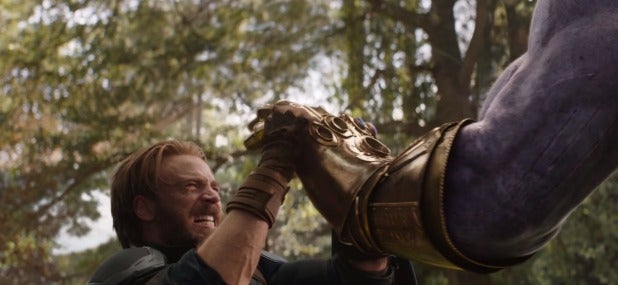
As I said:  in our dreams, we are all Steve Rogers; in our actions, we are much closer to Thanos.

*There is another good article about it at Vox.

Tuesday, May 15, 2018

Thomas' Question*


Mostly just because I can; and I like L.W. III

This is not the whole of Christian soteriology, nor necessarily even a part of it.  But this is the problem with the common conception of Christian "salvation":


Christianity is, by definition, an exclusive religion. Anyone can become a Christian, but doing so means accepting an exclusive doctrine. According to Christ, “I am the way and the truth and the life. No one comes to the Father except through me.”

This, by definition, means other religions are “false.” It’s a bold claim; there’s no denying that.
There is, actually, an ecumenical movement in Christianity that is accepting of other world religions.  Thomas Merton studied Buddhist teachings in Abbey Gethsemani.  Pope Francis pointedly promotes dialogue with Muslims and Jews.  There is, at one level, a widely disseminated sense of the unity of the human family that accepts all expressions of religion, or even non-expressions of religion, as acceptable and even honorable.

And then there's the stupidity of people like Matt Lewis.  I call his statement stupid only because he presumes to speak for me in claiming that my Christianity means I have to read John 14:6 the way he does.  Granted, to even engage this argument on this verse is to accept the standard hermeneutic that Christianity is first and foremost about metaphysical salvation (preservation of the immortal soul, or saving it from damnation).  So let me quote Bultmann on this passage, from his magisterial study of the Gospel of John, one heavily influenced by Kierkegaard and approaching this entire passage (it's part of the Farewell Discourse in John's Gospel.  Jesus goes on and on for 5 chapters, never observing the communion initiation of the Synoptics, and, as one of my New Testament professors said, sucking all the air out of the room.).

Bultmann starts with v. 4 of chapter 14:

The wording of v. 4 is provocative; the believer was addressed on a subject he ought to have known about, and yet did not.  It has the effect of drawing his attention to what has been given him, and thus of inciting him to ask a question about it.  It is Thomas who does so (v. 5)--foolishly, like the Jews (7:35f,; 8.22), because he should have known long ago whither Jesus is going.  His question is typical of the mythological standpoint, which can only conceive fo the goal and the way as things within the world.  And yet to this extent the question has been put correctly:  it makes clear that the disciple's knowledge of his own way depends on knowledge of Jesus' [going].[Bultmann uses a great deal of koine Greek freely; I will translate as best I can.]

Jesus' answer in v. 6 corrects the mythological thinking:

[I am the way, and I am truth, and I am life," replies Jesus.  "No one gets to the Father unless it is through me.]**

By describing himself as the way Jesus makes two things clear:  1.  His case is different from that of the disciples; he does not need a "way" for himself, as the disciples do, rather he is the way for them; 2. the way and the goal are not to be separated as they are in mythological thinking.  In the myth the redemption has become embodied in a cosmic event, and therefore--contrary to the intention of the myth--it is conceived as an intra-mundane event, as a divine history, which takes place apart from the existence of man [sic], who is referred to it as the guarantee of his future.  According to John the redemption is an event which takes place in human existence through the encounter with the Revealer, with the result that the believer's present is already based on his future; his existence is eschatological existence; his way is at the same time his goal.
Bultmann has a way of packing a great deal into a small space.  His exegesis here is not based on the standard hermeneutic that Jesus is all about saving souls, and that the Gospel of John is the locus of salvific teaching to help you escape the flames of Hell.  Bultmann doesn't even start there, but it is difficult to understand what he is getting at if you don't set that hermeneutic aside as one (at least) among many.  Per Bultmann's exegesis Jesus here is not declaring a soteriology, he is in fact making a Christological statement (he equates himself with God, a direct challenge to the Jews of the community the Gospel of John is written for) and a wisdom statement (very much in line with Jewish/Hebraic teachings.  Rabbis, after all, are teachers; and how does one learn wisdom except by being taught?).   Jesus is not, here, declaring himself as somehow the "way" to Heaven (salvation), but the way to God and wisdom and "life into the ages."  That phrase is the Greek phrase used in the Synoptics more than in John, and usually translated, less helpfully, as "eternal life."  It is not necessary, in other words, or I think even proper, to read the Gospel of John as a metaphysical guidebook to the afterlife (that's a very Gnostic reading, ironically.  Ironically because Bultmann notes the analogy to Gnosticism in v. 6, but points out again that the Gnostic teaching relies on what he calls the "myth," which v. 6 abandons.  Reading Bultmann, I would say Lewis' interpretation of John 14:6 is reinstating the myth and missing the point of the original altogether.).

Bultmann underscores this a few paragraphs on:

But the believer finds God only in him, i.e., God is not directly accessible; faith is not a mystical experience, but rather historical existence that is subject to the revelation.

That means that there is no "short cut" to the correct understanding of [truth] and [physical life].  The discovery of this [truth] is not something established once and for all, at men's [sic] disposal, such as could be communicated in "condensed form" like a truth of science on the contrary everyone has to take the way to it for himself [sic], for only on the way does this truth disclose itself.  Similarly Jesus is the truth; he does not simply state it.  One does not come to him to ask about truth; one comes to him as the truth.  The truth does not exist as a doctrine which could be understood, preserved, and handed on, so that the teacher is discharged and surpassed.  Rather, the position a man [sic] takes vis-a-vis the Revealer decides not whether he knows the truth, but whether he is "of the truth," that is to say whether his existence is determined by the truth, whether the truth is the ground on which his existence is based.  And as in Christianity everyone has to start for himself [sic] from the beginning, so too there is no such thing as a history of Christianity which world-history, in the sense of a history of ideas or problems, in which one progresses from stage to stage, from solution to solution; each generation has the same original relation to the revelation.

If however that is the answer to the question Thomas raised, as to the way that leads to the goal which is beyond historical existence, then this much is clear:  the questioner is referred back to his [sic] own historical existence.
The "way" is not a way to salvation, any more than it is a path to wisdom ("Follow this map.  'X' marks the spot.")  Jesus' declaration that he is "the way" is both a turn on Thomas' question (not really an answer, at least not to the question Thomas asked) and a statement made in the context of an early 2nd century community struggling for its identity as now (then) "Jews" (people from Judea) who have, within recent memory lost the Temple in Jerusalem and are only now beginning that rabbinic Judaism we all now think of as the religion of Judaism.  Against that struggle the Christians (Jews who have converted, in John's community) assert their own identity, much as the other Gospel writers did (the Pharisees in particular are the ancestors of the rabbis).  Must we also understand the anti-semitism that arose as a weed in historical Christianity is an essential feature of the religion?  If we do not, why can we not reject the interpretation of John as a basis for an exclusionary Christianity?

Is it really essential to our salvation that somebody else be damned?  Is it really essential to our Christianity that somebody else be wrong?


*"Thomas says to him, 'Master, we don't know where you're going.  How can we possibly know the way?"  John 14:5, SV.  I find it very helpful not to take verses out of context in order to exegete them properly.

**The translation is from the Scholar's Version, which appends this note to the verse:  "This may state the rhetoric of Jewish/Christian conflict that occasions this gospel--or one side of it--as much as the absolute claim it is usually taken to be.  Perhaps Jesus here speaks mainly positively, to reassure his followers, as v. 7 shows."  V. 7, by the way, reads:  "If you do recognize me, you will recognize my Father also.  From this moment on you know him and have seen him."  You have to go quite a ways from that to "And those who don't, burn in hell!"

Quotes from Rudolf Bultmann, The Gospel of John:  A Commentary, tr. G.R. Beasley-Murray, R.W.N. Hoare, and J.K. Riches.  The Westminster Press, 1971.

Monday, May 14, 2018

Arhythmic grumbling


In a Peanuts strip of sainted memory (meaning I can't find it easily via Google, and I'm not gonna do the work....), Sally Brown is giving a report to her class about overpopulation, and she says the problem is everybody is concerned about it but nobody wants to leave.  It's a variant on the argument that so long as things are good for me and mine, things are good and if there's a problem, it's with all those other people.  Or, as Ezra Klein puts it in an article about how bad things aren't these days:

Ian Haney López, director of the Racial Politics Project at the University of California Berkeley’s Haas Institute, calls the 20th-century United States “a herrenvolk liberal democracy” — a democracy for the majority ethnic group but something very different for the rest of society. “That herrenvolk liberal democracy solved major problems for whites,” says Haney López. “It solved the problem of national identity. It solved the problem of how to ensure wealth in society was continuously pushed downward and outward, so prosperity was shared and broad. For whites, democracy was working very well.” But for nonwhites, America was neither liberal nor a democracy."*

Which, I have to pause to point out, is what Dr. King said in his most famous speech; in the part we uniformly ignore:

But one hundred years later (All right), the Negro still is not free. (My Lord, Yeah) One hundred years later, the life of the Negro is still sadly crippled by the manacles of segregation and the chains of discrimination. (Hmm) One hundred years later (All right), the Negro lives on a lonely island of poverty in the midst of a vast ocean of material prosperity. One hundred years later (My Lord) [applause], the Negro is still languished in the corners of American society and finds himself in exile in his own land. (Yes, yes) And so we’ve come here today to dramatize a shameful condition.

In a sense we’ve come to our nation’s capital to cash a check. When the architects of our republic wrote the magnificent words of the Constitution and the Declaration of Independence (Yeah), they were signing a promissory note to which every American was to fall heir. This note was a promise that all men, yes, black men as well as white men (My Lord), would be guaranteed the unalienable rights of life, liberty, and the pursuit of happiness. It is obvious today that America has defaulted on this promissory note insofar as her citizens of color are concerned. (My Lord) Instead of honoring this sacred obligation, America has given the Negro people a bad check, a check which has come back marked insufficient funds. [enthusiastic applause] (My Lord, Lead on, Speech, speech)

But we refuse to believe that the bank of justice is bankrupt. (My Lord) [laughter] (No, no) We refuse to believe that there are insufficient funds in the great vaults of opportunity of this nation. (Sure enough) And so we’ve come to cash this check (Yes), a check that will give us upon demand the riches of freedom (Yes) and the security of justice. (Yes Lord) [enthusiastic applause]

We have also come to this hallowed spot (My Lord) to remind America of the fierce urgency of now. (Mhm) This is no time (My Lord) to engage in the luxury of cooling off or to take the tranquilizing drug of gradualism. [applause] (Yes, Speak on it!) Now is the time (Yes it is) to make real the promises of democracy. (My Lord) Now is the time to rise from the dark and desolate valley of segregation to the sunlit path of racial justice. Now is the time [applause] to lift our nation from the quicksands of racial injustice to the solid rock of brotherhood. Now is the time (Yes) [applause] (Now) to make justice a reality for all of God’s children.

It would be fatal for the nation to overlook the urgency of the moment. This sweltering summer of the Negro’s legitimate discontent (Yes) will not pass until there is an invigorating autumn of freedom and equality. (My Lord) 1963 is not an end, but a beginning. (Yes) And those who hope that the Negro needed to blow off steam and will now be content will have a rude awakening if the nation returns to business as usual. [enthusiastic applause] There will be neither rest nor tranquility in America until the Negro is granted his citizenship rights. The whirlwinds of revolt will continue to shake the foundations of our nation until the bright day of justice emerges.

We might mention that "promissory note;" but "whirlwinds of revolt"?  Yeah, we've forgotten that already, and it's only been, what, 50 years?  Indeed, talk like that is "identity politics," isn't it? At least, I'd say.  Things were so much calmer back then, right?  So much simpler than today, especially with selective memory.  Then again, it is clear that Ezra Klein is still learning (and kudos to him for doing it on the public stage):

Levitsky and Ziblatt, for instance, write that, “The norms sustaining our political system rested, to a considerable degree, on racial exclusion.” It’s an unsettling analysis that raises the question of how long, exactly, America has actually been a democracy.
I didn't come to that "unsettling analysis" myself until not quite 20 years ago, and being almost 30 years older than Mr. Klein I don't think he finally caught up with reality, but that he's catching up even faster than I did.  But it is reality; which brings me to fantasy.

That fantasy being the premise of the film "Avengers:  Infinity Wars."  Thanos is finally the villain some critics have said Marvel movies lack.  He shows compassion (insofar as he can) for his adopted daughter Gamora (we've met her in the "Guardians of the Galaxy" movies), which we see when he first met her, as a child (just as Thanos' troops are slaughtering half the inhabitants of Gamora's planet, including her mother).  Which is to say he has complexity, a sense of responsibility if no sense of guilt.  Thanos, we are given to understand, has been pursuing his goal long before he donned the gauntlet that allows him to collect, and employ, the infinity stones to enforce his will on the universe.  There are two stories here, aside from the motivations of Thanos (that would be another, albeit interesting, discussion):  one is the use and abuse of power.  Power used to defend is good, a fundamentally American ideal.  We've turned against torture because we think we aren't defending ourselves anymore.  While we were, it wasn't so bad.  We changed our "War Department" to the more anodyne "Defense Department" because we need to defend ourselves; but we don't want to always be at war, or preparing for war; which is exactly what a "defense department" is for, as it turns out.  But "Defense" sounds so much nicer, so much more...defensible.  That's the fight, really, in the Avengers movie that precedes "Infinity War":  "Captain America:  Civil War."  The plot of that film pits Tony Stark (Iron Man) against Captain America.  Tony wants a defense department, ready to protect the world (or the U.S.) when needed, held in check otherwise.  Steve Rogers (Captain America) wants a War Department, one needed only in time of war, not wandering around looking for  ways to prevent what the government perceives as trouble.  It's a fine distinction to those being attacked.  Captain America leads an assault on a villain that inadvertently creates significant damage to innocent people, the same thing Stark is confronted with in the movie, from his previous actions building Ultron, a villain who also caused the deaths of millions of innocents when Stark's aim was to defend those innocents from alien invader villains.  In the end we root for Captain America, but we understand Stark's position, too; they really aren't that far apart, but where the emphasis falls, as always, is the bone of contention.

The moral quandaries of those films are blanked by the villainy of Thanos, who wants nothing less than the annihilation of half of life in the universe (intelligent life, apparently; not plants and "lower" animals).  His power to pursue that goal is his villainy, but his desire is equally villainous.  What would have made the film more interesting is if Thanos' actions had displayed a moral universe in which he was annihilated in his wish.

Because what Thanos wants is a universe that suits him.  He doesn't want to balance the universe, as he often says in the film; he wants it to be balanced for his apperception.  He wants to enjoy the balance.  It is a given his wish does not include him.  The norm he wants to impose on the universe rests on his exclusion from that imposition.  He wants to be in it, but not of it; and that, actually, is the most villainous posture of all.

When Captain America insists, at the end of "Civil War," that a better system of control must be possible than the imprisonment of those who sided with him (he frees them from the prison they are put in), we approve of his illegal act.  Justice is for other people, not for people like us (and who watches a comic book movie and doesn't identify with the heroes, even if governments say they are criminals?).  It is not something we see easily, because all we see in comic book movies is violence:  the bad violence of the villains, the reactive violence of the good guys, who are always a step behind, but who eventually prevail if only because their violence has an approved end.  It never looks like this:

In White Rage, Carol Anderson reflects on the protests in Ferguson, Missouri, and the way the nation has always been transfixed by black rage, by images of “rampaging, burning, and looting.” But not all rage is so visually arresting. “White rage is not about visible violence,” she writes, “but rather it works its way through the courts, the legislatures, and a range of government bureaucracies. It wreaks havoc subtly, almost imperceptibly. Too imperceptibly, certainly, for a nation consistently drawn to the spectacular — to what it can see.”
It isn't just that we can't see it; we don't see it.  Governments and laws that keep us safe, happy, secure, comfortable, are doing what governments should do.  Governments that are helping the poor, the downtrodden, the dispossessed, the "other," make us uncomfortable, and that leads to "white rage."  White shooters, it is too often pointed out, are "lone wolves," are "disturbed," are "unique."  Black shooters are proof of "thug culture," brown shooters are "terrorists; everyone in those groups is to be feared because of the acts of individuals.  Whites are not to be feared as a class because we know "we" are "not like that."  And we aren't; but we are like Thanos, wishing for a universe that suits our preferences, our predilections.

And what makes Captain America a hero is that he accepts his status as an outlaw. He doesn't want to control the change of the world, he wants to be a moral example in it. Thanos wants to remake the universe in his image. That's what makes him a villain. But while we think we are Steve Rogers, we act like Thanos.  We think we know what the problems are in the world, and we always think those problems stem from other people; and if we could just get rid of them.....

Consider this bit of irony I just read about over at Thought Criminal:

Braasch has also fought againt hate crime laws. “I am pretty much the only person I know who hates hate-crime legislation as little more than bald-faced thought-crime legislation. I am not infrequently verbally vilified for asserting the claim that morality has no place in the law,” she wrote in the 2010 article. In 2011 she wrote a piece on Daylight Atheism titled, “Be Careful What You Wish For (Why I Hate Hate Crimes Legislation, But I Love Hate Speech).” 

"Braasch" is Sara Braasch, the graduate student at Yale who thought Lolade Siyonbola should be asleep in the common room of a dorm on campus because Ms. Siyonbola is black.  Well, there wasn't much other reason to suspect she didn't belong there.  I learned this experience in seminary, a very white seminary with deep German roots where one professor was black (and he taught me a great deal about being black in America, things I'd always known but never acknowledged), and one black woman, a student.  She came in full of justified anger toward white people, one of the few (if memory serves, one of the only) black students I saw in four years in seminary.  We learned about her, she learned about us, and we taught each other about the two Americas we lived in, although she mostly taught us about the America she lived in.  I most remember her because one of my classes featured a video from a mega-church "seeker service," one that was pointedly more about entertainment than about any kind of traditional worship.  The "sermon" of that service was a man (woman?) portraying a poor white woman, for the comedic possibilities and entertainment of the crowd.  I was the only person who didn't laugh because I pointed out that person resembled my family, mostly poor whites themselves.  I thought insulting people in the name of Christian worship, even in a "seeker service," was hardly Christian and was certainly offensive, at least to me.  Two people sided with me, privately, after the class unanimously told me to "lighten up."  One was a Southerner herself (there is a line between the South and the Midwest, and Missouri is not as Southern as it thinks it is, especially in St. Louis); the other was the black woman.  She said my story made her realize that, had the actor been in blackface, it would have offended her, and it was little different that the actor portrayed a poor white as a figure of mockery.  I had learned to respect her long before that day; but that day, we both realized we were fellow human beings.

We don't need to get rid of people:  we need to see them as fellow human beings.  I don't have an answer for how we do that.  I don't want to just be outraged that we don't.  I do know it's something we have to work very hard at, very conscientiously, and for all our lives.  We'll never be able to snap our fingers and solve the universe's problems as we see them; and we'll never be able to solve them by being the better fighters, or having the better reason to fight.  We can't rest on the past we think once existed, or worse insist upon its recovery.  Perhaps we could start with recognizing that complaining about "identity politics" does not mean we don't have an identity we think is both normative, and above "mere politics."  Because then why is ours the one so privileged, and not theirs?


*I have to point out Mr. Klein doesn't understand the full implications of everything he quotes, as he also quotes "Tiger Mom" Amy Chua (who is as qualified to opine on American political history as she is to give advice on child rearing, IMHO):

We find ourselves in an unprecedented moment of pervasive tribal anxiety. For two hundred years, whites in America represented an undisputed politically, economically, and culturally dominant majority. When a political tribe is so overwhelmingly dominant, it can persecute with impunity, but it can also be more generous. It can afford to be more universalist, more enlightened, more inclusive, like the WASP elites of the 1960s who opened up the Ivy League colleges to more Jews, blacks, and other minorities — in part because it seemed like the right thing to do.

Today, no group in America feels comfortably dominant. Every group feels attacked, pitted against other groups not just for jobs and spoils but for the right to define the nation’s identity. In these conditions, democracy devolves into zero-sum group competition — pure political tribalism.
Chua doesn't even notice that "white" in the '60's still didn't include Jews; anymore than it included most of Europe that wasn't Britain (which to this day insists it is NOT Europe) or French (or even all of Britain, eh, Ireland?) for much of the 19th century.  Funny thing about "Gangs of New York" is that it's whites against whites, but neither group at war in the New York slums is considered "white" by the New York elites.  Yeah, our problem today is "pervasive tribal anxiety."  Because some definitions (who is "white"?  Who is not?) are more tribal than others, eh?  And I guess that problem never arose with the people the Europeans found here?  Or the people the Europeans enslaved and brought here? Or at any time in the 19th or 20th centuries?  Yeah, as I was saying....

Thursday, May 10, 2018

Oh, dear, what can the matter be?


Really?  You think that's the problem?

I am still a member of the Texas Bar, even though I haven't practiced law in 25 years (and never intend to again, especially at this time of life).  I used to spend some time with the Bar Journal that comes to me every month, reading about lawyers who had died, or retired, or changed firms.  I knew a few of them at the time, or might have (it's a big state).  I do remember the disbarment proceedings reports:  not because of any one person's story, but because it was so unusual.  Violations of ethics for lawyers is complicated, like everything else.  There are basically two sets of rules:  one describing the things you should do, the other describing that which you cannot do.  Running afoul of those can cost you your license to practice law.

As I recall, the surest way to a disbarment proceeding was to mess with your client's property, most commonly the money clients have given you as a retainer, or that you hold for any purpose in escrow.  Escrow creates a special relationship that stock brokers are so anxious today not to be burdened with:  a fiduciary duty.  Simply put, the fiduciary duty means you must take care of the property (usually, again, $$$$) with greater care than you would your own property.  Breach that duty, and you are almost guaranteed a world of hurt.  The shortest route to disbarment, in other words, is to mess with the client's money.

Which is why Rudy Giuliani's old law firm is saying this:

“We cannot speak for Mr. Giuliani with respect to what was intended by his remarks,” the firm’s spokeswoman said. “Speaking for ourselves, we would not condone payments of the nature alleged to have been made or otherwise without the knowledge and direction of a client.”

Because what Giuliani is alleging is a breach of fiduciary duty.  You may say you did it to allow the client to keep clean hands (which is probably illegal, and undoubtedly unethical, since you are basically engaging in fraud against your client even if you think it is for the client's protection), but the simple fact is:  you don't mess with the client's money.  Do law firms do this anyway?  It's certainly possible; it may even be gospel Giuliani is speaking.

But there used to be a thing called a "secret gospel," and it was secret for a reason.  Giuliani is basically asking the State Bar of New York (or the AG, I don't know how the Bar is set up under New York law) to begin an investigation into the ethical and legal practices of Greenburg Traurig.  Some clients may prefer the plausible deniability of the situation Giuliani describes; other clients may just want to investigate the accounting on the funds they have given to the firm to be held in escrow, as a retainer or for any other purpose.

In short, Giuliani seems to have tired of damaging Trump and, like Trump, wants to damage everyone associated with him.

It must be something in the water in Manhattan.....

The Glenn Greenwald Seal of Approval


Which, among other things, led to:
And a reminder to many of us who probably need it:
And the cherry on the sundae:
The White House response did not deny the statement was made:

“We respect Senator McCain’s service to our nation and he and his family are in our prayers during this difficult time,” the White House said in a statement to The Hill.

The Hill notes that:
Sadler is a former opinion editor for The Washington Times. At the White House, she focuses on illegal immigration, often sending out press releases to highlight stories about the issue to reporters.

So, is it an accident that happened when this happened yesterday, and was reported today:

Kirstjen Nielsen, the homeland security secretary, told colleagues she was close to resigning after President Trump berated her on Wednesday in front of the entire cabinet for what he said was her failure to adequately secure the nation’s borders, according to several current and former officials familiar with the episode.
Another day in the life of the mole people.  But it's not complete without the end of the NYT article:

Mr. Trump’s anger about immigration has grown in recent weeks, according to several officials. He repeatedly claimed credit for the fact that during his first year in office, illegal border crossings dropped to their lowest levels in decades. But this year, they have risen again, robbing him of one of his favorite talking points.

In remarks to reporters before Wednesday’s meeting, Mr. Trump hinted at the anger that would cause him to erupt once TV cameras were led out of the room.

“We’ve very much toughened up the border, but the laws are horrible,” Mr. Trump said. “The laws in this country for immigration and illegal immigration are absolutely horrible. And we have to do something about it — not only the wall, which we’re building sections of wall right now.”
The laws are "horrible" because reality won't stay where it should:  in the TeeVee.

I love wall.  I love lamp.  And apologize to Sen. McCain and his family?  The President still prefers soldiers who don't get captured.  And wall; he loves wall.

Wednesday, May 09, 2018

Diplomacy is for loosers

Richard Grennel is the new U.S. Ambassador to Germany.  Apparently Twitter is now the preferred platform for U.S. diplomatic communiques.  Of course this is the diplomacy of the Ugly American.   And when it was noted this was a less than auspicious beginning, the new U.S. Ambassador to Germany said he was only following orders. On Twitter, of course.


Yeah, we may not survive this after all.

President Blue Collar


Molly Ivins used to say she loved having lunch with the Texas oil men at the Petroleum Club (I think her reference point was the one in Midland, but there was one in the town where I grew up, too), but she didn't want those guys running the country.

Can you tell which one is the guy you might like to have a beer with, and which one shouldn't be running the country?

“No chance,” scoffs Mike Sawchuk, 72, wearing an Eagles jacket and baseball cap, excitedly heading into the night with six Stormy autographs, purchased at $10 a pop, scrawled on baseballs.

He doesn’t think for a second that the busty blonde poses a serious threat to Trump, pointing out that sex scandals also dogged the presidencies of John F. Kennedy and Bill Clinton.

“I love Trump, I hope he straightens out this country. The other presidents really screwed us bad… Look at Korea, he almost has that straightened out!”

Neither was he the only detractor among the 50 or so clients who came to watch Stormy on a Monday night in Philadelphia. In ultra-polarized America, there are plenty of detractors about a scandal that has dominated headlines for months.

Howard, who refuses to give his last name, believes Trump has the upper hand. “He is bigger than that… and she is just a stripper.”
Vs.

 “He’s going big, with what he believes, and confident in it all,” a White House official told the website. “POTUS ran against experts — the ‘eggheads’ — and believes that rebalancing our policies on trade, defense spending, security, etc., simply makes sense.”

Trump was annoyed when Tillerson argued in favor of staying in the deal, an administration source said.

“He felt like Rex was always making excuses to stay in,” that source said.

Trump felt contempt for the officials and experts who negotiated the Iran deal, and the White House official explained the president’s motives for risking a potential Middle East crisis and setting in motion a chain of long-term consequences.

“(Trump) likes it when ‘experts’ are on CNN freaking out,” the White House official explained.
People like this:


There is a point where egalitarianism has to give way to competence.

Tuesday, May 08, 2018

And President John...


And Secretary Richard....

Today what we’re hoping to do is – there have been discussions between that day to now, and we’ve continued to develop both administratively and sort of begin to put some outlines around the substance of the agenda for the summit between the President and Chairman Un. And today we’re hoping to nail some of those down to say – to put in place a framework for a successful summit between the two presidents.

Or, as he is properly known, Supreme Leader Kim.  For those of you who imagined Pompeo was somehow a step up from Tillerson.

About going down into the dark


I was going to cast about for various news articles from which I could assemble a response to Trump's predictable stupidity (really, who is surprised by this?).  Sen. Flake, surprisingly, saved me the trouble:

Iran has already realized the benefits, which were front-loaded, in terms of sanctions relief and the release of these funds that were held in dispute, billions of dollars. And now, by our unilateral exit, it would give them license to renege on the nuclear aspects of the deal. So the West has upheld its end of the bargain, which was mostly front-loaded, and now Iran could get out of their agreement, and that just doesn’t make sense to me.

And also, I think, one of the most important things is, it’s just another signal to the world that we’re not a reliable partner. We begin negotiations, like on the [Trans-Pacific Partnership] and then we exit them. Or here, we actually execute an agreement, a new President comes in, and we’re out.

We’ve had a rules-based order that we have helped establish for 70 years post-World War II. And to see us just vacillate and move in and out, whether it’s tariffs that are imposed, and then certain countries exempted, it’s not so rules-based anymore, it’s ad-hoc, and we’re just not seen as a reliable partner.

We’re going to need to work with our allies, closely partner with them to address security challenges like North Korea, and the knock-on effects of us exiting here are not good.

There are also internal struggles in Iran between "moderates" and "hard-liners," and the U.S. walking away from this agreement strengthens the hand of the latter.  Perhaps Netanyahu and Bolton imagine a war with Iran would be a good thing, and so they fervently desire it.  Given how Israel left Lebanon (once a beautiful and peaceful country, now still a disaster area) and how the U.S. left Iran (no better off than we found it), one wonders what they are imagining for the future.  I read somewhere the Congress could effectively override Trump's decision, but I don't hold my breath on that before the midterms, and afterwards I think is too late (by the agreements terms).  I am convinced Trump just thinks he's "fixing" one more thing the "black guy" screwed up, and that's as much as he'll ever understand.  Given his past statements against involvement in Iraq, and then hiring Bolton the neo-con's neo-con cheerleader, it is proof enough Trump can't hold one thought in his mind.

This will probably make things worse; it certainly won't make them any better.

ADDING:  Trump talks on-line in Tweets (and does little better in person).  Obama speaks on-line rarely, but in full, reasoned paragraphs.  The best words, too.

Morning Twit


"TOUGH ON TERROR" translates as "What we did to Abu Zubeydah," and which Congress has again declared to be against the law.  "Bright and glorious future" sounds a bit too close to North Korean propaganda for comfort.
What negotiations?  The agreement with Iran involves Russia, China, Germany, France and England as signatories, along with the U.S.  There are no negotations to change it, and now the U.S. is likely to break its word and walk away from the deal.  And then what?  Sanctions on India and China, which buy most of Iran's oil?  Sanctions on Germany and France for trading with Iran, as they do now?  And how, exactly, does walking away from the agreement keep Iran from building a nuclear weapon or a delivery system for it?  I don't think it's John Kerry who is hurting our country.  (Not to mention experts who say Trump has already raised the price of gas, and a withdrawal from the agreement could raise it by 30 cents a gallon or more.  Yeah, that'll be popular.)

Monday, May 07, 2018

We all go down into the dark

John McCain, as all the world knows, is dying of brain cancer.  No matter what I think of John McCain's politics or his public actions, he is a human being; he has a family; he has friends; he deserves a measure of regard that all the dying deserve, because death is the great equalizer we all stand before together; sooner or later.

Unless, apparently, you are on Twitter:


The best part about Twitter is making it all about you:

Free speech is fine as long as you agree with me?

To everything there is a season, and a time to every purpose under heaven and every disagreement is propaganda, if you disagree with Glenn Greenwald.

Always knew I'd disagree with Glenn Greenwald on what day of the week it was; never saw myself agreeing with Bill Kristol or Jonah Greenberg, though:

Well, that criticism of a dying man (who was not a despot or a tyrant or responsible for the deaths of millions) is repulsive, we agree on; the rest, not so much (except voting for Trump).

Or the love of their ideology, their determination to impose their view on the world, and criticize the world for not conforming to it immediately, if not sooner.

Remember your Creator before the silver cord is snapped and the golden bowl is broken, before the pitcher is shattered at the spring and the wheel broken at the well, before the dust returns to the earth as it began and the spirit returns to God who gave it.--Ecclesiastes 12:6-7 (REB) 
 Seems better advice than criticizing the dying.


"Yes, Virginia, there is a legal system"


So all that babble about a federal judge in one case against Paul Manafort questioning why Mueller is bringing the charges has gotten Trump and other non-lawyers all excited.  But there is in fact a legal system in place, and if Mueller can't prosecute Manafort, someone else in the DOJ can, and will.

“There’s no evidence in the courtroom in front of him to justify that kind of an opinion,” [Andrew Napolitano] observed. “It drew enormous headlines over the weekend because it’s a political narrative with which Trump and reporters agree.”

“It is probably correct but it is irrelevant to the ruling on the matter,” he added. “The matter was Manafort moves to dismiss the indictment against him on the theory that Mueller doesn’t have the jurisdiction to prosecute me for bank fraud. The judge says, where does the jurisdiction come from? It comes from a letter authorizing it from the appointing authority, [Deputy Attorney General] Rod Rosenstein.”

Napolitano pointed out that even if Ellis rules in favor of Manafort, the case will simply continue under another prosecutor.

“Legally, it’s of no significance,” Napolitano said of Ellis’ remarks. “And Judge Ellis… knows that.”

Which, to repeat, is pretty much what happens if Trump fires Mueller:  the investigation continues under a new DOJ attorney.  Period.  All of this speculation about "Will Trump fire Mueller?" and "When will Trump fire Mueller?" is just misinformed and misdirected.  Trump can't fire Mueller, and if he appoints someone who will, the investigation will carry on, with renewed cause to wonder what Trump was trying to hide by firing the special prosecutor.  It wouldn't be a "Constitutional crisis," it would be Trump cutting his own (metaphorically) throat.

Trump has no clean way out of this, except to resign.  But he won't do that, because then he couldn't try to pardon himself.

I'm kinda holding out for him to try that, honestly.

"Yoo made me do it"


Probably the worst argument for promoting Haspel to head the CIA

I can't directly connect Gina Haspel to the torture of Abu Zubaydah, since she was not the Chief of Base at Detention Site Green in Thailand in from March through August, 2002 (she took that position in October of 2002).  To refresh your memory of what we mean by "torture," I would advise this account of what Abu Zubaydah suffered, for no purpose, during those months, in the name of We, The People.  She wasn't present for Mr. Zubaydah's torture, but she was there as COB for the torture of Abdul al-Rahim al-Nashari.  Mr. Zubaydah was waterboarded 83 times in four months.  He is still in U.S. custody, but his condition is classified.  His lawyer is only authorized to report this:

Because of what he was made to endure, Abu Zubaydah suffers from frequent seizures, the origin of which cannot be determined. He is tormented by sounds that others do not hear, and cannot remember simple things that others cannot forget. Because his condition is classified, there is much about his welfare that the United States will not let me say. They have authorized me to report, however, that I am “very concerned.”

Zubaydah's lawyer also notes:

Other questions surround her role in the destruction of nearly 90 videotapes of my client’s torture, as well as several showing the torture of al-Nashiri. Again, the public record is ambiguous. On the one hand, there is no question that Haspel signed the cable directing that the tapes be destroyed. This is an exceedingly serious matter, not simply because it led to the destruction of irreplaceable evidence, but because at least one federal judge had explicitly ordered that the tapes be preserved. If Haspel deliberately violated the order of a federal judge, she could — and should — be held in contempt of court.
As for the destruction of those videotapes, they didn't involve just the torture of Abu Zubaydah:

Haspel moved to cover up the agency’s operations at the Thai base. The chief of base told the security officer “to burn everything that he could in preparation for sanitizing the black site,” Mitchell wrote in his book, “Enhanced Interrogation: Inside the Minds and Motives of the Islamic Terrorists Trying to Destroy America,” which was published late last year.

According to Mitchell’s account, the security officer asked the chief of base whether he should include the tapes; he was told to hold off until “she” could check with Washington.

She was told to retain them. A few years later when she was back in Washington and chief of staff to the director of operations for counterterrorism, Jose Rodriquez, the man who had sent her to Thailand, she continued to lobby for destruction of the tapes.

“My chief of staff drafted a cable approving the action we had been trying to accomplish for so long,” Rodriquez writes in his memoir. “The cable left nothing to chance. It even told them how to get rid of the tapes. They were to use an industrial-strength shredder to do the deed.”

Without approval from the White House or Justice Department, Rodriquez gave the order.

In a twist of fate, destroying the tapes drew more outside scrutiny of the program. Disclosure of the shredding prompted the Senate Intelligence Committee to begin its long-running examination of the torture program. The result was a 7,000-page report that drew on thousands of highly classified cables relating to the Bush administration’s rendition and detention program and concluded torture was not effective.  
It's always the cover up, isn't it?  The CIA's defense of its action is that the tapes were not necessary, that detailed records were preserved:

Remarkably, the CIA argued that it did not need to preserve videotapes of its “enhanced interrogations” — torture sessions with suspects that involved methods like wall slams, confinement boxes, and waterboarding — because they were like formal government meetings, and therefore less stringent guidelines applied when it came to preserving records of such a “meeting.”
...
 In the correspondence they show, the CIA maintained that it was justified in destroying the tapes of torture sessions because it preserved cables and transcripts that, in its own judgement, accurately depicted what was on the tapes. In other words, the CIA argued that it could destroy the videotapes because it still had a record of what was on them — albeit in written, not recorded, form.
Go back and read just the summary of the torture of Abu Zubaydah for 4 months, and consider how much more graphic and disturbing it would be to watch the videotapes of those sessions.  Then consider what it means to appoint someone like Gina Haspel to head the CIA in the Age of Trump. the age in which, as John McCain puts it:

“The appearance of toughness, or a reality show facsimile of toughness, seems to matter more than any of our values.”
And a bit more pointedly:

“His lack of empathy for refugees, innocent, persecuted, desperate men, women and children is disturbing. The way he speaks about them is appalling,” said McCain, who still chairs the Senate Armed Services Committee despite his long medical absence from Washington.
.....

“The world expects us to be concerned with the condition of humanity. We should be proud of that reputation,” McCain said. “I’m not sure the President understands that.” 
Quite plainly, the President does not; the nomination of Gina Haspel to head the CIA is further proof of that.

Sunday, May 06, 2018

So, Emmett Flood is gonna fix this for Trump, right?


Right?


Will he do it by replacing Giuliani?

Former New York Mayor Rudy Giuliani was reportedly huddled with his client, President Donald Trump, at Trump National Golf Club in Virginia on Sunday afternoon after appearing on ABC for a widely-panned morning show appearance.

Getting up to speed on more facts, I guess.

This is like documenting a train wreck happening in slow-motion.  And I thought Nixon was evil and corrupt; he's beginning to look like a choir boy.  And I'm beginning to realize he almost got away with it, and Trump is being caught out more by his incompetence than by the "system" working.

Why Nobody Wants Trump At Their Funeral


On Friday, Trump also managed to disgust the French by acting out the 2015 terror attack at the Bataclan concert hall in Paris. He used his finger as an imaginary gun and said, “They took their time and gunned them down one by one. Boom! Come over here. Boom! Come over here. Boom.” He insisted armed civilians could have stopped the attack that killed a total of 130 people.

Paris mayor Anne Hidalgo blasted Trump’s comments as “contemptuous.” Former French president Francois Hollande called his remarks “shameful” and “obscene” in a tweet.
And remember this?


“We are fixing and building walls, but we need much more money,” he said at a Cleveland event touting his tax law Saturday. “We may have to close up our country to get this straight, because we either have a country or we don’t.”
The man has no respect for anyone, or anything, including good sense.