Thursday, October 29, 2015

Hallowe'en 2015

To be honest, the whole post is just an excuse for this gif.  Again.

I could just link to this; the comments there are certainly worth preserving.  But be honest, who follows my links anymore? (Indeed, who reads this blog anymore?  I've been combing spam out of comments, and it's nostalgia or wistful thinking, but things used to be more interesting around her once upon a time.  I blame the host!)  I'll re-post it anyway, even though some of the links may be dead after a year, and the controversy of children crossing invisible neighborhood borders to ask for free candy is not quite as heated as it was in 2014.

I consider this something of a public duty now, trying to untangle the skeins of nonsense surrounding the winter European holidays.  Hallowe'en probably has nothing to do with Samhain so much as Samhain has to do with All Hallow's Even, and Christmas has bugger all to do with Mithra or the winter solstice or Saturnalia.  But that's putting Christmas ahead of Hallowe'en, and we have retail stores to do that every year.  Repeating this information in my little corner of the internet, where it basically disturbs the dust and mice in the corners, is my job.

Maybe if somebody would declare a "War on Hallowe'en" I could get in on that action......

Oh, and before we commence the re-post, there's a nice discussion of Hallowe'en and All Souls here (although my stats tell me most of you come here from Thought Criminal, so odds are you already know that.  Either way, it's enjoyable listening).


This apparently, is what Halloween is becoming:

"I have noticed that on Halloween, what seems like 75 percent of the trick-or-treaters are clearly not from this neighborhood. Kids arrive in overflowing cars from less fortunate areas. I feel this is inappropriate. Halloween isn’t a social service or a charity in which I have to buy candy for less fortunate children," the anonymous homeowner whined.

"99 Percent" felt a little bad about wanting to cancel Halloween, but worse about taxes.

"Obviously this makes me feel like a terrible person, because what’s the big deal about making less fortunate kids happy on a holiday? But it just bugs me, because we already pay more than enough taxes toward actual social services," "99 Percent" wrote.
Well, I'm being unfair; that's probably NOT what Halloween's becoming; but the international back fence that is now the internet has made available to us all the small-mindedness of some, and it's no surprise we assume it is the attitude of the many.

Or we fear it is, anyway.

But isn't fear what Halloween is all about?

I don't honestly know where Halloween came from.  Various on-line sources connect it to Samhain, the Irish harvest (except it probably had nothing to do with a harvest; see below) festival, and to celebrations that came to this country from Ireland and other European countries in the 19th century.  Seems reasonable enough, if Samhain is connected to All Saint's Day.  But New Advent is my preferred on-line source for these matters, and it doesn't connect the day to the festival.  Pope Boniface did indeed establish an anniversary on March 13 for the dedication of the Pantheon in Rome to the Virgin and all the martyrs.  Pope Gregory III consecrated a chapel in St. Peters to the saints on November 1, about a century later.  Then Pope Gregory IV extended anniversary on November 1 to all of the church sometime in the early 9th century.

Which is not quite the story you get at other internet sites, viz:

On May 13, 609 A.D., Pope Boniface IV dedicated the Pantheon in Rome in honor of all Christian martyrs, and the Catholic feast of All Martyrs Day was established in the Western church. Pope Gregory III (731–741) later expanded the festival to include all saints as well as all martyrs, and moved the observance from May 13 to November 1. By the 9th century the influence of Christianity had spread into Celtic lands, where it gradually blended with and supplanted the older Celtic rites.
I throw that in because, first:  why not?, and second, because close only counts in horseshoes and hand grenades.  Sir James Frazer seems to have started the idea that All Saint's was connected to Samhain, but the only evidence he offers is that the former is a thin overlay on the latter.  (Frazer also sold us on the connection between Mithraism and Christianity, a connection no one sees anymore.  His scholarship didn't prove to last very long, in other words.)  History indicates it seems to have been more of a coincidence than not, and that in the 7th and 8th centuries the Irish church was celebrating All Saint's on April 20.  And when Gregory moved the festival, why was he concerned with practices in Ireland?  Especially since the Irish church was fine with a date in April?  And that's all long before the 9th century, so I'm left wondering whose dates are these anyway?

The history gets more interesting when you throw in All Souls:

In the early days of Christianity the names of the departed brethren were entered in the diptychs. Later, in the sixth century, it was customary in Benedictine monasteries to hold a commemoration of the deceased members at Whitsuntide. In Spain there was such a day on Saturday before Sexagesima or before Pentecost, at the time of St. Isidore (d. 636). In Germany there existed (according to the testimony of Widukind, Abbot of Corvey, c. 980) a time-honoured ceremony of praying to the dead on 1 October. This was accepted and sanctified by the Church. St. Odilo of Cluny (d. 1048) ordered the commemoration of all the faithful departed to be held annually in the monasteries of his congregation. Thence it spread among the other congregations of the Benedictines and among the Carthusians.

Of the dioceses, Liège was the first to adopt it under Bishop Notger (d. 1008). It is then found in the martyrology of St. Protadius of Besançon (1053-66). Bishop Otricus (1120-25) introduced it into Milan for the 15 October.
No apparent connection to Samhain there, especially since October seems to have been the preferred date.  I imagine it was moved to November 2 to line up against November 1, and not to "paper over" some connection to pagan practices, which can't have been all that widespread and in need of adoption by the church in the 10th and 11th centuries.  (I highlighted the line about the German observance because it seems an obvious root for the German E&R Totenfest.  It transferred from the German Catholics to the German Protestants, probably with a strong connection through the Lutherans.  These things to persist in cultures, but it isn't always a Christian overlay on a pagan ceremony.)

While we're on the subject, Samhain is usually referred to as a "Harvest" Festival.  However, as Frazer points out (on this I find him reliable),  by November 1 the harvest is already long in from the fields.  Urban dwellers miss this point, but I remember my two years in a southern Illinois country church, and the fields were bare long before October 31.  So it's no significant date for farmers, but Frazer points out it is significant for herdsman.  November 1 (or thereabouts) would mark the time to drive the flocks in from the field for the winter.  It would be a very significant date indeed for shepherds in Ireland (and it was).  Frazer goes on to note, with no real particularity, that the time of transition from autumn to winter (i.e., time to bring the flocks in from the fields) was celebrated across Europe as a time when the departed returned to earth (probably to seek warmth, too, Frazer conjectures, as winter winds began to blow) and when witches and demons wandered free, seeking to do mischief (again, because winter in northern Europe is hard).  Frazer tends to speak in these sweeping generalizations, which makes his work less than reliable over all; but it makes sense in a Northern European climate to connect winter with death, and the coming of winter with the return, briefly, of the dead (who are, in sense, never lost to the living, so long as memory remains).  So while the connection between Halloween and Ireland is a bit obscure, except for the jack o'lanterns, which I'll accept were Irish (though probably originally made from turnips, pumpkins being an American plant).

You can get all kinds of bad information on this topic.  Here's an excerpt from "American Catholic," calling Samhain "the Lord of the Dead" and attributing the date of November 1 to Gregory III about 100 years after his papacy ended.  I haven't found that designation anywhere else.  The link to Roman rituals involving Pomona and apples is another common thread, but knowing what little I do about the Romans, the idea a festival from an obscure backwater like Ireland would become a major festival of the empire is a bit ludicrous.  After all, the Romans never became Jews, and only because Christians in the 4th century because the Emperor became one.  The Romans were syncretistic to some degree, but mostly they left local cultures alone. They certainly didn't regularly re-write their own cultures to adopt all the practices of lands they had conquered (any more than the Roman Catholic church actually absorbed lots of pagan practices.  That's more likely a bit of anti-Papist slander from 19th century Anglicans like Frazer, akin to the 15th century designation of the "Dark Ages.")

The point is, it brings me back to the "Peace Sign," which in my callow youth was identified as a Satanic symbol.  I had a pair of leather sandals with leather peace signs attached to them, and still remember the conversation with a very scared mother of an acquaintance, that my sandals were going to invite demons into my life and, more importantly, into the soul of her daughter.

You can't make this stuff up.

Turns out, of course, it was invented as a peace sign by a British anti-nukes group in the '50's (you can look it up, I can't do everything for you).  As far as I'm concerned, Halloween was invented in America in the '50's, too (I've read that's when candy makers decided to tame the holiday.  The History Channel apparently said it started in the 30's, though.  I dunno; everybody's got their version, and even scholars can't agree on how Christmas came to be what it is.  So who can say about Halloween?)  The one Ray Bradbury eulogized was as real to me as a Dickensian Christmas would be:  a product of the author's experiences, nothing more.  Do we do it "right" now?  Compared to what?  It's an excuse to wear costumes and roam the streets freely (not so freely as in my youth) and gather treats from friendly strangers (but, alas, no more the homemade kind!) and generally have a nationwide block party when you aren't yet old enough to go to a party without your parents at all.

What could be wrong with that?

It's barely that anymore, I know.  We took my daughter to other neighborhoods when she was young, because we didn't live in a neighborhood at all (we lived in a parsonage on the church grounds on what was now a very busy urban street, lined with businesses and apartment complexes as friendly and inviting as prisons).  It doesn't matter where Halloween came from; what matters is what we do with it.

I think we need to keep it for the children.  And maybe find a way to make homemade treats acceptable again.  They were always the prize in the bag of candy at the end of the night.


Wednesday, October 28, 2015

Putting the "Public" back in Public Theology

Would you buy a public theology from this man?

This presents an interesting problem:  who gets to say what theology is sound theology?

A couple of points:  you can't have an intelligent discussion on Twitter.  It simply isn't possible.  You might as well conduct a discussion of theology in mime, or as characters in a Beckett play.  2:  what is "public theology"?  The last person I know who actually practiced what could be called "public theology" was Reinhold Niebuhr, and his work is far more subtle and nuanced than anyone who discusses it in public ever acknowledges.

Not that easy to have a public discussion by newspaper column and open letter, either.  Much of the commentary at RD focusses on the letter, and its tone; but I still don't understand the criticism.  I'll get back to that in a moment, because there are two issues here, and one is the forum.

There are public discussions; and there are serious discussions.  And if you are going to say that someone in a public discussion evidences "an ignorance of basic Catholic theology," you've already opened the door to explaining basic Catholic theology.  And that's almost impossible to do in a public discussion, where presumably the audience (the public) is no more learned in the subject than your opponent.

It can't be done at all on Twitter.

But the question remains: is Douthat qualified to write about Catholicism? He converted in his teens, and has practiced the religion for several decades. He wrote a book about Christianity and Catholicism in America. His columns may reveal, as Faggoli implies, problematic notions about church history and theology, but does that make him “unqualified”?

The comments at RD focus on the letter, which doesn't strike me as nearly so condescending or elitist as some claim it is:

On Sunday, October 18, the Times published Ross Douthat’s piece “The Plot to Change Catholicism.” Aside from the fact that Mr. Douthat has no professional qualifications for writing on the subject, the problem with his article and other recent statements is his view of Catholicism as unapologetically subject to a politically partisan narrative that has very little to do with what Catholicism really is. Moreover, accusing other members of the Catholic church of heresy, sometimes subtly, sometimes openly, is serious business that can have serious consequences for those so accused. This is not what we expect of the New York Times.
It seems to me this is addressed less to Douthat than to the New York Times, and the primary point of concern is the loose use of this word "heresy."  Lay people may toss that word around lightly and even liberally; but these Catholics take the word seriously within the teachings of the Catholic church, and any one person's relationship to those teachings.  It is true the Church no longer has the power to physically punish heretics; but the word itself, the letter writers argue, still has meaning far beyond "I don't like your theology."

As for the question of Mr. Douthat's qualifications; well, there's no question he doesn't have any.  He's not trained in Catholic theology any more than he's trained in medicine or law.  If Douthat made a claim about the law that was not only false but contrary to the idea of justice embodied in the law, I'd feel free to point out he "has no professional qualifications for writing on the subject," and that his views on the law "has very little to do with what the law really is."  Yes, we may perceive the law to be something else, but that doesn't mean it is.  We have to make that argument, we can't just say "I prefer to think of the law this way, and so I do."  If that is the basis of your argument, I think I'm on solid ground to point out your argument is based on ignorance.

But, of course, the Protestant stance is perceived as putting the believer before God directly, and so theology is unnecessary and even an obstacle to understanding.  There are some comments at RD that make this argument, more or less, based on Vatican II.  But again, that may be a popular or even pietistic stance:  it does't make it right.

I just heard a caller to Diane Rehm challenge the Rev. Barry Lynn on his Christianity because Rev. Lynn hadn't sufficiently, for the caller's taste, confirmed the importance of John 14:6.  The caller wasn't making a theological argument, but I could have responded to him with one (the Rev. Lynn was wiser than me).  Would that have changed the caller's mind?  No.  But then again, the caller wasn't, as I said, making a theological argument.  It is a popular argument in some circles, but I don't think (for many reasons) it is a sound one; nor is it at all a litmus test for Christianity (the only accepted tests are baptism in the name of the Trinity and confession of Jesus Christ as Lord and Savior).  It sounds good, in other words, to some people; but that doesn't make it a sound argument.  And if I say that the caller doesn't understand the most accepted standards for claiming to be a Christian, am I being elitist?

On the heresy issue, I think this is a language game we don't all participate in.  Massimo says the term, rather like Godwin's law, stops all conversation:

To accuse someone of heresy is ultimate silencing= saying that the interlocutor is no longer part of the conversation
I don't have to agree with him in order to understand the concern such a term raises.  Am I to tell him to "get over it" because it doesn't raise the same concerns for me as does "Black Lives Matter"?

"Unqualified" here doesn't mean Douthat must be silenced and never speak in public again about Catholicism.  But "heresy" can mean, in the same discussion, that what you have to say is beyond discussion; indeed, that's precisely what the term means.  Suddenly the reference to Godwin's Law doesn't seem so spurious after all.

Can we still judge what Douthat has to say; can we weigh it and find it wanting?  Yes, certainly we can.  I don't find much in Douthat's column that really addresses matters of theology or church history specifically (and besides, that isn't really the problem); but that makes the complaint against Massimo's tweets valid:  you can't discuss these topics in 140 characters.  It doesn't address the issue of the letter, however, which is more concerned with "heresy" than with Douthat's thin grasp of theology.  Still, if Douthat doesn't even understand what the term "heresy" means in the context of a theological discussion (or even a discussion of theology), then why listen to him on the subject?  And if we don't understand it, shouldn't we learn, before commenting?

What am I thinking?  This is the internet!

Monday, October 26, 2015

To the cloud!

"I believe in you."

"I believe in God."

Two statements that should say the same thing, but that couldn't be more different in meaning.  And the difference lies, not in the prepositional phrase, but in the verb.  What do we mean when we say "I believe"?

We don't mean the same thing as "trust" or "faith," which are synonymous terms.  If I trust you, it doesn't necessarily mean I believe in you.  You might say I can't trust God unless I believe in God, but you've skipped right over the issue and again committed the error of using the term without examining the meaning.  So, if I believe in you, what do I mean?

I mean, at a minimum, to be supportive.  Obviously I don't mean the same thing when I say "I believe in God."  But what do I mean?  That I assent to certain propositions about the nature of a deity?  But do those propositions have to include "existence" in the way that word is commonly understood?  Can the concept include "being"?  And then, what does "being" mean?  If I say "I believe in God," am I saying I believe in a anthropomorphic deity, like Zeus or Apollo?  Or am I saying something about a more complex concept, a concept better grasped by the word "unknowing" than by definition (one of the ultimate acts of knowing)?

We wander off immediately, you see, into the concept "God".  What do we mean by "God"?  Some insist a bearded old man, a la Blake's engravings.  Did Blake even believe in such a concept of God? Or was it simply an artistic contrivance, a convenient shorthand the way a man in a coat (we'd call it a  robe, not meaning the kind of bathrobe or house robe we use today; "coat" is the Biblical translation) with long brown hair, a brown beard, and a kindly expression.  No one knows what Jesus of Nazareth looked like, but most Americans are convinced they know him when they see him, especially when he's with little white children.


I suppose we could settle that concept first, but the problem then is, we have to decide whether or not God "exists."  And the problem is, how do you define "exist"?  No, seriously:  does the computer screen you are reading this on "exist"?  In the same sense as your family, friends, co-workers?  You?  What do we mean by "exist"?  A stone exists, but not the way a cat does, and a cat doesn't quite exist the way my wife does.  The usual distinction is that my wife (if not the cat) has being.  But what does "being" mean?

And then apply that concept to what Tillich called the "Ground of Being"?  He didn't come up with that label to make God ineffable or more a product of philosophical rumination.  He was pointing to the fact that God as Creator is also source of life, or existence (which may be two different things).  God is the source of being (not Being, that's Heidegger, and perhaps a whole 'other complication) and so God cannot have being, any more than your thoughts mean you have thinking.  You think, and you have thoughts, and so you are the ground of your thoughts.  But you are not thought; that would be a reductive argument, indeed.

It's not an elegant argument, but the terms of the discussion are abstract and somewhat obtuse.  We can do three hundred pages on being and existence right here, or we can get to the nub for our purposes:  God is not a human being with superpowers.  God is God; Creator of the Universe and Ground of Being.  God is "I am."  God is without referent.  You are the children of your parents; the colleague of your co-workers; the brother/sister/cousin/niece/nephew in your family; mother or father or spouse.  You are in community with others, you know yourself by who you are not as much as by who you are.  Your "existence" is not merely a matter of identity, because if you lose your identity you do not cease to exist.  You may lose your "mind" to dementia, but you will still exist in the world, still be a person, still deserve the respect accorded to persons.

You are you even if you are not you, because you are a human being among human beings.  God is "I am."  God is without referent, even without peer.  God is not Zeus with a wife and other gods to argue with; God has no father Chronos, no Titans to fight for control, needs no other god to drive the sun across the earth or welcome souls to Hades or to stir the waves or carry messages or model beauty.  It is perhaps more correct to speak of God apophatically, since everything said about God directly is sure to be wrong.

Now, what do I believe in?

I don't even know what's being said when someone says "I believe in God."  To me it's an empty phrase, like "God Bless America."  Is that a command?  A prayer?  A wish?  A declaration of national pride?  Is it performative, or declarative, or simply decorative?  Saying "I believe in God" is not the same thing as saying "I believe in luck," or "I believe that children are our future" (well, what else is except the ones who will carry one after we're gone?).  "I believe in God"?  In what?  And what does it mean in that sentence to "believe"?

This is the kind of thing I wish I could crowd source.  Because, really, "I believe in God"?  I might as well be saying I believe in mac and cheese.  Which is not to say I reject the very idea of God and want an argument for God's "existence" (what a silly notion).  But to say "I believe in God" is to say nothing.  It's a null set.  It's a sentence without content, a sign that doesn't signify.

Isn't it?

Saturday, October 24, 2015

The Old Masters

Is it Halloween yet?

There is a strong tendency, especially on the intertoobs, to set everything up as an either/or, the better to be belligerently defensive about your position.  Mea culpa, mea culpa, mea maxima culpa.  But this quote from Laurie Anderson made me want to re-examine the question of death, with perhaps less strenuousness on my part:

One of the interesting parts of the film was about your decision not to euthanize Lolabelle when she gets sick, because Buddhist teacshings say that dying is a process that involves approaching death and then withdrawing from it, and you didn’t want to deny Lolabelle that cathartic experience. But could you also argue that it wasn’t empathetic to keep her alive through her illness?

Of course you could. I try to be really light-handed with that because there are animals that get so sick that you kind of have to do that. The trouble is, the American way of death is really about that. There’s this fear of pain and fear of suffering. So I’ll just clonk you on the back of the head with a brick, put you out so you won’t be there. And I think being there is a really important thing now. Of course you might ask me that [question] when I’m on my deathbed, begging for morphine and you’ll go, “Remember what you said! I just want to see it through. We’ll take you home. There’s no equipment at all. “ I’m not trying to tell people what to do. I’m just trying to say what we did.
The point being:  death is informed by our philosophy (which includes, by most tellings, Buddhism); or by our theology; or, if you prefer, by our spirituality.  How we approach death, what we even think death is, is a matter of our own expectations.  Take Ivan Ilyich, for example:

And suddenly it grew clear to him that what had been oppressing him and would not leave him was all dropping away at once from two sides, from ten sides, and from all sides. He was sorry for them, he must act so as not to hurt them: release them and free himself from these sufferings. "How good and how simple!" he thought. "And the pain?" he asked himself. "What has become of it? Where are you, pain?"

He turned his attention to it.

"Yes, here it is. Well, what of it? Let the pain be."

"And death...where is it?"

He sought his former accustomed fear of death and did not find it. "Where is it? What death?" There was no fear because there was no death.

In place of death there was light.

"So that's what it is!" he suddenly exclaimed aloud. "What joy!"

To him all this happened in a single instant, and the meaning of that instant did not change. For those present his agony continued for another two hours. Something rattled in his throat, his emaciated body twitched, then the gasping and rattle became less and less frequent.

"It is finished!" said someone near him.

He heard these words and repeated them in his soul.

"Death is finished," he said to himself. "It is no more!"

He drew in a breath, stopped in the midst of a sigh, stretched out, and died.
Throughout the story, since he injured his hip, Ilyich has suffered from his fear of death; but there is nothing in 19th century Russia available to relieve his suffering; certainly no physician assisted suicide (Tolstoy's mocking of the medical establishment is one of the highlights of the story).  There are contextual reasons for the relief that releases Ilyich from his suffering, that allows him to embrace death and stop struggling against being forced into the black sack (Tolstoy's imagery).  And certainly this is a very internal view; his wife tells a visitor at the beginning of the tale that Ilyich screamed "incessantly for three days" before he finally died.  But internally?  He doesn't suffer at all at the very end.  Why?  Because he frees himself from his sufferings, something he has been able to do all along.  And what is the cause of his suffering?  In Tolstoy's telling, it is spiritual, not physical; but in Tolstoy's telling the spiritual and the physical are at odds with each other; and one is real, and one is, ultimately, false.

Maybe this is what we have lost.  It is dualism, to be sure; but it is a reality, too.  Suffering is a matter of apprehension as well as perception.  The contemporary fear of suffering seems to rest almost entirely on the fear of loss of control; the same fear Samuel Johnson suffered most of his life, as he worried again and again that he would lose his reason (it was his personal hell).

Modernity has deep roots.

This is not to compare the suffering that can be relieved with drugs to the suffering that is psychological.  Hospice care is about palliative care, and I am one of its biggest proponents.  I have been at the deathbed of people in hospice care, and I cannot recommend it strongly enough; especially since death took place at home, not in some building no one goes to but the sick and dying.  We should not part with the dead so easily when we have the choice.  We should recover the sense that even the corpse is our family member, our beloved father or grandmother, and they should not be left alone until the burial.

Our sense of the rightness of things has deep roots, too; but we keep uprooting them, thinking what is new is better, because it is new.

But about suffering:  there is chronic pain, and I have known people to suffer from that, and find little relief despite the best efforts of medicine; and I have known people so afraid of death it paralyzes life.  And we seem so prone to that we praise the courage of someone so afraid of dying they die on their own terms; so afraid of the suffering they have yet to feel, that the fear of it alone is too great to suffer.

I pity such people; but I will not praise them.

Tuesday, October 20, 2015

"Sailin' away to sea....."

As long as they aren't brown, and don't bring clocks to school....

Now all we need is for Richard Dawkins to tweet something about how this proves he was right all along:

Ahmed Mohamed, the Muslim teen who police arrested because they thought his homemade clock was a bomb, and his family are moving to Qatar, The Dallas Morning News reported Tuesday.
I mean, if Ahmed really built that clock, why would his family be seeking an education for him in Qatar?

His father, Mohamed Elhassan Mohamed, was quoted by the publication as saying that the family was moving to a place, "where my kids can study and learn and all of them being accepted by that country."

Oh.

Stay irrelevant, my friends

At this point, I just like the picture.

While most reactions to the 13 conservative cardinals who sent a letter to Pope Francis complaining that the outcome of the family synod was rigged in favor of progressives focused on the intrigue over the letter’s content and (supposed) signers, another significant element has flown largely under the radar.

Rather than highlight doctrine, tradition, or more direct social harms, the dissenters couched their concerns in terms of the effect of any reforms of marriage practice on the church, warning that it risked going the way of shrinking liberal Protestant denominations if it abandoned “key elements of Christian belief and practice in the name of pastoral adaptation.”

This is a long-standing contention of conservatives, as voiced most famously by Ross Douthat, who offers as proof the Episcopal Church, which aggressively adopted a host of progressive reforms to stay relevant, “[y]et instead of attracting a younger, more open-minded demographic with these changes, the Episcopal Church’s dying has proceeded apace.”

Of course, if you take that attitude to its logical extreme (abandoning "key elements of Christian belief and practice in the name of pastoral adaptation"), you end up with Westboro Baptist Church.  I'm not saying you have to end up there; but where do you put the brakes on?  At the point where the church is just where you want it to be?  But who is to say you, like Paul Ryan, aren't a squish, because of some position you held on the nature of sacraments some time back, that could indicate your feet are already on the slippery slope to perdition?  No, if we are going to insist on purity, we must insist on absolute purity!  And when you get to Westboro Baptist, you are about as pure as things can get.

Which is not the most obvious fault with the argument; but it is the most critical one.

If there is a similarity between Westboro Baptist and the critics of Pope Francis within the college of cardinals or among the bishops, it is on the issue of power.  Westboro Baptist is really only interested in power:  in who can be declared "out" with God, a group that seems to include the whole world except for the 9 (or so) members of Westboro Baptist Church.  It takes the power-hungry to perceive the power-hungry, even when there is nothing there but a mirror:

Conservatives have been pushing the idea for months that the synod isn’t just a meeting of bishops to discuss how the church’s teachings on the family can be made more relevant for Catholics, but a Machiavellian plot by Pope Francis and his allies to change church doctrine. As evidence, as per Douthat, they offer the fact that Francis has changed the synod procedures to allow for actual discussion about issues like the pastoral treatment of divorced and remarried Catholics or gay Catholics:
The documents guiding the synod have been written with that in mind. The pope has made appointments to the synod’s ranks with that goal in mind. … The churchmen charged with writing the final synod report have been selected with that goal in mind.
As Ms. Miller points out:

What Douthat doesn’t explain is why it wasn’t a “plot” for Pope John Paul II to stack the bishops’ ranks with conservatives; purge liberal bishops, theologians and dissenters from the church; declare teachings like the prohibition against women priests fundamentally unchangeable by future pontiffs; and then tee-up his own right-hand man to be the next pope to solidify his preferred reading of church doctrine.
The beauty of power is in the eye of the wielder.

And isn't this all bad?  Doesn't it point to the fact that religion is full of contradictions, or falsehoods, or hypocrisy?  That no one can agree on anything, and nothing is truly known?  To answer, I rather like this passage, from an article on a completely different topic:

But there are some key assumptions at play here, most of which break down a bit under closer analysis. What you tell a pollster about an election (“I’m voting for Marco Rubio”) and what you tell a pollster about faith (“I believe in God”) are not interchangeable statements. Elections offer discrete, limited, and registerable choices; they are giant polls, which pollsters replicate at a smaller scale, using the magic of statistics.

When two people say they’re voting for Marco Rubio, they’re voting for the same Marco Rubio. When two people say they believe in God, there’s a lot of gray space left to fill, presumably with the kind of conversation and investigation that does not translate easily into percentages and pie charts.

I would even challenge that two people vote for the same Marco Rubio.  By comparison to identifying God, identifying Sen. Rubio seems a rather simple task.  But any two supporters of Mr. Rubio will quickly sound like two blind men describing an elephant, if you ask them why they support the Senator for elected office, or after the election tell you the guy they voted for is not the guy now holding the office.  Ambiguity is baked into the pie of our reality.  It is that ambiguity people try to squash out when they declare God so wholly unknowable ("there is no proof!") as to be irrelevant.  I suppose The Cloud of Unknowing is no response to such people; but only because they've never heard of it.   And only because, as Wittgenstein pointed out, especially with regard to matters religious, this is very much a matter of language games.

And where "I believe in God" does not translate easily into percentages and pie charts, or indeed into even a clear statement about the nature of God or religious belief, battles over what God wants do translate into very clear outcomes:  I am right, you are wrong; and if I have the votes to prove it, then I win.  But such arguments leave us with variants of, not fundamentally apart from,  Westboro Baptist Church.  Such arguments leave us with drawing sharp, clear boundaries between "us" and "them."

And then along comes Jesus and says "Do you see this woman?"  And much to the despair of Westboro Baptist Church, this woman looks like Kim Davis.

Friday, October 16, 2015

It's the "Dismal Science" for a reason


Continuing my new habit of simply cribbing from everybody else (typing is hard!) combined with complaining about sciencevia Charlie Pierce:

Economists Zarek Brot-Goldberg, Amitabh Chandra, Benjamin Handel, and Jonathan Kolstad studied a firm that, in 2013, shifted tens of thousands of workers into high-deductible insurance plans. This was a perfect moment to look at how their patterns of care changed — whether they did, in fact, use the new shopping tools their employer gave them to compare prices. Turns out they didn't. The new paper shows that when faced with a higher deductible, patients did not price shop for a better deal. Instead, both healthy and sick patients simply used way less health care. "I am a little bit surprised at just how poorly patients were able to do when looking at very similar products, like MRI scans, and with a shopping tool," says Kolstad, an economist at University of California Berkeley and one of the study's co-author. "Two years in, and there's still no evidence they're price shopping."
No shit, Sherlock!

Who the hell are these people?  Even the "reasonable person" standard of the law is more reasonable than this!

Because the first question I ask when I need medical care is not "I want a second opinion," but:  "I want to compare price points."  Doesn't everybody choose medical care the same way they choose soap?

Thursday, October 15, 2015

What Josh Marshall said

We been down this road once or twice before....

As long as I'm quoting/referring to what everybody else is saying:

I chuckle a little when I see all these headlines about the GOP 'imploding' - largely in leftish publications. Because yes, they are imploding. But it's also something like falling off the ground. It's hard to see how much they can really be 'imploding' in any meaningful sense when they'll almost certainly retain the House next year, have a decent chance at holding onto the Senate and can by no means be counted out to win the presidency. They also continue to dominate state governments across the country. The simple reality is that the country is held hostage to a structural breakdown in the Republican party which is that a substantial fraction of the House caucus demands an increasingly nihilistic attack on the structure of the government itself. It's most concentrated in the ridiculously named 'Freedom Caucus' but extends well beyond it in various shades of extremity.*

My only disagreement is I really don't think the GOP has a snowball's chance in hell of winning the Presidency in 2016, even if Jeb! or Rubio defeat the occupants of the clown car and get the nomination.  Neither of them is credible enough to defeat Hillary either, and I think it's a given Hillary will be the Democratic nominee.  Whether I like that or not is another matter, but I think it's a given.

For the rest:  yeah.  The GOP isn't going anywhere.  They run most of the states of the Union, including the second most populous state (with the soon to be declared third largest city in the country).  You can blame gerrymandering all you want:  as Molly Ivins never tired of pointing out, it's a representative government.  Top to bottom.  And while the whole country votes for the President, most of those people who vote for the loser also elect the Congress that President has to work with, as well as the governors and state legislatures where a lot of the work of government, for better or worse, gets done, and where only a fraction of that work gets straightened out, or even reviewed, by the Supreme Court.

So the rumors of the death of the GOP, especially based on the candidates for the GOP nomination for POTUS, are greatly exaggerated.

You heard it here first.  At least I'll claim that, anyway.

* and why is that?  Why does that extreme character extend well beyond the 40 or 50 Freedom Caucus members (about 1/9th of the House, at best)?  It ain't because those 50 reps are the insane fringe that nobody knows how it got there.  It's more because they are the purest distillation of what the GOP is really about; that, and the POTUS roster tripping over their oversized shoes on the national stage.

They are just the purest members of a party almost entirely given over to governance by insanity and righteous ideology that is the entire GOP.  And, as I say, the GOP isn't going anywhere anytime soon. You might as well be a Dawkins' acolyte expecting the imminent collapse and departure of "religion" from the face of the earth as to expect the GOP to implode and go the way of the Whigs.

Cleaning out the attic....


This is not the story I heard on NPR Monday morning, although the subject is the same (the linked story seems to be the only one available).  That story involved a study out of Germany with kindergarten students flashed pictures of sets (like apples and pears) and asked to determine how many of each were in the picture.  Mixed in with the pictures were pictures of their teachers.

The conclusion was the students who liked their teachers and saw their teacher's picture, did better on the test of cognitive skills; thus proving that student/teacher relationships matter to students.  This, Vedankram reported, may seem obvious, but because its science it gives credence to the idea for people seeking to "reform" education.

Because, apparently, God forbid we should talk to teachers about teaching.  I mean, what do they know?  Are they scientists?  Psychologists?  Sociologists?  Away with them, then!  It is only what science says that is true and can be trusted, can be quantified and so justify the expenditure of money, which is the great green god our culture worships, anyway.

The linked story is similar:  students who get along with their teachers do better than students who don't.  The teacher student relationship matters, which is why class size matters and why quality teachers matter.  It's also why "celebrity" teachers (the kind they were making movies about 20 years ago) are celebrities:  they have winning personalities.  Now, of course, if we could just manufacture enough celebrity teachers for every classroom in America, from kindergarten through college.

So, in teaching, it turns out that while things matter (computers, textbooks) and ideas matter (curricula), what first matters is people.  But people are not quantifiable, and we can't accept that human beings are relational creatures, until we at first turn that knowledge into scientific data.  It was obvious before that teacher/student relationships mattered, but now it's not just true, it's science!

We're living in the future Ray Bradbury warned us about.  In fact, that most of the science fiction of my childhood warned us about.  People don't matter unless we can turn them into ideas.  People don't matter until we first reduce them to things.  What people report is unverifiable.

What science reports is truthy.

Tell me again that science and the "reason" prated about by on-line atheists and Dawkins and Harris and Maher, isn't a religion.  It is accepted by some as blindly as any fundamentalist, and nothing is accepted that doesn't bear science's imprimatur or at least nihil obstat.

Wednesday, October 14, 2015

Three times is the charm.....

Why is this man laughing?

I was teaching my class about a kind of argument that, according to the textbook, needs to recognize that people resist change; so calling for change might need to recognize that fact of human life.

Some people would call this coincidence; others would call it the working of the Holy Spirit, the wild goose.

And I was told once that when the Holy Spirit starts working, the devil gets busy.

Either way.....

Brain droppings

I have to point out that the idea of continuity of the self being tied to memory originated with a philosopher (John Locke), and was championed by a poet (William Wordsworth) long before it was taken up the by the Vienna School (Freud, et al.), and Philip K. Dick was speculating on who we are if we really are just a collection of memories some 60 years ago.

And we still talk of "mind" and "body" because of Plato.

So it's nice of science to catch up with the rest of us.  And as for this nugget:

Philosophical arguments are always subject to debate, but the scientific observations just are what they are.

Well, scientific observations established that neutrinos had no mass, until scientific observations established that the bulk of the mass of the universe is contained in neutrinos.

So, you know, whatever.....*

*I love it when scientists try to set themselves up as superior to philosophy.  It's like all the philosophical work of the 20th century never happened.

Bang, you're dead

Nothin' a good guy with a gun can't solve.

I'm not a big fan of imprisonment as a way to disincetivize behavior, so when Dahlia Lithwick says we should enforce CAP laws and start locking people up as a way to prevent more preventable gun deaths by children and of children, I don't think much of the solution.

Not because it would be so hard to prosecute such cases, although it would be.  Lithwick puts this down to public attorneys being elected officials, but lawyers do have an ethical responsibility not to clog the courts with lawsuits that have little chance of success, and criminal cases especially should be brought when there is a high likelihood of victory, not just because the community, through its law enforcement, wants to "send a message."

As Sam Goldwyn is supposed to have said, if you want to do that, call Western Union.

The other problem with such enforcement is socio-economic.  The parents with money, the ones who can hire lawyers to defend them, probably can afford trigger locks and gun safes, too; and most likely have them.  Guns can be an investment, even hand guns; and gun safes are to prevent theft as much as to keep little hands from big triggers.  But gun safes are expensive, and many people who leave guns within easy reach do so because the gun was  big expense itself.  Putting them in jail sends yet another message to the lower class and lower middle class in America:  you are expendable.  Yes, you   abuse your child by leaving loaded guns around, but we will abuse you by using you to send a message.

That's the other part about sending a message:  you have to use up a messenger to do it.  It's most unlikely that messenger is going to be the richest guy in town.  And the message he gets is:  "Thank God I'm not like those poor people and their crazy ways!"

The message, of course, should be basic gun safety.  Guns should not be loaded unless you intend to shoot them; and you shouldn't intend to shoot them in your house.  They should be locked with trigger locks and put away where small hands can't find them, much less reach them.  They should be considered dangerous objects, not the pride of one's possessions.

But of course that mindset, the mindset of basic gun safety, would undermine the argument of the yahoos who want to carry guns openly wherever they like, or concealed when on college campuses or almost anywhere else in public, and want to believe that the only think that stands between them and a home invasion is the loaded handgun with a round in the chamber on the nightstand, or on the table in the living room, or in the kitchen.  People, in other words, who have no concept of gun safety, have the most paranoid of beliefs about the country and society they live in, and have taken too much to heart the lessons about violence and guns that Hollywood movies have been preaching since Hollywood movies began.  The lesson that makes people listen rather than laugh when told "the only way to stop a bad guy with a gun is a good guy with a gun."

So even if we prosecuted enough cases of negligence in gun ownership to send a message, no one would think the message was aimed at them.  After all, they aren't the bad guy.

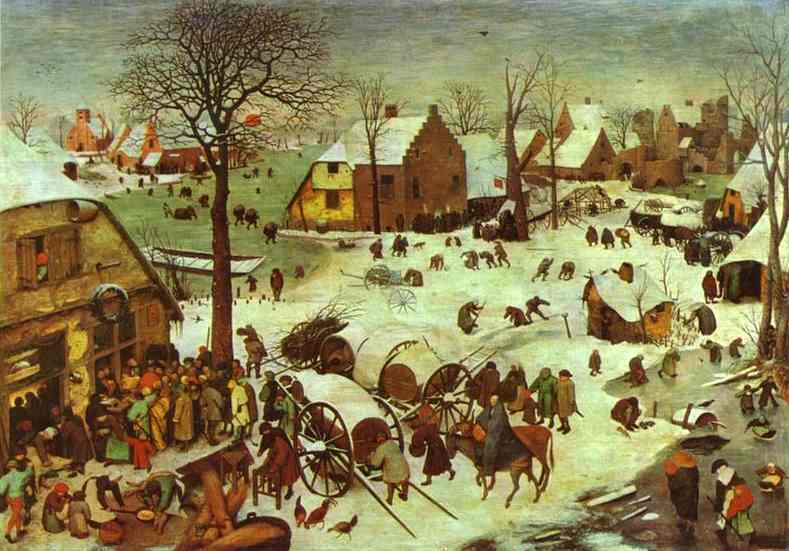
Musee des Beaux Arts


About suffering they were never wrong,
The Old Masters; how well, they understood
Its human position; how it takes place
While someone else is eating or opening a window or just walking dully along;
How, when the aged are reverently, passionately waiting
For the miraculous birth, there always must be
Children who did not specially want it to happen, skating
On a pond at the edge of the wood:
They never forgot
That even the dreadful martyrdom must run its course
Anyhow in a corner, some untidy spot
Where the dogs go on with their doggy life and the torturer's horse
Scratches its innocent behind on a tree.
In Breughel's Icarus, for instance: how everything turns away
Quite leisurely from the disaster; the ploughman may
Have heard the splash, the forsaken cry,
But for him it was not an important failure; the sun shone
As it had to on the white legs disappearing into the green
Water; and the expensive delicate ship that must have seen
Something amazing, a boy falling out of the sky,
had somewhere to get to and sailed calmly on.
--W.H. Auden, 1940

Tuesday, October 13, 2015

The grinning skull beneath the skin


"Death is the only experience of life that is not lived through."--Ludwig Wittgenstein

I've written on this subject before; and perhaps the entry to any discussion of euthanasia should face on time ("when") rather than subject ("what").  Be that as it may, this is a very good article on the conundrum of physician assisted suicide.  Yes, it is a lovely idea that say that we can have a "good death," but like a "good war" we only know that in our intentions, never in our actions; and we only get to determine which one was "good" in retrospect; we never get to set the conditions so the outcome will be as we wished it.

And frankly, let me say up front that "physician assisted suicide" is still just suicide.  The shock of suicide, the pain it brings to those left behind, is that whatever problem led to the death is now irresolvable.   It leaves a tangled mess, a "why?" that can never be answered, never be undone.  It is neater and easier when physicians are involved and everyone agrees only if everyone agrees never to look back and everyone agrees death was better than asking, perhaps, just one more question.

One of my law professors impressed upon me the problem with euthanasia, the "easy death" that we now couch as "physician assisted suicide."  He pointed out we can never be sure the deceased agreed to the plan because they wanted the succor of death, or simply because they wanted to stop being a burden on the living.  Or perhaps it was the living who wanted to drop the burden of the dying, and get on with it.  The case in the article is a case in point:  a father is dying, and wants to end it early but not, it turns out, because the pain is unbearable (that is corrected for him); it is mostly because he doesn't want to burden his child, who is caring for him.  She has the opportunity to assure him he is not a burden, and his death is not hastened but met when it finally comes.  It wasn't necessarily easier that way for either of them, but no one was "responsible" for his death, and no one left a question unanswered that death would leave unknowable:  why did he want to die?

The author is right, too: we fear death.  We do all we can to keep it away from us.  I've known people refuse to return to a church building because a funeral was held there, and the memories of that being the last place the beloved was before burial, is too much.  It's why people prefer funerals at funeral homes.  We used to die at home, and the family prepared the body for burial and stayed with it.  Someone would stay up through the night, out of respect for the loved one.  Now death happens in hospitals and strangers take the corpse and perform operations on it you don't want to know about, and keep the body in a building we only visit if we absolutely have to, and inter it in a place no one goes who doesn't have a reason to be there.

"My death, is it possible?"--Jacques Derrida

No, it isn't.  Your death is possible; mine?  Inconceivable.  I will be a ghostly presence observing the world without me.  The world will fill up the hole you leave behind as certainly as water closes over a stone.  But I will be the stone descending into the water, aware I am sinking and wondering why no one will retrieve me.

You, on the other hand, will just be gone; and we will mourn you and get on with our lives.  My life cannot end, because I cannot imagine the world where I am extinguished; to even do so, is to imagine I am there to observe it.  It's a neat trick of consciousness; in order to be self-conscious, we cannot also be conscious of our absence.  Which is another reason we fear death.  It is the only experience of life that is not lived through.

And so we think we don't have to live through it at all; not if we don't want to.  We can go to death, rather than let death come to us.  We can live through it by being in charge of it.  And then what?  Like any first experience, we can report that it isn't that bad after all?  No.  And we can't decide it wasn't such a good idea after all.  It is the one irrevocable act.  Perhaps that is why, today, we fear it more than ever.

Friday, October 09, 2015

Letting the days go by

Same as it ever was

Current political issues are the least important and most ephemeral things in the world, and this blog should be about Serious Subjects and Weighty Matters of Philosophy and Theology and Other Deep Thoughts.

Aw, to hell with it!  Nobody reads this damned thing anyway!

First, you should know that Paul Ryan is refusing to be Speaker of the House because he's a squish.  A squish with a record of squish votes:

Coming out of Friday morning's party meeting, Rep. Louie Gohmert (R-TX) told reporters he could not back Ryan because of his support for the government bailout of Wall Street in 2008 during the depths of the financial crisis.

"I love Paul. He's one of the smartest guys here," Gohmert said. "Back in 2008 there were a number of us that committed that we simply could not ever support a speaker who fought so hard to pass the Wall Street bailout."
Because, you see, he just doesn't pass the purity test:

 "Some of my conservative colleagues remember Paul Ryan's passionate please for the TARP, the Wall Street bailout -- he was asking them to vote for it several years ago," [Re/ Thomas] Massie [R-KY] said, "I don't have a problem with his ideology. I would want to talk to Paul Ryan about why he kicked conservatives off the budget committee, when he was chairman of the Budget Committee. So I am still supporting Daniel Webster."
Rep. David Schweikert insisted to NPR this morning that the problems in the House are about arcane matters of procedure, not about votes from 7 and 8 years ago.  Of course he also said the surprise withdrawal by McCarthy from the speaker's race had left House members actually talking to each other, rather than sticking to their little cliques.  He didn't mean the GOP was finally talking to the Democrats:

SCHWEIKERT:  What is fascinating, if you watched even the floor yesterday, the number of members who are running around talking to each other. So it's one of those unintended consequences of - you're having conversations with members that you typically almost never even crossed their paths.

MONTAGNE: Now, let me ask you, though. Are you talking about members - both Democrats and Republicans? Or are you talking about members within your own party?

SCHWEIKERT: Substantially, our own party, but even the Democrats coming over, hanging out with us saying, what's going on?

Whether Rep. Schwiekert is talking to members of his own Tea Party caucus remains unclear, however.  Still, that picture of a House where even Republicans don't talk to each other, is priceless.

Trey Gowdy, on the other hand, thinks Ryan can cause the House to come to Jesus:

 Asked if anyone could unite the conference, Gowdy was unequivocal that Ryan was the man for the job. “Either him or the fellow who just spoke to us,” he said, “but he went back to Italy.”
And why did McCarthy walk away?  Because of some alleged sexual scandal?  Maybe; but not really likely.  Because he couldn't get 218 votes?  Or maybe because he didn't want to:

I’m my own man, McCarthy told them. I’m not John Boehner. I’m committed to creating a more inclusive House.

He laid out plans to create a “kitchen cabinet” consisting of leaders drawn from conservative groups such as the Freedom Caucus.

But they wanted him to make specific promises. Rep. Tim Huelskamp (R-Kan.), the leader of the House Tea Party Caucus, asked McCarthy to publicly oppose efforts by establishment groups — the U.S. Chamber of Commerce and others — to run radio and TV ads criticizing conservatives who defied their own leaders.

McCarthy would not commit to a public pledge.
The "inclusive House" language sounds like Schweikert talk, but the intent to include the Freedom Caucus and others indicates "inclusion" meant giving the vocal minority a larger piece of the pie.  Squeaky wheels want their grease.  But when he couldn't curtail the free speech rights of others, he was a squish, and he had to go.

For the moment the best entertainment value is still to be found in the worthless media response:

The media were completely shocked — as they are every single time the House GOP caucus behaves like the radicals they are. It’s not as if this is the first time, after all. But they had convinced themselves that it made sense that the amateurish Kevin McCarthy could transcend the troubles which plagued the much more experienced John Boehner. Despite years of evidence, they simply cannot accept that the Republican caucus is completely ungovernable so they, and the GOP establishment, turned their hopeful eyes to yet another savior: Paul Ryan who, just as Kevin McCarthy had been days before, was seen as a man uniquely capable of bringing the feuding factions together.
Digby goes on to quote Chris Matthews who, in response to McCarthy's withdrawal from seeking a job no one in his or her right mind would want, all but said mere anarchy has been loosed upon the world.  Maybe your world, Chris, but from where I'm sitting, it's pure entertainment!

And so much cheaper than dinner and a movie.

Ryan is still refusing to be the savior Joe Scarbrough says he must be, so the show is still going on.  I'm gonna have to go out for more popcorn.  Darryl Issa says he may run; and Jeb Hensarling and Pete Sessions are said to be thinking about it.  It's doubtful those two are the "Texans" Blake Farenthold was thinking of (hey, if Issa and Chavetz can do it, why not Farenthold?).  Between the clueless media and the certifiably insane House, this is like finding a new comet:  a once-in-a-lifetime event!

Wednesday, October 07, 2015

"F*ck me, Ray Bradbury"*

Still the only acceptable cover for that book, as far as I'm concerned.
*No, it has nothing to do with the post; but I found the video while searching for a link, and now I've got the ear worm.  It was blocking all other possibilities until I got it out.

Neal deG. Tyson loves to say:  "Science is true whether your believe it or not."

Except:  no.  It isn't.

There's a long, complicated reason for that, having to do with interpretation theory and epistemology, among other things.  There's also a shorter version:  science is not a thing; science is a system of interpretation.  Science is simply what it was to the Greeks:  knowledge.  It is knowledge of the material world, but it is neither absolute, nor final, nor definitive of reality.  It is, at best, descriptive.

Consider:  the desk my computer sits on is solid.  It is solid whether I believe it is solid, or not.  My belief that it is a marshmallow is easily proven to be a delusion, if I try to smash it flat with my hand. Just as the man who mistook his wife for a hat was wrong when he tried to put his wife on his head, I am wrong to think my solid desk is a semi-solid marshmallow.

But science doesn't make the desk solid.  Science, at best, explains why the desk is solid (or, more likely, explains that, at the atomic or subatomic level, it isn't solid at all).  The desk is solid whether science explains it or not, whether I believe the scientific explanation, or not.

The problem is partially with the formulation:  Neal deG. has infelicitously expressed himself.  But the problem is also with the concept of "belief."  Whether I "believe" in science or not, it is true.  At one time, belief was understood to be assent, acceptance of an idea without requiring definitive proof.  Of course, David Hume marked "paid" to the idea of definitive proof, although the sons and daughters of defunct logical positivism still don't understand their cherished belief is a spectre.

Absolute knowledge is only one thing:  absolutely wrong.  The rise of fundamentalism has made some people a bit crazy, and left other people badly confused.  When Tyson says science is "true," what does he mean?  He means he accepts the tenets of science, even when they are false.  The Nobel Prize was offered today to two men who proved neutrinos, once thought to have no mass, actually have mass.  Granted, this work was done 15 years ago, and the wheels of the Nobel grind slow, but the point is the same:  science is true, until some new paradigm of science is true.

As Kuhn said; and the prophet is still without honor in his own country.

Still, what does Tyson mean when he says science is "true"?  It is not an idle question:  lawyers ask such questions all the time, and they are not eggheaded professors and brainiac philosophy teachers examining the qua qua qua.  What is "truth"?  Is what the client tells you the truth?  What the witnesses say?  What the next witness says?

In what way is science "true"?

I like certain foods, certain drinks, certain people.  I love my wife and my daughter, equally but quite differently.  Is this true?  Is it only true if science says so?  Can science say why, or how, this is true?  No?  That isn't "science"?  Ah; then what is true about science?  That neutrinos have no mass?  Except they do?

Is science true because it is self-correcting?  But when is it true, if it must always be corrected?  Isn't truth permanent and immutable?  So maybe science is "correct", whether I believe it or not?  Correct about what?  That this stone is heavy?  That's an analytical statement, says Hume, and it really doesn't tell me anything.  If science deals in synthetic statements, they can't be verified, so they can't be true.

So how is science "true"?  What is it science is "true" about, and in what way is that "truth"?

And then we're back to "belief," and what we mean when we say "I believe...."  Everyone has to believe in something, the old chestnut goes; I believe I'll have another drink!  I believe in God.  I believe in love.  I believe in never drawing to an inside straight.  "Have you heard this before?"  "No, I don't believe so."

Wittegenstein called this "language games."  He spent much of an incredible intellectual lifetime trying to point out how we use one word in so many ways, with so many meanings, and all of them correct, depending on the language game we are playing.  So scientific knowledge is true, says L.W.; but so is belief.  True, but in different ways.

Because, after all:  "What is truth?"

It's a matter of faith; and faith is a matter of trust.  "In God we trust; all others pay cash."  I believe that is a wise notion.  I believe my daughter when she tells me what happened in the car accident she was in.  I believe my wife when she tells me she loves me.  I believe in the power of coffee, even though I also believe caffeine has a negligible effect on me.  Mostly because I trust my experiences with my daughter, my wife, the gallons of coffee I consume every week.

In me I trust; all others pay cash.

I am told neutrinos exist.  I am told neutrinos have mass.  I take this information as true on faith, because the proof is beyond me, the science and reasoning far past my areas of expertise.   Do I believe it despite knowin' it ain't so?  No; I accept it as true on trust, on faith, and I convert that faith into knowledge.  But does it make it true even if I don't believe it?  No; it makes it a valid statement within the system of scientific thought.  It is perhaps even true in the same sense that a given stone is heavy.  But it is not truth into the ages; it is merely a fact.  Within the system of scientific thought it may, for the moment, be extremely important.

Outside that system, however, whether or not neutrinos have mass means nothing to me whatsoever.

One last thing:  scientists say neutrinos exist.  If I don't believe it, can they prove it to me?  They can present charts, graphs, equations, articles; they can produce data they say comes from mines and super-colliders; but even that data is a matter of interpretation, a matter of accepting the system of scientific thought in which that data has meaning, has meaning because of the system of interpretation created by the system of scientific thought.  If I don't accept that data, that reasoning, that interpretation, have they still proven neutrinos exist?  Not to me.

And if it isn't true to me, how can it be true?  This is the quality of the argument not only of on-line atheists, but of New Atheists like Dawkins and Harris and Maher.  If it isn't true for me, it isn't true.  It's nothing new; it's just an extreme form of solipsism.  Ray Bradbury would understand the consequences of that.

Because, after all:  "What is truth?"

I believe.  I have faith.  I trust.  I know.  How we use these words depends on how we mean to use them, and Humpty-Dumpty was right:  "Who's to be the master, then?  You, or the word?"  Words do not have a unitary meaning; they have a designated meaning depending on the language game they are being used in.  My faith and science and my faith in God may seem contradictory, but only if you don't understand that one kind of faith is not like the other, and no definition of "faith" suffices for all uses we have for that word in English.

After all, if I say "blue," do I mean:  a wavelength on the electromagnetic spectrum; an emotional state; my old hound dog?  If I say I love Blue and I love my wife, am I necessarily confessing to bestiality?  Or admitting my wife is the same to me as a dog?

It may be true that neutrinos have mass; but the truth that matters to me is, I have an obligation to grade papers now.  Which truth is true for me?

I believe I'll have another drink!  of coffee; and then, back to work.


Just when you think you've hit the bottom


Where Bobby Jindal sleeps at night
somebody gets out the shovels:


In the blog post -- titled "We fill Our Culture With Garbage, And We Reap The Result" -- Jindal blamed the prevalence of mass shootings in America on "deep and serious cultural decay in our society," jumping from a condemnation of violence in media and a reference to abortion to a discussion of the reported absence of the father of the Harper Mercer in the young man's life.

"This killer’s father is now lecturing us on the need for gun control and he says he has no idea how or where his son got the guns," Jindal wrote. "Of course he doesn’t know. You know why he doesn’t know? Because he is not, and has never been in his son’s life. He’s a complete failure as a father, he should be embarrassed to even show his face in public. He’s the problem here."

"He brags that he has never held a gun in his life and that he had no idea that his son had any guns.

Why didn’t he know? Because he failed to raise his son. He should be ashamed of himself, and he owes us all an apology," Jindal wrote. "When he was asked what his relationship was with his son, he said he hadn’t seen him in a while because he lived with his mother. Case Closed."

Jindal went on to call out "shallow and simple minded liberals" for blaming "pieces of hardware for the problem."

"If anyone is at all serious about changing any of this, they must address the root problems, and those are cultural decay, the glorification of evil, the devaluation of human life, the breakdown of the family, and specifically the complete abdication of fathers," Jindal wrote.
Charlie Pierce likes to say "these really are the mole people."  Jindal would have to dig up to reach the level of  the mole people.

Tuesday, October 06, 2015

Isn't it ironic? Don't you think?

Yeah, that's him.

Texas, our Texas:

On Aug. 1, 2016—the 50th anniversary of the Charles Whitman UT Tower shooting—Senate Bill 11 will go into effect, making it legal for concealed handgun licensees to pack heat on Texas campuses.

Yeah, we changed that law because, you know, freedumb.  That shooting on the campus in Tomball is the last one in Texas on a college campus that I know of.  The shooter wasn't supposed to have a gun on campus then (whether he can now is an open question my college system is struggling with, too).  He opened fire in a fight with another student, and hit several other people except the student, standing in front of him, whom he was aiming at.

Or supposedly aiming at.

Yeah, one thing led to another; and yeah, I got a real good feeling about this.

A little too ironic, don't you think?

"Union Made"*

*It was the title given this picture as a jpeg.  So, of course....

Speaking of "nones," the more things change, the more they remain the same:

Yes, even as Chicago’s class-conscious workers navigated an oppositional relationship to the institutional churches, they never wavered in their conviction that God was on their side. As the turn of the century approached, this belief steeled a growing wave of working-class religious activism.

In the spring of 1894, for example, Chicago’s Trades and Labor Assembly founded a church of its own—a congregation by and for the worker. Though short-lived, the Modern Church underscored ordinary believers’ dissatisfaction with the existing religious options. As one of its leading members put it, “[the church] has strayed from the paths marked out for it by its twelve immortal walking delegates, under the supervision of the Grand Master Mechanic of the universe.”

Later that same year the Pullman Strike catalyzed a new wave of working-class religious resistance. Many Catholics stopped their subscriptions to the archdiocesan newspaper out of frustration with the editor’s refusal to side more decisively with the American Railway Union. At churches across the city’s South Side, meanwhile, Protestant churchgoers rose up against “scab ministers.”

Nowhere was the backlash more severe than at Pullman Presbyterian Church. When the minister there railed against the strike—declaring at one point, “there is a maxim that half a loaf is better than no bread, and in my judgment the employees were getting two-thirds of a loaf”—working people walked out. By the time the dust had settled the church had lost nearly twenty percent of its members. Notably, all but a handful immediately re-affiliated with other congregations, making clear that they were not abandoning the larger church but rather this particular one, which had become too closely identified with capital.

The proliferation of such incidents had clergy of every denomination on edge. Why were working people so alienated from the church? This was the subject of an 1899 article in the American Journal of Sociology. The author—a Baptist minister based out of Chicago’s South Side—interviewed workers, asking what could be done to win them back. Their words varied but their answer was resoundingly clear: “Apply the Sermon on the Mount”; “Preach Christianity instead of theology”;

“Let the pastor have a personal relationship with the needs of labor. Be our champion.”
As they assimilated such data, many church leaders came to see the answer to the churches’ workingman problem and to the nation’s industrial crisis as one and the same: champion conservative labor reform.
I especially like the line "Great Master Mechanic of the Universe."  I won't venture to mock up a similar analogy for Millenials; let your imagination run wild.  And the idea that the church "has strayed from the paths marked out for it" is as old as Martin Luther, at least.  Or as old as Eliot, if you prefer:

And the Church must be forever building, and always
decaying, and always being restored.

Does any of these seem even vaguely familiar?  People leave churches in droves for any number of reasons, and it doesn't mean they are leaving religion.  Anthony pointed out in comments below that the "nones" category was invented as a way of signaling a rising atheism which really doesn't exist.  Equally, the idea that what is happening now has never happened before in human history is...well, it's just ignorant.

I visited one of these "upscale" churches; in St. Louis, though, not in Chicago.  St. Louis is Detroit's future today, frankly:  a once great city now a shell of itself, as people drained out of it because of the freeways, not because auto makers left.  Same effect, though.  The church was a UCC church, once the place to see and be seen, frequented by the Missouri Governor, the mayor of St. Louis, and most of the rich and socially important people of the town.  The church had its own silver pattern (sterling, not plate), and it's own china pattern.  It employed cooks and dishwashers for meals on Sunday and during the week.  All the echoes of that gilded era resounded in the empty halls.  It was not a place frequented, in its heyday, by the working class.

Something else from that interview, related but unrelated, that I've been thinking about recently:

One other constant bears mention here: because church life in America operates on a voluntary basis, Christian leaders are necessarily sensitive to changes in their membership rolls, which have immediate implications for their congregations’ bottom lines. This sensitivity can render religious communities susceptible to passing fads. But it can also make them more responsive to reform movements calling the churches to a more faithful witness in the world.
We want our religious leaders to represent Christ in the world, sometimes so we don't have to.  But when they do that, we resent them for not doing what we would rather they do.  Which raises an interesting conundrum:  is it possible to follow Christ in the world and be a part, especially an important part, of organized religion?  Or do the demands of the institution make too many claims on even a St. Francis (I'm thinking specifically of Kazantzakis' portrayal of Francis in his novel Saint Francis.  That's a bit unfair if you haven't read the novel, but Francis despairs of founding an order because while he demands absolute loyalty to God (indeed, a fanatical devotion), his followers understand too well the needs of even a monastic order.)  As Niebuhr said of nations, you can't force others to make a sacrifice for what you believe; you can only ask that of yourself.

Funny how much history repeats itself.

Monday, October 05, 2015

"Pretend you're good at it."

Yes, this is what I look like in the morning.  Why do you ask?


"They constantly try to escape
From the darkness outside and within
By dreaming of systems so perfect that no one will need to be good."'

--"Choruses from 'The Rock'"--T.S. Eliot


Been thinking about this:

“It sets an expectation that the public will or should automatically accept scientific solutions to problems because people think scientists are heroes. The scientist comes up with a solution, and the protagonist accepts it. That’s the power of the narrative from the perspective of the scientist—that someone could be persuaded to act based on a heroic scientific finding or instinct only.”
In terms not of the newest Ridley Scott movie, but of an ad I keep seeing from Microsoft since I've started watching football again (what can I say?).

It's an ad, so it's selling a product, but the product is the amazing ability of the right computer to unlock the potential of some child somewhere on the earth who will come up with the technological solution which will solve our current difficulties.  I think global warming gets a mention, though it's significant the problems to be solved are all first-world problems (transportation, renewable energy, recycling, IIRC), not problems of disease (polio in Pakistan, for example, or, relevant to today's headlines, parasites in Africa*) or overpopulation or drought or access to food and water, etc.  But even if those problems were addressed, the solution would be technological.

Not, say, philosophical (or religious, if you prefer), such as an idea on how we learn to live without expanding first-world appetites for food and things to the entire planet, an appetite the planet can barely sustain now for those who can satisfy it.  Or how we can live by actually caring for each other, rather than only caring about our own comfort and gain, and trusting the system (technology) to take care of everybody else in spite of our lack of concern for them.  I think, again, of Clifford Simak's science fiction story where a Martian (!) philosopher has a new theory that, if known, could change human thinking and society and make it well, more humane.  But technology has led humanity down a path which makes the one human who can save the dying philosopher (and so his philosophy) too parochial and agoraphobic to even leave his estate and perform the surgery; so the knowledge is lost, and human history continues down the path its technology has created.  In the end (it is part of a series of stories), humanity is altered by technology into oblivion; or at least into something no longer recognizably human.

That is the power of our current narrative:  that someone can be persuaded to act based on a heroic scientific finding or instinct only, which will alter the course of the technology we now enjoy so we can keep on enjoying it into the ages (the true Biblical concept usually translated as "life everlasting.").   We won't have to alter us, the savior will alter it.

Which Christianity has understood for millennia to be one of the problems of Christianity:  that we are inclined to want the savior to alter the situation, rather than to alter us.  But one outcome will save us, the other will doom us.

It has been ever thus.

*Parasites might one day fall to medicine and science, but the obstacle to eliminating polio in Pakistan is a melange of ideology, politics, and history.