Wednesday, May 21, 2008

The Indescribable Collision


Can't go forward; can't go backward; can't stand still; can't sit in the corner when you're in a round room. Now what?

"The brutally frank answer is that we're stuck, and we're stuck in several ways," Gates told the defense subcommittee of the Senate Appropriations Committee.

....

Gates said that he favors closing the detention center [at Guantanamo Bay], which currently holds about 270 detainees, but that a number of problems stand in the way.

For one, Gates said, there are about 70 detainees ready for release whose home governments either will not accept them or may free them after they return.

....

Gates said there were also several detainees who cannot be freed but who are also ineligible for prosecution under the military courts set up by the Bush administration. Gates did not elaborate on why those detainees would not be charged.

"What do you do with that irreducible 70 or 80, or whatever the number is, who you cannot let loose but will not be charged and will not be sent home?" Gates asked.

Furthermore, he said, there are lots of obstacles to overcome in order to send the detainees to U.S. prisons.

"We have a serious 'not in my backyard' problem. I haven't found anybody who wants these terrorists to be placed in a prison in their home state," he said.
One of the favorite paradoxes is the paradox of an omnipotent god, i.e.: could such a god create a boulder too heavy for the god to lift? Can there be, in other words, an unstoppable force and an immovable object, and what happens if they meet?

So what if we built a prison nobody wants, housed in it prisoners nobody wants back, and yet they are prisoners we cannot keep and perhaps should never have detained? What then? The most interesting problem here is that the people who created this problem, bear no responsibility for solving it. Congress must fund the Gitmo prison, or close it; the Defense Department must administer it and staff the guards there, or abandon it. There is no question some of the prisoners should not be there, and none of them were taken captive according to national or international laws. This was completely the action of a rogue state. But people don't stop being people simply because you lose interest in the symbols you once tried to make of them. They don't go conveniently away when the morning headlines shift from them. And what of those responsible for this disaster?

All moved on, muttering excuses or offering no apologies at all. What accountability will they face? What will a President Obama do about them (the answer if the question is President McCain is obvious on its face)? Nothing. He will do nothing. The great genius of the American system is its ahistoricity, we have been told for generations. We don't punish the past, we don't hold the historic grudges we claim to see in European, and now Middle Eastern, history. It has been the great genius of our system, we were told. It is now the reason the worst criminals will walk free.

What good, then, is a criminal justice system? I ask the question quite seriously: what good is it at all? It imprisons the poor, the powerless, the weak, the undefended. And it excuses the powerful, the wealthy, the self-important, the true monsters of our age, of every age; of any age.

When Jesus told his disciples to visit the prisoner, we comfort ourselves with thinking they were illegally and improperly imprisoned, because the Roman empire was an illegal and improper imposition of political will over a subjugated people; it held its power and control by force of arms, not as an expression of popular will. When Jesus says he has come to set the prisoner free, we comfort ourselves with thinking he meant spiritual imprisonment, and since we will never see the inside of a prison, we are quite sure he means us, and the cage of our complacencies and cares. But what if the fundamentalists are right about this much, and he meant what he said literally?

Even the fundamentalists don't take those words that seriously. What if they did, though? And why do we continue to trust our government to provide for our security, when they are so clearly incapable and uninterested in doing so? The alternative is not isolation and ammunition hoarding and mad defiance of the social order fed by paranoid schemes involving black helicopters and world governments. The alternative is to reconsider what government really means, and what is really supplies, and how much we can really expect it to do.

We never expected it to do this; but now it has. We never expected to face this dilemma; but now we do. We may even expect our new political leaders to find wisdom and solve these horrendous problems, to fix these nightmarish horrors. But if they do, how will they do it? We seem to be stuck going backward. What power, what rationale, what political position, what ideology or idea or hope, will make us move forward?

Is there an unstoppable force that can be brought to bear on this immovable object? If so, what will it be? What is the way forward? And who offers it?

Monday, May 19, 2008

Crimes of History


The Texas Observer does very good work, and this is a very good article on a very overlooked and underappreciated topic. Because one thing we have learned from the past 7 years of Republican control, both in Texas and in the nation, is that crime is what we say it is. As Lisa Turner says in the article:

“You have agents of the attorney general walking through a neighborhood, walking past three crack houses, to go talk to a voter. Think about that. What does that say their priorities are? It’s about holding on to the levers of power.”
The basis of prosecutorial discretion is that the prosecutor will decided to use the power of the government against those who threaten the peace and security of the community. When that discretion is abused, the legitimacy of the system is called into question. Of course, that system has always been abused; just ask Dr. Martin Luther King. And it has always been used to maintain the status quo of those in power.

That doesn't, however, mean it isn't abuse to use it that way. Texas, like Indiana, had a record turnout for the state's Democratic primary. Shaving a few percentage points may yet make a difference to who remains in power in Texas.

But it's still illegal. And keep reminding yourself this is 2008, not 1964, and remember Tim Russert sought assurances from Barack Obama that, in America, we no longer believe in white superiority and black inferiority. Yeah, right:

According to the Campaign Legal Center’s lawsuit, in which Ray, Johnson, Meeks, McDonald, Hinojosa, and the Texas Democratic Party are plaintiffs, a PowerPoint presentation used by Abbott’s office to train Texas officials was rife with racial stereotypes associating voter fraud with people of color—communities that in recent history have supported Democrats.

“As an introduction to a section of the PowerPoint involving ‘Poll Place Violations,’ a slide depicts a photograph of African-American voters apparently standing in line to vote,” the lawsuit’s complaint said. “Notably, the 71-slide presentation contains no similar photographs of white or Anglo voters casting ballots.

“Another slide in the same PowerPoint presentation, in a section involving tactics for investigating purported voter fraud, is entitled ‘Examine Documents for Fraud.’ That slide states that investigators should look for ‘Unique Stamps’ and shows a prominent picture of a postage stamp known as the ‘sickle cell stamp,’ which depicts an African-American woman and infant,” the complaint said. “The PowerPoint presentation thus communicates the message that minority voters should be the focus of election fraud investigations and prosecutions, particularly under the new 2003 criminal prohibitions.”
And the irony is: the Voting Rights Act was supposed to take care of this kind of thing:

“You have to understand that this would be 20 to 30 percent of the voting ballots from the Democratic Party, because senior citizens cherish the right to vote,” she said. “They remember the poll tax, having to pay it. And they want to vote.”
Maybe we should let Dr. King put this in perspective:

Our whole campaign in Alabama has been centered around the right to vote. In focusing the attention of the nation and the world today on the flagrant denial of the right to vote, we are exposing the very origin, the root cause, of racial segregation in the Southland. Racial segregation as a way of life did not come about as a natural result of hatred between the races immediately after the Civil War. There were no laws segregating the races then. And as the noted historian, C. Vann Woodward, in his book, The Strange Career of Jim Crow, clearly points out, the segregation of the races was really a political stratagem employed by the emerging Bourbon interests in the South to keep the southern masses divided and southern labor the cheapest in the land. You see, it was a simple thing to keep the poor white masses working for near-starvation wages in the years that followed the Civil War. Why, if the poor white plantation or mill worker became dissatisfied with his low wages, the plantation or mill owner would merely threaten to fire him and hire former Negro slaves and pay him even less. Thus, the southern wage level was kept almost unbearably low.

Toward the end of the Reconstruction era, something very significant happened. (Listen to him) That is what was known as the Populist Movement. (Speak, sir) The leaders of this movement began awakening the poor white masses (Yes, sir) and the former Negro slaves to the fact that they were being fleeced by the emerging Bourbon interests. Not only that, but they began uniting the Negro and white masses (Yeah) into a voting bloc that threatened to drive the Bourbon interests from the command posts of political power in the South.

To meet this threat, the southern aristocracy began immediately to engineer this development of a segregated society. (Right) I want you to follow me through here because this is very important to see the roots of racism and the denial of the right to vote. Through their control of mass media, they revised the doctrine of white supremacy. They saturated the thinking of the poor white masses with it, (Yes) thus clouding their minds to the real issue involved in the Populist Movement. They then directed the placement on the books of the South of laws that made it a crime for Negroes and whites to come together as equals at any level. (Yes, sir) And that did it. That crippled and eventually destroyed the Populist Movement of the nineteenth century.

If it may be said of the slavery era that the white man took the world and gave the Negro Jesus, then it may be said of the Reconstruction era that the southern aristocracy took the world and gave the poor white man Jim Crow. (Yes, sir) He gave him Jim Crow. (Uh huh) And when his wrinkled stomach cried out for the food that his empty pockets could not provide, (Yes, sir) he ate Jim Crow, a psychological bird that told him that no matter how bad off he was, at least he was a white man, better than the black man. (Right sir) And he ate Jim Crow. (Uh huh) And when his undernourished children cried out for the necessities that his low wages could not provide, he showed them the Jim Crow signs on the buses and in the stores, on the streets and in the public buildings. (Yes, sir) And his children, too, learned to feed upon Jim Crow, (Speak) their last outpost of psychological oblivion. (Yes, sir)

Thus, the threat of the free exercise of the ballot by the Negro and the white masses alike (Uh huh) resulted in the establishment of a segregated society. They segregated southern money from the poor whites; they segregated southern mores from the rich whites; (Yes, sir) they segregated southern churches from Christianity (Yes, sir); they segregated southern minds from honest thinking; (Yes, sir) and they segregated the Negro from everything. (Yes, sir) That’s what happened when the Negro and white masses of the South threatened to unite and build a great society: a society of justice where none would pray upon the weakness of others; a society of plenty where greed and poverty would be done away; a society of brotherhood where every man would respect the dignity and worth of human personality. (Yes, sir)
The more things change....


...which is not to say we are about to let them change back! But nothing ended in 1964, or in 1965, or in 1968, or in 2008 when 75,000 people turned out to rally for Barack Obama. We have to threaten to unite, again. We have to stay united, and we have to recognize that union will always be threatening. But, as Dr. King said in that speech, God's truth is marching on.

ADDENDUM: I should add that it is common knowledge in Texas that we are only a few years away from becoming a "minority majority" state, so these efforts at voter suppression are more than a little desperate, and ultimately doomed to failure based on sheer demographics alone. Indeed, that is much of the reason for the anti-immigrant hysteria, such as it is, and these problems are perfectly predictable, from a sociological point of view.

That doesn't make them any more palatable, of course, nor any less destructive. The interesting thing here is Texas politics. Texas became a Republican dominated state almost 30 years ago, and yet even the Republican legislature recognized what was coming, and passed a good law requiring the two major state universities (UT-Austin and Texas A&M) to admit the top 10% of all Texas high school graduates, if only to give poor students from poor school districts a chance. Efforts at roll back of that law are underway, and it's a less than perfect law (some of those 10% are truly not prepared for college, but is that their fault, or the fault of the state school system?); but rather than continue on that line, the state GOP has apparently chosen to fight a rearguard action.

Meanwhile, God's truth is marching on.

Sunday, May 18, 2008

Sermon for Trinity Sunday 2008


Genesis 1:1-2:4a

1:1 In the beginning when God created the heavens and the earth,

1:2 the earth was a formless void and darkness covered the face of the deep, while a wind from God swept over the face of the waters.

1:3 Then God said, "Let there be light"; and there was light.

1:4 And God saw that the light was good; and God separated the light from the darkness.

1:5 God called the light Day, and the darkness he called Night. And there was evening and there was morning, the first day.

1:6 And God said, "Let there be a dome in the midst of the waters, and let it separate the waters from the waters."

1:7 So God made the dome and separated the waters that were under the dome from the waters that were above the dome. And it was so.

1:8 God called the dome Sky. And there was evening and there was morning, the second day.

1:9 And God said, "Let the waters under the sky be gathered together into one place, and let the dry land appear." And it was so.

1:10 God called the dry land Earth, and the waters that were gathered together he called Seas. And God saw that it was good.

1:11 Then God said, "Let the earth put forth vegetation: plants yielding seed, and fruit trees of every kind on earth that bear fruit with the seed in it." And it was so.

1:12 The earth brought forth vegetation: plants yielding seed of every kind, and trees of every kind bearing fruit with the seed in it. And God saw that it was good.

1:13 And there was evening and there was morning, the third day.

1:14 And God said, "Let there be lights in the dome of the sky to separate the day from the night; and let them be for signs and for seasons and for days and years,

1:15 and let them be lights in the dome of the sky to give light upon the earth." And it was so.

1:16 God made the two great lights--the greater light to rule the day and the lesser light to rule the night--and the stars.

1:17 God set them in the dome of the sky to give light upon the earth,

1:18 to rule over the day and over the night, and to separate the light from the darkness. And God saw that it was good.

1:19 And there was evening and there was morning, the fourth day.

1:20 And God said, "Let the waters bring forth swarms of living creatures, and let birds fly above the earth across the dome of the sky."

1:21 So God created the great sea monsters and every living creature that moves, of every kind, with which the waters swarm, and every winged bird of every kind. And God saw that it was good.

1:22 God blessed them, saying, "Be fruitful and multiply and fill the waters in the seas, and let birds multiply on the earth."

1:23 And there was evening and there was morning, the fifth day.

1:24 And God said, "Let the earth bring forth living creatures of every kind: cattle and creeping things and wild animals of the earth of every kind." And it was so.

1:25 God made the wild animals of the earth of every kind, and the cattle of every kind, and everything that creeps upon the ground of every kind. And God saw that it was good.

1:26 Then God said, "Let us make humankind in our image, according to our likeness; and let them have dominion over the fish of the sea, and over the birds of the air, and over the cattle, and over all the wild animals of the earth, and over every creeping thing that creeps upon the earth."

1:27 So God created humankind in his image, in the image of God he created them; male and female he created them.

1:28 God blessed them, and God said to them, "Be fruitful and multiply, and fill the earth and subdue it; and have dominion over the fish of the sea and over the birds of the air and over every living thing that moves upon the earth."

1:29 God said, "See, I have given you every plant yielding seed that is upon the face of all the earth, and every tree with seed in its fruit; you shall have them for food.

1:30 And to every beast of the earth, and to every bird of the air, and to everything that creeps on the earth, everything that has the breath of life, I have given every green plant for food." And it was so.

1:31 God saw everything that he had made, and indeed, it was very good. And there was evening and there was morning, the sixth day.

2:1 Thus the heavens and the earth were finished, and all their multitude.

2:2 And on the seventh day God finished the work that he had done, and he rested on the seventh day from all the work that he had done.

2:3 So God blessed the seventh day and hallowed it, because on it God rested from all the work that he had done in creation.

2:4a These are the generations of the heavens and the earth when they were created.

Psalm 8
8:1 O LORD, our Sovereign, how majestic is your name in all the earth! You have set your glory above the heavens.

8:2 Out of the mouths of babes and infants you have founded a bulwark because of your foes, to silence the enemy and the avenger.

8:3 When I look at your heavens, the work of your fingers, the moon and the stars that you have established;

8:4 what are human beings that you are mindful of them, mortals that you care for them?

8:5 Yet you have made them a little lower than God, and crowned them with glory and honor.

8:6 You have given them dominion over the works of your hands; you have put all things under their feet,

8:7 all sheep and oxen, and also the beasts of the field,

8:8 the birds of the air, and the fish of the sea, whatever passes along the paths of the seas.

8:9 O LORD, our Sovereign, how majestic is your name in all the earth!

2 Corinthians 13:11-13
13:11 Finally, brothers and sisters, farewell. Put things in order, listen to my appeal, agree with one another, live in peace; and the God of love and peace will be with you.

13:12 Greet one another with a holy kiss. All the saints greet you.

13:13 The grace of the Lord Jesus Christ, the love of God, and the communion of the Holy Spirit be with all of you.

Matthew 28:16-20
28:16 Now the eleven disciples went to Galilee, to the mountain to which Jesus had directed them.

28:17 When they saw him, they worshiped him; but some doubted.

28:18 And Jesus came and said to them, "All authority in heaven and on earth has been given to me.

28:19 Go therefore and make disciples of all nations, baptizing them in the name of the Father and of the Son and of the Holy Spirit,

28:20 and teaching them to obey everything that I have commanded you. And remember, I am with you always, to the end of the age."


And we have forgotten it; DAS is right: we Christians have forgotten that. Or we think Christ is with us, and us alone, and not with those people who don't look like us or don't live like us or don't think like us or don't worship like us, and I mean that person two pews over who you just know is wrong! And you can be sure Christ is not with them! And Christ is not with crazy people like Jeremiah Wright, and Christ is not with anybody who agrees with him, and Christ is not with the pastor when he doesn't say what I want him to say, and when he doesn't make me feel the way I want to feel, and when he doesn't do what I think he should do! Christ is with us, but "us" only means the people who think and act and feel and talk and live and look just like I do!

That's who Christ is with! That's "us"! And Christ is certainly not with our enemies, because then there would be no "us" at all, but only me! and I'd be all alone, and what good would that be? So Christ must be with us, when us is just what I want; and no more. Because life is hard enough as it is; life is tough enough; and I don't need God in my life just making it tougher. No...I don't need that at all.

DAS is right

A faith which just says "love your neighbor" and doesn't guide you toward that goal sets in front of you, it may be argued, a stumbling block before the blind (**) -- also from this last week's parsha. And to say "well you just have failed the impossible test, so you can't achieve salvation (of your own accord)" seems austere to the point of nihilism (c.f. Nietzsche). A pragmatic and graceful God would make it easy on us, not by exempting us from the Law as if we were mere young children, but by being a loving parent and instilling discipline in us as we grow, and to help us grow, spiritually.
We've made ourselves pragmatic, and made a loving God impractical. We've wrung all the good and all the support and all the community out of the gospel message, and we've made it exclusive to people just like us, gathered in a church just like we like, gathered around a pastor just like we wanted, gathered at a time convenient to us, and comfortable to us, and reserved for us. Our little slice of heaven, made just for us. This God's for you!, and if you don't like it, well, send it back, and get another. Every version is freshness dated, so you can be sure it's as fresh a god as you could ever want, and if it gets old and stale, just throw it out, and get another one. Yes, I'm afraid DAS is right.

Not that he meant to be; not that he meant to be harsh or cruel or even critical. But the truth is just like that sometimes; the truth hurts. That's why we don't like the truth. That's why we don't like to listen to anything that sounds like it's aimed at us. That's why we like to be comfortable; but too often, anymore, being comfortable means being alone, means having just what I want, and no one to bother me: it means roads without traffic, which would mean without people; it means stores without crowds; which would mean without people; it means quite neighborhoods where no one drives through, and no strangers ever walk: which means without people. It means a world suited to our comfort, to your comfort, to my comfort: which means a world without people. It means a world like we imagine we used to have, when everyone thought like us and did like us and believed like us and acted like us: which, today, would mean a world without people.

But that's a terrible thing to wish for! Why would someone say those awful things? Why would someone make such awful statements! Why do you say that, pastor? Why do I say that, I ask myself!? What's going on here? What's wrong? What's happened?

What's happened is, we've made the world: we've made it comfortable and convenient and cooperative and complete: and now we have to lie down in it. And it turns out, it ain't no bed of roses. Because Jesus tells us: "Love your enemy." But if we do that, we'll be left all alone. Because everyone who disturbs our comfort; everyone who challenges our beliefs; everyone who doesn't let us think we, and the few people left like us, are the only people in the world, is our enemy. And if we love them, then we'd have to love everybody! And we can't do that! Only God can do that! And besides, we don't know anybody who even tries to do that! So how can we do that!? How can we even think to do that!?

Precisely. No one tries to do that. Only God tries to do that. God who is the Creator, who made everything, and saw that it was good. God who loved Creation into being with just a word, and blessed it, and saw it was good. God who made day and night; and it was good; and plants and trees, and saw it was good; God who made fish and birds, and animals and creeping things, and finally human beings, and each time saw: it was good. Which is why God loves God's enemies: because in Creation, everything is good; even enemies of God. God doesn't need us to love; but we need God. And that is good.

But we don't turn to God: we turn to our power over plants and trees and fish and birds and animals and every creeping thing, even over day and night: and we look at our creation, and we say that it is good. And then we never rest. We go inside our houses, and our cars, and the other products of our creation, and we ignore God's creation, or mine it, and strip it, and abuse it, and burn it, and destroy it, and tear at it, and we declare only our work good, and on the work of others like us good, and the work we don't like is not good, and the people we don't like are not good, and those people are not across the world or across the continent or in other countries they are...right next to us. In the pews, in our streets, in the stores, in the city: the city we have made this way. And we say that our city is good, and our life is good, and we ourselves are good: but we are only good by declaring other cities and other places and other people, even on our streets, even in our stores, even in our churches, not good. And there we are. We cannot turn to God, because we don’t know how: because all we expect from God is that God tell us we are good, and everything we do is good, and that can only mean everyone not like us is not good, because that proves we are good, that makes us better! Miserable creatures that we are, who is there to free us from this imprisonment? How are we to free ourselves?

We can’t do it alone; but we insist on living alone. We can’t do it by ourselves, but we insist on doing everything by ourselves. The neighbor with the overgrown lawn is a lazy neighbor; the neighbor who stays up all night working on car in the garage is an obnoxious neighbor; the neighbor whose teenage daughter is pregnant again is an immoral neighbor. The neighbor whose skin color is not like mine, whose language is not like mine, who doesn’t live like I do, is not my neighbor. My neighbors are the people who make me comfortable; and if I only find them in church, then those people are “neighbor” to me. But more and more, even those people don’t think like I do, don’t believe like I do, don’t live like I do. How am I to love my neighbor, much less my enemy, when they refuse to be like me?

13:11 Finally, brothers and sisters, farewell. Put things in order, listen to my appeal, agree with one another, live in peace; and the God of love and peace will be with you.
13:12 Greet one another with a holy kiss. All the saints greet you.
13:13 The grace of the Lord Jesus Christ, the love of God, and the communion of the Holy Spirit be with all of you.
Yes, that must be nice; but Paul must have been talking to special people, to people who all agreed and all thought like he did and were already living in peace; who didn’t have to contend with different languages and customs and rules, who knew what was right and just did it! Surely the people who live right finally receive the peace of God as their blessing. Surely; except we know it wasn’t that way. Paul taught that everyone was equal, in a day when children never ate with their parents, and women were never in the same room as men, not even a wife when her husband had friends over; and slaves ate in their quarters, and never with the family. Paul taught that everyone was equal in Christ, and that meant Mom and Dad and the children and the slaves and the grandparents and…well, everybody! And they accepted that, when no one else in town did. And they lived in peace, and the God of love and peace was with them. But the neighbors thought they were crazy.

Greet one another with a holy kiss. What would it be like to do that today? Greet everyone here in church that way? Or on the street? In the store? Over coffee? All the saints would greet you, but what would everyone else say? Would the grace of the Lord Jesus Christ, the love of God, and the communion of the Holy Spirit be with you, even as your friends decided you must be crazy? Even as your enemies in church, in life, decided you had gone insane? I mean, if everybody did that, if just every Christian did that, what kind of world would this be?

Yes. Precisely. What kind of world would this be? We were told to go and make a community, disciples of all nations, meaning followers no matter who they were: no matter race or national origin or place or language. We were told to find and build a community, and promised that Jesus would be with us always, to the end of the age. And what community have we built? What support have we given each other for the hard work of faith, of believing, of loving our enemy and seeing that Creation is indeed good? If Christ came in the doors today to ask us, what would we say?

Maybe we could say we were about to get to it; that we’ll get to it right away. That this Trinity Sunday, the day we honor Father, Son, and Holy Ghost; Creator, Redeemer, and Sanctifier, we set aside as the day of remembrance that we are together in Christ, and that the work to be done we can do together: that all the saints greet us, and guide us on our way. If we would just greet each other in peace, and accept their teaching, and accept their community, and God’s grace.

Much to be done; and we can begin today. We can begin with prayer, and study. There is a cloud of witness around us, ready to be our guide. Nothing is left to us alone. They are here; we can ask them. God is with us. It is good.

Amen.

Trinity Sunday 2008


I arise today through a mighty strength, the invocation of the Trinity, through belief in the Threeness, through confession of the Oneness of the Creator of creation.

I arise today through the strength of Christ with his Baptism, through the strength of His Crucifixion with His Burial through the strength of His Resurrection with His Ascension, through the strength of His descent for the Judgement of Doom.

I arise today through the strength of the love of Cherubim in obedience of Angels, in the service of the Archangels, in hope of resurrection to meet with reward, in prayers of Patriarchs, in predictions of Prophets, in preachings of Apostles, in faiths of Confessors, in innocence of Holy Virgins, in deeds of righteous men.

I arise today, through the strength of Heaven; light of Sun, brilliance of Moon, splendour of Fire, speed of Lightning, swiftness of Wind, depth of Sea, stability of Earth, firmness of Rock.

I arise today, through God's strength to pilot me: God's might to uphold me, God's wisdom to guide me, God's eye to look before me, God's ear to hear me, God's word to speak for me, God's hand to guard me, God's way to lie before me, God's shield to protect me, God's host to secure me: against snares of devils, against temptations of vices, against inclinations of nature, against everyone who shall wish me ill, afar and anear, alone and in a crowd.

I summon today all these powers between me (and these evils): against every cruel and merciless power that may oppose my body and my soul, against incantations of false prophets, against black laws of heathenry, against false laws of heretics, against craft of idolatry, against spells of witches, smiths and wizards, against every knowledge that endangers man's body and soul.
Christ to protect me today against poisoning, against burning, against drowning, against wounding, so that there may come abundance in reward.

Christ with me, Christ before me, Christ behind me, Christ in me, Christ beneath me, Christ above me, Christ on my right, Christ on my left, Christ in breadth, Christ in length, Christ in height, Christ in the heart of every man who thinks of me, Christ in the mouth of every man who speaks of me, Christ in every eye that sees me, Christ in every ear that hears me.

Wednesday, May 14, 2008

One More Reason I Love the Intertubes


The pleasure of watching a journalist tell this President to "Shut the hell up!" is not to be dismissed lightly.

Tuesday, May 13, 2008

Send in the Clowns


Futility, utter futility, says the Speaker, everything is futile. What does anyone profit from all his labour and toil here under the sun? Generations come and generations go, whil the earth endures forever.

All things are wearisome. No one can describe them all, no eye can see them all, no ear can hear them all. What has happened will happen again, and what has been done will be done again; there is nothing new under the sun. Is there anything of which it can be said, 'Look, this is new?' No, it was already in existence, long before our time. Those who lived in the past are not remembered, and those who follow will not be remembered by those who follow them.--Ecclesiastes 1: 2-4, 8-11
I'm not going to argue with David Brooks. I'm simply going to examine some of what he says, and consider it in light of the larger discussion, the one most people never seem to be privy to. Start with the last few paragraphs of his NYT column today:

If you survey the literature (and I’d recommend books by Newberg, Daniel J. Siegel, Michael S. Gazzaniga, Jonathan Haidt, Antonio Damasio and Marc D. Hauser if you want to get up to speed), you can see that certain beliefs will spread into the wider discussion.

First, the self is not a fixed entity but a dynamic process of relationships.
Or, as Anti-Climacus put it 150 years ago:

A human being is spirit. But what is spirit? Spirit is the self. But what is the self? The self is a relation that relates itself to itself or is the relation's relating itself to itself in the relation; the self is not the relation but is the relation's relating itself to itself. A human being is a synthesis of the infinite and the finite, of the temporal and the eternal, of freedom and necessity, in short, a synthesis. A synthesis is a relation between two. Considered in this way a human being is still not a self.... In the relation between two, the relation is the third as a negative unity, and the two relate to the relation and in the relation to the relation; thus under the qualification of the psychical the relation between the psychical and the physical is a relation. If, however, the relation relates itself to itself, this relation is the positive third, and this is the self.

If the relation that relates itself to itself has been established by another, then the relation is indeed the third, but this relation, the third, is yet again a relation and relates itself to that which established the entire relation.

The human self is such a derived, established relation, a relation that relates itself to itself and in relating itself to itself relates itself to another. This is why there can be two forms of despair in the strict sense. If a human self had itself established itself, then there could only be one form: not to will to be oneself, to will to do away with oneself, but there could not be the form: in despair to will to be oneself.

The formula that describes the state of the self when despair is completely rooted out is this: in relating itself to itself and in willing to be oneself, the self rests transparently in the power that established it.
Just to say, we've been down this road already. Yes, there is still a fight going on in philosophical circles over Descarte's "ghost in the machine" (itself a derisive term meant to remove the metaphor of the "soul" sitting in the mortal shell of the body from Western philosophical discourse), but the idea actually goes all the way back to Plato's Phaedo, and try as we might, we can't seem to dislodge dualism from our Western thinking. I've seen great claims for neuroscience having done that on the "Philosophy" shelves at Barnes & Noble, but somehow I don't think that revolution in thinking (replacing dualism would truly represent a major shift in Western thought) has happened yet; nor is it likely to anytime soon. But the very question of the self itself? The discussion predates Freud (who broke us up into Id, ego, and superego) and has long ago moved away from his categories (we still like to talk vaguely of our subconscious, the realm that either makes us behave insanely, or reveals the hidden truths we prefer to bury; such is the confusion of our discussion). At any rate: the self is relational? And we needed science to tell us this?

More likely science is simply reflecting the dominant paradigms of Western thought. After all, if you don't know what you are looking for, you can't find it. Even science understands that. One point, then, for Thomas Kuhn's "paradigms."

Second, underneath the patina of different religions, people around the world have common moral intuitions.
Not something I didn't learn before I went to seminary, actually. And didn't we learn this from anthropology by now? Indeed, the basis of structuralism is that all human societies have more in common than they have in distinction. Neuroscience may add to that understanding, but it only does so by confirming the paradigm structuralism (at least) has handed to it. Which brings me, skeptic that I am, back to Kuhn. But it takes the neuroscientists on to the experience of the sacred, which, since they can see it on an instrument, means it must be real!

Third, people are equipped to experience the sacred, to have moments of elevated experience when they transcend boundaries and overflow with love. Fourth, God can best be conceived as the nature one experiences at those moments, the unknowable total of all there is.
Well, the leap from third to fourth is practically a "leap of faith." I won't argue with it, so much as argue the necessary connection ain't necessarily there. But what is the difference between the testimony of a Julian of Norwich or a Teresa of Avila, and a neuroscientist, except the paradigms they approach the experience from? We are supposed to eschew subjectivity in favor of objectivity, but what is Freudian psychology except the elevation of the subjective to science? Which, of course, is why Freudian psychology is no longer in favor, but what other theory of the psyche so well explains our "inner" (itself a term of Cartesian dualism) life? The Humean answer that we are merely a bundle of neural responses leaves us still begging the question: what is responding, and why does it feel so much like a "self"? Because the responses themselves are a relationship?

Huh. Still feels like science-fiction to me.*

In their arguments with Christopher Hitchens and Richard Dawkins, the faithful have been defending the existence of God. That was the easy debate.
Actually, that's the stupid debate; but that's hardly Mr. Brooks' fault, and I understand why he brings it up here. Still, he brushes that aside in favor of what he considers "the real challenge":

The real challenge is going to come from people who feel the existence of the sacred, but who think that particular religions are just cultural artifacts built on top of universal human traits. It’s going to come from scientists whose beliefs overlap a bit with Buddhism.
Or from Christian monks like Thomas Merton, or mystics like Meister Eckhart, St. John of the Cross, or Hildegard von Bingen. Mystics have a disturbing tendency to move away from "cultural artifacts" as their experience of the Divine increases. It's why most churches generally prefer to keep their mystics on a very short leash, one the mystics are always slipping off. And then there are the philosophers of religion, and the theologians. But these are three groups nobody listens to, because they don't have government funding and laboratories and white coats. Or maybe because nobody makes movies about mad monks who want to take over the world, or theologians who want create artifical life, or mystics who unleash deadly viruses that turn us all in to zombies. Or something.

In unexpected ways, science and mysticism are joining hands and reinforcing each other. That’s bound to lead to new movements that emphasize self-transcendence but put little stock in divine law or revelation.
Let me slow down that onrushing train of thought right here, and point out that "revelation" as a source of knowledge is a debate that goes back to the first encounter between the Hebraic (or Semitic, if you prefer) cultures, and the Hellenistic (or Greek). The former relied on revelation, the latter on discovery; hence the Hellenistic preference for reason over all other areas of human mental endeavor. Or maybe that preference lead to the preference for discovery; it's a chicken-or-egg question we don't really need to tarry over. And revelation is not limited to "that which is revealed by the Divine." Buddhism is no less interested in revelation than Christianity, although Buddhism would radically suppress any consideration for a divinity in the orthodox Christian sense. And as for science and religion joining hands, well, theology was once seriously considered the mother of all the sciences. Everything old really is new again.

There's a delicious irony in this oncoming debate, because even as science says we must not rely on individual experience (i.e., subjectivity), it is being understood as reinforcing individual experience (thought waves exhibit evidence of the transcendent!). Individual experience, of course, is what American culture is all about ("This Bud's for you!"), and that emphasis on the individual arises, not from scientific reasoning, but from the reaction to scientific reasoning and the technology it produced in 18th and 19th century Europe: Romanticism. Once set up in opposition to science (Frankenstein is the prototype of the mad scientist, but his ancestor was Goethe's Faust; both Romantic heroes defying nature and fate), science now employs the tenets of Romanticism to explain data it gathers with its new technologies ("Magnetic helmets"!). So how much progress are we making, really? This much, apparently:

Orthodox believers are going to have to defend particular doctrines and particular biblical teachings. They’re going to have to defend the idea of a personal God, and explain why specific theologies are true guides for behavior day to day. I’m not qualified to take sides, believe me. I’m just trying to anticipate which way the debate is headed. We’re in the middle of a scientific revolution. It’s going to have big cultural effects.
Reckon I should send Mr. Brooks a copy of Bultmann's work from the early 20th century? Or introduce him to the German Biblical scholarship of the 19th century, itself a "scientific" endeavor that discovered a great deal about the Bible, and exposed a great many errors in our assumptions about its provenance? Indeed, it was the cultural effects of that "scientific revolution" which spawned fundamentalism, just as the technology science gave the West (the "Guns" and "Steel" of Guns, Germs, and Steel) prompted Islamic fundamentalism in the Middle East (although, interestingly, not among the majority of the world's Muslims, who don't live in the Middle East). Or should I just direct him to Ecclesiastes?

One further warning, my son: there is no end to the writing of books, and much study is wearisome.
Amen, brother. Amen.

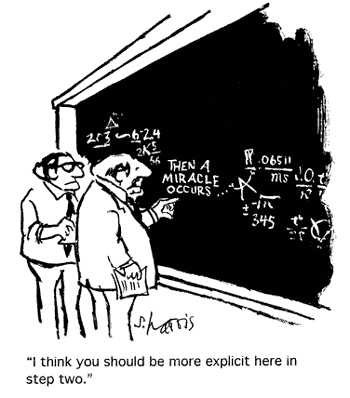
*I should explain. Clark's story, "Dial "F" for Frankenstein," rests on the premise he mentions in that interview: complexity gives rise to life (a variant on the "And then a miracle occurs" in step two of the famous cartoon). The idea of the story was that, given sufficient interconnection of telephones, a "mind" would result, which, rather like HAL, would make its own decisions about what is best. Any day now, the Internet's gonna wake up; just waitin' for that last person to log on; and...it could be you!

Or, maybe not.

Monday, May 12, 2008

Kyrie eleison. Christe eleison. Kyrie eleison.

Once or twice before, I've mentioned a picture published in the UCNews, the "house organ" of the United Church of Christ. In an odd moment of serendipity, I found that picture at last, over at Sadly, No. Here it is:


It's even more horrific in color than it was in black and white. But this is war; this is reality. This is what we do to other people in the name of national security, or freedom, or revenge, or self-preservation. This is "collateral damage," this is the face of the "unfortunate" families we apologize to when our "smart bombs" aren't smart as we are sure they must be. These are the people hurt when George W. Bush says "bring 'em on." When Bush says this:

“Kick ass!” Bush said. “If somebody tries to stop the march to democracy, we will seek them out and kill them! We must be tougher than hell!”
And this:

“There is a series of moments and this is one of them. Our will is being tested, but we are resolute. We have a better way,” Sanchez quoted the president as saying. “Stay strong! Stay the course! Kill them! Be confident! Prevail! We are going to wipe them out! We are not blinking.”
This is what results. This is what he is not blinking at.

I've recently received an e-mail, one that purports to tell me the sender declines to engage in "guilt by association," but he has found a website on the "truth" about William Ayres, whom Obama, per the e-mail, now considers "mainstream." I deleted the e-mail as cleverly disguised spam, but couldn't help thinking: why is Bill Ayers still subject to vilification 40 years later, but when George Bush does this over 1 million times, for both Iraqis and US soldiers (IED's are no less destructive than smart bombs, no less reprehensible), why isn't he hounded to the edges of respectful society and considered a pariah to the end of his days?

Sunday, May 11, 2008

Yeah, that's right, it's about Moms today....

I am so using this because Athenae did:


And because it's my favorite Kate Bush song evah!

"Oooh, it's hard on the man/now his part is over/Now starts the craft/of the father..."

A truer experince of being a parent was never set to music. Makes you want to hug your mother, it does. By the way, don't tell her "Happy Mother's Day." It's too late now: you've bought her the card, you've sent her the flowers (heaven help you if you didn't!). Maybe you took her to brunch (heaven help you if you did! What were you thinking?)

Just let her know you still love her.

Now I got somethin' in my eye......

Friday, May 09, 2008

"I panicked."


A secretive, militaristic government refusing foreign aid after a natural disaster, and seemingly incapable itself of offering any real aid to its citizens?

Wow. Good thing that would never happen here, huh? And if it did, we wouldn't stand for it! We demand our government be responsive to the needs of its people!

Democracy is a beautiful thing, ain't it?

I went looking for a picture to accompany this, found this entry from a visitor from Trinidad who was in the city a few days ago.

Sometimes a thousand words is worth a picture:

A visit to the city of the dead prepared me for my visit to the 9th Ward where Hurricane Katrina had struck with all of her fury. That expanse of land lay abandoned. No one seemed to care for the people who had lost all of their worldly possessions. A federal government that had spent over 500 billion dollars on a War in Iraq seemed indifferent to victims of Katrina whose belongings (or what was left of them) were strewn all over the place.

The 9th War reminded one of the cities of the dead. Somehow the city of the dead looked as though it were better cared for than the abandoned remains of Ward 9. Maybe only God that can put a hand to assist these abandoned victims of Hurricane Katrina. I hope it does not take too long.
Pray for the people of Myanmar and New Orleans. And remember prayer is action, too.

Wednesday, May 07, 2008

Can that conversation on race, um....wait?


The either/or is, ultimately, what protects us from ourselves. It is the ethical, we say, and it is on our side; so we bear no responsibility when things go wrong. Individuals who are hurt, we say, are caught on the wrong side of the either/or; and that's never our fault. Not 45 years ago, what Dr. King described was the norm in America, but the "either/or" of our public ethics said it was okay, or it was human nature, or it would change, but until it did, it was unethical to ask for something that sounded too much like a "both/and," which is always the only alternative we see to the either/or. The either/or cuts the both/and, as we all know, and leaves us with no choice but to wait:

For years now I have heard the word "wait!" It rings in the ear of every Negro with piercing familiarity. This "Wait" has almost always meant "Never." We must come to see, with one of our distinguished jurists, that "justice too long delayed is justice denied."

We have waited for more that 340 years for our constitutional and Godgiven rights. The nations of Asia and Africa are moving with jetlike speed toward gaining political independence, but we still creep at horse-and-buggy pace toward gaining a cup of coffee at a lunch counter. Perhaps it is easy for those who have never felt the stinging darts of segregation to say, "Wait." But when you have seen vicious mobs lynch your mothers and fathers at will and drown your sisters and brothers at whim; when you have seen hate-filled policemen curse, kick, and even kill your black brothers and sisters; when you see the vast majority of your twenty million Negro brothers smothering in an airtight cage of poverty in the midst of an affluent society; when you suddenly find your tongue twisted and your speech stammering as you seek to explain to your six-year-old daughter why she can't go to the public amusement park that has just been advertised on television, and see tears welling up in her eyes when she is told that Funtown is closed to colored children, and see ominous clouds of inferiority beginning to form in her little mental sky, and see her beginning to distort her personality by developing an unconscious bitterness toward white people; when you have to concoct an answer for a five-year-old son who is asking, "Daddy, why do white people treat colored people so mean?"; when you take a cross-country drive and find it necessary to sleep night after night in the uncomfortable corners of your automobile because no motel will accept you; when you are humiliated day in and day out by nagging signs reading "white" and "colored" when your first name becomes "Nigger," your middle name becomes "boy" (however old you are) and your last name becomes "John," and your wife and mother are never given the respected title "Mrs."; when your are harried by day and haunted by night by the fact that you are a Negro, living constantly at tiptoe stance, never quite knowing what to expect next, and are plagued with inner fears and outer resentments; when you are forever fighting a degenerating sense of "nobodiness" then you will understand why we find it difficult to wait. There comes a time when the cup of endurance runs over, and men are no longer willing to be plunged into the abyss of despair. I hope, sirs, you can understand our legitimate and unavoidable impatience.
But now the either/or has ended all of that, and either we are a racist country, or we are not; and we all agree, we are not:

MR. RUSSERT: When you announced your candidacy back in February of '07 in Springfield...

SEN. OBAMA: Mm-hmm.

MR. RUSSERT: ...the same place Abraham Lincoln announced his candidacy--and we're showing it there on the screen--Reverend Wright was going to give the invocation, he was disinvited. He told The New York Times that you said to him, "You get kind of rough in the sermons, so we decided it's best for you not to be out there in public." And you cited a Rolling Stone interview...

SEN. OBAMA: Right.

MR. RUSSERT: ...where he said that one of the essential facts about the U.S. is, "We believe in white supremacy and black inferiority and believe it more than we believe in God." Now, that is so contrary to a speech I heard you gave yesterday about one nation, one people.

MR. RUSSERT: So you knew in '07...

SEN. OBAMA: Right.

MR. RUSSERT: ..."This guy's a problem. I have to keep him out of the spotlight involving my campaign."

SEN. OBAMA: Right. Sure.

MR. RUSSERT: Why didn't you just say then, "You know, Reverend, we're going on different paths because this country does not believe in white supremacy and black inferiority."
At least, we didn't until we discovered the white rural voters of Pennsylvania, a "swing" bloc of voters who apparently didn't exist in any other state in the Union, but who now hold the key to the Democratic primary in their racist...no, wait, they aren't racist, though the pundits kept telling us they won't vote for a black man...well, now I'm confused. I thought we didn't believe in white supremacy and black inferiority. Maybe we don't believe in it, but we practice it anyway.

But racism is an either/or, a matter of ethics, a clear bright line. And as long as we declare that line clear and bright and deny any of us are on the wrong side of it, there is no both/and being practiced here, and we can cheer when Samuel L. Jackson shows up at the end of "Iron Man" in the character of Nick Fury, a white man in the comic books, a black man on screen. Because we don't believe in white suprmacy and black inferiority. Even though blacks still underperform in public schools due to poor funding of those schools. Even though blacks represent a majority of the prison population, all out of proportion to their numbers in the community; even though blacks are are more likely to get the death penalty for killing a white, than whites are for killing blacks. Even though the Dallas County D.A. now admits the prosecutions of blacks in Dallas County in the '70's and 80's was racially biased. We don't believe in white supremacy and black inferiority.

We just continue to practice it. But the either/or says our hands are clean, so we reap the benefits of the both/and. We get to eat our cake and have it, too. No wonder Tim Russert is so concerned about the opinions of the Rev. Jeremiah Wright. Rev. Wright wants to take us beyond the either/or to another place entirely.

Funny; Martin Luther King wanted to do the same thing, 45 years ago:

I must honestly reiterate that I have been disappointed with the church. I do not say this as one of those negative critics who can always find something wrong with the church. I say this as a minister of the gospel, who loves the church; who was nurtured in its bosom; who has been sustained by its spiritual blessings and who will remain true to it as long as the cord of life shall lengthen.

When I was suddenly catapulted into the leadership of the bus protest in Montgomery, Alabama, a few years ago, I felt we would be supported by the white church. I felt that the ministers, priests, and rabbis of the South would be among our strongest allies. Instead, some have been outright opponents, refusing to understand the freedom movement and misrepresenting its leaders; all too many others have been more cautious than courageous and have remained silent behind the anesthetizing security of stained-glass windows.

In spite of my shattered dreams, I came to Birmingham with the hope that the white religious leadership of this community would see the justice of our cause and, with deep moral concern, would serve as the channel through which our just grievances could reach the power structure. I had hoped that each of you would understand. But again I have been disappointed.

I have heard numerous southern religious leaders admonish their worshipers to comply with a desegregation decision because it is the law, but I have longed to hear white ministers declare: "Follow this decree because integration is morally right and because the Negro is your brother." In the midst of blatant injustices inflicted upon the Negro, I have watched white churchmen stand on the sideline and mouth pious irrelevancies and sanctimonious trivialities. In the midst of a mighty struggle to rid our nation of racial and economic injustice, I have heard many ministers say: "Those are social issues, with which the gospel has no real concern." And I have watched many churches commit themselves to a completely otherworldly religion which makes a strange, un-Biblical distinction between body and soul, between the sacred and the secular.

I have traveled the length and breadth of Alabama, Mississippi, and all the other southern states. On sweltering summer days and crisp autumn mornings I have looked at the South's beautiful churches with their lofty spires pointing heavenward. I have beheld the impressive outlines of her massive religious-education buildings. Over and over I have found myself asking: "What kind of people worship here? Who is their God? Where were their voices when the lips for Governor Barnett dripped with words of interposition and nullification? Where were they when Governor Wallace gave a clarion call defiance and hatred? Where were their voices of support when bruised and weary Negro men and women decided to rise from the dark dungeons of complacency to the bright hills of creative protest?"

Yes, these questions are still in my mind. In deep disappointment I have wept over the laxity of the church. But be assured that my tears have been tears of love. Yes, I love the church. How could I do otherwise? I am in the rather unique position of being the son, the grandson, and the great-grandson of preachers. Yes, I see the church as the body of Christ. But, oh! How we have blemished and scarred that body through social neglect and through fear of being nonconformists.

There was a time when the church was very powerful -- in the time when the early Christians rejoiced at being deemed worthy to suffer for what they believed. In those days the church was not merely a thermometer that recorded the ideas and principles of popular opinion; it was a thermostat that transformed the mores of society. Whenever the early Christians entered a town, the people in power became disturbed and immediately sought to convict the Christians for being "disturbers of the peace" and "outside agitators." But the Christians pressed on, in the conviction that they were "a colony of heaven," called to obey Gad rather than man. Small in number, they were big in commitment. They were too God-intoxicated to be "astronomically intimidated." By their effort and example they brought an end to such ancient evils as infanticide and gladiatorial contests.

Things are different now. So often the contemporary church is a weak, ineffectual voice with an uncertain sound. So often it is an archdefender of the status quo. Far from being disturbed by the presence of the church, the power structure of the average community is consoled by the church's silent -- and often even vocal -- sanction of things as they are. But the judgment of God is upon the church as never before. If today's church does not recapture the sacrificial spirit of the early church, it will lose its authenticity, forfeit the loyalty of millions, and be dismissed as an irrelevant social club with no meaning for the twentieth century. Every day I meet young people whose disappointment with the church has turned into outright disgust.
Left there, you might think Dr. King was simply hate-mongering. You might criticize what he had to say, and even denigrate his use of tactics of civil disobedience, of actually breaking the law and conspiring with others to break the law (something Rev. Wright has not yet been even accused of). Which would explain why this letter is titled "From Birmingham Jail." But you would also leave out all the scholarly references Dr. King makes, makes while in jail, to Reinhold Niebuhr and Thomas Aquinas, Martin Buber and St. Augustine, Paul Tillich and St. Paul. Like Rev. Wright, Dr. King grounded his arguments in authority, both scriptural and secular, theological and philosophical. Rev. Wright mentioned the provenance of the AIDS virus in the context of a book on the subject; he mentioned the responsibility for 9/11 by quoting a former US ambassador. But take all that away, and you would have Dr. King saying something very different. Deny Dr. King the opportunity to explain himself, or reduce that explanation to soundbites, you might even think he was dangerous. As, indeed, many people did.

I do not mean to glibly compare Dr. King and the Rev. Wright; but as a nation, we've been down this road once or twice before. By the way, we knew King was a "Commie" in that picture, because it showed white people sitting next to black people.

Certain ideas, you see, are not acceptable until they are...acceptable. And that this the either/or at work again. Thomas Kuhn describes its function in science as the paradigm, which satisfies all questions with acceptable answers, until the questions shift significantly enough that the paradigm no longer holds, and a new one must take its place. Thus the Newtonian universe is not displaced by the Einsteinian, but still it is changed; and the relative universe remains, but gives ground to the quantum universe. And so on, and so on. And in the middle of these transitions, we are caught by those who prefer to control the discussion, rather than explore alternatives that might provide better answers. And we certainly shoot the messenger:

Here was a distinguished man with an exceptionally great career watching his whole life being reduced to a few sound bites created by some political trash. He finally had enough. He was interviewed by Bill Moyers, and he made two great speeches, one at the National Press Club and one at the NAACP national convention. Now let's look at the media trick involved in this.

With the exception of public radio and television, America's media are all private, for-profit corporations. There is no democracy in media world. Nobody on the outside – not the readers or viewers – has any say at all in what the corporate media decide to cover and decide to ignore. Ordinarily, NAACP keynote speakers are not given much coverage. People speak at the National Press Club all the time and get ignored or have just a snippet broadcast. Both of Wright's speeches were broadcast in full, and cable-TV pundits pontificated for almost a solid week about him.

"Why did he choose to go public now? Why seek out all of this publicity?" the pundits cried. Well, the answer is, he didn't. He agreed to one interview, and he agreed to make two speeches. The corporate media decided to shine the spotlight on him. They could have ignored him. They didn't. Instead, they gave him exceptional coverage and spent literally hours of airtime exposing their ignorance and stupidity by talking about him.
Why is the media so focussed on Rev. Wright? Because it hurts Obama? Or because it hurts the ideas he espouses? Or because the conventional wisdom resents a new either/or, which may actually be neither either/or nor both/and, but something transcendent. And what would that look like?

Johannes de Silentio imagines it as the voice that calls Abraham to take Isaac to Moriah. But what he imagines he can only understand as a teleological suspension of the ethical, and it isn't that. The critics of Rev. Wright imagine that is what he is proposing, too; because that is what they would propose, a new end which would justify the means they use to get there. That is the way of the children of this world, and they want you to believe that they alone can welcome you into the eternal homes. So the attacks begin, persist, continue unabated:

As for the Rev. Wright's views, they are not that radical taken in context. The attack on the World Trade Center was a direct result of our policies in the Middle East. We do have blood on our hands. Some years ago, I corresponded with a respectable doctor who was convinced the AIDS virus had been created in a laboratory. Don't be like some spoiled Mafia brat who wants to enjoy the fruits of crime while pretending not to know how it was acquired. And know that being "uppity" is the most American of all traits.
There is little Jesus says in the gospels that isn't a direct challenge to the status quo of most church goers in America, and nothing that he said which isn't grounded in the Hebrew scriptures.yet we never hear it that way. There was nothing Rev. Wright is reported to have said which he wasn't quoting from some other source, and yet the first way of dismissing his message is consider him the source alone of those questions and comments. "Is he right?" is a less relevant question than: "Shouldn't we think about that?" But thinking about almost anything that challenges the status quo is almost anathema to church goers, as Chris Hedges points out in his new book:

The liberal church is a largely vapid and irrelevant force...[that]...may not support the violent projects of apocalyptic killing championed by the atheists such as [Sam] Harris or [Christopher] Hitchens...but it also does not understand how the world works or the seduction of evil. The liberal church is a largely middle-class, bourgeois phenomenon, filled with many people who have profited from industrialization, the American Empire, and global capitalism. They often seem to think that if 'we' can be nice and inclusive, everything will work out.
And why is this?

What grips the heart most powerfully is not the peaceful possession of a precious object but the imperfectly satisfied desire to posses it and the constant fear of losing it.
It is, in other words, as American as apple pie. The question is: can we be Christian, and still be Americans? Aye, there's the rub; because our "precious object" is not God, and it is not other people. It is what we own and what we can hang on to. So when whites loot a flooded store in New Orleans for food, having been abandoned by their useless governments, they are feeding their families; when blacks do it, they are looting. But we don't believe in white supremacy and black inferiority, oh no, not us. We ignore the fact that we live in Omelas; we resent the person who shows us the child in the basement, and decry him as the heretic. We don't even want anyone to ask for a second opinion: as

So where do we go from here?

What we want is to be free from the burdens of history. We want to believe that if enough of the right people agree, then as a nation we no longer belief in white supremacy and black inferiority, even though that is the lesson written in blood and memory in this land for almost 400 years. But 45 years and a couple of laws and a national holiday later, we are free to act like that history never happened. The "sundown towns" never happened; the restrictive covenants on land never blocked certain people from purchasing property; the conditions Dr. King described in 1963, have all been swept away. Haven't they?

The conditions, yes; the consequences, no. Just look at New Orleans today. What other major city in the US would still be in such shambles? Where is our national sense of shame, our resolve to help our neighbors? Where is the proof that we don't believe in white supremacy and black inferiority? How can you have one without the other, and it is abundantly clear to we have, at least, the "other."

Rev. Wright upsets that vision, too; he presents something that cleaves the both/and of "Can't we all just get along?" It is something that could be simply a new either/or (merely continuing the cycle of the dialectic), or it could be, like Dr. King's offer, something completely different, something outside the theme and variations of "both/and" and "either/or." And while the pundits would like to treat the Rev. Wright as the blush on the cheek of a dying age, he is actually the present as it is, rather than the present Barack Obama would like us to simply believe in:

Anyone who does the math knows that America is on track to become a white-minority nation in three to four decades. Yet if there’s any coherent message to be gleaned from the hypocrisy whipped up by Hurricane Jeremiah, it’s that this nation’s perennially promised candid conversation on race has yet to begin.
What do we do now? Maybe we should stop waiting for salvation to come to us; maybe we should start moving toward salvation. Seems to me that's the kerygma of the gospels.

But of course, I could be wrong.

Tuesday, May 06, 2008

Hallelujah! He is Risen, Indeed!

Like many good things, this comes from Wounded Bird. I am taking it out of the context of the problems of the Anglican Communion because it is such a true and good thing:

Communion is never created and developed by the letter. The true communion is nurtured by the Spirit. The true communion is life. The paschal mystery that we live in this liturgical season is an unmistakable demonstration of what we need to re-affirm. Faith in the Risen Christ does not presuppose text, but rather an open heart and a humble faith. It was the event of the Resurrection and the affective perception of it that generated a Community, a Communion.
Brazilian Bishops respond to the St Andrews's Draft of the Covenant

I post this, not to emphasize the Christian confession and so set boundaries around my audience, but to emphasize the fundamental importance of human experience, especially the human experience that arises from humility and an open heart. That will allow us to discard some of those boundaries we all set up in order to make ourselves feel safer.

Besides, I just like the way they put it.

Saturday, May 03, 2008

The Sin of Jeremiah Wright


"The sin, the sin, eating in..." A snatch of poetry suddenly bubbling up from memory; but Google doesn't recognize it, so maybe I remembered wrong...

Anyway, I have finally decoded the sin of Jeremiah Wright, the thing that made him so wrong, so Not Ready for Prime Time TeeVee. He forgot the cardinal rule of Media Figures (not to be confused with Public Figures, which he has been for decades now): Never Forget You Are On TeeVee. And the corollary to that rule, the one that makes this cardinal rule inviolable: TeeVee is the only Reality.

It's been this way for so long now we've stopped thinking about it. Harlan Ellison told the story in one of his collections of stories about Dan Blocker, the actor who played "Hoss" on "Bonanza," back when that show was on the air and as important to people as "The Sopranos" or "Battlestar Galactica" are now (yes, Gen X'ers and all you post Baby Boomers, hard as it is to believe, someday people will not recall your favorite TeeVee shows with any more importance than you have forgotten "Gunsmoke" and "The Rifleman" and "Have Gun, Will Travel," a particular favorite of my grandfather's and mine, when he was alive and I was wee. We also loved "professional wrestling," but that's another confession entirely. We dearly enjoyed comedy.)

Back to Dan Blocker: Ellison was with Mr. Blocker one day when an elderly woman approached him and reproached him for the condition of the Ponderosa, for the way Ben Cartwright (Lorne Greene, for those of you too young to know) was running the house, and the food "Hop Sing" (their Chinese cook) served. Mr. Blocker tried in vain to dissuade this ardent fan; he could not convince her he was an actor, that he had no familial relationship to Mr. Greene, nor was he really "Hoss Cartwright." That TeeVee show was her reality, and she wouldn't be shifted from it.

And she was too old to have grown up watching TeeVee.

When Rev. Wright preached his "controversial" sermons, he wasn't preaching to America, or anyone beyond his congregation, and they seemed to not only agree with his sentiments, but to understand just what he meant. I have learned from my brief time preaching (too brief, but that's yet another story) that sermons are aimed at a particular audience, at a congregation you come to know, and one that comes to know you. Sermons develop out of a conversation with that congregation, they develop their own vocabulary. The sermons of Martin Luther King we remember were delivered to an audience he knew was not his congregation. Whenever I give a sermon to a strange group, one, that is, strange and new to me, it's never the same sermon or experience, as a sermon I might give to a congregation I have pastored for many years. The differences are subtle but important, and the main one is this: I know who is listening to me when I preach to "my" congregation. Put that sermon on tape and send it out for the world to see, and I don't know who is listening to me, or how they will take what I say.

The other main criticism against Rev. Wright, the one that has achieved the imprimatur of "conventional wisdom," (and my thanks to Grandmere Mimi for the link) is that Rev. Wright did alright in his speech to the National Press Club, but it was in the Q & A afterwards where he "failed." Note that the criticism of that portion of his presentation is all based, again, on it being on TeeVee.

TeeVee is not reality, it is a camera: it is a small, narrow aperture, a tiny particular eye through which many people at once can see: and because of its narrowness and particularity, it presents an imitation of intimacy. It appears that the speaker before us is speaking to us, even though he can't possibly be aware who is watching him. It's a one-way conversation, which our celebrities and politicians are trained in using. They are experts at the mimicry of intimacy, when the intimacy is sometime not even with a questioner (who may be in a studio) but only with an instrument, a device, a lens and a box held on an unspeaking person's shoulder. We've all learned this, by now. Watch old footage of "man on the street" interviews, and people seem awkward and stiff with this glass eye sucking at their attention. They try to talk to the person holding the camera, not the persons watching the image the camera captures. Today everyone knows how to "act" on TeeVee.

I cannot describe to you how odd it is to first stand in front of a group and give a sermon. In many churches, no one responds, nor do they expect to. You can feel like you are casting pebbles into a very deep well, and not even hearing the splash, sometimes, until weeks later. Sometimes you hear nothing at all, ever. I imagine speaking to a TeeVee camera is like that: it's a one way conversation that we, the audience, imagine is two-way. Rev. Wright, of course, is used to a congregation that does respond; that is evident from the briefest clips of videotape. And even reading the transcript, you can see the audience responding at the National Press Club. But they respond with laughter, and applause, and even questions from the floor, which he tries to answer but which get cut off. Rev. Wright tries to establish the intimacy with the interrogators, not with the moderator: he tries to take the audience in the room seriously and personally, when the TeeVee Audience imagines it is the audience he should be playing to. Thanks to the narrow vision of the camera, we don't see that audience; and since we are not there, their presence is not present to you and me. Only the man before the camera is real, and since he does not pretend to be real to you and me, we take umbrage with his responses aimed at an audience we can't see.

That audience laughs, applauds, responds to what the speaker says, and the speaker responds to them. But that audience doesn't go on the evening news and pundit shows. The audience that does that, even if they were in the room, understand the rules of this "cool" medium, and they freeze out the man used to the "hot" medium of personal responses from an audience he can see. Those responses are even removed on the sound bites and clips shown on the evening news: the frame is narrowed further, the focus tightened until only the central figure can be seen, and his movements and expressions, isolated from context and meaning, become bizarre and weird and the unreality of TeeVee becomes the only reality we can see.

Which is still tangential, but then again not quite, to the either/or we are still pursuing.

Friday, May 02, 2008

The Rich Are Different


A palate cleanser between rants about the treatment of Jeremiah Wright (I take attacks on pastors, especially UCC pastors, rather personally, it seems) and getting back to the question of the "either/or" (which will return us to Jeremiah Wright, but not in the ways we've become accustomed to).

In America, the passion for material well-being is not always exclusive, but it is general. While not everyone experiences it in the same way, all feel it. Minds are universally preoccupied with meeting the body's every need and attending to life's little comforts.

Something similar is becoming more and more apparent in Europe.

...

When wealth is settled on certain families by inheritance, we find large numbers of men who enjoy material well-being, but not as an exclusive taste.

What grips the heart most powerfully is not the peaceful possession of a precious object but the imperfectly satisfied desire to posses it and the constant fear of losing it.

In aristocratic societies, the rich, never having known any condition different from their own, have no fear of changing it. They can scarcely imagine anything else. For them, therefore, material well-being is not the purpose of life. It is a way of living. They look upon it, in a sense, as synonymous with existence and enjoy it without thinking about it.

Since the natural and instinctive taste for well-being that everyone shares is thus satisfied without difficulty and without fear, the souls of men [sic] turn elsewhere and harness themselves to some grander, more difficult undertaking which animates and engages them.

...

In nations where the aristocracy dominates society and keeps it immobile, the people eventually become accustomed to poverty as the rich do to opulence. The latter do not concern themselves with material well-being because they possess it without effort, the former do no think about it because they have no hope of acquiring it and do not know it well enough to desire it.

In those kinds of society, the poor man's imagination is directed toward the other world. Though gripped by the miseries of real life, it escapes their hold and seeks it satisfactions elsewhere.

By contrast, when ranks lose their distinctions and privileges are destroyed, when patrimonies are divided and entitlement and liberty spread, the longing to acquire well-being enters the imagination of the poor man, and the fear of losing it enters that of the rich. A host of modest fortunes are amassed. Those who possess such fortunes enjoy sufficient material gratifications to conceive a taste for them and not enough to be content with them.

Hence, they are forever seeking to pursue or hold onto pleasures that are as precious as they are incomplete and fleeting.

In casting about for a passion that might be natural in men spurred on as well as constrained by the obscurity of their origins and the modesty of their fortunes, I find none that suits them better than the taste for well-being. The passion for material well-being is essentially a middle class passion. It grows and spreads with that class; it becomes preponderant when the class does. From there it reaches up into the upper ranks of society and descends among the people.

In America I found no citizen so poor that he did not gaze with hop and longing upon the pleasure of the rich, or that his imagination did not savor in advance goods that fate obstinately refused to grant him.

On the other hand, I never found among wealthy Americans that proud disdain for material well-being that can sometimes be seen even in the most opulent and dissolute of aristocracies.

Most of those wealthy people had been poor. They had felt the spur of need. They had waged a long battle against hostile fortune, and though victory was now theirs, the passions that had accompanied the struggle survived. They remained as though intoxicated amid the petty pleasures they had pursued for forty years.

Not that one does not find, in the United States as elsewhere, a fairly large number of wealthy people who, having inherited their property, find themselves effortlessly in possession of an opulence they did not acquire. Yet even they seem no less attached to the gratifications of material life. Love of well-being has become the national and dominant taste. The mainstream of the human passions runs in this direction and sweeps everything along with it.
--Alexis DeTocqueville

Thursday, May 01, 2008

Nobody's Wright, if everybody's wrong

"Young people speakin' their mind/Gettin' so much resistance from behind..."

There. I succumbed to a Wright pun. I'm so done with this topic I never want to hear about it again. Last one; I swear. Really. I can quit anytime I want to. I just don't want to yet.

So I'm looking at this, by Eric Boehlert:

Here's another first: the press's unique push to get a competitive White House hopeful to drop out of the race. It's unprecedented.
And I'm thinking: what about the other "first"? Since when did the media get to decide who a candidate's pastor should be, and what that pastor should say? Because there's really no question the media did a hatchet job on Rev. Wright, chopping up his statements and playing selected bits and pieces of them over and over again, always refusing to respond to the truth and responding, instead, to what they said he said.

Of course, the sinister and unspoken notion here is that pastors tell their members what to think. Interestingly enough, NPR found people in North Carolina who can respect a pastor without agreeing with all of his ideas, a thing apparently unpossible among our pundit class, for whom the thought and the personality are one. Unless, of course, you are Pat Buchanan. But while paid pundits are no reflection on their employer when they make blatantly racist statements (where is the gratitude, Pat?), pastors clearly reflect precisely what their members think, else why go to that church?

Does anybody else see a really demented, self-centered, and consumerist mentality disguised as ecclesiology, in that assumption? Not that there aren't plenty of people who pick the church they attend on precisely that basis, but the irony, again, is that Rev. Wright pastors a UCC church, a congregationalist denomination which places great emphasis on the conscience of the individual, and individual responsibility for one's spiritual life. So while the UCC all but champions attending a congregation where you feel comfortable with what is preached, that freedom of conscience is also precisely why Obama could be a member of that church, without agreeing with everything the Pastor said.

Too bad Obama didn't want to explain that. Or maybe he was just more worried about the kind of conversation res ipsa loquitur imagines. Maybe he decided the medium is the message, not the message itself, and he'd rather play their game than be a different kind of politician. Did Obama have a choice? Yes, he did. He could have done something besides throw Wright "under the bus." This wasn't Obama's "Sister Souljah" moment. It was closer to Clinton's Lani Guinier moment. Closer than that, actually, considering Obama famously said "I could no more disown this man than I could disown the black community."

So now who has he disowned?

Political expediency is all; even for a non-political politician.

This New York Times article buttresses my point, that this wasn't about Wright's jealousy of Obama. When Obama made his famous "race speech":

Mr. Wright was on a long-planned cruise... he returned to find his name a term of opprobrium all across the nation. Mr. Obama and his advisers decline to say if they attempted a reconciliation. Mr. Obama himself has acknowledged talking with Mr. Wright after the Philadelphia speech, and people close to both men tried to caution the pastor to remain silent.

Mr. Wright, however, wanted only to explain himself.
And that went well, so long as he was "scholarly" and quiet. (Or so the Times article says; many of us, however, recall the screams of outrage when a 30 second excerpt from the Moyers' interview was available before that interview aired. No matter what Rev. Wright said, the pundits were determined to hew to their narrative that he was dangerous for Obama.) But it was his answers to questions at the National Press Club that apparently upset everyone. Which brings this back to an earlier topic, about a generational divide. All of the "serious" pundits were quite sure Rev. Wright was terribly "unserious." But all those pundits are, or at least appear to be, my age or older. It was the unserious Jon Stewart who admired Wright's attitude; and it was also Jon Stewart who pointed out this issue is not only racial, it's also about the media's obsession:


And that obsession has made the narrative they've crafted inconsistent in ways that can only be understood as matters of style, and race:


This may be, as the New York Times article paints it, merely Obama's Oedipal moment, his need to kill his "father" in order to reject the father's influence and be his own man. It may have started that way (as the article points out, this didn't begin with YouTube), but it's gone far beyond that now, and the news coverage that led to that race speech was not concerned with Obama's psychic well-being. It has become simply another political weapon wielded by people with their own agendas and inconsistencies. As Stephen Colbert pointed out last night, Catholics like Sean Hannity and Bill O'Reilly understand that the church you attend is a matter of choice, and when you attend church, you are agreeing with everything the priest or pastor not only says, but does.

Aren't you?