Sunday, November 14, 2010

Twenty-Fourth Sunday after Pentecost: Every Purpose Under Heaven


Isaiah 65:17-25
65:17 For I am about to create new heavens and a new earth; the former things shall not be remembered or come to mind.

65:18 But be glad and rejoice forever in what I am creating; for I am about to create Jerusalem as a joy, and its people as a delight.

65:19 I will rejoice in Jerusalem, and delight in my people; no more shall the sound of weeping be heard in it, or the cry of distress.

65:20 No more shall there be in it an infant that lives but a few days, or an old person who does not live out a lifetime; for one who dies at a hundred years will be considered a youth, and one who falls short of a hundred will be considered accursed.

65:21 They shall build houses and inhabit them; they shall plant vineyards and eat their fruit.

65:22 They shall not build and another inhabit; they shall not plant and another eat; for like the days of a tree shall the days of my people be, and my chosen shall long enjoy the work of their hands.

65:23 They shall not labor in vain, or bear children for calamity; for they shall be offspring blessed by the LORD-- and their descendants as well.

65:24 Before they call I will answer, while they are yet speaking I will hear.

65:25 The wolf and the lamb shall feed together, the lion shall eat straw like the ox; but the serpent--its food shall be dust! They shall not hurt or destroy on all my holy mountain, says the LORD.

Psalm 98
98:1 O sing to the LORD a new song, for he has done marvelous things. His right hand and his holy arm have gotten him victory.

98:2 The LORD has made known his victory; he has revealed his vindication in the sight of the nations.

98:3 He has remembered his steadfast love and faithfulness to the house of Israel. All the ends of the earth have seen the victory of our God.

98:4 Make a joyful noise to the LORD, all the earth; break forth into joyous song and sing praises.

98:5 Sing praises to the LORD with the lyre, with the lyre and the sound of melody.

98:6 With trumpets and the sound of the horn make a joyful noise before the King, the LORD.

98:7 Let the sea roar, and all that fills it; the world and those who live in it.

98:8 Let the floods clap their hands; let the hills sing together for joy

98:9 at the presence of the LORD, for he is coming to judge the earth. He will judge the world with righteousness, and the peoples with equity.

2 Thessalonians 3:6-13
3:6 Now we command you, beloved, in the name of our Lord Jesus Christ, to keep away from believers who are living in idleness and not according to the tradition that they received from us.

3:7 For you yourselves know how you ought to imitate us; we were not idle when we were with you,

3:8 and we did not eat anyone's bread without paying for it; but with toil and labor we worked night and day, so that we might not burden any of you.

3:9 This was not because we do not have that right, but in order to give you an example to imitate.

3:10 For even when we were with you, we gave you this command: Anyone unwilling to work should not eat.

3:11 For we hear that some of you are living in idleness, mere busybodies, not doing any work.

3:12 Now such persons we command and exhort in the Lord Jesus Christ to do their work quietly and to earn their own living.

3:13 Brothers and sisters, do not be weary in doing what is right.

Luke 21:5-19
21:5 When some were speaking about the temple, how it was adorned with beautiful stones and gifts dedicated to God, he said,

21:6 "As for these things that you see, the days will come when not one stone will be left upon another; all will be thrown down."

21:7 They asked him, "Teacher, when will this be, and what will be the sign that this is about to take place?"

21:8 And he said, "Beware that you are not led astray; for many will come in my name and say, 'I am he!' and, 'The time is near!' Do not go after them.

21:9 "When you hear of wars and insurrections, do not be terrified; for these things must take place first, but the end will not follow immediately."

21:10 Then he said to them, "Nation will rise against nation, and kingdom against kingdom;

21:11 there will be great earthquakes, and in various places famines and plagues; and there will be dreadful portents and great signs from heaven.

21:12 "But before all this occurs, they will arrest you and persecute you; they will hand you over to synagogues and prisons, and you will be brought before kings and governors because of my name.

21:13 This will give you an opportunity to testify.

21:14 So make up your minds not to prepare your defense in advance;

21:15 for I will give you words and a wisdom that none of your opponents will be able to withstand or contradict.

21:16 You will be betrayed even by parents and brothers, by relatives and friends; and they will put some of you to death.

21:17 You will be hated by all because of my name.

21:18 But not a hair of your head will perish.

21:19 By your endurance you will gain your souls.

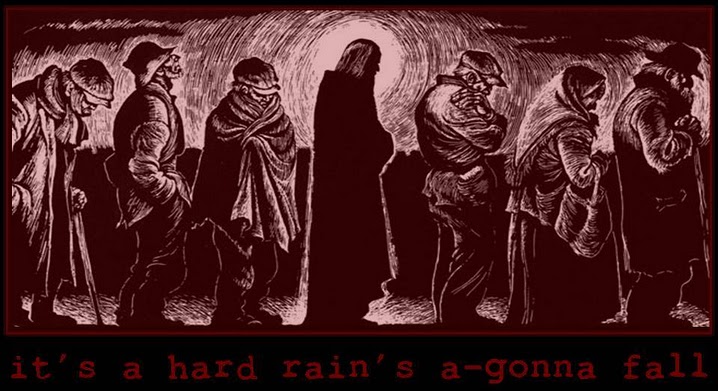
"Pantocrator Christ." That's the name of the painting. It's by El Greco. It represents blessing and judgment: love of humanity, and the failings of humanity. Why can't we take these two together? Why must we always imagine we are the lovable ones, they are the ones worthy of condemnation? And if there is no "they" allowed, then "we" are all lovable, all righteous, or at least all outside of judgment, and so we don't need God, we just need to be left alone.

Well, perhaps that's true. Perhaps we don't need God. We need air; we need water; we need food. We need shelter. What else do we need? Maslow's hierarchy posits the "what keeps mankind alive" school of thought: that lower needs trump higher needs, that needs can fit on a hierarchy, and only when the base is satisfied can the upper needs be addressed. So, except for rare exceptions, the "spiritual" individuals who find their spirituality in asceticism, humanity cannot "need" God until primary needs are met first; until, that is, God fulfills our needs. And if God cannot fulfill our needs, or is not needed to fulfill our needs, then we don't need God.

Perhaps.

Is it even necessary to need God? Is it not sufficient to "be still, and know that I am God"? There's little in scripture to speak of a need for God. The question seldom comes up. Certainly Abraham didn't need God when the unknown God (literally. Abram didn't know God at that time; God was not yet the God of Abraham) said "Come with me." Abram was comfortable where he was; but he believed, and he accepted the promises of God. A truly frightening sign of trust, of faith. Too much for us, and too far away from even the Pantocrator Christ to make any connection possible, to make anything necessary.

And the Pantocrator Christ who is not yet Pantocrator when he says these words to his disciples, these words from Luke, doesn't make things easier. Why do we need persecution and suffering for his sake? Why do we need to endure and persevere? Why can't we just have it now and enjoy it while we're alive? What perverse Creation is this, that needs a God to straighten us out, but a God who can't straighten us out until we have suffered and held fast and endured? Endured what? Persecution? Endure for what? Our souls? And what is that? A metaphysical conceit, nothing more. No, no, this will not do at all. Better away with all judgment, than have this judgment hanging over us for reasons we cannot fully understand, for a faith we cannot all share. Better no God at all than a God who demands this of us.

But where are the demands, and who is making them? There is no demand in the words of Christ in this passage from Luke. There is warning, and there is comfort, and there is assurance: but no demand. God does not make demands. We are not needed of God. We do not need God. We do not need God anymore than we need love. That is, we don't need love the way we need food; or shelter; or clothing. But is that what life is? First feed me, then shelter me, then clothe me; and then, perhaps, I will find time and space and even the need, for love?

Even the beasts aren't as beastly as that.

For I am about to create new heavens and a new earth; the former things shall not be remembered or come to mind.

65:18 But be glad and rejoice forever in what I am creating; for I am about to create Jerusalem as a joy, and its people as a delight.

65:19 I will rejoice in Jerusalem, and delight in my people; no more shall the sound of weeping be heard in it, or the cry of distress.

65:20 No more shall there be in it an infant that lives but a few days, or an old person who does not live out a lifetime; for one who dies at a hundred years will be considered a youth, and one who falls short of a hundred will be considered accursed.

65:21 They shall build houses and inhabit them; they shall plant vineyards and eat their fruit.

65:22 They shall not build and another inhabit; they shall not plant and another eat; for like the days of a tree shall the days of my people be, and my chosen shall long enjoy the work of their hands.

65:23 They shall not labor in vain, or bear children for calamity; for they shall be offspring blessed by the LORD-- and their descendants as well.

65:24 Before they call I will answer, while they are yet speaking I will hear.

65:25 The wolf and the lamb shall feed together, the lion shall eat straw like the ox; but the serpent--its food shall be dust! They shall not hurt or destroy on all my holy mountain, says the LORD.
Do we need that? Or, hearing of it, do we simply want it? And what is wrong with wanting? What makes want so suspect, and need so basic and authoritative? Are we really simply creatures driven and derided by lust, by our needs, our appetites, our hungers? Do we need the Pantocrator Christ? Or do we have him, regardless of our needs, our wants, our desires? Why is need our standard of measure? Why don't we measure by what is best for humankind? When did we become so selfish that our need was all that really, finally, fundamentally mattered?

3:6 Now we command you, beloved, in the name of our Lord Jesus Christ, to keep away from believers who are living in idleness and not according to the tradition that they received from us.

3:7 For you yourselves know how you ought to imitate us; we were not idle when we were with you,

3:8 and we did not eat anyone's bread without paying for it; but with toil and labor we worked night and day, so that we might not burden any of you.

3:9 This was not because we do not have that right, but in order to give you an example to imitate.

3:10 For even when we were with you, we gave you this command: Anyone unwilling to work should not eat.

3:11 For we hear that some of you are living in idleness, mere busybodies, not doing any work.

3:12 Now such persons we command and exhort in the Lord Jesus Christ to do their work quietly and to earn their own living.

3:13 Brothers and sisters, do not be weary in doing what is right.
Do we work because we need to eat, or because the work is good? Do we eat because we need to, or because food is good? Is shelter good, or is it just necessity? How sad to reduce the whole of Creation to what is in it for me, right now, at this moment. Even children must learn to be so selfish. How much better to think of Creation this way:

Let the sea roar, and all that fills it; the world and those who live in it.

98:8 Let the floods clap their hands; let the hills sing together for joy

98:9 at the presence of the LORD, for he is coming to judge the earth. He will judge the world with righteousness, and the peoples with equity.
Do we need justice and equity? Or is the world simply better with it? Perhaps the world doesn't need it; perhaps only we do. What does that say about us, then? How do we get ourselves collectively into this position where we need so much more than the world can give, than we ourselves can provide? If we need a Pantocrator, what did we do to need him? What did we do that we cannot undo? Why were we whole, and made ourselves un-whole?

Maybe we can reach beyond ourselves, reach out to others and do what is right for them; find in their comfort and aid the need we think is so important to us. Maybe we can see beyond ourselves and think first of others, come fully to appreciate how much more important they are than we. Maybe we can stretch ourselves and find in the stretching and the giving and the trying what matters most, what is most important; and even consider that a true need. Maybe, in doing that, we will start to find what we could describe, and understand, and know...as God.

Or at least a Pantocrator.

Whether we need to, or not; we should not. Be weary, that is; in doing what is right.

Amen.

Friday, November 12, 2010

Brother, Can You Spare a Dime?


Matt Taibbi, at the end of a long and excellent article on the foreclosure crisis, puts his finger on it:

When you meet people who are losing their homes in this foreclosure crisis, they almost all have the same look of deep shame and anguish. Nowhere else on the planet is it such a crime to be down on your luck, even if you were put there by some of the world's richest banks, which continue to rake in record profits purely because they got a big fat handout from the government. That's why one banker CEO after another keeps going on TV to explain that despite their own deceptive loans and fraudulent paperwork, the real problem is these deadbeat homeowners who won't pay their fucking bills. And that's why most people in this country are so ready to buy that explanation. Because in America, it's far more shameful to owe money than it is to steal it.

Monday, November 08, 2010

Vanity of Vanities....


I know it's really, really not the right thing to say, but honestly: what is new here besides the technology?

Shouldn’t we struggle against Facebook? Everything in it is reduced to the size of its founder. Blue, because it turns out Zuckerberg is red-green color-blind. “Blue is the richest color for me—I can see all of blue.” Poking, because that’s what shy boys do to girls they are scared to talk to. Preoccupied with personal trivia, because Mark Zuckerberg thinks the exchange of personal trivia is what “friendship” is. A Mark Zuckerberg Production indeed! We were going to live online. It was going to be extraordinary. Yet what kind of living is this? Step back from your Facebook Wall for a moment: Doesn’t it, suddenly, look a little ridiculous? Your life in this format?

The last defense of every Facebook addict is: but it helps me keep in contact with people who are far away! Well, e-mail and Skype do that, too, and they have the added advantage of not forcing you to interface with the mind of Mark Zuckerberg—but, well, you know. We all know. If we really wanted to write to these faraway people, or see them, we would. What we actually want to do is the bare minimum, just like any nineteen-year-old college boy who’d rather be doing something else, or nothing.

At my screening, when a character in the film mentioned the early blog platform LiveJournal (still popular in Russia), the audience laughed. I can’t imagine life without files but I can just about imagine a time when Facebook will seem as comically obsolete as LiveJournal. In this sense, The Social Network is not a cruel portrait of any particular real-world person called “Mark Zuckerberg.” It’s a cruel portrait of us: 500 million sentient people entrapped in the recent careless thoughts of a Harvard sophomore.
First, I should say I'm not "on" Facebook, and I don't want to be. In terms of this essay, that makes me a Luddite, not even Generation 1.0. Fine. I can live with that. And I have to say my touchstone here is the monastic community Kathleen Norris described in her books Dakota and The Cloister Walk, which is to say a world as virtual to me as the world of Facebook. And yes, I do understand there are enough people on Facebook to constitute a large country of its own; but it isn't a country of its own, is it? And it isn't new and different and alien to all human experience before now. Or is it now? Or now?

Do you get my point? I'll come in again.

How about now? No, not then, now. Well, that's already past. And so has this. Well, I should say, so will this.

Blogging was going to change the world. It was all going to be different now, all these people connected together into like-minded communities by the wide-open freedom of the World Wide Web. Except it didn't happen. People I used to converse with daily have all gone back to their lives, or gone on with their lives, and it turned out our interests weren't all that much the same, after all. Probably we would have drifted apart had we seen each other every day. I know all the friends I had in Austin, all the friends I had in seminary, are almost all just memories now. Time's moving finger writes and having writ, moves on. I can keep in touch with them just as well by e-mail or snail mail or telephone as I could by any internet access. I don't, very well, in part because the life I live now is not the life I lived then, and so few of them are a part of it. There are other reasons, too; but that's private. I'm not going to go there with you.

This isn't yet the "open internet" that Mark Zuckerberg envisions. Not for me, anyway.

So I keep in touch with people, and I don't, and that hasn't changed because of e-mail or blogging or even because now everyone is on Facebook. Maybe that's why everyone drifted away from blogging; maybe it's not. Either way, the familiar faces are gone, and the new familiar faces are growing tired of me, or I of them. I find myself repeating myself, like talking about everything old being new again, because I don't know what else to talk about. I don't know how not to be the persona I am on-line, when I'm on-line. And it isn't me; even when it is; because I'm more than that. And dragging that "more" on-line to display it, to explain it, to justify who I present myself to be now, is as much trouble as trying to keep up with people I was never that attached to anyway, people I shared work and experiences with, which I don't share anymore.

My true friends, my close friends, my best friends, have survived it all with me. I'm lucky. I have friends I've known since earliest childhood. I'm very lucky. I have new friends I might as well have known since earliest childhood. I hardly talk to them here; most of them I don't talk to here at all. But that's life, it seems to me. I am, as I say, lucky. The Great Transformation is still the Industrial Revolution. That one upended everything we knew about being human, and shook it all about, and tossed it back on the table in a random jumble and said, "There. Now do something with it." The reaction to that was Romanticism. The reaction to the "Computer Revolution"?

Po-Mo? No. What, then?

We're still wandering around in the ruins of Romanticism, though as a literary and philosophical movement we've now decided ("we"="scholars") it ended after only 30 years. Barely a generation. What is a generation now? Am I connected to my brother-in-law, the former Green Beret in Vietnam, over 10 years my senior? To my brother, two years younger? To anybody born between 1946 and 1964? Sometimes I don't feel like it. Sometimes I feel very connected to my daughter's generation, much more so than I ever felt connected to my father's generation (which isn't saying much, upon reflection, since I've never felt connected to my father's generation). But what connects us a culture? 9/11? Vietnam? Woodstock? Disco? Reagan and "Morning in America? "Hey, hey, LBJ, how many kids did you kill today?"

What revolution in technology has changed all of that? The industrial one, which uprooted us from home finally and fully, long after Abraham left his home and family and followed an unknown God to seek out an unseen land? Certainly not computers. They didn't cause us to create ribbons of highway, or race from place to place in mad riot, or to worship money above all things, that most determinedly American of sins and salvations. And it was long before computers and interstate highways and as many cars as there are Americans (1934, to be precise) that Eliot wrote:

And now you live dispersed on ribbon roads,
And no man knows or cares who is his neighbour
Unless his neighbour makes too much disturbance,
But all dash to and fro in motor cars,
Familiar with the roads and settled nowhere.
Nor does the family even move about together
But every son would have his motor cycle,
And daughters ride away on casual pillions.
So tell me again how new this all is. Tell me again how this:

What life have you if you have not life together?
There is no life that is not in community,
And no community not lived in praise of God.
Doesn't describe Generation 2.0, and Generation 1.0, and the Lost Generation of Eliot and Fitzgerald and Hemingway, as well. Tell me again what is so different, what has so fundamentally changed.

No, the problem is not technology, and it is not communications, and it is not sociology, and it is not even theology. It is pneumatology. It is spirituality. It is the relentless pursuit of what is desired, against the relentless desire for what is truly needed. It is as old as humanity itself, and as new as the next birth.

Call the satisfaction of the desire, the satiation of the itch, wisdom. And stop ascribing it to things wanted or invented or imagined; and start ascribing it to people, and the human condition.

A condition that really hasn't changed all that much, despite the externalities.

Sunday, November 07, 2010

Twenty-Third Sunday after Pentecost: New Styles of Architecture


Haggai 1:15b-2:9
1:15 on the twenty-fourth day of the month, in the sixth month.

2:1 In the second year of King Darius, in the seventh month, on the twenty-first day of the month, the word of the LORD came by the prophet Haggai, saying:

2:2 Speak now to Zerubbabel son of Shealtiel, governor of Judah, and to Joshua son of Jehozadak, the high priest, and to the remnant of the people, and say,

2:3 Who is left among you that saw this house in its former glory? How does it look to you now? Is it not in your sight as nothing?

2:4 Yet now take courage, O Zerubbabel, says the LORD; take courage, O Joshua, son of Jehozadak, the high priest; take courage, all you people of the land, says the LORD; work, for I am with you, says the LORD of hosts,

2:5 according to the promise that I made you when you came out of Egypt. My spirit abides among you; do not fear.

2:6 For thus says the LORD of hosts: Once again, in a little while, I will shake the heavens and the earth and the sea and the dry land;

2:7 and I will shake all the nations, so that the treasure of all nations shall come, and I will fill this house with splendor, says the LORD of hosts.

2:8 The silver is mine, and the gold is mine, says the LORD of hosts.

2:9 The latter splendor of this house shall be greater than the former, says the LORD of hosts; and in this place I will give prosperity, says the LORD of hosts.

Psalm 145:1-5, 17-21
145:1 I will extol you, my God and King, and bless your name forever and ever.

145:2 Every day I will bless you, and praise your name forever and ever.

145:3 Great is the LORD, and greatly to be praised; his greatness is unsearchable.

145:4 One generation shall laud your works to another, and shall declare your mighty acts.

145:5 On the glorious splendor of your majesty, and on your wondrous works, I will meditate.

145:17 The LORD is just in all his ways, and kind in all his doings.

145:18 The LORD is near to all who call on him, to all who call on him in truth.

145:19 He fulfills the desire of all who fear him; he also hears their cry, and saves them.

145:20 The LORD watches over all who love him, but all the wicked he will destroy.

145:21 My mouth will speak the praise of the LORD, and all flesh will bless his holy name forever and ever.

Psalm 98
98:1 O sing to the LORD a new song, for he has done marvelous things. His right hand and his holy arm have gotten him victory.

98:2 The LORD has made known his victory; he has revealed his vindication in the sight of the nations.

98:3 He has remembered his steadfast love and faithfulness to the house of Israel. All the ends of the earth have seen the victory of our God.

98:4 Make a joyful noise to the LORD, all the earth; break forth into joyous song and sing praises.

98:5 Sing praises to the LORD with the lyre, with the lyre and the sound of melody.

98:6 With trumpets and the sound of the horn make a joyful noise before the King, the LORD.

98:7 Let the sea roar, and all that fills it; the world and those who live in it.

98:8 Let the floods clap their hands; let the hills sing together for joy

98:9 at the presence of the LORD, for he is coming to judge the earth. He will judge the world with righteousness, and the peoples with equity.

2 Thessalonians 2:1-5, 13-17
2:1 As to the coming of our Lord Jesus Christ and our being gathered together to him, we beg you, brothers and sisters,

2:2 not to be quickly shaken in mind or alarmed, either by spirit or by word or by letter, as though from us, to the effect that the day of the Lord is already here.

2:3 Let no one deceive you in any way; for that day will not come unless the rebellion comes first and the lawless one is revealed, the one destined for destruction.

2:4 He opposes and exalts himself above every so-called god or object of worship, so that he takes his seat in the temple of God, declaring himself to be God.

2:5 Do you not remember that I told you these things when I was still with you?

2:13 But we must always give thanks to God for you, brothers and sisters beloved by the Lord, because God chose you as the first fruits for salvation through sanctification by the Spirit and through belief in the truth.

2:14 For this purpose he called you through our proclamation of the good news, so that you may obtain the glory of our Lord Jesus Christ.

2:15 So then, brothers and sisters, stand firm and hold fast to the traditions that you were taught by us, either by word of mouth or by our letter.

2:16 Now may our Lord Jesus Christ himself and God our Father, who loved us and through grace gave us eternal comfort and good hope,

2:17 comfort your hearts and strengthen them in every good work and word.

Luke 20:27-38
20:27 Some Sadducees, those who say there is no resurrection, came to him

20:28 and asked him a question, "Teacher, Moses wrote for us that if a man's brother dies, leaving a wife but no children, the man shall marry the widow and raise up children for his brother.

20:29 Now there were seven brothers; the first married, and died childless;

20:30 then the second

20:31 and the third married her, and so in the same way all seven died childless.

20:32 Finally the woman also died.

20:33 In the resurrection, therefore, whose wife will the woman be? For the seven had married her."

20:34 Jesus said to them, "Those who belong to this age marry and are given in marriage;

20:35 but those who are considered worthy of a place in that age and in the resurrection from the dead neither marry nor

are given in marriage. 20:36 Indeed they cannot die anymore, because they are like angels and are children of God, being children of the resurrection.

20:37 And the fact that the dead are raised Moses himself showed, in the story about the bush, where he speaks of the Lord as the God of Abraham, the God of Isaac, and the God of Jacob.

20:38 Now he is God not of the dead, but of the living; for to him all of them are alive."

It's not that I disagree with Bill Maher, but does he understand or remember that it was "The Rev. Dr. Martin Luther King, Jr."?

"Martin Luther King spoke on that Mall in the capital and he didn't say, 'Remember folks, those southern sheriffs with the fire hoses and the German shepherds, they have a point too.' No, he said I have a dream, they have a nightmare...Liberals, like the ones on that field, must stand up and be counted and not pretend that we're as mean, or greedy, or short-sighted or just plain bat-shit as they are. And if that's too polarizing for you, and you still wanna reach across the aisle...try church"
Mr. Maher has obviously never been to church, either.

But "trying church" is precisely the remedy I would recommend. The problem with Mr. Maher's approach is that it assumes "we" are superior to "them," or at least we aren't as "mean, or greedy, or short-sighted or just plain bat-shit as they are," when the fact is, "we" are. "We" absolutely are. Which is not to say Jon Stewart is closer to the truth because he tried to equate the political left and the political right the way he did. Mr. Stewart makes the same error: "they" are the crazy ones, "we" are the civil ones.

And our civility has landed us in rank insanity:

Some Republican lawmakers — still reveling in Tuesday’s statewide election sweep — are proposing an unprecedented solution to the state’s estimated $25 billion budget shortfall: dropping out of the federal Medicaid program.
Harris County (essentially Houston) recorded the largest number of straight party ballots for the GOP in its history. And this is the result. Now, were "we" civil, or were "we" crazy? Because "we" stayed home in droves. Was that "mean, or greedy, or short-sighted or just plain bat-shit" insane? Because no matter what you call it, the results are the same.

Jesus had a saying about this. When the Pharisees complained that his disciples ate unclean food, Jesus said it isn't what goes into a man that makes him unclean, but what comes out. God told Jeremiah that the human heart is devious, beyond all fathoming, and God has to test that heart to find out what is really in it. Did we find out on Tuesday? Did we find out we're all the same under the skin, that the results are the same whether it's us or them that's the crazy ones?

Because standing where I'm standing, I have a hard time seeing the difference in results based on the superiority of one of the parties.

Hard not to think of the events of this past week and not think of those words of Haggai, even as such a comparison seems to diminish the words of the prophet. Then again, someone almost always needs a reason to rejoice, and despite its reputation as being full of blood and thunder, the Hebrew Scriptures are often very good at supplying that reason (far better than at supplying excuses for blood and thunder).

For thus says the LORD of hosts: Once again, in a little while, I will shake the heavens and the earth and the sea and the dry land; and I will shake all the nations, so that the treasure of all nations shall come, and I will fill this house with splendor, says the LORD of hosts.

The silver is mine, and the gold is mine, says the LORD of hosts.
So what do you lack?

I'm sorry, that's too abrupt a transition; let me try again.

Hard not to think of the events of this past week, and not think of the words of the Psalmist:
98:1 O sing to the LORD a new song, for he has done marvelous things. His right hand and his holy arm have gotten him victory.

98:2 The LORD has made known his victory; he has revealed his vindication in the sight of the nations.

98:3 He has remembered his steadfast love and faithfulness to the house of Israel. All the ends of the earth have seen the victory of our God.

98:4 Make a joyful noise to the LORD, all the earth; break forth into joyous song and sing praises.

98:5 Sing praises to the LORD with the lyre, with the lyre and the sound of melody.

98:6 With trumpets and the sound of the horn make a joyful noise before the King, the LORD.

98:7 Let the sea roar, and all that fills it; the world and those who live in it.

98:8 Let the floods clap their hands; let the hills sing together for joy

98:9 at the presence of the LORD, for he is coming to judge the earth. He will judge the world with righteousness, and the peoples with equity.
No? Still not getting it? Alright, I'll try again.

Hard not to think....well, it is hard not to think of the events of the past week. Hard not to think of them and despair, if only because the GOP in Texas is emboldened to balance the state budget once again on the backs of the poor. Hard not to think of that, and think of the words of Jesus: "Now he is God not of the dead, but of the living; for to him all of them are alive." Well, I might have chosen more pointed words, but those are the words chosen by the lectionary, and far be it from my unhallowed hands to disturb the day's Scriptures.

Instead, I'll use them; just as I'll use this quote from Bill Maher, or the planned policy of the Texas GOP, or the words of Haggai. I'll use them to make a point, a particular and pointed and very difficult point: you need a change of heart. You do. You really do. It would do you all the good in the world.

The Saducceess are looking for superiority, in that story from Luke. They want to win the argument about the resurrection, and Jesus won't let them. He redefines the terms, because their terms are too narrow. He forces them to consider a change of heart. They want to challenge his mind. To them, this question of the resurrection is an intellectual puzzle, one that doesn't fit the law of Moses. But their hearts don't fit with the God of Moses. The God of Moses for whom the Psalmist said:

Let the sea roar, and all that fills it; the world and those who live in it.

98:8 Let the floods clap their hands; let the hills sing together for joy

98:9 at the presence of the LORD, for he is coming to judge the earth. He will judge the world with righteousness, and the peoples with equity.
There it is again. That tone of judgment. That murmur of the apocalypse, which we think means the "end of time." It means "revealing," actually. And what may be revealed is that we are all mad, and dangerous, and insane. That we are all equal, even as we insist on our superiority based on...well, based on distinctions more frivolous and difficult to identify than skin color or mother tongue. Haggai says "The silver is mine, and the gold is mine, says the LORD of hosts," but we insist on acting like it is ours; ours alone, and certainly not theirs. They aren't entitled to it. It is left to us, and we alone know how to use it wisely.

Could there be a greater madness than this? Could there be a clearer need for a change of heart?

And yet we still see it as an arms race, as a multi-lateral negotiation: you disarm, and then perhaps, I will disarm. But I will never disarm before you, because...well, we all know what "because" is. So when the sea roars and all the floods clap their hands, we will not fear, because we know we've kept the silver and gold of the Lord in safe hands, in safekeeping, we have preserved it against the day of judgment, to show how righteous we are, how very very unrighteous "they" are. Oh, yes, we are wise. Momma didn't raise no fools.

Is that how it will be? Do we imagine a day when our righteousness prevails and theirs fails, because ours is good and theirs is bad, and evil must always be fought, and evil is always "out there" and never in here among us, never looking out through our eyes and telling us everything we do is right, and everything "they" do is wrong? Is there no evil in that? How can there be? Well, maybe just a little, but their evil is greater! They have the sheriffs and the firehoses and the German shepherds and the majority in the Texas Legislature and in the Congress and EVIL MUST BE FOUGHT!

Do we ever feel our hand around our own throat when we say that? No? Then we aren't doing it right; because we should. Yes, evil must be fought. But where is evil, except in the human heart? And how do you remove it, except with a change of heart?

Who is left among you that saw this house in its former glory? How does it look to you now? Is it not in your sight as nothing?
Is it not in your sight as dead? And yet is it dead, if in God's sight all are living, and God is the God of the living, and not the dead? If the distinction we make are not the distinctions God makes, are we wise to insist on our distinctions? If all of the silver and gold is God's, are we smart to insist on ownership of any of it? If we insist they change first, before we have to, are we pursuing change, or obstructing it?

Without a change of heart, is any real change possible? With a change of heart, is any other change necessary?

One last work about what Mr. Maher said. It's true, Dr. King never said 'Remember folks, those southern sheriffs with the fire hoses and the German shepherds, they have a point too.' But neither did he ever say his fiercest opponents were "mean, or greedy, or short-sighted or just plain bat-shit". Indeed, he saved his fiercest words for those who would be his friends, but who only wanted him to stop leading the movement he was leading. But he knew if he was going to overcome his most ferocious enemies, the sheriffs with the fire hoses and the German shepherds, and all the hateful people they represented, he was going to have to do it by changing their hearts.

It was probably something he learned in church.

Amen.

Tuesday, November 02, 2010

Well, yeah, I guess


Jon Stewart:

If we amplify everything we hear nothing. There are terrorists and racists and Stalinists and theocrats but those are titles that must be earned. You must have the resume. Not being able to distinguish between real racists and Tea Partiers or real bigots and Juan Williams and Rick Sanchez is an insult, not only to those people but to the racists themselves who have put in the exhausting effort it takes to hate--just as the inability to distinguish terrorists from Muslims makes us less safe not more. The press is our immune system. If we overreact to everything we actually get sicker--and perhaps eczema.


In the old days, we used to distinguish between "prejudice" and "racism." "We," of course, meaning "white people." We carefully distinguished simply "bad" comments about race (for blacks or Jews, because for reasons I've never understood, Judaism is a race and a religion) from truly bad comments about race. The latter were "racist" and made only by "bigots," bigots being distinguished from the merely prejudiced because they were unapologetic about their views. The merely prejudiced could always be counted on to say they had nothing against other races, or some of their best friends were of that race, but still....

And like the U.S. military saying we don't intend to kill civilians, but in making omelets eggs must be broken and in conducting air raids on terrorists, civilians must die, somehow the qualification was supposed to make it all better.

Now, as someone who declared Juan Williams' provocative comments to Bill O'Reilly "racist," I'm not backing down from what I said when I say I can see Stewart's point: sort of. We do have a problem of overreacting to everything, and the press should be our national immune system. But Rick Sanchez and Juan Williams were fired because they overstepped the boundaries of their public positions. Sanchez has pretty consistently portrayed a journalist, and Williams has insisted, and been presented, as one on NPR (although he's never there except as a commentator). You can actually be a racist and say outrageously racist things and stay on the air. The prime example is Pat Buchanan. But you can't do those things if you are perceived, or portray yourself, as a journalist.

Ask Helen Thomas.

Monday, November 01, 2010

"The Silent Majority"--All Saint's Day 2010


Daniel 7:1-3, 15-18
7:1 In the first year of King Belshazzar of Babylon, Daniel had a dream and visions of his head as he lay in bed. Then he wrote down the dream:

7:2 I, Daniel, saw in my vision by night the four winds of heaven stirring up the great sea,

7:3 and four great beasts came up out of the sea, different from one another.

7:15 As for me, Daniel, my spirit was troubled within me, and the visions of my head terrified me.

7:16 I approached one of the attendants to ask him the truth concerning all this. So he said that he would disclose to me the interpretation of the matter:

7:17 "As for these four great beasts, four kings shall arise out of the earth.

7:18 But the holy ones of the Most High shall receive the kingdom and possess the kingdom forever--forever and ever."

Psalm 149
149:1 Praise the LORD! Sing to the LORD a new song, his praise in the assembly of the faithful.

149:2 Let Israel be glad in its Maker; let the children of Zion rejoice in their King.

149:3 Let them praise his name with dancing, making melody to him with tambourine and lyre.

149:4 For the LORD takes pleasure in his people; he adorns the humble with victory.

149:5 Let the faithful exult in glory; let them sing for joy on their couches.

149:6 Let the high praises of God be in their throats and two-edged swords in their hands,

149:7 to execute vengeance on the nations and punishment on the peoples,

149:8 to bind their kings with fetters and their nobles with chains of iron,

149:9 to execute on them the judgment decreed. This is glory for all his faithful ones. Praise the LORD!

Ephesians 1:11-23
1:11 In Christ we have also obtained an inheritance, having been destined according to the purpose of him who accomplishes all things according to his counsel and will,

1:12 so that we, who were the first to set our hope on Christ, might live for the praise of his glory.

1:13 In him you also, when you had heard the word of truth, the gospel of your salvation, and had believed in him, were marked with the seal of the promised Holy Spirit;

1:14 this is the pledge of our inheritance toward redemption as God's own people, to the praise of his glory.

1:15 I have heard of your faith in the Lord Jesus and your love toward all the saints, and for this reason

1:16 I do not cease to give thanks for you as I remember you in my prayers.

1:17 I pray that the God of our Lord Jesus Christ, the Father of glory, may give you a spirit of wisdom and revelation as you come to know him,

1:18 so that, with the eyes of your heart enlightened, you may know what is the hope to which he has called you, what are the riches of his glorious inheritance among the saints,

1:19 and what is the immeasurable greatness of his power for us who believe, according to the working of his great power.

1:20 God put this power to work in Christ when he raised him from the dead and seated him at his right hand in the heavenly places,

1:21 far above all rule and authority and power and dominion, and above every name that is named, not only in this age but also in the age to come.

1:22 And he has put all things under his feet and has made him the head over all things for the church,

1:23 which is his body, the fullness of him who fills all in all.

Luke 6:20-31
6:20 Then he looked up at his disciples and said: "Blessed are you who are poor, for yours is the kingdom of God.

6:21 "Blessed are you who are hungry now, for you will be filled. "Blessed are you who weep now, for you will laugh.

6:22 "Blessed are you when people hate you, and when they exclude you, revile you, and defame you on account of the Son of Man.

6:23 Rejoice in that day and leap for joy, for surely your reward is great in heaven; for that is what their ancestors did to the prophets.

6:24 "But woe to you who are rich, for you have received your consolation.

6:25 "Woe to you who are full now, for you will be hungry. "Woe to you who are laughing now, for you will mourn and weep.

6:26 "Woe to you when all speak well of you, for that is what their ancestors did to the false prophets.

6:27 "But I say to you that listen, Love your enemies, do good to those who hate you,

6:28 bless those who curse you, pray for those who abuse you.

6:29 If anyone strikes you on the cheek, offer the other also; and from anyone who takes away your coat do not withhold even your shirt.

6:30 Give to everyone who begs from you; and if anyone takes away your goods, do not ask for them again.

6:31 Do to others as you would have them do to you.

I wrote a quick (and brilliant!) post on the subject of All Saint's this morning, and Blogger somehow managed to eat it. It's gonna be that kind of day, apparently.

From the wreckage let me just note that, per Gore Vidal (I haven't checked it myself), "Silent majority" was Homer's metaphor for the dead. It seems an apt reference for today, if only to remind us of the clouds of witness which surround us and from which, in the spirit of Samhain, we can draw comfort and joy, not fear and loathing (we really need to get over our obsessive fear of death, even as we use death as the centerpiece of so much of our entertainment. Funny how the new Harry Potter movie will end up reminding us of that again.)

I'm going to go try to draw comfort from the loss of what was obviously going to be an excellent post (the lost ones are always the best of the lot.) And end this where I did before:

I pray that the God of our Lord Jesus Christ, the Father of glory, may give you a spirit of wisdom and revelation as you come to know him, so that, with the eyes of your heart enlightened, you may know what is the hope to which he has called you, what are the riches of his glorious inheritance among the saints, and what is the immeasurable greatness of his power for us who believe, according to the working of his great power.
Amen.

Sunday, October 31, 2010

March to Rally to Keep Sanity Restored Through Living Fear


So comedians Jon Stewart and Stephen Colbert held a rally on Saturday, and apparently a few people came. The critics had the knives out early for this; their critiques before and after are not hard to find, most providing, like criticism so often does, an X-ray of the sensibilities of the critic rather than an examination of the subject in question. Howard Fineman damned it with faint praise,and two other bloggers at HuffPost condemned it almost out of hand. While this account seems to sum up the response to the affair after the fact:

Jon Stewart managed to do something with his Rally to Restore Sanity that hasn’t been done in a long time. He confused the mainstream media to the point of a near collective nervous breakdown. The media couldn’t figure out what this rally was about, and it was only when Stewart explained it to them that they realized that it was about them.
....
The media just didn’t get it. In fact, the whole point of the rally eluded them until Jon Stewart told them during his speech to close the event. Stewart explained that the media themselves were part of the point of the rally. Cable news’ approach is part of the problem, “But unfortunately one of our main tools in delineating the two broke. The country’s 24 hour political pundit perpetual panic conflictinator did not cause our problems but its existence makes solving them that much harder. The press can hold its magnifying up to our problems bringing them into focus, illuminating issues heretofore unseen or they can use that magnifying glass to light ants on fire and then perhaps host a week of shows on the sudden, unexpected dangerous flaming ant epidemic. “
NPR, to its credit, ran that portion of Stewart's speech in its story this morning on the rally. But, I wonder, whence comes all this confusion?

Ricouer would call it a narrative, not meaning quite what we now refer to as the "narrative" of the media (which has replaced "paradigm," which is, after all, sooo po-mo and pre-9/11). Odd, of course, that Stewart's rally doesn't fit the national narrative, but this does:
Just last night it was revealed that, at the rally I had for Joe Miller on Thursday, it was revealed and we have the tape that proves it, that the CBS reporters, the affiliate in Alaska, conspired to make up stories about Joe Miller. We have the tape, Chris. I can't wait until it busts out all over the nation to show what it is that we, kind of what I put up with for two years now with the media, but what Joe Miller is faced with, in dealing with someone who feels, Lisa Murkowski, so entitled to seat that she and some of her people including some complicits [sic] in the media will do anything, they will stop at nothing.

[snip]

I'm saying that we have it on tape, the CBS reporters in the affiliate up there in Alaska are on tape saying let's find a child molester in the crowd as a supporter for Joe Miller, let's blast that. Let's concoct a Ron Paul moment there let's find any kind of chaos so that we can tweet an alert and say, 'oohh there's chaos, Joe Miller got punched.' That's sick. Those are corrupt bastards.
This is pretty much in keeping with the Cat Stevens cameo-at-the-rally controversy, except this appears to be a legitimate controversy (i.e., the accusations are being denied). But it fits the narrative we expect; what Stewart and Colbert did Saturday, didn't fit that narrative, anymore than Stephen Colbert's testimony to Congress did. Everybody talked about what he said in character; nobody talked about his reasons for testifying. As Jason Easley put it:

The corporate media didn’t expect anyone to catch on to their role as the dissemination system for partisan polarization. The media may not be to blame for the partisan divisions in our country, but they definitely help to spread and reinforce them by tilting their coverage towards conflict and sensationalism, while completely neglecting information and rational discussion.
So we'll hear a little or a lot about Sarah Palin turning "CBS" into "Corrupt Bastards" (although even FoxNews won't touch it), but whatever we hear will be more than we heard about Stephen Colbert providing witness to exploitation and compassion for migrant workers.

So I'm glad there was a rally. Now, can we go beyond restoring sanity, maybe think about restoring decency and humanity? Or is that just...insane?

Thursday, October 28, 2010

Ex nihilo nihil fit


come on you guys. i know it's hard. but really, let's try to unpack this data in a useful way. which is simply: willful ignorance of their own creed, on the part of believers. actually reading the whole Bible could lead to doubt, contradiction, and dispute. it's why the RCC tried so hard to put it down in Luther's day, and why priesthoods of every kind cling viciously to the notion that "only properly trained tradents can tell the little people what the holy text really means." believers thinking for themselves = less money for temple con artists. you don't have to make much more complicated than that.
This comment from Chicago Dyke in the post below struck me as funny this morning because it contains so many misconceptions about seminary education, and about religion in general. What she says is actually truer about "Bible colleges" than seminaries; and is actually based on a very Protestant idea, not an originally atheistic one.

Martin Luther, as tradition has it, set aside the traditional alb (a garment worn by manual laborers in Roman times, it eventually became the uniform of the office of the clergy, who were hardly manual laborers by then. Ironies abound.) in favor of the academician's robe, to emphasize the teaching office of the clergy, especially in the pulpit. Protestantism's greatest break with the Roman Catholic church, in fact, was based on increased literacy among the populace. Luther was one of the first to translate the Scriptures into the vulgate again. Latin was the tongue of Rome when Jerome translated the scriptures from Greek and Hebrew into Latin, but it was the language of the church alone when Luther did the same thing. He wasn't trying to "tell the little people what the holy text means," he was trying to create the "priesthood of all believers." And yet the leaders of this Reformation were all well-educated men so they, like Luke, put an emphasis on knowledge and learning.

It was still sanctioned knowledge; but that was the culture. We have sanctioned knowledge today; things we agree are true (sex is good! Unless the participants are too young, then it's bad. Or unless commerce is involved, then it's dirty! Science must be taught in an unadulterated form. Math is good. English is good, too. And so on, and so on.) and things we agree are false. What changes is where the emphasis falls. But back to the priesthood controlling knowledge. There is no question that's one purpose of the priesthood. As Bernard Shaw observed, all professions are a conspiracy against the laity. However, Protestantism soon ran away from Luther's vision, and Calvin's (himself trained as a lawyer): Protestants began to protest against their fellow Protestants, objecting to, among other things, the idea that a pastor knew better who had been educated. Education, especially in England (where Elizabeth took over for the Pope in Rome and ruthlessly quashed not only the Catholics but, through her descendants, any Protestants in England who were not Anglican), became a sign of state control, not a source of true knowledge. Many Protestants began to insist on a baptism of the Spirit as a sign one was fit to be a pastor (one only need read Pilgrim's Progress to realize this. Bunyan's ability to read and write was about the only formal education he ever had.)

It's no accident that in the land where Bunyan's work was most likely to be found in every home, next to the Bible, that most popular and famous preachers today are products not of formal seminary training, or even a Bible college, but simply of baptism by the Spirit. Joel Osteen took over Lakewood Church when his father died; he has no formal education in theology or exegesis. Baptist ministers to this day can still be ordained without any seminary training at all (there is an historical split between Protestants, for those who require seminary training to be ordained, and those who don't. Even those on the pro-training side are not all uniformly rigid about the requirement.). And, of course, the most interesting historical quirk is, there is a direct line from Protestantism to the Enlightenment to modern atheism. The two, in fact, really are joined at the hip.

The idea of the priesthood discouraging examination of the Scriptures is a hoary shibboleth, and hardly an accurate one. Judaism, from what I understand, has a long tradition of teaching children (mostly boys, true) to read the holy scriptures. Those who are really interested can study the midrash, where the conversation gets really heated, and the arguments with scripture and other commenters fly freely.

The main revolution of Protestantism was to displace the institution in favor of the individual. Luther and Calvin just preferred other institutions, it's true (and so the revolution was actually meant to be just a reformation), but once the genie was out of the bottle, it was hard to get it back in again. Pilgrim's Progress and Piers Plowman are tributes to the individual against the mass (even against the nuclear family; Pilgrim leaves hearth and home, wife and children, in order to attain the Celestial City), and they disparage earthly knowledge as much as they reject religious institutions. That strain of anti-institutionalism is fierce in American religious culture, and explains the plethora of "mega-churches" and non-denominational churches, as well as ceaselessly splintering denominations. The very idea that priesthoods perpetuate themselves and mean to keep the laity in the dark didn't originate with Thomas Jefferson; his skepticism has deep Protestant roots, which is to say they are cultural as much as ecclesiological. The skepticism of the Enlightenment owes a great deal to the Reformation, and the opening of bodies of knowledge to ordinary people; who, of course, did as much good and bad with it as people are doing now with the internet. There's a great deal of wisdom out there among "ordinary people." There is also a great deal of rank stupidity and venal bigotry. The Tea Party in American politics owes its rise and coalescence and coherence (such as the latter is) as much to technology as it does to political circumstances. Which, most historians note, is equally true of Protestantism.

But the irony in ChiDy's observation that "believers thinking for themselves = less money for temple con artists" is the choicest of all. True, that line of thinking is claimed by atheists today, as it was by "free-thinkers" in the 19th century, as a sign that believers=benighted louts who cannot reason on their own (or freely, in 19th century jargon). But the very history of Protestantism belies this observation. There is a reason there are so many Protestant denominations, and so many non-denominational churches, and it is simply because of believers thinking for themselves. Congregationalist churches, loathing priests as they did, used to sit in judgment on the pastor during his sermons, and upbraid him after the Sunday service if they thought is exegesis unsound. At the turn of the 20th century there was a booming trade in mail order koine Greek lessons, so one could read the New Testament in the original tongue, unfiltered by translation committees. Thinking for oneself is as Protestant as rejecting the Roman Catholic church and all its trappings. The corollary, that all who think for themselves will be atheists or individuals, is the false assumption of the argument. One, purely from a human culture and sociological viewpoint, people like to be in groups of like-minded persons. It's one reason Richard Dawkins' has such a following, a following little concerned with his work on evolutionary biology (and indeed, little versed in it). "Freedom of thought" does not create a vast sea of Ayn Randian individualists wandering the landscape asserting their independence at every turn. It produces another group of like-minded people who join together, either formally or informally, and discuss what they have in common, reinforcing with each other the soundness of their reasoning, the rightness of their opinions; sometimes, even, the superiority of their point of view. There is little difference between the believer who asserts his religion above all others, and the atheist who asserts she alone knows the truth because of her superior knowledge.

It may not have been necessary, in a purely logical world, for Protestantism to have led to modern atheism. There may be no necessary connection between the tenets first espoused by Calvin and Melancthon, and the attitudes of Christopher Hitchens and Sam Harris. But there is certainly an historical one, and it is impossible to be intellectually honest and not recognize the debt modern atheists owe to Protestant thinkers of 5 centuries ago. Atheism, as I have said before, is a product of a Christian Western, culture. It is no more ex nihilo or sui generis than the universe it claims is not the product of a Creator.

And, of course, the harsh fact is, if you really want to be in the spotlight losing your religion: go to seminary. A "Bible College" that will reinforce your most superstitions opinions, it ain't.

Friday, October 22, 2010

Tip-toeing through the racism


Juan Williams defends himself:

And I made it clear that all Americans have to be careful not to let fears lead to the violation of anyone’s constitutional rights, be it to build a mosque, carry the Koran or drive a New York cab without the fear of having your throat slashed. Bill and I argued after I said he has to take care in the way he talks about the 9/11 attacks so as not to provoke bigotry.

This was an honest, sensitive debate hosted by O’Reilly. At the start of the debate Bill invited me, challenged me to tell him where he was wrong for stating the fact that “Muslims killed us there,” in the 9/11 attacks. He made that initial statement on the ABC program, "The View," which caused some of the co-hosts to walk off the set. They did not return until O’Reilly apologized for not being clear that he did not mean the country was attacked by all Muslims but by extremist radical Muslims.

I took Bill’s challenge and began by saying that political correctness can cause people to become so paralyzed that they don’t deal with reality. And the fact is that it was a group of Muslims who attacked the U.S. I added that radicalism has continued to pose a threat to the United States and much of the world. That threat was expressed in court last week by the unsuccessful Times Square bomber who bragged that he was just one of the first engaged in a “Muslim War” against the United States. -- There is no doubt that there's a real war and people are trying to kill us.
Notice the lacunae? It's right there:

I took Bill’s challenge and began by saying that political correctness can cause people to become so paralyzed that they don’t deal with reality. And the fact is that it was a group of Muslims who attacked the U.S. I added that radicalism has continued to pose a threat to the United States and much of the world.
He left out what he said, however:

Well, actually, I hate to say this to you because I don't want to get your ego going. But I think you're right. I think, look, political correctness can lead to some kind of paralysis where you don't address reality.

I mean, look, Bill, I'm not a bigot. You know the kind of books I've written about the civil rights movement in this country. But when I get on the plane, I got to tell you, if I see people who are in Muslim garb and I think, you know, they are identifying themselves first and foremost as Muslims, I get worried. I get nervous.
Put that back in, suddenly his whole defense looks, and smells, quite a bit different.

I've read at least one defense of Mr. Williams' comments that argues that, "in context," his controversial statement was not really a controversial one. I am less than impressed with that argument when Mr. Williams cannot even provide the context himself. Leaving out precisely what you said from your own defense about why you said it, does not instill confidence that what you said wasn't inherently controversial or, in this case, inherently racist.

The President of Iran never appears in public in "Muslim garb," and yet he is often presented (in the Western press) as one of the most dangerous Muslims in the world. The Royal Family of Saud always appears in "Muslim garb," and yet Mr. Williams never expressed any fear of seeing the last President walking through the Texas bluebonnets holding a Saudi prince's hand. The majority of the world's Muslims are Asian, yet I doubt Mr. Williams is appalled by their "Muslim garb," or ever sees them as "identifying themselves first and foremost as Muslims." Indeed, I wonder what he thinks of the Muslims living in Africa? Would it be racist for a white man to say he feared African Muslims and their "Muslim garb"?

Mr. Williams offers a "full throated" justification of his statement, without ever saying what his statement was. Apparently there is no defense for it, anymore than I could defend a public pronouncement that young black men scare me because young black men attacked a family member many years ago (they don't scare me, by the way). I suppose that could be a "Shirley Sherrod" moment for me, as Mr. Williams now wants this to be for him; but that would depend on the context. Ms. Sherrod never shied away from what she said. Mr. Williams would prefer not to recount what he said.

QED, Mr. Williams. Your statement was racist, and the cost to you is signing a new multi-million dollar contract with FoxNews. I hope that isn't too harsh a punishment for you.

A brief addendum: Brit Hume claims Juan Williams was a "Bill Cosby liberal" (huh?), and his firing is evidence of NPR's racism. Obviously, I disagree, but it's interesting how we redefine "racism" to be whatever we want it to be (and to the extent I am guilty of that sin here, I can only say "Mea culpa.") More interesting is the argument NPR screwed up by firing Williams, that he has been made a martyr. Well, maybe; for all of 15 minutes he's a martyr.

Is this whole topic starting to sound like the "Ground Zero Mosque" that wasn't? It is to me, except I think the shelf life of this tempest in a teapot won't survive the weekend. Whatever happened to that mosque, anyway? It lasted as a controversy just beyond August, but then everyone moved on, and the sure sign of the end of the Republic as we know it became something nobody much cares about anymore. All the clamor to move the Muslim community center in order to "be fair (and balanced!)" faded, and the center continues, I presume, to raise money and plan for construction.

The same dynamic is at work here. Did callers refuse to pledge because of this firing? I know people who refused to pledge because Williams was on NPR. So it goes. Mr. Williams is enjoying his moment in the spotlight, wallowing in his shame and humiliation at actually being fired ("Where's my 15 minutes?", I hear many people asking, "and do I get one for each job I was fired from?"). Me, I never thought he added anything valuable, and I'm glad he's gone. I don't dislike E. J. Dionne or even David Brooks as much, but I could do without them, too.

I'd be more than happy for NPR to get back to straight journalism, and leave all the "news analysis" to cable TeeVee, where they devote whole programs and networks to it. But then, I'm curmudgeonly, and grow more so as I get older.

Still don't like Andy Rooney, though.

Turn, turn, turn


I had an epiphany of sorts last night, watching Garrison Keillor on the "cinecast" of A Prairie Home Companion. He was talking about being young and wanting to change the world, and then getting older, and wanting to just get along with the world, realizing in fact that the best change you could make for the world was to leave it be. And suddenly I thought about Kant.

Not the most logical connection, you're thinking. But Kant was a quiet professor in Germany, until he got hold of David Hume's ideas late in his life. I thought about it, and realized how many philosophers and theologians and artists, businessmen, activists, you name it, even saints, are driven by the youthful desire to change the world, to leave their mark on it, to alter the world for the better. And too late did they learn, (if they learned it at all; it's said Hume concluded from his philosophical musings that nothing valuable could be known or shown, and we were better off spending our days just herding sheep. Wittgenstein, likewise, was none too pleased with the process of philosophizing, and the muddled results it created. He, too, wanted to explain the world in his Tractatus; he spent the rest of his life trying to explain the Tractatus.); too late did they learn, as I started to say, that the world was better left alone. Kant, however, couldn't leave the world alone; not after Hume, and not even in his old age.

Kant couldn't leave the world alone because, after Hume, there was no world left to leave alone. Kant couldn't leave the world alone, because he had to resurrect the world. He had to recreate it. He had a reconstruction job to do. Hume, having started out like all ambitious young men, determined to understand the world truthfully, and thereby to improve the lot of humankind, if only so they would know the truth and the truth would set them free, ended up destroying the world. It fell to Kant to put Humpty-Dumpty back together.

This is not unusual in the history of philosophy. Soren Kierkegaard's 'master's thesis' (roughly the equivalent of what we think of as such, anyway; although it was far closer to a modern Ph.D. dissertation) was about the destructive irony of Socrates, an irony that left the world swallowing its own tail. It was fashionable when I started reading Kierkegaard to understand is work as one long reaction to Hegel, when it wasn't about Regina Olsen. Now, with a broader view, perhaps we should see that Kierkegaard, like Kant, was trying to put a world back together. After all, had he not died young, he would surely have retired to a Danish pastorate and lived out his days quietly, haranguing only his congregation with his too big, too complex, too ornate ideas about the too abstract but too concrete concept of being.

There is an ebb and flow to the nature of things, a time for every purpose under heaven, as the song if not the Preacher, has it. There are the youthful ambitions to create, that end up too often looking more like destruction. And there are the banked fires of middle and old age, that to youth look like passionless ashes of failed lives; in reality, though, they may be the more fruitful. It may be that a certain kind of respect for the world as it is presented, rather than as we struggle to re-present it, is the most useful and progressive benefit of all. It may be that in leaving the world alone, or trying to put it back the way we found it (as we learned in kindergarten!) is the best way to make the world better.

Gonna have to think about that.

Wednesday, October 13, 2010

"Work out your own salvation with fear and trembling...."


But what does it mean to share a secret? Here it isn't a matter of knowing what the other knows, for Abraham doesn't know anything. It isn't a matter of sharing his faith, for the latter must remain an initiative of absolute singularity. And moreover, we don't think or speak of Abraham from the point of view of a faith that is sure of itself, any more than did Kierkegaard. Kierkegaard keeps coming back to this, recalling that he doesn't understand Abraham, that he wouldn't be capable of doing what he did. Such an attitude in fact seems the only possible one; and even if it is the most widely shared idea in the world, it seems to be necessitated by this monstrosity of such prodigious proportions. Our faith is not assured because a faith never can be, it must never be a certainty. We share with Abraham what cannot be shared, a secret we know nothing about, neither him nor us. To share a secret is nothing that can be known, nothing that can be determined. What is a secret that is a secret about nothing and a sharing that doesn't share anything?

Such is the secret truth of faith as absolute responsibility and as absolute passion, the "highest passion" as Kierkegaard will say; it is a passion that, sworn to secrecy, cannot be transmitted from generation to generation. In this sense, it has no history. This untransmissability of the highest passion, the normal condition of a faith which is thus bound to secrecy, nevertheless dictates to us the following: we must always start over. A secret can be transmitted, but in transmitting a secret as a secret that remains secret, has one transmitted at all? Does it amount to history, to a story? Yes and no....

But there was no one who could understand Abraham. And yet what did he achieve? He remained true to his love. But anyone who loves God needs no tears, no admiration; he forgets the suffering in the love. Indeed, so completely has he forgotten it that there would not be the slightest trace of his suffering left if God himself did not remember it, for he sees in secret and recognizes distress and counts the tears and forgets nothing.

Thus, either there is a paradox, that the single individual stands in an absolute relation to the absolute, or Abraham is lost.
Jacques Derrida, The Gift of Death (2nd edition), tr. David Wills. Noted in passing, in response particularly to this:

Traditional religion, which does not measure the value of an argument by the date or by fashion, is not deterring progress. It is deterring decay.


Civilization partly consists of teaching men and women to say "no" to desires that are not productive or useful to their souls. What is productive? First, we would have to know the facts about the cosmos. Is there an afterlife? Is there a God? Does He have opinions on what we do?

There is, He exists, and He does. And if He has been clear on anything it is that human beings are good at kidding themselves into bad behavior when it comes to physical desires. Some pagan cultures believed all sex was bad and it became fashionable to castrate men in order to "restrain" desires. The Christian church had to stand against such behavior, which even infected its own ranks, and argue against the intellectual fashion of the day.

Our reward was to be murdered by the government on the pretext of condoning depravity!

In this age, Christian morality is once again unfashionable, but this time not for our tolerance of sex, but our intolerance of some forms of sex. If some ancient intellectuals saw sexual desire as an unspiritual horror, we now face a culture that in part believes it is a necessary part of life!

Saturday, October 02, 2010

The poor will always be with you....


This story on NPR this morning:


Take a trip to one of those 24-hour Walmarts on the last day of every month, and you'll get a glimpse into the lives of low-income families trying to get by. At one location in Fredericksburg, Va., at around 11 p.m., families start to load up on necessities like diapers and groceries.

People like Tracy and Martin Young live nearby, and for the pair in their early 30s, it's a chance to shop quietly without their five children, two of whom are teenagers. Each is pushing a shopping cart overflowing with food. There's mac and cheese, bags of cereal and cans of evaporated milk. Most of this has to last for the whole month.

...
"It's usually about a week and a half," she says. "We try to figure out what we need to do about a week and a half before the end of the month."

That's why they're here at midnight: It's when their food stamps and government checks for their 3-year-old daughter kick in on the first of every month.
That story was preceded by a discussion with Michelle Singletary , who lamented the poverty rate in America, but who also allowed that the recession was a corrective for people who'd been living beyond their means.

But, you know, in some ways, in just a tiny bit of me, I think it was a good thing. Because we were in a position that we shouldn't have been. There were far too many people living above their means, and I think this was the wake-up call that we needed. Unfortunately, it was a pretty, you know, when you're in a good sleep and someone sort of slaps you awake and you get jolted, it's not a good way to wake up. But I'm hoping and praying that when this is over -because it will end - that we learn from what happened, that we take these lessons and do better with our finances, both personally, corporately, and our government.
No sense of irony in what "living beyond their means" can mean, was displayed.

Tuesday, September 28, 2010

"Knowledge is Good"


I've said before that Protestantism took much of its form (and authority) from the culture; that it not only was shaped by the culture, but took its form from the culture. Now there is a study that shows it. Exhibit A:

Four in 10 Catholics misunderstood the meaning of their church's central ritual, incorrectly saying that the bread and wine used in Holy Communion are intended to merely symbolize the body and blood of Christ, not actually become them.
Ah, you will say, but those are Catholics, not Protestants. But, I respond, they clearly might as well be. Growing up in a predominately Protestant culture, they have conformed their thinking to what the culture prescribes. And the culture prescribes the Reformed tradition teaching on the elements of the Eucharist.

I really like this formulation, from the NYT article on the study:

Clergy members who are concerned that their congregants know little about the essentials of their own faith will no doubt be appalled by some of these findings:

¶ Fifty-three percent of Protestants could not identify Martin Luther as the man who started the Protestant Reformation.

¶ Forty-five percent of Catholics did not know that their church teaches that the consecrated bread and wine in holy communion are not merely symbols, but actually become the body and blood of Christ.

¶ Forty-three percent of Jews did not know that Maimonides, one of the foremost rabbinical authorities and philosophers, was Jewish.
First, I suppose we can divide clergy into those who are concerned about their congregants knowledge about their churches doctrines (not "faith," that's a different concept altogether), and those who simply don't care how ignorant their congregants are. Well, come to think of it, maybe we can; but pursuing that line would be churlish. However, I'd say most clergy wouldn't be appalled by those numbers; rather, they'd say "I told you so."

I don't know the history of religious education in other faiths, and my knowledge of it in Protestantism is rather sketchy, but anyone reading this who is also familiar with the term "Sunday school" probably presumes the church always had an active hand in teaching the doctrines of the church. No, actually.

"Sunday school" is a concept and institution that is just over 200 years old, which means it came along some 300 years after the Protestant Reformation. And it didn't begin as a church school to indoctrinate the children of the faithful. Such an idea would have been anathema. Protestant families considered religious instruction to be a family matter, and would have deeply resented any attempt to intrude on that duty by any institution, including the Church. Sunday school, in fact, was started by a Presbyterian pastor in Scotland, who was appalled that the poor children of his parish worked 6 days a week and received no education at all. On their one day off, he decided to teach them to read and write, and thus "Sunday school" was born. Only later did it become the Sunday morning baby-sitter and/or educational center of the Protestant churches.

Today, even Sunday school has withered away, under an onslaught of parents as teachers who themselves don't know basic church doctrines or religious tenets, and the pressure of a work week that spills over into ever day of the week. It may not be work to attend a child's soccer game, but somebody is working that game (the coaches, the referees, etc.), and athletic events of all stripes claim all the time not set aside from school activities. There is also just a general lack of interest in matters religious in the culture. At the turn of the 20th century, correspondence courses in koine Greek, the language of the New Testament, were a booming business. Who reads the New Testament at all, anymore, save for clergy and atheists? The churches I've been involved with have tried to catch the youth with "confirmation" classes, cramming into a year or (more commonly) less all the instruction they didn't receive in the years before. It's a bit like trying to give an uneducated 18 year old a college education; there's almost nothing there to build on, and the kids, predictably, aren't really interested in the doctrine of transubstantiation or the distinction between the Lutheran and Reformed doctrines on the elements of communion.

Of course, that assumes anyone ever really was. I question surveys like this, even as I point to them to confirm my worst suspicions. Does it really matter to anyone that we know today that Maimonides was Jewish? It's useful to scholars and to certain arguments and discussions, but as a matter of general knowledge? How important to one's faith is it to know who Martin Luther was, and what he did? Atheists trumpet such ignorance as proof of their superiority:

“I have heard many times that atheists know more about religion than religious people,” Mr. Silverman said. “Atheism is an effect of that knowledge, not a lack of knowledge. I gave a Bible to my daughter. That’s how you make atheists.”*
Atheism is an affect of knowledge, I will agree with that. But it is not an affect of superior knowledge, better knowledge, or "truer" knowledge. I know who Maimonides was (and what he wrote), I know who Martin Luther was (and what he wrote, especially about the Jews and laborers; it's not pretty), and yet this knowledge does not make me superior to religious people I have known, some of them family members. Indeed, I think in their faith and lives, they were far superior to me. I can also say that about a former neighbor of mine, who was a committed atheist. In his life and actions, his charity and generosity and kindness, he was a far better Christian than I've ever been.

What does it matter if I know the tenets of Calvin's Institutes? Am I less a believer if i don't know Zwingli gave Protestant worship the "pastoral prayer"? The issue of the status of the eucharistic elements divided Lutheran and Reformed tradition churches for nearly 500 years. It was only resolved in the 19th century in Prussia by the forced "marriage" of the two churches into the Evangelical church (later the German Evangelical Church in America). The rift was formally healed between the two Protestant traditions just a few years ago. In either case, did anybody really notice? Did anybody, aside from clergy, really care?

These things have always mattered to clergy, but we can't forget that, especially prior to the Protestant Reformation (which rested on rising literacy rates in Europe), the clergy were the literate members of society. They kept the records and formulated the arguments. It was important because they said so, and because they passed on their ideas and arguments in writing to later generations. Was the layperson in the cathedral at Koln or in Calvin's Geneva really that concerned with what the elements were when taken in the worship service? Probably not. Certainly not the way the priests were.

There is certainly knowledge worth saving, worth preserving and passing on. For the people of the Book (Jews, Muslims, Christians), that knowledge starts with scripture. But the rest is tradition, and, as the German E&R church once prayed:

Grant that thy Church may be delivered from traditions which have lost their life, from usage which has lost its spirit, from institutions which no longer give life and power to their generation; that the Church may ever shine as a light in the world and be as a city set on a hill.
Even the archaic English of that prayer, echoing the King James translation in words ("thy Church") and syntax is a tradition from which we have ultimately to be delivered. Certainly we can argue about the importance, even the validity, of the doctrine of transubstantiation, but more and more we are arguing among a shrinking circle, sounding more and more like the medieval scholastics caricatured by the Renaissance as arguing over how many angels could dance on the head of a pin. This is simply an argument that has no life for the congregants, and insists on a metaphysics, a usage, which has lost its spirit. If it is of no matter to those in the pews, perhaps it has become an institution which no longer gives life and power to this generation.

What does, then? Joel Osteen, among others, insists the words of the Bible mean God wants you to be rich and happy always. Fundamentalists and evangelicals insist the Bible means you must accept Jesus Christ as your Lord and Savior, or suffer the torments of the damned for all eternity. I preach the gospel as a teaching of the Risen Lord who taught us and gave us the power to care for each other, to become more like my atheist neighbor, a person too few of us can become on our own. Which of us teaches the essential information of Christianity? And what does it matter, in those teachings, what the elements of the Eucharist mean? How is my message affected by my audiences knowledge of who Mother Teresa was? Or Maimonides? Or the leader of the Exodus from Egypt?

How does any of the knowledge tested in that study help in answering the question: "What good does it do a person to acquire the whole world and lose...oneself?" At some point, in this context, that becomes the question of the story of Faustus. After all, the Bible tells us that when God appeared to Elijah there was a whirlwind and an earthquake and a fire, but God was not in any one of them. Is God in the doctrines of the Church, or the knowledge of the believer?

The title for this post is taken from the inscription on the statue of the founder of Faber College in Animal House. (I couldn't find that image; I had to make do with the gimme cap). Knowledge certainly is good, but good for what? Good for whom? I've no wish to preach to a congregation ignorant of the most basic ideas of Christianity (I'm no missionary, although perhaps I should reconcile myself to being one, in my own backyard), but neither do I need them to be current on a 500 year old controversy that only ever mattered to the professional clergy and theologians. Knowledge is good, but we have to use it for something, we have to have a use for it in people's lives, or it isn't much good at all.


*actually, I suspect what you make is a confused child. Unless you subscribe to a fundamentalist view that the Bible is magical text which explains itself to each and every person who reads it, you need a community to interpret and explain the meaning of the stories in those books. For much the same reason we teach literature in school, and do it for at least 14 years; longer, if you major in the subject.

Friday, September 24, 2010

Deportees


Stephen Colbert before Congress today:

On a more serious note, when asked why he was advocating for migrant workers, Colbert responded: "I like talking about people who don't have any power and it seems like one of the least powerful people in the United States are migrant workers who come and do our work but don't have any rights as a result. But yet we still invite them to come here and at the same time ask them to leave. [...] Migrant workers suffer and have no rights."
Matthew 25:31-46
25:31 "When the Son of Man comes in his glory, and all the angels with him, then he will sit on the throne of his glory.

25:32 All the nations will be gathered before him, and he will separate people one from another as a shepherd separates the sheep from the goats,

25:33 and he will put the sheep at his right hand and the goats at the left.

25:34 Then the king will say to those at his right hand, 'Come, you that are blessed by my Father, inherit the kingdom prepared for you from the foundation of the world;

25:35 for I was hungry and you gave me food, I was thirsty and you gave me something to drink, I was a stranger and you welcomed me,

25:36 I was naked and you gave me clothing, I was sick and you took care of me, I was in prison and you visited me.'

25:37 Then the righteous will answer him, 'Lord, when was it that we saw you hungry and gave you food, or thirsty and gave you something to drink?

25:38 And when was it that we saw you a stranger and welcomed you, or naked and gave you clothing?

25:39 And when was it that we saw you sick or in prison and visited you?'

25:40 And the king will answer them, 'Truly I tell you, just as you did it to one of the least of these who are members of my family, you did it to me.'

25:41 Then he will say to those at his left hand, 'You that are accursed, depart from me into the eternal fire prepared for the devil and his angels;

25:42 for I was hungry and you gave me no food, I was thirsty and you gave me nothing to drink,

25:43 I was a stranger and you did not welcome me, naked and you did not give me clothing, sick and in prison and you did not visit me.'

25:44 Then they also will answer, 'Lord, when was it that we saw you hungry or thirsty or a stranger or naked or sick or in prison, and did not take care of you?'

25:45 Then he will answer them, 'Truly I tell you, just as you did not do it to one of the least of these, you did not do it to me.'

25:46 And these will go away into eternal punishment, but the righteous into eternal life."

Adding: the plane wreck at Los Gatos Canyon was in 1948. There is, indeed, nothing new under the sun.

Thursday, September 09, 2010

Opposition is a force that gives us meaning

But it should not be confused with Christian doctrine:

Visit msnbc.com for breaking news, world news, and news about the economy


Adding: CNN now reporting the pastor in Florida (I refuse to name him) has called off the Koran burning. Shortly we will know why, but still: good news.