Tuesday, June 20, 2017

Is what we know who we are?

But how do I know?*

Or is who we are what we know?

This post from 12 years ago is suddenly, according to my stats reader, a hot topic.  I daresay I was more clear headed then than I am now; but I was also as prone then as now to let my readers work out their own salvation in fear and trembling.  Or at least confront ideas and reach their own conclusions (the two comments indicate this is still a source of frustration; but the source is intentional about it, to this day):

Which brings us back to Yourgrau: is it a question of being, or a question of knowing? Most criticism of religion in the Western world focusses on the question of knowing. If we don't know God exists, or don't know exactly what God wants, or don't know for sure which rules of God apply, or how to interpret them, how then do we claim as Christians to know anything at all? Likewise, if we do know these things, how do we restrain from imposing them on everyone else, from defining our truth as the truth absolute and even if we are tolerant of other truths, of not measuring them against ours and finding them, inevitably and if we are honest, wanting?

But what if it is a question of being, instead?

The conflict of the thesis is between Continental and Anglo-American schools of philosophy, described as fundamentally divided over the issue of epistemology v. ontology, and which is paramount.  I liked this concluding paragraph in part because I wrote it (let's be honest, and clear false modesty away now), but that's no recommendation for what it says.  I return to it because, 12 years later, I'm still picking the bones of the philosophical position of God's existence, and this puts that question in perspective (well, I think it does).

If knowledge is what being human is all about, then these are legitimate questions and, as well, legitimate stumbling blocks.  But if I don't think they are the foundation of being human (I was going to say "human being," but I'd be misinterpreted as referring to the species, not to being as regards the class of humans, which is what I'd mean), then am I guilty of violating Wittgenstein's "language games"?  Or just playing a language game, which most people think means playing fast and loose with the rules of the discussion.  (And is this particular concern, with engaging jargon, a consequence of our very Anglo resistance to speaking a language other than English?  The Brits and the Americans have that much in common:  we expect the Continent (at least; Mexico and the rest of the Americas, in our case) to speak English.  When people speak another language here in America, we typically grow uncomfortable that they don't speak in a way we can understand.  Jargon is as opaque as a language I don't speak, so....).  It is a language game, in one sense (though not, I think, in Wittgenstein's sense; he wasn't that slow, and besides, he spoke and wrote in at least two languages); but in another, it's simply a requirement that we reset our perspective; which is, admittedly, equally hard to do.

Challenging your assumptions, seeing your perspective as a choice, not an absolute of the universe, was one of the lessons taught in seminary.  We had to learn that our preferences, our assumptions, our theology, was not the only one available; was not the position of wisdom and superiority against which all others should be judged; was not the point of view aligned with God's.  It's tougher than you might think because it requires you to subsume your own ideas and listen carefully to those of others.  Good liberals like this when it involves issues of race, as it did for my seminary class.  There was a student, an African American woman, who wore her grievances about American society and white people, on her sleeve.  She came in prickly and we prickled right back, most of us being whites with the privileges of both our race and our class behind us.  In the end she taught us, and we taught her, because we both came to see each other as human beings, not as "others" impinging on "us."  That is the default setting of human beings, my Christianity teaches me:  the base selfishness of "I" and "not-I" that is how the world divides (and children, presumably, learn to overcome, though never wholly).  It isn't that self-abnegation is the goal, but overcoming selfishness surely is.

But is to be, to do?  Or is to do, to be?

There's not a real consistent thread in the scriptures for the idea that knowledge is fundamental to being human.  Abraham is told by God in Genesis 12 to go where God will lead him.  There is purposefully nothing in the story to indicate Abram (as he is in Gen. 12) knows God, has a relationship with God, is familiar and knowledgeable about God.  God just says "Go," and Abram without a word of demurrer, goes.  It echoes the beginning of the akedeh, the story of the binding of Isaac for sacrifice.  God says "Abraham," and Abraham responds "Here I am."  Abraham says the same thing when Isaac asks where they are going, and why.  "Here I am" is not a question, not a seeking of knowledge, not an acknowledgment (in every possible meaning of that word).  It is simply, as Jonathan Froer explained it in an interview recently, being present.   Abraham doesn't declare even a need to know; Abraham simply declares himself present, available, in the moment.

"Of the making of books there is no end, and much study is a vexation."  One of my favorite verses from Ecclesiastes, and one I used whenever I could to send high school and college graduates on their way in a special recognition in a worship service (and you wonder why I don't have a pulpit today.  More and more I wonder that I ever had one.)  Ecclesiastes, often attributed to Solomon (who probably didn't write anything, but purchased his wisdom by hiring scholars to make him look smart), is not a book to look to for confirmation that knowledge is the be all and end all of human existence.  Indeed, the final advice of the Preacher almost predicts that of Paul to the Thessalonians (where he advises them to work out their salvation with fear and trembling):  fear God.  Fear, need I point out, is not a position of knowledge.  If anything, it is the position of ignorance, or a lack of knowledge that cannot be filled.  Is our fundamental humanity to be found in fear ("I will show you fear in a handful of dust," Eliot says in "The Wasteland.")?  No, of course not.  But our fundamental humanity is certainly not found in knowledge.

Jesus mocks our preference for knowing:  Consider the lilies of the field; they neither spin nor sow.  Consider the birds of the air.  If your child ask for bread, would you give them a stone?  All aimed at the one thing his audience needs to know:  God loves you.  What knowing is needed in love?

Then there is the lesson in James, that what we do is what matters, not what we profess.  Consider there, again, the remonstrance of Jesus against the person who prays loudly in public, so all will know his piety.  Better to do good in secret, so that only God knows what you have done.  Knowing is not a waste of time; but knowing is not the purpose of being.

This is something of a facile contrast, but it's the difference between discovery and revelation.  Traditional Western thought rests on the importance of discovery, especially since the Renaissance.  One of the distinctly valid differences between "medieval" thought and post-Renaissance thought (there are many invalid ones) is that the former rested heavily on revelation (think of the Shewings of Julian of Norwich as a single example.  The visions came from God, not from human insight.), the latter of human effort at "uncovering" what nature hides.  Nature, of course, hides nothing; it is the nature of our knowledge that makes understanding nature complicated and difficult.

It's at this point I realize I'm not running a philosophical seminar, and not writing a theological treatise, and that I promised to say more about the thoughts raised by "Wonder Woman."

Maybe I need another cup of coffee first....


*also my Father's Day gift.  I am so proud.

Sunday, June 18, 2017

Not that it really matters

Just so you believe me when I say "22"
But I call "bullshit":

Milwaukee County Sheriff David Clarke, an African-American who became a staunch critic of the Black Lives Matter movement and a supporter of Donald Trump’s presidential campaign, has withdrawn his acceptance for a job as assistant secretary of the Department of Homeland Security, U.S. newspapers reported on Saturday.

Clarke notified Secretary of Homeland Security John Kelly on Friday of his decision, Craig Peterson, an adviser to Clarke, said in a statement, according to the Washington Post and other newspapers.

You will note this is entirely from Clarke:

Neither the agency nor Clarke’s office immediately responded to requests for comment.

Clarke’s decision comes a month after he told radio station WISN in Milwaukee that he would leave his post as sheriff in June to join the Department of Homeland Security.

At the time, a spokeswoman for the agency said no announcement on Clarke had been made.
I've yet to find an article, including the original from the Washington Post, that doesn't provide information solely from Clarke's camp.  I think this was pure fantasy, start to finish.  Hell, even the medals he likes to flash are mostly prizes from a Cracker Jack box.  Of the 22 pins he likes to wear, 1 is his sheriff's badge.  The other 21 include:

...a pin that reads “Sheriff” made and branded by the Harley-Davidson motorcycle company.

A U.S. flag lapel pin.

A “thin blue line” pin. The expression “thin blue line” is meant to evoke the role of police in society: a thin blue line of people willing to stand between us and them. This pin mirrors similar others that are popular in the United Kingdom.

...a pin for the Israeli civil guard.... At other times, Clarke has worn a badge for the Israeli traffic police.

A 9/11 memorial pin

...a badge for the General Mitchell International Airport division of the Milwaukee County Sheriffs Department.

a pin from the National Rifle Association. Clarke has been a proponent of the organization for some time, including starring in an ad for the NRA.

A U.S. flag bar pin.

A small replica of a 19th-century U.S. Secret Service badge

A 75th anniversary FBI National Academy pin.

A “thin blue line” ribbon from Concerns of Police Survivors, an organization for the family members of law enforcement officials killed in the line of duty.

An FBI National Executive Institute pin.

A pin labeled “NSI,” perhaps for the Nationwide Suspicious Activity Reporting (SAR) Initiative of which Milwaukee is a part.

An FBI National Academy completion pin.

Pin for the CeaseFire crime reduction program of which he was once a liaison for the Milwaukee Police Department.
 A pin depicting a baby’s feet (“the precious feet”), signifying support for the antiabortion movement.

Blue Knights law enforcement motorcycle club pin.

And his response when WaPo contacted him to find out what the pins were:

I am the subject of a lot of ridiculous narratives. This, I must say is the height of that ridiculousness. This smear is beneath me to say any more about, especially with a media outlet (Washington Post) that has proven time and time again with their biased coverage that they are always at the ready to be that propaganda machine for those pushing fake narratives — especially those that smear black conservatives.
He goes on for five paragraphs like that.  The man is a fantasist.  I'm sure he isn't working in the Administration because he would upstage the Fantasist-in-Chief.

Hey hey hey!


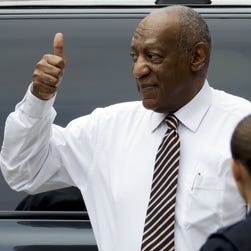
The Bill Cosby trial reminds me of a line a friend told me her former employer used.  He was a criminal lawyer, and when he lost a case, he'd always return to the office to say "Justice prevailed!"

I learned, as a legal assistant, that the courts only did things right when the client you represented, won.  Otherwise it was a gross miscarriage of justice and sign of the moral decay of America.  Or something. At least the clients always thought that way.  It was never what they deserved, or a reasonable outcome based on the facts and the law.

So is Bill Cosby guilty, still?  Not legally; well, not yet, anyway.  Tout le internet (well, the few websites I frequent) insist justice was once again denied.  Camille Cosby would beg to differ, and no doubt she will be castigated for her frank opinions (I even read an internet post castigating a former actor on "The Cosby Show" for going to court with Mr. Cosby on the first day of trial, when Mrs. Cosby was conspicuously absent.  Apparently friends of Mr. Cosby are traitors to the rest of us, or something.  Sort of like the outrage directed, for very different reasons, at Megyn Kelly.  Maybe enough is enough; then again, many people probably won't think so.)

Mrs. Cosby's reaction to the hung jury and mistrial verdict sound familiar to me.  She would agree that justice prevailed.  Many others don't think so.  But we don't sit in the courtroom; we don't hear the evidence; we don't carry the burden of the decision.  The Castile shooting case is in the same boat, unfortunately.  It seems perfectly clear the jury decided a black man is inherently dangerous, and police have a superior duty to shoot first and ask questions later, because you never know, right?

Did Bill Cosby equally escape justice because of "rape culture"?  That seems to me rather less well-established.  After all, many were convinced Cosby's lawyers had given up when they didn't put on a defense for their client.  But they knew what the non-lawyers didn't:  the burden of proof is on the state.  There is no burden on the defendant to prove he is not guilty.  The state failed to meet its burden.  If there is fault here, it is on the lawyers who brought this case.

Vox has a typical analysis of a jury trial:  typical, because it is subtly wrong.

After six days of deliberations regarding accusations that comedian Bill Cosby drugged and sexually assaulted a woman, a jury in Pennsylvania could not come to an agreement on whether he drugged and sexually assaulted Andrea Constand, resulting in a mistrial, the New York Times reports.
The jury asked, at one point, for a definition of "reasonable doubt."  What they were asked to decide was not, did Bill Cosby drug Andrea Constand and assault her, but did he do these things without her consent?  Consent is a key element of assault law.  The simple tort of assault is an unwanted and offensive contact.  So bumping into someone on the street isn't assault, but going out of your way to grab someone's butt, for example, is.  The question of what is "offensive contact" discriminates one from the other, and even when someone grabs your butt in a crowd, it can still be an assault (whereas if you don't want to be jostled by crowds, stay out of them).  The jury's question pretty clearly went to the issue of whether or not the prosecution had made its case, and the jury's decision was:  no, they hadn't.  They couldn't agree on whether the elements of the crime had been proven, not whether the acts alleged had occurred.  The jury, in other words, couldn't decide how to define the acts alleged; or maybe even if they believed they had occurred.  Vox has already made up its mind what happened and who is guilty; the jury didn't have that luxury, and had the burden of following the law.  That's why they asked for a definition of a term of law.

The jury did its job as it saw fit.  The prosecutors are the ones who failed the alleged victim.  If there is an injustice in this case, it is in their failure, not the decision, or inability to reach a decision, of the jury.

Who will rid us of this troublesome Twitter?


Just a quick fact check:

1)  Rasmussen is an outlier.

2) As of 100 days, these are the "legislative bills" Trump had signed:

The 28 Bills That Trump Has Signed Into Law
Extending Obama-Era Policy

S. 544: "A bill to amend the Veterans Access, Choice, and Accountability Act of 2014 to modify the termination date for the Veterans Choice Program, and for other purposes."
Modifying Existing Programs

H.R. 353: "Weather Research and Forecasting Innovation Act of 2017"
S. 442: "National Aeronautics and Space Administration Transition Authorization Act of 2017"
H.R. 72: "GAO Access and Oversight Act of 2017"
Repealing Obama-Era Rules And Regulations

H.J.Res. 67: "Disapproving the rule submitted by the Department of Labor relating to savings arrangements established by qualified State political subdivisions for non-governmental employees"
H.J.Res. 43: "Providing for congressional disapproval under chapter 8 of title 5, United States Code, of the final rule submitted by Secretary of Health and Human Services relating to compliance with title X requirements by project recipients in selecting subrecipients"
H.J.Res. 69: "Providing for congressional disapproval under chapter 8 of title 5, United States Code, of the final rule of the Department of the Interior relating to 'Non-Subsistence Take of Wildlife, and Public Participation and Closure Procedures, on National Wildlife Refuges in Alaska' "
H.J.Res. 83: "Disapproving the rule submitted by the Department of Labor relating to 'Clarification of Employer's Continuing Obligation to Make and Maintain an Accurate Record of Each Recordable Injury and Illness' "
S.J.Res. 34: "A joint resolution providing for congressional disapproval under chapter 8 of title 5, United States Code, of the rule submitted by the Federal Communications Commission relating to 'Protecting the Privacy of Customers of Broadband and Other Telecommunications Services' "
H.J.Res. 42: "Disapproving the rule submitted by the Department of Labor relating to drug testing of unemployment compensation applicants"
H.J.Res. 57: "Providing for congressional disapproval under chapter 8 of title 5, United States Code, of the rule submitted by the Department of Education relating to accountability and State plans under the Elementary and Secondary Education Act of 1965"
H.J.Res. 58: "Providing for congressional disapproval under chapter 8 of title 5, United States Code, of the rule submitted by the Department of Education relating to teacher preparation issues"
H.J.Res. 37: "Disapproving the rule submitted by the Department of Defense, the General Services Administration, and the National Aeronautics and Space Administration relating to the Federal Acquisition Regulation"
H.J.Res. 44: "Disapproving the rule submitted by the Department of the Interior relating to Bureau of Land Management regulations that establish the procedures used to prepare, revise, or amend land use plans pursuant to the Federal Land Policy and Management Act of 1976"
H.J.Res. 40: "Providing for congressional disapproval under chapter 8 of title 5, United States Code, of the rule submitted by the Social Security Administration relating to Implementation of the NICS Improvement Amendments Act of 2007"
H.J.Res. 38: "Disapproving the rule submitted by the Department of the Interior known as the Stream Protection Rule"
H.J.Res. 41: "Providing for congressional disapproval under chapter 8 of title 5, United States Code, of a rule submitted by the Securities and Exchange Commission relating to 'Disclosure of Payments by Resource Extraction Issuers' "
Naming Something/Siting A Memorial/Encouraging Flag Flying

S.J.Res. 1: "A joint resolution approving the location of a memorial to commemorate and honor the members of the Armed Forces who served on active duty in support of Operation Desert Storm or Operation Desert Shield"
H.R. 1362: "To name the Department of Veterans Affairs community-based outpatient clinic in Pago Pago, American Samoa, the Faleomavaega Eni Fa'aua'a Hunkin VA Clinic"
H.R. 609: "To designate the Department of Veterans Affairs health care center in Center Township, Butler County, Pennsylvania, as the 'Abie Abraham VA Clinic' "
S. 305: "Vietnam War Veterans Recognition Act of 2017"
Encouraging An Agency To Try Something New

H.R. 321: "Inspiring the Next Space Pioneers, Innovators, Researchers, and Explorers (INSPIRE) Women Act"
H.R. 255: "Promoting Women in Entrepreneurship Act"
Personnel-Related

S.J.Res. 30: "A joint resolution providing for the reappointment of Steve Case as a citizen regent of the Board of Regents of the Smithsonian Institution"
S.J.Res. 36: "A joint resolution providing for the appointment of Roger W. Ferguson as a citizen regent of the Board of Regents of the Smithsonian Institution"
S.J.Res. 35: "A joint resolution providing for the appointment of Michael Govan as a citizen regent of the Board of Regents of the Smithsonian Institution"
H.R. 1228: "To provide for the appointment of members of the Board of Directors of the Office of Compliance to replace members whose terms expire during 2017, and for other purposes"
S. 84: "A bill to provide for an exception to a limitation against appointment of persons as Secretary of Defense within seven years of relief from active duty as a regular commissioned officer of the Armed Forces"

Yeah; game changers, every one.  None of the 8 others signed since then have been any more significant.

And about those regulations that were rolled back:

The Congressional Review Act allows Congress to reverse rules within 60 legislative days of their submission, requiring only a simple majority in the Senate. In the current Congress, that means Democrats are not able to block the rollbacks.

House Speaker Paul Ryan touted the 13 laws as "measures to take excessive regulations off the book so we can grow this economy."

They included a rule meant to protect streams from pollution, which opponents argued hurt the coal industry; and a rule requiring financial advisers to put consumers' best interests ahead of their own, which critics said would hurt retirees.
Thanks for the sour persimmons, Cousin!

Saturday, June 17, 2017

I blame Twitter


for sometime-in-the-future celebrating the death of Kellyanne Conway:

The Lenox company has received roughly 40 such messages, including one that wished the theater “the worst possible life you could have and hope you all get sick and die.” At Shakespeare Dallas, executive and artistic director Raphael Parry says his company has received about 80 messages, including threats of rape, death, and wishes that the theater’s staff is “sent to ISIS to be killed with real knives.”

Meanwhile, New York Classical Theatre, which performs in Central Park, has received a host of threatening messages, and Shakespeare Theatre Company of Washington, D.C., has received about a dozen caustic e-mails and numerous tweets accusing the company of inciting violence and linking it to this week’s shooting at a congressional baseball practice.

“We just got slammed,” Parry said. “It’s pretty amazing the vitriol, the wishing we would die and our family would die. A whole lot of them say that we should burn in hell.”

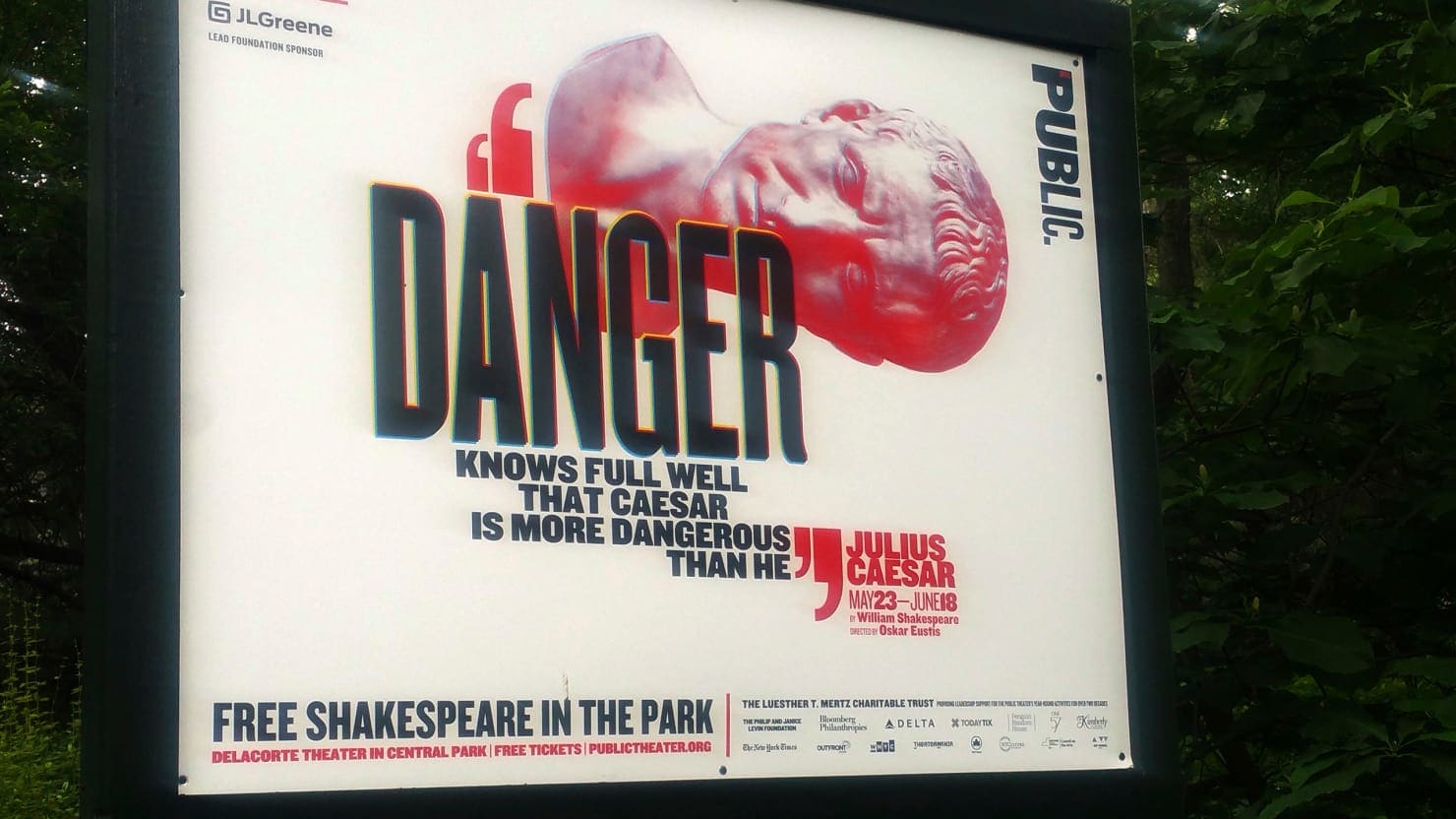
Because, you know, Shakespeare.  I'm guessing all these threats are coming from confirmed Baconians; or maybe DeVereans.  Those people can be quite zealous.  But the play they're concerned about is a production in Central Park.  It's not a play Shakespeare wrote about Donald Trump.

Yeah, yeah, I know, ignorance and all that.*  I'm left wondering why somebody dressed to resemble Trump is portraying Julius Caesar in the first place, except maybe the reference is to current governmental leaders in the country where the play is being performed.  It's not like Shakespeare ever wrote a play advocating anarchy or the death of rulers (his theater company would have been arrested on the spot, and he'd never have been heard from again).

Indeed, if you really wanted to insult Trump, dress an actor to look like him in the role of Iago.  That is Shakespeare's prime villain (Lady Macbeth could take lessons from Iago, who never felt a twinge of conscience about anything).  He identifies himself with the Father of Lies, and every word he utters, except in his soliloquies, the audience knows to be a falsehood.  You can see where I'm going with this.  And how many people would pick up on the reference, the way they are reacting to this play?

Protesters attempted to shut down the Friday night performance of Trump-assassination play, Julius Caesar, in New York's Central Park as one man shouted from the audience that 'the blood of Steve Scalise is on your hands'.

'Right-wing' journalist and activist, Laura Loomer, stormed the stage shouting that the controversial play was 'unacceptable'.

'Stop the normalization of political violence against the right! This is unacceptable. You cannot promote this type of violence against Donald Trump!'

'This is violence against the right. This is violence against Donald Trump,' Loomer yelled as many people in the audience started to boo her off the stage.
Enough, by the way, with this idea of "normalization" where something is said publicly you don't like.  Right wing loons are using it, which should be enough reason for the left-wing to be more reasonable (but don't hold your breath).   As I say, a true depiction of Trump in Shakespeare would be through Iago; and it wouldn't inflame the ignorant who want to march on Shakespeare in Dallas, now.

And really, the "blood of Steve Scalise"?  This is where Trump's loose talk about Scalise taking a bullet for us (what about the Capitol Police officers, who took bullets for Scalise and the other people there?) gets us.  If Scalise dies from his wounds (and again, no, I wish him no ill, despite his politics), heaven help us for the martyrdom that becomes.

Shakespeare actually had a lot to say about discord in government.  His famous phrase (very popular when I entered law school; I even had it on a t-shirt, though I knew what Willie meant, and most people didn't):  "The first thing we do, let's kill all the lawyers," was not a plea for rough justice, but for anarchy.  Remove the laws, as Robert Bolt had Thomas More say, and what stands between you and the Devil?

Iago is as lawless a character as Shakespeare ever created.  He is in no way to be admired.  His every action is for himself alone.  He manipulates and abuses everyone he knows; only his wife knows him well enough not to fully trust him, and he kills her in cold blood when she finally exposes him.  As I say, if you want to comment on the true character of Trump, making him resemble Julius Caesar, a man assassinated by fanatics who act, not selflessly but selfishly, is not the way to do it.

And maybe, once again, we can start turning down the rhetoric about turning down the rhetoric.  That fight doesn't seem to be winning this fight.


*Yeah, could be this, too:

“What might be gurgling up for them is their ire around having to do Shakespeare in high school,” he quipped. “They’re like, you know what? I never realized I hated my English teacher as much as I did.”

Philistines.

Friday, June 16, 2017

While the rest of us are on planet Earth....


Is this the point where we should tone down the rhetoric about toning down the rhetoric?

“I was there at the game last night at the beginning and there was a feeling of unity and healing,” Conway said. “I think that was brought about by our leader, President Donald Trump. He’s being a healer in chief he’s been just remarkably wonderful to the entire country calling for unity praying for those who have been injured for their full recovery.”

She continued: “I think the unity lasted a hot minute for some leaders.”

Conway argued that “You can oppose policies but it’s done with such hateful, charged rhetoric that active resistance becomes armed resistance in the case of this lone gunman.”

The program’s hosts then asked her about congressional Democrats whom she accused of inciting Hodgkinson. Conway pointed to Twitter to claim that “if I were shot and killed tomorrow, half of Twitter would explode in applause and excitement.”

Granted, Twitter is not a very nice place; but her boss does his part to make it so.  As for the "healer in chief," you mean this guy?

“My dear friend Steve Scalise took a bullet for all of us,” Trump said. “And because of him and the tremendous pain and suffering he’s now enduring — and he’s having a hard time, far worse than anybody thought — our country will perhaps become closer, more unified — so important. So we all owe Steve a big, big thank you.”

“And let’s keep the Warmbier family and the Scalise family and all of the victims of the congressional shooting in our hearts and prayers,” Trump continued. “And it was quite a day, and our police officers were incredible, weren’t they? They did a great job. Thank you. And let us all pray for a future of peace, unity, and safety for all of our people. Thank you.”
I'm still trying to wrap my head around how Steve Scalise was shot for my sins, or even the sins of Congress, but to ignore the other people who were shot, to not even be able to call them by name ("our police officers" is as close as he came, in an afterthought), is close to an obscenity.  Healing?  You must be joking.  Praying?  Is this where he asks if we're Christians, again?  That would REALLY be a "healing moment," donchaknow?

Maybe we can get somebody more unifying than Kellyanne Conway?  Like, I dunno, Ted Nugent?

"At the tender age of 69, my wife has convinced me that I just can't use those harsh terms," he said. "I cannot and I will not, and I encourage even my friends-slash-enemy on the left in the Democrat and liberal world that we have got to be civil to each other."
...
"The whole world is watching America, where you have the God-given right to life, liberty and the pursuit of happiness, and we have got to be more respectful to the other side," Nugent continued.
I mean, when the Nuge does the "healing" and "unity" thing better than you do, maybe you should withdraw and consider your place in the national conversation.

Or you can just whine about how mean Twitter is and how the "hot mess" in D.C. is the fault of people you don't agree with.  That's healing and unifying, too; in Bizarro World.

Ever so much more so


On that bullet thing I was talking about earlier; just go read this.

Maybe that will explain it better.
.

The Sound of Silence


There's something distasteful about this:

“My dear friend Steve Scalise took a bullet for all of us,” Trump said. “And because of him and the tremendous pain and suffering he’s now enduring — and he’s having a hard time, far worse than anybody thought — our country will perhaps become closer, more unified — so important. So we all owe Steve a big, big thank you.”

Ah, that's what it is!  The silence that is deafening:

It’s not that people should be defined by their skin color, gender, or who they love. But in this case, these details are important enough to focus on for a moment.

Capitol Police special agents Crystal Griner and David Bailey are widely credited with saving Republican lawmakers and staff during the horrific shooting in Alexandria, Virginia that left Representative Steve Scalise in the hospital in critical condition.

Both Griner and Bailey were wounded.

Both Griner and Bailey are minorities.

Crystal Griner is a female minority, who just so happens to be married to a woman. Griner married Tiffany Dyar in 2015.

As ESPN’s LZ Granderson pointed out, Griner saved the life of Rep. Steve Scalise (R-LA), who is opposed to same-sex marriage,

Well, yeah....


No, what's sad is that you think they have to.  It's still an investigation, not a trial.  Suck it up, buttercup.


No, that's not the problem....(patience, we're getting there!)

Enthusiasm for what?  Your removal from office?  As for regulations, they take years to alter or even remove.  That you think you've swept them away in your first 5 months in office is laughable!  The most effective thing you've done is issue two executive orders that courts have consistently rebuffed as beyond the scope of your powers.

Funny, you told the world you were going to fire Comey anyway.  How does this concept of causation work again?

Being a petty blogger, I can post those tweets and comment on them and chortle in my righteous joy and attract my audience of 3 or more (Hi!  Thanks for coming!).  CNN, on the other hand:

“This morning his tweets were about pushing back that there has been no proof yet on collusion with Russia,” Cuomo explained. “That was his first tweet morning.”

“Shame on us,” Camerota interjected. “I mean shame on us. We are the people who become consumed with the tweets. I know Chris likes the tweets — he thinks they are a window inside the mind of the president. But we are the people devoting our hours of this morning to that instead of something that affects a lot of people like, say, health care and what the Republican plan is and why they’re doing it behind closed doors.”

“I mean, we are the people that have to be judicious about which rabbit hole we want to go down,” she continued.

After CNN political director David Chalian attempted to defend the coverage, Camerota made a suggestion.

“There’s only 24 hours in a day. We have been doing it at the expense of health care,” Camerota remarked. “Let’s change that right now. Let me put my money with my mouth is. So we’re done with the tweets. What do you know about the health care — what do you know about what’s going on? Do we know any of the details of what the president will be presenting? Would be easier to talk about health care if we actually knew what was in the bill?”
The healthcare bill is a big deal.  But it isn't in print, and it isn't being done in front of cameras, and frankly no one knows what's in it (it's on double super secret probation!).  So how can CNN report on it when there are so many tweets from POTUS to flash on the screen and tut-tut over?

I mean, journalism is hard!  They've got 24 hours to fill, and talking about health care bills creates MEGO!  Right?  Of course, they could do this:  "We asked 8 Senate Republicans to explain what their health bill is trying to do," and report on the non-answers the way VOX did.   Or report on this story:

“I have been in contact with a lot of Democrats in Congress,” says Yale’s Jacob Hacker, who is influential in liberal health policy circles, “and I am confident that the modal policy approach has shifted pretty strongly toward a more direct, public-option strategy, if not ‘Medicare for all.’”
Which seems like a pretty big deal.  Because frankly, the problem of Trump's tweets is getting pretty boring, even for a petty blogger like me.

Thursday, June 15, 2017

Shut up, Fool!


For ye are all the children of God by faith in Christ Jesus. 27For as many of you as have been baptized into Christ have put on Christ. 28There is neither Jew nor Greek, there is neither bond nor free, there is neither male nor female: for ye are all one in Christ Jesus. 29And if ye be Christ's, then are ye Abraham's seed, and heirs according to the promise.

Galataians 3:26-29

v. 29 makes it quite clear, you white supremacist idiot:  in Christ, we are all Jews!

But enough about you, let's talk about me

Yesterday:


Today:


Turns out he wasn't through for the day:


Steve Scalise is undergoing his third surgery.  The Capitol Police who shot John Hodgkinson are still wounded.  The people in the UPS facility in San Francisco are still dead.  Otto Warmbier is still "awake but unresponsive."  And this is what the President has time to think about and talk about on Thursday afternoon.

This is why we need guns?


There has been some talk recently, marginalized and largely ignored, by surgeons and ER physicians and people familiar with treating gunshot wounds, to make us pay attention to what bullets do.

Not the bullets in Hollywood movies, which do whatever the writers want them to do, including bloodlessly enter bodies and render them immediately inert but otherwise unmarred, and certainly not pumping bodily fluids from sudden holes.  It is the Hollywood representation of guns that makes us think we are the heroes of our own action films, that if we only had a gun when the "bad guy" was there, we'd have saved the day.

Of course, it doesn't work that way.

Rep. Steve Scalise is finding out first hand what bullets do.  Reports this afternoon are that he's undergoing a third surgery for what the bullet that hit him in the hip did to him internally.  There are fragments, there are damaged organs, there are complications.   He remains in critical condition. You seldom see this kind of thing in a Hollywood movie, and when you do it's always vague and indefinite and calculated to raise the tension and make you sympathize with the "good guy" who is soon to go forth and slay the "bad guy" in the name the now dying comrade.  And the good guy will always hit his mark and the bad guy won't hit the broad side of a barn at 10 paces, and guns will win against guns again.

I do not think Steve Scalise deserves to learn the lesson of what it is to be on the receiving end of gunfire.  I have no doubt the lesson he will learn, should he live (and I pray that he does), is that he, too, should have had a gun; that two armed police officers was clearly not enough to stop the "bad guy with a gun."

And I don't think we'll take the lesson from this real-world experience (even as we ignore so many other victims of gun violence as if they were simply extras in our national movie).  We will go on pretending guns have totemic value, or symbolic value, or even Constitutional value, rather than look at them for what they are:  devices for hurling pieces of metal into other people at very high velocities, with very unpredictable results.

That's what guns are for;  this is what bullets do.

In the U.S.A.


Naomi Klein insists Donald Trump is acting out a deeply complicated theory that makes the "deep state" look like a coffee-klatsch and which only she can explain (even Noam Chomsky would be out of his depth) across three books and some 20 years.

Charlie Pierce puts the opposite case (without even referencing Klein) neatly and succinctly:  follow the money.

For a long time, I didn't believe that the president* would bring all this down on himself just to hide the fact that he isn't as rich as he says he is, but now I'm less sure. I think, maybe, that's what's at the bottom of everything else. I think he isn't that rich, so he and the family business allegedly needed freshly laundered Russian money to keep the business—and his image—afloat. Then, of course, the bill came due from Moscow, and that required another set of malodorous transactions which, in turn, required that they be concealed by another set of malodorous transactions, including the firing of James Comey, and so on.

God, the tax returns. If he'd only released the tax returns, and the people had gotten a look at how he does business and how much he's really worth, it's likely none of this happens. Of course, it's also likely he doesn't become president* either, but, what the hell, all indications are he doesn't much like the job, anyway, at least not enough to learn the basics of how to do it properly.

In any event, it appears that we're all going to get a crash course in the crooked side of high finance—like we need another one of those—and in identifying all the various fauna in the wild kingdom of the international real estate game. I love those teachable moments. Truly, I do.
It's not about shock and its not about "intersectionality" or how "all our movements are interconnected" (she means activist movements, not physical ones, to be clear), or even how Justin Trudeau is a "hollow brand" too (just like Trump; and as a dual Canadian-American citizen, she alone has returned alive to tell us this).  And it's not about three books and 20 years of conspiracy theorizing it took for her to tell us Trump is not just an idiot but a walking "shock-creation machine." It's simply about the words of wisdom William Goldman put in the mouth of "Deep Throat" for that movie about Watergate (search in vain for it in the works of Woodstein):  "Follow the money."

Trump's only raison d'être is money.  It's all he understands, lives for, and pursues.  He's running the Presidency like it was another business licensing the Trump brand.  Mueller is reportedly investigating money laundering by Trump associates.  Sometime back Pierce noted that Mueller had added an expert on such prosecutions to his team; now we know why.

Follow the money.  It's just that simple.  Follow the money.  Everything about this will resolve to that.

This is America, after all.  "It's money that matters/in the U.S.A.!"

Possession is 9/10ths of the need


The good guys with guns fired back at James Hodgkinson.  Their guns didn't provide them with protective shields.  They were wounded.  It also didn't protect Steve Scalise:

Only now he was aiming at human beings, and he hit Scalise over by second base despite the instant efforts of the majority whip’s security detail. Scalise went down and began to crawl across the field as the gunfire continued.

“The guy who’s shot out there—is he OK?” somebody called out.

The cellphone video shows Scalise sprawled in the field. And to see him was not to see a gun-control opponent or a Trump supporter or a Republican or a politician. He was a gunshot victim, as in need of help as any other, his blood as red as yours and mine.

His protectors continued to battle the gunman even after at least one of them was shot, calling out to the gunman, “Drop the weapon! Drop the weapon!”

The cadence of the protectors’ fire intensified and they brought the gunman down. The shooting ceased altogether.

In the cellphone video, figures can be seen rushing to assist Scalise. They included Rep. Brad Wenstrup of Ohio, who is also a physician and served as a combat surgeon in Iraq.

“You never expect a baseball field in America to feel like being back in a combat zone in Iraq, but this morning it did,” he later tweeted.

As night fell, Scalise and one of the other six wounded were listed in critical condition. Scalise’s wife and two young children were reportedly traveling from Louisiana to see him.

And Wenstrup was telling Fox & Friends, “If Scalise was not there, he’s the one with the security detail, we wouldn’t have had any protection, and God knows how bad that might have been.”
More guns didn't protect anyone from gunfire.  It stopped the shooter, but not allowing him to have a gun in the first place would have done more:

A deputy responded and determined that Hodgkinson had upgraded to an assault rifle such as a renewed federal ban would have kept him from legally possessing. Hodgkinson’s prior arrest for firing the shotgun and his outbursts in court had not prevented him from securing  a Firearm Owners Identification card, which is needed to acquire and own a gun in Illinois.

“SUBJECT DID HAVE IN HIS POSSESSION A VALID ILLINOIS FOID CARD,” the sheriff’s report reads. “SUBJECT WAS ADVISED TO NOT DISCHARGE HIS WEAPON IN THE AREA.” 

Hodgkinson was firing that gun in his backyard.  A gun he simply shouldn't have been able to get, but for a change in the law.  Had the law not changed there'd have simply been no need for good guys with guns to put their lives on the line, to risk death themselves, in order to stop a man from shooting other human beings for reasons we'll never understand, never even know.  Although, according to Steve Scalise following the Sandy Hook shooting, even raising that issue is an affront to the grieving process.

Steve Scalise didn't deserve to be shot because of his A+ rating from the NRA, as a kind of ironic joke on him from the cosmos.  But we don't deserve to live in a country ruled by the stupidity of slogans.  Val Demings, D-FL, pointed out on NPR yesterday that:

But I do want to go back to something that my colleague said about, you know, repeating the NRA statement about the answer to a bad guy with a gun is a good guy with a gun. Let me just remind everyone here that the Capitol Police were on scene, and Lord knows there's no question about them being good guys with guns. But I think we do have a responsibility to make sure that they - as they protect us, that we do everything we can to protect our first responders.

Paul Mitchell, R-MI, interrupted her to challenge the idea he was an NRA puppet spouting their slogans mindlessly.  It was not, he said, an NRA slogan, that one about the good guy with the gun.  He recognized the threat, and he had to shut it down:  this discussion can never be about people on the receiving end of bullets, it can only be about people on the possessory end of guns. Even discussion of gun safety, once the raison d'être of the NRA (how I first heard of them, in my youth), is not allowed.  We can only focus on our ability to own.

"The love of possession is a disease with them."  A friend had a poster which attributed that statement to Chief Sitting Bull of the Lakota Nation.  That's all this discussion is about now:  who can possess firearms.  How they are used, what they do to us when they turn a school into a slaughterhouse, a baseball diamond into a combat zone, is not to be considered.  Not even when the advocates of that possession are the victims of the violence it inevitably produces.

No wonder there is so much talk about who is responsible for this, and none of that talk focusses on our responsibility to each other, rather than to our possessions.

Wednesday, June 14, 2017

Anybody for cherry pie?

Might as well quit cherry-picking that quote....

There were two more shootings today, on opposite coasts, as it turns out.

One of those two is going to suck all the national oxygen out of the room.  The other will be a footnote, at best.

And I'm wondering how many people were shot in New Orleans in the last 24 hours. Or in Houston, Los Angeles, Chicago, New York City, Atlanta, San Antonio (when I spent some time there the evening news always led with the shootings in the bars.  It was as regular as the weather report.), and so on and so on and so on.  We won't even notice.  We certainly won't talk about it.

NPR ran a "conversation" between a GOP Rep from Michigan and a Democratic rep from Florida.  He quickly brought up the NRA slogan about bad guys with guns and good guys with guns, and then took all kinds of umbrage when she called it an NRA slogan in response (he doesn't work for the NRA, you see).  As best I could tell, the conversation started nowhere and went nowhere.  Guns save us from the bad guys; guns threaten us all.  You can write that script by now.

This is America.  This is what we do.  We shoot each other, and then we blame each other for the fact that we shoot each other.  Occasionally, someone among us sinks so low that even Fox News won't put up with it:

“The intensity on the left is very real,” Gingrich said. “Whether it’s a so-called comedian holding up the president’s head in blood, or it’s right here, in New York City, a play that shows the president being assassinated. Or it’s Democratic leading national politicians who are so angry they have to use vulgarity because they can’t find any common language.”

Fox’s Melissa Francis at this point objected and questioned whether it was right to blame the shooter’s actions on Democrats who swear.

“With respect, though, even if everything you’re saying is true, to talk about it in those kinds of terms, in left and right, right now in the wake of it, does that make sense?” she asked.

“If you want to know the truth,” Gingrich replied.

“But do you rise above it and say…” she began.

“No!” Gingrich objected.
The proper response there is that Newt Gingrich is no longer fit to be among civilized people, yet alone have privileged access to our national airwaves/conversation.  Or to at least point out if we did rise above it, Newt couldn't see us anymore, and wouldn't that be a shame?  We'd certainly have to look down on him more than we do now.

But this is America.  This is what we do.

Forget Athens, we've got to get back to the Garden....

Halcyon days when reasonable people occupied the White House

Because, of course he does:

The president was pleased by the ambiguity of his position on Mr. Mueller, and thinks the possibility of being fired will focus the veteran prosecutor on delivering what the president desires most: a blanket public exoneration.

Trump thinks Mueller's investigation, like Comey's, is a "witch hunt," and if he cuts off Mueller as he did Comey, it goes away.  But also, he doesn't care about the investigation except as it implicates him.  A "blanket public exoneration" is precisely what he demanded of Comey.  Obstruction of justice, in other words.  But he can't be obstructing justice if he's just getting a declaration that he's never responsible for anything, can he?

Of course, to Trump, the word means "just us."  He doesn't even care about the government.  He just cares about Donald Trump.

And away with the "Will he/won't he?" speculation.  He will, at the drop of a hat (the White House insists it can if it wants to.  Reasonable analysis says Trump will have to go through Rosenstein to get there, and there may even be a problem if enough appointed people refuse to play Robert Bork this time around.  Trump's incompetence in staffing may, in the end, prevent him from firing Mueller without a court fight.)  Recall, too, it wasn't the Saturday Night Massacre that did Nixon in.  Bad as that was, Nixon wasn't done for until the tape came out.

I don't need Nietzsche to explain this to me.  The good ol' Christian concept of sin, which has at its root human selfishness, tells me all I need to know.  That concept explains both Trump, and the willingness of some to see him as more sinned against than sinner.  I also don't care anymore who replaces him; this guy shouldn't be allowed in the White House for a public tour.

Tuesday, June 13, 2017

This is not the elf you are looking for....


Yeah, that's what I remembered:

Atty. Gen. Jeff Sessions said he would appear before the Senate Intelligence Committee on Tuesday to answer questions about his dealings with Russian officials.

Sessions, who came under criticism for failing to report meetings with the Russian ambassador, wrote a letter Saturday saying he wanted to answer questions raised during former FBI Director James B. Comey’s testimony on Thursday.
Wonder what happened?

Sessions declined to answer any questions about his conversations with Trump in the lead-up to the firing of FBI Director James Comey, insisting that the president’s executive privilege meant he didn’t have to tell senators anything about those exchanges.

But, as a host of Democrats pointed out, there’s a big catch: Trump hasn’t actually invoked his executive privilege—in other words, he hasn’t told the attorney general not to answer those questions. So Democrats say there wasn’t a clear-cut Constitutional or legal basis for Sessions to refuse to answer the senators. Still, Sessions refused.

The senators wanted to know if Trump gave Sessions any detail on why he decided to fire Comey.

And Sessions wouldn’t say.

At one point, Sen. Martin Heinrich, a Democrat from New Mexico, suggested he thought the attorney general’s defiance could be a violation of the oath he took at the start of the hearing to tell “the whole truth.”

“You are obstructing a Congressional investigation,” the senator said.
Except Sessions never invoked "executive privilege:

[Sen. Kamala] HARRIS: You referred to a longstanding DOJ policy. Can you tell us what policy it is you are talking about?

SESSIONS: Well, I think most cabinet people, as the witnesses you had before you earlier, those individuals declined to comment bc we’re all about conversations with the president—

HARRIS: Sir, I’m just asking you about the DOJ policy you are referring to.

SESSIONS:...because that’s a longstanding policy that goes beyond just the attorney general.

HARRIS: Is that policy in writing somewhere?

SESSIONS: I think so.

HARRIS: So did you not consult it before you came before this committee, knowing we would ask you questions about that?

SESSIONS: Well, we talked about it. The policy is based—

HARRIS: Did you ask that it would be shown to you?

SESSIONS: The policy is based on the principle that the president—

HARRIS: Sir, I am not asking about the principle. I am asking when you knew that you would be asked these questions and you would rely on this policy, did you not ask your staff to show you the policy that would be the basis for you refusing to answer the majority of questions that have been asked of you?

That's one lawyer trying to duck the questions of another lawyer.  Lawyers have a name for what Sessions was doing; we call it 'weasel speak.'  It's a highly technical term, but it applies here perfectly.  And Sen. Harris wasn't through, despite the best efforts of Sens. McCain and Burr:


You know, I'm really sorry I remember Watergate so well.  I was also quite sure I'd never see it's like again in my lifetime.  The Democrats sound pretty much the same now as they did then:


Reminds me once again that being right doesn't mean you win; but it's always better to be right.  And patient.

I'm also glad I didn't have to listen to too much of Sessions in high dudgeon insisting that his "honah" had been impugned and he would face his accusers with a brace of pistols at dawn, if they were gentlemen!  Honestly, that whole "how dare you, sir!" shit was worn-out decades ago.  It's not even a good comic routine, but that was all he had to hide behind.  Honestly, the man who says this on camera:

“We are receiving, as you know — I’m not sure the rest of you fully understand — the support of law enforcement all over America,” Mr. Sessions told the Cabinet members. “They have been very frustrated. They are so thrilled that we have a new idea that we’re going to support them and work together to properly, [to] lawfully fight the rising crime that we are seeing.”

As if to emphasize his eagerness to remain on the job, Mr. Sessions told the president, “And it’s an honor to be…

“That’s — that’s great,” Mr. Trump interrupted.

“… able to serve you in that regard,” Mr. Sessions said.

“Thank you,” the president said.

“And sends exact right message,” the attorney general continued. “And it’s being responded — the response is fabulous around the country.”

Has no personal honor and cannot be shamed.

Time to put him back on the store shelf.


(There's a pretty substantial list of just what Jeff Sessions wouldn't talk about, here.)


Starting with the death of gods.....


Speaking of Apollonian, nihilism and war, have you seen "Wonder Woman" yet? It asks a similar question of what it means to be a human in a corrupt world whose values are no longer rooted in a transcendent ethic because the gods are literally dead....
There is more in this question than meets the eye, especially since the premise of "Wonder Woman" is that Themyscira, the island of the Amazons, is a place hidden from humanity (men, but let's keep terms clear) and gods (so Ares won't find it).  In the story told to Diana, Ares warred with the gods and only Zeus, finally, was able to defeat him, but at great cost to Zeus.  Ares was not destroyed, but Zeus was (exhausted, basically, but cause of theocide need not detain us here).  Diana is also told she was made from clay by her mother, and given life by Zeus (a sort of inverse of the Pgymalion story.  Diana exists as an object of love, but not an object of sexual desire,).

And where are the gods?  Not killed by men, a la Nietzsche, but killed by war with each other; as the story makes clear at the end, only a god can kill a god.

Are the Amazons gods?  No.  They don't seem to age, though.  Diana is the only child on the island, the only one who matures into adulthood; catches up with the rest of the inhabitants, in other words.  Raised on a hidden island with eternal (if not immortal) women all around, she knows nothing of men (literally) although she's learned in anatomy (as she makes clear to a naked Steve Trevor; she isn't even curious about his physique, except as it is a valid representative of all males, and still her curiosity is only clinical.  Sexual desire is really not part of her make up, another inversion of both the Pygmalion story and all of Ovid's Metamorphoses.  Then again, it's mostly men chasing women in Ovid, so.....).  Anyway, one of the central points of Diana's character is that she is innocent.  She speaks hundreds of languages, is not shocked or surprised by modern weaponry (well, maybe the first time, as she sees the deadly but bloodless power of movie bullets, but she catches on quick to a defense against them) except in the scene where a village is gassed; even then, she is shocked by the needless death more than by the method of inflicting it.  It is the act that is appalling, less so the method.

Her innocence is her moral compass, and no doubt the reason young girls (as reported, anyway) are taking to Diana's character as a defender against evil.  But her innocence is also predicated on her ignorance.

She believes she is merely an animate lump of clay, a Pygmalion (or Adam; there's little difference in the origin stories on that point).  Turns out she is more ordinary than that, and more extraordinary, too.  She also believes humankind is good, and is corrupted by Ares; but Ares is much more in keeping with the conception of the Greek gods.  He is an influence, an instigator, but not the source of evil.  Humankind is quite capable of being evil without Ares, and while World War I is a fine example of a particularly evil form of combat (the slaughter in "No Man's Land," the corrupting poison of "mustard gas"), we all know it only gets worse a generation later, and the film's ending makes clear there's no Ares around to blame for that.  Diana loses her innocence about such matters ("innocence" in sexual terms is never on offer, which is refreshing).  She learns humankind is far more complex, capable of selfless acts as well as evilly selfish ones; that the whispers of gods may be influential, but they are not originating causes, probably not even proximate causes.  Ares fans the horror of war, but he lays no claim to have started it.

If these are the gods who are dead, do we miss them?

That's a cheat if we leave it there, because it ducks legitimate questions.  Those will be considered a bit later.

Meanwhile, back at the front....

While we're considering the nature of Nietzsche and who scribed Shakespeare (or preferably just what he meant by it), we can keep the "Wonder Woman" discussion alive, too.

The Duty to Choose


Ideally, this will be something of an inter-blog conversation, because I'm responding here to comments (gotta get back to that "Wonder Woman" observation!  That one I'm gonna have to think about a bit longer.) and this blog post.  And I want to start backwards, with Shakespeare, and work my way back to Nietzsche.

First, it's important to understand the political and social, even governmental (therefore fundamental) turmoil of Elizabethan England.  That age is considered a "golden" one for England, but all that is gold does not glitter, and that era was, by modern standards, horrifically uncertain and extremely violent.  People regularly disappeared into "Traitor's Gate" on the Thames at the Tower, and reappeared, if ever, as severed heads on Tower Bridge.  No public trials, no right to trial by jury, no appeal, no due process or equal protection of law.  A modern nightmare, but a "Golden Age."  A nutshell version to explain why people would keep their heads down and their opinions (especially about religion; Protestant (the Church of England) v. Catholic (the church of Rome).  It was Elizabeth, not her father, who established the English church, and it's enforcement at the level of life Shakespeare lived was brutal:  nasty, brutish, and short, in Hobbes' famous phrase.  I've read an excellent modern biography of Willie the Shake which argues his father was probably an unconverted Catholic who learned to hide his loyalty to Rome behind pledges of loyalty to the Queen (and therefore the Church of England).  The problem of duty is a theme that pervades Shakespeare's plays.

I was going to limit that last sentence to the plays that put government at their heart:  Hamlet, Lear, Othello, Julius Caesar, Macbeth, off the top of my head.  But duty plays a major role in "Midsummer Night's Dream," too, although there duty is husband to wife and wife to husband, even though Oberon is king of the fairies.  But consider the plays I've mentioned:  as many have pointed out because of the controversy over the production in Central Park, "Julius Caesar" is a play about duty:  the duty of Brutus to the governed community, rather than to his visions of himself as savior of Roman democracy.  His actions lead to greater control by the dictator (a Roman office for times of crisis, which Brutus sees Julius extending from emergency to permanent status), not the return to democracy he envisioned.  Yes, Julius is corrupt, but is Brutus above Caesar?  Is he entitled to replace his duty with his desire?

That's what Iago does; he is, as he tells Roderigo, not what he appears to me.  "I am not what I am," he says, a perversion of the statement of God in the bush to Moses worthy of the Father of Lies himself.   Iago's refusal to recognize any duty but to himself leads him to betray Othello, Cassio, and Roderigo, and murder his own wife.  His failure to do his duty to Othello and everyone else in the play is as much the engine of tragedy there as Othello's recognition that he "loved not wisely but too well."

Hamlet has a duty to his father to avenge his death, a duty so well-ingrained in Elizabethan England Shakespeare doesn't need to explain it.  And what of Hamlet's duty to the kingdom?  One does not kill a king lightly.  But what of his mother's duty to the memory of her husband?  Her hasty marriage bothers Hamlet before the Ghost appears.  Hamlet has a duty to avenge his father, but also  duty to the kingdom not to murder the king without sound justification, and the word of a ghost no one else has spoken to ain't exactly a strong defense to a charge of regicide.  It is Hamlet's conflicting duties that tear at his soul, not an immature inability to choose.

Lear owes a duty to his kingdom, and to his daughters, that he fails to uphold.  He wants to retain the benefits of being king, but give up the responsibilities.  Duty, however, will not allow such an outcome (and now you know why Elizabeth won't step down for Charles; at least in part).  Worse, he denies his duty to his children, and forces them to pour false honors on him as if they were Cabinet Secretaries for Donald Trump.  Lear's neglect, even rejection, of the burdens of duty to his kingdom and his family are his downfall, although it is not the hurricane he rages in (where the kingdom is as beset with chaos as Lear's mind is), but the death of Cordelia that finally breaks him.  To the end she was dutiful to her father, even as he doesn't realize what his duty was until he sees her struck down.

That's a hard play to even summarize without wanting to play in the traffic after.

If you're still with me, you've got a taste of the idea of duty that was so important to Shakespeare's work and the stories he told.  Because he was a suck-up to the crown ("Macbeth" is carefully crafted to flatter James I)?  Maybe; but more because he knew the importance of social order, v. the chaos that put so many heads on Tower Bridge.  So if we're going to spend some time with Shakespeare, let's not spend it foolishly railing against the costumes for a production of "Julius Caesar" and pay attention, not to the spectacle of the assassination in Act 3, but the reasons for it and, more importantly, the repercussions from it.  Because that's going to be important to a discussion of how Christian "Christian Europe" ever was.

I would, from a century plus later, look at Nietzsche's perspective on the death of God and say the communal God who supposedly kept the plebes in line was certainly killed in the 19th century, and was killed by the Romantics like Wordsworth (and to some extent Goethe) who raised up the common man first praised by Gray in the country churchyard, to the level of gods themselves, or at least aspirational Byronic heroes.  The dead deity Nietzsche laments is the one that kept democracy (rising in Europe in the 19th century) in check for all those centuries, and even after the French Revolution (for a time).  He was, I would argue, fighting a rearguard action, not diagnosing the ills of modernity (except to call them ills by comparison with his idealization of the Greeks, the Romans, and his version of Zoroaster).  Like Shakespeare, Nietzsche was concerned about duty, about what the individual owes to other individuals ("Othello") or to society at large ("Julius Caesar," "King Lear").  Romanticism challenged all that, and 200 years after "Lyrical Ballads" was first published, we have so absorbed that revolution we think it has always been this way.  But the question remains:  not "What does society owe us?", but "What do we owe society?"  "God" was never the all-purpose answer to that question, and pinning it on "God" (not the God of Abraham, but the concept of a deity) has always been another dodge on our part, another way of dodging the responsibility Nietzsche and Sartre realized Romanticism placed on our shoulders.

We are very, very good at denying responsibility.  We are no better than we ever were at being irresponsible.

The thesis, then, is this:  God is not for us, an emanation of our desires and wishes, our psyches projected on the scrim of the universe:  we are for God.  Put simply and abruptly:  it really doesn't do anything for God that I worship God (or fail to), that I pray to God (or fail to), that I honor God (or fail to).  It is what it does for me, and through that what I do for others, that matters.  This is not to imply we attain some new "Golden Age" when we all understand God and our relationship to God as I do; but the idea that God is a cosmic ruler reflecting the reign of earthly rulers and, having done away with the latter we have "killed" the former, is a failure to understand both religion and humanity entirely.

This, of course, is an idea that needs more development on its own.  Suffice to say for now, it isn't that we have to see it as a duty to God.  We should, in fact, see it as a duty to ourselves; and, as even the atheist Sartre understood, a duty to others.