Sunday, July 09, 2017

"Fredo, you broke my heart!"

Actually, that's an unfair comparison.  Michael is a more stand-up guy than Trump....

Tout le monde is aware of the NYT blockbuster (JMM christened it, so it must be so) which says Donald Jr. met with Soviet agents in hopes of getting dirt on Hillary Clinton for the campaign.

Was that wrong?  Yes, apparently it was:

“The Bush administration never would have tolerated this,” [Richard Painter, former ethics lawyer to George W. Bush] said. “And if this story is true, we’d have one of them or both of them in custody by now and we’d be asking them a lot of questions. This is unacceptable. This borders on treason if it’s not treason itself.”
No, that's not the fun part.  The fun part is how quickly Trump is throwing his namesake under the bus:

President Donald Trump was “not aware of and did not attend” a 2016 meeting between his son, Donald Trump Jr., and a Kremlin-connected lawyer that the New York Times reported on Sunday followed promises of damaging information on Hillary Clinton, Mark Corallo, a spokesman for Trump’s legal team, said.

That's the legal defense known as:  "Take him!  Not me!  Him!  Take him!  He's the one you want!!"

You know, there's a passage in the gospels where Jesus asks "Who among you would give your child a snake if they asked for a fish?"  I think we've found the parent who would do that.

It was only earlier today! Somebody taught Trump to Tweet!

He's been goin' in and out of sense/But he's guaranteed to be indiscrete! So may I introduce to you/the man who creates all our fears! The President of the United States!


Takin' it straight to the people; and then takin' it back again!

I really want to know who got through to him.....

Alas! Our headpieces filled with straw....


This comment on Botton:

As with almost all atheist babble, this is first-world problems, and by "first-world" I mean the affluent, exactly the people who James warned about in his one epistle. I am sick to death of the thoughts of the contented academic cattle of academia on these topics. I think that you're far more likely to find something important and daring coming out of Biblical studies or theology - where they might engage the economic quality, social justice content of the scriptures. You might get a few lectures at de Botton's atheist Sunday services which, I suspect, are about as durable as Compte's atheist religion with his girlfriend as its substitute deity. I understand there are several kept mostly as quirky, seldom visited museums to his flaky ideas, supported by legacies from dotty atheists of the past.

Made me think of this line from the head of the Swiss Guard in "Angels and Demons":

"My church comforts the sick and the dying. My church feeds the hungry. What does your church do? Oh, that's right, you don't have a church!"
You have only to look to some of the public statements of Pope Francis, including his most recent ones on the G20 summit; or the work of any number of people around the world, work done in the name of religion, done throughout time and space, to pause at the idea that religion is primarily about architecture and falling to your knees and questioning the meaning of life and seeking direction (three things I've never seen anyone do in a church, or worshipped in a church built to inspire that reaction). My primary functions as a pastor were pastoral care, church administration (let's be honest!), and funerals.  Even weddings were practically optional and pretty much up to me to take or leave; but funerals?  I did funerals for babies of people who weren't even church members, but how could I refuse?  Did the parents fall to their knees or seek direction from me?  They questioned the meaning of life in such circumstances, but they didn't ask me for answers.

If you're going to set up a straw man, maybe you shouldn't make him so flammable, eh?

The 19th century will always be with us


Alain de Botton engages in target practice: 
I'm targeting a sort of person who thinks believing in religion has never really been an option and who isn’t particularly interested in attacking religion, declaring it stupid, seeing its errors and flaws and cruelties. All of which, to my mind, clearly exist, but this person isn’t exercised by this.

They are more interested in saying, where might I turn in order to look at questions of higher meaning and higher purpose? In terms of ethics, they’re asking, what does a good life look like? What are my responsibilities to others? What is the community? The sorts of questions you don’t find discussed on late-night TV and that are not really part of the kind of general atmosphere of secular culture.

Actually, I want to come back to that.  A bit earlier in the interview Botton says something slightly more interesting:

Because let’s remember that when religion started to decline in the 19th century, in Western Europe, there was a lot of thinking that was done. People asked how would we fill the gap, the God-shaped hole. And there were lots of theories, and the leading answer, I suppose, was culture.

And we know that this is the case because you only have to look at the architecture of libraries and theaters and universities that were built in the age of declining religion to understand that our ancestors sought to fill the gap by creating temples of art, temples of culture, temples of learning, where we would congregate as we had previously done in the temples of religion.

I think it’s a very interesting ambition. It’s also an ambition that has failed. If you showed up at Harvard or the Museum of Modern Art and you fell on your knees and you questioned the meaning of life and you looked for direction, you would quickly be ushered into a mental asylum. This is simply not what culture nowadays sees itself as doing.
When I first visited New York City some 30 years ago, I went into some of the grander buildings in the city (those built in the early 20th century), and realized immediately they were temples to money, and money was power.  Which, I concluded, is all the great medieval cathedrals were, too:  examples of power, in this case the power of the Church (not necessarily of God).  I visited one of the oldest churches in Europe, a church predating medieval times, in Brugges, Belgium.  It was a grotto, a cave, a hole in the wall.  It was still in use.  Christianity grew into its imperial phase, its soaring arches and flying buttresses (I visited both Cologne and Notre Dame de Paris on that trip).  It started much humbler than that.  People didn't feel the need for gigantic temples in order to fall on their knees and question the meaning of life and look for direction.  Maybe that's what the great cathedrals were meant to do, but frankly that kind of architecture was passe by the time Luther nailed his 95 theses to the very old doors of the Wittenberg church (the public bulletin board, not another act of defiance.  Luther wanted to reform the Catholic church, not abandon it.  They kicked him out, after all.)  Temples to power became the forerunner to the halls of Parliament:  Henry VIII built a rambling palace on the river Thames that became the Houses of Parliament in the 19th century.  Kings built monuments to ego and even madness (Neuschwanstein in Bavaria).  The 19th century robber barons finally caught on, and built their towering phallic symbols on Manhattan Island.  More recently we have built hospitals that are temples to wealth and power, because that was, at least for the halcyon decades of the 80's dan 90's, where the money was.  We didn't actually build new temples we could congregate in, so much as we built temples reflecting what we congregated around.  Or at least, in the case of the "famous library in Oxford" that adorns the original article in a photo, what we are meant to congregate around (what is a university without a library?).

And when did culture ever see itself as doing that?  True, the medieval church had anchorites, but it also had Margery Kempes who were not accepted or acceptable to the Church's vision of religion.    People were ushered away from society then as now, even if our standards for "madness" seem to have changed (maybe we should bring Michel Foucault into this discussion).   I mean, if we're going to discuss how culture has changed, maybe we should set aside the simplistic thinking that "we" are so much better than "they" were.  Because, frankly, that kind of ignorance is neither "enlightened" nor is it a sign of "progress."

Which, as Niebuhr points out, is a peculiarly Christian idea, the idea of progress; in other words, one we wouldn't have without religion.

I have to admit I started this not meaning to puncture Botton's argument so thoroughly, but it was so easy I couldn't stop.  This is God's Funeral lite; it's Dawkins with a slightly better veneer.  Honestly, any random  Jesuit would mop the floor with this guy.

These things that pass for knowledge I REALLY don't understand.

Save the cheerleader


The language I criticized came from this post, which has this argument to make:

Here’s where it gets really dark. Faith can’t bridge the chasm between worldviews in part because those worldviews often see competing moral visions as fundamentally illegitimate. At the same time, we depend on shared values to confer legitimacy on our political leaders. The Founding Fathers were explicit in calling for their politicians to set aside “faction” in favor of the American project. But the singularity of that project was always bullshit, most notably in its equally explicit rejection of a role in the political body for African Americans, a rejection enforced in no small part by depictions of blacks as violent marauders who must be kept in check by the rights of white gun owners. That effort continues, as we have seen.

Now that the fraud has been exposed and there is little, if any, agreement on what the American project is or should be, there is correspondingly less agreement on who ought to lead the nation. That disagreement is in turn based on disagreements about who counts as an American, and whose moral framework should be the norm. You don’t get an ad like the NRA’s, or Charisma magazine conflating anti-government rioting in Venezuela with street crime in Louisville, Kentucky when you’re all one big happy family who can hash out their differences over the dinner table. Whatever happened to Christians not bearing false witness, by the way?
That's a logical outcome if you take faith to mean this:

Faith, then, serves in many ways as the moral demarcator of in-group boundaries, the ideology of the tribes. Don’t kid yourself: we all have a tribe. That doesn’t make faith any less true or meaningful. It’s very meaningful and provides moral guidance for the people who hold it in that particular place and that particular time and that particular community. If you don’t share the faith of the group, most likely you don’t really belong to it. 
What, then, is the solution?  Miserable creatures that we are, who will rescue us from this life?  Or, rather, what?  Wishing in one hand and pissing in the other, apparently:

So, that’s it? We should just go out in the woods and let ourselves be eaten by a bear, as one commenter suggested? Well, no. Here’s why.

We count on our morals—derived from religious faith or otherwise—to supply us with the answers to political questions. But the questions themselves are changing, as is our understanding of religion. We can’t overcome political differences through faith talk because we can’t come to even overlapping consensus because our society is changing, a change reflected in our politics.

Once Americans as a society have come to terms with the changes they are experiencing, the faith talk will regain its potency. It will serve to bridge divides. That will always be a contested process, so it’s not necessarily good news, depending on who gains the upper hand. But it will happen, sooner or later. In the meantime, we live through strange days and evil times, with wars and rumors of war, hoping that some damn fool doesn’t start an actual civil war. 
Pastor Dan painted himself into a corner, and couldn't face the outcome of his convictions.  Then again, if faith is the way we demarcate who is in and who is out, then faith will never be the bridge between disparate groups, no matter how similar they seem.   If you start with that argument, you can't decide at the end that all things shall be well and all manner of thing shall be well in the sweet bye and bye when the roll is called up yonder.  We don't live hunkered down through wars and rumors of wars hoping that somehow it will be alright.  Where's the good news in that?  Maybe we need to go back and reconsider what faith is in the first place.

I was thinking about faith in God and trust in the notion that we are all God's children and we are called as Christians (those of us who are, and are still within the sound of my voice) to help one another.  To be charitable does not require that you believe as I do; the object of my charity need not be like me.  See the parable of the Good Samaritan.

Faith is not a universal solvent.  It does not dissolve all concerns, clear away all problems, remove all obstacles to a goal.  Faith, in fact, has no telos, that idea that all things tend toward an end that Aristotle gave us.  It is a strange perversion of Judaism and Christianity to imagine that we, the faithful, the believers, have the responsibility to save the world.  In Isaiah's vision of the holy mountain to which all nations (i.e., peoples; not nation-states) will come, they are drawn there because of the life being lived there; because the people there have finally learned from the God of Abraham what is good, what is best in life, what it means to live wisely (wisdom is always bound up in the teachings of the prophets with how God would have us all live).  Israel doesn't save the world; Israel teaches the world, by example.  When Jesus sends out the 70, he doesn't tell them to go and save the world:  he tells them to tell anyone who will listen that the basiliea tou theou is at hand.  He doesn't tell them to change people; he even tells them to forget about the people who don't show the members of the 70 any hospitality.  Knock the dust off your feet is a wonderful metaphor for "don't carry anything of them with you," not even a memory.  Don't let them live rent-free in your head, we would say today.

We are the ones who want to carry everyone with us.  We are the ones who think it is our burden to save the world.  We never think who we are saving it from, except from "them."  We should consider that maybe the world needs to be saved from us.

A further consequence of modern optimism is a philosophy of history expressed in the idea of progress. Either by a force immanent in nature itself, or by the gradual extension of rationality, or by the elimination of specific sources of evil, such as priesthoods, tyrannical government and class divisions in society, modern man [sic] expects to move toward some kind of perfect society. The idea of progress is compounded of many elements. It is particularly important to consider one element of which modern culture is itself completely oblivious. The idea of progress is possible only upon the ground of a Christian culture. It is a secularized version of Biblical apocalypse and of the Hebraic sense of a meaningful history, in contrast to the meaningless history of the Greeks. But since the Christian doctrine of the sinfulness of man [sic] is eliminated, a complicating factor in the Christian philosophy is removed and the way is open for simple interpretations of history, which relate historical process as closely as possible to biological process and which fail to do justice either to the unique freedom of man or to the daemonic misuse which he may make of that freedom.

Reinhold Niebuhr, The Nature and Destiny of Man: A Christian Intepretation, Vol. I, Westminster John Knox Press 1996, p. 24.

And when that optimism goes sour, we just double down on it.  Faith will save us, even though it never has before!  But this time, it'll happen!

No; it won't.  That's not what faith is.  In Niebuhr's phrase, that's the daemonic misuse of faith.  We have to be even more careful when we wed the idea of faith as salvation, to politics.  What Arthur Schlesinger said about Niebuhr's thought applies here as well:

Niebuhr was a critic of national innocence, which he regarded as a delusion. After all, whites coming to these shores were reared in the Calvinist doctrine of sinful humanity, and they killed red men, enslaved black men and later on imported yellow men for peon labor - not much of a background for national innocence. "Nations, as individuals, who are completely innocent in their own esteem," Niebuhr wrote, "are insufferable in their human contacts." The self-righteous delusion of innocence encouraged a kind of Manichaeism dividing the world between good (us) and evil (our critics).
We are good, and our goodness will prevail; they are evil, and their evil will ultimately fail.  Sound like the usual political discourse to you?  We marry our religious presumptions to our politics at our peril, primarily because what should be our prevailing religious presumption is the one we set aside first:  humility.

Jesus said the first shall be last and the last first in the basiliea tou theou.    We would rather be first now, because the kingdom of God is coming along much, much later; and we have a world to save in the meantime.  Maybe, instead, we should have faith, and live out our trust that the basiliea tou theou is at hand.  After all, what does the Lord require of us?

It was 31 years ago today....


Well, not quite to the day:

The Russians are still klutzy at public relations, but this Gorbachev plays a shrewd game of poker — and he won big at Reykjavik. The Soviet leader kept upping the ante, offering real concessions toward arms reductions, and the president, surprised and unprepared, played along. Let's eliminate all of the medium-range nukes in Europe, Gorbachev suggested. Okay. How about a test-ban treaty? Sure, we can work it out. Let's both agree to dismantle half of our long-range nuclear missiles over the next ten years. Done, said the president. Then the Gipper got so carried away, he tried to top Gorby. Let's eliminate all of our nukes, he proposed. Why not? asked the smiling Russian.

Now Gorbachev showed his hole card — everything depended on Reagan sacrificing his dream of laser beams in space, the Strategic Defense Initiative, better known as Star Wars. It was a demand that shouldn't have surprised anyone, least of all the president; the Soviets have been insisting on an end to Star Wars for three years, ever since Reagan launched his space-defense program. But the president said no. He stumbled away from the table, looking very much the loser.
The highlighted line was the news that freaked everyone out, and that pushed Reagan's staff to be sure he was never alone again with anyone of consequence.  History repeats itself, the second time as farce:


So, fake news; blame the Democrats and Obama; and agree to form a security group with the people accused by all 17 of your intelligence agencies with interfering in the last national election.  Oh, and Russia didn't interfere, but Obama knew they did and didn't react to it.

Sure; why not?  All Reagan wanted to do was eliminate all our nukes.  This is much more farcical....

Thursday, July 06, 2017

Told ya so!


No, I never do get tired of this picture.  Why do you ask?

With right-wing zealots taking over the legislature even as the state’s demographics shift leftward, Texas has become the nation’s bellwether.

I'll be over here collecting my sizable royalties for having broached this subject long before The New Yorker caught on.

Yankees.  Pfft!

Time, time, time, see what's become of me....

Anybody remember when you could buy a book that size for $2.95? 
 If you do, then you may be a Boomer!

Somewhere in Ten Ever-Lovin' Blue-eyed years with Pogo (as a review excerpted on the cover of my copy points out, the book doesn't have an index, so I'm not going to look it up; time is money!) among the "running commentary" Walt Kelly relates an encounter with a disgruntled voter on the day after an election.  The election was held sometime in the '40's, if I recall correctly, and Kelly and a friend are celebrating victory, but not the unhappy person they encounter.  Her side lost, and she expresses her disappointment vividly, ending with the phrase that keeps me remembering this anecdote:  "You bastards are bastards!", she says, referring not just to Kelly and his friend, but to all who share their politics, which are not hers.

Elisabeth Sifton, Reinhold Niebuhr's daughter, remembers the Presidential election of 1952:

I remember going for a walk with him [her father] the morning after the election.  He had allowed me to play hooky because the family had stayed up until the wee hours listening to the devastating statistics slowly mount up against Stevenson, and I had had no sleep.  We took the poodle for the usual walk on Riverside Drive, and he said to me sadly, "You poor girl, you've never lived under a Republican administration.  You don't know how terrible this is going to be."
Elisabeth Sifton, The Serenity Prayer, Norton & Co., 2003, p 328.

The election of 1800 is now called "the birth of negative campaigning," which is true for America; but such vitriol dates back to the days of the Roman republic.  That election roiled with claims of identity based on religion (Jefferson would burn bibles!) as well as character ("hermaphroditical"?  The quality of our insults has been debased over time.)

So tell me again what political division is "arising" in America now?

In short, religious belief and practice are marks of identity in American society in the year of our Lord 2017. And as it happens, there is quite a bit of evidence emerging that American politics these days revolves around questions of identity, exacerbated by a growing urban-rural divide. 
Marks of identity in the year of our Lord 2017?  Isn't this like claiming you've just discovered fire?  Invented the wheel?  Learned there is such a thing as "history"?

Well, no, that latter wouldn't do, would it?  As for that "growing urban-rural divide, never heard of the country mouse and the city mouse?  Doesn't that one date back to Aesop?  That "divide" prompted a whole genre of literature at least twice in American history (once for Mark Twain, a second time in the early 20th century (Spoon River Anthology; Winesburg, Ohio), then again in the '60's with everything from "Peyton Place" to "The Andy Griffith Show."  The literary list is really quite long.)

Honestly, these things that pass for knowledge I don't understand......

The game's afoot!

Continuing my obsession with the coverage of CNN's coverage of the Reddit poster who "apologized" (more on that in a moment) for posting racist things on Reddit and for getting attention called to him by the POTUS, I hear this morning that Donald Trump is still blaming Barack Obama for Russia interfering (if they did!  Trump won't quite accept that as true) in the 2016 Presidential election.

Trump still insists Obama did nothing, and if he did do something (which he didn't!) he didn't do much because he was partisan!  He expected, in Trump's own words on NPR this morning, that Clinton would win in 2016, so Obama refrained from taking any actions against Russia (not true, but that's Trump's spin on the matter).  So Obama refraining from any public statements in America (Obama did warn off Putin directly, and took some other steps in response to the information he had) because he feared it would be considered a partisan use of government resources to influence the election (a la Comey, IOW), is now being presented as a partisan non-use of government resources to influence the election.

Damned if you do, damned if you don't, in other words.

Yes, that sounds familiar.  The GOP, frustrated that it's repeal of the ACA is not being better received, has tried to attack Bernie Sanders, Elizabeth Warren, and Hillary Clinton (one of these things is not like the other!) for not having plans to offer.  Such plans have been offered by all three people, of course; but damned if you do and damned if you don't is a GOP strategy they use even when it doesn't work at all.  And apparently the "liberal" press, at least on the internet (this is still an internet story.  CNN published their "alarming paragraphs" on-line, and it hasn't crossed over into the "real world" yet, because it's really not much of a story at all), has learned to apply that strategy at the least bidding of the right wing of the GOP.

So CNN reveals many details about the Reddit poster who created the video that Trump sent 'round the world, and that reveal becomes the story.  Slate has a new article on it this morning; it seems CNN was "petty" and "self-righteous."  Damned if you do, damned if you don't.  Maybe CNN inartfully expressed itself in those "amazing paragraphs."  But they didn't threaten anyone, and the subject of the threat insists he doesn't feel threatened (again, more on that in a moment).  No matter, this is the internet and there must be outrage!

Aye, there's the rub.

The "liberal" media on the internet has learned to dance to the tune piped by the right wing.  They cannot defend CNN (quelle horreurs!  Defend another media outlet!  My dear, it just isn't done!) so they parrot right wing media in order to sound "objective."  They blame CNN for making the "gaffe," for exposing themselves to this kind of critique, to giving the right wing an excuse to attack.  As if the right wing needs an excuse:  damned if you do, damned if you don't.  Trump attacks Obama for not stopping Russian interference in the 2016 election to deflect any responsibility for it away from Trump.  Away from his campaign, and away from his Presidency, where the only foreign leader he won't insult, disparage, or have a public hissy fit over, is Vladimir Putin.  The GOP can't get it's "reform" of the ACA up to just 50 Senate supporters, so it blames Clinton, Sanders, and Warren, their unholy trinity of dangerous liberals.  And what did those three do to deserve such condemnation, except to lose to Trump?  If that attempt wasn't so ludicrous and poorly aimed, I suspect it, too, would lead to tut-tutting articles on Slate, Vox, The Daily Beast, and The Huffington Post about the mistakes Democrats had once again made.

Because the important story here is what people are saying about CNN.  Even when those people are the very people who would shut down all "liberal" media outlets if they had the chance.  The term "useful idiots" comes to mind.

And what about that apology, and the Reddit poster who didn't feel threatened by CNN?  Amanda Marcotte points out it's really not much of an apology.  What HanAssholeSolo apologized for was getting national (perhaps international) attention for his racist and misogynistic views.  Despite the rise of Trump and the rise of public displays of racism, racism itself is still not acceptable.  HAS (let's just abbreviate it, shall we?) wants to express racist views; he doesn't want to be labeled a racist.  He knows he can't defend what he's posted as non-racist, or somehow as not his views, so he separates himself from his on-line persona and says, in effect, he was possessed when he was posting anonymously.  It was his persona saying those things, maybe akin to the narrator of Jonathan Swift's most famous essay, because it wasn't Dean Swift advocating cannibalism.  Personae, of course, don't work that way; but desperate to not be "outed" as a racist, even behind a pseudonym, and suddenly finding himself the bug under the national microscope, the person thrust into the spotlight on the national stage, HAS retreats in a cloud of squid ink.

Marcotte is right:  the apology isn't much of an apology.  But look, over there!  "Amazing paragraphs" in a CNN article!  That's the REAL story!

Not racism, not the power of critiques of racism (truly none dare speak its name; even racists don't want to be "outed" as racists), not even the video that was publicized by a sitting U.S. President; but the clumsy phrasing (at worst) in a CNN article.  I understanding "doxing" as a way of creating threats (that's how it's being used against CNN staff because of this tempest in a teapot, which I suppose is CNN's fault, too, right?), but I don't quite understand the virtue of anonymity on the internet when it shields racists from the consequences of their ideas.  But that's too nuanced and complicated, I suppose.

Better to follow the leader and run with the baying hounds.....

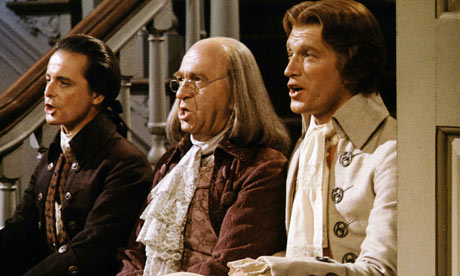
All men are created.....

The most important of his edits was small but resounding. He crossed out, using the heavy backslashes that he often employed, the last three words of Jefferson's phrase “We hold these truths to be sacred and undeniable” and changed them to the words now enshrined in history: “We hold these truths to be self-evident.”"

The idea of “self-evident” truths was one that drew less on John Locke, who was Jefferson's favored philosopher, than on the scientific determinism espoused by Isaac Newton and on the analytic empiricism of Franklin’s close friend David Hume. In what became known as “Hume's fork,” the great Scottish philosopher, along with Leibniz and others, had developed a theory that distinguished between synthetic truths that describe matters of fact (such as “London is bigger than Philadelphia”) and analytic truths that are self-evident by virtue of reason and definition (“The angles of a triangle equal 180 degrees”; “All bachelors are unmarried”). By using the word “sacred,” Jefferson had asserted, intentionally or not, that the principle in question—the equality of men and their endowment by their creator with inalienable rights—was an assertion of religion. Franklin's edit turned it instead into an assertion of rationality.*
Well, no; "Franklin's edit turned it instead into an assertion of [insularity]."  The "we" who hold these truths to be "self-evident" are set apart from the "they" who don't.  Strictly speaking it's exclusionary.  It may be an exclusion you think is sound and defensible because it is presumptively rational, but rational is not a one-size fits all model that places the subject so declared beyond purview.  It simply says "we" all agree on this and if you don't, you are NOK.  And so perhaps, as played out in the history of the country begun with those words, these truths don't apply to you.

Jefferson had it right the first time.  I wouldn't have said so if I didn't know the story of this edit, but Jefferson was right, and the elder man Franklin was wrong.

"Sacred and undeniable" are not synonyms for "self-evident," and "sacred" itself is not a religious or theological term that requires a confession, or even an assertion, of religious belief in order to be spoken.  I was listening to a story on "This American Life" about Teller of Penn & Teller creating a magic trick, a trick he only agreed to fully explain because, as it turned out, the explanation was part of the trick in the performance (Teller, on stage alone, manipulates a ball hung on a thread the audience can't see but is told is there.  The trick ends with Penn coming on stage with a large pair of scissors and cutting the thread, dropping the floating ball to the stage.).  How a magic trick works is sacred knowledge. The exception of this trick proves the rule Teller wouldn't reveal the secrets of other tricks and even Ira Glass, who performed magic for parties as a child, was careful never to reveal a magician's secrets.  Nothing about that is religious or pinned to religious belief, but that such knowledge is sacred and must be preserved, is beyond argument.

Which is what "sacred" means:  not a religious concept, but that something is "holy" (also not necessarily religious in content), set apart, to be preserved as it is against all change.  The trick Teller discussed worked because the audience knew how it was done, and still couldn't believe the explanation.  It worked because the secrets of all the other magic tricks in the show are held sacred.  If all magic tricks were explained, the entertainment of magic would be destroyed; it would change forever.  "Sacred" simple means protected against change; kept pure from adulteration (which is change); preserved as precious because it is so important.  As I originally commented at Thought Criminal, the love that creates a marriage is meant to be sacred, to not change over time, because it is a good that should be preserved against alteration.  So the truths Franklin thought should be self-evident are, to Jefferson, to be preserved against any diminishment.  Franklin is relying on Hume's fork, that the truths are as self-evident as an analytical statement; but, as Hume noted, such statements are worthless to human life, except as they create technologies for us.  What they don't do is provide us any information about the value of human existence, or the virtues of the truths the Declaration speaks of.

As for "undeniable," Jefferson puts these truths beyond argument, beyond cavil.  Reasoning, however, is never beyond argument:  just ask Socrates.  Tell him, like Euthyphro, that you know what "piety" is, and let the fun begin.  Socrates' discourse would fall on the opinion side of Hume's fork, but you are left no wiser for all that, and maybe even wonder if such a thing as piety is a truth, or not; or what truth would survive the acid of Socrates' irony.  Reasoning, as Hume did not understand, starts not with "truths that are self-evident by virtue of reason and definition," but with interpretation.  We interpret a scale, or even the evidence of our hands and arms, to determine if a stone is heavy, or if an object with angles equal to 180 degrees is a triangle, or if a triangle has angles equal to 180 degrees.  We even interpret what the idea of "degrees" means.  Reasoning begins, not with conclusion, but with interpretation.  This is why truth tables in logic don't reveal truth; they only reveal whether a structure of statements is properly organized, or not.  The conclusion of such a set of statements can prove only that the conclusion is sound; not that the statements are valid.  So:

All men are mortal.
Socrates is a man.
Socrates is mortal.

If Socrates is a man only in assertion, but not in fact, the syllogism is still valid; but it isn't true.  Change the name to "Han Solo," you get the same result.  You could quibble that Han Solo is not a "man," merely a fictional male character; but the syllogism is still properly constructed, and if I can introduce you to a living, breathing person named "Han Solo," it's also true.  If I can't introduce you to a man named Socrates, the syllogism is still valid; but is it true?

Truth is a different matter from self-evident.  Hume understood that; he thought his "fork" made it self-evident that philosophy (the pursuit of wisdom) was a dead end.  He didn't think it led to any self-evident truths that were any good to anybody, much less to base a national philosophy on.  Yes, we call that "irony."

"Undeniable" is a different claim than "self-evident."  "Undeniable" places the subject beyond cavil, beyond purview, beyond argument, but for different reasons. It places it, in fact, beyond interpretation.  It may well be Franklin struck the word because he realized this, and because it was too radical even for a document that continues to be too radical today.  If it is undeniable that "all men are created equal," then the extension of the qualities of "man" (the normative figure) to other peoples (including slaves and Native Americans), and even to women, would be both undeniable and greatly accelerated.  Indeed, we interpret "self-evident" that way now, and invoke the spirit of these words, actually Jefferson's original words, to extend equality to women (still) and non-whites (still!), as well as those distinguished by sexual preference.  It has never been self-evident that they deserve equality as much as white males do, but it is becoming undeniable, and gets set in stone when it is finally deemed sacred.

*Taking this from a conversation started at Dohiyi Mir and continued at Thought Criminal.

Wednesday, July 05, 2017

It's tubes all the way down!


Much as I read and use Trump's Twitter feed (because he IS the President, like it or not), the time will surely come when we realize the internet is not a news source (although it will always be a source of entertainment).

Case in point:  no good deed goes unpunished on Twitter (or the internet).


This, of course, is not good enough; not when there's outrage to be generated!


Sen. Cruz is a lawyer, and knows full well there is no crime unless the elements of the crime are present.  He doesn't say here that the elements of a crime under Georgia law are present but then, he doesn't have to, does he?  He's not making a legal argument, he's making a demagogic argument.

And interestingly, it doesn't seem to extend too far beyond Twitter (I'm sure it's all over CNN, but then, it would be, wouldn't it?).  I got this from Raw Story, which specializes in what came up on the internet in the last 10 minutes.  Nothing about any of this CNN "doxxing" being a calamitous state of affairs is showing up on Talking Points Memo, or Huffington Post, Slate, Vox, or Daily Beast.  It didn't make its way to NPR this evening; Trump's tweets about North Korea, but nothing about this.  Huffington Post has an article about the apology, Slate has one article about CNN's statement and the outrage of Donald Trump, Jr. (CNN comes out looking better by comparison to Jr.), TPM has an article covering much the same ground as the Slate article (with less implied critique of CNN), Vox is the most critical, calling the CNN article "doxxing" (small beer, IMHO, and mostly a matter of arguing over editorial decisions)*, Daily Beast can't seem to be bothered.  Nobody seems too concerned with the legal opinions of Julian Assange or Ted Cruz.

Is the language CNN used terrible language?  Vox quotes it as two "alarming paragraphs":

CNN is not publishing "HanA**holeSolo's" name because he is a private citizen who has issued an extensive statement of apology, showed his remorse by saying he has taken down all his offending posts, and because he said he is not going to repeat this ugly behavior on social media again. In addition, he said his statement could serve as an example to others not to do the same.

CNN reserves the right to publish his identity should any of that change.

Interestingly, CNN has said this private citizen reached out to them, apologized to CNN, and had no complaint with their story.  That, of course, is not good enough for the rest of us, who must decide for the accused how offended he/she should be.

Looking around, I realize most of this is a tempest in a teapot.  It's an internet story being reported by the internet (mostly) with no real impact on the "real world."  It is giving Donald Trump, Jr. a chance to look more and more like his father (not a good look for him), and to keep up the "pattern of circulating right-wing memes and news that’s often not thoroughly checked."  In the hall of mirrors that is the internet, this is what passes for reality.

Soon enough, that reality is not going to bleed into "meatspace," but is going to spin off into it's own hermetically sealed universe that no one outside of it even knows exists.  Maybe that should happen with a lot of what happens on the intertoobs.

*Since I originally wrote this, Vox has published another article providing almost too much detail about who did what when, but without really noting the apology CNN supposedly extracted from the Reddit user was published before CNN published its article with the "inflammatory" language, or nothing the Reddit user has told CNN he had no problem with their article.  This continues to be an internet-only story, and as with all internet tales what matters is the outrage, not the facts.

But what are you?


When you're a kid on a playground, your only concern is your standing among your friends, and something really stupid can seem really clever because, to you and your friends, its new and therefore effective.  Take what logicians call the tu quoque fallacy:  on the playground it's introduced as "I know you are, but what am I?"  And it's a devastating riposte, because there is no answer to it (appeals to the rules of logic are as pointless on the playground as they are in real life).  But it soon loses its edge because your friends eventually figure out it's a pointless response, not a devastating one.  It's barely a shield, much less a sword.  It soon becomes the "childish" thing to do, and that's devastating in a world where you are trying to develop more "adult" concerns, like girls (I imagine boys having these foolish arguments; perhaps that is sexist of me, but it's my experience), like jobs, like one's standing in the world.  These allures require you put away childish things, and schoolyard arguments in all their permutations are childish.

So you grow up, you get the girl (or guy, depending on your preference), you get the job, you make a place for yourself in the world, and then....you get old, and all those accomplishments are behind you, and you don't really need to fight for them anymore.  You've reached the place you were going to reach and either the system will take good care of you (golden parachutes and all those perks the lower classes envy), or just awareness that this is all it is, and you adjust to that, but:  you've won the spouse (or given up on that), you've made your place (or settled into what you have), you're pretty much done worrying too much about what the world thinks of you, and you settle back into worry about what your immediate friends, or the crowd you appeal to if you're a public figure, think is good.  Or you become an internet troll.

In both cases, you can end up with a President Trump.

Note these two articles, both about the subject (at least) of a President Trump.  Wikileaks and others are condemning CNN for "doxing" HanAssholeSolo, the creator of the infamous Trump-beating-CNN video.  The Reddit poster with that tag has apologized for his video, apologized to the Reddit thread he posted it on originally, and called CNN to agree with what they reported on him.  He is not complaining about CNN's reporting or claiming he has been blackmailed or "doxxed," and CNN has made it clear they won't reveal his personal information because he is sincere in his apology.

But still Wikileaks and others say CNN is at fault for....doing what Wikileaks does, basically.*  (And now someone has done it to CNN, because it's only fair to doxx somebody who specifically refused to doxx somebody, right?

I know you are, but what am I?

It's the same technique Richard Striner says Donald Trump uses.  Striner notes that CNN and other outlets started calling Trump's conspiracy theories and lies "Fake News," and Trump turned it on them.  Striner details how Trump uses this strategy and how he learned it from Roy Cohn, who learned it during the McCarthy era.  And yes, it is an effective strategy over a short term, as McCarthy found out.  But it is not a strategy that is helping the GOP; or Trump.  Trump's approval ratings continue to plumb new depths, while support for the bill pending in the Senate is down to as low as 12% of the nation in favor of it.  Indeed, the public trusts CNN more than they trust Trump.

We're supposed to be upset because the supporters of Trump, and Trump, are reaching for this "I know you are!" argument, as if it is as devastating as it was the first time it appeared on the playground.  What we don't understand is how repellant this is to most people, and not in a way that benefits Trump or the GOP.  Most people are adults, not superannuated children.  They aren't involved in the minutiae of political debate, where every statement is a minor win or loss in a zero-sum game.  Most people, if they were aware of this story about the poster who created the video Trump tweeted, wouldn't care about the details.  His (her? again, I assume women are better than this; perhaps I shouldn't) name isn't mentioned by CNN and, besides, it's all completely stupid.  What kind of President finds and then posts this kind of thing approvingly?  What kind of President whines incessantly about "fake news" and tweets about CNN and MSNBC so obsessively?  This is not adult behavior, and most people recognize that.

Trump isn't "winning" because he still has a Twitter account and a cell phone.  Wikileaks isn't winning hearts and minds because it lives down to the most hypocritical stance it can take on an fight it doesn't have a dog in.  This is playground stuff and most of us, even the oldest among us (and Trump is now one of those) know better than this.  We aren't impressed:  we're disgusted.  Trump isn't improving with time:  he's shaming us all more and more.

But he's like the kid on the playground nobody wants to put up with, except the losers who think he's clever.  You can't send him home, he's a student in the school.  The Principal can't send him to the office, he hasn't really done anything wrong except be obnoxious.  The problem, ultimately, is not that Trump is cleverly playing the game of "But what am I?"  The problem is that he's the President, and that he's no more capable of doing his job than a six year old on the playground.  His response to the North Korean missile test was not to assert the power of the U.S., it was to threaten North Korea with some kind of reaction from China!

And yeah, maybe we should be talking about that.....

*Julian Assange even went so far as to accuse CNN of committing a felony by NOT reporting the poster's real name.  The internet has indeed made experts of us all.  It even occurs to me that, as Mr. Assange has been accused of numerous crimes and still hides in the Ecuadorian embassy because of such allegations, he, too, is guilty of the tu quoque fallacy.  At least as Professor Striner identifies it, with accusing your enemies of what you are guilty of.  Everybody plays the same (it's the fuel of internet outrage!), but whose estimation of Mr. Assange is really raised by this kind of argument?

The More Things Change Dept.

Following up on the post from last night, this is how it's done:

“I can see you are using an old commie trick, putting God’s name on a radical petition,” one elderly man told him.

Hunter assured one woman that the opening words of his petition came from the Declaration of Independence, but she refused to believe him.

“That might be from the Russian Declaration of Independence, but you can’t tell me that it is ours,” the woman said.

The Associated Press and United Press International both refused to syndicate Hunter’s piece over McCarthyism fears, but it quickly became famous among journalists and political leaders.

McCarthy unsurprisingly criticized Hunter’s piece and congratulated Madison residents for refusing to sign a petition “put out by the communist editor of a communist newspaper,” and the reactionary Wisconsin State Journal ran a photo of the reporter with a bushy mustache with a caption suggesting unsavory connections.

What was presented as a "petition" was the preamble to the Declaration of Independence ("When in the course of human events...."), six of the first ten amendments, and the 15th amendment regarding voting (the amendment finally given legal authority by the Voting Rights Act, until the Roberts court declared the Year of Jubilee).  My favorite bit is McCarthy calling it a commie petition put out by a commie paper and a commie editor.  The paper was The Capitol Times in Wisconsin.  The year was 1951.  The reporter tasked with writing a column about the 4th of July (!) got one person to sign his petition; that person recognized the source material.  Nobody else did.  20 of those who refused also accused the reporter of being a communist.

Interestingly, nothing is self-evident after all.

Snapshots from the Third Coast

A bakery in Austin used to make cookies like this, with the heart more centrally located.  They called them "Heart in the Deep of Texas" cookies.  Sadly, this is as close as I could get for a picture.

The political diss on Texas is that Austin is the blueberry in the middle of a cherry red state.

Everybody's heard of Austin.  Nobody's heard of McAllen.  Everybody's heard of "the border."  Nobody seems to realize more people live along the border in Texas than along the rest of the U.S. border with Mexico (mostly because it's more habitable in Texas than points west, but anyway....).  Austin is not the drop of blue in an ocean of red; it's not even an outlier among major metropolitan areas in Texas (all of which went for Obama, twice, and then for Hillary).  The border of Texas is still deeply Democratic (although even Democrats in Texas seem wholly unaware of this, or just take it for granted).  That is evidenced in this picture:


Yes, somewhere in that car is the junior Senator from Texas, waving to the cheering....family of five.  Sadly, this doesn't reflect Cruz's popularity, or lack of it, in the Lone Star State.  It just emphasizes how deeply blue the Texas border is.  Compare and contrast, here is the announced challenger to Sen. Cruz in Lubbock, a much deeper red part of the state, up in the Panhandle:


I don't know if this says anything or not, but the contrast is interesting.  Here's Sen. Cruz again, still in McAllen:

Those are probably not the protestors the text mentions; but he was protested.  Things are not really going all that smoothly for the Cruz wing of the Texas GOP:


A completely bogus statement because Patrick has run out of ammunition.  The scary "predators in the bathroom" campaign that started in Houston to defeat the Houston Equal Rights Ordinance (HERO) has fizzled out, so now it's down to "privacy."  Patrick also knows the only place he can enforce this idiotic measure is in public schools (which will have to build separate but equal facilities for any transgendered students they have or may have, if Patrick gets his way.  Texas schools are already strapped for cash*, and Patrick has no interest in giving them state money to pay for this.  Part of his plan, I'm convinced, to simply shut down public schools because BIG GOVERNMENT!  Too bad public schools are required by the State Constitution.).  So what he really wants is to make life even more miserable for middle school and high school students.  But, we knew that.

I also love the jab at "New Yorkers," as if only they (well, and elitist snob Texans) read "The New Yorker" magazine.

What will happen?  Probably not enough.  Texas came within a whisker of voting for Hillary Clinton, closer than it had come in decades to selecting a Democrat for President.  It can be done, but the Democrats have to believe it can be done.  People in the cities could outvote people in the countryside, if they could be persuaded to vote in large enough numbers.  And maybe we could stop taking the Valley and the Border for granted.  Just because they won't turn out to cheer Ted Cruz doesn't mean they'll turn out to vote against him, either.

Then again, that parade in Lubbock might actually be encouraging.....

*No, seriously:

Texas lawmakers have been steadily cutting the state’s share of public education costs for a decade. They started this cycle of school finance with the state paying about 45 percent, the federal government paying about 10 percent and local school districts paying the remaining 45 percent. The feds are still covering their dime, but the state’s share has slipped to 38 percent and the local share — the share that’s financed by that notoriously unpopular property tax — has risen to 52 percent.

That pattern hasn’t stopped, by the way: During the regular legislative session that ended on Memorial Day, state lawmakers approved a new two-year budget that spends less state money per public school student than the last budget. At the same time, those same lawmakers are shocked — shocked! — at the way property taxes are going up.
A State Senator from my area has a solution to the rising school property taxes:  cap the rate at which the district can collect taxes.  Because who needs public schools anyway, right?

Tuesday, July 04, 2017

Hooray for the read, white and blue!


And here I thought I'd missed the fireworks this year.  Because...


This is absolutely hilarious!

After NPR tweeted the Declaration [of Independence] line by line, Donald Trump backers–seemingly unaware of the source document–accused NPR of playing partisan politics.

“So, NPR is calling for a revolution,” Twitter user @JustEsrafel wrote.

“Propaganda is that all you know how?” another asked.

You'll have to go to the article and trace out the tweets yourself; it's too much to do again here.  It's also gathered up here, by Twitter.  I've long realized the Declaration is a radical document, stating as it does that the people have the right, under any government, to overthrow it:

But when a long train of abuses and usurpations, pursuing invariably the same Object evinces a design to reduce them under absolute Despotism, it is their right, it is their duty, to throw off such Government, and to provide new Guards for their future security.

That's the "trigger" language JustEsrafel is responding to.   After the catalogue of grievances, there is also this:

 A Prince whose character is thus marked by every act which may define a Tyrant, is unfit to be the ruler of a free people.

Apparently Trump is a "Prince" to some people on Twitter.  Democracy and demotic share a root, for good reasons.

Monday, July 03, 2017

Call next time you're in town!


I wasn't even aware of this story until TC brought it up.  It has echoes of two previous fights in American politics, and underlines how dangerously clueless Donald Trump is.

Charlie Gard  suffers from a rare condition, and the British courts have ruled that, since his chance of survival is zero, he should be removed from life support.  There's the first echo:  the Terri Schiavo case.*

The second is a plane crash during Reagan's administration, which occurred, if memory serves, in the Potomac.  A passing motorist jumped into the water and rescued a few people before rescue services could arrive to save the rest.  The motorist was rightly praised as a hero, but Reagan used him as an example of the volunteer nature of Americans, and how much better that was than relying on government.  Except, of course, it was government who saved the other passengers on the plane from the river, not a lone individual saving one or two people before other help could arrive.  Why the echo?

“This bill (to repeal the ACA) puts the protections and peace of mind that come with comprehensive health insurance out of reach for millions of people—including children, the elderly and those with disabilities,” said Dr. Richard Besser, CEO of the Robert Wood Johnson Foundation.

The Los Angeles Times noted that under a Trumpcare amendment, maternity benefits required by former President Barack Obama’s Affordable Care Act (ACA) will join mental health benefits, addiction and recovery treatment, pediatric dental benefits and more on the chopping block.

Massive cuts to Medicaid and Planned Parenthood will add to the burdens faced by women of childbearing age who need reproductive care and services.

Charlie Gard and his reality TV sweepstakes-style story of being rescued by a wealthy benefactor may tug at the heartstrings, but millions of vulnerable Americans with chronic or pre-existing conditions will probably never be lucky enough to find their own billionaire patron.

The Senate healthcare bill “rolls back expansion of coverage under the Affordable Care Act, which helped millions of people become insured,” said Besser. “It shifts responsibility to cash-strapped states for covering healthcare for the poor. It turns the financial support that made health insurance affordable for millions of people into tax cuts for the wealthiest among us.”
So we have to dump millions of Americans from health insurance, but we can get 8000 tweets about helping a child in Britain with almost no hope of recovery.  And now for the cruelty:  beyond a tweet, what is Trump going to do about this?  Authorize the money to fly the family to America, put them up and get a hospital room for the child, pay for the experimental treatment, and fly the family back for the almost inevitable funeral?  Will he pay for this himself?  Get the money from Congress?  Redirect public funds for this very private charitable service?

Do nothing at all?  Experienced observers can safely bet on the last answer as the most likely.  Does Trump care about this child?  No; Trump cares about Trump, and beyond the response he gets on Twitter, he won't give this matter a second thought.  Not soon enough to save the child from losing life support in Britain, anyway.

Last week, his parents lost their appeal to the European court of human rights (ECHR), the final stage in a long legal fight to take him to the US for trial therapy, meaning Great Ormond Street hospital (GOSH) could withdraw his life support and allow him to die.
Beyond a tweet, what is Trump doing about it?  Tweeting about job numbers and the DOW numbers, so far.

As I say, I know little about this case, but this is the summary of events per the Guardian:

His parents, from Bedfont in west London, want to take him to the US to undergo an experimental treatment but doctors at GOSH said that, given Charlie’s condition, the therapy was unlikely to have a beneficial outcome.

British courts ruled that it would be lawful for the hospital to withdraw life-sustaining treatment because it was highly probable Charlie would suffer significant harm if his life was prolonged without realistic prospect of an improvement. They cited established human rights law, which dictates that the rights of a child should take precedence over the rights of a parent.

In the final ruling on Tuesday, the ECHR said it had, by a majority of the seven judges who considered the written arguments, declared the application inadmissible. It “endorsed in substance the approach” taken by the British courts and declared “the decision is final”.

It added: “Consequently, the court also considered that it was appropriate to lift the interim measure.” That measure required doctors to continue providing life support treatment for Charlie.

Responding to the judgment, a spokesperson for Great Ormond Street hospital for children NHS foundation trust said: “Our thoughts are with Charlie’s parents on receipt of this news that we know will be very distressing for them.

“Today’s decision by the European court of human rights marks the end of what has been a very difficult process and our priority is to provide every possible support to Charlie’s parents as we prepare for the next steps.

“There will be no rush by Great Ormond Street hospital to change Charlie’s care and any future treatment plans will involve careful planning and discussion.”
Not dissimilar, then, in any significant regard, to the Schiavo case.  The hospital is acting with compassion and humanity, but as even the Pontifical Academy of Life says:

“We do, sometimes, however, have to recognise the limitations of what can be done, while always acting humanely in the service of the sick person until the time of natural death occurs.” 
There is life support and there is life perpetuation.  Such is the state of our powers in this land of medical technology.  I've seen people undergo experimental treatment when all hope of recovery was lost.  I cannot recommend it.  It can have a cruelty all its own.

*More like the Schiavo case than I realized:

Numerous courts have ruled that any experimental therapy would not help Charlie get better and would only increase suffering of a baby who can’t see, move, hear, cry or swallow and has irreversible brain damage.

At some point you have to realize this case has been through several courts and numerous people are more familiar with the facts than any random group of American readers.

The president of a Vatican-owned hospital in Rome has said the doors of the facility are open to Gard’s parents if they want to transfer Charlie there. “We know that it is a desperate case and that there are no effective therapies,” Mariella Enoc, the head of the Bambino Gesù Hospital, said. “We are close to the parents in prayer and, if this is their desire, willing to take their child, for the time he has left to live.”

Which is not that different from what GOSH is offering the family.  I don't know the legal status of the case, or what authority the family would have to bring Charlie to America, where I'm quite sure the treatment would benefit the researchers far more than it would the child.  I am, as I said, quite sure Trump will do nothing about it beyond the tweet he wrote.

"These are not the scary people you're looking for."


So these are the Trump supporters we're supposed to appeal to, or worry about, or be afraid of:

“Congratulations /u/HanAssholeSolo, your dankery has been tweeted by the President of the United States,” one user wrote on the subreddit. This is not the first time the @realDonaldTrump account has posted content generated or spread on online forums. In one high-profile instance during the campaign, then-candidate Trump posted an image of Hillary Clinton next to a Star of David.

“Holy shit!! I wake up and have my morning coffee and who retweets my shitpost but the MAGA EMPORER himself!!!” HanAssholeSolo responded to the news in a comment on the subreddit.

“I am honored!!”
But apparently the "honor" depends on who's mentioning it:


This is the base the President brags about.  If I'm worried about them, I'm worried about the way law enforcement is going to respond to them.  As Charlie Pierce often notes, economic uncertainty is a strange causal factor, indeed.

ADDING:  The Dow Jones closed up 0.61%, which means something to you if you own stocks listed on the Dow.  Or maybe not; as Ultron said, "Finance is so weird!"  It means next to nothing to the national economy, something we all figured out a decade ago or so.

I can't wait to see what Trump tweets about what the market is doing tomorrow.....

Next Tweet: "I am sitting on the toilet!"

Congratulations!  You're a big boy, now!

(and they have nothing to do with peace in the Middle East!  This is the same Saudi Arabia which blockaded Qatar because Trump gave them the green light to do so, and which is still bombing the Sudan. Peace!  Interesting!)

Take the cannoli!

The fake news is coming from inside the (White) House!

Sunday, July 02, 2017

"Freedom's just another word for...


'War on Christmas Starts in July'!"
Trump began his speech by attacking the media and touting his election win, as he is known to do.

He went on to involved [sic] the memory of Benjamin Franklin and noted that at the Constitutional Convention, Franklin reminded his fellow delegates to “bow their head in prayer. I remind you, we’re going to start saying Merry Christmas again.”

Because nothing says "freedom" like a Presidential order to say "Merry Christmas!"  And you'd better mean it!

No, that's not the worst:

Reading from his speech [where Trump was to sign an executive order about the National Space Council], Trump had a poignant comment about “discovery” and a journey that “will not only make us stronger and more prosperous but will unite us behind grand ambitions and bring us all closer together.” But the moment was short-lived as Trump ad libbed, “Wouldn’t that be nice? Can you believe that space is going to do that?”

Trump then sat down at the table to sign the executive order. “I know what this is. Space!” he announced, enthusiastically.

[Astronaut Buzz] Aldrin again seemed uncomfortable. “To infinity and beyond!” he joked, and those at the event chuckled.

Trump missed the joke.

“This is infinity here. It could be infinity. We don’t really don’t know. But it could be. It has to be something — but it could be infinity, right?” he said and signed the order.

Nor is that:

“At some point in the future, we’re going to look back and say how did we do it without space?” Trump asked, as if “space” was one of the scientists on the team.

Trump is an expert on space.  His head's full of it!

Thanks, I'll be here all week.  Sadly, so will Trump:

“My administration will always support and defend your religious liberty. As long as I am President, no one is going to stop you from practicing your faith or from preaching what is in your heart,” Trump continued.

Is anybody going to tell him?

"But I am very concerned as to what this once again reveals about the president of the United States."

Ladies and gentlemen, the President of the United States:


What is wrong with this man?

And no, this isn't a genius "distraction" from the failing Obamacare repeal in the Senate; or the failure of the fraudulent "voter fraud" commission that even Kris Kobach, as committee member and Secretary of State of Kansas, won't comply with; or the "bombshell" in the Russia investigation, nor the Supreme Court ruling on Trump's travel ban.  Oddly enough, the country functions whether we pay attention to it or not.  Our teletronic gaze is not magical, it does not cause things to happen or to fail to happen.

This is the work of the President of the United States.  It is not what he is calling our attention to, it is that he thinks this is the best use of his precious time as President.  I can be concerned about more than one thing at a time, and I should certainly be concerned about a President who browses the internet to find video like this, and then posts it on his Twitter feed.

Adding:  Remember James Hodgkinson, who shot up a baseball diamond in D.C.?  It made even Ted Nugget recounce violent rhetoric.  Remember Steve Scales, still recovering from his wounds?  Remember all the concern about "violent rhetoric" that drove a man to relocate to D.C. and then shoot up as many Congresspersons as he could?

“I want to see how funny it’s going to be when somebody ends up getting killed or getting hurt or getting punched or getting injured,” Navarro told anchor Fredericka Whitfield. “There’s people that may be able to take this as humorous, I certainly don’t. Maybe it’s because I know the kind much social media feedback and threats that I get and that many other on CNN and of our colleagues get on a daily basis. There may be some people who are capable of taking this as humor, but there are a lot of unstable people out there who do not take it as humor, who take it as a cult leader’s call to action, a call to arms.”

Yeah, nobody else does, either.  Wassamater, can't ya take a joke?

To some observers and those working at political news outlets, the tweet was an inappropriate, and potentially dangerous, escalation of Trump’s long-running feud with CNN. To those in Trump’s political inner circle and many of his supporters, it was the mark of a tough guy—and funny as hell. Of the three senior Trump administration officials contacted on Sunday by The Daily Beast, all said that the tweet was both justified and amusing. Officials spoke on the condition of anonymity in order to speak freely.
....
When asked if they were concerned that these kinds of messages Trump sends could encourage actual physical violence against journalists, all officials ignored the follow-up questions.
Because, you know, if you have to explain the joke, it isn't funny anymore.