Showing posts sorted by relevance for query luke anointing. Sort by date Show all posts

Wednesday, March 31, 2021

Wednesday of Holy Week 2021

Luke's version of the anointing is the reason I got interested in this story in all four gospels in the first place.  There are few other stories all four gospels have in common; and three of the four gospels tell this story in pretty much the same manner.  Except John's version shows knowledge of Luke's version; and Luke's version turns this little story completely upside down.

Let's start with Luke:

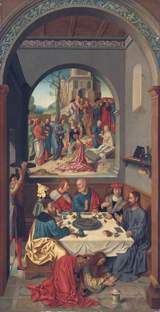
One of the Pharisees invited him to dinner; he entered the Pharisee's house and reclined at the table. A local woman, one who was a sinner, found out that he was having dinner at the Pharisee's house. She suddenly showed up with an alabaster jar of myrrh, and stood there behind him weeping at his feet. Her tears wet his feet, and she wiped them dry with her hair; she kissed his feet, and anointed them with the myrrh.

The Pharisee who had invited him saw this and said to himself, "if this man were a prophet, he would know who this is and what kind of woman is touching him, since she is a sinner."

And Jesus answered him, "Simon, I have something to tell you."

"Teacher," he said, "Speak up."

"This moneylender had two debtors; one owed five hundred silver coins, the other fifty. Since neither one of them could pay, he wrote off both debts. Now which of them will love him more?"

Simon answered, "I would imagine the one for whom he wrote off the larger debt."

And he said to him, "You're right." Then turning to the woman, he said to Simon, "Do you see this woman? I walked into your house and you didn't offer me water for my feet; yet she has washed my feet with her tears and dried them with her hair. You didn't offer me a kiss, but she hasn't stopped kissing my feet since I arrived. You didn't anoint my head with oil, but she has anointed my feet with myrrh. For this reason, I tell you, her sins, many as they are, have been forgiven, as this outpouring of her love shows. But the one who is forgiven little shows little love."

And he said to her "Your sins have been forgiven."

Then those having dinner with him began to mutter to themselves, "Who is this who even forgives sins?"

And he said to the woman, "Your trust has saved you; go in peace."

Luke 7:36-50, SV

Is grace a quid pro quo?  "...the one who is forgiven little shows little love."  Is that about grace; or about acknowledgement of grace?  If I don't think I need to be forgiven for anything, am I forgiven anyway?  Is that fair?

That's the central question this story, as Luke tells it, raises.  But let's put it in the context of Luke's narrative.  This story actually ends chapter 7 (not Luke's doing, the chapters, but it's convenient for us).  How does Luke 7 start?

After he had completed all he had to say to his audience, he went into Capernaum.

Luke 7:1, SV

So this comes immediately after the Sermon on the Mount, the one that includes the Beatitudes of Luke:

Then he would look squarely at his disciples and say:

Congratulations, you poor!

God's domain belongs to you!

Congratulations, you hungry!

You will have a feast.

Congratulations, you who weep now!

You will laugh.

Congratulations to you when people hate you, and when they ostracize you and denounce you and scorn your name as evil, because of the son of Adam! Rejoice on that day, and jump for joy! Just remember, your compensation is great in heaven.  Recall that their ancestors treated the prophets the same way.

Damn you rich!

You already have your consolation!

Damn you who are well-fed now!

You will know hunger.

Damn you who laugh now!

You will learn to weep and grieve.

Damn you when everybody speaks well of you!  Recall that their ancestors treated the phony prophets the same way.

Luke 6:20-26, SV

And Luke 8 begins:

And it so happened that he traveled through towns and villages, preaching and announcing the good news of God's imperial rule.  The twelve were with him, and also some women whom he had cured of evil spirits and diseases:  Mary, the one from Magdala, from whom seven demons had taken their leave, and Joanna, the wife of Chuza, Herod's steward, and Susanna, and many others, who provided for him out of their resources.

Luke 8:1-3, SV

This is the passage that led to the tradition that Mary Magdalene was a prostitute, reformed by Jesus.  It's also worth noting Mary Magdalene appears in all four gospels; but in the other three she doesn't appear until the crucifixion, until the women are actually at the foot of the cross.  She is mentioned in Mark, so Matthew and Luke both take her from that gospel, and she returns in Luke's crucifixion story.  But this anointing story is not a crucifixion story; in Luke it takes place long before that fateful Passover week.  And the reason Mary Magdalene was tagged as a prostitute is entirely because of this version of the anointing story.

But let's go back and walk through the story:  Jesus is at the house of Simon, who is now a Pharisee, not a leper.  We'll see there's more than a bit of humor in this story, in this narrative, and it starts there, with Luke making Simon no longer an outcast leper, but a respectable member of Palestinian society.  Who just happens to have the same name as the leper from the other stories in circulation about Jesus of Nazareth.  And, at this house, Jesus is reclining at table, with his feet out beside him.  And a local woman, "one who was a sinner," enters the room.  How is she known to be a sinner?  Well, walking into a room full of men is one clue.  Even Simon's wife wouldn't dare enter that gathering.  But there is another, as we'll learn in the next sentences.

She is, as in the anointing stories of Matthew and Mark, anonymous.  She is also carrying an alabaster jar of myrrh, the kind Mark first described.  But she doesn't pour it on Jesus' head; she pours it on his feet.  Now, we might think anointing his feet is not really an anointment; and we'd be right.  Anointment is a ritual recognizing the king in Hebraic custom; or a ritual used for events of great merit, at least.  The anointing in Mark and Matthew is just that:  a recognition of the authority of this son of peasants from a backwater on the fringe of the Empire.  It is also a symbolic preparation for burial, as Jesus points out in those stories.  But the feet?  Isn't that an act of great humility, the humility Jesus shows in John's gospel when he washes the feet of his disciples?

No; because the actor here is a woman, not another man.  And because feet carry, in this culture, the euphemistic connection to genitals.  (You might be thinking of the sexual fetish of feet; that doesn't really apply here.) In the Hebrew scriptures there are a few stories of men "covering their feet," meaning they dropped their robes in order to relive themselves.  It's practical, but it's also a delicate way of speaking of something, shall we way, indelicate?  Movie language of the '40's was just as discrete: the couple embraced in a passionate way, and the camera moved away, leaving them locked together.  We all knew they didn't just "hug it out."  We knew (or should have known) what was implied (which is now more or less explicit, but that's another matter). In the erotic literature of the time, mostly Greek eroticism, feet were themselves an erogenous zone, or at least one used to represent erotic acts.  Strange as it may sound today, a lover washing her beloved's feet with her tears, and drying those feet with her hair, was considered both an act of great intimacy (easy to see why) and great eroticism (a bit harder to grasp; but the there are cliches in porn and TV/movie sex, too, which aren't all that erotic in real life).  Now we know, as Luke's audience did, why this woman is known to be a sinner.  She's clearly a prostitute soliticing business.

This happened in the 1st century during dinner parties.  And Simon's discomfort underscores the point.  This woman is giving his guest of honor the 21st century equivalent of a lap dance, and Simon is too above her (and too moral himself) to send her away.  If you like, imagine this happening at a restaurant where you've taken your pastor in order to ingratiate him to you and your church friends.  Then a woman comes up and starts giving him a lap dance, for obvious reasons of commerce; and your pastor, rather than shoo her away, actually enjoys it!  And then he uses the event as an excuse to get a dig in on you!

The parable Luke tells is unique in the gospels.  Mark, Matthew, and John all raise the "but what about the poor!" objection (which is funny, considering how little John follows the narratives of the synoptics, even in the events of the crucifixion).  Luke turns that part of the tale inside out with the parable of the debtors.  It's pretty clear that parable puts Simon and the woman on the same level, and doesn't leave Simon with any reason to feel superior, morally or otherwise.  Jesus has already committed, in Simon's eyes, a social (if not moral) faux pas by not sending the woman away, relieving Simon of the shame of this happening in his home.  For Simon to send her away is for Simon to take some responsibility for her being in his home in the first place; far better for him if Jesus does it, and keeps all the shame on her, and none on the men at table.  Jesus doesn't do that.  Instead, after telling the parable, he asks Simon the very question Simon doesn't want asked:  "Do you see this woman?"

That, of course, is precisely what Simon has been trying not to do.  Now, rather than dismiss her and turn to the host and say "There's no shame on you, these things happen, I've already forgotten it," Jesus makes a lesson of it, a lesson with the clear point:  she's shown more gratitude than you have, because frankly, she's got more to be grateful for.  And worse, he goes step-by-step through the entire exercise:  she is kissing his feet, she's pouring myrrh on his feet, she's washed his feet with her tears and dried them with her hair (you should recall here Paul's admonition to his church in Corinth about women keeping their hair bound).  Jesus not only doesn't remove the shame, he shamelessly recounts the events himself.  See this woman?  Now Jesus is narrating this woman's actions!

And then he draws a line under the whole thing, with the action that seems most to bedevil Jesus' critics in the gospels (all four of them):  "Who is this who even forgives sins?"  But the real question is:  what did she do to deserve a forgiveness of her sins?

And he said to the woman, "Your trust has saved you; go in peace."

Luke 7:50, SV

And that's it.  The chapter ends there.  But the question hangs in the air:  what trust?  What has she done to earn this forgiveness?

It seems impossible, but the answer is:  nothing.  She is not among the company of the disciples.  She is probably not one of the women catalogued by Luke in the opening of chapter 8.  She is never named, in keeping with the stories from Mark and Matthew.  She doesn't do this just before Passover, so there's no connection to the crucifixion, to death, to burial.  The myrrh is just perfume.  And her actions don't mimic an anointing; they mimic 1st century Greek pornography.  What has she done that shows an "outpouring of love"?  At least the love we commonly associate with being among the forgiven of Christianity?  Jesus even plays with the cause and effect here:  because of what she's done (feet, hair, tears, myrrh) her sins are forgiven, he says.  Because her sins are forgiven, she has performed this grateful act of love.  Here, read it again:

"I walked into your house and you didn't offer me water for my feet; yet she has washed my feet with her tears and dried them with her hair. You didn't offer me a kiss, but she hasn't stopped kissing my feet since I arrived. You didn't anoint my head with oil, but she has anointed my feet with myrrh. For this reason, I tell you, her sins, many as they are, have been forgiven, as this outpouring of her love shows. But the one who is forgiven little shows little love."

So she came in because her sins were forgiven, and she was so grateful; but because she walked in, and washed his feet and poured out the myrrh, her sins are forgiven and therefor she's....grateful?  Has Jesus already had a little too much wine?  Or is he purposefully evading a cause-and-effect analysis of forgiveness, of grace?

What Jesus does here is reframe, reinterpret, redefine (choose your term) what this woman has done.  She thought she was soliciting business.  He told her, and Simon, she was showing great love (and again, Jesus's sly wit goes unappreciated, even unnoticed.  "Love" has so many interpretations, and the one he means is clearly not the one she meant, or that Simon understood.)  He casts her actions not as a cause for further shaming and even damning ("if this man were a prophet, he would know who this is and what kind of woman is touching him, since she is a sinner") but as a reason to forgive her shame (sins; same difference to Simon) and give her peace:  "Your trust has saved you; go in peace."  She might still leave the room wondering "What trust?  The trust I wouldn't get kicked in the face?"  And if she did join Jesus' entourage out of sheer gratitude ("I don't know how to love him/I don't know why he moves me" sings Mary Magdalene in "JCS"), who could blame her?  But if she did that, did that "buy" her grace, her forgiveness?

Jesus doesn't give us an answer to that question, because he doesn't want us to think grace and forgiveness are transactional, are some kind of cosmic (or divine, or even human) quid pro quo. In the parable, Simon is a debtor, just like the unnamed woman.  His debt is smaller, but he still owes a debt.  Does owing less debt really still put you above someone who owes more?  Is that a measuring stick worth living by?  Is any measuring stick to evaluate such status really worth living by?  Isn't the lesson here that we should take care of each other, show consideration equally to each other, rather than drawing boundaries around who is worthy of shame, and who is worthy of recognition?

"Do you see this woman?"  If anything is done in remembrance of her, it should be the repitition of that question.  Over and over and over again; as much as it takes.  Because the question is not:  what did she do?  The question is:  what did you do?  Do you see this woman?

Thursday, April 06, 2023

Maundy Thursday 2023: Oily Heads and Perfume

The connection to the day and this final version of the anointing is John’s “sacrament that wasn’t.”  John’s gospel doesn’t have a Eucharist, even though almost all the events of his gospel occur in what Christians now call Holy Week. The story John does tell of the last meal in the upper room isn’t “This is my body, this is my blood,” largely for reasons of John’s theology.  Instead, the story is of foot-washing, which perhaps not coincidentally is the anointing story as John tells it, following Luke’s variation.  Let’s start with John’s version:

Six days before Passover Jesus came to Bethany, where Lazarus lived, the one Jesus had brought back from the dead.  There they gave a dinner for him; Martha did the servince and Lazarus was one of those who ate with him. Mary brought a pound of expensive lotion and anointed Jesus' feet and wiped them with her hair. And the house was filled with the lotion's fragrance.  Judas Iscariot, the disciple who was going to turn him in, says, "Why wasn't this lotion sold? It would bring a year's wages, and the proceeds could have been given to the poor. (He didn't say this because he cared about the poor, but becasue he was a thief.  He was in charge of hte common purse and now and again wouild pilfer money from it.)

"Let her alone," Jesus said.  "Let her keep it for the time I am to be enbalmed.  There will always be poor around; but I won't always be around.

--John 12:1-8, SV

So that's it:  8 verses and done.  But the scene has shifted back to Bethany; the time is back to the days before Passover; and Jesus again refers the act as a foreshadowing of his death.  But two very important elements have shifted, perhaps through Luke's lens:  now the perfume goes on Jesus' feet, and again, a woman wipes his feet with her hair.  Only this time the woman is named, so perhaps now we can tell this story "in remembrance of her," at least in the modern understanding of "remembrance."

It's interesting, the similiarities between this story and the stories in Matthew and Mark.  There aren't that many commonalities between John and the Synoptics.  John the Baptizer plays an important role in the gospels of Mark and Matthew, a role that reaches its zenith in Luke's gospel, where he begins with the appearance of Gabriel to John's father, Zechariah. In John's gospel the Baptizer appears as a bystander, someone who literally comments on Jesus as Jesus walks by.  No one in John's gospel gets to share center stage, however briefly, with Jesus.  John's gospel has no Sermon on the Mount (Luke)/Plain (Matthew), and precious few parables.  In the synoptics, Jesus' miracles are "acts of power" in the original Greek; in John's version they are "signs."  So the resurrection of Lazarus is a "sign" of Jesus' authority and power, and it is precisely that sign which leads to the crucifixion:

When the huge crowd of Judeans found out he was there, they came not only because of Jesus but also to see Lazarus, the one he had brought back from the dead.  so the ranking priests planned to put Lazarus to death, too, since because of him many of the Judeans were defecting and believing in Jesus.

John 12:9-11, SV

The "sign" of Lazarus was costing the priests their power; at least in John's narrative.  I mentioned before that the cleansing of the Temple seems to have been the historical impetus for the crucifixion.  That occurs just before Passover, a time of tension in Roman occupied Jerusalem.  John includes that story, in a few verses in chapter 2, almost immediately after the first "sign" at the wedding in Cana:

It was almost time for the Jewish Passover celebration, so Jesus went up to Jerusalem.  In the temple precincts he came upon people selling oxen and sheep and doves, and bankers were doing business there too.  He made a whip out of rope and drove them all out of the temple area, sheep, goats, oxen, and all; then he knocked over the bankers' tables, and set their coin flying.  And to the dove merchants he said, "Get these birds out of here! How dare you use my Father's house as apublic market."

(His disciples were reminded of the words of scripture: "Zeal for your house is eating me alive.")

John 2:13-17, SV

It's worth pointing out here, as a side bar, that merchants in the temple weren't necessarily evil.  Temple sacrifice was the point of coming to the Temple during Passover, and most travelers couldn't bring animals with them for the ritual.  They bought animals as they were able to afford:  from doves to ox.  Coins given to the Temple also couldn't bear the image of Caesar, both because humans are made in the image of God (and no images of God can be created), and because Caesar declared himself a "son of God," or divine in his rule over the empire. So the coins of Rome had to be exchanged at Temple for coins acceptable in the Temple.  The problem with both practices, from Jesus' point of view, is that they exploited the poor (like Jesus).  The cost of a dove was already a sacrifice for the poor traveler to Jerusalem coming to the Temple to worship the God of Abraham who taught Israel to think first of the care of the poor.  The exchange rate on Temple coins made money for the banker, and cost the poor, especially, a great deal.  Jesus' objection, in other words, is not pious;  he objects to the economic exploitation of people like him, the very people the God of Abraham professes to identify with.  So you can see why he's pissed off.

But the cost of the perfume Mary uses doesn't bother him.  There's no contradiction here; just a contrast.  And a consistency that keeps this version of the anointing at Bethany in line with those of Matthew and Mark.  Luke's is still the outlier; but that outlier finds echoes in John's version, still.

First, note that the disciples appear in the story in Mark and Matthew, but not in Luke.  And John, who likes to tell more concrete stories (the better to ground his long, abstract discourses by Jesus.  As one of my professors in seminary pointed out, John's Jesus sucks all the air out of the upper room.  Chapter 13 of John begins that event, with Jesus washing the feet of his disciples.  Chapter 18 begins with Jesus finally going to the garden, although he's barely there before Judas shows up to betray him.  The chapters in between are almost all a monologue by Jesus.), replaces Simon the leper/Pharisee with Lazarus (the better to connect the resurrection of Lazarus in chapter 11 to the plot against Jesus in chapter 12) and "the disciples" with Judas Iscariot.  John's character of Judas is the one we all think of as the betrayer, the Iago to Jesus' Othello (except Jesus is not nearly so naive about Judas, especially in John's gospel), the Judas familiar to us from "JCS" (except, again, John's Judas doesn't really have any redeeming virtues).  So Judas is clearly the antagonist in this little story; he is even a hypocrite, because he doesn't care about the poor or whether the mony would go to them.  He's just, in modern parlance, a "troll."

And Jesus' response is equally blunt.  It also lends itself most easily to the dismissal of concern for the poor I've heard from too many professed Christians:  that the poor will always be with us.  It's usually said as if that's not only a fact of life, but the desire of God that some be poor.  As punishment; as part of God's "plan"?  The reason scarcely matters.  The excuse for ignoring them and denying any responsibility for them, is all that matters.

In some ways the Johannine version of this story is the most attenuated, and it suffers from that loss of detail.  John is less concerned with this story than with incorporating it into his narrative because, like the crucifixion, it is a part of the story of the Nazarene that cannot be excluded.  Curiously, it is John's gospel that gives us the long discourse between Pilate and Jesus, the back and forth between the Governor of Judea and a peasant rabble-rouser (which makes it, historically, a highly unlikely event.  Imagine your governor bandying words in public, before TV cameras, with a condemned prisoner just before his execution.)  We owe a lot of what we think about the story of Jesus to John's embellishments.  But in the anointing story John reduces the events to a bare minimum:  now the woman is named:  Mary, the sister to Martha and to Lazarus.  So she is in her brother's home, and yet still serving Jesus at table.  An attenuated scandal since Jesus is above such matters, and the focus stays on him in John's version.  Do you see this woman? Well, don't; she really doesn't matter.  Even the detail of drying his feet with her hair, which now can be a sign of love and honor for what Jesus has done (resurrected her brother Lazarus), but which would also be scandalous (it's still a first century lap dance; and imagine it happening today.  Washing someone's feet is intimate enough.  Drying them with your own long hair?).  John steps over that quickly by shifting attention to Judas, and in the most negative way possible.  Jesus dismisses the whole thing, using it as a foreshadowing of his death.  He doesn't even acknowledge what she's done, or why, except to dismissively say she should save the perfume for his burial preparations.

So the story comes from Mark to Matthew, almost unaltered; and then undergoes a radical transformation in Luke.  Some of those physical changes make it to John's version, but John seems ready almost to discard it, as it's not a "sign" pointing to who Jesus is or what his authority is, and it's not a "teachable moment" allowing Jesus to talk on and on and on about the nature of God and humanity.  For John it's a narrative transition point between the more important story of Lazarus (a "sign" if ever there was one) and the movement of the story into Jerusalem and the "upper room" (the remainder of chapter 12 is Jesus again talking about the concept of "signs" and the narrative moving toward the foot-washing of chapter 13 and the captive audience of the disciples Jesus then lectures for five chapters).  It's like John knows he can't leave this story out, but doesn't really think much of it, himself.  It's a pebble in his narrative shoe that he drops off as soon as he is able.

What, then, do we get from all of this?  This simple story was so important to the gospel writers they all included it (the canonical gospels, I mean; not the non-canonical ones).  Luke alters it dramatically.  From his "Special Luke" source?  From his own interests in the story of Jesus of Nazareth?  For whatever reason, he puts it through a blender, changing time and place and persons, leaving out the disciples and followers so thoroughly it is obvious the woman with the jar is a stranger to everyone else in that room.  There's a reason Luke goes immediately from his anointing story to a catalogue of the women traveling with Jesus.  It may be one of them is the woman in the room, since they provide for Jesus' ministry out of their own resources, and undoubtedly the perfume, even if it didn't cost a year's wages, was very expensive.  Luke is drawing a line underneath the woman's identity, the fact she was a stranger before she entered the room; and the enticing possibility that she is a stranger no more, because Jesus told her she had shown great trust, and that trust had saved her.  Matthew and Mark intimate the woman is one of the group; and maybe that's why Luke says the women had resources to fund the ministry when offerings weren't enough.  Matthew and Mark make it clear this is an anointing:  the perfume goes on the head, like the oil on the head of the king, or as in Psalm 133:

{A Song of degrees of David.} Behold, how good and how pleasant it is for brethren to dwell together in unity!

2It is like the precious ointment upon the head, that ran down upon the beard, even Aaron's beard: that went down to the skirts of his garments;

3As the dew of Hermon, and as the dew that descended upon the mountains of Zion: for there the LORD commanded the blessing, even life for evermore.

That is an anointing.  Luke shifts not only time and place (not Bethany; and far earlier than the fateful Passover events) and location (feet, not head).  Is it even an anointing anymore?  John restores (follows?) tradition, by calling the act an anointing, but Mary aims for the feet, not the head.  And in Mary we finally identify a woman (although no one tells that story in memory of her) and a reason for her gratitude (her brother has been restored to life).  John also includes a lovely, concrete detail: "And the house was filled with the lotion's fragrance."  A metaphor?  Or merely a physical detail about the nature of perfume?  Either way it's wiped aside by the actions of Judas and the blunt retort of Jesus.  None of this really interests John; but what's always been interesting to me is why John includes this story; and why he shifts to location to Jesus' feet, even as he keeps up with the tradition of the house being in Bethany, and the disciples (well, Judas) being present.

In "JCS," the anointing story turns into the emotional heart of the story.  Immediately after Judas' lament "Heaven on their minds" we meet the disciples with "What's the Buzz?"  And among them is Mary Magdalene and the women (as a backing chorus) who sing "Let me try to cool down your face a bit", which allows Judas back in with "Strange Thing, Mystifying":

It seems to me a strange thing, mystifying

That a man like you can waste his time on women of her kind.

Yes, I can understand that she amuses,

But to let her kiss you, stroke your hair, is hardly in your line.

It's not that I object to her profession,

But she doesn't fit in well with what you teach and say.

It doesn't help us if you're inconsistent.

They only need a small excuse to put us all away.

That's John crossed with Luke.  The objection is in Judas' mouth; but the objection itself, however obliquely expressed, is that of Simon the Pharisee.  Jesus has already accepted Mary's attention:

Mary, ooh, that is good

How you prattle through your supper,

Where and when and who and how

She alone has tried to give me, 

what I need right here and now.

Which sounds more like Luke than anybody.  This story recurs with the famous love song "I Don't Know How To Love Him."  Again Mary soothes Jesus, upset by the events of the march into Jerusalem (Simon Zealotes tells Jesus to use this power for glory), the cleansing of the Temple ("My Temple should be a house of prayer!/But you have made it a den of thieves!") and the followers ("Christ you know I love you/Did you see I waved?/I believe in you and God/so tell me that I'm saved!") and the beggars and diseased ("See my eyes, I can hardly see/See my legs, I can hardly walk/See my purse, I'm a poor, poor man/See my toungue I can hardly talk") to whom Jesus finally screams "HEAL YOURSELVES!"  And then Mary is back, offering "Myrrh for your hot forehead/calm you and anoint you" as she soothes him to sleep, and then sings her song of confused, bewildered love.  It isn't the song of the woman in Luke's version of the anointing; but it could be ours, if we examine that story carefully, if we take what Luke gives us, seriously.

And here's an interesting thing from the rock opera, too.  Judas says, in the first song, that Jesus has begun to matter more than the things he says.  This is an old discussion in Christianity.  The earliest gospels were likely "sayings" gospels.  Some of those are conjectural:  "Q" is thought to have been a collection of sayings of Jesus.  There's also presumably a "signs" gospel behind John's version.  The Gospel of Thomas is the most famous extant example of these kinds of gospels.  And its arguable, especially after the crucifixion, especially today, that Christians honor Jesus more in who he was than in what he taught.  Judas, in other words, is on to something.  Gallup reports that church attendance in America is declining, and thinks this marks something in American cultural history.  Perhaps; or perhaps it just marks a new social willingness to admit you don't go to church anymore.  The decline in attendance has been obvious to pastors and churches for half a century now.  Gallup thinks its discovered something but, again, the world is just catching up to the church.  And still we're a long way from the early 20th century.  This fight between who Jesus was, and what Jesus said (and which matters more) is a very old one, in other words; and if the latter is starting to prevail over the former (not to its extinguishment, but with a renewed emphasis on the latter above the former), perhaps that's all to the good.  Perhaps that's even the Holy Spirit (Luke) at work.  Perhaps we should let that fragrance fill the house (John).

Luke's story is, in my understanding, a powerful story about grace and salvation, forgiveness and redemption.  We want things to be earned, especially something as important as grace and acceptance (acceptance often includes some manner of forgiveness), but we want these blessings purchased with some coin.  For me that coin should be as small as possible, a mere mite, because surely I am deserving of forgiveness and grace, especially if I can't possibly pay for it.  For you, however?  Well, I'm not sure I want you getting something for nothing.  That seems unfair.  Maybe if you were to show a little love, you'd be deserving.  But to be deserving and to show some love, surely you have to have some prompting to respond to.  So would it work like this?

"I walked into your house and you didn't offer me water for my feet; yet she has washed my feet with her tears and dried them with her hair. You didn't offer me a kiss, but she hasn't stopped kissing my feet since I arrived. You didn't anoint my head with oil, but she has anointed my feet with myrrh. For this reason, I tell you, her sins, many as they are, have been forgiven, as this outpouring of her love shows. But the one who is forgiven little shows little love."

But that's an ouroboros, a Moebius strip; it doesn't seem to have a beginning or an end, and if you walk along it, it has only one surface.  There's no way in, no point at which you can begin your payment for that grace.  How do you earn it, then?

Precisely.  Begin there.

On what condition does goodness exist beyond all calculation? On the condition that goodness forget itself, that the movement be a movement of the gift that renounces itself, hence a movement of infinite love. Only infinite love can renounce itself and, in order to become finite, become incarnated in order to love the other, to love the other as a finite other. This gift of infinite love comes from someone and is addressed to someone; responsibility demands irreplaceable singularity.

Jacques Derrida, The Gift of Death, tr. David Wills (Chicago: University of Chicago Press, 1995), pp. 50-51.

These conflicts and disputes among you, where do they come from? Do they not come from your own cravings that are at war within you? You want something and do not have it, so you commit murder. And you covet something and cannot obtain it; so you engage in disputes and conflicts. You do not have because you do not ask. You ask and do not receive, because you ask wrongly, in order to spend what you get on your pleasures. Adulterers! Do you now know that friendship with the world is enmity with God? Therefore whoever wishes to be a friend of the world becomes an enemy of God. Or do you suppose that it is for nothing that the scripture says, "God yearns jealously for the spirit that he has made to dwell in us"? But he gives all the more grace; therefore it says, "God opposes the proud, but gives grace to the humble."

James 4:1-6

I am reading (Simone Weil's) essays as a part of my Lenten reading...She says that we "...must experience every day, both in the spirit and the flesh, the pains and humiliations of poverty...and further we must do something which is harder than enduring in poverty, we must renounce all compensations: in our contacts with the people around us we must sincerely practice the humility of a naturalized citizen in the country which has received us."

I keep reminding the young people who come to work with us that they are not naturalized citizens...They are not really poor. We are always foreigners to the poor. So we have to make up for it by "renouncing all compensations..."

Dorothy Day, from The Dorothy Day Book, p. 11. 

Thursday, March 28, 2024

Maundy Thursday 2024: Oily Heads and Perfume

The connection to the day and this final version of the anointing is John’s “sacrament that wasn’t.”  John’s gospel doesn’t have a Eucharist, even though almost all the events of his gospel occur in what Christians now call Holy Week. The story John does tell of the last meal in the upper room isn’t “This is my body, this is my blood,” largely for reasons of John’s theology.  Instead, the story is of foot-washing, which perhaps not coincidentally is the anointing story as John tells it, following Luke’s variation.  Let’s start with John’s version:

Six days before Passover Jesus came to Bethany, where Lazarus lived, the one Jesus had brought back from the dead.  There they gave a dinner for him; Martha did the servince and Lazarus was one of those who ate with him. Mary brought a pound of expensive lotion and anointed Jesus' feet and wiped them with her hair. And the house was filled with the lotion's fragrance.  Judas Iscariot, the disciple who was going to turn him in, says, "Why wasn't this lotion sold? It would bring a year's wages, and the proceeds could have been given to the poor. (He didn't say this because he cared about the poor, but becasue he was a thief.  He was in charge of hte common purse and now and again wouild pilfer money from it.)

"Let her alone," Jesus said.  "Let her keep it for the time I am to be enbalmed.  There will always be poor around; but I won't always be around.

--John 12:1-8, SV

So that's it:  8 verses and done.  But the scene has shifted back to Bethany; the time is back to the days before Passover; and Jesus again refers to the act as a foreshadowing of his death.  But two very important elements have shifted, perhaps through Luke's lens:  now the perfume goes on Jesus' feet, and again, a woman wipes his feet with her hair.  Only this time the woman is named, so perhaps now we can tell this story "in remembrance of her," at least in the modern understanding of "remembrance."

It's interesting, the similiarities between this story and the stories in Matthew and Mark.  There aren't that many commonalities between John and the Synoptics.  John the Baptizer plays an important role in the gospels of Mark and Matthew, a role that reaches its zenith in Luke's gospel, where he begins with the appearance of Gabriel to John's father, Zechariah. In John's gospel the Baptizer appears as a bystander, someone who literally comments on Jesus as Jesus walks by.  No one in John's gospel gets to share center stage, however briefly, with Jesus.  John's gospel has no Sermon on the Mount (Luke)/Plain (Matthew), and precious few parables.  In the synoptics, Jesus' miracles are "acts of power" in the original Greek; in John's version they are "signs."  So the resurrection of Lazarus is a "sign" of Jesus' authority and power, and it is precisely that sign which leads to the crucifixion:

When the huge crowd of Judeans found out he was there, they came not only because of Jesus but also to see Lazarus, the one he had brought back from the dead.  so the ranking priests planned to put Lazarus to death, too, since because of him many of the Judeans were defecting and believing in Jesus.

John 12:9-11, SV

The "sign" of Lazarus was costing the priests their power; at least in John's narrative.  I mentioned before that the cleansing of the Temple seems to have been the historical impetus for the crucifixion.  That occurs just before Passover, a time of tension in Roman occupied Jerusalem.  John includes that story, in a few verses in chapter 2, almost immediately after the first "sign" at the wedding in Cana:

It was almost time for the Jewish Passover celebration, so Jesus went up to Jerusalem.  In the temple precincts he came upon people selling oxen and sheep and doves, and bankers were doing business there too.  He made a whip out of rope and drove them all out of the temple area, sheep, goats, oxen, and all; then he knocked over the bankers' tables, and set their coin flying.  And to the dove merchants he said, "Get these birds out of here! How dare you use my Father's house as apublic market."

(His disciples were reminded of the words of scripture: "Zeal for your house is eating me alive.")

John 2:13-17, SV

It's worth pointing out here, as a side bar, that merchants in the temple weren't necessarily evil.  Temple sacrifice was the point of coming to the Temple during Passover, and most travelers couldn't bring animals with them for the ritual.  They bought animals as they were able to afford:  from doves to ox.  Coins given to the Temple also couldn't bear the image of Caesar, both because humans are made in the image of God (and no images of God can be created), and because Caesar declared himself a "son of God," or divine in his rule over the empire. So the coins of Rome had to be exchanged at Temple for coins acceptable in the Temple.  The problem with both practices, from Jesus' point of view, is that they exploited the poor (like Jesus).  The cost of a dove was already a sacrifice for the poor traveler to Jerusalem coming to the Temple to worship the God of Abraham who taught Israel to think first of the care of the poor.  The exchange rate on Temple coins made money for the banker, and cost the poor, especially, a great deal.  Jesus' objection, in other words, is not pious;  he objects to the economic exploitation of people like him, the very people the God of Abraham professes to identify with.  So you can see why he's pissed off.

But the cost of the perfume Mary uses doesn't bother him.  There's no contradiction here; just a contrast.  And a consistency that keeps this version of the anointing at Bethany in line with those of Matthew and Mark.  Luke's is still the outlier; but that outlier finds echoes in John's version.

First, note that the disciples appear in the story in Mark and Matthew, but not in Luke.  And John, who likes to tell more concrete stories (the better to ground his long, abstract discourses by Jesus.  As one of my professors in seminary pointed out, John's Jesus sucks all the air out of the upper room.  Chapter 13 of John begins that event, with Jesus washing the feet of his disciples.  Chapter 18 begins with Jesus finally going to the garden, although he's barely there before Judas shows up to betray him.  The chapters in between are almost all a monologue by Jesus.), replaces Simon the leper/Pharisee with Lazarus (the better to connect the resurrection of Lazarus in chapter 11 to the plot against Jesus in chapter 12) and "the disciples" with Judas Iscariot.  John's character of Judas is the one we all think of as the betrayer, the Iago to Jesus' Othello (except Jesus is not nearly so naive about Judas, especially in John's gospel), the Judas familiar to us from "JCS" (except, again, John's Judas doesn't really have any redeeming virtues).  So Judas is clearly the antagonist in this little story; he is even a hypocrite, because he doesn't care about the poor or whether the mony would go to them.  He's just, in modern parlance, a "troll."

And Jesus' response is equally blunt.  It also lends itself most easily to the dismissal of concern for the poor I've heard from too many professed Christians:  that the poor will always be with us.  It's usually said as if that's not only a fact of life, but the desire of God that some be poor.  As punishment; as part of God's "plan"?  The reason scarcely matters.  The excuse for ignoring them and denying any responsibility for them, is all that matters.

In some ways the Johannine version of this story is the most attenuated, and it suffers from that loss of detail.  John is less concerned with this story than with incorporating it into his narrative because, like the crucifixion, it is a part of the story of the Nazarene that cannot be excluded.  Curiously, it is John's gospel that gives us the long discourse between Pilate and Jesus, the back and forth between the Governor of Judea and a peasant rabble-rouser (which makes it, historically, a highly unlikely event.  Imagine your governor bandying words in public, before TV cameras, with a condemned prisoner just before his execution.)  We owe a lot of what we think about the story of Jesus to John's embellishments.  But in the anointing story John reduces the events to a bare minimum:  now the woman is named:  Mary, the sister to Martha and to Lazarus.  So she is in her brother's home, and yet still serving Jesus at table.  An attenuated scandal since Jesus is above such matters, and the focus stays on him in John's version.  Do you see this woman? Well, don't; she really doesn't matter.  Even the detail of drying his feet with her hair, which now can be a sign of love and honor for what Jesus has done (resurrected her brother Lazarus), but which would also be scandalous (it's still a first century lap dance; and imagine it happening today.  Washing someone's feet is intimate enough.  Drying them with your own long hair?).  John steps over that quickly by shifting attention to Judas, and in the most negative way possible.  Jesus dismisses the whole thing, using it as a foreshadowing of his death.  He doesn't even acknowledge what she's done, or why, except to dismissively say she should save the perfume for his burial preparations.

So the story comes from Mark to Matthew, almost unaltered; and then undergoes a radical transformation in Luke.  Some of those physical changes make it to John's version, but John seems ready almost to discard it, as it's not a "sign" pointing to who Jesus is or what his authority is, and it's not a "teachable moment" allowing Jesus to talk on and on and on about the nature of God and humanity.  For John it's a narrative transition point between the more important story of Lazarus (a "sign" if ever there was one) and the movement of the story into Jerusalem and the "upper room" (the remainder of chapter 12 is Jesus again talking about the concept of "signs" and the narrative moving toward the foot-washing of chapter 13 and the captive audience of the disciples Jesus then lectures for five chapters).  It's like John knows he can't leave this story out, but doesn't really think much of it, himself.  It's a pebble in his narrative shoe that he drops off as soon as he is able.

What, then, do we get from all of this?  This simple story was so important to the gospel writers they all included it (the canonical gospels, I mean; not the non-canonical ones).  Luke alters it dramatically.  From his "Special Luke" source?  From his own interests in the story of Jesus of Nazareth?  For whatever reason, he puts it through a blender, changing time and place and persons, leaving out the disciples and followers so thoroughly it is obvious the woman with the jar is a stranger to everyone else in that room.  There's a reason Luke goes immediately from his anointing story to a catalogue of the women traveling with Jesus.  It may be one of them is the woman in the room, since they provide for Jesus' ministry out of their own resources, and undoubtedly the perfume, even if it didn't cost a year's wages, was very expensive.  Luke is drawing a line underneath the woman's identity, the fact she was a stranger before she entered the room; and the enticing possibility that she is a stranger no more, because Jesus told her she had shown great trust, and that trust had saved her.  Matthew and Mark intimate the woman is one of the group; and maybe that's why Luke says the women had resources to fund the ministry when offerings weren't enough.  Matthew and Mark make it clear this is an anointing:  the perfume goes on the head, like the oil on the head of the king, or as in Psalm 133:

{A Song of degrees of David.} Behold, how good and how pleasant it is for brethren to dwell together in unity!

2It is like the precious ointment upon the head, that ran down upon the beard, even Aaron's beard: that went down to the skirts of his garments;

3As the dew of Hermon, and as the dew that descended upon the mountains of Zion: for there the LORD commanded the blessing, even life for evermore.

That is an anointing.  Luke shifts not only time and place (not Bethany; and far earlier than the fateful Passover events) and location (feet, not head).  Is it even an anointing anymore?  John restores (follows?) tradition, by calling the act an anointing, but Mary aims for the feet, not the head.  And in Mary we finally identify a woman (although no one tells that story in memory of her) and a reason for her gratitude (her brother has been restored to life).  John also includes a lovely, concrete detail: "And the house was filled with the lotion's fragrance."  A metaphor?  Or merely a physical detail about the nature of perfume?  Either way it's wiped aside by the actions of Judas and the blunt retort of Jesus.  None of this really interests John; but what's always been interesting to me is why John includes this story; and why he shifts to location to Jesus' feet, even as he keeps up with the tradition of the house being in Bethany, and the disciples (well, Judas) being present.

In "JCS," the anointing story turns into the emotional heart of the story.  Immediately after Judas' lament "Heaven on their minds" we meet the disciples with "What's the Buzz?"  And among them is Mary Magdalene and the women (as a backing chorus) who sing "Let me try to cool down your face a bit", which allows Judas back in with "Strange Thing, Mystifying":

It seems to me a strange thing, mystifying

That a man like you can waste his time on women of her kind.

Yes, I can understand that she amuses,

But to let her kiss you, stroke your hair, is hardly in your line.

It's not that I object to her profession,

But she doesn't fit in well with what you teach and say.

It doesn't help us if you're inconsistent.

They only need a small excuse to put us all away.

That's John crossed with Luke.  The objection is in Judas' mouth; but the objection itself, however obliquely expressed, is that of Simon the Pharisee.  Jesus has already accepted Mary's attention:

Mary, ooh, that is good

How you prattle through your supper,

Where and when and who and how

She alone has tried to give me, 

what I need right here and now.

Which sounds more like Luke than anybody.  This story recurs with the famous love song "I Don't Know How To Love Him."  Again Mary soothes Jesus, upset by the events of the march into Jerusalem (Simon Zealotes tells Jesus to use this power for glory), the cleansing of the Temple ("My Temple should be a house of prayer!/But you have made it a den of thieves!") and the followers ("Christ you know I love you/Did you see I waved?/I believe in you and God/so tell me that I'm saved!") and the beggars and diseased ("See my eyes, I can hardly see/See my legs, I can hardly walk/See my purse, I'm a poor, poor man/See my toungue I can hardly talk") to whom Jesus finally screams "HEAL YOURSELVES!"  And then Mary is back, offering "Myrrh for your hot forehead/calm you and anoint you" as she soothes him to sleep, and then sings her song of confused, bewildered love.  It isn't the song of the woman in Luke's version of the anointing; but it could be ours, if we examine that story carefully, if we take what Luke gives us, seriously.

And here's an interesting thing from the rock opera, too.  Judas says, in the first song, that Jesus has begun to matter more than the things he says.  This is an old discussion in Christianity.  The earliest gospels were likely "sayings" gospels.  Some of those are conjectural:  "Q" is thought to have been a collection of sayings of Jesus.  There's also presumably a "signs" gospel behind John's version.  The Gospel of Thomas is the most famous extant example of these kinds of gospels.  And it’s arguable, especially after the crucifixion, especially today, that Christians honor Jesus more in who he was than in what he taught.  Judas, in other words, is on to something.  Gallup reports that church attendance in America is declining, and thinks this marks something in American cultural history.  Perhaps; or perhaps it just marks a new social willingness to admit you don't go to church anymore.  The decline in attendance has been obvious to pastors and churches for more than half a century now.  Gallup thinks it’s discovered something but, again, the world is just catching up to the church.  And still we're a long way from the early 20th century.  This fight between who Jesus was, and what Jesus said (and which matters more) is a very old one, in other words; and if the latter is starting to prevail over the former (not to its extinguishment, but with a renewed emphasis on the latter above the former), perhaps that's all to the good.  Perhaps that's even the Holy Spirit (Luke) at work.  Perhaps we should let that fragrance fill the house (John).

Luke's story is, in my understanding, a powerful story about grace and salvation, forgiveness and redemption.  We want things to be earned, especially something as important as grace and acceptance (acceptance often includes some manner of forgiveness), but we want these blessings purchased with some coin.  For me that coin should be as small as possible, a mere mite, because surely I am deserving of forgiveness and grace, especially if I can't possibly pay for it.  For you, however?  Well, I'm not sure I want you getting something for nothing.  That seems unfair.  Maybe if you were to show a little love, you'd be deserving.  But to be deserving and to show some love, surely you have to have some prompting to respond to.  So would it work like this?

"I walked into your house and you didn't offer me water for my feet; yet she has washed my feet with her tears and dried them with her hair. You didn't offer me a kiss, but she hasn't stopped kissing my feet since I arrived. You didn't anoint my head with oil, but she has anointed my feet with myrrh. For this reason, I tell you, her sins, many as they are, have been forgiven, as this outpouring of her love shows. But the one who is forgiven little shows little love."

But that's an ouroboros, a Moebius strip; it doesn't seem to have a beginning or an end, and if you walk along it, it has only one surface.  There's no way in, no point at which you can begin your payment for that grace.  How do you earn it, then?

Precisely.  Begin there.

On what condition does goodness exist beyond all calculation? On the condition that goodness forget itself, that the movement be a movement of the gift that renounces itself, hence a movement of infinite love. Only infinite love can renounce itself and, in order to become finite, become incarnated in order to love the other, to love the other as a finite other. This gift of infinite love comes from someone and is addressed to someone; responsibility demands irreplaceable singularity.

Jacques Derrida, The Gift of Death, tr. David Wills (Chicago: University of Chicago Press, 1995), pp. 50-51.

These conflicts and disputes among you, where do they come from? Do they not come from your own cravings that are at war within you? You want something and do not have it, so you commit murder. And you covet something and cannot obtain it; so you engage in disputes and conflicts. You do not have because you do not ask. You ask and do not receive, because you ask wrongly, in order to spend what you get on your pleasures. Adulterers! Do you now know that friendship with the world is enmity with God? Therefore whoever wishes to be a friend of the world becomes an enemy of God. Or do you suppose that it is for nothing that the scripture says, "God yearns jealously for the spirit that he has made to dwell in us"? But he gives all the more grace; therefore it says, "God opposes the proud, but gives grace to the humble."

James 4:1-6

I am reading (Simone Weil's) essays as a part of my Lenten reading...She says that we "...must experience every day, both in the spirit and the flesh, the pains and humiliations of poverty...and further we must do something which is harder than enduring in poverty, we must renounce all compensations: in our contacts with the people around us we must sincerely practice the humility of a naturalized citizen in the country which has received us."

I keep reminding the young people who come to work with us that they are not naturalized citizens...They are not really poor. We are always foreigners to the poor. So we have to make up for it by "renouncing all compensations..."

Dorothy Day, from The Dorothy Day Book, p. 11. 

Thursday, April 01, 2021

Maundy Thursday 2021

The connection to the day and this final version of the anointing is John’s “sacrament that wasn’t.”  John’s gospel doesn’t have a Eucharist, even though almost all the events of his gospel occur in what Christians now call Holy Week. The story John does tell of the last meal in the upper room isn’t “This is my body, this is my blood,” largely for reasons of John’s theology.  Instead, the story is of foot-washing, which perhaps not coincidentally is the anointing story as John tells it, following Luke’s variation.  Let’s start with John’s version:

Six days before Passover Jesus came to Bethany, where Lazarus lived, the one Jesus had brought back from the dead.  There they gave a dinner for him; Martha did the servince and Lazarus was one of those who ate with him. Mary brought a pound of expensive lotion and anointed Jesus' feet and wiped them with her hair. And the house was filled with the lotion's fragrance.  Judas Iscariot, the disciple who was going to turn him in, says, "Why wasn't this lotion sold? It would bring a year's wages, and the proceeds could have been given to the poor. (He didn't say this because he cared about the poor, but becasue he was a thief.  He was in charge of hte common purse and now and again wouild pilfer money from it.)

"Let her alone," Jesus said.  "Let her keep it for the time I am to be enbalmed.  There will always be poor around; but I won't always be around.

--John 12:1-8, SV

So that's it:  8 verses and done.  But the scene has shifted back to Bethany; the time is back to the days before Passover; and Jesus again refers the act as a foreshadowing of his death.  But two very important elements have shifted, perhaps through Luke's lens:  now the perfume goes on Jesus' feet, and again, a woman wipes his feet with her hair.  Only this time the woman is named, so perhaps now we can tell this story "in remembrance of her," at least in the modern understanding of "remembrance."

It's interesting, the similiarities between this story and the stories in Matthew and Mark.  There aren't that many commonalities between John and the Synoptics.  John the Baptizer plays an important role in the gospels of Mark and Matthew, a role that reaches its zenith in Luke's gospel, where he begins with the appearance of Gabriel to John's father, Zechariah. In John's gospel the Baptizer appears as a bystander, someone who literally comments on Jesus as Jesus walks by.  No one in John's gospel gets to share center stage, however briefly, with Jesus.  John's gospel has no Sermon on the Mount (Luke)/Plain (Matthew), and precious few parables.  In the synoptics, Jesus' miracles are "acts of power" in the original Greek; in John's version they are "signs."  So the resurrection of Lazarus is a "sign" of Jesus' authority and power, and it is precisely that sign which leads to the crucifixion:

When the huge crowd of Judeans found out he was there, they came not only because of Jesus but also to see Lazarus, the one he had brought back from the dead.  so the ranking priests planned to put Lazarus to death, too, since because of him many of the Judeans were defecting and believing in Jesus.

John 12:9-11, SV

The "sign" of Lazarus was costing the priests their power; at least in John's narrative.  I mentioned before that the cleansing of the Temple seems to have been the historical impetus for the crucifixion.  That occurs just before Passover, a time of tension in Roman occupied Jerusalem.  John includes that story, in a few verses in chapter 2, almost immediately after the first "sign" at the wedding in Cana:

It was almost time for the Jewish Passover celebration, so Jesus went up to Jerusalem.  In the temple precincts he came upon people selling oxen and sheep and doves, and bankers were doing business there too.  He made a whip out of rope and drove them all out of the temple area, sheep, goats, oxen, and all; then he knocked over the bankers' tables, and set their coin flying.  And to the dove merchants he said, "Get these birds out of here! How dare you use my Father's house as apublic market."

(His disciples were reminded of the words of scripture: "Zeal for your house is eating me alive.")

John 2:13-17, SV

It's worth pointing out here, as a side bar, that merchants in the temple weren't necessarily evil.  Temple sacrifice was the point of coming to the Temple during Passover, and most travelers couldn't bring animals with them for the ritual.  They bought animals as they were able to afford:  from doves to ox.  Coins given to the Temple also couldn't bear the image of Caesar, both because humans are made in the image of God (and no images of God can be created), and because Caesar declared himself a "son of God," or divine in his rule over the empire. So the coins of Rome had to be exchanged at Temple for coins acceptable in the Temple.  The problem with both practices, from Jesus' point of view, is that they exploited the poor (like Jesus).  The cost of a dove was already a sacrifice for the poor traveler to Jerusalem coming to the Temple to worship the God of Abraham who taught Israel to think first of the care of the poor.  The exchange rate on Temple coins made money for the banker, and cost the poor, especially, a great deal.  Jesus' objection, in other words, is not pious;  he objects to the economic exploitation of people like him, the very people the God of Abraham professes to identify with.  So you can see why he's pissed off.

But the cost of the perfume Mary uses doesn't bother him.  There's no contradiction here; just a contrast.  And a consistency that keeps this version of the anointing at Bethany in line with those of Matthew and Mark.  Luke's is still the outlier; but that outlier finds echoes in John's version, still.

First, note that the disciples appear in the story in Mark and Matthew, but not in Luke.  And John, who likes to tell more concrete stories (the better to ground his long, abstract discourses by Jesus.  As one of my professors in seminary pointed out, John's Jesus sucks all the air out of the upper room.  Chapter 13 of John begins that event, with Jesus washing the feet of his disciples.  Chapter 18 begins with Jesus finally going to the garden, although he's barely there before Judas shows up to betray him.  The chapters in between area almost all a monologue by Jesus.), replaces Simon the leper/Pharisee with Lazarus (the better to connect the resurrection of Lazarus in chapter 11 to the plot against Jesus in chapter 12) and "the disciples" with Judas Iscariot.  John's character of Judas is the one we all think of as the betrayer, the Iago to Jesus' Othello (except Jesus is not nearly so naive about Judas, especially in John's gospel), the Judas familiar to us from "JCS" (except, again, John's Judas doesn't really have any redeeming virtues).  So Judas is clearly the antagonist in this little story; he is even a hypocrite, because he doesn't care about the poor or whether the mony would go to them.  He's just, in modern parlance, a "troll."

And Jesus' response is equally blunt.  It also lends itself most easily to the dismissal of concern for the poor I've heard from too many professed Christians:  that the poor will always be with us.  It's usually said as if that's not only a fact of life, but the desire of God that some be poor.  As punishment; as part of God's "plan"?  The reason scarcely matters.  The excuse for ignoring them and denying any responsibility for them, is all that matters.

In some ways the Johannine version of this story is the most attenuated, and it suffers from that loss of detail.  John is less concerned with this story than with incorporating it into his narrative because, like the crucifixion, it is a part of the story of the Nazarene that cannot be excluded.  Curiously, it is John's gospel that gives us the long discourse between Pilate and Jesus, the back and forth between the Governor of Judea and a peasant rabble-rouser (which makes it, historically, a highly unlikely event.  Imagine your governor bandying words in public, before TV cameras, with a condemned prisoner just before his execution.)  We owe a lot of what we think about the story of Jesus to John's embellishments.  But in the anointing story John reduces the events to a bare minimum:  now the woman is named:  Mary, the sister to Martha and to Lazarus.  So she is in her brother's home, and yet still serving Jesus at table.  An attenuated scandal since Jesus is above such matters, and the focus stays on him in John's version.  Do you see this woman? Well, don't; she really doesn't matter.  Even the detail of drying his feet with her hair, which now can be a sign of love and honor for what Jesus has done (resurrected her brother Lazarus), but which would also be scandalous (it's still a first century lap dance; and imagine it happening today.  Washing someone's feet is intimate enough.  Drying them with your own long hair?).  John steps over that quickly by shifting attention to Judas, and in the most negative way possible.  Jesus dismisses the whole thing, using it as a foreshadowing of his death.  He doesn't even acknowledge what she's done, or why, except to dismissively say she should save the perfume for his burial preparations.

So the story comes from Mark to Matthew, almost unaltered; and then undergoes a radical transformation in Luke.  Some of those physical changes make it to John's version, but John seems ready almost to discard it, as it's not a "sign" pointing to who Jesus is or what his authority is, and it's not a "teachable moment" allowing Jesus to talk on and on and on about the nature of God and humanity.  For John it's a narrative transition point between the more important story of Lazarus (a "sign" if ever there was one) and the movement of the story into Jerusalem and the "upper room" (the remainder of chapter 12 is Jesus again talking about the concept of "signs" and the narrative moving toward the foot-washing of chapter 13 and the captive audience of the disciples Jesus then lectures for five chapters).  It's like John knows he can't leave this story out, but doesn't really think much of it, himself.  It's a pebble in his narrative shoe that he drops off as soon as he is able.

What, then, do we get from all of this?  This simple story was so important to the gospel writers they all included it (the canonical gospels, I mean; not the non-canonical ones).  Luke alters it dramatically.  From his "Special Luke" source?  From his own interests in the story of Jesus of Nazareth?  For whatever reason, he puts it through a blender, changing time and place and persons, leaving out the disciples and followers so thoroughly it is obvious the woman with the jar is a stranger to everyone else in that room.  There's a reason Luke goes immediately from his anointing story to a catalogue of the women traveling with Jesus.  It may be one of them is the woman in the room, since they provide for Jesus' ministry out of their own resources, and undoubtedly the perfume, even if it didn't cost a year's wages, was very expensive.  Luke is drawing a line underneath the woman's identity, the fact she was a stranger before she entered the room; and the enticing possibility that she is a stranger no more, because Jesus told her she had shown great trust, and that trust had saved her.  Matthew and Mark intimate the woman is one of the group; and maybe that's why Luke says the women had resources to fund the ministry when offerings weren't enough.  Matthew and Mark make it clear this is an anointing:  the perfume goes on the head, like the oil on the head of the king, or as in Psalm 133:

{A Song of degrees of David.} Behold, how good and how pleasant it is for brethren to dwell together in unity!

2It is like the precious ointment upon the head, that ran down upon the beard, even Aaron's beard: that went down to the skirts of his garments;

3As the dew of Hermon, and as the dew that descended upon the mountains of Zion: for there the LORD commanded the blessing, even life for evermore.

That is an anointing.  Luke shifts not only time and place (not Bethany; and far earlier than the fateful Passover events) and location (feet, not head).  Is it even an anointing anymore?  John restores (follows?) tradition, by calling the act an anointing, but Mary aims for the feet, not the head.  And in Mary we finally identify a woman (although no one tells that story in memory of her) and a reason for her gratitude (her brother has been restored to life).  John also includes a lovely, concrete detail: "And the house was filled with the lotion's fragrance."  A metaphor?  Or merely a physical detail about the nature of perfume?  Either way it's wiped aside by the actions of Judas and the blunt retort of Jesus.  None of this really interests John; but what's always been interesting to me is why John includes this story; and why he shifts to location to Jesus' feet, even as he keeps up with the tradition of the house being in Bethany, and the disciples (well, Judas) being present.

In "JCS," the anointing story turns into the emotional heart of the story.  Immediately after Judas' lament "Heaven on their minds" we meet the disciples with "What's the Buzz?"  And among them is Mary Magdalene and the women (as a backing chorus) who sing "Let me try to cool down your face a bit", which allows Judas back in with "Strange Thing, Mystifying":

It seems to me a strange thing, mystifying

That a man like you can waste his time on women of her kind.

Yes, I can understand that she amuses,

But to let her kiss you, stroke your hair, is hardly in your line.

It's not that I object to her profession,

But she doesn't fit in well with what you teach and say.

It doesn't help us if you're inconsistent.

They only need a small excuse to put us all away.

That's John crossed with Luke.  The objection is in Judas' mouth; but the objection itself, however obliquely expressed, is that of Simon the Pharisee.  Jesus has already accepted Mary's attention:

Mary, ooh, that is good

How you prattle through your supper,

Where and when and who and how

She alone has tried to give me, 

what I need right here and now.

Which sounds more like Luke than anybody.  This story recurs with the famous love song "I Don't Know How To Love Him."  Again Mary soothes Jesus, upset by the events of the march into Jerusalem (Simon Zealotes tells Jesus to use this power for glory), the cleansing of the Temple ("My Temple should be a house of prayer!/But you have made it a den of thieves!") and the followers ("Christ you know I love you/Did you see I waved?/I believe in you and God/so tell me that I'm saved!") and the beggars and diseased ("See my eyes, I can hardly see/See my legs, I can hardly walk/See my purse, I'm a poor, poor man/See my toungue I can hardly talk") to whom Jesus finally screams "HEAL YOURSELVES!"  And then Mary is back, offering "Myrrh for your hot forehead/calm you and anoint you" as she soothes him to sleep, and then sings her song of confused, bewildered love.  It isn't the song of the woman in Luke's version of the anointing; but it could be ours, if we examine that story carefully, if we take what Luke gives us, seriously.

And here's an interesting thing from the rock opera, too.  Judas says, in the first song, that Jesus has begun to matter more than the things he says.  This is an old discussion in Christianity.  The earliest gospels were likely "sayings" gospels.  Some of those are conjectural:  "Q" is thought to have been a collection of sayings of Jesus.  There's also presumably a "signs" gospel behind John's version.  The Gospel of Thomas is the most famous extant example of these kinds of gospels.  And its arguable, especially after the crucifixion, especially today, that Christians honor Jesus more in who he was than in what he taught.  Judas, in other words, is on to something.  Gallup reports that church attendance in America is declining, and thinks this marks something in American cultural history.  Perhaps; or perhaps it just marks a new social willingness to admit you don't go to church anymore.  The decline in attendance has been obvious to pastors and churches for half a century now.  Gallup thinks its discovered something but, again, the world is just catching up to the church.  And still we're a long way from the early 20th century.  This fight between who Jesus was, and what Jesus said (and which matters more) is a very old one, in other words; and if the latter is starting to prevail over the former (not to its extinguishment, but with a renewed emphasis on the latter above the former), perhaps that's all to the good.  Perhaps that's even the Holy Spirit (Luke) at work.  Perhaps we should let that fragrance fill the house (John).

Luke's story is, in my understanding, a powerful story about grace and salvation, forgiveness and redemption.  We want things to be earned, especially something as important as grace and acceptance (acceptance often includes some manner of forgiveness), but we want these blessings purchased with some coin.  For me that coin should be as small as possible, a mere mite, because surely I am deserving of forgiveness and grace, especially if I can't possibly pay for it.  For you, however?  Well, I'm not sure I want you getting something for nothing.  That seems unfair.  Maybe if you were to show a little love, you'd be deserving.  But to be deserving and to show some love, surely you have to have some prompting to respond to.  So would it work like this?

"I walked into your house and you didn't offer me water for my feet; yet she has washed my feet with her tears and dried them with her hair. You didn't offer me a kiss, but she hasn't stopped kissing my feet since I arrived. You didn't anoint my head with oil, but she has anointed my feet with myrrh. For this reason, I tell you, her sins, many as they are, have been forgiven, as this outpouring of her love shows. But the one who is forgiven little shows little love."

But that's an ouroboros, a Moebius strip; it doesn't seem to have a beginning or an end, and if you walk along it, it has only one surface.  There's no way in, no point at which you can begin your payment for that grace.  How do you earn it, then?

Precisely.  Begin there.

On what condition does goodness exist beyond all calculation? On the condition that goodness forget itself, that the movement be a movement of the gift that renounces itself, hence a movement of infinite love. Only infinite love can renounce itself and, in order to become finite, become incarnated in order to love the other, to love the other as a finite other. This gift of infinite love comes from someone and is addressed to someone; responsibility demands irreplaceable singularity.

Jacques Derrida, The Gift of Death, tr. David Wills (Chicago: University of Chicago Press, 1995), pp. 50-51.

These conflicts and disputes among you, where do they come from? Do they not come from your own cravings that are at war within you? You want something and do not have it, so you commit murder. And you covet something and cannot obtain it; so you engage in disputes and conflicts. You do not have because you do not ask. You ask and do not receive, because you ask wrongly, in order to spend what you get on your pleasures. Adulterers! Do you now know that friendship with the world is enmity with God? Therefore whoever wishes to be a friend of the world becomes an enemy of God. Or do you suppose that it is for nothing that the scripture says, "God yearns jealously for the spirit that he has made to dwell in us"? But he gives all the more grace; therefore it says, "God opposes the proud, but gives grace to the humble."

James 4:1-6

I am reading (Simone Weil's) essays as a part of my Lenten reading...She says that we "...must experience every day, both in the spirit and the flesh, the pains and humiliations of poverty...and further we must do something which is harder than enduring in poverty, we must renounce all compensations: in our contacts with the people around us we must sincerely practice the humility of a naturalized citizen in the country which has received us."

I keep reminding the young people who come to work with us that they are not naturalized citizens...They are not really poor. We are always foreigners to the poor. So we have to make up for it by "renouncing all compensations..."

Dorothy Day, from The Dorothy Day Book, p. 11. 

Thursday, April 17, 2025

Maundy Thursday: Oily Heads and Perfume (New Revised Version)

The connection to the day and this final version of the anointing is John’s “sacrament that wasn’t.”  John’s gospel doesn’t have a Eucharist, even though almost all the events of his gospel occur in what Christians now call Holy Week. The story John does tell of the last meal in the upper room isn’t “This is my body, this is my blood,” largely for reasons of John’s theology.  Instead, the story is of foot-washing, which perhaps not coincidentally is the anointing story as John tells it, following Luke’s variation.  Let’s start with John’s version:

Six days before Passover Jesus came to Bethany, where Lazarus lived, the one Jesus had brought back from the dead.  There they gave a dinner for him; Martha did the servince and Lazarus was one of those who ate with him. Mary brought a pound of expensive lotion and anointed Jesus' feet and wiped them with her hair. And the house was filled with the lotion's fragrance.  Judas Iscariot, the disciple who was going to turn him in, says, "Why wasn't this lotion sold? It would bring a year's wages, and the proceeds could have been given to the poor. (He didn't say this because he cared about the poor, but becasue he was a thief.  He was in charge of hte common purse and now and again wouild pilfer money from it.)

"Let her alone," Jesus said.  "Let her keep it for the time I am to be enbalmed.  There will always be poor around; but I won't always be around.

--John 12:1-8, SV

So that's it:  8 verses and done.  But the scene has shifted back to Bethany; the time is back to the days before Passover; and Jesus again refers to the act as a foreshadowing of his death.  But two very important elements have shifted, perhaps through Luke's lens:  now the perfume goes on Jesus' feet, and again, a woman wipes his feet with her hair.  Only this time the woman is named, so perhaps now we can tell this story "in remembrance of her," at least in the modern understanding of "remembrance."

It's interesting, the similiarities between this story and the stories in Matthew and Mark.  There aren't that many commonalities between John and the Synoptics.  John the Baptizer plays an important role in the gospels of Mark and Matthew, a role that reaches its zenith in Luke's gospel, where he begins with the appearance of Gabriel to John's father, Zechariah. In John's gospel the Baptizer appears as a bystander, someone who literally comments on Jesus as Jesus walks by.  No one in John's gospel gets to share center stage, however briefly, with Jesus.  John's gospel has no Sermon on the Mount (Luke)/Plain (Matthew), and precious few parables.  In the synoptics, Jesus' miracles are "acts of power" in the original Greek; in John's version they are "signs."  So the resurrection of Lazarus is a "sign" of Jesus' authority and power, and it is precisely that sign which leads to the crucifixion:

When the huge crowd of Judeans found out he was there, they came not only because of Jesus but also to see Lazarus, the one he had brought back from the dead.  so the ranking priests planned to put Lazarus to death, too, since because of him many of the Judeans were defecting and believing in Jesus.

John 12:9-11, SV

The "sign" of Lazarus was costing the priests their power; at least in John's narrative.  I mentioned before that the cleansing of the Temple seems to have been the historical impetus for the crucifixion.  That occurs just before Passover, a time of tension in Roman occupied Jerusalem.  John includes that story, in a few verses in chapter 2, almost immediately after the first "sign" at the wedding in Cana:

It was almost time for the Jewish Passover celebration, so Jesus went up to Jerusalem.  In the temple precincts he came upon people selling oxen and sheep and doves, and bankers were doing business there too.  He made a whip out of rope and drove them all out of the temple area, sheep, goats, oxen, and all; then he knocked over the bankers' tables, and set their coin flying.  And to the dove merchants he said, "Get these birds out of here! How dare you use my Father's house as apublic market."

(His disciples were reminded of the words of scripture: "Zeal for your house is eating me alive.")

John 2:13-17, SV

It's worth pointing out here, as a side bar, that merchants in the temple weren't necessarily evil.  Temple sacrifice was the point of coming to the Temple during Passover, and most travelers couldn't bring animals with them for the ritual.  They bought animals as they were able to afford:  from doves to ox.  Coins given to the Temple also couldn't bear the image of Caesar, both because humans are made in the image of God (and no images of God can be created), and because Caesar declared himself a "son of God," or divine in his rule over the empire. So the coins of Rome had to be exchanged at Temple for coins acceptable in the Temple.  The problem with both practices, from Jesus' point of view, is that they exploited the poor (like Jesus).  The cost of a dove was already a sacrifice for the poor traveler to Jerusalem coming to the Temple to worship the God of Abraham who taught Israel to think first of the care of the poor.  The exchange rate on Temple coins made money for the banker, and cost the poor, especially, a great deal.  Jesus' objection, in other words, is not pious;  he objects to the economic exploitation of people like him, the very people the God of Abraham professes to identify with.  So you can see why he's pissed off.

You can also see why his protest would upset Pilate.  Pilate's palace overlooked the Temple.  I mean, directly overlooked.  Turmoil in the Temple during Passover, the high holiday of the Judeans (Jews is a bit of an anachronism during the time of Pilate), the "first of months" for the children of Abraham.  It's a time of high political tension for Rome, which tolerated diverse religious beliefs, but not diverse political beliefs.  And Passover was as political as it was religious, so....

Back to Jesus:  the cost of the perfume Mary uses doesn't bother him.  There's no contradiction here; just a contrast.  And a consistency that keeps this version of the anointing at Bethany in line with those of Matthew and Mark.  Luke's is still the outlier; but that outlier finds echoes in John's version.

First, note that the disciples appear in the story in Mark and Matthew, but not in Luke.  And John, who likes to tell more concrete stories (the better to ground his long, abstract discourses by Jesus.  As one of my professors in seminary pointed out, John's Jesus sucks all the air out of the upper room.  Chapter 13 of John begins that event, with Jesus washing the feet of his disciples.  Chapter 18 begins with Jesus finally going to the garden, although he's barely there before Judas shows up to betray him.  The chapters in between are almost all a monologue by Jesus.), replaces Simon the leper/Pharisee with Lazarus (the better to connect the resurrection of Lazarus in chapter 11 to the plot against Jesus in chapter 12) and "the disciples" with Judas Iscariot.  John's character of Judas is the one we all think of as the betrayer, the Iago to Jesus' Othello (except Jesus is not nearly so naive about Judas, especially in John's gospel), the Judas familiar to us from "JCS" (except, again, John's Judas doesn't really have any redeeming virtues).  So Judas is clearly the antagonist in this little story; he is even a hypocrite, because he doesn't care about the poor or whether the mony would go to them.  He's just, in modern parlance, a "troll."

And Jesus' response is equally blunt.  It also lends itself most easily to the dismissal of concern for the poor I've heard from too many professed Christians:  that the poor will always be with us.  It's usually said as if that's not only a fact of life, but the desire of God that some be poor.  As punishment; as part of God's "plan"?  The reason scarcely matters.  The excuse for ignoring them and denying any responsibility for them, is all that matters.

In some ways the Johannine version of this story is the most attenuated, and it suffers from that loss of detail.  John is less concerned with this story than with incorporating it into his narrative because, like the crucifixion, it is a part of the story of the Nazarene that cannot be excluded.  Curiously, it is John's gospel that gives us the long discourse between Pilate and Jesus, the back and forth between the Governor of Judea and a peasant rabble-rouser (which makes it, historically, a highly unlikely event.  Imagine your governor bandying words in public, before TV cameras, with a condemned prisoner just before his execution.)  We owe a lot of what we think about the story of Jesus to John's embellishments.  But in the anointing story John reduces the events to a bare minimum:  now the woman is named:  Mary, the sister to Martha and to Lazarus.  So she is in her brother's home, and yet still serving Jesus at table.  An attenuated scandal since Jesus is above such matters, and the focus stays on him in John's version.  Do you see this woman? Well, don't; she really doesn't matter.  Even the detail of drying his feet with her hair, which now can be a sign of love and honor for what Jesus has done (resurrected her brother Lazarus), but which would also be scandalous (it's still a first century lap dance; and imagine it happening today.  Washing someone's feet is intimate enough.  Drying them with your own long hair?).  John steps over that quickly by shifting attention to Judas, and in the most negative way possible.  Jesus dismisses the whole thing, using it as a foreshadowing of his death.  He doesn't even acknowledge what she's done, or why, except to dismissively say she should save the perfume for his burial preparations.

So the story comes from Mark to Matthew, almost unaltered; and then undergoes a radical transformation in Luke.  Some of those physical changes make it to John's version, but John seems ready almost to discard it, as it's not a "sign" pointing to who Jesus is or what his authority is, and it's not a "teachable moment" allowing Jesus to talk on and on and on about the nature of God and humanity.  For John it's a narrative transition point between the more important story of Lazarus (a "sign" if ever there was one) and the movement of the story into Jerusalem and the "upper room" (the remainder of chapter 12 is Jesus again talking about the concept of "signs" and the narrative moving toward the foot-washing of chapter 13 and the captive audience of the disciples Jesus then lectures for five chapters).  It's like John knows he can't leave this story out, but doesn't really think much of it, himself.  It's a pebble in his narrative shoe that he drops off as soon as he is able.

What, then, do we get from all of this?  This simple story was so important to the gospel writers they all included it (the canonical gospels, I mean; not the non-canonical ones).  Luke alters it dramatically.  From his "Special Luke" source?  From his own interests in the story of Jesus of Nazareth?  For whatever reason, he puts it through a blender, changing time and place and persons, leaving out the disciples and followers so thoroughly it is obvious the woman with the jar is a stranger to everyone else in that room.  There's a reason Luke goes immediately from his anointing story to a catalogue of the women traveling with Jesus.  It may be one of them is the woman in the room, since they provide for Jesus' ministry out of their own resources, and undoubtedly the perfume, even if it didn't cost a year's wages, was very expensive.  Luke is drawing a line underneath the woman's identity, the fact she was a stranger before she entered the room; and the enticing possibility that she is a stranger no more, because Jesus told her she had shown great trust, and that trust had saved her.  Matthew and Mark intimate the woman is one of the group; and maybe that's why Luke says the women had resources to fund the ministry when offerings weren't enough.  Matthew and Mark make it clear this is an anointing:  the perfume goes on the head, like the oil on the head of the king, or as in Psalm 133:

{A Song of degrees of David.} Behold, how good and how pleasant it is for brethren to dwell together in unity!

2It is like the precious ointment upon the head, that ran down upon the beard, even Aaron's beard: that went down to the skirts of his garments;

3As the dew of Hermon, and as the dew that descended upon the mountains of Zion: for there the LORD commanded the blessing, even life for evermore.

That is an anointing.  Luke shifts not only time and place (not Bethany; and far earlier than the fateful Passover events) and location (feet, not head).  Is it even an anointing anymore?  John restores (follows?) tradition, by calling the act an anointing, but Mary aims for the feet, not the head.  And in Mary we finally identify a woman (although no one tells that story in memory of her) and a reason for her gratitude (her brother has been restored to life).  John also includes a lovely, concrete detail: "And the house was filled with the lotion's fragrance."  A metaphor?  Or merely a physical detail about the nature of perfume?  Either way it's wiped aside by the actions of Judas and the blunt retort of Jesus.  None of this really interests John; but what's always been interesting to me is why John includes this story; and why he shifts to location to Jesus' feet, even as he keeps up with the tradition of the house being in Bethany, and the disciples (well, Judas) being present.

In "JCS," the anointing story turns into the emotional heart of the story.  Immediately after Judas' lament "Heaven on their minds" we meet the disciples with "What's the Buzz?"  And among them is Mary Magdalene and the women (as a backing chorus) who sing "Let me try to cool down your face a bit", which allows Judas back in with "Strange Thing, Mystifying":

It seems to me a strange thing, mystifying

That a man like you can waste his time on women of her kind.

Yes, I can understand that she amuses,

But to let her kiss you, stroke your hair, is hardly in your line.

It's not that I object to her profession,

But she doesn't fit in well with what you teach and say.

It doesn't help us if you're inconsistent.

They only need a small excuse to put us all away.

That's John crossed with Luke.  The objection is in Judas' mouth; but the objection itself, however obliquely expressed, is that of Simon the Pharisee.  Jesus has already accepted Mary's attention:

Mary, ooh, that is good

How you prattle through your supper,

Where and when and who and how

She alone has tried to give me, 

what I need right here and now.

Which sounds more like Luke than anybody.  This story recurs with the famous love song "I Don't Know How To Love Him."  Again Mary soothes Jesus, upset by the events of the march into Jerusalem (Simon Zealotes tells Jesus to use this power for glory), the cleansing of the Temple ("My Temple should be a house of prayer!/But you have made it a den of thieves!") and the followers ("Christ you know I love you/Did you see I waved?/I believe in you and God/so tell me that I'm saved!") and the beggars and diseased ("See my eyes, I can hardly see/See my legs, I can hardly walk/See my purse, I'm a poor, poor man/See my toungue I can hardly talk") to whom Jesus finally screams "HEAL YOURSELVES!"  And then Mary is back, offering "Myrrh for your hot forehead/calm you and anoint you" as she soothes him to sleep, and then sings her song of confused, bewildered love.  It isn't the song of the woman in Luke's version of the anointing; but it could be ours, if we examine that story carefully, if we take what Luke gives us, seriously.

And here's an interesting thing from the rock opera, too.  Judas says, in the first song, that Jesus has begun to matter more than the things he says.  This is an old discussion in Christianity.  The earliest gospels were likely "sayings" gospels.  Some of those are conjectural:  "Q" is thought to have been a collection of sayings of Jesus.  There's also presumably a "signs" gospel behind John's version.  The Gospel of Thomas is the most famous extant example of these kinds of gospels.  And it’s arguable, especially after the crucifixion, especially today, that Christians honor Jesus more in who he was than in what he taught.  Judas, in other words, is on to something.  Gallup reports that church attendance in America is declining, and thinks this marks something in American cultural history.  Perhaps; or perhaps it just marks a new social willingness to admit you don't go to church anymore.  The decline in attendance has been obvious to pastors and churches for more than half a century now.  Gallup thinks it’s discovered something but, again, the world is just catching up to the church.  And still we're a long way from the early 20th century.  This fight between who Jesus was, and what Jesus said (and which matters more) is a very old one, in other words; and if the latter is starting to prevail over the former (not to its extinguishment, but with a renewed emphasis on the latter above the former), perhaps that's all to the good.  Perhaps that's even the Holy Spirit (Luke) at work.  Perhaps we should let that fragrance fill the house (John).

Luke's story is, in my understanding, a powerful story about grace and salvation, forgiveness and redemption.  We want things to be earned, especially something as important as grace and acceptance (acceptance often includes some manner of forgiveness), but we want these blessings purchased with some coin.  For me that coin should be as small as possible, a mere mite, because surely I am deserving of forgiveness and grace, especially if I can't possibly pay for it.  For you, however?  Well, I'm not sure I want you getting something for nothing.  That seems unfair.  Maybe if you were to show a little love, you'd be deserving.  But to be deserving and to show some love, surely you have to have some prompting to respond to.  So would it work like this?

"I walked into your house and you didn't offer me water for my feet; yet she has washed my feet with her tears and dried them with her hair. You didn't offer me a kiss, but she hasn't stopped kissing my feet since I arrived. You didn't anoint my head with oil, but she has anointed my feet with myrrh. For this reason, I tell you, her sins, many as they are, have been forgiven, as this outpouring of her love shows. But the one who is forgiven little shows little love."

But that's an ouroboros, a Moebius strip; it doesn't seem to have a beginning or an end, and if you walk along it, it has only one surface.  There's no way in, no point at which you can begin your payment for that grace.  How do you earn it, then?

Precisely.  Begin there.

On what condition does goodness exist beyond all calculation? On the condition that goodness forget itself, that the movement be a movement of the gift that renounces itself, hence a movement of infinite love. Only infinite love can renounce itself and, in order to become finite, become incarnated in order to love the other, to love the other as a finite other. This gift of infinite love comes from someone and is addressed to someone; responsibility demands irreplaceable singularity.

Jacques Derrida, The Gift of Death, tr. David Wills (Chicago: University of Chicago Press, 1995), pp. 50-51.

These conflicts and disputes among you, where do they come from? Do they not come from your own cravings that are at war within you? You want something and do not have it, so you commit murder. And you covet something and cannot obtain it; so you engage in disputes and conflicts. You do not have because you do not ask. You ask and do not receive, because you ask wrongly, in order to spend what you get on your pleasures. Adulterers! Do you now know that friendship with the world is enmity with God? Therefore whoever wishes to be a friend of the world becomes an enemy of God. Or do you suppose that it is for nothing that the scripture says, "God yearns jealously for the spirit that he has made to dwell in us"? But he gives all the more grace; therefore it says, "God opposes the proud, but gives grace to the humble."

James 4:1-6

I am reading (Simone Weil's) essays as a part of my Lenten reading...She says that we "...must experience every day, both in the spirit and the flesh, the pains and humiliations of poverty...and further we must do something which is harder than enduring in poverty, we must renounce all compensations: in our contacts with the people around us we must sincerely practice the humility of a naturalized citizen in the country which has received us."

I keep reminding the young people who come to work with us that they are not naturalized citizens...They are not really poor. We are always foreigners to the poor. So we have to make up for it by "renouncing all compensations..."

Dorothy Day, from The Dorothy Day Book, p. 11.