Thursday, October 19, 2006

History Illustrated

Thomas Jefferson: First Inaugural Address

About to enter, fellow-citizens, on the exercise of duties which comprehend everything dear and valuable to you, it is proper you should understand what I deem the essential principles of our Government, and consequently those which ought to shape its Administration. I will compress them within the narrowest compass they will bear, stating the general principle, but not all its limitations.

Equal and exact justice to all men, of whatever state or persuasion, religious or political;


peace, commerce, and honest friendship with all nations, entangling alliances with none;


the support of the State governments in all their rights, as the most competent administrations for our domestic concerns and the surest bulwarks against antirepublican tendencies;

the preservation of the General Government in its whole constitutional vigor, as the sheet anchor of our peace at home and safety abroad;

a jealous care of the right of election by the people -- a mild and safe corrective of abuses which are lopped by the sword of revolution where peaceable remedies are unprovided;


absolute acquiescence in the decisions of the majority, the vital principle of republics, from which is no appeal but to force, the vital principle and immediate parent of despotism;

a well-disciplined militia, our best reliance in peace and for the first moments of war till regulars may relieve them;


the supremacy of the civil over the military authority;


economy in the public expense, that labor may be lightly burthened; the honest payment of our debts and sacred preservation of the public faith;


encouragement of agriculture, and of commerce as its handmaid;


the diffusion of information and arraignment of all abuses at the bar of the public reason;


freedom of religion;

freedom of the press, and freedom of person under the protection of the habeas corpus, and trial by juries impartially selected.


These principles form the bright constellation which has gone before us and guided our steps through an age of revolution and reformation. The wisdom of our sages and blood of our heroes have been devoted to their attainment. They should be the creed of our political faith, the text of civic instruction, the touchstone by which to try the services of those we trust; and should we wander from them in moments of error or of alarm, let us hasten to retrace our steps and to regain the road which alone leads to peace, liberty, and safety.

The Monsters are Due on Maple Street


From the BBC, via the Mad Priest:

Nearly a third of people worldwide back the use of torture in prisons in some circumstances, a BBC survey suggests.

Although 59% were opposed to torture, 29% thought it acceptable to use some degree of torture to combat terrorism.

While most polled in the US are against torture, opposition there is less robust than in Europe and elsewhere.

More than 27,000 people in 25 countries were asked if torture was acceptable if it could provide information to save innocent lives.

Some 36% of those questioned in the US agreed that this use of torture was acceptable, while 58% were unwilling to compromise on human rights.

The percentage favouring torture in certain cases makes it one of the highest of all the countries polled.

So we are back to the question: "What is torture?" I would like to be able to say I am surprised by this. But in a world where "24" is considered entertainment, and people seriously discuss the "ticking time bomb" scenario as if it made sense, I'm not. Certainly not in a world where this kind of thing happens to a priest:

"I have had my tyres slashed. I have had anonymous threatening letters. I have received other unkind signed letters. I have had fuel stolen from my heating oil tank on two occasions and once we had water put in the tank so we had to have the tank bled. The phone has been tampered with and the exchange reckoned it had been done deliberately. I have had nuisance calls and every now and again we get a prowler. It is very sinister," he said.
Well, let's just say it's a very short step to condoning torture; much shorter than most of us realize. Especially if you've known people capable of doing things that rector describes, as I have. It's far easier to stir the monsters on Maple Street than you might imagine.

Still, there is this:

For many - a large majority, if this opinion poll's indications are correct - torture per se is abhorrent. There are simply no circumstances in which it can be justified.

But for a smaller, though significant section of the global population - more in some countries than others - some form of torture has a place, albeit in certain specific circumstances.

It's back to that ticking bomb again and the essential question: just how far should interrogators be allowed to go?
So it's a mixed bag, and we're back to the question again: what is torture? John Ashcroft on "The Daily Show" called it "shouting in someone's face" in order to get information we need. Keith Olbermann understands it as something more visceral and reprehensible (and it's no surprise Ashcroft wants to call it "shouting in someone's face." One can't help but want to ask the famouly Christian politician "Who Would Jesus Torture?"). Mr. Olberman delivers as stirring a call to arms against torture and lying politicians as I've heard in my lifetime. But neither Mr. Olbermann nor Mr. Aschcroft answers the central question: what is torture? Or is it just that, we know it when we see it?

"Ceci n'est pas une torture."
(apologies to Maigret Magritte and my high school French teacher) (Note to self: never post before the coffee is ready)

Failing Nobly


Thinking about politics made me think about "Clean Gene" Eugene McCarthy, and the campaign of 1968, one I remember only vaguely. I paid more attention 4 years later, when McGovern ran against Nixon, though I was still too young to vote that time, either. But my memory of McCarthy was that he ran against the war knowing he didn't have a chance. Quite a difference from politics as practiced today.

McCarthy ran hoping to force settlement negotiations. He ran against Johnson, the incumbent, and surprised everyone by pulling 42% to Johnson's 49% in New Hampshire, largely due to student volunteers (who had a motivation; the war was beginning to churn through their ranks). But then Robert Kennedy entered the race, and was assasinated, which caused many Kennedy supporters to switch to McGovern. And, of course, the Democrats held their convention in Chicago, with the infamous "police riot" between demonstrators, Chicago police, and the Illinois National Guard. By the time of the convention, McCarthy only had 23% of the delegates.

4 years later, McGovern, also on a platform opposing the war, carried only Massachusetts and the District of Columbia. If you were old enough then, you remember that. I certainly do.

But three years after McGovern's loss, the US was out of Vietnam. Because of McCarthy and McGovern? No; not directly. In spite of them? No; clearly, not at all. What does this tell us about the present day?

Politics today, more than ever, is about power. It's easy enough to be cynical, to say that's all it's ever been about; but that isn't quite true. It would take a Candide to insist politics is never about power, but a Machiavelli to insist it is always and only about nothing more. Except today, the pendulum has swung very much in one direction. Indeed, it seems to be hanging at one end of its arc, no longer free to swing back the other way. Gene McCarthy didn't run because he could win. He ran to oppose the Vietnam War, to try to make a difference as a politician. George McGovern lost in one of the most singular defeats in American politics, but his opponent resigned in disgrace two years later, largely over what he did in his campaign against McGovern, and the war McGovern wanted to end left us with the indelible image of a US helicopter taking off as frantic Vietnamese try to cling to its runners.

Why don't we have such politicians today? Partly because of the passions unleashed by the '60's, but that release of powerful emotions was inevitable. Partly due to the campaigns of McCarthy and McGovern, and the changes in Presidential nominations they wrought. Ironically I think the very evil those changes were meant to prevent, the unpalatable national candidate, have returned in the full primary system. John Kerry won in the early primaries because voters were convinced he could win against George W. Bush. They didn't vote for the right candidate, but for the most electable one, precisely the standard of the "smoke-filled rooms." Shortly thereafter Kerry's nomination was a fait accompli, the money all flowed toward him, no other candidates need apply, and the result is the Military Commissions Act of 2006. Imagine what might have happened if a politician more concerned with principle than with power had spoken up by now.

And partly, of course, simply because of the ideology of the GOP; an ideology traced back at least to the Goldwater campaign of 1964. But this is the problem with power and politics. Even if you say you want it because you will wield it rightly, who is to say you are right? What is to keep their ideology from prompting your own? It's a concept some mock, but that's a serious question (albeit seldom handled seriously in the public discourse). Where is the concept of the noble failure? Where, among Christians, is the concept of the Crucified God? A new "mock bible" has been published to highlight just how much Christians have co-opted their beliefs in order to be very comfortable in the world. What about the central image of our faith, the crucified Lord? It was the failure of Jesus on the cross that Paul proclaimed the wisdom of God, and he denounced everything and said he gave up everything in order to be closer to Christ in all things.

And we complain because the political parties don't listen to us. We complain because we don't have enough political power. What could be more Christian than the noble failure? What could be more appropriate than to demand, not that politicians give us a place at the table, but that they abandon the table altogether? We complain that "they" have shifted the discourse so far in their favor that "we" must shift it back before we can even consider negotiation. What if we just insisted on what is right, and lived our lives in that example? Seems to me "Clean Gene" McCarthy did that much. He was a politician, and he used his skills to change the direction of the nation. He failed; but he failed better than most of us have.

Wednesday, October 18, 2006

Finally! A Reason to Celebrate!


Once again, unable to improve on perfection: what the Mad Priest said.

Let all the people rejoice!

Why I don't read Noam Chomsky


Note to rmj: this is not an argument for the full-scale politicization of religion. Rather, it's a reminder that when citizens - religious or not - walk away from the public square it empowers those who stay behind. Denominational leaders need to be involved in the political process in the same way that all citizens need to be involved: as educated and responsible decision-makers, and as effective advocates for their own interests. The more people who choose to be involved, the less power any one person or group of people can accumulate. That's the American way.

So it seems to me that Kuo's proferred solution is exactly what got him and his fellow evangelicals in the pickle they're in. (More to the theological point, it's a mistake to think that one cannot "pray, learn, listen and serve" in the midst of being a citizen.) It's the conservative desire to withdraw from the fallen world that paradoxically leaves them vulnerable to quasi-messianic figures like George W. Bush who have a quick and easy program for the restoration of the earth to sell.
The Daily Show ran a statistic the other day, showing the US is just above Mexico in voter participation. We’re 139 to their 140, if I recall. What we have in common with Mexico, it seems to me, is one-party rule. At least Mexico had one-party rule, until recently; the US still does. We call the one party two different names, but the differences between them are discernable only to another politician.

And most American citizens are not politicians.

Now it is true that there will always be government, and there will always be rulers, and ignoring them will not make them go away, nor make them improve their game. But neither is that argument much of a motivator for participation in the political system. If it was, we’d be giving Western Europe a run for their electoral money. But let’s begin by admitting this much: our national government, just like our local governments, is run by the lunatic fringe. It is owned and operated for the people with the greatest vested interest in what it can provide, and those people are, by and large, businesses. As Jon Stewart put it last night, every four years 50% of 40% of the electorate chooses the person who will occupy the most powerful office in the land. Out of 43 such leaders, we've had a handful who are considered significant. "43" is not so much an anomaly as the norm.

Houston makes a fine microcosm of an example for my purposes. To judge by appearances, the business of city government in Houston is to provide roadways: lots of them. There was a tiny pocket park in the corner of an intersection of the interstate near my house, and the toll road. It was overshadowed by the spaghetti bowl of overpasses that formed that intersection, and basically was a bit of useless land in front of a hotel tucked in under one of the taller off-ramps (18 wheelers must pass freely!). But it was sponsored by the county, not the city, and actually paid for by a corporation (not even a local business). And it’s now gone: plowed under and churned into mud as the interstate is expanded to twice it’s original size. The city is not in the business of building parks, apparently. I know of one, and it’s old, large, and in the wealthy residential area of town; nowhere near where the rest of us live. The other park I know of is near my house, but that, too, is a county venture. Why Texas retains a county government in places like Harris County, which is all Houston, is another mystery for another day. But the City of Houston, as I say, is all about the roads.

There is a shopping mall complex near my house which is devouring the land around it at a rapacious rate. I call it a “complex” because it now includes a hospital (expanding rapidly), buildings for doctors’ offices, a separate office complex (my bank is in that one), and new residential (apartment) buildings, as well as strip centers for other retail ventures. It is expanding over so many city blocks that it is its own quasi-government authority, (called a “TIRZ” in Texas; it’s a low-tax zone meant to induce business investment in low income areas. The other big TIRZ in town is the wealthiest shopping center in Houston, the Galleria. You see how this works, now). The local TIRZ wants more roads, so more people can get to it’s business. The six lane road that now serves it, running north/south, is not enough. They want another road on their eastern boundary, a two lane road that runs through a residential neighborhood and past an elementary school. It is to be widened to four lanes, simply to push more traffic through the area and toward the stores on the south side of the interstate. This is Houston: it will happen. Business rules, everyone else drools. Neighborhoods be damned, they are in the way of “progress.”

Why am I telling you this?

Because it occurs to me that what George W. Bush does on a daily basis has no more effect on my daily life than what Tony Blair does, or Angela Merkel, for that matter. Because national politics is not about my life, or my friends, or my family, or my community. Because much as I enjoy railing about “neo-cons” and the evils of Dick Cheney or even the suspension of habeas corpus, it has damn all to do with what my day will be like today, or what my neighborhood will be like tomorrow. The one national issue which really has any effect on my life is immigration, and I know nothing is really going to change about that. So why should I get worked up about how cynical George Bush is in dealing with his supporters? I can’t stop a road from tearing down houses and uprooting trees over the distance of less than a mile. What effect am I going to have on the foreign policy of the United States? What makes me think I’ll have an effect at all?

Which is not to say national politics doesn’t matter; but some perspective is called for, here. I have a friend in ministry, who got involved in the UCC boycott of Taco Bell without ever meaning to. It seems the supplier of tomatoes to Taco Bell was headquartered in his town, and the plant which processed the tomatos that went on the tacos that Taco Bell built, was in that town. The UCC, wanting to express solidarity with the pickers of those tomatos, in Florida and other states, urged a boycott of Taco Bell, a boycott which would directly affect people in my friend’s congregation (did I mention he’s a pastor, too?). Several pastors in his town, my friend included, realized the national church’s position was far from simple, and far from clear. The national church, however, in the form of an executive from Cleveland, didn’t realize that at all. When the local UCC clergy urged the national representative to sit down and talk to them (he was coming to town to promote the boycott with direct public action), the UCC representative was condescending and, well, shrill. He lectured the pastors, rather than worked with them collegially. His mind was made up, and the local condition, the local issues, the lives of people in the pews who would be affected by this boycott, meant nothing to him. He had bigger fish to fry, and he even obliquely compared himself and this “struggle” to the efforts of Martin Luther King, Jr., urging the UCC clergy to read King’s “Letter from Birmingham Jail,” as he had done, and realize the social justice issues involved. I read his letter to them; it all but said “Stand away from me, for I am holier-than-thou.” No recognition of the people, however; it was the idea, the abstraction, which was more important.

Reinhold Niebuhr tells the story of being a pastor in Detroit, and giving a blistering sermon one Sunday about layoffs at one of the automobile plants. He was, of course, on the side of the working man. After the sermon, a parishioner on the way out told Pastor Neibuhr that he, the parishioner, was an executive at that plant, and had spent the week personally handing out the pink slips. He made it clear to Niebuhr the pain and anguish he felt as he did his job; that he realized every man represented a family that was going to go hungry, struggle to pay its bills, possibly lose its housing. Niebuhr, chastized, reconsidered the priority of abstractions over human beings.

I’m not trying to contradict what Pastor Dan said; I’m trying to augment it. But I’m also trying to point out that ministry, whether of the laity or of the clergy, is local; it is personal; it is about individuals. Grand sweeping theories are the stories we tell each other to paper over the selfishness and venality of our own efforts and aims.

All of which has to do with why I don't read Noam Chomsky. Nothing against his theories or his books. But reading him I might be inclined to think the world's problems have rational solutions, and that I might be part of that solution simply by having the knowledge he has, and thinking the thoughts he thinks. I might actually come to believe that theories and reason will save the world; which would lead me right back to the position of European society just before Sarajevo plunged them into World War I, and the generation of Hemingway and Fitzgerald and Eliot was "Lost." I've seen that movie; I know how it ends.

The reality, of course, is that I have no such power at all, and all my Chomsky-inspired consideration of international relations will have no effect on James Baker III or Condoleeza Rice, or even Madeline Albright, whatsoever. I just heard the Ambassador from Syria on the BBC World Service, talking about Syria's offer to help the situation in Iraq, an offer the US has consistently rejected. Everything he said made perfect sense and seemed quite pragmatic, to me. But if he can't influence events in that troubled country, what hope do I have? I am as likely to influence US foreign policy with my deeper knowledge of Chomsky's theories as I am to stop a local business from driving bulldozers through my neighborhood. Undoubtedly it's a matter of strength in numbers. Perhaps if I team up with a group like The Metropolitan Organization, something could be done. That's a blending of religion and politics I certainly support. But am I going to change the world? Maybe one heart at a time, if by that much. Certainly no faster, or more broadly, than that.

Tuesday, October 17, 2006

Just a brief comment on power


What? Hallowe'en is coming! And the new jack o'lanterns haven't been carved yet. Until then, you'll have to make do with last year's.

Why I don't much care for power, especially when combined with religion. Two posts to illustrate the issue: Echidne (via Eschaton) and Pastor Dan (never thought I'd be listing those two side by side). God is a large enough concern in human affairs, and quite enough to worship, without dashing over to the altar of power to see what you can get. Especially since God promises us service if we act in servanthood to the world (I'm working on a sermon from Mark 10:35-45; I've been asked preach at 8:00 a.m. and 10:00 a.m. Last Sunday went well, I'd say.). Power only promises to get back to us; when it suits power's purposes.


I still I have soft spot for that one-eyed one.

(Corrected my error, too! You see why I like the one-eyed one.)

Knowledge is power


But therein lies the rub - that in Iraq today, insecurity has made it almost inhumanly difficult to conduct proper research on the harms and benefits of war. Indeed, what both media and pundits seem to never highlight as a deeply troubling anomaly is that, were it not for the work of a few courageous researchers such as the Hopkins/Mustansiriya University team, or the painstaking work of concerned members of the citizenry such as the Iraqi Body Count project, quantifying the effects of the U.S.-led intervention on human health would largely be a matter of divination.

Twenty-four hours later, the Lancet study is fast disappearing off the news headlines. Dismissing and, worse, ignoring this and other alarming findings simply because "they sound wrong" is no way to move forward - if they can't be proven wrong (or partly wrong) on scientific grounds, they must certainly stand, until better evidence emerges.
From an article reviewing, briefly, the reaction to the Lancet published study of deaths in Iraq. The article concludes with what can only be considered commonsense:

Indeed, coalition powers should, in the interest of public accountability and the very success of their mission in Iraq, promote and facilitate more accurate and transparent monitoring of all humanitarian law violations, and of the true effects of violence on Iraqi civilian health.
But transparency seems to be precisely what the coalition powers do not want.

Monday, October 16, 2006

Be Afraid. Be very afraid.

Paying attention to the NSA wiretapping matter (which is still unresolved), we have this little tidbit, from the conviction of Lynne Stewart, attorney at law:

AMY GOODMAN: Your lawyers have filed motions to compel the government to disclose whether it was the National Security Agency who recorded you or your lawyers by wiretapping without warrant?

LYNNE STEWART: Right. That motion was denied late Friday afternoon. It was a peculiar -- after we were Alice in Wonderland down the rabbit hole, because everything is secret, you see. We brought the motion. Then they answered in secret. Then we argued to the judge. Then the judge made a secret order to them. Then they answered that order in secret. Then the judge made another order to them. Then they answered that order in secret.

So we really -- we have no idea what’s going on, except that the judge allowed one paragraph to be made public out of this, and it has to do with an old wiretap of my client, Ahmed Sattar, a wiretap that was a garden variety wiretap, Title III, went to a federal judge, got a warrant, and he was overheard on it. So, we don't know what that means, and we don't know why it wasn't divulged ages ago in connection with the case. But that is where the NSA motion stands today. Very confusing, but it will, of course, be part of an appeal, which is coming next. We will undoubtedly have a long appeal process.
These are the Star Chamber proceedings the Bush Administration wishes to use when it can't stay out of court altogether. Basically, what you don't know can't hurt the government's attempt to incarcerate you.

It's worth noting that Lynne Stewart received 28 months for her conviction on 5 counts of conspiring to aid terrorists and lying to the government. Her convictions were obtained "rimarily on transcripts from more than 85,000 secretly recorded audio and video clips of meetings between Stewart and her client as well as the home phone of Ahmed Abdel Sattar." What she has not been able to determine, then, is how this evidence was gathered against her. At this point, she doesn't even know what the government's arguments are for keeping these matters secret from her. The government sought the maximum sentence of 30 years (Stewart is 67), but the judge found that, while she was guilty:

There was “no evidence that any victim was in fact harmed” by her actions, the judge said. He also cited her long career as a “lawyer to the poor and the unpopular.”

“It is no exaggeration to say that Ms. Stewart performed a public service not only to the court but to the nation,” he said, adding that she did not chose her cases to become wealthy.
And from a lawyer's point of view, here is what's going on:

The fact that they have used this to make a chill effect on the profession, that they have shortened the court, if you think of it more in terms of a basketball court as opposed to a courtroom, but the court in which we operate now is so changed that lawyers are afraid that they are -- the Guantanamo lawyers have to think twice before they even tell their clients how their children are, because they’re limited to only discussing the case. So if the client says, “You’ve spoken to my wife. How are my children?” they have to say, “Can I tell him this? Is this going to be off bounds?”
And if you doubt this can happen to almost anyone: don't. How many of us, after all, have the name recognition of Ramsey Clark? How many of us even know (the New York Times article doesn't mention it) that Ramsey Clark was a lawyer in the case Stewart was convicted for?

LYNNE STEWART: I think for all my political life and for all my understanding of the government and the way it works, Amy, I think I was reckless in the sense that I never understood they would really come after me in the way they have. I believed that I was -- I had enough prestige, I had been 30 years at this business. I had a certain cachet when I walked into court. Even the very prosecutors that I had been up against in the Sheik’s case would say, “You may not like the words she says, but no one ever said it better than she did.” So I always felt I was removed from it. I think I was also lured into this to some degree, because Ramsey made so many -- Ramsey Clark, that is, made a number of press releases --

AMY GOODMAN: The former U.S. attorney general.

LYNNE STEWART: Right. And there was never even a letter to him about, you know, the [inaudible] were breached by your press release. Of course, I’m not Ramsey Clark. I’ve said many times my father was not on the Supreme Court of the United States. He was a schoolteacher in Queens. And I certainly never attained the stature that he had.

This is not to demean Ramsey in any way, who has actually written a remarkable letter to the judge challenging the facts that the U.S. attorney has put forth. He pointed out, among other things, that if I’m supposed to be the communications hub for the Sheik, how come I only visited him about once a year, if that, rarely, if ever, took a phone call, because I was in court trying cases? So, he points out all of this, that if anybody was the hub, he was the hub. And yet, of course, they would not go after someone with his prestige and position.
Somebody tell me which Democrats are going to make sure this is stopped in January. Please. Tell me. Somebody. I could use some reassurance about now.

Among School Children

The problem for Salman Rushdie, which is actually not tolerance of ideas or people, but this: Do ideas make people; or do people make ideas?

It's a problem of Western civilization, going back as far as Plato. Aristotle wrote the first book of ethics, but his ethics were not the ethics of Socrates. Socrates was convinced (per Plato, anyway) that ideas made people; that our existence was meant to conform us to proper ideas, and then we would be shaped by them and so escape earthly existence and exist solely in the province of the Good.

Aristotle saw people as the makers of ideas, and so discerned which ones seem to work best in a given society, and advocated those as the ones to pursue in pursuit of happiness. Aristotle's ethic applied to his Athens, and he certainly didn't have the modern anthropologist's point of view toward non-Western cultures (anthropology being a very Western science), but his system is behind the kind of deference to those cultures that Rushdie decries. For Rushdie, ideas are universal and must be respected no matter who holds them, or rather, fails to hold them.

But aye, there's the rub. The ideas he holds sacred, are all Western ideas. Why are they universal? Because we say so?

This is a separate matter from the issue of, say, gays in church in the Anglican Communion. In that issue ideas are clearly subordinate to individuals. Ideas are paraded as universal, but only certain ideas are upheld; others are fiercely denigrated. Ideas there simply exist as conduits to power. Witness, for example, the recent exclusion of the Revised Common Lectionary by Bishop Peter Beckwith, Diocese of Springfield. Somehow the bishop connects that to the offense (an undefined one) of Presiding Bishop Elect Schorti (she who cannot be named, according to their resolution; the ultimate disavowal of individual worth). Ideas, for Bishop Beckwith, have simply become tools for assault. Rushdie, who has been on the receiving end of this kind of thing, wants to find a middle path, where ideas don't exist in a zero-sum game frame, but where all ideas are equally respected simply because they are ideas. So tolerance for gays and intolerance for gays are both equally tolerated in an ideal Rushdie world, simply because they are ideas. And that takes us back to the problem: how do you know the idea, separate from the individual? Or, if you prefer, seperate from the community, the culture which espouses it? Do ideas really have a separate reality, a metaphysical one apart from human minds or brains, apart from human existence? Can we truly say no one should take an idea personally, because the idea is the universal Ideal? Is anyone buying this?

No one except perhaps Hegel and a few lingering die-hard Idealists think of ideas as a realm separate from human existence and only, from time to time, impinging upon it. Even the God of the Hebrews and of Jesus is actively involved in history. Indeed, it is a one of the scandals to the Greek mind of perfection that the God of the Abraham could be perfect, and yet be so intimately involved in human history; could be eternal, and yet so caught up in temporal matters. But that seeming contradiction is the expression of human existence at its core: the irreconcilable conflict between the individual who is mortal, and the community which is eternal (well, from the individual's point of view); between the reality of existence and what justice tells us it should be; between the present, and the hoped-for future. These things are so intimate as to be who we are, as to be our identity. To ask us to separate ourselves from them is to ask us to deny their importance, their essential value: not the value of the ideas themselves, but their value to us. It is the latter that makes ideas essential; not the ideas-in-themselves.

Sunday, October 15, 2006

The 2 X 4 of God

So I start this rather overly righteous screed (I know when I'm going over the top, but hey, it's a blog! If you can't embarass yourself there once in a while, you're gonna do it publicly some other way!), and then this book comes into the bookstore.

It's really a lovely coffee-table selection of a book, with breathtakingly beautiful pictures from all over Texas (and I love Texas; I really do. But, like Molly Ivins, I consider that a harmless affliction I wouldn't wish on my worst enemy.), and pictures of people, and all in all just a lovely collection of thoughts and portraits and pictures, and about as useful as bicycle for a fish, or, well, a book for a coffee-table.

But I look through it anyway, because it has these lovely sentiments like something attributed to St. Ignatius Loyola about "for believers, no explanation is necessary; for non-believers, no explanation is possible," and I want to say, "Yeah, that's right," and only later do I think "What the hell does that mean? It's pure tautology!"

So you see my dilemma. But the book is about ordinary people who are, in their individuality and quotidian lives, really quite extraordinary. Some I agree with, some I don't, but God bless 'em all, they're obviously good people. Another one struck me, a musician whose name I don't remember, but he was quoted saying something like, "It doesn't matter whether you think God is there or not, he's there."

Well, you can see where this is going. I almost tack all this on to that post, but then I don't, and the imp of the perverse makes me publish it, and I feel all righteous and good and mickle in my wroth, and I go to bed and get up this morning and go preach a sermon for the first time in...well, so many years it hurts to think about it.

Which, it turns out, is just like riding a bicycle; natural as breathing, in other words. So then I finish the sermon and the service, first of the morning, and go to Starbucks between services (I was also scheduled to lead the prayers at the mid-morning service) where this is on my coffee cup:

The Way I See It #158
"It's tragic the way extremists co-opt the notion of God, and that hipsters and artists reject spirituality out of hand. I don't have a fixed idea of God. But I feel that it's us--the messed-up, the half-crazy, the burning, the questing--that need God, a lot more than the goody-two-shoes do."--Mike Doughty, Musician
I get it. Somebody's trying to tell me something.

Clearly, at least, I should lighten up

If wishes were horses

beggars would ride. The proverb raises a question: is George W. Bush a beggar, wishing for a horse?

President Bush finds the world around him increasingly "unacceptable."

In speeches, statements and news conferences this year, the president has repeatedly declared a range of problems "unacceptable," including rising health costs, immigrants who live outside the law, North Korea's claimed nuclear test, genocide in Sudan and Iran's nuclear ambitions.

Bush's decision to lay down blunt new markers about the things he deems intolerable comes at an odd time, a phase of his presidency in which all manner of circumstances are not bending to his will: national security setbacks in North Korea and Iraq, a Congress that has shrugged its shoulders at his top domestic initiatives, a favorability rating mired below 40 percent.

But a survey of transcripts from Bush's public remarks over the past seven years shows the president's worsening political predicament has actually stoked, rather than diminished, his desire to proclaim what he cannot abide. Some presidential scholars and psychologists describe the trend as a signpost of Bush's rising frustration with his declining influence.
Granted, this is the part Atrios and Matt Yglesias focussed on. But the more interesting part is at the end:

Moisés Naím, the editor in chief of Foreign Policy magazine, said there is a relationship between "how strident and extreme" the language of many leaders is and how limited their options are. For Bush, Naím said, "this comes at a time when the world is convinced he is weaker than ever."

Many foreigners think the United States is losing Iraq and are no longer in awe of U.S. military might, Naím said, and at home, Bush is so weak that Republican candidates are wary of appearing with him. "The world has noticed," Naím said. "What is happening is that a lot that was deemed unacceptable [by Bush] now has become normal and tolerable."

Bush's proclamations are not the only rhetorical evidence of his mounting frustrations. One of his favorite verbal tics has long been to instruct audiences bluntly to "listen" to what he is about to say, as in "Listen, America is respected" (Aug. 30) or "Listen, this economy is good" (May 24). This year, he made that request more often than he did in a comparable portion of 2005, a sign that he hasn't given up hope it might work.
"Listen," in that second person voice of command, is the favorite trope of the self-centered. It's not quite the same directive as "Those who have ears had better listen!" It's much more selfish than that. It's a command to the audience to conform your view of reality to that of the speaker, so that his view of reality is confirmed. He's not telling you what you should know; he's telling you to agree with him, so that what he prefers, will be proved right.

Pardon me while I make an odd connection between that and Jean-Paul Sartre, Douglas Adams, and Julia Sweeney. Because it's all about Romanticism, Pietism, and the cult of the individual. Don't worry; like Eliot, "I can connect/Nothing with nothing."

The newest edition of McSweeney's Best American Nonrequired Reading 2006 includes Julia Sweeney's "Letting Go of God," her "famous critique of religion." I have a vague memory of a Douglas Adams essay with much the same content as Ms. Sweeney's effort: a profound sense of liberation when they each, separately, finally let go of their notions of God and embraced...well, what? Their inner selfishness? Their freedom from responsibility?

We have to start this discussion with the acknowledgment that Kierkegaard was right:

If there were no eternal consciousness in a man [sic], if at the foundation of all there lay only a wildly seething power which writhing with obscure passions produced everything that is great and everything that is insignificant, if a bottomless void never satiated lay hidden beneath all--what then would life be but despair? If such were the case, if there were no sacred bond which united mankind [sic], if one generation arose after another like the leafage in the forest, if the one generation replaced the other like the song of birds in the forest, if the human race passed through the world as the ship goes through the sea, like the wind through the desert, a thoughtless and fruitless activity, if an eternal oblivion were always lurking hungrily for its prey and there was no power strong enough to wrest it from its maw--how empty then and comfortless life would be!
Johannes de Silentio, Fear and Trembling, tr. Walter Lowrie (Princeton: Princeton University Press 1973 ), p. 30. That language is a product of Romaniticism, but it draws a valid point: the abandonment of God means the abandonment of value. Value can, as Sartre did, be replaced; but the cost must be acknowledged. The Romantics were perhaps too willing to pay that cost; in a perversion of Romanticism, post-moderns are all too willing to ignore the cost in a blind fit of "it's all about me!" Sartre would later call the experience described here "the encounter with nothingess," and, far from liberating him, it would fill him with the angst Kierkegaard also diagnosed. For Sartre this realization was not liberating; it merely reflected the awful responsibility of the individual. For the post-modern individual, the experience doesn't exist, because that would mean the community has some claim on the individual; that the self can be invaded, intruded upon, indeed even defined, by the world. And that responsibility for being our brother's, or our sister's, keeper, is simply unacceptable.

Sartre's ethic arising from the rejection of God is easily explained, as he did himself in a lecture. If there is no God, explained Sartre, no ethical system sustained by an outside authority to which humanity must conform, then it is indeed every individual for herself. But far from being liberating, that realization is even more burdensome: because now your choice, is the choice for all humankind. "Do unto others as you would have them do unto you" is a two-way street. By choosing for ourselves how we will treat others, we choose who those others are. We are responsible, in other words, for the entirety of humanity, because ethics is the concern of living a human life among other human beings. When we choose how that life is to be lived, we choose for all human beings what they are, who they are, and how they, too, should live. It is the very opposite of selfishness: it is responsibility, wholly and completely. When we choose, we choose for all humankind. We must choose very carefully, then; but we have no choice except to choose.

So the relief of a Julia Sweeney or a Douglas Adams just reads to me like the relief of an adolescent who has finally moved out of their parents' house, and can do whatever they want to, because they are free! Sartre understood better than any modern thinker that freedom is not free, and he didn't mean a price paid in other people's blood to maintain a system of governance in a particular country. He meant freedom is not freedom at all; it is in fact greater responsibility. Just as "Religion is responsibility; or it is nothing at all." Call it the responsibility of adulthood, if you must. But is it the kind of responsibility George Bush refuses to accept.

The world as seemingly imagined by a Julia Sweeney or a Douglas Adams, is the world of the hippies of the '60's: children of privilege who never had to work the land or in a factory, imagined life could be sustained on peace, love, and Woodstock, with never a thought to the sweatshops that made the denim jeans they wore, or who mined the metal for the guitar strings, who drilled the earth for the plastic guitar bodies and picks, who farmed the land for food and stores against drought and want. It's a bit of John Lennon's "Imagine," in which the world is perfect when everybody thinks like we do. Except the God Sweeney and Adams cast off is the god of religion, the god of Sunday school lessons, the god of the comfortable middle class who worry only about their place in the world and who, occassionaly, like Ivan Ilych, are forced to wonder why life includes suffering and even death. The god they reject is not the God of Thomas Merton, or Dorothy Day, or Mother Teresa, Oscar Romero, Maura Clerk, Ita Ford, Jean Donovan, and Dorothy Kazel, or the Berrigan brothers. The god they reject is the god of comfort and illusion and assurance that life for them is good, and is supposed to be good. Fed on such pap, who wouldn't object when the world refuses to stop being unacceptable? Who wouldn't want God, or someone, to listen, and consider the individual more important than the whole, this person more deserving of a bit more comfort, a bit better explanation, a little more happiness and some better explanation?

Except, as Ilych found, explanations are not easy to come by. Not in Christianity; not outside Christianity. As Ilych found, there is no explanation for suffering, except that it is. "These are the conditions that prevail." What more explanation could we hope for? One that would make suffering make sense? Or go away? Only adolescents wish for such things. Even children are wiser than that.

It is an interesting problem: to critique God is to engage in theology. To abandon God and critique the very idea of God, is to reject religion and engage in the discourse of philosophy of religion. To do either is fine, but never imagine you are unique or brave or noteworthy for doing so. As Ecclesiastes said, there is indeed nothing new under the sun, and disbelief is as old as humankind. I am frankly bemused by attempts to make life still more comfortable for the extremely comfortable. We have a president who has never been forced to take public responsibility for anything in his life, who has wandered from business failure to business failure sustained soley by who his father is, now reduced to public foot-stomping and virtual temper tantrums. And yet, as ever, no one really seems to notice. We are more concerned with whether or not it is safe to publicly condemn religion and question the existence of God, as if it were faith that were not the courageous stance, but disbelief. Faith, however, has always been the challenge; proof always the desire:

64:1 O that you would tear open the heavens and come down, so that the mountains would quake at your presence--

64:2 as when fire kindles brushwood and the fire causes water to boil-- to make your name known to your adversaries, so that the nations might tremble at your presence!

64:3 When you did awesome deeds that we did not expect, you came down, the mountains quaked at your presence.
Isaiah 64:1-3Oh, that it were so easy! Oh that God would just overwhelm our doubt and destroy our unbelief and conquer our enemies for us and rout the forces of darkness!

Instead, God makes us responsible. And when I hear of people who have shucked that responsibility, and declare themselves courageous for doing what we dare not do, I wonder who they are talking to, and what they are talking about. True, religion is mostly about avoiding responsibility for the poor. "When I give food to the poor, they call me a saint. When I ask why the poor have no food, they call me a communist."--Dom Helder Camara, Gutierrez, it seems to me, is absolutely right, but how many of us who call ourselves Christians come to God through that commitment to people, and how many of us come through a commitment to our own comfort and security? If that were the religion Adams and Sweeney are rejecting, then I would stand with them. If they were rejecting the religion of George W. Bush, the perversion of Pietism that came down through the Wesleyan movement to the United Methodist church, I would stand with them. Pietism grew out of Romanticism and Protestantism: an emphasis on the experience of the individual, which experience would first be emotional (because experiential) and only later, "recollected in tranquility," become the basis for theology and reasoning as to how we should then live. Modern Christianity has perverted that message into "We Believe In You!". If that were what Sweeney and Adams were rejecting, I would be four-square with them.

But rejecting religion does not make us less responsible to our fellow human beings; if anything, it makes us more responsible, because we have no one to share the burden with, and now we are wholly responsible, individual and alone, for all of humanity. "Religion in responsibility, or it is nothing at all." And it is justice, or it is only about just-us. The hardest thing a lawyer has to do is try to convince his client that the justice system exists to enact justice, not the client's wishes, and that it is complex and cumbersome precisely because other people are involved, and their needs must be considered, too. The world has far less to do with Lennon's "Imagine" and far more resembles Jagger's "Sympathy for the Devil."

Pleased to meet you; hope you guess my name.

But for now, I don't want any more lectures from self-righteous evangelists about the state of my immortality because of my tolerance for other people. And I don't want any more bragging from self-satisfied atheists convinced they've taken a courageous step because they've dropped belief in a Sunday-school version of deity most adult believers abandoned years ago. Both groups sound too much like George W. Bush demanding that everyone "listen," and declaring what he cannot control and has ever controlled is "unacceptable."

As if anyone asked him; or cares what he thinks. He's not in charge of the world. None of us are. But we are responsible, one for the other. Whether that responsibility comes from the encounter with nothingness; or the personal experience of God.

Thursday, October 12, 2006

In response to Phila's point


made below (and an exuse to bring that conversation back to the top of the thread), I just came across this quote from Gustavo Gutierrez (Gutierrez tends to write in very complete thoughts, so we'll have to get a running start):

Every theology is a discourse about God; in the final analysis, God is really the only theme of a theology. But the God of Jesus Christ comes to us as a mystery! A sound theology is therefore conscious that it is attempting something extremely difficult, if not impossible: to think and speak about this mystery. This
accounts for the well-known warning of Thomas Aquinas: "We know more of what God is not than of what God is." It is important to be clear on this point at the very beginning of any discourse on the faith, for God is truly more an object of hope (which respects mystery) than of knowledge.

How, then, are we to find a way of speaking about God? From the viewpoint of liberation theology it must be said that we must first contemplate God and put God's plan for history into practice and only then think about God. What this statement means is simply that adoration of God and the doing of God's will are necessary conditions for thinking about God. Only within the framework provided by mysticism and practice is it possible to develop a discourse about God that is both authentic and respectful of its object. It is in practice and, concretely, in our actions toward our neighbor, especially the poor, that we enounter the Lord, although at the same time this enounter deepens our solidarity with the poor and makes it more authentic. Contemplation and historical commitment are indispensable and interrelated dimensions of Christian existence. The mystery that God is reveals itself in contemplation and solidarity with the poor. Contemplation and commitment make up what liberation theology calls practice, the "first act," which is Christian life itself; only then can this life inspire "second acts," a process of reasoning.
Gustavo Gutierrez, The Truth Shall Make You Free: Confrontations, tr. Matthew J. O'Connell, (Maryknoll, New York: Orbis Books, 1991), pp. 54-55.

Granted, Gutierrez places this in the context of theology; but I think it is sound epistemology, as well.

Regarding the Dead


Les Roberts has what is truly the last word on the Johns Hopkins/Lancet study of deaths in Iraq. He notes that their report (he is a co-author) indicates the death toll in Iraq is 4 times higher than it was before the invasion, and proposes an easy check of their study. Any interested journalist can go to 4 or 5 cemetery operators around Iraq and ask them if there has been an increase in burials since the invasion, and review the numbers (as he helpfully points out, cemetery operators keep records) to determine by how much they have increased.

If the study is just a guess, if it is "not credible," that can easily be assessed.

He also points out that in 90-95% of the cases, families were able to produce death certificates. Very little of their evidence is purely anecdotal, in other words. And it is the methodology used by the US government in counting the dead in Kosovo, and it trains NGO's to use this methodology to determine death rates in times of war. He is sure there is less than a 2% chance their number is below 400,000. This is the methodology Bush assures us "is pretty well discredited."

Interestingly, this story is getting some attention, but Bush's statement that Iraqi's "tolerate a level of violence" that is, quite simply, beyond horrific, is getting no attention at all. But, as Roberts points out, Bush was asked about the first Johns Hopkins study (which estimated 100,000 died in the invasion) 14 months after that study was released. Bush was asked about the second study 4 hours after it was released.

And what the dead had no speech for, when living,
They can tell you, being dead: the communication
Of the dead is tongued with fire beyond the language of the living.


T.S. Eliot, "Little Gidding"

Let it be so.

Update: Sadly, I seem to be right about the media ignoring Bush's comment about Iraqi's "tolerating violence:"

...the traditional media took no notice of Bush's assertion about tolerating violence. It wasn't in any of the major newspaper stories. The NBC Nightly News actually aired that sound byte, but without comment.
Well, after all, Iraqis aren't Americans....

Wednesday, October 11, 2006

WAR! Or a reasonable fascimile thereof.

Well, this is very interesting:

American al Qaeda spokesman Adam Yahiye Gadahn is to face treason charges, federal sources told CNN on Wednesday.

The 28-year-old California native who has appeared in five al Qaeda videos will also be charged with offering material support for terrorism, the two sources said.

His indictment was to be returned in Los Angeles and will be announced at 4 p.m. ET in Washington by the Justice Department, one of the sources said.

Gadahn, known as "Azzam the American," is not in U.S. custody and his location is unknown.
Treason, of course, is the only crime defined by the Constitution, not statutory law:

Section 3: Treason against the United States, shall consist only in levying War against them, or in adhering to their Enemies, giving them Aid and Comfort. No Person shall be convicted of Treason unless on the Testimony of two Witnesses to the same overt Act, or on Confession in open Court.

The Congress shall have power to declare the Punishment of Treason, but no Attainder of Treason shall work Corruption of Blood, or Forfeiture except during the Life of the Person attainted.
As Wikipedia notes (no, not my preferred source, but convenient in this case): "In Ex Parte Bollman (1807), the Supreme Court ruled that 'there must be an actual assembling of men, for the treasonable purpose, to constitute a levying of war.' "

Is terrorism, then, an act of war, or a criminal act? Clearly the Administration wants to throw its lot behind "act of war." But, again, per Wiki, the holding in Ex Parte Bollman was:

The Constitutional definition of treason is limited to actual, direct, and concrete involvement in an attempt to forcefully overthrow the government.

That is, treason is essentially a "military" offense. For instance, no amount of anti-government speech can qualify as treason, although giving away military secrets might.
Here is the language from the case itself:

To constitute that specific crime for which the prisoners now before the court have been committed, war must be actually levied against the United States. However flagitious may be the crime of conspiring to subvert by force the government of our country, such conspiracy is not treason. To conspire to levy war, and actually to levy war, are distinct offences. The first must be brought into operation by the assemblage of men for a purpose treasonable in itself, or the fact of levying war cannot have been committed. So far has this principle been carried, that, in a case reported by Ventris, and mentioned in some modern treatises on criminal law, it has been determined that the actual enlistment of men to serve against the government does not amount to levying war. It is true that in that case the soldiers enlisted were to serve without the realm, but they were enlisted within it, and if the enlistment for a treasonable purpose could amount to levying war, then war had been actually levied.
And clearly Bollman envisioned both the capacity and intent to conduct war, and to do something such as seek the overthrow of the government:

It is therefore more safe as well as more consonant to the principles of our constitution, that the crime of treason should not be extended by construction to doubtful cases; and that crimes not clearly within the constitutional definition, should receive such punishment as the legislature in its wisdom may provide.

To complete the crime of levying war against the United States, there must be an actual assemblage of men for the purpose of executing a treasonable design. In the case now before the court, a design to overturn the government of the United States in New-Orleans by force, would have been unquestionably a design which, if carried into execution, would have been treason, and the assemblage of a body of men for the purpose of carrying it into execution would amount to levying of war against the United States; but no conspiracy for this object, no enlisting of men to effect it, would be an actual levying of war.
I don't think that language allows much room for saying al Qaeda has actually levied war against the US. Perhaps Mr. Gadahn has expressed anti-government sentiments, or even a desire to see the US government overthrown. But are we at war with al-Qaeda, or they with us?

Or is this more of the John Yoo school of jurisprudence?

Addendum: yeah, I'm sorry, this is just plain weird:

The charge of treason was used for the first time in the United States' war on terrorism Wednesday, filed against a California man who appeared in propaganda videos for al-Qaida.

Adam Yehiye Gadahn, 28, could be sentenced to death if convicted of the charge, which has been used only a few dozen times in U.S. history and not at all since the World War II era. He also was indicted on a charge of providing material support to terrorists.

Meet the new boss, same as the old boss

Picking up on part of this, we have this:

One party has controlled the White House, Senate and House for most of the past six years. Why have Republicans found it so hard to enact priorities such as comprehensive immigration changes, a Social Security overhaul, and even nuts-and-bolts legislation such as a budget bill?

ORNSTEIN : One answer is the small majorities that Republicans have had in both houses; it is hard to command perfect party unity in both houses for any length of time in our political system. But the Democrats had much larger margins for the first two years of Bill Clinton's presidency and also had immense difficulty making anything major happen. United government in an age of fierce partisanship and sharp ideological polarization between the parties does not work very well for very long. . . .

Congress is meant to check and balance the other branches, especially the executive. How have members' attitudes changed in recent years about Congress's institutional role?

MANN : It is striking, the extent to which the Republican majority in Congress deferred to the president in the face of one of the most aggressive and ambitious assertions of executive authority in American history. . . . They are now paying a political price for the policy consequences of their inattention. In Iraq, for example, it has meant flawed planning, poor implementation and no midcourse corrections. . . .


Few incumbents of either party face a serious risk of electoral defeat. How has this affected Congress's work? Does it make House members bolder, less inclined to blow with the political winds?

MANN : The last five congressional elections have produced fewer incumbent defeats and seats changing party hands than any comparable period in American history. Congressional districts have become safer for one party. . . . Those recruited, elected and reelected from such districts tend to reflect the ideological pole of their party rather than the center of public opinion.

Incumbency adds a layer of advantage on top of this party dominance. But rather than foster an environment in which members of Congress feel free to buck popular sentiment and wrestle seriously with the problems confronting the country, it reinforces the ideological divide between the parties. Incumbents are safe, but party majorities are not. This fosters symbolic votes, message politics and little serious legislating in Congress.
And the Democrats, as I've said, have challenged Bush how, exactly? 65 Senators voted to suspend habeas corpus. No leading Democrat (Pelosi, Biden, Clinton) has threatened to cut off funding for Iraq, or otherwise dramatically challenge the President's assertions, lies, falsehoods, or demonstrable incompetence. Congress abdicated to Bush in a way almost unknown in US history, but will Democrats take the wheel in January and jerk us back onto the true course we should be on? And then, of course, we keep voting for the incumbents who have brought us to this point....

So, dramatic change in January? Sorry; I just don't see it. I don't buy the argument that "partisanship" and "ideology" have been our undoing, either. Those I consider concomitants of democratic government. If anything, we need more political parties, not less distinction between the two we have (which are almost indistinquishable as it is). Come November, the game of musical chairs will be played again. No serious effort to stop the bleeding in Iraq, no real effort to challenge Bush's all-too evident insanity and incompetence, will come from it. No Democrat will stand on the Johns Hopkins study and declare this invasion a catastrophe which must be stopped for our sake and for the sake of the Iraqi people. I don't even expect a Democrat to point out, finally, that the emperor not only has not clothes, but no soul as well. Come November, nothing really changes.

"Paranoia strikes deep"


It is a notorious fact that the Monarchs of Europe and the Pope of Rome are at this very moment plotting our destruction and threatening the extinction of our political, civil, and religious institutions. We have the best reasons for believing that corruption has found its way into our Executive Chamber, and that our Executive head is tainted with the infectious venom of Catholicism.…The Pope has recently sent his ambassador of state to this country on a secret commission, the effect of which is an extraordinary boldness of the Catholic church throughout the United States.…These minions of the Pope are boldly insulting our Senators; reprimanding our Statesmen; propagating the adulterous union of Church and State; abusing with foul calumny all governments but Catholic, and spewing out the bitterest execrations on all Protestantism. The Catholics in the United States receive from abroad more than $200,000 annually for the propagation of their creed. Add to this the vast revenues collected here.…
That language is dated only because of the subject matter. Alter it slightly, you could read it today, or hear it spouted by James Dobson or Jerry Falwell or Rush Limbaugh. Change "Catholic" to "fundamentalist," and leave in references to the Pope, and it could be a post or a comment from almost anywhere in left blogistan. In fact, it comes from Texas, in 1855. For a bit of historical perspective, a year earlier Soren Kierkegaard had published his articles proclaiming the end of "Christendom." History is full of such ironies.

So when I say I've seen this movie before, and I know how it ends, I mean it. And it isn't a sentiment relegated to the 19th century, or just curiously echoed in the 21st. Hofstadter points out that:

Anti-Catholicism has always been the pornography of the Puritan. Whereas the anti-Masons had envisaged drinking bouts and had entertained themselves with sado-masochistic fantasies about the actual enforcement of grisly Masonic oaths,* the anti-Catholics invented an immense lore about libertine priests, the confessional as an opportunity for seduction, licentious convents and monasteries. Probably the most widely read contemporary book in the United States before Uncle Tom’s Cabin was a work supposedly written by one Maria Monk, entitled Awful Disclosures, which appeared in 1836. The author, who purported to have escaped from the Hotel Dieu nunnery in Montreal after five years there as novice and nun, reported her convent life in elaborate and circumstantial detail. She reported having been told by the Mother Superior that she must “obey the priests in all things”; to her “utter astonishment and horror,” she soon found what the nature of such obedience was. Infants born of convent liaisons were baptized and then killed, she said, so that they might ascend at once to heaven. Her book, hotly attacked and defended , continued to be read and believed even after her mother gave testimony that Maria had been somewhat addled ever since childhood after she had rammed a pencil into her head. Maria died in prison in 1849, after having been arrested in a brothel as a pickpocket.
What's interesting about that passage, to me, is that I know a man who told me, in my youth, that this was a certain truth about Catholic priests and nuns. He is a good man, and I love him dearly, but he had clearly grown up in Southern Baptist dominated Texas under the influence of Maria Monk, because he told me in all seriousness that the priests impregnated the nuns, who aborted the fetuses and buried them behind the convent walls, so no one would know. To read Hofstadter's essay, such sentiments seem to be almost part and parcel of American history, as American as apple pie and the 4th of July. Certainly the paranoid style is part and parcel of the idea that the whole world revolves around the US, and is concerned with the US:

Now the reason North Korea is causing trouble is that it wants to influence the November election. As we discussed last week, Iran's doing the same thing in Iraq — ramping up the violence so Americans will turn against the Bush administration.

That is not a partisan statement. It is a fact. America's enemies are emboldened by the stalemate in Iraq and feel they can do anything they want to do. They also hate Mr. Bush and want to weaken him as much as possible.
And if you don't believe Bill O'Reilly, well...you're already a dupe:

Remember, these are the bad people. America is not causing the problem. North Korea and Iran are causing the problem.

Now if you don't get that, there's nothing you can take from this broadcast. If you feel the USA is the problem in the world, you are firmly in the secular progressive camp.
It's the simple calculus of the "other," the enemy that is every other person than you. But that phenomenon is not limited to the right wing in America:

In the history of the United States one find it, for example, in the anti-Masonic movement, the nativist and anti-Catholic movement, in certain spokesmen of abolitionism who regarded the United States as being in the grip of a slaveholders’ conspiracy, in many alarmists about the Mormons, in some Greenback and Populist writers who constructed a great conspiracy of international bankers, in the exposure of a munitions makers’ conspiracy of World War I, in the popular left-wing press, in the contemporary American right wing, and on both sides of the race controversy today, among White Citizens’ Councils and Black Muslims.
I was listening to "Uprising" today, and they did a story on the documentary about the Jesus Camp. The host of "Uprising" was genuinely shocked and disturbed by the film, considering some parts of it tantamount to child abuse. (Interestingly, when she made that comment, the filmmaker she was interviewing said they'd never seen that kind of pressure on children in America, but had seen it in other countries. Unfortunately, she didn't elaborate.) But having grown up in East Texas, all I could think about Ms. Kolhakter's reaction was: she needs to get out of Berkley more. Nothing against Berkeley, either, but according to the filmmaker there are 100 million "evangelicals" in America. Time to learn about how the other third is living. Of course, it's always a good idea to keep an eye on the lunatic fringe(courtesy of Pastor Dan):

Voters should oust congressional Republican leaders because U.S. foreign policy is delaying the second coming of Jesus Christ, according to a evangelical preacher trying to influence closely contested political races.

K.A. Paul railed against the war in Iraq on Sunday before a crowd of 1,000 at the New Spirit Revival Center in Cleveland Heights, his first stop on what he hopes is a 30-city campaign.

The Houston-based preacher said he believes that the Bush administration has delayed the second coming because U.S. foreign policy has blocked Christian missionaries from working in Iraq, Iran and Syria.

"Somebody needs to say enough is enough," he said to worshippers who stood, waved and called out in support.
Especially when they are consulting with political leaders. Of course this doctrine has only been around since the 19th century (pre-millenarianism was accepted doctrine in the first three centuries of Christianitiy, and then suppressed in the Constantinian church. It reappeared in the 1830's). Having only just begun, historically speaking, it hasn't peaked yet and, in a Christian church no longer dominated by one denomination, it is not likely to go away soon.

Much of what seems peculiarly American, in fact, has its roots in the 19th century. Romanticisim taught us the importance of the individual, which of course fueld the Pietistic movement in Germany and the Great Awakening in this country which gave rise, among other things, to the Methodist Church of Wesley. That emphasis on fervor and emotional experience was the one that disturbed Ms. Kolhakter, but it's quite commonplace in evangelical circles, and in fact the parents in the documentary encourage it in their chidren so that they have a truly "inward" experience of Christ, which the parents consider more authentic. There are, indeed, more things in heaven and earth than are dreamt of in your philosophy, Horatio, and an emotional experience over ratiocination (which itself is merely the experience of reasoning) is just one of those things. Certainly I can experience reasoning, but it is far more compelling to experience strong emotions.

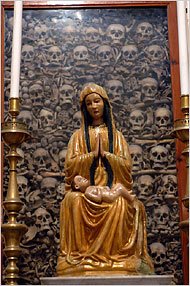
Which gets us back to the picture, and "bells and smells." But before we get there, take in this observation from Hofstadter:

A final characteristic of the paranoid style is related to the quality of its pedantry. One of the impressive things about paranoid literature is the contrast between its fantasied conclusions and the almost touching concern with factuality it invariably shows. It produces heroic strivings for evidence to prove that the unbelievable is the only thing that can be believed. Of course, there are highbrow, lowbrow, and middlebrow paranoids, as there are likely to be in any political tendency. But respectable paranoid literature not only starts from certain moral commitments that can indeed be justified but also carefully and all but obsessively accumulates :evidence.” The difference between this “evidence” and that commonly employed by others is that it seems less a means of entering into normal political controversy than a means of warding off the profane intrusion of the secular political world. The paranoid seems to have little expectation of actually convincing a hostile world, but he can accumulate evidence in order to protect his cherished convictions from it.

Paranoid writing begins with certain broad defensible judgments. There was something to be said for the anti-Masons. After all, a secret society composed of influential men bound by special obligations could conceivable pose some kind of threat to the civil order in which they were suspended. There was also something to be said for the Protestant principles of individuality and freedom, as well as for the nativist desire to develop in North America a homogeneous civilization. Again, in our time an actual laxity in security allowed some Communists to find a place in governmental circles, and innumerable decisions of World War II and the Cold War could be faulted.

The higher paranoid scholarship is nothing if not coherent—in fact the paranoid mind is far more coherent than the real world. It is nothing if not scholarly in technique. McCarthy’s 96-page pamphlet, McCarthyism, contains no less than 313 footnote references, and Mr. Welch’s incredible assault on Eisenhower, The Politician, has one hundred pages of bibliography and notes. The entire right-wing movement of our time is a parade of experts, study groups, monographs, footnotes, and bibliographies. Sometimes the right-wing striving for scholarly depth and an inclusive world view has startling consequences: Mr. Welch, for example, has charged that the popularity of Arnold Toynbee’s historical work is the consequence of a plot on the part of Fabians, “Labour party bosses in England,” and various members of the Anglo-American “liberal establishment” to overshadow the much more truthful and illuminating work of Oswald Spengler.
I'm tempted to point out that left blogistan is as insistent on this "standard-of-proof reasoning" as any "paranoid scholar," ("Got a link for that?"), but that would be unkind (although very close to accurate, I'm afraid). Still, the interesting bit here is that no one comes to their conclusions about what is important to them by way of reason; they come to it by experience. Reason is the common parlance we use to justify our decisions and defend our conclusions. Whether your preferred religious experience is ecstatic and pentecostal, or high church "bells and smells" (I'm working my way back to the post I took this picture from), it is first the emotional experience that matters to you; the ratiocination to justify it, comes later.

Kierkegaard, in other words, was right: truth is subjective. But that's not why I brought you here. And I'll get to that "why" shortly. Blog posts weren't meant to contain this much speculation, I'm afraid.

Tuesday, October 10, 2006

Sparkly Lights

What the Mad Priest said.

What have you seen, my blue-eyed son?


I'm going to find a way to make this picture a permanent part of the blog. Well, at least for awhile. It says way too many things on way too many levels to let it just be a one-off.

I could comment on it for hours. Days, even. But for now, let it suffice to serve as backdrop and headnote to my contemplation of what is coming.

Dems lead by 23% over the GOP in a generic House race. The GOP is losing moms and maybe evangelical voters. Foley is hurting the GOP and evangelicals may be figuring out they've been played for rubes. Turn out the lights, the party's over.

I purposely drew from blogs for that news. Just two, but there's more news like it. And I could have gone here, or here, or even here. No slight on any of those bloggers, but it's all left blogistan is talking about; and no surprise there, is it? It's all pretty much the same news, and all pretty much the same spirit of expectation: that a new day is going to dawn.

Pardon me if I demur. Pardon me if I begin to feel like I've seen this movie, and I know how it comes out. Pardon me if this all just looks like the deck chairs on the Titanic are being arranged into a familiar pattern.

But, you will say, Democrats would never have gotten us into Iraq, or approve of torture, or an unconstitutional wire-tapping campaign, or secret prisons, or Gitmo, Abu Ghraib, silencing protestors via false arrest, set up "free-speech zones," and so on, and so on. And I will say: what have Democrats done to prevent any of those abuses of power? And what will they do in January, even if they control both Houses of Congress after November?

And the right answer is: nothing.

Atrios is right; Bush will not leave Iraq, period. And Congress will not cut off the funding that allows the troops to stay there. Precious little, in fact, is going to look any different in January than it does right now. Joe Biden's plan for withdrawal or John Kerry's or even John Murtha's is going to run up against the Bush consigliere, and nothing will really change. Nor does anyone in Washington really want it to.

We will awake on the second Wednesday of November, in other words, to find that nothing has changed except the faces in front of the TV cameras. There is no Jimmy Stewart in the Democratic party, and he is not going to clean up Washington and return it to the place of our dreams and imaginings. Things may get marginally less worse than they are now, but only marginally. No laws will be passed forcing Bush to shut down the secret prisons, or close Gitmo, or try every person in US custody (not just "citizens") in open court or just turn them loose again. The wars in Iraq and Afghanistan will go bloodily on, with no end in sight, and when there is finally an end we will still just pull out like we did from Saigon; except this time there won't be a government to take over and the people of the countries won't forgive us our sins, because this time we threw the first punch, and the people of Iraq and Afghanistan know their even numbered punch is never coming. And if this sounds like I'm saying "We're done for, we're done for!", well, I'm not that naive. But the political system is not going to be our salvation. It isn't even going to give us the tools to effect anything close to justice. The musicians will simply swap seats, and the band will play on.

It would be wonderful to live in a world where we could be as gentle as Mary, but alas, those skulls keep piling up behind us. Mark Foley should go to jail if he is found guilty of a violation of the law - and again, there is no indication so far that he has comitted a crime - and even if he has not, he doesn't belong in Congress. Nor does Hastert or any of the leaders who turned a blind eye to Foley's salacious messages. To say as much is not judgmental, nor is it unforgiving. It is rather an admission of the responsibility that we bear to the people affected by these leaders. It's the same thing down the line in this election season: we owe to the people of Iraq, at the very least, to hold our elected officials accountable for their miscues in allowing a stupid, unjust war to proceed and deteriorate. As much as the Christian in me would like to offer absolution to Foley, et. al., the citizen cannot.
Yes, it would be a wonderful world if that were possible. And yes, the skulls do keep piling up; and they are going to go on piling up, no matter what we do. These are the conditions that prevail. And while we can hold our representatives accountable, in the end the only accountability they really have is re-election. And in our system, the incumbents are almost always a shoo-in. On the rare occasion when they are not, their replacement is, for all intents and purposes, nearly identical to them. Joe Biden, after all, is not going to be replaced by John Conyers.

That hard rain? It's a long time a-comin'. The arc of the universe is long; and it does bend toward justice. But it doesn't spend more sharply because of an election, or because Tweedledee trades places with Tweedledum. And the skulls will keep piling up. So excuse me if I leave the party early. The more people get excited about this, the more I think they're gonna be disappointed come January.

And if they aren't, I'm gonna be mighty disappointed in them.

Monday, October 09, 2006

Morning Reading

Jurassicpork gives us Paul Krugman's latest column.. Paranoia strikes deep, indeed.

And here is the Hofstadter essay Krugman refers to. Needless to say, it's well worth reading.

Oh, and there will be a quiz.

Sunday, October 08, 2006

Please adjust your metrics accordingly

More than 20,000 U.S. troops have been wounded in combat in the Iraq war, and about half have returned to duty. While much media reporting has focused on the more than 2,700 killed, military experts say the number of wounded is a more accurate gauge of the fierceness of fighting because advances in armor and medical care today allow many service members to survive who would have perished in past wars. The ratio of wounded to killed among U.S. forces in Iraq is about 8 to 1, compared with 3 to 1 in Vietnam.

"These days, wounded are a much better measure of the intensity of the operations than killed," said Anthony H. Cordesman, a military expert at the Center for Strategic and International Studies in Washington.
This news comes bundled with this news:

Last month, 776 U.S. troops were wounded in action in Iraq, the highest number since the military assault to retake the insurgent-held city of Fallujah in November 2004, according to Defense Department data. It was the fourth-highest monthly total since the U.S.-led invasion of Iraq in March 2003.
And why is the fighting so much worse than before? We're still staving off the acceptance that we've lost control of Iraq. We have a euphemism or a metaphor for everything in this occupation. The chosen metaphor for chaos is: "Civil war."

The sharp increase in American wounded -- with nearly 300 more in the first week of October -- is a grim measure of the degree to which the U.S. military has been thrust into the lead of the effort to stave off full-scale civil war in Iraq, military officials and experts say.
"Civil war" in this case means it's no longer our fault that we can't control Iraq; but it also means we set the spark, that we started the conflagration. So it is both our sin, and our excuse; our guilt, and our exculpation. It's a curious sort of cover-up for many reasons, not least of which is a majority of Americans believe Iraq is in civil war already. And what seems to be the problem? Well, it can, again, be attributed to the brute calculus of war:

"The Baghdad security plan and the general spiral of operations is driving us to be more active than we have been in recent months," said Michael E. O'Hanlon, a military analyst at the Brookings Institution, a Washington-based think tank. "We have more people on patrols and out of base, so we get more people hurt and killed in firefights," he said, explaining that U.S. military offensives -- more than other factors such as shifting enemy tactics -- tend to drive the number of American casualties.
But if you want to hang it on one person, there's always Donald Rumsfeld:

In March, Defense Secretary Donald H. Rumsfeld said that Iraqi forces -- not U.S. troops -- would deal with a civil war in Iraq "to the extent one were to occur." Today's operations in Baghdad demonstrate that that goal was not realistic, experts say.

"In a sense, the Baghdad security plan is a complete repudiation of the earlier Rumsfeld doctrine where he said the Iraqis would prevent the civil war," said O'Hanlon.
That's too easy, however. The people responsible are the American people. The people who paid for this invastion, supported it, continued to support it, and now fear it and the consequences it will inevitably bring, has brought, is bringing. The people who agreed that the root cause of America's problems was in insufficient show of force:

"The Baghdad security plan will only be a temporary fix," said a Pentagon official who has served in Iraq. "You need to address the root causes," said the official, who spoke on the condition of anonymity because he was not authorized to speak publicly.
Force has it limits? Huh. Whodathunk it?

"We made decisions to take an indirect approach, which is great if you want low U.S. casualty rates," said the Pentagon official. However, he said: "Passing responsibility to Iraqis does not equal defeating terrorists and neutralizing the insurgency. Period."
Which leaves the question unanswered: just what are we trying to do in Iraq? Stand down as they stand up? Defeat terrorism? Redeem Vietnam? Raise our casualty rates meaninglessly? Because this is what war is, and it isn't a matter of having the "stomach" for it, or not. It's a matter of killing people, but of killing more of their than they do of yours. Except that brute calculus only works for awhile, only works when one side is exhausted before the other is, only works when neither side is fighting for its hearth and home and family.

Which is what we should have learned in Vietnam. Now what?