Saturday, June 09, 2018

Crazy like a fox? Or just crazy?

He does know Trudeau can read these, right?
Canada makes cars?

Pictures v. Words


This is going well:

Speaking to reporters at the annual G-7 meeting, the president said that totally eliminating trade barriers between the nations would be “the ultimate thing” and “that’s the way it should be.” He called many current tariffs on U.S. goods and services “ridiculous.”

“We’re like the piggy bank that everybody’s robbing ― and that ends,” the president said.

He later said, “It’s going to stop, or we’ll stop trading with them. And that’s a very profitable answer, if we have to do it.”
I think all the heads on all the bodies of all the Wall Street Journal editorial board just exploded. 

Meanwhile, on the other side of the world:

“It’s going to be something that will always be spur of the moment,” he said about any potential agreements with Kim. “You don’t know. This has not been done before at this level.” At the top of the agenda for the meeting is Washington’s demands that Pyongyang surrender its nuclear weapons program, though Trump said he believes the summit will at the very least help build a “relationship” between the two countries. Whether or not it will yield a more significant agreement is something he said he’ll know “within the first minute.” “Just my touch, my feel. That’s what I do. And if I think it won’t happen, I’m not going to waste my time. I don’t want to waste his time,” he said.

Yeah; may you live in interesting times.  I don't know if that's an old Chinese curse or not, but it comes now translated from the Russian

Oikonomos as a Christian value


Brian Palmer drags up an old shibboleth: 
But outside of the mainstream media and the coastal cities, Pruitt has supporters who like him so much that they’re willing to ignore his petty scandals and Napoleon complex. They like him because he thinks like them: He puts people before the environment, just like God does.

Which, frankly, is no better a statement on Christianity or Christians than saying that someone puts whites before blacks (or Asians, or Hispanics) "just like God does."  I can think of a number of Christian white supremacists who would agree with that sentiment; but no major Christian denomination that would.  Does that alleviate Christianity of the charge about Pruitt and the environment?  No; but the reality is far more complex than that.

Palmer goes on to cite an article I read back in high school (I remember it well; my first research paper was on the then burgeoning subject of environmental science.  It wasn't a very scientific research paper, but at the time the EPA had just been established, and concerns about environmental destruction were thick in the air.  If I recall correctly, the title of my paper included the words "eventual destruction" of the environment.  We have always lived in pessimistic times.)  The article is by Lynn White, published in 1967 (halcyon times!).    In it, White argues that the "environmental crisis" (50 years ago!) is the fault of Christianity, which, in a fight with "paganism," had to destroy the notion of nature being filled with spiritual beings.

To say that's a sloppy reading of history or anthropology or world religions is to state the obvious; but we won't belabor that point now.*  He starts his article with an anecdote about Aldous Huxley and rabbits (the latter were introduced to England, he says, in 1176.  That didn't work out as well in Australia, however.  Huxley, at the time of the anecdote, was on his way out.  So it goes.).  White goes on to discuss the reclamation of the Zuider Zee, and the fish and animals which may have been destroyed in that process (even among environmentalists that would probably be considered a "so it goes" today).  Now, White was a professor of history, not of science or religion, or even especially religious history, so his argument really turns on a lot of popular opinions about religion, most of them formed in the Enlightenment and later in 19th century Europe (I think Nietzsche had a better grasp on religion, to be honest, and his tended to be all slippery.).    But following White's argument with Huxley about the rabbits, Huxley's lament calls to mind Thoreau's lament at the noise created by trains in the countryside he so loved.  150+ years later, who doesn't hear a train whistle with a nostalgic pang for a vanishing past?

So it goes.

This isn't as strong an argument as everyone makes it out to be, in other words, and it deserves more critical attention (or perhaps less) than it still gets.  The central argument is that Christianity is fundamentally anti-environment, and encourages everyone to plunder the planet because, as Leonard Bernstein so memorably put it, "God made us the boss!"  Well, that's certainly a strain of Christianity; but then so are the teachings, and perhaps more important, the symbolism, of Francis of Assisi.

Like most saints the Francis we admire is more plaster than person; which is a pity.  But still, everyone knows a figure in a robe (however vaguely represented) with a rope belt (a cincture, but no matter), with a bird on his shoulder and maybe a rabbit in his arms (or more pointedly, a wolf at his feet) is Francis, the man of God so pure in spirit the animals befriended him.  Francis represents peace with nature, not destruction and dominance.  There is even a patron of gardening, St. Fiacre (an Irish saint with a French name; go figure), and even of brewing (St. Arnold).  I don't know of one for felling trees, poisoning the water, or polluting the air.  And true, Francis has not been the tranquilizing figure we might imagine him to be.  It was Franciscan monks who settled what is now San Antonio, on a mission from the Spanish kings.  They weren't all or always as kind and gentle to the natives as their founder might have counseled.  And that is a fault of Christianity, but it is not the heart of Christianity.  As Palmer quotes White, in a stunningly silly statement:

“Christianity is the most anthropocentric religion the world has seen. … By destroying pagan animism, Christianity made it possible to exploit nature in a mood of indifference to the feelings of natural objects.”

That sort of imagines all Native Americans, to pick a group, were nature loving "noble savages" from the most perfervid Romantic imagination, when nothing could be further from the truth.  In southern Illinois there is a magnificent structure of mounds built by the Cahokia tribe.  It was a city in a "primitive" land, complete with irrigation for crops, and a wall of timber (felled trees) around it's perimeter (you can see pictures of what it was like, and is like now, here).  In the spirit of White's concern for the reclamation of the Zuider Zee, one can only wonder how many insects and animals were destroyed in the building of those mounds, some of which were large enough to farm.  And then, at some point, they abandoned the place.  Probably the land was used up, the area couldn't sustain the population; maybe even pollution from human and animal waste played a part.  Funny thing is, this was a pre-Columbian village; they had not a hint of Christianity to teach them to be so profligate and destructive (destructive enough they had to move on, anyway).

A "mood of indifference to the feelings of natural objects" is not the opposite of "Paganism."  Unless you really don't know what you're talking about; and on the subject of world religions, most people don't.

Again, is this the fault of Christianity?  Should the Church have blocked the Industrial Revolution (which is really when the "ecological crisis" White complains of, got started)?  On what grounds would it do so?  Was the Church a handmaid to destruction?  No less than paganism ever was.  If there is a flaw in our makeup, that flaw lies in science, not religion.  Science taught us we could replace the beneficence of God with the power of engineering and technology.  Was it God who gave us weapons of mass destruction and biological weapons and chemical weapons?  Was it Christianity that taught us to multiply savagery upon savagery, poison the ground to grow food, foul the waters to fertilize plants?  As I recall my history, much of that was seen as a gift from God, a product of the gift of reason which is prized in Christianity until the 1920's in the rise of American fundamentalism (which echoes the disgust with "elites" under Trump today, echoes in the reaction against reason that fundamentalism ushered in.  Is that disgust the result of Christianity; or have evangelicals simply jumped on that train to worldly power?).

Christianity is no more anthropocentric than the Greek gods, humans with immortal powers but human weaknesses.  The idea of the God of Abraham, even of Jesus of Nazareth, is that they transcend human limitations in all things.  Which is more anthropocentric:  the God of the vision of Isaiah's holy mountain or Ezekiel's plain of dry bones?  Or Zeus and Apollo, who damn Oedipus before his birth and punish him for circumstances far beyond his control?  They transcend humans only by being ultimately indifferent to them, and vindictive in ways even the God of Abraham is never charged with.

Palmer touches on the true issue, but shies away from it in favor of something he thinks more damning:

But there’s something that bothers me about the simplicity and convenience of explaining this all by the transitive logic of evangelicals are Republicans, Republicans hate environmental regulation, so evangelicals hate environmental regulation. It suggests that Christians are willing to cast off their moral obligations for political convenience. Maybe that’s true. Or maybe they don’t feel a moral obligation to protect Earth in the first place.
Actually, that penultimate sentence is the right one, and it's connected to a very Christian idea:  the concept of original sin.  The beating heart of that concept is selfishness:  the refusal or inability to place yourself second, and everyone else first.  Selfishness allows you to think of the world as a series of objects, and very shortly people themselves become objects (industrialists were not known for their humanitarian impulses, in the 19th century or now).  If that isn't the antithesis of Christianity, I don't know what is.  But still it is the attitude of many a "Christian," so we cannot say it is not a reality.  As for a "moral obligation to protect the Earth," again, that's a post-Industrial Revolution idea.  Until then, we had no need to protect the earth from us; we couldn't do that much damage, except in locales like the Cahokia mounds.  And then we left, and the landscape recovered.  It still does, but not quite so easily, anymore.  Palmer is essentially arguing a Romantic argument, and that doesn't make it an unsound one; it just makes it an anachronistic one, especially if you try to extend it into pre-19th century European thought (he never concerns himself with Asians or Africans, interestingly).

There is a burgeoning idea, in part in reaction to White's 1967 article, that Christians are called to be stewards of the planet, not exploiters.  It is no more popular now than it would have been in early 19th century England (where the IR started).  The idea that the ecological crisis is a peculiarly Christian one is a silly notion, and reminds me again of Thoreau:  those snipping away the branches of the tree of evil, for every one hacking at its roots.  Palmer's bete noir is Scott Pruitt, the man determined to finish the job James Watt started (remember him?  I don't think Palmer does.).  But Pruitt is not acting out of Christian motives, he is acting out of selfish motives.  His every act in public office is an act of corruption and lining his own pockets or those of his cronies.  That, too, is not unknown in Christianity; but no one should mistake it for being Christian.

Modern day theology understands, and teaches, the idea of oikonomos, or law of the house, as the basis of stewardship.  Oikonomos (the cognate of "economy," which opens up Christian critiques of that subject, too) is about responsibility, not power; about stewardship and care, not exploitation and plunder.  It is much more central to Christianity than "God made us the boss" is, even if the latter seems to be the more likely practice of Christian cultures.  But Christianity addresses that, too:  we call it "original sin."  And while Christianity has never eliminated it, much less controlled it, it never promised to do either.

That, like everything else, is up to us.  The fault is not in our stars, nor in our religion.  We have met the enemy, and he is us.

*White's premise might appeal to the Frazer Golden Bough crowd, but I can only imagine modern anthropologists would cringe at it, and politely walk away.

Friday, June 08, 2018

Will Anyone Be Polling...

any changes in opinion?

Or do we just assume he can't do it?

"And all the news is full of deaths..."


Suicide is the most selfish act imaginable.  How do you leave a note to your teenage daughter explaining what you have done that can't be undone?  How do you explain away the obvious:  that what was most important to you was yourself, and your death?  How do you explain that, in the end, you were the center of the world, the universe, and that without you, it will not go on?

Because how else could you convince yourself the hearts and souls of those who love you mean nothing, and you choose death?

I'm sure some tumult in the soul drives people to suicide, but this is not a grand Romantic gesture, the last act of defiance, taking control of the world by refusing your place in it.  This is selfishness:  pure and simple.  This is an act of ego.  This is the final proof that no one matters more than you do, in a world where making everyone else matter but you is the ultimate sin.  Suicide is the final pronouncement of the importance of being first of all and more important than all.  It is the supreme arrogance:  that when I am gone, the world goes with me; that those left behind won't be left behind, because I won't be there to feel their agony, their loss, their horror and sadness.  It won't matter, because all that matters is me.  But no one is an island:

No man is an Iland, intire of itselfe; every man
is a peece of the Continent, a part of the maine;
if a Clod bee washed away by the Sea, Europe
is the lesse, as well as if a Promontorie were, as
well as if a Manor of thy friends or of thine
owne were; any mans death diminishes me,
because I am involved in Mankinde;
And therefore never send to know for whom
the bell tolls; It tolls for thee.

We are all involved in these deaths, because we are all diminished by them.  Something failed, that these people failed at life, at the worthiness of existence.  Or that they saw no hope in depression, no redemption in suffering, no choice but to end it.  Did one lead to the other?  Probably.  We say mass shooters inspire more mass shootings; why shouldn't celebrity suicides inspire more suicides?  And we are all the lesser for it.  If you strive to be last of all and servant of all, what servant rejoices at the suicide of his master?  What service is there in abiding self-death?

And what of those left behind?  What, in this case, of the daughters?  What can we, the living, do for them?  What could we have done for their parents?

"Any mans death diminishes me, because I am involved in Mankinde."  Whether we think we are, or not.

Thursday, June 07, 2018

What's the Japanese for "Oh, shit!"?


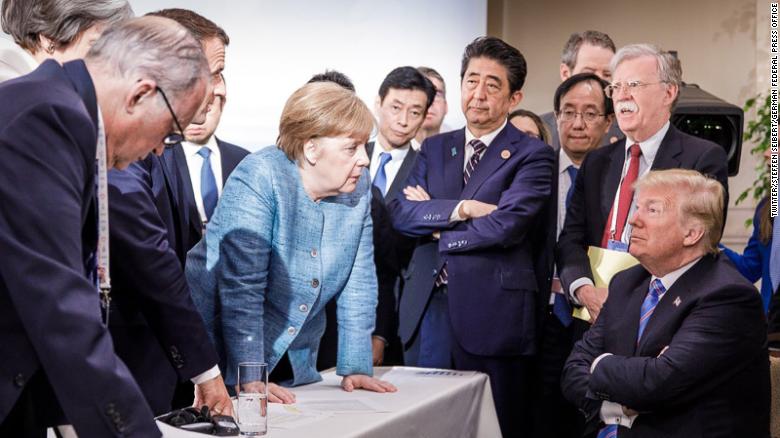
Trump at a press conference with Japanese Prime Minister Shinzo Abe.

And remember back 9 days when he said:

 
Apparently he was still able to focus his energy on this:
 
It's all about attitude, ya know.

"They're Tryin' to Wash Us Away...."

It would also help if the President was not delusional:

Trump was on a conference call with state and federal leaders in preparation for another dreadful hurricane season. During the call, Trump thanked the Coast Guard for its service in helping save 16,000 people after Harvey, Hurricane Maria and other storms. The Coast Guard doesn’t “get enough credit,” Trump said.

"Sixteen thousand people, many of them in Texas, for whatever reason that is. People went out in their boats to watch the hurricane,” Trump said. “That didn't work out too well.”
Really wondering what color the sky is on his planet.  Let's take it piece by piece:  "Sixteen thousand people"?  As usual, the real number is not big enough, Trump has to increase it by 50%.  The Coast Guard itself (you know, a government agency) released this number last September:

During their response to Hurricane Harvey, Coast Guard men and women rescued 11,022 people and 1,384 pets.
Which, frankly, is plenty enough to be proud of, and good on the Coast Guard.  Everyone in Texas is grateful for their efforts.

Then:  "...many of them in Texas, for whatever reason that is."

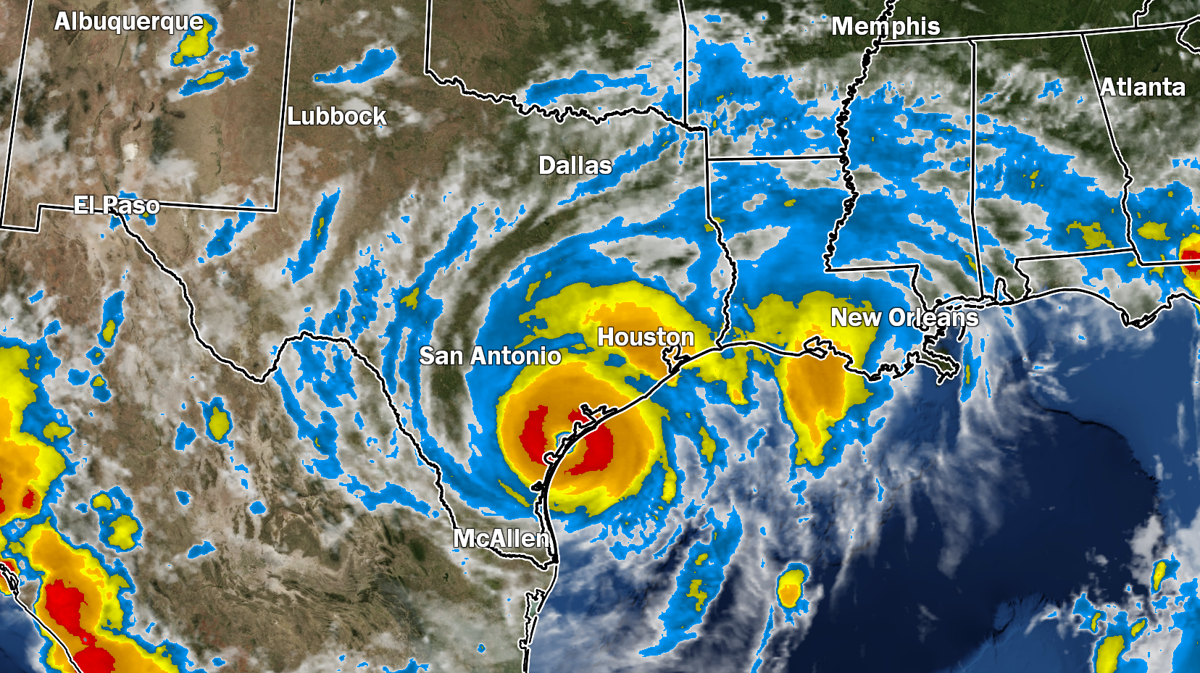
Well, could be because Hurricane Harvey stretched from Rockport to Beaumont, and covered the Texas coast inland to San Antonio and Austin.  It looked like this:


Or because it flooded the fourth largest city in the country?  And then we get to the "WTF?" portion:  "People went out in their boats to watch the hurricane."

Nobody knows what he's talking about:

Houston Fire Chief Sam Peña said he wasn’t aware of the specific context of Trump’s quotes but praised the many Houstonians who used their own equipment to rescue trapped neighbors.

“During Harvey, certainly the community — those who were able to get out and help their neighbors — that was really a game-changer for us in meeting the extraordinary demand for evacuations,” he said. “Without the assistance of private citizens in their own boats… we would have had a more difficult time in getting to everybody that needed assistance.”

The comments perplexed a wide range of professional first responders and civilians who rushed into the flood waters to help their neighbors.

“I can only imagine he’s not talking about Houston,” said Lancton.  “The reality is, I did not experience people sitting out in Brays Bayou waiting for the storm to come in… All the boats I saw out there were ones trying to help.”

Francisco Sanchez, spokesman for Harris County’s Office of Homeland Security & Emergency Management, said the U.S. Coast Guard was a “top-notch” partner with a long history helping out in disasters in Harris County. It rose to the occasion during Harvey, he said.

“They were just beyond heroic in what they did,” he said. “They certainly -- here in Harris County -- are not underappreciated. they are part and parcel of any response that might involve maritime, ports, or even inland search and rescue operations.”

Sanchez also echoed comments about how civilians had helped Houston and Harris County overcome Harvey’s onslaught.

“I’m not aware of anybody in Harris County on a boat in the midst of the storm and its aftermath as a matter of leisure or entertainment,” he said. “The response from our community members and folks at the Cajun Navy that brought their boats, put them in the water to rescue people and to help, filled the gap that we couldn’t simply because of size and scope of what Hurricane Harvey was doing to our community."

Taylor Fontenot was working as a bartender when Hurricane Harvey hit. Fontenot spent long days with other members of the Cajun Navy rescuing resident after resident. Many of the volunteers liquidated their financial resources in the rescue efforts.

By the end of the storm, members of the Cajun Navy and other civilian volunteer organizations had rescued 35,000 people, he said.

Fontenot, of Sugar Land, said he didn’t take the president’s comments personally, but said he'd heard from many other rescuers and people who had been victimized by the storm.

“For it to be looked lightly on or diminished, or seen as a joke, it’s kind of a slap in the face,” he said.

Sanchez said first responders coordinated closely with civilians to direct them to areas that needed help. Authorities are trying to formalize a similar approach pairing up first responders and civilians who want to help in future storms, he said.
It's worth noting that Joe Straus is Speaker of the Texas House until the next Legislature meets in 2019 (He isn't running for office again), and he has more to say about Trump's ludicrous statement than the Governor of Texas, who could only manage:

When asked by the Houston Chronicle to confirm if Texans were out on boats gawking at the storm, Texas Gov. Greg Abbott said he had “no information one way or another about that.”
And finally:  “That didn't work out too well.”

Houstonians, at least, are justifiably proud of their efforts to help each other during and after the Hurricane.  The Coast Guard was important, but hundreds of people, maybe thousands, brought out anything that would float and ferried people out of flooded neighborhoods to transport and higher ground.  I know some of those people.  It worked out brilliantly well.

I know running against Trump is not the surest method to win office, but tying him like an albatross around the necks of the Texas GOP is an opportunity not to be missed.

People out in their boats in Houston to watch Hurricane Harvey.

Wednesday, June 06, 2018

Notorious....


I walked out of the documentary "RBG" convinced not that Ruth Bader Ginsberg's legal arguments were on the right side of history, but that they were so soundly reasoned there were simply right (no mean feat, that).  But that conclusion can rest too easily on tautology:  what you want to believe true is true.

Her dissent in Masterpiece Cake Shop would be "Exhibit A" in my argument.  But before I get there, I have to point out that while Kennedy wrote the majority opinion, Kagan and Breyer signed a concurring opinion, as did Gorsuch and Alito.  A footnote in the Kagan/Breyer opinion points out Gorsuch disagrees with a point in their argument.  Gorsuch also joined Thomas' concurring opinion, in part.  This was not a decision, in other words, based on consensus, despite the 7-2 vote.  That interests me in part because it reminds me of the Bakke decision, which we studied in Con Law lo these many decades gone.  Bakke presented (if memory serves; corrections gladly accepted) a "reverse discrimination" claim that he was not allowed into a college because he was a white male.  The court kind of reached a decision on that issue, but wrote 8 different opinions trying to do it.  Non-lawyers latch onto the judgment; lawyers look at the legal reasoning.  There's a reason justices write out lengthy opinions, analyzing the facts and the law to justify their decision(s).  The more broken up the opinions (Bakke is the gold standard for this legal principle), the more uncertain the power of the conclusion.  The judgment matters to the parties in the case; the reasoning matters to the lawyers trying to use that opinion on behalf of their clients.  This case, in other words, is a mess.

In the concurring opinion he wrote,  Gorsuch tries to take on the Ginsburg dissent, which will serve as a prelude to that opinion.  I have to say that goes as well for him as it did for Ted Olsen in a case before Justice Ginsburg, referenced in the documentary.   Here is Gorsuch's argument, in brief:

Take the first suggestion first. To suggest that cakes with words convey a message but cakes without words do not—all in order to excuse the bakers in Mr. Jack’s case while penalizing Mr. Phillips—is irrational. Not even the Commission or court of appeals purported to rely on that distinction. Imagine Mr. Jack asked only for a cake with a symbolic expression against same-sex marriage rather than a cake bearing words conveying the same idea. Surely the Commission would have approved the bakers’ intentional wish to avoid participating in that message too. Nor can anyone reasonably doubt that a wedding cake without words conveys a message. Words or not and whatever the exact design, it celebrates a wedding, and if the wedding cake is made for a same-sex couple it celebrates a same-sex wedding.
To put that in context, the words of the dissenting opinion, in pertinent part:

On March 13, 2014—approximately three months after the ALJ ruled in favor of the same-sex couple, Craig and Mullins, and two months before the Commission heard Phillips’ appeal from that decision—William Jack visited three Colorado bakeries. His visits followed a similar pattern. He requested two cakes

“made to resemble an open Bible. He also requested that each cake be decorated with Biblical verses. [He] requested that one of the cakes include an image of two groomsmen, holding hands, with a red ‘X’ over the image. On one cake, he requested [on] one side[,] . . . ‘God hates sin. Psalm 45:7’ and on the opposite side of the cake ‘Homosexuality is a detestable sin. Leviticus 18:2.’ On the second cake, [the one] with the image of the two groomsmen covered by a red ‘X’ [Jack] requested [these words]: ‘God loves sinners’ and on the other side ‘While we were yet sinners Christ died for us. Romans 5:8.’ ”

In contrast to Jack, Craig and Mullins simply requested a wedding cake: They mentioned no message or anything else distinguishing the cake they wanted to buy from any other wedding cake Phillips would have sold.

One bakery told Jack it would make cakes in the shape of Bibles, but would not decorate them with the requested messages; the owner told Jack her bakery “does not discriminate” and “accept[s] all humans.”  The second bakery owner told Jack he “had done open Bibles and books many times and that they look amazing,” but declined to make the specific cakes Jack described because the baker regarded the messages as “hateful.”  The third bakery, according to Jack, said it would bake the cakes, but would not include the re- quested message.

Jack filed charges against each bakery with the Colorado Civil Rights Division (Division). The Division found no probable cause to support Jack’s claims of unequal treatment and denial of goods or services based on his Christian religious beliefs. In this regard, the Division observed that the bakeries regularly produced cakes and other baked goods with Christian symbols and had denied other customer requests for de- signs demeaning people whose dignity the Colorado Antidiscrimination Act (CADA) protects.  The Commission summarily affirmed the Division’s no-probable-cause finding.

The Court concludes that “the Commission’s consideration of Phillips’ religious objection did not accord with its treatment of [the other bakers’] objections.”  But the cases the Court aligns are hardly comparable. The bakers would have refused to make a cake with Jack’s requested message for any customer, regardless of his or her reli- gion. And the bakers visited by Jack would have sold him any baked goods they would have sold anyone else. The bakeries’ refusal to make Jack cakes of a kind they would not make for any customer scarcely resembles Phillips’ refusal to serve Craig and Mullins: Phillips would not sell to Craig and Mullins, for no reason other than their sexual orientation, a cake of the kind he regularly sold to others. When a couple contacts a bakery for a wedding cake, the product they are seeking is a cake celebrating their wed- ding—not a cake celebrating heterosexual weddings or same-sex weddings—and that is the service Craig and Mullins were denied. Cf. ante, at 3–4, 9–10 (GORSUCH, J., concurring). Colorado, the Court does not gainsay, prohibits precisely the discrimination Craig and Mullins encountered.   Jack, on the other hand, suffered no service refusal on the basis of his religion or any other protected characteristic. He was treated as any other customer would have been treated—no better, no worse.3

The fact that Phillips might sell other cakes and cookies to gay and lesbian customers was irrelevant to the issue Craig and Mullins’ case presented. What matters is that Phillips would not provide a good or service to a same-sex couple that he would provide to a heterosexual couple. In contrast, the other bakeries’ sale of other goods to Christian customers was relevant: It shows that there were no goods the bakeries would sell to a non-Christian customer that they would refuse to sell to a Christian customer.   Nor was the Colorado Court of Appeals’ “difference in treatment of these two instances . . . based on the government’s own assessment of offensiveness.” Phillips declined to make a cake he found offensive where the offensiveness of the product was determined solely by the identity of the customer requesting it. The three other bakeries declined to make cakes where their objection to the product was due to the demeaning message the requested product would literally display. As the Court recognizes, a refusal “to design a special cake with words or images . . . might be different from a refusal to sell any cake at all.”5  The Colorado Court of Appeals did not distinguish Phillips and the other three bakeries based simply on its or the Division’s finding that messages in the cakes Jack requested were offensive while any message in a cake for Craig and Mullins was not. The Colorado court distinguished the cases on the ground that Craig and Mullins were denied service based on an aspect of their identity that the State chose to grant vigorous protection from discrimination.   (“The Division found that the bakeries did not refuse [Jack’s] request because of his creed, but rather because of the offensive nature of the requested message. . . . [T]here was no evidence that the bakeries based their decisions on [Jack’s] religion . . . [whereas Phillips] discriminat[ed] on the basis of sexual orientation.”). I do not read the Court to suggest that the Colorado Legislature’s decision to include certain protected characteristics in CADA is an impermissible government prescription of what is and is not offensive. To repeat, the Court affirms that “Colorado law can protect gay persons, just as it can protect other classes of individuals, in acquiring whatever products and services they choose on the same terms and conditions as are offered to other members of the public.”
——————
3JUSTICE GORSUCH argues that the situations “share all legally sa- lient features.” Ante, at 4 (concurring opinion). But what critically differentiates them is the role the customer’s “statutorily protected trait,” ibid., played in the denial of service. Change Craig and Mullins’ sexual orientation (or sex), and Phillips would have provided the cake. Change Jack’s religion, and the bakers would have been no more willing to comply with his request. The bakers’ objections to Jack’s cakes had nothing to do with “religious opposition to same-sex wed- dings.” Ante, at 6 (GORSUCH, J., concurring). Instead, the bakers simply refused to make cakes bearing statements demeaning to people protected by CADA. With respect to Jack’s second cake, in particular, where he requested an image of two groomsmen covered by a red “X” and the lines “God loves sinners” and “While we were yet sinners Christ died for us,” the bakers gave not the slightest indication that religious words, rather than the demeaning image, prompted the objection. See supra, at 3. Phillips did, therefore, discriminate because of sexual orientation; the other bakers did not discriminate because of religious belief; and the Commission properly found discrimination in one case but not the other. Cf. ante, at 4–6 (GORSUCH, J., concurring).
5The Court undermines this observation when later asserting that the treatment of Phillips, as compared with the treatment of the other three bakeries, “could reasonably be interpreted as being inconsistent as to the question of whether speech is involved.” Ante, at 15. But recall that, while Jack requested cakes with particular text inscribed, Craig and Mullins were refused the sale of any wedding cake at all. They were turned away before any specific cake design could be dis- cussed. (It appears that Phillips rarely, if ever, produces wedding cakes with words on them—or at least does not advertise such cakes. See Masterpiece Cakeshop, Wedding, http://www.masterpiececakes.com/ wedding-cakes (as last visited June 1, 2018) (gallery with 31 wedding cake images, none of which exhibits words).) The Division and the Court of Appeals could rationally and lawfully distinguish between a case involving disparaging text and images and a case involving a wedding cake of unspecified design. The distinction is not between a cake with text and one without, see ante, at 8–9 (GORSUCH, J., concurring); it is between a cake with a particular design and one whose form was never even discussed.
This is pretty much the entirety of the factual recitation and argument based on it.  I removed most of the citations to the record, but included those to Justice Gorsuch's concurring opinion (thus does RBG use Gorsuch's argument against him) and two footnotes because I thought them important, too.

If you read Ginsburg's words carefully, you'll see one of the purposes of dissent, especially in a case with so many opinions:  she is analyzing (dissecting, really) the majority opinion and pointing the way to the proper legal conclusion in future cases.  So:

To repeat, the Court affirms that “Colorado law can protect gay persons, just as it can protect other classes of individuals, in acquiring whatever products and services they choose on the same terms and conditions as are offered to other members of the public.”
But the heart of her argument, and where she is so right despite Gorsuch's attempt (and failure) to rebut her, is here:

When a couple contacts a bakery for a wedding cake, the product they are seeking is a cake celebrating their wedding—not a cake celebrating heterosexual weddings or same-sex weddings—and that is the service Craig and Mullins were denied. Cf. ante, at 3–4, 9–10 (GORSUCH, J., concurring). Colorado, the Court does not gainsay, prohibits precisely the discrimination Craig and Mullins encountered.   Jack, on the other hand, suffered no service refusal on the basis of his religion or any other protected characteristic. He was treated as any other customer would have been treated—no better, no worse.
Gorsuch's weak rebuttal is to claim cakes carry messages, with or without words.  As Ginsburg points out, that isn't the issue:  the issue is, can services offered to be public be denied to certain persons because they are perceived to be in a class the shop owner does not wish to do business with?  Had the baker declined to bake a cake for a Jewish wedding because he thought Jews "Christ Killers," or refused to make a cake for a black couple because he believed they bore the "Mark of Cain," would the Colorado Civil Rights Commission have been wrong to denounce his religious beliefs?  Would there have been no discrimination in that case?  As the dissent points out, the question of discrimination is not in what message you are forced to send, but in what services you deny to whom.    Jack was not discriminated against; Craig and Mullins were.  If Ginsburg's definition is not the definition of "discrimination," then civil rights law going back at least to Brown v. Board is completely undone.

She is not right because she is on the right side of public opinion or history; but simply because her argument is right.

QED.

Tuesday, June 05, 2018

I Shouldn't Be Using Twitter Like This


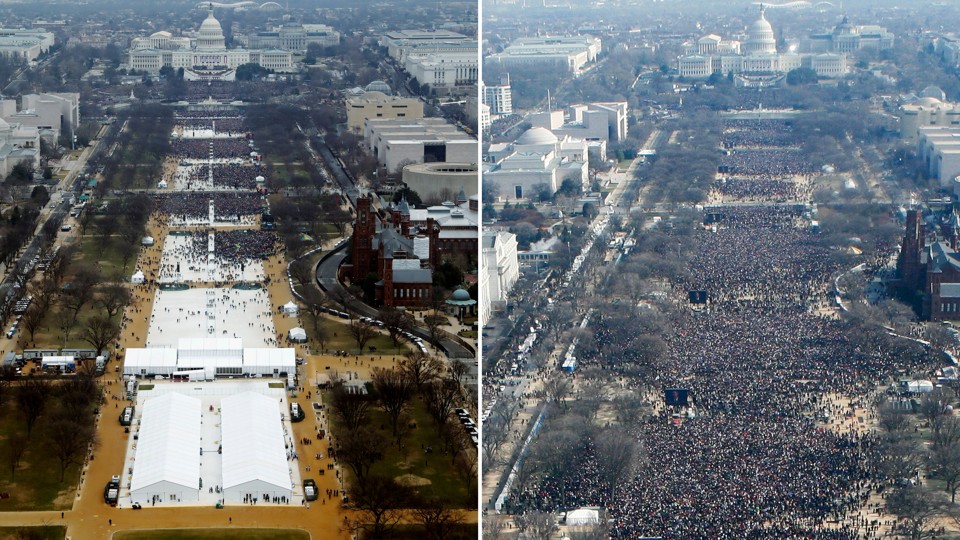
But I can resist anything but temptation.  True to form, Trump touted the crowd size:
Who look suspiciously like government workers, not your stereotypical Eagles fans:
How few Eagles fans?
Which goes a long way towards supporting this:
And our unsung hero:

Alright, a few more comments on the issue:


Costello is PA-06(R)  Don't get between a Rep. and the home team.
And underlining the point that it's not about race because it's never about race, someone who identifies as a "Red State front page contributor":
On that note, George Takei gets the last word:

Me? Or your lyin' eyes?

Because this really never gets old...

Ben Rhodes was on Fresh Air this morning, and I noted in passing (busy with other things) his account of Trump's meeting with Obama on the day of the inauguration.  Rhodes said Obama invited several people, including Rhodes, into the Oval Office after Trump had left.  Obama recounted trying to explain policy issues and other matters to the incoming President, but all Trump wanted to talk about was crowd size.  Trump praised Obama for the crowds he could draw, took credit for the crowds Trump said he could draw, and denigrated Hillary Clinton for not being able to draw large crowds.  Interesting, in the light of today's news:

Last week, the Eagles submitted 81 names of players who were planning to visit the White House, press secretary Sarah Huckabee Sanders said in a statement. The team was "full steam ahead," another administration official said, for an event that had been in the works since February.

But on Monday, the White House was informed that the delegation had been reduced to just two or three players, the owner, and the team's beloved mascot, Swoop.

"We feel like they wanted to publicly humiliate the White House and the president," the official said.

Or they just didn't want to associate with him.  Gee, why would that be?  Notice, of course, the White House didn't want to attribute this to "scheduling conflicts" or some other face saving reason; so they attack the players:

“Unfortunately, the Eagles offered to send only a tiny handful of representatives, while making clear that the great majority of players would not attend the event, despite planning to be in D.C. today,” White House press secretary Sarah Huckabee Sanders said in a statement. “In other words, the vast majority of the Eagles team decided to abandon their fans.”
Interestingly, according to Politico the whole point of the invitation was to shore up Trump's political base:

The change of plans was a setback for a White House that has until now viewed its culture war with the National Football League as a winning issue with its base. The event had been in the works for months, and taken up hours of planning by senior administration officials.

Because, you know, he draws large crowds.

Not surprisingly, Trump cancelled the whole thing in a fit of pique, blaming the anthem controversy he stirred up for the non-attendance of the players, and leaving his staff to figure out what just happened:

The last-minute cancellation took many White House staffers by surprise. Some people working in the communications shop said they were alerted to the change of plans just minutes before the presidential statement was blasted out by the press office.
A decision that, of course, had ramifications Trump neither considered nor really cares about:

On Tuesday morning, the NFL Players Association said in a statement posted to Twitter: "Our union is disappointed in the decision by the White House to disinvite players from the Philadelphia Eagles from being recognized and celebrated by all Americans for their accomplishment. This decision by the White House has led to the cancellation of several player-led community service events for young people in the Washington, D.C. area. NFL players love their country, support our troops, give back to their communities and strive to make America a better place." 
Trump is the President of the people who come to his rallies and give him a sense of really big crowds (last week he attacked the NYT report on attendance at his rally with about as much credibility as his claims about his inaugural audience).   Everything is an excuse to declare some group "unmutual!"  Which, frankly, is far more disturbing than quasi-legal arguments about the President's pardon power and legal authority over the administration of justice.

Ted Cruz Does His Impression of Bill Clinton Doing An Impression of Donald Trump


If you are old enough, you remember Bill Clinton (in a deposition, if memory serves) arguing about what the definition of "is" is.  Watch carefully as Ted Cruz, renowned debater who is supposed to be the scourge of his opponents in argument, steps all over his...tie...yeah, his tie, in trying to sound outraged and injured while also trying to say nothing at all while also trying to argue about...well, what the meaning of "is" is:
I'll pause here to say I've read excerpts of that article, including a footnote some seem to think is now hypocritical, and I don't find anything in that excerpt that proves anything against Cruz, or anything about the question of a presidential self-pardon.  He's not wrong, in other words; that law review article really doesn't apply here.  But that's a lawyer talking, so whaddo I know?
This all started because Cruz did his best impression of a landed fish in the halls of the Senate:
 24 hours later, Cruz digs in with a non-pithy response that really doesn't say anything except "reasonable people can disagree" on the legal question because it has never been presented before, and it really does turn on what the meaning of "pardon" is, or "President," or even "crime."

Still not sure where the "knee jerk partisanship" and "dishonest journalism" comes from.  You can go back to the tape for the latter; what's "knee jerk" about being appalled at a President who says he can pardon himself?  Yes, it is a case of first impression (as the lawyers say), and there is a reason it has never been presented before ("L'etat, c'est moi!" being a primary explanation), but Cruz dare not say that and disturb his Trump supporting GOP Texas base.  OTOH, he dare not say the President has the powers of the Sun King.  So he waffles, in 17 tweets that manage to make no argument at all, including a rebuttal of the fact that he did wait 18 (or was it 20?) seconds before answering the question put to him.  Although he does manage to say it's a "close" question and imply he's not sure whether he'd impeach Trump for using it on himself, or not; which is a revealing answer in itself.  It's revealing, but it's not at all bold and forthright.  Besides, this guy is the Debate King!  He was the Solicitor-General of Texas, his primary job was getting interrupted with questions in oral arguments before appellate courts.  And he can't handle a reporter asking a question in a Senate hallway?

I think Beto O'Rourke should debate Cruz, and press him on what powers the President has.  Cruz, after all, as a Senator, has to decide whether Trump's exercise of those powers would exceed his Constitutional authority, should it come to an impeachment trial.  And Senators, as I've pointed out before, are not jurists; they are free to have opinions about the case long before it is presented in an impeachment trial.  I think we know where Sen. Cruz stands; it would be a legitimate issue to press him on that stance, especially since it sure seems he prefers a Sun King in the White House, over a President.

It was bound to come to this

Because kneeling in public now can only be an act of disrespect.

Monday, June 04, 2018

That Was The Day That Was

After the tweets of the morning, the President proves he has absolutely no self-awareness. No sense of history, either.

Well, I thought the day was done:


Trump apparently decided if the Eagles weren't coming, why not just take his ball and go home?

What's interesting is how conciliatory he suddenly sounds, and at the same time so awkward.  He's ditched the narrative about respecting the military, but he's still whinging about the kneeling.  And is he "Sorry!" he had to cancel, or does he mean football players who kneel on the field are "Sorry!"?  Honestly, it could go either way; and either way, it didn't impress Torrey Smith at all:
And I thought this was particularly to the point:


Has it only been 500 days?

And here's how he's celebrating it:

  • Pardons don't issue until after crimes have been committed, is the usual answer.  Ford pardoned Nixon for what he might have done, not for what he might do in the future. Bush pardoned the Iran/Contra figures, and they all maintained they were innocent, but he didn't pardon them for what they might do after his Presidency ended.  So why haven't you pardoned yourself yet?  Maybe because you don't have the spine to be so arrogant?


No, he still hasn't learned how to spell "counsel." (He corrected it an hour later, which is why this won't show up as a tweet now.) And yes, he is a konstitooshinal skollar, as Kellyanne Conway's husband has pointed out:


Trump is also a powerful world leader.

A call about trade and migration between US President Donald Trump and French President Emmanuel Macron soured last week after Macron candidly criticized Trump's policies, two sources familiar with the call told CNN.

"Just bad. It was terrible," one source told CNN. "Macron thought he would be able to speak his mind, based on the relationship. But Trump can't handle being criticized like that."
Which might explain this:


Although the simpler explanation is:  the President is an idiot.

There is a remedy for this.  Congress gave the President power over international trade; Congress needs to take that power back.  As for the right to pardon himself, that's up to the courts.  If they recognize the pardon as valid, it is.  If they don't, it isn't.  It's not really a "Constitutional crisis" (that phrase beloved of the media, but with as much legal value as Trump's claims there was no "collusion" with Russia.  "Collusion" is not a crime, so no, there was no criminal act of "Collusion."  That's not the criminal issue.).  Pardons are only valid if the courts say so, and a Presidential self-pardon would be, almost by definition, invalid.  And even though Trump rants about it on Twitter, I honestly don't think he has the cojones to issue himself one.  (I'm resting my analysis in part on a line of cases where the Court declined to enforce racial covenants in deeds.  The Courts did not remove the covenants from the chain of title (a very difficult, almost impossible task), it simply refused to enforce them.  A pardon must be presented to the court to block a criminal investigation; if Trump pardoned himself, the Court could simply refuse to recognize it as valid.*)

The best hope now is that the Democrats run on issues people care about (not just "anti-Trump").  But I haven't seen any Democrats here in Texas running solely against Trump, not even in the Democratic primaries; so I don't think that's really an issue.  If they can regain control of Congress they don't have to impeach Trump; they can simply clip his wings.  It may be Trump does us all a service by ending the "imperial Presidency" and returning the Constitutional balance back to the Congress.

*There is also this fascinating argument:

Were a president to pardon himself, this would surely trigger prosecution in the states (e.g., for fraud or tax evasion). It would, therefore, be a very foolish decision. The pardon would be admissible evidence of guilt.

The pardon power is not the "Get out of jail free" card some imagine it to be.

Sunday, June 03, 2018

Oxen being gored

Um, sure.
Which leads to:
 You see, when the police power of government is exerted against MS-13 or the families of immigrants, that's a good thing.

But when justice comes for you....

Oh, by the way, the best response no-prize goes to:

Over the Mountains of the Moon....


Let us posit a hypothetical: that I am trying to run a race for public office (I wouldn't, because I'd lose a one-man race for dogcatcher.  Trust me on this.).  But I'm running, and the subject of my religious beliefs comes up.  Let's say my blog posts become campaign fodder for my opponent.  I'd lose.  Not because I'm an atheist, but because I might as well be, in the eyes of some.

Now, has it always been this way and only now it is changing?  Hardly.

Jefferson was slammed in his campaign for the Presidency with the allegation he would destroy Bibles and close churches (or something on those lines; I'm too lazy to search even my own archives, though I know I've mentioned this before).  He was what, our third President?  Washington wasn't much more religious than Jefferson or Franklin, yet those two are revered figures whose religious beliefs really don't count for much, even today.  Jack Kennedy was only nominally a Catholic, and it was a problem for him only because of the anti-Papist sentiment that still runs through American culture (a gift from the Puritans, who really can't be blamed directly for that much, but can for this).  Did LBJ even go to church while he was in office?  Nixon claimed to be a Quaker, but no one really believed him.  Jimmy Carter was very publicly a Southern Baptist (almost refreshing after Nixon), but I think it was Reagan who taught us all politicians must wear flag lapel pins and say "May God Bless America" at the end of every speech.  I think Trump has ended both those conventions, which may be the only contribution to American life he makes (everything else he does is a subtraction from American life).

So when atheists complain that they can't be elected in America, they are imagining the America of Paige Patterson, which started in the '70's and put Reagan in office in the '80's, is still a thing.  But if it was, Paige Patterson would still have his position and his income and the respect of the Southern Baptist Convention.  Instead, he's the Southern Baptist Harvey Weinstein.

Patterson's rise to power, and the rise of "conservative" (read:  ultra-montane) Protestant Christianity began in the '70's, and now it is declining in power and influence rapidly.  Trump's kowtowing to them is the blush on the cheek of a dying age.  And good riddance to it.  In the '50's everyone went to church and the differences between them were only in how enthusiastic you were in worship (from Frozen Chosen to Holy Rollers, or bells 'n' smells for Catholics and Episcopalians).  Religion was a matter of anti-communism more than anything, because all Commies were Godless.  That's why we put "One nation under God" in the Pledge of Allegiance in 1954 (Lincoln coined it in his Gettysburg Address) and "In God We Trust" on the money in 1956.  In the '60's, I daresay religion affiliation didn't matter all that much (I don't know what denomination LBJ claimed membership in).  Reagan made it seem important in the '80's, although he didn't claim a church membership either, that I remember.  It was always more a cudgel than a statement of sentiments, but even that cudgel is broken now.  The "authority" of the ultra-montane Protestants lasted about 50 years, and its time has now ended.  Good riddance to it.  But to those who grew up in it and rejected it, it still seems like the only game in town.

Understandable; it is our youth and experiences then that set our perspective on the world.  I grew up in Baptist East Texas, one of the many "buckles" on the "Bible Belt."  I didn't grow up Baptist nor a holy roller nor an uninterested party.  I was reading Kierkegaard in high school, which drew me back from an imagined dalliance with Hinduism (because it didn't have a culture of evangelizing) and just giving up on Christianity altogether (which I was never quite able to do).  I read, and I questioned.  I discarded hell as a concept by my junior year in high school, never really thought only Christianity was the "true" religion, and generally put a capstone on my efforts by attending a "liberal" seminary where my New Testament professor was a member of the then infamous Jesus Seminar.  I have no doubt even my childhood friends would, upon hearing some of my religious beliefs/convictions, consider me a lost soul (no, no one who comments here; other dear friends who went more conservative as I went more "liberal" in such matters, and probably politics, too).

I have always, in other words, been a religious stranger in a religiously strange land.  So what?  It's not a mark against me, or society, and I don't expect the world to change to accommodate me.  I learned how strange I was in parish ministry, where I failed for reasons of temperament as well as religious conviction (mine are flat weird).  Life goes on.

Although for some, it doesn't:

And yet, for a person like me who was somewhat recently born-again into faithlessness, they are a stark reminder that I’m now part of a minority demographic in the United States.

America is a country where Senators, Representatives, and even the U.S. Navy, repeatedly, actively, and formally discriminate by rejecting the chaplaincy applications of secular humanists who want to serve our non-believing military.

America is a country where few open atheists can successfully run for office. And when they do, they are labeled “dangerous” and anti-faith, as was the case in Tennessee, when Lt. Governor Randy McNally opposed Democrat and atheist, Gayle Jordan’s run for state senate. America is a country where former House Speaker Newt Gingrich can score points by demonizing atheists as “an equally or even more dangerous threat” than Muslim terrorists.

America is a country where the theology of our president’s evangelical influencers manifests itself in his policies on Muslim immigrants, women’s healthcare, or the rights of LGBTQ+ Americans. Even the EPA’s Baptist head, Scott Pruitt, dangerously rejects the consensus on anthropogenic climate change, making policy based on theological positions rather than sound scientific facts.

“The biblical world view with respect to these issues,” Pruitt once told The Christian Broadcasting Network, “is that we have a responsibility to manage and cultivate, harvest the natural resources that we’ve been blessed with to truly bless our fellow mankind.”

And America is where school shootings are first followed up with “thoughts and prayers” and putting “In God We Trust” in schools, rather than in crafting serious and nationally comprehensive reform. (By the way, non-believers view “thoughts and prayers” the way the NRA sees “Gun-Free Zone” signs.)
Jefferson had the same problem as Gayle Jordan; and Abraham Lincoln was "religious" in a very vague, 19th century sense; more akin to Whitman's "religion" than Christian abolitionists.  Yeah, Gingrich denounces atheists; again, he'd probably denounce me as an atheist.  Deal with it.

As for the evangelical influence, that's all about power, not religion.  Pruitt doesn't feel called by God to protect the coal industry or exploit natural resources; he attaches God as an easy way to shill the rubes.  It's the same device for the Salem witch trials, or the Red Scare, or the Japanese internments:  find an excuse the rubes will support.  And yeah, "thoughts and prayers" is offensive, even to believers.  Surprise!  We don't all think like the evangelicals you ran away from.

Withrow went on a road trip where he saw things like this:

On this trip, for example, sex-shaming messages along the South, warning that “fornicators will not inherit the kingdom of God,” reminded me of a conservative sex-education partially delivered to me by James Dobson’s Focus on the Family.

Yeah, I grew up with that before James Dobson was a dot on the horizon of the public consciousness. He learned it from the people who taught it to me.  Old news, and you learn to ignore it the way I learned to ignore all the earnest students I knew who, in high school suddenly learned their salvation depended on their evangelization, and set to asking me "Are you saved?"  Which meant did I believe in their theology (although they'd insist they had no theology, only the "truth of God."  The word "hermeneutic" would have bewildered them.  Today critics dismiss hermeneutic as "post-modernism," yet Christianity has known about it for millennia.  So it goes.).  The world doesn't exist to make you comfortable.  I find it offensive, too; but I also find it ridiculous.  Deal with it.  But this gets back to the point of the history lesson:

When I was younger, I was a soldier in the still ongoing evangelical culture wars. Today, however, I see that conservative Christian enthusiasm in the United States as showing some signs of weakness. As it did once with me, I believe it too will one day lose its grip on the American psyche.

As I say, that "grip" is maybe 50 years old, and it was only as strong as W. let it be (he toyed with evangelicals, he didn't really employ them).  Pruitt is really no more nonsensical than James Watt, Reagan's Interior Secretary (who wondered by we were preserving the national parks since Jesus was coming soon.  Not soon enough, apparently).  I think Pruitt and Watt are idiots, but I don't think they're a sign of anything except bad Presidents.  Trump, remember, speaks of "2 Corinthians," but he serves the power desires of evangelical leaders, so they forgive him all his sins.  Those "signs of weakness" were always there.  Being a soldier in the "evangelical culture wars" can convince you they were earnestly fought on many fronts:  but they weren't.  And they are being exposed as sexist and racist and xenophobic, not just as matters of God's law.  That was never about religion anyway:  it was about power.

The abolitionist movement was, in large part, Christian.  Dr. King's civil rights effort was Christian (Malcolm X led one, too; his was not Christian.  I make the point just to distinguish, not to denigrate.).  The effort to free the slaves captured on the Amistad, led by John Quincy Adams, was on  the grounds of Christianity (not the legal argument, but Adams' involvement).  It was about power only tangentially.  Conservative Christian enthusiasm, which in the public (i.e., governmental sphere) is all about power, will lose its grip on the American psyche.  Actually, it pretty much already has (see below).

There is, of course, the obligatory nod to statistics here:

Regardless of the America I experienced on the road, there are signs for a different kind of religious American landscape on the horizon. Because—also in America—“the Nones,” those who are spiritual (but not religious), atheist, or agnostic, are now roughly 24% of the U.S. population, according to the Public Religion Research Institute. America has never been as religiously diverse as it is now. Recent numbers from an ABC News/Washington Post poll even show that “Evangelical white Protestants’ share of the total adult population has gone from 21 percent in 2003 to 13 percent last year. Non-evangelical white Protestants have gone from 17 to 11 percent.”

Additionally, a new report in January from Barna Group shows that being an atheist for Generation Z is “no longer a dirty word.” In fact, “the percentage of teens who identify as such is double that of the general population (13% vs. 6% of all adults).” Similarly, according to a new study from Pew Religion, while nine in 10 Americans “believe in a higher power,” only  a “slim majority” (56 percent) say they “believe in God as described in the Bible.” Young adults—those under the age of 30 (43 percent)—are less likely to believe in a biblical God.

Meh.  Lies, damned lies, and statistics.  As recently as 2014:

Around 95 percent of Americans say that they believe in God, 90 percent pray, 82 percent believe that God can perform miracles, and over 70 percent believe in life after death. It’s striking that only 50 percent believe in hell, which shows a certain lack of consistency.
I quoted that from an article on a website; it must be true!  But there is history here, too:

As recently as the 1920s, church membership was routinely inherited and implied obedience to a set of behavioral rules. Over the years, church membership became elective and behav ioral rules lost their importance.

American religion lost much of its authoritative character. The mainline Protestant churches no longer applied their traditional sanctions against fornication, illegitimacy, divorce, homosexuality, suicide, and blasphemy. The majority of Catholics favored and practiced birth control, contrary to church doctrine.

The growth of evangelical denominations committed to biblical literalism can be interpreted as a reaction against this general trend, as the 1999 figures in the two charts suggest (see page 108). But even in that conservative sector of the religious spectrum, some old prohibitions—including those against fornication, illegitimacy, drinking, dancing, gambling, homosexuality, abortion, and illegal drug use—often appeared less enforceable by the end of the century.
That would be the end of the last century.  Sure, there are still billboards in the South about "fornication."  But the power of those sentiments is fading fast.  And my favorite statistic of all, via the U.S. Census Bureau, is that 41% of the population considered themselves a member of a religious organization, in 1906.  That number rose to 70% at the end of the century (1998).  I don't know how many of those in the 59% group didn't "believe in a biblical God," but I'm guessing it was more than 30% of those then under 30 (i.e., a larger percentage of the population as a whole).  As I often say:  when we get back to 1906, wake me up.

As for offensive signs in the South, frankly I'm more bothered by statutes honoring the Confederacy, most of which were put up in the 1920's and 1950's, in response to civil rights movements.  Those billboards will eventually be replaced.  Removing those statutes will take governmental action; and they are far more offensive symbols, even to me, a white Christian aging male, than signs about "fornicators."  Those I can get over; government sanctioned memorials to an effort to protect "the peculiar institution" are far more troubling; or at least they should be.

Saturday, June 02, 2018

The Madness of King Donald

Maybe he can get Melania to wear the t-shirt

"Well, when the President does it, that means its not illegal."--Richard Nixon to David Frost

The NYT has the memo from Trump's lawyers (Dowd and Sekulow) to Mueller.  Nick Akerman was polite to call its legal reasoning "substandard."  It contains no legal reasoning at all, just assertions clearly aimed, not at Mueller, but at Trump's base.

It remains our position that the President’s actions here, by virtue of his position as the chief law enforcement officer, could neither constitutionally nor legally constitute obstruction because that would amount to him obstructing himself, and that he could, if he wished, terminate the inquiry, or even exercise his power to pardon if he so desired.1Nevertheless, the President’s strong desire for transparency indicated the need to obtain an honest and complete factual report from the Special Counsel, which would sustain and even benefit the Office of the President and the national interest throughout his time in office. Thus, full cooperation was in order, and was in fact provided by all relevant parties.
(Yes, I have belatedly realized the argument is "The law, c'est moi."  How, otherwise, could the President "obstruct himself"?)  That footnote at "1" is striking.  Here it is:

It is not necessary to go so far as to contend that no conduct by a President could ever amount to obstruction of justice. All that is necessary here is to understand that the set of facts alleged in this situation cannot amount to obstruction of justice. We also note that, a President has no constitutional authority to bribe witnesses or suborn perjury and any such conduct would of course be subject to the relevant statutes. But such conduct has not even remotely been alleged against the President. And, we leave aside for now the well-established rule that a sitting President cannot be indicted, as opposed to impeached, for any crime (A Silting [sic] President ‘s Amenability to Indictment and Criminal Prosecution, Op. O.L.C. (Oct. 16, 2000)). In sum, it remains clear that the President’s exercise of his constitutional authority at issue here — to terminate an FBI Director and to close investigations — cannot constitutionally constitute obstruction of justice.
Of course it can, because it depends on the intent.  As Akerman points out, if he advises a client to take the 5th, that's legal.  But if he does so intending the client to hide Akerman's criminal liability, that's obstruction of justice (this is why, in a  roundabout way, Sessions had to recuse himself from the Russia investigation).  The question is not the power, but the reason.  There is also the matter of what has been alleged against the President, or even charged.  Nobody knows what that is (or even if a sealed indictment has been issued), so this footnote is all pettifoggery and persiflage (ancient legal terms, hem-hem).

We move on:

We express again, as we have expressed before, that the Special Counsel’s inquiry has been and remains a considerable burden for the President and his Office, has endangered the safety and security of our country, and has interfered with the President’s ability to both govern domestically and conduct foreign affairs. This encumbrance has been only compounded by the astounding public revelations about the corruption within the FBI and Department of Justice which appears to have led to the alleged Russia collusion investigation and the establishment of the Office of Special Counsel in the first place.2The Special Counsel acknowledged that he was aware of and understands this burden and, accordingly, has committed to expedite his effort.
If you've been paying attention you know DOJ regulations don't allow a sitting President to be indicted because it will be a "distraction" for the Executive (they referenced it above, one of the few vaguely legal references in the memo).  Echoes of that reasoning are intentional; and weak; very, very weak.

And the point of this drill (which gets more tedious as it gets into the evidentiary weeds)?  Funny you should ask:

While we have confidence that you will come to the same conclusions set forth below, if you conclude a further investigation is warranted, we respectfully request to be advised and be provided the opportunity to raise our statutory and Constitutional objections with the Acting Attorney General.

In plain English:  you play our rules, or we're gonna tell Mommy!  Which is funny, because the King's minions are here asserting the King can do whatever he wants to do!  So what gives?

They got nothin', in other words.  This is not even vaguely in the form of a legal memorandum, or even a legal argument.  It is not intended for lawyers but for non-lawyers.  It is not intended for legal professionals of any kind (FBI special agents, investigators, etc.).  It is intended for the viewers of Fox News, without the incendiary language and conspiracy theories that would give the game away completely.  This is farce, and it is coming from the White House pretending to be Very Serious People.

The rest of the memo rehashes, in detail and tedium, the argument that, when the President does it, it's legal; and presumably you can't inquire into his intent (mens rea, as the lawyers say), either, so King's X!

I could say more, but honestly, these people are clowns.  Someone noted recently (Avenatti, if memory serves) how bad Trump's lawyers are, that Trump is down to 3rd rate talent because no one will touch him with a club.  Mueller lined his bird cage with this memo, after putting a copy in a file. The legal argument here isn't shocking, it's paltry.  Trump isn't even acting the part of mad King George; he's just squirting squid ink so he can get away, except he's not a squid, and the law has a very firm grasp on him.  If Mueller has the goods on Trump, he can get his witnesses to testify whether Trump pardons them or not (and some have already reached plea agreements, so too late there!).  If there is a sealed indictment, or will be one anytime soon, Trump's goose is cooked.  And he'll never know either way, until the day after his last day in office.