Sunday, December 10, 2006

Second Sunday of Advent 2006


Texts: Baruch 5:1-9; Psalm 126; Philippians 1:3-11; Luke 3:1-6

"ARCHBISHOP Romero offers her a chair. Marianela prefers to talk standing up. She always comes for others, but this time Marianela comes for herself. Marianela Garda Vilas, attorney for the tortured and disappeared of EI Salvador, does not come this time to ask the archbishop's solidarity with one of the victims of D' Aubuisson, Captain Torch, who burns your body with a blowtorch, or of some other military horror specialist. Marianela doesn't come to ask help for anyone else's investigation or denunciation. This time she has something personal to say to him. As mildly as she can, she tells him that the police have kidnapped her, bound, beat, humiliated, stripped her-and that they raped her. She tells it without tears or agitation, with her usual calm, but Archbishop Romero has never before heard in Marianela's voice these vibrations of hatred, echoes of disgust, calls for vengeance. When Marianela finishes, the archbishop, astounded, falls silent too.

"After a long silence, he begins to tell her that the church does not hate or have enemies, that every infamy and every action against God forms part of a divine order, that criminals are also our brothers and must be prayed for, that one must forgive one's persecutors, one must accept pain, one must. . . Suddenly, Archbishop Romero stops.

"He lowers his glance, buries his head in his hands. He shakes his head, denying it all, and says: 'No, I don't want to know.'

" 'I don't want to know,' he says, and his voice cracks.

"Archbishop Romero, who always gives advice and comfort, is weeping like a child
without mother or home. Archbishop Romero, who always gives assurances, the tranquilizing assurance of a neutral God who knows all and embraces all-Archbishop Romero doubts.

"Romero weeps and doubts and Marianela strokes his head."

“Arise, O Jerusalem, stand upon the height; look toward the east, and see your children gathered from west and east at the word of the Holy One, rejoicing that God has remembered them. For they went out from you on foot, led away by their enemies, but God will bring them back to you , carried in glory, as on a royal throne. For God has ordered that every high mountain and the everlasting hills be made low and the valleys filled up, to make level ground, so that Israel may walk safely in the glory of God.”

I read the story of Romero and Marianela every year, in the first weeks of Advent. I read it as a reminder that Advent is not about Christmas; not Christmas as the world knows it. It is not about packages and trees and lights and maybe even snow; it is not about family and eating too much and wonderful foods you don't see the rest of the year and the lovely old carols we all know by heart, even though most of them are hymns and not carols at all. Advent isn't about that. Advent isn't supposed to prepare us for shopping and hot chocolate and the children's service on Christmas Eve. Advent is about what comes before the mountains and the everlasting hills are made low, before the valleys are filled up, before we can walk safely in the glory of god. Advent is about the world God comes into, the world that needs God. Advent is even about the world that rejects God. And probably, the more the world has rejected God, the less the church has dominated society, the more our Advent has become the world’s celebration of buying and selling and giving and receiving, and the less it has been our preparation from the coming of our Lord. Before the Lord could restore the fortunes of Zion, those fortunes had to be lost, and lost completely, wholly, irrevocably.

The good fortune of Archbishop Romero was lost in a sudden blow when the horrors of life for his people in El Salvador was finally brought home to him by the story of Marianela. He would have preferred an Advent like ours: a chance to hide a little longer behind the tranquilizing assurance of a neutral God who knows all and embraces all. He would have preferred to remain comfortable with the familiar, to not hear the voice of a God calling him out to the wilderness, calling him to accompany the people. But what came to him was the world that needed God; what came to him was the world God needed to come into, not the world he wanted to bring God to. Archbishop Romero, like me, like anyone of us, wanted the world to be a safe place for God, which hope might someday make the world a safe place for us. That’s the Advent we want every year: a world made safe for the child to be born into. Instead, we get the Advent of reality: of war and needless deaths and crimes. Reality shattered Romero’s illusions of safety and security. The world always breaks in to our carefully protected traditions, just like the Massacre of the Innocents which follows every Christmas. For Romero it was the cry of the oppressed: “When will you save the people? O God of mercy, when? The people, Lord, the people! Not thrones and crowns, but men!” To have our fortunes restored, we must first admit that we are empty.

"THERE are so many deaths everywhere that it is incredible.

"The "death squadron" strikes in so many poor homes. A family of seven, including three small children, was machine gunned to death in a nearby town just last week. It is a daily thing- death and bodies found everywhere, many decomposing or attacked by animals because no one can touch them until they are seen by a coroner. It is an atmosphere of death.

"The organized, as they call the left, are made up of some of those simple courageous, suffering farmers. In the Pastoral de Asistencia [pastoral Assistance] work that Ita began in Chatelango, one comes in contact with so many poor refugees-women and children especially, who have lost husbands, brothers, fathers.

"It has become an ordinary daily happening. Two lovely young women were cut into pieces by machetes in a community nearby where so many of the people have been killed. The brave mother of one of these young women is also the mother-in-law of the other and she was here with us taking refuge. We are trying to help the refugees-bringing them to shelters and getting food to places where it is desperately needed.
"Archbishop Romero [murdered while he said Mass in San Salvador on March 23] and all the martyrs of this little violent land must be interceding for a new day for Salvador.

"I am beginning to see death in a new way, dearest Katie. For all these precious men, women, children struggling in just laying down their lives as victims, it is surely a passageway to life or, better, a change of life. . . .

"I don't know what tomorrow will bring. I am at peace here and searching-trying to learn what the Lord is asking. Ita is a beautiful, faith-filled young woman. I am learning much from her. At this point, I would hope to be able to go on, God willing. . . . This seems what he is asking of me at this moment. The work is really what Archbishop Romero called "acompanamiento" [accompanying the people], as well as searching for ways to bring help.

"Write to me soon. Know that I love you and pray for you daily. Keep us in your heart and prayers, especially the poor forsaken people."--Maura Clarke

Maura Clarke was a Maryknoll sister working with the poor in EI Salvador when she wrote this letter in October 1980. On December 2 of that year, Maura Clarke, Ita Ford, Jean Donovan and Dorothy Kazel were brutally murdered.

December 2, 1980. The story of Maura Clarke and Ita Ford, or Jean Donovan and Dorothy Kazel, is a story of Advent, too. Eight days ago now. 26 years ago, now. No wonder we ask every year that Emmanuel come and ransom captive Israel. No power on earth can do it, can save the people; only the power of God can do it. Only the emptying of our hands and our hearts can let God do it. Listen again to Luke: “In the fifteenth year of the reign of Emperor Tiberius, when Pontius Pilate was governor of Judea, and Herod was ruler of Galilee, and his brother Philip ruler of the region of Ituraea and Trachonitis, and Lysanias ruler of Abilene, during the high priesthood of Annas and Caiaphas, the word of God came to John son of Zechariah in the wilderness.” He takes us from the center of the known power of the world, the palace if Emperor Tiberius, out to the edge of the empire, and the palace of Pontius Pilate, sitting so close to the Temple of Jerusalem Pilate’s guards can stare over the walls into the Temple courtyard. And then down the chain of power we go: Herod the tetrarch, ruler of a quartered kingdom, shared with his brother Philip, who rules half, and Lysanias, ruler of the last quarter. Jumping from each ruler’s home we come to the high priests, the religious powers of Jerusalem, and from them we jump out of the cities altogether, into the wilderness. None of those powerful people matter. Who matters is John, son of Zechariah, living empty handed in the wilderness, waiting for the voice of God. All the powers the world passed by to find this particular, seemingly insignificant, person in the wilderness of Galilee, who is waiting, empty.

Advent is the church’s season of apocalyptic. The world wants to devote December to buying things, filling our arms so we don’t feel empty. The church prepares us by making us empty ourselves, to make room for God. The world is anxious to open packages. The church is anxious to kneel by the feeding trough with the shepherds. Like the shepherds, we want to be empty, not looking for anything, so we will see God in a baby born to peasants. That’s what Advent prepares us for: to see peasants as the messengers of God. Peasants were so important God wanted to be sure to help them. Peasants were so important God came as one of them. Peasants were so important Herod wanted their children killed. The poor of El Salvador were so important, that someone was willing to murder, repeatedly, to keep them from being helped. Emptiness is not lack or wanting, or even insignificance. Emptiness, too, can be important. And the work of God, the work for us who are not poor, is acompanamiento, is accompanying the people. That is what Advent looks forward to: the time when God accompanied us. The time when God took on the risk of mortality, in order to be with us in our lives, to find ways to bring help, so we would help each other. God took on the risks of life, in order to be with us. God came to us! The fact that God is among us is almost apocalyptic; it almost turns our world upside down. And it should.

Caesar, Pilate, Herod, Anas, Caiphas: their hands are full with the great crushing weight of civil authority, and it all weighs down on the people beneath them. They sit in their palaces and hold audiences: we have to go to them. They do not accompany the people, they rule the people. John, his hands empty, his spirit ready, accompanies the people. He calls them to the wilderness, he calls them in the opposite direction. Because of that, he will be the prophet of the most high, and go before the Lord to prepare his way. Because the Lord is coming, not to palaces and kings and cities and temples, but to those whose hands are empty. To those who wait only to be filled by God.

Advent is not about death, but death is a part of it. Advent is not about birth, but birth is a part of it. Advent is about reversal, because God is coming; because things are not as they should be, and God is coming to set them right. Advent is about paradox, because God has come, and set things right. Advent is about the encounter with God which forces a choice, a giving up of the old ways for the new one God is revealing. Advent is about acompanamiento, and our preparation to accompany the people.. Advent teaches us to empty ourselves, so that our love may grow richer in knowledge and insight of every kind, enabling us to learn by experience what things really matter. Then on the day of Christ we will be flawless and without blame, yielding the full harvest of righteousness. Not reaping, as you might want to think, but yielding, as Paul says. The harvest of a heart overflowing more and more with knowledge and full insight gained from the effort of acompanamiento. That is also the apocalypse, the revelation: that God is with us, that God goes before us and prepares the way. That all things are in God’s hands, and the better life is here for us. We must be ready to be empty, so God will fill us.

Amen.

Saturday, December 09, 2006

The More They Remain the Same


Arthur Schlesinger on Reinhold Niebuhr via Pastor Dan:

A democracy," Niebuhr said, "cannot of course engage in an explicit preventive war," and he lamented the "inability to comprehend the depth of evil to which individuals and communities may sink, particularly when they try to play the role of God to history."
It's safe to say Niebuhr didn't mean a democracy was absolutely blocked from engaging in an explicit preventive war, and meant only that it could not justify such a war. And fundamentally, he was right, which is one more reason the Bush Administration is so determined to destroy any restraints democracy might put on its exercise of power. On the other hand, there is nothing which prevents a democracy from doing anything. And that has become the problem.

Hecate says, in comments below:

I think it would be moral for us to leave [Iraq]. Staying there isn't preventing a civil war and, more important, to me, the Iraqis want us to leave. And it's their country. Of course, it would have been better to have never invaded, but often, in life, the choice is between a number of unappealing alternatives. That's what we've got here. The moral thing to do is to leave as fast as we can leave.
I think she's right; but that doesn't end the moral question, it just shifts it. Having left Iraq, having left a situation we originated, what is our moral obligation then? What duty do we have to Iraq, or the Middle East, or the world, or just to our own citizens and how our government uses the huge military it has insisted it must have, and we have agreed we must build? Are we going to go on lamenting "inability to comprehend the depth of evil to which individuals and communities may sink, particularly when they try to play the role of God to history"? Very likely. But lamenting and hand-wringing are not the point, any more than seeking leverage. The point is seeking humility, which is the true irony of American history: it is our humility that has made us so sure of our sanctity. On this Niebuhr was actually quite specific, and what he had to say speaks to many comments easily discovered in left blogistan:

But whether or not we avoid another war, we are covered with prospective guilt. We have dreamed of a purely rational adjustment of interests in human society; and we are involved in "total" wars. We have dreamed of a "scientific" approach to all human problems; and we find that the tensions of a world-wide conflict release individual and collective emotions not easily brought under rational control. We had hoped to make neat and sharp distinctions between justice and injustice; and we discover that even the best human actions involve some guilt.

This vast involvement in guilt in a supposedly innocent world achieves a specially ironic dimension through the fact that the two leading powers engaged in the struggle are particularly innocent according to their own official myth and collective memory. The Russian-Communist pretensions of innocency and the monstrous evils which are generated from them, are the fruit of a variant of the liberal dogma. According to the liberal dogma men are excessively selfish because they lack the intelligence to consider interests other than their own. But this higher intelligence can be supplied, of course, by education. Or they are betrayed into selfishness by unfavorable social and political environment. This can be remedied by the growth of scientifically perfected social institutions.
The "innocence" of the American enterprise after World War II may seem clear to us now. As Niebuhr points it, it wasn't really so clear then. We still hope to make neat and sharp distinctions between justice and injustice; and our complete inability to do so, our recognition that "even the best human actions involve some guilt" (invading Iraq can hardly be classed among "the best human actions,"), plagues us even today as we consider what to do in Iraq now. Niebuhr quotes John Adams and employs the words against communism, but surely they apply to the US government as well:

"Power," he wrote, "always thinks it has a great soul and vast views beyond the comprehension of the weak; and that it is doing God’s service when it is violating all His laws. Our passions, ambitions, avarice, love and resentment, etc., possess so much metaphysical subtlety and so much overpowering eloquence that they insinuate themselves into the understanding and the conscience and convert both to their party."
What Niebuhr couldn't foresee, or didn't, was the argument that carried the day until 11/7: the President knows far more than mere mortals do, and he must be trusted to wield his power in accordance with that knowledge which is "beyond the comprehension of the weak," because, after all, Bush "is doing God's service" even as he violates all God's laws. Which is ironic in itself:

The irony of our situation lies in the fact that we could not be virtuous (in the sense of practicing the virtues which are implicit in meeting our vast world responsibilities) if we were really as innocent as we pretend to be. It is particularly remarkable that the two great religious-moral traditions which informed our early life — New England Calvinism and Virginian Deism and Jeffersonianism — arrive at remarkably similar conclusions about the meaning of our national character and destiny. Calvinism may have held too pessimistic views of human nature, and too mechanical views of the providential ordering of human life. But when it assessed the significance of the American experiment both its conceptions of American destiny and its appreciation of American virtue finally arrived at conclusions strikingly similar to those of Deism. Whether our nation interprets its spiritual heritage through Massachusetts or Virginia, we came into existence with the sense of being a "separated" nation, which God was using to make a new beginning for mankind. We had renounced the evils of European feudalism. We had escaped from the evils of European religious bigotry. We had found broad spaces for the satisfaction of human desires in place of the crowded Europe. Whether, as in the case of the New England theocrats, our forefathers thought of our "experiment" as primarily the creation of a new and purer church, or, as in the case of Jefferson and his coterie, they thought primarily of a new political community, they believed in either case that we had been called out by God to create a new humanity. We were God’s "American Israel." Our pretensions of innocency therefore heightened the whole concept of a virtuous humanity which characterizes the culture of our era; and involve us in the ironic incongruity between our illusions and the realities which we experience. We find it almost as difficult as the communists to believe that anyone could think ill of us, since we are as persuaded as they that our society is so essentially virtuous that only malice could prompt criticism of any of our actions.
Put more simply: "They hate us for our freedom."

And I keep saying there is a moral aspect to this situation. One question will be the question of forgiveness. Vietnam was able, as a country, to look past the long, bloody war we prosecuted there, to their benefit and ours. However:

Nations are hardly capable of the spirit of forgiveness which is the final oil of harmony in all human relations and which rests upon the contrite recognition that our actions and attitudes are inevitably interpreted in a different light by our friends as well as foes than we interpret them. Yet it is necessary to acquire a measure of this spirit in the collective relations of mankind. Nations, as individuals, who are completely innocent in their own esteem, are insufferable in their human contacts. The whole world suffers from the pretensions of the communist oligarchs. Our pretensions are of a different order because they are not as consistently held. In any event, we have preserved a system of freedom in which they may be challenged. Yet our American nation, involved in its vast responsibilities, must slough off many illusions which were derived both from the experiences and the ideologies of its childhood. Otherwise either we will seek escape from responsibilities which involve unavoidable guilt, or we will be plunged into avoidable guilt by too great confidence in our virtue.
Which is, frankly, where we are now, barely 50 years after Niebuhr wrote those words.

The more things change....

When is a pipe not a pipe?


Apparently when it's less than 71%.

Yes, the Washington CW is that Bush has to decide when we leave Iraq, since he is both the Commander in Chief and the Decider. But the former is only a title meant to keep the military under civilian control, and the latter is a self-applied designation that is, quite simply, frightening. The question should actually be put to the sovereign which, in a democracy, is the people. But even when it is asked and answered, the answer is distorted:

Even so, Americans are not necessarily intent on getting all U.S. troops out right away, the poll indicated. The survey found strong support for a two-year timetable if that's what it takes to get U.S. troops out. Seventy-one percent said they would favor a two-year timeline from now until sometime in 2008. When people are asked instead about a six-month timeline for withdrawal that number drops to 60 percent.
In any other count, 60% would count as a super-majority, and 71% would only be seen as a distinction between the support for getting out right now, or within 4 more FU's. A distinction, in other words, without a substantive difference. But apparently withdrawal is still so unimaginable that a difference of 11% means the American people agree with their pundits, and a minority, are dirty stinking hippies.

Still not sure when 60% became a minority of the voters, but there you have it. It's not just Bush holding us back.

Clearly, we need to get our intensities aligned.

Friday, December 08, 2006

Frank James is right


"We American reporters aren't sure why our British cousins don't stand when they ask questions of our president or their prime minister like we do," he writes.

"But they sure have a suave way of asking the impertinent questions we reporters are duty bound to ask the powerful."

Via Froomkin.

I am fully aware that blogging Dan Froomkin is like carrying coals to Newcastle. But if you can't use your blog to appreciate words like this, what good is it anyway?

Bush's answer to two questions yesterday, complete with appropriate editorial indications:

First off was Nick Robinson of the BBC: "Mr. President, the Iraq Study Group described the situation in Iraq as 'grave and deteriorating'. You said that the increase in attacks is 'unsettling'. That won't convince many people that you're [not] still in denial about how bad things are in Iraq, and question your sincerity about changing course."

Bush's response was at first testy, then jokey, then righteously indignant.

"It's bad in Iraq. Does that help?" Bush snapped. Then he chuckled.

"Q: Why did it take others to say it before you've been willing to acknowledge for the world --

"PRESIDENT BUSH: In all due respect, I've been saying it a lot. I understand how tough it is. And I've been telling the American people how tough it is. And they know how tough it is. And the fundamental question is, do we have a plan to achieve our objective. Are we willing to change as the enemy has changed? And what the Baker-Hamilton study has done is it shows good ideas as to how to go forward. What our Pentagon is doing is figuring out ways to go forward, all aiming to achieve our objective.

"Make no mistake about it, I understand how tough it is, sir. I talk to families who die [sic]. I understand there's sectarian violence. I also understand that we're hunting down al-Qaeda on a regular basis and we're bringing them to justice. I understand how hard our troops are working. I know how brave the men and women who wear the uniform are, and therefore, they'll have the full support of this government. I understand what long deployments mean to wives and husbands, and mothers and fathers, particularly as we come into a holiday season. I understand. And I have made it abundantly clear how tough it is.

"I also believe we're going to succeed. I believe we'll prevail. Not only do I know how important it is to prevail, I believe we will prevail. I understand how hard it is to prevail. But I also want the American people to understand that if we were to fail -- and one way to assure failure is just to quit, is not to adjust, and say it's just not worth it -- if we were to fail, that failed policy will come to hurt generations of Americans in the future.

"And as I said in my opening statement, I believe we're in an ideological struggle between forces that are reasonable and want to live in peace, and radicals and extremists. And when you throw into the mix radical Shia and radical Sunni trying to gain power and topple moderate governments, with energy which they could use to blackmail Great Britain or America, or anybody else who doesn't kowtow to them, and a nuclear weapon in the hands of a government that is -- would be using that nuclear weapon to blackmail to achieve political objectives -- historians will look back and say, how come Bush and Blair couldn't see the threat? That's what they'll be asking. And I want to tell you, I see the threat and I believe it is up to our governments to help lead the forces of moderation to prevail. It's in our interests.

"And one of the things that has changed for American foreign policy is a threat overseas can now come home to hurt us, and September the 11th should be a wake-up call for the American people to understand what happens if there is violence and safe havens in a part of the world. And what happens is people can die here at home.

"So, no, I appreciate your question. As you can tell, I feel strongly about making sure you understand that I understand it's tough. But I want you to know, sir, that I believe we'll prevail. I know we have to adjust to prevail, but I wouldn't have our troops in harm's way if I didn't believe that, one, it was important, and, two, we'll succeed. Thank you."
Next question, by Bill Neely of ITV News:

"Q: Mr. President, the Iraq Study Group said that leaders must be candid and forthright with people. So let me test that. Are you capable of admitting your failures in the past, and perhaps much more importantly, are you capable of changing course, perhaps in the next few weeks?

"PRESIDENT BUSH: I think you're probably going to have to pay attention to my speech coming up here when I get all the recommendations in, and you can answer that question, yourself. I do know that we have not succeeded as fast as we wanted to succeed. I do understand that progress is not as rapid as I had hoped. And therefore, it makes sense to analyze the situation and to devise a set of tactics and strategies to achieve the objective that I have stated. . . .

"You wanted frankness -- I thought we would succeed quicker than we did, and I am disappointed by the pace of success."
Reading these answers I am reminded, for some reason, about another American:

Persons attempting to find a motive in this narrative will be prosecuted; persons attempting to find a moral in it will be banished; persons attempting to find a plot in it will be shot.
And persons attempting to find any coherence in what the President said, moral or otherwise, will be disappointed; as well as confused.

It's all about Archimedes


and moving the world:

"As I’ve written before, our real choices in Iraq are 10 months or 10 years. Either we commit the resources to entirely rebuild the place over a decade, for which there is little support, or we tell everyone that we will be out within 10 months, or sooner, and we’ll deal with the consequences from afar. We need to start the timer — today, now.

"As long as we’re in Iraq, Iraq implodes, and we absorb a lot of the pain. The minute we leave, Iraq explodes — or at least no one can be sure it won’t — and that is a real threat to the Iraqi factions and neighbors. Even facing that reality might not knock enough sense into them to compromise, but at least then they’ll have their medieval religious war without us.

"Only that threat will give us leverage."
--Thomas Friedman, via E&P

Not to pick on the Moustache of Freedom, but this is the conventional wisdom, not just in D.C., or the GOP, or among the neo-cons, but in the world: we cannot afford to act to our disadvantage. It might be arguable whether morality requires self-sacrifice, but if certainly requires consideration of the other, as well as acceptance of responsibility for what we have done. And morality is not a simple either/or where we always give advantage to the other, and take only responsibility and blame on ourselves. Yet this entire Iraq fiasco has been an exercise in either/or thinking, and the very opposite of the caricature of Christianity as a "slave morality." If Christians are last of all and servants of all, US foreign policy has been determined to make our nation first of all nations, and ruler of all nations.

And we can see where that has gotten us.

The conventional wisdom is still running that way. As long as it looks like we haven't failed, as long as we can make it look like we've done the right thing, all will be well. If our eventual withdrawal from Iraq can be re-cast as one that increases, not decreases, our power, it is more palatable. If we can just see it as giving us "more leverage," then we won't have lost anything by this debacle, and we can still convince ourselves that "We're No. 1!"

This is, of course, of a piece with Christian evangelical thinking, which rose up to grab the reins of power in a Deuteronomistic fervor, convinced that once American government was purged of sin, the millenium would surely follow, convinced that as long as everyone looked moral and upright, the nation, too, would be. Or at least people like James Dobson and Ted Haggard would get the best seats at the table. ($190,000 a year buys a pretty nice seat.) Small irony now that some of them aren't even welcome at the table, and may never return there. Rather than serve, they would be served, and the church that believes in you! would be the church that ruled the world. For the most popular evangelicals it is not about service, but about financial management. As it is in the world, so it is in the evangelical church: it's all about power management:

In many evangelical congregations, men and women with same-sex attractions are expected to use prayer and Bible study to help them resist the temptation to sin. Haggard comes from a charismatic tradition that puts particular emphasis on the devil's corrupting influence. He has described supernatural visions of demons waiting to infect newborns with sinful desires.

This theology of constant spiritual warfare has led some of his followers to blame Haggard's fall not on any personal weakness but on Satan's cunning. As congregation member Jan Long, 60, put it: "The enemy wants to destroy us."

Such constructions worry the Rev. Tony Campolo, a liberal evangelical leader who helped guide President Clinton's spiritual restoration after the Monica S. Lewinsky affair. "The idea that this is a matter of some evil spirit taking hold of him is setting Ted Haggard up for disaster," Campolo said. "He may have a tendency to pretend that he's been delivered from his homosexual feelings … and all is well."

Campolo said he hoped the restoration team would impress upon Haggard that "there is no easy fix. These are problems he will struggle with for a lifetime."
"The enemy wants to destroy us." That language, of course, sounds familiar. It is the language of George W. Bush, justifying the war in Iraq. Whatever the reason we are there, now, we mus justify the use of our power as events move forward into an unknown future that we thought we could control. It's all about power. There may be one power in the world, but He needs our help in order to prevail, because there is an Enemy who is almost as powerful, and until He returns to hurl the Enemy into the eternal lake of fire, we must be His soldiers. That, at least, is the way it's sold. It was sold that way in Ted Haggard's church; it was sold that way as an excuse for invading Iraq. The only humility there, is being humble enough to recognize you are responsible for defeating Satan. It's a helluva job, but somebody's gotta do it. After all, with great moral purity comes great responsibility.

The problems of Iraq, of course, are problems this country will struggle with for a lifetime. Just as we have struggled with the legacy of slavery; just as we have struggled with the genocide of the Native Americans. It's all about power, in the end, and power is antithetical to the practice of morality. Machiavelli understood as much. Indeed, "religion is so frequently a source of confusion in political life, and so frequently dangerous to democracy, precisely because it introduces absolutes into the realm of relative values." When those absolute values conflict with our relative ones (Q: should we withdraw from Iraq "six months from now," or on a date certain?), the relative ones always prevail (A: on a date certain to be selected at least six months from now), until we see a way to gain advantage.

And as long as we can keep fighting them over there, we don't have to fight them over here. Which means the violence remains as real as the violence on our TV screens every night.

O Wisdom, O holy word of God, you govern all creation with your strong yet tender care; Come and show your people the way to salvation.
Because until then, we'll keep believing we actually have some leverage; and despite what they tell us, we'll keep believing in pictures:

Moral Country and Immoral World


The question remains. What do we do now? And what does our morality compel? So far, nobody wants to answer, so anyone with the moral courage to actually say what should be done, not what could be done, is to be applauded. So, give a hand to William M. Arkin (even if Atrios does think he's double plus ungood):

In the short term, the study group recommends an unclear and contradictory course for the American military. The call for the withdrawal of the U.S. "combat" troops is so qualified and hedged, I'm not sure that the headlines -- that the study group is calling for the removal of all combat brigades by early 2008 -- is even true. On the one hand, the group recommends that the independent conventional forces be removed. On the other, it calls for a significant force to stay, including special operations forces.

What the group is fundamentally proposing though is that the core of the U.S. military effort switches from independent combat to a combined U.S.-Iraqi effort.The number of U.S. personnel in uniform embedded in Iraqi units would increase significantly under this proposal.

Regardless of whether the president surges more forces to Iraq, whether or not he follows through on the study group's suggestion and indeed draws down independent U.S. combat brigades, builds a rapid reaction force, reduces the American footprint, the accelerated training mission is already underway.

Just like the imagined silver bullet of diplomacy with Iran and Syria, the tough question here is whether the training and advisory approach will make a difference. I don't think so for a number of reasons. First, we are assigning U.S. troops to an even more sensitive and intimate mission with Iraqi players when we have already shown time and again that we are culturally challenged when it comes to understanding the Iraqis. Second, we are shifting responsibility for the security and success of U.S. forces to another party, one whose motivations and capabilities are suspect.

This is not some back-handed stay the course argument. I think we should get out altogether.

But let's be realistic about what will likely unfold even if we adapt the group's proposal: First, there is the question again of waiting for the Iraqis to assume the responsibilities we are thrusting upon them. No wonder Baker and others speak of "years" of continued U.S. presence. Second there remains the question of Baghdad's authority and national mandate. It isn't clear that the Shi'a dominated government -- the faction of the Shiite-dominated government -- is interested in a national military for the purpose of bringing the country together.

I understand that this "new" solution is Washington's way of withdrawing without saying it is withdrawing. But there is too much hope associated with the shift: hope that if we just redouble our effort with the Iraqis, they will all of a sudden get it and transform. In here as well is the strange article of faith that less capable Iraqi military units will succeed where more capable U.S. units failed. It seems to me that if we are admitting that there is no military solution to the problem, there is no Iraqi military solution either.
And if there is not military solution, what do we do? Is there even a moral option open to a nation? Can we justify abandoning Iraq? Can we justify leaving our soldiers there to be killed or wounded?

The question remains open.

Thursday, December 07, 2006

'Tis the season to consume electricity

I once lived in the lighted plastic baby Jesus capital of the world (southern Illinois, where every lawn with any self-respect at all had a hard-plastic Nativity scene with at least two shepherds, one Magi, and the Holy Family, all glowing merrily with incandescent glory; and those were the down-scale houses), and have since that time longed for my own electric creche for the yard (alas, the Lovely Wife will have none of it!).

As a consequence, I've never been a fan of the new "inflatables" craze, but this could make me change my mind:


Talk about bringing Christmas close to a person!

Just a comment


on what scoutprime noted:

Blogger Ray in New Orleans has posted a great video made by Gordon Soderberg from New Orleans Voices for Peace. It features the relief work being done in New Orleans by the Iraq Veterans Against the War.

There are interviews with Iraq and Afghanistan war vets. They questioned why we're fighting in Iraq with so little being accomplished there when so much needs to be done on American soil. In New Orleans the vets group worked on the home of a Vietnam War vet. What I found particularly interesting is that they talk about how therapeutic it is to go to New Orleans and help in rebuilding after fighting in Iraq. As one said it was far more helpful being with his brothers and sisters "to help out our brothers before us" than is talking to therapists about PTSD.
She also has the link to the video.

What heals us, is what we do for each other. An Advent lesson, non?

The Moral Question Remains


WaPo:

"It comes far too close to having the U.S. threaten to take its ball and go home if the Iraqi children do not play the game our way," Anthony Cordesmann, a military analyst at the Center for Strategic and International Studies, said in an e-mailed analysis, referring to possible withdrawal of support.
Whether we leave or stay, the moral responsibility remains ours, and ours alone. We took up the "cause" of the Iraqi people when we decided to invade, to make the world a "better place" without Saddam Hussein in power, or threatening us with WMD, or with a new democracy in the Middle East, or whatever the excuses were. That doesn't matter now. We broke it; we bought it.

NYTimes:

“They came up with a political thought but then got to tinkering with tactical ideas that in my view don’t make any sense,” General McCaffrey said. “This is a recipe for national humiliation.”
Humiliation is only a concern when you are the only one involved. We are well past the question of national humiliation, now. This is no longer a matter of how the US appears; it is a question of who we are responsible for, and how we discharge that responsibility. Because this is where we are right now:

A last issue is that given the deterioration of security in Iraq, it may take the combined efforts of American combat units and Iraqi security forces to try to arrest the spiraling violence. In the end, that task may not be achievable. But since it is American forces that have often worked to curb the sectarian killings — and since many of the Iraqi forces have been infiltrated by sectarian militias — there is reason to believe that the civil strife will grow if the American combat forces soon begin to leave.
Of course, there is no reason to believe the violence will diminish so long as we stay. Should we stay, or should we go? That appears to be the only "consensus" James Baker envisions arising from his study group's report. As the Times notes:

The study contains all the ingredients of a Washington compromise. What is less apparent is a detailed and convincing military strategy that is likely to work in Iraq.
Matt Taibbi points out this is a classic Washington scenario, and nothing is going to change anytime soon:

We may soon have to face this fact: with the midterm elections over, and George Bush already a lame duck, the Iraq war is no longer an urgent problem to anyone on the Hill who matters. The Democrats are in no hurry to end things because it will benefit them if Iraq is still a mess in '08; just as they did this fall, they'll bitch about the war without explicitly promising to end it at any particular time. George Bush has already run his last campaign and he's not about to voluntarily fuck up his legacy with a premature surrender or a humiliating concession to Syria or Iran. At least publicly, John McCain is going to head into '08 siding with those in the military who believe the problem is a lack of troops.

For the Iraq disaster to end, someone among these actors is going to have to make a difficult decision -- admit defeat, invite a bloody civil war, lose face before a pair of rogue terror-supporting states -- and it's obvious that none of them is ever going to do that, not until there's absolutely no choice. The Baker-Hamilton report is being praised for its cautious, sensible, bipartisan approach to the Iraq problem (Time magazine even called it "genius") but actually all it is is a tacit recognition of this pass-the-buck dynamic in Washington. Because there is currently no way to even think about ending the actual problem without someone in Washington having to eat a very big bucket of shit, both sides have agreed, in the spirit of so-called bipartisan cooperation, to avoid thinking about ending the problem in the immediate future. Instead, the official policy in the meantime, bet on it, will end up being some version of a three-pronged strategy that involves 1) staying the course or even increasing the amount of troops temporarily 2) seeing what happens in '08, and 3) revisiting the issue after we see who wins the White House two years from now.
Perhaps part of the problem is continuing to see this as a military issue, something that can be solved simply by greater force of arms. The Iraqis certainly present a more nuanced view of their situation, but no one is asking them. Could it be the solution is a moral one, and that requires talking to people? Not just talking to them, but listening to people? Could it be that is what we fear most: that we will have to treat the Iraqis as people, and respect them, and take up the challenges of our ideas of American history and morality, and actually put them to work? Could it be we are simply afraid of getting our fingernails dirty, or of the "national humiliation" that might come from the slow, complicated, messy work of letting people live the lives they want to, rather than the quick, brutal, and ineffective effort of imposing our dreams and visions, our will, on others through blunt and savage power?

Could it be the final irony of American history that our sense of moral superiority has caught up with us, and we finally have to decide if we want to do the hard work of being moral, or mount the brittle bulwarks and defend our "superiority"?

Because whatever we do as a nation now, in Iraq, the moral question remains. We are going to be forced to face an issue of responsibility, again. Which is what morality is supposed to guide us in accepting. Whether we will follow that guidance, or not, is now the national question everyone is avoiding.

When will they ever learn?


Christopher Dickey

The sad fact is that insurgencies are defeated only rarely, and then by imposing the peace of the grave on hundreds of thousands if not millions of people. How much more can Washington let itself be implicated in such carnage? How far over the horizon do American troops need to pull back to escape the stench of such a victory?

One answer: all the way home.
John Murtha:

"On November 7th, 2006 the American public sent a message on Iraq and as the new Democratic majority, we must respond with decisive action. Staying in Iraq is not an option politically, militarily or fiscally. The American people understand this. Today there is near consensus that there is no U.S. military solution and we must disengage our military from Iraq. The ISG recommended that we begin a withdrawal of U.S. troops by early 2008, depending on conditions on the ground. This is no different than the current policy. We must do what is best for America and insist on a responsible plan for redeployment. Iraq is plagued by a growing civil war and only the Iraqis can solve it."

Russ Feingold:

The fact is this commission was composed apparently entirely of people who did not have the judgment to oppose this Iraq war in the first place, and did not have the judgment to realize it was not a wise move in the fight against terrorism. So that's who is doing this report. Then I looked at the list of who testified before them. There is virtually no one who opposed the war in the first place. Virtually no one who has been really calling for a different strategy that goes for a global approach to the war on terrorism. So this is really a Washington inside job and it shows not in the description of what's happened - that's fairly accurate - but it shows in the recommendations. It's been called a classic Washington compromise that does not do the job of extricating us from Iraq in a way that we can deal with the issues in Southeast Asia, in Afghanistan, and in Somalia which are every bit as important as what is happening in Iraq. This report does not do the job and it's because it was not composed of a real representative group of Americans who believe what the American people showed in the election, which is that it's time for us to have a timetable to bring the troops out of Iraq.
Washington Post:

The Iraq Study Group's prescriptions hinge on a fragile Iraqi government's ability to achieve national reconciliation and security at a time when the country is fractured along sectarian lines, its security forces are ineffective and competing visions threaten to collapse the state, Iraqi politicians and analysts said Wednesday.

They said the report is a recipe, backed by threats and disincentives, that neither addresses nor understands the complex forces that fuel Iraq's woes. They described it as a strategy largely to help U.S. troops return home and resurrect America's frayed influence in the Middle East.

Iraqis also expressed fear that the report's recommendations, if implemented, could weaken an already besieged government in a country teetering on the edge of civil war.

"It is a report to solve American problems, and not to solve Iraq's problems," said Ayad al-Sammarai, an influential Sunni Muslim politician.
So what do we do now?

Vatican II, The Church in the Modern World:

PEACE is more than the absence of war: it cannot be reduced to the maintenance of a balance of power between opposing forces nor does it arise out of despotic dominion, but it is appropriately called "the effect of righteousness" (Isaiah 32 :17). It is the fruit of that right ordering of things with which the divine founder has invested human society and which must be actualized by humans thirsting after an ever more perfect reign of justice. . . .

Peace cannot be obtained on earth unless human welfare is safeguarded and people freely and trustingly share with one another the riches of their minds and their talents. A firm determination to respect the dignity of others and other peoples along with the deliberate practice of love are absolutely necessary for the achievement of peace. Accordingly, peace is also the fruit of love, for love goes beyond what justice can ensure. . . .

Therefore, all Christians are earnestly to speak the truth in love (cf. Ephesians 4 :15) and join with all who love peace in pleading for peace and trying to bring it about. In the same spirit we cannot but express our admiration for all who forgo the use of violence to vindicate their rights and resort to those other means of defense which are available to weaker parties, provided it can be done without harm to the rights and duties of others and of the community.

Insofar as all are sinners, the threat of war hangs over them and will so continue until the coming of Christ; but insofar as they can vanquish sin by coming together in charity, violence itself will be vanquished and they will make these words come true: "They shall beat their swords into plowshares, and their spears into pruning hooks; nation shall not lift up sword against nation, neither shall they learn war any more" (Isaiah 2:4).

Wednesday, December 06, 2006

St. Nicholas Day


The richest 2 per cent of adults own more than half the world’s wealth, according to the most comprehensive study of personal assets.

Among the largest economies, Britain boasted the third-highest average wealth of $126,832 (£64,172) per adult, after the United States and Japan, a United Nations development research institute found.

Those with assets of $500,000 could consider themselves to be among the richest 1 per cent in the world. Those with net assets of $2,200 per adult were in the top half of the wealth distribution.

Although global income was distributed unequally, the spread of wealth was more skewed, according to the study by the World Institute for Development Economics Research of the UN University.

“Wealth is heavily concentrated in North America, Europe and high-income AsiaPacific countries. People in these countries collectively hold almost 90 per cent of total world wealth,” the report said.

Researchers defined wealth as the value of physical and financial assets minus debts.

The richest 10 per cent of adults accounted for 85 per cent of assets. The bottom 50 per cent of the world’s adults owned barely 1 per cent of global wealth.
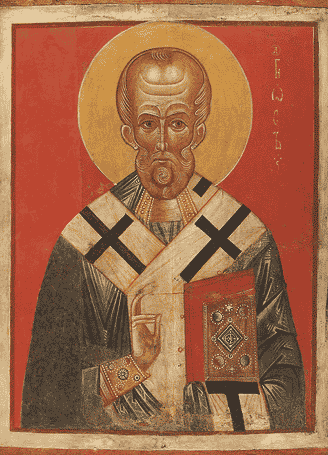
SAINT Nicholas. Day of death: (according to the martyrology) December 6, about 360. Grave: originally at Myra; since 1087 at Sari in Italy. Life (highly legendary): Nicholas was born at Patara in Asia Minor to parents who, having long been childless, had petitioned God with many prayers. Already as a youth Nicholas became noted for his zeal in helping the unfortunate and oppressed. In his native city there lived a poor nobleman who had three marriageable daughters; he could not obtain a suitor for them because he could offer no dowry. The contemptible idea struck him to sacrifice the innocence of his daughters to gain the needed money. When Nicholas became aware of this, he went by night and threw a bag containing as much gold as was needed for a dowry through the window. This he repeated the second and third nights. During a sea voyage he calmed the storm by his prayer; he is therefore venerated as patron of sailors. On a certain occasion he was imprisoned for the faith. In a wonderful way he later became bishop of Myra; his presence is noted at the Council of Nicaea. He died a quiet death in his episcopal city, uttering the words: "Into your hands I commend my spirit."

Nicholas is highly venerated in the East as a miracle worker, as "preacher of the word of God, spokesman of the Father." --Pius Parsch


O you who love festivals,
Come gather and sing the praises
of the fair beauty of bishops,
The glory of the fathers,
The fountain of wonders and great protector
of the faithful.

Let us all say: Rejoice, 0 guardian of the people of Myra,
Their head and honored counsellor,
The pillar of the church which cannot be shaken.
Rejoice, 0 light full of brightness
That makes the ends of the world shine with wonders.

Rejoice, 0 divine delight of the afflicted,
The fervent advocate of those who suffer from injustice.
And now, 0 all-blessed Nicholas,
Never cease praying to Christ our God
For those who honor the festival of your memory
With faith and with love.--Orthodox Liturgy

"What keeps you from giving now? Isn't the poor person there? Aren't your own warehouses full? Isn't the reward promised? The command is clear: the hungry person is dying now, the naked person is freezing now, the person in debt is beaten now-and you want to wait until tomorrow? "I'm not doing any harm," you say. "I just want to keep what I own, that's all." You own! You are like someone who sits down in a theater and keeps everyone else away, saying that what is there for everyone's use is your own. . . . If everyone took only what they needed and gave the rest to those in need, there would be no such thing as rich and poor. After all, didn't you come into life naked, and won't you return naked to the earth?

"The bread in your cupboard belongs to the hungry person; the coat hanging unused in your closet belongs to the person who needs it; the shoes rotting in your closet belong to the person with no shoes; the money which you put in the bank belongs to the poor. You do wrong to everyone you could help, but fail to help."

Basil
4th Century

"The large rooms of which you are so proud are in fact your shame. They are big enough to hold crowds--and also big enough to shut out the voices of the poor....There is your sister or brother, naked, crying! And you stand confused over the choice of an attractive floor covering."--Ambrose, 4th Century

A voyce from heven to erth shal com:
"Venite ad iudicium."

This voyce both sharp and also shryll
Shal be herd from heven to hell; All mydle erthe it shall fulfyll:
"Venite ad iudicium."

"Venite" is a blyssed song
For them that for joye dooth longe
And shall forsake paynes strong:
"Venite ad iudicium."

Glad in hert may they be
Whan Chryst sayeth, "Venite;
Ye blyssed chyldren, come to me,
Into vitam eternam.

"Whan I hongred, ye gave me meat;
Ye clothed me agaynst the heat;
In trouble ye dyde me not forget;
Venite ad iudicium.

"Ye socoured me at your doore
And for my sake gave to the poore;
Therfore wyll I you socoure;
Venite ad iudicium."

Sory in hert may they be
That hereth this hevy worde: "Ite;
Ye cursed chyldren, go fro me,
Into ignem eternum.

"Whan for nede that I dyde crye,
Comfortlesse ye lete me dye;
Therfore now I you deny;
Venite ad iudicium.

"For by me ye set no store,
Ye shall abye ryght dere therfore
In hell with devyls for evermore;
Venite ad iudicium."

Marana tha. Come, Lord Jesus. But not before Christmas. We have a lot of shopping still to do.

13,568,229: number of dollar millionaires in 2000
499: number of dollar billionaires in 2000

Tuesday, December 05, 2006

Season's Gleamings

Something to lighten the burden of the liturgical calendar before I leave for the day (or most of it). And it's more appropriate to the time of year. Probably drive my traffic up a bit, too, as this is certainly more "user-friendly" than the kind of stuff I usually post.


We had one of these when I was a child (the tree, not the book). Complete with color wheel. It's gone now, just when I could appreciate it.

It really brings Christmas close to a person. Especially during Advent.

"Let the reader understand": An Advent Meditation

Via French phenomenology:


"Mysterium tremendum. A frightful mystery, a secret to make you tremble.

"Tremble. What does one do when one trembles? What is it that makes you tremble?

"A secret always makes you tremble. Not simply quiver or shiver, which also happens sometimes, but tremble. A quiver can of course manifest fear, anguish, apprehension of death; as when one quivers in advance, in anticipation of what is to come. But it can be slight, on the surface of the skin, like a quiver that announces the arrival of pleasure or an orgasm. It is a moment in passing, the suspended time of seduction. A quiver is not always very serious, it is sometimes discreet, barely discernible, somewhat epiphenomenal. It prepares for, rather than follows the event. One could say that water quivers before it boils; that is the idea I was referring to as seduction: a superficial pre-boil, a preliminary and visible agitation.

"On the other hand, trembling, at least as a signal or symptom, is something that has already taken place, as in the case of an earthquake [tremblement de terre] or when one trembles all over. It is no longer preliminary even if, unsettling everything so as to imprint upon the body an irrepressible shaking, the event that makes one tremble portends and threatens still. It suggests that violence is going to break out again, that some traumatism will insist on being repeated. As different as dread, fear, anxiety, terror, panic, or anguish remain from one another, they have already begun in the trembling, and what has provoked them continues, or threatens to continue, to make us tremble. Most often we neither know what is coming upon us nor see its origin; it therefore remains a secret. We are afraid of the fear, we anguish over the anguish, and we tremble. We tremble in that strange repetition that ties an irrefutable past (a shock has been felt, a traumatism has already affected us) to a future that cannot be anticipated; anticipated but unpredictable; apprehended, but, and this is why there is a future, apprehended precisely as unforeseeable, unpredictable; approached as unapproachable. Even if one thinks one knows what is going to happen, the new instant of that happening remains untouched, still unaccessible, in fact unlivable. In the repetition of what still remains unpredictable, we tremble first of all because we don't know from which direction the shock came, whence it was given (whether a good surprise or a bad shock, sometimes a surprise received as a shock); and we tremble from not knowing, in the form of a double secret, whether it is going to continue, start again, insist, be repeated: whether it will, how it will, where, when; and why this shock. Hence I tremble because I am still afraid of what already makes me afraid, of what I can neither see nor foresee. I tremble at what exceeds my seeing and my knowing [mon voir et mon savoir] although it concerns the innermost parts of me, right down to my soul, down to the bone, as we say. Inasmuch as it tends to undo both seeing and knowing, trembling is indeed an experience of secrecy or of mystery, but another secret, another enigma, or another mystery comes on top of the unlivable experience, adding yet another seal or concealment to the tremor (the Latin word for "trembling," from tremo, which in Greek as in Latin means I tremble, I am afflicted by trembling; in Greek there is also trameo: I tremble, I shiver, I am afraid; and tromos, which means trembling, fear, fright. In Latin, tremendus, tremendum, as in mysterium tremendum, is a gerundive derived from what makes one tremble, something frightening, distressing, terrifying).

"Where does this supplementary seal come from? One doesn't know why one trembles. This limit to knowledge no longer only relates to the cause or unknown event, the unseen or unknown that makes us tremble. Neither do we know why it produces this particular symptom, a certain irrepressible agitation of the body, the uncontrollable instability of its members or of the substance of the skin or muscles. Why does the irrepressible take this form? Why does terror make us tremble, since one can also tremble with mid, and such analogous physiological manifestations translate ex¬periences and sentiments that appear, at least, not to have anything in common? This symptomatology is as enigmatic as tears. Even if one knows why one weeps, in what situation, and what it signifies (I weep because 1 have lost one of my nearest and dearest, the child cries because he has been beaten or because she is not loved: she causes herself grief, complains, he makes himself complain or allows himself to be felt sorry for-by means of the other), but that still doesn't explain why the lachrymal glands come to secrete these drops of water which are brought to the eyes rather than elsewhere, the mouth or the ears. We would need to make new inroads into thinking concerning the body, without dissociating the registers of discourse (thought, philosophy, the bio-genetico-psychoanalytic sciences, phylo-and ontogenesis), in order to one day come closer to what makes us tremble or what makes us cry, so that cause which is not the final cause that can be called God or death (God is the cause of the mysterium tremendum, and the death that is given is always what makes us tremble, or what makes us weep as well) ut to a c oser cause; not the immediate cause, that is, the accident or circumstance, but the cause closest to our body, that which means that one trembles or weeps rather than doing something else. What is it a metaphor or figure for? What does the body mean to say by trembling or crying, presuming one can speak here of the body, or of saying, of meaning, and of rhetoric?

"What is it that makes us tremble in the mysterium tremendum? It is the gift of infinite love, the dissymmetry that exists between the divine regard that sees me, and myself, who doesn't see what is looking at me; it is the gift and endurance of death that exists in the irreplaceable, the disproportion between the infinite gift and my finitude, responsibility as culpability, sin, salvation, repentance, and sacrifice. As in the title of Kierkegaard's essay Fear and Trembling, the mysterium tremendum includes at least an implicit and indirect reference to Saint Paul. In the Epistle to the Philippians 2: 12, the disciples are asked to work towards their salvation in fear and trembling. They will have to work for their salvation knowing all along that it is God who decides: the Other has no reason to give to us and nothing to settle in our favor, no reason to share his reasons with us. We fear and tremble because we are already in the hands of God, although free to work, but in the hands and under the gaze of God, whom we don't see and whose will we cannot know, no more than the decisions he will hand down, nor his reasons for wanting this or that, our life or death, our salvation or perdition. We fear and tremble before the inaccessible secret of a God who decides for us although we remain responsible, that is, free to decide, to work, to assume our life and our death."

Jacques Derrida, The Gift of Death, tr. David Wills (Chicago: The University of Chicago Press 1995), pp. 53-55

Monday, December 04, 2006

Synchronicity?


So, I got one of these from a friend the other day. And then what shows up in the news but this:

"The election was not a happy event around here, obviously," Bolten said, sitting on a couch in his spacious corner office where light streams in through tall windows. "Everybody's disappointed, but I haven't seen a single discouraged person."

To keep the staff focused, Bolten handed out about a dozen countdown clocks that show the number of days, hours, minutes and seconds left in Bush's presidency. The clock read 1,000 days in April when Bolten started his job, saying it was time for the White House to "get our mojo back."

Six months later, the pendulum has swung the Democrats' way, Iraq is chaotic and the president's job approval rating is stuck in the 30s. There now are fewer than 800 days left -- not a long time to push the Bush agenda, especially when the president's power is slipping away.
Yeah, I doubt it, too. Just a coincidence, I'm sure. By the way, as of just now, it reads 777 days, 6 hours, 29 minutes, 52 (and counting) seconds. I am, obviously, using mine for quite a different reason.

CONDITOR alme siderum


CONDITOR alme siderum,
aeterna lux credentium,
Christe, redemptor omnium,
exaudi preces supplicum.

Qui condolens interitu
mortis perire saeculum,
salvasti mundum languidum,
donans reis remedium,

Vergente mundi vespere,
uti sponsus de thalamo,
egressus honestissima
Virginis matris clausula.

Cujus forti potentiae
genu curvantur omnia;
caelestia, terrestria
nutu fatentur subdita.

At whose dread Name, majestic now,
all knees must bend, all hearts must bow;
and things celestial Thee shall own,
and things terrestrial Lord alone.

Te deprecamur hagie,
Venture judex saeculi,
Conserva nos in tempore
Hostis a telo perfidi.

CREATOR of the stars of night,
Your people's everlasting light,
Jesus, Redeemer of us all,
We pray you hear us when we call.

In sorrow that the ancient curse
should doom to death a universe,
You came, O Savior, to set free
Your own in glorious liberty.

Come, Sun and Savior, to embrace,
Our gloomy world, its weary race,
As groom to bride, as bride to groom:
The wedding chamber, Mary's tomb.

At your Great Name, O Jesus, now
All knees must bend, all hearts must bow;
All things on earth with one accord,
Like those in heav'n, shall call you Lord.


"FOR many, Advent would not be Advent if introduced by any other hymn. It is well-nigh impossible for even the best of poets to find a formula that really corresponds to the first line of the Latin text. The Latin "sidus" ["siderum"] means more than "star." It includes the stars, of course, but also sun and moon and planets and all the heavenly constel¬lations and comets and meteors. These are the cosmic elements that will appear in later stanzas of the hymn. For the ancients, these mysterious heavenly bodies that moved about and that had their cycles of waxing and waning and that in some unfathomable way could affect the course of human destiny-these heavenly bodies were perhaps living beings.

"The opening line of this Advent hymn should make us think of the great array of all the powerful cosmic bodies that figure in those eschatological texts of scripture where the whole of the created universe responds to the presence of its God. The point of reference is not some lovely nightfall scene studded with gently glimmering stars, but rather that Great Day when "the sun will be darkened, and the moon will not give her light, the stars will fall from heaven, and the powers of heaven will be shaken" (Matthew 24:29). Indeed, this Advent hymn, if we really look at it, is something of a "Dies irae" in a less strident mode.

"In stanza three, the world's evening draws to a close. We recognize in the last three lines of this stanza the allusion to verse six of Psalm 19, the verse that occurs so frequently in the Christmastide cycle: "And he, as a bridegroom coming forth from the bridal chamber, rejoices as a giant to run his course." So just when the world seems doomed to certain extinction, the Sun comes forth in a blaze of light and begins its paschal journey across the whole of human life and experience. This imagery is especially appropriate towards the beginning of December and the first Sunday of Advent, when nights are growing progressively longer and longer, until, upon the arrival of the winter solstice just before Christmas, the inexorable onslaught of darkness is reversed with the birth of Christ, the Sun of Justice, who now begins to run his course over the whole of our existence."

--Chrysogonous Waddell

Adventus

I come back to the story of the late Archbishop Oscar Romero and Marianela every year about this time. I'll come back to it again in another week. Today, I feel like the Archbishop felt: I don't want to know.

In the brig, Mr. Padilla was denied access to counsel for 21 months. Andrew Patel, one of his lawyers, said his isolation was not only severe but compounded by material and sensory deprivations. In an affidavit filed Friday, he alleged that Mr. Padilla was held alone in a 10-cell wing of the brig; that he had little human contact other than with his interrogators; that his cell was electronically monitored and his meals were passed to him through a slot in the door; that windows were blackened, and there was no clock or calendar; and that he slept on a steel platform after a foam mattress was taken from him, along with his copy of the Koran, “as part of an interrogation plan.”
But because " 'His basic needs were met in a conscientious manner, including Halal (Muslim acceptable) food, clothing, sleep and daily medical assessment and treatment when necessary,' the government says "'Padilla’s conditions of confinement were humane and designed to ensure his safety and security.'" After all: " 'While in the brig, Padilla never reported any abusive treatment to the staff or medical personnel.'" As Auden wrote: "Had anything been wrong/We should certainly have heard."

I honestly don't know which is worse: that they would do this to another human being; or that they don't see anything inhumane about this treatment. We are, of course, assured that the Military Commissions Act of 2006 does not apply to American citizens. Funny no one mentions Mr. Padilla's case when making that argument:

Mr. Padilla’s situation, as an American declared an enemy combatant and held without charges by his own government, was extraordinary and the conditions of his detention appear to have been unprecedented in the military justice system.
And what is Mr. Padilla charged with?

Mr. Padilla was added as a defendant in a terrorism conspiracy case already under way in Miami. The strong public accusations made during his military detention — about the dirty bomb, Al Qaeda connections and supposed plans to set off natural gas explosions in apartment buildings — appear nowhere in the indictment against him. The indictment does not allege any specific violent plot against America.

Mr. Padilla is portrayed in the indictment as the recruit of a “North American terror support cell” that sent money, goods and recruits abroad to assist “global jihad” in general, with a special interest in Bosnia and Chechnya. Mr. Padilla, the indictment asserts, traveled overseas “to participate in violent jihad” and filled out an application for a mujahedin training camp in Afghanistan.
O Key of David, O royal power of Israel, controlling at your will the gate of heaven: Come, break down the prison walls of death for those who dwell in darkness and the shadow of death, and lead your captive people to freedom.

Veniet Dominus et non tardabit,
ut illuminet abscondita tenebrarum


The Lord will come soon, will not delay
The Lord will make the darkest places bright.

Indeed, it has already started.

Sunday, December 03, 2006

The Legacy of LBJ, Vietnam, and Reagan


Whether New Orleans recovers is one thing. But history will record how we lost a major US city, and what we, as a country, as a people, did about it; even if we don't talk much about it now. It will also remember who was President when it was lost:

At first, you'd want to compare Bush's Iraq predicament to that of Lyndon B. Johnson during the Vietnam War. But LBJ had major domestic accomplishments to boast about when leaving the White House, such as the Civil Rights Act and Medicare/Medicaid. Bush has virtually none. Look at how he dealt with the biggest post-9/11 domestic crisis of his tenure. He didn't rush to help the Gulf region after Hurricane Katrina because the country was overextended in Iraq and had a massive budget deficit. Texas conservatives always say that LBJ's biggest mistake was thinking that he could fund both the Great Society and Vietnam. They believe he had to choose one or the other. They call Johnson fiscally irresponsible. Bush learned this lesson: He chose Iraq over New Orleans.
I'm still not sure we didn't, too.

First Sunday of Advent-2006


Yesterday:


The emerging plan by the Iraq Study Group tries to find a middle road between President Bush's adamant refusal to leave Iraq until the job is done and Democratic demands to pull out U.S. troops. But in achieving unanimity among its Republican and Democratic members, the commission has outlined a strategy with its own political and military risks.

If they choose, leaders in both parties could embrace the plan in the interest of putting aside the polarizing differences of the past three years. This post-election moment, many say, presents the best and perhaps last chance for consensus. And some military experts say the commission's plan to pull out combat units by early 2008 and shift remaining troops into a supporting role may be a logical response to the sectarian violence.

But there are already signs of discord over the plan, as Bush on one side and the fiercest war opponents on the other stake out positions suggesting they may not come together after all. Some military and diplomatic veterans warn that the commission's plan may not be the magic solution so many hope for. It could, they say, even open the door to a broader and ever more brutal civil war between radical Shiite and Sunni forces competing for power in the resulting vacuum.

...

Some say it is too late for the United States to determine the outcome of the war in Iraq either way. "For all the excitement in Washington, this will be decided on the ground in Baghdad," said Richard C. Holbrooke, the former U.S. ambassador to the United Nations who brokered the Dayton peace accords, which ended the Bosnian war in the 1990s. "The United States has lost its capacity to shape the events on the ground, regardless of what's recommended by the commission, regardless of what's done by the U.S. military and the president."
Today:

“In my view it is time for a major adjustment,” wrote Mr. Rumsfeld, who has been a symbol of a dogged stay-the-course policy. “Clearly, what U.S. forces are currently doing in Iraq is not working well enough or fast enough.”

Nor did Mr. Rumsfeld seem confident that the administration would readily develop an effective alternative. To limit the political fallout from shifting course, he suggested the administration consider a campaign to lower public expectations.

“Announce that whatever new approach the U.S. decides on, the U.S. is doing so on a trial basis,” he wrote. “This will give us the ability to readjust and move to another course, if necessary, and therefore not ‘lose.’ ”

“Recast the U.S. military mission and the U.S. goals (how we talk about them) — go minimalist,” he added. The memo suggests frustration with the pace of turning over responsibility to the Iraqi authorities; in fact, the memo calls for examination of ideas that roughly parallel troop withdrawal proposals presented by some of the White House’s sharpest Democratic critics.
Now:

Above the clamor of our violence
your word of truth resounds,
O God of majesty and power.
Over nations enshrouded in despair
your justice dawns.
Grant your household
a discerning spirit and a watchful eye
to perceive the hour in which we live.
Hasten the advent of that day
when the weapons of war shall be banished,
our deeds of darkness cast off,
and all your scattered children gathered into one.
We ask this through him whose coming is certain,
whose day draws near:
your Son, our Lord Jesus Christ,
who lives and reigns with you and the Holy Spirit,
one God, for ever and ever.

Prayer, First Sunday of Advent

Friday, December 01, 2006

Feast Day of St. Nicholas of Ferrar


Ask Mimi for the connection.

I was going to leave some portion of this out, but I couldn't decide where to do so. Actually, it makes quite a nice Advent meditation. And if I have any time to reflect, I might actually be able to explain that statement.

LITTLE GIDDING
(No. 4 of 'Four Quartets')
T.S. Eliot

I

Midwinter spring is its own season
Sempiternal though sodden towards sundown,
Suspended in time, between pole and tropic.
When the short day is brightest, with frost and fire,
The brief sun flames the ice, on pond and ditches,
In windless cold that is the heart's heat,
Reflecting in a watery mirror
A glare that is blindness in the early afternoon.
And glow more intense than blaze of branch, or brazier,
Stirs the dumb spirit: no wind, but pentecostal fire
In the dark time of the year. Between melting and freezing
The soul's sap quivers. There is no earth smell
Or smell of living thing. This is the spring time
But not in time's covenant. Now the hedgerow
Is blanched for an hour with transitory blossom
Of snow, a bloom more sudden
Than that of summer, neither budding nor fading,
Not in the scheme of generation.
Where is the summer, the unimaginable
Zero summer?

If you came this way,
Taking the route you would be likely to take
From the place you would be likely to come from,
If you came this way in may time, you would find the hedges
White again, in May, with voluptuary sweetness.
It would be the same at the end of the journey,
If you came at night like a broken king,
If you came by day not knowing what you came for,
It would be the same, when you leave the rough road
And turn behind the pig-sty to the dull facade
And the tombstone. And what you thought you came for
Is only a shell, a husk of meaning
From which the purpose breaks only when it is fulfilled
If at all. Either you had no purpose
Or the purpose is beyond the end you figured
And is altered in fulfilment. There are other places
Which also are the world's end, some at the sea jaws,
Or over a dark lake, in a desert or a city—
But this is the nearest, in place and time,
Now and in England.

If you came this way,
Taking any route, starting from anywhere,
At any time or at any season,
It would always be the same: you would have to put off
Sense and notion. You are not here to verify,
Instruct yourself, or inform curiosity
Or carry report. You are here to kneel
Where prayer has been valid. And prayer is more
Than an order of words, the conscious occupation
Of the praying mind, or the sound of the voice praying.
And what the dead had no speech for, when living,
They can tell you, being dead: the communication
Of the dead is tongued with fire beyond the language of the living.
Here, the intersection of the timeless moment
Is England and nowhere. Never and always.

II

Ash on and old man's sleeve
Is all the ash the burnt roses leave.
Dust in the air suspended
Marks the place where a story ended.
Dust inbreathed was a house—
The walls, the wainscot and the mouse,
The death of hope and despair,
This is the death of air.

There are flood and drouth
Over the eyes and in the mouth,
Dead water and dead sand
Contending for the upper hand.
The parched eviscerate soil
Gapes at the vanity of toil,
Laughs without mirth.
This is the death of earth.

Water and fire succeed
The town, the pasture and the weed.
Water and fire deride
The sacrifice that we denied.
Water and fire shall rot
The marred foundations we forgot,
Of sanctuary and choir.
This is the death of water and fire.

In the uncertain hour before the morning
Near the ending of interminable night
At the recurrent end of the unending
After the dark dove with the flickering tongue
Had passed below the horizon of his homing
While the dead leaves still rattled on like tin
Over the asphalt where no other sound was
Between three districts whence the smoke arose
I met one walking, loitering and hurried
As if blown towards me like the metal leaves
Before the urban dawn wind unresisting.
And as I fixed upon the down-turned face
That pointed scrutiny with which we challenge
The first-met stranger in the waning dusk
I caught the sudden look of some dead master
Whom I had known, forgotten, half recalled
Both one and many; in the brown baked features
The eyes of a familiar compound ghost
Both intimate and unidentifiable.
So I assumed a double part, and cried
And heard another's voice cry: 'What! are you here?'
Although we were not. I was still the same,
Knowing myself yet being someone other—
And he a face still forming; yet the words sufficed
To compel the recognition they preceded.
And so, compliant to the common wind,
Too strange to each other for misunderstanding,
In concord at this intersection time
Of meeting nowhere, no before and after,
We trod the pavement in a dead patrol.
I said: 'The wonder that I feel is easy,
Yet ease is cause of wonder. Therefore speak:
I may not comprehend, may not remember.'
And he: 'I am not eager to rehearse
My thoughts and theory which you have forgotten.
These things have served their purpose: let them be.
So with your own, and pray they be forgiven
By others, as I pray you to forgive
Both bad and good. Last season's fruit is eaten
And the fullfed beast shall kick the empty pail.
For last year's words belong to last year's language
And next year's words await another voice.
But, as the passage now presents no hindrance
To the spirit unappeased and peregrine
Between two worlds become much like each other,
So I find words I never thought to speak
In streets I never thought I should revisit
When I left my body on a distant shore.
Since our concern was speech, and speech impelled us
To purify the dialect of the tribe
And urge the mind to aftersight and foresight,
Let me disclose the gifts reserved for age
To set a crown upon your lifetime's effort.
First, the cold friction of expiring sense
Without enchantment, offering no promise
But bitter tastelessness of shadow fruit
As body and soul begin to fall asunder.
Second, the conscious impotence of rage
At human folly, and the laceration
Of laughter at what ceases to amuse.
And last, the rending pain of re-enactment
Of all that you have done, and been; the shame
Of motives late revealed, and the awareness
Of things ill done and done to others' harm
Which once you took for exercise of virtue.
Then fools' approval stings, and honour stains.
From wrong to wrong the exasperated spirit
Proceeds, unless restored by that refining fire
Where you must move in measure, like a dancer.'
The day was breaking. In the disfigured street
He left me, with a kind of valediction,
And faded on the blowing of the horn.

III

There are three conditions which often look alike
Yet differ completely, flourish in the same hedgerow:
Attachment to self and to things and to persons, detachment
From self and from things and from persons; and, growing between them, indifference
Which resembles the others as death resembles life,
Being between two lives—unflowering, between
The live and the dead nettle. This is the use of memory:
For liberation—not less of love but expanding
Of love beyond desire, and so liberation
From the future as well as the past. Thus, love of a country
Begins as attachment to our own field of action
And comes to find that action of little importance
Though never indifferent. History may be servitude,
History may be freedom. See, now they vanish,
The faces and places, with the self which, as it could, loved them,
To become renewed, transfigured, in another pattern.

Sin is Behovely, but
All shall be well, and
All manner of thing shall be well.
If I think, again, of this place,
And of people, not wholly commendable,
Of no immediate kin or kindness,
But of some peculiar genius,
All touched by a common genius,
United in the strife which divided them;
If I think of a king at nightfall,
Of three men, and more, on the scaffold
And a few who died forgotten
In other places, here and abroad,
And of one who died blind and quiet
Why should we celebrate
These dead men more than the dying?
It is not to ring the bell backward
Nor is it an incantation
To summon the spectre of a Rose.
We cannot revive old factions
We cannot restore old policies
Or follow an antique drum.
These men, and those who opposed them
And those whom they opposed
Accept the constitution of silence
And are folded in a single party.
Whatever we inherit from the fortunate
We have taken from the defeated
What they had to leave us—a symbol:
A symbol perfected in death.
And all shall be well and
All manner of thing shall be well
By the purification of the motive
In the ground of our beseeching.

IV

The dove descending breaks the air
With flame of incandescent terror
Of which the tongues declare
The one discharge from sin and error.
The only hope, or else despair
Lies in the choice of pyre of pyre—
To be redeemed from fire by fire.

Who then devised the torment? Love.
Love is the unfamiliar Name
Behind the hands that wove
The intolerable shirt of flame
Which human power cannot remove.
We only live, only suspire
Consumed by either fire or fire.

V

What we call the beginning is often the end
And to make and end is to make a beginning.
The end is where we start from. And every phrase
And sentence that is right (where every word is at home,
Taking its place to support the others,
The word neither diffident nor ostentatious,
An easy commerce of the old and the new,
The common word exact without vulgarity,
The formal word precise but not pedantic,
The complete consort dancing together)
Every phrase and every sentence is an end and a beginning,
Every poem an epitaph. And any action
Is a step to the block, to the fire, down the sea's throat
Or to an illegible stone: and that is where we start.
We die with the dying:
See, they depart, and we go with them.
We are born with the dead:
See, they return, and bring us with them.
The moment of the rose and the moment of the yew-tree
Are of equal duration. A people without history
Is not redeemed from time, for history is a pattern
Of timeless moments. So, while the light fails
On a winter's afternoon, in a secluded chapel
History is now and England.

With the drawing of this Love and the voice of this
Calling

We shall not cease from exploration
And the end of all our exploring
Will be to arrive where we started
And know the place for the first time.
Through the unknown, unremembered gate
When the last of earth left to discover
Is that which was the beginning;
At the source of the longest river
The voice of the hidden waterfall
And the children in the apple-tree
Not known, because not looked for
But heard, half-heard, in the stillness
Between two waves of the sea.
Quick now, here, now, always—
A condition of complete simplicity
(Costing not less than everything)
And all shall be well and
All manner of thing shall be well
When the tongues of flame are in-folded
Into the crowned knot of fire
And the fire and the rose are one.

These words, by the way:

And what the dead had no speech for, when living,
They can tell you, being dead: the communication
Of the dead is tongued with fire beyond the language of the living.
Are engraved on the stone bearing Eliot's name in Poet's Corner in Westminster Abbey.

The Question du jour


In morality, which is primary: intention? or actions?

Via Atrios, we have this from William Saletan.

As Saletan implicitly accepts, we have worked ourselves into a moral dilemma in Iraq. Convinced we must either save ourselves from the incipient mushroom cloud of WMD, or that we had to make the world safe for democracy once again, or that the world was counting on us to remove a dictator from power, we girded our moral loins and waded in to fight the good fight. And now we can't leave, because we kicked over the ant bed, and we've acquired moral responsibility for the chaos that was once a country. This, now, is the problem: if we leave, we are responsible for the deaths that occur as we flee for safe havens. As someone said on NPR yesterday, if the US withdraws, there are a lot of Iraqis we have to take with us, because otherwise, we condemn them to death.

Shades of Vietnam, indeed.

And so we have the question: in the arena of morality, is it intention that matters most, or actions? The law distinquishes between intentions in order to judge criminal culpability: negligent homicide is not as heinous a crime as intentional murder, although in both cases someone ends up dead. Should our morality recognize the same gradations of culpability? And if so, can we apply those standards to ourselves, and justify what we have done in Iraq, or whatever we will do to withdraw (which is, in the long or short run, an inevitability)? Are we to be judged by what we have done? Or by what we intended to do, either in invading, or in leaving? If purity of heart is to will one thing, is it merely disunity in our politics that keeps our national heart from being pure?

ADDENDUM: Let me reiterate (rather than start yet another post) that the interesting quandary we now find ourselves in, is that morally we are responsible for the state of Iraq, and yet morally, we were required to invade Iraq. Glenn Greenwald notes one particular:

In column after column prior to the war, Friedman argued that invading Iraq and overthrowing Saddam was a noble, moral, and wise course of action. To Friedman, that was something we absolutely ought to do, and as a result, he repeatedly used his column to justify the invasion and railed against anti-war arguments voiced by those whom he derisively called "knee-jerk liberals and pacifists" (so as not to clutter this post with long Friedman quotes, I'm posting the relevant Friedman excerpts here).
Greenwald goes on to discuss the logical inconstencies of Friedman's position, but it was not illogic that got us into this dilemma; it was morality. We had a moral duty to invade Iraq (we were told); we have a moral duty not to leave it in chaos. But we also have a moral duty not to leave our own military there in a fruitless and futile effort. What now?