Showing posts sorted by relevance for query franklin graham. Sort by date Show all posts

Saturday, June 15, 2019

Twins Sons of Different Mothers


In his own words:

The outspoken Trump supporter praised the president in an interview, bragging that the president has accomplished a lot “without a fully supportive Republican majority.”

“He, of course, has been able to do it with the relentless attacks of the Democrats,” Graham continued. “He may go down in history as one of the best presidents we’ve had.”

The Christian leader has previously cited Trump’s polices as proof that the president defends the Christian faith.

“I think he has honored his commitments to the faith-based community,” Graham told the outlet. “He is pro-life, [the] first president really in my lifetime that has been this vocal about life. I certainly appreciate that about him.”

Graham also noted that Trump kept his campaign promise to appoint conservative judges. “He’s put two Supreme Court justices so far on the bench that are conservative. He’s appointed a number at lower courts. I hope that he’ll be able to do even more in that area, because that will have an impact on my childrens' lives. If we have the right judges, it will benefit all of us.”

1)  The "faith-based community" being only people who agree with Graham on all things.

2)  Pro-life, but only until birth.  After that, they're on their own (just like Jesus said they should be?) Notice under this argument, life begins at conception, but ends at birth.  Apparently.

3)  Conservative Supreme Court Judges and lower court judges.  Because what really matters in this life, is the law.  (Wasn't that how the Pharisees were portrayed in the gospels?)

Please note none of this has anything to do with anything explicitly Christian.  No questions of salvation, of care for the poor, feeding the hungry, tending the sick; it's all solely about political power and personal loyalty.  Franklin Graham likes Donald Trump because Franklin Graham is Donald Trump:  committed to those who are loyal to him and what he calls important.  The sole difference is, Trump calls himself important.  Then again, Graham calls himself important.  He certainly betrays not one shred of Christian humility, or concern for others.  His only concern is for people who agree with him, and support what he supports.  Which, despite references to a "Community" and judges, is really just anything that supports Franklin Graham and the world he wants to live in; for the comfort and convenience of Franklin Graham.

It's really hard to tell them apart, after all.

Monday, April 06, 2020

Palm Sunday In Time of Coronavirus

And if Franklin Graham falls ill, does that mean God is angry with Franklin Graham?  And what does Franklin Graham think Jesus meant by "Don't judge, and you won't be judged"?  That it doesn't apply to someone as righteous as Franklin Graham?

In other religious news, this guy is only interested in preserving his business model: 

“How many people did you have last Sunday?” host Blackwell asked. “How many people are you expecting this Sunday?”

“Last Sunday we had 1,800 in attendance. This Sunday with the fear that’s been propagated into the hearts of my people, it may have had an adverse effect with more people than last week,” the pastor replied.

“The governor has barred gatherings of 50 or more and the scientists who advise him say the gatherings put the people coming to your church, 1,800 last week and whomever will show up this woke in danger. Do you believe them?” he was asked.

“We believe the science of this, Victor,” Spell replied. “However, we do have a command from God, and there are no governing bodies that can tell us we cannot worship and gather freely.”

“Do you believe the science that people who are in these large gatherings close together are at a greater risk of contracting this deadly — this deadly disease, this virus? Do you believe the science?” Blackwell pressed.

“Yes, we believe the science,” Spell shot back. “We also believe that 99.3, which the science says of the people that contract it, a lot of them don’t even know they have it and recover and then, with that also, we’re more interested. People have been locked up in their homes for 22 days now, suicide, domestic violence, starvation and desperation is the last stronghold in their lives.”

“Let me ask you this,” the CNN host proposed. “If you believe the science and I assume you’re pro-life, is that correct?”

“I am pro-life,” the pastor replied.

“How is this a pro-life stance to put people in jeopardy of contracting a disease, getting a virus that has no treatment, no cure, often has no symptoms and has killed more than 8,400 people, 1500 people this morning in our country in five weeks,’ Blackwell exclaimed.

“My response to that is people’s hope is in the house of God,” Spell countered. “If they do contract the virus, if they have fears of the virus, the church is more essential now than ever to pray with people, to let them know there is a physician in Jesus Christ. He is the healer; come under you all that are weary and heavy-laden, let me give you rest. We were supposed to be at a million and a half body bags and we’re at 4,800 so the narrative is false, Victor.”


This is a man on a Trump-sized ego trip.  This is a man speaking Trump's language (braggadocio, bravado, empty words, insane and contradictory lies, and absolutely no concern for his congregation, only for himself and how many people he can draw to hear him).  This is a man trying to keep his business open.  I am old, I am cranky, I am fed up.  I have no time or compassion for these people (the pastor, not the congregation).  This is a man interested in himself and his self-aggrandizement.  He has no interest in God, except as an idea to get people to pay attention to him.
”Religion is responsibility, or it is nothing at all.”

Sunday, March 29, 2026

The Paths Of Glory 🪦

Handing out water bottles? To make the hours long wait “bearable”? Moving money around without Congressional authorization was the basis of the Iran/Contra investigation. Ron Johnson is a living, breathing, human-sized shitstain. "The last, and greatest, delusion, is that people don’t matter.”
BARTIROMO: Some people look at this situation and they don't understand. Republicans are in charge. You are running the House, Senate, and White House, and yet we have these fights and it's obvious that you can't get on the same page and it seems like Democrats are still winning

McCLAIN: It's extremely frustrating
Sucks to be incompetent, don’t it? But is our children learning?
Trump just posted a letter from Franklin Graham assuring him that says "you commented to the media that you might not be heaven bound. Maybe you responded in jest, but it is an important issue to know for certain that your soul is secure and will spend eternity in the presence of God."
Franklin Graham is the voice of God Sauron.* ASK ME HOW! In long run, we’re all better off! (In the long run, we’re all dead.)


.*For the record, I abandoned the idea of hell and damnation in seminary. But then there’s that parable of the sheep 🐑 and the goats 🐐, and the place of wailing and gnashing of teeth, so my opinion is not determinative. Neither is Graham’s, therefore.  I always prefer to comfort the afflicted; which tends to afflict the comfortable, so that works out alright.
Apparently Graham did hedge his bets, because his brand of evangelical soteriology is that his salvation depends on doing his best to secure your salvation; but in the end, you ain’t draggin’ him down with you, miserable sinner that you are.

So this is all evangelical SOP. Definitely not the soteriology I subscribe to.

Tuesday, November 27, 2018

Prepare Ye The Way of the Advent


“Now people say, ‘Well Frank, but how can you defend him, when he’s lived such a sordid life?'” Graham told Axios on HBO. “I never said he was the best example of the Christian faith. He defends the faith. And I appreciate that very much.”

Which raises a perfectly legitimate question:  which faith is Trump defending?

This faith?

At Culberson’s post-election gathering, according to video from Houston television station KHOU, [Dr. Ed] Young [pastor of Second Baptist Church, Houston] claimed a Pittsburgh-area Democratic Party chairman had been forced out over a Facebook repost about how Americans should “kneel at the cross.”

The post actually criticized NFL players’ anthem protests, one of several that seemed more like racial insults.

But Young took it out of context, telling the Republican gathering the Democratic Party is “no longer a party. It’s some kind of religion that is basically godless, and as long as America — and this is represented by every Democrat I know — does not believe in the sacredness of the life in the mother’s womb, God will not bless America or make us a great nation.”

I noted, when I first published that:

Come to think of it, people like Ed Young don't think too much of the sacraments either, consider attendance at revivals a greater sign of personal holiness than attendance on Sunday morning, think "God helps those who help themselves" is from the book of Proverbs, and don't really care about confession or even moral responsibility, since once you're saved you've got it made, And church attendance is mostly to see who's NOT there or what condition they're in before noon on Sunday morning.  So yeah, I guess Donald Trump is religious by those standards, since his politics are to the right of Atilla the Hun, and that's what really matters..

Time to expand on that a bit, because there is an argument to be had about theologies and religious practices, apart from the argument that I am right and you are wrong (not too far from it, of course, so I speak already knowing I'm violating that text about "don't judge, and you won't be judged."  We'll see how well I do.)

Ed Young's theology, much as I can describe it from the outside and from decades of exposure to it in the Southern Baptist culture of my youth (in it but not of it, literally, as I grew up Presbyterian in a Southern Baptist town), is that salvation is a once and for all act that saves you from any further obligation, except to prove that you are truly "saved" and not just saying so for the social (and presumably eternal) benefits.  So Baptists don't speak to each other in the liquor store, and you take two Baptists fishing with you because if you take one, they'll drink all your beer.  Humor from my youth, living in a "dry" county where the Baptists sobered up for the occasions when the county's liquor sales status was up for a vote.  This soteriological focus pretty much determines how everything else is done:  the liturgical calendar is non-existent, except for Christmas Eve and Easter Sunday, when communion must be offered (and only a handful of times the rest of the year, 5 being the usual number.).  Sunday worship is to praise God and get life lessons from the pastor, nothing too challenging because the message is either about the damned (which group you have safely avoided staying with) and the blessed (that's you, especially since you are well off and white and admired as a church member).  The church calendar mostly revolves around "revivals," where fervor is increased and altar calls bring new people to salvation (like baptism, a once in a lifetime experience, although like the medieval days of the epiclesis, some would attend revivals in different places for the pleasure of answering the altar call more than once).  Soteriology is the be all and end all of Christianity for people like Ed Young, and once you have achieved that, the rest is gravy and good eatin', with a backstop against back-sliding because you really don't want people to know you're call to the altar was a wrong number.

As you can see from Dr. Young's remarks, "faith" has a great deal more to do with the right politics than it does with right living.  It wasn't always thus, but it seems to be more and more that way today, at least among conservative Christians with a public soapbox.  But don't take my word for it, or the example of Young and Graham, alone.

In the BGC survey, when white evangelicals were asked to name all the factors that influenced their votes in 2016, fewer than half mentioned abortion or the Supreme Court. Their top issues were the economy, health care, national security, and immigration. The biggest gap between pro-Trump evangelicals and other evangelicals, when they were pressed to name the most important voting issue, was on immigration. That issue was more important to Trump supporters in the BGC survey, and it’s a big winner for Trump among WEPs [White Evangelical Protestants] in other polls. “White evangelicals overwhelmingly back more hardline positions on immigration, with three-fourths wanting a reduction in legal immigration,” Stetzer reports.

The enthusiasm for Trump’s hard line on immigration isn’t just about terrorism or enforcing laws. It’s about fear of immigrants per se. In the Pew Research Center’s 2014 Religious Landscape Study, non-evangelical Republicans and Republican leaners said, by a margin of 35 percentage points, that “a growing population of immigrants” was “a change for the worse,” not for the better. Among Republicans who identified themselves as evangelical or born-again, the margin rose to 48 points. In a survey taken after the 2016 election, 50 percent of white evangelicals, compared with 33 percent of white non-evangelicals, agreed that “immigrants hurt the economy.” The 2018 PRRI survey asked whether “the growing number of newcomers from other countries … strengthens American society” or “threatens traditional American customs and values.” Only one religious group said the newcomers were a threat. You guessed it: WEPs.
There is, William Saletan discerns from the statistics, a deep racism at work here:

 Initially, when Stetzer diagnosed race and ethnicity as sources of the white evangelical backlash against immigration, he was talking about gaps between white and nonwhite evangelicals on poll questions that were open to interpretation. But PRRI, in its 2018 survey, proved that race and ethnicity were factors. The survey informed respondents that “by 2045, African Americans, Latinos, Asians, and other mixed racial and ethnic groups will together be a majority of the population.” Then came the query: “Do you think the likely impact of this coming demographic change will be mostly positive or mostly negative?” After listening to this question, most white Catholics and most white mainline Protestants said the change would be positive. Most WEPs said it would be negative. A PRRI/Atlantic poll taken in June found the same result.

In his warning on Election Day, Stetzer faced the bitter truth: “It is hard not to conclude that far too many white evangelicals are motivated by racial anxiety and xenophobia.”
Not that there's anything new about this.  11:00 on Sunday morning has long been the most segregated hour in America..  That may be changing as white evangelicals "age out" and younger evangelicals embrace a multi-racial, multi-cultural world,  Or maybe not, who knows?  Young white people seem to be the most prominent racists around just now, proving racism is still being taught and those teachers are still finding willing students, and the idea that racism in America faces demographic demise is surely more a matter of narrative than reality.  10% of American shopping is done on-line, yet the narrative about Black Friday is now about how much shopping wasn't done in stores (probably more than last years, but as an absolute percentage?).  Still, the issue remains:  the rabid supporters of Donald Trump who also claim a religious identity, are not easily reconciled with the core messages of Christianity.  And we return to the question asked of Franklin Graham:  what faith is Trump defending?  And what defense does faith need, anyway?

Christian apologetics has devolved into a FoxNews level battle between Christians and atheists, with neither side being especially well versed in their subjects.  It was once the province of thinkers who reshaped Western thought and culture, people like Anselm and Augustine.  No one is ever going to confuse Richard Dawkins or the late Christoper Hitchens with Duns Scotus or Aquinas (who built his Summa Theologica on Aristotle's works).  The original "defense of the faith" was an effort to explain it to a Hellenistic world in terms that would be understood by the greatest minds of the day.  Today it is discussed like this:

Christianity says you should love the stranger, respect families, honor your wife, and treat all people as children of God. WEPs, more than any other constituency, are choosing to ignore those values at the ballot box.
 That's not wrong; and it's convenient to the argument, which is far more political than it is even ecclesiological (much less theological), but it's not exactly a deep understanding of the subject, either.

The racial divide in American Christianity is as old as the racial divide in this country.

The simple fact is, the media loves conflict.  What the Catholic Bishops get up to on a daily basis is of no interest to journalists at all.  When the Bishops issue a statement sure to prompt a response, to create, in other words, a secular conflict, then that is reported.  Otherwise, what the Bishops do to protect their flock or serve their God, is not reported.  What ordinary Christians do, as individuals and as church members, is almost never reported.  What some pastor says, especially when it is about politics and promotes conflict ("they are wrong, we are right!"), gets reported.  Otherwise?  Crickets.

So what do we learn from stories about statistics and what public figures say about matters of the day?  We learn that conflict drives narrative, and journalists love to tell stories.  Franklin Graham knows if he says Trump is defending the faith it will get him some more media attention, and it will stir people like me to respond.  He knows it will feed conflict, and conflict is what he thrives on.  Ed Young wants conflict when he says things have not gone his way in November.  I want to stir conflict because I take to my keyboard and write things like this.  And what, in the name of Christ, are we doing?

Not acting in the name of Christ; that much is clear.

I have no patience and want no association with the theology of Ed Young or Franklin Graham.  Their raison d'être is personal salvation; once the individual is saved, all obligations to others are off, except to live as an exemplar of the faith (faithful to your spouse, no drinking, no swearing in public, basically the Boy Scout pledge to be clean, reverent, brave, and socially upright).  Your only obligation after that, possibly, is to evangelize others so they, too, are saved; but the emphasis on that varies and wanes as one becomes more prominent and important in the church (and, not coincidentally, society).  Obligations to the poor show up at Christmas time, when some token gesture is made by the church as a whole, and you play a minor part, and nothing disturbs the slumber of your moral righteousness.    Mostly it's about personal salvation and personal satisfaction, and "Jesus loves me, but he can't stand you."  It's theology as soteriology, first and last, alpha and omega, and very little more involved.  God is not transcendent, God is immanent, and that immanence is shown in the comfort in which you live, and your community lives, and your nation lives; and anything that disturbs your comfort is a sign God is not immanent enough in all the right places, and that's the fault of the people in those places; not the result of your failure to understand God's transcendence, or your responsibility to others.  "Lord, when did we see you?" is answered by "Didn't we see you in our friends and our church members and our comfort?"

I think the answer to that response is already stated in Matthew 25.  Then again, none of the sheep in Matthew 25 were saying "I told you so" to the goats, so I do myself no benefit to say that now.

I'm more interested in news reports about churches:  when churches act like Christian institutions, when they care for the immigrant and the stranger and the poor, when they see Jesus in prison, needing food, needing clothing, needing shelter, nobody reports on that.  Acts of charity and spirituality don't promote conflict, except a conflict with the narrative of the world, where giving a man a fish is weakening him, and teaching a man to fish is the highest and best good (except then why do so many college graduates today have debts that can't pay, and jobs that don't pay them?  Haven't they been taught to fish?).  But that's not enough of a conflict to create a story, so journalism ignores that, too.  Christmas is coming, and the story will be about conflict again:  the turnout for shopping v. previous years; the amount of money spent on-line v. at physical stores; the clashes in stores to get the sales items before they run out of supply (funny, no stories like that gained national attention this Black Friday).  The conflict between Christmas as a season for charity and mercy, v. the mercantile vision of Scrooge keeping as many coins in the till as he can gather ("A poor excuse for picking a man's pocket every 25th of December!").   I don't want to fight that old, old war on Christmas anymore; I've made my peace with it.

What I need to do now is make my peace with the people constantly presented to me as Christians and Christian leaders, when I don't recognize them as either.  I struggled with this post, trying to get it to this point without knowing clearly what point I wanted to reach, and without being able to make a start at getting there.  I finally settled on a rough draft, with this portion attached to that portion.  If it changes theme or thesis or direction abruptly to end here, that's not an accident or a mistake.  I don't think these two things fit together, in the end, except as a sort of confession, a laying out of data which finally forces the reasoning to break through.  Much as he tries not to, Saletan lumps too many people together in groups too small to be more than rhetorically convenient; it is a reductio argument far too common in this age of reliance on polls based on what Walt Kelly wisely described as "the buckshot use of the curved question."  That problem infects most of our public discussions.  I keep trying to find a way to clean that up and find a new position, a different narrative, another way of thinking about it all.  I keep failing, mostly because I keep relying on the same internet sources for my springboard.

Maybe this time I can finally treat Advent as the "little Lent" it was meant to be, and truly clear away the undergrowth and prepare the way of the Lord; in my soul, if nowhere else.  Or I can just be grandiose while preaching my own humility.

I think I'll do something within reach, and try to drop politics for a month in favor of preparing the way for the Christchild.  That's what Advent should be about, anyway; and it could be a fruitful spiritual practice to try it as fiercely as I can.

Friday, August 20, 2010

One Nation, Under Free Willl....


Franklin Graham explains it all for you:

"Well, you know, you can be born a Muslim, you can be born a Jew, but you can't be born a Christian," said Graham. "The only way you can become a Christian is by confessing your sins to God, asking his forgiveness, and by receiving Jesus Christ by faith into your heart, that Christ died for your sins, shed his blood on Calvary's Cross, and that God raised him to life. If you're willing to accept that and believe that, and let Jesus Christ be the lord of your life, God will forgive your sins, he will heal your heart, and that's the only way you can become a Christian. And so if the President has done that, then I would say he's a Christian, if that's what he has done."
He's on sound theological ground here. You can't be "born" a Christian. That's the basis of Kierkegaard's "Attack upon 'Christendom:'" that the individual must make a choice to be a Christian disciple, that it is not a birthright, or the consequent of being born into the right country or culture. But that means something else, too.

It means Franklin Graham has proven that America is not, and cannot be, a "Christian nation." Because Christianity must always be the choice of the individual. It can never be the inheritance of the group. If there is no "Christian seed," there is no Christian nation. There is simply a nation in which Christians, among others, dwell.

QED.

Wednesday, January 30, 2019

I am not saying Franklin Graham is a Monkey

In an interview on MSNBC, host Craig Melvin pointed out to Graham that The Washington Post counted 8,158 false or misleading claims made by the president during his first two years in office.

“Well, I don’t know how to reconcile that, because I don’t know,” Graham replied. “You have a fact checker for the president but I don’t know if you have a fact checker for the media at the same time.”

“Pastor Graham, you and I both know this president has said things over and over that aren’t true,” the MSNBC host pressed.

“No, I don’t know that,” Graham insisted. “I don’t sit around and try to find every fault in the president every day, looking for everything that he might have misspoken or mis-said. I don’t do that.”

“But you can acknowledge that the president has said things that aren’t true,” Melvin asked.

“I don’t think the president is sitting there behind the desk trying to make up lies,” Graham said. “I don’t believe that for a second. Has he misspoken on something? Sure, all of us do that, you do it, I do it.

“So I think the president is trying to do the best that he can under very difficult circumstances,” the pastor added. “But no one person can fix this, it’s too complex. We need god. As a nation, we’ve turned our back on god.”

But you can draw your own conclusions.  I am, however, old enough to recognize this monkey statue; and to remember when lies were not considered a Christian virtue, or even a necessity, and willfully ignoring lies was not considered a Christian value.

But then, I'm an old man....

Saturday, June 15, 2019

Is there a theologian in the house?

1) Way behind it?
2) So far behind it God hasn't caught up yet?
3) God was behind the popular vote?
4) Even God doesn't understand the electoral college?
5) I'm actually an ordained minister (unlike Graham, who had a famous father, and otherwise has no claim to being religious, or a "religious leader"), and I fundamentally disagree with him on (at least) this point. Which of us is right? Discuss.
6) Really, who cares what Franklin Graham thinks, especially when it comes to discerning the will of God?

Tuesday, February 21, 2012

It's Only Words


So today BBC World Have Your Say was discussing the infamous "Chink in the Armor" headline at ESPN.com. The discussion, of course, centered on the word "Chink," which some insisted was as racist as "nigger" or "spic", and could not be used in polite company, and others insisted was harmless enough, or at least not blatantly racist without further evidence of intent.

And then Dahlia Lithwick was on "Talk of the Nation" defending her position that the Texas and soon-to-be Virginia laws (we're ahead again!) requiring a vaginal probe sonogram before an abortion can be performed, is akin to rape because it involves a non-consensual penetration of the genitals, which Ms. Lithwick pointed out is pretty much the definition of "rape" used by the FBI and most state statutes. This prompted three calls (TTN never leaves enough for calls, IMHO), only one of which was from someone who was professionally involved with both sonograms or abortions, and who was also from Texas and could state she knew of one case where this new requirement caused a woman to decline to seek an abortion, rather than submit to the sonogram.

Both were interesting because both revolved around words and how we use them.

Try as I might, I can't think of a word that has a dual meaning, one of which is innocuous, the other racist, equivalent to "chink." One person on WHYS, who objected to the ESPN headline, admitted the problem was not the word, but the juxtaposition of the word with a picture of an Asian-American basketball player. It was the picture, in other words, in combination with the word in the phrase, which offended. All well and good, but interesting that a word can have two very different meanings. I cannot write "nigger" without offending someone, I'm sure; and that's fine, too. But "chink"? If I use it in a sentence referring to a breach in armor or a wall, is it racist? Even Conrad's story with the "N" word in the title is dubious; but "Chink in the armor"? Do I immediately call to mind Asians and racial slurs? Should I, whether I mean to or not?

As for the "rape" issue, I quite agree with Ms. Lithwick, and I quite approve of her incendiary language (two callers did not, one more vehemently than the other). It's an incendiary topic, and the sole purpose of the law is clear: to dissuade women from having a legal procedure. I don't know how many medical procedures men are subject to in which the state requires they abandon their consent at the door just to proceed to the procedure. And consent is, legally, entirely the issue in a rape charge. After the facts of the physical assault are determined, and it is clear penetration of the genitals (or the anus) is involved, with a body part or an object, the only question left is the question of consent. The popular use of the word as a crime almost always involves the "stranger in the bushes" type of rape, but what then of "date rape," where the victim knows, at least to some degree, her attacker? Matters get very fuzzy there, but the fuzziness turns, not on the penetration, but on the question of consent. No consent, and it is rape.

It is also a word we use metaphorically, however. It is a word, like "chink," with dual meanings. A priest at Issa's famous panel of "religious liberty" likened the requirement that all employers provide contraceptive coverage to the "rape of the soul." In the '70's I enjoyed carting around a book title (if memory serves) The Raping of America. In both cases, the actual crime of rape is not intended, only the sense of violation. It was that sense the two callers (all three were women, interestingly enough) to TTN objected to. They didn't want any kind of medical procedure compared to a violent crime, to something that so represents a violation of the person. That's understandable, but the problem was not Ms. Lithwick's choice of terms, so much as the fact that the term has two rather distinct meanings. Ms. Lithwick's use of it is metaphorical and legal, at the same time: she means to catch our attention, and to point out that this provision conflicts with well-accepted criminal law. It is, in other words, a doubly strong argument; but it points out how emotionally attached we are to concepts like rape. And if we are so attached, perhaps, rather like "chink," it's a word we should use less lightly.

Such as the word "Christian," which has not become a political litmus test for Presidential candidates. In part, this is connected to Islam, and the idea that President Obama is a closet Muslim.

On Obama, [Franklin] Graham said: "You have to ask him. I cannot answer that question for anybody... You have to ask every person. He has said he’s a Christian, so I just have to assume that he is." When asked directly if he believed Obama had "accepted Jesus Christ," Graham replied, "I don't know."

While not specifying whether he believed Obama is a Christian, Graham did manage to mention the president's Muslim father, and argue that Obama has given Muslims "a free pass" during his time in the oval office: "Under President Obama…the Muslims of the world, he seems to be more concerned, than Christians who are being murdered in Muslims countries."
Now, is this because Obama attended the wrong kind of church for 20 years? Rick Santorum noted that factoid the other day. What he hasn't mentioned lately is his attitude about "liberal theologies":

After he’d accused Obama and other Democrats of religious fraudulance [sic] for a few minutes, journalist Terry Mattingly of GetReligion.org asked whether it’s possible that rather than being fake, perhaps, Obama was sincerely reflecting a form of liberal Christianity in the tradition of Reinhold Neibuhr. Santorum surprised me by answering that yes, “I could buy that.” However, he questioned whether liberal christianity was really, well, Christian. “You’re a liberal something, but you’re not a Christian.” He continued, “When you take a salvation story and turn it into a liberation story you’ve abandoned Christiandom and I don’t think you have a right to claim it.”

In other words, Obama’s faith is fraudulant [sic] in part because liberal Christianity is. I’ve come across this sentiment before. To a degree rarely discussed, many conservative Christians truly doubt both the theological truth and the spiritual authenticity of liberal Christians.
I've faced this all my life, both from conservative believers and from non-believers (going in different directions, of course). What's wearying is the idea that a word can only have one meaning. As the reaction to Ms. Lithwick's argument illustrates, words have emotional resonances. So perhaps we should give more consideration to what we are really saying.

But that applies to everyone.

ADDENDUM: Late last night I caught Lawrence O'Donnell, explaining why nobody should pay attention to Franklin Graham. "Fraudulant." It's everywhere.

Saturday, May 09, 2020

Sign Without Signification

Among three RC cardinals and a bishop, and anti-vaxxer RFK, Jr. And Franklin Graham as well as CatholicVote.org. Arch-conservatives in Italy and America commonly connected with fringe ideas, in other words. I suppose they are gaining momentum by NPR reporting on them , but since no one mentioned is really a surprise (or is the surprise that they aren’t all white gun-toting rednecks?

Honestly, the political distance from the rednecks to Franklin Graham to CatholicVote.org just isn’t that great. Getting those people to agree is not a sign of anything.

Wednesday, June 03, 2020

Daniel Berrigan would make Trump’s head explode

First, we have this:

So what's THAT all about?

And then you have this:

“Most religious leaders loved it,” Trump told Fox host Brian Kilmeade. “I heard Franklin Graham this morning thought it was great. I heard many other people think it was great, and it’s only the other side that didn’t like it, the opposing — the opposition party, as the expression goes.”

“They burned down the church the day before,” he added. “I heard how nice and wonderful the protesters were over there. Really? Then why did they burned down the church the day before?”
First:  who does Franklin Graham represent?  What congregation, much less what church?  "Religious leader"?  Well, he's religious, I guess, I'll give you that.  But leader?  Of what?  "Samaritan's Purse"?

The rest of that sounds like he almost went into "Big guys, strong guys, with tears rolling down their cheeks, streaming, came up to me and said "Mr. President, I've never seen anything I approved of more!"

The "opposition party"?  Christianity, you mean?  Yeah, I'll take that label.

But finally, the church was barely damaged by a fire in the basement.  The windows and doors are boarded because it's closed for the pandemic ("Church on-line" is the tell, in the sign over his shoulder in most of the pictures).  If it "burned to the ground," what was he standing in front of waving that Bible like a...well, I still don't know what that was like.  It was sui generis, and as such completely without meaning.

Opposition party?  I'm still good with that, if by "opposition" you mean people handing out water and snacks when the teargas started, or people holding a prayer vigil surrounded by your goons.  Or maybe this is the opposition you speak of:  your former Secretary of Defense.

IN UNION THERE IS STRENGTH

I have watched this week’s unfolding events, angry and appalled. The words “Equal Justice Under Law” are carved in the pediment of the United States Supreme Court. This is precisely what protesters are rightly demanding. It is a wholesome and unifying demand—one that all of us should be able to get behind. We must not be distracted by a small number of lawbreakers. The protests are defined by tens of thousands of people of conscience who are insisting that we live up to our values—our values as people and our values as a nation.

When I joined the military, some 50 years ago, I swore an oath to support and defend the Constitution. Never did I dream that troops taking that same oath would be ordered under any circumstance to violate the Constitutional rights of their fellow citizens—much less to provide a bizarre photo op for the elected commander-in-chief, with military leadership standing alongside.
From the June 2020 issue: We are living in a failed state

We must reject any thinking of our cities as a “battlespace” that our uniformed military is called upon to “dominate.” At home, we should use our military only when requested to do so, on very rare occasions, by state governors. Militarizing our response, as we witnessed in Washington, D.C., sets up a conflict—a false conflict—between the military and civilian society. It erodes the moral ground that ensures a trusted bond between men and women in uniform and the society they are sworn to protect, and of which they themselves are a part. Keeping public order rests with civilian state and local leaders who best understand their communities and are answerable to them.

James Madison wrote in Federalist 14 that “America united with a handful of troops, or without a single soldier, exhibits a more forbidding posture to foreign ambition than America disunited, with a hundred thousand veterans ready for combat.” We do not need to militarize our response to protests. We need to unite around a common purpose. And it starts by guaranteeing that all of us are equal before the law.

Instructions given by the military departments to our troops before the Normandy invasion reminded soldiers that “The Nazi slogan for destroying us…was ‘Divide and Conquer.’ Our American answer is ‘In Union there is Strength.’” We must summon that unity to surmount this crisis—confident that we are better than our politics.

Donald Trump is the first president in my lifetime who does not try to unite the American people—does not even pretend to try. Instead he tries to divide us. We are witnessing the consequences of three years of this deliberate effort. We are witnessing the consequences of three years without mature leadership. We can unite without him, drawing on the strengths inherent in our civil society. This will not be easy, as the past few days have shown, but we owe it to our fellow citizens; to past generations that bled to defend our promise; and to our children.

We can come through this trying time stronger, and with a renewed sense of purpose and respect for one another. The pandemic has shown us that it is not only our troops who are willing to offer the ultimate sacrifice for the safety of the community. Americans in hospitals, grocery stores, post offices, and elsewhere have put their lives on the line in order to serve their fellow citizens and their country. We know that we are better than the abuse of executive authority that we witnessed in Lafayette Square. We must reject and hold accountable those in office who would make a mockery of our Constitution. At the same time, we must remember Lincoln’s “better angels,” and listen to them, as we work to unite.

Only by adopting a new path—which means, in truth, returning to the original path of our founding ideals—will we again be a country admired and respected at home and abroad.

Now THAT is opposition.  'Bout damned time, too.

The words “Equal Justice Under Law” are carved in the pediment of the United States Supreme Court. This is precisely what protesters are rightly demanding. It is a wholesome and unifying demand—one that all of us should be able to get behind. We must not be distracted by a small number of lawbreakers. The protests are defined by tens of thousands of people of conscience who are insisting that we live up to our values—our values as people and our values as a nation.

Damned skippy.

Yeah, I like that, too.

Saturday, June 01, 2019

Dumber and Dumberer


I love it when he plays "fact-checker."  I also don't believe a word he says, including "and" and "the," so I'll stick with the Post's facts (especially since it doesn't matter to the argument that tariffs are taxes imposed on us by us to make us buy local, not international, sourced goods.  Of course, that new iPhone would cost about $3000 if we couldn't get FoxConn to make it in China (or is it now Vietnam?), and I don't think collapsing sales of electronics would help the U.S. economy much).
Would that be a reference to the FoxConn factory that isn't coming to Wisconsin after all?  Or is Apple moving assembly plants back to America to raise the cost of cellphones to prices beyond the reach of most consumers, even the Apple die-hards?  As for "Mexican companies" moving back to the U.S.:  huh?  Does this idiot even understand how internationalized the market is now?  And are we going to open more farms in America because we can't get foods from Mexico?  Why do I bother asking, the answer is obvious.
And of course he's trying to get his "USMCA" passed in America, but it hasn't been approved by Mexico, either.  So maybe returning to racist and xenophobic insults of Mexico is not the smartest play for the country right now?  Or are FoxNews hosts and Trump's imagined "base" the only people who matter anymore? (The answer is: "YES!"  As I was typing this, 12 new tweets appeared on Trump's feed; 11 of them were retweets about Franklin Graham's Special Day of Prayer for the President (and a really said re-tweet of a The Hill article, claiming the highest approval rating for Trump in two years:  48%, v. 52% disapproval in the same poll.  Pitiful when you think that's good news for you.).  So all of them are about stroking Trump's ego.  And how many people attend Franklin Graham's church?  Or rallies, for that matter.

Tuesday, June 04, 2019

Everything Trump Touches Dies (credit to Rick Wilson)

And he doesn't look too happy about it....

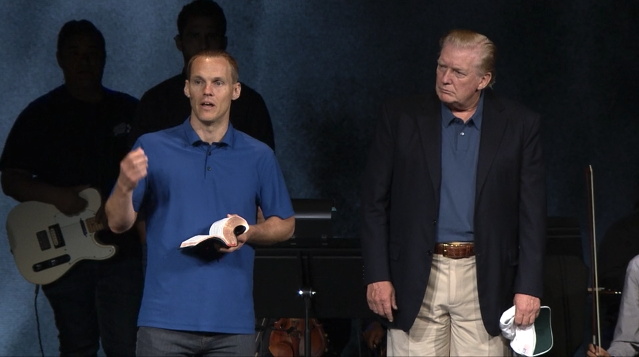
A benighted President walks into a church....

First, why was Trump wearing his golf shoes off the course?  My father played golf for most of his adult life.  He never wore his golf shoes off the golf course unless he was in the club locker room, or in the grille that allowed such shoes.  To wear them home, as Trump did?  That kind of golfer drives his golf cart onto the green (for you non-golfers, you don't even take your golf bag onto the green.  Persons, balls, and putters,  only.)

But what's especially interesting is how much attention this scene has prompted, especially attention particularly due to the situation the pastor was in.  TPM reports it fairly straightforwardly:

“Sometimes we find ourselves in situations that we didn’t see coming, and we’re faced with a decision in a moment when we don’t have the liberty of deliberation, so we do our best to glorify God,” McLean Bible Church pastor David Platt said in a letter to church goers, explaining the circumstances of Trump’s arrival.

Platt said he was alerted at the end of his sermon on Sunday that President Trump was on his way to the church and would be there “in a matter of minutes.” The White House had apparently requested that the pastor pray for Trump, a request likely fueled by prominent evangelical and ardent Trump supporter Franklin Graham’s decision to proclaim Sunday as a special day of prayer to Trump. Graham claimed last week that Trump needed protection from his “enemies.”

But they focus on the pastor's letter to his congregation, not on his prayer.  Ruth Graham pays attention to his prayer at Slate:

In contrast with other pastors who have prayed for Trump, Platt was scrupulously nonpartisan. Robert Jeffress, pastor of First Baptist Church in Dallas, once thanked God at a campaign event for Trump’s willingness to “make America great again.” Platt prayed that God would give Trump wisdom, and that the president would trust God. He did not betray any hints as to whether he believes Trump currently possesses wisdom or currently trusts God. “We pray … that he would govern and make decisions in ways that are good for justice, and good for righteousness, and good for equity, every good path,” Platt said, lifting up his Bible and bowing his head. “We pray that you would give him all the grace he needs to govern in ways … that lead to peaceful and quiet lives, godly and dignified in every way.”

If Trump wanted to appear alongside a pastor who would lavish him with praise and edge up to endorsing him, Platt was an odd choice.

The White House told reporters that Trump made the appearance at the church to “pray for the victims and community of Virginia Beach.” But that topic did not come up during his brief time at the church, which is more than three hours north of the site of Friday’s mass shooting.
A fairly anodyne prayer, in other words, despite the Slate headline:  "Pastor David Platt Prayed for Trump While Trying Super Hard Not to Sound Like a Trump Supporter."  That headline grabs eyes, I'm sure, but it's not even supported by Graham's commentary.  I suppose Rev. Platt was supposed to do the Christian thing, and spit on the ground at the mention of Trump's name, maybe even try to exorcise his demons on-stage.  It just seems to me the pastor did the right thing under the circumstances.  Here's part of how he explained himself to his congregation:

“I wanted to share all of this with you in part because I know that some within our church, for a variety of valid reasons, are hurt that I made this decision. This weighs heavy on my heart,” he said. “I love every member of this church, and I only want to lead us with God’s Word in a way that transcends political party and position, heals the hurts of racial division and injustice, and honors every man and woman made in the image of God. So while I am thankful that we had an opportunity to obey 1 Timothy 2 in a unique way today, I don’t want to purposely ever do anything that undermines the unity we have in Christ.”
That's not too different from the tack I would have taken, had Trump called up and said he was coming to my church (of course, if he'd called during worship at my old church, nobody would have answered the phone.).  How do you refuse the POTUS?  Part of your congregation might say "Good on ye!", but most of your congregation would be aghast at your presumptuousness.  (Yes, this would vary from congregation to congregation, but few are going to be virulently anti-Trump, and it's doubtful Trump would try to go to such a church.  Note he picked a non-denominational church, to be safe.)  In my old church, in this situation, I'd be seen as the host on behalf of the entire congregation, and refusing a visit by a public official, especially the POTUS, would not be contemplated (some on any end of the political spectrum would grumble, but the majority would want me to be gracious).  And I would pray as this pastor did:  for the President (we did it from time to time in regular worship.  It was among the congregational prayers of the E&R Church hymnal, IIRC.  It's also not unknown in the UCC Book of Worship.  The prayers are not for the President's politics, but for the nation.)  And yet Rev. Platt is not supposed to think about his congregation and his pastoral duties to them, but about what the world thinks:

As critics pointed out, Platt may not have praised Trump this past weekend, but he did invite him onstage. “The prayer was very nonpartisan and very inclusive, but at the same time, there’s an image of this pastor with a positive expression on his face laying a hand on Donald Trump and the other hand holding up a Bible, and Trump has his head bowed,” Dan Nejfelt, who works for a national network of progressive faith leaders, told me. “That image conveys Trump is a Christian and a normal leader that Christians can get behind.” Photographs of Platt praying for Trump have already been used to illustrated approving coverage by Breitbart, the Christian Post, and the Christian Broadcasting Network, among others.

That's really a bit too much.  Rev. Platt was acting on behalf of his church and his ministry, not on behalf of political interests.  How do you acknowledge the presence of the POTUS in your church without bringing him forward?  ("On stage"?  Are we sure it wasn't the chancel?  See what I mean about clueless reporting.  Words matter.)  Yes, the President brings those political interests trailing in his wake, but when the POTUS attends services in D.C., is it incumbent upon the person in the pulpit to deliver a political message?  Or to avoid being near the President, lest she/he find themselves in the frame of a photo?   No, the President is not usually invited to the chancel for special recognition, but then he doesn't usually call ahead and ask for prayers for him upon his arrival.  The fault here is much more Trump's than Platt's.

By all appearances, Platt made an earnest, even sophisticated, attempt to avoid becoming Trump’s minion onstage on Sunday. (A representative of McLean Bible Church did not respond to multiple interview requests.) But declining to mention politics is itself a political act. And public prayer consists of much more than the text of its message. After Platt concluded his prayer for Trump on Sunday, video captured the congregation bursting into sustained applause and hoots of approval so enthusiastic that Trump seemed to linger onstage to enjoy it. It’s not clear that everyone at the church participated, or what exactly the applause meant; members of the musical ensemble looked unenthusiastic, for what it’s worth. Platt shook the president’s hand after the prayer but did not clap for him. He tried, impossibly, to have it both ways: to be on the stage with Trump, and also rise above it. 
Have it both ways?  According to whom?  He tried to be a pastor, with a church that should, properly, be open to all (even people walking on the floors in golf cleats.  There's a reason golf clubs don't allow cleats in their main buildings.).  He showed the proper hospitality, and offered a prayer for the nation and the office, and he didn't spit on Trump or turn his back on him or otherwise show the disrespect and disdain some of us (raises hand) think Trump deserves.

He did the right thing; and it is obvious his concern still is for his congregation, as it should be.

The rest of us are just kind of cluelessly haranguing him because of who the President is.

Monday, January 09, 2006

The Business of American Religion is Business--Calvin Coolidge

Admittedly I am wandering into Metacomments territory here, but this entry at the CBSblog is related to a discussion that started here, and it makes some interesting points.

First, Bob Schieffer says:

"I think we have to be very careful about quoting Robertson, because I'm not sure who he represents anymore," he said. "His comments have gone beyond interesting and into bizarre." The "Evening News," he points out, has not covered Robertson's recent comments.
But unfortunately, no one else picks up on the issue: just who does Pat Robertson speak for? And why did anyone ever decide he spoke for anyone except Pat Robertson? Even Schieffer falls for the error that media presence = representation:

So who does he think is a better representative of evangelicals? Jim Wallis, who Schieffer calls "very compelling." (It's worth noting that many consider Wallis to be left-leaning, unlike most evangelical leaders.)And then it sort of goes downhill from there:

Michael Bass, the executive producer of the "Early Show," also gave me his take on the issue. "We would only try to book Pat Robertson when he's a newsmaker and we want to interview him to ask him about it," he says. "Otherwise he would not be a choice for us because there are other people who speak for many more people."
And Pat Robertson speaks for people because he has a TV audience?

Bass says two of his favorite voices when it comes to religion are Rick Warren, author of "The Purpose Driven Life," and Joel Osteen of Lakewood Church. He also mentions Billy Graham, who these days is rarely available for interviews, and his son Franklin. "They're worthy of the following they've inspired," he says.
Now, I can't quite argue about Billy Graham; but Joel Osteen would only speak for Lakewood Church; which is a big church, but if it is associated with a denomination, it's not obvious from its website. They do claim to reach 200 million households, though.) Rick Warren is a best-selling author; as is Osteen, for that matter. So I guess that makes them "leaders." But again, of who? TV watchers and buyers of books?

Getting still closer to the nut of the matter:

Gal Beckerman, who wrote a piece asking why journalists don’t “get” religion for Columbia Journalism Review, says figures like Robertson and Jerry Falwell are overcovered. "They have the most bombastic thing to say. It's like anything else – you go to the guys who give you the best quotations," he says. "They make for good TV. It's unfortunate." (Bass, for his part, says Falwell "has been a guest several times and we like him.")

Beckerman says that the media's reporting on Robertson's extreme comments "does evangelicals a disservice." Other, more representative evangelical leaders, he says, are more likely to "give nuanced answers – and from a media perspective that makes them less interesting."

This isn't, ultimately, just a religious issue, says Schieffer. It's rooted in larger questions about the way the media functions. "One of the problems we have in TV is that we too often go to the first person who has something to say – and that's often the person we should be paying the least attention to," he says. "We go out and find the people who are on the most extreme sides and let them scream at each other."

Media outlets don't just want the most incendiary quote, however. They also want a familiar face. That's why, Sullivan argues, Robertson and Falwell continue to get significant coverage. "As for Pat Robertson and Jerry Falwell, their heyday was twenty years ago; the only reason they're still booked as talking heads is that most producers don't know these two men no longer have any power," she writes. Sullivan says that Ted Haggard, Warren, Brian McLaren, Osteen, Rod Parsley, and Franklin Graham, among others, are religious leaders who should be featured as evangelical voices of today.
I guess it's a question of what power you're talking about, since Robertson has a pretty good sinecure (thanks to NYMary for that link). There is business power, and then there is leadership power, apparently.

But I'm still left wondering why any of the people Sullivan lists should be considered "leaders" of public opinion among evangelicals. Especially since the anointing of such a person tends to be a tautological one: "they" are leaders of "that group" because we said so, which gives "them" a "leadership position," because the media all says so.

And round and round it goes.

Monday, October 21, 2024

😈

Pretty sure Graham meant “with.”

Sunday, March 20, 2011

Oh, Good Grief


Rev. Franklin Graham thinks the tsunami that hit Japan might mean that Jesus is returning to earth soon.

Graham said that Jesus told his followers that earthquakes were one of the signs of the second coming.

"Maybe this is, I don't know. But regardless, all of us need to be prepared to stand before almighty God," Graham said.

As he explained, an increase in natural disasters was just like how "as a woman gives birth to a child, those labor pains as they begin they start intensifying with more frequency."


Sometimes you just want to say: "Shut up! Will you just please shut up!!"

Tuesday, March 27, 2018

“Look for your inspiration to the victorious lobster..."

"I should have been a pair of ragged claws
Scuttling across the floors of silent seas."

I think of "intellectuals" as very intelligent people with very interesting, if not always sound (because "sound" is what the hearer agrees with) thoughts.  People like Reinhold Niebuhr and Noam Chomsky, or Michel Foucault and Jacques Derrida, even people like Pope Benedict and Pope Francis.  Not all intellectuals are publicly identifiable, but the term usually denotes a public, rather than publicly obscure, figure.

And then there are people like Jordan Peterson, someone I hadn't even heard of until his name came up at Thought Criminal, and now in an article at Vox.  TC convinced me that Peterson is somewhat of a Man To Be Reckoned With, if only because some bloggers with better than average credentials take his thought seriously.  Reading the Vox article, I'm not so sure about that anymore:

In the lecture, Peterson weaves together an incredibly broad set of topics — ranging from Soviet history to the biblical story of Cain and Abel to Nietzsche to lab experiments that involve feeding rats cocaine — to produce a kind of unified theory of modern politics. At base, he argues that that Soviet-style communism, and all the mass murder and suffering it created, is still a serious threat to Western civilization. But rather than working openly, it seeps into our politics under the guise of “postmodernism.”

Peterson’s argument starts with a vivid denunciation of Marxism. Human society, like all animal kingdoms, is in Peterson’s mind defined by certain biological truths — including the reality that some people are naturally more gifted than others, and that life will always involve suffering. Marxism, he believes, is rooted fundamentally in the hatred of people who succeed in a capitalist economy — and thus will always result in violence when one attempts to implement it.

“Are these Marxists motivated by love or hatred? Well, is it love or hatred that produces 100 million dead people?” he asks in the speech, rhetorically.

Peterson believes that the failure of Soviet communism has not actually deterred communism’s fans in the West, who still secretly cling to the old hateful beliefs. He argues that they do so under the guise of a school of thought he refers to as “postmodernism,” which he sees as his archenemy.

There's a whole lot of stupid swimming around in there, starting with Red Scare era anti-communism, and continuing through vapid denunciations of postmodernism.  Postmodernism is really just a term meant to demarcate literary and social categories in history.  The Romantic Era gave way to the Victorian writers, who, especially in American literature, gave way to the Realists and then the Naturalists, who gave way to the Surrealists (borrowing from the fine arts in Europe), who were part of the Modernists, the post-WWI group that included, among Americans, the "Lost Generation" of Hemingway, Fitzgerald, and others (the name came later, from Edmund Wilson, IIRC).  Eventually modernism had to run its course (as Romanticism did, although like the Roman empire, although defunct, it continues to hold a powerful influence in the way we think about ourselves, history, philosophy, literature; all that "liberal arts" stuff) and scholars and professors soon noted "post-modernism," because they couldn't come up with a better name.  But blaming it for anything is rather like blaming an astrological sign for a bad economy, or a Chinese Zodiac year (valid, so far as I know, only on restaurant placemats) for bad weather.  It's a stupid, vacuous claim, in other words.  "Postmodernism" is not a school of thought, it's a convenient grouping of artistic (usually literary) work, as much responsible for content as "baby boomer" or "millennial" is controlling on the personalities of millions depending on their birth-year.

So why I need to take a guy like this seriously?  I might as well worry about Rick Warren's impact on the body politic (anybody remember him?).    Or James Dobson's, or Jerry Falwell, Jr., for that matter; or the preaching of Franklin Graham.  Billy Graham was supposed to be one of the most influential preachers in modern history:  name two of his sermons, or one of his ideas.  If you can get beyond a vague notion of some kind of Christian soteriology based on Jesus and your "heart," you remember more about him than most people do, or ever will.  No slight on Mr. Graham, but "influential" is a curiously ephemeral measure.  Reinhold Niebuhr was influential once, and deserves to be remembered more fully, but whether his work will remain vital or be as forgotten as that of Schopenhauer and Feuerbach remains to be seen.

Frankly, to even talk in the 21st century about "Marxists" as if they still exist and exert influence (even China isn't "Marxist" anymore) is to betray yourself as a Deeply Unserious Person (I'm going to try to make that phrase happen!).

“Western leftist intellectuals are [fundamentally complicit] in the horrors of the 21st century,” he says. “It’s not that they’ve learned anything since; they’ve just gone underground. And that’s what I see when I see postmodernism.”
And they stole his lunch money and beat him up after school, too!  "Western leftist intellectuals"?  Really?  And who would they be?  And when did they "go underground"?  Are they being pursued with arrest warrants or something?  And "horrors of the 21st century"?  It's only 17 years old; what "horrors" have we seen that "Western leftist intellectuals" were "fundamentally complicit" in?  9/11?  The invasion of Afghanistan by the U.S.?  The invasion of Iraq?  The collapse of the financial markets because of mortgage backed securities?  Lehman Brothers and Dick Cheney and John Bolton are "Western leftist intellectuals"?  Who knew?

Turns out "Western leftist intellectuals" are Foucault and Derrida, responsible for these "horrors" because they worked in the French philosophical tradition of language and rhetoric (the use of words).  How Foucault and Derrida influenced W. is not explained (or influenced anybody beyond a handful of literary theorists at the end of the 20th century), but it might as well be through radio waves beamed into his fillings.

It gets worse from there, with his popular books about 12 Rules for Life:  An Antidote for Chaos.  You can just imagine, although the description of it in Vox is interesting:

The book is a kind of bridge connecting his academic research on personality and his political punditry. In it, Peterson argues that the problem with society today is that too many people blame their lot in life on forces outside their control — the patriarchy, for example. By taking responsibility for yourself, and following his rules, he says, you can make your own life better.

For some reason it puts me in mind of the advice of Rick Santorum; although its certainly akin to Ayn Rand's objectivism, and about as foolish.

I'm sure this is all deeply influential because its on the best-seller list at Amazon; then again, students (and high schools!) have kept Ayn Rand in print for 75 years now, and the world is not markedly the worse for it.


Of course, it was clearly a better place when an Ayn Rand work was published in a pulp magazine alongside Kafka's most famous story.  Besides, the lobster is the cockroach of the sea......

Friday, April 06, 2018

"Come for water, all who are thirsty...." Well, except for you divorced people......


This argument:

Douthat’s argument is at its most effective when he criticizes Francis on these political grounds. He argues that Francis’s papacy is dangerous because it puts the church, as an institution, in jeopardy. If he moves the church in a “liberalizing” direction like that shared by, say, Anglicans, he risks challenging what is distinctive about Catholicism in order to hold on to the would-be faithful. Douthat points out, fairly, that churches that have tried to “liberalize” end up hemorrhaging their members anyway, and that Mass attendance has been flat under Francis.

”Liberal Catholicism’s difficulty,” he writes, “is that it has the most appeal to Catholics with the loosest connections to the Church ... it can do well in opinion polls of all Catholics ... and still fail to generate the level of commitment that induces men and women to give their lives in service to the faith.”

Always brings me back to the same question:  "What is church for?"  Although perhaps the question should be:  "Who is church for?"  Which is a more political than ecclesiological question; but to answer the first entails asking, if not answering, the second.  It's an old argument:  that the Church (however identified) must not change because it will lose both its way and its congregations.  However, what Church are you identifying with?

As I’ve argued before, much of our contemporary conception of the Catholic Church as this kind of historic monolith is rooted in the church of the 19th century: a time when the church was already redefining itself in opposition to so-called “modernity” precisely by becoming more conservative and codified.
A time when Christianity was being challenged by the Enlightenment and the Industrial Revolution, which put the Enlightenment on the ground and in the driver's seat as the primary source of human society, the reason for social order, and relegated God largely to something needed to keep the great unwashed in line for the factory owners and the social order they now supported.  Not coincidentally, also the time when Biblical scholarship began to use the tools of textual analysis and literary criticism, themselves newly forged, to examine holy writ itself.  The age that turned the Roman church into a "monolith" because it was defining itself in opposition to "modernity," also gave rise in the early 20th century to fundamentalism, which has ever after claimed a special right to being more Christian than thou based on membership.  But that's probably an argument that began as soon as Protestant churches began to woo worshipper from Catholic cathedrals.  Where does its validity rest, however?  Why is a church with more people right?  If that's the case, isn't Joel Osteen more right than Catholics and Protestants and even evangelicals and fundamentalists (Osteen fits into the prosperity Gospel camp, which is neither Catholic nor traditionally Protestant, nor evangelical nor fundamentalist).

When you define the problem, you define the solution, and Burton is accepting Douthat's definition in order to credit his argument as worth considering. But is Francis trying to hold on to the "would-be faithful"? Or is he trying to be true to the revelation of God?

The prophetic vision, summed up in Isaiah's vision of the "holy mountain," is that an Israel faithful to the covenant with God will become a place all the world is drawn to, to learn from their peace and prosperity (yes, the "prosperity gospel" preachers get that much almost right; but entirely wrong, and all of that is another discussion).  There is an absolute inclusion in that vision, with the only exclusion being the Gentiles (i.e., those who are not "children of Abraham"), who do not have to become subject to the covenant in order to benefit from the blessings of the covenant. Their exclusion is only from the burden of the covenant.  But the benefits of the covenant will be open to all:

"Come for water, all who are thirsty;
though you have no money, come, buy grain and eat;
come, buy wine and milk,
not for money, not for a price.
Why spend your money for what is not food,
your earnings on what fails to satisfy?
Listen to me and you will fare well,
you will enjoy the fat of the land."--Isaish 55:1-2, REB)

That is the call of Wisdom to all people, the voice of God for all humanity.  It's the very model for what, in Christian ecclesiology, is called the "open table."

The "open table" is the concept of the eucharist, communion, the Lord's Supper that is open to all.  Who is the table for?  "Do this in remembrance of me," are the words of Jesus recalled at the eucharist.  But who is allowed to remember him, and how?  This is not an idle question, or a small matter.  The baptized are allowed at the table; those in good standing with God and the church; those who believe.  As my New Testament professor put it once, would you want someone at communion who slouches in the pew, throws a leg over the arm rest, swirls the cup of grape juice (in a pew service of the communion, obviously) and smacks as he eats the bread/cracker/whatever?  I got into trouble in the UCC, with it's open table tradition, for using hot chocolate and cinnamon rolls on Christmas Day and calling it "communion."  The boundary there was the label, not the elements; but it was the elements, because without them I couldn't use the label.  We want, as my professor pointed out, some measure of reverence at communion.  We want some boundaries.  But which ones, and where do we lay them?

So my preference is for the open table, but I'm aware of the arguments, even the wisdom, of a closed table.  This is not the feast on the holy mountain, this is an act of remembrance and reverence.  Remembering Donald Trump describing his experience of the eucharist makes my skin crawl, because he treats it like the boor he is.  On the other hand, if we exclude people from the table for their manners, why can't we exclude them for their marital history?  Then again, who is so right with God, so without sin, that their presence at the altar is without blemish or stain?  "Who," as Pope Francis so famously asked, "am I to judge?"  Which echoes the directive of Jesus: "Don't judge, and you won't be judged."  Once you enter that cycle of judgment it is very hard to step out; and there is no humility in a cycle of judgment, only an implicit insistence that you are superior to them, and so in a position to judge them.  But "What does the Lord require of you, but to do justice, love mercy, and walk humbly with your God?"  Is justice judgment on others?  Can you walk humbly with your God knowing at least your better than them?

And then there's the question of judging churches based on the numbers in the pews.

Christianity itself proves its validity in the gospels by the numbers of people who flock to Jesus, or the numbers who believe after Pentecost because they heard the disciples speaking in their tongues.  But is our faithfulness reflected by who agree with us, or by our fealty to our interpretation of what God says?  Neither standard is wrong, but neither standard is right.  Franklin Graham just responded to the judicial election in Wisconsin:


He pretty clearly thinks "Christians" are people who agree with his political ideology, which means God supports his political ideology, too.  That, at least, is the way he interprets the scriptures.  I don't think he's right, but am I right because more people agree with me than with him?  Or is he right if more people agree with him than with me?  And if I start judging him, how am I faithful to Jesus' statement about judgment?  Or Jesus' example about who should throw the first stone?  Or even his encounter with the Syro-Phoenician woman, a story that's another argument against the "closed table."

There is always this push-pull, in other words.  If the church is not drawing people, it is probably not following God's will.  But if a church is drawing people, that isn't necessarily because it is following God's will.  Many a popular church has lost its popularity when it turns out the charismatic leader is not the ethical leader some thought he (it's almost always "he") was.  And then there's just the novelty factor wearing off.  Joel Osteen is still preaching, as is Rick Warren (I assume in the latter case; I don't know), but the spotlight has moved off of them for the most part.  If their congregations decline, is it because they are no longer as faithful to the word of God?  Or because they are no longer as interesting?  My experience is that people attend, or stop attending, churches based on the people who are there, including the pastor, more than they do based on the theology of that congregation.  It often matters more who you have to sit with in the pews or at the pot-lucks than it does what the pastor's soteriology or ecclesiology, or even posture on "open" v. "closed" communion tables, is.

To complicate this discussion further, let's just talk about the discussion itself.  There is a growing interest, it seems (based on the few websites I frequent, so take everything with a grain, or a boulder, of salt, as appropriate) in matters of religion that aren't just atheist-based Christian bashing, or mere disgust with evangelicals and fundamentalists (the people Religion Dispatches still seems to think are the only Christians in America, despite the fact they host at least two UCC pastors regularly, and never post anything in the affirmative about those two groups).  There are regular articles now at Vox, like this one; there was a very fair article at Daily Beast around Easter; and there's this one, just now, at Slate:

This inability to correctly read Scripture is both a political and theological problem—and one that’s intrinsic to modern American Christianity.

One of first things any theology student learns is the importance of reading the Bible for context. Verses that seemingly speak directly to a political issue can be misunderstood if not read within the bounds of the time and culture from which they emerged. In the heavily politicized theology of evangelical Christianity, however, this decontextualization seems to be a deliberate feature. White evangelical Christianity is first and foremost an individualized faith, exemplified by the imperative to have “a personal relationship with Jesus Christ” and asking forgiveness for individual sins. What’s important is how you read a Bible verse and how it speaks to your life—not the fact that the verse is actually about something completely different.


This inability to exegete properly—to place verses in their contexts and understand the whole instead of just the part—is symptomatic of the politicized national religion that evangelical Christianity has become. White evangelical Christianity is built to cherry-pick, and the politicians of the religious right are particularly adept at doing it.

First I have to note the correct usage of "exegete" without any further explanation of what the word means.  That assumes a fairly knowledgeable readership on a fairly technical issue.  Further, being an article about how Republican politicians abuse Scriptures by quoting them out of context (the primary reason I resist citing scripture at all, though I do it from time to time), it is remarkably free of religion-bashing.  The error, in the thesis of the article, is not that politicians are citing Christian scriptures; it's that they are doing it wrong.

That's a sea-change in recent on-line discussions of both politics and religion.  I want to encourage that change, not critique it.  If I disagree with Tara Burton, it is a respectful disagreement.  She raises excellent points about the flexibility of the Roman church throughout history; without such flexibility it would have lost its value to the world centuries ago.  As the UCC is fond of saying "God is still speaking."  But discerning what God is saying is the act of the community; it is part of the struggle with God (which is one translation of the word "Israel").  The root of Christian humility is not just that Jesus told us the first would be last and the last first; it is that we must be humble before each other in order to be truly open to understanding God in the world, in human history, and in our lives.

As for the change, is it historic, or merely historical?  The latter, I imagine.  The rabidly right-wing face of Christianity, epitomized by evangelicals and fundamentalists as identified in media (if not actually in churches), have run their string with Donald Trump, much as the earlier generation in the '70's and '80's seemed to dominate television only to fall from grace and power as people finally changed the channels (and as their scandals finally caught up with them).  With them go the equally rabid atheists ready to pounce on any reference to religion on the intertoobs that was not as critical and damning as they were.  It isn't that these new articles represent a change in public religious interest so much as they represent a changed attitude toward religious practice, a change pretty much as inevitable as a pendulum swing.  It's too bad, though; I was looking forward to that atheistic future South Park envisioned, where atheist groups war over who is most truly atheistic.  Well, it made a good cartoon, anyway.


*Because I can't resist, and because I've come to respect Notorious TIB's writings about religion:

Christian Danish philosopher Søren Kierkegaard’s “suspension of the ethical,” for example, argued for a religious ethics based not on objective rules but on love toward’s one fellow man.

No; just, no.  The "suspension of the ethical" appears in one of the philosophical works (Fear and Trembling), discussing the act of Abraham in the akedeh, the sacrifice of Isaac.  Even the argument there has nothing to do with "love toward's [sic] one fellow man [sic]," but with the incommensurability of the act of Abraham with any ethical system, religious or otherwise.  The "suspension of the ethical" is an attempt to make sense, ethically, of Abraham's attempted sacrifice, in order to recognize Abraham, not as a madman, but as an avatar of faith.  Even that, however, Johannes de Silentio argues, can't be done, and so one is left with the paradox of Abraham being right (to follow God's command) and wrong (to be willing to murder his son) at the same time.  If anything, Abraham's act is an example of the awful nature of supreme love for God; it's hardly an example of "love [towards one's fellow] man."