Showing posts sorted by relevance for query spong. Sort by date Show all posts

Thursday, June 13, 2013

Ye shall know the truth, and yet probably know not that you know....

Trying to put recent posts in perspective, I wanted to say something about how telling people what you know won't necessarily make them think the way you think.  This is what Edward Snowden says he feared:  that his NSA revelations wouldn't lead to a reaction against the NSA similar to the one he had, the one that led him to spend a month or two preparing to breach his oath of secrecy.

And then the universe, or God, or happenstance, or just blind simple doo-dah luck, landed this in my lap:

Christianity is not about the divine becoming human so much as it is about the human becoming divine. That is a paradigm shift of the first order.

These are the conclusions to which my study of John's Gospel has led me, and they are the conclusions that I explore and document in this book "The Fourth Gospel: Tales of a Jewish Mystic."
That's Shelby Spong at the end of a blog post describing his new book.  He's rather boldly claiming that once you read it, you'll never go back, and in fact you'll be a Spong disciple and with him recreate Christianity in the way Shelby Spong thinks best!

Which, really, ain't gonna happen.

I have no problem with Spong's assertions about the Gospel of John.  I would make more of the importance of the semeia (signs) John's gospel uses.  That gospel calls the miracles not dunamis, as the synoptics do (usually translated as "miracle" but implying an act of power) and refers to them as "signs."

Yeah, kinda like the Mel Gibson movie.

There's a lot of subtlety going on in John's gospel, in other words; and yet it is often used as a club, because "whosoever believeth in him (things always sound more holy and authoritative in the King James' English)," donchaknow?  I mean, those who don't, will perish!  It's right there in black & white, waddyawantmetodoaboudit?

But I digress....

Shelby Spong, despite his claims of spending several years on this, is not a scholar.  He doesn't write for scholars, he doesn't write as a scholar, he doesn't even pretend to be a scholar.  He's a polemicist, really.  So he takes a bit of scholarship and spins a tale with it and comes up with an idea he's sure everyone would agree upon, if they just understood what he understands!

But it doesn't work that way.  It never does.

Scholars don't try to persuade a vast group of others of the truth of their position.  They try to defend it among other scholars; and very narrow ground that can be, too.  But if they imagine that what they know will enlighten and enlist others to their scholarly cause if it is just well enough understood; then they have gone astray from scholarship.

Mind, I have nothing against Biblical scholarship.  I think its incredibly valuable.  But I don't think it's going to change the world anytime soon.  The  very idea that the Gospel of John is not the work of John Zebedee, for example, is probably 150 years old; or older.  Among scholars, that is.  Spong cites it as if he just discovered fire, and is bringing the burning coal back to the cave for the first time.  The people who already know that, in other words, haven't had their paradigm shifted all that much by the knowledge.  Some of them accept it, and move on; some don't even accept it at all.

There's even a story in the Gospel of John about this, oddly enough.  Jesus is not baptized in that gospel, but like the baptisms in the Synoptics, there is a scene meant to show Jesus speaks for God.  Jesus says, "Father, glorify your name!"

Then a voice spoke out of the sky:  "I have glorified it and I'll glorify it further."

The crowd there heard this, and some people remarked that it had thundered, others that an angel had spoken to him.

"That voice did not come for me but for you," Jesus replied.
 So some hear thunder; some hear an angel.  It's not clear anyone heard what was said, or knew who it was, or that any paradigms that day were shifted.

Maybe it's better not to expect them to be; and just to be happily surprised, whenever they are.

Tuesday, December 14, 2021

Jesus, Jesus, Rest Your Head


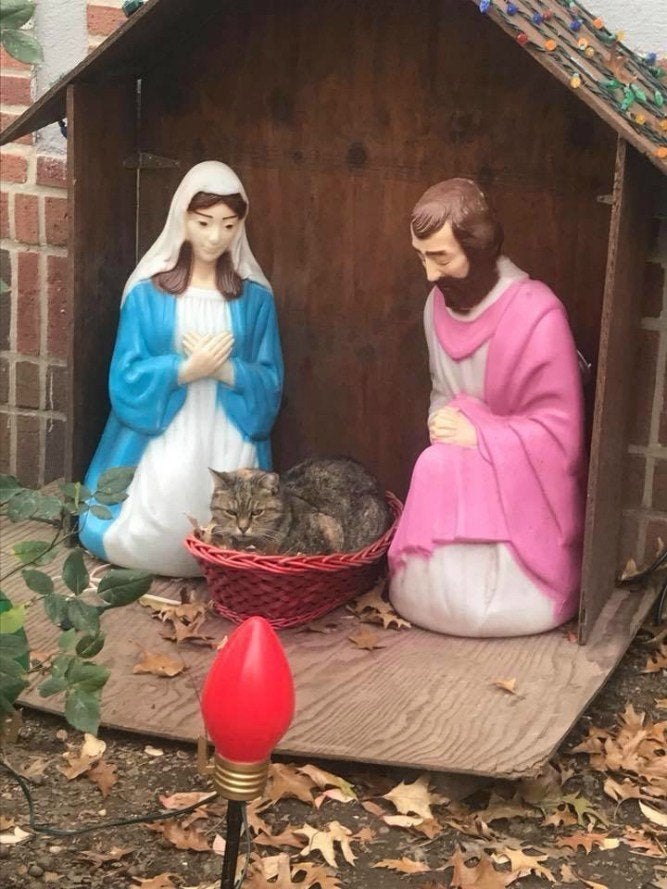
What follows is old stuff; not just in the world, but in the history of this blog.  Some of this goes back almost as far as that picture, above.  I don't even have that fake wreath anymore; but I still have the advent wreath and the nativity figures.  And still a few words to say about these narratives.

My starting point is an "X-Files" episode I saw in re-runs recently.  It was from the one-season "revival" of the show, one of the many efforts at comedy in that season.  This one involved a false "recording" of Jesus raising Lazarus from the dead (don't ask).  That it even existed (it was a fake, even in the narrative of the show) was a great scandal to the Catholic (is there any other kind?) Archbishop who found it (where it was planted) in the catacombs under the cathedral (in California?).  Nothing really signficant about the plot there, except the recurrent idea that a simple story will someday arise to destroy Christianity, or at least the  Church (almost always the Roman church), and Rome is scared stiff of this possibility. 

Yeah, right. (In another example, a story by George R.R. Martin, IIRC, posits the discovery of a "Gospel of Judas" in the far future, and the trouble such an "heretical text" poses to the Church.  Except there already is one, written in the 2nd century.  Not the scandalous gospel of Martin's story, but the very idea of one is not the earth-shattering discovery Martin and the rest of us assume it to be.  There is indeed nothing new under the sun.) 

Here, this might give you a better flavor of what I mean.  This, in blog years, is older than that picture:

John Shelby Spong, in his 1998 book Why Christianity Must Change or Die (Bishop Spong doesn't pussyfoot around, obviously) discusses (on pp. 75-83) the chronological development of the notion of Jesus as the Christ. 

He notes that, as the earliest of the canonical writings, the Epistles of Paul, written between 50 and 60 C.E., not only fail to mention the birth of Jesus, but, in Romans (1:1-5) states that Jesus was designated "Son of God" by the Father only at his resurrection. 

Mark, the earliest of the synoptic writers, writing some 20 years later, moves this designation backward in time to the baptism of Jesus (1:9-10), while Matthew, writing 10 to 20 years after Mark, moves even further backward in time to his birth.

Luke, writing 5 to 10 years after Matthew, changes the birth details somewhat, but makes the Annunciation the moment of divine designation. 

Finally, John, writing almost 100 years into the Common Era, dispenses with all previous times of designation and proclaims that Jesus shared divine identity from "In the beginning," then states that "the Word became flesh and dwelt amongst us." 

As for the noncanonical infancy narratives, many are based on the 2d century Protoevangelium of James, which concentrates on the virginity of Mary, rather than the circumstances of Jesus's birth as well as the Infancy Gospel of Thomas and the Infancy Gospel of James (It's worthwhile to note, I think, that these latter sources are the basis for Anne Rice's recent novel, Christ the Lord. No doubt it'll become a best seller, given the current temper of the times... Boreas 

My original response was “a quick note, not by way of argument or disagreement, but clarification.” It went on pretty much like this: 

This idea is not original with Spong, nor really all that challenging. Fr. Raymond Brown acknowledges the same exegetical understanding in his magisterial (and, by modern scriptural studies standards, quite safe and conservative) Birth of the Messiah (a book I like even as I might disagree with it; but then, much as I admire his magisterial study of the gospel of John,  I disagree with Bultmann's "demythologization," which is basically Spong's shtick. Bultmann was convinced Christianity must "demythologize" or die.  Both men's arguments have not, as the kids say, aged well.). 

Mark is dated to around 70 C.E., and contains no mention of a nativity at all. Neither does John, which clocks in between 100 and 120 C.E. 

The only story from the life of Jesus of Nazareth in Paul's letters is the reference to the eucharisto in Corinthians. Otherwise, Paul preaches "Christ crucified," which for Paul clearly is what made Jesus of Nazareth "Messiah" (which means the "last supper" for Paul is a memorial meal; the metaphysics of it came much later. Although it raises the interesting question, again: what do the words of institution in Corinthians mean?)

Matthew and Luke both have widely divergent nativity stories, which cannot be reconciled. In Matthew, Mary and Joseph live in Bethlehem, and the wise men come when Jesus is 2 or younger (because that's the age of the innocents slaughtered by Herod). The family flees to Egypt (recaptiulating Israel's history; in with Joseph, out with Moses), and comes back to settle in Nazareth. 

In Luke, they live in Nazareth and go to Bethlehem for the census (for which there is no other record than in Luke's tale).

By John's gospel, metaphysics has taken over, and Jesus not only predates Creation, but is the shaping force of Creation (the logos of Greek philosophy is thus reconciled with the Creator of Hebraic belief). Birth is irrelevant to the Word, which exists, with God, prior to the beginning. 

What does this mean? 

Well, that the gospels are not history texts in the way the Greeks understood them, or even as we, after them, do. They are, in seminary language, confessional documents. They confess a belief in the God of Abraham and Jesus, based on an experience that the communities which created these documents felt could best be expressed in this way. I learned all this in seminary, and yet I still sing "O Come, O Come Emmanuel" every December, still read Luke 2 in the King James Version every Christmas Eve, still believe in the songs of Mary and Zechariah and Simeon and the angels, and even in the dreams of Joseph. I know what it all means, and yet is still means something to me. I can exegete the Magnificat and the gifts of the Magi and even the journeys of the holy family and the visitation of shepherds.

But they still have their confessional meanings, too.

To that I would add this postscript:  the fear Spong (and Bultmann before him) have is that this is a rational age and Christianity is not "rational" enough for the age (usually described as being too "metaphysical."  I'll accept that classical metaphysics is almost as dead as logical positivism (which is really well and truly dead, despite what Carnap's disciples say), but what is the material and physical explanation of love?  If you can answer that without an absurdly reductio argument, I'd be interested.  A professor told me once he read that Emmanuel Levinas, the philosopher of phenomenology, once witnessed a stranger rescue a young girl on a busy street from the traffic and an oncoming car.  Why, he wondered, would this happen?  Levinas was no logical positivist or Anglo-American materialist; he worked on his own answers.  But it's a profoundly simple question with no simple answer. So while I don't defend classical metaphysics, I don't toss out the baby with the bathwater.  Not everything, at all, is material; or can be understood as such.

But more importantly, people don't ratiocinate about matters religious (or miraculous, or absolutely contrary to human experience, like a "virgin birth") nearly so much as Bultmann or Spong, et al., imagine they do.  Christianity won't die because people can't think about a virgin birth or a triune but monotheistic god.  I, too, thought they should think more about such matters; they taught me otherwise.  Bultmann was a scholar (and a damned fine one).  Spong was a bishop (ECUSA).  Pastors, even those with the briefest of careers, see the people in the church a bit differently. Close contact with reality will do that to you.

Well, I really wanted to use that to make the point that Christianity is not nearly so fragile as "outsiders" believe; and to introduce the idea the infancy narratives of Jesus aren't so singular and simple as, especially at this time of year, we often think.  The following all post-date the canonical gospels; but they are interesting takes on the birth, and even childhood, of Jesus the Christ.

Arabic infancy gospel:

1. We find what follows in the book of Joseph the high priest, who lived in the time of Christ. Some say that he is Caiaphas. He has said that Jesus spoke, and, indeed, when He was lying in His cradle said to Mary His mother: I am Jesus, the Son of God, the Logos, whom you have brought forth, as the Angel Gabriel announced to you; and my Father has sent me for the salvation of the world.

2. In the three hundred and ninth year of the era of Alexander, Augustus put forth an edict, that every man should be enrolled in his native place. Joseph therefore arose, and taking Mary his spouse, went away to Jerusalem, and came to Bethlehem, to be enrolled along with his family in his native city. And having come to a cave, Mary told Joseph that the time of the birth was at hand, and that she could not go into the city; but, said she, let us go into this cave. This took place at sunset. And Joseph went out in haste to go for a woman to be near her. When, therefore, he was busy about that, he saw an Hebrew old woman belonging to Jerusalem, and said: Come hither, my good woman, and go into this cave, in which there is a woman near her time.

3. Wherefore, after sunset, the old woman, and Joseph with her, came to the cave, and they both went in. And, behold, it was filled with lights more beautiful than the gleaming of lamps and candles, and more splendid than the light of the sun. The child, enwrapped in swaddling clothes, was sucking the breast of the Lady Mary His mother, being placed in a stall. And when both were wondering at this light, the old woman asks the Lady Mary: Are you the mother of this Child? And when the Lady Mary gave her assent, she says: You are not at all like the daughters of Eve. The Lady Mary said: As my son has no equal among children, so his mother has no equal among women. The old woman replied: My mistress, I came to get payment; I have been for a long time affected with palsy. Our mistress the Lady Mary said to her: Place your hands upon the child. And the old woman did so, and was immediately cured. Then she went forth, saying: Henceforth I will be the attendant and servant of this child all the days of my life.

4. Then came shepherds; and when they had lighted a fire, and were rejoicing greatly, there appeared to them the hosts of heaven praising and celebrating God Most High. And while the shepherds were doing the same, the cave was at that time made like a temple of the upper world, since both heavenly and earthly voices glorified and magnified God on account of the birth of the Lord Christ. And when that old Hebrew woman saw the manifestation of those miracles, she thanked God, saying: I give You thanks, O God, the God of Israel, because my eyes have seen the birth of the Saviour of the world.

....

7. And it came to pass, when the Lord Jesus was born at Bethlehem of Judæa, in the time of King Herod, behold, magi came from the east to Jerusalem, as Zeraduscht had predicted; and there were with them gifts, gold, and frankincense, and myrrh. And they adored Him, and presented to Him their gifts. Then the Lady Mary took one of the swaddling-bands, and, on account of the smallness of her means, gave it to them; and they received it from her with the greatest marks of honour. And in the same hour there appeared to them an angel in the form of that star which had before guided them on their journey; and they went away, following the guidance of its light, until they arrived in their own country.

8. And their kings and chief men came together to them, asking what they had seen or done, how they had gone and come back, what they had brought with them. And they showed them that swathing-cloth which the Lady Mary had given them. Wherefore they celebrated a feast, and, according to their custom, lighted a fire and worshipped it, and threw that swathing-cloth into it; and the fire laid hold of it, and enveloped it. And when the fire had gone out, they took out the swathing-cloth exactly as it had been before, just as if the fire had not touched it. Wherefore they began to kiss it, and to put it on their heads and their eyes, saying: This verily is the truth without doubt. Assuredly it is a great thing that the fire was not able to burn or destroy it. Then they took it, and with the greatest honour laid it up among their treasures.
I found this at New Advent.  It goes on to describe Jesus' early life, where he performs various miracles, including making a dead boy speak and tell who pushed the dead boy from the roof (which is why he's dead; all the other boys accuse Jesus).  I mention this only because the story shows elements both from Matthew's infancy narrative, and from Luke's.  Luke is the only gospel that gives us a glimpse of Jesus as a young boy (in the Temple, teaching the elders).  The Arabic infancy gospel expands on those stories, echoing Luke to lend these stories authenticity.  It even echoes Luke’s Nunc Dimmitus. Even today we have a "canon" which fictional characters must follow, be the character James Bond or Dr. Who or just in the comic books. The non-canonical part is the introduction of a cave as the birthplace. But that becomes “canonical” in the other nativity stories.

The other interesting bit, for our purposes, is this nativity story makes reference to a cave as the birthplace of the Christ child.  I can't tell you where this idea comes from (perhaps Mithras; see below), but it persists in the narratives that follow, which is a curious thing in itself.
 
So close in time we can’t say which came first, the Infancy Gospel of James (a/k/a Protevangelium of James) also betrays familiarity with the canonical gospel accounts. But it does some interesting things with point of view, while shifting the location of the birth from Bethlehem to the desert. Like Matthew’s version, it centers on Joseph, not Mary. It even tries to combine the two: there is a census, but Joseph is ashamed of his pregnant wife. And in that desert there is again a cave.

Chapter 17

(1) Then, there was an order from the Emperor Augustus to register how many people were in Bethlehem of Judea. (2) And Joseph said, "I will register my sons. But this child? What will I do about him? How will I register him? (3) And my wife? Oh, I am ashamed. Should I register her as my daughter? The children of Israel know that she is not my daughter. (4) This day, I will do as the Lord wants."

(5) And he saddled his donkey and sat her on it and his son led and Samuel followed. (6) And they arrived at the third mile and Joseph turned and saw that she was sad. (7) And he said to himself, "Perhaps the child within her is troubling her." (8) And again Joseph turned around and saw her laughing and said to her, "Mary, what is with you? First your face appears happy and then sad?"

(9) And she said, "Joseph, it is because I see two people with my eyes, one crying and being afflicted, one rejoicing and being extremely happy."

(10) When they came to the middle of the journey, Mary said to him, "Joseph, take me off the donkey, the child pushing from within me to let him come out."

(11) So he took her off the donkey and said to her, "Where will I take you and shelter you in your awkwardness? This area is a desert."

Chapter 18

(1) And he found a cave and led her there and stationed his sons to watch her, (2) while he went to a find a Hebrew midwife in the land of Bethlehem.

(3) Then, Joseph wandered, but he did not wander. (4) And I looked up to the peak of the sky and saw it standing still and I looked up into the air. With utter astonishment I saw it, even the birds of the sky were not moving. (5) And I looked at the ground and saw a bowl lying there and workers reclining. And their hands were in the bowl. (6) And chewing, they were not chewing. And picking food up, they were not picking it up. And putting food in their mouths, they were not putting it in their mouths. (7) Rather, all their faces were looking up.

(8) And I saw sheep being driven, but the sheep were standing still. (9) And the shepherd lifted up his hand to strike them, but his hand remained above them. (10) And I saw the rushing current of the river and I saw goats and their mouths resting in the water, but they were not drinking. (11) And suddenly everything was replaced by the ordinary course of events.

....

Chapter 20

(1) And the midwife went in and said, "Mary, position yourself, for not a small test concerning you is about to take place."

(2) When Mary heard these things, she positioned herself. And Salome inserted her finger into her body. (3) And Salome cried out and said, "Woe for my lawlessness and the unbelief that made me test the living God. Look, my hand is falling away from me and being consumed in fire."

(5) And Salome dropped to her knees before the Lord, saying, "God of Abraham and Isaac and Jacob, (6) do not expose me to the children of Israel, but give me back to the poor. (7) For you know, Lord, that I have performed service and received my wage from you."

(8) Suddenly, an angel of the Lord appeared, saying to her, "Salome, Salome, the Lord of all has heard your entreaty. (9) Stretch out your hand to the child and lift him up and he will be salvation and joy for you."

(10) And Salome went to the child and lifted him up, saying, "I worship him because he has been born a king to Israel." (11) And at once Salome was healed and left the cave justified.

(12) Suddenly, there was a voice saying, "Salome, Salome, do not proclaim what a miracle you have seen until the child comes to Jerusalem."
As I mentioned, the cave reference is not limited to this gospel. Several retellings of the nativity story from the medieval era on often place the birth of Christ in a cave.  We've lost the source of that echo, but we still hear the echo.  The earliest reference seems to be from Justin Martyr, in his Dialogue with Trypho, a very early work of Christian apologetics:

"Now this king Herod, at the time when the Magi came to him from Arabia, and said they knew from a star which appeared in the heavens that a King had been born in your country, and that they had come to worship Him, learned from the elders of your people that it was thus written regarding Bethlehem in the prophet: 'And thou, Bethlehem, in the land of Judah, art by no means least among the princes of Judah; for out of thee shall go forth the leader who shall feed my people.' Accordingly the Magi from Arabia came to Bethlehem and worshipped the Child, and presented Him with gifts, gold and frankincense, and myrrh; but returned not to Herod, being warned in a revelation after worshipping the Child in Bethlehem. And Joseph, the spouse of Mary, who wished at first to put away his betrothed Mary, supposing her to be pregnant by intercourse with a man, i.e., from fornication, was commanded in a vision not to put away his wife; and the angel who appeared to him told him that what is in her womb is of the Holy Ghost. Then he was afraid, and did not put her away; but on the occasion of the first census which was taken in Judea, under Cyrenius, he went up from Nazareth, where he lived, to Bethlehem, to which he belonged, to be enrolled; for his family was of the tribe of Judah, which then inhabited that region. Then along with Mary he is ordered to proceed into Egypt, and remain there with the Child until another revelation warn them to return into Judah. But when the Child was born in Bethlehem, since Joseph could not find a lodging in that village, he took up his quarters in a certain cave near the village; and while they were there Mary brought forth the Christ and placed Him in a manger, and here the Magi who came from Arabia found Him. I have repeated to you," I continued, "what Isaiah foretold about the sign which foreshadowed the cave; but for the sake of those who have come with us to-day, I shall again remind you of the passage." Then I repeated the passage from Isaiah which I have already written, adding that, by means of those words, those who presided over the mysteries of Mithras were stirred up by the devil to say that in a place, called among them a cave, they were initiated by him. "[Chapter 78]
A mix, again, of Luke and Matthew, but with the birth relocated to a cave. A cave with a feeding trough. But now the Magi come from Arabia, which is interesting specificity. It was popular once to connect Christianity and Mithraism. It seems that supposed connection is quite old (this dialogue is an apologetic), which may explain the origins of the cave in the nativity stories.

 Origen also puts the birth in a cave, and notes the location is known, which he offers as proof of the story.

CHAP. LI.

Now the Scripture speaks, respecting the place of the Saviour's birth--that the Ruler was to come forth from Bethlehem--in the following manner: "And thou Bethlehem, house of Ephrata, art not the least among the thousands of Judah: for out of thee shall He come forth unto Me who is to be Ruler in Israel; and His goings forth have been of old, from everlasting." Now this prophecy could not suit any one of those who, as Celsus' Jew says, were fanatics and mob-leaders, and who gave out that they had come from heaven, unless it were clearly shown that He had been born in Bethlehem, or, as another might say, had come forth from Bethlehem to be the leader of the people. With respect to the birth of Jesus in Bethlehem, if any one desires, after the prophecy of Micah and after the history recorded in the Gospels by the disciples of Jesus, to have additional evidence from other sources, let him know that, in conformity with the narrative in the Gospel regarding His birth, there is shown at Bethlehem the cave where He was born, and the manger in the cave where He was wrapped in swaddling-clothes. And this sight is greatly talked of in surrounding places, even among the enemies of the faith, it being said that in this cave was born that Jesus who is worshipped and reverenced by the Christians. Moreover, I am of opinion that, before the advent of Christ, the chief priests and scribes of the people, on account of the distinctness and clearness of this prophecy, taught that in Bethlehem the Christ was to be born. And this opinion had prevailed also extensively among the Jews; for which reason it is related that Herod, on inquiring at the chief priests and scribes of the people, heard from them that the Christ was to be born in Bethlehem of Judea, "whence David was." It is stated also in the Gospel according to John, that the Jews declared that the Christ was to be born in Bethlehem, "whence David was." But after our Lord's coming, those who busied themselves with overthrowing the belief that the place of His birth had been the subject of prophecy from the beginning, withheld such teaching from the people; acting in a similar manner to those individuals who won over those soldiers of the guard stationed around the tomb who had seen Him arise from the dead, and who instructed these eye-witnesses to report as follows: "Say that His disciples, while we slept, came and stole Him away. And if this come to the governor's ears, we shall persuade him, and secure you."
No Mithra this time, but a cave and a great deal more interest in establishing authorities in order to establish the authority and veracity of the infancy narrative. A very Matthean take, in other words. But there is one other nativity story in the canon, one that captures not what happened, but what it meant. From the Revelation to John:

A great sign appeared in the sky, a woman clothed with the sun, with the moon under her feet, and on her head a crown of twelve stars.

She was with child and wailed aloud in pain as she labored to give birth.

Then another sign appeared in the sky; it was a huge red dragon, with seven heads and ten horns, and on its heads were seven diadems.

Its tail swept away a third of the stars in the sky and hurled them down to the earth. Then the dragon stood before the woman about to give birth, to devour her child when she gave birth.

She gave birth to a son, a male child, destined to rule all the nations with an iron rod. Her child was caught up to God and his throne.

The woman herself fled into the desert where she had a place prepared by God, that there she might be taken care of for twelve hundred and sixty days.

Then war broke out in heaven; Michael and his angels battled against the dragon. The dragon and its angels fought back,

but they did not prevail and there was no longer any place for them in heaven.

The huge dragon, the ancient serpent, who is called the Devil and Satan, who deceived the whole world, was thrown down to earth, and its angels were thrown down with it.

Then I heard a loud voice in heaven say: "Now have salvation and power come, and the kingdom of our God and the authority of his Anointed. For the accuser of our brothers is cast out, who accuses them before our God day and night.

They conquered him by the blood of the Lamb and by the word of their testimony; love for life did not deter them from death.

Therefore, rejoice, you heavens, and you who dwell in them. But woe to you, earth and sea, for the Devil has come down to you in great fury, for he knows he has but a short time."

When the dragon saw that it had been thrown down to the earth, it pursued the woman who had given birth to the male child.

But the woman was given the two wings of the great eagle, so that she could fly to her place in the desert, where, far from the serpent, she was taken care of for a year, two years, and a half-year.

The serpent, however, spewed a torrent of water out of his mouth after the woman to sweep her away with the current.

But the earth helped the woman and opened its mouth and swallowed the flood that the dragon spewed out of its mouth.

Then the dragon became angry with the woman and went off to wage war against the rest of her offspring, those who keep God's commandments and bear witness to Jesus.

It took its position on the sand of the sea.

What do all these versions tell us?  That we've been creating an infancy narrative to suit our purposes almost since the original birth.  Are we closer, or further away, from the truth, then?  That depends on what you mean by "truth."  Is the actual birthdate and birthplace of Jesus of Nazareth that important?  Should we clean up our manger oriented nativities; remove the camels and the rich visitors and their gifts, maybe even put the whole thing inside a 1st century Palestine peasant's dwelling, rather than some imagined European-style stall, complete with hay and oak beams? Should we erase the "innkeeper" from all the Christmas pageants, because there was no such industry in first century Bethlehem?  Call an immediate halt to all those Las Posadas observations? And shouldn't we make all the characters at the manger scenes look Middle Eastern?

Or is that really what Christmas is all about, Charlie Brown?

Friday, February 26, 2016

Literally?


I've never been a big fan of Shelby Spong (and what's a blog post for if you can't complain about what somebody else said, amirite?).  So I rise to semi-praise him in this interview (even though I won't be reading the book) and to challenge some of his assertions.  Such as this one:

Then, by the year 150 or thereabouts, there were so few Jews left in the Christian church that Marcion wanted to remove any semblance of Judaism from the Christian scripture. The church officially resisted that, but unofficially they became quite anti-Semitic. What happens then, you have an audience of only Gentiles reading these Jewish stories and because they don’t understand the storytelling background they have to assume that the stories are literal.

“We imposed fundamentalism on the Bible. No one who has ever read the Bible could be a literalist.”

The literalization of the Gospels is not the result of the authors, it’s the result of a generation 150 years after the birth of Jesus who didn’t know the Jewish tradition so they couldn’t see these connections. They didn’t know, for example, that the feeding of the 5,000 was not a miracle. It was a retelling of Moses’ manna in the wilderness story heightened and applied to Jesus. That’s a very different perspective so the Jews never argued about whether Jesus actually fed all those people with five loaves and two fish. But, if you see it as a familiar story in the Jewish tradition where the food supply is expanded in the Moses story, and in the stories of Elijah and Elisha, then you can retell it about Jesus and magnify it.
I'll accept that literalism did distort the Bible and did do damage to a story Matthew's audience (probably Jews, and Matthew was probably Jewish; although, if we're going to get historical/critical, there probably was no person named "Matthew" who said down and wrote the gospel with that name appended to it the way we expect Stephen King to write his novels.  There are modern examples of this:  Carolyn Keene, "author" of the Nancy Drew novels, or Victor Appleton II, who took over for Victor Appleton and wrote the Tom Swift, Jr. novels I favored as a child.  Even today  Nora Roberts publishes several novels a month; does anyone really think one person named Nora Roberts writes all those novels?  Do her readers really care?.  We can get into the weeds quickly here, you see; then again, same as it ever was.  Safer to say "The Gospel According to Matthew" was written by Jews for Jews, and leave it at that.  Although "Jews" is an anachronism in this discussion, too.....

I'll be quiet now.)

Where was I?  Oh, yeah, Shelby and Biblical hermeneutics.  First:  the problem of Jews belonging to the early church is vastly more complicated than the attempts of Marcion to reduce the canonical gospels to his Thomas Jeffersoned version of Luke.  Frankly, I don't know how you get from Marcion to anti-semitism in the church without passing "GO" or collecting $200.00.  Second:  if no one who has ever read the Bible could be a literalist, how did Marcion become a Biblical literalist?  By being wholly ignorant of the Bible?  Or was it a problem of literacy in the Roman Empire? And did Biblical literalism arise with Marcion and become the only hermeneutic allowed until the Germans came along in the 19th century?  No; of course not.  Biblical literalism is far better attached to the fundamentalist movement of the 20th century, since whatever literalism was involved in the first centuries of church pales by comparison with that effort, and using the term unilaterally as Spong does is to engage in anachronism.  Marcion himself was considered a heretic.    We would today call him anti-semitic because he wanted to remove Christianity from its Jewish roots; but he did so by cutting up the Gospel of Luke and tossing the other gospels altogether.  He was denounced by St. Justin the Martyr, Ireneaus, and Tertullian, so the idea that we should start with Marcion is, let's say, distorted at best.

And the problem, as many scholars have pointed out, has more to do with Hebraic v. Hellenistic thought, than with anti-semitism in the post-Marcion church.  The very idea of an eternal soul is Platonic, not Hebraic.  The idea of history as a indisputable record of events (where even "indisputable" has to be, well, disputable) is Hellenistic, not Hebraic.  The roots of this conflict, in other words, were set down the minute Paul split with Peter over who to evangelize.  That the gospels were interpreted away from their Hebrew roots, and that the Hebraism of Jesus, Paul, Matthew, Mark, and John, as well as the letters of the New Testament, was all too easily lost, can't really be disputed; and that such a "divorce" lead to distortions in the interpretation of the gospels, I quite agree with.  To this day the common wisdom is that the "Old Testament" (actually, the Jewish scriptures) are fraught with war and death and vengeance and an "angry God," while the New Testament is full of love and fuzzy bunnies.  I presume this is where the "contradiction" lies that on-line atheists so often refer to.  The clash arises from ignorance, as Spong implies; not from necessity.

But to explain that any further I'd have to give you a short course in (at least) the work of Walter Brueggemann as well as Western philosophical history.

Take Spong's method and apply it around Matthew, you get (as he does, later) the correct context (IMHO, of course) for the Magi, as well as the flight into Egypt, as well as the Sermon on the Mount (it's more egalitarian in Luke's Gentile telling), and so on.  Frankly, it's come to matter less and less to me how much of this "literally happened."  I spent too many years with "eyewitness testimony" to believe that anything anyone told me was 100% irrefutably true and happened just that way.  You learn to live with a certain fuzziness; and then you learn that the fuzziness is a feature, not a bug.

So I'm not really arguing with Spong, so much as sort of wincing, again, and how he says it.  As when he defends his position, which I actually find kind of refreshing:

I happen to know the Bible pretty deeply and I didn’t reject the Bible when I rejected its literal frame of reference. I happen to be a believing, practicing Christian. I don’t go to church on Sunday mornings for show. I go because I want to be there and I need to worship. It’s not an option for me to sleep in on Sunday. My faith is deeper than that. I do not eat a meal that I don’t stop and say grace beforehand because that’s how I acknowledge the presence of God in my life at a regular time. I try to live a life of absolute commitment. I claim my Christian identity publicly.

This puts me at odds with my colleagues in the Jesus Seminar who are so scholarly but they are not devoted. They really think the church is a sick institution and they don’t want to be part of it. I think the church is the only place we’ve got, but we’ve got to transform and redeem it. If the church is not going to be the place where people encounter God and Christ I don’t see any other place in our society to do so. I work to transform the church. I don’t work to get rid of the church. I work to transform the meaning of what it means to be a Christian, not to get rid of that meaning.
I was never really taught to take the Bible literally.  On the other hand, I finally realized the generally accepted Nativity story made no sense the way we all agree it happened:  Magi and shepherds gathered with ox and sheep around a "manger" while Joseph and Mary look on, with a Star shining directly overhead and an angel hovering nearby.  (Yeah, like the picture.  That's cross-stitch, a set of patterns, and I'm actually working on it.  Had it for 25 years, finally getting around to finishing it.  I have the two left-hand panels finished, and the camel on the far right.  Working on the angels and star to finish the center panel, then the magi on the right to go.)  It's a mash-up of Matthew and Luke, who get the Holy Family to Bethlehem by very different means, and to Nazareth by different means, too.  And besides, the Magi didn't really show up until about two years later.   That mash-up is far more modern than Spong wants it to be, I think.  I've read some of the early mystery plays, including various "shepherd's plays," and they seldom include the Magi showing up to join the shepherds at the manger.  Maybe they took the story more "literally' than we do, or something.

Anyway, I stumbled over that second paragraph, if only because I know (or have met) some of the members of the Jesus Seminar.  The ones I knew didn't think the church was "sick" (one was my NT professor in seminary; he was training people for that institution, and his seminary was sustained by it).  I'm sure some of the members are of that opinion, but scholarship and devotion don't have to go hand in hand.  They don't have to be opposing magnetic poles, either, though.

Spong says he wants to work to transform the church, and that's fine with me.  I have to say the way he used to do it was fairly similar to the way he criticizes now:

But when your agenda is to convert someone to your way of thinking, it’s hostile. You’re saying, “My faith is better than your faith, which means I’m better than you, and if you don’t accept my faith there’s something wrong with you.” That’s hostile and you can’t communicate the love of God through hostility. That’s what we’ve got to break open.

The love of God can never be communicated with human hostility. What we’re to preach in the world is not conversion. It’s to preach the Gospel, which is the infinite love of God for all that God has made. That’s a very different gospel than what I hear going on in places that believe you have to convert or you’re going to fry in hell. I think I’d rather fry in hell than spend an eternity with people who think that way.

The primary issue in the Christian church today is to get away from original sin and to see the story of Jesus not as saving the sinful but as expanding their humanity. I look out not on original sinners but on incomplete human beings yearning to be made whole and that’s what the gospel is all about. It’s not about saving sinners.

I agree with him, there.  But I really like what he says here:

Do you think your view of Christianity will become the majority view at some point?

No, and that doesn’t worry me, because every image in the Bible is a minority image. The Christian church is to be the yeast in the bread, the light in the darkness, the salt in the soup. It’s never supposed to be Christendom running the world. We are to give a flavor to life. We’re remnant people walking into the mystery of God and we have to walk faithfully.
Although part of me has to ask:  if Jesus didn't really recite "the Lord's Prayer" (as Spong asserts in the interview), did Jesus literally say that about the yeast in the bread and the salt of the earth?

And does it really matter?

Friday, November 18, 2005

Both/And

John Shelby Spong, in his 1998 book Why Christianity Must Change or Die (Bishop Spong doesn't pussyfoot around, obviously) discusses (on pp. 75-83) the chronological development of the notion of Jesus as the Christ.

He notes that, as the earliest of the canonical writings, the Epistles of Paul, written between 50 and 60 C.E., not only fail to mention the birth of Jesus, but, in Romans (1:1-5) states that Jesus was designated "Son of God" by the Father only at his resurrection.

Mark, the earliest of the synoptic writers, writing some 20 years later, moves this designation backward in time to the baptism of Jesus (1:9-10), while Matthew, writing 10 to 20 years after Mark, moves even further backward in time to his birth.

Luke, writing 5 to 10 years after Matthew, changes the birth details somewhat, but makes the Annunciation the moment of divine designation.

Finally, John, writing almost 100 years into the Common Era, dispenses with all previous times of designation and proclaims that Jesus shared divine identity from "In the beginning," then states that "the Word became flesh and dwelt amongst us."

As for the noncanonical infancy narratives, many are based on the 2d century Protoevangelium of James, which concentrates on the virginity of Mary, rather than the circumstances of Jesus's birth as well as the Infancy Gospel of Thomas and the Infancy Gospel of James (It's worthwhile to note, I think, that these latter sources are the basis for Anne Rice's recent novel, Christ the Lord. No doubt it'll become a best seller, given the current temper of the times...
Boreas

A quick note, not by way of argument or disagreement, but clarification.

This idea is not original with Spong, nor really all that challenging. Fr. Raymond Brown acknowledges as the same exegetical understanding in his magisterial (and, by modern scriptural studies standards, quite safe and conservative) Birth of the Messiah (a book I like even as I might disagree with it; but then, I disagree with Bultmann's "demythologization," which is basically Spong's shtick).

Mark is dated to around 70 C.E., and contains no mention of a nativity at all. Neither does john, which clocks in between 100 and 120 C.E.

The only story from the life of Jesus of Nazareth in Paul's letters is the reference to the eucharisto in Corinthians. Otherwise, Paul preaches "Christ crucified," which for Paul clearly is what made Jesus of Nazareth "Messiah" (which means the "last supper" for Paul is a memorial meal; the metaphysics of it came much later. Although it raises the interesting question, again: what do the words of institution in Corinthians mean?)

Matthew and Luke both have widely divergent nativity stories, which cannot be reconciled. In Matthew, Mary and Joseph live in Bethlehem, and the wise men come when Jesus is 2 or younger (because that's the age of the innocents slaughtered by Herod). The family flees to Egypt (recaptiulating Israel's history; in with Joseph, out with Moses), and comes back to settle in Nazareth.

In Luke, they live in Nazareth and go to Bethlehem for the census (for which there is no other record than in Luke's tale).

By John's gospel, metaphysics has taken over, and Jesus not only predates Creation, but is the shaping force of Creation (the logos of Greek philosophy is thus reconciled with the Creator of Hebraic belief). Birth is irrelevant to the Word, which exists, with God, prior to the beginning.

What does this mean?

Well, that the gospels are not history texts in the way the Greeks understood them, or even as we, after them, do. They are, in seminary language, confessional documents. They confess a belief in the God of Abraham and Jesus, based on an experience that the communities which created these documents felt could best be expressed in this way. I learned all this in seminary, and yet I still sing "O Come, O Come Emmanuel" every December, still read Luke 2 in the King James Version every Christmas Eve, still believe in the songs of Mary and Zechariah and Simeon and the angels, and even in the dreams of Joseph. I know what it all means, and yet is still means something to me. I can exegete the Magnificat and the gifts of the Magi and even the journeys of the holy family and the visitation of shepherds.

But they still have their confessional meaning, too.

Friday, August 25, 2017

The Square and Stationary Internet

Where everybody has something to be outraged about, and wants to let you know it.

I almost thought about reading this book on fundamentalism.  Then I got to the last paragraph:

My working title [for his next book]  is Liberal Fundamentalism: Why Popular “Progressive Christianity” Is neither Progressive nor Christian. It will be a critique of the Jesus Seminar crowd: Marcus Borg, John Dominic Crossan, John Shelby Spong, etc. They have the same binary thinking found among Christian Right leaders. They took dated ideas from earlier generations of liberal theologians and marketed them (through false advertising) as new and fresh. While they love colored beads, they apparently have little interest in people of color—their project is steeped in white, middle-class privilege, just like their target audience. When this book comes out, I will have two completely different groups of people pissed off at me. Woohoo!

First, I'd rather read Martin Marty's book on fundamentalism, because I suspect the scholarship is better.  Not because I feel called to defend Crossan and Borg (certainly not Spong), but because:  seriously?  It's 2017 (and will be 2018, at least, before that projected book comes out).  Is anybody reading Spong, Borg, or Crossan anymore?  I mean, maybe you have some groundbreaking theology to interpose against their "dated ideas from earlier generations of liberal theologians," but it doesn't sound like it from that.   If you do, why not get on with it?  We could use some new ideas.  But it sounds more like you want to bitch, and they're a soft target (in some ways, they are.)  As for "steeped in white middle class privilege," um, who do you think is going to be reading your new book, or your proposed one?  Not the people Dorothy Day served.  Pointing fingers and blaming others is no way to go through life.

I dunno; just seemed like a glib and gratuitous throwing of stones to me; cursing the darkness rather than lighting a candle.  I mean, what did the Jesus Seminar ever do to him?


Wednesday, December 24, 2025

The Infancy Gospels


What follows is largely old stuff; not just in the world, but in the history of this blog.  With some new and improved bits added.

My starting point is an "X-Files" episode I saw in re-runs, long ago now. It was from the one-season "revival" of the show, one of the many efforts at comedy in that season.  This one involved a false "recording" of Jesus raising Lazarus from the dead (don't ask).  That it even existed (it was a fake, even in the narrative of the show) was a great scandal to the Catholic (is there any other kind?) Archbishop who found it (where it was planted) in the catacombs under the cathedral (in California?).  Nothing really signficant about the plot there, except the recurrent idea that a simple story will someday arise to destroy Christianity, or at least the  Church (almost always the Roman church), and Rome is scared stiff of this possibility.  (Which, if you remember, sort of takes us back to “Burnt Norton.” Well, it will when I attempt to tie this up with a bow sometime during the 12 days, later.)

(In a similar example, a story by George R.R. Martin, IIRC, posits the discovery of a "Gospel of Judas" in the far future, and the trouble such an "heretical text" poses to the Church.  Except there already is one, written in the 2nd century.  Not the scandalous gospel of Martin's story, but the very idea of one is not the earth-shattering discovery Martin and the rest of us assume it to be.  There is indeed nothing new under the sun.) 

Here, this might give you a better flavor of what I mean.  This, in blog years, is older than my introduction:

John Shelby Spong, in his 1998 book Why Christianity Must Change or Die (Bishop Spong doesn't pussyfoot around, obviously. And 27 years later Xianity still hasn’t. I guess it’s a more long term demise. 🤷🏻‍♂️) discusses (on pp. 75-83) the chronological development of the notion of Jesus as the Christ. 

He notes that, as the earliest of the canonical writings, the Epistles of Paul, written between 50 and 60 C.E., not only fail to mention the birth of Jesus, but, in Romans (1:1-5) states that Jesus was designated "Son of God" by the Father only at his resurrection. Spong is not wrong about that; but it’s an open secret.

Mark, the earliest of the synoptic writers, writing some 20 years later than Paul’s letter, moves this designation backward in time to the baptism of Jesus (1:9-10), while Matthew, writing 10 to 20 years after Mark, moves even further backward in time to his birth.

Luke, writing 5 to 10 years after Matthew, changes the birth details somewhat, but makes the Annunciation the moment of divine designation. Although the angels singing to the shepherds announce a cosmic event that’s meant to be a bit more publicized than in Matthew’s story.

Finally, John, writing almost 100 years into the Common Era, dispenses with all previous times of designation and proclaims that Jesus shared divine identity from "In the beginning," then states that "the Word became flesh and dwelt amongst us." I learned this stuff in seminary, but I realized it had been hiding in plain sight in the New Testament scriptures the whole time.

I have this note buried in previous versions of this post. No doubt the formatting was lost at some point, and any convenient introduction went with it. Now it’s just a fragment, but still an instructive one.
As for the noncanonical infancy narratives, many are based on the 2d century Protoevangelium of James, which concentrates on the virginity of Mary, rather than the circumstances of Jesus's birth as well as the Infancy Gospel of Thomas and the Infancy Gospel of James (It's worthwhile to note, I think, that these latter sources are the basis for Anne Rice's recent novel, Christ the Lord. No doubt it'll become a best seller, given the current temper of the times... Boreas 

Most of what Boreas says, and what follows, is unknown outside of seminaries and Biblical scholarship.  That may seem to make it "secret" knowledge, or even suppressed knowledge: but it's nothing of the sort.  You can find this stuff on the internet; or in books like Raymond Brown's The Birth of the Messiah, a very mainstream Catholic (Brown was a priest) study; lots of places, really. Some of it, as I say, is plainly in the canonical scriptures. It isn’t "obscure", it's just not widely known. In the case of the canon, we’re just taught to ignore what’s right in front of us. "Obscure" implies "hidden."  But these narratives are only hidden from people either not interested in them, or afraid of them.

Let's start with a bit of history, just to provide context. I said this a moment ago, but restating it may clarify a thing or two.

The Gospel of Mark is dated to around 70 C.E., and contains no mention of a nativity at all. Neither does The Gospel of John, which clocks in between 100 and 120 C.E., is the last of canon, both in placement and appearance. Mark is the earliest canonical gospel, John the latest; Matthew and Luke fall in between, in that chronological order.

The only story from the life of Jesus of Nazareth in Paul's letters is the reference to the eucharisto in Corinthians. Otherwise, Paul preaches "Christ crucified," which for Paul clearly is what made Jesus of Nazareth "Messiah" Or Christos. Both terms better translate as “Anointed One.” It also which means the "last supper" for Paul is a memorial meal; the metaphysics of it came much later. Although it raises the interesting question, again: what do the words of institution in Corinthians mean? But that is another question, isn’t it?

Matthew and Luke both have widely divergent nativity stories, which cannot be reconciled. In Matthew, Mary and Joseph live in Bethlehem, and the wise men come when Jesus is 2 or younger (because that's the age of the innocents slaughtered by Herod). The family flees to Egypt (recaptiulating Israel's history: in with Joseph, out with Moses), and comes back to settle in Nazareth. 

In Luke, they live in Nazareth and go to Bethlehem for the census (for which there is no other record than in Luke's tale).

By John's gospel, metaphysics has taken over, and Jesus not only predates Creation, but is the shaping force of Creation (the logos of Greek philosophy is thus reconciled with the Creator of Hebraic belief). Birth is irrelevant to the Word, which exists, with God, prior to the beginning. (John establishes Jesus’ humanity in ways other than his birth to a woman.)

What does this mean? 

Well, that the gospels are not history texts in the way the Greeks understood them, or even as we, after them, do.* They are, in seminary language, confessional documents. They confess a belief in the God of Abraham and Jesus, based on an experience that the communities which created these documents felt could best be expressed in this way. I learned all this in seminary, and yet I still sing "O Come, O Come Emmanuel" every December, still read Luke 2 in the King James Version every Christmas Eve, still believe in the songs of Mary and Zechariah and Simeon and the angels, and even in the dreams of Joseph. I know what it all means, and yet is still means something to me. I can exegete the Magnificat and the gifts of the Magi and even the journeys of the holy family and the visitation of shepherds.

But they still have their confessional meanings, too.

To that I would add this postscript, regarding the fear some modern theologians have is that this is a rational age and Christianity is not "rational" enough for the age (the “problem” with Christianity is usually described as being too "metaphysical."  I'll accept that classical metaphysics is almost as dead as logical positivism (which is really well and truly dead, despite what Carnap's disciples say), but what is the material and physical explanation of love?  If you can answer that without an absurdly reductio argument, I'd be interested.  A professor told me once he read that Emmanuel Levinas, the philosopher of phenomenology, once witnessed a stranger rescue a young girl on a busy street from the traffic and an oncoming car.  Why, Levinas wondered, would this happen?  Levinas was no logical positivist or Anglo-American materialist; he worked on his own answers.  But it's a profoundly simple question with no simple answer. So while I don't defend classical metaphysics, I don't toss out the baby with the bathwater.  Not everything, at all, is material; or can be understood as such.  Some things are "human nature," or just the "human psyche," and what is more metaphysical than that?

But more importantly, people don't ratiocinate about matters religious (or miraculous, or absolutely contrary to human experience, like a "virgin birth") nearly so much as some theologians (and non-theologians), imagine they do.  Kierkegaard wrote (mockingly) of the young man who so objectively observed his own life he awoke one day to find he’d reasoned himself out of existence. No one, as he pointed out, stands apart from their own existence, nor can we explain it objectively. The same is true of religion.

Christianity won't die because people can't think about a virgin birth or a triune but simultaneously monotheistic god.  I, too, thought they should think more about such matters; they taught me otherwise.  Pastors, even those with the briefest of careers, see the people in the church a bit differently. Close contact with reality will do that to you. I just had a note from a member of my first church, the one I pastored as a student. Almost thirty years on, he remembers my first sermon there because, he says, I painted a picture (in words) of bluebonnets. And all I remember of those sermons was struggling to make my abstruse theological ideas understandable in a 15 minute monologue. 

The point I’m trying to make is that Christianity is not nearly so fragile as "outsiders" believe; and to introduce the idea of the infancy narratives of Jesus aren't so singular and simple as, especially at this time of year, we often think.  The following nativity gospels all post-date the canonical gospels; but they are interesting takes on the birth, and even childhood, of Jesus the Christ.  What interests me are not the similarities, but the variations, and the way the details change, and then get cemented into place. We have traditions around the nativity stories, and even Christmas, almost buried here.

Arabic infancy gospel:

1. We find what follows in the book of Joseph the high priest, who lived in the time of Christ. Some say that he is Caiaphas. He has said that Jesus spoke, and, indeed, when He was lying in His cradle said to Mary His mother: I am Jesus, the Son of God, the Logos, whom you have brought forth, as the Angel Gabriel announced to you; and my Father has sent me for the salvation of the world.

2. In the three hundred and ninth year of the era of Alexander, Augustus put forth an edict, that every man should be enrolled in his native place. Joseph therefore arose, and taking Mary his spouse, went away to Jerusalem, and came to Bethlehem, to be enrolled along with his family in his native city. And having come to a cave, Mary told Joseph that the time of the birth was at hand, and that she could not go into the city; but, said she, let us go into this cave. This took place at sunset. And Joseph went out in haste to go for a woman to be near her. When, therefore, he was busy about that, he saw an Hebrew old woman belonging to Jerusalem, and said: Come hither, my good woman, and go into this cave, in which there is a woman near her time.

3. Wherefore, after sunset, the old woman, and Joseph with her, came to the cave, and they both went in. And, behold, it was filled with lights more beautiful than the gleaming of lamps and candles, and more splendid than the light of the sun. The child, enwrapped in swaddling clothes, was sucking the breast of the Lady Mary His mother, being placed in a stall. And when both were wondering at this light, the old woman asks the Lady Mary: Are you the mother of this Child? And when the Lady Mary gave her assent, she says: You are not at all like the daughters of Eve. The Lady Mary said: As my son has no equal among children, so his mother has no equal among women. The old woman replied: My mistress, I came to get payment; I have been for a long time affected with palsy. Our mistress the Lady Mary said to her: Place your hands upon the child. And the old woman did so, and was immediately cured. Then she went forth, saying: Henceforth I will be the attendant and servant of this child all the days of my life.

4. Then came shepherds; and when they had lighted a fire, and were rejoicing greatly, there appeared to them the hosts of heaven praising and celebrating God Most High. And while the shepherds were doing the same, the cave was at that time made like a temple of the upper world, since both heavenly and earthly voices glorified and magnified God on account of the birth of the Lord Christ. And when that old Hebrew woman saw the manifestation of those miracles, she thanked God, saying: I give You thanks, O God, the God of Israel, because my eyes have seen the birth of the Saviour of the world.

....

7. And it came to pass, when the Lord Jesus was born at Bethlehem of Judæa, in the time of King Herod, behold, magi came from the east to Jerusalem, as Zeraduscht had predicted; and there were with them gifts, gold, and frankincense, and myrrh. And they adored Him, and presented to Him their gifts. Then the Lady Mary took one of the swaddling-bands, and, on account of the smallness of her means, gave it to them; and they received it from her with the greatest marks of honour. And in the same hour there appeared to them an angel in the form of that star which had before guided them on their journey; and they went away, following the guidance of its light, until they arrived in their own country.

8. And their kings and chief men came together to them, asking what they had seen or done, how they had gone and come back, what they had brought with them. And they showed them that swathing-cloth which the Lady Mary had given them. Wherefore they celebrated a feast, and, according to their custom, lighted a fire and worshipped it, and threw that swathing-cloth into it; and the fire laid hold of it, and enveloped it. And when the fire had gone out, they took out the swathing-cloth exactly as it had been before, just as if the fire had not touched it. Wherefore they began to kiss it, and to put it on their heads and their eyes, saying: This verily is the truth without doubt. Assuredly it is a great thing that the fire was not able to burn or destroy it. Then they took it, and with the greatest honour laid it up among their treasures.
I found this at New Advent.  It goes on to describe Jesus' early life, where he performs various miracles, including making a dead boy speak and tell who pushed the dead boy from the roof (which is why he's dead; all the other boys accuse Jesus).  I mention this only because the story shows elements both from Matthew's infancy narrative, and from Luke's.  Luke is the only gospel that gives us a glimpse of Jesus as a young boy (in the Temple, teaching the elders).  The Arabic infancy gospel expands on those stories, echoing Luke to lend these stories authenticity.  It even echoes Luke’s Nunc Dimmitus. This should not be a surprise. Even today we have a "canon" which fictional characters must follow, be the character James Bond or Dr. Who or just in the comic books. The non-canonical part is the introduction of a cave as the birthplace. But that becomes “canonical” in the other nativity stories.

That's the other interesting bit, for our purposes, in this nativity story: the reference to a cave as the birthplace of the Christ child.  I can't tell you where this idea comes from, but it persists in the narratives that follow, which is a curious thing in itself.
 
So close in time we can’t say which came first, the Infancy Gospel of James (a/k/a Protevangelium of James) also betrays familiarity with the canonical gospel accounts. But it does some interesting things with point of view, while shifting the location of the birth from Bethlehem to the desert. Like Matthew’s version, it centers on Joseph, not Mary. It even tries to combine the two: there is a census, but Joseph is ashamed of his pregnant wife. And in that desert there is again a cave.

Chapter 17

(1) Then, there was an order from the Emperor Augustus to register how many people were in Bethlehem of Judea. (2) And Joseph said, "I will register my sons. But this child? What will I do about him? How will I register him? (3) And my wife? Oh, I am ashamed. Should I register her as my daughter? The children of Israel know that she is not my daughter. (4) This day, I will do as the Lord wants."

(5) And he saddled his donkey and sat her on it and his son led and Samuel followed. (6) And they arrived at the third mile and Joseph turned and saw that she was sad. (7) And he said to himself, "Perhaps the child within her is troubling her." (8) And again Joseph turned around and saw her laughing and said to her, "Mary, what is with you? First your face appears happy and then sad?"

(9) And she said, "Joseph, it is because I see two people with my eyes, one crying and being afflicted, one rejoicing and being extremely happy."

(10) When they came to the middle of the journey, Mary said to him, "Joseph, take me off the donkey, the child pushing from within me to let him come out."

(11) So he took her off the donkey and said to her, "Where will I take you and shelter you in your awkwardness? This area is a desert."

Chapter 18

(1) And he found a cave and led her there and stationed his sons to watch her, (2) while he went to a find a Hebrew midwife in the land of Bethlehem.

(3) Then, Joseph wandered, but he did not wander. (4) And I looked up to the peak of the sky and saw it standing still and I looked up into the air. With utter astonishment I saw it, even the birds of the sky were not moving. (5) And I looked at the ground and saw a bowl lying there and workers reclining. And their hands were in the bowl. (6) And chewing, they were not chewing. And picking food up, they were not picking it up. And putting food in their mouths, they were not putting it in their mouths. (7) Rather, all their faces were looking up.

(8) And I saw sheep being driven, but the sheep were standing still. (9) And the shepherd lifted up his hand to strike them, but his hand remained above them. (10) And I saw the rushing current of the river and I saw goats and their mouths resting in the water, but they were not drinking. (11) And suddenly everything was replaced by the ordinary course of events.

....

Chapter 20

(1) And the midwife went in and said, "Mary, position yourself, for not a small test concerning you is about to take place."

(2) When Mary heard these things, she positioned herself. And Salome inserted her finger into her body. (3) And Salome cried out and said, "Woe for my lawlessness and the unbelief that made me test the living God. Look, my hand is falling away from me and being consumed in fire."

(5) And Salome dropped to her knees before the Lord, saying, "God of Abraham and Isaac and Jacob, (6) do not expose me to the children of Israel, but give me back to the poor. (7) For you know, Lord, that I have performed service and received my wage from you."

(8) Suddenly, an angel of the Lord appeared, saying to her, "Salome, Salome, the Lord of all has heard your entreaty. (9) Stretch out your hand to the child and lift him up and he will be salvation and joy for you."

(10) And Salome went to the child and lifted him up, saying, "I worship him because he has been born a king to Israel." (11) And at once Salome was healed and left the cave justified.

(12) Suddenly, there was a voice saying, "Salome, Salome, do not proclaim what a miracle you have seen until the child comes to Jerusalem."
You’ll find some similarities there, and in the section from the Apocalypse to John (below), to the Ted Hughes poem “Minstrel’s Song.” I’m pretty sure Hughes knew the scriptural passage; I can’t say he also knew the Protevangelium. But describing dreams in the voice of the character is an old narrative technique, and it’s interesting how effective it is in both works.

Notice, too, how quickly the birth comes. Mary can’t even complete the journey. Luke’s gospel gives us the story of the journey and the pregnant Mary.  But the family is in Bethlehem several days before Mary gives birth. (Luke 2:6) As I said before, we accelerated the pregnancy. What we see already is the acceleration of the dramatic tension from Luke’s original.

There are also characters here, and a conversation between Joseph and Mary. This version probably gave license and material for the mystery plays in medieval England, which added characters to the nativity and made the shepherds comic figures. We’ve continued this, too: Amahl and the night visitors; La Befana, in Italy; the 3 Magi who became men of different ethnicities (the original DEI?). Even the little drummer 🥁 boy.

As I mentioned, the cave reference is not limited to this gospel. Several retellings of the nativity story from the medieval era on often place the birth of Christ in a cave.  I have memories of nativity scenes set in a grotto rather than a barn or a stall.  I think there were even sets for household use sold with a cave as the backdrop, rather than a stable.  (In fact, I know of one from a pottery company in Louisville, Kentucky.) We've lost the source of that echo, but we still hear the echo.  The earliest reference seems to be from Justin Martyr, in his Dialogue with Trypho, a very early work of Christian apologetics:

"Now this king Herod, at the time when the Magi came to him from Arabia, and said they knew from a star which appeared in the heavens that a King had been born in your country, and that they had come to worship Him, learned from the elders of your people that it was thus written regarding Bethlehem in the prophet: 'And thou, Bethlehem, in the land of Judah, art by no means least among the princes of Judah; for out of thee shall go forth the leader who shall feed my people.' Accordingly the Magi from Arabia came to Bethlehem and worshipped the Child, and presented Him with gifts, gold and frankincense, and myrrh; but returned not to Herod, being warned in a revelation after worshipping the Child in Bethlehem. And Joseph, the spouse of Mary, who wished at first to put away his betrothed Mary, supposing her to be pregnant by intercourse with a man, i.e., from fornication, was commanded in a vision not to put away his wife; and the angel who appeared to him told him that what is in her womb is of the Holy Ghost. Then he was afraid, and did not put her away; but on the occasion of the first census which was taken in Judea, under Cyrenius, he went up from Nazareth, where he lived, to Bethlehem, to which he belonged, to be enrolled; for his family was of the tribe of Judah, which then inhabited that region. Then along with Mary he is ordered to proceed into Egypt, and remain there with the Child until another revelation warn them to return into Judah. But when the Child was born in Bethlehem, since Joseph could not find a lodging in that village, he took up his quarters in a certain cave near the village; and while they were there Mary brought forth the Christ and placed Him in a manger, and here the Magi who came from Arabia found Him. I have repeated to you," I continued, "what Isaiah foretold about the sign which foreshadowed the cave; but for the sake of those who have come with us to-day, I shall again remind you of the passage." Then I repeated the passage from Isaiah which I have already written, adding that, by means of those words, those who presided over the mysteries of Mithras were stirred up by the devil to say that in a place, called among them a cave, they were initiated by him. "[Chapter 78]
A mix, again, of Luke and Matthew, but with the birth relocated to a cave. A cave with a feeding trough. But now the Magi come from Arabia, which is interesting specificity. It was popular once to connect Christianity and Mithraism. It seems that supposed connection is quite old (this dialogue is an apologetic), which may explain the origins of the cave in the nativity stories.

It’s also interesting how the Matthean nativity dominates in these versions. Joseph is prominent, Mary much less so; there are references to Egypt, if not the flight there; and the Magi. Except for them, we tend to favor Luke’s version now. Tastes change.

 Origen also puts the birth in a cave, and notes the location is still known, which he offers as proof of the veracity of the story.

CHAP. LI.

Now the Scripture speaks, respecting the place of the Saviour's birth--that the Ruler was to come forth from Bethlehem--in the following manner: "And thou Bethlehem, house of Ephrata, art not the least among the thousands of Judah: for out of thee shall He come forth unto Me who is to be Ruler in Israel; and His goings forth have been of old, from everlasting." Now this prophecy could not suit any one of those who, as Celsus' Jew says, were fanatics and mob-leaders, and who gave out that they had come from heaven, unless it were clearly shown that He had been born in Bethlehem, or, as another might say, had come forth from Bethlehem to be the leader of the people. With respect to the birth of Jesus in Bethlehem, if any one desires, after the prophecy of Micah and after the history recorded in the Gospels by the disciples of Jesus, to have additional evidence from other sources, let him know that, in conformity with the narrative in the Gospel regarding His birth, there is shown at Bethlehem the cave where He was born, and the manger in the cave where He was wrapped in swaddling-clothes. And this sight is greatly talked of in surrounding places, even among the enemies of the faith, it being said that in this cave was born that Jesus who is worshipped and reverenced by the Christians. Moreover, I am of opinion that, before the advent of Christ, the chief priests and scribes of the people, on account of the distinctness and clearness of this prophecy, taught that in Bethlehem the Christ was to be born. And this opinion had prevailed also extensively among the Jews; for which reason it is related that Herod, on inquiring at the chief priests and scribes of the people, heard from them that the Christ was to be born in Bethlehem of Judea, "whence David was." It is stated also in the Gospel according to John, that the Jews declared that the Christ was to be born in Bethlehem, "whence David was." But after our Lord's coming, those who busied themselves with overthrowing the belief that the place of His birth had been the subject of prophecy from the beginning, withheld such teaching from the people; acting in a similar manner to those individuals who won over those soldiers of the guard stationed around the tomb who had seen Him arise from the dead, and who instructed these eye-witnesses to report as follows: "Say that His disciples, while we slept, came and stole Him away. And if this come to the governor's ears, we shall persuade him, and secure you."
No Mithra this time, but a cave and a great deal more interest in establishing authorities in order to establish the authority and veracity of the infancy narrative. A very Matthean take, in other words. But there is one other nativity story in the canon, one that captures not what happened, but what it meant. From the Revelation to John:

A great sign appeared in the sky, a woman clothed with the sun, with the moon under her feet, and on her head a crown of twelve stars.

She was with child and wailed aloud in pain as she labored to give birth.

Then another sign appeared in the sky; it was a huge red dragon, with seven heads and ten horns, and on its heads were seven diadems.

Its tail swept away a third of the stars in the sky and hurled them down to the earth. Then the dragon stood before the woman about to give birth, to devour her child when she gave birth.

She gave birth to a son, a male child, destined to rule all the nations with an iron rod. Her child was caught up to God and his throne.

The woman herself fled into the desert where she had a place prepared by God, that there she might be taken care of for twelve hundred and sixty days.

Then war broke out in heaven; Michael and his angels battled against the dragon. The dragon and its angels fought back,

but they did not prevail and there was no longer any place for them in heaven.

The huge dragon, the ancient serpent, who is called the Devil and Satan, who deceived the whole world, was thrown down to earth, and its angels were thrown down with it.

Then I heard a loud voice in heaven say: "Now have salvation and power come, and the kingdom of our God and the authority of his Anointed. For the accuser of our brothers is cast out, who accuses them before our God day and night.

They conquered him by the blood of the Lamb and by the word of their testimony; love for life did not deter them from death.

Therefore, rejoice, you heavens, and you who dwell in them. But woe to you, earth and sea, for the Devil has come down to you in great fury, for he knows he has but a short time."

When the dragon saw that it had been thrown down to the earth, it pursued the woman who had given birth to the male child.

But the woman was given the two wings of the great eagle, so that she could fly to her place in the desert, where, far from the serpent, she was taken care of for a year, two years, and a half-year.

The serpent, however, spewed a torrent of water out of his mouth after the woman to sweep her away with the current.

But the earth helped the woman and opened its mouth and swallowed the flood that the dragon spewed out of its mouth.

Then the dragon became angry with the woman and went off to wage war against the rest of her offspring, those who keep God's commandments and bear witness to Jesus.

It took its position on the sand of the sea.

John’s vision and version have the virtue of capturing the truly revolutionary, truly apocalyptic (in terms of revelation) aspect of the nativity stories. Rather like a modern day CGI laden movie, he makes vivid and visual what the other stories merely suggest. Sometimes subtlety is nice; but sometimes, you want the spectacle.

What do all these versions tell us?  To even consider that, we have to include the canonical gospels in this discussion. Mark is the oldest, and it doesn’t have a nativity story. The question of Jesus’ divinity is answered in the events of his life. Paul established Jesus’ divinity at his resurrection. Mark moves it back to the Transfiguration, so the sayings and events of his life can be significant. (Paul centers on the resurrection. Between the time of Paul and Mark’s gospel, there came “sayings gospels@ that collected sayings attributed to Jesus, but these were very short on events.) Matthew presents the first nativity making the birth of Jesus important, and establishing the “virgin birth.” Luke radically moves the story from men to women, and makes Mary the main character of the nativity story, as well as the most impressive. John leaves out the nativity, but pushes the existence of Jesus back until it is co-equal to God, and the primary force of creation. So over the course of 120 years, followers of Jesus adapt stories of his life that answer the questions they have about who he was ab initio; and what those events can teach us. That desire to know, that interest in what it means to say “Jesus is God,” didn’t end with John’s gospel, even if the results didn’t get into the canon. The infancy gospels stand in that tradition.

We’ve been creating an infancy narrative to suit our purposes almost since the original birth. The cave, for example:

One of the queerest spots on Earth — I hope — is the patch of planet where, according to tradition, a cave once stabled animals, and where Mary gave birth to a son whose later preaching — scholars of every stripe agree, with varying enthusiasm — caused the occupying Romans to crucify him.  Generations of Christians have churched over the traditional Bethlehem spot to the highest degree.  Centuries of additions have made the architecture peculiar
That tradition comes from these “infancy gospels,” which themselves have passed almost completely out of mind. But their influence continues.

Our current narrative is largely a blend of Luke and Matthew, heavy on the Luke:  magi and shepherds coming to a manger, angels and a star shining down over the holy family and the first worshippers as they mingle with animals and offer rich gifts to the baby.  I should point out Luke’s version provided us with the idea of Xmas songs, and the opportunity to add characters, via the Shepherds plays of medieval England (at least). The favoritism shifted early as the story moved away from apologetics to characters the people in the nave (pews didn’t come along for centuries) could identify with. 

We never lost characters, of course. Sometimes we even name the magi, but always we think there were three of them (Matthew only identifies three gifts.  We've lost the significance of those, though Matthew couldn't be any clearer about it.)  Are we closer, or further away, from the truth, then? 

That depends on what you mean by "truth."  Is the actual birthdate and birthplace of Jesus of Nazareth that important?  Should we clean up our manger oriented nativities; remove the camels and the rich visitors and their gifts, maybe even put the whole thing inside a 1st century Palestine peasant's dwelling, rather than some imagined European-style stall, complete with hay and oak beams? Should we erase the "innkeeper" from all the Christmas pageants, because there was no such industry in first century Bethlehem?  Call an immediate halt to all those Las Posadas observations? And shouldn't we make all the characters at the manger scenes look Middle Eastern?

Or is that really what Christmas is all about, Charlie Brown?


*Even the Greek histories aren’t history as we think of it. The historian Josephus wrote of the Roman assault on Jerusalem that the blood in the streets came up to the horses’ knees. Everyone pretty much understands that as his attempt to convey the brutality and horror of the attack,  History and literature often overlap like that.

Monday, October 30, 2006

Serendipity? Synchronicity?


Partly because I agree with Rick:

The gentleman in the originally-cited post is concerned that the Episcopal catechism, which seems to have been carefully drafted with modern sensibilities in mind, is offensive to his post-modern mind. He is looking to see if he can find any communion conformable to himself before forming his own denomination. I do not put him beyond God's mercy or the Church's welcome. But I think his attitude, a very common American one, perhaps the most common, is a stumbling block.
Rick Allen
Partly because I had some time to kill yesterday in the church library. Connecting nothing with nothing, as is my wont, I offer these observations.

Church libraries are like time capsules:

"Echoing Jesus' polemic against the religious institution of his day, Father James Kavanaugh presents a devastating yet deeply moving account of what pharisees and high priest have done in the church of our generation."--Father Gregory Baum, O.S.A.

"One of the most soul-searching and progressive statements I have read in years. It will move millions of hears and minds."--Rabbi Samuel M. Silver, National Chaplain, Jewish War Veterans

"Here is what millions have felt and desperately needed to be said. A superbly written and courageous book. It is the religious book of our generation. This book will move the world."--Mary Harrington Hall, Managing Editor, Psychology Today*

"It is the most powerful, most persuasive plea of this kind that I have ever read."--Rev. Richard C. Grant, Retired Professor, Union Theological Seminary

The book? A Modern Priest Looks at his Outdated Church, by Father James Kavanaugh (New York: Trident Press 1967) Yes, James Kavanaugh the poet. Apparently his poetry (no comment) had more impact on the world than his theological views. But the importance of hype in American culture is not really the point here (but it is the elephant in the room, isn't it? I'm intrigued by the call of humility of Christianity and the call to hyperbole of American culture, especially since we are "a Christian nation." But, as usual, I digress...) Kavanaugh obviously was not the Bishop Spong of his generation, and more than Bishop Spong speaks for any identifiable generation. What really struck me was how quaint things look from only a short distance.

3 years before publishing this book, as Kavanaugh himself admits in it, he published a pseudonymous article in The Saturday Evening Post (back when that was the magazine in America; even I still mourn its demise, though probably I shouldn't), about why he, a Catholic priest, should be allowed to marry. That one, of course, is still around; the controversy, I mean. It was the hype on the book jacket (quoted above) that really caught my attention. Clearly the more things change...

..Except things have changed. Another book on the shelf was a history of the Episcopal Church (to be clear, the one in America, not to be confused with the Anglican Communion). This I needed to read, so I sat down with it, and quickly found a reference to another book I'd just seen on the shelf (small world, indeed!): The Secular Meaning of the Gospel: An Original Enquiry, by Paul M. Van Buren. This title, the history book told me, had gained Van Buren some notoreity, not to say almost infamy, and gotten him dubbed a "death of God" theologian. As all of that was recent history for the history book, little more was said. But Van Buren's book, published in 1963, had a lot more to say.

In the introduction alone there are references to Rudolf Bultmann, Shubert Ogden (one of Bultmann's students), Martin Heidegger, and Ludwig Wittgenstein. This is a fairly serious attempt at theology for the non-theologian. Van Buren starts, as everyone did, wiht Bultmann's critique of theology by challenging modern humanity's ability to assimilate a 1st century world view in which heaven could be understand in terms of 7 ascending spheres and God's transcendence cannot be decribed in terms of the modern understanding of the world. To encapsulate this, he starts with a quote from Dietrich Bonhoeffer:

Honesty demands that we recognize that we must live in the world as if there were no God. And this is just what we do recognize--before God! God himself drives us to this realization.--God makes us know that we must live as men who can get along without Him. The God who is with us is the God who forsakes us (Mark 15:34)! We stand continually in the presence of the God who makes us live in the world without the God-hypothesis."
(Dietrich Bonhoeffer, Widerstand und Ergebung (Munich: Chr. Kaiser Verlag, 1951), p. 241, tr. Paul Van Buren, quoted in Paul M. Van Buren, The Secular Meaning of the Gospel (New York, The Macmillan Company 1963), p. 1.

You can see where the "Death of God" label came from. In fact, though I haven't studied it (it was considered obsolete shortly after it was labeled), this is probably where it started: with the Lutheran theologian who proclaimed the absolute necessity of discipleships and who plotted to kill Hitler. Ironies abound.

Van Buren represents the theologians of the 1960's who were concerned that "modernity" was leaving them behind. But, it turns out, the future isn't what it used to be. Part of that is attributable, in part no doubt, to faulty analysis. Despite the explicit reliance of Bultmann on Kierkegaard in the former's magnum opus, The Gospel of John, there is no mention of Kierkegaard in this book at all. Those studies were just about to break forth and institute changes Van Buren and the theologians of his time could not foresee. But the other cause is just as unforeseeable: these theologians, seeking to respond to reality, also sought to reshape it. So they pushed reality: and reality pushed back.

Some of that is just failure of vision. You can't read Niebuhr's work in the 1950's and catch even a glimmer of the Civil Rights movement, and while King clearly read Niebuhr in seminary (as Taylor Branch records), he doesn't often cite Niebuhr or Bonhoeffer in his speeches or letters, except to drive a point home to his fellow pastors about the importance of justice. No one who marched in the South was discussing the "Death of God" as a motivation for their activism. Neither, of course, would they have gone far listening to the Gospel as preached by Jerry Falwell or Joel Osteen. But the assumption that modern man was forged in the image of either Immanuel Kant (Van Buren mentions the Idealist philosophers of Germany) or phenomenology (Van Buren mentions Heidegger, but Sartre and Levinas and French phenomenology would soon rush the stage) or Anglo-American empiricism, simply hasn't proven true.

And that's the fight many of us are still fighting. Having chosen sides with either Dawkins-Dennett-Sam Harris, Spong-Crossan-Borg, or Falwell-Osteen-Dobson, we continue to fight over the "soul" of "modern humanity." But is that the fight at all? Given our propensity for hype and outrageous categorical statements, is perhaps the problem one of our own making?


*I can't help but note I think I read that encomium, in a review of Sam Harris' The End of Faith. Obviously going in a different direction, but basically the same idea.