Thursday, March 28, 2024

Maundy Thursday 2024: Oily Heads and Perfume

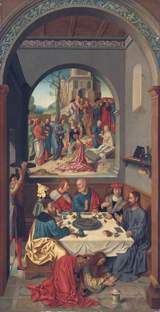
The connection to the day and this final version of the anointing is John’s “sacrament that wasn’t.”  John’s gospel doesn’t have a Eucharist, even though almost all the events of his gospel occur in what Christians now call Holy Week. The story John does tell of the last meal in the upper room isn’t “This is my body, this is my blood,” largely for reasons of John’s theology.  Instead, the story is of foot-washing, which perhaps not coincidentally is the anointing story as John tells it, following Luke’s variation.  Let’s start with John’s version:

Six days before Passover Jesus came to Bethany, where Lazarus lived, the one Jesus had brought back from the dead.  There they gave a dinner for him; Martha did the servince and Lazarus was one of those who ate with him. Mary brought a pound of expensive lotion and anointed Jesus' feet and wiped them with her hair. And the house was filled with the lotion's fragrance.  Judas Iscariot, the disciple who was going to turn him in, says, "Why wasn't this lotion sold? It would bring a year's wages, and the proceeds could have been given to the poor. (He didn't say this because he cared about the poor, but becasue he was a thief.  He was in charge of hte common purse and now and again wouild pilfer money from it.)

"Let her alone," Jesus said.  "Let her keep it for the time I am to be enbalmed.  There will always be poor around; but I won't always be around.

--John 12:1-8, SV

So that's it:  8 verses and done.  But the scene has shifted back to Bethany; the time is back to the days before Passover; and Jesus again refers to the act as a foreshadowing of his death.  But two very important elements have shifted, perhaps through Luke's lens:  now the perfume goes on Jesus' feet, and again, a woman wipes his feet with her hair.  Only this time the woman is named, so perhaps now we can tell this story "in remembrance of her," at least in the modern understanding of "remembrance."

It's interesting, the similiarities between this story and the stories in Matthew and Mark.  There aren't that many commonalities between John and the Synoptics.  John the Baptizer plays an important role in the gospels of Mark and Matthew, a role that reaches its zenith in Luke's gospel, where he begins with the appearance of Gabriel to John's father, Zechariah. In John's gospel the Baptizer appears as a bystander, someone who literally comments on Jesus as Jesus walks by.  No one in John's gospel gets to share center stage, however briefly, with Jesus.  John's gospel has no Sermon on the Mount (Luke)/Plain (Matthew), and precious few parables.  In the synoptics, Jesus' miracles are "acts of power" in the original Greek; in John's version they are "signs."  So the resurrection of Lazarus is a "sign" of Jesus' authority and power, and it is precisely that sign which leads to the crucifixion:

When the huge crowd of Judeans found out he was there, they came not only because of Jesus but also to see Lazarus, the one he had brought back from the dead.  so the ranking priests planned to put Lazarus to death, too, since because of him many of the Judeans were defecting and believing in Jesus.

John 12:9-11, SV

The "sign" of Lazarus was costing the priests their power; at least in John's narrative.  I mentioned before that the cleansing of the Temple seems to have been the historical impetus for the crucifixion.  That occurs just before Passover, a time of tension in Roman occupied Jerusalem.  John includes that story, in a few verses in chapter 2, almost immediately after the first "sign" at the wedding in Cana:

It was almost time for the Jewish Passover celebration, so Jesus went up to Jerusalem.  In the temple precincts he came upon people selling oxen and sheep and doves, and bankers were doing business there too.  He made a whip out of rope and drove them all out of the temple area, sheep, goats, oxen, and all; then he knocked over the bankers' tables, and set their coin flying.  And to the dove merchants he said, "Get these birds out of here! How dare you use my Father's house as apublic market."

(His disciples were reminded of the words of scripture: "Zeal for your house is eating me alive.")

John 2:13-17, SV

It's worth pointing out here, as a side bar, that merchants in the temple weren't necessarily evil.  Temple sacrifice was the point of coming to the Temple during Passover, and most travelers couldn't bring animals with them for the ritual.  They bought animals as they were able to afford:  from doves to ox.  Coins given to the Temple also couldn't bear the image of Caesar, both because humans are made in the image of God (and no images of God can be created), and because Caesar declared himself a "son of God," or divine in his rule over the empire. So the coins of Rome had to be exchanged at Temple for coins acceptable in the Temple.  The problem with both practices, from Jesus' point of view, is that they exploited the poor (like Jesus).  The cost of a dove was already a sacrifice for the poor traveler to Jerusalem coming to the Temple to worship the God of Abraham who taught Israel to think first of the care of the poor.  The exchange rate on Temple coins made money for the banker, and cost the poor, especially, a great deal.  Jesus' objection, in other words, is not pious;  he objects to the economic exploitation of people like him, the very people the God of Abraham professes to identify with.  So you can see why he's pissed off.

But the cost of the perfume Mary uses doesn't bother him.  There's no contradiction here; just a contrast.  And a consistency that keeps this version of the anointing at Bethany in line with those of Matthew and Mark.  Luke's is still the outlier; but that outlier finds echoes in John's version.

First, note that the disciples appear in the story in Mark and Matthew, but not in Luke.  And John, who likes to tell more concrete stories (the better to ground his long, abstract discourses by Jesus.  As one of my professors in seminary pointed out, John's Jesus sucks all the air out of the upper room.  Chapter 13 of John begins that event, with Jesus washing the feet of his disciples.  Chapter 18 begins with Jesus finally going to the garden, although he's barely there before Judas shows up to betray him.  The chapters in between are almost all a monologue by Jesus.), replaces Simon the leper/Pharisee with Lazarus (the better to connect the resurrection of Lazarus in chapter 11 to the plot against Jesus in chapter 12) and "the disciples" with Judas Iscariot.  John's character of Judas is the one we all think of as the betrayer, the Iago to Jesus' Othello (except Jesus is not nearly so naive about Judas, especially in John's gospel), the Judas familiar to us from "JCS" (except, again, John's Judas doesn't really have any redeeming virtues).  So Judas is clearly the antagonist in this little story; he is even a hypocrite, because he doesn't care about the poor or whether the mony would go to them.  He's just, in modern parlance, a "troll."

And Jesus' response is equally blunt.  It also lends itself most easily to the dismissal of concern for the poor I've heard from too many professed Christians:  that the poor will always be with us.  It's usually said as if that's not only a fact of life, but the desire of God that some be poor.  As punishment; as part of God's "plan"?  The reason scarcely matters.  The excuse for ignoring them and denying any responsibility for them, is all that matters.

In some ways the Johannine version of this story is the most attenuated, and it suffers from that loss of detail.  John is less concerned with this story than with incorporating it into his narrative because, like the crucifixion, it is a part of the story of the Nazarene that cannot be excluded.  Curiously, it is John's gospel that gives us the long discourse between Pilate and Jesus, the back and forth between the Governor of Judea and a peasant rabble-rouser (which makes it, historically, a highly unlikely event.  Imagine your governor bandying words in public, before TV cameras, with a condemned prisoner just before his execution.)  We owe a lot of what we think about the story of Jesus to John's embellishments.  But in the anointing story John reduces the events to a bare minimum:  now the woman is named:  Mary, the sister to Martha and to Lazarus.  So she is in her brother's home, and yet still serving Jesus at table.  An attenuated scandal since Jesus is above such matters, and the focus stays on him in John's version.  Do you see this woman? Well, don't; she really doesn't matter.  Even the detail of drying his feet with her hair, which now can be a sign of love and honor for what Jesus has done (resurrected her brother Lazarus), but which would also be scandalous (it's still a first century lap dance; and imagine it happening today.  Washing someone's feet is intimate enough.  Drying them with your own long hair?).  John steps over that quickly by shifting attention to Judas, and in the most negative way possible.  Jesus dismisses the whole thing, using it as a foreshadowing of his death.  He doesn't even acknowledge what she's done, or why, except to dismissively say she should save the perfume for his burial preparations.

So the story comes from Mark to Matthew, almost unaltered; and then undergoes a radical transformation in Luke.  Some of those physical changes make it to John's version, but John seems ready almost to discard it, as it's not a "sign" pointing to who Jesus is or what his authority is, and it's not a "teachable moment" allowing Jesus to talk on and on and on about the nature of God and humanity.  For John it's a narrative transition point between the more important story of Lazarus (a "sign" if ever there was one) and the movement of the story into Jerusalem and the "upper room" (the remainder of chapter 12 is Jesus again talking about the concept of "signs" and the narrative moving toward the foot-washing of chapter 13 and the captive audience of the disciples Jesus then lectures for five chapters).  It's like John knows he can't leave this story out, but doesn't really think much of it, himself.  It's a pebble in his narrative shoe that he drops off as soon as he is able.

What, then, do we get from all of this?  This simple story was so important to the gospel writers they all included it (the canonical gospels, I mean; not the non-canonical ones).  Luke alters it dramatically.  From his "Special Luke" source?  From his own interests in the story of Jesus of Nazareth?  For whatever reason, he puts it through a blender, changing time and place and persons, leaving out the disciples and followers so thoroughly it is obvious the woman with the jar is a stranger to everyone else in that room.  There's a reason Luke goes immediately from his anointing story to a catalogue of the women traveling with Jesus.  It may be one of them is the woman in the room, since they provide for Jesus' ministry out of their own resources, and undoubtedly the perfume, even if it didn't cost a year's wages, was very expensive.  Luke is drawing a line underneath the woman's identity, the fact she was a stranger before she entered the room; and the enticing possibility that she is a stranger no more, because Jesus told her she had shown great trust, and that trust had saved her.  Matthew and Mark intimate the woman is one of the group; and maybe that's why Luke says the women had resources to fund the ministry when offerings weren't enough.  Matthew and Mark make it clear this is an anointing:  the perfume goes on the head, like the oil on the head of the king, or as in Psalm 133:

{A Song of degrees of David.} Behold, how good and how pleasant it is for brethren to dwell together in unity!

2It is like the precious ointment upon the head, that ran down upon the beard, even Aaron's beard: that went down to the skirts of his garments;

3As the dew of Hermon, and as the dew that descended upon the mountains of Zion: for there the LORD commanded the blessing, even life for evermore.

That is an anointing.  Luke shifts not only time and place (not Bethany; and far earlier than the fateful Passover events) and location (feet, not head).  Is it even an anointing anymore?  John restores (follows?) tradition, by calling the act an anointing, but Mary aims for the feet, not the head.  And in Mary we finally identify a woman (although no one tells that story in memory of her) and a reason for her gratitude (her brother has been restored to life).  John also includes a lovely, concrete detail: "And the house was filled with the lotion's fragrance."  A metaphor?  Or merely a physical detail about the nature of perfume?  Either way it's wiped aside by the actions of Judas and the blunt retort of Jesus.  None of this really interests John; but what's always been interesting to me is why John includes this story; and why he shifts to location to Jesus' feet, even as he keeps up with the tradition of the house being in Bethany, and the disciples (well, Judas) being present.

In "JCS," the anointing story turns into the emotional heart of the story.  Immediately after Judas' lament "Heaven on their minds" we meet the disciples with "What's the Buzz?"  And among them is Mary Magdalene and the women (as a backing chorus) who sing "Let me try to cool down your face a bit", which allows Judas back in with "Strange Thing, Mystifying":

It seems to me a strange thing, mystifying

That a man like you can waste his time on women of her kind.

Yes, I can understand that she amuses,

But to let her kiss you, stroke your hair, is hardly in your line.

It's not that I object to her profession,

But she doesn't fit in well with what you teach and say.

It doesn't help us if you're inconsistent.

They only need a small excuse to put us all away.

That's John crossed with Luke.  The objection is in Judas' mouth; but the objection itself, however obliquely expressed, is that of Simon the Pharisee.  Jesus has already accepted Mary's attention:

Mary, ooh, that is good

How you prattle through your supper,

Where and when and who and how

She alone has tried to give me, 

what I need right here and now.

Which sounds more like Luke than anybody.  This story recurs with the famous love song "I Don't Know How To Love Him."  Again Mary soothes Jesus, upset by the events of the march into Jerusalem (Simon Zealotes tells Jesus to use this power for glory), the cleansing of the Temple ("My Temple should be a house of prayer!/But you have made it a den of thieves!") and the followers ("Christ you know I love you/Did you see I waved?/I believe in you and God/so tell me that I'm saved!") and the beggars and diseased ("See my eyes, I can hardly see/See my legs, I can hardly walk/See my purse, I'm a poor, poor man/See my toungue I can hardly talk") to whom Jesus finally screams "HEAL YOURSELVES!"  And then Mary is back, offering "Myrrh for your hot forehead/calm you and anoint you" as she soothes him to sleep, and then sings her song of confused, bewildered love.  It isn't the song of the woman in Luke's version of the anointing; but it could be ours, if we examine that story carefully, if we take what Luke gives us, seriously.

And here's an interesting thing from the rock opera, too.  Judas says, in the first song, that Jesus has begun to matter more than the things he says.  This is an old discussion in Christianity.  The earliest gospels were likely "sayings" gospels.  Some of those are conjectural:  "Q" is thought to have been a collection of sayings of Jesus.  There's also presumably a "signs" gospel behind John's version.  The Gospel of Thomas is the most famous extant example of these kinds of gospels.  And it’s arguable, especially after the crucifixion, especially today, that Christians honor Jesus more in who he was than in what he taught.  Judas, in other words, is on to something.  Gallup reports that church attendance in America is declining, and thinks this marks something in American cultural history.  Perhaps; or perhaps it just marks a new social willingness to admit you don't go to church anymore.  The decline in attendance has been obvious to pastors and churches for more than half a century now.  Gallup thinks it’s discovered something but, again, the world is just catching up to the church.  And still we're a long way from the early 20th century.  This fight between who Jesus was, and what Jesus said (and which matters more) is a very old one, in other words; and if the latter is starting to prevail over the former (not to its extinguishment, but with a renewed emphasis on the latter above the former), perhaps that's all to the good.  Perhaps that's even the Holy Spirit (Luke) at work.  Perhaps we should let that fragrance fill the house (John).

Luke's story is, in my understanding, a powerful story about grace and salvation, forgiveness and redemption.  We want things to be earned, especially something as important as grace and acceptance (acceptance often includes some manner of forgiveness), but we want these blessings purchased with some coin.  For me that coin should be as small as possible, a mere mite, because surely I am deserving of forgiveness and grace, especially if I can't possibly pay for it.  For you, however?  Well, I'm not sure I want you getting something for nothing.  That seems unfair.  Maybe if you were to show a little love, you'd be deserving.  But to be deserving and to show some love, surely you have to have some prompting to respond to.  So would it work like this?

"I walked into your house and you didn't offer me water for my feet; yet she has washed my feet with her tears and dried them with her hair. You didn't offer me a kiss, but she hasn't stopped kissing my feet since I arrived. You didn't anoint my head with oil, but she has anointed my feet with myrrh. For this reason, I tell you, her sins, many as they are, have been forgiven, as this outpouring of her love shows. But the one who is forgiven little shows little love."

But that's an ouroboros, a Moebius strip; it doesn't seem to have a beginning or an end, and if you walk along it, it has only one surface.  There's no way in, no point at which you can begin your payment for that grace.  How do you earn it, then?

Precisely.  Begin there.

On what condition does goodness exist beyond all calculation? On the condition that goodness forget itself, that the movement be a movement of the gift that renounces itself, hence a movement of infinite love. Only infinite love can renounce itself and, in order to become finite, become incarnated in order to love the other, to love the other as a finite other. This gift of infinite love comes from someone and is addressed to someone; responsibility demands irreplaceable singularity.

Jacques Derrida, The Gift of Death, tr. David Wills (Chicago: University of Chicago Press, 1995), pp. 50-51.

These conflicts and disputes among you, where do they come from? Do they not come from your own cravings that are at war within you? You want something and do not have it, so you commit murder. And you covet something and cannot obtain it; so you engage in disputes and conflicts. You do not have because you do not ask. You ask and do not receive, because you ask wrongly, in order to spend what you get on your pleasures. Adulterers! Do you now know that friendship with the world is enmity with God? Therefore whoever wishes to be a friend of the world becomes an enemy of God. Or do you suppose that it is for nothing that the scripture says, "God yearns jealously for the spirit that he has made to dwell in us"? But he gives all the more grace; therefore it says, "God opposes the proud, but gives grace to the humble."

James 4:1-6

I am reading (Simone Weil's) essays as a part of my Lenten reading...She says that we "...must experience every day, both in the spirit and the flesh, the pains and humiliations of poverty...and further we must do something which is harder than enduring in poverty, we must renounce all compensations: in our contacts with the people around us we must sincerely practice the humility of a naturalized citizen in the country which has received us."

I keep reminding the young people who come to work with us that they are not naturalized citizens...They are not really poor. We are always foreigners to the poor. So we have to make up for it by "renouncing all compensations..."

Dorothy Day, from The Dorothy Day Book, p. 11. 

Maundy Thursday 2024: Dirty Feet and the Sacrament That Wasn't


Exodus 12:1-4, (5-10), 11-14

12:1 The LORD said to Moses and Aaron in the land of Egypt:

12:2 This month shall mark for you the beginning of months; it shall be the first month of the year for you.

12:3 Tell the whole congregation of Israel that on the tenth of this month they are to take a lamb for each family, a lamb for each household.

12:4 If a household is too small for a whole lamb, it shall join its closest neighbor in obtaining one; the lamb shall be divided in proportion to the number of people who eat of it.

12:5 Your lamb shall be without blemish, a year-old male; you may take it from the sheep or from the goats.

12:6 You shall keep it until the fourteenth day of this month; then the whole assembled congregation of Israel shall slaughter it at twilight.

12:7 They shall take some of the blood and put it on the two doorposts and the lintel of the houses in which they eat it.

12:8 They shall eat the lamb that same night; they shall eat it roasted over the fire with unleavened bread and bitter herbs.

12:9 Do not eat any of it raw or boiled in water, but roasted over the fire, with its head, legs, and inner organs.

12:10 You shall let none of it remain until the morning; anything that remains until the morning you shall burn.

12:11 This is how you shall eat it: your loins girded, your sandals on your feet, and your staff in your hand; and you shall eat it hurriedly. It is the passover of the LORD.

12:12 For I will pass through the land of Egypt that night, and I will strike down every firstborn in the land of Egypt, both human beings and animals; on all the gods of Egypt I will execute judgments: I am the LORD.

12:13 The blood shall be a sign for you on the houses where you live: when I see the blood, I will pass over you, and no plague shall destroy you when I strike the land of Egypt.

12:14 This day shall be a day of remembrance for you. You shall celebrate it as a festival to the LORD; throughout your generations you shall observe it as a perpetual ordinance.

Psalm 116:1-2, 12-19

116:1 I love the LORD, because he has heard my voice and my supplications.

116:2 Because he inclined his ear to me, therefore I will call on him as long as I live.

116:12 What shall I return to the LORD for all his bounty to me?

116:13 I will lift up the cup of salvation and call on the name of the LORD,

116:14 I will pay my vows to the LORD in the presence of all his people.

116:15 Precious in the sight of the LORD is the death of his faithful ones.

116:16 O LORD, I am your servant; I am your servant, the child of your serving girl. You have loosed my bonds.

116:17 I will offer to you a thanksgiving sacrifice and call on the name of the LORD.

116:18 I will pay my vows to the LORD in the presence of all his people,

116:19 in the courts of the house of the LORD, in your midst, O Jerusalem. Praise the LORD!

1 Corinthians 11:23-26

11:23 For I received from the Lord what I also handed on to you, that the Lord Jesus on the night when he was betrayed took a loaf of bread,

11:24 and when he had given thanks, he broke it and said, "This is my body that is for you. Do this in remembrance of me."

11:25 In the same way he took the cup also, after supper, saying, "This cup is the new covenant in my blood. Do this, as often as you drink it, in remembrance of me."

11:26 For as often as you eat this bread and drink the cup, you proclaim the Lord's death until he comes.

John 13:1-17, 31b-35

13:1 Now before the festival of the Passover, Jesus knew that his hour had come to depart from this world and go to the Father. Having loved his own who were in the world, he loved them to the end.

13:2 The devil had already put it into the heart of Judas son of Simon Iscariot to betray him. And during supper

13:3 Jesus, knowing that the Father had given all things into his hands, and that he had come from God and was going to God,

13:4 got up from the table, took off his outer robe, and tied a towel around himself.

13:5 Then he poured water into a basin and began to wash the disciples' feet and to wipe them with the towel that was tied around him.

13:6 He came to Simon Peter, who said to him, "Lord, are you going to wash my feet?"

13:7 Jesus answered, "You do not know now what I am doing, but later you will understand."

13:8 Peter said to him, "You will never wash my feet." Jesus answered, "Unless I wash you, you have no share with me."

13:9 Simon Peter said to him, "Lord, not my feet only but also my hands and my head!"

13:10 Jesus said to him, "One who has bathed does not need to wash, except for the feet, but is entirely clean. And you are clean, though not all of you."

13:11 For he knew who was to betray him; for this reason he said, "Not all of you are clean."

13:12 After he had washed their feet, had put on his robe, and had returned to the table, he said to them, "Do you know what I have done to you?

13:13 You call me Teacher and Lord--and you are right, for that is what I am.

13:14 So if I, your Lord and Teacher, have washed your feet, you also ought to wash one another's feet.

13:15 For I have set you an example, that you also should do as I have done to you.

13:16 Very truly, I tell you, servants are not greater than their master, nor are messengers greater than the one who sent them.

13:17 If you know these things, you are blessed if you do them.

13:31b When he had gone out, Jesus said, "Now the Son of Man has been glorified, and God has been glorified in him.

13:32 If God has been glorified in him, God will also glorify him in himself and will glorify him at once.

13:33 Little children, I am with you only a little longer. You will look for me; and as I said to the Jews so now I say to you, 'Where I am going, you cannot come.'

13:34 I give you a new commandment, that you love one another. Just as I have loved you, you also should love one another.

13:35 By this everyone will know that you are my disciples, if you have love for one another."


Paul doesn't call it a commandment, or a sacrament.  He just passes on to the church in Corinth what he received from the Lord (where and how is never clear.  Biblical scholars wonder about dangling threads like this, and tug at them constantly).  John mentions a commandment:  "that you love one another.  Just as I have loved you, you also should love one another."  Typical for the Johannine narrative, what that means in practice is entirely unclear.  Jesus speaks in confusing parables and makes pronouncements that carry far more under the surface than appears on the surface ("Your faith has saved you; go in peace."  Luke 7:50).  But John doesn't record any parables, at all.  Instead it is Jesus speaking almost gnostically (how, Nicodemus wonders, can one be "born again."  Jesus makes it clear you either understand him, or you don't.), and here, as usual, he makes a sweeping statement with nothing to back it up.

Except.....

This is one of the few times in John's gospel that Jesus actually does something.  He raises Lazarus from the tomb, he changes water into wine, he speaks and God answers directly.  But none of those actions is comparable to this:  he doesn't talk about the servant role; he literally embodies it. Master of his disciples, head of the table, he takes a bowl and a towel and washes their feet.  The feet of men who have been walking in sandals all day in dust and dirt.  Remember what Jesus said to Simon the Pharisee?

"Do you see this woman? I walked into your house and you didn't offer me water for my feet; yet she has washed my feet with her tears and dried them with her hair. You didn't offer me a kiss, but she hasn't stopped kissing my feet since I arrived. You didn't anoint my head with oil, but she has anointed my feet with myrrh. (Luke 7:44b-46, SV)

That's a servant's job.  And it's not one any of us would take up willingly, or accept willingly.  I tried one year to initiate the footwashing service which is allowed, even encouraged in Protestant traditions, on Maundy Thursday.  A few of my church council members were willing to participate, and I had the bowl and towel.  It may be a profoundly moving religious ritual; but unless you are used to it, it is uncomfortable and awkward.  Much like it must have been the very first time it was done for the followers of Christ.

This is Jesus personally acting, and in all of John's gospel, indeed in all of the gospels, there is nothing comparable to it.  Jesus wept at the news of the death of Lazarus, which in John proves Jesus is human (in much of John's narrative Jesus is almost inhumanly abstract, and all but nails himself to the cross.  He doesn't die in agony, he pretty much says "Okay, that's all," and passes on.)  This is Jesus being supremely human, and supremely God.  This is God's weakness being stronger than human strength.  This is what Holy Week should really come down to, and all the rest be anti-climax against it.  It should be.  It isn't.  This is the sacrament that wasn't.  This is the command we still can't quite get around to.

The passover in Exodus is full of details and requirements, and that's actually a good thing.  Ritual demands acts that can and must be repeated to keep the ritual whole, which is almost to say "holy."  Do you open your presents on Xmas Day?  Or Xmas Eve?  First thing in the morning, or after breakfast?  Maybe after lunch, when the family has gathered?  Do you try to do Christmas the same way ever year?  Are the small details important?  No, there's nothing wrong with how the Passover is ordered for memory. The contrast is the simplicity of the footwashing.  Maybe that's why it fails.

Paul gives us a ritual, one most churches follow almost word for word from this passage in Corinthians.  All the words of institution are there, and they are protected jealously.  There is a formula for Christian baptism, and by common agreement it must include the trinitarian formula of being in the name of the Father, the Son, and the Holy Spirit.  Those words; no others.  The words of institution for the eucharist are there, in Paul's words; and you cannot use them for elements other than bread and wine (like, say, hot chocolate and cinnamon rolls on Xmas morning in a UCC church), because those words are "holy words," and not to be used lightly or wrongly.

But footwashing?  What ritual do we have for that?  We don't.  Catholics have, if memory serves, 7 sacraments (baptism, eucharist, marriage, death, confession. I'm probably wrong on some of those); Protestants have only two (Baptism, eucharist).  If the words are not right, if the formula is not preserved, the sacrament isn't a sacrament.  No one has a ritual for footwashing.  Yes, the Pope does it, if he is physically able.  The monarchs did it in Europe, at least in the Middle Ages.  Even then it soon shifted from actually washing feet to simply giving gifts to those whose feet were not washed.  It never held on very long.   I tried it once, on a Maundy Thursday, with my church council members in the Maundy Thursday service.  It was very hard for all of us; I mean very hard.  And it didn't seem to mean much to anyone there, except discomfort.  That's the nature of rituals:  if they are not familiar, they are simply awkward and off-putting.   They gain their power from familiarity, even though they can lapse into roteness and lose their power again.  But when they are awkward and invasive and almost embarrassing, they are just an obstacle.  Footwashing  is too intimate, too personal.  If it was meant by John to be linked to that command that we love one another as Jesus loved us, if it is connected to washing our feet as Jesus connected it to an act of love in Luke , then we have failed this command, and rejected this commandment.

Love is so much easier when it remains in our hearts and minds, rather than when it is shown by what we put in our hands.  How we literally and physically show it, in other words. Thinking is easy; doing is always another matter.

Wednesday, March 27, 2024

🪤

Judge Lewis Kaplan had ordered Trump not to speak about Carroll’s past relationships, sexual experiences or orientation and he could not debate about whether sexually abused or raped her. "These prohibitions hinged on the fact that he had already been found liable for defamation," Law&Crime's report stated. 
Kaplan went on to say that “the jury heard with their own ears and saw with their own eyes exactly how Trump has continued to defame Carroll since the Carroll II verdict and his mid-trial promise to defame her ‘a thousand times.'” 
And the jury watched Trump carry out this promise in real time, treating the courtroom like a campaign event,” Carroll's lawyer wrote. 
“Given this pattern of behavior, Carroll understandably had serious concerns that Trump would continue in his attempts to cast into doubt whether he sexually assaulted and defamed Carroll, and would do so in front of the jury. 
"That danger seemed particularly acute if Trump himself elected to testify — since the Carroll II verdict, Trump had repeated his defamatory statements about Carroll in multiple forums and included references to topics that this Court had ruled inadmissible in the upcoming trial. 
"And during this intervening period, Trump had also testified in a different lawsuit, where he repeatedly defied the judge’s orders in that case,” Kaplan wrote.
Much of this is in the court record, which other judges can easily take notice of. Meaning Trump’s campaign attitude toward the courts is not going unnoticed, and can even be part of the basis for subsequent orders in unrelated courts. This stuff is deep minutiae that will never get to the jury or matter to the electorate. But the pattern is damning. And it is damning because Trump is doing it to judges. Trump thinks (I use the term loosely) that because the judge can’t gag him, he’s winning. But judges decide criminal sentences; and they can remember what an ass Trump was, and sentence accordingly. And they can act cumulatively. The more Trump gathers convictions and insults the integrity of judges, the more their sentences reflect his actions and justify the sentences; especially when it comes to the question of jail now, or later.

Trump winds up in jail, sooner or later. And he’ll have definitively put himself there.

Holy Week Follies

I’m going to set my cynicism about people in the pews aside and say this is exactly right. How many heathens are going to buy that? And if Trump is so rich: Why is he hawking Bibles? Or still doing this? Could it be clearer Trump has no idea what “Holy Week” means or what Good Friday commemorates (“Hey, it’s good, right?” 🤙)? Then again, I guarantee most of his evangelical supporters don’t, either. (Bonus points there for citing “Two Corinthians.”)

Pretty Sure This Will Never Get Old

Of Glass Houses And Stones

And how quickly did you fire Don Lemon after the interview?

Judicial Judgemanship

Justice Samuel Alito, one of the most doggedly devoted members of the bench to reverse engineering even doily-like arguments into his preferred outcome, tried valiantly to put a gloss on the anti-abortion case. 
Is the FDA “infallible?” he challenged the government. Isn’t it “obvious” that lifting multiple restrictions at once may have a different effect in combination, he mused, parroting the anti-abortion group’s argument. He sneered that the manufacturer of branded mifepristone’s injury is just monetary — a refreshingly dismissive take on corporate interest from a right-wing judge. 
“So your argument is it doesn’t matter if FDA flagrantly violated the law, it didn’t do what it should have done, it endangered the health of women, it’s just too bad, nobody can sue in court?” he asked U.S. Solicitor General Elizabeth Prelogar. But the fight went out of Alito as the arguments went on and it became clear that his peers were, at the least, highly suspect of the legal underpinnings of the challenge.

More and more I’m convinced Alito leaked his Dobbs decision so he could take an early victory lap. That argument this week would embarrass a law student in moot court, and yet it’s made by a senior member of the highest court in the land.

Pretty sure the “fight went out of Alito” after this:

“So you were asked if the agency is infallible, and I guess I'm wondering about the flip side, which is do you think that courts have specialized scientific knowledge with respect to pharmaceuticals, and as a company that has pharmaceuticals, do you have concerns about judges parsing medical and scientific studies?" [Justice Ketanji Brown] Jackson said. 
"I think we have significant concerns about that, and there are two amicus briefs from the pharmaceutical industry that expand on why exactly that's so concerning for pharmaceutical companies who do depend on FDA's gold standard review process to approve their drugs and then to be able to sell their products in line with that considered judgment," Ellsworth replied.
Alito really needs to stay in his lane. Or resign. Resign would be better. Better yet is Congress passing a law that the resignation age of federal judges apply to the Supremes as well. Lock their chambers if they don’t comply.

The Supremes are gettin’ too big for their britches. Time Congress reminded them they’re an Art. III institution, not Art. IA.

What Would Donald Do?

Trump couldn’t get an infrastructure bill passed. Biden’s success has some people wanting to eat their cake and have it, too. Some people are going to find out there’s such a thing as being too hungry.

Democrats Are Overperforming

“My Imprisonment, Is It Possible?”

"Judge Juan Merchan, who is suffering from an acute case of Trump Derangement Syndrome... has now issued another illegal, un-American, unConstitutional 'order,' as he continues to try and take away my Rights," Trump complained. 
"This Judge, by issuing a vicious 'Gag Order,' is wrongfully attempting to deprive me of my First Amendment Right to speak out against the Weaponization of Law Enforcement, including the fact that Crooked Joe Biden, Merrick Garland, and their Hacks and Thugs are tracking and following me all across the Country, obsessively trying to persecute me, while everyone knows I have done nothing wrong!" 
Trump also singled out Merchan's daughter for posting "a picture of me behind bars." 
"So, let me get this straight, the Judge's daughter is allowed to post pictures of her 'dream' of putting me in jail, the Manhattan D.A. is able to say whatever lies about me he wants, the Judge can violate our Laws and Constitution at every turn, but I am not allowed to talk about the attacks against me, and the Lunatics trying to destroy my life, and prevent me from winning the 2024 Presidential Election, which I am dominating?" he asked.
Merchan took into account Trump’s statements about other courts in his civil cases. Trump has nothing left now but criminal cases, and those judges can do the same in deciding his punishment.

In other words, Trump is talking himself into a jail cell, in this case or the next one, and the one after that.

I guess that $4 billion in Truth Social money will buy a lot of cigarettes.

Morning Media Notes

Not exactly a medua note, but: He’s so close to getting it.

Dear Sean Hannity:

Now say something about how Dominion voting machines are untrustworthy. Do it on your program.  Call it a celebration of free speech.

This is still America, right?

Holy Wednesday 2024


 Isaiah 50:4-9a

50:4 The Lord GOD has given me the tongue of a teacher, that I may know how to sustain the weary with a word. Morning by morning he wakens-- wakens my ear to listen as those who are taught.

50:5 The Lord GOD has opened my ear, and I was not rebellious, I did not turn backward.

50:6 I gave my back to those who struck me, and my cheeks to those who pulled out the beard; I did not hide my face from insult and spitting.

50:7 The Lord GOD helps me; therefore I have not been disgraced; therefore I have set my face like flint, and I know that I shall not be put to shame;

50:8 he who vindicates me is near. Who will contend with me? Let us stand up together. Who are my adversaries? Let them confront me.

50:9a It is the Lord GOD who helps me; who will declare me guilty?

Psalm 70

70:1 Be pleased, O God, to deliver me. O LORD, make haste to help me!

70:2 Let those be put to shame and confusion who seek my life. Let those be turned back and brought to dishonor who desire to hurt me.

70:3 Let those who say, "Aha, Aha!" turn back because of their shame.

70:4 Let all who seek you rejoice and be glad in you. Let those who love your salvation say evermore, "God is great!"

70:5 But I am poor and needy; hasten to me, O God! You are my help and my deliverer; O LORD, do not delay!

Hebrews 12:1-3

12:1 Therefore, since we are surrounded by so great a cloud of witnesses, let us also lay aside every weight and the sin that clings so closely, and let us run with perseverance the race that is set before us,

12:2 looking to Jesus the pioneer and perfecter of our faith, who for the sake of the joy that was set before him endured the cross, disregarding its shame, and has taken his seat at the right hand of the throne of God.

12:3 Consider him who endured such hostility against himself from sinners, so that you may not grow weary or lose heart.

John 13:21-32

13:21 After saying this Jesus was troubled in spirit, and declared, "Very truly, I tell you, one of you will betray me."

13:22 The disciples looked at one another, uncertain of whom he was speaking.

13:23 One of his disciples--the one whom Jesus loved--was reclining next to him;

13:24 Simon Peter therefore motioned to him to ask Jesus of whom he was speaking.

13:25 So while reclining next to Jesus, he asked him, "Lord, who is it?"

13:26 Jesus answered, "It is the one to whom I give this piece of bread when I have dipped it in the dish." So when he had dipped the piece of bread, he gave it to Judas son of Simon Iscariot.

13:27 After he received the piece of bread, Satan entered into him. Jesus said to him, "Do quickly what you are going to do."

13:28 Now no one at the table knew why he said this to him.

13:29 Some thought that, because Judas had the common purse, Jesus was telling him, "Buy what we need for the festival"; or, that he should give something to the poor.

13:30 So, after receiving the piece of bread, he immediately went out. And it was night.

13:31 When he had gone out, Jesus said, "Now the Son of Man has been glorified, and God has been glorified in him.

13:32 If God has been glorified in him, God will also glorify him in himself and will glorify him at once.

We keep running up on these personal pronouns. Isaiah uses it; so does the Psalmist. It’s easy to misread Isaiah, to think the “I” there is a person; but hear it as the nation of Israel, the children of Abraham, the party to the covenant. That actually makes more sense. Israel is the light of the world, not the prophet. And the Psalms?  We read those so often as personal prayers; and that's not a false reading.  But consider them as corporate prayers, the prayers of worshippers in a liturgy, and that "I" becomes the collective "we," the people speaking as one, but not as individuals. 

So the Psalm is about God's deliverance; a deliverance the Psalmist is praying for, but expecting nonetheless; is even resting on, secure in trust in God.  And that deliverance is for the people, for everyone; not just for me, myself, an "I". And the passage from the Hebrews is about community, the "cloud of witnesses" which surrounds us and supports us and proves to us that we are not alone, no one is ever alone.  Isaiah is full of the passionate trust that leads to vindication, because if the Lord is with you, who can stand against you?  And if God is not with you, you are wholly alone.  But again, the "you" there is collective, not individual. And the story from John is about betrayal by Jesus' closest friends; he stands alone, soon to be abandoned by all; but it in that betrayal is the glorification of the Son of Man and of God.

But how is the kingdom of heaven like that?

Wittgenstein said death is the only experience of life which is not lived through.  Tolstoy in the 19th century, and the morality play "Everyman" in the 15th century, dramatized that death is experienced by each of us, alone; no one can do it for us, or with us.  Death may bring our community together to mourn, but they mourn for themselves.  We die, each of us, alone.  But we live in community.  We live as a part of the whole. When we die, the community continues; but we die alone.  Which is better? 

Even the story of Judas here (probably an invented name, one linked to "Judah" and so to "Jews".  Crossan, among others but I remember Crossan most strongly, wrote a short book on the slander of the invented name "Judas."  It isn't a name recorded anywhere in ancient literature except in the gospels, which indicates it was invented to make clear the onus for betrayal was on the people of Judea, not the Romans.  Which in a first-century context makes sense:  the people of Judea had no political/military (they were entirely synonymous) power; the Romans did.  The Romans could crucify you, after all; the Judeans couldn't.) is a story of the community v. the individual. If the gospels spoke plainly about who was responsible for crucifying Jesus, they’d have to squarely blame Rome. That would be too provocative, and, as Jackson Browne said, they’d get the same as the rebel Jesus. Those with the power to kill you don’t like rebels. Judas acts selfishly (indeed, in John's version Judas acts because Satan enters him; which makes Judas a puppet on strings, nothing more), yet it serves the glorification of Jesus and God.

Me, myself, an "I".  Who am I, if not a member of a community?  How odd that community which offers life, must find its origin, its spark, its flashpoint, in death.  We are the people who worship the crucified God.

Tuesday, March 26, 2024

Today In Trump

I expect all references to money to be printed in gold leaf. A fool and his money, etc., etc., etc. And while I have you here: The only language missing is the promise to "repeal and replace" the ACA, which Trump is hoping you forget until after November of this year.  There's absolutely no change here.Except Trump in decline:

In case you missed it today:
So the judge responded: Raising the point that Trump's never faced a criminal trial before: And that was preceded by an order warning Trump's counsel not to Fuck Around, or they'll Find Out:
"This Court advises counsel that it expects and welcome zealous advocacy and creative lawyering. However, the Court also expects those advocates to demonstrate the proper respect and decorum that is owed to the courts and its judicial officers and to never forget that they are officers of the court. As such, counsel is expected to follow this Court’s orders. As such, “a court of record has power to punish for a criminal contempt, a person guilty of . . . [w]illful disobedience to its lawful mandate.” This Court emphasizes that it hopes for and fully expects zealous advocacy from counsel as well as spirited contribution from witnesses and parties alike. Nonetheless, the Court expects that the line between zealous advocacy and willful disregard of its orders will not be crossed."
Only Bibles endorsed by Trump are real American Bibles. I’d like to believe this means evangelicals will finally drop Trump like a bad habit; but I’m not as naive as Russell Moore.

Bridge Brain Collapse

So, not the border? Or Covid? Or a cyber-attack? It’s not over until Elmo calls the rescuers “pedos.” And tries to send a Cyber Truck into the river for rescue.

Money Money Money Money 💸

If you can't beat 'em, sue 'em!

With the most litigious man in the history of the planet, who has been involved as plaintiff or defendant in over 4,200 lawsuits in his lifetime, now in complete control of the Republican National Committee, it is gearing up to spend an unprecedented amount of money it raises this year on pre and post-election "integrity" challenges. The RNC is setting aside a significant pool of money it is raising this year to fund election lawsuits and challenges rather than political campaigns. 

Their team of lawyers will now be led by Trump lawyer, former OAN host, and crackpot election fraud conspiracy theorist Christina Bobb, who mused before the 2022 midterms that a Republican House of Representatives could overturn the 2020 election and restore Trump to the presidency in 2023. Bobb has been brought into the RNC off the Trump PAC payroll to serve as "Senior Counsel for Election Integrity."
Christina Bobb in a nutshell (er, tweet):
Follow the money:

With Christina Bobb leading a team of conspiracy theorists with access to the RNC's checkbook, it is likely that we will see a cornucopia a lawsuits and challenges of "fraud" being launched all across the country. Additionally, it is highly likely with Trump presently spending an estimated $200,000 a day in legal fees, which will only get worse as his criminal cases and civil appeals ramp up, that RNC money will continue to be siphoned off to fund Trump's Save America PAC.
💸

Wonder if they can get the billionaires to fund this?  💸
Billionaire hedge fund founder John Paulson was involved in the behind-the-scenes effort by donors concerned about Trump's legal woes and looking to help provide money toward the bond, two of the sources told Reuters. Oil and gas magnate Harold Hamm was also involved, one of those sources said.

Are they trying to raise the $175 million?  Because I doubt Trump has it.  Note:  if he gets it, the court monitor will know about it, and where it came from, and where it's going.  Those billionaires may not want to talk to reporters:

Paulson, the founder of Paulson & Co, did not immediately respond to requests for comment. Reached by phone and asked about his involvement, Hamm, the founder of oil company Continental Resources, appeared to hang up. A spokesperson for Hamm did not respond to requests for comment.

But their donations will be made public nonetheless.  And if they are considered to be political contributions in kind, that amount of money will be under a great deal of scrutiny.  Like:  are they political donations?

Donors helping to pay for Trump's bonds could draw scrutiny from election regulators or federal prosecutors if the benefactors were to give Trump amounts exceeding campaign contribution limits.
While the payment would not be a direct donation to Trump's campaign, federal laws broadly define political contributions as "anything of value" provided to a campaign.

Nor does the bond make a great deal of difference.  Contrary to Trump's rantings, the Appellate Division has only ruled on the statute of limitations as it applies to some defendants (mainly Ivanka, who was dropped), and there's no indication they'll overrule Engoron or even reduce the judgment.  The order they did issue merely says everything about the judgment is held in abeyance for 10 more days, pending Trump filing the reduced bond.  The only part they didn't suspend is the court monitor and her new authority.  So these billionaires either want to piss their money away, or they think they know where Trump lives.  And if they want to chase Trump for their pound of flesh after the appeals are over, that's fine with me.  😎

Then And Now

Four years ago:

Happy Holy Week!

Two years ago it was "HAPPY GOOD FRIDAY TO ALL!"  I'd say this was an improvement, except now he's hawking a Bible with his name on it.

Better Get Your Trump Bible, Then!

Just In Time For Easter 🐣!

The authorized God Bless The USA King James Version. The language Jesus spoke!

I only made up part of that.
Trump said, "We have to bring Christianity back into our lives and and back into what will be again a great nation."
Jews don’t count because they’ve already abandoned their religion by not voting for Trump. And non-Christians ain’t real Americans, anyway.

This is the only Bible endorsed by Trump. It includes the Constitution, Bill of Rights, Declaration of Independence, and the Pledge of Allegiance. Out founding documents! But caveat emptor: the Trump Bible has no refund policy.

Praise Jesus and keep those mail-in ballots away from the ballot box!🗳️