Showing posts sorted by relevance for query alamo. Sort by date Show all posts

Friday, June 11, 2021

"Tax-Funded Curricula"


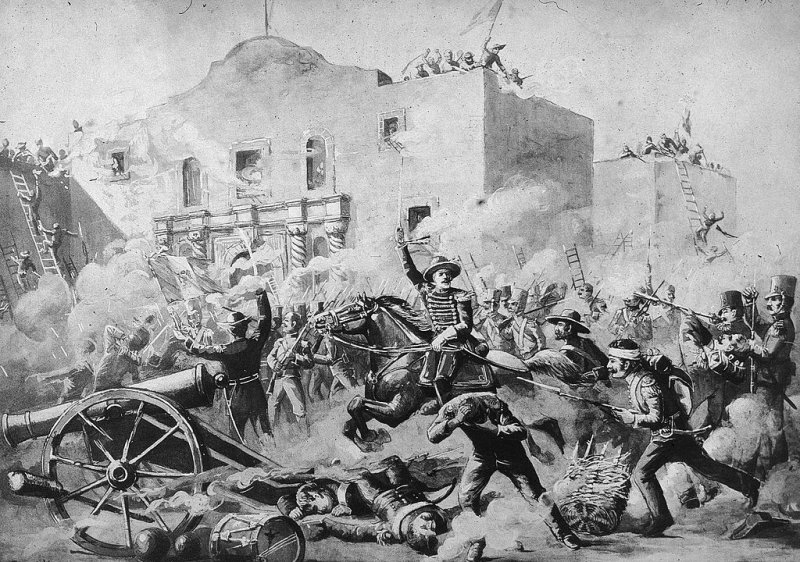
Think of this as a footnote to my previous post and the issue of "tax-payer funded curricula."  Because I went to school in Texas (up until I entered seminary in a suburb of St. Louis, MO), and I learned as holy writ that, but for the brave actions of William B. Travis and Davy Crockett and others, we would still be "enslaved" by Mexico.  The Alamo was even run as a shrine, not the mission it was in the 19th century, but a shrine to Texas independence.  I remember the picture that hung above the entry, of John Wayne as Davy Crockett being speared by a number of Mexican soldiers as he mowed them down with... a flag?  A spear?  A sword?  Anyway, it was an epic and sweeping vision, a donation from "The Duke" to the site, a painting of a scene from the movie he made about the battle.

Even as a child I knew that was complete, ahistorical bullshit.  Nobody really knew how Crockett died, I'd learned.  There weren't any survivors, were there?  Anyway, we knew he'd died bravely, as did everybody at the Alamo.

Turns out we were wrong about everything:

 Start with the Alamo. So much of what we “know” about the battle is provably wrong. William Travis never drew any line in the sand; this was a tale concocted by an amateur historian in the late 1800s. There is no evidence Davy Crockett went down fighting, as John Wayne famously did in his 1960 movie The Alamo, a font of misinformation; there is ample testimony from Mexican soldiers that Crockett surrendered and was executed. The battle, in fact, should never have been fought. Travis ignored multiple warnings of Santa Anna’s approach and was simply trapped in the Alamo when the Mexican army arrived. He wrote some dramatic letters during the ensuing siege, it’s true, but how anyone could attest to the defenders’ “bravery” is beyond us. The men at the Alamo fought and died because they had no choice. Even the notion they “fought to the last man” turns out to be untrue. Mexican accounts make clear that, as the battle was being lost, as many as half the “Texian” defenders fled the mission and were run down and killed by Mexican lancers.

Nor is it at all clear that the Alamo’s defenders “bought time” for Sam Houston to raise the army that eventually defeated Santa Anna at the Battle of San Jacinto the following month. Santa Anna had told Mexico City he expected to take San Antonio by March 2; he ended up doing so on March 6. In the end, the siege at the Alamo ended up costing him all of four days. Meaning the Alamo’s defenders, far from being the valiant defenders who delayed Santa Anna, pretty much died for nothing.

Oh, that's hardly the worst of it.  Sam Houston kept telling Travis to abandon the Alamo (it wasn't worth protecting, nor much of a redoubt).  And it's more likely Houston's famous retreat to the marshes near the San Jacinto was to allow a U.S. artillery company to cross over from Louisiana and join up with Houston's forces.  Without them, we'd probably still be a part of Mexico.  That part isn't taught in Texas history classes.  Neither is this:

Imagine if the U.S. were to open interior Alaska for colonization and, for whatever reason, thousands of Canadian settlers poured in, establishing their own towns, hockey rinks and Tim Hortons stores. When the U.S. insists they follow American laws and pay American taxes, they refuse. When the government tries to collect taxes, they shoot and kill American soldiers. When law enforcement goes after the killers, the colonists, backed by Canadian financing and mercenaries, take up arms in open revolt.

As an American, how would you feel? Now you can imagine how Mexican President Jose Lopez de Santa Anna would have felt in 1835, because that’s pretty much the story of the revolution that paved the way for Texas to become its own nation and then an American state.

Yeah, I was never taught that Texas independence was for the purpose of being able to own people and work them like machines.  And my only question now is (history being what it is, and the truth being better told than lies and fictions):  should this history be taught in Texas public schools?

Will it be?  Yeah, I'd be surprised if Texas schools weren't afraid to put this book on their library shelves.  And this isn't likely to soon find itself in to Texas history classes in Texas public schools; but shouldn't it? They’re tax-funded, aren’t they? Or does that mean they should only teach what the people want taught?

Friday, July 02, 2021

Forget The Alamo!

I was wondering when this book would get noticed by the right people.

The title, to begin with, is a quote. It was not invented by the authors for the sake of marketing.  It’s of historical provenance, actually.

The book calls itself an “historiography,” a history about history.  It’s pretty much a fancy word for “journalism,” since the three authors are primarily journalists.  That is not damning with faint praise,it’s just to note that half the book is about “current events,” if by that you mean events going back about 20 years from the present and coming forward to 2020 (when the book went to press).  The first half is, in fact, a review of the history of the battle of the Alamo and for Texas independence.  It seems that, up until the late 20th century, very little historical study had been made of both battles (Alamo and San Jacinto) because, well…nobody cared.  And the myth was so embedded, challenging it (which is all history would do) would just paint a target on your back.  Still, it was done; but nobody paid attention, except historians.

Kinda like CRT, before conservatives needed a new bugaboo to shout about.

So history says, in brief, that the battle of the Alamo shouldn’t have happened.  Sam Houston sent Jim Bowie there after Mexican forces had been driven from San Antonio, to blow the place up and leave.  (The mission you think of as the Alamo had a large walled compound in front of it.  Most of that wall was incomplete or broken.  There was no roof on the building; that was added by the Army in the ‘40’s.). Travis refused to leave, thinking he could defend the place since the Mexican troops had been routed so easily.  But Santa Ana came with a far larger contingent of troops.  If Travis didn’t anticipate that, it was probably due to the racism that made them think the Mexicans inferior to whites.  (Someone alert Sen. Cotton!). Anyway, Travis ignored and rejected reports of Santa Ana coming with a large contingent, until the place was surrounded and the situation hopeless.

It wasn’t, in other words, a brave stand, a David v. Goliath story.  For the Mexicans, it was shooting fish in a poorly constructed barrel.  The main siege took only a few hours, and Santa Ana didn’t take prisoners.   Bowie died in his sickbed, probably without firing a shot.  Travis was killed on the ramparts in the first minutes.  One woman, there with her husband, was allowed by Santa Ana to leave.  But Davy Crockett was caught, brought before Santa Ana, and slaughtered by his soldiers with their swords.

Houston withdrew what men he had to a ranch and drilled them for two weeks.  Santa Ana, meantime, headed to the seat of the colonists government only to find nothing (they’d fled) and followed them down to Galveston.  Santa Ana had spread his army out between San Antonio and Galveston (about 4 hours by car today, so quite a distance), and Houston came in behind him near San Jacinto.  Houston by now had acquired the aid of some artillery troops and their cannons, from the U.S. Army in Louisiana (unofficially acquired).  Houston’s men, once dispirited by news of the rout in San Antonio, became fired up to “remember the Alamo!” and “remember Goliad!”  The Mexican general slaughtered three thousand men there, on his way to Galveston.  Santa Ana thought he was terrorizing the Anglo settlers with his tactics; instead, he inspired them to fight.  The Battle of San Jacinto didn’t last any longer than the one at the Alamo, but the result was far different.

So then there’s the myth of the Alamo since the 19th century.  It was neglected until the middle of the 20th century.  It’s return to prominence was in part due to Walt Disney, who launched “The Wonderful World of Color” with a three part series on Davy Crockett.  Except now Crockett died swinging his rifle “Old Betsy” (probably a Disney invention, too) as he was overwhelmed by Mexicans.  Disney’s version was the stance of liberty loving Americans against Godless commies, here played by Mexicans.  This is the start of what the authors called the “Heroic Anglo Narrative,” which was boosted by John Wayne’s film “The Alamo.”  Which because so much a part of Texas history a painting of John Wayne as Davy Crockett swinging Old Betsy again, used to hang over the front doors of the Mission.  Which was run by the Daughters of the Republic of Texas more as a shrine than as anything to do with history and facts.

And it’s the Heroic Anglo Narrative that has prevailed ever since.

As for the cenotaph:  that was placed in the 1940’s (if memory serves), a marker with the names of all who died there.  The Texas General Land Office now operates the Alamo (as of the early 21st century) and George P. Bush (head of the GLO) suggested moving the Cenotaph the better to begin restoring the Alamo compound (which is now he mission building surrounded by cheap shops and busy streets.  To restore the compound as it was during the battle would extend the grounds of the mission into the federal courthouse nearby, if that gives you an idea how much of the place has been lost).  That was met with the fury usually reserved for removing Civil War statues.  Armed men actually surrounded the cenotaph for a time, although the mission building is 300 years old and the memorial stick is maybe 80 years old.

Most of the story of the Alamo, in brief, is bullshit.  Mexico “owned” what is now Texas, but they didn’t have the government sufficient to control it, mostly from Native Americans; and nobody was crazy enough to want to live there except Anglos.  Mexico needed settlers, the Anglos obliged. But the Anglos wanted to live there because East Texas is, geographically, western  Louisiana, and that meant cotton.  In the 19th century, cotton was Google and Amazon and Microsoft and Elon Musk all rolled up together.  Cotton was the industry of the time, but the only way to make it economically viable was with slave labor (things have barely changed in America, as many people have realized since the covid year).  But Mexico had fought a revolution against the Spanish peonage system, so slavery was not going to be allowed.  That fight finally exploded into the Texas war for independence. It was not, as John Wayne said in his speech in the movie, for freedom for a man to live the way he wanted; it was for the freedom for white men to own black men and to tell brown men to piss off.

Things haven’t changed that much from those days.  There is, in other words, a reason Texas left the Union less than 2 decades after joining it, to sign up for the Confederacy.  And also a reason Juneteenth happened in Galveston, as Texas was the last state to get the news that slavery was well and fully over.

Dan Patrick, in other words, is full of shit.  But he knows what pots to stir, and how to stir them.  Not that I think this will come to much.  People who take guns down to a rock memorial to keep it from being moved 30 feet don’t read much, and won’t pay attention to a book that isn’t being accused of CRT, even though it’s quite harsh on Texas racism and the Heroic Anglo Narrative, a narrative that is in its death throes as Texas becomes a minority/majority state.  And if anyone wondered what that transition would look like, keep watching.  We’ve only just started.
This ain't gonna go well; not for a long time.

Saturday, May 17, 2025

Another Thing That Never Happened The Most

Josh Blackman tries to use this tale from Texas history to counter Justice Sotomayor’s shredding of the Solicitor General in oral arguments yesterday. He does about as well as the SG.
We have a similar story in Texas history. During the Texas Revolution, the Mexican Army demanded that the Texians in the City of Gonzales surrender their cannon. What did the Texians say? Come and Take It! The remedy here was not equitable; it was belligerent. The Texians did not reply with a canon of construction; they replied with a cannon of destruction. This was the Lexington of Texas. And the Battle of Gonzales led to the Battle of the Alamo, which led to Texas Independence. Sensing a pattern of what happens when the government tries to disarm the people?
Yeah...no. That’s not what happened at all.  Here, I’ll just quote myself:

Here, I'll quote from Forget The Alamo, a book I'm sure Cruz has never read:
The nearest cannon in American hands was at Gonzales, seventy miles east [of San Antonio]; it had been given to the town to ward off Comanche attacks years earlier. Ugartechea sent a squad to fetch it, but the American alcalde refused to hand it over and buried it.  On October 1, a Mexican force of two hundred arrived, upping the ante.  Texas militiamen, smelling a fight, were already pouring into Gonzales.  There was a lot of yelling back and forth.  Some smart-aleck American made a flag with a picture of the cannon and the words "Come and Take It." Thus was born the Texas T-shirt industry; to this day, it's hard to spend a half hour in Dallas or Houston without seeing a "Come and Take It" tee.

Forget The Alamo: The Rise and Fall of An American Myth, by Bryan Burrough, Chris Tomlinson, and Jason Stanford.  Penguin, 2021.  p. 61.

As for the battle, there wasn't one.  On October 2 the "Texians" opened fire on the Mexican troops.  200 Mexican troops were soon 800, but they withdrew to San Antonio.  The Texians took that as a victory.  No surprise; to this day they think the Battle of the Alamo was a victory, instead of an almost useless massacre.

Santa Anna eventually bypassed Gonzales on his way to San Jacinto. You’ll note the alcalde in Gonzales buried the small gun. It’s never been found. Blackman includes a picture of it at the Gonzales museum. He probably doesn’t realize it’s a replica. And no, nobody in Texas fought for independence because of a small cannon the town of Gonzales buried rather than use in battle.

Mexico eventually marched from San Antonio (after the battle at the Alamo) to San Jacinto, bypassing Gonzales, but the army slaughtered 3000 down the road, in Goliad. It was that massacre that actually prompted Texans to fight back for independence. Not for a gun; for the people.

Like Alito, Blackman prefers to make up facts that support an opinion, rather than consider ordinary human motivations like anger at gross injustice, or just consequence of actions on human beings. His argument against Sotomayor’s questions is about as effective as that buried cannon was.

Wednesday, March 07, 2018

Narrating the Texas Political Narrative

Another Texas political story we haven't even touched on yet.

First, the power of incumbency is powerful.  Every GOP incumbent in a contested primary race in Texas won their race yesterday, usually quite handily.    Which you wouldn't know if you read stuff like this:

That didn’t seem to be a sure thing. As the Texas Tribune has written, George P. had faced some criticism over a controversial plan for oversight over the Alamo released during his first term. So former Land Commissioner Jerry Patterson and two other Republicans challenged him during the GOP primary. But George P. got the coveted presidential tweetdorsement and cruised to victory. You can’t keep a good dynasty down.

Yeah, George P. faced criticism for the state of the Alamo, but the fact is, the Alamo is not the sacred space it once was.  I remember when the Daughters of the Republic of Texas (don't laugh, I have family members who belong to this group because of ancestry, not because of devotion to the Republic of Texas) ran the Alamo, and it was treated like the shrine it once was (it's part of the missions now a World Heritage Site and a National Park, with the Alamo alone not part of the National Park system.)  People were shushed by blue-haired ladies, a sign reminded all to be respectful of this hallowed ground by blood shed for liberty, men were minded to remove their hats (even cowboy hats, which should come off indoors, no matter what foolishness Hollywood has told you), etc.  It simply isn't that way now, and nobody but old people like me seem to notice.  We aren't going back, but I do miss the air of reverence the place once had.  Then again, I miss a lot of things.  The controversy over the site now is actually an attempt to improve it (there is a lot of commercial development almost to the front door of the old mission; some of the other missions are still in use as Catholic sites of worship, and surrounded by the original walls), not really over the risk of disparaging it.  Either way, that campaign might have appealed to old farts (like your humble host), but it wasn't enough to disturb Bush's incumbency.  Did Trump have anything to do with it?  Only if his tweet likewise confirmed the nomination of all the other incumbents.

Which brings us to our first lesson about internet (especially!) political analysis:  when reality fails to live up to the hype, blame reality.  It works like this:

It’s true that Rep. Beto O’Rourke — Democrats’ great hope for taking on Ted Cruz in Texas’s Senate race this fall — had never run for statewide office before. From that perspective, clinching the nomination and avoiding a runoff with about 61.8 percent of the vote (at press time) isn’t so bad.

Yet O’Rourke has received a tremendous amount of hype, gotten fawning national press, and faced no opponents who got any significant amount of attention in the primary. Considering that, the fact that more than a third of Democratic voters opted for relative unknowns rather than backing him seems a bit disappointing.
Disappointing because outside of Texas tout le internet (i.e., those reading your favorite websites; which all sux, by the way) knew that Beto O'Rourke was the great Democratic hope against evil Ted Cruz.  But this is O'Rourke's first run for statewide office.  He hails from El Paso, which is so far west it puts Texas in the Mountain Time zone, and were it not fabled in song and the gateway to Juarez, most of Texas would never have heard of it.  Well, that and the fact that by the time you get to El Paso you are, from the eastern edge of the state, halfway to California, half-way through New Mexico, and damn near to Arizona. El Paso is well off the beaten path, in other words.  So all that hype, fawning national press, and lack of real opponents, didn't mean much in a state where Democrats haven't fielded a real statewide challenger to any office in over 25 years.  That's a lot of eligible Texas voters who have never known a Democrat in statewide office in their lifetimes.  And that leads to a second lesson:  why do people think Trump is ever a factor?

The Trump Factor?

How important was Trump?  Well, his first tweet supported three people never really at risk of losing their primaries:


Paxton didn't even have a challenger in his primary.

Hegar didn't have a contested primary, either.  Craddick was the incumbent, along with all the Republicans Trump endorsed.  So did his endorsement help them, too, as well as George P.  Or did Trump simply keep the elephants away?

I don't see any evidence that it wasn't the latter.  But, you know, the narrative is all about the importance of the hype, and that the President must be important to party politics, so who am I to challenge the received wisdom?  Speaking of which, the other received wisdom is how much money matters in politics; and when it doesn't, don't speak of it, please.

After Gov. Greg Abbott spent more than a quarter of a million dollars in a campaign to unseat three Republican incumbents in the Texas House, two of those incumbents nonetheless defeated their primary challengers Tuesday.

And state Rep. Sarah Davis, Abbott’s most explicit target, bested challenger Susanna Dokupil by more than 12 percentage points.
The power of incumbency is powerful, and even Abbott's 90% electoral victory and massive campaign war chest he could spend on other GOP candidates wasn't enough to change the outcome against his political enemies.

Davis took several explicit shots at Abbott — who has called out her voting record in ways she has called disingenuous — as well as her opponent, who is backed by the anti-vaccine movement. Davis thanked her district for “supporting science and medicine — and vaccines,” to big applause.

"No amount of money in a campaign account can buy back your reputation when you squander it by making false accusations to exploit the suffering brought to us by the natural disaster that was Hurricane Harvey,” Davis said, in an apparent reference to Abbott’s claim that a Davis bill filed in 2017 might have undercut the state’s response to Harvey.   

It probably didn't hurt that her opponent was a clown, even by Texas GOP standards.  I read somewhere the disgraced and now former MD who tried to link autism to vaccines had moved to Texas and stirring people to follow his lead.  I don't think he's having the impact he wanted, either.

I said, after reading quickly the list of results from the primaries, that all GOP incumbents won their races.  That isn't quite correct:

And like the governor, the powerful conservative group Empower Texans saw many of the new candidates it had backed fail Tuesday night. Of the 16 Republican challengers who won an endorsement fromthe group, only Luby Ryan and Middleton won their challenges against an incumbent.

"Empower Texas" is an arch-right group that couldn't substantially overcome the advantage of incumbency, either.  These two races are the exception that proves the rule.

Turnout Turnabout

GOP turnout bested Democratic turnout in the end, by about 500,000 votes.  Democratic turnout was 1 million voters, a near 100% increase over the 2014 midterms.  GOP turnout was up 16% for the same period.  Whether that lives up to the hype or even turns Texas "blue" is beside the point.  For at least 25 years no Democrat has won statewide office, and the few sent to Washington have been in districts drawn to give the Democrats token representation in the House.  Democrats have seen no reason to vote:  their party has been supine and moribund, apparently so stunned as losing control of the state after almost 150 years of political monopoly it couldn't get over the fact it was not automatically in power anymore.  A near 100% increase in turnout means the times are a-changin', and if people can get excited enough to vote for nominees for the party, and candidates can be encouraged enough to run against multiple seekers for the same office, it must mean life is returning to the Democratic side of the political ledger.  Will Texas even be purple in November?  If it isn't, it won't mean the Texas Democratic Party is a "loser."

It will only mean the Texas Democrats are finally doing what it takes to win, even if winning takes a little longer than one election cycle to accomplish.

Saturday, July 03, 2021

Old Folks At Home

Jerry Patterson hasn't read the book:

Former Land Commissioner Jerry Patterson, said he has doubts about several claims the authors make. The Texas General Land Office that he once ran has jurisdiction over the Alamo site in San Antonio.

But instead of supporting the event's cancelation, Patterson said he was looking forward to the authors facing tough questions about their sourcing and accuracy. 

"It would have been better if they had been asked hard, specific questions and been forced to answer them. And in that case, they should have been allowed to be at the Bullock," Patterson said.

He’d have been disappointed to find out the book was extensively supported by footnotes and references, and reflected the consensus of academic historians for the past several decades. 

The real problem here is the Bullock State History Museum being turned into a propaganda arm because you don’t mess with Texas mythology.  And I love the story of the Alamo, but I love the “true” story even more.  The myth is mostly bullshit embroidered and filigreed by Walt Disney and John Wayne.  That kind of “history” I don’t need.  Which makes this a good place to drop this in:

Now let's hear from the authors: I wish this were new, or surprising. But it sounds just like the Texas I grew up in. That, of course, is the problem.

Wednesday, March 03, 2021

Social Experiment

That's what Gov. Absent wanted everyone to know yesterday. But that's not what he announced.  And the interesting thing is:  who was listening, and what did they hear?

I went to a store today, a Lowe's, to pick up some lumber and paint brushes (home improvement is the homeowner's burden).  I wore a mask because I'm going to no matter what.  The radio talk show host (local NPR station) was very upset (in an NPR local host way) about Absent's order. The people in the store were all construction workers and DIY'ers like me:  and they were all wearing masks.

Have they not heard?  If they did, did they catch the nuance that this starts next Wednesday, not today?  Will they all gleefully shed their masks at midnight next Tuesday and never wear them again?

I doubt it.  More likely they'll go back to the bars, at worst.  My sympathies are with the bar owners.  Word came today that Alamo Drafthouse, my sentimental favorite for movie theaters (I actually enjoy going to movies again thanks to Alamo, and I get to see "art house" films there) has filed for Chapter 11.  They carefully restrict capacity in their theaters, but with so many films shifted to 2022 (I speak of the MCU films that bring in large audiences, especially) they really have nothing to draw even small crowds with.  (They had Chris Nolan's last film, but apparently nobody went to see that anywhere.)  This change in orders won't do much for them; I suspect, like Costco did early on in this pandemic, they'll act to protect their employees first, not their bottom line.  But even if they do throw caution to Abbot's winds, what films are they going to show that will fill seats again?  And how much sympathy do I have for bar patrons who shop at my Lowe's during the week?  Not much, actually.

This is what I'm concerned about, largely.  Sort of like Alamo limiting audience size both to protect their patrons, but also to protect their employees (waiters bringing food to moviegoers, mostly).  I read that HEB, the grocery chain where I shop, won't force customers to wear masks after Wednesday.  I don't blame them; they can't post police at the doors and tell people to put on a mask or leave (Alamo can control their patrons a bit better).  But I also don't see them telling workers to remove their masks nor will they start taking down all the plexiglass.  I suspect most stores will do the same.  It's not much, but it's something.  Will Texans suddenly scrap their masks and declare their freedom from public health tyranny?  I'm not seeing much impetus to do that 24 hours after Abbott declared the year of jubilee.  It could be this will take time.  I expect more maskless people in stores starting next week, but I don't expect a massive outpouring of support for our governor.  Mostly I fear the apathy of voters who decide it doesn't make any difference, chowderheaded neanderthal Republicans are in charge and always will be and since we don't have Beto to vote for (charisma counts for something, Beto is what we've got at the moment), why bother at all?

It's a sentiment I know all too well.
I just heard some major chains in Texas will still require customers to wear masks, and retail workers are being included now in groups who get priority for vaccines. Still, I think more of us in Texas agree with Biden than with Gov. Absent. (Twitter sez "#neanderthal" is trending in Politics. 😂)

Friday, July 23, 2021

"Let's You And Him Fight!"

The simple fact is, the value of the Alamo is rapidly shrinking in Texas consciousness. Texas is a minority majority state, and that's going to be felt sooner rather than later in Texas culture and politics. I don't mean the non-whites are going to turn Texas into California (in the way Michael Anton caricatures California), but Texas doesn't live up to Anton's caricature, either.

If you read the book, you find out Phil Collins fell for the myth of the Alamo and the caricature of Texas it embodies, and he burned millions on crap that he thought had historical significance.  I can't find any evidence the museum he demanded in order to donate his collection to Texas is ever going to be built, though I hope not.  (It's a curiosity of how we pay attention to things that people in Houston still want the Astrodome torn down rather than spend money to renovate it, but the millions it would cost to build the museum Collins wants goes unnoticed by all.  One is as big a waste of money as the other, but at least the Astrodome has some historical significance as the first domed stadium.  Collins' collection isn't even that historically valuable.)  So that myth is fading, rapidly; mostly because the Davy Crockett generation who grew up wearing coonskin caps and knows what "Old Betsy" refers to, are fading.

Anton's comment is redolent with stupidity, but he's entitled to that.  But the "spirit of the Alamo" is precisely what the tweet says:  a quick slaughter in an indefensible position by men (including, especially, Travis) who were too arrogant and stupid to do what Sam Houston told them to do:  blow the place up and leave town.  Houston propagandized it into a rallying cry that led his ragamuffin troops to defeat Santa Ana's far superior forces, but it really was just a bloody useless rout.  If that's the spirit that burns in the hearts of Texans, it's a spirit of stupidity and arrogance that leads to disaster.

And that's not true of Texans, either. 

Now, Texans against the Okies....that's a fight I might pay to watch.

Saturday, May 08, 2021

"Old Age That Is Tied To Me As To A Dog's Tail"


 No:

Respectable white people marvel at the fact that Americans consuming right-wing propaganda inhabit a fact-free world. As a consequence, they do not take it seriously. People who insist on inhabiting a fact-free world are not just ignorant—not when democracy depends on the ability of individuals to associate and organize themselves for the purpose of self-rule. When huge numbers of people inhabit a fact-free world, and collectivist leaders police the integrity of that groupthink, they threaten not only democracy's ability to function minimally, but its survival. Liz Cheney is now being reassimilated into the collective. Democracy itself faces the very same fate. Do not marvel at these people and their fact-free world. Regard them as the danger they are.

I'm used to people inhabiting a fact-free world.  I grew up among earnest young Southern Baptists who asked me earnestly (as only young Southern Baptists could do in those days) if I'd accepted Jesus "into my heart."  The sub-text was that I wasn't a Southern Baptist (I was a Presbyterian, as foreign to their concept of the world as a Muslim, which was an unimaginable person in those days.  Little green men from Mars were more plausible in my hometown.), so I must be in spiritual trouble.  I responded to such queries by saying I wasn't sure which ventricle Jesus would fit into.

I just got tired of the question, and responded like a smart ass.

I had people earnestly tell me the leather peace signs attached to my leather sandals (it was the '70's, what can I tell you?) were Satanic emblems.  Had I known then what I know now (that the symbol was created in the '50's by a British anti-nuke group), I'd have laughed louder and harder.  But the concerned parent was earnest in her concerns; and as clueless as a goose. I soon learned most people are; and that "most people" included me.

I was educated in Texas history by two old women who sincerely believed Davy Crockett looked like John Wayne and died valiantly at the Alamo (new research says he begged for his life before he was executed), and the Alamo itself was a brave stand for liberty.  (The Texas battle for independence was all about slavery, which Louisiana allowed but Mexico, which Texas was then a part of, didn't.  Even Sam Houston told Travis to burn the Alamo and leave it, and help him in the actual battle with Mexico. Travis was less brave hero than stubborn fool.)  I was also taught Marxism was Communism was Socialism was all antithetical to American freedom and the free market capitalism that made America great.  This at the end of an era of American socialism that began under FDR and continued through Nixon/Ford (the years I was in high school) and didn't come fully to an end until Reagan replaced Carter.

And there our cycle of boom and bust began with a vengeance, and the stability of the economy since the end of WWII was put through an historical shredder.  But nobody acknowledged that fact, either.

So don't begin to tell me about a "fact-free world."  I haven't even scratched the surface, and believe me just because your political opponents don't think the world works the way you do, it doesn't mean your "facts" are real and theirs are all falsehoods.  Democracy managed quite well during the "Red Scare" (another fact-free assertion of national danger) and Reagonomics (as fact-free as it gets), and even under LBJ/Nixon and the Vietnam War (a military endeavor so fact-free it led to 1968), and political violence in the '70's.  We've conveniently dropped the political violence of the '70's down the memory hole, replacing it with John Travolta posing under a glitter ball.  Funny, that.  We fear the possibility of violence just as our Senators fear the possibility of a filibuster.  Either is enough to paralyze the system or the national discussion.  Don't begin to talk to me about a "fact-free world."  I won't have it.  In fact, I'm likely to jam it down your throat.

"Regard them as the danger they are"?  And what, you represent salvation and the guide to the Promised Land?

The irony is, this is the title of this commentary: "The GOP's bizarre obsession with 'critical race theory' has almost nothing to do with critical race theory."  And this is the opening sentence:

The right-wing media apparatus, which is global in scale, has lately been making a fetish of something called "critical race theory" (CRT). This has prompted academics to defend it. It's not a radical political ideology, they say. It's merely a form of critical inquiry. It is not the boogeyman it's being made out to be. There's nothing to fear.

I've gotta say, that "which is global in scale" passing fancy echoes the "world-wide communist conspiracy" language of my youth.  Any minute now we're gonna resurrect the "domino theory" as more countries succumb to "the right-wing media apparatus, which is global in scale." 

Feh.

But in the entire article you never get one hint, one reference, one suggestion, about what "Critical Race Theory" is.  It is, in other words, as fact-free an analysis as the "fact-free world" it adjudges is inhabited by "the other side."

Go away.  Learn something.  Live longer.  Or maybe just reflect that your experience is not a font of wisdom; that experience itself is not a guide to enlightenment, that maybe you know less than you think you know, that maybe history and reality are far, far more complicated than any story somebody told you, or that you now tell yourself.

Or at least get offa mah lawn.  Punks.

Monday, February 07, 2022

SNAFU

"The inquiry cited was submitted by one parent of the over 89,500 children the school district serves," Katy ISD Communications Manager Maria Corrales DiPetta wrote in an email. "Contrary to suggestive media reports, the book was never considered for removal, nor removed at any point, from District libraries."

Texas Gov. Abbott introduces new 'parental bill of rights' 

Except:

So far, Abbott’s promise is light on details. But it’s not the details that are remarkable, but the gesture itself. Experts — and current law — say that parents already have rights — and the announcement can be seen by some as a way to score points with pandemic-weary Texas parents.

“‘Parental rights’ has become a proxy for the anger people feel about government, specifically towards public schools,” said Brandon Rottinghaus, a political science professor at the University of Houston. “This ‘bill of rights’ is mostly a repackaging of policies already in place, including current law and recently passed regulations, but the bright bow on the package is politically attractive.”

It's true, in education, that states and parents are clamoring for "white-friendly" education.  This is a return to status quo.  Parents raised learning the Civil War was a bit of unpleasantness regarding state v. federal sovereignty are shocked to learn their children are hearing about Ruby Bridges and Rosa Parks and "whites only" restaurants, restrooms, hotels...well, everything.

I was raised in Texas schools, and learned that the "War between the States" was about state's rights, and most definitely NOT about slavery.  Needless to say we didn't read the statements issued by the seceding states which made it quite clear the reason for secession was almost nothing but slavery.  I was an adult before I found out Texas fought for independence from Mexico, not because "FREEDOM!" and "LIBERTY" and that completely stupid speech John Wayne drawled out as Davy Crockett in his version of "The Alamo."  It was simply and solely because Mexico had never allowed slavery, and Santa Ana finally decided to enforce Mexican law in Mexico north of the Rio Grande.

Which is not to say Santa Ana wasn't a brutal bastard who might well have kept Texas for Mexico had he been smarter and less ruthless.  The fight, in the end, was really to avenge the deaths in Goliad (it was the more significant event to the fighters at San Jacinto, because it came after the Alamo and it was an even more brutal slaughter of people who had surrendered) and at the Alamo.  Texas won its independence because Santa Ana was too harsh, and not smart enough on the battle field the morning Houston's troops attacked.  What they won was the right to own slaves, a right they fought for just a few years later when Texas seceded from the Union it had worked so hard to join.  None of this did I learn in the state-mandated high school course on Texas history.

So, are we moving rapidly backwards in time to a pre-Neolithic information age?  I remember the SNL sketch with Chris Rock and Dave Chapelle after Trump won the election against Hillary.  Rock and Chapelle were non-plussed by events; the white characters in the sketch were agog, unbelieving, unable to believe.  Rock and Chapelle took the "I told you so" position.  They were not surprised at all.  Neither am I. Not any more.

Is there a fever? Not in Katy, Texas, despite NBC declaring it the symbolic center of metaphorical book-burning in Texas. NBC reported on the issue in Texas, but only reported on Katy schools, and they seem to have grossly exaggerated that. A school board in backwater Tennessee takes Maus off the history curriculum. The result is the book is sold out on Amazon. A right wing pastor burns “Harry Potter” for the attention it gets him. And suddenly tout le internet imagines book bonfires are the next big thing; except no one is inspired to follow suit. As Wendy’s asked in the memorable ad of almost 50 years ago: “Where’s the beef?”

“Simple tolerance for opposing views”? I have never in my life actually seen that, on a large or a small scale. Opposing views are only tolerated so long as they are in the powerless minority and can be safely dismissed.

It was the radical change that didn't happen, not the radical reaction to it.  Or rather, the change did happen, and this is the wholly predicatable blowback.  I had thought covid had unleashed this racism and paranoia, but I see now Obama did that, just by being the first black President.  Trump was supposed to “correct” all that, but he only lasted four years.  That's also the reason so many people still think Trump was robbed; because they think they were.  They think they were supposed to return to power, politically, culturally, economically; in every way possible.  Now they don't see that happening, and even bland white guys like Biden are "traitors" to them and their cause.  Which is less white supremacy (although that underlies it) than it is white hegemony.  They were very upset by 8 years of Obama; they thought they'd have 8 years of Trump (and Stephen Miller) to set the stage for correcting that historical injustice and imbalance. Remember the talk about DJT, Jr. and some sort of dynasty? They didn't get it.

Nor are they going to; but neither are they going gentle into that good night.  Just because their squeaks are being amplified into roars doesn’t mean the counter-revolution is an unstoppable force. Abbott has terrified some school librarians into thinking they will be charged for dealing in pornography, which is criminal in itself because that’s never going to happen.

Wednesday, July 09, 2025

Time For The Finger Pointing…

 …it is:

Host Katy Tur cited Lt. Gov. Dan Patrick (R-TX), who claimed that the state would fund a flood alert system along the Guadalupe River. Her comments came as news to Herring.

"Your report is the first time I've heard that the state is going to help us have sirens up and down the river," the mayor said. "The truth is, our community, or the county government, looked into that in 2017. And from what I heard, their grand application was denied. So, I wasn't in government at that time, but it sounds like we talk about it, we ask for help, and we were denied before."

Patrick and Gov. Greg Abbott (R) were both in office when that application was submitted in 2017.

Herring said he is a longtime resident of the city and was there when it flooded before, including in the large 1987 flood. He said that he was alerted to the flooding due to a call from the city manager at 5:30 a.m. CDT. The city manager stated that he wasn't informed about the flood alert when the first National Weather Service warning was issued at 1:14 a.m.

Instead, he learned of the flood dangers at approximately 4:45 a.m. At 3 a.m. he said that he was jogging along the river to keep an eye on the situation and at 4 a.m., things all appeared "fine," he said in a Fox4 News interview.
This is disingenuous, at best. Flash floods are caused by heavy rains at one point, rushing downstream to the lower point, in this case the Guadalupe River. What’s “fine” now is calamitous in 30 minutes. You need a better warning system than a jogging city official.
The mayor stated that an investigation would be conducted and that the community would engage in a conversation about what went wrong and the plan to prevent it from happening again.

"I also need to let you know: I checked the weather that night. Yeah, I am positive that the owner of Camp Mystic checked the weather that night. I'm positive the owner of Heart of the Hills Camp for Girls checked the weather that night. That night we had a very slim chance of rain the next day. Yeah, we had no flash flood warnings. It happened so fast," Herring added.
That warning came at 1 in the morning. That’s when conditions for flooding began to be seen. Anything before that would be a “watch.”
A flash flood "warning" means that a flood is likely or already underway. A "watch" means that the conditions are perfect for one to happen.

NBC 5 reviewed the National Weather Service's alerts sent on Thursday. They were warning of "potentially dangerous flooding in Kerr County" approximately 12 hours before the storm hit.

On Sunday, Abbott complained in a press conference that the warning of a "potentially dangerous flood" did not convey the risks.

“The amount of rain that fell in this specific location was never in any of those forecasts,” Abbott said.
This, too, is chickenshit.
Forecasts can't predict the precise amounts of rain that will fall.

The National Weather Service alert sent out at 1:32 a.m., read in part, "IMPACTS...Excessive runoff may result in flooding of rivers, creeks, streams, and other low-lying and flood-prone locations. Creeks and streams may rise out of their banks."
That’s as much warning as I’ve ever seen for imminent flooding. When Hurricane Harvey was coming to Houston, forecasters said it would be a rain event. Nobody could predict the 30”” to 50” of rain that fell.

In Texas parlance, these officials are all desperately proclaiming: “Me no Alamo!”*

(The story goes (and it’s probably more legend than fact), that at the Battle of San Jacinto, where Texas won independence from Mexico, the Texican soldiers ran into battle shouting “Remember the Alamo!” Overwhelmed Mexican soldiers responded “Me no Alamo” as they surrendered.)

Thursday, August 04, 2022

Remember The....Lost Cannon Of Gonzales?

$10 if Cruz can explain the Gonzales Battle Flag*. (And the point of wearing boots with that flag on them (does he never change his boots?) when it can't be seen unless he tucks his pants into his boots (Hint: he'd better not.))

*Here, I'll quote from Forget The Alamo, a book I'm sure Cruz has never read:

The nearest cannon in American hands was at Gonzales, seventy miles east [of San Antonio]; it had been given to the town to ward off Comanche attacks years earlier. Ugartechea sent a squad to fetch it, but the American alcalde refused to hand it over and buried it.  On October 1, a Mexican force of two hundred arrived, upping the ante.  Texas militiamen, smelling a fight, were already pouring into Gonzales.  There was a lot of yelling back and forth.  Some smart-aleck American made a flag with a picture of the cannon and the words "Come and Take It." Thus was born the Texas T-shirt industry; to this day, it's hard to spend a half hour in Dallas or Houston without seeing a "Come and Take It" tee.

Forget The Alamo: The Rise and Fall of An American Myth, by Bryan Burrough, Chris Tomlinson, and Jason Stanford.  Penguin, 2021.  p. 61.

As for the battle, there wasn't one.  On October 2 the "Texians" opened fire on the Mexican troops.  200 Mexican troops were soon 800, but they withdrew to San Antonio.  The Texians took that as a victory.  No surprise; to this day they think the Battle of the Alamo was a victory, instead of an almost useless massacre.

So it's fitting that Cancun Cruz wears a reproduction of the flag of a non-battle for a buried (now lost forever) cannon, on the back of his boots.  I still wonder if he has them on every pair of boots he wears to the Senate, or if he just doesn't go to the Senate that often.  Obviously he wasn't wearing them that day, so maybe he's really just a poser.

Wednesday, June 23, 2021

Knowing The Truth Will Just Hurt Your Knuckles

So this contains a better explainer of CRT than I've seen so far.

Critical race theory is a discipline, analytical tool and approach that emerged in the 1970s and ‘80s. Scholars took up the ways racial inequity persisted even after “a whole set of landmark civil rights laws and anti-discrimination laws passed” during the civil right movement, Daniel HoSang, professor of ethnicity, race and migration and American studies at Yale University, said.

“These scholars and writers are asking, why is it that racial inequality endures and persists, even decades after these laws have passed?” HoSang said. “Why is racism still enduring? And how do we contribute to abolishing it?”

HoSang described critical race theory not as “content,” or a “set of beliefs,” but rather an approach that “encourage[s] us to move past the superficial explanations that are given about equality, and suffering, and to ask for new kinds of explanations.”

In the introduction of Critical Race Theory: The Key Writings That Formed the Movement, a seminal collection of the foundational essays of the movement edited by principal founders and scholars like Kimberlé Crenshaw and Neil Gotanda, the editors write that critical race theory is about transforming social structures to create freedom for all, and it’s grounded in an “ethical commitment to human liberation.”

I was talking to a friend of mine, someone I've known for 60 years (!), who just retired from ministry (!!).  When I mentioned that churches have a culture that is almost genetic (the last church I served was 150 years old, and the roots of its culture reached back to the beginnings of the congregation), he immediately knew what I was talking about, and he agreed.  I mention that because what Dr. HoSang is talking about there is what I understand as the "genetics of culture" of an institution; or, indeed, a nation.  To give you a more prosaic example, I've been reading Forget the Alamo!  It's a history both of the Texas battle for independence and how the myth of the Alamo has been so important to Texans for so long. 

In brief:  Texas was a problem for Mexico because Mexico didn't have a strong enough central government to control the largely unpopulated Mexican (then) state, and the few who did try to settle there were soon run off or killed by the Comanche (largely; and for good reasons of their own, as it turned out).  So Mexico needed enough people there the groups could fend off attacks from the natives, and basically settle the place.  The same interest the government in D.C. had as they urged people to "go West," mostly with land grants, etc. (the western portion of the U.S. was settled with the heavy involvement of the federal government, not in its absence or in spite of it, as man Westerners like to think).   The settlers in Texas wanted the money from cotton (which, at the time, was Google/Amazon/Microsoft/Apple, all rolled up together), and that meant slaves to tend the cotton fields.  It was the only viable economic model available at the time (but we are NOT a racist country!  We just needed cheap labor.  Or something.)  Now, Mexico, having thrown off the peonage system of Spain, thought slavery abhorrent (they were right!).  So for quite some time the weak government in Mexico (Mexico City is a long way from San Antonio, especially on horseback) couldn't control the settlers in Texas bringing in slaves as "indentured servants" (complete with contracts the slaves could never complete the terms of).  But slavery in all of Mexico was still illegal.

The slavery of blacks also fed the resentment of Mexicans, especially mestizos (the ones you think of as "Mexican."  Mostly they have Aztec/Inca/Native American blood in their ancestry.  It's as proud a one as any daughter of the Mayflower; or the Republic of Texas, for that matter.  But I digress....) by the Anglo settlers.  Racism against the Tejanos was all too easy, and frankly, until early in this century, they were written out of Texas history, and especially out of the battle for the Alamo (which was more of a slaughter than a battle, but again, I digress....).  The upshot is, Texas culture was formed and forged in racism.  In East Texas when I grew up it was mostly aimed at blacks; east Texas is mostly western Louisiana (of course we just erased Chicanos from Texas history and culture as blithely as anyone else).  In central and south, hell, most of the rest of Texas, it's just as brutally aimed at Tejanos/Chicanos/Latinos.  I'm not sure if they prefer any label at all.  But we know who to hate, or to call "dirty" or "lazy" or "dangerous."  Gov. Abbott says he's going to start arresting "illegal" immigrants for trespass and other misdemeanors.  Whether he can is one problem; but his cops won't be picking up me, or most of my friends and family, simple because we register as "white."  I know people from El Salvador, though; and I wonder if they'll have to show their citizenship papers.

It's a rotten system.

The proponents of CRT in that article point out it isn't about individuals, that in fact the theory is not aimed at chastizing anyone or blaming anyone.  It wants to examine how race has affected laws in our country, laws we think have no racial bias or basis at all, and show that they do.  If that is shown, it is to be a tool for correction, not a club for beating someone else into submission, not a position from which to claim moral or legal authority to wield power for retribution.  The aim is reconciliation, not revenge.

But then there's that splinter in your eye, which is but a reflection of the log in mine.

Think of it this way:  imagine you have a rod, a wooden dowel, between your fists.  Now, you are pressing as hard as you can on that dowel, trying to drive your fists together.  Along comes a slight external force on the dowel, enough to displace it.  What happens?  Your fists slame together, or course.  

The dowel is whatever lie you want to preserve.  You are pressing on it because you imagine it is the only way to preserve it.  Release the pressure, and you may lose it, and then what? Displace that lie by the external force that effectively redirects the energy of your two fists,  and you aren't immediately set free; your eyes don't open, the sun doesn't bathe you with warmth, butterflies don't gather about you.  All that energy makes your fists slam together.  Letting go of the lie hurts.

The log in your eye requires all the effort you can muster to ignore.  You don't see it because you work so hard to not see it.  You put an extraordinary amount of energy into not noticing it, and when you are forced to, the revelation that frees, at first hurts.  It's a self-inflicted wound, but still: it hurts.  You don't blame your fists for crashing together; first, you blame the external force that displaced the dowel.  You don't blame yourself for ignoring that log with all your might; you blame the person who makes you finally see it, finally do what you've worked so hard not to do.

The purpose of CRT is to make you see the log; see the log, and then remove the log.  But that's why people resent it so.

True, dat.

Tuesday, August 20, 2019

Looking Backward (but not too far backward)


The biggest problem with any discussion of historical based arguments on the internet (or, be fair, cable TV) is that the problem can never have roots older than the age of the person complaining. Take this Slate article as an example.

The problem of how popular culture views American history dates back to 1993 according to that article, despite the fact it quotes an historian writing about the problem in 1925. But that's so long ago! Better to stick to a time frame more favorable to recent (!) memory.

I mean, I remember the '60's and how Dr. King was not a beloved figure, a reality that shocked Chris Hayes a few years ago when he saw some news footage of King being interviewed as if he were more a trouble maker than a sainted icon.  I didn't learn anything in Texas public schools about slavery in Texas history, or that it was the real reason people died at the Alamo and fought Santa Anna at San Jacinto.  I learned the John Wayne 1950's version of history, that virtuous white people battled the evil Mexican government for "freedom!"  No mention that that freedom included the freedom to enslave people who weren't white.  The Civil War, likewise, was the War Between the States for state's rights and not just because of slavery.  I learned the truth about both much, much later, and it was "revisioninst history" (kinda like history by Commies) when I did learn it.  That term was already old and grey and completely worn out by the time Rush Limbaugh revived it in 1993. (Yup, I remember that, too)

And all decent Americans hated Communism and socialism (gateway to communism) and never looked to the government for anything (except clean water, safe food, roads, railways, airports, national defense, interstate commerce, contract and commercial law, traffic laws, police and fire departments, schools, athletic events and team sports for children, public stadia and arenas for professional sports, regulation of the airwaves so FM music wouldn't be played on AM stations (I remember when AM stations PLAYED music) and kept pirate radio like Wolfman Jack south of the border where they couldn't stop him, but wanted to.

And nobody talked about how socialist Medicare was, or Social Security, or most of the New Deal programs that saved the country from revolution (but again, I learned that much, much later, because America was great and never on the brink of collapse, economically or otherwise) and the Civil War was just a Minor Inconvenience although it created the Damn Yankees of popular Southern lore, and the Great Depression was just a great inconvenience that people got through with grit and not with government help at all (my father insisted to his dying day that "WPA" stood for "We Piddle Around," because that's what he heard when he was a child in the Depression years before war, the greatest of all government programs, lifted all boats up to the bounteous free-flowing river of the '50's).  We certainly didn't talk about all the laws that kept blacks and whites separated because my family had nothing against black people but it was fine they couldn't go to school with me (until they could, in 1971.  25 years later "liberal" Austin was still resisting integrating its schools and making sure they were all treated equally.) because that's just the way things were and it didn't do to dwell on it or try to hard to change it, or want to change it too fast.  And here, if you don't hear Dr. King's diatribe against "WAIT" ringing in your ears, you need to stop and read his "Letter from Birmingham Jail" again.  (I finally read that in the new century, although I read Dick Gregory's autobiography when it was fresh and new, and also read "Black Like Me," which opened my eyes somewhat to what life for black Americans was like.)

I remember a great deal of history buried or overlooked or ignored.  I remember the publication of Bury My Heart at Wounded Knee, a cataclysm in a decade of them that is now mostly ignored again, where the very existence of Native Americans mostly comes up because of Elizabeth Warren, but never otherwise.  That was a massive recovery of history, too, because for most of us history came through movies from Hollywood.  For years the Alamo in San Antonio had a huge oil painting hanging above the entrance door depicting Davy Crocket bravely fighting off the invading hordes of Mexican soldiers as they clambered over the walls of the doomed mission turned fort.  Davy looked a lot like John Wayne, because the painting was a gift from Mr. Wayne after making his version of the intrepid stand for freedom to own slaves (never mentioned in the movie, of course), and the scene was one from the movie.  Neither was any truer to history, but it hung in the shrine of Texas history.  Today the truth of the battle, and the complexity of the situation, including the involvement of Mexicans on both sides of the battle, is better reflected in the walls of the Alamo than it was when the Daughters of the Republic of Texas kept it as a shrine to ideals that existed only in imagination, and only 100 years after the fact.

Old times there are not forgotten, but they're not remembered too accurately, either.

Like violence, historical amnesia is as American as cherry pie.  Ask Howard Zinn.  Ask any historian alive today.  Any historian, that is, who doesn't write popular clap-trap that continues to tell us what we want to believe.  Some probably still think Abe Lincoln was born in a log cabin he built with his own hands, and that George Washington did chop down a cherry tree, even though that was a lie invented by a biographer writing for children to teach them the virtues of honesty ("Tell a really good lie, kiddies!").  American history is full of self-serving foolishness and blatant lies and comforting falsehoods.  Is it really any surprise that the NYT "1619" project is annoying so many conservative writers? It would be more of a surprise if it didn't.  We've ignored the reality of slavery for 400 years. Did anybody really pay attention to the descriptions of slavery in Toni Morrison's Beloved?  Maybe for about as long as we did the violence in "Django Unchained," but one was a revenge fantasy, and one was a novel, and neither really affected the national conversation.  Hell, we imagine today that Martin Luther King floated down on clouds, told us he "had a dream," we all held hands and sang "Kum ba yah" and then went off for three days at Woodstock, and Dr. King floated back into the clouds again and everybody was happy.

The Civil Rights Act?  The Voting Rights act?  Wasn't that always the law?

Well, until Reagan took office.

I'm aware of the "Great Man" theory of history which most conservatives and whites still cling to, and they don't like it upset by "revisionist" historians who look at diaries and newspapers and records of history from ordinary people, unless it's not too much about upsetting things, like the way Ken Burns' documentary all but buried the issue of slavery in cards and letters and heartfelt feelings from lots and lots and lots of white people, when it wasn't being silent so the solo violin could play and Garrison Keillor could pour his honeyed voice over everything and make it alright again. That war should have destroyed us, but Burns is careful to leave us with the impression it was really more of a series of unfortunate events.  (I'm being too harsh, but how much of that do you recall being about slavery, and how much of it was about, in Auden's deathless phrase, "men who thirst at nine who were to thirst at noon"?).  Pepys is the exception that proves the rule, Churchill is the man who shaped British history and wrote his version into history, at least for most Americans.  The problem, ultimately, is not that a few white men whose opinions "count"  are upset by the effort of the New York Times, the problem is ultimately how we understand history and our place in it.  Reinhold Niebuhr was lecturing us on that when Time Magazine decided he was the most influential theologian in America.  And who remembers him now, or his Irony of American History, or his even more magisterial The Nature and Destiny of Man[sic]? That's all so pre-1993, it's like ancient history or something!  Better to stick with what we can easily find on the internet, and remember from our own experience to recollect and piece together.

I guess.

Tuesday, January 23, 2007

Revel in the Irony

NYT

Two blocks from the new American outpost in Ghazaliya, one of Baghdad’s most dangerous neighborhoods, a fight was raging. Shiites were battling Sunnis, the latest skirmish in a sectarian war that has left this area a wasteland.

On Friday morning, it became an American fight, too, after a few rounds whizzed by Sgt. Sergej Michaud’s head, and he and three other soldiers returned fire.

The battle would rage for nearly an hour, with mortar shells and rocket-propelled grenades exploding near the soldiers, who in turn laid down heavy fire, eventually driving the attackers away.

Previously, that would have been the end of it, with the soldiers moving on to their next patrol area and eventually returning to their base. But this time, the Americans were staying, defending their new home in a neighborhood where the rule of law had been driven out by the reign of the gun.

Their outpost here, a cluster of fortified houses officially designated a joint security station and unofficially called the Alamo by some of the soldiers, is a test case for President Bush’s new Baghdad security plan. The strategy envisions at least 20 more facilities like it in other troubled neighborhoods, all jointly staffed by Iraqi and American forces.
This is the only answer we have in Iraq: the rule of law has been replaced by the reign of the gun (and who started that, hmmmm?). Now we, the "good guys," will restore the rule of law by...the reign of the gun. Presumably the bigger gun.

Should I remind the soldiers that the Alamo was a failure and a slaughterhouse, in a fight for the right to own slaves? No, perhaps not.

This is Bush's vision, in a nutshell. The bigger gun imposes order, and order gives rise to law, and law gives way to freedom and freedom gives rise to prosperity. It's civics for 5 year olds. 5 year olds have no concept of civil war, you understand:

As residents began arriving to offer information, a man who lived next to the new station, a Sunni and former police commander, loaded his family’s possessions into a pickup truck.

He was happy that the Americans were there, he said, but he was afraid that they would attract constant attacks, so he was moving to a different part of the neighborhood. As he packed up his family, he noticed a young boy loitering. The man became enraged, pointing two fingers at his eyes, then pointing at the boy, yelling, “Mahdi! Mahdi!”

The man explained that both the Mahdi Army and Al Qaeda were sending spies to see who was feeding the Americans information. The boy slipped away.

At the same time, Iraqi Army soldiers were starting to move into the outpost. They arrived in the late afternoon, one truck with a flat tire towing another truck that was not working.

Maj. Chasib Kattab, a boisterous Shiite who commands the Iraqi unit of two companies, about 200 men, started to provide information. But, in a likely hint of things to come, all his tips involved Sunni fighters. He had nothing to say about the Shiite militias.

He also seemed eager to fight. When he told the Americans about a car that was likely to be used as a bomb, he asked whether American helicopters would be able to destroy it. Told that, at night, they could make out the shape but not the color, Major Chasib seemed to think that was good enough. “They should just shoot it,” he said.

Captain Peterson had to explain that was not how things worked, aware that his partner’s decisions would affect how the Americans would be perceived.
As Corporal Callahan, a US medic, says: “The adults, they are going to do what they are going to do.” Even 5 year olds know that. But this is worse than if 5 year olds were in charge. This is blind stupidity pretending to be policy.
Over the course of three days spent with the 105 soldiers here — Company C of the Second Battalion, 12th Cavalry — four American vehicles were hit by roadside bombs near the outpost. No soldiers from Company C were wounded, but they know the fighting will intensify.

“I’m a juicy target they are just trying to figure out,” said Capt. Erik Peterson, 29, the commander at the outpost.
The "surge" in 25 words or less.

I can't stand it. I just can't stand it.

Sunday, April 12, 2015

The nature and destiny of the "unpleasantness between the states"


I've been looking at posts from, frankly, "Yankees," about the anniversary of Appomattox and what was given up by the "North" to appease the "South."  I say "Yankees" because the slant is obviously in favor of Northern sentiments over Southern ones. Which is not to say they should be more amendable to the execrable history of racism in America; but quit trying to imply, at the same time, that racism would have faded sooner had the U.S. been less conciliatory to the states of the former Confederacy.  I'd always understood Lincoln's point in going to war was to preserve the Union, not to punish the secessionists.

In other words, let's not make the mistake of Creon and try to leave the dead on the battlefield for the birds and the dogs, again.

I'm not going to name names because I don't want to start some kind of fight, here.  I don't rise to defend "the noble Cause" or the "heritage of the South."  That heritage was brutality and racism and greed and almost everything ugly about human society.  Yeah, I've seen "Django Unchained," and yeah, it struck me as being as good a representation of the pre-War South as any fictional presentation could be.  I accept Tarentino's vision as valid, at least for the sake of argument here.

Granted, I learned a different version of history growing up in Texas.  I didn't know this, for example; but I'm hardly surprised, either.  My sympathies are actually with those who don't want some of the slave states back in the Union, especially because Texas left with the Confederacy a short time after petitioning to be a state.  Texas took great pride in requiring all public school students to learn Texas history when I was a child; but I never learned that the battle at the Alamo was not for freedom, so much as it was for the ability to own slaves.  Seems Mexico had outlawed slavery, and the Texicans wanted to emulate Louisiana and points immediately east, so they resented being cut off from that kind of opportunity.  To this day, Texas has the highest percentage of persons living on minimum wage (which is not higher in Texas than the Federal floor), and our State leaders still brag about how many people in Texas are employed.

Not how many people in Texas are able to make a decent living.  Low wages are attractive to big employers, donchaknow....

But Reconstruction was not a period where the North did all it could to leave the South alone.  The town of Brenham, not far from where I sit, has an historical site in its downtown now (this is new.  Lots of Texas towns are doing it, and most are really good.  Even the history at the Alamo has greatly improved, now that they've removed the huge painting showing Davey John Wayne Crockett boldly making a last stand in a scene from the movie, a scene which has nothing to do with history.  The painting was a gift from Wayne after he shot his film there; it would have been bad manners not to leave it up for a decade or so.).  It details the history of the small town, including occupation by Union soldiers during Reconstruction.  Granted, racism still abounded in Texas (it was strong until my early adulthood; it has abated, somewhat, but seems determined to recur across the country).  But the display notes the harshness of the Union officers; men who had little regard for the Texans and not that much concern for the races in general.  The central event was a fire downtown which the Union troops did nothing to quell, and they may even have enjoyed watching the destruction.

It wasn't, in other words, the imposition of just order under the mythical Abraham Lincoln or the ideal envisioned by Dr. King, only to be trashed by Southerners who refused to bend.  It didn't make the town happy about the "occupation."

I'll grant Southerners were not willing to put aside the culture they had known from before the war; but neither did Europe give up its various cultures after a century of war (the 19th), or another half-century of war (the 20th).  It really wasn't until the fall of the USSR that Europe finally began to recover from its nationalism, but looking at Greece and Eastern Europe, one has to wonder how much has finally changed.  The Greeks still think the Germans who them reparations, for example.  And some countries can't decide (not just Ukraine) whether they want to be European or Russian.  That's a discussion that's been going on in Europe for centuries; and the beat goes on....

None of which is to justify the acts of Southerners in the late 19th century, or through the 20th century.  I'm just asking for a bit of perspective.  The United States was not full of angels in paradise trying to reform the demons in the hell of the American South.  Too much would have been asked to require the South to become like New England in the space of 14 years.  150 years later and we're still struggling with racial issues in America, from New York City to Ferguson, Missouri.  And I'm not really willing to let anybody forget what happened when Boston schools had to integrate in the late '70's, nor that the death of Brown v. Board came at the hands of a Supreme Court never dominated by Southern judges.

There is plenty of ugliness in American history.  I have no sympathies for the parties who, sometime in the '50's put a plaque up in the Texas Capitol arguing that the War between the States was not about slavery (at least it's on the back of a column in a poorly visited public area.  You have to look for it to find it.  I'd rather the State had the guts to take it down.).  But the best response to the attempted (again!) revision of American history is not to say, or just imply, that things would have been better but for the South.

Things would have been better had we never started the transatlantic slave trade, but while Britons never, never, never shall be slaves, they had no problem making slaves of others.  That was a profitable business for almost everyone, and the first thing America really learned was:  it's money that matters.

And it's violence that protects it; still two very American truths we should spend far more time being ashamed of; or at least being critical of.*

*I have to say this sounds more recent than historical, and a further proof that those who do not learn from history are doomed to repeat it.  This history also indicates the problems of trying to reconcile two disparate visions of governance, even of "America" (which also sounds distinctly contemporary, especially in our foreign policy debates; except we can't blame religion for the struggles in America).  The Southern take on Reconstruction is still formed as much by the occupation by soldiers as it is by the desire to continue the oppression of former slaves by groups like the KKK.

Wednesday, June 16, 2021

"When I Look Back At All The Crap I Learned In High School..."--Paul Simon

Actually, it's a lot more fun than that.  First, this is some of the language of the bill that passed and became law:

 (1)  the fundamental moral, political, and intellectual foundations of the American experiment in self-government;
(2)  the history, qualities, traditions, and features of civic engagement in the United States;
(3)  the history of Native Americans;
(4)  the structure, function, and processes of government institutions at the federal, state, and local levels;
(5)  the founding documents of the United States, including:
(A)  the Declaration of Independence;
(B)  the United States Constitution;
(C)  the Federalist Papers;
(D)  the transcript of the first Lincoln-Douglas debate;
(E)  the writings of and about the founding fathers and mothers and other founding persons of the United States, including the writings of:
(i)  George Washington;
(ii)  Ona Judge;
(iii)  Thomas Jefferson;
(iv)  Sally Hemings; and
(v)  any other founding persons of the United States;
(F)  writings from Frederick Douglass's newspaper, the North Star;
(G)  the Book of Negroes;
(H)  the Fugitive Slave Acts of 1793 and 1850;
(I)  the Indian Removal Act;
(J)  Thomas Jefferson's letter to the Danbury Baptists; and
(K)  William Still's Underground Railroad Records;
(6)  historical documents related to the civic accomplishments of marginalized populations, including documents related to:
(A)  the Chicano movement;
(B)  women's suffrage and equal rights;
(C)  the civil rights movement;
(D)  the Snyder Act of 1924; and
(E)  the American labor movement;
(7)  the history of white supremacy, including but not limited to the institution of slavery, the eugenics movement, and the Ku Klux Klan, and the ways in which it is morally wrong;
(8)  the history and importance of the civil rights movement,  including the following documents:
(A)  Martin Luther King Jr.'s "Letter from a Birmingham Jail" and "I Have a Dream" speech;
(B)  the federal Civil Rights Act of 1964 (42 U.S.C. Section 2000a et seq.);
(C)  the United States Supreme Court's decision in Brown v. Board of Education;
(D)  the Emancipation Proclamation;
(E)  the Universal Declaration of Human Rights;
(F)  the Thirteenth, Fourteenth, and Fifteenth Amendments  to the United States Constitution;
(G)  the United States Court of Appeals for the Ninth  Circuit decision in Mendez v. Westminster;
(H)  Frederick Douglass's Narrative of the Life of Frederick Douglass, an American Slave;
(I)  the life and work of Cesar Chavez; and
(J)  the life and work of Dolores Huerta;
(9)  the history and importance of the women's suffrage movement, including the following documents:
(A)  the federal Voting Rights Act of 1965 (52 U.S.C. Section 10101 et seq.);
(B)  the Fifteenth, Nineteenth, and Twenty-Sixth Amendments to the United States Constitution;
(C)  Abigail Adams's letter "Remember the Ladies";
(D)  the works of Susan B. Anthony; and
(E)  the Declaration of Sentiments;
(10)  the life and works of Dr. Hector P. Garcia;
(11)  the American GI Forum;
(12)  the League of United Latin American Citizens; and
(13)  Hernandez v. Texas (1954).

Which, to be honest, is an improvement over what the Texas Senate first proposed:

(4)  the founding documents of the United States,
  including:
                    (A)  the Declaration of Independence;
                    (B)  the United States Constitution;
                    (C)  the Federalist Papers, including Essays 10
  and 51;
                    (D)  excerpts from Alexis de Tocqueville's
  Democracy in America;
                    (E)  the transcript of the first Lincoln-Douglas
  debate; and
                    (F)  the writings of the founding fathers of the
  United States.

Tocqueville wrote a "founding document"?  Okay.  The Lincoln-Douglas debates?

The debates focused on slavery: specifically, whether it would be allowed in the new states to be formed from the territory acquired through the Louisiana Purchase and the Mexican Cession. Douglas, as part of the Democratic party, held that the decision should be made by the residents of the new states themselves rather than by the federal government (popular sovereignty). Lincoln argued against the expansion of slavery, yet stressed that he was not advocating its abolition where it already existed.

So, isn't that going to bring in  "the concept that one race or sex is inherently superior to another race or sex"?  Yeah, there were more than a few contradictions in the Senate language.  Which is not to say this bill still isn't nuts.  It's mostly fan service for the rubes, a stone to keep the elephants away.  But it's not just for the reasons Jennifer Bendery thinks it is.

This is the part you could be upset about (sorry for the length):

(h-3)  For any social studies course in the required curriculum:

(1)  a teacher may not be compelled to discuss a particular current event or widely debated and currently controversial issue of public policy or social affairs;

(2)  a teacher who chooses to discuss a topic described by Subdivision (1) shall, to the best of the teacher's ability, strive to explore the topic from diverse and contending perspectives without giving deference to any one perspective;

(3)  a school district, open-enrollment charter school, or teacher may not require, make part of a course, or award a grade or course credit, including extra credit, for a student's:

(A)  political activism, lobbying, or efforts to persuade members of the legislative or executive branch at the federal, state, or local level to take specific actions by direct communication; or

(B)  participation in any internship, practicum, or similar activity involving social or public policy advocacy; and

(4)  a teacher, administrator, or other employee of a state agency, school district, or open-enrollment charter school may not:

(A)  be required to engage in training, orientation, or therapy that presents any form of race or sex stereotyping or blame on the basis of race or sex;

(B)  require or make part of a course the concept that:

(i)  one race or sex is inherently superior to another race or sex;

(ii)  an individual, by virtue of the individual's race or sex, is inherently racist, sexist, or oppressive, whether consciously or unconsciously;

(iii)  an individual should be discriminated against or receive adverse treatment solely or partly because of the individual's race;

(iv)  members of one race or sex cannot and should not attempt to treat others without respect to race or sex;

(v)  an individual's moral character, standing, or worth is necessarily determined by the individual's race or sex;

(vi)  an individual, by virtue of the individual's race or sex, bears responsibility for actions committed in the past by other members of the same race or sex;

(vii)  an individual should feel discomfort, guilt, anguish, or any other form of psychological distress on account of the individual's race or sex;

(viii)  meritocracy or traits such as a hard work ethic are racist or sexist or were created by members of a particular race to oppress members of another race;

(ix)  the advent of slavery in the territory that is now the United States constituted the true founding of the United States; or

(x)  with respect to their relationship to American values, slavery and racism are anything other than deviations from, betrayals of, or failures to live up to, the authentic founding principles of the United States, which include liberty and equality; and

(C)  require an understanding of The 1619 Project.

(h-4)  A state agency, school district, or open-enrollment charter school may not accept private funding for the purpose of developing a curriculum, purchasing or selecting curriculum materials, or providing teacher training or professional development for a course described by Subsection (h-3)(3).

(h-5)  A school district or open-enrollment charter school may not implement, interpret, or enforce any rules or student code of conduct in a manner that would result in the punishment of a student for discussing, or have a chilling effect on student discussion of, the concepts described by Subsection (h-3)(4).

But not most of what it says is that teachers "may not be compelled" or "required" to do certain things.  This doesn't ban teaching subjects so much as it protects the feelings of snowflakes who might have to teach something they didn't already learn in school.  In other words, it might apply to some wing-nut teachers (yes, there are probably plenty of those), but those teachers are already teaching Texas and American history they way I learned it:  the benefits of "Manifest Destiny" and the brave "Texians" who fought the evil dictator Santa Anna so Texas could be free.  To have slavery, is what they wanted to be free for; but we never learned that part in school.  

The highlighted language is what sets everybody (including Bender) on fire.  But that is one long provision about "training, orientation, or therapy."  "Re-education," in other words. The fact is, by now, most teachers are quite familiar with the information in "The 1619 Project."  If they have any training in history, for example, especially if they are recent college graduates, they may have heard of the history of the Alamo represented in Forget The Alamo.  That book is a "popular history," which means you and I may not have heard history that way, but nothing in the book is original research.  It re-presents the work of historians to a non-academic audience.  Is it "re-education" if I, as a teacher, read that book and use it in a Texas history class?  Well, only if I was "compelled" or "required" to read it.  But it's summer, it's a good read, and my time is my own; as are my thoughts.  Public school teachers are restricted in what they can teach (this entire amendment to the Education Code applies to material to be covered on Texas's statewide standardized tests), but they aren't subject to mind-control.

Well, not yet, anyway.

This language says teachers can't "be compelled" to teach certain topics.  It doesn't say they can't be taught.  Let's go back to this section:

(1)  a teacher may not be compelled to discuss current

  events or widely debated and currently controversial issues of

  public policy or social affairs;

              (2)  a teacher who chooses to discuss topics described

  by Subdivision (1) shall, to the best of the teacher's ability,

  strive to explore those topics from diverse and contending

  perspectives without giving deference to any one perspective;

Alright:  "may not be compelled", but if the teacher "chooses to discuss topics described," they must do it from "diverse and contending perspectives."  Which I support, so long as this isn't interepreted into saying slavery was good for America, or worse, good for the slaves.  But presenting "diverse and contending perspectives" actually sounds like a good idea to me.

Basically, I disagree with Bendery that this prohibits teachers from teaching current events or things like this:

No, they can't be "compelled" to do those things. But frankly, a teacher who gets crossways with their district over the course curriculum and issues like this may soon find themselves parting ways with that district, although the grounds will not be because the teacher was "compelled" to teach history accurately. I mean, the Texas Education Code is full of the fossils of previous "culture war" shibboleths, like this:

A school district may not use common core state standards to comply with the requirement to provide instruction in the essential knowledge and skills at appropriate grade levels under Subsection (c).

Does anybody even know what "common core state standards" are anymore?

The valid legal question, IMHLO, is how Lite Guv. Patrick rammed this turkey through the Texas Senate and on to the Governor's desk:

Rottinghaus is not a lawyer, but he's essentially right: it's a question of which challenge is likeliest to bear fruit.  The process challenge is the interesting one:  does this law's passage violate the Texas Constitution, making it null and void ab initio?  I mean, either the state constitution means what it says, or it means whatever we want to do is fine, and there are no rules.  I sort of like that one, though I can see the 1st Amendment argument, too; it's just not as straight-forward as non-lawyers think it is.

Mostly this is just jackassery.  It looks good on paper, but it doesn't mean a helluva lot.  It's going to create more work for school district lawyers, and cost school districts more money in legal fees, and I don't mean from lawsuits (there aren't really grounds for recovery here).  Aggrieved citizens might make a complaint to the Texas Education Agency, but they won't be getting gag orders from state district courts on this statutory language.  They certainly won't get damages or attorney's fees, so who's going to hire a lawyer for a lawsuit?  The district will have to pay for legal advice, and that's another problem and another expense schools don't need.

I'm not a fan of this law.  It's unnecessary and an enroachment on the classroom, but then public schools are already so micro-managed one more "scary" topic put into law with language as vague and unenforceable as this (I speak as a lawyer; nobody's going to court to enforce this language; not successfully, anyway) is must another snowflake in a blizzard.  This is more crap, but then our public schools have never been about education as much as they are about indoctrination.  This is another bad look for Texas, but otherwise?  Same as it ever was.