Wednesday, March 29, 2006

Still reelin' in the years...

Prior Aelred sent me this some time ago, but I haven't had a chance to address it until now. For some reason I had forgotten Richard Dawkins' connection to "selfish gene" theory, and I also thought that the "selfish gene" idea had found its Wittgenstein, and already been as discredited as thoroughly as Wittgenstein and Godel discredited logical positivism.

Obviously, I was wrong.

I worked out a fairly coherent argument against the "selfish gene" theory when I first heard of it, and seem to remember reading most of my points among criticisms of the idea, which is why, I think, I considered it a dead issue. It is, by and large, premised on a reductio ad absurdum not too different from Daniel Dennett's approach to religion, and since they keep company it is tempting simply to drag out my tar brush and proclaim guilt by association. It would be easier than resurrecting a tedious argument of insidious intent, and besides, Dennett is as poor a philosopher, in my humble opinion, as I am a poor musician. I say that partly because of what I've said before (here and here); partly because I've skimmed Dennett's book (Breaking the Spell) and find it very weakly reasoned (and very clearly written for a popular audience, which is not a back-handed brief for academic philosophers, but technical language serves a purpose of clarity and Dennett's more "accessible" prose masks a number of unsubstantiated assumptions and a great deal of sloppy reasoning); and partly because I agree with Michael Ruse:


Even more reckless, Ruse put on the net an email exchange between himself and Dennett in which he accused his adversary of being an "absolute disaster" and of refusing to study Christianity seriously: "It is just plain silly and grotesquely immoral to claim that Christianity is simply a force for evil." Dennett's reply was an opaque one line: "I doubt you mean all the things you say."
That opaque line, by the way, is fairly consistent with Dennett's method of "argument" in his latest book. Ruse's critique is an argument I've made myself, many times. Most critics of Christianity don't have the passing acquaintance with it a teenager acquires from sitting stolidly in a pew for the first 18 years of life, and yet they proclaim their expertise in their superiority to that about which they know next to nothing. My critiques of science come from my study of it, not from my blank ignorance. It is that ignorance of the subject that makes critics of religion like Dennett and Dawkins little different from the fundamentalist Christians who blast science even as they remain clearly ignorant of scientific reasoning.

Madeline Bunting's argument, by the way, is a bit bizarre itself, which perhaps reflects the difficulty we still have with squeezing religion into a box small enough that we can dismiss it easily. If, indeed, "religion has outrun its evolutionary advantage," (if, indeed, religion is all about providing "evolutionary advantage), then it will wither away on its own, not via the battering of intellectuals. Indeed, it is the reaction to such battering that produced American fundamentalism. And a similarly dismissive attitude toward religion has fueled radical Islam in certain parts of the world. Wittgenstein's observation that we are simply talking about different things, not the same things in different terms, is still the most valuable one. We don't, in other words, need to "demythologize" religion; we need to set aside the claims of "reality" v. "mythology."

In most religious circles, we simply call that "ecumenism" and "tolerance."

"The things that pass for knowledge I don't understand."

We don't need no steenkin' separation of powers!

Again, not some crank, crackpot, or anonymous blogger, but a reporter for the Boston Globe. The subject is Presidential signing statements:

This is not a proclamation that says, "I'm really glad that I signed the bill; it's going to help us." It's a technically legal document that lays out how he's going to enforce the bill, what it is he says that he signed that day. And previous presidents have issued these, but they've never issued them the way President Bush has, both in terms of frequency and in terms of the aggression with which he says, ‘I am not bound by this, I'm not bound by that, I will take this law in bits and pieces, I'll enforce the measures I like, and I have the power as president and commander-in-chief to ignore the provisions I don't like.’
It is almost cute the way Bush issues these statements as if he were a legislator, capable on his own of drafting and enacting a bill into law simply by the authority of his office. It is telling that he feels compelled to reduce his reasoning to paper. This may seem obvious to us, until we reflect on the fact that the President has no such power. Even a veto statement has no legal effect, and is purely a political document. No court of law ever reviews a veto statement to determine Congressional intent in considering the statutory history of a law, precisely because the veto ends the law, and that is all the effective power the President has. The Presidential power over law also ends when the President signs a bill into law, so, again, the courts never consider "signing statements" when taking into account the Congressional history of the law. (And the courts do consider the Congressional record when examining the intent of Congress in passing a law, something that prompted a blogistan kerfluffle in the Hamdan case, but which the Supreme Court clearly stepped around yesterday in oral arguments.)

How serious is this?

And so, in this case, in the PATRIOT Act case, all the provisions in which Congress said, ‘We'll give you these powers, we'll renew this act. But you've got to tell us how you're using them, so we make sure that they're not being abused,’ he said ‘as president and commander-in-chief and the head of the executive branch, I will decide what I tell you, if anything, and that's just what I can do under the Constitution.’
What Bush is doing, effectively, is instituting his own version of a line-item veto:

And the Bush team has never vetoed a single bill in the five years he’s been president now. Instead, they’ve used these signing statements to say that ‘we will take, you know, the bits that we want and ignore the other parts.’ And no one has been used to looking at these things.
But, as I say, what's really interesting is the apparent compulsion to put his reasoning for this on paper, as if writing it down somehow makes it both legal and effective. Exaggeration? No:

After approving the bill [outlawing the torture of detainees] last Friday, Bush issued a ''signing statement" -- an official document in which a president lays out his interpretation of a new law -- declaring that he will view the interrogation limits in the context of his broader powers to protect national security. This means Bush believes he can waive the restrictions, the White House and legal specialists said.

''The executive branch shall construe [the law] in a manner consistent with the constitutional authority of the President . . . as Commander in Chief," Bush wrote, adding that this approach ''will assist in achieving the shared objective of the Congress and the President . . . of protecting the American people from further terrorist attacks."

Some legal specialists said yesterday that the president's signing statement, which was posted on the White House website but had gone unnoticed over the New Year's weekend, raises serious questions about whether he intends to follow the law.
Rare? No:

When President Bush signed the reauthorization of the USA Patriot Act this month, he included an addendum saying that he did not feel obliged to obey requirements that he inform Congress about how the FBI was using the act's expanded police powers.

The bill contained several oversight provisions intended to make sure the FBI did not abuse the special terrorism-related powers to search homes and secretly seize papers. The provisions require Justice Department officials to keep closer track of how often the FBI uses the new powers and in what type of situations. Under the law, the administration would have to provide the information to Congress by certain dates.
Kevin Phillips insists that Bush is not guilty of "high crimes and misdemeanors" but simply of incompetence. The soft bigotry of low expectations? At what point do we decide that our Constitution is the document whereby we grant power to government officials, and their determined efforts to ignore those restrictions and assert powers they do not have renders them unfit to hold that office, whatever the political costs? When do we reach the point when we must tell the President: you are not fit to hold office because of the way you have abused the power of your office? This is no longer about the decision to go to war, or the decision about how to provide national security. This is government run amok, and it's even leaving us a paper trail.

If not now, when?

And promises to keep

Fascinating interview with Gary Hart this morning on Democracy Now! Did you know that, until the Church Committee started looking into COINTELPRO, Congress had never exercised any oversight of the CIA or the FBI?

Never!

Which explains why:

Basically, what the country is going through now is a rerun of what happened during periods of the Vietnam War, in which largely the Nixon administration undertook illegal activities to place American citizens under surveillance and accuse them of unpatriotic conduct, and justifying support for the war -- using support for the war as a justification for violation of constitutional rights and liberties. So, what's happening now is a rerun of history, in effect.
There is no cultural basis, no tradition, for this kind of oversight. But let's put that committee in context:

There had never been genuine congressional oversight of the intelligence community in the United States since the C.I.A. was formed in 1947. By and large, members of Congress did not want to know what was going on. When press leaks of unconstitutional behavior on the part of the administration occurred, there was public demand for some kind of investigation. That's what led to our committee.

We had eleven members -- six Democrats, five Republicans -- including the late Barry Goldwater and others, and we began a unique undertaking which was to try to find out what the C.I.A. and the F.B.I. and N.S.A. and others were up to. And it was during that that the most startling revelations had to do with our efforts to assassinate foreign leaders, particularly Fidel Castro, over two or three administrations, and this massive scheme to surveil American citizens.
The members were Goldwater, John Tower, Frank Church, Gary Hart, Philip Hart, Walter Mondale. Try to imagine a similiar committee today. Tower and Goldwater were certainly not "liberals" in their day. But try to imagine who would do what they did, today. Try to imagine members of both parties concerned enough about governmental activity and restrictions on governmental power. And this was in 1975. Gerald Ford was President.

As I say, there is no long history of Congressional oversight of intelligence activity. It goes back no further than 30 years, and began almost 30 years after the CIA was started. FISA came from the work of the Church Committee. The FISA court system is no older than that. It is no wonder the attempts at oversight now are so pathetic and wan. Even in an era dominated by partisan politics in a way we haven't seen in decades, it isn't in the culture of the Congress to look into what "intelligence agencies" are up to. Mostly, as Hart says, because Congress doesn't want to know. Like the public at large, they buy into the idea that there are dark things needed to "protect us," and the less we know about such things, the better (and safer) we will sleep. They, and the public, buy into the idea that government functions best when it has a "reasonable monopoly on violence." But that's the problem, isn't it? Government governs best which has the greatest monopoily on power over individuals, and that power need not be limited to violence in order to legitimate the government. After all, if it is only violence that is the standard, then only brutal rulers are truly legitimate. Surely government should have a right to a monopoly on certain kinds of power, the better to make life as comfortable as possible for those of us who do not run afoul of the government.

Surely? And if we grant government that right, isn't it better to remain chastely ignorant of what government must do in our name, in order to protect us from the projections of our own id? Welcome to reality as a Tom Clancy novel. Frankly, it was bound to come to this.

And so now we have COINTELPRO all over again. It's in the culture, in other words. Americans will always despise "big government," fed as we are on lies about "self-reliance" and "independent frontiersman" (who wouldn't have gone West if the gov't wasn't giving away land, offering military protection, and extending civilization, like railroads, out to them). And we will always look to government whenever we decide there might be monsters under the bed. Because one of the powers we seem determined to cede to government, is a reasonable monopoly on keeping the monsters, and the elephants, away.

So, as ever, we have miles to go before we sleep.

Tuesday, March 28, 2006

On the Anniversary of Three-Mile Island

This slipped past me, although it's apparently been in the news and on NPR recently. Our nuclear power plants are leaking:

"It does appear that it's bang, bang, bang - one right after the other," Steve Klementowicz, a Nuclear Regulatory Commission senior health physicist, said of discharges of radioactive tritium-laced water at nuclear plants in Arizona, Illinois, and New York.

Tritium, a byproduct of nuclear power generation, is a relatively weak source of radiation. But long-term exposure can increase the risks of cancer, miscarriages and birth defects. It can be ingested or absorbed in human tissue.

Klementowicz and other NRC officials said at a hearing here that the task force of experts will evaluate the health impacts of what has happened at least five plants since December, and possibly earlier incidents. But they emphasized that the latest reports from all the sites, including Palo Verde, do not indicate any immediate public hazards.
One small problem with that assurance: according to Dr. Michio Kaku (I first heard of this problem today on his program "Explorations"), water with tritium is chemically indistinguishable from water without. Nor is there any way to remove tritium from contaminated water. So if it gets into your water supply, it gets into you, and there's nothing to be done about it. And should it be in amounts large enough to be problematic, well....

How long has this been going on? Well, since 1996 in Braceville, Illinois. There have been spills at two other plants owned by the same company, all around Chicago. There was also a spill at the Palo Verde plant in Wintersburg, Arizona, as well as at the Indian Point power plant in New York.

The prevailing sentiment seems to be the amounts leaked are not dangerous. But the prevailing concern is: how long has this been going on, and what else is not known about such discharges? Consider this, for example, from the Palo Verde leak article:

In Arizona, while APS has not pinpointed the source of the tritium contamination in water found at Palo Verde, company officials said more and more evidence suggests that rainfall, rather than a cracked or leaking pipe, could be a source.

Adding to this "washout" theory, they said, is that recent rainfall samples collected from a roof vent found tritium levels similar to the samples found in the contaminated water.

"This is what we believe is going on," said Craig Seaman, Palo Verde's general manager of regulatory affairs. "We're certainly not willing to hang our hat on this yet, and say this is the absolute answer."

Palo Verde vents tritium into the air as a normal byproduct of nuclear power generation. Other nuclear power plants typically dispose of the chemical in streams or lakes where it quickly dissipates, Seaman said.

Seaman said APS officials believe rainfall captured the tritium released from the plant and washed it into the soil there.

He said APS believes it is a "localized phenomenon" restricted to Palo Verde, so it is unlikely rainfall outside the plant would carry heavier tritium samples.

State environmental officials who also are working with APS to determine the source of the tritium said rainfall would be more problematic than a leaking pipe.

"If that is their conclusion - that tritium is being released into the air and coming down to earth with the rain - that raises a heck of a lot more questions in my mind than it answers," said Steve Owens, director of the Arizona Department of Environmental Quality.
I know I feel better thinking we might be lacing the rain with tritium.

The peace of God which passes all understanding

From a few days ago, but still worth reading. Norman Kember was with the CPT team captured in Baghdad and recently freed:

NORMAN KEMBER: Now, there's a real sense in which you are interviewing the wrong person. It's the ordinary people of Iraq that you should be talking to. Those are the people who have suffered so much over so many years and still await the stable and just society that they deserve.

Another group that I hope you do not forget are the relatives of British soldiers killed or wounded in Iraq. I do not believe that lasting peace is achieved through armed force, but I pay tribute to their courage and thank those who played a part in my release.

I'm not ready at this time to talk about my months of captivity, except to say, of course, that I'm delighted to be free and reunited with my family. In reality, it was my wife who was kidnapped last November; she suffered more than I, because while I knew that I was alive and well, she did not. And I thank all who supported Pat during that most agonizing and stressful time.

Now, while in Baghdad, we had -- the Canadians and I had -- the opportunity to thank the embassy staff who worked so diligently for our release. And I know -- I now thank the staff in Britain, who also dedicated so much time to the same end.

Then, I'm grateful to all those from many faith communities who appealed for my release, held prayers and vigils in my name. Pat assures me that I'll be overwhelmed by the volume of goodwill messages, and our home is currently like a flower shop.

I thank the media for agreeing to share news and reduce the stress on me on this occasion. I now need to reflect on my experience -- was I foolhardy or rational? -- and also to enjoy freedom in peace and in quiet.

Adventures in Wonderland

Well, I shan’t go, at any rate,’ said Alice: ‘besides, that’s not a regular rule: you invented it just now.’

‘It’s the oldest rule in the book,’ said the King.

‘Then it ought to be Number One,’ said Alice.

The King turned pale, and shut his note-book hastily. ‘Consider your verdict,’ he said to the jury, in a low, trembling voice.

‘There’s more evidence to come yet, please your Majesty,’ said the White Rabbit, jumping up in a great hurry; ‘this paper has just been picked up.--Lewis Carroll
‘Nina Totenberg gave an excellent rundown of Hamdan v. Rumsfeld this morning. The case goes to oral arguments in the Supreme Court today. As she points out, the core issue is: who gets to establish tribunals? The Executive, or the Legislative? The problem for the Bush Administration (one I didn't know about) is that even the Uniform Code of Military Justice (UCMJ) requires due process that we would recognize in a civilian court. There are, in other words, rules.

"Rules" in law are called "procedure," or, more formally, "Rules of Procedure." My procedure professor in law school told us that he would give us the statutes and all the laws, and he would keep the rules, and he would win in court everytime. He was right. The rules determine how the case is presented, heard, examined, weighed, considered, re-considered, etc. The NPR report is excellent on this point. The "rules" at Gitmo resemble something from Lewis Carroll, not U.S. jurisprudence. What the Bush Administration wants to do is to establish the rules for the military tribunals it wants to set up, and then change those rules at its whim. As the Queen said in Carroll's famous trial: "Sentence first--verdict afterward!" Notice in the report that the argument for Bush's position relies on vague and glittering generalities of "contingencies of war," etc.

Take away the rules, and you've cut down all the trees between you and the devil. We are left with, as one quote in the report says, "kangaroo justice."

This could be, as Ms. Totenberg says, a landmark case, or a fizzle. I would be surprised if the court finds that Congress took away it's jurisdiction, especially given the controversy on that point in the amicus brief filed by Sen. Graham and Kyl. There are serious questions of law here which I think the Court will address because, as I've said, I don't think they will give up their jurisdiction lightly.

There is no mention of it here, but the New York Times reports that "five retired generals who support Hamdan's arguments sent a letter late Monday to the court with the request that Scalia withdraw from participating in the case. They say Scalia appears to have prejudged the case." One is left wondering what will get through Scalia's bubble.

It will be interesting to see if the Court actually grapples with these issues, or punts them.

Tell me lies, tell me sweet little lies....

The fact is, the French don't want to give up what they have, and become more like us. I can't help but think, in this country, in the name of "individual responsibility," we have given up all responsibility to a "system" that doesn't exist, and to an idea that is devouring us alive even as we pursue our acquisition of larger and heavier vehicles, larger and more mesmerizing TV's (a wall screen that makes TV even more interesting by shining colored lights on the walls around it?), more and more pointless gossip about celebrities (who's getting married, who's getting divorced?).

Listen to the statistics in the report. This law was just passed, and 83% of the French public have lost confidence in the French Prime Minister. Large majorities oppose the law and the way it was passed (as an "emergency" measure). In this country we can't agree on whether or not the President should be free to break the law in the name of national security. Our ire is aroused by a stupid and unenforceable proposed immigration law (which I caught John Cornyn pitifully defending on C-Span at the Judiciary Committee hearing, claiming the gov't wouldn't be "going after" people who provide humanitarian assistance to illegal aliens), but we have been in a stupid, indefensible, and illegal war for which words like "utter debacle" and "complete clusterf*ck" no longer seem adequate. The French are upset, says Eleanor Beardsley, because they don't want to be like us.

And we are upset because? Certainly not because we are becoming more sane, more civilized, more humanitarian and compassionate in our government. Certainly not because we are threatened with becoming more "French."

"Individual responsibility" is going to the noose by which we hang American democracy, if we don't start to consider how we are going to stand together, and not just in response to the next outside threat. That is the model we took from World War II. It was Pearl Harbor that formed a nation out of a disparate set of states. It was World War II that convinced us we had to act as one, as a nation, not as people in California and Hawaii and Alabama and Maine. It has been used ever since, to manipulate us into supporting a military-industrial complex; to scare us through my childhood with the "Red Scare" and the "Cold War." And now it is being used, more and more ineffectually by increasingly stupid and incompetent men, to scare us into giving those men ever more power over our lives.

De Villepin's government was undoubtedly telling the French public happy lies about the wisdom and necessity of the new law. The French public wasn't buying. They regard their system of government far more highly than they regard any officeholder in that government. Their "socialism" leads them to take responsibility for how they govern themselves. Our government tells us happy lies about why we need to go to war, why the President needs to be a monarch, and why the press shouldn't ask questions but rather become a propaganda organ. Our "capitalism" (the very idea the French are rejecting) leads us to listen to the lies until reality finally rolls over them like a bulldozer.

And then what do we do?

When do we start to take responsibility for our government?

The American people come around. They always do.

Yes, its on at Huffington Post, but still: Eric Haney is one of the guys who founded "Delta Force."

Q: What's your assessment of the war in Iraq?

A: Utter debacle. But it had to be from the very first. The reasons were wrong. The reasons of this administration for taking this nation to war were not what they stated. (Army Gen.) Tommy Franks was brow-beaten and ... pursued warfare that he knew strategically was wrong in the long term. That's why he retired immediately afterward. His own staff could tell him what was going to happen afterward.

We have fomented civil war in Iraq. We have probably fomented internecine war in the Muslim world between the Shias and the Sunnis, and I think Bush may well have started the third world war, all for their own personal policies.

Q: What is the cost to our country?

A: For the first thing, our credibility is utterly zero. So we destroyed whatever credibility we had. ... And I say "we," because the American public went along with this. They voted for a second Bush administration out of fear, so fear is what they're going to have from now on.

Our military is completely consumed, so were there a real threat - thankfully, there is no real threat to the U.S. in the world, but were there one, we couldn't confront it. Right now, that may not be a bad thing, because that keeps Bush from trying something with Iran or with Venezuela.

The harm that has been done is irreparable.
He doesn't have one good thing to say about the war. Not one. He has a few choice words about torture, too:

Q: What do you make of the torture debate? Cheney ...

A: (Interrupting) That's Cheney's pursuit. The only reason anyone tortures is because they like to do it. It's about vengeance, it's about revenge, or it's about cover-up. You don't gain intelligence that way. Everyone in the world knows that. It's worse than small-minded, and look what it does.
Everyone but America, apparently.

Monday, March 27, 2006

Scalia Speaks!

Actually, what bothers me here is the incredibly sloppy reasoning Scalia is employing, because "trial by jury" is a very limited concept in federal courts. But there are other problems that are more serious:

During an unpublicized March 8 talk at the University of Freiburg in Switzerland, Scalia dismissed the idea that the detainees have rights under the U.S. Constitution or international conventions, adding he was "astounded" at the "hypocritical" reaction in Europe to Gitmo. "War is war, and it has never been the case that when you captured a combatant you have to give them a jury trial in your civil courts," he says on a tape of the talk reviewed by NEWSWEEK. "Give me a break." Challenged by one audience member about whether the Gitmo detainees don't have protections under the Geneva or human-rights conventions, Scalia shot back: "If he was captured by my army on a battlefield, that is where he belongs. I had a son on that battlefield and they were shooting at my son and I'm not about to give this man who was captured in a war a full jury trial. I mean it's crazy."
One assumes that by March 8 Justice Scalia had the briefs in Hamdan v. Rumsfeld and knew the basic facts. Here are some legitimate questions about those facts:

1) Where is the "battlefield"?

2) Under what conditions were "detainess" (why can't we just call them "prisoners"?) captured? It is widely accepted by now that Americans are paying for information leading to the capture of "insurgents" and "terrorists," and everyone is playing that game by turning in their enemies and their rivals. For those inclined to be skeptical of such reports, I would remind you that Aparasim Ghosh works for TIME Magazine.

3) On what grounds are they being held? Most face no charges, have no appeal, can't even get representation by counsel, and are being held "for the duration of the war." And how long with this war on evil last? Until the Last Trump?

4) Who determined whether or not they were "combatants"? George W. Bush? A soldier on the "battlefield"?

5) Are we really determined to ape the Roman Empire to the point of having one law for citizens, another for "detainees" and "enemy combatants"? Is that how we promote democracy and "let freedom reign"? By making sure democracy only covers certain people, and freedom leaves us free to do as we damned well please?

6) Why does everyone hate the Geneva Conventions?

7) If the statement "I had a son on that battlefield and they were shooting at my son and I'm not about to give this man who was captured in a war a full jury trial. I mean it's crazy," is not grounds to demand recusal, what is?

jane speaks. We listen

Janeboatler is right: I'm a poor hand at correspondence, especially by e-mail. Writing this blog seems to suck the writing energy from me. That's not a complaint; I have the choice of where to direct my energies, and perhaps a growing responsibility to ignore this blog than to feed it. And because I should be writing my "spiritual autobiography" for submission to the local Diocese as part of my application for the priesthood in the Episcopal Church (and because I despise writing about myself, especially when it is something so important to my future, and I've put this task off too long now), but not least because what follows is so well written, I am posting it this morning.

The obvious issue is the question of sexual orientation, and whether or not that bars a person from taking holy orders. That is one issue. What jumped out at me was the nature of the opposition here, characterized by a rather typical "pull the ladder up I'm here now" approach to tradition. When did the Roman Catholic church begin to lay the host on the tongue, rather than place it on the hand? At some point in ecclesiastical history, I'm sure. And before that, was it done improperly? Paul doesn't even document a "eucharist" as any modern worshipper would understand it; he documents no more than a common meal, which would be as radical a concept then as it would be now, were a mere meal to replace the eucharist. "Tradition," you see, is what we are accustomed to; but it is not necessarily holy simply because it is familiar.

Anyway, the rest is jane's:

Robert, I wrote this piece about a Romas Cahtolic Priest priest here in Thibodaux who sent a letter to his parishioners announcing that he was gay. I wrote it mainly as therapy for myself, to vent my anger and frustration, but then I thought it might be something that you coutld use in whole or in part, so I cleaned it up a bit. Feel free to use it or not. No obligation, of course, and no hard feelings if you don't. As I said it was good therapy for me to get my disgust and disappointment outside of myself.

I tried sending it as an attachment - first to myself - but it came out with all sorts of code which I could not remove, so I'm sending it in the body of the email. I could not put in the links and italics properly from my email program. Here it is:

A Tale of a Good Priest

Fr. Jim Morrison is a Roman Catholic priest who serves as pastor of St. Thomas Aquinas Chapel on the campus of Nicholls State University in Thibodaux, LA. In January, Fr. Jim sent a letter to his parishioners acknowledging that he is gay.

You can read the story here in the Thibodaux "Daily Comet".

He gives his reason for revealing his sexual orientation:

"Instead, Morrison said, he wanted to be a person of higher integrity, maintaining an open and honest relationship with his flock. The priest also wanted to break the shame-laden silence cloaking his orientation and put a face to the group he says the Vatican singled out for special rules."

Fr. Jim is well-known for his good works in the Roman Catholic Diocese of Houma-Thibodaux. He is well-liked for his open and caring manner towards all and his pastoral concern for his people.

"But Morrison has never stayed tucked inside church walls. The priest is well known for playing an active part in the community, helping found a school for at-risk Terrebonne youths and creating a benefit race to support that school. He has traveled to Nicaragua to minister, mentored youths hoping to become priests and won awards for his service.

"After Hurricane Katrina, Morrison welcomed storm evacuees with pets to the St. Thomas Aquinas Center when some other shelters wouldn’t allow animals"

Fr. Jim's revelation came as no surprise to me and probably did not surprise many others, although it was not something he discussed openly before now.

The early response was encouraging; the parishioners seemed to take the announcement in stride, and the bishop's comments were supportive.

Somehow, I did not believe that this was the end of the story, and indeed it is not. Jump forward to March of this year. This is from the "Houma Courier":

"A Thibodaux pastor’s January announcement that he is gay is still reverberating within local Catholic circles.

"V.J. Gianelloni III, organizer of a group called Concerned Citizens for the Diocese, has written a letter to an archbishop in the Vatican as well as two cardinals, asking that something be done to hold Houma-Thibodaux’s bishop responsible for the Rev. Jim Morrison’s announcement."

....

"In the letter mailed a few weeks ago by Gianelloni, a Bourg father of six and grandfather of 18, asked Vatican leadership to hold 'Bishop Sam Jacobs personally accountable for the humiliation caused directly by his ineffectiveness, which is now thrust upon the Catholic faithful of this region.'

"Gianelloni and about 300 others in the Houma-Thibodaux Diocese signed the letter, asking that Catholic leadership investigate the matter and 'correct the damage already afflicted.' The signatures represent only a fraction of how many Gianelloni plans to get, and he is still 'seeking support for his position'."

It gets even more interesting:

"Gianelloni has brought the issue to the attention of The Roman Catholic Faithful, a group based out of Illinois whose main purpose is to expose corruption and perversion within the Catholic hierarchy."

Go to their web site and click around:

From their web site, "RCF has received a lot of information regarding possible clergy misconduct within the Archdiocese. Some of these allegations include homosexual activity. RCF would like to investigate these charges and if proven to be true—expose the corruption.

"WE NEED YOUR HELP!

"If you live within the Archdiocese we need names and addresses of Catholics willing to help. We need mailing lists from local parishes. We need a Diocesan clergy directory and any information you may have. We also need funds to cover mailing and background checks as well as someone to set up a local RCF meeting for area militant Catholics."

Gianelloni and the local group have other issues with the bishop:

"Some issues the group view as problems within the local diocese include the abandonment of many traditions; the group opposes allowing altar girls to serve during Masses.

" 'It should be a privilege for boys because it is a stepping stone for boys who might become priests,' Gianelloni said.

"Gianelloni also cites what he calls the demystifying of the 'real presence of Christ in the Eucharist.'

"Rather than people being given communion in the hand, he said communion should be given on the tongue and only by an ordained priest, as it was originally given in the Roman Catholic Church.

"Also at issue, Gianelloni said, is the lack of reverence immediately after services.

" 'It turns into a town-hall meeting as soon as service is over,' he said. 'People should stay in silence after church is over and allow us to pray.'

"The main issue that tipped the proverbial scales was Morrison’s announcement and what Gianelloni views as its apparent endorsement by the bishop."

....

"Brady [a member of the Illinois group, The Roman Catholic Faithful] said Morrison’s public announcement proves that he is pushing a homosexual agenda."

Fr. Jim is not in a relationship and lives a celibate life. He has had to announce this publicly, as no other priest is in the diocese is required to do, although all have taken the vow of celibacy. The only 'homosexual agenda" that I can see is that Fr. Jim made the decision to be open and honest about his sexual orientation. He's not pushing gay marriage or the blessing of same-sex relationships or any kind of "homosexualagenda".

Brady added, " 'Priests will only go so far as the bishop will allow,' he said. 'The bishop is showing this priest he has nothing to fear from the bishop.' "

Think of it: a priest who has nothing to fear from his bishop. What an idea!

This local group and the Illinois group, who is aiding and abetting the locals in their meanspirited attacks, are part of a sickness which has spread throughout Christianity across denominational lines. The issue here is not preaching the Gospel of Jesus Christ, but gaining power to impose their ideas - and only their ideas - of what the church should be.

I don't mean to pick on the Roman Catholic Church. My own church, the Episcopal Church has its own groups similar to the RCF, and the wider Anglican Communion has Archbishop Peter Akinola of Nigeria leading the charge to "purify" the whole Communion. The Episcopal Church and the Anglican Communion could possibly go into schism because of the efforts of these vocal and intolerant groups to "purify" the church.

Friends of mine who grew up in Southern Baptist churches tell me that many of the Southern Baptist Convention churches of today are very different than the churches that they grew up in. All have moved to other denominations. They had never heard talk of the rapture and Jesus's second coming in Israel and setting dates for Armageddon and naming the anti-Christ as they were growing up.

I chose this example, because I have met Fr. Jim, and I know the good he has done and is continuing to do in my area. He is, to my knowledge, an exemplary priest and a loving and caring pastor. The attacks on him and the bishop sadden me greatly, and they are, unfortunately, only one example of this type of activity all across the country in many different denominations.

I await the next episode of this story.

Sunday, March 26, 2006

Turn out the lights, the party's over....

It's just too good not to enjoy. Like ice cream on a summer's day:

Considering that Vice President Dick Cheney had come a long way to help Florida Congressman Ric Keller raise $250,000 last week, the reception he got in the Sunshine State could have been a bit warmer. After extolling Cheney as "one of the most effective Vice Presidents in the history of the U.S.," Keller launched into all the times he had recently opposed the Bush Administration, including the deal to allow a Dubai company to manage operations at several U.S. ports. And then Keller went right for the punch line: "'Don't be too hasty,'" he claimed the Vice President had pleaded with him. "'Let's go hunting. We'll talk about it.'"

...

The midterm contests in a President's second term are almost always treacherous, but this time around, Republicans thought it would be different. The 2006 elections, coming on top of their gains in 2002 and 2004, would make history and perhaps even cement a g.o.p. majority in Congress for a generation. George W. Bush's credibility on national security and the states' aggressive gerrymandering, they believed, had turned the vast majority of districts into fortresses for incumbents. But that's not turning out to be the case. In recent weeks, a startling realization has begun to take hold: if the elections were held today, top strategists of both parties say privately, the Republicans would probably lose the 15 seats they need to keep control of the House of Representatives and could come within a seat or two of losing the Senate as well. Former Speaker of the House Newt Gingrich, who masterminded the 1994 elections that brought Republicans to power on promises of revolutionizing the way Washington is run, told Time that his party has so bungled the job of governing that the best campaign slogan for Democrats today could be boiled down to just two words: "Had enough?"

Saturday, March 25, 2006

Glenn Greenwald Doesn't Go Far Enough

He notes this response by the Administration to questions put to it by Congressional committees:

"In order to execute the laws and defend the Constitution, the President must be able to interpret them. The interpretation of law, both statutory and constitutional, is therefore an indispensable and well established government function. . . .

The President's power to interpret the law is particularly important when he is engaged in a task -- such as the direction of the operations of an armed conflict -- that falls within the special and unique competence of the Executive Branch."
But the Administration is not just taking the authority of Congress to itself; it is taking the full authority of the government to itself. In other words, not only is Congress irrelevant, but so is the Supreme Court. And this is the real Constitutional crisis, because it is the Executive which executes the laws passed by Congress, and the rulings handed down the by the courts. Without the enforcement power of the Executive, the Courts are toothless, and Congress is pointless.

We have, in full effect here, if not yet in fact, a coup d'etat. The Executive has declared the other two branches of government separate and unequal. Napoleon has crowned himself Emperor.

And when the rest of the country starts paying attention, is anybody's guess.

Friday, March 24, 2006

"We have a dream, too."

It seems the Hispanic vote is flexing it's muscle, and not in favor of the GOP:

In Phoenix, police said 10,000 demonstrators marched to the office of Republican Sen. Jon Kyl, co-sponsor of a bill that would give illegal immigrants up to five years to leave the country. The turnout clogged a major thoroughfare.

"They're here for the American Dream," said Malissa Greer, 29, who joined a crowd estimated by police to be at least 10,000 strong. "God created all of us. He's not a God of the United States. He's a God of the world."


And it's not just Arizona (!):

At least 500 students at Huntington Park High School near Los Angeles walked out of classes in the morning. Hundreds of the students, some carrying Mexican flags, walked down the middle of Los Angeles streets, police cruisers behind them.

The students visited two other area high schools, trying to encourage students to join their protest, but the schools were locked down to keep students from leaving, said Los Angeles district spokeswoman Monica Carazo.

In Georgia, activists said tens of thousands of workers did not show up at their jobs Friday after calls for a work stoppage to protest a bill passed by the Georgia House on Thursday.

That bill, which has yet to gain Senate approval, would deny state services to adults living in the U.S. illegally and impose a 5 percent surcharge on wire transfers from illegal immigrants.

Supporters say the Georgia measure is vital to homeland security and frees up limited state services for people legally entitled to them. Opponents say it unfairly targets workers meeting the demands of some of the state's largest industries.

Teodoro Maus, an organizer of the Georgia protest, estimated as many as 80,000 Hispanics did not show up for work. About 200 converged on the steps of the Georgia Capitol, some wrapped in Mexican flags and holding signs reading: "Don't panic, we're Hispanic" and "We have a dream, too."

Jennifer Garcia worried what would the proposal would do to her family. She said her husband is an illegal Mexican immigrant.

"If they send him back to Mexico, who's going to take care of them and me?" Garcia said of herself and her four children. "This is the United States. We need to come together and be a whole."

On Thursday, thousands of people filled the streets of Milwaukee, Wisconsin, for what was billed as "A Day Without Latinos" to protest efforts in Congress to target undocumented workers. Police estimated more than 10,000 people joined the demonstrations and march to downtown Milwaukee. Organizers put the number at 30,000.

Thursday, March 23, 2006

Turning the wheel

Athenae made these observations on a comment by Mark Helprin (a fine novelist, by the way):

Helprin hits on something here that I think is important, and I'm just rambling away, but bear with me. We seem to have lost, among the many things we've sunk into the sand in Iraq, any concept of what our national interests are. He quite rightly points out that we now seemingly have a foreign policy which says that we will enforce representative democracy at gunpoint in every country around the world. Bush's speeches talk about freedom as if we have freedom in a box, and can hand it out to whoever we want, forcing it on those who don't want to take it.

It's radical and it's infantile, either of which qualities would be dangerous enough on its own. As Helprin points out, there have been many, many times in our nation's history when propping up authoritarian regimes has been deemed to be in our national interest. If we need another nation for money, or goods, or security purposes, do those concerns automatically take a backseat to whether or not they have elections? Has anyone stopped to think whether making this or that country adopt this or that system of government will actually be good for us? Let alone whether it'll be good for them.

And then, here's the other problem. You force people to have elections, you tell them to vote, and then ... they elect some anti-gay, anti-woman, anti-freedom nutball who offers Osama a wing of his house to set up a TV studio in. Then what? They did what you asked, you can't exactly bitch at them, but now you've got democratically elected crazies you can't work with, and you did it to yourself. Nice job, Slick. You want fries with your theocracy?
She made me think, again, about the problem of democracy and rogue states. And then, before I could post my thoughts, there was this, today:

Q Scott, you and the President both have said in the past that democracies in other countries, especially in the Middle East, may not have -- may not look like America's democracy. Is that what we're seeing in Afghanistan?

MR. McCLELLAN: Well, there are certain universal values that all democracies have. And the President has talked about that, as well. So I think you're confusing two issues. There are certain universal values that you see in any lasting democracy. And those are ones that I've talked about earlier: freedom of worship, freedom of expression, freedom of the people in this room, tolerance. Those are all universal values of freedom.

And we made it very clear that -- the President did yesterday -- about what our expectations are, that we fought and sacrificed in defense of freedom and to provide freedom to some 25 million people in Afghanistan. Great sacrifices have been made. And we have reminded the Afghan government of that.

Q Is it reasonable, though, for -- to expect that non-Muslims would be treated the same as Muslims in a government that's based on Islamic law?

MR. McCLELLAN: Well, I think you should look at the Afghan constitution. It was a constitution that was widely praised for how forward-looking it was and the values that are enshrined in that constitution. And it's important for the government of Afghanistan to reaffirm the bedrock principles in that constitution, one of which is freedom of religion.
Abdul Rahman faces the death penalty for converting to Christianity while living for 9 years in Germany. Tremendous pressue is bearing down on Hamid Kharzi, who has reportedly assured the Prime Minister of Canada that Rahman will not be executed. The escape clause seems to be "insanity":

"We think he could be mad. He is not a normal person. He doesn't talk like a normal person," said prosecutor Sarinwal Zamari.

Moayuddin Baluch, a religious adviser to President Hamid Karzai, said Rahman would undergo a psychological examination.

"If he is mentally unfit, definitely Islam has no claim to punish him," he said. "He must be forgiven. The case must be dropped."
Unfortunately, it may not be that simple:

However, senior clerics warn that if the government caves into Western pressure and frees him they will incite people to quote -- "pull him into pieces."

One cleric, who is considered a moderate, says "this man must die."
So the Afghan government may be painfully aware of the sacrifices made by the U.S. and the rest of the Western world to bring freedom to Afghanistan; but the people may have their own idea of what democracy means.

Bush seems convinced that democracy consists merely of the holding of elections. Iraq's government met last week for 30 minutes, but since they were elected, that's all that matters. Afghanistan would fall into complete chaos tomorrow if U.S. forces pulled out, but since they had elections, all is well. Except, of course, Palestine had elections, too; only, they elected Hamas. Which everyone still seems to agree, is a real problem. Everyone, that is, except the Palestinians who voted for Hamas. So elections solve things, except when they don't. And elections bring Western ideas along with them; except when they don't. The problem is not the idea of democracy; or the idea of elections; it's the guy in the White House who thinks that is the magic solution to every nation's problems. Except when it isn't.

Let freedom reign.

Addendum: I read through some of those articles last night in too much haste, and mised a few points. I looked again when Holden found this quote:

Hamidullah warned that if the government frees Rahman, "the government will lose the support of the people. What sort of democracy would it be if the government ignored the will of all the people?"
So I went back to the Canadian report, and what to my wondering eyes should appear, but these quotes:

Franklin Pyles, president of the Christian and Missionary Alliance in Canada, said his organization is appalled Rahman's life is at risk for converting to Christianity.

"If we are not going to fight for all freedoms, then what are we doing (in Afghanistan)?"
...
Rahman's neighbours in Kabul showed little sympathy for him.

"For 30 years, we have fought religious wars in this country and there is no way we are going to allow an Afghan to insult us by becoming Christian," said Mohammed Jan, 38, who lives opposite Rahman's father, Abdul Manan. "This has brought so much shame."
I would note, too, that Rahman's parents turned him in to the police, for the crime of being Christian.

As Ernest Hemingway reportedly asked: "How do you like it now, gentlemen?"

Karl Rove Catches the Zeitgeist

From the NYT this morning:

By most accounts inside and outside the administration, Mr. Rove is relentlessly cheerful, presenting himself as an optimistic face in a gloomy White House. One person who met Mr. Rove said he attributed Mr. Bush's problems more to external events, in particular Hurricane Katrina and Iraq, than to anything the White House did wrong.
Think about that a moment. Hurricane Katrina was an "external event," until it blew itself out. But five days of TV coverage of people stranded in a major metroplitian area with no rescue in the offing, with the federal government, the National Guard, and the military, all apparently unable to respond, and still it's "nothing the White House did wrong."

Iraq, of course, was not even an act of God (except, perhaps, in George W.'s twisted theology). How is it that neither of these events are the responsibility of the White House?

Could Rove more perfectly express the American id? I honestly believe that, if he didn't exist, America would have to invent him. The spiritus mundi demands self-expression, and Rove seems to be it for the Americus mundi. He is the best example of the conjunction of Freudian and Jungian psychology incarnate that I have ever seen.

Speaking of inconvenient truths

The magic of the market is failing to provide the healthcare Americans need, and the voluntary charity of doctors is waning. Why? Because of the market, of course.

As NPR reported this morning, doctors who provide charitable care are, by and large, self-employed. They can collect, or not, as they like. But fewer and fewer doctors can afford self-employment. Because of the paperwork involved in keeping up with a patchwork of insurance policies, more doctors find it easier and wiser to either be in a clinic, a hospital, or work for an HMO. The result is the same: they are not self-employed, and they cannot give away their work without the compliance of their employer.

And the number of uninsured in America, continues to rise. As NPR puts it:

Americans are getting less charity care from doctors. The number of physicians providing charity care has remained relatively stable. But the number of uninsured people has gone up over the past decade.
So when is the market going to save us?

A question for Christians in this: is this what Jesus meant by "Give Caesar the things that are Caesar's, and God the things that are God's"?

Wednesday, March 22, 2006

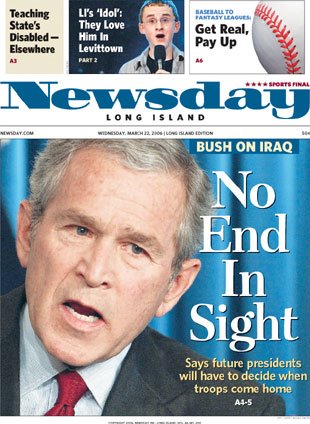
My Favorite Headline


In keeping with Holden's question earlier today, I stumbled across this, and had to share.

As Holden points out later, not at all what the White House wanted the press to take away from that news conference. But what did they expect?

Let the Administration wear it proudly.

What? My Lai?--Alfred E. Neuman

The reporter on this story was on Democracy Now! yesterday. I haven't seen any mention of it among the blogs yet, but it deserves wider discussion:

But the details of what happened that morning in Haditha are more disturbing, disputed and horrific than the military initially reported. According to eyewitnesses and local officials interviewed over the past 10 weeks, the civilians who died in Haditha on Nov. 19 were killed not by a roadside bomb but by the Marines themselves, who went on a rampage in the village after the attack, killing 15 unarmed Iraqis in their homes, including seven women and three children. Human-rights activists say that if the accusations are true, the incident ranks as the worst case of deliberate killing of Iraqi civilians by U.S. service members since the war began.
There is, of course, a controversy over precisely what happened:

In January, after Time presented military officials in Baghdad with the Iraqis' accounts of the Marines' actions, the U.S. opened its own investigation, interviewing 28 people, including the Marines, the families of the victims and local doctors. According to military officials, the inquiry acknowledged that, contrary to the military's initial report, the 15 civilians killed on Nov. 19 died at the hands of the Marines, not the insurgents. The military announced last week that the matter has been handed over to the Naval Criminal Investigative Service (ncis), which will conduct a criminal investigation to determine whether the troops broke the laws of war by deliberately targeting civilians. Lieut. Colonel Michelle Martin-Hing, spokeswoman for the Multi-National Force-Iraq, told Time the involvement of the ncis does not mean that a crime occurred. And she says the fault for the civilian deaths lies squarely with the insurgents, who "placed noncombatants in the line of fire as the Marines responded to defend themselves."
But read the article. This is what life is like in a war zone, for the warriors, and the civilians. And this is how we are conducting it:

AMY GOODMAN: You say the U.S. has paid relatives of the victims $2,500 for each of the 15 dead civilians, plus smaller payments for the injured?

APARISIM GHOSH: Yes. That is commonplace in cases of innocents being killed in combat.
And consider this, and contrast it with what George Bush said he "understands," yesterday:

AMY GOODMAN: You end, in a very touching way, the piece that you wrote along with your colleague who is -- who has just left Baghdad also.

APARISIM GHOSH: Yes.

AMY GOODMAN: Tim McGirk. “Nothing can bring back all that was taken from 9-year-old Eman Waleed on that fateful day last November. She still does not comprehend how, when her father went in to pray with the Koran for the family's safety, his prayers were not answered, as they had been so many times in the past. ‘He always prayed before, and the Americans left us alone,’ she says. Leaving, she grabs a handful of candy. ‘It's for my little brother,’ she says.” Her brother, very terrorized, very traumatized.

APARISIM GHOSH: As are thousands of young people in Iraq today, but this family, in particular. She's now an orphan. There is an extended family that will look after her, but she will never -- any hope of a normal life for her now over.

Tuesday, March 21, 2006

Worst President Ever

This is what comes of not keeping up with the news, I suppose.

The Supreme Court two years ago emphatically rejected the president's claim that its jurisdiction did not extend to Guantánamo. Seeking to reverse that ruling, the White House in December helped push through a special amendment as part of the deal that also saw Mr. Bush sign a watered-down ban on torture of military detainees. The amendment, sponsored by Senator Lindsey Graham, a Republican, and Senator Carl Levin, a Democrat, stripped Guantánamo detainees of the normal rights of judicial review. It also designated a single appellate court to conduct a limited review of decisions by the military commissions, and left "enemy combatants" held without a trial in a seemingly inescapable legal black hole.

As soon as Mr. Bush signed this law, he declared that the administration was going to apply it to all pending cases, about 160 or so, and the solicitor general told the Supreme Court it no longer had a right to hear Hamdan v. Rumsfeld. This is court-stripping — the attempt by another branch of government to prevent the court from deciding a particular issue. The White House tried to justify this outrageous tampering with the judiciary by ignoring the new law's actual language and legislative history to argue that the new legislation took away the power of the courts to hear not just future cases but also cases already filed and accepted for review. The Supreme Court responded by adding the jurisdictional objection to the list of issues it will consider when the case is heard on March 28.
This editorial made me look into the Hamdan case. According to the appellate court opinion (PDF file):

On July 3, 2003, the President determined “that there is reason to believe that [Hamdan] was a member of al Qaeda or was otherwise involved in terrorism directed against the United States.” This finding brought Hamdan within the compass of the President’s November 13, 2001, Order concerning the Detention, Treatment, and Trial of Certain Non-Citizens in the War Against Terrorism, 66 Fed. Reg. 57,833. Accordingly, Hamdan was designated for trial before a military commission.
It is worthwhile, I think, to see how detailed these issues are. The crux of the legal matter before the appellate court is here:

In response to the Supreme Court’s decision in Hamdi v. Rumsfeld, 124 S. Ct. 2633 (2004), Hamdan received a formal hearing before a Combatant Status Review Tribunal. The Tribunal affirmed his status as an enemy combatant, “either a member of or affiliated with Al Qaeda,” for whom continued detention was required.
That led to a hearing in Federal district court:

Among other things, the court held that Hamdan could not be tried by a military commission unless a competent tribunal determined that he was not a prisoner of war under the 1949 Geneva Convention governing the treatment of prisoners. The court therefore enjoined the Secretary of Defense from conducting any further military commission proceedings against Hamdan. This appeal followed. Hamdan was held at Guantanamo, and granted a "military The legal issue taken up by the Court of Appeals
The appellate court considered arguments from Hamdan regarding the validity of the military tribunals, and rejected them, reversing the decision of the District Court, largely on the basis that, per the Eisentrager decision, the 1949 Geneva Convention cannot be judicially enforced.

The Motion to Dismiss, based on the "Detainee Treatment Act" removing jurisdiction, is here, for those interested in legal briefs (also a PDF file).

There is more to it than just this, of course:

In light of the Rasul judgement, the Government, on 7 July 2004, created the Combatant Status Review Tribunal (CSRT), a body composed of three noncommissioned officers, to examine the legality of detentions. Thereafter, the United States District Court dealing with the habeas corpus petitions of the Guantánamo detainees ruled that the CSRT proceedings “deny [the detainees] a fair opportunity to challenge their incarceration” and thus fail to comply with the terms of the Supreme Court’s ruling. (From In re Guantanamo Detainees Cases, 355 F. Supp. 2d 443, at 468-478.)
That is from the UN report on Human Rights Abuses at Gitmo. This is another issue the Supreme Court needs to address: the government's response to Rasul. The lower courts have not found these 'tribunals' to meet the standards of habeas corpus, and it isn't at all clear that the Detainee Treatment Act addresses that fundamental jurisdictional issue, or that it can, without simply carving habeas corpus out of the jurisdiction of the Federal courts; which would present a wholly different Constitutional issue, of course.

The Administration ignored the Rasul ruling and set up a system to thwart it, the "military tribunals," which are nothing more than kangaroo courts. Courts tend to jealously guard their jurisdictional authority (it is the only real authority they have), so I don't expect that even Justice Alito will prove a "swing vote" in favor of allowing the Federal courts to be stripped of their jurisdiction in so fundamental a matter as habeas corpus (a right even Scalia vociferously defended in his dissenting opinions). Indeed, Scalia's dissent in Rasul was in part on the court's extension of habeas corpus to non-citizens in that case, a holding he said ran contrary to Eisentrager, the opinion the appellate court relied on (and that may or may not be a significant issue on appeal). And the government is now clearly relying on the "Detainee Treatment Act" as warrant for its actions, even as those actions bring it into conflict with the Hamdi and rasul holdings. It is hard to read Hamdi as validation for the "military tribunals" the Administration has relied on. Rasul extended habeas corpus to non-citizens like Hamdan. These two issues are clearly present in this case, which is why the government is anxious to have it dismissed on jurisdictional grounds.

And the Court has agreed to take up the jurisdictional issue, again. In Hamdi, they rejected the argument that the President had the power to change the Court's jurisdiction. The District Court received the Hamdan case because of Rasul. It would be ironic indeed if that case were now to be used to undo the Court's jurisdiction over the detainees. But that is the government's position in the matter.

What we are witnessing is nothing less than an attempt to shred the Constitution. Bush doesn't want to shrink government; he wants to supplant it. The blatant grab for raw power continues unabated, and has finally reached the Supreme Court. Kevin Phillips is right: Bush is a national embarassment. But it's worse than that: he's a danger to the republic, and to the Constitution he swore to defend against all enemies, foreign and domestic. It's going to be very hard to convince Bush he is that domestic enemy.

Monday, March 20, 2006

"There will be no poor among you."

Deuteronomy 15:4

That is too simple and declarative a statement to be left bare; when I get home, I should look it up and give it more context. But a clearer, more definitive statement of what we now call "economic justice," it would be harder to find in the Old Testament. Nor can I think of a better one sentence refutation of the proof-texted notion of the "god" of the "Old Testament" being a vengeful and blood-thirsty god.

But for now, that verse, and this observation from Martin Luther on the 7th commandment ("Thou shalt not steal") will be enough:

For to steal is nothing else than to get possession of another's property wrongfully, which briefly comprehends all kinds of advantage in all sorts of trade to the disadvantage of our neighbor. To steal is to signify not only to empty our neighbor's coffer and pockets, but to be grasping in the marketplace wherever there is trading or taking and giving of money for merchandise or labor. Therefore they are also called swivel-chair robbers, land- and highway-robbers, not pick-locks and sneak-thieves who snatch away the ready cash, but who sit on the chair [at home] and are styled great noblemen, and honorable, pious citizens, and yet rob and steal under a good pretext.

No more shall all the rest prosper who change the open free market into a carrion-pit of extortion and a den of robbery, where the poor are daily overcharged, new burdens and high prices are imposed, and evey one uses the market according to his caprice, and is even defiant and brags as though it were his fair privilege and right to sell his good for as high a price as he please, and no one had a right to say a word against it.
It is said that Jesus chased the moneychangers from the temple, and lashed the vendors out, not because of what they were doing per se, but because they were cheating the poor, the pilgrims who, like Jesus, came to Jerusalem for passover with little or nothing, and paid exorbitant fees to change their few coins from Roman coins (with the blasphemous human image of Caesar on them) to "temple coins" acceptable under the law; or, if they bought an animal for sacrifice, paid high fees in order to offer worship to God. It is also said that it was this act which led directly to his crucifixion.

Martin Luther lived for many years under the protection of the wealthy in Germany, when the Catholic church literally sought his life. Imagine any of our comfortable, popular, and wealthy preachers today writing those words for publication. Imagine almost any preacher in any congregation, large or small, preaching those words from the pulpit. Almost 500 years old, and they still sound radical.

I found them in: Getting on Message: Challenging the Christian Right from the Heart of the Gospel, ed. Rev. Peter Laarman. The essay is "Honoring Those Who Work" by Alexia Salvaterria. There are essays here by Bill McKibben (who echoes Luther's Christian focus on neighbors, and contrasts that with the "mega-church" American emphasis on self); and by Joan Chittester; and by many others I don't know, but hope to know more about, soon.

Right after I renew my acquaintance with Deuteronomy.