Blessed are those who mourn, for they shall be comforted.
O God, give us your Wisdom
O God, give us your mercy,
O God, give us your fullness,
And your guidance in the face of every trial.
O God, give us your holiness,
O God, give us your shielding,
O God, give us your surrounding,
And your peace in the knot of these deaths.
Oh, give us your surrounding,
and your peace at the news of these deaths!
--adapted from the Carmina Gadelica
Monday, April 16, 2007


Friday, April 13, 2007
In Memory of Kurt Vonnegut, Jr.
Been pondering how best to rememer Kurt Vonnegut, Jr., and what his work meant for me once upon a time. And, reading this at Street Prophets, I hit on it:
Demand the Beatitudes be posted in public places.
Well, "demand" is a bit strong, but talk it up. Why not? The only reason people like Roy Moore want the Ten Commandments posted is because they are orders issued in the imperative voice: "THOU SHALT NOT....!" Let's go to the words of Jesus, if we are going to insist Christianity be respected in this country (and no, we aren't, but by now you should be getting my drift). Let's post the Beatitudes.
Now obviously this will involve some discussion as to what translation to use. "Blessed art..." is a bit archaic; indeed, maybe even "blessed" is not the best translation for makarioi, which Nestle-Aland tells me is "blessed, fortunate, happy, usu. in the sense priviliged recipient of divine favor." I still like "Congratulations!"
Demand the Beatitudes be posted in public places.
Well, "demand" is a bit strong, but talk it up. Why not? The only reason people like Roy Moore want the Ten Commandments posted is because they are orders issued in the imperative voice: "THOU SHALT NOT....!" Let's go to the words of Jesus, if we are going to insist Christianity be respected in this country (and no, we aren't, but by now you should be getting my drift). Let's post the Beatitudes.
Now obviously this will involve some discussion as to what translation to use. "Blessed art..." is a bit archaic; indeed, maybe even "blessed" is not the best translation for makarioi, which Nestle-Aland tells me is "blessed, fortunate, happy, usu. in the sense priviliged recipient of divine favor." I still like "Congratulations!"
Congratulations, you poor!Seems pleasant enough. Who wouldn't feel better if they saw that on a public wall? Of course, that's Luke's version, and only half of it. If we want some sterner language, something closer to "THOU SHALT NOT!," we could finish those three off with the other three:
God's domain belongs to you!
Congratulations, you hungry!
You will have a feast.
Congratulations, you who weep now!
You will laugh.
Damn you rich!Which, you gotta admit, would bring the room right down. So maybe we want to use Matthew's version:
You already have your consolation!
Damn you who are well-fed now!
You will know hunger.
Damn you who laugh now!
You will learn to weep and grieve.
Congratulations to the poor in spirit!Personally, I wouldn't mind seeing every one of those in a courtroom, the Pentagon, both chambers of Congress, the Oval Office....the applications seem limitless.
Heaven's domain belongs to them.
Congratulations those who grieve!
They will be consoled.
Congratulationss to the gentle!
They will inherit the earth.
Congratulations to those who hunger and thirst for justice!
They will have a feast.
Congratulations to the merciful!
They will receive mercy.
Congratulations to those with undefiled hearts!
They will see God.
Congratulations to those who work for peace!
They will be known as God's children.
Congratulations to those who have suffered persecution for the sake of justice!
Heaven's domain belongs to them.
Thursday, April 12, 2007
Romanticism: 1; Enlightenment: 0
In an excerpt from a BBC News interview broadcast on the news of his death, Kurt Vonnegut discussed the fire-bombing of Dresden. He talked about coming home from the war and seeing and hearing nothing about the event he miraculously lived through, which made him conclude nothing had actually happened. Only later, when word of the destruction began to appear, did he begin to consider the event and how to respond to it. It was, he said, “the largest single massacre in European history.”
I thought about that a moment, shook my head over it. The comparison with the Holocaust leapt to mind, then I thought: “But the Holocaust was a genocide.” It was, but it was also a concerted effort at destruction, not a single act. Dresden burned in one night, a retaliation for the bombing of London. A generation after the “Good War,” we forget that bombing civilian targets was considered inhuman and savage, and Germany was denounced for doing it. By the end of the war, there were no “civilian targets.” I’ve been to Munich. I’ve seen the mounds in the city, grass covered knolls which are man-made, the rubble piled up to clear the way for new buildings in what is surely the newest city, architecturally, in all of Europe. We burned Hiroshima and Nagasaki to the ground with only two bombs, and justified it as the sacrifice necessary to save the lives of American soldiers. The Allies destroyed Dresden in a holocaust atomic weapons could not replicate, or surpass. I think about that every time I think about the “Good War.”
But what I thought about this time, was the odd thing that we had so many words, such careful nuance, for mass killing. “Genocide” is one thing; “massacre” another, and we mean separate things by them. But we have no words for “mass love of persons.” We can name how we dispatch our fellow humans, in terms which distinguish who did what (our enemies commit “massacres” or even “genocide”), in terms of how long it took, even in terms of how many died (“Mass murder” is less than a “massacre,” which is less than a “genocide”). But we have no terms for acts of mass love.
And it occurred to me that, in this, the Romantics were exactly right: love is individual. Love is not mass, is not directed toward a group, is not possible on a large scale. “I love mankind! It’s people I can’t stand!,” Linus Van Pelt once memorably remarked in Peanuts. Love requires knowledge of the other, and such knowledge often, we know, kills the ability to love. Abstraction, however, makes mass killing possible. Better “they” died in Hiroshima and Nagasaki than “we” did invading Japan. Better “they” died in Dresden, for what “we” had to suffer. The reason Dresden affected Vonnegut so much is that he lived through it, it happened to him; and by his art, he made us feel what he felt about that, he made it, as much as humanly possible, happen to us.
Auden was right: “We must love one another, or die,” is a lie. We are going to die anyway. Love won’t save us from death. But neither can we love in the abstract. We cannot love people; we can only love persons. Which is why war will always be so much easier than peace. But it is also why love is so important; why individuals are so important.
I thought about that a moment, shook my head over it. The comparison with the Holocaust leapt to mind, then I thought: “But the Holocaust was a genocide.” It was, but it was also a concerted effort at destruction, not a single act. Dresden burned in one night, a retaliation for the bombing of London. A generation after the “Good War,” we forget that bombing civilian targets was considered inhuman and savage, and Germany was denounced for doing it. By the end of the war, there were no “civilian targets.” I’ve been to Munich. I’ve seen the mounds in the city, grass covered knolls which are man-made, the rubble piled up to clear the way for new buildings in what is surely the newest city, architecturally, in all of Europe. We burned Hiroshima and Nagasaki to the ground with only two bombs, and justified it as the sacrifice necessary to save the lives of American soldiers. The Allies destroyed Dresden in a holocaust atomic weapons could not replicate, or surpass. I think about that every time I think about the “Good War.”
But what I thought about this time, was the odd thing that we had so many words, such careful nuance, for mass killing. “Genocide” is one thing; “massacre” another, and we mean separate things by them. But we have no words for “mass love of persons.” We can name how we dispatch our fellow humans, in terms which distinguish who did what (our enemies commit “massacres” or even “genocide”), in terms of how long it took, even in terms of how many died (“Mass murder” is less than a “massacre,” which is less than a “genocide”). But we have no terms for acts of mass love.
And it occurred to me that, in this, the Romantics were exactly right: love is individual. Love is not mass, is not directed toward a group, is not possible on a large scale. “I love mankind! It’s people I can’t stand!,” Linus Van Pelt once memorably remarked in Peanuts. Love requires knowledge of the other, and such knowledge often, we know, kills the ability to love. Abstraction, however, makes mass killing possible. Better “they” died in Hiroshima and Nagasaki than “we” did invading Japan. Better “they” died in Dresden, for what “we” had to suffer. The reason Dresden affected Vonnegut so much is that he lived through it, it happened to him; and by his art, he made us feel what he felt about that, he made it, as much as humanly possible, happen to us.
Auden was right: “We must love one another, or die,” is a lie. We are going to die anyway. Love won’t save us from death. But neither can we love in the abstract. We cannot love people; we can only love persons. Which is why war will always be so much easier than peace. But it is also why love is so important; why individuals are so important.
Wednesday, April 11, 2007
The Hard Question
This has come back up again, largely because Pastor Dan caught up with it, and prompted some very interesting, and sincere, comments over at Street Prophets.
Concerns there are expressed for the safety of the congregation and the hospitality due to the confessed child molester. You really have to read all the comments to get the full flavor of the concerns raised. When I pick one or two, I don't mean to exclude the full spectrum of the discussion there. But three parts of it struck me as interesting; not because of the positions taken, but because of the contrast to something I'd read elsewhere.
One position is, of course, the congregation must protect itself. The other, that the congregation must show all due hospitality. The third issue raised is the issue of the comfort of the congregation; that is, what will they accept in what is, after all, a worship space and service for them. This is a very pastoral, and very legitimate, concern. That is, in the polity of the UCC (which Pastor Dan explains very well): "I think being a pastor means leading/encouraging/helping the congregation make the most faithful, least fearful decision it can." Yes, it does; and yes, that is very hard. What isn't raised clearly in those comments, I think, though it is referred to obliquely, is the necessary vulnerability that hospitality always entails. But that's yet another matter.
What brings me almost to despair in this matter is the framework, the model, in which a polity or a congregation finds a proper response to this issue. Too many congregational (small "c" intentionally) churches depend too much on their culture to give them answers to the question: "How do we respond?". Because that question goes beyond "How should we respond" to "What do we actually do, and how do we do it?" That is, when the discussion begins to turn on the issues (as it is doing in that forum) of: "How do we protect the group, while maintaining both our identity and our integrity?", consideration for the individual who is not of the group, but who has been asked to be allowed into the group, takes second place. Not because anyone in the church is mean, venal, nastry, or even close-minded; but simply because modern society is more and more a collection of groups which each demand "respect" for their integrity. And when integrity becomes more important to the church than fealty to the gospel, or faith (i.e., trust) in the Risen Lord, well....bad things happen.
What do I mean? Not that there is an easy or appropriate answer that can be applied in the case of a UCC congregation, which, after all, is governed by a congregational polity. But the issue of how the congregation makes that decision, is the rose with lots of thorns on it, and we have to grasp that securely, if we are going to try to pluck it at all.
Michel Foucault, in his book Madness and Civilization, opens with a discussion of the closing of the lazar houses in France in the 17th century. Medieval Catholic France, of course, is as far removed culturally from Pilgrim UCC in Carlsbad, California, as either are from 1st century Palestine. But on the question of exclusion and protection of the congregation, note how the Church dealt with the removal of lepers from the body of worshippers:
As I say, a very different culture, a very different idea of Church, and a theology that would trouble many of us today. But how different is the position of society toward the leper, or the child molester? The primary difference is, we don't call the child molester's proclivities a sign of God's anger; we label them either "mental disease" or somehow blame the actions on the criminal's "weakness." It doesn't seem much of an improvement, as the blame still falls on the person who offends society, only without any mitigation that the affliction is a sign of God's grace as well as anger. We have so separated grace and anger that we cannot hold them together in the same thought; but we are not necessarily the better for that.
But can we imagine even this kind of compassion being shown to a child molester today? If the congregation votes to ask him to leave, can the pastor show love for him by walking him out the door in a public ritual as described above, complete with words of reconciliation and atonement? If he or she does, will she or he be speaking for the congregation, or solely for the pastor? Would there be any understanding that salvation is still offered to the criminal, even if it is salvation which must be sought wholly outside the gathered people of God, the "body of Christ," the "church visible"? Does the UCC, or almost any other Protestant denomination, have a theology for this situation?
I don't know. I think we might have a vague and ill-formed one, but most pastors I know would either feel confident in insisting upon this man's inclusion, or caught in a way that makes them feel pinched between a rock and a hard place, between leading the congregation, and persuading the congregation, knowing (as only a pastor can know) that the decision is never really up to you. Not, at least, in a congregational polity.
So, can we offer "another form of communion"? And if not, what can we offer such a person at all? And how will Christ answer when we ask: "Lord, when did we see you?"
Concerns there are expressed for the safety of the congregation and the hospitality due to the confessed child molester. You really have to read all the comments to get the full flavor of the concerns raised. When I pick one or two, I don't mean to exclude the full spectrum of the discussion there. But three parts of it struck me as interesting; not because of the positions taken, but because of the contrast to something I'd read elsewhere.
One position is, of course, the congregation must protect itself. The other, that the congregation must show all due hospitality. The third issue raised is the issue of the comfort of the congregation; that is, what will they accept in what is, after all, a worship space and service for them. This is a very pastoral, and very legitimate, concern. That is, in the polity of the UCC (which Pastor Dan explains very well): "I think being a pastor means leading/encouraging/helping the congregation make the most faithful, least fearful decision it can." Yes, it does; and yes, that is very hard. What isn't raised clearly in those comments, I think, though it is referred to obliquely, is the necessary vulnerability that hospitality always entails. But that's yet another matter.
What brings me almost to despair in this matter is the framework, the model, in which a polity or a congregation finds a proper response to this issue. Too many congregational (small "c" intentionally) churches depend too much on their culture to give them answers to the question: "How do we respond?". Because that question goes beyond "How should we respond" to "What do we actually do, and how do we do it?" That is, when the discussion begins to turn on the issues (as it is doing in that forum) of: "How do we protect the group, while maintaining both our identity and our integrity?", consideration for the individual who is not of the group, but who has been asked to be allowed into the group, takes second place. Not because anyone in the church is mean, venal, nastry, or even close-minded; but simply because modern society is more and more a collection of groups which each demand "respect" for their integrity. And when integrity becomes more important to the church than fealty to the gospel, or faith (i.e., trust) in the Risen Lord, well....bad things happen.
What do I mean? Not that there is an easy or appropriate answer that can be applied in the case of a UCC congregation, which, after all, is governed by a congregational polity. But the issue of how the congregation makes that decision, is the rose with lots of thorns on it, and we have to grasp that securely, if we are going to try to pluck it at all.
Michel Foucault, in his book Madness and Civilization, opens with a discussion of the closing of the lazar houses in France in the 17th century. Medieval Catholic France, of course, is as far removed culturally from Pilgrim UCC in Carlsbad, California, as either are from 1st century Palestine. But on the question of exclusion and protection of the congregation, note how the Church dealt with the removal of lepers from the body of worshippers:
If the leper was removed from the world, and from the community of the Church visible, his existence was yet a constant manifestation of God, since it was a sign both of His anger and His grace: "My friend," says the ritual of the Church of Vienne, "it pleaseth Our Lord that thou shouldst be infected with this malady, and thou hast great grace at the hands of Our Lord that he desireth to punish thee for thy iniquities in this world." And at the very moment when the priest and his assistants drag him out of the church with backward step, the leper is assured that he still bears witness for God: "And howsoever thou mayest be apart from the Church and the company of the Sound, yet art thou not apart from the grace of God."...Hieratic witnesses of evil, they accomplish their salvation in and by their very exclusion: in a strange reversability that is the opposite of good works and prayer, they are saved by the hand that is not stretched out. The sinner who abandons the leper at his door opens his way to heaven. "For which have patience in thy malady; for Our Lord hateth thee not because of it, keepeth thee not from his company; but if thou hast patience thou wilt be saved, as was the leper who died before the gate of the rich man and was carried straight to paradise." Abandonment was his salvation; his exclusion offers him another form of communion.Michel Foucault, Madness and Civilization, tr. Richard Howard (New York: Vintage 1988), 6-7.
As I say, a very different culture, a very different idea of Church, and a theology that would trouble many of us today. But how different is the position of society toward the leper, or the child molester? The primary difference is, we don't call the child molester's proclivities a sign of God's anger; we label them either "mental disease" or somehow blame the actions on the criminal's "weakness." It doesn't seem much of an improvement, as the blame still falls on the person who offends society, only without any mitigation that the affliction is a sign of God's grace as well as anger. We have so separated grace and anger that we cannot hold them together in the same thought; but we are not necessarily the better for that.
But can we imagine even this kind of compassion being shown to a child molester today? If the congregation votes to ask him to leave, can the pastor show love for him by walking him out the door in a public ritual as described above, complete with words of reconciliation and atonement? If he or she does, will she or he be speaking for the congregation, or solely for the pastor? Would there be any understanding that salvation is still offered to the criminal, even if it is salvation which must be sought wholly outside the gathered people of God, the "body of Christ," the "church visible"? Does the UCC, or almost any other Protestant denomination, have a theology for this situation?
I don't know. I think we might have a vague and ill-formed one, but most pastors I know would either feel confident in insisting upon this man's inclusion, or caught in a way that makes them feel pinched between a rock and a hard place, between leading the congregation, and persuading the congregation, knowing (as only a pastor can know) that the decision is never really up to you. Not, at least, in a congregational polity.
So, can we offer "another form of communion"? And if not, what can we offer such a person at all? And how will Christ answer when we ask: "Lord, when did we see you?"
A literary diversion
It may be because the personalities I perceived in her at that time were so various that I later took to turning into a different person, depending on which Albertine was in my mind: I became a jealous man, an indifferent man, a voluptuary, a melancholic, a madman, these characters coming over me not just in response to the random recurrence of memories, but also under the variable influence of some intervening belief which affected this or that memory by making me see it differently. There was, there is, no getting away from these beliefs: most of the time, they fill our mind unawares; yet they are more important for our happiness than the very person standing there in front of us, since it is through these ideas that we see such a person, since it is they that endow the person seen with whatever importance he or she may have. In the interests of accuracy, I should really give a separate name to each of the selves in me that was to harbor a future thought of Albertine; and it would be even more appropriate if I had a different name for each of the Albertines who appeared in her single guise, none of whom was identical to the others, as variable as the seas I saw before me, which I simplified to the same word "sea," and which served as a backdrop to my inconstant nymph.Macel Proust, In the Shadow of Young Girls in Flower, tr. James Grieve (New York: Penguin 2005), pp. 525-26. Emphasis added.
There must be some kind o' way outta here....
This really isn't that hard to figure out:
"I and theschool childrenpublic know
Whateveryone mustall schoolchildren learn.
Those to whom evil is done,
Do evil in return."
--W.H. Auden [good grief!]
And yet the White House can't seem to add 2+2 and come up with anything but 1:
At this point, all we can hope for is that Congress takes their shovel away. The hole we're in is plenty deep enough.
Iraq has become a "combat training zone for jihadists" as a result of the US-led war on terror, a new report claims.and the blowback is perfectly clear:
The damning critique of British and US foreign policy by the Oxford Research Group, comes amid growing concern over Iran's apparent willingness to confront the international community.
The authors of the report - entitled Beyond Terror: The Truth About the Real Threats to Our World - say support for political Islam is increasing worldwide and the war in Iraq has actually boosted the risk of further terrorist atrocities on the scale of 9/11.
"Treating Iraq as part of the War on Terror only spawned new terror in the region and created a combat training zone for jihadists," the report added.
Britain's part in the Iraq war has seriously hurt its ability to stop war crimes and human rights abuses elsewhere, Oxfam said on Wednesday, as a poll showed over half the British public consider the war unethical.Haven't we been here before?
Reviewing British foreign policy during Prime Minister Tony Blair's 10 years in power, the international aid body said Blair's successor -- widely expected to be Finance Minister Gordon Brown -- needed to introduce a tough new stance of standing up to Britain's allies if they violate human rights.
It said its workers in war zones around the world were reporting a trend of anti-British sentiment driven by perceived double standards in Britain's foreign policy.
"I and the
What
Those to whom evil is done,
Do evil in return."
--W.H. Auden [good grief!]
And yet the White House can't seem to add 2+2 and come up with anything but 1:
The White House wants to appoint a high-powered czar to oversee the wars in Iraq and Afghanistan with authority to issue directions to the Pentagon, the State Department and other agencies, but it has had trouble finding anyone able and willing to take the job, according to people close to the situation.What's really sad is that criticism about about Speaker Nancy Pelosi's trip to Syria still dominates US news, while the press in Egypt, Lebanon, and the UAE, seems mostly interested in the fact Tom Lantos said yesterday that he now wants to travel to Iran. (I can't find anythning on this press conference at WaPo or NYTimes.com. The most current news on Pelosi I can find is this opinion column on the effect of the White House smear campaign against Pelosi.) Seems the people most affected by our diplomacy, welcome our diplomacy. But our leadership still prefers belligerence.
At least three retired four-star generals approached by the White House in recent weeks have declined to be considered for the position, the sources said, underscoring the administration's difficulty in enlisting its top recruits to join the team after five years of warfare that have taxed the United States and its military.
"The very fundamental issue is, they don't know where the hell they're going," said retired Marine Gen. John J. "Jack" Sheehan, a former top NATO commander who was among those rejecting the job. Sheehan said he believes that Vice President Cheney and his hawkish allies remain more powerful within the administration than pragmatists looking for a way out of Iraq. "So rather than go over there, develop an ulcer and eventually leave, I said, 'No, thanks,' " he said.
At this point, all we can hope for is that Congress takes their shovel away. The hole we're in is plenty deep enough.
Tuesday, April 10, 2007
Return to the Irony of American History
This story on NPR was simply so good, it deserves special mention.
Maybe because, when it started in on a new production of "Inherit the Wind," I expected the same old distortions about the Scopes Monkey Trial. But suddenly the story turned on the fact that the playwrights were addressing McCarthyism, not the teaching of evolution. And then Brian Dennehy, who plays the William Jennings Bryan character in the play, noted that Bryan was concerned with Social Darwinism, with the forced sterilization cases in America at the time of the original trial, and other matters that would appall many of us today.
And I thought of the irony of American history, again. Not the way Niebuhr meant it, but the way it often works out. The writers of "Inherit the Wind," as the NPR report notes, probably never imagined teaching Darwin's theory would be controversial (it actually wasn't that controversial in the days of the original trial. That was a manufactured controversy.). But their image of William Jennings Bryan as a benighted and ultimately wrong-headed figure has become accepted as the historical report on the man. The irony? The man who could write these words is still generally regarded as a beacon of reason and wisdom:
What, by the way, is the story on Carrie Buck?
Maybe because, when it started in on a new production of "Inherit the Wind," I expected the same old distortions about the Scopes Monkey Trial. But suddenly the story turned on the fact that the playwrights were addressing McCarthyism, not the teaching of evolution. And then Brian Dennehy, who plays the William Jennings Bryan character in the play, noted that Bryan was concerned with Social Darwinism, with the forced sterilization cases in America at the time of the original trial, and other matters that would appall many of us today.
And I thought of the irony of American history, again. Not the way Niebuhr meant it, but the way it often works out. The writers of "Inherit the Wind," as the NPR report notes, probably never imagined teaching Darwin's theory would be controversial (it actually wasn't that controversial in the days of the original trial. That was a manufactured controversy.). But their image of William Jennings Bryan as a benighted and ultimately wrong-headed figure has become accepted as the historical report on the man. The irony? The man who could write these words is still generally regarded as a beacon of reason and wisdom:
The attack is not upon the procedure but upon the substantive law. It seems to be contended that in no circumstances could such an order be justified. It certainly is contended that the order cannot be justified upon the existing grounds. The judgment finds the facts that have been recited and that Carrie Buck "is the probable potential parent of socially inadequate offspring, likewise afflicted, that she may be sexually sterilized without detriment to her general health and that her welfare and that of society will be promoted by her sterilization," and thereupon makes the order. In view of the general declarations of the legislature and the specific findings of the Court, obviously we cannot say as matter of law that the grounds do not exist, and if they exist they justify the result. We have seen more than once that the public welfare may call upon the best citizens for their lives. It would be strange if it could not call upon those who already sap the strength of the State for these lesser sacrifices, often not felt to be such by those concerned, in order to prevent our being swamped with incompetence. It is better for all the world, if instead of waiting to execute degenerate offspring for crime, or to let them starve for their imbecility, society can prevent those who are manifestly unfit from continuing their kind. The principle that sustains compulsory vaccination is broad enough to cover cutting the Fallopian tubes. Jacobson v. Massachusetts, 197 U.S. 11. Three generations of imbeciles are enough.That's one of the sterilization cases Bryan would have been concerned about. That's Oliver Wendell Holmes, in 1927. That's the enlightened view of Social Darwinism at work. Holmes is considered a leading light of his age, while Bryan is regarded, after the success of the play, as a japing fool with a medieval worldview. Read those words again, and consider who has the "medieval" view of the world.
What, by the way, is the story on Carrie Buck?
Current scholarship shows that Carrie Buck's sterilization relied on a false diagnosis premised on the now discredited science of eugenics. It is likely that Carrie's mother, Emma Buck, was committed to a state institution because she was considered sexually promiscuous, that the same diagnosis was made about Carrie when she became an unwed mother at the age of 17 due to being raped, and that her daughter Vivian was diagnosed as “not quite normal” at the age of six months largely in support of the legal effort to sterilize Carrie.Which doesn't mean Bryan was right in the Scopes Monkey Trial. But, as Dennehy says, his position was complex. And we do ourselves, and him, and even Darrow, a disservice, to simplify the debate for our own purposes.
IMHO, or: Why Your Blog Sucks
Everytime I think I'm out, they drag me back in!
It's my fault, of course. I spend too much of my time reading blogs. I recognize this. I am an addict. I need a support group.
But I can quit anytime I want to. I just don't want to, yet.
Here, for example, is how this post started almost a month ago:
Well, that was one direction I was going to go in. But I set it aside, went on about my Lenten business, tried to forget it. Then I wrote the bulk of this post. Then I set it aside again, decided I wouldn't bother with it, that it was pointless and whinging and didn't serve any purpose very well. "This just might do nobody any good," I pretty much concluded, and not having the chops of an Edward R. Murrow, I was pretty sure I had concluded rightly. But the blogwars on civility are out in force again, and once again we are all called upon to take ourselves oh so seriously, and to defend our turf against all complainers, and to fight to the last breath for our right to print 'obscene' words (which really don't matter to me, one way or the other), and to justify our high dudgeon. So now I'm wondering again if this is a topic worth bothering with at all?
And maybe, if only for a few reasons buried here amid the dunghill of my response, it is. Who knows? It won't add to my blogging significance or insignificance (which is really the point, isn't it? That blogs make nothing happen, that they exist in the valley of their own making, a way of happening, a mouth, as Auden said to Yeats). So, what the heck?
Blogging, we all like to declare, is all about accuracy and authenticity. Except those two words are defined in much the same way many people want to define religion: as entirely personal concepts which should be kept personal. Of course, you can't do that when you are talking about politics; or religion, for that matter. Both are inevitably and unavoidably public topics. Religion and politics both take place in the polis, the public marketplace. And both go far beyond mere ideas.
But blogs don't. Blogs exist in a world of their own making, a way of happening, a mouth. Like poetry, they make nothing happen. But, like a thousand little W.B. Yeats, bloggers imagine they do; or at least, that they should.
Political discourse is never moral (“are these things right, or wrong?”); it is only, at best, ethical (“Is this an approved path to happiness?”), and often, in the hands of a Karl Rove, it isn’t even that: it’s only about raw power. Atrios and most political bloggers aren’t interested in debating, evaluating, or considering ideas. They are only interested in who has access to the biggest megaphone. The leading concern in blogistan, left and right, is about who controls the “mainstream discourse.” Just the other day, Atrios didn’t want to engage E.J. Dionne in a debate on the merits of the issue of militant atheism v. religious belief. He simply wanted to shut Dionne up, to so debase Dionne’s right to speak on a particular topic that the latter would have no right to speak at all. He didn’t address the subject of Dionne’s column, but instead set up a straw man in the guise of wholly unrelated comments by Rick Warren, comments Dionne didn’t even allude to, and proceeded to use those poorly argued words to tar Dionne’s right, not to have an opinion, but to publicly express one.
And this is common currency in blogistan, especially when the topic is religion or politics, two topics we all learned could not be discussed in polite company. So, in left blogistan especially, we feel free to use all the “dirty words” our parents told us not to use ever, and pretend we are all latter day Lenny Bruces bravely speaking our minds in words we know the “pundits” consider “uncivil.” But when everybody else on the schoolyard is using those words and all the “adults” are shocked by our brazen behavior, are we really speaking our minds? Or are we reveling in the chance to discuss matters we can’t discuss in “polite company” in terms we also can’t use in such company? Is it honest discourse, in other words, or just the false courage of naughty children? Well, when was the last time Josh Marshall used a four letter word in a post? And when was the last time NPR, or any other major news outlet, interviewed any other blogger about his or her impact on a Bush Administration scandal such as the firing of the U.S. attorneys? Is there a correlation there? I certainly think so.
Politics and religion both inflame these kinds of discussions. Politics in left blogistan must be “liberal” or “progressive” or the comments are considered those of “trolls.” Religion, likewise, is widely suspect and subject to fierce derision for no other reason than it proves the commenter “brave” and, in the 19th century term, a “free thinker.” I should hasten to add here I do not mean to include Atrios in that company. He has included my on his blogroll and never harassed me about my comments or the very religious posts I made on his blog as a guest, before I started this one. I don’t even mean to paint him as intolerant and close-minded; but his recent diatribe against E.J. Dionne serves as an example for me of what blogging is clearly all about. It is about grabbing control of the public discourse, and turning it to your own ends. Which is certainly a laudable goal in most circles, one hotly pursued by bloggers and pundits and politicans alike. Up until a year or so ago, the conventional wisdom bestowed upon Karl Rove the mantle of ruler of that discourse, at least as far as the Bush Administration was concerned, and it was bestowed with great admiration for the results he produced. There is certainly nothing inherently wrong with seeking to redirect that discourse in a direction more in keeping with one’s own opinions, and Atrios has labored mightily in that effort. It may well be he will ultimately succeed in ways I cannot envision. I do not rise here to bury Atrios, or to praise him. I only mean to state my own observations about blogging and political discourse. Consider Eschaton a model for an abstraction, not the particular example most in need of correction. But Eschaton and Kos are where much of the action is in left blogistan, and I avoid Kos for the same reasons I spend too much time at Eschaton: I know the latter far better than the former, and find it, over all, a more congenial place. There: my first paradox.
Politics and religions inflame discussions because both, ultimately, are about power. There is no use in denying that. This is not a problem of a Constantinian church, a church too enamored of “the world” in which it must exist, of which it cannot but be a part. This is a problem of human nature, where all problems are presumably solved by the proper application of power: either by an ethical application, or even a moral one. Thus Woodrow Wilson promised to make the world safe for democracy, and some fifty years after the attempt had clearly failed, Walt Kelly could say: “We gotta make democracy safe for the world!” A lesson, as Iraq has once again taught us, that this nation still has not learned. A generation later, Reinhold Niebuhr would decisively put to rest the idealism of Wilson, or so one would have thought. But Wilson was a President, Niebuhr merely a theologian and seminary professor; one is not equivalent to the other, and so the game goes one.
Ironically, though, the two are connected. Power is the question at the heart of Christianity, because hospitality is at the center of Christian practice, which is to say at the center of Christian doctrine and theology. All of Christianity begins in praxis, not in theoria or even in pioesis. It begins in the actual doing. Thus Jesus of Nazareth was an itinerant rabbi, with no place to lay his head from night to night. Thus his teachings were all about what should be done, or about shaking up what we thought was right and good; were all about making us do and God would have us do, and only afterward think about how God might wish us to think. Jeremiah said it best when he spoke for God: “The heart is devious above all things. Who can fathom it? I, God, test the heart….” Luther understood this, too. His heart was not his to control, to make pure as an offering to God. Luther realized he could never know his own thoughts well enough to know they could be pure enough for God, so Luther had to rely on God’s grace and do as best he could from that starting point.
Power is all about praxis. Theoria and even pioesis mean nothing until power has acted. They are always explanations after the fact: either justification for what has been done, or reflection on what has been produced. But both of them begin in power, and power is to be understood in terms of praxis. So power is at the center of Christianity, and yet power is immediately displaced by the teaching of hospitality. It is not what you do with power that counts, but how you give up power. The central teaching of Christianity then becomes not salvation (the exercise of power over sinners, and the exercise of power by sinners to escape judgment through repentance), but the paradox of powerlessness, which is the only real power. That is the central lesson of the crucifixion, and the central lesson of hospitality. “Lord, when did we see you?” If you do not believe in the Risen Lord, there is no reason to see him in others. If you do not accept the truth of the Resurrection, you have no need to look for Jesus in Galilee, or, indeed, anywhere else. And so his teachings may mean something to you, but they do not necessarily mean life itself. This, of course, is an idea addressed to professing Christians. Non-Christians are not bound by it, damned by ignoring, cursed by not accepting it. They stand wholly outside of it, and can stay there or choose to come in, as they please. Hospitality is not compulsion to make a guest of a stranger; it is only the offer. The host does not damn the wayfarer who does not stay the night in his house. Neither should Christians condemn those who do not believe as they do. That we still do is an issue of boundaries and identities and human nature; not a requirement of Christian praxis.
This will be misunderstood (if it is noticed), so let me make the thesis statement explicit: blogs have not created discussion. If they have had any effect at all, they have killed discussion as surely as talk radio and TV talk shows did. This is not a new phenomenon, of course. As "long ago" as the 1950's, Ray Bradbury could predict that TV would kill human conversation in Fahrenheit 451. Harlan Ellison noted, 20 years later, that "conversation" was now considered what Johnny Carson did on "The Tonight Show," which was nothing more than banter emptily with starlets and celebrities with something to sell, or who just needed more exposure on TV. Nothing has changed except the medium for the tedious and one-sided exchange. Most conversation on blogs is of like-minded people reaffirming each other's opinions. Nothing wrong with that, of course. But getting a true conversation, a true meeting of minds, started, is hard work. It's easy to be misunderstood. Easier, still, to just find a group that supplies meaning and belonging, rather than make the sacrifices first that lead to true, and deeper, meaning and belonging. So maybe blogs haven't really killed discussion. Maybe all they've done is to do exactly what they claim the do not do: maintain the status quo.
Consider yet another exhibit:
Maybe it's my Calvinist upbringing. Maybe it's my experience in family law, or in the church; but I'm not surprised at all. What? Human beings are irrational, venal, small-minded, churlish, and cruel? I'm shocked, shocked! The next thing you'll be telling me is that they gamble, too! You know what? The discourse wasn't polluted by rich white men sometime in the recent past. It's always been polluted. Great Caesar's Ghost, doesn't anybody read Shakespeare anymore? Othello? MacBeth? Hamlet? King Lear? Do any of these ring a bell? I Henry IV? Anthony Burgess reported teaching Richard III in Malaysia.
No. But I could wish there was a better recognition of what's important, and what is not, and why. I could wish there was less ego involved in such discussions, and more understanding; less heat, and more light. Despite the universal example of the lightbulb, one does not necessarily lead to the other. Is it really a problem that the New York Times thinks bloggers are dirty, uncivil hippies who need to be corralled? Is it any greater a problem than the latest stupid thing that dribbled out of the mouth of Don Imus? Or is the difference only that one is personal, and the other simply offensive to right-minded people? But there are a lot of wrong-minded people out there. Taking them on, either one by one or en masse, is a bootless and bottomless task. Like a talk show host in St. Louis used to intone: "You can't fix stupid." Maybe the whole system really is corrupt from the bottom up, and the top of the ladder is inhabited by venal and small-minded persons rather than Plato's philosopher kings; but you know what? I knew that already. I learned that a long time ago. I've come to grips with it. Dese are de conditions dat prevail. Are our airwaves filled with pointless diatribes day and night? Why is that surprising? If left blogistan has proven anything, it's proven that it's always easier to complain than to construct, to tear down rather than to build up, to propose wholesale replacement of the bums in charge with our bums, because once our bums have the power, they'll use it wisely!
But the difference between Karl Rove and the preferred replacement of left blogistan (if, indeed, that herd of cats could agree on a single replacement) is one of degree more than it is one of kind. Karl Rove is just more extreme than James Carville or Dick Morris. I'm not sure he's fundamentally different. Certainly he's more venal than Carville or Morris, but the difference between Lear and Goneril and Regan was less vast than between Lear and Cordelia. The former are more clearly his daughters than the latter. Iago was the worst of the lot, but almost every character in the play except Desdemona was all too willing to listen to what he said, and have their own weaknesses that make them all too susceptible to his guile. In the end, Carville and Morris were after the same things Rove was. The only question was where they would stop in pursuing it. That is not as large a difference as it appears, from a moral, or even a legal, standpoint. Does that redeem Iago, or Cordelia's cruel siblings? No. But it does mean we shouldn't be quite so shocked at the state of things; as if we expected royal families and career military officers to be better human beings than we know we could ever be.
Power cannot be used wisely. It can only be used. It can be used as well as possible, but there are always unintended consequences. Power is, indeed, a necessary evil in this fallen world (another Christian concept), but the power to tear down should not be confused with the power to build up. And control of the power is always illusory. James Taylor gave me the best metaphor for it in one of his songs: "There's a man up here who claims/To have his hands upon the reins/There are chains upon those hands/He is just riding on a train."
Power is all about praxis. But that doesn't mean praxis is all about power. In Christian terms, this is the paradox: that we have theoria (Tillich said time is in love with the production of eternity; blogistan, especially left blogistan, is in love with the production of theoria); we have pioesis (which blogistan loves to think it is responsible for; but I think we are no more capable of that than Yeats' poetry was capable of changing mad Ireland), and then we have praxis, which we do even by not doing anything. One guides us, one follows, and one springs from whatever we choose, no matter the reason we choose it. The paradox is that this is not power; it is the very opposite. It is powerlessness. We can tell ourselves it is power; we are wrong. And there's the paradox: the powerlessness, rightly understood, rightly wielded, is the most powerful thing of all. And not to be confused with impotence.
It's my fault, of course. I spend too much of my time reading blogs. I recognize this. I am an addict. I need a support group.
But I can quit anytime I want to. I just don't want to, yet.
Here, for example, is how this post started almost a month ago:
Let's start with a simple premise: Tom Friedman is an idiot.As you can see, it never got beyond the stage of making notes. I think the reference to Joan Didion actually came from a mental comparison I was making between Tom Friedman and Molly Ivins. Like Didion, the late Ms. Ivins was an actual reporter (a despised term in left blogistan, by and large) because she actually went out and talked to people like George W. Bush, and talked to people who knew George W. Bush, and so when she wrote about people like George W. Bush, she actually had, you know, first hand knowledge of the subject. Unlike, say, Thomas Friedman; or, for that matter, Glenn Greenwald, who seems to get all his information the same place I do, or the same place almost every other blogger does: from the media we all claim is so biased and untrustworthy.
(cf. joan didion. Ex: digby; atrios; wounded bird)
I keep saying I won't publish this post, and then I keep coming across something like this:
I've been piling up examples of this. They aren't hard to find, like this one, recounting the foibles of The Weekly Standard. Chris Matthews compared this war to the Bay of Pigs, before it started? Who knew?
And now this blogwar wants to start. It's funny because people take blogs so damned seriously.
Well, that was one direction I was going to go in. But I set it aside, went on about my Lenten business, tried to forget it. Then I wrote the bulk of this post. Then I set it aside again, decided I wouldn't bother with it, that it was pointless and whinging and didn't serve any purpose very well. "This just might do nobody any good," I pretty much concluded, and not having the chops of an Edward R. Murrow, I was pretty sure I had concluded rightly. But the blogwars on civility are out in force again, and once again we are all called upon to take ourselves oh so seriously, and to defend our turf against all complainers, and to fight to the last breath for our right to print 'obscene' words (which really don't matter to me, one way or the other), and to justify our high dudgeon. So now I'm wondering again if this is a topic worth bothering with at all?
And maybe, if only for a few reasons buried here amid the dunghill of my response, it is. Who knows? It won't add to my blogging significance or insignificance (which is really the point, isn't it? That blogs make nothing happen, that they exist in the valley of their own making, a way of happening, a mouth, as Auden said to Yeats). So, what the heck?
Blogging, we all like to declare, is all about accuracy and authenticity. Except those two words are defined in much the same way many people want to define religion: as entirely personal concepts which should be kept personal. Of course, you can't do that when you are talking about politics; or religion, for that matter. Both are inevitably and unavoidably public topics. Religion and politics both take place in the polis, the public marketplace. And both go far beyond mere ideas.
But blogs don't. Blogs exist in a world of their own making, a way of happening, a mouth. Like poetry, they make nothing happen. But, like a thousand little W.B. Yeats, bloggers imagine they do; or at least, that they should.
Political discourse is never moral (“are these things right, or wrong?”); it is only, at best, ethical (“Is this an approved path to happiness?”), and often, in the hands of a Karl Rove, it isn’t even that: it’s only about raw power. Atrios and most political bloggers aren’t interested in debating, evaluating, or considering ideas. They are only interested in who has access to the biggest megaphone. The leading concern in blogistan, left and right, is about who controls the “mainstream discourse.” Just the other day, Atrios didn’t want to engage E.J. Dionne in a debate on the merits of the issue of militant atheism v. religious belief. He simply wanted to shut Dionne up, to so debase Dionne’s right to speak on a particular topic that the latter would have no right to speak at all. He didn’t address the subject of Dionne’s column, but instead set up a straw man in the guise of wholly unrelated comments by Rick Warren, comments Dionne didn’t even allude to, and proceeded to use those poorly argued words to tar Dionne’s right, not to have an opinion, but to publicly express one.
And this is common currency in blogistan, especially when the topic is religion or politics, two topics we all learned could not be discussed in polite company. So, in left blogistan especially, we feel free to use all the “dirty words” our parents told us not to use ever, and pretend we are all latter day Lenny Bruces bravely speaking our minds in words we know the “pundits” consider “uncivil.” But when everybody else on the schoolyard is using those words and all the “adults” are shocked by our brazen behavior, are we really speaking our minds? Or are we reveling in the chance to discuss matters we can’t discuss in “polite company” in terms we also can’t use in such company? Is it honest discourse, in other words, or just the false courage of naughty children? Well, when was the last time Josh Marshall used a four letter word in a post? And when was the last time NPR, or any other major news outlet, interviewed any other blogger about his or her impact on a Bush Administration scandal such as the firing of the U.S. attorneys? Is there a correlation there? I certainly think so.
Politics and religion both inflame these kinds of discussions. Politics in left blogistan must be “liberal” or “progressive” or the comments are considered those of “trolls.” Religion, likewise, is widely suspect and subject to fierce derision for no other reason than it proves the commenter “brave” and, in the 19th century term, a “free thinker.” I should hasten to add here I do not mean to include Atrios in that company. He has included my on his blogroll and never harassed me about my comments or the very religious posts I made on his blog as a guest, before I started this one. I don’t even mean to paint him as intolerant and close-minded; but his recent diatribe against E.J. Dionne serves as an example for me of what blogging is clearly all about. It is about grabbing control of the public discourse, and turning it to your own ends. Which is certainly a laudable goal in most circles, one hotly pursued by bloggers and pundits and politicans alike. Up until a year or so ago, the conventional wisdom bestowed upon Karl Rove the mantle of ruler of that discourse, at least as far as the Bush Administration was concerned, and it was bestowed with great admiration for the results he produced. There is certainly nothing inherently wrong with seeking to redirect that discourse in a direction more in keeping with one’s own opinions, and Atrios has labored mightily in that effort. It may well be he will ultimately succeed in ways I cannot envision. I do not rise here to bury Atrios, or to praise him. I only mean to state my own observations about blogging and political discourse. Consider Eschaton a model for an abstraction, not the particular example most in need of correction. But Eschaton and Kos are where much of the action is in left blogistan, and I avoid Kos for the same reasons I spend too much time at Eschaton: I know the latter far better than the former, and find it, over all, a more congenial place. There: my first paradox.
Politics and religions inflame discussions because both, ultimately, are about power. There is no use in denying that. This is not a problem of a Constantinian church, a church too enamored of “the world” in which it must exist, of which it cannot but be a part. This is a problem of human nature, where all problems are presumably solved by the proper application of power: either by an ethical application, or even a moral one. Thus Woodrow Wilson promised to make the world safe for democracy, and some fifty years after the attempt had clearly failed, Walt Kelly could say: “We gotta make democracy safe for the world!” A lesson, as Iraq has once again taught us, that this nation still has not learned. A generation later, Reinhold Niebuhr would decisively put to rest the idealism of Wilson, or so one would have thought. But Wilson was a President, Niebuhr merely a theologian and seminary professor; one is not equivalent to the other, and so the game goes one.
Ironically, though, the two are connected. Power is the question at the heart of Christianity, because hospitality is at the center of Christian practice, which is to say at the center of Christian doctrine and theology. All of Christianity begins in praxis, not in theoria or even in pioesis. It begins in the actual doing. Thus Jesus of Nazareth was an itinerant rabbi, with no place to lay his head from night to night. Thus his teachings were all about what should be done, or about shaking up what we thought was right and good; were all about making us do and God would have us do, and only afterward think about how God might wish us to think. Jeremiah said it best when he spoke for God: “The heart is devious above all things. Who can fathom it? I, God, test the heart….” Luther understood this, too. His heart was not his to control, to make pure as an offering to God. Luther realized he could never know his own thoughts well enough to know they could be pure enough for God, so Luther had to rely on God’s grace and do as best he could from that starting point.
Power is all about praxis. Theoria and even pioesis mean nothing until power has acted. They are always explanations after the fact: either justification for what has been done, or reflection on what has been produced. But both of them begin in power, and power is to be understood in terms of praxis. So power is at the center of Christianity, and yet power is immediately displaced by the teaching of hospitality. It is not what you do with power that counts, but how you give up power. The central teaching of Christianity then becomes not salvation (the exercise of power over sinners, and the exercise of power by sinners to escape judgment through repentance), but the paradox of powerlessness, which is the only real power. That is the central lesson of the crucifixion, and the central lesson of hospitality. “Lord, when did we see you?” If you do not believe in the Risen Lord, there is no reason to see him in others. If you do not accept the truth of the Resurrection, you have no need to look for Jesus in Galilee, or, indeed, anywhere else. And so his teachings may mean something to you, but they do not necessarily mean life itself. This, of course, is an idea addressed to professing Christians. Non-Christians are not bound by it, damned by ignoring, cursed by not accepting it. They stand wholly outside of it, and can stay there or choose to come in, as they please. Hospitality is not compulsion to make a guest of a stranger; it is only the offer. The host does not damn the wayfarer who does not stay the night in his house. Neither should Christians condemn those who do not believe as they do. That we still do is an issue of boundaries and identities and human nature; not a requirement of Christian praxis.
This will be misunderstood (if it is noticed), so let me make the thesis statement explicit: blogs have not created discussion. If they have had any effect at all, they have killed discussion as surely as talk radio and TV talk shows did. This is not a new phenomenon, of course. As "long ago" as the 1950's, Ray Bradbury could predict that TV would kill human conversation in Fahrenheit 451. Harlan Ellison noted, 20 years later, that "conversation" was now considered what Johnny Carson did on "The Tonight Show," which was nothing more than banter emptily with starlets and celebrities with something to sell, or who just needed more exposure on TV. Nothing has changed except the medium for the tedious and one-sided exchange. Most conversation on blogs is of like-minded people reaffirming each other's opinions. Nothing wrong with that, of course. But getting a true conversation, a true meeting of minds, started, is hard work. It's easy to be misunderstood. Easier, still, to just find a group that supplies meaning and belonging, rather than make the sacrifices first that lead to true, and deeper, meaning and belonging. So maybe blogs haven't really killed discussion. Maybe all they've done is to do exactly what they claim the do not do: maintain the status quo.
Consider yet another exhibit:
We bloggers didn't make this toxic, fetid environment, we just live in it. And toxic and fetid it is. At some point the prim and proper MSM are going to have to put down the smelling salts over the uncivil blogosphere and deal with the fact that the world they enabled with their convivial chuckling and snorting at Rush and Imus over the years has brought us to this place. The rest of us are little busy fighting off the neanderthal thugs they helped create.No, bloggers didn't. But, you know what? It's been around so long, the notion that public (which is to say political) discourse was ever civil is just so much eyewash. It's the "objective" journalist that's the aberration in human, or just U.S., history. Journalists who:
all share the politics and beliefs of Rush and Imus and O'Reilly and Hannity and Savage [and].... could be crude racists and misogynists and haters of all forms of liberalism who love to make vulgar jokes at others' expenseis actually that culture reasserting itself after an all-too brief absence (in the movie version, Edward R. Murrow managed to hold out until McCarthy was shamed into submission. He then descended into the dark night of "Person to Person." That's how long the man who could talk to the industry like this lasted. Today, we don't even have Walter Cronkite.). The problem is not that they are misogynistic racist pigs. The problem is that we are surprised by that.
Maybe it's my Calvinist upbringing. Maybe it's my experience in family law, or in the church; but I'm not surprised at all. What? Human beings are irrational, venal, small-minded, churlish, and cruel? I'm shocked, shocked! The next thing you'll be telling me is that they gamble, too! You know what? The discourse wasn't polluted by rich white men sometime in the recent past. It's always been polluted. Great Caesar's Ghost, doesn't anybody read Shakespeare anymore? Othello? MacBeth? Hamlet? King Lear? Do any of these ring a bell? I Henry IV? Anthony Burgess reported teaching Richard III in Malaysia.
This story of assassination of innocents, including children, Machiavellian massacre, and the eventual defeat of a tyrant was typical of their own history, even their own contemporary experience, and they accepted Shakespeare as a great poet. [T.S.] Eliot would not have registered with them at all. Translation is not a matter of words only; it is a matter of making intelligible a whole culture.I never thought I'd be saying this, but I see a value of being a Christian, a thoughtful, learned Christian, in this. Perhaps Jews feel the same way, the ones who take their faith earnestly enough to really invest themselves in it. I don't know, and I mention it only so as not to seem exclusionary about it. But as a Christian, as one who grew up among Christians as convinced I was a benighted fool as ever Richard Dawkins or Sam Harris ever could, I learned to understand both my culture, and the culture of Abraham and Jesus and Paul, in order to understand what it was I believed, and why. I don't mean I'm an expert in ancient cultures, or anything so grand and serious. But Burgess says a very true thing there, and it gets to the heart of what keeps bugging me about this conversation I keep stumbling across in left blogistan. "Translation... is a matter of making intelligible a whole culture." And rather than do that, the conversation in left blogistan seems to keep going 'round and 'round on the point of bashing their culture and declaring "Our is better!" As a committed, learned, deeply serious Christian (serious to the point of entering the ministry, of now pursuing the priesthood, which I know puts me in rarified company), I've learned to make a whole culture intelligible to a wholly other culture. How else does one incorporate into one's life the teachings of scriptures 3000 years old from a Semitic culture as unlike my own as mine is unlike the culture of Hindu India? I've learned to add to my understand of both God and human nature the Exodux, the Exile, the Massacre of the Innocents; the denial of Peter; the crucifixion; the martyrdom of the saints; the visions of Ezekiel, the weeping of Jeremiah, the humility of Amos, the family of Hosea, even the sacrifice of Isaac on Moriah. And in that effort you begin to recognize the similarities and accept, yes, the evil that men and women do. And frankly, the evil of debating the merits of civil speech in left blogistan, is so petty and minor and parochial a thing, it offends me when it is taken seriously. Not because Atrios or Digby or anyone else must bow to my whims, but because it is such a petty distraction, such a minor and inconsequential thing! Do I care what Howard Kurtz thinks of me? He doesn't even know I exist. Do I care what Digby thinks, or Atrios? No more than I care what Kurtz does. But does that mean they should not care, either?
No. But I could wish there was a better recognition of what's important, and what is not, and why. I could wish there was less ego involved in such discussions, and more understanding; less heat, and more light. Despite the universal example of the lightbulb, one does not necessarily lead to the other. Is it really a problem that the New York Times thinks bloggers are dirty, uncivil hippies who need to be corralled? Is it any greater a problem than the latest stupid thing that dribbled out of the mouth of Don Imus? Or is the difference only that one is personal, and the other simply offensive to right-minded people? But there are a lot of wrong-minded people out there. Taking them on, either one by one or en masse, is a bootless and bottomless task. Like a talk show host in St. Louis used to intone: "You can't fix stupid." Maybe the whole system really is corrupt from the bottom up, and the top of the ladder is inhabited by venal and small-minded persons rather than Plato's philosopher kings; but you know what? I knew that already. I learned that a long time ago. I've come to grips with it. Dese are de conditions dat prevail. Are our airwaves filled with pointless diatribes day and night? Why is that surprising? If left blogistan has proven anything, it's proven that it's always easier to complain than to construct, to tear down rather than to build up, to propose wholesale replacement of the bums in charge with our bums, because once our bums have the power, they'll use it wisely!
But the difference between Karl Rove and the preferred replacement of left blogistan (if, indeed, that herd of cats could agree on a single replacement) is one of degree more than it is one of kind. Karl Rove is just more extreme than James Carville or Dick Morris. I'm not sure he's fundamentally different. Certainly he's more venal than Carville or Morris, but the difference between Lear and Goneril and Regan was less vast than between Lear and Cordelia. The former are more clearly his daughters than the latter. Iago was the worst of the lot, but almost every character in the play except Desdemona was all too willing to listen to what he said, and have their own weaknesses that make them all too susceptible to his guile. In the end, Carville and Morris were after the same things Rove was. The only question was where they would stop in pursuing it. That is not as large a difference as it appears, from a moral, or even a legal, standpoint. Does that redeem Iago, or Cordelia's cruel siblings? No. But it does mean we shouldn't be quite so shocked at the state of things; as if we expected royal families and career military officers to be better human beings than we know we could ever be.
Power cannot be used wisely. It can only be used. It can be used as well as possible, but there are always unintended consequences. Power is, indeed, a necessary evil in this fallen world (another Christian concept), but the power to tear down should not be confused with the power to build up. And control of the power is always illusory. James Taylor gave me the best metaphor for it in one of his songs: "There's a man up here who claims/To have his hands upon the reins/There are chains upon those hands/He is just riding on a train."
Power is all about praxis. But that doesn't mean praxis is all about power. In Christian terms, this is the paradox: that we have theoria (Tillich said time is in love with the production of eternity; blogistan, especially left blogistan, is in love with the production of theoria); we have pioesis (which blogistan loves to think it is responsible for; but I think we are no more capable of that than Yeats' poetry was capable of changing mad Ireland), and then we have praxis, which we do even by not doing anything. One guides us, one follows, and one springs from whatever we choose, no matter the reason we choose it. The paradox is that this is not power; it is the very opposite. It is powerlessness. We can tell ourselves it is power; we are wrong. And there's the paradox: the powerlessness, rightly understood, rightly wielded, is the most powerful thing of all. And not to be confused with impotence.
Monday, April 09, 2007
Everything Old Is New Again
This just sounds so familiar:
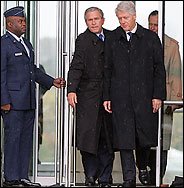
This is where I came in.
Credit Ford Motor Co. CEO Alan Mulally with saving the leader of the free world from self-immolation.No, not that part; this part:
Mulally told journalists at the New York auto show that he intervened to prevent President Bush from plugging an electrical cord into the hydrogen tank of Ford's hydrogen-electric plug-in hybrid at the White House last week. Ford wanted to give the Commander-in-Chief an actual demonstration of the innovative vehicle, so the automaker arranged for an electrical outlet to be installed on the South Lawn and ran a charging cord to the hybrid. However, as Mulally followed Bush out to the car, he noticed someone had left the cord lying at the rear of the vehicle, near the fuel tank.
"I just thought, 'Oh my goodness!' So, I started walking faster, and the President walked faster and he got to the cord before I did. I violated all the protocols. I touched the President. I grabbed his arm and I moved him up to the front," Mulally said. "I wanted the president to make sure he plugged into the electricity, not into the hydrogen This is all off the record, right?""So, I started walking faster, and the President walked faster and he got to the cord before I did." Why does this seem familiar to me? Oh, that's right:
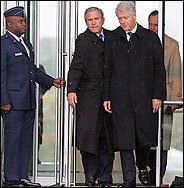
This is where I came in.
You got to have spin
I heard the story of Robert Daniels on Democracy Now. It sounded to me like life in hell, so I went looking about for more information. I found this at NPR:
CNN, MSNBC, and the Tuscon Citizen have the same AP report (which tells you something about local news coverage of this story), which is:
Now imagine how Mr. Daniels feels.
I don't mean to be snarky, or deliberately insulting: but this is the kind of fear and ignorance I am much more concerned about than the abstractions of who is dominating our "mainstream discourse" with what ideas. It's the actions of sheriffs, not national politicians, that matter to most people. As far as I'm concerned, Sam Harris and Rick Warren deserve each other. My concerns are much more pastoral, and that means real human beings, not abstract debating points (much as I do love a good rhubarb!). Of course, I can't do any more about Mr. Daniels' situation than I can do about US troops in Iraq or who's in the White House. Still, this is an indication of an erosion of civil rights that may be as worrisome as the "war on terror."
An Update: "ross upshur" defends his position in this matter in the comments. To the extent that position is misrepresented in this post, I humbly apologize.
Robert Daniels is being held in a detention ward at an Arizona hospital because he is infected with a deadly strain of tuberculosis. Daniels refused to comply with voluntary quarantine rules.This report is a good starting point. Notice, for one thing, how quickly the sheriff blames Mr. Daniels for how the Sheriff's Dept. is treating him. One note from this report I haven't found elsewhere: the court documents related to Mr. Daniels are sealed, meaning no one can see them without court permission. Hmmm....
Rene Gutel of member station KJZZ reports, and Dr. Ross Upshur, head of the University of Toronto Joint Centre for Bioethics, argues that isolation is the only way to contain dangerous types of TB.
CNN, MSNBC, and the Tuscon Citizen have the same AP report (which tells you something about local news coverage of this story), which is:
Robert Daniels has been locked up indefinitely in Maricopa County, perhaps for the rest of his life, since last July. But he has not been charged with a crime. Instead, he suffers from an extensively drug-resistant strain of tuberculosis, or XDR-TB. It is considered virtually untreatable.And here is Dr. Upshur again:
County health authorities obtained a court order to lock him up as a danger to the public because he failed to take precautions to avoid infecting others. Specifically, he said he did not heed doctors' instructions to wear a mask in public.
Dr. Ross Upshur, director of the Joint Centre for Bioethics at the University of Toronto, said authorities should detain people with drug-resistant tuberculosis if they are uncooperative.Indeed, in light of the work of Michel Foucault, this is an intersting sidenote:
"We're on the verge of taking what was a curable disease, one of the best known diseases in human endeavors, and making it incurable," Upshur said.
But a paper Upshur co-wrote on the issue in a medical journal earlier this year has been strongly criticized.
"Involuntary detention should really be your last resort," Harrington said. "There's a danger that we'll end up blaming the victim."
University of Pennsylvania medical ethicist Art Caplan said Maricopa County health officials were confronted with the same ethical dilemma that communities wrestled with generations ago when dealing with leprosy and smallpox.The medical risk here is obviously the question. But how great is the risk? That's something these articles assume, but do not answer. Notice in that NPR story that Dr. Upshur never addresses the issue of contagion. He leaves assumed that TB is very contagious, so isolation is the only remedy for TB that is "XDR." As bloggers know, however, one must beware of "conventional wisdom:"
GEORGE ANNAS: Well, it disturbs me more than it surprises me. It's not surprising that when we get the public basically totally ignorant of infectious, contagious diseases, then they're told there's a new disease here that could kill you and it's not treatable, what do you expect? How do you expect people to react, especially people in law enforcement? They're going to react, to use the tools they have. And the tools they have are jails and punishment. And Professor Gostin is right: that's wrong. We shouldn't be doing that.This, by the way, is a point the AP article tacitly makes:
We do not want this disease in the United States, although it's clearly here. And we do want to take reasonable measures to make sure that it's not spread in the community. But it does not require locking anybody up in a jail. TB is not that easy to get. I mean, if you hang around in homeless shelters, in prisons or in places where a lot of people are immuno-compromised, like have HIV disease, then it's certainly going to be spread. But just someone walking around, at least if he doesn't go right up next to you and breathe in your mouth for a couple of hours, you're not going to get TB that way. So we have to learn something about tuberculosis, as well as something about the inappropriateness and, I think, unconstitutionality of locking people up with the disease.
HIV patients with weakened immune systems are especially susceptible. In South Africa, WHO reported that 52 of 53 HIV patients died within an average of 25 days after it was discovered they also had XDR-TB.But in contrast to the claims of Dr. Upshur in that NPR story, according to the Director of the Center for Law & the Public's Health at Johns Hopkins and Georgetown Universities:
LAWRENCE GOSTIN: Yeah, I mean, it's -- TB is a bacterial infection. It's very prevalent throughout world. In fact, one out of every three or four people have tuberculosis infection, but don't get the disease. So only a small number of those will go on to get the disease. It's prevalent in other parts of the world. It exists in the United States. And in the 1990s in New York and a number of other cities, there was a rise of cases of what they called multidrug-resistant tuberculosis. And more recently, not in the United States particularly, but in other countries, like Russia and South Africa and other places, there's been something called extremely drug-resistant tuberculosis, which means that it really can't even be treated with second- and third-line medications. And that's what I gather we're talking about here, something that is extremely resistant to treatment. And the reason is, is that the bacteria just simply adapt to the medications and become resistant and resist them.And while the NPR report mentions it, the AP article doesn't bother to mention the bleak conditions Mr. Daniels is forced to live in:
Today, Daniels has been forced to live in a hospital cell in complete isolation. His only visitors are medical staff. Sheriff's deputies have taken away his television, his radio, his phone and his computer. He's under 24-hour surveillance. The light in his room is never turned off, even at night. His only contact with the outside world is a pay phone.Let me put this in further context. The Houston Pacifica station runs a program called "The Prison Show." Part of the program is devoted entirely to call ins, but call ins of a unique type. The callers are family and friends of prisoners in the Huntsville prison north of Houston. They call for one more opportunity to talk to their loved ones who are behind bars, one more chance to communicate with them. You can tune into the show one Friday night, if you like, and listen to the phone calls. If they don't break your heart, then you simply aren't human. And these are prisoners who are not in solitary confinement, not shut off entirely from the outside world. These are simply people who have done crimes and been locked up and are cut off from family, from friends, from whatever world they know.
Daniels recently described his ordeal in a phone interview with the Arizona radio station KJZZ.
ROBERT DANIELS: I never thought that this could happen. I’m telling you, I'm sometimes sitting on a bed, and I'm just crying because of all the quietness. I don't have, you know, a permission to take a normal shower, and I have to spit wash. It's really cold, especially at this time. I can't, you know, even -- I can’t even spit wash normally.
They 're telling me I’m an inmate. They gave me a booking number, you know, which is for what? For having TB? Booking number? It's just being all ridiculous. If they want me to be isolated, that's fine with me, but, you know, they don't have the right to isolate me from the other world, especially my family, especially from the media, the news, the everything. I mean, I’m all alone here. I don't even know what the hell is going on in the world. I’m not being isolated. I’m being incarcerated, and I have nobody to talk to. My mental health is going down. I’m just slowly dying.
AMY GOODMAN: Robert Daniels is speaking to the Arizona radio station KJZZ. On Wednesday, Democracy Now! spoke to a former worker at the Maricopa County Medical Center who has kept in touch with Daniels. She spoke to us on condition that she not be identified and that we disguise her voice.
FORMER MARICOPA COUNTY MEDICAL CENTER WORKER: He says he cries a lot, says he's very depressed. You have to understand that he is in what, for all practical purposes, is in solitary confinement. He is in a room in the hospital that, number one, has no hot water, has no privacy, has no natural lights. The windows are blocked.
He has no visitation. He can make calls, but who can afford to accept their collect calls? At 4:00, they turn the telephone on. He doesn't really have magazines. If he does, it's rare. He doesn't have TV. He does not have a radio. So all he has is the quietness of the room and then the nurses coming in when they bring him his medicine.
He cannot take a shower. There are no showers right now. There are no showers on the floor. But he has not had a shower since January. So he gets nothing for personal hygiene other than a basin of water and some, you know, washcloths. So he's unable to shampoo his hair, because the faucet in a detention unit is very small, and, of course, with no warm water in there, he can't shampoo anyway.
Now imagine how Mr. Daniels feels.
I don't mean to be snarky, or deliberately insulting: but this is the kind of fear and ignorance I am much more concerned about than the abstractions of who is dominating our "mainstream discourse" with what ideas. It's the actions of sheriffs, not national politicians, that matter to most people. As far as I'm concerned, Sam Harris and Rick Warren deserve each other. My concerns are much more pastoral, and that means real human beings, not abstract debating points (much as I do love a good rhubarb!). Of course, I can't do any more about Mr. Daniels' situation than I can do about US troops in Iraq or who's in the White House. Still, this is an indication of an erosion of civil rights that may be as worrisome as the "war on terror."
An Update: "ross upshur" defends his position in this matter in the comments. To the extent that position is misrepresented in this post, I humbly apologize.
Who's in Charge Here?
Pay very, very careful attention to the statements being made here; statements being made to justify conditions that we protest, when someone like Iran does them to our people. There is a hunger strike going on at Gitmo, another one. But the response of the military?
prisoners detainees are complaining because conditions have improved. Why, now they're being held in the equivalent of a super-max prison stateside! Of course, only 2.5% of the prisoners detainees have been charged with a crime. But still, the Supreme Court said they have rights, and there's that Military Commissions Act, so what are they complaining about? I mean, if things are worse, it's the detainees' fault:
prisoners detainees (actually, the NYT is calling them "prisoners," isn't it?) to be propaganda, and then we use the very technigues of propaganda: limited information carefully slanted to suit one point of view, in order to justify our clearly unjustifiable actions. Remember, these are the "worst of the worst". Right? And after all, if they would just cooperate, this lifelong imprisonment with no possibility of release would go a lot easier on them.
Do the conditions in this prison begin to sound even vaguely familiar?
A military spokesman at Guantánamo, Cmdr. Robert Durand of the Navy, played down the significance of the current hunger strike, describing the prisoners’ complaints as “propaganda.”And why are they striking?
Lawyers for several detainees being held in the new maximum security complex, called Camp 6, compared it to “super-max” prisons in the United States. The major differences, they said, are that the detainees have limited reading material and no television, and that only 10 of the roughly 385 men at Guantánamo have been charged.Ahem; as I was saying....(and DAS's comment deserves to be folded in here, on that point). But let's put this in context now:
The Camp 6 inmates are generally locked in their 8-by-10-foot cells for at least 22 hours a day, emerging only to exercise in small wire cages and shower. Besides those exercise periods, they can talk with other prisoners only by shouting through food slots in the steel doors of their cells.Catch that? The
“My wish is to die,” one reported hunger striker in the camp, Adnan Farhan Abdullatif, a 27-year old Yemeni, told his lawyer on Feb. 27, according to recently declassified notes of the meeting. “We are living in a dying situation.”
Commander Durand, the Guantánamo spokesman, dismissed such accounts as part of an effort by the prisoners and their lawyers to discredit the detention mission. He described new unit as much more comfortable than the detainees’ previous quarters, and he denied that they suffer any greater sense of isolation in the new cellblocks.
“Anytime something changes, people will seize on that as an opportunity to say that things are getting worse,” he said. “This was designed to improve living conditions, and we think it has.”
Camp 6 was originally designed as a modern, medium-security prison complex for up to 200 inmates, with common areas where they could gather for meals and a large, fenced-in athletic field where they might jog or play soccer outside the high, concrete walls.Do you see the neat trick? We proclaim the actions of the
But after a riot last May and the suicides of three prisoners in June, the unit was retrofitted to limit the detainees’ freedom of movement and reduce the risk that they might hurt themselves or attack guards, military officials said.
Lawyers for half a dozen Camp 6 detainees said their clients were uniformly despondent about the move even though, as military officials note, the new cells are 27 square feet larger than the old ones and have air-conditioning, nicer toilets and sinks, and a small desk anchored to the wall.Might as well match conditions in Americs. Clearly the inmates are in charge of the asylum here. "Senior officials" keep making all the right noises: "Senior officials expressed concern in interviews about how prisoners would react to the greater isolation in Camp 6." But apparently no one listens to them anymore. And of course, there's the bouncing rationale for forced feedings, which all comes down to a matter of control. We will keep you imprisoned, and we will keep you alive, and we will make your life a iiving hell, and don't you try to do a thing about it, because it can always get worse:
“They’re just sitting on a powder keg down there,” said one lawyer, Sabin Willett, who, like others, described an atmosphere of growing desperation among the prisoners. “You’re going to have an insane asylum.”
In an interview as the move began in December, the commander of the military guard force, Col. Wade Dennis, suggested that he would be unperturbed by such protests: “If they want to do that, hook it up,” he said of the restraint-chair feeding system.Oh, and since you "terrorists" have no respect for human life, we can prove to you that two can play at that game:
Military officials have described the restraint-chair regimen as unpleasant but necessary. They originally said prisoners needed to be restrained while digesting, so they could not purge what they were fed.
Now, the rationale has changed: The restraints are generally applied “for safety of the detainee and medical staff,” records show, and they are kept on for as little as 15 minutes at a time, rather than the two hours commonly used before. Afterwards, the prisoners are moved to a “dry room,” and monitored to make sure they do not vomit.
Even so, some detainees describe the experience as painful, even gruesome.
One Sudanese detainee, Sami al Hajj, a 38-year-old former cameraman for the Arab television network Al Jazeera, described feeling at one point that he could not bear the tube for another instant. “I said I would begin to scream unless they took it out,” he wrote in a recent diary entry given to his lawyer. “They finally did.”Probably better medical care than he'd get outside of Gitmo! Damn straight! (On second thought, perhaps we shouldn't even go there. Too many embarassing questions about Hippocratic oaths and such.) Besides, concern for torture victims (and what is solitary confinement if not a form of torture?) is a liberal vice, so we shouldn't expect this Administration to have any qualms at all, eh?
Military officials said they have segregated the hunger strikers from other detainees to impede their recruitment of others. The authorities have also continued to isolate at least two detainees considered leaders among the prisoners, and lawyers for the men complained that their clients’ mental health is deteriorating.
“The man has been in segregation — virtual isolation — for over nine months,” said Stephen H. Oleskey, who represents Saber Lahmar, an Algerian religious scholar whom military officials accused of propagating a religious legal ruling that was linked to the suicides. “Physically and emotionally, he’s collapsing. We think this punishment does exceed what the law allows, and that he won’t survive.”
Military officials said Mr. Lahmar receives adequate medical attention.
Do the conditions in this prison begin to sound even vaguely familiar?
Sunday, April 08, 2007
Ubi et Orbi Easter 2007
Sylvia Poggioli, on Weekend Sunday Edition this morning, reported that Pope Benedict said "nothing positive" has come out of Iraq, and that the violence was causing people to flee the country. This, from the AP version, is the language she noted:
O Christ, thou Lamb of God, who takest away the sins of the world, have mercy upon us.
O Christ, thou Lamb of God, who takest away the sins of the world, have mercy upon us.
O Christ, thou Lamb of God, who takest away the sins of the world, grant us they peace.
"Afghanistan is marked by growing unrest and instability," Benedict said. "In the Middle East, besides some signs of hope in the dialogue between Israel and the Palestinian Authority, nothing positive comes from Iraq, torn apart by continual slaughter as the civil population flees."For Americans, this statement is completely without context. Which leaves me wondering: will we skip over it, a mental lacunae for something we simply have no information by which to absorb it? Or will people begin to ask: "Wait a minute? Fleeing the country? Then what are we doing there?"
O Christ, thou Lamb of God, who takest away the sins of the world, have mercy upon us.
O Christ, thou Lamb of God, who takest away the sins of the world, have mercy upon us.
O Christ, thou Lamb of God, who takest away the sins of the world, grant us they peace.
Easter Sunday 2007
And when the sabbath day was over, Mary of Magdala and Mary the mother of James and Salome bought spices so they could go and embalm him. And very early on the first day of the week they got to the tomb just as the sun was coming up. And they had been asking themselves, "Who will help us roll the stone away from the opening of the tomb?" Then they look up and discover that the stone has been rolled away! (For in fact the stone was very large.)And when they went into the tomb, they saw a young man sitting on the right, wearing a white robe, and they grew apprehensive.He says to them, "Don't be alarmed! You are looking for Jesus the Nazarene who was crucified. He was raised, he is not here! Look at the spot where they put him! But go and tell his disciples, including 'Rock,' he is going ahead of you to Galilee! There you will see him, just as he told you."And once they got outside, they ran away from the tomb, because great fear and excitement got the better of them. And they didn't breathe a word of it to anyone: talk about terrified. . .
--Mark 16:1-8 (SV)
--Mark 16:1-8 (SV)
Saturday, April 07, 2007
Friday, April 06, 2007
As I've said before
on more than one ocassion: Sam Harris is nuts. I don't think much of Richard Dawkins, either. And given what day it is, I certainly agree with E.J. Dionne:
And whether he does, or not, is no business of mine. I rise only to point out that the fundamental problem with Dawkins and Harris, whom Dionne dubs "neo-atheists" (although Madalyn Murray O'Hair was never an icon of tolerance when she was alive), is their intolerance. Atrios seems to think that's okay, because people like Warren, as evidenced by his feeble version of Pascal's rather interesting argument, are equally intolerant. Two wrongs, somehow, make a right. Or at least balance the scales. Or something. Maybe it's matter requires anti-matter, or that each action must provoke an equal and opposite reaction.
But in any case, my problem with the neo-atheists is not what they believe, or refuse to believe, or even that they are intolerant in their beliefs. Certainly fundamentalists are just as intolerant, and Warren's rather screwy soteriology ("He's betting his life that he's right. I'm betting my life that Jesus was not a liar.") is as poorly reasoned as Harris' assertion that: "certainty about the next life is simply incompatible with tolerance in this one." Aye, as the Bard said, there's the rub: neither extreme in this argument, makes any sense. It is true that
I don't think so. I think we focus too much, too often, especially in blogs, on what we perceive to be "the mainstream discourse," as if real people really lived there. Just the other day Atrios noted that 20% of the people were interested in the Justice Department attorney scandal, which sounds like a small number; except 20% paid attention to the OJ trial, to the impeachment of Clinton, to Janet Jackson's "wardrobe malfunction." Is 20% a large number, or not? If only 20% of American churches are operating food pantries and other aid to the poor, is that "mainstream," or not? I only ask because blogs were once famous for being so concerned about the absolute accuracy of facts, and I'm beginning to wonder when we can declare we know what "mainstream America" is thinking and talking about, when we also deride the media for not talking about what "mainstream America" is thinking and talking about.
Is religion simply what shows up on TV or on the bestseller lists or in the headlines? Or is it how people live their daily lives? Sam Harris and Richard Dawkins are bestselling authors, but I know few people who would recognize either name, or could name any of their books. Are all my friends out of the mainstream? Are they really missing anything?
Dionne is entitled to his opinion, Atrios to his. My two cents? Tempest in a teapot, and my problem with "neo-atheism" is that it disgraces the valid critiques of religion that have existed for millenia. It is poorly reasoned, poorly argued trash, parading itself as new and searing insight. Rubbish. I have more respect for Bertrand Russell than I do for Sam Harris, and far more respect for Thomas Huxley than for Richard Dawkins.
But maybe that's just me.
As for me, Christianity is more a call to rebellion than an insistence on narrow conformity, more a challenge than a set of certainties.All of this, for some reason, annoys Atrios, who drags into the conversation a poor man's (well, I guess Rick Warren is hardly a poor man) version of Pascal's wager. Fair enough. But you can see from this why Warren's version is as easily knocked down as Atrios says it is:
In " The Last Week," their book about Christ's final days on Earth, Marcus J. Borg and John Dominic Crossan, distinguished liberal scriptural scholars, write: "He attracted a following and took his movement to Jerusalem at the season of Passover. There he challenged the authorities with public acts and public debates. All this was his passion, what he was passionate about: God and the Kingdom of God, God and God's passion for justice. Jesus' passion got him killed."
That's why I celebrate Easter and why, despite many questions of my own, I can't join the neo-atheists.
“Pascal's Wager” is the name given to an argument due to Blaise Pascal for believing, or for at least taking steps to believe, in God. The name is somewhat misleading, for in a single paragraph of his Pensées, Pascal apparently presents at least three such arguments, each of which might be called a ‘wager’ — it is only the final of these that is traditionally referred to as "Pascal's Wager". We find in it the extraordinary confluence of several important strands of thought: the justification of theism; probability theory and decision theory, used here for almost the first time in history; pragmatism; voluntarism (the thesis that belief is a matter of the will); and the use of the concept of infinity.Does all of this mean Atrios is wrong? No. It's just a little surprising he takes such umbrage at something he says he really doesn't care about.
And whether he does, or not, is no business of mine. I rise only to point out that the fundamental problem with Dawkins and Harris, whom Dionne dubs "neo-atheists" (although Madalyn Murray O'Hair was never an icon of tolerance when she was alive), is their intolerance. Atrios seems to think that's okay, because people like Warren, as evidenced by his feeble version of Pascal's rather interesting argument, are equally intolerant. Two wrongs, somehow, make a right. Or at least balance the scales. Or something. Maybe it's matter requires anti-matter, or that each action must provoke an equal and opposite reaction.
But in any case, my problem with the neo-atheists is not what they believe, or refuse to believe, or even that they are intolerant in their beliefs. Certainly fundamentalists are just as intolerant, and Warren's rather screwy soteriology ("He's betting his life that he's right. I'm betting my life that Jesus was not a liar.") is as poorly reasoned as Harris' assertion that: "certainty about the next life is simply incompatible with tolerance in this one." Aye, as the Bard said, there's the rub: neither extreme in this argument, makes any sense. It is true that
the proselytizing of Harris, even in the mean scary quotes Dionne provides, is at its most strident rather meek and mild compared to the equivalent proselytizing from believers which is a steady drumbeat in our mainstream discourse.But I'm not sure Dionne is trying to say Harris should shut up so Warren can be heard. Indeed, Dionne expressly welcomes the challenge of Harris:
As a general proposition, I welcome the neo-atheists' challenge. The most serious believers, understanding that they need to ask themselves searching questions, have always engaged in dialogue with atheists.On this, Dionne is right; it's called Christian apologetics, and it is, frankly, at the heart of all Christian theology. It's the reason Christian doctrine developed along the lines of Greek, not Hebraic, thought. It's the reason we have the Christianity we do today, from Rick Warren on one end, to Dom Crossan and Marcus Borg (and your humble host) on the other. Does the fundamentalist line dominate "our mainstream discourse"? Of course; because it's simple, simplistic, and easily sold. Does that negate all the work of Dorothy Day or Thomas Merton or the Jesus Seminar or Catholic Relief or food pantries run by coalitions of local churches, homeless shelters, soup kitchens, etc., etc., etc.?
I don't think so. I think we focus too much, too often, especially in blogs, on what we perceive to be "the mainstream discourse," as if real people really lived there. Just the other day Atrios noted that 20% of the people were interested in the Justice Department attorney scandal, which sounds like a small number; except 20% paid attention to the OJ trial, to the impeachment of Clinton, to Janet Jackson's "wardrobe malfunction." Is 20% a large number, or not? If only 20% of American churches are operating food pantries and other aid to the poor, is that "mainstream," or not? I only ask because blogs were once famous for being so concerned about the absolute accuracy of facts, and I'm beginning to wonder when we can declare we know what "mainstream America" is thinking and talking about, when we also deride the media for not talking about what "mainstream America" is thinking and talking about.
Is religion simply what shows up on TV or on the bestseller lists or in the headlines? Or is it how people live their daily lives? Sam Harris and Richard Dawkins are bestselling authors, but I know few people who would recognize either name, or could name any of their books. Are all my friends out of the mainstream? Are they really missing anything?
Dionne is entitled to his opinion, Atrios to his. My two cents? Tempest in a teapot, and my problem with "neo-atheism" is that it disgraces the valid critiques of religion that have existed for millenia. It is poorly reasoned, poorly argued trash, parading itself as new and searing insight. Rubbish. I have more respect for Bertrand Russell than I do for Sam Harris, and far more respect for Thomas Huxley than for Richard Dawkins.
But maybe that's just me.
Good Friday 2007
The music for this day should be Bach. For better or worse, for me it is inextricably the final music of "Jesus Christ Superstar."
The first of these two is far better than the second. I'll admit I can't watch the first (which I had never seen before) without crying. The final shot, of the grieving woman looking up from the corpse, obviously trying to see God, and finding only an empty cross.... That just seems to define the day.
"Now in the place where he was crucified there was a garden; and in the garden a new sepulchre, wherein was never man yet laid."--John 19:41
The first of these two is far better than the second. I'll admit I can't watch the first (which I had never seen before) without crying. The final shot, of the grieving woman looking up from the corpse, obviously trying to see God, and finding only an empty cross.... That just seems to define the day.
"Now in the place where he was crucified there was a garden; and in the garden a new sepulchre, wherein was never man yet laid."--John 19:41
Thursday, April 05, 2007
Pax Romana
I've been very cautious about leaping to the conclusion that George W. Bush's piety, or even his projected piety, had a profound, rather than incidental, impact on his world view. He projects the image of the aggrieved Christian striking back more in sorrow than in anger, but I've never believed it was his true personality showing through. He is a child of privilege, used to having his own way or being bailed out of situations that go sour. There is little in his background to indicate he would reflexively turn to God for salvation from his troubles, rather than speak of God in public because it plays well in Peoria.
But listening to this story, I'm reconsidering that position. Bush may still not be as Christian as he wants to appear, but there are some definite religious notions lurking in his policies.
I'm sure this is not an original idea, but it is clear to me now that "extraordinary rendition" could not have come up under any other President, and that it is rooted in a particular religious idea: that of America as "holy ground," as the "shining city on a hill," as the place God has especially blessed. As such, it must be maintained inviolate. That, of course, was the great "sin" of 9/11: that foreigners, using our systems, our technologies, our planes, against us, attacked our "holy ground," penetrated the barrier of the oceans that were supposed to protect "Fortress America," and there could be only one response: destructive retaliation.
Well, that much is hardly unique to America. But now, as a result of that act, we have "extraordinary rendition." And it is justified in part by law. The Supreme Court has never clearly stated that American law applies outside America (unlike, say, Germany, where Donald Rumsfeld can be charged with crimes he did not commit in Germany. I am simplifying here, and I know it.) There are untried and untouched questions of jurisdiction when the American government acts outside the political boundaries of the 50 states. This, too, is a reflection, though, not just of our jursiprudence, but of our "holiness." Holiness requires a boundary, a line, a sharp distinction between "us" and "them," between "here" and "there." It is that distinction that extraordinary rendition exploits.
Consider: American citizens in America are subject to due process. We do not "kidnap" such people off the streets, secret them in "black prisons" somewere in this country, torture them, keep them imprisoned indefinitely, deny them all acess to lawyers or courts. Not here. Not in the holy ground.
But over there, in, say, Ethiopia? Well, that is not holy ground. Outside the bounds of God's chosen country, anything can happen, and those who live there, as well as Americans who go there, can safely be treated as "outlaw," in the old sense of the word: one who is outside the bounds, and so outside the protection, of the law. This is the rest of the world as frontier, as lawless place, a place where order is only established by US military bases and naval carrier groups and ruthless repression in "black prisons" because, after all, "those people" are unholy, and American citizens who mingle with them, who go to live among them, are likewise corrupted. Having placed themselves beyond the protection of the law, therefore, they are undeserving of its protections. And so this Administration defends its extraordinary practice of what can only be considered criminal acts with no warrant in law or national security whatsoever.
But it is not security they are trying to establish: it is purity. It is holiness. The holy ground has been defiled, and the price of that defilement has been paid in blood. But it cannot be futher defiled with still more "outlaws." So we must do what needs to be done, and keep our holy ground pure. It is not just that we should not know; but that we cannot know. Because what is being done, is being done to keep us holy, to keep us clean; to maintain our blessing.
The rest of the world, who are not blessed as we are, either do not understand the burdens of the blessing, or are jealous of our special favor. Their concerns, therefore, are not to be regarded. We have God on our side. We are God's holy people.
This seems to be the logic behind this Administration's actions. God help us all.
And why do I bring this up today? Coincidence, I suppose:
But listening to this story, I'm reconsidering that position. Bush may still not be as Christian as he wants to appear, but there are some definite religious notions lurking in his policies.
I'm sure this is not an original idea, but it is clear to me now that "extraordinary rendition" could not have come up under any other President, and that it is rooted in a particular religious idea: that of America as "holy ground," as the "shining city on a hill," as the place God has especially blessed. As such, it must be maintained inviolate. That, of course, was the great "sin" of 9/11: that foreigners, using our systems, our technologies, our planes, against us, attacked our "holy ground," penetrated the barrier of the oceans that were supposed to protect "Fortress America," and there could be only one response: destructive retaliation.
Well, that much is hardly unique to America. But now, as a result of that act, we have "extraordinary rendition." And it is justified in part by law. The Supreme Court has never clearly stated that American law applies outside America (unlike, say, Germany, where Donald Rumsfeld can be charged with crimes he did not commit in Germany. I am simplifying here, and I know it.) There are untried and untouched questions of jurisdiction when the American government acts outside the political boundaries of the 50 states. This, too, is a reflection, though, not just of our jursiprudence, but of our "holiness." Holiness requires a boundary, a line, a sharp distinction between "us" and "them," between "here" and "there." It is that distinction that extraordinary rendition exploits.
Consider: American citizens in America are subject to due process. We do not "kidnap" such people off the streets, secret them in "black prisons" somewere in this country, torture them, keep them imprisoned indefinitely, deny them all acess to lawyers or courts. Not here. Not in the holy ground.
But over there, in, say, Ethiopia? Well, that is not holy ground. Outside the bounds of God's chosen country, anything can happen, and those who live there, as well as Americans who go there, can safely be treated as "outlaw," in the old sense of the word: one who is outside the bounds, and so outside the protection, of the law. This is the rest of the world as frontier, as lawless place, a place where order is only established by US military bases and naval carrier groups and ruthless repression in "black prisons" because, after all, "those people" are unholy, and American citizens who mingle with them, who go to live among them, are likewise corrupted. Having placed themselves beyond the protection of the law, therefore, they are undeserving of its protections. And so this Administration defends its extraordinary practice of what can only be considered criminal acts with no warrant in law or national security whatsoever.
But it is not security they are trying to establish: it is purity. It is holiness. The holy ground has been defiled, and the price of that defilement has been paid in blood. But it cannot be futher defiled with still more "outlaws." So we must do what needs to be done, and keep our holy ground pure. It is not just that we should not know; but that we cannot know. Because what is being done, is being done to keep us holy, to keep us clean; to maintain our blessing.
The rest of the world, who are not blessed as we are, either do not understand the burdens of the blessing, or are jealous of our special favor. Their concerns, therefore, are not to be regarded. We have God on our side. We are God's holy people.
This seems to be the logic behind this Administration's actions. God help us all.
And why do I bring this up today? Coincidence, I suppose:
In a new report published today (5 April), Amnesty International says that 80% of detainees at the US military prison at Guantánamo Bay in Cuba are being held in solitary confinement, often in harsh and inhumane conditions.Things we cannot do "here," we can do "there." After all, in the provinces, like Galilee, the people are so much more barbaric than in the civilized centers, like Rome.
...
Amnesty International UK Director Kate Allen said:
'The entire process at Guantánamo is a travesty of justice, but we have particular concerns over the widespread use of solitary confinement in harsh conditions at the camp.
'With many prisoners already in despair at being held in indefinite detention on a remote island prison, some are dangerously close to full-blown mental and physical breakdown after years of solitary confinement.
'The US authorities should immediately stop pushing people to the edge with extreme isolation techniques and allow proper access for independent medical experts and human rights groups.'
There are approximately 385 men held at Guantánamo Bay and, after an apparent hardening of US operational detention policy in January, around 300 of these are now being held in three units with minimal contact with other prisoners or even prison guards. These units - known as Camp 5, Camp 6 and Camp Echo - are comparable to so-called 'super-max' high security units in the United States.
Unlike mainland super-max prisoners, however, Guantánamo detainees are held indefinitely as 'enemy combatants', face either no trial at all or an unfair one, have no family visits and no independent expert examinations.
The Sacrament of the Last Supper
Wounded Bird has a wonderful meditation on the Last Supper. To the mystery of the presence in the elements, I would only add this, in order to deepen the mystery.
My New Testament professor was Stephen J. Patterson, a fine Biblical scholar and a member, at the time, of the infamous Jesus Seminar. As such, he proudly declared he was one of the most skeptical of members, casting a black pebble (for "non-authentic") over almost every statement attributed to Jesus in the gospels (the purpose of the Seminar was to counter the rigid literalism of Christian fundamentalists, by establishing a text which could be verified according to a rubric of critical standards). If those standards were not satisfied, Steve was quite comfortable with denying any claim to authenticity to the words.
It was a good stance for a scholar, and he defended it as such. But one day, he told us about a graduate seminar he took, one where the class spent a semester examining the words of institution that are now so much as the center of the theories of the eucharist: "This is my body...this is my blood." What did those words mean?
Despite perceived allusions to the cult of Mithra or any other mystery cults, or ideas of "eating the god" from non-Hebraic cultures, Steve told us that they could find no precedent for these words, no relationship to any other ideas extant in the 1st century world of Jesus and the disciples, that would give a context, an explanation, to his words.
Think about that a moment. If Socrates is right, all of our ideas are the result of similarity to ideas we already have, ideas we are born with, and so we "recover" knowledge, not acquire it. To acquire what you do not know is an impossibility, since you must be able to relate it to what is already known, and with a perfectly blank slate, there is no outside hand and piece of chalk to write on yours. Hume dodged this issue later, in arguing for analytic and synthetic statements as the only categories of thought available to us. One is purely about sensory information, which we gain by experience; the other is purely a creation of our thoughts and, as such, impossible to verify, and therefore useless. Kant only restored value to our thoughts by returning us, in some measure, closer to Socrates's position.
So what does it mean to say something so unique, so original, it has no precedent? "This is my body....this is my blood. Do this to remember me." What was he saying? What are we saying, today?
And, as Grandmere Mimi says, reflecting on the words of John's Gospel: "If Jesus was speaking symbolically, why would they have left?"
My New Testament professor was Stephen J. Patterson, a fine Biblical scholar and a member, at the time, of the infamous Jesus Seminar. As such, he proudly declared he was one of the most skeptical of members, casting a black pebble (for "non-authentic") over almost every statement attributed to Jesus in the gospels (the purpose of the Seminar was to counter the rigid literalism of Christian fundamentalists, by establishing a text which could be verified according to a rubric of critical standards). If those standards were not satisfied, Steve was quite comfortable with denying any claim to authenticity to the words.
It was a good stance for a scholar, and he defended it as such. But one day, he told us about a graduate seminar he took, one where the class spent a semester examining the words of institution that are now so much as the center of the theories of the eucharist: "This is my body...this is my blood." What did those words mean?
Despite perceived allusions to the cult of Mithra or any other mystery cults, or ideas of "eating the god" from non-Hebraic cultures, Steve told us that they could find no precedent for these words, no relationship to any other ideas extant in the 1st century world of Jesus and the disciples, that would give a context, an explanation, to his words.
Think about that a moment. If Socrates is right, all of our ideas are the result of similarity to ideas we already have, ideas we are born with, and so we "recover" knowledge, not acquire it. To acquire what you do not know is an impossibility, since you must be able to relate it to what is already known, and with a perfectly blank slate, there is no outside hand and piece of chalk to write on yours. Hume dodged this issue later, in arguing for analytic and synthetic statements as the only categories of thought available to us. One is purely about sensory information, which we gain by experience; the other is purely a creation of our thoughts and, as such, impossible to verify, and therefore useless. Kant only restored value to our thoughts by returning us, in some measure, closer to Socrates's position.
So what does it mean to say something so unique, so original, it has no precedent? "This is my body....this is my blood. Do this to remember me." What was he saying? What are we saying, today?
And, as Grandmere Mimi says, reflecting on the words of John's Gospel: "If Jesus was speaking symbolically, why would they have left?"
Maundy Thursday-2007
"The traditional English name for the Thursday preceding Easter, derived from the first antiphon of the ceremony of the washing of the feet, 'mandatum novum' (John 13:34)" F.L. Cross, The Oxford Dictionary of the Christian Church, 2nd edition (New York: Oxford University Press 1993).
On this day the Sovereign of England would bring in beggars, wash their feet, and give them alms and gifts. According to Wikipedia, this practice was followed up until the death of King James II. Today the tradition continues with the giving of "Maundy Money." The practice itself, attested only in the Gospel of John, has never risen to the level of a sacrament, but it remains an inextricable part of the observance of the day.
God, bless to me this day,
God, bless to me this night;
Bless, O bless, Thou God of grace,
Each day and hour of my life;
Bless, O bless, Thou God of Grace,
Each day and hour of my life.
God, bless the pathway on which I go,
God, bless the earth that is beneath my sole;
Bless, O God, and give to me Thy love,
O God of Gods, bless my rest and my respose;
Bless, O God, and give to me Thy love,
O God of Gods, bless my rest and my respose.
Psalm 78
14 In the daytime also he led them with a cloud, and all the night with a light of fire.
15 He clave the rocks in the wilderness, and gave them drink as out of the great depths.
16 He brought streams also out of the rock, and caused waters to run down like rivers
17 And they sinned yet more against him by provoking the most High in the wilderness.
18 And they tempted God in their heart by asking meat for their lust
19 Yea, they spake against God; they said, Can God furnish a table in the wilderness?
20 Behold, he smote the rock, that the waters gushed out, and the streams overflowed; can he give bread also? can he provide flesh for his people?
23 Though he had commanded the clouds from above, and opened the doors of heaven,
24 And had rained down manna upon them to eat, and had given them the corn of heaven
25 Man did eat angels' food: he sent them meat to the full.
John 13:1-15
13:1 Now before the festival of the Passover, Jesus knew that his hour had come to depart from this world and go to the Father. Having loved his own who were in the world, he loved them to the end.
13:2 The devil had already put it into the heart of Judas son of Simon Iscariot to betray him. And during supper
13:3 Jesus, knowing that the Father had given all things into his hands, and that he had come from God and was going to God,
13:4 got up from the table, took off his outer robe, and tied a towel around himself.
13:5 Then he poured water into a basin and began to wash the disciples' feet and to wipe them with the towel that was tied around him.
13:6 He came to Simon Peter, who said to him, "Lord, are you going to wash my feet?"
13:7 Jesus answered, "You do not know now what I am doing, but later you will understand."
13:8 Peter said to him, "You will never wash my feet." Jesus answered, "Unless I wash you, you have no share with me."
13:9 Simon Peter said to him, "Lord, not my feet only but also my hands and my head!"
13:10 Jesus said to him, "One who has bathed does not need to wash, except for the feet, but is entirely clean. And you are clean, though not all of you."
13:11 For he knew who was to betray him; for this reason he said, "Not all of you are clean."
13:12 After he had washed their feet, had put on his robe, and had returned to the table, he said to them, "Do you know what I have done to you?
13:13 You call me Teacher and Lord--and you are right, for that is what I am.
13:14 So if I, your Lord and Teacher, have washed your feet, you also ought to wash one another's feet.
13:15 For I have set you an example, that you also should do as I have done to you.
Life be in my speech,
Sense in what I say.
The love Christ Jesus gave
Be filling every heart for me,
The love Christ Jesus gave,
Filling me for every one.
On this day the Sovereign of England would bring in beggars, wash their feet, and give them alms and gifts. According to Wikipedia, this practice was followed up until the death of King James II. Today the tradition continues with the giving of "Maundy Money." The practice itself, attested only in the Gospel of John, has never risen to the level of a sacrament, but it remains an inextricable part of the observance of the day.
God, bless to me this day,
God, bless to me this night;
Bless, O bless, Thou God of grace,
Each day and hour of my life;
Bless, O bless, Thou God of Grace,
Each day and hour of my life.
God, bless the pathway on which I go,
God, bless the earth that is beneath my sole;
Bless, O God, and give to me Thy love,
O God of Gods, bless my rest and my respose;
Bless, O God, and give to me Thy love,
O God of Gods, bless my rest and my respose.
Psalm 78
14 In the daytime also he led them with a cloud, and all the night with a light of fire.
15 He clave the rocks in the wilderness, and gave them drink as out of the great depths.
16 He brought streams also out of the rock, and caused waters to run down like rivers
17 And they sinned yet more against him by provoking the most High in the wilderness.
18 And they tempted God in their heart by asking meat for their lust
19 Yea, they spake against God; they said, Can God furnish a table in the wilderness?
20 Behold, he smote the rock, that the waters gushed out, and the streams overflowed; can he give bread also? can he provide flesh for his people?
23 Though he had commanded the clouds from above, and opened the doors of heaven,
24 And had rained down manna upon them to eat, and had given them the corn of heaven
25 Man did eat angels' food: he sent them meat to the full.
John 13:1-15
13:1 Now before the festival of the Passover, Jesus knew that his hour had come to depart from this world and go to the Father. Having loved his own who were in the world, he loved them to the end.
13:2 The devil had already put it into the heart of Judas son of Simon Iscariot to betray him. And during supper
13:3 Jesus, knowing that the Father had given all things into his hands, and that he had come from God and was going to God,
13:4 got up from the table, took off his outer robe, and tied a towel around himself.
13:5 Then he poured water into a basin and began to wash the disciples' feet and to wipe them with the towel that was tied around him.
13:6 He came to Simon Peter, who said to him, "Lord, are you going to wash my feet?"
13:7 Jesus answered, "You do not know now what I am doing, but later you will understand."
13:8 Peter said to him, "You will never wash my feet." Jesus answered, "Unless I wash you, you have no share with me."
13:9 Simon Peter said to him, "Lord, not my feet only but also my hands and my head!"
13:10 Jesus said to him, "One who has bathed does not need to wash, except for the feet, but is entirely clean. And you are clean, though not all of you."
13:11 For he knew who was to betray him; for this reason he said, "Not all of you are clean."
13:12 After he had washed their feet, had put on his robe, and had returned to the table, he said to them, "Do you know what I have done to you?
13:13 You call me Teacher and Lord--and you are right, for that is what I am.
13:14 So if I, your Lord and Teacher, have washed your feet, you also ought to wash one another's feet.
13:15 For I have set you an example, that you also should do as I have done to you.
Life be in my speech,
Sense in what I say.
The love Christ Jesus gave
Be filling every heart for me,
The love Christ Jesus gave,
Filling me for every one.
Subscribe to:
Posts (Atom)