Saturday, August 11, 2018

Old Times There Are Best Forgotten....


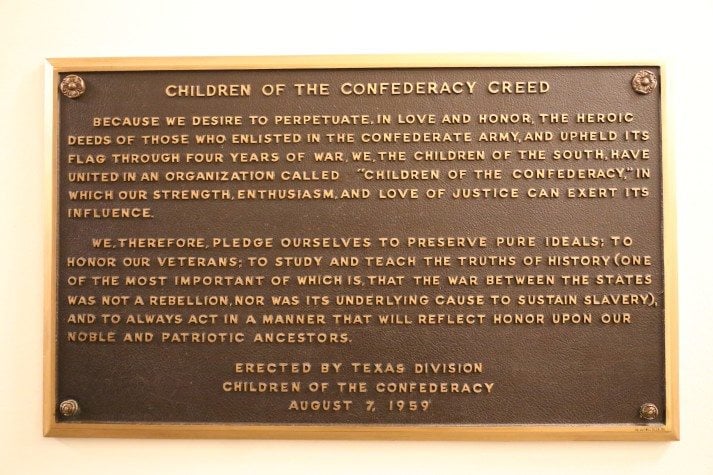
I've written about this plaque before.  And I have to admit, there's been so much change to the Capitol building that the last time I was there, I couldn't find this plaque.  It used to be downstairs from the main lobby, but when I was there the basement now connects to the new offices, built underground behind the Capitol.  There was an historical display in the basement of the old building, and I couldn't find the column with this plaque on it, though I've seen it before.

Speaker Straus makes an eloquent and reasoned argument for removing it posthaste.  But this small plaque in the basement of the Capitol is not the most offensive piece of Civil War remembrance on the Capitol grounds.  That distinction goes to the largest statue (or one of them, anyway) on the grounds, placed in front of the building on the long esplanade leading from the border of the grounds to the building.


The statue, with Jefferson Davis in the center, and four soldiers representing the Confederacy around him, was erected in 1903, and there is no question why it was put there:

Texas lawmakers in 1895 approved a monument “to the Confederate dead” to be placed on the grounds of the Capitol. Eight years later, more than 5,000 people gathered to see the Confederate Soldiers Monument unveiled — a particularly large crowd considering Austin’s population at the turn of the last century was just 22,000.

At the unveiling, John H. Reagan, the former Confederate postmaster general, told the crowd outside the Capitol that the North was to blame for the Civil War. “The people of the New England states, even as far back as 1803, when the Louisiana Purchase was consummated, opposed it, as they declared it would increase the power of the agriculture states and diminish the power of the manufacturing states,” he said, according to an account of the ceremony in the Austin Statesman.

Reagan said slavery had “existed in every civilized country in the world, including the Eastern states.”
That argument, that the "East" was as guilty as the South, will come up again.

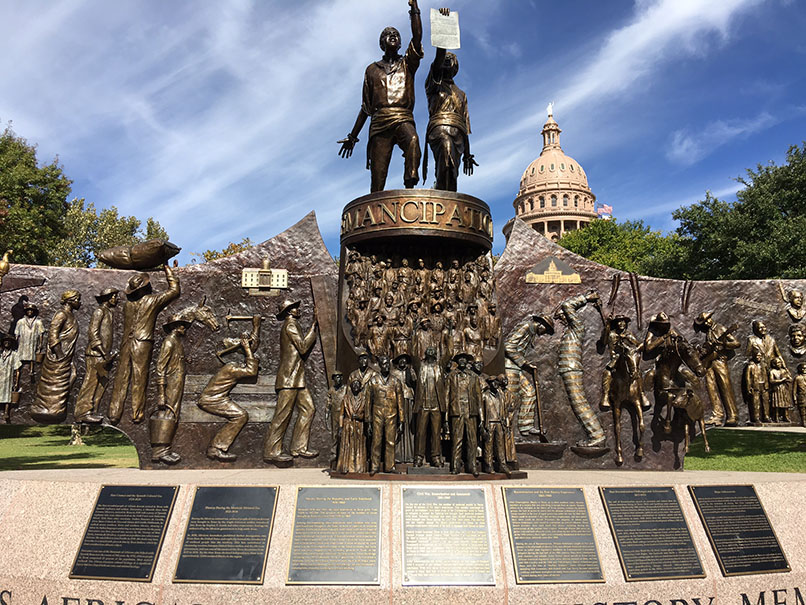
To the left of this statue, as you face the Capitol, is a large, two-sided statue that is a tribute to African-Americans in Texas.


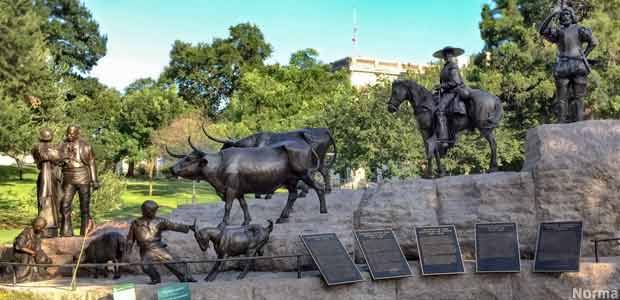
There is another statue, to the right, honoring Tejanos:


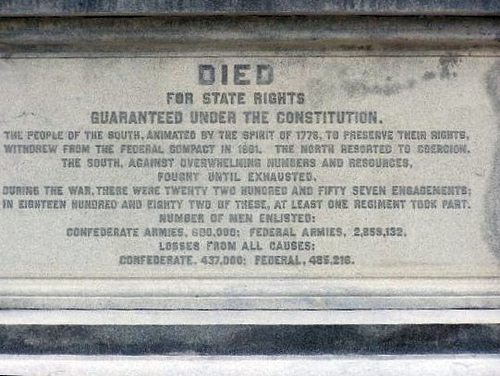
The last time I was at the Capitol those two statues were drawing small crowds of interest and attention; the large statue to the Confederacy stood alone in the sun, with no one much interested in it.  But it is an obscenity, as surely as that plaque is, and it should be removed.  If its history wasn't enough, the statue itself declares its purpose:


There is an effort to remove all the Confederate statues on the Capitol grounds (there are at least 20). Republican leadership, not surprisingly, doesn't want to "erase history":

The monuments are being defended by Gov. Greg Abbott and other Republican leaders as representing a chapter of American history that shouldn’t be forgotten. But, based on a review of the legislative record authorizing the memorials and contemporary accounts of their dedications, the monuments were erected as part of an effort to recast the war as a battle over “state rights.” Slavery and African-Americans are not mentioned on the memorials.
Some history deserves to be erased, apparently, but some doesn't.

What these memorials represent is what the contested plaque represents:  a refusal to take responsibility for a heinous chapter in American history, to acknowledge what Wendell Berry called our "hidden wound" of racism, present from the moment Columbus touched the shores of the New World, continued by us to this day.

Shortly before the unveiling of the Hood’s Texas Brigade Monument in 1910, William R. Hamby, president of the Hood’s Texas Brigade Association, said the Civil War was not a “lost cause” for the South. Hamby fought for the Confederacy and later became managing editor of Austin Daily Statesman, and then a state lawmaker.

“Those who still call us traitors and rebels think treason is the child of the South and that it was conceived in the sin of slavery and was born in the iniquity of secession,” Hamby said, as quoted in the Austin Statesman. “They overlook the fact that treason, slavery and secession are all children of New England. The first of all the colonies to legalize traffic in human slavery and to pass laws for the regulation and control of trade in African slaves was Massachusetts.”

Then-Gov. Thomas Mitchell Campbell said during the unveiling of the Hood’s Brigade monument that the war was “great because of the great principles for which they fought and died.”

“The men of the South did not surrender because they were whipped, for they never were,” Campbell claimed, “but they surrendered because they were tired of victory.” 

And if it isn't clear those attitudes were not buried by the Civil Rights Movement and giving Dr. King a holiday:

Marshall Davis, spokesman for the Texas Division of the Sons of Confederate Veterans, said the Civil War was not fought over the South’s continued interest in enslaving African-Americans.

“Seems to me if slavery was the issue, there would have been a constitutional amendment in 1861,” he told the Statesman. “You cannot morally judge history by today’s standards.”


The Confederacy did not create slavery, Davis added.

“It was ‘you’re not telling me what to do,’” Davis said. “It is a very complicated issue. Slavery was a factor.”
In other words slavery wasn't the cause of the war, petulance and spite were.

Sounds about right; certainly seems to be the reason racism is rearing its ugly head again, lead by our Petulant Spiter in Chief.

Take 'em all down.  We're not remembering heroes or veterans with those monuments.  We're trying to paper over our own complicity in evil.  That is the history that should not be erased, and we should be ashamed of ourselves for even trying to.

Cowardly Bully Says What?


I'm getting more comfortable with Trump tweeting nonsense. What he tweets about he doesn't really do anything about. He loves to make threats. He hates to carry them out.

He didn't preview the family separation policy in a tweet, but he did say transgendered people could not serve in the military on Twitter.

One policy was enacted, one wasn't.

"Oh, Lord, he's gonna preach again!"


Jeff Sessions got crosswise with the United Methodist Church (the name comes from the merger of the Methodists and the United Brethren.  As my father, raised a Methodist before the merger, used to say, he didn't know where that "United" came from, because Methodists were anything but.), which decided that because he was acting as a government official, he couldn't be held personally responsible for the family separation policy he so gleefully implemented, and indeed got in trouble with the court over just this week.  But that is now and this was then.  Whether the UMC should have dropped the case or not (and had it not, it would have found itself as toothless as a tiger with dentures; I'm sure that played into the decision), Tara Burton sums up the issue rather precisely:

The case against Sessions nevertheless raises wider questions for politicians across the religious spectrum. To what extent should religious organizations hold their politician members accountable for legislative positions they take on issues that defy their church’s perspective? To what extent should political stances — be they on immigration, income inequality, abortion, or capital punishment — be held by religious institutions to the same, or higher, standards than personal or private behavior?

Except my question is:  who are you to judge?  Yes, there is the directive in Matthew for the community:  take your complaint to your brother or sister (in Christ); then to a group of believers, if necessary; then finally to the whole community, if you must.  But this wasn't a personal matter between Mr. Sessions and a church member, so that doesn't really apply.  This was a question of association:  is Jeff Sessions fit to be among us, the membership of the United Methodist Church (in my case it would be "among them," as I claim no closer association with the UMC than the commonality of Christianity).  But seriously:  how should churches handle these matters?

Back when the Church practically was the state (and was superior to it, hence the Pope crowned Kings and Emperors; which is why Napoleon upset the apple cart, but that's another story), excommunication meant expulsion from society, not just from the congregation.  Today, who checks your ID at the door to be sure you "belong" there?  And knowing some of the truly nasty people I encountered in church as a pastor, who are they to say I don't belong there (except they had the institutional power I didn't, but that, too, is another story)?

The charges against Sessions, even in general terms, are interesting and a little shocking:

The complaint against Sessions included charges of child abuse, immorality, racial discrimination, and the dissemination of false doctrine — the latter charge a reference to his use of the Bible verse Romans 13 to advocate for submission to government authority. Sessions faced the possibility of an ecclesiastical trial and, ultimately, expulsion from the church.
So racists and convicted criminals ( a felony is , or used to be, a "crime of moral turpitude"), or who don't use the accepted exegesis are not fit to be Methodists? Gonna be mighty sparse congregations.  And I'm still back to this question of judgment:  what would expulsion mean?  We don't like you any more?  We don't care for the way you behaved?  And who among the members of the UMC is so without sin they can cast the first stone?

Tara Burton connects the use of Romans 13 to the issue of the church in the world.

Sessions’s use of Romans 13 further blurred the lines between the private, religious sphere and the political arena. For now, the United Methodist Church has, by arguing that public and private life should be judged differently, seemingly chosen to keep the two distinct.

But as (Christian) religion and politics become increasingly intertwined in the current political climate, it remains to be seen to what extent religious institutions will attempt to use that influence to challenge the Trump administration. 

First:  that line, between church and world, is always going to be blurry, and always going to be blurred.  Either the church ignores the world (huh?), or the church interacts with the world and, by doing so and by definition, interferes with the world.  It simply can't be helped.  I don't think the argument that Sessions "blurred" that line by his interpretation of Romans 13 is all that helpful an analysis.  Simply saying "Love your neighbor" and "Do good to those who persecute you" is blurring the line.  Quoting even the most famous parables, like the Prodigal Son or the Good Samaritan, is blurring the line.

As for the use of Romans 13 and what any institution can do about it, she may be assuming a Roman Catholic view of exegesis, where the Church can at least argue it has the "right" interpretation (and the right to impose it on church members). That was more true 500 years ago than today, but Protestantism established a very different relationship between believers and scripture. The UMC can't really tell Jeff Sessions how to interpret Romans 13.  But a press release offering an alternative exegesis wouldn't get near the attention a church trial would. In the end, the former would be wiser than the latter, because the trial would not involve the church in opposing the Trump Administration.  A trial would only prove the church had no real power, and was vindictive to boot. I don't like Jeff Sessions at all, but the best thing Christian churches can do is provide an alternative to his racism and xenophobia. Trying to punish him because they don't like his actions doesn't make Sessions look immoral. It makes the institution of the Church look like it wants to be a power, but really doesn't have any.

What influence, ultimately, to religious institutions have?  Pope Francis doesn't seem to stand too stalwartly on the side of the U.S. Bishops (who have gone rather quiet lately).  The UCC regularly issues press releases on issues of the day; does anyone have any better idea what "UCC" is (beyond the very secular Uniform Commercial Code)?  If the UMC hadn't first made public the charges against Jeff Sessions, would anyone notice if they'd issued a statement condemning the family separation policy?  I don't know of a mainstream Christian denomination that has supported that policy, but can anyone state the specific objections of any church?  I'd have to Google them myself, and I haven't.

We are back, again, to questions of judgment.  Whatever authority the Church had, historically, to pass judgment on individuals or even nations, it always played fast and loose with that issue of "Don't judge, and you won't be judged."  "Kill them all, God will know His own" is not exactly a high moral point in Church history, and the Church has never really stood firmly on Augustine's "just war" theory, or been able to prevent war or reverse government policy.  What good would be accomplished, then, by declaring a prominent person beyond the reach of the hospitality of a denomination, of the fellowship supposedly open to all?  Does "he who is without sin" not apply when the stones are being cast in the name of the church?

The policies of the Trump Administration are reprehensible and immoral and unjust and probably illegal (the courts have reversed them).  Do we change them by telling Jeff Sessions he's not welcome as a church member?  Has his position on government policy really changed all that much since he became AG?  It's my understanding they haven't.  Is the church really called to do more than bear witness to God's word and God's truth?  The more we blur that line, the more we become like the powers that be.

And the prophets of the Exile didn't exactly applaud the government of Israel for contributing to that disaster for Israel.  Read that in connection with Romans 13, and you get a very different interpretation of the latter.

Thursday, August 09, 2018

The End of the World As We Know It

First, he'd have to wipe out half the movies, to achieve balance....

From some documentary I saw on TeeVee many, many years ago, I still recall this anecdote about the early Academy Awards presentations.  This would have been before TV became the best friend the Academy ever had, and much closer to the time the Academy was a shameless attempt by the studio heads to garner some credibility for the trash they regularly churned out (i.e., before tout le monde discovered that Howard Hawks and John Ford* became auteurs and 40's films were dubbed "Film Noir" by the French, whom we still despise unless they bestow fancy labels on what we consume and make locally).  Jimmy Stewart, I think the phrase was attributed to, said he and his fellow actors were  laughing at the pretension of an "Academy of Motion Picture Arts and Sciences" because, in their experience, there was damned little art involved, and even less science.

I think of that now, every time someone takes the Oscars seriously, at all.  Like now, for instance:


Yes, "Achievement in Popular Film."  Because "Annie Hall" wasn't popular, nor was "Schindler's List," or "Saving Private Ryan," or any other film that won "Best Picture" (a dubious category on it's own) in the past.  Now finally the blockbusters will get their due, which will:  increase the market value of "Black Panther" or "Avengers:  Infinity War" or "Deadpool 2"?

Holy Shitballs!  Holy shit!**

**Deadpool 2 joke.  Don't think about it too hard.  Except as what it does to the sanctity of the Oscars to award a film that has a choir, very English, very formal, singing those words over the end credits.  I mean, it's funny, and the film was extremely popular ("Deadpool" was, frankly, better overall) but is it:  Oscarbait?

Dunno, don't care, just noticing the humor in it.  I mean, I loved "Annie Hall" at the time, but I'm not sure it wears as well as "A Night at the Opera" or even "Duck Soup."  And none of them lay a glove on "You Can't Take It With You."  I can't remember what else has won "Best Picture," but it's not usually a movie I cared about that much, and the award certainly never drove me back to the theater to see what I missed.  In fact, most of the awards are pretty dumb. Is the winner of "Best Actor" really better than the other nominees?  And isn't the "Best Actress" award kind of sexist by now?

The best part about this announcement is all the thumb-sucker pieces that will be produced with arguments turning archly on how one defines a "popular film."  

Here’s an arbitrary metric the Academy could use: “Popular” movies are the top 30 grossers at the domestic box office for the year. (There are problems with this metric, which I’ll get to, but go with me for the moment.)

This will be the typical (even stereotypical) sentence, and it will immediately be shot down because some "bad" movie like "The Greatest Showman" (which, honestly, looked like crap.  Then again, not my genre, and what do I know.  If it's made by Marvel Studios, I respond like Pavlov's dog.)  And the conclusion will be something like this:

So “popular” will likely end up being defined as “vaguely genre-y,” except the Academy can’t say, “This award is for sci-fi, horror, fantasy, action, superhero, and comedy films,” for fear of further segregating those films from consideration in other categories, when they already struggle to get noticed, to say nothing of the fear of defining movies in those genres as “not good enough to be the Best Picture.”

And no one will bother to offer a definition of what "Best Picture" is; apparently the Academy just knows it when it sees it.  And in fact, "Popular" movie gives the Academy an excuse to eat its cake and have its cake, too; because it can still award "Best Picture" to the one that most burnishes its reputation as an academy of arts (sciences are relegated to all those awards for sound editing and cinematography that take place in another place at another time, without the glitterati or the cameras).

Whatever.

*Who apparently was quite a bit of a dick, at least in the ways he treated Maureen O'Sullivan, on-screen and off, and shouldn't we be exhuming his corpse soon and berating him and his career for that, hmmmm?


I'm not really certain....


Pundits and poo-bahs propound profoundly about party identification.  Just the other day I heard a pollster analyzing his own organization's poll and announcing that Beto O'Rourke is still largely an unknown in Texas (he is; he's from El Paso, which is so far into New Mexico it's practically in Arizona.  If you leave East Texas on a journey to California, you'll be halfway there when you reach El Paso, and you still haven't left Texas.) and popular only because of the "D" beside his name.   Which is curious since "D" has been the death-mark in Texas politics for at least 30 years, but now it isn't, and yet that isn't a profound shift, per the pollster's analysis.  And it really isn't so bad; the idea of a "yellow-dog Democrat" (and I wish I still had the political pin with the picture of the yellow dog on it and the legend "I'm a yellow-dog Democrat."  Because I am.) was that the voter would vote for a yellow dog if it ran on the Democratic ballot.  I think that's all he meant by it, too, but it's supposedly a lesser thing to be so partisan, even though that's the story of American politics since the Whigs and the Federalists.

I mention this because I've been getting material from the NRA, and I finally decided why.  One was a loaded survey, full of what Walt Kelly described as "the buckshot use of the curved question."  I answered them all contrarily and sent it back, just to charge them the postage and the personnel to open the envelope.  Yesterday they sent me a membership offer.  I am the furthest thing from a prospective NRA member (well, there are probably a few people in Berkeley), and I couldn't figure out why they had me on a mailing list.  Then the penny dropped.

In the May primaries I voted in the GOP, in a foolhardy attempt to block the nomination of the Lt. Gov.  Foolhardy because it was the desperate attempt of a GOP candidate to win that nomination by urging school employees across the state to oppose the incumbent's idiotic ideas about schools, especially about how schools treat transgendered students (of which there are probably, what, 5 in Texas?  Honestly, how is that a big problem, and how is treating them with respect an issue for government to oppose?).  Didn't work, but I got lots of phone calls about GOP primary runoffs.  The runoffs came and went and now the Democrats are back to courting me, which is much nicer.

But I realized the NRA must have used those voting rolls for fundraising and mailings.  It's the only explanation, because in 60+ years I've never gotten on their radar.  This can't be a coincidence.  And the conclusion is obvious:  people who vote for people with "R" by their name are obviously more sympathetic to the NRA.  QED.

I'm sure there's something profoundly wrong with that.  Except that we call it marketing, and use it as the basis for all polling (the pollster being interviewed went on to explain that Cruz would probably win in November because there are simply more R's and D's in Texas, and the former are the greater number of likely voters.  Well, yeah, except the NRA is wasting a lot of postage on me, so these classifications aren't always as sound as made out to be, especially if D's decide to actually vote this time around.  Nothing is so certain as uncertainty.)

In the meantime I'm seeing several "BETO" yard signs in my neighborhood, where I've never seen any before, or if so the occasional GOP candidate.  Other Democrats signs, too.  This may mean more in November than anyone sees yet.  As a life long yellow-dog, it warms my old Democratic heart.

Keep Pluckin' that Chicken!

Hmmm...yeah, about that:

The race is extremely close in Ohio's 12th Congressional District, where Democrat Danny O'Connor is facing off against Republican state Senator Troy Balderson. The winner will take over the term of Pat Tiberi, who resigned to work for a business group earlier this year.

With 99 percent of precincts reporting, Balderson has 50.1 percent of the vote, to O'Connor's 49.3 percent. The vote may come down to counting provisional and absentee ballots -- but that could take days. County boards of elections reported that 3,435 provisional ballots were cast and there were 5,048 outstanding absentee ballots. State law dictates election officials cannot begin counting these ballots until the 11th day after the election, which would be Aug. 18.

Balderson appeared to claim victory, saying in a statement, "THANK YOU #OH12! I am honored for the opportunity to represent Ohio's 12th Congressional District. I will work relentlessly for everyone in this district. Congratulations to Danny O'Connor on running a hard-fought race."
.....

If the vote margin is ultimately within half a point, an automatic recount would be triggered.

So not yet 8 out of 9; and besides, it was a "special election."  The number of votes cast was just over 200,000, and both candidates face another vote in November, when turnout will be larger.  Does that matter?  Probably:

While the loss will doubtlessly disappoint Democrats, it was still just a 1 percentage-point Republican win in a district with an R+14 partisan lean. That’s a Democratic overperformance of 13 points — not too far off the average Democratic overperformance (16 points) in federal special elections going into this week.

Besides, sometimes a miss is as good as a win:

And Five Thirty-Eight shows a Democratic swing (from 3 points to 31 points) in every special election since April 4, 2017, which is a fine augury for a blue wave in November, when people expect to turn out and vote.  And down in Texas, Cruz is so worried about Beto (who is now within 1 point of Cruz in polling), he's asking Trump to come campaign for him.  Maybe it'll help; Trump is the only person in D.C. more obnoxious than Cruz.  The contrast might do Cruz some good.

Wednesday, August 08, 2018

"Judge not, lest ye be judged"


So this caught my eye the other day (mostly because of the comments at the post about the judge):

U.S. District Judge T.S. Ellis III pressed prosecutors to limit their use of an extensive trove of evidence, saying that some documents and photographs were not relevant to charges that Manafort tried to hide millions of dollars in income on his tax returns.

At one point in the trial’s second day, Ellis also said he was told that attorneys on both sides had been seen rolling their eyes after leaving the bench or in response to his rulings. The lawyers’ facial expressions, Ellis said, appeared to show them thinking “why do we have to put up with this idiot judge?”

Since then there has been a story of the judge challenging the prosecutor, in a bench conference, not to cry in his court.  Some may think that was done in open court, in full view and hearing of the jury, but it was a "bench conference."  The judge was talking privately, not publicly, to the attorney, and frankly, it's hardly a mark of pride in trial lawyers to let the judge hurt your feelings.

I've told people I got over my shyness about speaking in public by being yelled at in court by judges.  I have had them yell at me in hearings for violating the decorum of the court.  It's the way trial lawyers learn how to conduct themselves in court; not unlike a pup getting snapped at by the leader of the pack, to learn how to fall in line.  If you can't take it, you find another venue of legal work.

But mostly, what non-lawyers don't understand is that you don't fuck with a federal judge.

The only federal trial I ever worked (as a legal assistant, before law school) was a product liability case involving an A-10, a brand new plane at the time. It was a wrongful death case with 2 defendants, the manufacturer of the plane and of the plane's ejection seat. I can still, 30+ years later, tell you more than you ever want to know about military ejection seats circa 1980.  It was something of a first impression, bringing a strict liability claim for wrongful death against two defense contractors. There was a reason the parties wanted time to try the case.

We went to court planning on a three week trial. The judge informed us he had a trial set in Pecos (yes, Roy Bean country) the following Monday, and he would be in attendance there. We were in Austin, and we knew he didn't plan to commute between trials (look at a map if you have to). So the plaintiff had three days, each defendant had one day apiece, and the case went to the jury on Saturday. Judges hate to be in court on Saturday, but the judge kept to his schedule and was in Pecos on Monday.  He even kept the jury until 8 o'clock on Thursday (a callback to the days when stores closed at 5, but stayed open "late" on Thursday nights. Yes, I am old.).  Lifetime appointment gives you certain liberties.

Today the federal courthouse in Pecos is named for that judge. I don't think the Austin federal courthouse carries anyone's name to this day.  He left quite an impression.

Did the judge slant that case in favor of the plaintiff?  Probably.  It was a gruesome case already:  the plaintiff brought a wrongful death suit on behalf of her husband, whose spinal cord was severed by his spine when he ejected from his faulty A-10.  I'll spare you the details, but I learned far more about human anatomy and the damage our technology can do to it in those years working for that law firm.  The pace of the case, the long days, the pressure-cooker atmosphere the judge created, undoubtedly helped the plaintiff win the jury's sympathies against a defense that was basically "We gave the DOD what they asked for," a defense that really isn't that sound in any case (two years later I worked on a civil engineering case, where our client had built the drainage system the architect wanted to budget for.  It was inadequate, and the building flooded shortly after it opened.  We had pretty much the same defense to offer, and it wasn't a strong one.).  But the judge gave the plaintiff plenty of time, the defense far less, and forced the thing to an exhausted jury at the end of five very long days (and a 10 hour Thursday).  So this happens, especially with federal judges.  judge in the Manafort case sounds normal to me. Judges control their courtroom, and given the egos of trial lawyers (and the parties, sometimes), they need to. Federal judges are a breed apart because their appointment is for a lifetime.  They don't have to please a judicial commission, or the governor, or the voters (who will mostly be lawyers), or even stay on good terms with anybody.  I'm not saying this judge is an exemplar, nor is he an asshole; I'm saying he's not unusual.  This judge is not quite as extreme as the one of my memory; but he is determined to finish this case as expeditiously as possible which, considering the time it takes away from the lives of the jurors to sit in a trial, is probably a commendable thing.

And I'm glad I'm not appearing before him.

Of course, it's the internet; what's the point of the internet if you can't feel superior to other people?

Never NeverTweet Land

Thanks to Ezra Klein, I finally understand Twitter:

Twitter is weird. A huge amount of what’s written there is metatextual commentary on other tweets intended for a knowing audience reading in a specific moment. It’s an ephemeral, self-referential mode of discourse that is unfortunately not ephemeral or tied to reference points at all — in fact, it’s designed to be broadcast, archived, searched, and embedded by anyone, in any context, at any point in the future.

There’s a term for this: It’s called “context collapse.” danah boyd, who may or may not have coined the term, explained it in a paper co-written with Alice Marwick:

"Every participant in a communicative act has an imagined audience. Audiences are not discrete; when we talk, we think we are speaking only to the people in front of us or on the other end of the telephone, but this is in many ways a fantasy. (Social norms against eavesdropping show how ‘privacy’ requires the participation of bystanders.) Technology complicates our metaphors of space and place, including the belief that audiences are separate from each other. We may understand that the Twitter or Facebook audience is potentially limitless, but we often act as if it were bounded. Our understanding of the social media audience is limited. While anyone can potentially read or view a digital artifact, we need a more specific conception of audience than ‘anyone’ to choose the language, cultural referents, style, and so on that comprise online identity presentation."

We write for an audience we think we know, in a vernacular they’ll understand, using reference points they’re familiar with. Six years later, our tweets are weaponized to an audience we don’t know, thick with terms they understand differently, with the reference points completely absent.

So it's blog comments without the blog posts. I can only imagine the trouble someone could make for me if they bothered to retrieve my Eschaton comments from ages gone by (or at Salon's"Table Talk" before that) and flung them about without context.

It’s not just context collapse, though. Part of constructing your community on Twitter is bounding it. Part of winning retweets and likes is sending missives your community will love. Given how human beings police group boundaries, that means making jokes only your friends understand, slamming common enemies, expressing sentiments in ways that signal group belonging.

Twitter is a medium that rewards us for snark, for sick burns, for edgy jokes and cruel comments that deepen the grooves of our group. And then it’s designed to make the sickest of those burns and the worst of those jokes go viral, reaching far beyond their intended audience, with untold consequences. That’s good for engagement on the platform, but it’s often bad for the people it happens to.

"Table Talk" was divided into broad categories, and each had its regulars. The rest of the community looked upon the "Politics" thread as the neighborhood where, if you found yourself there you didn't stop at the red lights. "White House" was the white-hot center of the "Politics" category.  This was during the Clinton Administration, and we were rabidly partisan about the intransigence of the Gingrich House, the Starr investigation, the impeachment and Senate trial.  We were the crazed mutants of "Mad Max."  We scared even the "Politics" regulars; and we liked it that way.  Take all those comments out of context now, Lord knows what we would all sound like, but it wouldn't be the way we sounded to each other then; and it wouldn't be good.

The very first tweet was sent in 2006. This is a young medium, and over time, we’ll (hopefully) figure it out — how to interpret it, how to couch it, how to delete old tweets automatically. But for now, the lesson is clear: #NeverTweet.

Table Talk is long gone, those comments, as far as I know, completely inaccessible (but is that true of anything on the internet?).  Then again, I'm not James Gunn, I've never worked for a multi-national corporation jumpy enough to fire me because I put my hand on a woman's back or wrote and directed two major motion pictures but also published some impolitic jokes.  I was a pastor for awhile, which made me just as vulnerable (my favorite crack was the church member who, when he was really annoyed with me for not kissing his ring finger, accused me of acting like a lawyer), but that was hardly so public a position.  I have had my blog posts used against me, read in ways I never intended; but that was a minor matter that ultimately didn't change the direction my life was already going in.

Still, I wonder if we wouldn't be better off without this medium of communication.  We don't seem to be very responsible with it.  We imagine we are all super-heroes, using our power for good; but we behave more like infants with our hands on the fully loaded pump shotgun.

Tuesday, August 07, 2018

This demi-paradise, this under kingdom....


A coin of Julius Caesar shows his spirit descending cometlike to takes it place among the eternal deities. A coin of Augustus Caesar calls him divi filius, son of a divine one, son of a god, son of the aforesaid comet. A coin of Tiberius Caesar hails him as pontifex maximus, supreme bridge builder between earth and heaven, high priest of an imperial people. A silver denarius was a day's pay for a laborer and, if a day laborer meant somebody who worked every day rather than somebody who looked for work every day, it would have been a very good salary. Imagine this situation: If, after three days of hard work, a day laborer held those silver denarii in his hand, how would he, could he, should he distinguish between politics and religion in the Roman Empire?....Rome, and Rome alone, had built a kingdom and only it could approve how to build an underkingdom, a minirealm, a subordinate rule.
John Dominic Crossan and Jonathan Reed, Excavating Jesus, revised & updated (New York: HarperSanFrancisco, 2001), pp. 178-79.

And hot on the heels of my post about Trump's "bizarre" tweets comes Ezra Klein to point out we are amusing ourselves to death with Trump news.  I read his ideas expecting them to be at least a useful insight into my own, if not a better corrective.  In the end, I was disappointed.  He has a point, I think, but along the way he stops to distance himself from Neil Postman's analysis of our culture (well, the one we had when Postman was alive and writing, but even Klein has to acknowledge, sotto voce, that technology hasn't really changed culture that much) and drops this clunker, and it doesn't really get any better after this:

It can be hard to read Postman today; much of his argument scans as crankiness, and some of the world he describes — writing, as he was, before the dawn of Facebook and Twitter and search engine optimization and autoplay videos — feels like a golden age. This is a manifesto in which Sesame Street, with its mission of making learning fun, serves as a villain because children shouldn’t be taught that education is just another form of entertainment.

There is a lot of pedagogical theory running around these days (most of it, I think, about as sound as most sociological theory; i.e., based on nothing at all) about education being something other than the dull lecture, caricatured by J.K. Rowling's history professor at Hogwarts who died during a lecture, but his ghost kept droning on, and still teaches classes.  Yes, lectures can be dull and pedantic, and yes, there can be better ways to educate.  But consider the examples of the "super-teachers" that swept the country a few years ago in the wake of "Stand and Deliver," the story of Jaime Escalante.  Escalante was portrayed, in the film at least, as engaging his class; but really, all he did was lecture.  His approach was little different than the one I've seen portrayed in British film as the experience at Oxford:  small classes of students talking to a teacher. The lectures everyone loves to hate are actually what are done for first and second year students, to get them through the basics they need in order to advance to junior and senior level studies (I use the American terms, but you get the point).  I teach classes of 35 students in Freshman English every semester; UT-Austin teaches upwards of 150 (or more?  I don't know, never went there as an undergrad or taught there) students per Freshman English class (the student body is upwards of 50,0000).  The university has no choice bu to fill lecture halls in order to teach incoming students how to write for a university class.  As students rise in education, classes get smaller; graduate classes are seminars of a handful of students and a teacher, probably the ideal size for pedagogy; but hardly a practical size for a university that can't afford 1 faculty member for every 10 students.

And the biggest problem with education is students who expect to be entertained.

I've taught students who want to engage the subject; I've taught students who expect to have their boredom alleviated.  I don't blame Sesame Street for that, but there are studies beyond Neil Postman pointing out Big Bird & Co. really don't do that much to educate pre-schoolers.  Beyond a rudimentary level (basic language acquisition), knowledge and understanding are not absorbed through exposure; it is an intellectual effort, no more or less demanding than physical fitness.  You don't get "ripped" by watching somebody work out on a machine being sold to you between acts in a police drama.  You don't become educated by watching TeeVee, no matter what the program is.

And Mr. Postman's thesis that we were, and are, entertaining ourselves to death still pretty much holds up, especially when you consider how subdivided we are now by the internet and the ability to find people who agree with us, and damn all the benighted fools who don't!

And really, Ezra, you aren't that old and the world didn't begin with your birth.  It can be hard to read Plato today (not that Postman is on Plato's level); or Dickens; or really any book at all, in this age of tweets and Facebook posts.  That doesn't mean the effort is not repaid.  Besides, something "hard to read" may simply mean you need to face the challenge and learn something from it.  True education, really deep learning, can be the hardest thing of all.  Then again, as we used to say (maybe before Ezra's time, or maybe it would embarrass him as a memory):  "No pain, no gain."

Or maybe Mr. Klein is not that critical of all that came before him:

And yet the world we live in is both the sort of dystopia Postman feared and worse than anything he dared predict. The president of the United States emerged out of reality television, cable news, and caps-lock tweeting, and his great gift is his ability to own our attention in the precise ways those mediums own our attention — by stoking conflict, deepening grievance, starting fights, and turning everything, absolutely everything, into can’t-look-away entertainment.

Yeah, I don't know about that, either.  Just as we can't quite (yet) call the President wholly detached from reality (i.e., "insane" by lay standards), we can't also ignore the pronouncements of the President of the United States even when his Press Secretary tells us to.  Trump doesn't really have a gift;  Trump is the President, and while Trump may be the most useless person ever to hold the office, he's certainly no "Silent Cal" Coolidge.  He demands attention but he's the President; it's very difficult not to give the modern President attention.

But Mr. Klein sees my argument, and raises me:

But that’s precisely the point: While everything a president says is newsworthy in theory, virtually nothing that most presidents say is newsworthy in practice. President Obama, like Presidents Bush and Clinton before him, put endless time into painstakingly crafted speeches in carefully chosen locales laying out energy policy and tax ideas and defenses of his record. They didn’t get a tenth of the coverage that Trump’s rallies got. Sometimes they got no coverage at all — particularly on cable news, where entertainment value reigns supreme.

Yes, Trump does get coverage because he entertains.  His rallies are more interesting than policy speeches.  That isn't an accident, but you can't blame the media because people don't want to watch policy speeches.  Who has better ratings:  C-Span, or FoxNews?  Even MSNBC was beating out C-Span before Trump took office.  We will always prefer spectacle, especially in a democracy.  This is something Plato understood and the Romans exploited (panem et circenses, anyone?).  Did Trump really invent this?  Or does he just exploit it?  And besides, when the President is calling NFL players "sons of bitches" and responding with vituperation to a U.S. citizen (LeBron James) or damning California for not building enough dams, I think those statements are newsworthy.  Policy speeches are newsworthy, too, and I'd rather hear more of them from this Administration; but simply because smooth traffic flow doesn't draw the rubber-necking attention a 10 car pile up does is no reason to damn the local news for not airing a 5 minute story about how there were no major road accidents today.

Which is not to say Klein's thesis is completely wrong; but it is a bit too simplistic:

The chaotic swirl of information, anger, conflict, identity, performance, and trivia that characterizes Trump’s governance also characterizes the mediums that created him. For all the talk of normalizing Trump, it was our normalization of the platforms he thrived on — reality television, cable news, and Twitter — that made Trump possible. Could Trump have won the Republican primary and the presidency in the days before he could call into cable news shows at will, get his rallies carried live on television, drive media coverage from the comfort of his Twitter account? Could he have won if we hadn’t come to see our politicians as entertainers, to believe conflict the true story of governance, to connect the quantity of media coverage with the quality of candidates? I doubt it.
In that highlighted sentence there is a world of discussion to be had.  Andrew O'Hehir asked recently whether "left wing hate" aimed at Hillary put Trump in office.  To the extent it simply kept people away from the polls, people convinced Trump couldn't win (even Trump didn't think he could), the narrative attached to Clinton, the "quantity of media coverage" of her since her husband ran for office and she declared she wouldn't be in the kitchen baking cookies (ask your grandfather!), was undeniably a factor.  But is that a wholly new thing in American politics?

Lyndon Johnson was reported to have told an aide to spread a scurrilous rumor against a political opponent.  But it's not true, the aide protested.  "I know it's not," Johnson supposedly replied.  "I wanna see him deny it!"  We are surely more saturated with political coverage and news reporting than LBJ ever experienced.  But even to this day, without the benefit of CNN or Facebook or Russian trolls, everyone remembers LBJ for Vietnam or the "failure" of the Great Society, without realizing how much of the modern world we accept as immutable and eternal, came from his legislative efforts.  We have yet, 50+ years later, to begin to connect the quantity of media coverage of LBJ's decision to not run for office again (Vietnam) with the quality of the candidate (LBJ accomplished more in 6 years than FDR did, legislatively, in 12).  Maybe the situation seems worse to Mr. Klein because he's alive for it now.  But I can tell you it's more like Howland Owl's observation on nuclear physics:  it ain't so new, and it ain't so clear.

Mr. Klein does quote Postman just after that paragraph quoted above, and it's an apt warning, because nothing is ever neutral or benign, or "magical" in the sense that it will take of our problems without our oversight or input:

“To be unaware that a technology comes equipped with a program for social change, to maintain that technology is neutral, to make the assumption that technology is always a friend to culture is, at this late hour, stupidity plain and simple,” Postman warned.

Yes, but to think human nature, or human society, is fundamentally altered by technology or even "a program for social change," is not necessarily an advance on that stupidity.  Consider, after all, what Donald Trump does with it:

Like an NFL coach reviewing game film, President Trump likes to watch replays of his debate and rally performances. But instead of looking for weaknesses in technique or for places to improve, Trump luxuriates in the moments he believes are evidence of his brilliance.

Behind the scenes: Trump commentates as he watches, according to sources who've sat with him and viewed replays on his TiVo, which is pre-loaded with his favorites on the large TV in the private dining room adjoining the Oval Office. When watching replays, Trump will interject commentary, reveling in his most controversial lines. "Wait for it. ... See what I did there?" he'll say.

"People think it's easy," Trump said in one riff about rally footage, per a source with direct knowledge. "I've been doing this a long time now and people are used to it, every rally, it's like, people have said P.T. Barnum. People have said that before. And they think that's easy, because hey, P.T. Barnum, he does the circus. ... They don't realize, it's a lot of work. It's not easy."

In the early weeks of the administration, Trump loved to relive his debate performances against Hillary Clinton. His favorite, according to sources with direct knowledge, was the St. Louis debate after the Access Hollywood tape leaked, when the Trump team invited Bill Clinton's sexual misconduct accusers as their guests in the live audience.

Trump used to enjoy rewatching the moment in that debate when Clinton observed, "It's just awfully good that someone with the temperament of Donald Trump is not in charge of the law in our country."

"Because," Trump replied, "you'd be in jail."

A source who's discussed the moment with Trump told me, "He thinks it's the greatest thing that ever happened in the history of presidential debates."

Panem et circenses, divi filius, pontifex maximus.  The technology may replace coins and statues, but the fundamentals remain.

Monday, August 06, 2018

The Last Will Be First, and the First Last


For heaven's imperial rule is like a proprietor who went out the first thing in the morning to hire workers for his vineyard.  After agreeing with the workers for a silver coin a day he sent them into the vineyard.

And coming out around 9 a.m. he saw others loitering in the marketplace, and he said to them 'You go into the vineyard too, and I'll pay you whatever is fair.'  So they went.

Around noon he went out again, and at 3 p.m., and repeated the process.  About 5 p.m. he went out and found others loitering about and says to them, 'Why did you stand here idle the whole day?'

They reply, 'Because no one hired us.'

He tells them, 'You go into the vineyard as well.'

When evening came the owner of the vineyard tells his foreman:  'Call the workers and pay them their wages starting with those hired last and ending with those hired first.'

Those hired at 5 p.m. came up and received a silver coin each.  Those hired first approached thinking they would receive more.  But they also got a silver coin apiece.  They took it and began to grumble against the proprietor.  'These guys hired last worked only an hour but you have made them equal to us who did most of the work during the heat of the day.'

In response he said to one of them, 'Look, pal, did I wrong you?  You did agree with me for a silver coin, didn't you?  Take your wage and get out!  I intend to treat the one hired last the same way I treat you.  Is there some law forbidding me to do with my money as I please?  Or is your eye filled with envy because I am generous?'


The last will be first and the first last."(Matthew 20:1-16, SV)

There are lots of ways to interpret parables.  The one I was taught, in my youth a lifetime ago, was to treat them as allegories.  I wouldn't do that anymore, for reasons too tedious to bother with.  Let's just say I won't be doing that here, and the change may well be noticeable.  There is a modern Biblical scholarship approach, which my approach will probably most closely follow.  Historicism is part of that; too much of it, sometimes.  I won't describe it so much as use it, but I want to do something original, so I'll try not to use it exclusively, and probably try to distance myself from it to some degree.  There are various literary theory approaches, some of them taught in biblical studies, some of them not formally known to Biblical hermeneutics, which is a pity.  Literary studies has a wealth of methods of analysis to contribute, but it's largely the red-headed stepchild of academia anymore.  Partly that's the fault of literary studies trying to be legitimate in the fight with science that C.P. Snow was writing about, back when science was still in its ascendency and humanities were enjoying the blush on the cheek of their fading age.  Things have wholly reversed since Snow's lament, in other words, and now literary theory borrows from science (Freudianism, when it was seen as scientific; structuralism, from anthropology) or philosophy (deconstruction) in an attempt to be legitimate again.  I'll employ some literary theories, and try to identify them when I do, just to keep things honest.

So, the parable of the vineyard.  If you want to understand the context, you can transpose it to modern-day America.  I'm within walking distance of a city park where day workers gather in hopes of being picked up and earning a day's wage.  The men in this parable are those men, out early hoping to work all day and so earn more money.  I can imagine they'd grumble if they were used like this by a contractor looking for lots of laborers (it's a title on construction sites; I did it myself for a summer, having no other skills aside from my English degree, which was worth nothing there.  It's been worth little more since, from a monetary point of view.).  So put it in that context, if it helps you.  If I veer away from that "fact," it's not because I need to ignore it.  It's more that I don't need to pay attention to it.

This is the virtue and the vice of modern Biblical scholarship.  It's another hermeneutic, developed (when I learned it; all has changed in almost 25 years, I'm sure) largely in response to the hermeneutic of literalism, of taking the Bible as translated (seldom do fundamentalists argue the words of the Bible, except maybe "agape" or "philos," two terms I heard dissected, badly, in Sunday school as a youth (feckless and otherwise).  I didn't hear it from fundamentalists, but focus on words tends to be one word or another, not the language, not the context.  "Abba," for example, is better translated, modern scholars say, as "Daddy" than "Father."  How does that change the "literal" meaning of the "Our Father"?  Anyway....).  So there's a weakness in the focus on the historical setting of the text; it can become "originalism" very similar to that which afflicts students of the late Antonin Scalia.  There are several reasons to reject "originalism" in law, but some of them have to do with modern philosophical theories on language (Ayer, Wittgenstein, a lot of contemporary French philosophers), and originalism is in no small part a reaction to "post-modernism," a term everybody uses and almost no one understands.

But I digress....

The historical setting can draw our attention too closely to anthropological and sociological theories about daily life in 1st century Palestine, which can cause us to accept and reject the comparison of the workers in this parable to the men standing in the park near my house.  I don't want to dwell on that, but I do want to use modern Biblical scholarship to take some of the varnish off this parable (and the others I'll get around to).  It may be my struggle simply to set aside the teachings of parables as allegories from my youth; so that could be a weakness, too.

Enough of putting my tools on the table; let's get to work.  Literary theory tells us to keep this parable in its context.  Scholars might argue this parable comes Special Matthew, since it doesn't appear in Luke or Mark.  (Special Matthew is the conjectural document of passages peculiar to Matthew.  Overlaps between Matthew and Luke that don't come from Mark are conjecturally from "Q," the "source" document (source in German is "quelle").  There is also a "Special Luke.").  In Matthew, it appears in the narrative as Jesus is on his way to Jerusalem.  Matthew opens chapter 19 with Jesus arguing with the Pharisees about marriage and divorce (that's truly an arcane historical subject); then he blesses the children and tells the rich young man it's easier for a camel to pass through the eye of a needle than for a rich person to enter the basiliea tou theou.  Which, if you equate the "empire of God" with the afterlife, is depressing news indeed; and if you don't, is rather interesting.  But again, I digress; except it is right after this that Matthew inserts the story of the laborers in the vineyard.

I say "inserts" because to this point, starting at chapter 19, Matthew has been following Mark (I have a "Gospel Parallels" that lays this out rather neatly; don't be impressed with my ability to keep three gospels in mind at once, I can't).  After that parable Matthew picks up Mark again and echoes him, with slight interruptions from "Q" and one more from "Special Matthew," down through chapter 21 (and perhaps further, let's not belabor the point now).  My point is not to study how Matthew follows and diverges from, or even rearranges, Mark; it's why he puts this story where he does.

Coming just after the story of the rich young man, however, and ending his parable with the line: "The last will be first and the first last," Matthew clearly means to connect this parable to that encounter.  Just as clearly, he means to provide a graphic presentation, an object lesson, in what it looks like to make the first last and the last first.  It is a vision of radical equality.   "For heaven's imperial rule is like...." is what the parable is supposed to illustrate.  This is exactly how heaven's imperial rule works:  everyone is treated equally, no one who shows up early gets more than someone who comes in at the last minute.  Set this against the story of the rich young man and it's clear Matthew means to disabuse anyone of the idea that they are at least better than that man, who "went away dejected since he possessed a fortune."  For God, Jesus tells his perplexed disciples, all things are possible, so even the rich young man is not necessarily lost, cast into the place of darkness and gnashing of teeth (the fate of the goats in Matthew's final parable).  Jesus is not interested in judgment, Jesus is interested in justice.

But God's justice does not look like our justice.  Our justice says the workers who worked longest deserve more pay than the ones who worked only an hour.  And there's where the parable really sticks the knife in:  " 'Or is your eye filled with envy because I am generous?' "

Go back to the rich young man a moment:

Jesus said to him, "If you wish to be perfect, make your move, sell your belongings and give (the proceeds) to the poor and you will have treasure in heaven.  And then come, follow me!"

When the young man heard this advice, he went away dejected since he possessed a fortune.

Jesus said to his disciples, "I swear to you, it is very difficult for the rich to enter Heaven's domain.  And again I tell you, it's easier for a camel to squeeze through a needle's eye, than for a wealthy person to get into God's domain."

When the disciples heard this, they were quite perplexed and said, "Well, then, who can be saved?"

Jesus looked them in the eye and said to them, "For mortals this is impossible; for God, everything's possible."

In response Peter said to him, "Look at us, we left everything to follow you!  What do we get out of it?"

Jesus told them, "I swear to you, you who have followed me, when the son of Adam is seated on his throne of glory in the renewal (of creation), you also will be seated on twelve thrones and sit in judgment on the twelve tribes of Israel.  And everyone who has left homes of brothers or sisters or father or mother or children or farms, on my account, will receive a hundred times as much and inherit eternal life.  Many of the first will be last, and of the last many will be first."

Matthew 19: 21-30, SV

Just picking up on Peter's question, you can read the parable as a lesson to him (especially if you are honest and see Peter asking the question for all of us).  We who have given up so much, what do we get? Same as those who gave up only a little. The first will be last, and the last first. Even Peter will be last, although he was first; and the rich young man could yet be first, even if he comes last.  God's grace is for all.  Jesus means just what he means, and yet, the parable undercuts that promise of receiving 100 times as much. Or at least, it seems to.  Maybe the "100 times as much" refers, not to a greater reward in heaven (the sweet bye and bye), but in comparison to "homes...or farms."  Maybe those are the things not worth as much as doing things on Jesus' account.  Or maybe, even harsher, it's not just homes and farms, but giving up brothers, sisters, fathers, mothers, or children.

There's the basis, by the way, of Roman Catholic priests being celibate and disconnected from family.  Priests are buried with their fellow priests in the end, not with their family.  Do they gain 100 times as much in the sweet bye and bye; or is that recompense gained here on earth, in ways not measured by human standards of value?  The answer to that question depends on where you place the basileia tou theou:  in some Platonic after life where we finally, through of own efforts and the grace of the Creator, achieve our place in the presence of the Good?  or in life here and now, the only life we know, arguably the only life that matters?  If you give up homes, farms, and family in this life, do you only gain a vague promise of a possible recompense of some undefined nature in the sweet bye and bye?  Or is there an option closer to the day spent in the vineyards, where another day follows, and life must be lived through.  As Wittgenstein said, death is the only experience of life that is not lived through.  So unless we think this parable has a hidden lesson about death, it seems reasonable to understand it as a lesson about life.  And the lesson is that God's justice, God's promise, is true and just; it's only that it may not look that way to us, especially if our eye is filled with envy because God is so generous.
Bizarre is the new black


The President is no longer "bizarre:"

President Trump tweeted Sunday morning that his tariffs are “working big time” and made a bizarre claim that the money raised from these new import taxes will go a long way to helping pay down America’s large debt. (Short answer: That’s not what will happen).

The President is benighted.  The President is uncontroversially wrong.  The President is as dumb as a post.  The President is not engaged with reality.  The President, in Walt Kelly's deathless phrase, should not be allowed anything sharper than a rubber ball.

When Kelly wrote that, he did so in the context of Tailgunner Joe McCarthy terrorizing the nation, with J. Edgar Hoover running the FBI (any complaints one has about Comey pale in comparison, even if the comparison doesn't justify Comey's actions).  But Mr. Kelly could not have imagined the President would be the clear and present danger because he was so disconnected from facts.  Donald Trump simply lives in his own world, and that isn't bizarre, it is frightening.

The way to solve forest fires is to cut down trees.  California should conserve water by damming all its rivers.  Tariffs are not taxes paid by U.S. importers, they are charges levied against foreign companies.  None of these things are even vaguely true.  Their assertion is not bizarre, but baseless.  No one would call it "bizarre" if Trump declared the earth flat and that the sun revolves around the earth; but that claim would be no more valid than what he's said in recent tweets.

Worse, even Trump's staff says to ignore the tweets and the man behind them.  Remember when Trump declared transgendered persons persona non grata in the military?  The DOD quietly demurred that such a policy change would have to go through proper channels, that the President's tweet effectively meant nothing.  And it didn't; no change in military policy was ever made.  Just last week the Press Secretary said the President's tweets are merely his opinion; implying strongly that Presidential opinion is not at all equivalent to Presidential directive.  The President is free to say what he wants; the government is free to ignore him because he's just a blowhard.

Which raises the question:  who's in charge?

When Ronald Reagan was shot, Alexander Haig rushed to the microphones to assure the country that, while the President was incapacitated, he was in charge.  Haig overreached his authority that day, but the intent was clear:  someone was in charge, even if the President was in an operating room, unconscious and unavailable.  Donald Trump seems never to sleep, tweeting at all hours of the day and night; but his own staff seems to think he's not really in charge, and what he says doesn't really matter.  And the rest of us deal with his madness by saying his statements are "bizarre."

What is bizarre is that we are tolerating this.  What is bizarre is that Democrats aren't demanding the invocation of the 25th Amendment.  What is bizarre is that our President thinks tariffs are taxes paid by foreigners and will be enough to reduce a $21 billion debt by levying them on $85 billion of goods.  Is it bizarre that our President is so innumerate?  Or is it disturbing?  Our President thinks trees cause forest fires, and that rivers are a result of bad laws.

What is bizarre is that we can't seem to do more than label the President's tweets "bizarre."

Sunday, August 05, 2018

Fiddle-faddle


Remember when I said Trump wasn't paying attention to the wildfires in the American west?  Well, he woke up:


It's another stupid conspiracy theory.  The West is burning and the President is blaming it on a conspiracy theory.  Suddenly his supporters who believe in "QAnon" don't seem so dangerous.

It's the stupid POTUS who's dangerous.

This is what an admission of guilt looks like


No, it's not. And no, it's not.  And yes, you did:

Designed to keep her corrupt dealings out of the public record, putting the security of the entire country at risk and a President in a corrupt system is totally protecting her – not right. I am going to give a major speech on probably Monday of next week and we’re going to be discussing all of the things that have taken place with the Clintons. I think you’re going to find it very informative and very, very interesting. I wonder if the press will want to attend, who knows.

That was two days before the Trump Tower meeting.  The press didn't attend because you never gave that speech.  Wonder why you thought you would, and then you didn't?

Now start complaining about law enforcement using your tweets against you.

That's not how this works!


That's not how any of this works!

There is no sly genius here, just blank stupidity.

Saturday, August 04, 2018

That has such creatures

Reporters are appalled to find out there are people in America with crazy ideas:

“Honestly, it felt like we weren’t in America anymore,” he said. “I don’t know how to put it any more plainly than that. Americans should not be treating their fellow Americans in this way.”

“He is whipping these crowds up into a frenzy to the point where they really want to come after us,” Acosta said.

He said that President Trump supporters get their skewed opinions by watching Fox News.

He continued: “My sense of it is that these opinions these folks have at these rallies, they’re shaped by what they see in the primetime hours of Fox News and what they hear from some conservative news outlets that just sort of give them this daily diet of what they consider to be terrible things we do over here at CNN.”

“It’s very unfortunate. But it’s a pitting of American against American and honestly, it needs to stop,” he concluded.

People don't matter, only conspiracy theories matter!

And some of those people are actually in government:

Ryssdal: Indiana's 2nd congressional district right. She's a Republican, went heavily for the president in the election. She supports the idea of a new trade regime under this president. But I said to her tell me what your constituents are saying and this is Elkhart, Indiana right. They made RVs, they make all those things that depend on steel and she said people are coming to her saying “we want to know when it's going to stop. When's it gonna stop?”

Kudlow: It being?

Ryssdal: It the tariffs and the pain that is happening to American companies and consumers from these tariffs.

Kudlow: I think that, look I appreciate, I don't happen to know this house member but you know I appreciate the concern, absolutely. But I will say so far the pain has been de minimis, really very little.

Ryssdal: Look, sir, really with all respect that's easy for you to say sitting here on the second floor of the West Wing of the White House.

Kudlow: Now, don't class warfare me or anything like that. I'm telling you quantitatively we follow this very closely because we are concerned about it. There is very little impact, almost unmeasurable impact on real GDP. OK? That's a fact. It may be out there. I don't want to predict U.S.-China relations on trade but I'm just saying, thus far, in GDP terms, it's been nothing, unmeasurable. Now, there are worries, I get that and I respect those worries. Some farmers have been hurt probably the soybean area has been the clearest and hardest hit. Soybean prices are off about 20 percent and there may be other things besides trade but I think it has a big, big to do with China's tariffs. So I'm going to, I'm going to even that out. I'm going to sell so many bushels of soybeans to Europe that I'm going to take the price back to $10 and take China out of the calculus. That's one of the things that came out of the EU deal and that's by the way literally written in the, in the, in the final statement. We are prepared to help the farmers if we need to. As the president has indicated we could come to their rescue for a considerable sum of money. Thus far it's not necessary. I personally don't think it's ever going to be necessary. But my crystal ball is not perfect here. Other than that, I can't, I just don't see anything yet.

People don't matter, only numbers matter.  But it's not a conspiracy theory, so it's okay!

Thursday, August 02, 2018

None Dare Call Local Government a Deep State


Q is:

a) a fictional character of god-like power from the Star Trek universe
b) the speculative source (German: "quelle") document for stories common to the gospels of Luke and Matthew
c) a whacked out internet conspiracy theory that believes, among other things:

Uscinski, who has studied Q over the last month, says the user’s posts are often about the “deep state” battling Donald Trump, using bureaucratic inertia. Which isn’t that farfetched, he said, given that many in federal government didn’t likely vote for Trump.

You know, they may be on to something:

The facility would be a "family detention center" to hold immigrants seeking asylum, or just work, in the U.S.  Yes, the irony that it would be located on "Emancipation" is not lost on anyone here.  Then again, it may not be coming soon after all:
The facility apparently also still needs a permit to serve food, so it won't be opening anytime soon.  The plan to open a facility here has been opposed by the Mayor and other civic leaders.  Apparently, they found a way to make good on their opposition.

Heh.

Wednesday, August 01, 2018

Looking Backwards

Remember when Trump was going to fire Mueller and Rosenstein and half the DOJ and probably the FBI and thumb his nose at the Constitution while a supine Congress did nothing and we all marched down into the national dark?

Yeah, that's not going to happen.  Trump is a coward.

A scared shitless coward.
Who is running out of excuses. And who is more concerned with the imprisonment of Paul Manafort than of immigrant families.

Monday, July 30, 2018

Oh FFS!

The Judge forced Trump to solve a problem Trump created, and Trump wants to take a victory lap and take a baseless swipe at Obama as well?

And as for that praise:

"The government is at fault for losing several hundred parents in the process and that's where we go next," the judge said.

Sabraw ordered the government and the American Civil Liberties Union, which represents the parents, to submit written updates every Thursday on still-separated families.
.....

Sabraw said the "problem" could not be repeated, describing how Homeland Security, Health and Human Services and Justice departments didn't have a system to keep track of the families that were separated when the administration introduced a "zero tolerance" policy toward illegal entry.
"Each (department) was like its own stovepipe, each had its own boss, and they did not communicate," he said. "What was lost in the process was the family."
.....

More than 1,800 children 5 and older had been reunited with parents or sponsors as of Thursday. That included 1,442 children who were returned to parents who were in U.S. Immigration and Customs Enforcement custody, and another 378 who were released under a variety of other circumstances.

On Thursday, the government said 711 children remained in custody because their parents or relatives are ineligible for reunification. More than 400 of the 711 still in custody have parents who may have already been deported. 

Meanwhile, down in Texas....


On a parallel legal front, a federal judge in Los Angeles said Friday that she will appoint an independent monitor to evaluate conditions for immigrant children in U.S. border facilities in Texas following a spate of reports of spoiled food, insufficient water and frigid conditions faced by the youngsters and their parents.

Judge Dolly M. Gee said she reached her decision after seeing a "disconnect" between U.S. government monitors' assessment of conditions in facilities in Texas' Rio Grande Valley and the accounts of more than 200 immigrant children and their parents detailing numerous problems.

"It seems like there continue to be persistent problems," she said during a hearing on a longstanding settlement in a case focusing on the care of children in government custody. "I need to appoint an independent monitor to give me an objective viewpoint about what is going on at the facilities."

Peter Schey, an attorney who represents immigrant children detained by the U.S government, said problems have worsened with children now spending three to six days in U.S. Customs and Border Protection facilities, where they were previously held one to three days.

"We've seen an intensification with all the chaos the administration has caused," said Schey, who has long requested an independent monitor.

I think the previous administration's record looks pretty good next to this picture of chaos and incompetence.

Fiddling


There are 17 fires burning in California.  There are 3 burning in Colorado, including the third-largest in the state's history.  There are more than 90 wildfires at the moment, burning from Texas to California.

Trump has made no mention of them. He has ranted on Twitter about the Mueller investigation, praised his poll numbers, campaigned for GOP Congressional candidates, argued about immigration; but nothing about states on fire, lives lost, homes and even towns destroyed. Maybe he's waiting for another chance to throw paper towels.....