Sunday, April 04, 2021

Easter 2021

The Easter Vigil is an ancient service of the church, predating the Christ Mass (which became "Christmas") by centuries.  It was a vigil service, meant for Holy Saturday, a preparation for the resurrection.  Its four part form reflect the importance of the service and the importance of Easter Sunday.  It has been preserved by Protestants as well as Catholics, with whom it originated.  What follows is a description and adaptation of such a service for worship on Easter Sunday morning  The spectacle is appropriate to Easter Sunday, but the Vigil is a good reminder of Good Friday (which many people skip over) and to give the Vigil its due. 

This service divides into four services:  a service of light; a service of the word; a service of water; a service of the eucharist.  The form I used is drawn from the United Church of Christ Book of Worship which, in good Reformed tradition, places as much emphasis on the Word as on the Bread and Wine (so the Word precedes the renewal of baptism vows in the service of Water, and comes before the service of Bread and Wine, or the eucharist).  

Each part is meant to recall the salvation history set out in the scriptures.  The Service of Light centers around the lighting of the Paschal Candle and the Easter Proclamation, that recalls the salvation history.  The service of the Word involves four lessons from the Hebrew Scriptures:  Genesis 1:1-2:3, and verses from Psalm 33 or 46; Genesis 22:1-18, and Psalm 16; Exodus 14:15-51 and the Song of Moses, Exodus 15:1-10; and Isaiah 55:1-11, and the First Song of Isaiah, Isaiah 12:2-6.

The lessons from the New Testament is Romans 6:3-11, and Psalm 114 or 118, preferably sung; and the gospel lesson for the lectionary year.  This year, Luke 24:1-12.

The Service of Water includes a renewal of Baptismal vows; and the vigil concludes with a service of the Eucharist.


It should start in a darkened room.  Not a dark room, just a darkened one.  No lights but what comes in the windows, and those preferably stained glass.  "Stained" is the right term here; the right metaphor.  Stained glass straining the light that wants to get in.  Not yet; we are not yet ready for the light.

A darkened room; and a large room, not a small one.  Not huge, but large, with a high ceiling; and with people.  Not crowds, unless you like crowds.  As many as you think necessary; as many as should be there.  The first Easter was a solitary affair, but they ran to get others, so you shouldn't be alone, but neither do you need the whole world in attendance.

Now, song.  Mournful song.  "Were you there when they crucified my Lord?" is appropriate, because too many of those there will have skipped Good Friday; and who can blame them?  Death comes to us all, why should we be in haste to remember the death of our God?  And if we don't recognize it as that, more shame on us.  But if we do not care to come, year after year, to acknowledge it, let that be in our hearts.  Song, preferably sung only by one, and light.  A candle.  A huge candle, perhaps four feet tall; but a single flame.  A single candle.  And that's all the light.  Were you there?

If you have an orchestra, this would be a good time for the opening of Bach's Easter Oratorio.  Only strings can emulate light in song, only Bach can put sunlight into music with such joy.  But an organ will do, and a hymn, if no small orchestra is available.  It doesn't matter.  The joy is all that matters.  Joy and more song and now lights and flowers, the lilies everyone associates with Easter, and the cloths on the altar, on the pulpit, on the lectern:  the beautiful pure white ecclesial cloths of Easter.  Bring those out now.  And sing, and rejoice, and listen to the word, from the beginning to now, the lessons and the word, and celebrate the waters of life and baptism, the waters separated from the firmament as the earth is separated from the rain-bearing heavens.  With the community, remember your baptism, renew your sacramental vows; vows made to the community of believer as well as to God.  Then join in the eucharist, the thanksgiving, the celebration, shared on this day of all days.  And go out in joy and triumph, sure over the victory of life over death, joy over sorrow, rejoicing over mourning.


Easter 2021--Earlier That Same Day


The last words of the gospel of Mark are the earliest of the canonical gospels, and that gospel ends the least conclusively.  John includes three stories of Jesus appearing to his disciples after his resurrection.  Luke has the road to Emmaus, and the ascension into heaven.  Mark has what has always struck me as the most human response to such an event:

And when the sabbath day was over, Mary of Magdala and Mary the mother of James and Salome bought spices so they could go and embalm him. And very early on the first day of the week they got to the tomb just as the sun was coming up. And they had been asking themselves, "Who will help us roll the stone away from the opening of the tomb?" Then they look up and discover that the stone has been rolled away! (For in fact the stone was very large.)And when they went into the tomb, they saw a young man sitting on the right, wearing a white robe, and they grew apprehensive.  He says to them, "Don't be alarmed! You are looking for Jesus the Nazarene who was crucified. He was raised, he is not here! Look at the spot where they put him! But go and tell his disciples, including 'Rock,' he is going ahead of you to Galilee! There you will see him, just as he told you."And once they got outside, they ran away from the tomb, because great fear and excitement got the better of them. And they didn't breathe a word of it to anyone: talk about terrified. . .(Mark 16:1-8, SV)

Which is, let's face it, pretty much how we would all feel.  Sorrow, terror, and joy, in one passage; that is worth reflecting on, and even rejoicing over.

And over and over again.

Saturday, April 03, 2021

Evening of Holy Saturday 2021


Now some women were observing this from a distance, among whom were Mary of Magdala, and Mary the mother of James the younger and Joses, and Salome. (These women) had regularly followed and assisted him when he was in Galilee, along with many other women who had come up to Jerusalem in his company.
In the canonical gospels it is consistently the women who pay attention to the body of Jesus. They appear in the Gospel of Mark for the first time, here; but they are two of many, we are told. The irony is not lost on Matthew, who records the days before Jesus' death this way:

Verily I say unto you, Wheresoever this gospel shall be preached in the whole world, there shall also this, that this woman hath done, be told for a memorial of her.
And yet to this day, we don't know who she was. Most memorials are like that, though. We see the statue but have no idea who the person was, or what they did. Or we hear the stories, yet misunderstand them or lose their meaning over time. The crucifixion stories are especially subjects of this problem.

And when it had already grown dark, since it was preparation day (the day of the Sabbath), Joseph of Arimethea, a respected council member, who was himself anticipating God's imperial rule, appeared on the scene, and dared to go to Pilate to request the body of Jesus. And Pilate was surprised that he had died so soon. He summoned the Roman officer and asked him whether he had been dead for long. And when he had been briefed by the Roman officer, he granted the body to Joseph. And he bought a shroud and took him down and wrapped him in the shroud, and placed him in a tomb that had been cut out of rock, and rolled a stone up against the opening of the tomb.
The writer of Mark's gospel is especially concerned to allay stories that Jesus of Nazareth was not dead, and so never rose from the dead. Skepticism abounded, then as now, to such a claim. Joseph of Arimethea is a wealthy follower of Jesus, another unknown person in Mark's gospel until this point. He appears in order to make the burial in a tomb of a Nazarene peasant executed for sedition, for threatening the Pax Romana, credible. Dom Crossan argues it is more likely such a criminal was removed from the crucifix when dead, and tossed in a shallow pit, to be devoured by dogs and carrion eaters. It is not, on the other hand, impossible that a person notable enough to leave such a following behind, would be notable enough in his lifetime to have rich followers who would wish to honor their teacher in death.

But Crossan's version helps us strip away the patina of the story after 2000 years, to see it as less an inevitabilty leading to Easter morning, and more as a finality ended before Holy Saturday.

Versions are important here. One version of the Easter story relates it to Ishtar and Sumeria, "[i]n the Sumerian tradition, in which much of the Bible is rooted."  The Gospels, however, are also rooted in Greek traditions, no surprise as they are written in Greek, not in a Semitic tongue like Aramaic or Hebrew. Stories of resurrection of heroes are not unknown in Greek literature; they reflect the special favor of the hero by the gods. Paul's account of the resurrection (which, aside from the eucharist, is all Paul ever tells about the life of Jesus of Nazareth) reflect this understanding of the resurrection. Is the story related to that of Dumuzi and Ishtar? Frankly, that one sounds more like Persephone than Jesus of Nazareth, especially as the "descent into hell" and the "harrowing of hell" are not mentioned in the gospels at all, and come much later in Christian doctrine. But again, versions and interpretations highlight the humanity of the stories. These are myths, perhaps, but "a myth traditionally is not just a false tale. Rather, it is a story that, at least at one point in time, had a very powerful spiritual resonance. The story of death and resurrection is one such story." Restoring the power to that story is ever the task of the body of believers.

And Mary of Magdala and Mary the mother of Joses noted where he had been laid to rest.
It is a woman who anoints Jesus in all four gospels. And in all four stories, it is women who come to the tomb first. Women care for the dead as if they were living; or, more importantly, as if death really meant something.

2000 years later, it still does, and still should. We gather to worship and pray at the tomb of a crucified god.

Job 14:1-14

14:1 "A mortal, born of woman, few of days and full of trouble,

14:2 comes up like a flower and withers, flees like a shadow and does not last.

14:3 Do you fix your eyes on such a one? Do you bring me into judgment with you?

14:4 Who can bring a clean thing out of an unclean? No one can.

14:5 Since their days are determined, and the number of their months is known to you, and you have appointed the bounds that they cannot pass,

14:6 look away from them, and desist, that they may enjoy, like laborers, their days.

14:7 "For there is hope for a tree, if it is cut down, that it will sprout again, and that its shoots will not cease.

14:8 Though its root grows old in the earth, and its stump dies in the ground,

14:9 yet at the scent of water it will bud and put forth branches like a young plant.

14:10 But mortals die, and are laid low; humans expire, and where are they?

14:11 As waters fail from a lake, and a river wastes away and dries up,

14:12 so mortals lie down and do not rise again; until the heavens are no more, they will not awake or be roused out of their sleep.

14:13 Oh that you would hide me in Sheol, that you would conceal me until your wrath is past, that you would appoint me a set time, and remember me!

14:14 If mortals die, will they live again? All the days of my service I would wait until my release should come.

Lamentations 3:1-9, 19-24

3:1 I am one who has seen affliction under the rod of God's wrath;

3:2 he has driven and brought me into darkness without any light;

3:3 against me alone he turns his hand, again and again, all day long.

3:4 He has made my flesh and my skin waste away, and broken my bones;

3:5 he has besieged and enveloped me with bitterness and tribulation;

3:6 he has made me sit in darkness like the dead of long ago.

3:7 He has walled me about so that I cannot escape; he has put heavy chains on me;

3:8 though I call and cry for help, he shuts out my prayer;

3:9 he has blocked my ways with hewn stones, he has made my paths crooked.

3:19 The thought of my affliction and my homelessness is wormwood and gall!

3:20 My soul continually thinks of it and is bowed down within me.

3:21 But this I call to mind, and therefore I have hope:

3:22 The steadfast love of the LORD never ceases, his mercies never come to an end;

3:23 they are new every morning; great is your faithfulness.

3:24 "The LORD is my portion," says my soul, "therefore I will hope in him."

Psalm 31:1-4, 15-16

31:1 In you, O LORD, I seek refuge; do not let me ever be put to shame; in your righteousness deliver me.

31:2 Incline your ear to me; rescue me speedily. Be a rock of refuge for me, a strong fortress to save me.

31:3 You are indeed my rock and my fortress; for your name's sake lead me and guide me,

31:4 take me out of the net that is hidden for me, for you are my refuge.

31:15 My times are in your hand; deliver me from the hand of my enemies and persecutors.

31:16 Let your face shine upon your servant; save me in your steadfast love.

Friday, April 02, 2021

Good Friday 2021


Good Friday should be silent. The church should be shrouded, the altar stripped, funereal cloths draped, only prayers and whispers heard. No music; certainly there should be no music.

Good Friday should be silent. The world needs occasions to consider the values of silence.

As Merton noted, words are a stain on the silence.

"Now in the place where he was crucified there was a garden; and in the garden a new sepulchre, wherein was never man yet laid."--John 19:41

Thursday, April 01, 2021

I Think We’re Done Here

They don't catch the smart ones. They do catch the ones that pay for sex with credit cards and other forms of payment that leave records with third-parties.

(Still) Cleaning My Desk Off Before Good Friday

Twitter isn't the only platform with a character limit.  Or something.  Coding is weird.

Perspective Is All

A Reminder To Close Your Windows When Not Driving The Car


They Know We Can See Them, Right?

It's A Representative Government

Cleaning Off The Desk Before Good Friday

This is something in the way of an experiment. I don't want to hold all these posts until next week, but I really don't want to post anything else on Maundy Thursday. And I plan to be quiet (and busy) from Good Friday through Easter Sunday. So I'm cramming all the posts accumulating today into one post, which I may update as the day goes on. Bold type indicates the original post titles, and serves as a marker between posts. Or something. I dunno. Maybe this means you won't have to come back as many times.  I just know I gotta get this done and do a bunch of other stuff today!


Old People and College Students = Welfare Queens!
If you give this money to old people and college kids and people who need affordable housing and to prevent violence, those groups will just:

1) buy Cadillacs!

2) have more kids!

3) buy more drugs!

Everybody knows this is what a 2 year college degree, or healthcare, or affordable housing, or violence prevention, leads to!!!!*

(*I dunno, I'm just trying to apply the GOP oldie-goldies from the Reagan era to this situation.  Isn't that what's called for?)

"Lookah Me!  Ah'm Doin' Somethin'!"
Because, you know, dangerous stupidity in the midst of a public health crisis is a civil right that overrides the interests of everybody else around the stupid people. That's in the konstitooshun!

(Do either of these bills stand a snow-ball's chance in hell of reaching the House floor?  Or even getting out of committee?  Does it matter?)

And Now That We Do Know What We Were Dealing With....
....let's all find somebody else to blame so we can feel smarter.

Saletan has a good analysis, and Haberman makes a good point.  Most of the criticism of Birx is because she wasn’t on TeeVee, but that’s because Trump wouldn’t let her go on TeeVee.  Turns out she actually spent a great deal of time not in front of TeeVee cameras trying to work with groups and companies to do something about the pandemic from her position as a government official.

Would she have been on TeeVee if she had quit?  Would she have been able to offer any help from the government if she had quit?

Tobacco Pipes?
Just trying to make sense of this...

And The Apotheosis Of Journalism Is Objectivity
General v. Specific
A textbook example of a category error. 

If A Tree Falls In The Forest....
This is the third mass shooting in just over two weeks that has made headlines, but as CNN reports today there have been at least 20 mass shootings since the Atlanta spa massacre that left eight people dead.

And there's no TV news crew there to report it....

Everything New Is Old Again


That's the White House during the Truman Administration.

So, coulda been worse.

The whole process took less than four years to complete, and President Truman and his family were able to move back in before the end of his presidency. 

Still, what fun is a 2 month delay in housing, amirite?

Best April Fool's Joke (You Thought I Forgot, Didn't You?)

Maundy Thursday 2021

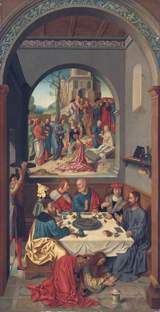
The connection to the day and this final version of the anointing is John’s “sacrament that wasn’t.”  John’s gospel doesn’t have a Eucharist, even though almost all the events of his gospel occur in what Christians now call Holy Week. The story John does tell of the last meal in the upper room isn’t “This is my body, this is my blood,” largely for reasons of John’s theology.  Instead, the story is of foot-washing, which perhaps not coincidentally is the anointing story as John tells it, following Luke’s variation.  Let’s start with John’s version:

Six days before Passover Jesus came to Bethany, where Lazarus lived, the one Jesus had brought back from the dead.  There they gave a dinner for him; Martha did the servince and Lazarus was one of those who ate with him. Mary brought a pound of expensive lotion and anointed Jesus' feet and wiped them with her hair. And the house was filled with the lotion's fragrance.  Judas Iscariot, the disciple who was going to turn him in, says, "Why wasn't this lotion sold? It would bring a year's wages, and the proceeds could have been given to the poor. (He didn't say this because he cared about the poor, but becasue he was a thief.  He was in charge of hte common purse and now and again wouild pilfer money from it.)

"Let her alone," Jesus said.  "Let her keep it for the time I am to be enbalmed.  There will always be poor around; but I won't always be around.

--John 12:1-8, SV

So that's it:  8 verses and done.  But the scene has shifted back to Bethany; the time is back to the days before Passover; and Jesus again refers the act as a foreshadowing of his death.  But two very important elements have shifted, perhaps through Luke's lens:  now the perfume goes on Jesus' feet, and again, a woman wipes his feet with her hair.  Only this time the woman is named, so perhaps now we can tell this story "in remembrance of her," at least in the modern understanding of "remembrance."

It's interesting, the similiarities between this story and the stories in Matthew and Mark.  There aren't that many commonalities between John and the Synoptics.  John the Baptizer plays an important role in the gospels of Mark and Matthew, a role that reaches its zenith in Luke's gospel, where he begins with the appearance of Gabriel to John's father, Zechariah. In John's gospel the Baptizer appears as a bystander, someone who literally comments on Jesus as Jesus walks by.  No one in John's gospel gets to share center stage, however briefly, with Jesus.  John's gospel has no Sermon on the Mount (Luke)/Plain (Matthew), and precious few parables.  In the synoptics, Jesus' miracles are "acts of power" in the original Greek; in John's version they are "signs."  So the resurrection of Lazarus is a "sign" of Jesus' authority and power, and it is precisely that sign which leads to the crucifixion:

When the huge crowd of Judeans found out he was there, they came not only because of Jesus but also to see Lazarus, the one he had brought back from the dead.  so the ranking priests planned to put Lazarus to death, too, since because of him many of the Judeans were defecting and believing in Jesus.

John 12:9-11, SV

The "sign" of Lazarus was costing the priests their power; at least in John's narrative.  I mentioned before that the cleansing of the Temple seems to have been the historical impetus for the crucifixion.  That occurs just before Passover, a time of tension in Roman occupied Jerusalem.  John includes that story, in a few verses in chapter 2, almost immediately after the first "sign" at the wedding in Cana:

It was almost time for the Jewish Passover celebration, so Jesus went up to Jerusalem.  In the temple precincts he came upon people selling oxen and sheep and doves, and bankers were doing business there too.  He made a whip out of rope and drove them all out of the temple area, sheep, goats, oxen, and all; then he knocked over the bankers' tables, and set their coin flying.  And to the dove merchants he said, "Get these birds out of here! How dare you use my Father's house as apublic market."

(His disciples were reminded of the words of scripture: "Zeal for your house is eating me alive.")

John 2:13-17, SV

It's worth pointing out here, as a side bar, that merchants in the temple weren't necessarily evil.  Temple sacrifice was the point of coming to the Temple during Passover, and most travelers couldn't bring animals with them for the ritual.  They bought animals as they were able to afford:  from doves to ox.  Coins given to the Temple also couldn't bear the image of Caesar, both because humans are made in the image of God (and no images of God can be created), and because Caesar declared himself a "son of God," or divine in his rule over the empire. So the coins of Rome had to be exchanged at Temple for coins acceptable in the Temple.  The problem with both practices, from Jesus' point of view, is that they exploited the poor (like Jesus).  The cost of a dove was already a sacrifice for the poor traveler to Jerusalem coming to the Temple to worship the God of Abraham who taught Israel to think first of the care of the poor.  The exchange rate on Temple coins made money for the banker, and cost the poor, especially, a great deal.  Jesus' objection, in other words, is not pious;  he objects to the economic exploitation of people like him, the very people the God of Abraham professes to identify with.  So you can see why he's pissed off.

But the cost of the perfume Mary uses doesn't bother him.  There's no contradiction here; just a contrast.  And a consistency that keeps this version of the anointing at Bethany in line with those of Matthew and Mark.  Luke's is still the outlier; but that outlier finds echoes in John's version, still.

First, note that the disciples appear in the story in Mark and Matthew, but not in Luke.  And John, who likes to tell more concrete stories (the better to ground his long, abstract discourses by Jesus.  As one of my professors in seminary pointed out, John's Jesus sucks all the air out of the upper room.  Chapter 13 of John begins that event, with Jesus washing the feet of his disciples.  Chapter 18 begins with Jesus finally going to the garden, although he's barely there before Judas shows up to betray him.  The chapters in between area almost all a monologue by Jesus.), replaces Simon the leper/Pharisee with Lazarus (the better to connect the resurrection of Lazarus in chapter 11 to the plot against Jesus in chapter 12) and "the disciples" with Judas Iscariot.  John's character of Judas is the one we all think of as the betrayer, the Iago to Jesus' Othello (except Jesus is not nearly so naive about Judas, especially in John's gospel), the Judas familiar to us from "JCS" (except, again, John's Judas doesn't really have any redeeming virtues).  So Judas is clearly the antagonist in this little story; he is even a hypocrite, because he doesn't care about the poor or whether the mony would go to them.  He's just, in modern parlance, a "troll."

And Jesus' response is equally blunt.  It also lends itself most easily to the dismissal of concern for the poor I've heard from too many professed Christians:  that the poor will always be with us.  It's usually said as if that's not only a fact of life, but the desire of God that some be poor.  As punishment; as part of God's "plan"?  The reason scarcely matters.  The excuse for ignoring them and denying any responsibility for them, is all that matters.

In some ways the Johannine version of this story is the most attenuated, and it suffers from that loss of detail.  John is less concerned with this story than with incorporating it into his narrative because, like the crucifixion, it is a part of the story of the Nazarene that cannot be excluded.  Curiously, it is John's gospel that gives us the long discourse between Pilate and Jesus, the back and forth between the Governor of Judea and a peasant rabble-rouser (which makes it, historically, a highly unlikely event.  Imagine your governor bandying words in public, before TV cameras, with a condemned prisoner just before his execution.)  We owe a lot of what we think about the story of Jesus to John's embellishments.  But in the anointing story John reduces the events to a bare minimum:  now the woman is named:  Mary, the sister to Martha and to Lazarus.  So she is in her brother's home, and yet still serving Jesus at table.  An attenuated scandal since Jesus is above such matters, and the focus stays on him in John's version.  Do you see this woman? Well, don't; she really doesn't matter.  Even the detail of drying his feet with her hair, which now can be a sign of love and honor for what Jesus has done (resurrected her brother Lazarus), but which would also be scandalous (it's still a first century lap dance; and imagine it happening today.  Washing someone's feet is intimate enough.  Drying them with your own long hair?).  John steps over that quickly by shifting attention to Judas, and in the most negative way possible.  Jesus dismisses the whole thing, using it as a foreshadowing of his death.  He doesn't even acknowledge what she's done, or why, except to dismissively say she should save the perfume for his burial preparations.

So the story comes from Mark to Matthew, almost unaltered; and then undergoes a radical transformation in Luke.  Some of those physical changes make it to John's version, but John seems ready almost to discard it, as it's not a "sign" pointing to who Jesus is or what his authority is, and it's not a "teachable moment" allowing Jesus to talk on and on and on about the nature of God and humanity.  For John it's a narrative transition point between the more important story of Lazarus (a "sign" if ever there was one) and the movement of the story into Jerusalem and the "upper room" (the remainder of chapter 12 is Jesus again talking about the concept of "signs" and the narrative moving toward the foot-washing of chapter 13 and the captive audience of the disciples Jesus then lectures for five chapters).  It's like John knows he can't leave this story out, but doesn't really think much of it, himself.  It's a pebble in his narrative shoe that he drops off as soon as he is able.

What, then, do we get from all of this?  This simple story was so important to the gospel writers they all included it (the canonical gospels, I mean; not the non-canonical ones).  Luke alters it dramatically.  From his "Special Luke" source?  From his own interests in the story of Jesus of Nazareth?  For whatever reason, he puts it through a blender, changing time and place and persons, leaving out the disciples and followers so thoroughly it is obvious the woman with the jar is a stranger to everyone else in that room.  There's a reason Luke goes immediately from his anointing story to a catalogue of the women traveling with Jesus.  It may be one of them is the woman in the room, since they provide for Jesus' ministry out of their own resources, and undoubtedly the perfume, even if it didn't cost a year's wages, was very expensive.  Luke is drawing a line underneath the woman's identity, the fact she was a stranger before she entered the room; and the enticing possibility that she is a stranger no more, because Jesus told her she had shown great trust, and that trust had saved her.  Matthew and Mark intimate the woman is one of the group; and maybe that's why Luke says the women had resources to fund the ministry when offerings weren't enough.  Matthew and Mark make it clear this is an anointing:  the perfume goes on the head, like the oil on the head of the king, or as in Psalm 133:

{A Song of degrees of David.} Behold, how good and how pleasant it is for brethren to dwell together in unity!

2It is like the precious ointment upon the head, that ran down upon the beard, even Aaron's beard: that went down to the skirts of his garments;

3As the dew of Hermon, and as the dew that descended upon the mountains of Zion: for there the LORD commanded the blessing, even life for evermore.

That is an anointing.  Luke shifts not only time and place (not Bethany; and far earlier than the fateful Passover events) and location (feet, not head).  Is it even an anointing anymore?  John restores (follows?) tradition, by calling the act an anointing, but Mary aims for the feet, not the head.  And in Mary we finally identify a woman (although no one tells that story in memory of her) and a reason for her gratitude (her brother has been restored to life).  John also includes a lovely, concrete detail: "And the house was filled with the lotion's fragrance."  A metaphor?  Or merely a physical detail about the nature of perfume?  Either way it's wiped aside by the actions of Judas and the blunt retort of Jesus.  None of this really interests John; but what's always been interesting to me is why John includes this story; and why he shifts to location to Jesus' feet, even as he keeps up with the tradition of the house being in Bethany, and the disciples (well, Judas) being present.

In "JCS," the anointing story turns into the emotional heart of the story.  Immediately after Judas' lament "Heaven on their minds" we meet the disciples with "What's the Buzz?"  And among them is Mary Magdalene and the women (as a backing chorus) who sing "Let me try to cool down your face a bit", which allows Judas back in with "Strange Thing, Mystifying":

It seems to me a strange thing, mystifying

That a man like you can waste his time on women of her kind.

Yes, I can understand that she amuses,

But to let her kiss you, stroke your hair, is hardly in your line.

It's not that I object to her profession,

But she doesn't fit in well with what you teach and say.

It doesn't help us if you're inconsistent.

They only need a small excuse to put us all away.

That's John crossed with Luke.  The objection is in Judas' mouth; but the objection itself, however obliquely expressed, is that of Simon the Pharisee.  Jesus has already accepted Mary's attention:

Mary, ooh, that is good

How you prattle through your supper,

Where and when and who and how

She alone has tried to give me, 

what I need right here and now.

Which sounds more like Luke than anybody.  This story recurs with the famous love song "I Don't Know How To Love Him."  Again Mary soothes Jesus, upset by the events of the march into Jerusalem (Simon Zealotes tells Jesus to use this power for glory), the cleansing of the Temple ("My Temple should be a house of prayer!/But you have made it a den of thieves!") and the followers ("Christ you know I love you/Did you see I waved?/I believe in you and God/so tell me that I'm saved!") and the beggars and diseased ("See my eyes, I can hardly see/See my legs, I can hardly walk/See my purse, I'm a poor, poor man/See my toungue I can hardly talk") to whom Jesus finally screams "HEAL YOURSELVES!"  And then Mary is back, offering "Myrrh for your hot forehead/calm you and anoint you" as she soothes him to sleep, and then sings her song of confused, bewildered love.  It isn't the song of the woman in Luke's version of the anointing; but it could be ours, if we examine that story carefully, if we take what Luke gives us, seriously.

And here's an interesting thing from the rock opera, too.  Judas says, in the first song, that Jesus has begun to matter more than the things he says.  This is an old discussion in Christianity.  The earliest gospels were likely "sayings" gospels.  Some of those are conjectural:  "Q" is thought to have been a collection of sayings of Jesus.  There's also presumably a "signs" gospel behind John's version.  The Gospel of Thomas is the most famous extant example of these kinds of gospels.  And its arguable, especially after the crucifixion, especially today, that Christians honor Jesus more in who he was than in what he taught.  Judas, in other words, is on to something.  Gallup reports that church attendance in America is declining, and thinks this marks something in American cultural history.  Perhaps; or perhaps it just marks a new social willingness to admit you don't go to church anymore.  The decline in attendance has been obvious to pastors and churches for half a century now.  Gallup thinks its discovered something but, again, the world is just catching up to the church.  And still we're a long way from the early 20th century.  This fight between who Jesus was, and what Jesus said (and which matters more) is a very old one, in other words; and if the latter is starting to prevail over the former (not to its extinguishment, but with a renewed emphasis on the latter above the former), perhaps that's all to the good.  Perhaps that's even the Holy Spirit (Luke) at work.  Perhaps we should let that fragrance fill the house (John).

Luke's story is, in my understanding, a powerful story about grace and salvation, forgiveness and redemption.  We want things to be earned, especially something as important as grace and acceptance (acceptance often includes some manner of forgiveness), but we want these blessings purchased with some coin.  For me that coin should be as small as possible, a mere mite, because surely I am deserving of forgiveness and grace, especially if I can't possibly pay for it.  For you, however?  Well, I'm not sure I want you getting something for nothing.  That seems unfair.  Maybe if you were to show a little love, you'd be deserving.  But to be deserving and to show some love, surely you have to have some prompting to respond to.  So would it work like this?

"I walked into your house and you didn't offer me water for my feet; yet she has washed my feet with her tears and dried them with her hair. You didn't offer me a kiss, but she hasn't stopped kissing my feet since I arrived. You didn't anoint my head with oil, but she has anointed my feet with myrrh. For this reason, I tell you, her sins, many as they are, have been forgiven, as this outpouring of her love shows. But the one who is forgiven little shows little love."

But that's an ouroboros, a Moebius strip; it doesn't seem to have a beginning or an end, and if you walk along it, it has only one surface.  There's no way in, no point at which you can begin your payment for that grace.  How do you earn it, then?

Precisely.  Begin there.

On what condition does goodness exist beyond all calculation? On the condition that goodness forget itself, that the movement be a movement of the gift that renounces itself, hence a movement of infinite love. Only infinite love can renounce itself and, in order to become finite, become incarnated in order to love the other, to love the other as a finite other. This gift of infinite love comes from someone and is addressed to someone; responsibility demands irreplaceable singularity.

Jacques Derrida, The Gift of Death, tr. David Wills (Chicago: University of Chicago Press, 1995), pp. 50-51.

These conflicts and disputes among you, where do they come from? Do they not come from your own cravings that are at war within you? You want something and do not have it, so you commit murder. And you covet something and cannot obtain it; so you engage in disputes and conflicts. You do not have because you do not ask. You ask and do not receive, because you ask wrongly, in order to spend what you get on your pleasures. Adulterers! Do you now know that friendship with the world is enmity with God? Therefore whoever wishes to be a friend of the world becomes an enemy of God. Or do you suppose that it is for nothing that the scripture says, "God yearns jealously for the spirit that he has made to dwell in us"? But he gives all the more grace; therefore it says, "God opposes the proud, but gives grace to the humble."

James 4:1-6

I am reading (Simone Weil's) essays as a part of my Lenten reading...She says that we "...must experience every day, both in the spirit and the flesh, the pains and humiliations of poverty...and further we must do something which is harder than enduring in poverty, we must renounce all compensations: in our contacts with the people around us we must sincerely practice the humility of a naturalized citizen in the country which has received us."

I keep reminding the young people who come to work with us that they are not naturalized citizens...They are not really poor. We are always foreigners to the poor. So we have to make up for it by "renouncing all compensations..."

Dorothy Day, from The Dorothy Day Book, p. 11. 

Thursday Of Last Week's Week of Lent 2021


This was posted here; but I was afraid it would be lost to view, being a week ago (ancient history in terms of blogs, eh?)  So without permission or warning, I moved it up to more immediate view:

Our church put together a Lenten Devotional, I was asked to contribute for this day. 12 Restore to me the joy of your salvation and grant me a willing spirit, to sustain me. (Psalm 51:1-12) Joy has not described much of this past year. Better descriptions are anxiety, worry and depression. A pandemic with over 440,000 deaths of Americans as I write this, angry mass protests against enduring racism, a bitter political campaign season, attacks on our government, loss of most of the normality of life with closed schools, restaurants, gyms and churches, lost jobs, financial worries, isolation and so much more. Anxiety, depression and worry seem much more appropriate than joy. So today we pray to God to help us. I want to ask God to relieve our depression and anxiety, but instead the psalmist says no, you need to ask for the willing spirit to restore joy. Joy! I shouldn’t be surprised. God’s world and vision is always bigger than what I can imagine. When I see someone in need, I (maybe on my better days) will give that extra shirt. God says give the one off your back. When that person with a view so radically different from my own grates against me I pray for tolerance, but God wants me to do more, to love. And when I want to be relieved of my sadness and worries, God sees a world of so much more, and wants to restore my joy. Joy! As people of faith we live in God’s world of hope. Not a world of rose co lored glasses and false hope, but a world of the endless hope of our Creator. As we gather together, “for where two or three gather in my name, there am I with them,” even if only over our computers, we gather to share our anxiety and worries, but more importantly our hope and joy. Joy! Dear God, in this time of worry and anxiety let me see the world of joy that flows from your endless hope.

--rustypickup 

Remember When Sarah Palin Was Still Politically Potent Even After McCain Lost?

Yeah; maybe you have to be this old to remember that. No idea why that comes to mind. And look how successful it's going to be: Yup, that's the future Trump left behind.

Wait A Minute....

 "The reason we're not" bringing this evidence to the Supreme Court, Lindell claims, "the reason we're not everybody is because we've got some bad people on the Supreme Court that don't want to look at cases, and we have bad judges in this country that don't want to look at stuff."

....

"Then I'm also countersuing, I'm not countersuing, putting a lawsuit with MyPillow against Dominion, countersuing of the public for free speech, for the first amendment rights, we're all doing this over the course of five weeks, just show the world, all the evidence, including nine people on the Supreme Court, and including their neighbors, their friends, everybody going, 'Did you see this? Did you see this? Did you see this?'"

Anybody else see the problem here?

He won't take his claims to court because of "bad judges."  But he will take his claims to court against Dominion, sure he'll get the outcome he wants.

Pretty sure there's a reason this guy is only getting noticed on radio shows and podcasts and almost nowhere else.

Wednesday, March 31, 2021

Even If I See It, I Won’t Believe It

And just like that, an object lesson in social media: This got enough attention on Twitter to merit an article on Raw Story.   The original tweet also garnered a number of responses.  But honestly, if it hadn’t started on Twitter, who would have noticed?  This isn’t exactly the kind of story that gets the attention of the media if it had only been a press release from a former Texas legislator nobody’s otherwise heard of.

Mike Lindell promises to allow all manner of cranks and crazies to post on his platform, and swears he’ll have the servers to support it.  He’s also famously and publicly delusional, so who knows?  But the real issue is:  who cares?  If a pin drops on Twitter it echoes ‘round the world (unless it’s Amazon execs taking on U.S. Senators over unions?); but if a tree falls on Parler, who hears it?  And then Lindell’s “Frank”?
He told Steve Bannon all of his evidence will go before the Supreme Court. Based on that, Trump will be back in office by August.

Yeah.  That’s how this works.  That’s how any of this works.

Wednesday of Holy Week 2021

Luke's version of the anointing is the reason I got interested in this story in all four gospels in the first place.  There are few other stories all four gospels have in common; and three of the four gospels tell this story in pretty much the same manner.  Except John's version shows knowledge of Luke's version; and Luke's version turns this little story completely upside down.

Let's start with Luke:

One of the Pharisees invited him to dinner; he entered the Pharisee's house and reclined at the table. A local woman, one who was a sinner, found out that he was having dinner at the Pharisee's house. She suddenly showed up with an alabaster jar of myrrh, and stood there behind him weeping at his feet. Her tears wet his feet, and she wiped them dry with her hair; she kissed his feet, and anointed them with the myrrh.

The Pharisee who had invited him saw this and said to himself, "if this man were a prophet, he would know who this is and what kind of woman is touching him, since she is a sinner."

And Jesus answered him, "Simon, I have something to tell you."

"Teacher," he said, "Speak up."

"This moneylender had two debtors; one owed five hundred silver coins, the other fifty. Since neither one of them could pay, he wrote off both debts. Now which of them will love him more?"

Simon answered, "I would imagine the one for whom he wrote off the larger debt."

And he said to him, "You're right." Then turning to the woman, he said to Simon, "Do you see this woman? I walked into your house and you didn't offer me water for my feet; yet she has washed my feet with her tears and dried them with her hair. You didn't offer me a kiss, but she hasn't stopped kissing my feet since I arrived. You didn't anoint my head with oil, but she has anointed my feet with myrrh. For this reason, I tell you, her sins, many as they are, have been forgiven, as this outpouring of her love shows. But the one who is forgiven little shows little love."

And he said to her "Your sins have been forgiven."

Then those having dinner with him began to mutter to themselves, "Who is this who even forgives sins?"

And he said to the woman, "Your trust has saved you; go in peace."

Luke 7:36-50, SV

Is grace a quid pro quo?  "...the one who is forgiven little shows little love."  Is that about grace; or about acknowledgement of grace?  If I don't think I need to be forgiven for anything, am I forgiven anyway?  Is that fair?

That's the central question this story, as Luke tells it, raises.  But let's put it in the context of Luke's narrative.  This story actually ends chapter 7 (not Luke's doing, the chapters, but it's convenient for us).  How does Luke 7 start?

After he had completed all he had to say to his audience, he went into Capernaum.

Luke 7:1, SV

So this comes immediately after the Sermon on the Mount, the one that includes the Beatitudes of Luke:

Then he would look squarely at his disciples and say:

Congratulations, you poor!

God's domain belongs to you!

Congratulations, you hungry!

You will have a feast.

Congratulations, you who weep now!

You will laugh.

Congratulations to you when people hate you, and when they ostracize you and denounce you and scorn your name as evil, because of the son of Adam! Rejoice on that day, and jump for joy! Just remember, your compensation is great in heaven.  Recall that their ancestors treated the prophets the same way.

Damn you rich!

You already have your consolation!

Damn you who are well-fed now!

You will know hunger.

Damn you who laugh now!

You will learn to weep and grieve.

Damn you when everybody speaks well of you!  Recall that their ancestors treated the phony prophets the same way.

Luke 6:20-26, SV

And Luke 8 begins:

And it so happened that he traveled through towns and villages, preaching and announcing the good news of God's imperial rule.  The twelve were with him, and also some women whom he had cured of evil spirits and diseases:  Mary, the one from Magdala, from whom seven demons had taken their leave, and Joanna, the wife of Chuza, Herod's steward, and Susanna, and many others, who provided for him out of their resources.

Luke 8:1-3, SV

This is the passage that led to the tradition that Mary Magdalene was a prostitute, reformed by Jesus.  It's also worth noting Mary Magdalene appears in all four gospels; but in the other three she doesn't appear until the crucifixion, until the women are actually at the foot of the cross.  She is mentioned in Mark, so Matthew and Luke both take her from that gospel, and she returns in Luke's crucifixion story.  But this anointing story is not a crucifixion story; in Luke it takes place long before that fateful Passover week.  And the reason Mary Magdalene was tagged as a prostitute is entirely because of this version of the anointing story.

But let's go back and walk through the story:  Jesus is at the house of Simon, who is now a Pharisee, not a leper.  We'll see there's more than a bit of humor in this story, in this narrative, and it starts there, with Luke making Simon no longer an outcast leper, but a respectable member of Palestinian society.  Who just happens to have the same name as the leper from the other stories in circulation about Jesus of Nazareth.  And, at this house, Jesus is reclining at table, with his feet out beside him.  And a local woman, "one who was a sinner," enters the room.  How is she known to be a sinner?  Well, walking into a room full of men is one clue.  Even Simon's wife wouldn't dare enter that gathering.  But there is another, as we'll learn in the next sentences.

She is, as in the anointing stories of Matthew and Mark, anonymous.  She is also carrying an alabaster jar of myrrh, the kind Mark first described.  But she doesn't pour it on Jesus' head; she pours it on his feet.  Now, we might think anointing his feet is not really an anointment; and we'd be right.  Anointment is a ritual recognizing the king in Hebraic custom; or a ritual used for events of great merit, at least.  The anointing in Mark and Matthew is just that:  a recognition of the authority of this son of peasants from a backwater on the fringe of the Empire.  It is also a symbolic preparation for burial, as Jesus points out in those stories.  But the feet?  Isn't that an act of great humility, the humility Jesus shows in John's gospel when he washes the feet of his disciples?

No; because the actor here is a woman, not another man.  And because feet carry, in this culture, the euphemistic connection to genitals.  (You might be thinking of the sexual fetish of feet; that doesn't really apply here.) In the Hebrew scriptures there are a few stories of men "covering their feet," meaning they dropped their robes in order to relive themselves.  It's practical, but it's also a delicate way of speaking of something, shall we way, indelicate?  Movie language of the '40's was just as discrete: the couple embraced in a passionate way, and the camera moved away, leaving them locked together.  We all knew they didn't just "hug it out."  We knew (or should have known) what was implied (which is now more or less explicit, but that's another matter). In the erotic literature of the time, mostly Greek eroticism, feet were themselves an erogenous zone, or at least one used to represent erotic acts.  Strange as it may sound today, a lover washing her beloved's feet with her tears, and drying those feet with her hair, was considered both an act of great intimacy (easy to see why) and great eroticism (a bit harder to grasp; but the there are cliches in porn and TV/movie sex, too, which aren't all that erotic in real life).  Now we know, as Luke's audience did, why this woman is known to be a sinner.  She's clearly a prostitute soliticing business.

This happened in the 1st century during dinner parties.  And Simon's discomfort underscores the point.  This woman is giving his guest of honor the 21st century equivalent of a lap dance, and Simon is too above her (and too moral himself) to send her away.  If you like, imagine this happening at a restaurant where you've taken your pastor in order to ingratiate him to you and your church friends.  Then a woman comes up and starts giving him a lap dance, for obvious reasons of commerce; and your pastor, rather than shoo her away, actually enjoys it!  And then he uses the event as an excuse to get a dig in on you!

The parable Luke tells is unique in the gospels.  Mark, Matthew, and John all raise the "but what about the poor!" objection (which is funny, considering how little John follows the narratives of the synoptics, even in the events of the crucifixion).  Luke turns that part of the tale inside out with the parable of the debtors.  It's pretty clear that parable puts Simon and the woman on the same level, and doesn't leave Simon with any reason to feel superior, morally or otherwise.  Jesus has already committed, in Simon's eyes, a social (if not moral) faux pas by not sending the woman away, relieving Simon of the shame of this happening in his home.  For Simon to send her away is for Simon to take some responsibility for her being in his home in the first place; far better for him if Jesus does it, and keeps all the shame on her, and none on the men at table.  Jesus doesn't do that.  Instead, after telling the parable, he asks Simon the very question Simon doesn't want asked:  "Do you see this woman?"

That, of course, is precisely what Simon has been trying not to do.  Now, rather than dismiss her and turn to the host and say "There's no shame on you, these things happen, I've already forgotten it," Jesus makes a lesson of it, a lesson with the clear point:  she's shown more gratitude than you have, because frankly, she's got more to be grateful for.  And worse, he goes step-by-step through the entire exercise:  she is kissing his feet, she's pouring myrrh on his feet, she's washed his feet with her tears and dried them with her hair (you should recall here Paul's admonition to his church in Corinth about women keeping their hair bound).  Jesus not only doesn't remove the shame, he shamelessly recounts the events himself.  See this woman?  Now Jesus is narrating this woman's actions!

And then he draws a line under the whole thing, with the action that seems most to bedevil Jesus' critics in the gospels (all four of them):  "Who is this who even forgives sins?"  But the real question is:  what did she do to deserve a forgiveness of her sins?

And he said to the woman, "Your trust has saved you; go in peace."

Luke 7:50, SV

And that's it.  The chapter ends there.  But the question hangs in the air:  what trust?  What has she done to earn this forgiveness?

It seems impossible, but the answer is:  nothing.  She is not among the company of the disciples.  She is probably not one of the women catalogued by Luke in the opening of chapter 8.  She is never named, in keeping with the stories from Mark and Matthew.  She doesn't do this just before Passover, so there's no connection to the crucifixion, to death, to burial.  The myrrh is just perfume.  And her actions don't mimic an anointing; they mimic 1st century Greek pornography.  What has she done that shows an "outpouring of love"?  At least the love we commonly associate with being among the forgiven of Christianity?  Jesus even plays with the cause and effect here:  because of what she's done (feet, hair, tears, myrrh) her sins are forgiven, he says.  Because her sins are forgiven, she has performed this grateful act of love.  Here, read it again:

"I walked into your house and you didn't offer me water for my feet; yet she has washed my feet with her tears and dried them with her hair. You didn't offer me a kiss, but she hasn't stopped kissing my feet since I arrived. You didn't anoint my head with oil, but she has anointed my feet with myrrh. For this reason, I tell you, her sins, many as they are, have been forgiven, as this outpouring of her love shows. But the one who is forgiven little shows little love."

So she came in because her sins were forgiven, and she was so grateful; but because she walked in, and washed his feet and poured out the myrrh, her sins are forgiven and therefor she's....grateful?  Has Jesus already had a little too much wine?  Or is he purposefully evading a cause-and-effect analysis of forgiveness, of grace?

What Jesus does here is reframe, reinterpret, redefine (choose your term) what this woman has done.  She thought she was soliciting business.  He told her, and Simon, she was showing great love (and again, Jesus's sly wit goes unappreciated, even unnoticed.  "Love" has so many interpretations, and the one he means is clearly not the one she meant, or that Simon understood.)  He casts her actions not as a cause for further shaming and even damning ("if this man were a prophet, he would know who this is and what kind of woman is touching him, since she is a sinner") but as a reason to forgive her shame (sins; same difference to Simon) and give her peace:  "Your trust has saved you; go in peace."  She might still leave the room wondering "What trust?  The trust I wouldn't get kicked in the face?"  And if she did join Jesus' entourage out of sheer gratitude ("I don't know how to love him/I don't know why he moves me" sings Mary Magdalene in "JCS"), who could blame her?  But if she did that, did that "buy" her grace, her forgiveness?

Jesus doesn't give us an answer to that question, because he doesn't want us to think grace and forgiveness are transactional, are some kind of cosmic (or divine, or even human) quid pro quo. In the parable, Simon is a debtor, just like the unnamed woman.  His debt is smaller, but he still owes a debt.  Does owing less debt really still put you above someone who owes more?  Is that a measuring stick worth living by?  Is any measuring stick to evaluate such status really worth living by?  Isn't the lesson here that we should take care of each other, show consideration equally to each other, rather than drawing boundaries around who is worthy of shame, and who is worthy of recognition?

"Do you see this woman?"  If anything is done in remembrance of her, it should be the repitition of that question.  Over and over and over again; as much as it takes.  Because the question is not:  what did she do?  The question is:  what did you do?  Do you see this woman?

“Love Ain’t Nothin’ But Sex Misspelled”


Or love is just pheromones.  That’s the “hook” in “The One,” a Netflix series based on a novel I’ve never heard of (so how faithfully or not it follow the novel I can’t say).  The premise is that, with enough DNA information on enough people, you can be “matched” to the person genetically predisposed to love you; at least at first sight.  Is that what love is?  Is that what makes a long-term, even lifetime, relationship?  The story doesn’t stretch that far, at least in this one season.  All the characters are below 50; they aren’t married or involved with their “match” long enough to know how permanent, or not, it is.

The premise of the “match” within the world of the story, is that the attraction:  physical, emotional, spiritual, what-have-you, is immediate.  Immediate and, presumably, permanent. Characters who are “matched” think, at first sight, that they’ve known each other for life.  Is that reasonable?  Who cares?  It’s a science fiction premise, not a philosophical conundrum. Is there choice involved?  

Well, if there wasn’t, the characters would all be robots; or no more than “particles and fields” causing and being caused upon because of Aristotle’s Unmoved mover or the Big Bang or some seminal event which wasn’t caused but caused all because....well, that’s a pseudo-philosophical conundrum.  Leave it.  The idea of the company that markets this “matching” service is that it is infallible and inescapable; that when you meet your match, there’s no going back.  Which would make for dull story-telling if it worked that way in this simulacrum of reality.

So it doesn’t.  Which makes the story intriguing, and having at least a bit of verisimilitude.  The company does begin with two clever people who realize ants recognize each other by pheromones, which somehow has something to do with people (else how does the premise begin?) and all that’s needed is enough of a database to start making “matches.”  How that blithely works into a world-wide phenomena (think Google plus Facebook plus Twitter turned into the ultimate app that can match any human being with any other human being on the planet) by getting enough data to fulfill its  promise of perfection, is not explained.  Maybe an unmoved mover is involved; or a Big Bang.  Or a miracle just happens because the interesting part of the story is not how, but:  what happens next.  An insight Margaret Atwood had, it occurs to me; in a short story I used to teach.  If I remember the title I’ll plug it in (maybe), but the story is a series of plot conjectures with two base characters who meet, marry, live together, and suffer the consequences until they die. As the stories gain more characters, old characters disappear in the new iterations, but the result is always the same:  the story ends when the characters die.  That’s how stories are, she explains:  just a who and a who and a what and a what.  That’s all plots are.  “Now ask why,” she concludes; if memory serves.

The plot of this story is not important.  Part of it is a potboiler murder mystery related to the origins of the company.  No one who is rich earns their fantastic wealth by being humble and servile.  There is always some larceny involved.  It’s a mundane insight and an almost cliched storyline, but it’s what provides the main dramatic tension while other characters in ancillary stories meet their “match” and find themselves unable to resist the pairing off.  Which, yes, reduces “love” to pheromones or genetics (the two most popular forces of popular science today.) In Marvel Comics in the ‘60’s it was “radiation,” which did marvelous and magical things to human beings; rather than just give them cancer and very painful deaths.  I put the word in quotes because it wasn’t really radiation, it was the latest “scientific” concept, according to popular science, and it would provide magical resources for us. Ironically I’m old enough to remember when viruses were explained to us in school as not animal, vegetable, or mineral, and therefore maybe something falling off a passing comet or that came to earth with a meteor.  Genetic material, at least to popular science, was completely unknown.  Oh, Mendel’s peas and where blue eyes came from (or didn’t) was taught; but free-floating genetic material anxious to invade the DNA of a cell and replicate itself by re-writing that code?  It wasn’t the stuff of science fiction, it was literally incomprehensible unimaginable.

The interesting part of the “match” process in the show comes up when a woman is matched to another woman.  One lives in England (where the show is set), the other is from Spain.  The Spaniard comes to England to meet her “match” but is in a traffic accident and winds up in hospital, which eventually draws her brother across the Channel.  The English woman and the brother meet, of course, and the genetic match works with him, too.

Oops.

So is love just genetics?  Is sex better with the “one”?  Science actually tells us the idea of soul-mate, an ideal partner, is a fiction.  We marry, or don’t, the people we grow up around.  People don’t marry people they don’t know, and most people don’t travel that far from home, or have meaningful relationships with people of wildly dissimilar backgrounds.  It isn’t impossible to marry someone from another country, it’s just so rare those who do marry people they met as adults, are the exceptions that prove the rule.  One couple in the story almost break up their marriage because the wife learns curiosity killed the cat.  She seeks the match for her husband, and it turns out to be a woman she’s friends with.  Tensions rise as she tries to keep them apart, convinced the myth of the “one” is true, and love at first sight trumps all.  In the end the fated couple do meet; but we see him returning to his wife, because life experiences mean more than pheremones or genetics.  It rings true.  Love in adolescence or at first meeting is a powerful force; but it’s rather like having an ecstatic religious experience in youth, and expecting to have that experience the rest of your life.  Some of us never have them; some of us do, only once.  Some of us garner a sense of reality from the experience that others don’t have.  Some struggle with the absence to the end of their days.  Some turn it into a deep religious commitment to others.  Some couples marry and divorce. Some couples marry and are together until death do them part, decades, even three-quarters of a century, later.  Because of pheremones?  Genetics?  It seems unlikely.

The premise of the “match” is interesting, and almost credible because its reach is global.  One character in London is matched with a woman in Somalia (how the database gets her DNA is not explained), a woman who is a refugee.  But if a “match” can’t be someone from the other side of the planet, then the “match” is just somebody you grew up with, went to university with, met through work.  How can you fail in love with someone you never meet?  But then, if there is “true love,” and so few people find it, doesn’t that mean you just never meet “the one” you were meant to be with?

Or is “The One” the myth, and “true love” something that involves a bit more effort than breathing or deciding what to have for breakfast?  Is the question of the story ultimately:  are we all wrong about the nature of love?  Is it more a force in human existence, which is to say, for us, in the universe, as fundamental as gravity or atomic bonds, as connected to us as time is connected to space?  The characters who are “matched” act like adolescents in the first throes of love.  There is a period when you can’t think about anything but your beloved; and there is a period when you can.  To everything there is a season, and a time for every purpose under heaven.  Is love really just adolescent infatuation attenuated by genetics, made permanent by science?  If that’s love, then love itself is as false as water.  If love is just as immutable as eye color, than we are just vessels for particles and fields; which is a helluva thing to tell your beloved.  For some people love is just fiction; or a skill they never master.  For others it is a force, as inscrutable and as undeniable as a religious experience; “as permanent as death, implacable as stone.”  And you learn to cultivate that reality, or you try your damndest to just be worthy of it.  Or you never have that experience; and you have no idea what it’s really all about.

We are not all Romeos and Juliets; and besides, they died young.  Had they lived long enough, would it have been happily ever after?  Even Shakespeare left his wife and mother of his children the “second-best bed.”  Then again, he left her in Stratford and spent almost all his marriage in London, until he retired and then, shortly after, died.  What are the lessons we are supposed to learn about love?

Is love just a way of making us responsible for the children that result?  Love in the story is primarily about sex; “matches” can’t physically resist each other.  Their passion is always expressed in the carnal embrace.  Thanks to modern science we already know that doesn’t have to mean procreation; but isn’t that the purpose of lust?  And isn’t love the bond, the power, the force, that makes us take care of the offspring when such passions have long cooled, or at least produced the after-effects of that physical action?  So is that what love is:  the way we keep the species going, not only in procreation but in the important years after?  Our entertainment and our science has taught us to divorce on from the other.  People copulate freely on our screens (or rather pretend to, for our entertainment) but the consequences are always emotional, never physical.  The few times there is a pregnancy the issue is always abortion and choice; and the children are easily separated from the equation, because children are so hard to present on a the screen, so hard to work into a story line. They are born; then they disappear. Adulthood is so much more entertaining than parenthood.

The main character in “The One” is matched, but not to the man she publicly identifies as her match.  There are reasons for this, but they don’t matter here.  Another character exposes the charade by seeing the couple on stage (deeply in love, for public view), but sees them off stage walking away from each other, dispassionately.  My wife and I would behave the same way, in the circumstances.  Are we not a “match”?  Again, in the mythology of the story, a “match” is permanent adolescence.  But in the words of Dorothy Parker:  “What fresh hell is this?”

There are characters in this story who are married, and stay married (so far) because of the history they have with each other, the knowledge (and love) they have for each other   Love is surely knowledge as much as pheremones, else why do we date for so long (some of us; there are exceptions to every rule) before marriage (my father proposed to my mother a few weeks after meeting her.  They met as adults, after he’d come home from the war. He met her through his best friend, who was dating my mother’s twin sister.  They were friends (and in-laws) for the rest of their lives.  My parents were married for almost 70 years; only death finally parted them.). And there are characters who love each other, but don’t know each other.  True love, apparently, prevails even in the face of lies.  Or does it?  If it does, it can be idiotic.  How do you love someone you don’t know?  Do you love someone you don’t know?  Linus once tells Lucy he loves everything in the world, in a bid to be truly open and accepting of all of creation, to emulate God.  Lucy tells him (wisely) that he doesn’t love Gila monsters.   “I don’t know what a Gila monster is,” he declares loudly, “but if I did, I’d love it!”  Is that what love is?  I don’t know who you are, but I love you anyway?  Is that even plausible?

Does it matter when we lie to each other?  Doesn’t it matter?  Aren’t lies the acid that dissolve the trust between two people that is the basis, as well as the result, of love?  But isn’t love just genetics, or pheromones? Iago dissolves the trust Othello has in Desdemona; but the tragedy is he doesn’t destroy the trust she has in him.  Othello is guilty, as surely as Oedipus is, because Othello believes Iago, and too late realizes he has been wrong.  But his love for his newlywed wife is destroyed; his love for her is lost.  Lies destroy the bonds that preserve love. Iago’s lies threaten to dissolve social order itself, the authority of government, the basis upon which we are social beings in a civilized, or just a socially ordered, world.  Murder mysteries (there is one at the heart of “The One”) expose the same danger:  who is the murderer?  Who is it we cannot trust, who would kill any one of us for their own selfish purposes?  Who is the one telling the lies about who they are?  Who is the one the rest of us can’t trust?

The power of lust, of sexual desire unrestrained, is that it dissolves the bonds of society, of social order. Just ask Ovid.  It can be rape (Zeus) or it can just be the disruptive and unrequited need (Apollo and Daphne).  It can be a powerful force that is too powerful, that turns the lives of everyone involved in the story upside down.  The murder mystery story revolves around power and money, the desire for something other than sex.  Murder is the ultimate disruption; at least in our fiction, at least when it’s part of the story.  But the stories of other characters in “The One” turn on questions of relationship, of trust, of human bonds and bondage. Lies turn those lives upside down, too.

Love is not about misery; but surely it isn’t also just about happiness.  Are people in love happy?  Always?  One character loses her “match” to murder, and tells a friend the idea of never being with him again, “hurts.  It really hurts.”  Love is about her; but what about him?  Isn’t love about the other, more than it is about you?  Is what hurts that you can’t be with them?  Or that they are gone forever, that they no longer know life itself?  Love in adolescence is about how I feel; love in maturity is about the beloved.

The character who markets this revolution, this technical marvel, admits to another, just one other character, that the whole process is a lie, that what she’s selling is “magic,” because genetics can create siblings so closely aligned that they create a “match” for one person with both of them.  So there is no “one,” not even in science.

And then there are the characters that “register” another for a “match,” without the person being matched knowing it’s being done. Isn’t that an invasion of privacy?  The company takes the hair follicle, fingernail clipping, what have you, and sends the “donor” a notice of his/her match.  That can be so disruptive it amounts to a tort.  It could certainly be a tool of revenge. But don’t we give technology that much power over us now?  There’s more than a touch of “Black Mirror” in this story, too.  Still, the interesting question is:  “What is love?”  Is it just genetics; a response to pheromones; what we need to keep humanity going? Or is it a fundamental force, at least in human existence (and what force outside of human existence is knowable or worth knowing?)

Is there one answer?

What Happened To That?

I remember when the GOP “controlled the narrative” by making us all think about the crisis on the border.

What happened to that?
Ain't it, though?

“She Looked 16!” 👀

They all told him they were 18? That’s his defense? Not the defense he thinks it is. In fact, much closer to a confession than he wants to get.

Tuesday, March 30, 2021

Since You Asked

Well, you didn't; but since I brought it up.

Miss him yet?  Yeah, neither do I.