Wednesday, October 25, 2017

Notice a common thread here?


In just the past 12 hours:


If it's not true, how do you disprove it? (and why bother?)

If it is true, it's truly frightening, especially in the light of Sen. Flake's speech in the Senate yesterday (although Flake is still Brave Sir Robin).

Garza v. Hargan


I remember a case from ConLaw from many years ago (closer to 30 than not), Plyler v. Doe.  The Supremes held that undocumented immigrant children had a right to a public education under the 14th Amendment (which applies due process and equal protection to "persons"; that word becomes important in a minute), not just to citizens or those here in accordance with immigration laws.  I remember because I knew the "Plyler" of the case; he was the superintendent of schools in my hometown.  I went to school for 12 years with his son.  It's easy to hang on to things like that.

I haven't held on to my knowledge of how Constitutional law has defined "persons" under the 14th Amendment, though it is my impression the reasoning used in Plyler has not been discarded or superceded, at least not directly.   And yet:

Does an alien minor who attempts to enter the United States eight weeks pregnant—and who is immediately apprehended and then in custody for 36 days between arriving and filing a federal suit—have a constitutional right to an elective abortion? The government has inexplicably and wrongheadedly failed to take a position on that antecedent question. I say wrongheadedly because at least to me the answer is plainly— and easily—no. To conclude otherwise rewards lawlessness and erases the fundamental difference between citizenship and illegal presence in our country.

That's from the dissent to the D.C. Circuit court ruling that a minor immigrant can receive an abortion while in government custody.  The same judge, on a panel of three, ruled she could not; en banc, that judge was overruled.  And from my outline of the 14th Amendment perhaps you see the problem already:  the Constitution does not divide us into citizens and non-citizens.  This is not Rome, nor John Kelly's Heinlein fantasy of a new Sparta.  The dissent cites a large number of appellate cases, but never cites Plyler (at least my quick examination doesn't discover it).  No surprise, as Plyler stands directly against the dissent's claim that undocumented immigrants do not have due process or equal protection rights.

Except, of course, as persons, they do.  To this day, the state of Texas (and all other 49 states) have to accept and educated undocumented minors in their public schools.  They are persons, and the 14th Amendment grants them certain rights, regardless of their immigration status.  I'm glad to see such an egregiously legally ignorant decision overturned; I'm disgusted that it was ever penned in the first place.

In fairness, the government's case was based (per news reports) on it acting in loco parentis and preserving the "best interests of the child."  I presume that meant the 17 year old mother, since a fetus is not afforded the status of "child" under Texas family law (there is no Federal family law).  The concurring opinion to the per curiam en banc reversal notes the government doesn't try to raise the issue of the child's legal status as a bar to constitutional protections.  So for the dissent to take off on a 14th Amendment argument is simply bizarre.

The struggle to humanize people who are too easily de-humanized (the judge harps on "illegal" as if such immigrants were criminals morally equivalent to felons) continues.

Tuesday, October 24, 2017

Just wading through the cesspool splashes shit all around


Josh Marshall likes to say that Trump is poison, and poisons everything associated with him.  Sometimes that's just in the system, far removed from Trump, but still illuminated in stories about him.  The New York Times assesses the tempest in a teapot of the past week, by telling us it was really a playground spat and the Democrats (and blacks) started it:

Ms. Wilson’s decision to go public with her criticism of the president, even as Ms. Johnson was at her husband’s coffin to receive his body, was a reflection of the unbridled anger and frustration among many Democrats, black Americans and others as Mr. Trump tries to dismantle Barack Obama’s legacy.

Or maybe she just thought the President of the United States shouldn't be such a ham-handed klutz as to make a widow break down into tears on the way to retrieving her husband's body, a body she was not allowed to see.  Maybe she thought her constituents and her personal friends deserved better than that from a dullard who thinks what he said (who now disputes it is what he said?) was appropriate, and even wants to argue with the widow now about how polite he was and whether or not he knew her husband's name (she says he stumbled over it so badly it was clear he didn't know who he was talking about or who he was talking to).  "Frustration among many Democrats" and "black Americans"?  What, it can't be simply an interpersonal thing?  Because clearly, it was.

Oh, but we have skipped ahead:

Likewise, the nasty back-and-forth with Frederica S. Wilson, a Democratic congresswoman who is close to the soldier’s family, might have dissipated had she not repeatedly disparaged Mr. Trump’s intentions on national television, failing to extend him the benefit of the doubt that previous presidents had received.

I still have a decent timeline of these events on my blog page.  Wilson spoke to the press for reasons I have outlined above; then Trump counter-attacked, calling her a liar.  She went on to defend her honor and veracity, without complaining about the white supremacists in the Administration (rather like commenting on the paint color of the White House at this point) until Ret. Gen. John Kelly made it personal by declaring himself superior to uppity black women who don't know their place (all that sanctimonious claptrap about "sacred" was just the nicest way he could think of to say "Shut and mind your place, bitch!") and to all American citizens with no military background (which appalled at least one other former military officer, but I'm sure the NYT will get around to blaming him for having an opinion, too; in the interests of fairness).  It wasn't Rep. Wilson who "disparaged Mr. Trump's intentions on national television" until Mr. Trump called her a liar; and then it turned out that Kellyanne Conway and John Kelly separately confirmed that her facts were correct, and Trump was a liar.  In claims of libel, truth is an absolute defense.

Too bad truth isn't polite enough for the Gray Lady.  But notice how quickly they paint her as a member of the "resistance," the better to claim the middle ground of objective observer of the "facts, just the facts:"

She had listened in on the president’s call as a longtime friend of the Johnson family, and though it is unclear whether the family knew that she was going to reveal what the president had said, they backed her characterization of his remarks. They were offended that the president never used Sergeant Johnson’s name, instead calling him “your guy.”

The congresswoman’s actions were consistent with those of a member of the “resistance” to Mr. Trump, primed to react harshly to whatever he says. “There’s no reason for the president to be so insensitive,” Ms. Wilson said on CNN on Tuesday night. She added that “it’s disrespectful to the family of every soldier that has paid the ultimate price.”

“Our community is livid,” she said.

Well, I would say it's fairly clear they knew she would speak out, since no one in the family has complained about her statements yet, and the widow herself went on television this morning to explain her personal reaction to Trump's phone call and to defend Ms. Wilson's statements.  The President felt compelled to react to that,  where most adults would simply remain silent or offer an apology for giving offense.  Was Mrs. Johnson also "primed" to react harshly to what the President said in that phone call?  Or was she equally upset and perhaps even appreciative of Rep. Wilson speaking up for the family in the first place?  No, probably it's the latter, right?  Can't blame the President, so we'd better cast blame in all directions just to be "fair and balanced."

An interesting lacunae in the article, the same silence that prevailed on the weekend talk shows, is the propriety of Gen. Kelly's assertions about the hallowed dead, the separation of citizens from soldiers, and the blunt refusal to countenance questions from those who were not, or who did not know personally, Gold Star families.  The first reporter to get to ask a question prefaced it with "Semper Fi," as a way of appeasing the retired Marine, a rhetorical tugging of the forelock.  There was a lot of commentary on that last week, aside from Col. Killebrew's statements about it:

“That odd press conference has exposed Kelly’s emotional, personal disdain for the citizens he served in uniform and still serves in a sensitive political post,” he writes. “His remarks lead me to wonder if he really understands that soldiers are the servants of democracies, not some special race apart. A MacArthur or a George Patton, disdainful or ignorant of democracy but close to the president is dangerous to the Republic.”

There is no similar assessment in the entire NYT article.  Indeed, it only mentions the General's "empty barrel" comment, and points out that was factually incorrect.  Far more worrisome were his remarks about soldiers and civilians, but about that the Gray Lady has nothing whatever to say.  I suppose that would seem like arguing with a general, and such an argument would be highly inappropriate.

I'm not a big fan of jumping on the media for perceived slights, but this is ridiculous.  Charlie Pierce is right, except he's too kind by half.  This entire article is weaselspeak.

"Who Can Replace A Man?"

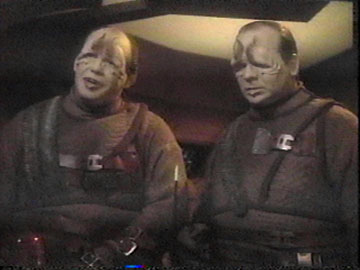
We are all Pakleds now; or at least, we aspire to be.

A computer has learned to play Go.  Can a computer learn to drive a nail?  Raise a wall?  Make sure a floor is level, a stud plumb?  Can it re-model a house and deal with what it finds there?

I ask because "A.I." is always discussed in terms of what computer programmers do.  How many computer programmers can do simple carpentry tasks?  How many could replace a wall switch, wire a light fixture for two switches, lay a new floor in a bathroom?  I've learned to do some of these things from YouTube.  Could a computer learn to do them?   And if it learned them, how would it do them?  Which is a more useful skill, or even a display of intelligence:  learning to play a board game, or learning to figure out what to do when you open a wall and wonder why it was built that way in the first place, and how do you correct it now?

I've yet to do the simplest home-repair/improvement project and not wonder what the people who were obviously there before me were thinking.  Can a computer program figure that out?  Can it decide what meals I should plan for this week, and then prepare them?  Can it alter a recipe because of tastes, or because of what's in the pantry, the refrigerator, the freezer?  Can it set the table, clear the table, load the dishwasher, empty it again, know when it's ready to run?  Can it, in other words, perform the daily tasks of living?

It can play a board game better than experts.  Can those experts remodel a bathroom?  Paint a wall?  Hang a window shade and curtains?  Replace a light fixture?

I've done jobs and tasks that, while they are aided by modern technology, are still matters of physical labor.  My great uncle the carpenter would find the job a little faster today with power tools, but not substantially different.  I've worked for a caterer, and the labor is intensely physical.  Yeah, the mixer does the stirring, but you have to load the pans, unload the oven, prep the food (even with a food processor for some chopping tasks), cook it, load it into the van, set up when you get there, clean up, take it down, take it back, clean up again.  Are computers learning to do that?  To bus tables, to fill glasses, to remove dirty plates and bring more chips and more coffee?

I can think of tasks computers can "learn" to do (if we define "learning" in the most reductive way possible, a way below that of the youngest child learning a language).  But is learning to play board games a useful function of intelligence, even a useful measure?  Playing a board game like Go is supposed to take rarified skills:  but a carpenter can assess my need for a new wall, gather the materials, do the work, adjust to unforeseen circumstances (who knew the wall would look like that inside?) and adjust based on experience (learning) that computers have to learn to learn to learn how to do.  Just yesterday I saw an episode of "This Old House" that was new to me, where Tom Silva oversaw three apprentices removing materials around a front porch to determine why it sagged and how to fix it.  Silva knew from experience what should be there, and how to assess what was damaged.  I suppose a computer could be programmed to do that, but why bother?  And could the computer do the work?  Does what Mr. Silva does not require intelligence?  I might whip him at Go (or not), but his knowledge of carpentry and construction far exceeds mine, and is frankly much more valuable than my knowledge of literature and theology, or the strategies of a board game.

And what is the value of knowing how to play Go?  It's pleasurable for me; but what's in it for the computer?

I dunno; but I think we're still defining "intelligence" as much too small a range of concepts.  (And no, I still don't have any use for IQ, for much the same reason.*  Even if it more accurately applies to the population rather than the individual, it's not an idea that really provides that much insight into the human condition.  No more than A.I. does.)


*Hume pointed us to the distinction between analytical and synthetic statements.  The former are basically statements of the banal:  "This stone is heavy" (Or:  weighs this much on this scale of measure).  The latter are judgments, and non-objective:  "This flower smells nice, and is pretty."  You can't argue with it, but it doesn't really establish anything.  If all statements divide into this dichotomy, then measures of intelligence are synthetic, not analytical, since no one can define "intelligence" the way we can define pounds or grams.  If you're going to tell me it matters in populations I'm going to tell you you're chasing your tail and referencing "intelligence" because you think you make things go and that makes you smart.

Monday, October 23, 2017

Never Let Me Go

Now he's going to argue with the widow:

Johnson on Monday broke her silence about the now infamous phone call with the president during an interview on ABC’s Good Morning America. During the interview, Johnson backed up Rep. Frederica Wilson’s (D-FL) account of what happened, and said that Trump left her feeling “very upset.”

So Trump had to respond:


Curiosly,  this seems to be the first time he's mentioned the sergeant's name. But now he can't name the widow.  And how childish are you to have to insist your conversation was "respectful" when the person you were talking to says it wasn't?  Is that really a fit subject for an argument?  Maybe among very small children.....

"The Return"


See, they return; ah, see the tentative
Movements, and the slow feet,
The trouble in the pace and the uncertain
Wavering!

See, they return, one, and by one,      
With fear, as half-awakened;
As if the snow should hesitate
And murmur in the wind,
            and half turn back;
These were the “Wing’d-with-Awe,"      
            inviolable.

Gods of the wingèd shoe!
With them the silver hounds,
            sniffing the trace of air!

Haie! Haie!      
    These were the swift to harry;
These the keen-scented;
These were the souls of blood.

Slow on the leash,
            pallid the leash-men!

--Ezra Pound


Sunday, October 22, 2017

Call the names

Thanks for the reference!

“I was so nice. Look, I’ve called many people. And I would think that every one of them appreciated it. I was very surprised to see this to be honest with you,” Trump said on Fox News’ “Sunday Morning Futures with Maria Bartiromo.”

He claimed the call “was a very nice call.”

“And by the way, I spoke of the name of the young man, and I — it was a really — it’s a very tough call. Those are the toughest calls,” Trump said. “These are tougher than dealing with the heads of countries, believe me. These are very, very hard calls. They’re sad and sometimes, you know, the grieving is so incredible.”

He used the pronoun "I" six times in 9 sentences.  Not surprising; everything in those 9 sentences is about him; nothing is about anyone else:  not the soldier, not the widow, not the mother, not the soldier's children.  And he still can't mention the fallen soldier's name.  He knows the name of the Representative who was in the car, though:

What is sacred is the death of a man in service to his country.  But when you can't even name that man, two weeks after the event and after another week of controversy over how you handled the call to the family, you have profaned that event. Not Rep. Wilson, or the widow, or the grieving mother; the POTUS is the violator of sanctity.

Better, at this point, that we not name him, in fact.

Saturday, October 21, 2017

House full of shovels


I wonder why that is:

“I can say this about Donald Trump, he’s not real good at talking,” Jacobs pointed out. “If I were Trump, I would have picked up the phone and said, ‘look, that was my ham-handed way of being sympathetic, I’m not good at that and I apologize.’ And all this stuff would have been over.”

Another former combat veteran agreed. Senior Chief Petty Officer Malcolm Nance (U.S. Navy, Ret.) said an apology is necessary to maintain the integrity of the United States.

“Right now, I think today is the day that this controversy needs to stop,” Nance suggested. “Right is right and wrong is wrong — and this needs to be set right.”

“This is not a question of going after someone’s integrity, it’s a question of maintaining the integrity of this nation,” Nance noted.

“General Kelly needs to apologize to Congresswoman Wilson,” Nance advised. “And he needs to talk to the president and shut this thing down and from this point onward we need to honor these fallen soldiers.”

“It’s not going to stop because Donald Trump this morning, got up bright and early and starting tweeting again…attacking Congresswoman Wilson,” Reid reminded.


“So Donald Trump doesn’t want it to end and he doesn’t want the discussion to be about the fact it took him 13 days to call the families of these four fallen soldiers,” Reid concluded. “He wants it to be about Congresswoman Wilson.”

“Yeah, Joy, for every Trump controversy there seems to be a black woman that this administration wants to take down publicly, dehumanize, and really just try to destroy and it’s incredibly dangerous, troubling, and disgusting,” Karine Jean-Pierre, a senior advisor at MoveOn.org explained.

“This is what this administration continues to do, because they’re so by afraid of powerful black women and so that’s how they cover up their controversy is by finding one they can take down,” Jean-Pierre suggested.

The Administration “cannot complete a full sentence without lying” Jean-Pierre charged.

“Not only that, you have his aides, John Kelly and Sarah Huckabee Sanders, that come out behind the podium that’s supposed to be sacred — I worked in the White House, that is supposed to be incredibly sacred and they are working the people,” Jean-Pierre explained.

“And all they do is give more lies to Donald Trump’s lies and then when they’re caught in lying, they double down on those lies,” Jean-Pierre noted.

“This is just the biggest mess and i think that I am in agreement with the majority of America that this is a week-long scandal that should have never happened and the White House keeps making it worse,” conservative strategist Sarah Rumpf admitted.

Be Careful What You Ask For


While some warned us against it, we accepted Gen. Kelly as the military father who would bring discipline to the unruly POTUS, much as his family hoped military school would straighten young Donald out (and how did THAT work out?).  But we assumed Kelly would be the avuncular Ike, painting by numbers to reassure us all was well, and darkly warning against the Military Industrial Complex on his way out the door, the better to leave a legacy without really rocking the boat.

We like our heroes brave but not discourteous or upsetting of the status quo.

Instead we got Robert Duvall in "The Great Santini."  We got the stuff of "Seven Days in May" in real life.  We got Alexander Haig once again proclaiming, as Reagan lay in an operating room, that Haig was in charge (and anyone old enough remembers what a near-Constitutional crisis that off the cuff and intemperate remark sparked).  Gen. Kelly is not the kindly avatar of our dreams, he is the stuff of our nightmares.  And it's not democracy he threatens, it's the republic.

There was a reason the founding Fathers didn't want a standing army, and it wasn't just because of European history.  Much is made of their knowledge of Greece and Rome, and while they structured their government on Roman principles, they were quite aware that Caesar became a "diktator" (we altered the spelling when we made it an English word) by Roman law, and just kept the power and the authority.  It's the reason Brutus killed Julius in the first place.  A standing military was not just a European fear of war for the sake of those in power; it was Sparta.  The founders had heard of it long before Frank Miller did, and they didn't admire it nearly as much.  They envisioned Athens instead; why else would Jefferson hope for a democracy as a government which governs least?  Sparta was the government which governed most:  every member of the society was suborned to its military purpose.

And now we are not only supposed to not question John Kelly because of his military background, we are supposed to give him the benefit of the doubt long after he has stripped away any pretense of being other than Donald Trump in a military uniform.  He was in mufti this week in the White House briefing room, but he was wearing his uniform so conspicuously he almost polished his medals as he talked.  He all but invoked Sparta with his references to the "1 percent" and his insistence that only the select few could be allowed to even address him.

As Charlie Pierce is fond of asking, "Who is he when he's at home?"  Well, we found out; and it should be a chilling revelation.  The problem is, when do we believe it?  Erick Erickson spoke for many:

“I don’t think it was an intentional lie on his part,” Erickson said. “If it’s a pattern of behavior of his — and maybe it is — but right now I’m willing to give him the benefit of the doubt that he misspoke. Probably some other person at the White House gave him the wrong facts but he needs to apologize for it.”

Too bad that's not what happened:

But that’s not an accurate summary of the chief of staff’s statement. Kelly said he was “stunned” that Wilson had spoken about securing the building’s funding. In reality, she had only briefly mentioned her efforts to pass legislation to have the building named after two fallen FBI officers. And, secondly, Wilson made no mention of lobbying Obama in her 2015 speech, according to the Sentinel’s video.

Neither Sanders nor another White House spokesperson responded to TPM’s questions about the details it mischaracterized in recounting Kelly’s attack.

Sanders’ statement continued: “As Gen. Kelly pointed out, if you’re able to make a sacred act like honoring American heroes about yourself, you’re an empty barrel.”
Ad hominem and empty pieties ("a sacred act...."), the usual response of the demagogue.  Kelly has not only allied himself with that, he started it.  He is not the father figure we thought he was.  It was our mistake to think he would be, to think the military, of all institutions, would save the republic.  We believed our freedom came from our warriors, and now we find that kind of freedom is a two-edged sword.  We thought Kelly would be amiable Ike; we find out he's the raving "Santini":

Before walking off the stage, Kelly told Americans who haven’t served in the military that he pities them. “We don’t look down upon those of you who haven’t served,” he said. “In fact, in a way we are a little bit sorry because you’ll have never have experienced the wonderful joy you get in your heart when you do the kinds of things our servicemen and women do—not for any other reason than that they love this country.”

When Kelly replaced the ineffectual Reince Priebus as the chief of staff, a sigh of relief emerged: at least the general would impose some discipline on the Administration. Now we have a sense of what military discipline in the White House sounds like.
And we should be very concerned; because if freedom comes from those who fight for us, then they hold our freedom in their hands; and can withdraw it whenever they see fit.  Which brings us perilously closer to what Franklin meant:  that we had a republic, if we can keep it.

Friday, October 20, 2017

"Where are you going, where have you been?"


Comment on the arguments of John Kelly:

Argument 1. Those who criticize the President don’t know what they’re talking about because they haven’t served in the military. To demonstrate how little lay people know, Kelly provided a long, detailed explanation of what happens when a soldier is killed in battle: the body is wrapped in whatever is handy, flown by helicopter, then packed in ice, then flown again, then repacked, then flown, then embalmed and dressed in uniform with medals, and then flown home. Kelly provided a similar amount of detail about how family members are notified of the death, when, and by whom. He even recommended a film that dramatized the process of transporting the body of a real-life marine, Private First Class Chance Phelps. This was a Trumpian moment, from the phrasing—“a very, very good movie”—to the message. Kelly stressed that Phelps “was killed under my command, right next to me”; in other words, Kelly’s real-life experience was recreated for television, and that, he seemed to think, bolstered his authority.

Fallen soldiers, Kelly said, join “the best one per cent this country produces.” Here, the chief of staff again reminded his audience of its ignorance: “Most of you, as Americans, don’t know them. Many of you don’t know anyone who knows any of them. But they are the very best this country produces.”
The one-per-cent figure is puzzling. The number of people currently serving in the military, both on active duty and in the reserves, is not even one per cent of all Americans. The number of veterans in the population is far higher: more than seven per cent. But, later in the speech, when Kelly described his own distress after hearing the criticism of Trump’s phone call, the general said that he had gone to “walk among the finest men and women on this earth. And you can always find them because they’re in Arlington National Cemetery.” So, by “the best” Americans, Kelly had meant dead Americans—specifically, fallen soldiers.

The number of Americans killed in all the wars this nation has ever fought is indeed equal to roughly one per cent of all Americans alive today. This makes for questionable math and disturbing logic. It is in totalitarian societies, which demand complete mobilization, that dying for one’s country becomes the ultimate badge of honor. Growing up in the Soviet Union, I learned the names of ordinary soldiers who threw their bodies onto enemy tanks, becoming literal cannon fodder. All of us children had to aspire to the feat of martyrdom. No Soviet general would have dared utter the kind of statement that’s attributed to General George S. Patton: “The object of war is not to die for your country but to make the other bastard die for his.”


Our identity as a nation – unlike many other nations – is not determined by geography or ethnicity, by soil or blood. Being an American involves the embrace of high ideals and civic responsibility. We become the heirs of Thomas Jefferson by accepting the ideal of human dignity found in the Declaration of Independence. We become the heirs of James Madison by understanding the genius and values of the U.S. Constitution. We become the heirs of Martin Luther King, Jr., by recognizing one another not by the color of their skin, but by the content of their character.

Government of the military, for the military, by the military....

He's certainly done more damage.....

I had this tweet, from Trump's feed (he re-tweeted it) as an example of Trump creating a bubble and then moving into it.  It's an echo of what Trump told the Heritage Society on the 17th:

“(We) have ended finally the war on clean, beautiful coal. People are going back to work,” he said. “Over the last nine months we have removed job-killing regulations at a record pace. In fact, in nine months, we have done more, they say, than any President in history.”

I was going to leave it behind among the drafts gathering dust, and then Huckabee Sanders took the podium to berate reporters who dare to question a "Marine general":

“She also had quite a few comments that day that weren’t part of that speech and weren’t part of that video that were also witnessed by many people that were there,” Sanders said, referring to “what Gen. Kelly referenced yesterday.”

The reporter pressed: Would Kelly respond to reporting on his inaccurate statement?

“I think he’s addressed that pretty thoroughly yesterday,” Sanders said.

“He was wrong yesterday in talking about getting the money,” the reporter countered.

“If you want to go after Gen. Kelly, that’s up to you,” Sanders said. “But I think that, if you want to get into a debate with a four-star Marine general, I think that that’s something highly inappropriate.”

Just let that sink in a minute.  Gen. Kelly's veracity and authority is his uniform and military service.  Did Rep. Wilson say bad things off camera, where Kelly could hear it but not where the cameras could catch it?  Except that's not what Gen. Kelly said:

And a congresswoman stood up, and in the long tradition of empty barrels making the most noise, stood up there and all of that and talked about how she was instrumental in getting the funding for that building, and how she took care of her constituents because she got the money, and she just called up President Obama, and on that phone call he gave the money — the $20 million — to build the building. And she sat down, and we were stunned. Stunned that she had done it. Even for someone that is that empty a barrel, we were stunned.

So she stood up and sat down off camera, and "we were stunned."  Stood up and addressed whoever would listen after the speeches were over and the cameras turned off?  Sorry, not buying it.  But the point is, I dare to question a Marine general because he is not superior to me, and his lies are not better than the truth, and his word is not to be trusted any longer.

And I don't give a damn what uniform he wears or how many medals he has on his chest or what rank he holds.

And then we're back to what Trump said, which everybody agrees he said except Trump, apparently.  And if there was a "misunderstanding," the fault is on the family, because fault can never rest at the feet of anyone in this White House:

“Certainly if the spirit of which those comments were intended was misunderstood, that’s very unfortunate. As the President has said, as General Kelly has said, who I think has a very deep understanding of what that individual would be going through, his comments were very sympathetic, very respectful,” Sanders said. “And that was the spirit in which the President intended them. If they were taken in any other way, that’s certainly an unfortunate thing.” 

What is this childish perseverance in having this last word on this subject?  What is wrong with these people?  There is not a person in that building who is not beneath contempt and unworthy of the high office they serve.  And to defend this insanity, this pusillanimity, on the grounds that we can't question Marine generals?

Barack Obama is right; our democracy is at stake; and not just in an election in Virginia.

The Wages of Sin

Like most stories these days, you can't keep up with the pace of the details.  Already Charlie Pierce has said John Kelly "is better than this."  But he only means Rep. Wilson was a friend of the Johnson family from the time Sgt. Johnson was a child, and that she denied Kelly's story about bragging about getting funding for a federal building, and Kelly shouldn't have been so hard on her.

Turns out Kelly not only shouldn't have attacked her, but he lied about her, too:

In the speech, Wilson describes how she and congressional leaders worked together to pass legislation to name the FBI building, after the starting the process just four weeks prior to the dedication ceremony at the agency’s request. She said it was a “miracle” that the bill passed both chambers and was signed by President Barack Obama in time.

She said that her effort and that of her colleagues who also pushed for the bill “speaks to the respect that our Congress has for the Federal Bureau of Investigation, the men and women who put their lives on the line every single day.”

She then honored FBI agents gathered in the room, as well as the two special agents who died in a gunfight in 1986, Benjamin Grogan and Jerry Dove, for whom the new building was named.

“We are proud of their sacrifice, the sacrifice for our nation. It is only fitting that their names be placed on the same mantel as the FBI,” she said in the speech.

Kelly lied; or he "misrepresented" her speech; or he was mistaken about what she said, his memory was faulty, he was confused; he was inadvertently in error.  Does it matter what the excuse will be?  He made it up out of whole cloth, presented it as true, and damn the consequences because it served his purpose.  Just like his boss does.

Kelly isn't "better than this."  We just thought he was, mostly because he once wore a military uniform, and we all still have a soft spot for tough men who talk about honor and tradition.  It makes it harder for us to see how dishonorable they are, and that their tradition is used to cover up lies.

George W. Bush, who is still being excoriated for not wearing a hair shirt in public when he made his remarks, had this remarkably Niebuhrian thing to say to us all:

Too often, we judge other groups by their worst examples while judging ourselves by our best intentions – forgetting the image of God we should see in each other.
Whatever Trump's best intentions in that phone call, he failed miserably.  Now the defense is to judge the critics by their worst examples, even if we have to invent them.  That's a very Trumpian defense.  To reach for it is not to reach beneath yourself, because so few people would ever try to reach that low.  Yesterday Pierce called this a "tragic error."  The tragic hero has a flaw that causes him to crack under the right pressure.  This is not the result of a flaw; this is an indicator of character.  The tragic hero is tragic because he takes responsibility for his error, for the consequences of his failure.  There is no hero here, tragic or otherwise, except the slain soldier.  What we are seeing, in what should be a inconsequential event, is the true nature of the people involved.

John Kelly is not better than this, and he doesn't work for Donald Trump as an amanuensis for the rest of us.  This is who we have allowed into the White House, and who he surrounds himself with.  Trump is not poisonous and inflicting his poison on others, and he's not bringing out the darkness in others.  They are there because they think like him and agree with him and want to work with him.

And that's where the darkness is coming from.

Yup.


Stories matter.

And Josh Marshall is right; Kelly's speech could have come out of the movie version of "Starship Troopers," where the only citizens are those with military service.

Underneath this logic is a belief which Kelly actually stated much more clearly than most are willing to do. We don’t just owe respect to people who serve in the military. They are actually better than us civilians.

Kelly’s words …

"We don’t look down upon those of you who that haven’t served. In fact, in a way we’re a little bit sorry because you’ll have never have experienced the wonderful joy you get in your heart when you do the kinds of things our service men and women do — not for any other reason than they love this country. So just think of that."

Kelly made a similar point when he refused to take questions from any reporter who was not either from a Gold Star family themselves or personally knew someone who was. You may not even deserve your civic freedoms, the right to talk, to ask question, unless you are near to military sacrifice.
Beyond the appalling defense of the indefensible is Kelly's premise:  that the military are superior to civilians, and the POTUS is uber alles.  Let's be clear:  Kelly didn't have to defend Trump:  he chose to defend Trump.  He didn't have to make the argument he made in order to defend Trump; he chose to make that argument.  This is not Gen. Kelly being "poisoned" by association with Trump:  this is simply who Gen. Kelly is.  Maybe we imagined him to be something else:  we were wrong.  There is a reason he works for Donald Trump, and that reason is that he thinks like Donald Trump.

"What Planet Are We On?"

Trump really needs to start paying attention to what his staff is saying:

Kellyanne Conway admitted the news reports of the conversation were accurate:

“They are misrepresenting the President. You have to give the full quote,” Conway said.

She claimed Trump’s full remarks to Johnson’s widow “ended with him saying, ‘But it’s never easier,’ ‘It’s always difficult,’ or ‘This is very tough’ or ‘These are hard.'”
John Kelly said he was the source of the now-controversial remarks:

 Well, let me tell you what I told him. Let me tell you what my best friend, Joe Dunford, told me — because he was my casualty officer. He said, Kel, he was doing exactly what he wanted to do when he was killed. He knew what he was getting into by joining that 1 percent. He knew what the possibilities were because we’re at war. And when he died, in the four cases we’re talking about, Niger, and my son’s case in Afghanistan — when he died, he was surrounded by the best men on this Earth: his friends.

That’s what the President tried to say to four families the other day.
Maybe it's because neither statement has been covered on "Fox & Friends" yet.....

Thursday, October 19, 2017

John Kelly is an ass

The face of White House arrogance

NPR says John Kelly leant his moral authority to Trump by speaking out against Rep. Frederica Wilson.  No, Kelly provided no moral gravitas; what he provided was moral arrogance.  He proved why he works for a man like Donald Trump, and why Kelly is as beneath contempt as his boss is.

Kelly established that he was the source both of the story about Obama not calling when his son was killed in action, a story Kelly said he told Trump without criticism of Obama, and the story about "they signed up for this."   Trump, of course, immediately turned the Obama story into an insult.  When Kelly offered that he was the source of Trump's comment that Sgt. Johnson "knew what he signed up for", he abandoned all moral authority he might ever have claimed.

But let's start with Kelly being stunned by Rep. Wilson's comments:

“I was stunned when I came to work yesterday morning and brokenhearted at what I saw a member of Congress doing,” Kelly at a White House press briefing. “A member of Congress who listened in on a phone call from the president of the United States to a young wife — and in his way tried to express that opinion that he’s a brave man, a fallen hero.”

It was on a speaker phone; she wasn't eavesdropping on the extension.  My guess is the widow pushed the button so everyone would know why she was crying.  As for the sanctity of the matter, that horse left that barn months ago, and the barn has long since burned down, and not because of an otherwise unknown representative with a fondness for cowboy hats.  No, the fault lies in the President, who is do disrespectful he says things everyone now agrees he said.  Such words lose any right to the "sacred" you may wish to impose on them just because of the office-holder that said them.  Insults do not deserve to remain private when a President speaks them in his capacity as President.  And Rep. Wilson was reporting on what had upset the grieving family of a fallen soldier.  She wasn't violating a confidence; she was doing a service for a constituent.  She was speaking their truth to power for them.

Kelly told the press that his best friend and former "casualty officer" advised Kelly that men like his son died knowing they had signed up for that risk, and surrounded by their friends, the best people on earth.  Good advice to a commanding officer bearing the burden of sending men to die, perhaps; terrible advice for the family of a fallen military member.  Worse than terrible advise when fed to the sewer that is the personality of Donald Trump.  It is moral arrogance to argue, as Kelly did, that what Trump said (which has now been confirmed by two White House officials on the record.  How many more staffers are going to call Trump a liar?  Trump never said he was misunderstood; he said he didn't say what Wilson said he did.  It is now beyond cavil that was a lie.) should have been understood by the widow and the mother and even Rep. Wilson the way Kelly understood it, or even the way Kelly intended it when he passed it on to Trump.

The man was actually lecturing the mother and wife, again, as Kellyanne Conway did, without ever mentioning them.  He did it by very carefully excluding any mention of the family from his remarks, but they are as much a source of this information as the Representative is.  Had he mentioned them, his entire argument would had dissolved before his eyes.  He knew what he wasn't mentioning, and he knew why.  This entire White House is a cess pool and a moral black hole.  George W. Bush looks like a paragon of virtue by comparison to these people, and Barack Obama comes off as a candidate for immediate beatification.

This is almost beyond belief.  There is no moral authority left in that building, and it isn't just because Trump is poison, as Josh Marshall keeps saying.  The staff are agents in their own right, and moral actors responsible for their own actions.  They cannot say Trump made them do it.  They are complicit on their own.  Kelly stood there and, while tacitly taking credit for everything Trump said that Trump explicitly said he didn't say, also agreed with Trump that this is personal, and it's all about Trump and what Trump said and how everyone should give Trump "the benefit of the doubt."  Yes, he used those words.  Josh Marshall says:  "President Trump is a blowhard and a phony and a liar. Kelly isn’t."  He is now.

This entire Administration is morally repellant and bankrupt.*


*and to comments like this that are apparently being bandied about because cable news, they have to fill the hours:

Toobin made his comments in response to claims by CNN White House correspondent Kaitlan Collins that it’s possible there was a breakdown in communication and interpretation between the Johnson widow and the president.

I call bullshit.

I have counseled grieving families over sudden deaths, and over deaths after long and lingering illnesses, and never once did I say:  "Well, you knew it was going to end like this sooner or later!"  Saying that is not a "breakdown in communication" or "interpretation," it is grotesque beyond measure.  And Kelly's argument is simply a variant on "blame the victim."  (Trump was "misunderstood.")  I know people want to make some sense of this nonsense, but even Toobin's frustration (“What country has controversy over condolence calls?” Toobin implored. “It’s an example of what a surreal moment we are in.”) is not an example of an errant zeitgeist, it is entirely the fault of one man and it is to be laid at the feet of this thoroughly incompetent human being who shouldn't be among civilized beings without a handler with a leash and a muzzle.

There is no excuse for what Trump said, and no controversy any more that he said it.  You don't get to blame the family because the would-be comforter was so abominably inept and so completely lacking in human feelings.  This planet is the one that allowed such a cretin to be in such a position of power, and to surround himself with people willing to serve him.  That we always thought this was impossible is our problem; that we allowed it to happen is our problem, too.

When you start thinking Cheney wasn't so bad....


I did not like George W. Bush as a President, at all.  He was installed by Scalia and the Supremes, and made a hash of things from Day One of his Presidency.  He was so bad the Nobel Committee gave Obama the Peace Prize just for winning the election that replaced Bush.  But I have to agree with the tweets:  in the age of Trump, even George W. Bush was a better President.

This is a transcript of George W. Bush's speech delivered Oct. 19, 2017 at the “Spirit of Liberty: At Home, In The World" event in New York.


Thank you all. Thank you. Ok, Padilla gracias. So, I painted Ramon. I wish you were still standing here. It’s a face only a mother could love – no, it’s a fabulous face. (Laughter.) I love you Ramon, thank you very much for being here.

And, Grace Jo thank you for your testimony. And, big Tim. I got to know Tim as a result of Presidential Leadership Scholars at the Bush Center along with the Clinton Foundation, with help from 41 and LBJ’s libraries.

I am thrilled that friends of ours from Afghanistan, China, North Korea, and Venezuela are here as well. These are people who have experienced the absence of freedom and they know what it’s like and they know there is a better alternative to tyranny.

Laura and I are thrilled that the Bush Center supporters are here. Bernie [Tom Bernstein], I want to thank you and your committee. I call him Bernie. (Laughter.)

It’s amazing to have Secretary Albright share the stage with Condi and Ambassador Haley. For those of you that kind of take things for granted, that’s a big deal. (Laughter and Applause.) Thank you.

We are gathered in the cause of liberty this is a unique moment. The great democracies face new and serious threats – yet seem to be losing confidence in their own calling and competence. Economic, political and national security challenges proliferate, and they are made worse by the tendency to turn inward. The health of the democratic spirit itself is at issue. And the renewal of that spirit is the urgent task at hand.

Since World War II, America has encouraged and benefited from the global advance of free markets, from the strength of democratic alliances, and from the advance of free societies. At one level, this has been a raw calculation of interest. The 20th century featured some of the worst horrors of history because dictators committed them. Free nations are less likely to threaten and fight each other. 
And free trade helped make America into a global economic power.
For more than 70 years, the presidents of both parties believed that American security and prosperity were directly tied to the success of freedom in the world. And they knew that the success depended, in large part, on U.S. leadership. This mission came naturally, because it expressed the DNA of American idealism.
We know, deep down, that repression is not the wave of the future. We know that the desire for freedom is not confined to, or owned by, any culture; it is the inborn hope of our humanity. We know that free governments are the only way to ensure that the strong are just and the weak are valued. And we know that when we lose sight of our ideals, it is not democracy that has failed. It is the failure of those charged with preserving and protecting democracy.

This is not to underestimate the historical obstacles to the development of democratic institutions and a democratic culture. Such problems nearly destroyed our country – and that should encourage a spirit of humility and a patience with others. Freedom is not merely a political menu option, or a foreign policy fad; it should be the defining commitment of our country, and the hope of the world.

That appeal is proved not just by the content of people’s hopes, but a noteworthy hypocrisy: No democracy pretends to be a tyranny. Most tyrannies pretend they are democracies. Democracy remains the definition of political legitimacy. That has not changed, and that will not change.

Yet for years, challenges have been gathering to the principles we hold dear. And, we must take them seriously. Some of these problems are external and obvious. Here in New York City, you know the threat of terrorism all too well. It is being fought even now on distant frontiers and in the hidden world of intelligence and surveillance. There is the frightening, evolving threat of nuclear proliferation and outlaw regimes. And there is an aggressive challenge by Russia and China to the norms and rules of the global order – proposed revisions that always seem to involve less respect for the rights of free nations and less freedom for the individual.

These matters would be difficult under any circumstances. They are further complicated by a trend in western countries away from global engagement and democratic confidence. Parts of Europe have developed an identity crisis. We have seen insolvency, economic stagnation, youth unemployment, anger about immigration, resurgent ethno-nationalism, and deep questions about the meaning and durability of the European Union.

America is not immune from these trends. In recent decades, public confidence in our institutions has declined. Our governing class has often been paralyzed in the face of obvious and pressing needs. The American dream of upward mobility seems out of reach for some who feel left behind in a changing economy. Discontent deepened and sharpened partisan conflicts. Bigotry seems emboldened. Our politics seems more vulnerable to conspiracy theories and outright fabrication.

There are some signs that the intensity of support for democracy itself has waned, especially among the young, who never experienced the galvanizing moral clarity of the Cold War, or never focused on the ruin of entire nations by socialist central planning. Some have called this “democratic deconsolidation.” Really, it seems to be a combination of weariness, frayed tempers, and forgetfulness.

We have seen our discourse degraded by casual cruelty. At times, it can seem like the forces pulling us apart are stronger than the forces binding us together. Argument turns too easily into animosity. Disagreement escalates into dehumanization. Too often, we judge other groups by their worst examples while judging ourselves by our best intentions – forgetting the image of God we should see in each other.

We’ve seen nationalism distorted into nativism – forgotten the dynamism that immigration has always brought to America. We see a fading confidence in the value of free markets and international trade – forgetting that conflict, instability, and poverty follow in the wake of protectionism.

We have seen the return of isolationist sentiments – forgetting that American security is directly threatened by the chaos and despair of distant places, where threats such as terrorism, infectious disease, criminal gangs and drug trafficking tend to emerge.

In all these ways, we need to recall and recover our own identity. Americans have a great advantage: To renew our country, we only need to remember our values.

This is part of the reason we meet here today. How do we begin to encourage a new, 21st century American consensus on behalf of democratic freedom and free markets? That’s the question I posed to scholars at the Bush Institute. That is what Pete Wehner and Tom Melia, who are with us today, have answered with “The Spirit of Liberty: At Home, In The World,” a Call to Action paper.

The recommendations come in broad categories. Here they are: First, America must harden its own defenses. Our country must show resolve and resilience in the face of external attacks on our democracy. And that begins with confronting a new era of cyber threats.

America is experiencing the sustained attempt by a hostile power to feed and exploit our country’s divisions. According to our intelligence services, the Russian government has made a project of turning Americans against each other. This effort is broad, systematic and stealthy, it’s conducted across a range of social media platforms. Ultimately, this assault won’t succeed. But foreign aggressions – including cyber-attacks, disinformation and financial influence – should not be downplayed or tolerated. This is a clear case where the strength of our democracy begins at home. We must secure our electoral infrastructure and protect our electoral system from subversion.

The second category of recommendations concerns the projection of American leadership – maintaining America’s role in sustaining and defending an international order rooted in freedom and free markets.

Our security and prosperity are only found in wise, sustained, global engagement: In the cultivation of new markets for American goods. In the confrontation of security challenges before they fully materialize and arrive on our shores. In the fostering of global health and development as alternatives to suffering and resentment. In the attraction of talent, energy and enterprise from all over the world. In serving as a shining hope for refugees and a voice for dissidents, human rights defenders, and the oppressed.

We should not be blind to the economic and social dislocations caused by globalization. People are hurting. They are angry. And, they are frustrated. We must hear them and help them. But we can’t wish globalization away, any more than we could wish away the agricultural revolution or the industrial revolution. One strength of free societies is their ability to adapt to economic and social disruptions.

And that should be our goal: to prepare American workers for new opportunities, to care in practical, empowering ways for those who may feel left behind. The first step should be to enact policies that encourage robust economic growth by unlocking the potential of the private sector, and for unleashing the creativity and compassion of this country.

A third focus of this document is strengthening democratic citizenship. And here we must put particular emphasis on the values and views of the young.

Our identity as a nation – unlike many other nations – is not determined by geography or ethnicity, by soil or blood. Being an American involves the embrace of high ideals and civic responsibility. We become the heirs of Thomas Jefferson by accepting the ideal of human dignity found in the Declaration of Independence. We become the heirs of James Madison by understanding the genius and values of the U.S. Constitution. We become the heirs of Martin Luther King, Jr., by recognizing one another not by the color of their skin, but by the content of their character.

This means that people of every race, religion, and ethnicity can be fully and equally American. It means that bigotry or white supremacy in any form is blasphemy against the American creed. (Applause.)

And it means that the very identity of our nation depends on the passing of civic ideals to the next generation.

We need a renewed emphasis on civic learning in schools. And our young people need positive role models. Bullying and prejudice in our public life sets a national tone, provides permission for cruelty and bigotry, and compromises the moral education of children. The only way to pass along civic values is to first live up to them.

Finally, the Call to Action calls on the major institutions of our democracy, public and private, to consciously and urgently attend to the problem of declining trust.

For example, our democracy needs a media that is transparent, accurate and fair. Our democracy needs religious institutions that demonstrate integrity and champion civil discourse. Our democracy needs institutions of higher learning that are examples of truth and free expression.

In short, it is time for American institutions to step up and provide cultural and moral leadership for this nation.

Ten years ago, I attended a Conference on Democracy and Security in Prague. The goal was to put human rights and human freedom at the center of our relationships with repressive governments. The Prague Charter, signed by champions of liberty Vaclav Havel, Natan Sharansky, Jose Maria Aznar, called for the isolation and ostracism of regimes that suppress peaceful opponents by threats or violence.

Little did we know that, a decade later, a crisis of confidence would be developing within the core democracies, making the message of freedom more inhibited and wavering. Little did we know that repressive governments would be undertaking a major effort to encourage division in western societies and to undermine the legitimacy of elections.

Repressive rivals, along with skeptics here at home, misunderstand something important. It is the great advantage of free societies that we creatively adapt to challenges, without the direction of some central authority. Self-correction is the secret strength of freedom. We are a nation with a history of resilience and a genius for renewal.

Right now, one of our worst national problems is a deficit of confidence. But the cause of freedom justifies all our faith and effort. It still inspires men and women in the darkest corners of the world, and it will inspire a rising generation. The American spirit does not say, “We shall manage,” or “We shall make the best of it.” It says, “We shall overcome.” And that is exactly what we will do, with the help of God and one another.

Thank you. 

And you may contribute a verse...or not

Not likely to ever be Neil Gorsuch

I hadn't seen/heard this until I came across it at Slate.  Nina Totenberg speaks about the newest member of the Supreme Court:

My surmise, from what I’m hearing, is that Justice [Elena] Kagan really has taken [Gorsuch] on in conference. And that it’s a pretty tough battle and it’s going to get tougher. And she is about as tough as they come, and I am not sure he’s as tough—or dare I say it, maybe not as smart. I always thought he was very smart, but he has a tin ear somehow, and he doesn’t seem to bring anything new to the conversation.

So, more Thomas than Scalia, eh?  I have to say, I never thought Scalia was as smart as he made sure to tell everyone he was.  That's a trick Donald Trump has exposed by not being nearly as smart as he says he is:  "Believe me!"  I find it interesting how much emphasis we put on "smart" as a qualification, and how few units of measure we have to truly assess such claims.  Trump says he is smart, and people eventually challenge it by examining his vocabulary (it's extremely limited).  We should measure intelligence by output, I suppose; but somehow judges and would-be justices who are not notable for their legal decisions (Al Franken, a non-lawyer, eviscerated Gorsuch's opinion on the freezing truck driver without once reaching for a legal dictionary.  That should have told us something about Gorsuch's legal intelligence.).  Scalia proclaimed himself an "originalist," as if that were a profound new school of jurisprudence, but ground-breaking thinkers are known by the followers they keep:  Socrates led to Plato, who led to Aristotle, for example.  And who follows Scalia?  Justice Thomas?

No, not even him.

I knew a student in school once, who came in in a blaze of glory, declaring herself a brilliant addition to the student body (it was a small one to begin with) and an important and profound thinker.  Word soon leaked out that the professors knew she was no such thing, and while she declared herself the smartest person in the room, the rest of us soon learned to ignore her.  She eventually conducted herself in ways ignominious to the ministry (no, nothing scandalous; much subtler and more disturbing than that) and I don't know what happened to her.  But she certainly had a tin ear and brought nothing to the conversation.

Funny how hard it is to figure that out, and how far people can get proclaiming themselves "smart."  Usually, they can't even make things go.

Perhaps the best part of this is that Trump keeps declaring Gorsuch his greatest accomplishment so far.  Yeah, about that:

Gorsuch is a pale imitation of his predecessor [Scalia], boasting a bratty attitude that has nettled justices across the ideological spectrum. He was supposed to build a new conservative consensus. Instead, it seems, his unctuous demeanor has given his colleagues something they can agree on.
Apparently he's the Ted Cruz of the Court.  Another guy who tells everyone how smart he is and, despite the evidence, some people are keen to believe it.

So it goes.

"They drag me back in!"

It was only yesterday Trump said:

He insisted on it again in front of cameras:  it was all lies!
And then the White House said Trump was just misunderstood.  By whom?  How disgraceful of you to ask!  Now Kellyanne Conway explains who misunderstood the President:  haters.

“It’s just the haters being presumptively negative, as they always are,” Conway said. “But you know what’s tragic? That family just suffered a loss … and yet it gets immediately politicized because people of privilege think they can score cheap political points against the president.”

“That’s what we do find to be most disgraceful,” she added.
"Disgraceful" and "nasty" are this White House's favorite words for people who don't kowtow to it.

But notice who the haters are:  the mother of LaDavid Johnson, the widow of Sgt. Johnson, and Rep. Frederica Wilson.  Apparently the "people of privilege" include the immediate family of the slain soldier.  Ms. Conway wasn't done there; she had to go on to confirm that everything we've already heard about this conversation was true:

“They are misrepresenting the President. You have to give the full quote,” Conway said.

She claimed Trump’s full remarks to Johnson’s widow “ended with him saying, ‘But it’s never easier,’ ‘It’s always difficult,’ or ‘This is very tough’ or ‘These are hard.'”

But that language was reported on the 17th, when the story broke:

So we have confirmation of the original story, complete refutation of the President's response to the story, and a new way to interpret it because when Trump said "but it still hurts" or some variation thereon, hey!  That made it all better!

Still, haters gonna hate, amirite?

Wednesday, October 18, 2017

"The Check is in the Mail"


Trump is crazy like a fox and just distracting us from all the clever things he's accomplishing while we aren't looking, because our "looking" has magical powers that prevents Mike Pence from getting Trump to do the bidding of the Koch brothers.

Or something.

Anyway, gaze up on his genius and be awed by his mighty powers:

Chris Baldridge told the Post that when Trump called him a few weeks after his son, Army Cpl. Dillon Baldridge, was killed by an Afghan police officer on June 10, he had mentioned to the President that his ex-wife was listed by their son as the beneficiary of the Pentagon’s $100,000 death gratuity.

“He said, ‘I’m going to write you a check out of my personal account for $25,000,’ and I was just floored,” Baldridge told the Post, referring to Trump. “I could not believe he was saying that, and I wish I had it recorded because the man did say this. He said, ‘No other president has ever done something like this,’ but he said, ‘I’m going to do it.’”

(Actually, according to Josh Marshall, "I believe I remember that there are records of President Obama sending sums of money to private citizens who were struggling."  But let's not get bogged down in the fine print, or Trump's need to stroke his own ego even in private phone conversations.)

As you can guess, the check never arrived.  But it's only a cold sore, we're from the IRS and here to help you, and the check is in the mail.  No, really!

In a statement to the Post, White House spokesperson Lindsay Walters said “[t]he check has been sent,” and that it was “disgusting that the media is taking something that should be recognized as a generous and sincere gesture, made privately by the President, and using it to advance the media’s biased agenda.”
"Disgusting" is, next to "nasty," the favorite adjective of the Trump White House.  Scholars will be parsing that for years.   And will the check ever arrive?  Probably right after Trump presents proof Obama's birth certificate was a fake, and that what was reported about his phone conversation with a grieving widow was the opposite of what actually happened.  But wait, there's more!

Trump also claimed — while admitting Monday and Tuesday that he had not yet been in touch with the four military families who lost loved ones in Niger on Oct. 4 — that he had spoken to “every” family of a service member killed during his presidency.

According to the Post, that’s not true: The paper found five families who lost service members during Trump’s tenure as President who had not heard from Trump over the phone. The Associated Press earlier on Wednesday contacted one family who had not been in touch at all with Trump, via phone or letter.

But he's managing to keep us from thinking about what a disgusting and nasty person he is, right?  Nobody has noticed how he flip-flopped on Obamacare subsidies, did they?

Man, that guy's a Houdini!

"I am come to tell you all...."

Oops!  That's the other Lazarus....


I am bemused that the "religious right" has now been "exposed" as the den of money-lenders and merchants in the Temple that they always were.  This is supposedly a great revelation and Bannon at the Value Voters summit has made the scales fall from many an eye as they finally have their Emmaus road experience and see in a flash who it is they were dining with, and it ain't Jesus.

Does no one remember Ralph Reed?  If I have to explain that, my point is made.  If you remember him for what he actually did (rather than what he said he did), my point is made.  Yes, Jennifer Rubin may have denounced the apostates, and Michael Gerson may have seen the light, and Jane Meyer may have written the definitive article on the perfidy of Michael Pence (I heard her interview on "Fresh Air" today, and no doubt she has the goods on him).  Then again, Mayer wrote the book on the Koch Brothers, and they're still around (backing Pence and influencing Trump, to hire Pruitt among other things. Hell, per Mayer, this is the Koch Brothers Administration, and removing Trump won't change a thing).  Ralph Reed is still around, too.  And still part of the "religious right."

The once-proud Religious Right, which bullied the country—and the often-cowed Democratic Party—with its claims of moral superiority and family values is now “a pitiful appendage” to the “squalid” Bannon–Trump agenda, “seeking preference and advancement from a strongman.”

Eh, it always has been.  I refer you, again, to Ralph Reed.

Even if someone returned from the dead, they wouldn't change their tune.  I think Jesus said something like that.....