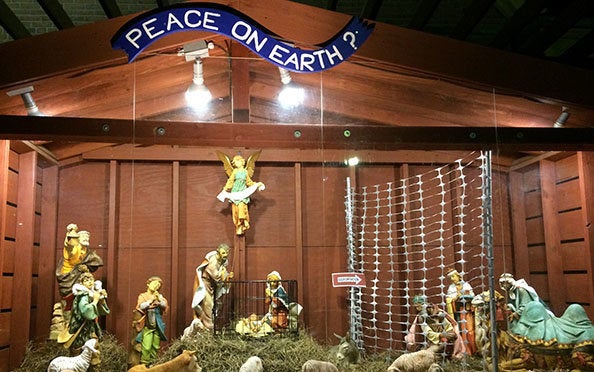
Monday, December 17, 2018

Rorate caeli desuper


THERE was in the days of Herod, the king of Judaea, a certain priest named Zacharias, of the course of Abia: and his wife was of the daughters of Aaron, and her name was Elisabeth. 6 And they were both righteous before God, walking in all the commandments and ordinances of the Lord blameless. 7 And they had no child, because that Elisabeth was barren, and they both were now well stricken in years.

8 And it came to pass, that while he executed the priest's office before God in the order of his course,

9 According to the custom of the priest's office, his lot was to burn incense when he went into the temple of the Lord. 10 And the whole multitude of the people were praying without at the time of incense. 11 And there appeared unto him an angel of the Lord standing on the right side of the altar of incense. 12 And when Zacharias saw him, he was troubled, and fear fell upon him. 13 But the angel said unto him, Fear not, Zacharias: for thy prayer is heard; and thy wife Elisabeth shall bear thee a son, and thou shalt call his name John. 14 And thou shalt have joy and gladness; and many shall rejoice at his birth. 15 For he shall be great in the sight of the Lord, and shall drink neither wine nor strong drink; and he shall be filled with the Holy Ghost, even from his mother's womb. 16 And many of the children of Israel shall he turn to the Lord their God. 17 And he shall go before him in the spirit and power of Elias, to turn the hearts of the fathers to the children, and the disobedient to the wisdom of the just; to make ready a people prepared for the Lord.

18 And Zacharias said unto the angel, Whereby shall I know this? for I am an old man, and my wife well stricken in years. 19 And the angel answering said unto him, I am Gabriel, that stand in the presence of God; and am sent to speak unto thee, and to shew thee these glad tidings. 20 And, behold, thou shalt be dumb, and not able to speak, until the day that these things shall be performed, because thou believest not my words, which shall be fulfilled in their season.

21 And the people waited for Zacharias, and marvelled that he tarried so long in the temple. 22 And when he came out, he could not speak unto them: and they perceived that he had seen a vision in the temple: for he beckoned unto them, and remained speechless. 23 And it came to pass, that, as soon as the days of his ministration were accomplished, he departed to his own house.

24 And after those days his wife Elisabeth conceived, and hid herself five months, saying, 25 Thus hath the Lord dealt with me in the days wherein he looked on me, to take away my reproach among men.

26 And in the sixth month the angel Gabriel was sent from God unto a city of Galilee, named Nazareth, 27 To a virgin espoused to a man whose name was Joseph, of the house of David; and the virgin's name was Mary. 28 And the angel came in unto her, and said, Hail, thou that art highly favoured, the Lord is with thee: blessed art thou among women. 29 And when she saw him, she was troubled at his saying, and cast in her mind what manner of salutation this should be. 30 And the angel said unto her, Fear not, Mary: for thou hast found favour with God. 31 And, behold, thou shalt conceive in thy womb, and bring forth a son, and shalt call his name JESUS. 32 He shall be great, and shall be called the Son of the Highest: and the Lord God shall give unto him the throne of his father David: 33 And he shall reign over the house of Jacob for ever; and of his kingdom there shall be no end. 34 Then said Mary unto the angel, How shall this be, seeing I know not a man? 35 And the angel answered and said unto her, The Holy Ghost shall come upon thee, and the power of the Highest shall overshadow thee: therefore also that holy thing which shall be born of thee shall be called the Son of God. 36 And, behold, thy cousin Elisabeth, she hath also conceived a son in her old age: and this is the sixth month with her, who was called barren. 37 For with God nothing shall be impossible. 38 And Mary said, Behold the handmaid of the Lord; be it unto me according to thy word. And the angel departed from her.

39 And Mary arose in those days, and went into the hill country with haste, into a city of Juda; 40 And entered into the house of Zacharias, and saluted Elisabeth. 41 And it came to pass, that, when Elisabeth heard the salutation of Mary, the babe leaped in her womb; and Elisabeth was filled with the Holy Ghost: 42 And she spake out with a loud voice, and said, Blessed art thou among women, and blessed is the fruit of thy womb. 43 And whence is this to me, that the mother of my Lord should come to me? 44 For, lo, as soon as the voice of thy salutation sounded in mine ears, the babe leaped in my womb for joy. 45 And blessed is she that believed: for there shall be a performance of those things which were told her from the Lord.

And Mary said, My soul doth magnify the Lord,

47 And my spirit hath rejoiced in God my Saviour.

48 For he hath regarded the low estate of his handmaiden: for, behold, from henceforth all generations shall call me blessed.

49 For he that is mighty hath done to me great things; and holy is his name.

50 And his mercy is on them that fear him from generation to generation.

51 He hath shewed strength with his arm; he hath scattered the proud in the imagination of their hearts.

52 He hath put down the mighty from their seats, and exalted them of low degree.

53 He hath filled the hungry with good things; and the rich he hath sent empty away.

54 He hath holpen his servant Israel, in remembrance of his mercy;

55 As he spake to our fathers, to Abraham, and to his seed for ever.

And Mary abode with her about three months, and returned to her own house.

57 Now Elisabeth's full time came that she should be delivered; and she brought forth a son. 58 And her neighbours and her cousins heard how the Lord had shewed great mercy upon her; and they rejoiced with her.

59 And it came to pass, that on the eighth day they came to circumcise the child; and they called him Zacharias, after the name of his father. 60 And his mother answered and said, Not so; but he shall be called John. 61 And they said unto her, There is none of thy kindred that is called by this name. 62 And they made signs to his father, how he would have him called. 63 And he asked for a writing table, and wrote, saying, His name is John. And they marvelled all. 64 And his mouth was opened immediately, and his tongue loosed, and he spake, and praised God. 65 And fear came on all that dwelt round about them: and all these sayings were noised abroad throughout all the hill country of Judaea. 66 And all they that heard them laid them up in their hearts, saying, What manner of child shall this be! And the hand of the Lord was with him.

67 And his father Zacharias was filled with the Holy Ghost, and prophesied, saying

Blessed be the Lord God of Israel; for he hath visited and redeemed his people,

69 And hath raised up an horn of salvation for us in the house of his servant David;

70 As he spake by the mouth of his holy prophets, which have been since the world began:

71 That we should be saved from our enemies, and from the hand of all that hate us;

72 To perform the mercy promised to our fathers, and to remember his holy covenant;

73 The oath which he sware to our father Abraham,

74 That he would grant unto us, that we being delivered out of the hand of our enemies might serve him without fear,

75 In holiness and righteousness before him, all the days of our life.

76 And thou, child, shalt be called the prophet of the Highest: for thou shalt go before the face of the Lord to prepare his ways;

77 To give knowledge of salvation unto his people by the remission of their sins,

78 Through the tender mercy of our God; whereby the dayspring from on high hath visited us,

79 To give light to them that sit in darkness and in the shadow of death, to guide our feet into the way of peace.

And the child grew, and waxed strong in spirit, and was in the deserts till the day of his shewing unto Israel.

And it came to pass in those days, that there went out a decree from Caesar Augustus that all the world should be taxed. 2 (And this taxing was first made when Cyrenius was governor of Syria.) 3 And all went to be taxed, every one into his own city. 4 And Joseph also went up from Galilee, out of the city of Nazareth, into Judaea, unto the city of David, which is called Bethlehem; (because he was of the house and lineage of David:) 5 To be taxed with Mary his espoused wife, being great with child. 6 And so it was, that, while they were there, the days were accomplished that she should be delivered. 7 And she brought forth her firstborn son, and wrapped him in swaddling clothes, and laid
him in a manger; because there was no room for them in the inn.

8 And there were in the same country shepherds abiding in the field, keeping watch over their flock by night. 9 And, lo, the angel of the Lord came upon them, and the glory of the Lord shone round about them: and they were sore afraid.

And the angel said unto them, Fear not: for, behold, I bring you good tidings of great joy, which shall be to all people. 11 For unto you is born this day in the city of David a Saviour, which is Christ the Lord. 12 And this shall be a sign unto you; Ye shall find the babe wrapped in swaddling clothes, lying in a manger.

And suddenly there was with the angel a multitude of the heavenly host praising God, and saying,

Glory to God in the highest, and on earth peace, good will toward men.

And it came to pass, as the angels were gone away from them into heaven, the shepherds said one to another, Let us now go even unto Bethlehem, and see this thing which is come to pass, which the Lord hath made known unto us. 16 And they came with haste, and found Mary, and Joseph, and the babe lying in a manger. 17 And when they had seen it, they made known abroad the saying which was told them concerning this child. 18 And all they that heard it wondered at those things which were told them by the shepherds. 19 But Mary kept all these things, and pondered them in her heart. 20 And the shepherds returned, glorifying and praising God for all the things that they had heard and seen, as it was told unto them.

21 And when eight days were accomplished for the circumcising of the child, his name was called JESUS, which was so named of the angel before he was conceived in the womb.

22 And when the days of her purification according to the law of Moses were accomplished, they brought him to Jerusalem, to present him to the Lord; 23 (As it is written in the law of the LORD, Every male that openeth the womb shall be called holy to the Lord;) 24 And to offer a sacrifice according to that which is said in the law of the Lord, A pair of turtledoves, or two young pigeons.

25 And, behold, there was a man in Jerusalem, whose name was Simeon; and the same man was just and devout, waiting for the consolation of Israel: and the Holy Ghost was upon him. 26 And it was revealed unto him by the Holy Ghost, that he should not see death, before he had seen the Lord's Christ. 27 And he came by the Spirit into the temple: and when the parents brought in the child Jesus, to do for him after the custom of the law, 28 Then took he him up in his arms, and blessed God, and said,

Lord, now lettest thou thy servant depart in peace, according to thy word:

30 For mine eyes have seen thy salvation,

31 Which thou hast prepared before the face of all people;

32 A light to lighten the Gentiles, and the glory of thy people Israel.

And Joseph and his mother marvelled at those things which were spoken of him. 34 And Simeon blessed them, and said unto Mary his mother, Behold, this child is set for the fall and rising again of many in Israel; and for a sign which shall be spoken against; 35 (Yea, a sword shall pierce through thy own soul also,) that the thoughts of many hearts may be revealed.

36 And there was one Anna, a prophetess, the daughter of Phanuel, of the tribe of Aser: she was of a great age, and had lived with an husband seven years from her virginity; 37 And she was a widow of about fourscore and four years, which departed not from the temple, but served God with fastings and prayers night and day. 38 And she coming in that instant gave thanks likewise unto the Lord, and spake of him to all them that looked for redemption in Jerusalem.

39 And when they had performed all things according to the law of the Lord, they returned into Galilee, to their own city Nazareth. 40 And the child grew, and waxed strong in spirit, filled with wisdom: and the grace of God was upon him.

[I would post the Scholar's Version of Luke's first two chapters if only to blow the cobwebs off the familiar words, or to present a clearer text than Early Modern English (the language of the King James Version) provides.  But I didn't have to type this one from scratch, and the beauty of the KJV is on its best display in the many songs Luke puts in his nativity story.  So muddle past the "holpens" and the spellings and archaisms as best you can.]

Matthew's nativity begins with the genealogy of Jesus of Nazareth, an important history for the children of Abraham (not yet the "Jews" in Matthew's day) since the Exile, the other great defining historical event in Hebraic history, after the Exodus from Egypt.   Luke's story ends with it, although I didn't post it here.  This indicates either that the writer of Luke knew Matthew's gospel, or at least the "Special Matthew" that writer got his/her nativity from; or the idea of a genealogy of Jesus was already so widespread even the Gentiles "Luke" wrote for expected it to be a part of the story.  That they expected a nativity story is obvious.  That a nativity story would be more of a Gentile than Hebrew expectation perhaps needs to be noted.  Egyptian pharaohs marked their birthdays because they were gods; Roman emperors marked their accession to power, and became, by the time of Julius Caesar, divi filius, "son of god."  There is a great deal that is radical here, in both nativity stories; claims of humanity and divinity which mix like oil and water.  But where Matthew puts his story squarely in Abrahamic history, starting with the genealogy and continuing outward to the gentile Magi, Luke starts the story outside the Holy Family, and moves slowly towards them.  Jesus' place in the world is through extended family, not through extended ancestry.

The story starts with Zacharias, a priest doing his priestly duties in the Holy of Holies.  It's helpful to understand this is an inner sanctum of a Temple laid out in three "layers."  There's the outer public area, where the adult Jesus will overturn the tables of the money-changers during Passover; there's an inner courtyard where only men may enter (a very exclusive boy's club), and then the inner room to that which only priests can enter on certain days.  Whether this is one of those days is doubtful; Luke's grasp of Hebraic liturgy and ceremony is not strong; but when the priest entered the holiest of places, where God might possibly appear, a rope would be tied to his ankle, in order to drag him out if the presence of God should strike him dead.  God is so wholly other that when God appears in creation, creation trembles:  winds blow, the earth shakes, bush catch fire but don't burn; that kind of thing.   Only the greatest of prophets can face God and live:  Moses does it twice (the bush, and atop Sinai), Ezekiel does it once, in a vision; Elijah does it once, as well.  Zacharias gets the next best thing:  an angel, which word we get from the Greek for "messenger" (we turned it into a winged being providing protection to children).  A messenger here doesn't mean an errand boy, but more of a modern ambassador, a person with authority and robed in the power of the ruler.  To speak to an angel is to speak to God, but to survive the experience; the angel is God's representative, but not so holy and wholly other as to be a danger to mortal existence.

Still, Zacharias, the priest, the man, the representative of authority coming down from God to the people, makes a fatal error.  He doubts.  There are four stories of woman facing infertility and receiving the blessing of a child from God in the Hebrew Scriptures; three of them involve direct communications with the mother, two involve communication with God by the father, in none of them does the father or mother doubt the promise of God, or even question it.  The closest is Sarah, who laughs at such good news; which is why she names her son Isaac, the one who brings laughter.  Zacharias stands apart, and for his doubt he is silenced until his son is named.

The silence is significant because everyone in Luke's nativity story sings when they hear good news.  Mary's Magnificat is a response to her cousin's joyful greeting; the angels sing to the shepherd at the good news that Christ is born; Simeon sings out at the revelation that the savior he has waited to see has been shown to him.  Luke's gospel is probably the reason we have so many Christmas songs (or probably not, but it's a lovely idea).  It's certainly the reason we think angels have wings; but we'll get back to that.

So Zacharias leaves the temple unable to speak, and that's a sign to everyone else that something significant has happened.  It's also a sign that Gabriel's words are true. and that everything else predicted in this story will happen.  This is a story as much about the future as it is about the past.  But then, the scriptural stories of promises of children are always stories about the future, not the past.  There are echoes here of those stories:  in Genesis 16 Sarah laughs at the idea she would finally have a child, and wonders if it can be true.  In Judges 13 Manoah asks the angel of God for the angel's name, but doesn't get it:  "Why do you ask my name? It is beyond understanding," is the answer, a perfectly Hebraic answer where even the name of God is withheld.  Gabriel gives his name to Zacharias as evidence of his authority, and also so we will know the same messenger appears to Mary (as the angel in Judges appeared first to his wife, and then to Manoah).  Mary echoes Hannah in 1 Samuel:  when she is praying for a child at the Temple, Eli the priest thinks she is drunk.  When she pours out her heart to him, he realizes his error and tells her:  "Go in peace, and may the God of Israel grant you what you have asked of him."  Hannah responds:  "May your servant find favor in your eyes."

But Mary is not an old woman hoping still to have a child; she is a young woman who has not "known a man."  And she is braver than Zacharias: "And when Zacharias saw him, he was troubled, and fear fell upon him."  But Mary is not afraid, just concerned:  "Fear not, Mary," says Gabriel; but she is just disturbed at why she should be announced as blessed among women.  Mary is not afraid; Mary is humble.  We can confuse this with the expected subservience of women, then and to some extent still, now.  But Mary is properly humble before God; her response is "How is this going to happen?", not "That's impossible!"  In that difference we already see the raising up and casting down that she will sing about to her cousin Elizabeth.  And when the angel announces the future, declares what is to come, Mary responds almost with the words of Hannah:  "Behold the handmaid of the Lord; be it unto me according to thy word."

Are those the words of a strong woman?  Or words of groveling submission?  It really isn't for me to say.  

The last speaker was ANDREA, a young married woman, and now OSCAR, her young husband breaks in:  "God is selfish because he wants us to be his slaves. He wants our submission. Just him.  I don't see why Mary has to call herself a slave. We should be free!  Why just him?  That's selfishness."

ALEJANDRO, who is a bachelor:  "We have to be slaves of God, not of men."

Another young man:  "God is love.  To be a slave of love is to be free because God doesn't make us slaves.  He's the only thing we should be slaves of, love.  And then we don't make slaves of others.'

ALEJANDRO'S MOTHER says:  "To be a slave of God is to serve others.  That slavery is liberation."

I said that it's true that this selfish God Oscar spoke about does exist.  And it's a God invented by people.  People have often invented a god in their own image and likeness - not the true God, but idols, and those religions are alienating, an opium of the people.  But the God of the Bible does not teach religion, but rather he urges Moses to take Israel out of Egypt, where the Jews were working as slaves, He led them from colonialism to liberty.  And later God ordered that among those people no one could hold another as a slave, because they had been freed by him and belonged only to him, which means they were free...

The words of the "last speaker" referred to there are these:

in the words of a woman named Andrea, "[Mary] recognizes liberation.... We have to do the same thing.  Liberation is from sin, that is, from selfishness, from injustice, from misery, from ignorance - from everything that's oppressive.  That liberation is in our wombs too, it seems to me."   Especially intriguing for our study is these "uneducated" and "unofficial" interpreters' grasp of nuance, even in their most revolutionary ideas. In a discussion about whether "the proud" automatically equates to "the rich," some argue that even a poor person can become "an exploiter in his heart" if she or he years to be rich and acts in a correspondingly exploitative manner.  Others regard God's humbling of the arrogant, rich, and powerful; the exploiters must be liberated,according to Solentiname resident Olivia, "from their wealth.  Because they're more slaves than we are."
I mention this because there is a lively discussion still to be had about Luke's story, about Mary's words, and I don't want to offer my exegesis as the last word, or even an authoritative word, on how to understand them.  Is Mary's humility proper, or improper; a sign of strength, or a sign of weakness?  That should be a lively discussion.  What is interesting is that Mary's acceptance prompts Gabriel to tell her more, as if to prove his word is true and can be trusted.  We learn it has been six months or more since Zacharias saw Gabriel in the Temple, and that the future he promises Mary is confirmed in the future he promised to Zacharias.  But it's also the mention of Elizabeth that sends Mary to see her cousin, and that carries the story forward as now the journeys of this nativity story begin.

This first journey is a voluntary one, in strong contrast to the later journey to Bethlehem.  Like that story, it involves staying at the house of a family member, so in the narrative this trip foreshadows the more famous one.  But it also prompts the first spontaneous overflow of powerful emotions, which doesn't happen to result in a song, but it certainly prompts one.  This first journey also marks the first appearance of Luke's idea of "Holy Spirit."

And it came to pass, that, when Elisabeth heard the salutation of Mary, the babe leaped in her womb; and Elisabeth was filled with the Holy Ghost: 42 And she spake out with a loud voice, and said, Blessed art thou among women, and blessed is the fruit of thy womb. 43 And whence is this to me, that the mother of my Lord should come to me? 44 For, lo, as soon as the voice of thy salutation sounded in mine ears, the babe leaped in my womb for joy. 45 And blessed is she that believed: for there shall be a performance of those things which were told her from the Lord.
That idea of the Holy Ghost is important here, because it gives Elizabeth knowledge she couldn't otherwise have had.  She underlines the blessing on Mary who, unlike Elizabeth's husband, believed.  But how would she know that, except for the inspiration of the Holy Spirit?  See it as a theological or religious element if you will; it is at least a narrative device for Luke to underline what Sojourner Truth divined so many centuries later:

"That man say we can't have as much rights as a man 'cause Christ wasn't a woman.  Where did your Christ come from?  From God and a woman.  Man had nothing to do with it."
Because you will notice so far we have four characters in this story, and of the three mortals only one is male; and he whiffed it.  Mary and Elizabeth carry the weight here, and carry it effortlessly.  And in another foreshadowing of the stay in Bethlehem, Mary stays with Elizabeth for three months; or until just about the time Elizabeth's son is born.  But to skip to that is to race past the first significant song in Luke's gospel.

I'll start that discussion by quoting myself; at length, as it turns out:

Quite a lot to claim on just the word of an angel; a lot of expectation for her child. But she doesn’t speak in the future tense; she sings about the present. She praise what God has done, not what God will do; she focuses on the fulfillment of the promise, not a new expectation.

And everything is shattered: thrones, wealth, worthiness; all mean nothing. Hunger and low estate are reversed, power and arrogance are defeated. All without firing a shot. All without anything yet having really happened. How can this be?

One other thing: this is not a political statement. This is not about a greater power than all others on earth, overwhelming what we know and wiping it out. If reason is really going to save us from ourselves, it can only do so by overpowering emotions; it will only do so when we all finally and fully think alike, and praise the same things, and damn the same things, and there is no deviation. It will only finally rule supreme when human emotion is wiped out, and desires and wants are expunged. Reason will only finally be our best and highest ruler when everyone is a slave and no one thinks unlike the rest, and the philosopher kings take their rightful place, and we all learn to bounce our ball in sequence on the coldly perfect planet of Camazotz.

The Magnificat is not a political song. It is not the Maccabees taking on Rome and precipating the slaughter of Jerusalem in 70 C.E. It is not the Pax Romana that finally fell, never to rise again. It is not the plea of the Populists, of New Deal Democrats, the Yippies, or the Green Party. The Magnificat is not about what will be, but about what is.

It is not about resistance, about plans to rule and overpower, either malicious or benign. It understand implicitly: there is no power without resistance. It is not a song of resistance, or a song of prediction.

It is a song of now. 
That's one interpretation, and I stand by it.  There are others, such as to point out how this song fits the context of Luke's story.  Mary starts with praise of God by God working through Mary:  "My soul magnifies the Lord."  Which still could be a political statement, as Dom Crossan and Jonathan Reed pointed out:

On the one hand, "lord" was a polite term usable by slave to master or disciple to teacher. On the other, "the Lord" meant the emperor himself. 
To speak of God as "Lord" is to speak as a handmaiden; or it is to jump right past the emperor; to declare this Lord will pull down the mighty from their seats, is to predict political chaos and the destruction of the Pax Romana.  Or it is to declare the vision of streams in the desert and every valley filled and every high place made low, that all might see the glory of the Lord.  But notice first how much it is a praise of God, and a thanksgiving for blessings already received, for Mary and for the children of Abraham.  And then she explains why she is praising God:  not just for what God has done, but for what God is going to do.  Notice how each prediction is balanced, how each declaration of what God will do declares justice and restoration of order:

He hath shewed strength with his arm; he hath scattered the proud in the imagination of their hearts.

God shows strength, but that strength scatters the proud "in the imagination of their hearts."  The proud imagine themselves mighty and dreadful; but even in the safehold of their imaginations God scatters them.

He hath put down the mighty from their seats, and exalted them of low degree.

Here are the valleys raised and the mountains lowered; and this theme will be a major one throughout Luke's narrative.

He hath filled the hungry with good things; and the rich he hath sent empty away.

Or, as Jesus will say a bit later in Luke's gospel:

Congratulations, you hungry!
You will have a feast.

Damn you rich!
You already have your consolation!
But for now Luke puts all the power in the hands of women. The story returns to Elizabeth after Mary leaves. Her delivery brings the blessings of the community to het, recognizing her blessing from God. And she's in charge when it comes time to name the baby. When she says the boy will be named John, Zacharias writes his agreement and that finally frees his tongue. Mary and Elizabeth have their agency; Zacharias has to learn his lesson.

Like Mary's Magnificat, [Zacharias'] Benedictus is a doxology and a prophecy, a truth-telling, about the present and the future.  As befits a priest, he recalls the covenant history starting with Abraham, connecting the child yet to be born (Mary's) to the genealogy yet to be given (waiting in Luke's narrative until after the nativity story is over).  Mary's Magnificat is about revolution; the Benedictus is about salvation; fittingly, about blessings.  And again, to quote myself:

And as soon as Zecharias fulfills the word of the Lord as spoken by the angel, he can speak again, and he sings. We call that one the Benedictus, because the Latin version begins: “Benedictus Dominus, Deus Israel.” Mary’s song praises what God will do; Zecharias' song praises what God has done. Together they tie up the strands of history, past and future, and make them one moving knot through the present, but all of time connected through that knot, through the moving present. Ironically, Zechariah’s song also does one more thing, in a way Luke never could have foreseen or intended. It ends with the one use of the word “epiphany” in all the Gospels.

The word means “revelation,” but it also means “light, illumination.” Epiphanai, sings Zecharias: Epiphanai tois en skotei kai skia thanatou kathamenois: light to those in darkness and in death’s shadow. Epiphanai: light, to show us the way. And so the Christmas stories connect again, through music.
That connection is, specifically, with Matthew's story of the Magi, celebrated by the church as the Epiphany.  But hold on to that image of the knot of past and future moving as the present through history; Luke will make much use of it before the nativity story is through.

Now we get to the most famous part of the nativity stories and, again, we get it wrong. We condense the timeline so much we have Joseph and Mary arrive in Bethlehem in the day, and she gives birth that night. As Luke actually tells it, they spend several days before she gives birth.  And she lays the baby in the manger because the house is full, not because the holy family is in a stable. Stables are a northern European structure from many centuries later.

We hasten Mary's pregnancy the better to heighten the narrative tension and prove the world a cruel and harsh place, inimical to the savior; and ignore our role in making the world that way.  It doesn't happen that Mary is forced to a stable to give birth while animals look on, and it doesn't happen that she is in labor even as Joseph tries in vain to find a place to stay.  We invented that part to make their plight worse than even Luke says it is, to overlook the power of the government in forcing the family on this journey, to overlook a system that makes Mary and Joseph poor ("Carpenter" meant one step up from beggar, not a journeyman tradesman with a union card.  Jesus' father is no better off than the fishermen he will recruit later; he recruits them because he's one of them, he grew up as poor as they live.).  We want the story to be a bit crueler so we can tell ourselves we'd have taken better care of them if we'd been there; but we don't now.   Brueghel and Auden are our corrective.  Luke sets up the obstacles to our comfort; over the centuries we've done our best to flatten them out.

Joseph appears for the first time in this narrative, and he has no role in it except "husband."  His role here is social:  to make Mary and Jesus legitimate.  Mary still takes center stage; where she is silent in Matthew's telling, she is the actor in Luke's.  More reversals, because the angels never speak to Joseph, but they go out to the hills where the shepherds are awake (!) and sing to them.

The thing about shepherds is, they aren't the pale and idyllic figures of later Romantic literature (some 1800 years later!).  They are outlaws, bikers, people on the fringe of a society that has a very large and broad fringe (imagine a funnel with a point at the top for the Emperor, a very attenuated reach up to the Emperor, and a very, very broad base out of all proportion to the peak.  It's a system of patronage, where wealth concentrates at the top and trickles down to the bottom, a bottom where the majority live, and where very little wealth trickles down.  On the far edge of that bottom, you find the shepherds.).  They stink, and they steal.  You can't brand sheep, and if a few more come home with you than you left with, that's to your benefit.  They live outside town, they aren't welcome among polite company, they have their own rules of behavior and they scare most people, the way working class workers do to this day.  If such a thing were known then, they would be migrant immigrant labor.  This is who the angels sing to; this is who comes to see Mary's baby.

Luke is dealing in social-economic concepts we've all but lost today.  The shepherds aren't comic figures from medieval mystery plays (the ones we turned into Christmas pageants with children in bathrobes and a few live animals); they aren't the unsullied pure hearts of the Romantics.  They make the carpenter Joseph look rich; their business practices would shame Micheal Cohen and Donald Trump.  But they are invited; they get the news first:

8 And there were in the same country shepherds abiding in the field, keeping watch over their flock by night. 9 And, lo, the angel of the Lord came upon them, and the glory of the Lord shone round about them: and they were sore afraid.

And the angel said unto them, Fear not: for, behold, I bring you good tidings of great joy, which shall be to all people. 11 For unto you is born this day in the city of David a Saviour, which is Christ the Lord. 12 And this shall be a sign unto you; Ye shall find the babe wrapped in swaddling clothes, lying in a manger.

And suddenly there was with the angel a multitude of the heavenly host praising God, and saying,

Glory to God in the highest, and on earth peace, good will toward men.
Again, the first thing the angels do is reassure.  Maybe they have learned from Mary; maybe they expect better of priests like Zacharias.  But they tell the shepherds not to be afraid, and they tell them the sign:  a babe wrapped in swaddling clothes, lying in a manger.  Someone like them, in other words; a child of poverty, born to peasants, the Savior, the Anointed One, the Christ, the Lord.  And there's that word again; it can hardly mean "master" this time, not when applied to a peasant's baby swaddled in a feeding trough.  It has to be political; and we forget, too, so many millennia later, how dangerous that claim would be.  But Herod doesn't hear it, or does Caesar; only shepherds hear, and then they hear the gloria:

Gloria in excelsis Deo!

We know that much of it, from the Vulgate, in the Latin of St. Jerome.  The rest, again, we interpret to our own purposes.  I read a comment recently that garbled the rest of that line, limiting it to "men of goodwill" by turning it around and making it come out backwards.  Men of good will, of course, meant people who agreed with the speaker.  Luke's gospel, as much as Matthew's, tries to destroy boundaries beginning with the nativity; we work as hard as we can to replace them.  God is funny like that; some consider it proof God is not us.  Some, pay no attention; boundaries are a great comfort.

The blessing is, of course, the Christmas wish:  peace on earth, good will toward men.  Toward men because the good will comes from Heaven, and God is not human.  It is a wish, a blessing, a sign that God is active in history, a wish that we would be active, too.

As an aside, this part of the story is probably where we get the idea that angels have wings; how else could they be in the sky?  Of such small features are mighty theories made.

So the shepherds show up, and see the child, and are convinced by what they angels told them and what they found; and it is Mary who stores all this in her heart.  Joseph?  He's a cipher.  And while the shepherds praise God and start spreading the evangel, the good news, of what they have heard and seen, they don't get a song.  There is a fourth song coming, but it will be by another named individual.  In the meantime, no one listens to the talk of shepherds, at least no one with political or temporal power, so there is no danger to the child, and the story moves on to his presentation at the Temple.  This occasions another journey, though we seldom notice it.  Time passes and the scene shifts to Jerusalem, the setting for the conclusion of the nativity story, and the final song, a song again inspired by the activity of God.

This journey to Jerusalem is not a minor narrative point; it is a counterbalance to the decree of the census.  This journey, like the one to Bethlehem, is required of the Holy Family; but this journey is in accordance with the laws of the God of Abraham, not the whims and needs of Caesar (who is only doing it to assess taxes, another burden on the poor by the rich).  God uses the census to have Jesus born in the city of David; God's law brings the Holy Family to Jerusalem so they can be a blessing to, and receive a blessing from, Simeon; and so Mary can get one more thing to store in her heart:

And, behold, there was a man in Jerusalem, whose name was Simeon; and the same man was just and devout, waiting for the consolation of Israel: and the Holy Ghost was upon him. 26 And it was revealed unto him by the Holy Ghost, that he should not see death, before he had seen the Lord's Christ. 27 And he came by the Spirit into the temple: and when the parents brought in the child Jesus, to do for him after the custom of the law, 28 Then took he him up in his arms, and blessed God, and said,

Lord, now lettest thou thy servant depart in peace, according to thy word:

30 For mine eyes have seen thy salvation,

31 Which thou hast prepared before the face of all people;

32 A light to lighten the Gentiles, and the glory of thy people Israel.

And Joseph and his mother marvelled at those things which were spoken of him. 34 And Simeon blessed them, and said unto Mary his mother, Behold, this child is set for the fall and rising again of many in Israel; and for a sign which shall be spoken against; 35 (Yea, a sword shall pierce through thy own soul also,) that the thoughts of many hearts may be revealed.

36 And there was one Anna, a prophetess, the daughter of Phanuel, of the tribe of Aser: she was of a great age, and had lived with an husband seven years from her virginity; 37 And she was a widow of about fourscore and four years, which departed not from the temple, but served God with fastings and prayers night and day. 38 And she coming in that instant gave thanks likewise unto the Lord, and spake of him to all them that looked for redemption in Jerusalem.
For the second time the Holy Spirit is the in spiritus, the inspiration, for song; and again, the Holy Ghost inspires a man.  Simeon bookends Zacharias, offering a doxology to God and another prophecy about the child, as well as a second prophecy to the mother, this time (and for the first time in Luke's narrative) with a dark warning, also to Mary.  Joseph wonders, as his wife does, but Mary gets all the messages.  This is not a slight against Joseph but more of Isaiah's streams in the desert, of low places raised up and high places brought low.  The image of streams in the desert is life where apparently all is lifeless (Elizabeth's pregnancy); the handmaiden of the Lord is blessed among women, and women are just as important as men (Anna seems almost the afterthought here, but she is a prophetess and given a lineage, just like Zacharias as the beginning (Simeon is simply "just and devout")).  And it is Anna who, like the shepherds, spreads the evangel, the good news of the child.  God uses the most marginalized to spread the message of the angels, just as God chose the most marginalized to be the Holy Family.  Luke's nativity ends with the years of Jesus' childhood passed over, years left to others to fill in with infancy gospels about what Jesus did before Luke's story takes up again.

Luke's gospel emphasizes the poverty, the fringe of society, the powerlessness of the Holy Family.  That's in Matthew's story, too, but we overlook the danger that forces them to flee to Egypt, stay several years there, and then return not to Bethlehem, but to Nazareth so they can remain incognito.  But Luke's story doesn't draw the attention of Herod or any rulers; who listens to shepherds, then or now?  These two nativity stories are diptychs, each telling the same story in only slightly different ways.  Matthew emphasizes the light to the nations and the threat to world power; Luke emphasizes the poverty and the redemption that comes from the fringes toward the center.  Both stories ultimately affirm the same theme:  glory to God in the highest and on earth peace, good will toward men.  Not that we have that yet; but we have the faith (trust) that it will come.

Advent 16: 2018


Once two brothers went to visit an old man.  It was not the old man's habit, however, to eat every day.  When he saw the brothers, he welcomed them with joy, and said:  "Fasting has its own reward, but if you eat for the sake of love you satisfy two commandments, for you give up your own will and also fulfill the commandment of refreshing others."

Desert Wisdom

Sunday, December 16, 2018

The "Death Spiral of Stupid"


You would be better off today reading this, than anything I have posted today, or will post today.  In the meantime, Giuliani-on-the-loose is breaking what's left of my legal mind:

“[Cohen] is saying the president knew it was wrong and directed him to do it anyway,” ABC host George Stephanopoulos told Giuliani on Sunday.

“Which is the truth?” Giuliani quipped, denying Cohen’s statements to federal prosecutors. “I think i know what the truth is. Unless you’re god, you’ll never know what the truth is.”

In other words, it depends on what the meaning of "is," is.  Courts of law don't determine "truth," of course, in the sense of Pilate's question (and Giuliani's sneer), and Rudy knows it.  He's playing the weakest kind of defense lawyer he can, because he's literally  got nothing.  But he speaks for the POTUS; think about that.  The interview was worse than just that exchange, too:

Giuliani began by comparing the hush money campaign finance violations to which Michael Cohen pleaded guilty (and in which the President is implicated) to the violations for which a jury ultimately did not convict former North Carolina Sen. John Edwards.

“If there’s another purpose” for a hush money payment, besides aiding a candidate’s campaign, Giuliani argued, “it’s no longer a campaign contribution.”

Which is false, but moving on:

Stephanopoulos pushed back: “In this case, you have contemporaneous witnesses saying it was for the campaign, you have the statement of fact saying Donald Trump met with [American Media executive] David Pecker–”

“And I can produce an enormous number of witnesses that say the President was very concerned about how this was going to affect his children, his marriage,” Giuliani interjected. “All those women came forward at that time, that tape with Billy Bush and all that. It’s all part of the same thing. I know what he was concerned about. I can produce 20 witnesses to tell you what he was concerned about.”

“Two weeks before the campaign?” Stephanopoulos asked.

“You’re damn right,” Giuliani said.

Earlier this year, Giuliani implied that at least one hush money payment was made to help Trump’s campaign.

In May, Giuliani said of Stormy Daniels’ allegations of an affair with Trump: “Imagine if that came out on Oct. 15, 2016, in the middle of the last debate with Hillary Clinton.”
And moving lower:

Stephanopoulos pushed back, noting that Cohen is not the only one making allegations. The Southern District of New York also wrote in Cohen’s sentencing memo that Trump directed him to make the payments. “They write, with respect to both payments, Cohen acted in coordination with and at the direction of individual one. That’s in their own words. Of course individual one, the president,” Stephanopoulos said. “They wouldn’t write that if they didn’t have corroborating evidence, would they?”

“They don’t have corroborating evidence,” Giuliani replied. “Plus, they didn’t let Cohen plead guilty to a conspiracy. I ran that office. I know what they do.”

Which will be quite a surprise to Lanny Davis:

“Let’s remember that Michael Cohen has corroborating evidence for everything that he has said,” Davis explained. “[Special counsel Robert Mueller] certainly does. On the issue of the purpose of the money paid to Stormy Daniels, [Donald Trump], the same man who called Michael Cohen a rat, denied on Air Force One to the American people that he knew anything about Stormy Daniels.”
Does anybody really think those redacted documents recently released from the special prosecutor didn't contain evidence to convince the judge of the factual basis for the legal proceedings?  Evidence that is still part of an ongoing investigation, and so privileged for the moment?  Even Rudy knows about that.

It just got worse on FoxNews:

“We’re talking about something that doesn’t matter,” Giuliani said. “Whether it happened or it didn’t happen, it’s not illegal.”

Wallace interrupted, “You’re moving shells around on me. Either it happened or it didn’t happen.” But Giuliani defended himself by claiming, “That’s what lawyers do all the time.”

“I’m asking you for the truth, sir,” said Wallace, visibly frustrated by the circular exchange.

Asked if Trump would sit for an interview with the special counsel’s office, Giuliani scoffed.

“Good luck,” Giuliani said of Mueller’s team. “After what they did to Flynn ― the way they trapped him into perjury. ... They’re a joke. Over my dead body.”

Again, with feeling:  you can't trap someone into perjury.  You can make them reveal what they didn't mean to reveal; but lying on a material issue under oath (the definition of perjury) is a matter of intent, not accident.  If Flynn didn't mean to lie, he wouldn't have plead guilty to perjury.  And Giuliani knows it.  Rudy is a terrible defense lawyer:

“Giuliani is correct that collusion [with Russia] is not a federal crime writ large,” [NYU law professor Melissa] Murray said. “But all of the activities that go into collusion — misleading statements, collaborating with a foreign government, directing payments from a foreign government to a campaign — all of those things are federal crimes and the conspiracy to engage with others to do this is also a crime.”

Murray went on to say that Giuliani was also incorrect to suggest that prosecutors have a “weak” case on campaign finance violations because Trump had paid only “a little money” to his alleged mistresses.

“Is that really the issue?” Murray asked. “I mean, we have a representative of the president of the United States basically admitting to paying women money to not disclose the fact that they have been in some kind of untoward [relationship] with the president.”

“And his response and his defense is that if it had been more money, it would have been more serious,” she continued. “We are living in strange times. I mean, we are in a death spiral of stupid. This is insanity.”
Yes; yes, it is.

Las Posadas 2018


"LAS Posadas, literally, "the shelters," which begins on the 16th of December, is celebrated with great joy as the"holy pilgrims" (Mary and Joseph) move each night from house to house, one after another. It is always celebrated with song, prayers and special food, some of which are: tamales, donuts, champurrado and buffets.

"Why? Because it is the time of Advent, the time of expectation, the jubilant wait, the time when all await the birth of the son, awaiting the celebration of his birthday. This is the time of Las Posadas, the time of joy, preparation and waiting.

Why do people carry lanterns in the procession of Las Posadas? Because all those carrying the lanterns represent the stars which illuminate the way for the shepherds who make their way to the house of the birth." --Celestina Castro


FOR the LORD, your God, befriends the alien, feeding and clothing them. So you too must befriend the alien, for you were once aliens yourselves.
--Deuteronomy 10:17-19
DIYINO Y eterno Verbo, que desde el Padre descendiste al corazon de siempre Virgen Marfa; el amor que tienes a los hombres te conduce a la ciudad de Belen para nacer a media noche en un pobre y humilde establo.

Es verdad que millares de angeles te acompanan en este viaje; pero tambien es cierto que te dejamos, nosotros a quienes viniste a salvar y a conducir al Belen de la eterna felicidad.

Perdonanos, Dios y Senor del Universo, y ayudanos a cami-nar con Maria y San Jose para luchar y poder triunfar sobre toda adversidad. Amen.


Divine and eternal Word, who descended from the Father into the heart of the ever Virgin Mary, your love for humankind leads you to Bethlehem where you are born at midnight in a poor and humble stable.

In truth, thousands of angels accompany you on this journey, and yet we, whom you came to save and lead to that Bethlehem of eternal joy, stubbornly turn away from you.

Forgive us, God and Lord of the universe, and help us to walk alongside Mary and Joseph, thus giving us the courage to fight against and triumph over every adversity. Amen.--Posadas Prayer
"Las Posadas is a time of celebration in Mexico and the Southwest United States. It is an event of much significance with joy, protection and festivity. Las Posadas is always observed with much song and celebration. It is a novena of preparation for the feast of the Nativity. It begins on the 16th of December and ends on the 24th of December with the" Mass of the Rooster," the celebration of the Mass at Midnight.

"Las Posadas has its origins, possibly, from Father Diego de Soria, a religious of the order of St. Augustine. He was an enthusiastic priest, introducing the devotion in Mexico, in the church of Alcoman, in 1587. It was the intention of this celebrated religious to contrast the celebration of the Aztecs in honor of their god of war, Huitzilopochtli. It was celebrated at the same time as the time of the Nativity, and was presenting many problems of attraction for the neophyte Christians.

"Las Posadas of Father Diego became popular very quickly and extended to other churches in Mexico and the surrounding countryside. It then began to be celebrated in the homes of individuals.

"It is the celebration of the "pilgrims" who go from house to house led by an angel who conducts the little donkey with the seated Virgin. She is accompanied by St. Joseph. They sing songs as they look for shelter, the masters of the houses open their doors and all who participate share in the buffet which the owners (innkeepers) of the house offer.

"The people celebrate that the messiah will come again. It is the celebration of preparation for this coming. It is time to open the doors of our hearts to give shelter. How do we give shelter to Jesus? By the doing of good works. It is the preparation time for the doing and practicing of the virtues. It is a time for coming together with our neighbors. It is the occasion for gathering with our families and with those who live near us.--Fiestas Navideñas

We forget how much of the Christmas story, whether told by Luke or by Matthew, is about hospitality, as much for Mary and Joseph as it was for the Magi.   The nativity stories are surprisingly full of journeys:  the Magi, the flight into Egypt, the return to Nazareth, in Matthew.  The journey to Elizabeth's house by Mary, Mary's return to her own home, the journey to Bethlehem, the journey to Jerusalem, and back to Nazareth, in Luke.  The story in Luke emphasizes hospitality:  the welcome of Elizabeth to Mary; the stay in Bethlehem, the visit of the shepherds, welcomed to greet the new-born; the extravagant welcome of Simeon and Anna in Jerusalem.

Somebody stayed up late last night

IMHO, SNL last night was one if the best in a long time. Every sketch was funny, from beginning to end. But I never confused it with news. Truth, maybe.

Meanwhile, there's the dog that won't hunt:
The DOJ says 9000 texts were recovered, none were erased or "wiped clean." But thanks for the opportunity to fact check that again! And how can I leave this out? The titular head of our justice system doesn't understand its most basic, and constitutionally mandated, functions.

Third Sunday of Advent: 2018


Zephaniah 3:14-20
3:14 Sing aloud, O daughter Zion; shout, O Israel! Rejoice and exult with all your heart, O daughter Jerusalem!

3:15 The LORD has taken away the judgments against you, he has turned away your enemies. The king of Israel, the LORD, is in your midst; you shall fear disaster no more.

3:16 On that day it shall be said to Jerusalem: Do not fear, O Zion; do not let your hands grow weak.

3:17 The LORD, your God, is in your midst, a warrior who gives victory; he will rejoice over you with gladness, he will renew you in his love; he will exult over you with loud singing

3:18 as on a day of festival. I will remove disaster from you, so that you will not bear reproach for it.

3:19 I will deal with all your oppressors at that time. And I will save the lame and gather the outcast, and I will change their shame into praise and renown in all the earth.

3:20 At that time I will bring you home, at the time when I gather you; for I will make you renowned and praised among all the peoples of the earth, when I restore your fortunes before your eyes, says the LORD.

Isaiah 12:2-6
12:2 Surely God is my salvation; I will trust, and will not be afraid, for the LORD GOD is my strength and my might; he has become my salvation.

12:3 With joy you will draw water from the wells of salvation.

12:4 And you will say in that day: Give thanks to the LORD, call on his name; make known his deeds among the nations; proclaim that his name is exalted.

12:5 Sing praises to the LORD, for he has done gloriously; let this be known in all the earth.

12:6 Shout aloud and sing for joy, O royal Zion, for great in your midst is the Holy One of Israel.

Philippians 4:4-7
4:4 Rejoice in the Lord always; again I will say, Rejoice.

4:5 Let your gentleness be known to everyone. The Lord is near.

4:6 Do not worry about anything, but in everything by prayer and supplication with thanksgiving let your requests be made known to God.

4:7 And the peace of God, which surpasses all understanding, will guard your hearts and your minds in Christ Jesus.

Luke 3:7-18
3:7 John said to the crowds that came out to be baptized by him, "You brood of vipers! Who warned you to flee from the wrath to come?

3:8 Bear fruits worthy of repentance. Do not begin to say to yourselves, 'We have Abraham as our ancestor'; for I tell you, God is able from these stones to raise up children to Abraham.

3:9 Even now the ax is lying at the root of the trees; every tree therefore that does not bear good fruit is cut down and thrown into the fire."

3:10 And the crowds asked him, "What then should we do?"

3:11 In reply he said to them, "Whoever has two coats must share with anyone who has none; and whoever has food must do likewise."

3:12 Even tax collectors came to be baptized, and they asked him, "Teacher, what should we do?"

3:13 He said to them, "Collect no more than the amount prescribed for you."

3:14 Soldiers also asked him, "And we, what should we do?" He said to them, "Do not extort money from anyone by threats or false accusation, and be satisfied with your wages."

3:15 As the people were filled with expectation, and all were questioning in their hearts concerning John, whether he might be the Messiah,

3:16 John answered all of them by saying, "I baptize you with water; but one who is more powerful than I is coming; I am not worthy to untie the thong of his sandals. He will baptize you with the Holy Spirit and fire.

3:17 His winnowing fork is in his hand, to clear his threshing floor and to gather the wheat into his granary; but the chaff he will burn with unquenchable fire."

3:18 So, with many other exhortations, he proclaimed the good news to the people.


"And the crowds asked him, 'What then should we do?' In reply he said to them, 'Whoever has two coats must share with anyone who has none; and whoever has food must do likewise.' Even tax collectors came to be baptized, and they asked him, 'Teacher, what should we do?' He said to them, 'Collect no more than the amount prescribed for you.' Soldiers also asked him, 'And we, what should we do?' He said to them, 'Do not extort money from anyone by threats or false accusation, and be satisfied with your wages.'"

I should tell you this is one of my favorite passages, because it gives me Biblical warrant to get all self-righteous on everybody else about how they should behave, when I don't do any of it myself, but I don't have to, because I can just quote John the Baptist. I share food with my friends at Christmas, but I don't go out on the street and give it away to people with no food. I have at least four winter coats in my closet, in a climate where I hardly need one more than a few times a year, but I haven't so much as given any of them away to a resale shop. I don't extort money from anyone, but I'm about as satisfied with my wages as the next guy, which is to say: not at all.

But enough about me: let's talk about you.

I don't get off the hook that easily, do I?

Surely God is my salvation; I will trust, and will not be afraid, for the LORD GOD is my strength and my might; he has become my salvation.

With joy you will draw water from the wells of salvation.

And you will say in that day: Give thanks to the LORD, call on his name; make known his deeds among the nations; proclaim that his name is exalted.
I love Isaiah's words but, like most of us, I'm waiting for that day to do the rejoicing. I'm waiting, in fact, for someone else to do the rejoicing for me. I'm waiting for something to make me rejoice. I'm waiting to trust and not be afraid because the last few years especially have been hard ones for someone who thought he'd be a laborer in the vineyard. But enough about me; let's talk about you.

Let's talk about the covenant between me and you. It's what John is talking about. It's all that John is talking about. Jesus will ask, later: "Why did you go into the wilderness? To see a reed bending in the wind?" No; they went to hear about the requirements of the covenant, to find out how they should live. And John told them. Imagine the energy of the man, that people would go out to the wilderness to find him, and would listen, and even Roman soldiers would ask what they should do because they wanted to respond to him. And John didn't give them any doctrinal answer at all. He gave them the answer of St. Nicholas. He gave them the answers of Basil and Ambrose, four centuries later. He gave them the answers of Jesus, of whom he was the herald. Your neighbor is anyone who needs what you have, and you can spare. Your sister or brother is anyone you can help. He gave them the answer of Jacob Marley, 18 centuries later: "Mankind is your business!"

This is where that chain begins. With this energetic prophet in the wilderness drawing people out to see him because what he says, who he is, what he gives or demands or presents, draws them like honey draws flies, like a Christmas tree draws presents, like Christmas carols draw our memories. The covenant between us is not law or culture or tradition. It is not a creature of law, like a contract, or even comparable to a contract. It is not social or even moral or ethical. It simply is. And the coming wrath is not the terrible judgment of a vengeful God, fed up with creatures who ignore and disobey His Almighty Will: it is the consequence of our own actions and inactions and unrighteousness. It is the results of our own mistakes. What then should we do? Start with taking better care of each other.

John never says "Fear God, and keep God's commandments," though that would be wise, and in keeping with the priestly traditions of his father. He doesn't even try to convert the Roman soldiers to Judaism. They ask what to do, he tells them. (and notice the soldiers ask him what to do!  John is not evangelizing, John is realizing Isaiah's vision of God's holy mountain).  It applies to all people. The vision here is the one from Isaiah, from Micah, from the prophets: that all the people would come to the place where God dwells, because there would be justice and righteousness for all. There, the fortunes would be restored, and it would be as on the day of a festival. And restored from what? The consequences of our actions. The creation of the covenant by giving our second coat to one who has none, or giving our food to those who are hungry, and treating everyone fairly and equally.

But enough about you; let's talk about me.

When we put this in terms of "me," then it's all about personal satisfaction. If you put this in terms of a single person, it's all about the limitations and the boundaries and the limits on how much I can, or cannot, do. It's all about my ability to alleviate the suffering of the poor, or to warm a heart, or to bring a smile, or to please a child. Christmas is a sad season for the poor, and when it's all about me, it's up to me to make Christmas happier for someone who is poor, to share my abundance with them. And if that doesn't work, well...what then?

But if Christmas is about us. and the Christchild in our midst, the little baby in the feeding trough the angels invite us to come and visit, how does that make things different? If Christmas is about you, and you, and not about me, how does that change my expectations? And if it is for you and you and even you, not about gifts and material things, but about what you need, about what every person needs, how does that change the season?

If we hear the voice crying in the wilderness, what do we hear it saying? And if we hear what the voice is saying, what does it mean to us? To carry on as we have always done, and be blessed in whatever we were doing? Or to do something completely different? To come to the wilderness, where the shepherds are, where the prophets are, where the angels sing? To return back to the city, and see the child, and realize: enough about me, let's think about you. And if we all did that?

What then?

Saturday, December 15, 2018

Happy Holidays!!!


What an outrage!  And it will never be covered by Fake News!
The Justice Department's watchdog has found no evidence the FBI intentionally destroyed text messages of two former FBI officials involved in the Hillary Clinton email investigation.

Instead, the inspector general in a report on Thursday faulted an FBI-wide software failure that has resulted in large portions of FBI text messages not being archived.

The report examined a gap in messages from December 2016 through May 2017 from the phones of former FBI agent Peter Strzok and ex-FBI lawyer Lisa Page. The FBI ultimately managed to recover thousands of the messages.


An investigation by the Justice Department’s watchdog into missing text messages from the FBI-issued cellphones of former investigators Lisa Page and Peter Strzok recovered thousands of text messages on agency-issued phones belonging to the pair.

But it did not attribute the missing texts to malicious intent on behalf of the two but rather a technology failure by the FBI’s tool meant to sweep up text messages, according to a new report.

I will say I had to go overseas to get this:

The inspector general’s office, a watchdog group within the Justice Department, located more than 9,000 texts transferred on Mr Strzok’s phone that had previously not been included in its probe, noting a case of systemic and widespread failure with the automatic tool used by the FBI. At least six separate department-issued electronic devices used by Mr Strzok and Ms Page were included in the probe.

It remains unclear where the president got the "19,000" figure from. The White House did not immediately respond to questions. 

Well, and this:

The president also claimed the “Fake News” would not report the development, despite Politco, The Washington Post and several major domestic and international outlets already having published stories about the issues in retrieving the missing messages. 

I'd say it was a distraction, but all he's doing is proving what an ignorant liar he is.

Advent 14: 2018


Nothing that is worth doing can be achieved in our lifetime; therefore we must be saved by hope. Nothing which is true or beautiful or good makes complete sense in any immediate context of history; therefore we must be saved by faith. Nothing we do, however virtuous, can be accomplished alone; therefore we are saved by love. No virtuous act is quite as virtuous from the standpoint of our friend or foe as it is from our standpoint. Therefore we must be saved by the final form of love which is forgiveness.

--Reinhold Niebuhr

Friday, December 14, 2018

Speaking of "advice of counsel"


Trump's defense is a novel theory that, if a lawyer says it's okay, it can't be a crime to follow that advice.  But it wasn't a crime because it wasn't a campaign contribution and besides, he was following legal advice, so "King's 'X'"!  Except somebody forgot to tell his new lawyer:

Trump insists he is innocent of any related crimes because he never explicitly asked for Cohen or AMI to violate campaign finance law by sitting on stories of his extra-marital affairs. And the president’s current lawyer, Rudy Giuliani, contends that the scandal is overblown entirely.

“Nobody got killed, nobody got robbed… This was not a big crime,” Giuliani told The Daily Beast on Wednesday. He added, sardonically, “I think in two weeks they’ll start with parking tickets that haven’t been paid.”
It's a crime, says Rudy, but "This was not a big crime."  See?  Only "big crimes" matter.  I'm sure Rudy heard that defense against white collar crime many times when he was a prosecutor.  Trump says there was no crime; his lawyer says it was a crime, but a small one. "Advice of counsel" as a defense is getting weaker and weaker.

And then he realizes his error:


Of course now we're back to "deep state conspiracy," but that sounds so nuts even Giuliani prefers "witch hunt!"  Because if these are non-crimes, why did Cohen plead guilty and get a judge to accept it?  Non-crimes don't generally end up with three-year prison terms approved by a trial judge.  But at least he's not undermining the President's non-legal argument, so that's something.

Peace on earth, goodwill toward all right-minded men


The concept of interpretation is all here: there is no experience of truth that is not interpretative. I do not know anything that does not interest me. If it does interest me, it is evident that I do not look at it in an uninterested way.

Gianni Vattimo, "Toward a Nonreligious Christianity," After the Death of God, ed. Jeffrey W. Robbins (New York: Columbia University Press 2007)


So apparently this happened:

Everyone has a religion. It is, in fact, impossible not to have a religion if you are a human being. It’s in our genes and has expressed itself in every culture, in every age, including our own secularized husk of a society.

By religion, I mean something quite specific: a practice not a theory; a way of life that gives meaning, a meaning that cannot really be defended without recourse to some transcendent value, undying “Truth” or God (or gods).

And got people from Mike Pesca to Ezra Klein all hot and bothered; Klein because Vox was called out by name ("But the banality of the god of progress, the idea that the best life is writing explainers for Vox in order to make the world a better place, never quite slakes the thirst for something deeper.") and Pesca because he's an atheist and is damned sure he doesn't have a religion.  A lot of other people weighed in, too, according to Pesca; I'll take his word for it, the internet exists to gin up and distribute this kind of outrage (or agreement).  For my money, it's a stupid essay that Pesca and Klein take far too seriously (Pesca does an almost line by line rebuttal, while skipping over any mention of Christopher Hitchens or Bertrand Russell which Sullivan includes in his essay.  In other words, the Catholic who insults Pence by insisting atheism is a "religion" has more to say about atheism from two acknowledged representatives, than Pesca can muster.  Indeed, to read Pesca, you'd never know Sullivan mention Hitchens or Russell at all.  Klein does a better job rebutting what he sees as Sullivan's thesis, but he does it with a heavy hand.  The simple fact is, we always think history was simpler "back then," simply because the past is known territory and the future is unknowable (and scary).  Klein isn't wrong, he just wields a sledgehammer instead of a fly swatter.).  The better answer to all of this is that Sullivan is fighting well above his weight class (his definition of "religion" is bad, no question about it; he should consult both world religion scholars and anthropologists for help, not to mention some of the better theologians and philosophers of religion; and even then....); but what is not clear to either Klein or Pesca, because this isn't their area at all, is that Sullivan is engaging the classical Roman Catholic teachings of Augustine here to make his argument.  Consider:

I suspect that most thinking beings end up with this notion of intense love as a form of salvation and solace as a kind of instinct. Those whose minds have been opened by psychedelics affirm this truth even further. I saw a bumper sticker the other day. It said “Loving kindness is my religion.” But the salient question is: why?

That isn't Tolstoy's question "How should we then live?," though clearly Sullivan thinks it is.  That is, rather, Augustine's statement to God:  "Our hearts are restless until they rest in Thee."  I like Augustine; I see a clear line from Augustine to Luther (an Augustinian monk before he was excommunicated for his heresy) to Kierkegaard (a pastor in the Danish Lutheran church), one of my primary intellectual and spiritual influences.  But still, I think Augustine has conflated his experience with that of humankind; and I think he got it wrong.  His heart may have been restless, but mine is not; not in that sense, anyway (the restlessness of my heart is another matter altogether.  I'm more inclined to agree with the hymn:  "The peace of God, it is no peace, but strife sown in the sod."  I am perhaps more Jewish than Augustinian (which is to say more Hebraic than Hellenistic, but let's not get too far afield); but I don't confuse my experience with the experience of humankind.

Sullivan's statement comes after quoting John Stuart Mill's "A Crisis in My Mental History" and including this from Russell on the occasion of visiting the sick wife of a colleague:

“Suddenly the ground seemed to give away beneath me, and I found myself in quite another region. Within five minutes I went through some such reflections as the following: the loneliness of the human soul is unendurable; nothing can penetrate it except the highest intensity of the sort of love that religious teachers have preached; whatever does not spring from this motive is harmful, or at best useless.”

That sounds a bit more like Sartre or Camus than St. John of the Cross or even Augustine to me, but these things are always subject to interpretation.  It also sounds like someone realizing that, just when they had all life's answers figured out, someone changed all the questions.  That happens, but it isn't necessarily a religious experience when it does.  In fact, it can just as easily happen to religious believers, even the very devout ones.  "My God, my God, why have you forsaken me?!"  Yup; right there in the Bible.  Even Job never went quite that far.

Sullivan does connect this to politics, so Klein's angle about "political tribalism" is not that off-base.  For Sullivan "liberal" means both wrong politically and, apparently, wrong theologically, which doesn't really make sense, but then again, he's not a student of theology:  he may not know much about religion, but he knows what he believes, and more importantly, he knows what he likes when he sees it.  And his critique of the "modern world" is downright hilarious:

Our modern world tries extremely hard to protect us from the sort of existential moments experienced by Mill and Russell. Netflix, air-conditioning, sex apps, Alexa, kale, Pilates, Spotify, Twitter … they’re all designed to create a world in which we rarely get a second to confront ultimate meaning — until a tragedy occurs, a death happens, or a diagnosis strikes. Unlike any humans before us, we take those who are much closer to death than we are and sequester them in nursing homes, where they cannot remind us of our own fate in our daily lives. And if you pressed, say, the liberal elites to explain what they really believe in — and you have to look at what they do most fervently — you discover, in John Gray’s mordant view of Mill, that they do, in fact, have “an orthodoxy — the belief in improvement that is the unthinking faith of people who think they have no religion.”

The Trappist monk walking barefoot in winter to the chapel for prayers is not so self-deluded and unself-conscious as Sullivan is there.  Does he have no library from which he can snatch volumes by Russell and Mill, no Netflix (or Amazon Prime) account, no air-conditioned (and heated) living space, no social media connections at all?  Ezra Klein gets this right, too:  Sullivan is annoyed because so many people on this earth don't think like Andrew Sullivan.  How dare they! Worse, mist of us lack the moral fibre of Mr. Sullivan. The modern world may be "designed" to hide us from ultimate meaning, but he is made of sterner stuff. Well, of course he is.

This is where most religions draw their real power:  the idea of transcendence, of otherness, of you not being the center of the universe and others being as important, in their otherness, as you are.  Indeed, the central point of religion is not worship (pace, Pesca; you're as wrong about the definition of religion as Sullivan is), but accepting that to others, YOU are "the other."  Work that one around in your imagination's mouth a bit, see what it tastes like, and if you can even swallow it.  Sullivan's argument, finally, is that everyone has a religion, and most of them have the wrong religion, because it's not the religion (read:  weltanschaung) of Andrew Sullivan.

Yes, we do all have world views; no, they are not the same thing as religious beliefs, practices, or doctrines.  When Sullivan says:

Liberalism is a set of procedures, with an empty center, not a manifestation of truth, let alone a reconciliation to mortality.

it's hard to take him seriously, because this is his definition of "liberalism," with nothing antecedent in the argument to explain what liberalism is, and what it is not.  "A set of procedures"?  What, like the rules of procedure that govern court proceedings?  "A manifestation of truth"?  Like the incarnation?  What in the world would a "manifestation of truth" be?  What, to quote Pilate, is truth?

Answer comes there none; either you agree with Andrew Sullivan, or you are banished to the place of wailing and gnashing of teeth.  Lord, when did we see you?  When you read Andrew Sullivan, obviously.

Nice work, if you can get it.  I suppose God needed the time off to rest, or something.*

*I have to say Ezra Klein is closer to the heart of the matter in his response than Pesca is.  When Sullivan says something like this:

The need for meaning hasn’t gone away, but without Christianity, this yearning looks to politics for satisfaction. And religious impulses, once anchored in and tamed by Christianity, find expression in various political cults. 

It's ridiculous for reasons Klein apparently doesn't know about.  The Amistad event was fired by a "religious impulse" not "tamed" by Christianity, but  seeking to undo political and legal expression (i.e., racism and slavery) in the name of justice.  The Abolitionist movement, a key factor in the lead-up to the Civil War (and during it), was not religious impulses tamed by Christianity.  The Berrigan brothers' Christianity didn't tame their attack on government files and military sites.  In fact, the tamer Christianity is in American history, the more of a handmaid it is to evil and injustice, rather than controlling the improper excesses of "the religious impulse."  That is, unless you approve of the politics of Andrew Sullivan, in which case all of these actions were either wrong (I can't imagine he'd endorse the Berrigans under any circumstances) or are best overlooked.

Advent 13: 2018


The spirit of the Lord God is upon me,
    because the Lord has anointed me;
he has sent me to bring good news to the oppressed,
    to bind up the brokenhearted,
to proclaim liberty to the captives,
    and release to the prisoners;
2 to proclaim the year of the Lord’s favor,
    and the day of vengeance of our God;
    to comfort all who mourn;
3 to provide for those who mourn in Zion—
    to give them a garland instead of ashes,
the oil of gladness instead of mourning,
    the mantle of praise instead of a faint spirit.
They will be called oaks of righteousness,
    the planting of the Lord, to display his glory.
4 They shall build up the ancient ruins,
    they shall raise up the former devastations;
they shall repair the ruined cities,
    the devastations of many generations.
5 Strangers shall stand and feed your flocks,
    foreigners shall till your land and dress your vines;
6 but you shall be called priests of the Lord,
    you shall be named ministers of our God;
you shall enjoy the wealth of the nations,
    and in their riches you shall glory.
7 Because their shame was double,
    and dishonor was proclaimed as their lot,
therefore they shall possess a double portion;
    everlasting joy shall be theirs.
8 For I the Lord love justice,
    I hate robbery and wrongdoing;
I will faithfully give them their recompense,
    and I will make an everlasting covenant with them.
9 Their descendants shall be known among the nations,
    and their offspring among the peoples;
all who see them shall acknowledge
    that they are a people whom the Lord has blessed.
10 I will greatly rejoice in the Lord,
    my whole being shall exult in my God;
for he has clothed me with the garments of salvation,
    he has covered me with the robe of righteousness,
as a bridegroom decks himself with a garland,
    and as a bride adorns herself with her jewels.
11 For as the earth brings forth its shoots,
    and as a garden causes what is sown in it to spring up,
so the Lord God will cause righteousness and praise
    to spring up before all the nations.

--Isaiah 61

Thursday, December 13, 2018

"I was only following advice of counsel!"


This starts out making quasi-sense, (if you ignore the fact Trump is on tape directing the payments, which is the violation of law; ignorance of the law is no excuse, ya know, whatever a lawyer tells you) but then the real Trump breaks out by the third tweet:
Got that?  Campaign finance laws don't apply here, and even if they did, Trump did nothing wrong, "because this was not campaign finance."  That logic is so convoluted pretzels look on in wonder at how he did it.  No idea who these "many campaign finance lawyers" are, but they all should turn in their licenses for giving such poor legal advice.
 So "King's X" because the lawyer said it was okay (which is not a legal defense) and besides it wasn't a criminal violation of law and besides Cohen lied to get a reduced sentence on this crime he admitted to which wasn't a crime at all but something everybody (judges, prosecutor, Cohen, his attorney) did to embarrass Trump. It's a conspiracy!, but don't say that out loud because it sounds crazy.  Cohen may need to contact his malpractice carrier (a little late for that, actually), but again, that doesn't exonerate Trump's variation on the Nuremberg defense.

And while none of that makes any sense whatsoever, it also conveniently ignores the plea agreement entered into by the parent company of the National Enquirer:

That sound you hear are the walls crashing down; not exactly Jericho's walls, but close enough for our purposes.

And on another topic, but related to the la-la land Trump has moved into:

This is a joke, right?

ADDING:

Let's note that Cohen is not the sole witness against Trump, and that Cohen is not the only person whose credibility can be reasonably questioned:

“On the issue of campaign finance violation, which was hush money before the election, Mr. Mueller — rather the Southern District now — yesterday presented several witnesses within the organization, as well as the publication that corroborates Mr. Cohen’s version,” [former Cohen attorney Lanny] Davis elaborated.

“You call it hush money,” Hemmer challenged. “Different people have a different reading of the law on that. The president said this 90 minutes ago: ‘I never directed Michael Cohen to break the law. He was a lawyer and supposed to know the law. It is called advice of counsel. A lawyer has great liability if a mistake is made and why they get paid'” There were three more tweets with that.”

“Can I do a quick answer?” Davis jumped in. “Mr. Trump, like a lot of people, can blame his lawyer. On Air Force One he looked at the media, of which you are a member and said, ‘no, I know nothing about the Stormy Daniels payment.’ The next day Giuliani contradicted him. The credibility of that is subject to —.”

“I appreciate the comment on that and see where it goes,” Hemmer interrupted before snapping, “It wasn’t under oath. You can call him a liar. It was not in a court of law.”

“I use the word ‘credibility’,” Davis dryly answered.
That "publication that corroborates Mr. Cohen's version" is, of course, the National Enquirer, about which Trump is notably silent.  This really isn't as simple as "he said/she said."


Advent 12: 2018


Lucy, whose day is in our darkest season,
(Although your names is full of light,)
We walkers in the murk and rain of flesh and sense,
Lost in the midnight of our dead world's winter solstice
Look for the fogs to open on your friendly star.

We have long since cut down the summer of history;
Our cheerful towns have all gone out
like fireflies in October.
The fields are flooded and the vine is bare;
How have our long days dwindled,
now the world is frozen!

Locked in the cold jails of our stubborn will,
Oh hear the shovels growling in the gravel.
This is the way they'll make our beds for ever,
Ours, whose Decembers have put out the sun;
Doors of whose souls are shut against the summer time!

Martyr, whose short day sees our winter and our Calvary,
Show us some light, who seem forsaken by the sky;
We have so dwelt in darkness that our eyes are screened and dim,
And all but blinded by the weakest ray.

Hallow the vespers and December of our life,
O martyred Lucy:
Console our solstice with your friendly day.

--Thomas Merton

Wednesday, December 12, 2018

Baby, it's bad out there!

  It debuted in a film.  Who knew?

Honestly, isn't "a little rapey" like "a little pregnant"?

First, it's not a "Christmas classic" because it's not a Christmas song, anymore than "Winter Wonderland" is a Christmas song.  It's a song with a winter setting, and since winter doesn't technically start until 4 days before Xmas, we could sing it in January and February, when it's much colder outside and the weather better fits the lyrics.

But honestly, whatever happened to flirtation and coyness?  The anachronism in this song isn't that it's "a little rapey," it's that the premise of the song is that the young woman has her reputation to think of.  She'd rather stay the night (and clearly, she does), but she doesn't want the stain of being "loose" or even "a whore."  I mean, if you're gonna complain about this song, that's the grounds for complaint:  the assumption that the woman would bear any stigma for spending the night, while the man is just "sowing wild oats" because "boys will be boys," and any responsibility for sexual intercourse falls on the woman.  Which is an attitude hasn't really changed that much in 70 years, has it?

But "a little rapey"?  Please.

But when you listen closer, the song’s lyrics also seem, well ... a little rapey. The guy ignores his date’s protests and badgers her to stay, which feels a lot like sexual coercion. At one point the woman asks, “Say, what’s in this drink?” — which is pretty alarming to a modern audience that understands how roofies work. The original score even lists the man’s part as “Wolf” and the woman’s part as “Mouse,” making the predator/prey dynamic creepily explicit.

The song’s legions of defenders argue that those concerns are overblown. They note “What’s in this drink?” was a common joke in the 1930s and ’40s made by people who wanted to make an excuse for something that they knew very well they shouldn’t be doing. And in that more prudish time period, women were expected to turn down sex (at first, anyway) even if they wanted it.

I still remember the first time I heard that joke:  in the '70's, in a Rolling Stone article about Rick Wakeman (I was young when I did it, don't hold it against me.)  Wakeman made the remark to someone on the morning after:  "I think someone put something in my drink."  "What?," was the response of a rather concerned roadie.  "Alcohol," Wakeman responded.  Sure, in the post-roofie age, that can be an alarming statement; but in the context of the song, the woman is clearly making excuses for her decision to spend the night.  Is it a "wolf" and "mouse" paradigm, predator/prey?  Sadly, that's the way sexual relationships were portrayed in popular culture up until....well, the present moment, actually.  That hasn't changed as much as it should.

Still, as the Vox article points out, I'm not exactly breaking new analytical ground here.  I do have to say, though, the "rapey" reading the lyrics get a bit further on in Vox deny all possible agency to the woman.  Is there a reason she doesn't get up and leave?  Is the man so powerful, so demanding, so overwhelming in his suasion, that she cannot possibly say "No, thanks!", and walk out?  I know it works that way in pop culture (the man grins wolfishly, the woman starts removing her dress, the camera fade to black), but I've never known it to work that way in real life, even among my bragging male friends in high school and college (who usually told the stories they thought they should tell, rather than the truth).  And some of the argument in that article is even more problematic:

If you touch someone in a sexual way without her consent, you’ve committed sexual assault or rape. Those are serious crimes — but they’re still not taken as seriously as they should be. Sexual assault is common but underreported, and conviction rates are abysmally low.

How underreported depends in part on how you define the crime.   Garrison Keillor was separated from MPR because of an allegation of touching a woman's back without her consent.  Was that sexual assault, or rape?  No, on either count.  Sexual assault is not "touch[ing] someone in a sexual way," whatever "sexual way" means (like "rapey" and "sexy," the term means what the speaker wants it to mean, but that's a rather awkward method of communication).  Sexual assault and rape are serious crimes; but let's treat them seriously, not as any physical contact between persons of the opposite sex (because men touching men or women touching women doesn't seem to be a major concern, for some reason). This is the problem with "a little rapey." We shouldn't reduce 'rape' to an uncomfortable social situation.

I sort of like this counterargument in defense of the song, which I found while browsing for that picture above:

An ex-English teacher posting on Tumblr (@bigbutterandeggman) argues that “yes, by applying today’s worldview to the song, it does sound like a rape anthem but the song makes sense in the context of a society in which women are expected to reject men’s advances whether they actually want to or not. The woman is perfectly sober and about to have awesome consensual sex and use the drink (offered to her in the song) as plausible deniability because she’s living in a society where women aren’t supposed to have sexual agency .. It’s not a song about rape, it’s a song about a woman finding a way to exercise sexual agency in a patriarchal society designed to stop her doing so”.

Which isn't to say this argument can't go 'round and 'round.  If you don't like the song, I have no argument with you. If it makes you uncomfortable, I'm sympathetic to what may be a traumatic experience in your past, or just how the lyrics read to you.  As I say, my main complaint would be thinking this is a "Christmas song," but that happens because we start celebrating what we call Christmas the day after Thanksgiving, and we're fed to the gills with it by December 24th.  Plenty of songs about winter ("Jingle Bells," "Frosty the Snowman," "Winter Wonderland") make no mention of Christmas, and could serve well in the bleak days of January and February, but good Puritans that we are, we stoically endure the real winter while Romantically (not romance, but Romanticism) engaging winter before it starts with music in December.  And honestly, that's where Garrison Keillor's complaint begins to make sense. Well, that and I find the idea of "a little rapey" to be offensive.

I still like to reserve "real" Christmas music for the last few days of Advent, and the full 12 days of Christmas; but I'm weird like that.


(The columnist at the "Irish Times" specifically notes this song is not a "Christmas song," which makes me realize they do Xmas differently across the Pond.)

Advent 11: 2018


"God saw the world falling into ruin because of fear and immediately acted to call it back with love.  God invited it by grace, preserved it by love, and embraced it with compassion."

Peter Chrysologus, 5th century

Tuesday, December 11, 2018

God Is Still Speaking*


Wait a minute:

Many modern American Christians believe that that the Bible is inerrant. That is to say, it contains no mistakes, no inconsistencies, and no inaccuracies. Of course, believing that the Bible has no mistakes assumes that the Bible is a complete and fully polished collection of works. But a new book on the writing of the Gospels blows this assumption out of the water and suggests, for the first time, that the gospels—the books of the Bible that tell the story of Jesus’ life–were not finished products. One of the versions that we have—the Gospel of Mark, the earliest one–might never have been intended for publication and was more like a rough draft or collection of notes than a book.

I know it's common practice to treat all scholarship, and especially Biblical scholarship (because it's on a subject so many think they are familiar with), as non-existent until someone publishes something (hello, Jesus Seminar!  We still remember you!) that seems to challenge the conventional wisdom (which is neither conventional nor wise, just like nu-clear physics ain't so new and it ain't so clear.) But while "many modern American Christians believe that the Bible is inerrant," many more don't, and never have.  Especially if by "inerrant" you mean so factually correct as to be beyond cavil.  How, for example, do you reconcile the nativity stories?  Matthew has Mary and Joseph living in Bethlehem, then fleeing to Egypt, and returning to live in Nazareth, so Jesus can be (as he was known, in his time), a Nazarene.  Luke has them travel to Bethlehem for the census (of which there is no record) and return to Nazareth.  No flight to Egypt, no star (modern directors of planteriums take note!), no magi two years later.  Which is it? And which one is in error, since both can't be "inerrant"?

But it gets sillier, because reporting on scholarship without context sort of makes you wonder how many reporters are reporting on current events without understanding (in the case of the Mueller investigation and what it is doing as a criminal justice probe, that covers a lot of ground):

In Gospels Before Book, Matthew Larsen, a member of the Society of Fellows at Princeton, examines ancient writing and “publishing” practices. Most scholars believe that the four New Testament gospels—Matthew, Mark, Luke and John—were written between 70-120 CE. Larsen discovered that prior to the second century people didn’t talk about the gospels as “Gospels” or books. In fact, he says, “the very idea that there are four separate, finished, and fully authored books called the Gospels according to Matthew, Mark, Luke and John” is one of the “more significant ideological invention[s]” of the late second century.

I'm not familiar with this particular line of argument, but I'm not at all shocked by it. The canon wasn't set until the 4th century, so it took awhile to even decide what books were allowed. And "gospel" didn't start out as a noun of particular application; again, not a surprise.  I don't think there's anything reported out of this book in this article that actually breaks new scholarly ground.  Yet it is reported here as breathlessly as the actions of the Jesus Seminar in voting on what portions of the gospel were closest to the historical Jesus (Hint:  that was a product of guesswork as much as sound scholarship).  Take this as an example:

David is not the author of the “Book of Psalms” but, rather, is a figure that gradually colonizes an increasing number of texts. 
He's not even that, any more than Solomon was a wise ruler.  Solomon hired scholars who, working for him, created the wisdom he took credit for (not unlike a modern employer who owns the inventions of its employees).  David has not been considered the author of the Psalms for as long as Moses has not been considered the author of the Pentateuch. David "colonized" the prayers of the Psalms by being famous, not by his editorial decisions.  And honestly, doesn't anybody remember The Book of 'J' that Harold Bloom got so much mileage out of (none of it for Biblical scholarship)?  Scholars have known most of what is in this article for 150 years; the authors cited are just putting particular spins on old data.  I'm not sure their work is much more interesting than Bloom's on "J", though I'd be uncharitable to be that harsh without studying their books first.

What all of this means is that at least some of texts that make up our modern Bibles may never have been intended as set-in-stone “books.”

What she means (though she doesn't know it) is that in this context 'books' is an anachronism as much as "novel" would be (the novel originated in the late 18th century), and also that, recalling the "discovery" of The Book of 'J', there are four identified strands in the Pentateuch (J,E, D, P), each representing separate authorship by groups, not one person.  And need I go into the "Q" hypothesis behind Matthew and Luke, or the accepted notion that "Matthew" and "Mark" are just designations of tradition, not identifiers of individuals who lived and wrote under those names, their gospels faithfully transmitted just as they wrote them, with no alterations whatsoever (an idea that's laughable, if you know anything about transmission of texts and textual criticism.  The Nestle-Aland Greek New Testament is full of footnotes noting variants in almost every verse of every "book")?  And I haven't even gotten to the pseudepigrapha of Paul.

Rather than assuming that there is a solid text (whether inerrant or not), they suggest that some of the books we hold as sacred scripture were fluid and amorphous textual traditions that were not only open to augmentation and interpretation; they in fact demand it. 

Which is where the Midrash comes in, but that's yet another subject most Gentiles are ignorant of.  Part of the tradition of Scripture is argument over what that scripture says and means. It's a tradition practically as old as Scripture itself.  Even if Scripture is inerrant (a 20th century Christian fringe notion), intepretation of it isn't.  The argument in this article sounds like a very modern idea, but in fact it's very ancient.  Partly the "fluid and amorphous textual traditions" reflects the transition from oral to written literature.  The Iliad, the Odyssey, the Epic of Gilgamesh, Beowulf, were all changed because they were written down (indeed, Tolkien proved beyond cavil that the "Beowulf" we have is a Christian version of a pagan story).  It's old news to say so, but it also makes the texts new again, because it makes the texts separate from us (as it is from its authors; po-mo won't let us go!), and that makes the texts a greater object of reverence and insight than if we think of them as "ours."  And reducing them to concepts like "inerrant" and "infallible" and "literally true" is the worst kind of idolatry.

Idolatry, by the way, is something the "books" of the Bible ("Bible" itself means "Books"; you could look it up. It's not what the Jews called their scripture, so this idea is another Gentile overlay) provide plenty of ammunition against.  Huh.  Who knew?

*a slogan of the United Church of Christ. No surprise if you've never heard of it. But then the UCC is not a fundamentalist denomination, so why would you?

Advent 10: 2018


Charm with your stainlessness these winter nights,
Skies, and be perfect!
Fly vivider in the fiery dark, you quiet meteors,
And disappear.
You moon, be slow to go down,
This is your fill!

The four white roads make off in silence
Towards the four parts of the starry universe.
Time falls like manna at the corners of the wintry earth.
We have become more humble than the rocks,
More wakeful than the patient hills.

Charm with your stainlessness these nights in Advent, holy spheres,
While minds, as meek as beasts,
Stay close at home in the sweet hay;
And intellects are quieter than the flocks that feed by starlight.

Oh pour your darkness and your brightness over all our solemn valleys,
Your skies:  and travel like the gentle Virgin,
Towards the planets' stately setting,

O white moon full as quiet as Bethlehem!

--Thomas Merton

Monday, December 10, 2018

Donald Trump, Legal Genius


Which doesn't explain why a federal judge accepted a guilty plea to a criminal charge, if it was only "a CIVIL CASE, like Obama's."

Except it wasn't, of course.  Or the judge is part of the "deep state" conspiracy and thwarted (for the moment!) coup that Mike Pence is in on.

You can't make this stuff up.  Or maybe you can, and that's the problem.

December 10: Thomas Merton


The Advent mystery is the beginning of the end of all in us that is not yet Christ.

--Thomas Merton


MERTON'S most important experience in his whole Asian trip came at Polonnaruwa. He went to visit the giant Buddhas and took a series of superb photographs of them.

I am able to approach the Buddhas barefoot and undisturbed, my feet in wet grass, wet sand. The silence of the extraordinary faces. The great smi les. Huge and yet subtle. Filled with every possibility, questioning nothing, knowing everything, rejecting nothing, the peace not of emotional refutation. . . that has seen through every question without trying to discredit anyone or anything-without refutation-without establishing some other argument. For the doctrinaire, the mind that needs well-established positions, such peace, such silence, can be frightening. I was knocked over with a rush of relief and thankfulness at the obvious clarity of the figures. . . . Looking at these figures I was suddenly, almost forcibly, jerked clean out of the habitual, half-tied vision of things, and an inner clearness, clarity, as if exploding from the rocks themselves, became evident and obvious. . . . I don't know when in my life I have ever had such a sense of beauty and spiritual validity running together in one aesthetic illumination. Surely, with Mahabalipuram and Polonnaruwa my Asian pilgrimage has come clear and purified itself. I mean, I know and have seen what I was obscurely looking for. I don't know what else remains but I have now seen and have pierced through the surface and have got beyond the shadow and the disguise.

That was on December 4. . . . [On December 10, after addressing the conference in Bangkok,] Merton had lunch and did disappear to his room, commenting to a colleague on the way about how much he was looking forward to having a siesta. In a long letter later written by the delegates at the Conference to Dom Flavian what then occurred was expressed in the following words: "Not long after he retired a shout was heard by others in his cottage, but after a preliminary check they thought'they must have imagined the cry.

"He was found at the end of the meridian (afternoon rest) and when found was lying on the floor. He was on his back with the electric fan lying across his chest. The fan was still switched on, and there was a deep burn and some cuts on his right side and arm. The back of his head was also bleeding slightly."

Perhaps any death brings with it both a sense of surprise and a sense of its inevitability. There are always those, and there were many after Merton's death, who feel that it somehow "had to be like that." Merton had, from time to time, both spoken and written comments that suggested that his death might come early. Some of his friends commented on the extraordinary, almost Zen-like way that death had come to him. Fewer people than one might expect noted that he died on the same day as the great Protestant theologian Karl Barth, and it was a measure of the ecumenism in Louisville, which Merton had been instrumental in promoting, that Catholics and Protestants there united in a joint memorial service for both of them.

Many years before Naomi Burton had made the suggestion, humorously, that Merton was accident-prone. "I couldn't help noticing that it's your visitors who get locked out of the church, and your server who forgets things, and your vestments that get caught in the folding chair. . . . I find your incredible adventures with nature and with publishing extremely endearing." Perhaps Merton was accident-prone; perhaps, like many intellectuals, he tended to get lost in his thinking, and absentmindedly forgot about the dangers of touching electrical equipment with wet hands; perhaps the fan was merely faulty. Perhaps, however, he had finished his life six days before at Polonnaruwa and was called to the God he had loved and served so well.

--Monica Furlong

The sermon I gave [at the conference on monasticism the morning after Merton's death] was a moment of talking about Merton's search for God.  When a monk enters a monastery, what is asked of him is "Are you truly seeking God?"  The question isn't "Have you found God?"  The question is "Is he seeking God?  Is his motivation highly involved in that search of who and what God is in relationship to us?"  It's not philosophical--it's existential.  And Merton, to me, was a great searcher.  He was constantly unhappy, as all great searchers are.  He was constantly ill at ease, he was constantly restless, as all searchers are--because that's part of the search.  And in that sense he was the perfect monk.  Contemplation isn't satisfaction--it's search.

--Rembert Weakland

Away in a Feeding Trough

Not historically accurate; but symbolically powerful, anyway

Thought Criminal has been posting musical pieces by Messiaen, which prompted this comment in a post:

In writing a Christmas post about eleven years ago, I did a similar exercise of really thinking of what it said in the text to the people who those stories were originally told to would have made of the manger scene and the shepherds, having grown up on and lived on farms my entire life, my mind went to animal shit in a time and place when bedding for animals in a cave or hovel would have been minimal and labor to clean them out probably only slightly more plentiful.  To talk about the Son of God being born in a stable wouldn't have looked like the creches erected at almost any time since that custom started, it would have been filthy, smelly, fly ridden, noisy and probably a danger to the life of both mother and child.  And the people who first told that story and heard it would likely have known that.  "Silent Night" might have some truth in it but it isn't the truth.  No doubt mothers, especially young mothers who went through labor and gave birth in such circumstances might be touched with the feelings of that song but it wouldn't have been the only thing they thought and felt.  I can imagine it is something that lots of women who give birth to children under similar danger and hardship, today, might be those in the best position to tell us about what that must have been like. 
I thought I'd written a post on this, or copied my sermon "Away in a Feeding Trough," but if I did, I can't find that post now.  The most I could find was this brief passage:

There is a "renegade" reading of the Lukan nativity story, one that comes from a scholar who lived much of his life in the Middle East. He insists that the standard reading of the story completely misunderstands the culture of the area. Such inhospitality would be unthinkable; and besides, if Mary and Joseph did come to Bethlehem, family there would put them up (if they were as poor as most of the people, the thought of an inn would never occur to them, if, indeed, such commercial establishments existed at the time. More than likely, they didn't. The economy was very sharply divided between the "haves" (less than 5% or so), and the "have nots." There probably weren't enough people between very rich and poor to keep "inns" in business.)  [Crossan is very good on this point:  the market economy we have today, and imagine has existed since trade began, has no parallel in Rome.  That economy was dominated by patronage; the more powerful your patron (starting at the top, with Caesar), the more powerful and rich you were.  At the bottom were peasants like Joseph, and shepherds and fishermen, who sold their labor, and found a very disinterested and fragile market for labor.  Recall the parables of Jesus about laborers hired for the day; that was more common for his parents than the "market" as we imagine it.  You have to shift your thinking dramatically in order to understand these stories correctly.]

So where do we get the idea? This scholar said the word translated as "inn" referred to the guest room, not a free-standing building. He also said the "manger" was the feeding trough, a feature of most homes of the time. [I have a note at my original post: "the word Luke uses, katalamati, could mean 'inn,' but 'is perhaps best understood here as lodging...or guest room....' Arnot and Gingrich, Greek-English Lexicon of the New Testament, 2nd edition, 1958, p. 414."  Again, translating to my own family's experience, if family came to town in my childhood for Thanksgiving or Christmas, we made room for them in our house, my brother and I usually giving up our beds to sleep on cots, or the floor, for the adults.  To make them get a hotel room was unthinkable.  I don't imagine hospitality was any different in first-century Palestine.]

Imagine that you are poor, but own a few animals. What you don't own, is land, because land is power, and wealth. But you own animals. Where do you put them at night, if they are so valuable? In the one building you control, of course. Homes had a raised area, a platform just high enough for a feeding trough. The family slept on the platform, which also, because of the height, kept the animals out. The children of such poor families were regularly placed in the trough as a makeshift crib. So what Luke is telling us is not a story of inhospitality, but of peasant hospitality; of a ruler living as the poor lived, fully and completely.

"But at the coming of the king of heaven, all's set at six and seven." Well, it is for us, because we are the rulers, not the peasants. The hospitality that is common among the poor, and practiced widely in the Middle East (the Bible is full of exemplary stories of hospitality, as valued by that culture), is not common among us. There are inns for travelers, other places for them to stay; and if they can't afford it, what business is that of mine? Who are they to me? [That, at least, is how we imagine the people of Bethlehem at the time of Jesus's birth; but why?  Because we imagine we are so much superior in manners and welcome?]
This is part of a more complete reading of the Lukan nativity narrative.  I bring it up now so we can have it in mind a bit later, because Luke's nativity story is much longer and more complicated than Matthew's; and serves a very, very different purpose, as we will see.


Advent 9 2018: Keep Awake!


Mark 13:24-37

13:24 "But in those days, after that suffering, the sun will be darkened, and the moon will not give its light,

13:25 and the stars will be falling from heaven, and the powers in the heavens will be shaken.

13:26 Then they will see 'the Son of Man coming in clouds' with great power and glory.

13:27 Then he will send out the angels, and gather his elect from the four winds, from the ends of the earth to the ends of heaven.

13:28 "From the fig tree learn its lesson: as soon as its branch becomes tender and puts forth its leaves, you know that summer is near.

13:29 So also, when you see these things taking place, you know that he is near, at the very gates.

13:30 Truly I tell you, this generation will not pass away until all these things have taken place.

13:31 Heaven and earth will pass away, but my words will not pass away.

13:32 "But about that day or hour no one knows, neither the angels in heaven, nor the Son, but only the Father.

13:33 Beware, keep alert; for you do not know when the time will come.

13:34 It is like a man going on a journey, when he leaves home and puts his slaves in charge, each with his work, and commands the doorkeeper to be on the watch.

13:35 Therefore, keep awake--for you do not know when the master of the house will come, in the evening, or at midnight, or at cockcrow, or at dawn,

13:36 or else he may find you asleep when he comes suddenly.

13:37 And what I say to you I say to all: Keep awake."

Sunday, December 09, 2018

This explains a lot


And backs up Rex Tillerson:

"We're very happy with what we're reading because there was no collusion whatsoever," Trump told reporters Saturday at the White House before boarding Marine One for the Army-Navy game in Philadelphia.

Trump told reporters he has not read the court filings, which detail alleged lies Cohen and Manafort told publicly and to investigators.

Three possibilities:

1)  Several members of White House staff need to be fired, or

2)  Trump really does want to be a happy idiot, or

3) Both 1) and 2) are true, and also Trump carries a mouse in his pocket.

Neither of these is a good look for the President of the United States.

P.S. Anybody believes he did read the Comey transcripts, I've got a bridge in Brooklyn to sell you....