Wednesday, February 06, 2019

"You should smile more!"


So apparently it wasn't just Peggy Noonan who had a problem with Alexandria Ocasia-Cortez at the SOTU.


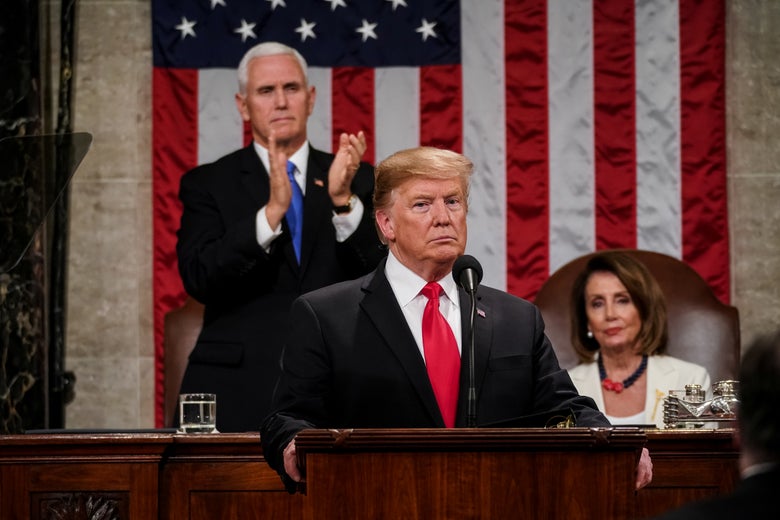
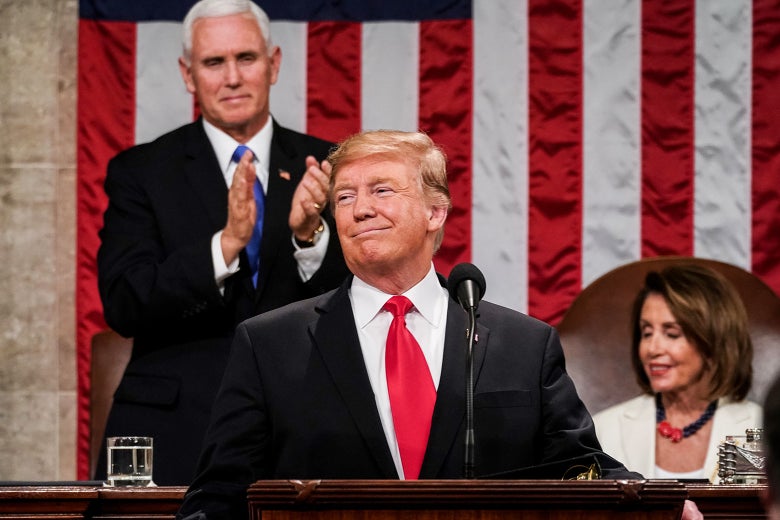
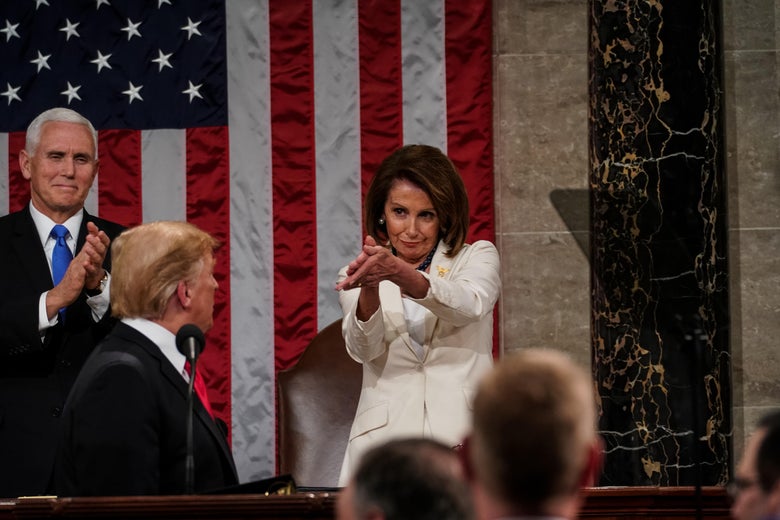
I wonder why they aren't complaining about Nancy Pelosi's behavior during the speech. It's the pictures of the Speaker, after all, that have gone viral.  This, for example:


Even Breitbart used that picture without comment on it.   And what about these?

You can say "At least she doesn't look sullen."  But she doesn't look like somebody you want to take on, either.   Maybe it's because Trump calls her "Nancy."  Or maybe it's because they don't want to mess with her anymore than Trump does.


"How Would You Spend Them?"


This started here, if you're interested in the context.  I decided to post all 25 tweets because the substance of this issue (border security) is so rarely discussed, and because the nature and definition of that idea of security, as well as of the reality of border, is, as Crenshaw's tweets proved, so often dismissed in favor of ignorant sloganeering.  The tweets, for the most part, speak for themselves; although they break into two segments by the author herself.  In the first segment she lays out her credentials (challenged by Crenshaw) and asks the basic question of government:  why should we spend public monies this way?, a question largely ignored in this discussion.  In the second part Ms. Kayyem argues the fundamental issues of how a policy is proposed, defended, and agreed on; matters, again, largely ignored in the national discourse that wants to resolve the issue into the stubbornness of children on one side or the other.  This struggle is about how government should function and why it should function that way; it is not about who wins and who loses and the next election cycle.


And then the discussion of policy and security and even how government should function, was re-engaged. Note especially in this second part of the discussion the concept of a "single point of failure".


This is the way a discussion of government policy and, perhaps more important, government spending should proceed.  The discussion of the wall has never advanced beyond bad slogans ("Build the wall and crime will fall!", which even Trump has abandoned) and posturing presented as moral positioning:

“I never think it’s a mistake to stand up for what you believe in,” [Vice President] Pence said, “and I think what the American people admire most about this president is he says what he means and he means what he says in a very real sense.”

“He said there’s a crisis at our southern border,” Pence added. “He said he was determined to get the funding to build a wall and secure our border, and he was willing to take a stand to accomplish that.”

Well, until he folded like a tent without a tent pole.

Ms. Kayyem presents the facts and reasons which should be the basis for any argument for or against a proposed government policy and related expenditures.  There was an argument during the last shutdown to "just give him the money!", as if that's the way government should function.  I'm quite sure government funding is seldom really treated as "real money," but that's no excuse for letting this bedrock principle of governance be run over roughshod for such a silly and indefensible reason.  If Trump is doing all of this simply to assure his base he will keep his campaign promises, we need to reconsider his legitimacy as President, because he is not presenting even the fig leaf to cover his ignorance of how government works.  Imagine a CEO making this kind of presentation for the use of corporate funds:  do it because I said so and I promise to do it if I became CEO!  Is that a good reason to spend the money, to pursue the project?  Is that any way to run a business?  And yet we were told a businessman would run government far better than a politician will.  Is this better?  Is this sensible?  Or is it merely mob rule, the President responding to his "base," a minority of voters who base their opinions on ignorance and xenophobia and racism?

It's at this point I have to point out Rep. Will Hurd actually knows about life on the Texas border, where Rep. Dan Crenshaw is a newly minted representative from a suburban district in Houston, Texas.  Houston is, to its shame, a major center of human trafficking, but that's not because Houston is on the Mexican border or indeed anywhere near it.  It's because Houston is a major air travel hub and a port city, two conditions a border wall won't affect in the least; and the issue of human trafficking through Houston should be Rep. Crenshaw's concern.  His district doesn't touch on the Texas-Mexico border, and his knowledge of it from one Jeep ride with a Border Patrol Agent does not make him more knowledgeable than Rep. Hurd or Ms. Kayyem.  So far as I know, he didn't respond to her argument on Twitter.  That her argument has to be made on Twitter, and that it sounds so rational among the news reports about immigrants and "security" and borders, that it proves the paucity of our national discussion and the emptiness of so many politician's words, is perhaps the strongest indictment of our media and our systems of governance.

We can only keep it, if we insist it be run properly.  This is not an utter failure of government; but it's pretty goddamned close.

Gettin' All Righteous Up In Here

It must be the long span between Christmas and Lent this year; Epiphany is leaving me too much time on my hands.  But I was reflecting on Trump's appeal to evangelicals, and to the famous words of Micah:

Hear what the LORD says: Rise, plead your case before the mountains, and let the hills hear your voice. Hear, you mountains, the controversy of the LORD, and you enduring foundations of the earth; for the LORD has a controversy with his people, and he will contend with Israel. "0 my people, what have I done to you? In what have I wearied you? Answer me! For I brought you up from the land of Egypt, and redeemed you from the house of slavery; and I sent before you Moses, Aaron, and Miriam. 0 my people, remember now what King Balak of Moab devised, what Balaam son of Beor answered him, and what happened from Shittim to Gilgal, that you may know the saving acts of the LORD." "With what shall I come before the LORD, and bow myself before God on high? Shall I come before him with burnt offerings, with calves a year old? Will the LORD be pleased with thousands of rams, with ten thousands of rivers of oil? Shall I give my firstborn for my transgression, the fruit of my body for the sin of my soul?" He has told you, O mortal, what is good; and what does the LORD require of you but to do justice, and to love kindness, and to walk humbly with your God?

Micah 6:1-8

I could have just cut to v. 8, the most famous verse from Micah; but I like putting these things in context, even if I don't want to address the context.  What I want to address is v. 8; but it comes in the context of what is important to the God of Abraham, and what is important is not the sacrifices humans are so eager to make.  Sacrifices they are eager about because those sacrifices so often involve sacrifice by something else, actions that are repeatable but not really functional, that don't involve other people, and certainly don't involve treating other people, all people, as people.  Notice the order of the litany in v. 8, where this discussion about God and relationship and sacrifice culminates..  I was going to point out none of these three applies to Trump, or to Jerry Falwell's son's public actions, or those of Bill Graham's son, or Robert Jeffress in Dallas, and on and on.  Seat myself comfortably on the throne of judgment, in other words; but then I would be judged, too.  So just pay attention to the order of the litany.  What comes first?

Justice.

There is so much encompassed in that word I almost don't know where to start; but justice begins with what is what is done in the name of consideration of the Other, not in consideration of you.  I had a friend who had been a legal secretary to a criminal lawyer before I met and worked with her, and she said the lawyer often returned from the courthouse and, if his client had been convicted, declared that "Justice was done!"  Not because he believed his clients guilty, but because that is the system of justice, that is pretty much what we call "justice".  I represented many clients who thought justice meant they would win.  Donald Trump's insistence that a deal mean he wins, is not that extraordinary, except in such a high office and place of such responsibility.  Justice begins with not being about you and what you think is in your best interests.  That's a good starting point, so let's leave it there and move on to the next admonition.

Mercy.

Mercy is also not about you.  Showing mercy can be the hardest thing you do, because who knows if the person you show it to deserves mercy?  I had a friend the other day approached on the street by a young girl, a teenaged girl, who seemed visibly upset and tearfully spun a tale of woe, of living on the streets and needing some money just for food.  Was it a lie?  Was she, quite credibly possible in this, one of the centers of human trafficking, being forced to beg by her captor, who was watching nearby?  Would mercy benefit her, feed a pernicious addiction, go in someone else's pocket and further her slavery?  Would mercy be shown to a con artist?  To a victim? All of which raises the fundamental question of mercy:  when is mercy about the other person, and not about you?  How much are you your brother's/sister's keeper?  Mercy, it turns out, is as simple and easy and clear cut as justice.  Yet what society are we without both?  We pay lip service to both ideals; but what would our society look like if we instantiated them, made them the bedrock of our law and our public morals and our common dealings?  What then?  What if we lived our lives as if they were about other people, and not about us?  Would we be more merciful and just?  Would we be any less so?

Walking humbly with God.

Finally, a mention of the God of Abraham; and what is the mention?  It is not aimed at some requirement God has to be worshipped and adored, or even to have as many companions as possible. It is still aimed at you, and now it is about humility.  Then again, what true justice and what true mercy is there, without humility?  The arrogant man is not just, he is preening in his power to punish or bless.  The calculating man is not merciful, he is gauging the value of his ability to dispense gifts.  We don't have to set aside God to ask:  what would our society look like if we followed this litany?  If we did justice, loved mercy, and walked humbly with God, whom Jesus identifies as the least and last among us (so no metaphysics required, if you don't want them), what then?

For one thing, we'd have to leave the evangelicals to explain their business, without us clambering into the judgement seat.

The Times They Are A'Changin'

Tuesday, February 05, 2019

The State of the Union

He shall from time to time give to the Congress information of the state of the union, and recommend to their consideration such measures as he shall judge necessary and expedient; 
Art. II, Sec. 3, U.S Constitution

This "report" is included in the Constitution to remind the President that he reports to Congress on a regular basis.  In the era of the Imperial Presidency, it has become a grand-standing event.  In the Age of Trump, it has become all about the pictures.  Donald Trump was forced to back down when Speaker Pelosi told him the invitation was suspended until after the government shutdown (which he ended, because he began it) was ended.  Trump wanted the pomp and ceremony of speaking to a joint Session of Congress from the well of the House so badly he could taste it, and when he got the chance, he tried to get back a little of his own:

“We should point out, if the speech started abruptly — especially to fans of history watching at home — she was supposed to introduce the president,” Brian Williams reminded.

“The language we’ve become used to, ‘the distinct pleasure and high honor,’ followed by a volley of cursory applause, but the president jumped in before the speaker could introduce the president,” he explained.
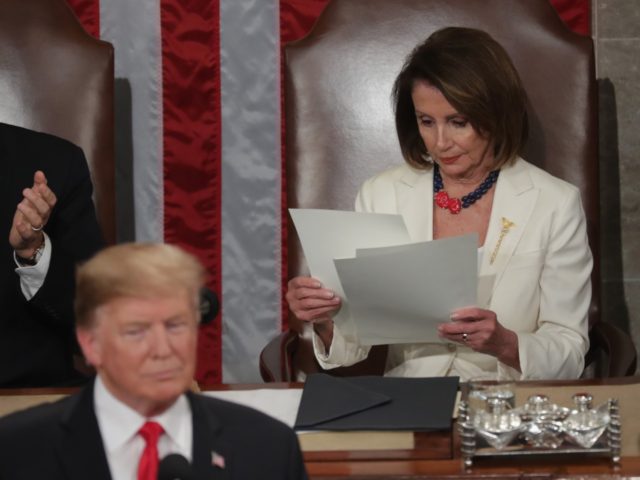
If you're explaining, you're losing.  Besides, a picture is worth a thousand words:


Dan Rather is right; no one is going to remember this speech.  That picture, however, is eternal.  As well as a good reminder of what the SOTU is about.

Doomed to Repeat It


If we were in France, we might be hearing the sound of tumbrels.  And a silence nobody seems to be noticing (which puts us all in the same class with Trump):


As Close As I Plan to Get To The SOTU


Or before....

Adding:  I am truly thankful for books and Netflix.

A pox on all their houses.

Monday, February 04, 2019

We Are All Procedural and Legal Experts Now


I read Twitter so you don't have to:


The basic idea here is:  if Trump uses the National Emergencies Act to declare himself king and announce an emergency on the Mexican border, the House can pass a resolution cancelling the emergency which the Senate would then take up.  But would the Senate have to take it up?
Alternatively, will Trump just shut down the government again?
So the options are:  1) stop this nonsense.  2) shutdown the government again, which worked so well the last time.  3) declare an emergency, but do not pass "Go" and do not collect $200, but instead wind up on the wrong side of a court injunction and face open fracturing of the Senate (which might not override the veto, but the damage would be done before that).

Helluva way to run a railroad.

Where Angels Fear to Tread


First, this stuff looks dreadful.  Were it offered to me at a Super Bowl party (or anywhere else, for that matter), I would politely pass it by.

It gets worse when you know what's in it.


But the dumb part of this Vox article is assuming "queso" is some kind of "Latin" dish that only "Latinos" can make, or comment on.  Puh-leeze.

I have a recipe book full of queso recipes put together by a Texas expatriate who, from her pictures on her cookbooks (I have three of them), is as white as a white girl can be.  Her queso book includes recipes from as far "north" as Austin (she may have one from Dallas) and as far "south" as the Border.  Most are from Texas, and most are from restaurants large and small, renowned and unknown.  The variety of ingredients is impressive, the variety of styles is remarkable, but one simple truth abounds:  cheese melted together with hot peppers is not "Latin" or "Mexican" or even "Central American."  It's cheese dip.

Maybe it's called "queso" because it's spicy, and spicy means "Mexican" (except in southern Louisiana, but I don't know of any cheese dip associated with Cajun or even Creole cuisine).  We're actually into treacherous territory here.  I got a sample magazine from Christopher Kimball, the whitest male associated with food that I know of, and he acknowledged in its pages that his idea of cuisine was Vermont-centric and therefore Euro-centric, and what he had learned in his new venture ("Milk Street") is that we should no longer speak of "ethnic food," because the term is condescending and parochial.  "Ethnic food" in Asia, after all, would be hamburgers and french fries and Cokes, and while I might not see the appeal of a hamburger colored with squid ink, I'd never say the Asians should leave that dish to the "whites."  And saying "I made queso" is actually closer to saying "I made cerveza" than it is to saying "I made a casserole" (which should have cream of mushroom soup in it.  In fact, that's the only use of cream of mushroom soup I would countenace.  YMMV.).  At least in direct translation it is. This turns into a minefield once we start an argument about who is, and who is not, qualified to present a recipe on-line.

So let's get back to queso.  There's nothing really "Latin" about melting Velveeta and adding a can of Ro-Tel tomatoes to it, although it is delicious.  I have queso recipes that use Cheddar cheese, and one (at least) that uses Muenster and (IIRC) sour cream.  The varieties of ingredients in "good" queso can be quite surprising, and some would seem very "white" indeed (barbecue!).  Queso is a bit like chili:  some recipes are simple and basic (and usually the best), some include so much it stops being chili (at least by Texas standards).  Is chili "Latin"?  Can we even take that question seriously?  Making the cheese dip of my childhood (and adulthood; I have some in the fridge at home I'll be heating up this afternoon) into something only Latinos can write tweets about is...well, it's condescending and just a bit too precious.

And really, to her credit, Dana Perino noted the Vox article:


She gets a lot of credit for being such a good sport about this, especially on Twitter.  Vox, on the other hand, really needs to adjust their spectacles on how they view food and who can contribute a recipe about it.

We're all eating at the same table, ya know.  At least, we should be.

Sunday, February 03, 2019

1 dimensional criminals are so single-minded


2 dimensional criminals are hard to see when they turn sideways.

4 dimensional criminals are really hard to grasp.

In other important news:

Did they draw little hearts and smiley-faces on each other's score cards?

What the schedules show: Trump, an early riser, usually spends the first 5 hours of the day in Executive Time. Each day's schedule places Trump in "Location: Oval Office" from 8 to 11 a.m.

But Trump, who often wakes before 6 a.m., is never in the Oval during those hours, according to six sources with direct knowledge.

Instead, he spends his mornings in the residence, watching TV, reading the papers, and responding to what he sees and reads by phoning aides, members of Congress, friends, administration officials and informal advisers.
Since Nov. 7, the day after the midterm elections, Trump has spent around 297 hours in Executive Time, according to the 51 private schedules we've obtained.

For those same schedules, Trump has had about 77 hours scheduled for meetings that include policy planning, legislative strategy and video recordings.

The most important asset in any presidency is the president's time," [Chris] Whipple said. "And Trump is a guy who gives new meaning to the notion of an unstructured presidency."

Gross Incompetence Or High Treason?

What's the difference?

Of Pots And Kettles

Actually, he pretty much has:
The picture plays second fiddle to the  proposed abortion law. Only in the next tweet does it become "terrible," but the racism issue goes unmentioned except for how it would have cost Northam the election.

Would have been much worse if it didn't matter, right?

Oh, and the real reason for the second tweet:
Nothing the man speaks of isn't about him.

Ariel Poems: Epiphany 2018


There are several attitudes towards Christmas,
Some of which we may disregard:
The social, the torpid, the patently commercial,
The rowdy (the pubs being open till midnight),
And the childish – which is not that of the child
For whom the candle is a star, and the gilded angel
Spreading its wings at the summit of the tree
Is not only a decoration, but an angel.
The child wonders at the Christmas Tree:
Let him continue in the spirit of wonder
At the Feast as an event not accepted as a pretext;
So that the glittering rapture, the amazement
Of the first-remembered Christmas Tree,
So that the surprises, delight in new possessions
(Each one with its peculiar and exciting smell),
The expectation of the goose or turkey
And the expected awe on its appearance,
So that the reverence and the gaiety
May not be forgotten in later experience,
In the bored habituation, the fatigue, the tedium,
The awareness of death, the consciousness of failure,
Or the piety of the convert
Which may be tainted with a self-conceit
Displeasing to God and disrespectful to the children
(And here I remember also with gratitude
St. Lucy, her carol, and her crown of fire):
So that before the end, the eightieth Christmas
(By “eightieth” meaning whichever is the last)
The accumulated memories of annual emotion
May be concentrated into a great joy
Which shall be also a great fear, as on the occasion
When fear came upon every soul:
Because the beginning shall remind us of the end
And the first coming of the second coming.

--T.S. Eliot

The late addition to the "Ariel" poems.

Saturday, February 02, 2019

Digging In


TC says things like this all the time:

Anyone who would choose the banal, historically inaccurate and dishonest propaganda of The Freedom From Religion Foundation over Walter Brueggemann's  radical alternative to even that adjunct of the market totalism is too stupid to argue with. 

No, not the part about Ron Reagan, Jr.; the part about Walter Brueggemann.  In fact, if Brueggemann were a public office holder, not an otherwise obscure Biblical scholar (not obscure in his field, but not well known beyond it), I wonder if he's be subject to a "fact check" for his ideas:

I think I'll either find where this talk is published as text or transcribe it over the next month in lieu of reposting my series on the history of abolitionism from several years ago.  This talk is all about how we are enslaved even as slavery is abolished, especially those who were alleged to be emancipated.  

That description puts Brueggemann miles beyond what AOC (I'm lazy, sue me) said in an interview on MLK Day this year:

But I do think a system that allows billionaires to exist when there are parts of Alabama where people are still getting ringworm because they don’t have access to public health is wrong. And I think it’s wrong that [1] a vast majority of the country doesn’t make a living wage, I think it’s wrong that [2] you can work 100 hours and not feed your kids. I think it’s wrong that [3] corporations like Walmart and Amazon can get paid by the government, essentially experience a wealth transfer from the public, [4] for paying people less than a minimum wage. And it not only doesn’t make economic sense, but it doesn’t make moral sense and it doesn’t make societal sense.
I don't think Brueggemann would argue with her; I know I don't.  I bring this up because it prompted a "fact check" from Glenn Kessler at WaPo where he awarded AOC 3 "Pinocchios" for having the temerity to make an economic argument that didn't praise capitalism in all its rapaciousness.  Yeah, IMHO; but I think this, the heart of the analysis I recommend you read, is accurate to a pinpoint:

So, read in context, everything AOC said was true, even if we accept Kessler’s factual counterclaims! The entire fact-checking ritual was a charade. As I suggested earlier, it was really a boundary-policing episode, meant to keep her “radical” ideas outside the sphere of legitimate debate by portraying her as untrustworthy. Further, it was meant to deter others from similar infractions while trying to break through the barriers excluding them from legitimacy. (See AOC’s related Twitter thread on “gravitas” here.)
Fact-checking is a way of excluding from the conversation ideas the "mainstream" doesn't like.  Such exclusion doesn't mean excluded ideas are sound (racism is rightly excluded, for example); but it does mean only certain ideas merit attention or study, while others don't.  I can agree that Marx was a lousy economist (and historian; but I blame Hegel and the 19th century for that; it's a long discussion); but I can't reach that conclusion without at least reading Marx (something that was considered heresy in my childhood; we were to take Marx as "wrong" and be done with him).  Maybe AOC is as wrong, too (no, I don't think so, but the argument has to be considered).  How do I know until I test her arguments, and the best way to do that is to consider that her arguments may be right, and mine may be wrong.

It takes a bit of effort to learn to do this, but it's worth the price of admission.

It wasn't so long ago that capitalism was not the be all and end all of human existence; partly the withering away of the church as a place where you might get a counter-narrative (it's certainly in the Scriptures, even if most denominations hide from it) is the reason for its supremacy today.  The meanness of spirit, the withering of generosity, the narrowness of vision, are all hallmarks of a generally accepted philosophy that scarcity is the rule and want is the demon, and we must hold tightly to what we have and protect it against all takers who would rob us of our futures, if not our present.  That's the fear I detect in Kessler's analysis of AOC's observations (and the article at the link is right, too, about the radical MLK which we prefer to replace with the anodyne version who basically only "had a dream"); the fear that the future is arriving behind her, and is going to snatch away all the comforts he has.  The theology of scarcity, Brueggemann calls it; the idea that everything is limited and must be hoarded because the future that faces us is as grim and despairing as any apocalyptic cinema vision of the ruin that awaits us all, that we can at best postpone but can never avoid.

There's a reason apocalyptic movies and video games are still so popular; or at least visions of a doomed future our heroes might be able to prevent before the final credits, still creates the rising action in so many films and games.  More and more we believe there is less and less available, and our doom is certain and unshakeable; whether we have brought it on ourselves or it will be brought upon us, is irrelevant to the analysis, to the fear.  We must be afraid but we must be more afraid of those who would show us a different, a better path, because while this path is doomed, all other paths lead to damnation.  AOC, in the spirit of Dr. King, is saying it doesn't have to be this way, it can be better; Kessler, in the spirit of those who reviled Dr. King (and they were legion; ah yes, I remember it well), says it can only be "this way," and AOC is not only a fool but a dangerous one.

While, as the article points out, Donald Trump crosses the threshold of 8000 established lies since he took office, and that number, as this week's events proved, is only going up ever more sharply.  But Trump is just a bull in a china shop; AOC is the threat to the existence of the china shop; apparently.  And the first step, the one we've taken most successfully, is to erase history (it is no accident the Hebrew Scriptures are dominated by a recording of Israel's history, and why the God of Abraham is present and active in history):

Dell Technologies CEO Michael Dell laughed at the idea [of a 70% tax rate, as proposed by AOC], and said he thought it would be bad for economic growth. “Name a country where that’s worked,” he responded. “Ever.” Sitting there with him was MIT economist Erik Brynjolfsson, who supplied the example: the United States, throughout most of its post-World War II expansion. It was a rare, Marshall McLuhan-in-“Annie Hall” moment. Usually, when the super-rich or their sycophants spout off like that, truth does not intrude. Certainly not from the fact-checking media.
Dell is much younger than me, and obviously much more ignorant of history.  What does he need to know, except that his skill and genius made him rich?  They didn't, of course; in a country with no access to the markets, infrastructure, industrialization, established social order, and educated at public expense work force, Michael Dell would likely be an unknown citizen.  That's another leg of the theology of scarcity:  I alone can do it, when in reality, as Donne said, "no man is an island."  It's not just that the funeral bell tolls for thee, but that apart from each other we are each one nothing.  Donne refused to imagine such a society; we refuse to imagine it any other way.  Who is the richer for our radically different visions of community?

And consider this "crazy idea" from George Soros, the man you've heard about yet likely never heard from:

For the last 25 years … the motor of the world economy that has been driving it was consumption by the American consumer, who has been spending more than he has been saving, all right? Than he’s been producing. So that motor is now switched off. It’s finished. … You need a new motor. And we have a big problem. Global warming. It requires big investment. And that could be the motor of the world economy in the years to come.
Has the motor been switched off, and only momentum gives us the impression we are still being powered?  That's the lesson, and the fear, of apocalyptic:  that we've run out, scarcity is upon us, and before us lie deserts of vast eternity; vast, and empty, and lifeless.  There they are, and there's nothing we can do about it; or there is, and it's more of the same that got us here.

What's the definition of insanity?

Fact checkers will not save us from ourselves, nor protect us from reality.  The bird in Eliot's poem was right:  humankind cannot bear very much reality.  But we are still obligated to come up with ways to do so, rather than spend ever more energy finding ways to refuse it.


Candlemas 2019

Νϋν άπολύεις τον δοϋλον σου, δέσποτα,
κατά τό πήμά έν είρήνη
οτι είδον οί όφθαλμοί μου τό σωτήριόν σου
ό ήτοίμασας κατά πρόσωπον πάντων τώυ λαϖν
φϖς είς άποκάλυψιν έθνϖν
καί δόξα νλαοϋ σου ‘Ισραήλ

Ceremony upon Candlemas Eve--Robert Herrick

Down with the rosemary, and so
Down with the bays and mistletoe;
Down with the holly, ivy, all
Wherewith ye dressed the Christmas hall;
That so the superstitious find
No one least branch left behind;
For look, how many leaves there be
Neglected there, maids, trust to me,
So many goblins you shall see.


At Candlemas--Charles Causley

'If Candlemas be fine and clear
There'll be two winters in that year';

But all the day the drumming sun
Brazened it out that spring had come,

And the tall elder on the scene
Unfolded the first leaves of green.

But when another morning came
With frost, as Candlemas with flame,
The sky was steel, there was no sun,
The elder leaves were dead and gone.

Out of a cold and crusted eye
The stiff pond stared up at the sky,

And on the scarcely breathing earth
A killing wind fell from the north,

But still within the elder tree
The strong sap rose, though none could see.


The Gospel according to St. Luke, Chapter 2

22 And when the days of her purification according to the law of Moses were accomplished, they brought him to Jerusalem, to present him to the Lord;

23 (As it is written in the law of the LORD, Every male that openeth the womb shall be called holy to the Lord;)

24 And to offer a sacrifice according to that which is said in the law of the Lord, A pair of turtledoves, or two young pigeons.

25 And, behold, there was a man in Jerusalem, whose name was Simeon; and the same man was just and devout, waiting for the consolation of Israel: and the Holy Ghost was upon him.

26 And it was revealed unto him by the Holy Ghost, that he should not see death, before he had seen the Lord's Christ.

27 And he came by the Spirit into the temple: and when the parents brought in the child Jesus, to do for him after the custom of the law,

28 Then took he him up in his arms, and blessed God, and said,

29 Lord, now lettest thou thy servant depart in peace, according to thy word:

30 For mine eyes have seen thy salvation,

31 Which thou hast prepared before the face of all people;

32 A light to lighten the Gentiles, and the glory of thy people Israel.

33 And Joseph and his mother marvelled at those things which were spoken of him.

34 And Simeon blessed them, and said unto Mary his mother, Behold, this child is set for the fall and rising again of many in Israel; and for a sign which shall be spoken against;

35 (Yea, a sword shall pierce through thy own soul also,) that the thoughts of many hearts may be revealed.

36 And there was one Anna, a prophetess, the daughter of Phanuel, of the tribe of Aser: she was of a great age, and had lived with an husband seven years from her virginity;

37 And she was a widow of about fourscore and four years, which departed not from the temple, but served God with fastings and prayers night and day.

38 And she coming in that instant gave thanks likewise unto the Lord, and spake of him to all them that looked for redemption in Jerusalem.

39 And when they had performed all things according to the law of the Lord, they returned into Galilee, to their own city Nazareth.

40 And the child grew, and waxed strong in spirit, filled with wisdom: and the grace of God was upon him.

The date for Candlemas does not come from "pagan" Irish holidays, but from Mosaic law (Leviticus 12:2-8). As New Advent notes, the earliest attestation to any observation of the day is in the Jerusalem church, where the event was observed on February 14th, meaning Christ's birthday was, as at least one version of The Cherry Tree Carol has it, on Epiphany, not December 25th. (Interestingly, that carol has roots in Pseudo-Matthew, where it's a palm tree, not a cherry tree (of course), something I didn't know, but suspected. Chapter 20, if you're wondering. Interesting how these "apocryphal" stories persist, isn't it?)

Anyway, the folklore connected with this day is that now, finally, Christmas is over, because the last public act of Christ the child is conducted.   The Christmas celebration ends with the άποκάλυψιν, the apocalypse, again. What Simeon sings is that this child, presented at the Temple, will be a revelation, an "apocalypse," to the έθνϖν, the "ethnown," the Gentiles. People like Luke. People like most of us. Lord, now let us depart in peace.

 
Rain and grey clouds and falling temperatures here on the Third Coast. (The pagan connection is that this day, midway between winter solstice and spring equinox, marks the start of spring.) No unfolding first leaves of green. I was taught by a farmer's daughter (watch it! She was my mother's age when I met her) that winter isn't over here until the pecan trees start to bud, so I wait patiently; and, as ever, hope only to depart in peace.

Friday, February 01, 2019

Only Connect

The Washington Examiner notes:

House Speaker Nancy Pelosi could move to block President Trump from invoking a national emergency to build a border wall, forcing Senate Republicans to choose between preserving congressional power and crossing the White House.

The California Democrat, under a seldom-used statute, could put a binding “resolution of disapproval” on the House floor to counter Trump should he claim constitutional powers to unilaterally build a border wall. The president is threatening action if Congress refuses his demand for $5.7 billion in border wall funding. Friday, Trump expressed skepticism that a bipartisan commission seeking a deal on the wall to avoid another government shutdown would succeed, saying there was a "good chance" he would declare an emergency.

The lawmakers are desperate to avoid another standoff over immigration and are worried about political anger and even retribution from the pro-Trump base. Yet they are wary of endorsing an unprecedented expansion of presidential emergency powers. Some fear the powers, once in a Democratic president's hands, could be used to justify all sorts of progressive priorities.

The resolution would almost assuredly pass the Democratic House. Then, in a quirk of the law — the Congressional Review Act — Senate Majority Leader Mitch McConnell, R-Ky., would essentially be forced to hold a floor vote, with only a simple majority required for passage rather than the customary 60 votes.

Mitch McConnell thinks it would pass the Senate, too:

At least a half-dozen Republican senators are fiercely opposed to the idea of an emergency declaration, generating enough opposition that a disapproval resolution could pass the Senate,” the report says.
So does the Majority Whip in the Senate:

“We have a lot of folks who are uncomfortable with [an emergency declaration] for different reasons, some of which are constitutional and separation of powers,” Senate Majority Whip John Thune, R-S.D., said Thursday. “We prefer that not be the direction that the administration chooses to go. But the Democrats have to be willing to play ball here if we’re going to get a deal.”

Thune is not ruling out that several Senate Republicans could join with the Democrats to block Trump from declaring an emergency. A second Republican senator, speaking on condition of anonymity, predicted the president would suffer major defections if a vote on a resolution of disapproval is held.

And he wants to strike a "defiant tone" at the State of the Union.  As I've said, Trump's presidency is over.  All that's left now is the funeral.  He's a lame duck from here on.

History Lessons

You'll just make things worse...

In 1949 the state of Texas implemented the school system the state has functioned under ever since.  It gave school districts the power to raise local taxes to support themselves, and established state funding of 75% state funds to 25% local funds.  70 years later that formula has flipped:  the state provides roughly 32% of funding to schools, the schools have to raise the other 68% themselves.  What schools are required to do, from students it must educate (special needs) to tests it must administer (statewide testing) add to the financial burden without adding money to relieve that burden.

Hang on to this factoid, we'll return to it in a moment.

Several years ago I was involved in a traffic accident; I pulled out of a parking lot onto the street and was struck by an oncoming car, one I couldn't see because of traffic.  When a tow truck showed up, I told the driver to pull my car out of the road into the parking lot.  The attorney for the other driver was there and objected, claiming I had to wait for the police to arrive and write out an accident report.  Now, I was reading those reports and the diagrams of the accident police used to make before this attorney was born (she was quite young), and I also knew the law had changed, certainly before she entered law school if not before her birth, to "no fault," so the police would not be making the detailed report that was once common.  I knew the best thing to do was to clear the road, and get a police report for my insurance purposes.  I knew that because I'm a lawyer, too, and I know that area of the law.  I was quite sure she didn't, but she "knew" what the law was; even though it hadn't been the law for probably as long as she'd been alive.

Don't go away, we're getting there.

In the 1980's the State of Texas was sued, and the Texas Supreme Court ruled that the funding mechanism for education, much tinkered with since 1949, was unconstitutional under the State Constitution.  The legislative remedy was to apply a new system atop the old (rather than remove the old and replace it root and branch, as had been done in 1949), a system whereby "property rich" districts would pay a portion of their tax revenues to the state, which would distribute those monies to "poor" districts and thus make the entire funding system "equitable."  There was much fanfare over this, so much that I knew about it even though I'd left the state by the time the laws were finally passed.  But most people in Texas seemed blissfully ignorant of this sea change.

The school districts weren't, however; but the smaller districts in the large urban areas (there are 5 such districts in the Houston Metro area, most of which barely rate a blip even on otherwise excellent local news coverage on the local NPR station, to this day) were hit first and hardest, being 'property rich' according to the formula, and therefore most able to pay.  The scheme is still called "Robin Hood" for obvious reasons.  Smaller districts went through multiple years of layoffs, and even when it hit the classrooms, the parents and taxpayers didn't seem to much notice.  Then Houston Independent School District (HISD), the largest single district in the state, became a "property rich" district, and suddenly everybody was aware of how public schools were being funded; or, more accurately, defunded.

Part of that awareness led to a new lawsuit against the state, this time by the school districts (the first was by parents stuck in a substandard school system by state laws).  To understand that you need to understand something else as much part of the common knowledge of Texans once upon a time as the need to get an accident report complete with pictures of the wreck, to determine fault in court.  That piece of knowledge is that Texas, by our state constitution, doesn't allow a statewide property tax.  Counties and cities and school districts and other specified entities (there are about half a dozen in Harris County, where Houston is located) can assess property taxes; the state cannot.  This was a rallying cry in Texas politics in my youth; it's where I first learned about it.  So a statewide property tax to fund schools (an income tax, which would solve the problem, is tantamount to declaring the state religion to now be Satanism) is verboten.

And that was the argument against Robin Hood, because the handful of people aware of the law assumed the money going from one school district was sent directly to another; but that was not so.  Monies sent to Austin by the school districts "too rich" by the formula of Robin Hood went into the general fund, to be spent as the Lege decided.  The formula for funding schools from Austin, as I said earlier, flipped in 70 years; the amount of money going from ISD's to Austin, rose dramatically in about 25 years.  Money taxed to fund local schools became money spent to pay the costs of state agencies, or for any other general purpose the Lege had in mind.  Legislators in Austin knew about this; but they didn't advertise it.

School districts facing financial disaster (as HISD now is) for years from Robin Hood did all they could to inform their taxpayers; but you can lead a horse to water only.  The school districts sued to change Robin Hood, but the Texas Supreme Court, brave in the '80's when they tried to solve this problem, blinked in the 21st century, and said there was no state property tax issue involved here (even though there clearly is).  And what did the taxpayers do about this clearly constitutional crisis, this shameless and indefensible decision to not touch this hot potato or defend the plain language of our founding state legal document, this complete capitulation on a crucial issue of state governance?

Nothing.  By and large, they still don't understand it happened.  Small districts in Houston have been bled dry by Robin Hood, and are on the verge of bankruptcy from it.  The local NPR station, which prides itself on its local news coverage, has yet to report on that.  When HISD suddenly had to pay Austin, rather than just receive from it, local NPR (and the rest of the state) suddenly noticed this law was on the books.  But they still aren't reporting on the Texas Supreme Court decision, or the multiple and myriad problems with education funding in Texas.

Something is rotten in the state of the Lone Star.  But if no one talks about it, is it happening?

You can, at this point, put a lot of blame for this on the media; and I do.  But as I say, school districts have been sending out letters annually to taxpayers explaining where the money is going:  no one listened, no one cared, no one noticed.  There was a huge campaign when "no fault insurance" became the law in Texas; 40 years later, people not born when that law changed still think it's not the law yet.  School funding has gone from being a state obligation to a state burden, and yet the burdens heaped on the schools (we started the school testing craze.  Thanks, Ross Perot!, and we haven't realized the folly of it yet.) have gone up (it takes a full time staff of administrators to keep up compliance with those tests, and the bigger the district, the more people you need just to do that).  And what is the real problem?

The real problem is the responsibility of democracy.  If you don't pay close attention to what the people acting in the name of the People are doing, they will rob you blind and thank for your letting them do it.  Texas wasn't always such a benighted and backwoods realm of would-be robber barons; accepting the stupidity of the "free market" philosophy is on us.  But if we ignore what our elected officials are doing, if we assume we know the state of things when we haven't a clue what reality is and we don't want to really pay attention because, you know, we're busy!, then we have no one to blame in the end but ourselves.

Which is why, I suppose, I keep posting from Donald Trump's Twitter feed.  It's there in plain sight now.  He's trying to arrange reality so he can declare victory on a wall that is never going to exist, in a fight only he is having, and it is with himself.  It isn't gaslighting if it doesn't work to perplex the victim; it's just the rantings of a delusional man.  If that man was living under a highway overpass near me pushing a shopping cart full of crap, I would feel sorry for him, or maybe try to help him.  But that man is the President of the United States, and he's saying things so clearly at odds with reality it should make us wonder why the 25th Amendment is not being invoked, and how much more careful we really need to be next time.

And how much attention we have to pay, because Trump's victory and what power he's had, has rested largely on the fact we just assume the person saying what we agree with is the truth, without ever wondering once what the truth really is.  I dunno, maybe once the system was more adversarial or just more responsible, and the competing ideas about foreign policy at least had the core of protecting America and preserving order.  It may be the INF is a flawed treaty and the Obama administration was concerned about Russia's violations, too; but coming from the guy who thinks he convinced North Korea to give up its nukes and that the public testimony of his intelligence chiefs was misreported, I don't trust his actions now, and the Congress is too supine yet to tell him shutting down the government and declaring yourself king are both non-starters and not the way to run a government, and grounds for serious questions about the President's fitness for office.

And the rest of us seem to be interested largely in Anyone But Trump; which is not exactly the lesson we should be learning, here.

"A patch of ice doth not a winter make"

I never liked Dan Crenshaw.  I voted against him, but in the "blue wave" of last November he still managed to surf to victory (most Republicans did, sadly).  I evenresented the boost SNL gave him.  This is why:


As Raw Story pointed out, there's more than a bit of disparity here between Ms. Kayyem and Mr. Crenshaw:

Juliette Kayyem is a John F. Kennedy School of Government Harvard professor, a national security analyst for CNN, and serves on the Council on Foreign Relations. She has served on Secretary Jeh Johnson’s Homeland Security Advisory Council, and if that weren’t enough, she was the U.S. Assistant Secretary of Homeland Security for Intergovernmental Affairs.

In the 1990’s she worked at the Dept. of Justice and served as an advisor to Attorney General Janet Reno. She was appointed to the the National Commission on Terrorism, and was Massachusetts’ first Undersecretary for Homeland Security.

Kayyem has also written a book on homeland security for homeowners and was a columnist writing about national security for the Boston Globe.

Rep. Crenshaw was a Navy Seal.

Raw Story also gives you a nice sampling of the responses to Mr. Crenshaw's mansplaining.  What it won't give you is her excellent retort:

This appears to be the tweet she's referring to:


She's right; it's a fair point.  The second tweet is just childish and unbecoming an adult, much less a U.S. Representative.

Ms. Kayyem's reply is how you do it; and why I didn't vote for Dan Crenshaw.  Being a Navy Seal who can get Pete Davidson to apologize to him is not qualification for U.S. Representative.  Driving around with a Border Patrol agent does not make you an expert on the issues of a 2000 mile border that bounds 4 different states and encompasses landscapes from the Sonoran Desert to the Big Bend to the Pacific coast to the Gulf of Mexico (not to mention the people who live along it, and know it better than Crenshaw ever will).

With any luck he'll only serve two years.

Nothin' but GOOD times ahead!

What's the old joke? "The economy is creating so many jobs!" "Yeah, I have 3 of them."

The classics never go out of style. Meanwhile, the delusions are not just on Twitter any more:
Add this to the rest, and the cause for concern only increases.

Time Past Is Time Forgotten


That was then, this is now:

These days, one must run as fast as one can just to stay in one place:
Apparently the Wall is no longer an obstacle to governance.


So you see, nothing to worry about. Congress might as well get on to other work. The only thing left now is to stop calling the wall "peaches." CALL A WALL A WALL!