Monday, May 08, 2017

Oh, do shut up!

Actually, it's people who want to be protected from getting their feelings hurt.
  But a strict enforcement of blasphemy laws would outlaw seminaries....

Once upon a time, on Irish television, Stephen Fry said something that may have violated this Irish law:

36.— (1) A person who publishes or utters blasphemous matter shall be guilty of an offence and shall be liable upon conviction on indictment to a fine not exceeding €25,000.

(2) For the purposes of this section, a person publishes or utters blasphemous matter if—

(a) he or she publishes or utters matter that is grossly abusive or insulting in relation to matters held sacred by any religion, thereby causing outrage among a substantial number of the adherents of that religion, and

(b) he or she intends, by the publication or utterance of the matter concerned, to cause such outrage.

(3) It shall be a defence to proceedings for an offence under this section for the defendant to prove that a reasonable person would find genuine literary, artistic, political, scientific, or academic value in the matter to which the offence relates.

(4) In this section “ religion ” does not include an organisation or cult—

(a) the principal object of which is the making of profit, or

(b) that employs oppressive psychological manipulation—

(i) of its followers, or

(ii) for the purpose of gaining new followers.


This is what he said:

"How dare you create a world in which there is such misery? It’s not our fault? It’s not right. It’s utterly, utterly evil. Why should I respect a capricious, mean-minded, stupid god who creates a world which is so full of injustice and pain?"

He went on to say that if he was met by the Greek gods he would accept them quicker because, "they didn’t present themselves as being all seeing, all wise, all beneficent."

He added: "Because the god who created this universe, if it was created by god, is quite clearly a maniac, an utter maniac, totally selfish.

"We have to spend our lives on our knees thanking him. What kind of god would do that?"
The Irish Independent says the interview "caused a big reaction."  I don't doubt it, although it's hardly as challenging as anything I went through in seminary.  I'd say it's about on the grade school level of theodicial critique, actually.  But someone in Ireland responded with what we might call a "big reaction":

"I told the Garda I wanted to report Fry for uttering blasphemy and RTE for publishing/broadcasting it and that I believed these were criminal offences under the Defamation Act 2009.

"The garda then took a formal written statement from me in which I quoted Fry’s comments in detail. This written statement mentioned both Fry and RTÉ specifically."

He said he was asked by the garda if he had been personally offended by the programme and If he wished to include this in the written statement.

"I told the Garda that I did not want to include this as I had not personally been offended by Fry's comments - I added that I simply believed that the comments made by Fry on RTÉ were criminal blasphemy and that  I was doing my civic duty by reporting a crime."
The interview was aired in February 2015; the complaint was made in "late 2016"; the Gardai responded in 2017.  The mills of God grind slowly.  And what are the odds of prosecution?  "A well-placed source said it was 'highly unlikely' that a prosecution would take place."

So, legally, this is a nullity.  You might be surprised how many blasphemy laws are still on the books in the world; and who has them, and where they came from.  Denmark still has one, though it hasn't been enforced since 1946.  Pakistan has one, but that's a holdover from colonial times; the British were the first to impose it.  10 countries out of 35 have them in the Americas, although not in America itself.  But then the key issue is whether they are enforced, or not.

Mr. Fry probably won't be charged with blasphemy.  I'd rather see him charged with childishness.  His argument sounds a great deal like the Marcion heresy, the idea that the Creator God was a demiurge, and a greater God was the God of Jesus.  Thus was Jesus allowed to escape the problem of evil.  Fry, of course, isn't looking for an escape, so he stops with the demiurge idea.  Then he tosses in some further nonsense about God requiring our worship:  "We have to spend our lives on our knees thanking him.  What kind of god would do that?"

The kind you made up as a straw man?

I mean, there are better arguments about theodicy than this, and more intelligent challenges than this bleating. I don't wish Mr. Fry to be charged with heresy, much less tried for it, or convicted. It's pretty clear he meant to cause outrage; how else would be get any attention for his opinion?  He sounds more like a child who thinks he's being daring than a serious adult whose thought about this issue.  If it came to that he might defend himself on artistic grounds, a provision put into the law to avoid banning Ulysses again, I presume.   But if you're going to get some attention for being blasphemous, at least raise your remarks above the level of the school yard.

Can't the atheists of the world do better than have these kind of people for their standard-bearers?

Sunday, May 07, 2017

Ba-what, again?


I've noted before that science has replaced religion for many people, which is why "scientists" like Jerry Coyne and Richard Dawkins are such vocal atheists.  This is a neat representation of my point:

On his new Netflix series “Bill Nye Saves the World,” the 61-year-old “science guy” (who, while he has a degree in engineering is not an actual scientist so much as a sort of science mascot) constantly explains natural phenomena by exclaiming “It’s science!”

He does so to canned hurrahing, whoops and rounds of applause. The studio audience isn’t cheering the result of one or another experiment, or even Nye, but science itself. There’s something disturbingly anti-scientific about all this. The pop-star scientists become modern-day soothsayers. They are something to believe in. As long as we believe in them, we don’t have to do the work of science, or even understand it with any nuance. Under such conditions, science — that legendary realm of experimentation and free-thinking — becomes nothing more than another form of indoctrination. And why should we be surprised? Guys like Tyson and Nye offer the rarest, and perhaps most desirable of promises: certainty. They grant the authority and conviction that science is said to provide, wielded like a blindly bright iPhone flashlight to ward off the consuming dimness of uncertainty and unknowability.
The latter hasn't become, by the way, the realm of religion or theology by default; it has always been the realm of religion and theology.  It is the arrogance of the uninformed that turn any field of knowledge and endeavor into the only field needed, and turned nuance and complexity into a monolith of simplicity.

And the amusing thing is the responses to the article at Salon are largely the responses of acolytes manning the battlements to defend their religion, or as Semley puts it:  "the smugly scientifically-minded front-liners in baggy 'Bazinga!' t-shirts shoring up the battlements of loving science."

And they said irony is dead.

Saturday, May 06, 2017

"I can resist anything but temptation."


Trump is a disease, and it's contagious:

“That line is so indefensible,” [Rep. Raul] Labrador [R-ID] replied. “Nobody dies because they don’t have access to health care.”

He might have gotten away with "because they don't have access to health insurance;" but that's not what he said.

Just like Trump didn't say America's health care system is the worst because of Obamacare; he said Australia's health care system is better. and everbody else's is, too.  Full stop.  End of sentence.  Of course, almost every country in the industrialized world (and some not) has single-payer healthcare.

And (I shouldn't even have to say it) people do die whose only access to healthcare is the emergency room.

Strange days indeed.

Where Are the Oral Roberts of Yesteryear?

Remember this guy?  Anybody?  Anybody?

Oral Roberts crashed and burned sometime in the '80's.  I'm too lazy to look it up, but I remember when he claimed a 900 foot Jesus in a vision had commanded him to build a hospital the city of Tulsa didn't want and didn't need.  He tried to build it anyway, then when it got built tried to foist it on the city as their responsibility (i.e., buy it from him).  The city pointedly refused to bail Mr. Roberts out, and since 900 foot Jesus didn't seem to have any cash either, Oral Roberts went broke.

That's how I remember it, anyway.  The hospital didn't help his finances, and Oral tried to turn his "ministry" over to Richard, his son.  But Richard was no Joel Osteen (who among us is?); he didn't have the magic touch of Daddy (Osteen, in a rare move, exceeded his father's efforts), and the ministry struggled and died when Roberts retired.  The hospital was part of it, but not all of it.

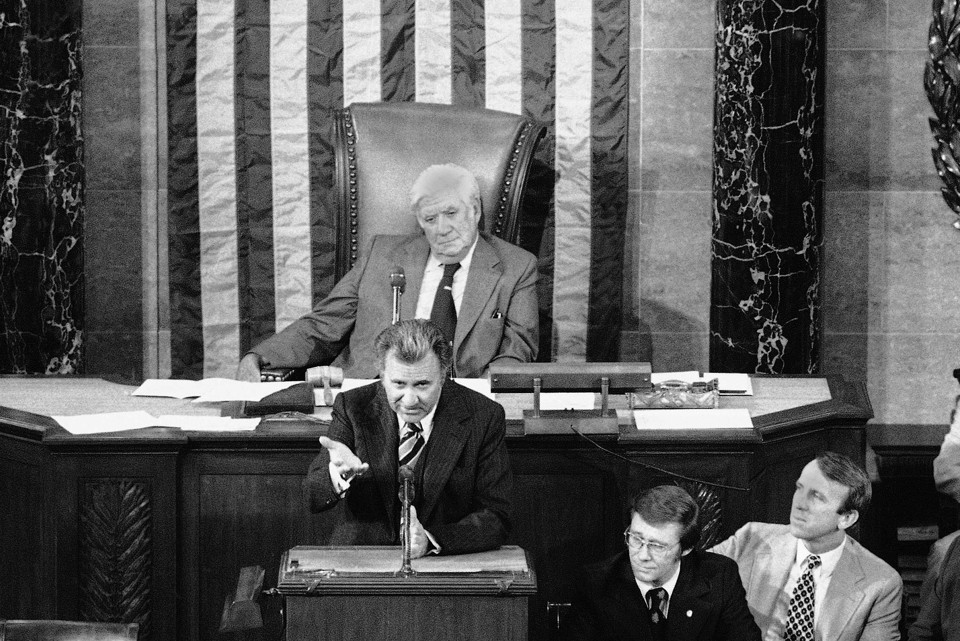
That picture is Roberts in his heyday, in 1978.  He had great sway on TV in those days, but not in the halls of Congress.  Tip O'Neill seems especially bored.  Roberts was a cartoon figure, a living stereotype of the religious huckster.  But, in the way of culture, what started in the '70's with cable TV (where the "TV evangelists" took flight from being local figures to national ones) finally created a wave that is just now cresting in Washington, D.C.

“[The plan] will allow insurance companies to require people who have higher health care costs to contribute more to the insurance pool,” Brooks claimed. “That helps offset all these costs, thereby reducing the cost to those people who lead good lives, they’re healthy, they’ve done the things to keep their bodies healthy. And right now, those are the people—who’ve done things the right way—that are seeing their costs skyrocketing.”
This is not at all a new attitude in human society, and it doesn't stem back only so far as Oral Roberts or even Carnegie's Gospel of Wealth (which, ironically, argued that the wealthy had a social obligation to use their money for the good of mankind, somewhat like the lesson Marley teaches Scrooge.  The more current version of that gospel is that I alone am worthy to be rich.).  Jesus tells the story in Luke of Lazarus and the rich man, making it clear the latter's wealth didn't earn him a place in heaven, and indeed his neglect of Lazarus the beggar earns him a place in hell.  Not a parable Joel Osteen preaches too often, I'll warrant.  And of course, there is the question the disciples ask Jesus in the Gospel of John:  "Who sinned, that this man was born blind?"

The counter to Rep. Brooks' statement is supposed to be Jimmy Kimmel's story of his new born son with congenital heart defects; how can you blame a child for the circumstances of his birth?  Rep. Brooks would, if he were being honest; he'd blame the parents, if only for their moral turpitude and not just for any healthcare choices they had made.

Like the poor, this attitude of merit has always been with us.

Who sinned, that this man was born selfish and ignorant?  Funny, nobody ever asks that question.  It's the wrong question, too, for the same reasons.  But health is something we can't really control.  Some people never smoke, and die of lung cancer.  My father smoked like a chimney.  I can remember a layer of smoke in our house, right about at the level of my young nose.  It was a constant haze, and nobody thought anything of it.  He lived to be 90, and didn't die of lung cancer or suffer any serious respiratory problems.  He had heart problems, but that didn't kill him, either.  OTOH, I had asthma as a child, and have suffered on and off with respiratory problems related to allergies.

Who sinned, that I was born this way?

Cancer is more likely to be environmentally caused than by any other factor.  Do children make bad choices by being born to parents who smoke?  Do people make bad choices by being poor and forced to live in areas where they are exposed to carcinogens at a higher rate than the wealthy like Rep. Dr. Brooks?

It's an obscenity to even suggest such a thing; but it's an attitude as old as human society itself.  We repress it, but it comes back around again.  "Ideas are bulletproof."  They are also immortal.

If we ask "What is church for?", in part it exists precisely to counter ideas like that.  It exists to preach the gospel, and the primary lesson of the gospel is humility.  Granted, that's not a terribly attractive kerygma, but it is humility that leads away from the "gospel of wealth" and toward the "gospel of meaning."  And I truly think, if you don't start there, you don't ever get there.

Friday, May 05, 2017

I left the computer on


and made the mistake of checking Trump's twitter feed:


Like the fake news that you really need to watch "Schoolhouse Rock" again?  Maybe several times?


Well, if you ignore the last 90 months:

CHAMBERLAIN: Yeah. And this is a continuation of this strong, slow, growing labor market. We're 94 months now into this economic expansion. So you know, that's eight years, and there's a lot of young millennials today who in their entire young working careers have never seen a really weak labor market.

MCEVERS: So it's expanding - the economy - but where exactly is it expanding? I mean from what you're seeing, what jobs are most in demand?

CHAMBERLAIN: Well, the big job generator so far in the last few years has been health care. That is really the 800-pound gorilla of the labor market. It's generating tons of jobs. About 20 percent of job openings in America are in health care. And we're also seeing pay growing pretty fast for roles like registered nurse and emergency medical technician.

So without question, health care is a big contributor. But today we're also seeing gains in some surprising jobs like warehouse associates. These are, like, the frontline employees fueling the supply chain for Amazon and Wal-Mart, and we're seeing jobs and pay pick up for those roles also.
Wait a minute; if Trumpcare throws 24 million people off health insurance, will that affect jobs in health care?  Do ya think?  Possibly?


Reckon we can replace it with Australian Medicare?  Somebody thinks that's a better system than what we have.

It's only words

No, he still doesn't get it 

“I think he was simply being complimentary of the prime minister and I don’t think it was much more than that,” Sanders said during the daily press briefing of Trump’s remark.

During a joint appearance Thursday night in New York City, Trump told Australian Prime Minister Malcolm Turnbull that “right now Obamacare is failing.”

“We have a failing health care,” Trump told Turnbull. “I shouldn’t say this to our great gentleman and my friend from Australia, because you have better health care than we do.”

Australia has government-funded universal health coverage via a program called Medicare, which allows its citizens to visit doctors and public hospitals for free.
....
“I’m saying that the President was complimenting a foreign leader on the operations of their health care system and that it didn’t mean anything more than that,” she told one reporter.

“Again, that’s one of the biggest things that is wrong with Obamacare,” she elaborated. “It’s tried to be a one-size-fits-all, and that’s the opposite of what the plan is that we are putting in place right now, it allows for state flexibility. What works in Australia may not work in the United States. So I think again, he was complimenting the prime minister, and we’re are focused on putting a health care plan in place that works here.”

Yup.  American Medicare is a COMPLETE disaster!

This is certainly what church is for....


In light of the news about the executive order Trump just signed regarding "religious freedom" (it was neither very liberating, nor very religious, and was also more a squib than an explosive; but don't take my word for it), I pass you on directly to this editorial in the Dallas Morning News.  I won't even quote from it.  I urge you to read it in its entirety.  It is a fine lesson in the idea that:  "Religion is responsibility, or it is nothing at all."  Or, in more religious terms:  "Do unto others as you would have them do unto you."

Oh, Good Grief!


It's a pity I'm having such a good conversation on what church is for in comments below, and then I come across this, except it's a fine example of the problem, because this will get much more attention than anything I've ever said or read about ecclesiology:

“The person who’s in need… they look to the government for the answer, not God, and I think in that way government has done an injustice that’s even bigger than just the creation of an entitlement welfare state,” Green said. “In this setting, I’ll share the story, I think it interrupts the opportunity for people to come to a saving knowledge of who God is.”

Green argued that since Jesus regularly used his powers to cure lepers, the modern-day church should take on a similar role.

“If you look at the Gospels and you go and study the Gospels, every person who came to Christ came to Christ with a physical need,” he said. “It was either hunger or a disease.”

I've talked before about what I call "vulture theology," the idea that, like undertakers, church is inevitable and people will have to come there.  This ups the ante on that considerably:  illness as a chance to save souls.

I've nothing against religiously supported hospitals (my daughter was born in one; so was I, for that matter).   The UCC still operates hospitals and nursing homes and orphanages and even mental care facilities which were started in the 19th century by the German E&R church, not in the spirit of evangelism, but in the spirit of care.  And not because Jesus healed people in order to save their souls but because, in the theology I espouse, because Jesus cared about people and illness both burdened them, and set them apart from society ("Master, who sinned, that this man was born blind?").

That attitude, as we've heard recently, still prowls the halls of Congress, and no doubt many regions of this country.

Is this a proper role of the church?  To care for people in order to make them proper Christians?  Raises all sorts of issues about who is a patient, doesn't it?  Besides the question "What is church for?", which is obviously being answered here with "for people to come to a saving knowledge of who God is."

I'm not arguing for or against that idea, because it can't be argued against and eliminated from consideration.  But it is an idea that is primary in American culture, and the answer to the question is more and more  "Saved from what?"  Saved from the empty pursuit of possessions?  So Christianity is all about asceticism?  Saved from the empty enjoyment of our possessions, so we can enjoy them more fully and richly?  Saved from illness; or if not from illness, from being treated in a government hospital?  I agree with this idea:  "I guess I would say that finding our way is a large part of our responsibility, since our proper way leads us back to God and our neighbors."  The question is:  how do we express that now?  Especially when what is more loudly heard is either the attitude of the church should be to use hunger and disease as opportunities to evangelize, or hunger and disease are conditions people deserve because they have sinned; or at least made "bad decisions".

Dese are de conditions dat prevail.

And then there's "Science Mike":

According to McHargue, his work is uniquely suited to a digital world. “We’re this work for the Internet age,” McHargue said. “In a world where every idea is a Google search away and there’s too much information to create a coherent narrative, how do we help people adapt to that world at the intersection of science, faith and art?”

If you want to find out what "Science Mike" McHargue is on about (and why he calls himself "Science Mike") you can read the article.  It splits into two halves, and it's the second half I'm interested in, because of the "nones":

The increase in the religiously unaffiliated, or “nones,” population in the United States over the last decade has led some to conclude that the American public is becoming less religious. The Pew Research Center published data in 2015 showing that the religiously unaffiliated comprise 23 percent of the American public and much higher rates among Millennials. More recently, Pew reported that over half of the nones have a low or medium religious commitment.

But does this mean the religiously unaffiliated are not religious? Or does it just mean we need to readjust our definition of religious commitment?

The term none “becomes a catch-all for a lot of different people,” says RD contributor Kaya Oakes, author of the The Nones Are Alright, pointing out that the term was constructed by polling firms.

Surveys conducted by Pew or the Public Religion Research Institute do not provide options that would explain the diversity of religious commitment in the United States. Public knowledge about the nones remains limited when we use a polling term that overlooks people who may identify with multiple religions or still believe in religious ideas, but do not want to belong to an institution.

In her research for The Nones Are Alright, Oakes says she encountered folks who identified with a Christian identity, but did not go to church. This is the population McHargue and Gungor belong to and seek to speak to through The Liturgists.

“It is a mass disaffiliation movement. It is not a secularization movement,” McHargue said about the rising number of religiously unaffiliated. “Why? Because the church was an abusive uncle for a long time and it’s reaping what it has sown.”

Oakes stresses there needs to be an understanding that disaffiliation “has become normative.” Religious affiliation is not always a transition from one religion to another. People are “curating and assembling an identity” outside religious institutions that can be permanent, Oakes said.
Sorry for the long quote, because the point is almost buried there:  "disaffiliation 'has become normative.' "  And that's the real issue for the church, be it a Protestant denomination or the Church of Rome.  I won't even raise the question whether people can "curate and assemble an identity" outside of religious institutions, because the answer is:  "No."  But if people don't see the church as being "for" that, then the question is:  "What is church for?"

And the answer can't be:  "waiting patiently until they realize they need us."

Thursday, May 04, 2017

I can't believe he's the President either....

Why are these people laughing?

In the battle of bad optics and tasteless public gestures:

In the moments after it became clear that House Republicans had passed the Trump-endorsed American Health Care Act, a handful of legislators began to sing. The voices rose up from the House floor: “Na na na na / hey he-hey / goodbye.”

I assumed at first—as did at least one CNN on-air analyst—that it was Republicans celebrating the demise of Obamacare. But no: According to multiple reporters present, the song came from a group of Democratic legislators. The implication: By voting to pass the unpopular bill, GOP lawmakers had ensured that they’d be voted out of office at the next opportunity.Be that as it may: It’s disgusting.
....
Be that as it may: It’s disgusting. This was not an own goal at a soccer game. It was not a vote noteworthy solely for its long-term effects on the partisan balance of Congress. It was a vote for a bill that, if signed into law, would likely strip health coverage from millions of Americans while potentially threatening protections for many more. It was not an occasion for singing. And it sure as hell wasn’t an occasion for celebration by the party that failed to stop it—the party whose members purport to represent the interests of the vulnerable citizens whom Trumpcare would affect.
This one wins (by which I mean it is the bigger loser):

The caucus amassed behind Trump, all smiles as he and Paul Ryan spoke, to inflate the bigness of the moment. The bill hasn’t passed Congress yet. It, in fact, will never pass. Senate Republicans announced this afternoon that they won’t vote on the AHCA and will instead write new legislation of their own, taking parts of the AHCA they like and discarding the rest. The bill, in essence, is already dead.

One wonders what kind of stagecraft the White House will produce if and when something does clear Congress—perhaps a setup less likely to distract the president than this one, which, toward the end of his speech, did. “Coming from a different world and only being a politician for a short period of time, how am I doing,” he turned and asked the caucus. “Am I doing OK? I’m president! Hey! I’m president! Can you believe it? Right?”
I rest my case.


And Still I Smile.....


I guess I'm more cynical than Charlie Pierce:

I can't deal with the politics now, though. This was a bill constructed to be as cruel as possible to as many people as possible for the benefit of the wealthiest Americans and to give a "win" to an incompetent and vulgar talking yam that flukes and circumstance have placed at the head of a once-great republic. It is an altogether remarkable piece of American political history that should follow the people celebrating it to their graves, to which they will be proceeded by thousands of their fellow citizens, who might not have, had there not been so much to celebrate on Thursday, in Washington, among all the tomb-white monuments.

He's right about the bill.  Several GOP House members have made a point of making it clear that they, personally, don't give a wet snap for people who are not their immediate associates, close family members, friends, or otherwise just NOK.  I get that.  I think I've become inured to it because I've dealt with such people's attitudes toward me in my professional life (when my wife's sister died in a car wreck, I had to rearrange my affairs at the church, and cut short my vacation, to deal with it.  Later I was excoriated for taking that time to neglect my parish, according to my enemies.  Yes, I have to call them my enemies, for that alone, if nothing else.)  I don't disagree with a thing Mr. Pierce said, but still I smile (I don't rise, but I smile) because I know whatever the Senate does, the House won't like it (they passed this because, as Josh Marshall said, the center cannot hold).  I don't trust the Senate; I just know how crazy the House Freedom Caucus is, and even Ted Cruz isn't so crazy he wants to be held responsible for his craziness.

Besides, Cruz is only one Senator among 100.

I felt that way before I saw this:

Senate Republicans on Thursday said that they will come up with their own version of legislation to repeal and replace Obamacare rather than vote on the bill that House Speaker Paul Ryan (R-WI) and colleagues in the lower body of Congress have spent weeks hammering into passable shape.

Remember this all has to fit within reconciliation or it's a bust.  Remember, too, it has to allow for a big chunk of the major tax cut Paul Ryan dreams about at night; otherwise all is lost.  And it has to be palatable to the Freedom Caucus, who only liked this last bill because it was even more draconian than the one nobody could approve in March.  And this one got passed because the Senate wasn't going to pass it, anyway.

So is the Senate going to feel pressured to move this out in as haphazard a fashion as Ryan forced the House to do?

There is a tradition that Jefferson coming home from France, called Washington to account at the breakfast-table for having agreed to a second, and, as Jefferson thought, unnecessary legislative Chamber.

"Why," asked Washington, "did you just now pour that coffee into your saucer, before drinking?"

"To cool it," answered Jefferson, "my throat is not made of brass."

"Even so," rejoined Washington, "we pour our legislation into the senatorial saucer to cool it."

Not, in other words, very likely.  (My maternal grandfather always drank his coffee that way.  I like this apocryphal story because it reminds me of him, as kind and gentle a man as I've ever known.)

So, still I smile.

Now is the narrative of our discontent


We are running out of narrative notions, so we are simply recycling them faster and faster.

I know the Campbell/Moyers theory that there are only 7 stories, or 8 heroes, or a thousand faces (and not 1001!) or something.  Frankly, I think that's hooey, though I am convinced there are really only two plots in literature:  somebody comes to town, or somebody goes on a journey.  Homer stood at the beginning of our narrative trek, and greets us when we finally come to the end.

Everything goes around in circles.

But the two "hot" takes that everyone is anticipating or already explicating, are "Alien:  Covenant" (a title that thoroughly ruins the meaning of the title of the first film, where the monster is truly "alien", but not necessarily an "Alien") and "American Gods."  Both are simply retreads, and not in the Campbellesque sense, but in the sense of taking source material and simply doing it again.

Retreads, in other words.  Sequels without an original for reference.  You'll say that's not quite true for "Covenant," and I'll grant you it's a fine line, but I stand by my statement.  "American Gods" may well make you say:  "Huh?"

I read the novel some time back, and don't remember much about it except I enjoyed it.  Then again, the experience was sort of like the old joke about Chinese food:  an hour after I finished I was hungry for a story again.  Disposable, in other words.  Unremarkable, in the end.  Good pulp fiction, but not like, say, a Chandler novel is good.  Just better than Mickey Spillane or Ian Fleming.

I tried to re-read Fleming a few years ago.  I really tried.  Couldn't get the book back on the shelf fast enough.  Life's too short to read that stuff twice.

"Covenant," from what I've seen in trailers, is just "Alien" with a new batch of people to kill off.  The trailers not only make it clear this movie is largely "Alien" redux, but makes much of the "chest burster" scene that scared the bejesus out of everybody 38 years ago.  But that's the loose thread that unravels the whole thing:  we've seen that already.  In the original, that scene came out of nowhere, announcing the horror to follow; but that horror rested, not on the gore and action of the chest burster, but on the darkness and stealth of the never-quite-seen xenomorph (the title "Alien" emphasizes the creature is not us; not in any way at all).  In "Aliens" the scene is repeated, once in Ripley's nightmare (to establish how traumatized she is by the experience) and again when the Marines find the colonists who've been made into incubators.  The horror of that scene is that we know what the Marines don't:  what's going to happen.  It doesn't show up again in that movie because that would simply be tedious.  Now, nearly 4 decades later, all the surprise is drained from that part of the creature's life-cycle, so let's have it come out of someone's back!  New!  Original! Unforeseen!

I even saw an on-line movie magazine trying desperately to make a virtue of this "concept."  Pitiful.

"Alien, " of course, had its source material:  the gothic novel.  It was a science-fiction story (spaceships!  Alien planets!), but the setting was a haunted house/castle.  All it lacked was a thunderstorm, but the dim lighting (very effective, mind) set the atmosphere of the beleaguered castle, the old house with dark shadows and creaky noises, and the sirens and sudden explosions of sound made up for the thunder and lightning, the kind of thing Poe used when Madeline Usher threw upon the door and fell face first on her brother Roderick, bearing them both to an early grave (just as the door bursts open the lightning flashes and the thunder rolls.  Poe was 100 years ahead of his time in visuals).  So "Alien" was not sui generis, but it used the familiar elements in new and unexpected ways, and it still deserves our respect.

"Covenant" looks like "Alien" without Sigourney Weaver.  Been there, done that.  The "twist" is the "Prologue" that picks up where "Prometheus" ends (the movie that "Covenant" is a sequel to, and which somehow makes "Alien" a sequel to a sequel to a sequel.  One more reason to go on living.)  This prologue ends (in this trailer) when the escapees from "Prometheus" find the home planet of the "Engineers."  (Or maybe not their home, maybe just the moon the colonists find later.  It's probably too early to be completely unfair to this movie, but what the hell?)  Apparently David unleashes the black goo (shades, still, of Scully and Mulder!  There is indeed nothing new under the sun!  Any sun!) on the Engineers, no doubt to terrible effect.  (Again:  or not.  That "not" just makes the whole thing seem even more unnecessarily convoluted, at least from here.)  No doubt, too, there is an explanation of this somewhere in the prologue, or in the film.  Apparently David the android meets Walter the android, who is an advanced version of David among the crew of "Covenant," the doomed ship.  They are twins because, of course they are.  One of the charms of the films has been the "artificial persons" look nothing alike (Ian Holm, Lance Henrikson, Winona Ryder), making the line between persons and replicable machine an deliciously blurred one.  But why let that spoil things?

So it's a pastiche of familiar sequences (monsters burst forth in horrible parodies of birth!  No, wait, they did that in "Prometheus") and already known tropes (black goo!) and once again being chased by a beastie on a ship (gee, where did that plot point happen before?).  And narratively, it sounds like it's going to make you long for the simple pleasures of "Prometheus," a movie in which nobody's actions really made any sense (don't get me started).

What does this have to do with "American Gods"?  Only this:  Gaiman cribbed the whole premise from "Star Trek."  "Who Mourns for Adonais?"  Anybody?  Anybody?  Bueller?  The Enterprise crew finds Apollo on an uncharted planet, a Greek god with amazing powers (because before the Enlightenment we were all cargo cult followers!) who just happens to need the worship of humans to stay...well, corporeal, at least.  Apollo wants to keep the crew there for the same reason Wednesday (psst!  Odin!)  wants to claim more than a footnote in America's consciousness (and the same reason we have new gods like Media and Easter (Gillian Anderson and Kristen Chenoweth, respectively; two reasons to watch, anyway).  Gaiman's premise is the same as "Adonais":  gods are simply projections of human desires, anthropomorphic entities we create because we need them, until we don't.  Gaiman's twist is that we always need them, but that's not much of a distinction.  The basic idea is still that, without worship from us, gods die.  Is it a remarkably stupid idea of what "worship" of a god is, even of pagan gods?  Yup.  Is it as anthropologically and historically unsound as can be?  Yup.  Are we supposed to close our eyes and shout "WILLING SUSPENSION OF DISBELIEF!" in order to make it work?  Absolutely.  Does that presumption completely undermine the point of the "willing" and "suspension," in Coleridge's famous post-enlightenment phrase?  Well, duh.  Are we gonna go down that rabbit trail?  Not if I can help it (Will power!  Must use will power!!!!)

So Gaiman is cribbing from "Star Trek," and Scott is cribbing from himself and "The X-Files."  And both are presented as "New!" and "Daring!" and..... it's the same old wine in the same old wineskins.

Millions of dollars, and this is what we get for it.  But hey!  "Twin Peaks" is coming back!  That'll be....

....different.

"...all is vanity and striving after emptiness."

"An Atypical Presentation of a Common Condition."

I am unashamedly lifting that title from Charlie Pierce because it convinced me to turn an e-mail to a friend into a blog post (and now you know what it's like to be on the receiving end of my correspondence!).  I'm not as thrilled (as I say below) with this metaphor as I was when I hadn't written it down; then again, the idea of shell we put around the message that makes the good stuff both look unpleasant and be very hard to get to, may still have resonance.  I still have to work on that; and that title is pointing in the right direction.

Anyway....(The "subject" by the way, was a simple question:  "Is church over?")

I tend to go ‘round and ‘round on this subject, and I intend here to do better than that.  The question is “What is church for?,” the kind of thing you and I call a question of ecclesiology.  I think the question actually is “What is Christianity for?”  The sociologists (well not all but some) answer that question by discerning between the Church of Belonging and the Church of Meaning and Belonging.  You and I are tilted toward the latter (I’ll try not to presume too much about you after this); many people prefer the former.  The distinction is pretty clear.  The details can be tedious and confining, so I won’t bother with them.  It’s also not my major point of interest, but we have to stake some markers or we’ll just go around in circles.

Actually, we may to that anyway.  There is no system that will save us from ourselves.  “O machine, O machine!”

Sorry.  Where was I?  Oh, yes; church and religionless Christianity.

Well, I was going to be there, I just hadn’t got ‘round to it.  Soon as those round-to-its come in, I can get around to something, I’m sure.  Anyway….

Cutting to the chase because this is going in no particular order, and if it gets too ordered I’ll lose the thread and never get out of this maze, the problem in fine is not with the church directly (as in, what do you do on Sunday morning, and why do you do it?), it is with the message directly, and the church indirectly.

My understanding of Jesus of Nazareth is much altered by seminary, and much improved.  I know Rick Allen (bless his soul!) is more than overtly challenged by my appreciation for Crossan and what I was taught 20 years ago (all doubtless hopeless dated by now.  It is so hard to stay on the bleeding edge!).  But without it, my appreciation for Christianity and my own beliefs would have faded badly by now (worse than it has as I am, again, a decade or so away from church.  It’s a rhythm in my life, and ebb and flow.  But we’re not about that now! On!  On!).  It is the humanity of the gospels that shines through for me; the humanness of the documents.  If I shrink it to a nutshell, I would put it in the words of Rabbi Abraham Joshua Heschel:

“The Bible is a book about men, rather than mans' book about God.  And the great problem is how to answer. to response to the human situation and somehow religion religious leaders have often become petrified in their own traditions and understandings and couldn't relate to the burning issues of the day.”

Stop with the “how to answer” portion; we’ll come back to the other half in a moment.  That is my great understanding, my epiphany:  those who wrote the Bible are not so far away as to be saints themselves, not so distant in culture as to be other than as I am, not so removed in time as to have nothing to do with me.  The continuity, the connection, is profound and moving and inspiring and true.

Or perhaps this is caught up in my experience of God; surely so, because objectively the Scriptures can be read as literature, or as simply human documents, of interest as I am interested in the Tibetan Book of the Dead.  That book has a profoundly different meaning to a Tibetan Buddhist than it does to me.

But if the Bible can be that central, that important, that necessary, why do we hide it?  I mean, in the lectionary we barely get to the Book of Job or Ecclesiastes or even Proverbs, and John’s Gospel only shows up on special days when it seems right to replace one of the canonicals with it (it’s no accident the lectionary is on a three, not four, year cycle).  Many of the letters never show up at all.  But that’s a symptom, and a minor one, and one suffered only by those of us who use (used) the lectionary.  Those who don’t have their own problem of leaving out valuable books in favor of favorite, and comfortable, books.  Of course, even the lectionary becomes comfortable soon enough.

But this isn’t about the comfort of the preacher at sermon time, when she is required to deliver the wisdom of God because, good Protestants that we are, the Word is always equal to, if not superior to, any Sacrament.  (And just using those terms sets us back from the 21st century, doesn’t it?  See what I mean about getting tangled up and going ‘round and ‘round?)

No, that’s not my point either, but it’s on the way there.  My point is to examine what the church delivers as the Message:  Get Right with God?  Sinners in the hands of an angry God?  God is still speaking?  God wants you to win the lottery of life?  God wants the church to have a mission?

Each of those answers is fraught with peril, even the last one.  When I grew up, “mission” meant supporting missionaries and giving them a covered dish supper once every summer or so (more likely once every three summers or so) as they came to tell you what good your contributions were doing in the benighted places of the world across the waters.  And it might include gathering items at Thanksgiving or Christmas for a “needy” family.  That’s as much “mission” as the church I knew ever had.

And that’s just one issue:  “Mission?  And MY mission?”  But it seems to me the more basic problem is messaging at all.  The accepted Xian message runs along some softened lines of avoiding damnation.  It rests, as you and I say, in soteriology:  you must know you are a sinner, you must confess your sins and accept Jesus Christ into your heart (location, location, location!), to be saved!  Atonement, atonement, atonement!  You know, the message that prompted the Inuit to ask the missionary:  “If you hadn’t told me about this, would I have been damned?”  And when the missionary admits, no, you can’t be damned for not knowing, the Inuit asks:  “Then why did you tell me?”

Mission?  and MY mission?

The church has a messaging problem, and I don’t mean any particular church (let’s not digress into particulars, hmmm?).  If we solve that, will people flood back to our precincts like the nations coming to Isaiah’s holy mountain?  Nah!  But could we do a bit better at explaining ourselves?  Yup.  And what’ the problem?

The problem is metaphor, a handy tool when dealing with abstractions like God and “love” and, yes, even “mission.”  We need a helpful metaphor.  I think I have one.

What we have on our hands, in the church, is a lobster.  I’m partial to crawdads, myself, but it doesn’t matter; lobster will do, since it takes a lot of crawdads to make a meal, but one lobster is plenty.  Now, the thing about lobsters is, they’re basically cockroaches of the sea.  But they’re tasty, if you can get to the meat.  And a lot of what’s necessary to the lobster, isn’t at all needed by the diner.  Moreover, to get to the meat, you’ve got to do a little work.  You’ve got to know what you’re going for, and how to get it and, most importantly, how worthwhile the effort is.

I don’t mean to push the analogy past that, if that far.  What I mean is:  we have a lovely message (the meat) hidden in a shell that’s rather hard to get at.  And while most people know how good lobster can be, some people would still rather not eat it at all, than face the prospect of tearing a lobster apart at the table (or crawdads, for that matter).  It’s a cockroach, you see; and they’d rather just not think about it at all.

Don’t get too hung up on the cockroach and try to find analogies for that; I just mean to say it’s a message the church has which is rather difficult to get to, especially by people who don’t already know it, and what most people know now is that the message of the church is the shell, not the meat inside.  It’s the shell because the message is soteriology (certainly the shell is the salvation of the lobster!  Well, for a while…..), but the meat is…..well, it ain’t the shell.

If Bonhoeffer was right and there will be a religionless Christianity in the future, could it be one divorced from the liturgy of salvation and confession and abjection?  I understand the value of humility.  I understand humility is the heart of the gospel.  The first of all will be last of all and servant of all.  We destroy the gospel to ignore that teaching.  But is the servant of all the most abject of all?  Are we humbled by our sins?  Or are we humbled by the recognition that the world is not about us, but about others?  Are we humbled by learning and recognizing the power of powerlessness, rather than by replacing the power of the world with what we think is the power of God?  A great deal of the complaining about why God didn’t help me or save him or intervene to relive suffering is based on that misunderstanding:  that the power of God is just a substitute for worldly power (it’s also the basis of the error that we have attained god-like powers through science and technology; contrary to The Last Whole Earth Catalog we are nothing like gods, which is why 45 years since publication, we still haven’t gotten any better at it).  We have the message that Isaiah said would bring the nations to the mountain.  The problem is, we keep it in the lobster shell.

The shell can be TULIP based soteriology; it can be “God is still speaking” (but saying what?  Everyone is speaking.  Too damned many people are speaking.  Who is worth listening to, and why?  That’s the question!); it can be “God wants to buy you a Mercedes Benz!”  We need to crack the shell; we need to get at the meat for people who don’t even know they like lobster.

Which is not as helpful a metaphor as I thought it might be, because it doesn’t tell us what the meat is.  Personally, I think it’s found in a deep dive of the gospels, where the woman who comes Simon’s table to bathe Jesus’ feet in her tears is not showing great devotion, but it performing an erotic act (Gospel porn!  Think of the marketing!).  And the lesson in that, how Jesus turns it into an act of devotion (probably surprised her as much as anyone!) and forgives her sins, just to teach Simon a lesson, but to teach her one, too.  Or a deep dive of the letters, moving away from Paul’s theology (which ain’t as systematic as we want it to be) and into his relationships with his churches, and his pre-Augustinian (I’ve studied my Stendahl) ideas about both God and conscience.  Or the non-Pauline letters, which nobody bothers with; or even the Revelation, which isn’t so weird and hallucinatory as everyone takes it to be.

Yeah, I know, I’m pumping for teachers.  To the man with a lectern the whole world looks like a lecture hall.  I’m well aware few people want to be students, and I’ve not desire to make disciples (students) of them with my predilections foremost.  But there’s something to be said for cracking the shells and getting the meat out for them, rather than trying to tell them they should develop a taste for ocean cockroach.

Maybe if we use the metaphor that way, we’ll get somewhere…..

Wednesday, May 03, 2017

"Arcane rules"


I really just want to pass on this article, with a few comments of my own, because I think this is the soundest explanation for why the GOP is still trying to pass the AHCA.

First, it helps to understand something my Procedure professor said on the first day of class in my second year of law school.  Procedure is the rules of conduct in a trial.  The rules affect what happens before the courtroom, what happens in the courtroom, and what happens after the verdict.  I learned an important lesson on that first day, one what won me the few small successes I had in the courtroom in my brief and unspectacular legal career.  "I'll give you the law," he said as I remember it, "and I'll take the rules; and I'll beat you every time."

Reporting on the efforts to pass a repeal bill all focus on the facts (the "Law" in my professor's statement):  how the bill will affect people, what provisions the bill has.  Important as that is, it doesn't explain why the GOP tried to run this bill through, why Paul Ryan declared it dead after the first vote was cancelled (it's easy to forget there has never been a vote on this bill in the House), and why they are still pressing it, even after Trump's "I want to cut taxes" memo was released.  But what's driving all this is Senate rules.

This gets into the weeds fast, and I won't try to improve on Andrew Prokop's explanation.  You may have heard, early on, that the House was going for "reconciliation" in an attempt to avoid the Senate filibuster.  But it isn't just the filibuster that is the point of health care reform; it's also tax law.  The idea in the GOP was that passing healthcare reform would make tax reform easier; so healthcare reform needs to pass in order to make tax reform possible.

How's that?

Well, first, reconciliation in the Senate can't be used to pass laws that will affect the deficit less than 10 years out.

So by splitting their preferred tax cuts between both reconciliation bills, one of which (Obamacare repeal) would include large spending cuts to offset lost tax revenue, Republicans would give themselves the ability to cut taxes even further than they would have with a single reconciliation bill, and to make those cuts permanent. This was an extremely important priority for them.
But here's the other important point of reconciliation:

Basically, to use budget reconciliation for a bill, you first have to pass a yearly budget resolution with “reconciliation instructions.” Once you do that, those reconciliation instructions can only be used for one bill that affects both spending and revenue (as Obamacare repeal does). 
The GOP has a strategy for getting around that.  The plan was a bit complex, and Prokop explains it well.  Suffice to say here it requires four steps which have to happen early and quickly in order for the Senate rules on reconciliation to allow another tax cut under reconciliation (got to avoid that filibuster!).

It is driven, in other words, by Senate rules more than political necessity or pressure, and it is all about getting two tax cuts through Congress under the rules for reconciliation, in order to avoid the 60 vote threshold problem.  They can't do it in one bill, that would affect the deficit.  They can't use reconciliation for two bills, unless they can engineer an "expiration" of the first bill.

In other words, the AHCA is not about healthcare reform; it's about tax reform.  If it was about healthcare reform, the GOP would take the time to hash out the disagreements between their own factions, and the Senate wouldn't be signaling they don't want that mess (the AHCA) in their laps.  That it has become about healthcare reform but on the schedule of reconciliation is more because Trump was stung by the loss (which he engineered by telling Ryan to pull the bill from the floor the first time) than because Ryan, et al., want to be going through this.  Then again, without the tax repeal of the AHCA, they can't get their complete tax reform through the Senate, because they can't do it on reconciliation.

In the end the GOP is hoist on their own strategy because they want to cut taxes so badly, and so deeply.  And they know they don't have the power to do that, which is why the budget compromise favors Democrats so much, and why Trump's offer to shutdown the government to get rid of the filibuster is falling on deaf ears in the Senate.  The GOP knows the price of another government shutdown.  Having obstructed the Democrats for 8 years, they have no choice but to play ball with them now.  Add to that the fact that Donald Trump is the most inept President in American history (Millard Fillmore is redeemed!), and you have what's going on right now.  Ryan wants a tax cut; Trump wants to erase the embarrassment of failure.

It has bugger all to do with healthcare or even repealing Obamacare.  Of course, once the House dumps it on the Senate's lawn (if they do), they will move on to tax "reform" in hopes the Senate will pave the way for it.  If they continue to fail,  it will be because if you give me the rules, I'll beat you every time.

"Ask him!"


It is not lost on me that this critique is tweeted by a guy who thinks
Dog whistle?  What dog whistle?*

President Trump, adapting to realities:

“We want to create peace between Israel and the Palestinians,” Trump said during a joint statement with Palestinian leader Mahmoud Abbas. “We will get it done. We will be working so hard to get it done. It’s been a long time, but we will be working diligently.”

“I think there’s a very, very good chance you and I think you feel the same way,” he added, addressing Abbas directly.

Trump said he is “committed to working with Israel and the Palestinians to reach an agreement.”

“I will do whatever is necessary to facilitate the agreement, to mediate, to arbitrate, anything they’d like to do,” Trump said. “But I would love to be a mediator or an arbitrator or a facilitator and we will get this done.”
You'll have to follow that second link to get the context of the phrase.  You'll have to listen to the video.  Go on, it's worth it.  I've decided to adopt it as my own.  It provides a thesis for addressing what Trump is up to now, and how it is understood.

Because this guy is so disconnected from reality it isn't funny.

*and no, that's not the problem in the Middle East either. Then again, even the Daily Wire thinks Trump sounds like an idiot.  And all of this indicates how intractable the issues are, and not only in the countries concerned.  Everybody thinks they know what the real problem is, and it's always the other guy.  But hey, if Trump can't do it, maybe we can resurrect Monty Hall, right?

Tuesday, May 02, 2017

History Repeats Itself


Trump is upset that Washington doesn't play bean bag:

Mick Mulvaney, the White House budget director, told reporters Tuesday afternoon that the reason Trump floated the possibility of a shutdown was all because of Democrats’ happiness at the spending deal. Over and over, he went after Democrats for hurting the president’s feelings. Some highlights:

“The Dems have been trying to claim victory on this, which I think is a very strange way to look at a bipartisan discussion. If you’re in a bipartisan meeting, I think it is very unusual for one group to walk out and start spiking the football and say, ‘We won, we killed the other guys.’ It certainly doesn’t bode very well for future discussions.”

“I think the president is frustrated with the fact that he negotiated in good faith with the Democrats and they went out to try and spike the football to make him look bad. I get that frustration because I think it’s a terrible posture for the Democrats to take.”

“I think what you heard this morning was his sense of frustration over how he’s being mistreated by the Democrats on a bipartisan piece of legislation.”

“You have a president who is able to work with Democrats and Republicans. Again, a little disappointed with the way Democrats acted after the deal was put together.”

“What I think you heard the president express this morning was frustration over how he’s been treated as part of the negotiation. And it may be if things don’t get better, we may get to that point [of a shutdown].”

Just so we're clear on what the White House is saying.

Of course, Newt did it first, 22 years ago:

Here was Newt Gingrich, leader of the Republican Revolution and defender of civilization on this planet, forced to sit for 25 hours in the back of Air Force One, waiting for President Clinton to stop by and negotiate a budget deal. But Clinton never came back. So Gingrich, in his rage, drafted two resolutions that forced Clinton to bring the federal government to a grinding halt.

And we remember how that worked out for him.  In the 1998 midterms, despite the Lewinsky scandal, Republicans lost 9 seats in Congress and Gingrich lost his Speakership.

But the Daily News got a great cover out of it.


"I don't stand by anything."


Following up on that previous post, a few select paragraphs from this Politico article:

"It seems to be among the most bizarre recent 24 hours in American presidential history," said Douglas Brinkley, a presidential historian. "It was all just surreal disarray and a confused mental state from the president."

The interviews — published by Bloomberg, Face the Nation and the SiriusXM radio network — seemed timed to the president's 100-day mark but contained a dizzying amount of news, even for a president who often makes news in stream-of-consciousness comments. Trump's advisers have at times tried to curb his media appearances, worried he will step on his message. "They were not helpful to us," one senior administration official said. "There was no point to do all of them."

White House officials said privately there was no broader strategy behind the interviews. GOP strategists and Capitol Hill aides were puzzled by it all. "I have no idea what they view as a successful media hit," said one senior GOP consultant with close ties to the administration. "He just seemed to go crazy today," a senior GOP aide said.
....

"White supremacists, lost causers, states-rights activists could latch onto this,” said David Blight, a Civil War historian at Yale University. “I don’t know if Trump even knows he’s doing it. You can be too ignorant to know you’re ignorant.”
....
Trump surprised senior Hill Republicans later Monday by also telling Bloomberg that his proposed health law was likely to change, even as his advisers furiously tried to get votes for the current bill. Some wondered if he was just referring to the bill changing in the Senate, which is widely expected, if it passes the House. Two senior administration officials said there were no big changes coming to the House of Representatives text and that they weren't exactly sure what he was saying. Republican legislators were still seeking guidance from the White House Monday night, officials said.

And then there's all the praise for Duterte and the willingness to meet with Kim Jong Un, the leader of a country with whom we have no diplomatic relationship.   Of course, I'm not sure how new this really is:


 Maybe that 25th Amendment remedy will have to be imposed after all.

In Order to Save the Government We Had to Destroy the Government


What's the point of being President if you can't get what you want?  (Please to note he can't even get an AHCA reform through the House, so how the Senate is the problem is a mystery.  Damned arcane Senate Rules!)

P.S.  "The last time the government shut down was in 2013, which cost the U.S. economy at least $24 billion."  So, yeah.....

P.P.S.

And when is a government shutdown not a good idea?


P.P.P.S.

The remarks of the Honorable Senator from New York:

“I want to respond to the President’s latest tweets about the bipartisan, bicameral deal we just reached to fund the government through September,” Schumer said from the Senate floor. “Now, members of both parties worked very hard to come to this agreement, and there was a real spirit of cooperation.”

“The President has been complaining about a lack of bipartisanship in Washington,” he added later. “Well, this deal is exactly how Washington should work when it is bipartisan. Both parties negotiated and came to an agreement on a piece of legislation that we can each support. It is truly a shame that the President is degrading it because he didn’t get 100 percent of what he wanted. Bipartisanship is best summed up by the Rolling Stones: You can’t always get what you want, or at least everything you want.” 

Rod Serling is as good an explanation as we're going to get....


Take this:

And sometimes he’s just bullshitting. When the president is asked about some policy topic, his default response is to say he’s “considering” it. This often results in breathless headlines that are followed up with no discernible action, such as the president’s vows to bring drug prices down or his statements that he’s open to comprehensive immigration reform.


The commonality here is that it’s now clear that Trump’s statements on policy do not signal the culmination of a serious policy and political debate inside the administration. Indeed, they might not signal much of significance at all. So the best approach when Trump says something unusual in an interview is probably to wait and see whether it’s followed by actual substantive action from the administration or Congress.*
And Exhibit A:

On Sunday, a day after President Trump railed against the press at a rally marking his 100th day in office, White House chief of staff Reince Priebus said of amending the Constitution to expand libel law: “I think it’s something that we’ve looked at, and how that gets executed or whether that goes anywhere is a different story.”

White House spokesperson Sean Spicer doubled down on Monday.

“Is that a project that is currently being worked on by the counsel’s office?” the New York Times’ Glenn Thrush asked, referring to Priebus’ statements. “Can you tell me the status of that? Who is pursuing that?”

“I think the chief of staff made it very clear that it’s something that is being looked into, substantively and then both logistically, how it would happen” Spicer said. “But that’s nothing new. It’s something the President talked about on the campaign trail.”

“Is the counsel actually—” Thrush attempted.

“I will not go into it,” Spicer said.

And in that light reconsider this:

This, needless to say, should set off everyone’s alarm bells. If this isn’t really what Priebus meant, he should be given the chance to categorically disavow it. The plain meaning of the words, on the record, is that abridging or abolishing the 1st Amendment is something the Trump White House is currently considering.

Big deal.
And this (granted, this one borders on absurdity anyway):**

In your book you discuss the idea that Donald Trump will have his own version of Hitler’s Reichstag fire to expand his power and take full control of the government by declaring a state of emergency. How do you think that would play out?

Let me make just two points. The first is that I think it’s pretty much inevitable that they will try. The reason I think that is that the conventional ways of being popular are not working out for them. The conventional way to be popular or to be legitimate in this country is to have some policies, to grow your popularity ratings and to win some elections. I don’t think 2018 is looking very good for the Republicans along those conventional lines — not just because the president is historically unpopular. It’s also because neither the White House nor Congress have any policies which the majority of the public like.

This means they could be seduced by the notion of getting into a new rhythm of politics, one that does not depend upon popular policies and electoral cycles.

Whether it works or not depends upon whether when something terrible happens to this country, we are aware that the main significance of it is whether or not we are going to be more or less free citizens in the future.

My gut feeling is that Trump and his administration will try and that it won’t work. Not so much because we are so great but because we have a little bit of time to prepare. I also think that there are enough people and enough agencies of the government who have also thought about this and would not necessarily go along.
It's true, we should be able to take seriously what the President says, but we can't anymore.  Not for the next four years, anyway.  We have to see the entire Administration in this light:  words don't mean anything.  Trump said as much:  he stands by nothing, and he values deeds above verbiage.  Funny thing is, the Presidency runs on words; all of government does.  It is the source of words that mean something:  we call them "laws."

These are people who would screw up a two-car funeral; but then tell you it was the biggest funeral in the history of funerals, and the best funeral ever!  And that is the beginning and the end of what we are going to see out of D.C. for the next four years.

Now, about the states......

*Case in point being the news today that Trump backed away from everything he was demanding in order to fund the government for a week, or even until September.  Everything.

House and Senate appropriators unveiled the text of the more than $1 trillion spending package early on Monday morning. Despite threats of drastic cuts to vital and varied domestic programs outlined in President Donald Trump’s proposed “skinny budget” for fiscal 2018, the more than 1,600-page bill concerning funding through the end of September provides increased spending for the National Institute of Health, the National Endowments for the Arts and Humanities, Pell Grants to assist with college tuition, and the federal judiciary — which Trump has attacked on numerous occasions. Additionally, Republicans in the House agreed to continue fully funding Planned Parenthood and saved nearly 99 percent of the Environmental Protection Agency’s current level of funding.

Republicans’ plan does not provide funding for Trump’s proposed border wall construction and only about half the amount sought by Trump for a military buildup.

**and yes, references to "Reichstag fire" violate Godwin's Law.

Monday, May 01, 2017

Cui bono?

You've mistaken him for someone who cares what you think....

This is the first time, frankly, I have learned that Obama is scheduled to give the dreaded $400,000 speech in September (!  "Sufficient unto the day is the evil thereof"), and that he's addressing a health care conference sponsored by a Wall Street firm, not speaking to employees of said firm.  And it makes sense he'd be asked to speak about health care policy (I'm sure he's not speaking about the actual delivery of healthcare to individuals), and if he can get that much money for it, power to him.

Primarily what I've read about this has been that Obama is one of these three options:

Here's another perspective—a third way, if you will: Barack Obama is not selling out his ideals or taking a paycheck that's unrelated to them. He's doing this because he thinks big-money special interests have a valid place in American politics.

But it's not "another perspective."  It's the same perspective: the appearance of impropriety because the former POTUS took money from Wall Street.  "Another perspective" would be to ask:  what is he going to say?  And more importantly:  who is he going to say it to?

I doubt he'll bite the hand that will feed him $400,000.00  I'm sure he won't pull a Colbert At The White House Correspondents' Dinner.  But what will he say?

I hesitate to bring up this comparison because it always seems over the top, but the criticisms of Jesus in the gospels raises the same issue: it wasn't what he was saying or doing with the poor, beggars, prostitutes, and tax collectors.  It was that he was seen with them at all.  Of course the response of Jesus to his critics is not the response of Obama at all, except in this sense:  Jesus talks about what he is doing, and then who he is doing it with.  He turns the criticism back on his critics, relying on the Mosaic traditions of caring for the outcast, the marginalized, the metaphorical "widows and orphans" (rather than being limited literally to those groups).  In the end, he uses the criticism as an object lesson in being last of all and servant of all.

Obama, of course, is not speaking for the marginalized, the outcast, the "widows and orphans."  But in a sense, maybe he is.  The GOP wants to gut the ACA so badly it will hurt your grandchildren.  I think it's clear by now that Paul Ryan doesn't care about healthcare delivery at all, he just wants to eliminate the taxes the ACA imposed; taxes that fall mostly on the rich.  Obama is taking $400,000 from rich people to tell them why the ACA is good (I can guess that much).  What's the problem here?

It isn't the same thing as preaching the gospel, I'll admit.  But it's a far sight better a message than anything else coming out of any politicians right now, and I include Bernie Sanders in that.  Maybe the issue isn't that Obama will take the filthy lucre of the filthy rich:  it is theirs to give and his to take.  Maybe the issue is:  what will he say?  Yes, Wall Street is the enemy of "progressives;" but do you defeat your enemies by opposing them, or by treating them as not-your-enemies?  If Obama speaks up for the ACA and the very concept of healthcare for all, is that message rendered moot by his speaking fee, or who paid it?  Obviously there are forms of confrontation that are not cooperation; and Barack Obama speaking about health care to a conference sponsored by a Wall Street firm is speaking to truth to power when the power is the GOP Congress and President Donald Trump.  Obama is not likely to tell them anything close to what Jesus told the beggars and the prostitutes in his day, but he is more likely to tell a health conference that how important it is that they see themselves as servants than almost any politician (or former politician) I can name.

"Words are less important to me than deeds"


Well, that would explain a lot:

Dickerson asked Trump if Obama had given him advice.

“He was very nice to me, but after that, we’ve had some difficulties. So it doesn’t matter. You know, words are less important to me than deeds, and you saw what happened with surveillance,” Trump said in response.

Dickerson pressed the president on whether he still stood by the wiretapping claim. Trump wouldn’t say, but claimed “our side has been proven very strongly.”

“You can figure that out yourself,” he said. “I don’t stand by anything. You can take it the way you want. I think our side has been proven very strongly, and everybody has been talking about it.”

The highlighted sentence is the one I'm interested in.  Does he know what he just said?  What does he mean by that, because what I hear is:  "My word is not to be trusted, 'I don't stand by anything.' "

It simply appears the President of the United States doesn't use words the way the rest of us do.  I heard a report the other day on his concept of "extreme vetting."  Experts in the field, people who's job it is to run programs to evaluate refugees for entry to this country, said the phrase is never used by them, that no one knows what it means.  Donald Trump seems to have invented it, so it means what he wants it to mean, but what is that?

When someone says "I don't stand by anything," that means something to me:  it means you are a mendacious weasel and not to be trusted even when standing in front of me.  In fact, the whole exchange disavows responsibility for what Trump says or does:  "You can figure it out for yourself....You can take it any way you want.  I think our side has been proven strongly, and everybody else has been talking about it."  As if "talking about it" meant they agreed with Trump; as if "Everybody else" was the totality of America, or at least the Americans who "count".   There's something dismissive in "you can take it any way you want," too.  You have your facts; I have mine.  You disagree with me?  Fine; but you don't count.  "Everybody else has been talking about it."

It's the vindication of a five-year old.  If you challenge him, he just sulks:

“I just wanted to find out. You’re the president of the United States. You said he was sick and bad,” Dickerson said, referring to Trump’s tweets on his allegation against Obama. “I want to know your opinion.”

“I gave you my opinion,” Trump said.

After several more refusals to answer, Trump dismissed Dickerson and ended the interview, angrily walking back to his desk.

“OK, it’s enough. Thank you. Thank you very much,” the president said.
Facts don't matter; only opinions matter.  And Trump notoriously conflates the two, always to what he thinks is his advantage.  During the White House Correspondents' Dinner, he left town to hold a rally for himself.  He claimed the attendance broke records for the hall.  Well, not at all, really:


We've seen this before, starting with his inauguration.  Trump lies about things important to him all the time, and when challenged, he continues the lies.  He won't let go of his lies.  His "side" "has proven it strongly," and that's all that matters.   It is, as I say, the attitude of a child.

That child is the President of the United States.  And just as in his other interviews he is not ashamed to reveal who he really is, because he has no understanding of who he should be.  He seems to lack the critical self-awareness of an adult in a world of adults.  He's a child in a world where the only thing that matters is the child:  himself.

So, how long do we allow this adolescent to remain in the most powerful office in the world?

Adding:  Holy Crap!

I mean had Andrew Jackson been a little later you wouldn’t have had the Civil War. He was a very tough person but he had a big heart. He was really angry that he saw what was happening with regard to the Civil War, he said “There’s no reason for this.” People don’t realize, you know, the Civil War, if you think about it, why? People don’t ask that question, but why was there the Civil War? Why could that one not have been worked out?