Thursday, February 14, 2019

When News Breaks, It Breaks On Twitter


Or maybe Trump just wants to knock McCabe's book out of the news:

Because As Long As You're Daring The GOP

...to remove you from office, why not go all the way?

Happy VD, GOP!


Apparently the GOP has lost control of its President.

Now what?*

(I'm old enough to remember when the Democrats were the institutional party of disarray.)

More Crunchy Goodness


This time it's not all about the Benjamins, but the "base"; and the primaries.

I stand by my prediction:  this is the hill Trump's presidency dies on, and with him will go the GOP.

And:  sure, why not?

As I was saying:


And just like that...

Every other political issue, large or small, goes away.

Sheer political genius, no?


Last I heard, Trump is more popular in Kentucky than McConnell.

Wednesday, February 13, 2019

Is Your Offense Offensive?


So this is an interesting take on Ilhan Omar:

The day that began with a media furor around Rep. Ilhan Omar’s recent tweets did not end the way many on the left feared it would. While centrist Democrats and the party’s leadership predictably criticized the first-year congresswoman from Minnesota for her tweets about the pro-Israel lobby AIPAC (American Israel Public Affairs Committee), most of the party’s progressive base rallied behind her. Omar’s tweet about “the Benjamins” may have been ill-advised—many thought it traded, whether intentionally or not, on the anti-Semitic idea that Jewish money controls the government—but by the news cycle’s end it had performed a kind of public service, focusing attention on, and in a way demonstrating, the power the pro-Israel lobby wields in American politics. Articles detailing the way AIPAC marshals its significant resources and extensive influence to shut down criticism of Israel and bolster support for Israeli policies appeared not only in reliably left-wing publications like the Intercept, but also among the gatekeepers of acceptable liberal opinion like Vox. If Omar’s intention was to shift public debate about AIPAC’s role in U.S. politics, she seems to have succeeded.

Not least because it appears in Slate, which ran an article by another author decrying Omar's comments as clearly anti-Semitic, although not denouncing her as an anti-semite.  Maybe that's a distinction as sound as decrying the racist statements of Donald Trump without saying Donald Trump is a racist (well, most of the news media does that.  Even Steve King is not tarred as a racist.  At worst, he's a "white nationalist.")  But Omar's statement that "it's all about the Benjamins" still strikes me as almost racist; but then again, almost not.  This article in Slate is the first time I've seen that ambiguity acknowledged: "Omar’s tweet about “the Benjamins” may have been ill-advised—many thought it traded, whether intentionally or not, on the anti-Semitic idea that Jewish money controls the government—"  It still seems to me the tweet was about the influence of lobbyists like AIPAC (whose influence is through money, the whole complaint about lobbyists in the first place), and not about money and Jews.  But I see the connection to anti-semitism and foul Jewish stereotypes, too.  Just like I see the connection between denouncing George Soros' politics (or how he spends his money), and the fact that George Soros is Jewish.  But does that mean I can't disagree with George Soros' political opinions (I don't, but arguendo) without being an anti-semite?  If I disagree with the politics of Ben Carson (and I do), am I a closet racist?

Is that really what racism is about?  Is it really what anti-semitism is about?  If so, then I can't denounce Woody Allen as a child-molester (I don't; again, arguendo) without also engaging in racist attitudes.  Or maybe that's okay because there's no historical connection between pederasty and Jews (actually there probably is, as I have no doubt Jews have been accused of every crime imaginable.  But if so, it's long forgotten).  On the other hand, a number of people mischaracterize the God of the Hebrew Scriptures as a blood-thirsty tyrant demanding fealty and blind loyalty, without ever once considering they are speaking of the God of the Jews, or that such a mischaracterization is distinctly and profoundly anti-semitic, in fact is probably the root of European antisemitism (the distinction between "our" loving God, and "their" vicious one)

So can we have discussions about Israel and the political influence of Israel in American politics without resorting to cries of anti-semitism?  That's an old question by now, and maybe the answer is that a new generation is coming with new ideas:

Among young people, support for Israel is low—just one-quarter of respondents ages 18–29 in a 2018 Economist/YouGov poll said they considered Israel an ally. 

My daughter doesn't remember the 1972 Munich Olympics; or Yassir Arafat, or the Six Day War or even the peace agreement between Israel and Egypt brokered by Jimmy Carter.  Her frame of reference, in other words, is not mine (and mine has shifted as I've learned more about the history of modern Israel and the Palestinians).  Her generation does not tend to understand Israel as good, and all around it evil.  I understand Israel as being founded by terrorists (one man's freedom fighter is another man's....), not because Israel has no "right to exist" (what country does?) but because "those to whom violence is done/do violence in return," and Israel did a lot of violence to to others to create itself.  Someone will tell me I am an anti-semite to say this, but I don't think I am.  And there are a number of people in the international community who would agree with me.  Perhaps news events since my formative years, combined with a greater international understanding due to technology (however slightly that door is opening), may be causative factors.  I do know my daughter appreciates aspects of other cultures which weren't even open to me at her age; she has friends from around the world simply because that's the nature of our world today, she appreciates ideas and cultural matters I had to struggle to even find a reference to.  That Ilhan Omar is in Congress means there are more people like Rep, Omar in this country, now; and that's a good thing (there are still too many people like Steve King, but as others have pointed out, the President didn't demand Rep. King resign from Congress).

If we use this as an opportunity to talk and listen, rather than to decry and blame, that would be a good thing, too.

(Besides, and wholly apart from this controversy, she's asking the questions that need to be asked.  I'm old enough to be her father, but there's no "generation gap" here for me!).

Adding: a bit of information on AIPAC:

The Wall Is Coming?

On foot? Horseback? Strapped to turtles?

Who's With Me?


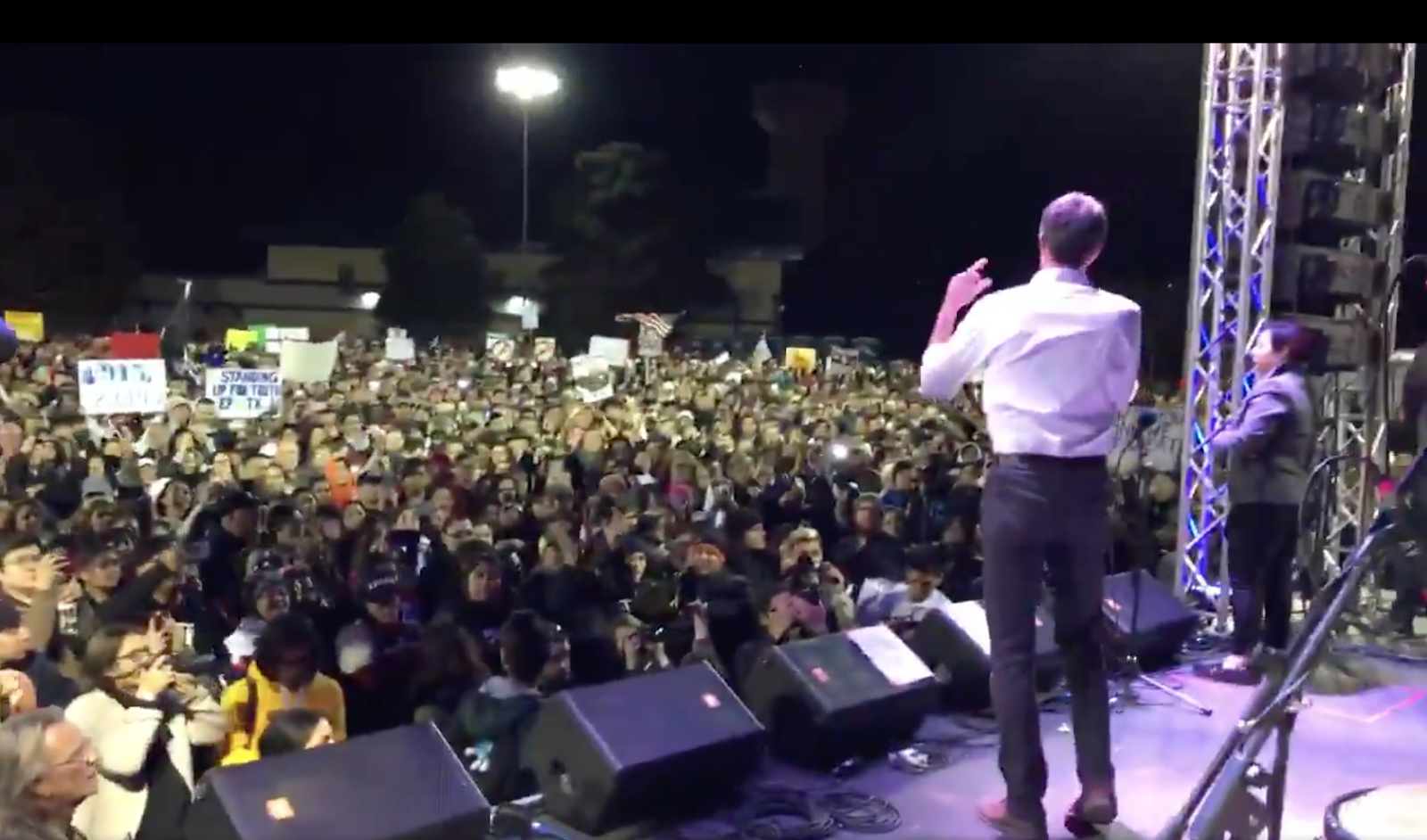
So, the argument from numbers about the El Paso rally is, in the final analysis, only partially about who actually showed up.  Trump claimed as many as 69,000 people wanted to be there, and 10,000 were allowed into the arena where he spoke:
There were "thousands" of people outside, but there is no official estimate as to how many.  Nobody seems think that number is somewhere between 59,000 and 61,000.

How many were at the Beto rally?  Frankly, this gets a bit dicey.  The El Paso Police Department said it made no official estimate.  "An O'Rourke spokesman said about 8,000 attended the counter-rally."  Or maybe it was 7000.  Or maybe it was 10,000 to 15,000.  The numbers on the high end are very dubious, so let's leave at at 7000 to 80000.  What does it matter?

Only in this:  first, Amanda Marcotte is right.  Beto proves that, when they go low, we go high.  Trump told lies about the wall, crime in El Paso, and encouraged violence against journalists.  Beto appealed to the angels of our better nature:

"We are making a stand for truth against lies and hate and ignorance and intolerance," the potential 2020 Democratic candidate said. "We are going to show the country who we are. We're going to make a stand to ensure that we live up to our promise, to our potential, to our purpose as a country."

"We will not take advantage of them," O'Rourke added about immigrants. "We will not send them back to certain death. We will not believe that walls can or should keep them out. Instead, we welcome them with open arms."

And he did it outside in shirtsleeves after leading a march through El Paso.


How cold was it again?  How devoted were those Trump followers outside the coliseum?

We hear a great deal about Trump's base and their loyalty to Trump and even their indifference to any ideas or facts that don't come from Trump.  It wouldn't hurt to point out they are a minority of the population and even of the electorate.  Donald Trump won in a very low turnout election, in states where the turnout was especially low.  If not for the electoral college, his "base" would have been irrelevant.  Beto O'Rourke, without the power of the Presidential seal (reports from El Paso found many residents attended because the President was in town, not out of sympathy for his beliefs), drew at least as big a crowd as the President did.  Trump's followers may be blindly devoted to whatever he claims; but there are at least an equal number of people who are not so blind.

And probably many, many more besides.

No Comment


This was just too good not to pass along.

(I have to add, in the spirit of disclosure, that the problem of Batman's modus operandi had never really struck me until "The Dark Knight,"  Watching Batman punch his way, slowly and repeatedly, through crowds of bad guys, I began to realize this was a labor intensive method without much real return.  Back in the real world, 4 Houston police officers were shot in a raid that made national news.  What may not have been national news was the fact the raid was supposedly on a virtual warehouse of black heroin, but all that was found was some marijuana.  The "bad guys" in that raid were shot to death, not just punched out, but four police officers were wounded, some seriously, and the results didn't exactly change the crime scene in Houston.  No more than, as I heard this morning, did the capture (and now conviction) of El Chapo diminish the effects of his cartel, which is still going strong and is now considered the largest and most powerful such cartel in Mexico.  Maybe simple solutions don't solve complex problems after all.  Oh, well.....)

To Whom Do We Apologize?


So this popped up in my statistics as a post of sudden interest to the few who come here, although it's almost 14 (!) years old now.  It caused me to re-read it and to consider the statements in it and think "Huh.  That's interesting.  Sounds like seminary-speak.  Don't speak seminary-speak anymore."  My first reaction, in other words, is to reject it because it is far too narrow and rigid.  And I think that; this is largely the language either of opposition for fundamentalist literalism, or a submission to scientific naturalism.

These days I reject either extreme, and find myself less interested in apologetics for Christian metaphysics (a product of its age, and something of a tradition which has lost its life; we need not take down Christianity with it, or replace it with something more acceptable or "common sense.") than I am in Tolstoy's question "How should we then live?".  Which is to say much of what that post dwells on:  the nature of miracles as recorded in the gospels, the nature of Christ (God?  Man?  both and a little bit of neither?), church dogma, even the Resurrection itself, are more in the nature of what Wittgenstein called things talked about in one "language game" that make no sense in another.  Let me illustrate with a simple illustration.  I say I love my wife.  You say, "Prove it."  How would I do so?  What does the statement even mean to you?  It means everything to me, it seems to be an expression of my very being.  To you it may be immaterial, sentimental, even embarrassing, an expression of emotion (or merely a statement, merely words?).  My love for my wife is completely subjective and personal; does she even understand what I mean?  Do I?  I love my daughter, too, but how do I explain that statement?  I didn't love my wife at first sight, but I've loved my daughter from the moment of her birth.  Does that make sense?  Can I explain it, defend it, justify it?  How?  Could my statements be considered legendary?  After all, it is not "objectively and neutrally ascertainable historical fact" (and the gospels contain four different stories of the Resurrection; it certainly fits those terms, even in the records we have).

Does this mean my claims of love are not "true"?

Let's return to the miracles.  Even the gospels contend about them.  Mark has fewer than Matthew or Luke; John has radically different ones, and fewer (the wedding at Cana, the resurrection of Lazarus).  The synoptics call them "acts of power" (dunamis, transliterated from the Greek), John calls them "signs" (semeia, again from the Greek).  Scholarship tells us the literature of that age is full of claims of miracles, usually portrayed as dunamis.  John is radical in his re-description, and emphasizes that it is better to believe without seeing, than to believe because you see, or think these "signs" are proof, or even measures of truth.  It is in John's gospel that Pilate asks his famous question; it doesn't appear in the other three.  Perhaps Pilate is being cynically philosophical; or perhaps he sincerely doesn't know how to adjudicate the case before him, because he has no access to the truth Jesus presents.  Are those truths, then, not true?  And which matters more:  what Jesus said, or who Jesus was?

This split goes back to Paul, who didn't have the gospels to preach from or to write about.  He taught who Jesus was; but is that still our primary concern?  (And I don't mean to reduce Paul's letters to such a simplistic dichotomy, except arguendo for the moment,)  Questions of "truth" and "verification" and "Evidence" are of no interest to me, because they are not, as Tillich described them (cribbing Kierkegaard), matters of  "ultimate concern."  Do I need an apologetic for the miracles or the Resurrection in order to discuss Christianity?  Or should the focus be more in accord with the teachings of the prophets, and the line from them to the teachings of Jesus of Nazareth?

Isaiah's vision of the holy mountain is a place which, in the fullness of time, will be a draw to all nations (read:  people, not nation-states) because it will offer a better way of life, a guide to living that everyone will want to share (but not be required to).  Micah's reduction of the requirements of the God of Abraham to do justice, love mercy and walk humbly with God, comes after God (as God frequently does in the words of the prophets) has rejected the empty gestures and hollow rituals which are not bad in themselves, but are hollow because the children of Abraham have reduced them to shams, as bargaining chips whereby they think they purchase God's favor while doing whatever it is they want to do.  God does not punish Israel because it is immoral or even unfaithful; God just leaves them to their own devices because they have turned their backs on God, because they have chosen to ignore God's wisdom, God's sophia, God's guidance on "how should we then live?".  When Peter refuses to eat with those who don't keep the dietary laws of Moses, God's vision to Peter tells him not to put form in front of substance.  God never demands adherence to rules when such adherence is meant simply to maintain God's favor.  As Jesus succinctly puts it to his critics:  were people made for the Sabbath, or the Sabbath made for people?  Every time we reduce God's teachings to rules and regulations, or doctrines or dogma which must be established first before we can settle the question of how life should be conducted, we are trying to remake people for the Sabbath, rather than recognizing what the Sabbath does for people.

That, too, can be a reductio argument which condemns those who keep the Sabbath very carefully, mindful of what effort is, or is not, labor.  Jesus' point was not to condemn methods of observing the Sabbath; he was pointing out the error of judgment.  In Micah's terms you can't do justice, love mercy, and walk humbly with God if you're stopping to point out how somebody else is doing it wrong.  In Isaiah's visionary terms, who wants to come to a holy mountain full of scolds, or, in our terms, full of arguments over what the meaning or reality of a miracle is?  Which matters more:  treating each other as the Christ, in terms of the Matthean parable?  Or arguing over who is right about the nature of the stories of miracles in the gospels?

(Which is not to say I'd object to planting some trees in concrete.  One answer never fits all.)

You Can't Fix Stupid


I knew someone who had lost hearing in one ear due to having measles as a child (long before the vaccine was available).  She died of cancer as an adult. 

It's not a refutation per se, but this is such a dumb comment it hardly deserves one.  I suppose we should bring back polio, too.  I knew adults crippled by polio, but it's a childhood disease, right?

Tuesday, February 12, 2019

I Honestly Don't Think Jeebus Loves Me This Much


Because the result will be a spanking in the courts (even Scalia relied on Youngstown in slapping down an executive order over reach by Obama; that precedent is alive and well, IMHLegalO) and Trump bringing his entire Presidency to an undeniable and crashing halt.  Nancy Pelosi will bring up a resolution in the House which the Senate will have to vote on (no choice, Mitch!).  It will be the point when every one in DC will have to admit the Emperor is buck nekkid.  (And let us not ignore the Democrats are winning bigly on this issue, especially if Trump signs off on the spending plan and then tries to wreck the government by declaring himself the Sovereign Lord and Master.  For one thing, all the nonsense getting started about the Green New Deal suddenly disappears from the radar, and who's gonna care what Ilhan Omar said?)

This is the hill his Presidency dies on.

Monday, February 11, 2019

Better Late Than Never?


The interesting thing about the report on the Southern Baptist Convention is that the SBC is, structurally and intentionally, the very opposite of the Roman Catholic Church.  The denomination is strictly  "congregational," meaning every congregation associates with every other congregation through the Southern Baptist Convention, but the SBC has absolutely no authority over those congregations.  So there can't be the active concealing of clergy abuse that the RC engaged in, but there can be the willful blindness to that abuse that the entire culture engaged in.  According to the first report (of three), the SBC didn't keep good records on employees and clergy, even sending employees on to other churches with letters of recommendation.  Well, to be fair, the SBC didn't do that, the churches did; the SBC just never so much as told the churches that might be a bad idea, even as it discarded churches which called gay or lesbian pastors to their pulpits.  Some things the SBC can do something about, you see.

I'm familiar with this phenomenon, not in terms of knowing victims of clergy or church employee abuse, but in terms of shunning, as many victims of abuse who reported it to their congregations were shunned.  I've mentioned before the last funeral I conducted, for a childhood friend who had "come out" in her adult life as a lesbian.  A life-long member of an SBC congregation, the church that knew her from childhood shunned her for being who she was.  That's not a peculiarity of the SBC; congregations are good at turning their backs on church members.  As we will see, sexual orientation is a much more serious issue for the SBC than sexual abuse (which is wrong in so many ways it defies argument).  Such treatment doesn't usually make the newspapers, though.

The other interesting fact here is that the reporter for the Houston Chronicle told NPR this morning they decided to look into allegations of sexual abuse among clergy and employees of SBC churches 10 years after activists pushed the SBC to respond to the allegations of abuse.  That's also acknowledged in the article itself:

In June 2008, [Debbie Vasquez, a victim of abuse 35 years earlier] paid her way to Indianapolis, where she and others asked leaders of the Southern Baptist Convention and its 47,000 churches to track sexual predators and take action against congregations that harbored or concealed abusers. Vasquez, by then in her 40s, implored them to consider prevention policies like those adopted by faiths that include the Catholic Church.

"Listen to what God has to say," she said, according to audio of the meeting, which she recorded. "... All that evil needs is for good to do nothing. ... Please help me and others that will be hurt."

Days later, Southern Baptist leaders rejected nearly every proposed reform.

The abusers haven't stopped. They've hurt hundreds more.

Most of the stories found by the Chronicle are public records of lawsuits and criminal convictions, not hidden stories tucked away behind SBC authorities (there really aren't any SBC authorities; nothing remotely comparable to any episcopalian form of church hierarchy).  So the question is:  why did the SBC ignore this for so long?  And the other question is:  why did Texas news media ignore this for so long?   It's a terrible thing, but 10 years ago activists confronted the Southern Baptist Convention with the problem and their complicity.  And 10 years later, the press in Texas has finally decided to investigate those allegations.  It only took six months to do the investigation; it only took 10 years to decide to undertake it, even with all the evidence hiding in plain sight.

I mean, the narrative that a free press is a shining light in the darkness and a tower of public moral responsibility is just undercut by a story that took 10 years to finally spark six months of investigation into "thousands of pages of court, prison and police records and,' finally, "conducting hundreds of interviews."  And no, I don't have a lot of sympathy for the SBC's position that it can't do anything because of it's non-episcopal structure:

Other leaders have acknowledged that Baptist churches are troubled by predators but that they could not interfere in local church affairs. Even so, the SBC has ended its affiliation with at least four churches in the past 10 years for affirming or endorsing homosexual behavior. The SBC governing documents ban gay or female pastors, but they do not outlaw convicted sex offenders from working in churches.

In one email to Debbie Vasquez, Augie Boto assured her that "no Baptist I know of is pretending that 'the problem does not exist.'"

"There is no question that some Southern Baptist ministers have done criminal things, including sexual abuse of children," he wrote in a May 2007 email. "It is a sad and tragic truth. Hopefully, the harm emanating from such occurrences will cause the local churches to be more aggressively vigilant."

Gays and lesbians are bad, especially in the pulpit; but child molesters in the pulpit?  Well, waddareyagonna do, except to "preach it round and square?"

The SBC Executive Committee also wrote in 2008 that it "would certainly be justified" to end affiliations with churches that "intentionally employed a known sexual offender or knowingly placed one in a position of leadership over children or other vulnerable participants in its ministries."

Current SBC President J.D. Greear reaffirmed that stance in an email to the Chronicle, writing that any church that "proves a pattern of sinful neglect — regarding abuse or any other matter — should absolutely be removed from fellowship from the broader denomination."
You see the exit there:  "knowingly."  As long as the congregation doesn't know, it's not responsible.  And if no system exists to tell them, then they don't have to know, and they can't be responsible.  It depends, you see, on what the meaning of "is," is (oh, ask your grandfather!).  Or it just depends on not really wanting to cut off churches from the convention who don't hate gays and lesbians (because that's what's really wrong!):

 But the newspapers found at least 10 SBC churches that welcomed pastors, ministers and volunteers since 1998 who had previously faced charges of sexual misconduct. In some cases, they were registered sex offenders.

"Knowingly" is a rather generously defined term, apparently.  And that applies to the newspapers as well:

In 2007, victims of sexual abuse by Southern Baptist pastors requested creation of a registry containing the names of current and former leaders of Southern Baptist churches who had been convicted of sex crimes or who had been credibly accused. That didn't happen; the last time any such list was made public was by the Baptist General Convention of Texas. It contained the names of eight sex criminals.

In 2018, as advocates again pressed SBC officials for such a registry, Houston Chronicle reporters began to search news archives, websites and databases nationwide to compile an archive of allegations of sexual abuse, sexual assault and other serious misconduct involving Southern Baptist pastors and other church officials. We found complaints made against hundreds of pastors, church officials and volunteers at Southern Baptist churches nationwide.
I don't defend the SBC here; as the article makes clear, the Convention itself, and its individual leaders over the years (including many from Houston), did all they could to distance themselves from allegations made in their congregations, or in congregations associated with the SBC.  The Rev. Ed Young's statement in an affidavit seeking to quash a deposition request states it plainly:

I have no educational training in the area of sexual abuse or the investigation of sexual abuse claims.  I have had no personal experience relative to any claim of sexual abuse among church members of any church of which I have been Pastor since my ordination as a Baptist minister over thirty four years ago.
...
Since 1979, as Pastor of Second Baptist Church of Houston, my sermons have been broadcast locally on a regular basis.  I have appeared on local television and national television regarding religious issues since my arrival in Houston, Texas.  My deposition testimony could unfavorably affect that television ministry, which is now seen on a daily basis in the greater Houston area.

In other words, Pastor Young is just the President (at the time) of the SBC, but that doesn't make him responsible for anything going on in the congregations of the SBC, and imputing any responsibility to him (like making him give a deposition in a lawsuit against the SBC, and other parties) would be damaging to his career.   Real towers of moral probity and authority these guys are.  When there was an allegation against a church employee in 1994, the mother of the victim says Young spoke to her once on the phone, hung up when she said she'd already called the police, and never spoke to her or her family again.  It was several months after that before the employee finally left his position with the church. Was the church concerned with interfering in a police investigation?  Or were they just concerned with appearances?

There's plenty of finger-pointing to go around, here; and certainly issues of sexual impropriety and institutional responses to it seem to depend on one's cultural, even political, persuasion.  Before my daughter was born (so, what, almost 30 years ago now?) my pastor was involved in a local church investigation into his behavior, including his behavior before his marriage (there was no allegation of impropriety in his marriage).  It was very low-level stuff, the major allegation being that he had dated, briefly, a member of the congregation.  No allegations of abuse; just some questions of propriety.  I later knew of another investigation of a UCC pastor, this about 10 years on from the investigation of my pastor, involving again questions of judgment about who he dated; nothing about any allegations of abuse, physical or otherwise.  Such matters nearly lead to loss of standing (i.e., ability to be a minister in the UCC) in both cases.  The UCC took any allegation of impropriety (not even rising to the level of alleged assault, I again emphasize) seriously; too seriously, I thought at the time (and still think).  Then again, the UCC has allowed the ordination and placement of gays and lesbians in its pulpit since the '90's, if memory serves (it may have been a bit later than that, I'm not going to look it up now).  Does this make the UCC 'better' than the SBC?  Hardly; it's just interesting how the culture of institutions shapes the behavior of those institutions.  The UCC is notoriously "liberal," the SBC is notoriously "conservative."  Ed Young is notoriously Republican and conservative in his politics, a position I'm sure that aligns with the majority of his congregation.  There are many reasons Ed Young has a congregation and I don't, and I'm also sure that's one of them.  But churches do have to hold themselves to higher, or perhaps better, standards.  The UCC was purging supposed Al Frankens from its midst 30 years ago, long before the U.S. Senate Democrats caught up.  More concerned with appearances isn't necessarily better than more concerned with gays and lesbians than sexual abuse allegations.  But the SBC has a lot to answer for, even if they can deny any legal liability for the actions of employees of their affiliated congregations.

I just don't want the indifference of the press to be overlooked here, either.  I'm not impressed with Texas news organizations and how they handle local Texas news.  As I've mentioned before, Texas education funding has been a mess for almost 40 years, yet few people in Texas even recognize there is a problem.  Most don't understand their school taxes go, not primarily to their local schools, but to the state's general fund; and a lot of that ignorance is the refusal of the Texas media to cover the story.  Is that because no one is trying to make a public issue of Texas school finance and in general how Texas funds state government?  If so, who finally got the Houston Chronicle to get interested in this story?  Round 2 of the activists trying to engage the SBC, ten years after the first attempt?  So twice in 10 years makes the press think "Hey, is there a story here?"  That's pretty pathetic for a "free press" supposedly so integral to the functioning of government and society it needs special Constitutional protections available to any individual or business entity that calls itself "media".  With great power comes great responsibility, but frankly the responsibility of the press to notice what's going on in the SBC is as great as the responsibility of the SBC to take action.

Is it any wonder our dominant cultural paradigm seems to be pointing fingers at other people while never taking any responsibility ourselves?

Internet Follies


Because I wrote about Micah 6:8 recently, a website ad service showed me the picture above.  Right next to it, in the same ad, was this picture:


I'm left pondering what one has to do with the other.  I'll get back to you on that.....

Sunday, February 10, 2019

Why Should Virginia Get All the Attention?


This is a test...of the American Media Narrative.  Which is the most serious example of racism in public office in America?

Or can we even pay attention to both?  Inquiring minds want to know....

(And by the way, he's really busy today:

 
...in case there was any doubt....)

Saturday, February 09, 2019

Reading the Tweets

One sentence at a time:

A)  On the one hand you declare an invasion by a "caravan" to be imminent; on the other hand (sometimes in the same tweet) you declare we have "stopped" migrants from Mexico who have presented themselves at check points lawfully seeking asylum.  Which is it?  Are we stopping them, or are we being overrun by them because we have "open borders" and no "border security"?  Is the Border Patrol a joke, or are the BP agents the only experts in the world who can tell Democrats (never Congress) what to do about the border?

B)  There are no recommendations, because there have been no hearings.  The proper legislative process is to submit a bill to Congress, through a Representative or Senator, that will lead to committee hearings to gather evidence and establish a basis for the validity of such governmental expenditures, including cost estimates, construction ideas, feasibility studies, environmental impact studies, a bidding process, etc.  "Border Agents recommendations" is not even anecdotal evidence; it is no basis for governmental action on anything.  And coming from a documented liar with 8000+ to his credit since inauguration, your claims don't mean much, and shouldn't.

C)  Why is the President of the United States relying on "news reports" for what they Democrats are, or are not, offering?  Doesn't he have Congressional liaisons to gather and report that kind of information to him?  Or would such a practice interfere with his "Executive Time"?

D) "They look to be making this a campaign issue"?  Pot calls kettle too dark.

E)  "The Wall" will get built, regardless?  What are you, the Monarch?  Aren't you the one making this a campaign issue for 2020?

Reading the Story

So, that didn't happen, after all.   Except Slate says the House Committee gave away the store before Whitaker testified (and did a poor job questioning him, to boot).

For one, as the committee’s ranking minority member Doug Collins noted in his opening remarks, Whitaker likely has less than a week left in office before William Barr is confirmed as the new attorney general. Secondly, as Collins also noted, Nadler had the day before held a vote to authorize a subpoena of Whitaker should he refuse to answer the panel’s questions, only to quietly holster that power after Whitaker threatened to cancel his appearance. Nadler had actually announced in a letter to Whitaker that was released to the public on Thursday evening that the committee would not use the subpoena “if you are prepared to respond to questions from our Members.” The clear implication was that a subpoena was still on the table if Whitaker dodged. In actuality, Collins said, the chairman had sent a second letter to the Department of Justice guaranteeing that there would be no subpoena.

As Collins described it, this was “a full-blown cave.”

Without a legitimate subpoena threat—and with so little time left for the acting attorney general in office—Whitaker felt comfortable literally laughing off Democrats’ questions. With time ticking down on Rep. Sheila Jackson Lee’s clock and the Texas congresswoman asking for more time in the face of the witness’ ducking, for example, Whitaker commented, “Congresswoman, I don’t know if your time has been restored or not.”

Or maybe you shouldn't take the word of the GOP on matters of fact, after all:

“You owe us responses on a number of issues raised here today. Responses we intend to secure,” Nadler said. “I ask the Department [of Justice] to work with the committee to provide them. As part of that work I fully intend to call you back for an interview, under subpoena if necessary and I expect more answers at that time.”

Nadler said that at the end of the hearing, not in some obscure press conference later.  Watch the donut, not the hole.  Or ignore the narrative that Democrats are in disarray and weak and feckless, and the GOP always holds the whip hand, no matter what.  It's always about the narrative:

The goals of the Green New Deal are impossible. Which is exactly what makes it a great idea.

Huh? Don’t you get it? By asking the impossible, the Green New Deal asks us to consider the possibilities! You see, a plan’s actual workability as a plan is no longer the value of a plan. Plans are good for thinking, and thinking leads to dreaming, and dreaming is the only way that change occurs—that’s just science, folks.

We’ve blown past the era of evaluating an idea’s worth by subjecting it to the standard of “feasibility.” Workability or feasibility is no way to judge any idea put forth by the exciting and innovative Rep. Alexandria Ocasio-Cortez, says Shadi Hamid, senior fellow at the Brookings Institution. Writing in the Atlantic of another of AOC’s headline-grabbing proposals, a 70 percent tax rate, Hamid admits he does not have a well thought out position on whether it’s a good idea.

Which may well be what the "Green New Deal" is about; but the difference between the GND and, say "Build the wall/Crime will fall!" should be rather obvious.  One is the starting point for a discussion, for literally a new narrative (what, you think LBJ sprang sui generis from the Senate to the White House and started handing out landmark legislation like pre-wrapped peppermints?); the other is a foolish and ignorant demand based, not on reality, but on demagoguery.  And it's doing so badly news now is Trump is going to cave, and accept $2 billion for...wait for it....border security.  Which, as Katty Kay of the BBC said on Washington Week last night, could well mean rose bushes; planted along the border, of course.

The GND ain't about rose bushes.  That's just science, donchaknow?

What actually happened yesterday is a matter of the dust settling, and everyone wants to make sure the dust settles in their favor.  And yeah, there's a political strategy here:

A Republican political operative and Capitol Hill veteran told me: "It doesn’t take long for ordinary voters — who are very different from people in Washington — to start seeing participating committee members as pompous, rude and belittling, and begin to side with whoever is sitting in the hot seat."

And here:


Except the audience for C-SPAN 2 is not that large, and the majority of the country would ask "Whitaker who?"  Besides, this is not football, a season of only 16 games, where every defeat is a major setback, and every victory another foothold on the playoffs; this is baseball; it's a much, much longer season.

And while we're distracted by political theater:

What the hell?

It's all about the narrative; and sometimes, that's the problem.  Which is what Sen. Whitehouse understands:

 
"Follow the money," one of the greatest of American narratives.

Friday, February 08, 2019

A Modest Proposal for Preventing the Hubris of Thinking We Are Better Than We Are And for Making Us Beneficial to the Publick


I was going to say I wasn't that big a fan of Atwood's novel the first time around, and now that it's a Disney theme park I'm even less thrilled.  But I had to type the comment on my phone and my thumbs couldn't take it and I had too many typos and then I went to class to teach (again!) "A Modest Proposal" and I realized what my problem with such dystopian tomes (all the rage!  again!) is, in light of Swift's modest genius.

The basic problem with novels like The Handmaid's Tale is that they allow us to see others as the problem, and not us.  We are not the barbarian fundamentalists or even the women cowed by authority who submit to this nightmarish world order in the name of survival (the obvious analogue being all that mass of people ("men" in the original, but now....) living lives of quiet desperation.  We don't do that, O best beloved, but they do!).  It's too easy to look at tales like Handmaid and conclude the problem is with what people would let happen but I never would!  Just like the people packing weapons because they will be the heroes of their own action movies, but thankfully for the rest of us never get the excuse to prove it (bullets go where physics dictates, not human desire), we have zero chance of living in the dystopian hellscapes these novels (and movies!) all "project."  Even horror films about what white people really want to do to black people are escapist fare in this sense.

Then comes the Rev. Dr. Swift, with his morality tale about economics and human beings.

The heart of the argument in the "Modest Proposal" is one that would please the most die-hard Reaganite or, today, Trumpite:  allow the market to work, and all will be well.  The idea of eating children may be morally abhorrent, but the market has no morals, only costs and benefits and returns on investment and goods and services to sell and buy.  The invisible hand keeps all in balance and benefits all who accept its guidance.  This early 18th century essay presents a proposal based on the way the market and those in agriculture calculate the cost and return on investment of sheep, cattle, and swine, and shows those calculations work as well for infants who can quite reasonably be raised cheap on mother's milk for one year, then sold for slaughter before they become both an expense (needing food and clothing of their own) and too tough and stringy to be delectable.  Besides, miss that deadline and its another 11 years before they can be put to work at any job besides stealing.  Even chickens lay eggs and cows give milk (well, some species do; the ones that don't can go to market before 12 years have passed).

It's the perfect free market solution.  To solve the problem of poverty give the poor something to sell, and the only thing they are guaranteed to have, and can replace of their own efforts, is infants.  This gives, as the narrator says, property for the landlord to seize against deadbeat tenants, a reason for husbands to marry wives (think of the money, dear!), and a new source of trade for butcher shops and taverns, not to mention the multiplier effect from trade in a product locally grown and marketed.

And if you don't see yourself in that system, it's only because you aren't looking hard enough.  The system that consumes the poor in all but body, is the system that sustains the rest of us.  The difference between the narrator's proposal (it is not Swift's plan) and reality, is its honesty for, as the narrator says, the landlords having consumed the better part of the parents, might as well eat the children for a gain to both parties.

I don't see my daughter in Offred, or myself in Offred's master turning a minor practice mentioned once in the story of Abraham into the basis for social order; I do see my complicity in the system Swift satirizes.  Maybe it's because satire is so much closer to reality than fiction; maybe it's because of Swift's genius.  I tend to think it's because of his experiences as a Christian pastor, but that's probably bias on my part.  In any case, Swift does not offer us a hellscape for our entertainment, an imagined garden of red delights to make us shudder at how bad "they" are and delight us with how much better we are, or would be, if only because we won't allow that "future" to come true.  Swift offers us the world here and now, and the passing of almost 300 years only reminds us that the more things change, the more they remain the same.  The description of the problem Swift's narrator describes, the argument for the solution he modestly proposes, is written in the language of early 18th century England; but its terms are as familiar today, as they would have been recognizable then.

And that's the most frightening horror story I know.

'Ah, but the strawberries....


Ah, but the strawberries, that's, that's where I had them, they laughed at me and made jokes, but I proved beyond the shadow of a doubt, with geometric logic, that a duplicate key to the ward room icebox did exist, and I've had produced that key if they hadn't pulled the Caine out of action. I, I know now they were only trying to protect some fellow officer. [He pauses - looked at all the questioning faces that stared back at him, and realizes that he has been ranting and raving] Naturally, I can only cover these things from memory. If I left anything out, why, just ask me specific questions and I'll be glad to answer them, one by one.
 

Give him some steel balls, so the picture's complete.

Yes, yes it should


Huh?

On what planet does this make any sense at all?

Thursday, February 07, 2019

Looking Forward


I include the whole thread because this is a picture of the next two years.  It's not going to be quite so simple as Congress asks and the Administration answers.  It should be, but this is Trump, and the sooner we stop talking about "disruptive" and "untraditional" and recognize this is as defiance of the Constitution itself (by being completely opposed to the functions of government outlined therein, not by actions that are necessarily so extreme as to be "unconstitutional"), the sooner we'll understand what Trump and the GOP are doing.


One interesting point there is the "run out the clock" strategy, which may work for the Congressional hearing but won't work for Mueller or SDNY, if they are really interested in what Whitaker knows about what Trump tried to do.  Likely, of course, both investigators already know, and may not even need Whitaker's testimony.  I don't assume superhuman powers of omniscience from the investigators, but if published reports tell us what may be going on, I imagine the investigators (a) already know, or (b) become interested rather quickly.  And their process doesn't move as slowly, nor as publicly, as Congressional oversight.

Still, the latter is an important function of our system of government, especially to expose corruption to sunlight.  The DOJ panic over Whitaker's testimony stinks to high heaven.  I suspect incompetence, rather than Machiavellian strategy, went into the failure to evoke executive privilege before now, because this all seems as organized as a five-alarm panic.  Either way, much of what the House tries to do in the next two years is going to wind up in court battles, starting with Trump's tax returns.

You Go First

Well, now it should stop:

In 2010, at the urging of Donald Trump's lawyer Michael Cohen, the National Enquirer began promoting a potential Trump presidential campaign, and with Cohen's involvement, the tabloid began questioning Obama's birthplace and citizenship.

In March 2011, during an interview on Good Morning America, Donald Trump said he was seriously considering running for president, that he was a "little" skeptical of Obama's citizenship, and that someone who shares this view should not be so quickly dismissed as an "idiot" (as Trump considers the term "birther" to be "derogatory"). Trump added, "Growing up no one knew him", a claim ranked Pants-on-Fire by Politifact.  Later, Trump appeared on The View repeating several times that "I want him [Obama] to show his birth certificate." He speculated that "there [was] something on that birth certificate that [Obama] doesn't like", a comment which host Whoopi Goldberg described as "the biggest pile of dog mess I've heard in ages."  On the March 30, 2011, edition of CNN Newsroom, anchor Suzanne Malveaux commented on Trump's statements, pointing out that she had made a documentary for which she had gone to Hawaii and spoken with people who knew Obama as a child.   In an NBC TV interview broadcast on April 7, 2011, Trump said he would not let go of the issue, because he was not satisfied that Obama had proved his citizenship.  After Trump began making his views public, he was contacted by Joseph Farah of WorldNetDaily, who was reportedly on the phone with Trump every day for a week, providing Trump with a "birther primer", answers to questions, and advice.  After Obama released his long-form birth certificate on April 27, 2011, Trump said "I am really honored and I am really proud, that I was able to do something that nobody else could do."

On October 24, 2012, Trump offered to donate five million dollars to the charity of Obama's choice in return for the publication of his college and passport applications before October 31, 2012.

On September 16, 2016, as the Republican Party presidential nominee, Trump conceded that "President Barack Obama was born in the United States. Period." Trump gave himself credit for putting the controversy to rest and also repeated a false claim that Hillary Clinton, his opponent in the 2016 U.S. presidential election and one of Obama's opponents in the 2008 Democratic presidential primaries, had started the controversy concerning Obama's place of birth. While those who did so were Clinton supporters, there is no evidence of Clinton or her campaign questioning Obama's birthplace.

Publicly he finally conceded the fact; but privately, as recently as late November, 2017:

In recent months, they say, Mr. Trump has used closed-door conversations to question the authenticity of President Barack Obama’s birth certificate. He has also repeatedly claimed that he lost the popular vote last year because of widespread voter fraud, according to advisers and lawmakers.

One senator who listened as the president revived his doubts about Mr. Obama’s birth certificate chuckled on Tuesday as he recalled the conversation. The president, he said, has had a hard time letting go of his claim that Mr. Obama was not born in the United States. The senator asked not to be named to discuss private conversations.

Trump's Twitter archive just on the topic of birtherism runs from 2011 to 2014, or one year longer than he's been in office.

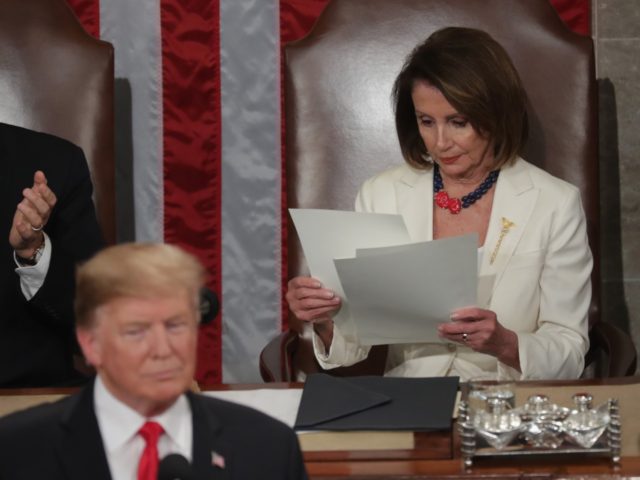
Amazing how much he has accomplished, isn't it?  Nancy Pelosi provides the applause:


Wednesday, February 06, 2019

"So much unity! We're getting tired of all the unity!"


First sentence of the second paragraph of the SOTU 2019:

The agenda I will lay out this evening is not a Republican agenda or Democrat agenda, it is the agenda of the American people.
That's the way you unify people, right?

 Democrat Party is an epithet for the Democratic Party in the United States, used in a disparaging fashion by the party's opponents. While historical and occasional current usage includes non-hostile appearances (including from within that party), the term has grown in its negative use since the 1940s, in particular by members of the Republican Party—in party platforms, partisan speeches, and press releases—as well as by conservative commentators. While there is grammatical argument regarding the propriety of use of both of the terms, with ending and without, ongoing use of the shortened term for political ends is a source of irritation to members of the Democratic Party.

You really don't have to examine anything else in the speech after that, or refer to any prior actions by the President.  The offense is hiding in plain sight.