Saturday, February 09, 2019

Reading the Tweets

One sentence at a time:

A)  On the one hand you declare an invasion by a "caravan" to be imminent; on the other hand (sometimes in the same tweet) you declare we have "stopped" migrants from Mexico who have presented themselves at check points lawfully seeking asylum.  Which is it?  Are we stopping them, or are we being overrun by them because we have "open borders" and no "border security"?  Is the Border Patrol a joke, or are the BP agents the only experts in the world who can tell Democrats (never Congress) what to do about the border?

B)  There are no recommendations, because there have been no hearings.  The proper legislative process is to submit a bill to Congress, through a Representative or Senator, that will lead to committee hearings to gather evidence and establish a basis for the validity of such governmental expenditures, including cost estimates, construction ideas, feasibility studies, environmental impact studies, a bidding process, etc.  "Border Agents recommendations" is not even anecdotal evidence; it is no basis for governmental action on anything.  And coming from a documented liar with 8000+ to his credit since inauguration, your claims don't mean much, and shouldn't.

C)  Why is the President of the United States relying on "news reports" for what they Democrats are, or are not, offering?  Doesn't he have Congressional liaisons to gather and report that kind of information to him?  Or would such a practice interfere with his "Executive Time"?

D) "They look to be making this a campaign issue"?  Pot calls kettle too dark.

E)  "The Wall" will get built, regardless?  What are you, the Monarch?  Aren't you the one making this a campaign issue for 2020?

Reading the Story

So, that didn't happen, after all.   Except Slate says the House Committee gave away the store before Whitaker testified (and did a poor job questioning him, to boot).

For one, as the committee’s ranking minority member Doug Collins noted in his opening remarks, Whitaker likely has less than a week left in office before William Barr is confirmed as the new attorney general. Secondly, as Collins also noted, Nadler had the day before held a vote to authorize a subpoena of Whitaker should he refuse to answer the panel’s questions, only to quietly holster that power after Whitaker threatened to cancel his appearance. Nadler had actually announced in a letter to Whitaker that was released to the public on Thursday evening that the committee would not use the subpoena “if you are prepared to respond to questions from our Members.” The clear implication was that a subpoena was still on the table if Whitaker dodged. In actuality, Collins said, the chairman had sent a second letter to the Department of Justice guaranteeing that there would be no subpoena.

As Collins described it, this was “a full-blown cave.”

Without a legitimate subpoena threat—and with so little time left for the acting attorney general in office—Whitaker felt comfortable literally laughing off Democrats’ questions. With time ticking down on Rep. Sheila Jackson Lee’s clock and the Texas congresswoman asking for more time in the face of the witness’ ducking, for example, Whitaker commented, “Congresswoman, I don’t know if your time has been restored or not.”

Or maybe you shouldn't take the word of the GOP on matters of fact, after all:

“You owe us responses on a number of issues raised here today. Responses we intend to secure,” Nadler said. “I ask the Department [of Justice] to work with the committee to provide them. As part of that work I fully intend to call you back for an interview, under subpoena if necessary and I expect more answers at that time.”

Nadler said that at the end of the hearing, not in some obscure press conference later.  Watch the donut, not the hole.  Or ignore the narrative that Democrats are in disarray and weak and feckless, and the GOP always holds the whip hand, no matter what.  It's always about the narrative:

The goals of the Green New Deal are impossible. Which is exactly what makes it a great idea.

Huh? Don’t you get it? By asking the impossible, the Green New Deal asks us to consider the possibilities! You see, a plan’s actual workability as a plan is no longer the value of a plan. Plans are good for thinking, and thinking leads to dreaming, and dreaming is the only way that change occurs—that’s just science, folks.

We’ve blown past the era of evaluating an idea’s worth by subjecting it to the standard of “feasibility.” Workability or feasibility is no way to judge any idea put forth by the exciting and innovative Rep. Alexandria Ocasio-Cortez, says Shadi Hamid, senior fellow at the Brookings Institution. Writing in the Atlantic of another of AOC’s headline-grabbing proposals, a 70 percent tax rate, Hamid admits he does not have a well thought out position on whether it’s a good idea.

Which may well be what the "Green New Deal" is about; but the difference between the GND and, say "Build the wall/Crime will fall!" should be rather obvious.  One is the starting point for a discussion, for literally a new narrative (what, you think LBJ sprang sui generis from the Senate to the White House and started handing out landmark legislation like pre-wrapped peppermints?); the other is a foolish and ignorant demand based, not on reality, but on demagoguery.  And it's doing so badly news now is Trump is going to cave, and accept $2 billion for...wait for it....border security.  Which, as Katty Kay of the BBC said on Washington Week last night, could well mean rose bushes; planted along the border, of course.

The GND ain't about rose bushes.  That's just science, donchaknow?

What actually happened yesterday is a matter of the dust settling, and everyone wants to make sure the dust settles in their favor.  And yeah, there's a political strategy here:

A Republican political operative and Capitol Hill veteran told me: "It doesn’t take long for ordinary voters — who are very different from people in Washington — to start seeing participating committee members as pompous, rude and belittling, and begin to side with whoever is sitting in the hot seat."

And here:


Except the audience for C-SPAN 2 is not that large, and the majority of the country would ask "Whitaker who?"  Besides, this is not football, a season of only 16 games, where every defeat is a major setback, and every victory another foothold on the playoffs; this is baseball; it's a much, much longer season.

And while we're distracted by political theater:

What the hell?

It's all about the narrative; and sometimes, that's the problem.  Which is what Sen. Whitehouse understands:

 
"Follow the money," one of the greatest of American narratives.

Friday, February 08, 2019

A Modest Proposal for Preventing the Hubris of Thinking We Are Better Than We Are And for Making Us Beneficial to the Publick


I was going to say I wasn't that big a fan of Atwood's novel the first time around, and now that it's a Disney theme park I'm even less thrilled.  But I had to type the comment on my phone and my thumbs couldn't take it and I had too many typos and then I went to class to teach (again!) "A Modest Proposal" and I realized what my problem with such dystopian tomes (all the rage!  again!) is, in light of Swift's modest genius.

The basic problem with novels like The Handmaid's Tale is that they allow us to see others as the problem, and not us.  We are not the barbarian fundamentalists or even the women cowed by authority who submit to this nightmarish world order in the name of survival (the obvious analogue being all that mass of people ("men" in the original, but now....) living lives of quiet desperation.  We don't do that, O best beloved, but they do!).  It's too easy to look at tales like Handmaid and conclude the problem is with what people would let happen but I never would!  Just like the people packing weapons because they will be the heroes of their own action movies, but thankfully for the rest of us never get the excuse to prove it (bullets go where physics dictates, not human desire), we have zero chance of living in the dystopian hellscapes these novels (and movies!) all "project."  Even horror films about what white people really want to do to black people are escapist fare in this sense.

Then comes the Rev. Dr. Swift, with his morality tale about economics and human beings.

The heart of the argument in the "Modest Proposal" is one that would please the most die-hard Reaganite or, today, Trumpite:  allow the market to work, and all will be well.  The idea of eating children may be morally abhorrent, but the market has no morals, only costs and benefits and returns on investment and goods and services to sell and buy.  The invisible hand keeps all in balance and benefits all who accept its guidance.  This early 18th century essay presents a proposal based on the way the market and those in agriculture calculate the cost and return on investment of sheep, cattle, and swine, and shows those calculations work as well for infants who can quite reasonably be raised cheap on mother's milk for one year, then sold for slaughter before they become both an expense (needing food and clothing of their own) and too tough and stringy to be delectable.  Besides, miss that deadline and its another 11 years before they can be put to work at any job besides stealing.  Even chickens lay eggs and cows give milk (well, some species do; the ones that don't can go to market before 12 years have passed).

It's the perfect free market solution.  To solve the problem of poverty give the poor something to sell, and the only thing they are guaranteed to have, and can replace of their own efforts, is infants.  This gives, as the narrator says, property for the landlord to seize against deadbeat tenants, a reason for husbands to marry wives (think of the money, dear!), and a new source of trade for butcher shops and taverns, not to mention the multiplier effect from trade in a product locally grown and marketed.

And if you don't see yourself in that system, it's only because you aren't looking hard enough.  The system that consumes the poor in all but body, is the system that sustains the rest of us.  The difference between the narrator's proposal (it is not Swift's plan) and reality, is its honesty for, as the narrator says, the landlords having consumed the better part of the parents, might as well eat the children for a gain to both parties.

I don't see my daughter in Offred, or myself in Offred's master turning a minor practice mentioned once in the story of Abraham into the basis for social order; I do see my complicity in the system Swift satirizes.  Maybe it's because satire is so much closer to reality than fiction; maybe it's because of Swift's genius.  I tend to think it's because of his experiences as a Christian pastor, but that's probably bias on my part.  In any case, Swift does not offer us a hellscape for our entertainment, an imagined garden of red delights to make us shudder at how bad "they" are and delight us with how much better we are, or would be, if only because we won't allow that "future" to come true.  Swift offers us the world here and now, and the passing of almost 300 years only reminds us that the more things change, the more they remain the same.  The description of the problem Swift's narrator describes, the argument for the solution he modestly proposes, is written in the language of early 18th century England; but its terms are as familiar today, as they would have been recognizable then.

And that's the most frightening horror story I know.

'Ah, but the strawberries....


Ah, but the strawberries, that's, that's where I had them, they laughed at me and made jokes, but I proved beyond the shadow of a doubt, with geometric logic, that a duplicate key to the ward room icebox did exist, and I've had produced that key if they hadn't pulled the Caine out of action. I, I know now they were only trying to protect some fellow officer. [He pauses - looked at all the questioning faces that stared back at him, and realizes that he has been ranting and raving] Naturally, I can only cover these things from memory. If I left anything out, why, just ask me specific questions and I'll be glad to answer them, one by one.
 

Give him some steel balls, so the picture's complete.

Yes, yes it should


Huh?

On what planet does this make any sense at all?

Thursday, February 07, 2019

Looking Forward


I include the whole thread because this is a picture of the next two years.  It's not going to be quite so simple as Congress asks and the Administration answers.  It should be, but this is Trump, and the sooner we stop talking about "disruptive" and "untraditional" and recognize this is as defiance of the Constitution itself (by being completely opposed to the functions of government outlined therein, not by actions that are necessarily so extreme as to be "unconstitutional"), the sooner we'll understand what Trump and the GOP are doing.


One interesting point there is the "run out the clock" strategy, which may work for the Congressional hearing but won't work for Mueller or SDNY, if they are really interested in what Whitaker knows about what Trump tried to do.  Likely, of course, both investigators already know, and may not even need Whitaker's testimony.  I don't assume superhuman powers of omniscience from the investigators, but if published reports tell us what may be going on, I imagine the investigators (a) already know, or (b) become interested rather quickly.  And their process doesn't move as slowly, nor as publicly, as Congressional oversight.

Still, the latter is an important function of our system of government, especially to expose corruption to sunlight.  The DOJ panic over Whitaker's testimony stinks to high heaven.  I suspect incompetence, rather than Machiavellian strategy, went into the failure to evoke executive privilege before now, because this all seems as organized as a five-alarm panic.  Either way, much of what the House tries to do in the next two years is going to wind up in court battles, starting with Trump's tax returns.

You Go First

Well, now it should stop:

In 2010, at the urging of Donald Trump's lawyer Michael Cohen, the National Enquirer began promoting a potential Trump presidential campaign, and with Cohen's involvement, the tabloid began questioning Obama's birthplace and citizenship.

In March 2011, during an interview on Good Morning America, Donald Trump said he was seriously considering running for president, that he was a "little" skeptical of Obama's citizenship, and that someone who shares this view should not be so quickly dismissed as an "idiot" (as Trump considers the term "birther" to be "derogatory"). Trump added, "Growing up no one knew him", a claim ranked Pants-on-Fire by Politifact.  Later, Trump appeared on The View repeating several times that "I want him [Obama] to show his birth certificate." He speculated that "there [was] something on that birth certificate that [Obama] doesn't like", a comment which host Whoopi Goldberg described as "the biggest pile of dog mess I've heard in ages."  On the March 30, 2011, edition of CNN Newsroom, anchor Suzanne Malveaux commented on Trump's statements, pointing out that she had made a documentary for which she had gone to Hawaii and spoken with people who knew Obama as a child.   In an NBC TV interview broadcast on April 7, 2011, Trump said he would not let go of the issue, because he was not satisfied that Obama had proved his citizenship.  After Trump began making his views public, he was contacted by Joseph Farah of WorldNetDaily, who was reportedly on the phone with Trump every day for a week, providing Trump with a "birther primer", answers to questions, and advice.  After Obama released his long-form birth certificate on April 27, 2011, Trump said "I am really honored and I am really proud, that I was able to do something that nobody else could do."

On October 24, 2012, Trump offered to donate five million dollars to the charity of Obama's choice in return for the publication of his college and passport applications before October 31, 2012.

On September 16, 2016, as the Republican Party presidential nominee, Trump conceded that "President Barack Obama was born in the United States. Period." Trump gave himself credit for putting the controversy to rest and also repeated a false claim that Hillary Clinton, his opponent in the 2016 U.S. presidential election and one of Obama's opponents in the 2008 Democratic presidential primaries, had started the controversy concerning Obama's place of birth. While those who did so were Clinton supporters, there is no evidence of Clinton or her campaign questioning Obama's birthplace.

Publicly he finally conceded the fact; but privately, as recently as late November, 2017:

In recent months, they say, Mr. Trump has used closed-door conversations to question the authenticity of President Barack Obama’s birth certificate. He has also repeatedly claimed that he lost the popular vote last year because of widespread voter fraud, according to advisers and lawmakers.

One senator who listened as the president revived his doubts about Mr. Obama’s birth certificate chuckled on Tuesday as he recalled the conversation. The president, he said, has had a hard time letting go of his claim that Mr. Obama was not born in the United States. The senator asked not to be named to discuss private conversations.

Trump's Twitter archive just on the topic of birtherism runs from 2011 to 2014, or one year longer than he's been in office.

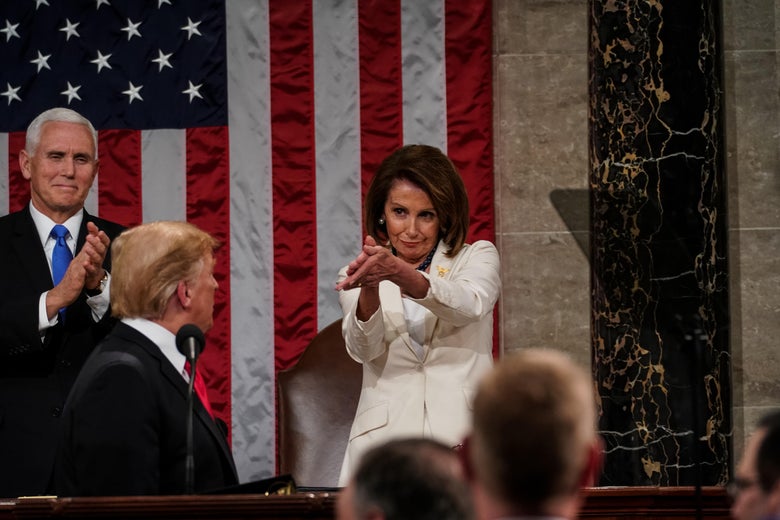
Amazing how much he has accomplished, isn't it?  Nancy Pelosi provides the applause:


Wednesday, February 06, 2019

"So much unity! We're getting tired of all the unity!"


First sentence of the second paragraph of the SOTU 2019:

The agenda I will lay out this evening is not a Republican agenda or Democrat agenda, it is the agenda of the American people.
That's the way you unify people, right?

 Democrat Party is an epithet for the Democratic Party in the United States, used in a disparaging fashion by the party's opponents. While historical and occasional current usage includes non-hostile appearances (including from within that party), the term has grown in its negative use since the 1940s, in particular by members of the Republican Party—in party platforms, partisan speeches, and press releases—as well as by conservative commentators. While there is grammatical argument regarding the propriety of use of both of the terms, with ending and without, ongoing use of the shortened term for political ends is a source of irritation to members of the Democratic Party.

You really don't have to examine anything else in the speech after that, or refer to any prior actions by the President.  The offense is hiding in plain sight.

"You should smile more!"


So apparently it wasn't just Peggy Noonan who had a problem with Alexandria Ocasia-Cortez at the SOTU.


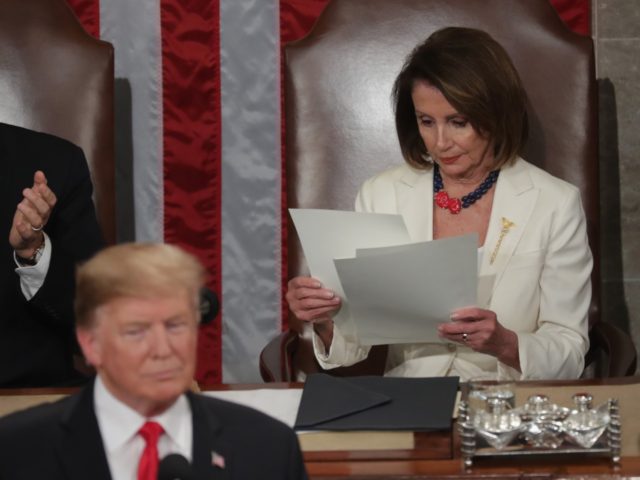
I wonder why they aren't complaining about Nancy Pelosi's behavior during the speech. It's the pictures of the Speaker, after all, that have gone viral.  This, for example:


Even Breitbart used that picture without comment on it.   And what about these?

You can say "At least she doesn't look sullen."  But she doesn't look like somebody you want to take on, either.   Maybe it's because Trump calls her "Nancy."  Or maybe it's because they don't want to mess with her anymore than Trump does.


"How Would You Spend Them?"


This started here, if you're interested in the context.  I decided to post all 25 tweets because the substance of this issue (border security) is so rarely discussed, and because the nature and definition of that idea of security, as well as of the reality of border, is, as Crenshaw's tweets proved, so often dismissed in favor of ignorant sloganeering.  The tweets, for the most part, speak for themselves; although they break into two segments by the author herself.  In the first segment she lays out her credentials (challenged by Crenshaw) and asks the basic question of government:  why should we spend public monies this way?, a question largely ignored in this discussion.  In the second part Ms. Kayyem argues the fundamental issues of how a policy is proposed, defended, and agreed on; matters, again, largely ignored in the national discourse that wants to resolve the issue into the stubbornness of children on one side or the other.  This struggle is about how government should function and why it should function that way; it is not about who wins and who loses and the next election cycle.


And then the discussion of policy and security and even how government should function, was re-engaged. Note especially in this second part of the discussion the concept of a "single point of failure".


This is the way a discussion of government policy and, perhaps more important, government spending should proceed.  The discussion of the wall has never advanced beyond bad slogans ("Build the wall and crime will fall!", which even Trump has abandoned) and posturing presented as moral positioning:

“I never think it’s a mistake to stand up for what you believe in,” [Vice President] Pence said, “and I think what the American people admire most about this president is he says what he means and he means what he says in a very real sense.”

“He said there’s a crisis at our southern border,” Pence added. “He said he was determined to get the funding to build a wall and secure our border, and he was willing to take a stand to accomplish that.”

Well, until he folded like a tent without a tent pole.

Ms. Kayyem presents the facts and reasons which should be the basis for any argument for or against a proposed government policy and related expenditures.  There was an argument during the last shutdown to "just give him the money!", as if that's the way government should function.  I'm quite sure government funding is seldom really treated as "real money," but that's no excuse for letting this bedrock principle of governance be run over roughshod for such a silly and indefensible reason.  If Trump is doing all of this simply to assure his base he will keep his campaign promises, we need to reconsider his legitimacy as President, because he is not presenting even the fig leaf to cover his ignorance of how government works.  Imagine a CEO making this kind of presentation for the use of corporate funds:  do it because I said so and I promise to do it if I became CEO!  Is that a good reason to spend the money, to pursue the project?  Is that any way to run a business?  And yet we were told a businessman would run government far better than a politician will.  Is this better?  Is this sensible?  Or is it merely mob rule, the President responding to his "base," a minority of voters who base their opinions on ignorance and xenophobia and racism?

It's at this point I have to point out Rep. Will Hurd actually knows about life on the Texas border, where Rep. Dan Crenshaw is a newly minted representative from a suburban district in Houston, Texas.  Houston is, to its shame, a major center of human trafficking, but that's not because Houston is on the Mexican border or indeed anywhere near it.  It's because Houston is a major air travel hub and a port city, two conditions a border wall won't affect in the least; and the issue of human trafficking through Houston should be Rep. Crenshaw's concern.  His district doesn't touch on the Texas-Mexico border, and his knowledge of it from one Jeep ride with a Border Patrol Agent does not make him more knowledgeable than Rep. Hurd or Ms. Kayyem.  So far as I know, he didn't respond to her argument on Twitter.  That her argument has to be made on Twitter, and that it sounds so rational among the news reports about immigrants and "security" and borders, that it proves the paucity of our national discussion and the emptiness of so many politician's words, is perhaps the strongest indictment of our media and our systems of governance.

We can only keep it, if we insist it be run properly.  This is not an utter failure of government; but it's pretty goddamned close.

Gettin' All Righteous Up In Here

It must be the long span between Christmas and Lent this year; Epiphany is leaving me too much time on my hands.  But I was reflecting on Trump's appeal to evangelicals, and to the famous words of Micah:

Hear what the LORD says: Rise, plead your case before the mountains, and let the hills hear your voice. Hear, you mountains, the controversy of the LORD, and you enduring foundations of the earth; for the LORD has a controversy with his people, and he will contend with Israel. "0 my people, what have I done to you? In what have I wearied you? Answer me! For I brought you up from the land of Egypt, and redeemed you from the house of slavery; and I sent before you Moses, Aaron, and Miriam. 0 my people, remember now what King Balak of Moab devised, what Balaam son of Beor answered him, and what happened from Shittim to Gilgal, that you may know the saving acts of the LORD." "With what shall I come before the LORD, and bow myself before God on high? Shall I come before him with burnt offerings, with calves a year old? Will the LORD be pleased with thousands of rams, with ten thousands of rivers of oil? Shall I give my firstborn for my transgression, the fruit of my body for the sin of my soul?" He has told you, O mortal, what is good; and what does the LORD require of you but to do justice, and to love kindness, and to walk humbly with your God?

Micah 6:1-8

I could have just cut to v. 8, the most famous verse from Micah; but I like putting these things in context, even if I don't want to address the context.  What I want to address is v. 8; but it comes in the context of what is important to the God of Abraham, and what is important is not the sacrifices humans are so eager to make.  Sacrifices they are eager about because those sacrifices so often involve sacrifice by something else, actions that are repeatable but not really functional, that don't involve other people, and certainly don't involve treating other people, all people, as people.  Notice the order of the litany in v. 8, where this discussion about God and relationship and sacrifice culminates..  I was going to point out none of these three applies to Trump, or to Jerry Falwell's son's public actions, or those of Bill Graham's son, or Robert Jeffress in Dallas, and on and on.  Seat myself comfortably on the throne of judgment, in other words; but then I would be judged, too.  So just pay attention to the order of the litany.  What comes first?

Justice.

There is so much encompassed in that word I almost don't know where to start; but justice begins with what is what is done in the name of consideration of the Other, not in consideration of you.  I had a friend who had been a legal secretary to a criminal lawyer before I met and worked with her, and she said the lawyer often returned from the courthouse and, if his client had been convicted, declared that "Justice was done!"  Not because he believed his clients guilty, but because that is the system of justice, that is pretty much what we call "justice".  I represented many clients who thought justice meant they would win.  Donald Trump's insistence that a deal mean he wins, is not that extraordinary, except in such a high office and place of such responsibility.  Justice begins with not being about you and what you think is in your best interests.  That's a good starting point, so let's leave it there and move on to the next admonition.

Mercy.

Mercy is also not about you.  Showing mercy can be the hardest thing you do, because who knows if the person you show it to deserves mercy?  I had a friend the other day approached on the street by a young girl, a teenaged girl, who seemed visibly upset and tearfully spun a tale of woe, of living on the streets and needing some money just for food.  Was it a lie?  Was she, quite credibly possible in this, one of the centers of human trafficking, being forced to beg by her captor, who was watching nearby?  Would mercy benefit her, feed a pernicious addiction, go in someone else's pocket and further her slavery?  Would mercy be shown to a con artist?  To a victim? All of which raises the fundamental question of mercy:  when is mercy about the other person, and not about you?  How much are you your brother's/sister's keeper?  Mercy, it turns out, is as simple and easy and clear cut as justice.  Yet what society are we without both?  We pay lip service to both ideals; but what would our society look like if we instantiated them, made them the bedrock of our law and our public morals and our common dealings?  What then?  What if we lived our lives as if they were about other people, and not about us?  Would we be more merciful and just?  Would we be any less so?

Walking humbly with God.

Finally, a mention of the God of Abraham; and what is the mention?  It is not aimed at some requirement God has to be worshipped and adored, or even to have as many companions as possible. It is still aimed at you, and now it is about humility.  Then again, what true justice and what true mercy is there, without humility?  The arrogant man is not just, he is preening in his power to punish or bless.  The calculating man is not merciful, he is gauging the value of his ability to dispense gifts.  We don't have to set aside God to ask:  what would our society look like if we followed this litany?  If we did justice, loved mercy, and walked humbly with God, whom Jesus identifies as the least and last among us (so no metaphysics required, if you don't want them), what then?

For one thing, we'd have to leave the evangelicals to explain their business, without us clambering into the judgement seat.

The Times They Are A'Changin'

Tuesday, February 05, 2019

The State of the Union

He shall from time to time give to the Congress information of the state of the union, and recommend to their consideration such measures as he shall judge necessary and expedient; 
Art. II, Sec. 3, U.S Constitution

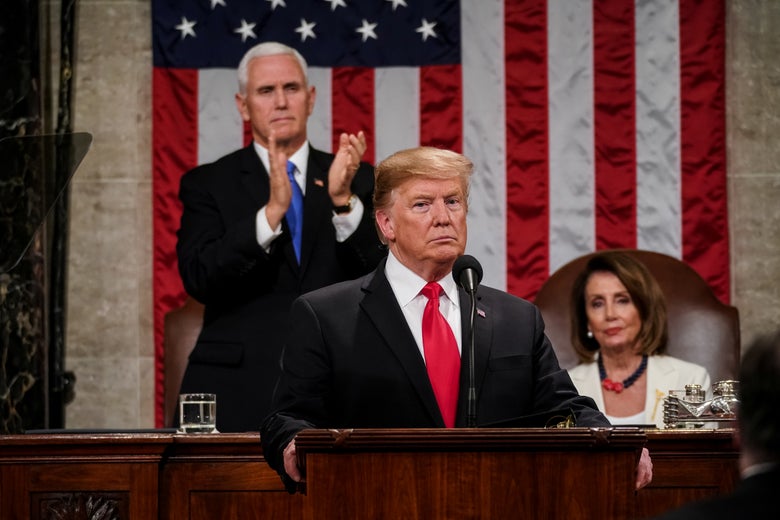
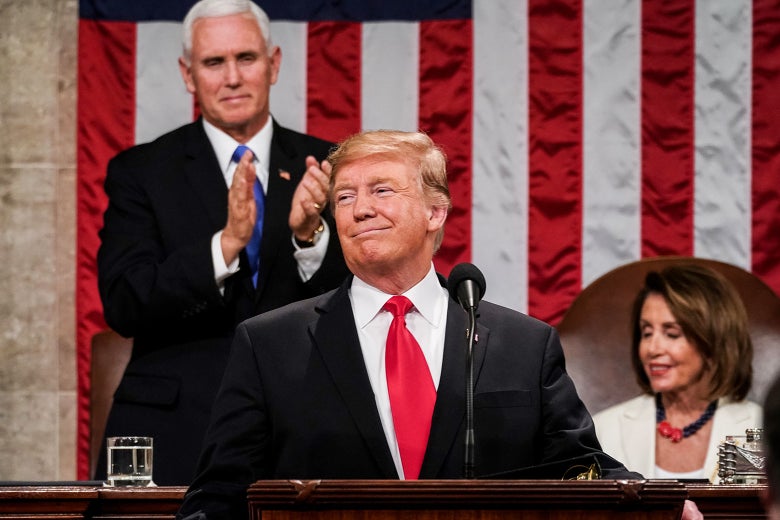
This "report" is included in the Constitution to remind the President that he reports to Congress on a regular basis.  In the era of the Imperial Presidency, it has become a grand-standing event.  In the Age of Trump, it has become all about the pictures.  Donald Trump was forced to back down when Speaker Pelosi told him the invitation was suspended until after the government shutdown (which he ended, because he began it) was ended.  Trump wanted the pomp and ceremony of speaking to a joint Session of Congress from the well of the House so badly he could taste it, and when he got the chance, he tried to get back a little of his own:

“We should point out, if the speech started abruptly — especially to fans of history watching at home — she was supposed to introduce the president,” Brian Williams reminded.

“The language we’ve become used to, ‘the distinct pleasure and high honor,’ followed by a volley of cursory applause, but the president jumped in before the speaker could introduce the president,” he explained.
If you're explaining, you're losing.  Besides, a picture is worth a thousand words:


Dan Rather is right; no one is going to remember this speech.  That picture, however, is eternal.  As well as a good reminder of what the SOTU is about.

Doomed to Repeat It


If we were in France, we might be hearing the sound of tumbrels.  And a silence nobody seems to be noticing (which puts us all in the same class with Trump):


As Close As I Plan to Get To The SOTU


Or before....

Adding:  I am truly thankful for books and Netflix.

A pox on all their houses.

Monday, February 04, 2019

We Are All Procedural and Legal Experts Now


I read Twitter so you don't have to:


The basic idea here is:  if Trump uses the National Emergencies Act to declare himself king and announce an emergency on the Mexican border, the House can pass a resolution cancelling the emergency which the Senate would then take up.  But would the Senate have to take it up?
Alternatively, will Trump just shut down the government again?
So the options are:  1) stop this nonsense.  2) shutdown the government again, which worked so well the last time.  3) declare an emergency, but do not pass "Go" and do not collect $200, but instead wind up on the wrong side of a court injunction and face open fracturing of the Senate (which might not override the veto, but the damage would be done before that).

Helluva way to run a railroad.

Where Angels Fear to Tread


First, this stuff looks dreadful.  Were it offered to me at a Super Bowl party (or anywhere else, for that matter), I would politely pass it by.

It gets worse when you know what's in it.


But the dumb part of this Vox article is assuming "queso" is some kind of "Latin" dish that only "Latinos" can make, or comment on.  Puh-leeze.

I have a recipe book full of queso recipes put together by a Texas expatriate who, from her pictures on her cookbooks (I have three of them), is as white as a white girl can be.  Her queso book includes recipes from as far "north" as Austin (she may have one from Dallas) and as far "south" as the Border.  Most are from Texas, and most are from restaurants large and small, renowned and unknown.  The variety of ingredients is impressive, the variety of styles is remarkable, but one simple truth abounds:  cheese melted together with hot peppers is not "Latin" or "Mexican" or even "Central American."  It's cheese dip.

Maybe it's called "queso" because it's spicy, and spicy means "Mexican" (except in southern Louisiana, but I don't know of any cheese dip associated with Cajun or even Creole cuisine).  We're actually into treacherous territory here.  I got a sample magazine from Christopher Kimball, the whitest male associated with food that I know of, and he acknowledged in its pages that his idea of cuisine was Vermont-centric and therefore Euro-centric, and what he had learned in his new venture ("Milk Street") is that we should no longer speak of "ethnic food," because the term is condescending and parochial.  "Ethnic food" in Asia, after all, would be hamburgers and french fries and Cokes, and while I might not see the appeal of a hamburger colored with squid ink, I'd never say the Asians should leave that dish to the "whites."  And saying "I made queso" is actually closer to saying "I made cerveza" than it is to saying "I made a casserole" (which should have cream of mushroom soup in it.  In fact, that's the only use of cream of mushroom soup I would countenace.  YMMV.).  At least in direct translation it is. This turns into a minefield once we start an argument about who is, and who is not, qualified to present a recipe on-line.

So let's get back to queso.  There's nothing really "Latin" about melting Velveeta and adding a can of Ro-Tel tomatoes to it, although it is delicious.  I have queso recipes that use Cheddar cheese, and one (at least) that uses Muenster and (IIRC) sour cream.  The varieties of ingredients in "good" queso can be quite surprising, and some would seem very "white" indeed (barbecue!).  Queso is a bit like chili:  some recipes are simple and basic (and usually the best), some include so much it stops being chili (at least by Texas standards).  Is chili "Latin"?  Can we even take that question seriously?  Making the cheese dip of my childhood (and adulthood; I have some in the fridge at home I'll be heating up this afternoon) into something only Latinos can write tweets about is...well, it's condescending and just a bit too precious.

And really, to her credit, Dana Perino noted the Vox article:


She gets a lot of credit for being such a good sport about this, especially on Twitter.  Vox, on the other hand, really needs to adjust their spectacles on how they view food and who can contribute a recipe about it.

We're all eating at the same table, ya know.  At least, we should be.

Sunday, February 03, 2019

1 dimensional criminals are so single-minded


2 dimensional criminals are hard to see when they turn sideways.

4 dimensional criminals are really hard to grasp.

In other important news:

Did they draw little hearts and smiley-faces on each other's score cards?

What the schedules show: Trump, an early riser, usually spends the first 5 hours of the day in Executive Time. Each day's schedule places Trump in "Location: Oval Office" from 8 to 11 a.m.

But Trump, who often wakes before 6 a.m., is never in the Oval during those hours, according to six sources with direct knowledge.

Instead, he spends his mornings in the residence, watching TV, reading the papers, and responding to what he sees and reads by phoning aides, members of Congress, friends, administration officials and informal advisers.
Since Nov. 7, the day after the midterm elections, Trump has spent around 297 hours in Executive Time, according to the 51 private schedules we've obtained.

For those same schedules, Trump has had about 77 hours scheduled for meetings that include policy planning, legislative strategy and video recordings.

The most important asset in any presidency is the president's time," [Chris] Whipple said. "And Trump is a guy who gives new meaning to the notion of an unstructured presidency."

Gross Incompetence Or High Treason?

What's the difference?