Thursday, March 05, 2015

Blessed are the Poor* (Offer not valid in America)


Why does this sign never seem to wear out?


Can we just say America is no country to be poor in?

Recent reports of "debtor's prisons" returning to America have come and gone.  Now they are being reinforced by stories about Ferguson, Missouri, financing it's city government on the backs of the poor.  

Pro Publica reveals how worker's compensation has been all but eliminated as a way to pay people who are injured on the job.  Worker's compensation was an idea that came out of Germany in the early 20th century, designed to replace the only recourse injured workers had: a tort claim in civil court.  It was the "no fault insurance" of its day:  the injured worker made a claim for compensation, which claim was paid based on a standard of payment for the type of injury incurred.  Although it came to involve lawyers (some of the first work I did when I was hired as a legal assistant by a law firm was worker's compensation cases), it was meant to keep contest out of the system, to lower the cost to everyone and get the money to the worker as quickly as possible.  Now it is a system for keeping money from the worker for as long as possible.

In Texas, the new Lite Guv (hat tip to the late Molly Ivins) is so concerned with the runaway cost potential of Medicaid he wants to drastically reduce the number of Texans eligible for Medicaid.  Seems the number of individuals who qualify for even the stingy Medicaid Texas allows has gone up too rapidly in the past few years.  Texas crows about the number of people who move here, a sure sign of our economic success and proper balance of government and bidness.  When that brings an inordinate number of poor people (because we have the highest percentage of population in the country earning the minimum wage), we solve that problem by making more poor people invisible.

The proposed solution is health savings accounts and co-pays placed on Medicaid recipients.  The problem with that solution is, the majority of Texans on Medicaid are children, pregnant women, the elderly poor, and disabled workers (back to worker's comp).  These are people living not paycheck to paycheck, but without paychecks.  Where they get the money to save for an HSA (or the life span, in the case of the children) and meet co-pays, is their problem.  People are too damned expensive.  Medicaid is "unsustainable," largely because the powers that be in Texas don't want to sustain it.

Sorry, poor Texans:  sucks to be you.

I'm not sure which is the greater scandal:  Ferguson, Missouri, or the absolute disdain for the poor in Texas.  The latter cuts across racial lines:  it's money that matters in the U.S.A., and without money skin color doesn't really get to be a factor.  It is hideous what the government of Ferguson did to its residents, and that it did so on the basis of skin color. But it more clearly acted on the basis of income, which makes it of a piece with Texas' disdain for the poor, and the nationwide scandal that is the worker's compensation system (each state runs and funds its own system).

This is America, where poverty and race go hand in hand.  But it's not about race, because it's never about race.  And we have no class system; to even suggest that, is to spark class warfare.

Wednesday, March 04, 2015

The Wasteland


Now I'm just being obnoxious to point this out, but Noam Chomsky is right:

“Is there a slave museum in the United States?” Chomsky asks. “Actually, the first one is just being established now by private—some private donor. I mean, this is the core of our history, along with the extermination or expulsion of the native population, but it’s not part of our consciousness. ”

There are a number of "Holocaust" museums in America, including one in the town where I live.  Nothing wrong with that, but America had bugger all to do with the Holocaust, yet we want to remember it.

Fine.  Well and good.  Where is the museum commemorating the "Trail of Tears"?  Wounded Knee?  Indeed, the virtual extermination of the natives who were here when Europeans first arrived?  Slavery was a 400 year old business.  It built much of the wealth of America.

Where do we remember it?

We don't, of course. We remember the Holocaust, because we should never forget.  But we forget our own historical genocides, our own complicity in slavery.  The wound runs deep, even today.  I tried to find the link for it, but BBC World Service is not so accommodating.  They've been running a series of stories from Selma, Alabama.  Day before yesterday residents of Selma complained about their notoriety based on events which happened 50 years ago.  Selma has changed, they insisted; it isn't like that anymore.

Yesterday they ran a story about schools in Selma.  Seems the public schools are predominately, and in some cases exclusively, black.  Private schools are predominately, and in some cases exclusively, white.  They interviewed an African American woman who told of getting her child enrolled in a private school.  She was invited to the first meeting of parents, before school started, and was treated to a parent standing up and castigating school leaders for destroying the "traditions" of that school; by admitting her daughter, of course.

But wait, it gets worse.  A spokesman for Alabama schools told the BBC that Brown v. Board had tried to force people to do what they didn't want to do, and the federal government can't mandate that.  State governments, of course, can mandate racial segregation, but the federal government can't override that mandate.  White private schools and black public schools are just a result of Brown v. Board, of the federal government meddling where it doesn't belong, of not understanding what people really want.

In short, the very same racist arguments I heard as a child, unchanged by time, undimmed by the passage of the years.  But challenge that man, call him a racist, and you would offend him; as you would had he been making those arguments 50 years ago.

As Charlie Pierce says, it's not about race, because it's never about race (especially in Ferguson).  As Wendell Berry says, we have a hidden wound, and that wound is how much our country was founded upon, and still depends upon, racism.

We work very, very hard to keep that wound hidden.

Tuesday, March 03, 2015

Sunday Mornin' comin' down


So Alternet (via Salon) tells me, once again, that religion is in sharp decline in America, and it's all over but the crying as we are now a "post-religious" country, and soon atheism will rule the land with Richard Dawkins as our acknowledged savior.

Okay, some of that might not be true.

But via Thought Criminal I get this link, and this fascinating chart.  It seems that, as of 1906, 41% of the population (per the Census Bureau) considered themselves members of a religious organization (I'll presume this is self-reported, rather than derived from an analysis of church records).  92 years later, that percentage was 70%.

And I'm supposed to believe, in 17 years, that number has plummeted to a record low?  Or at least low enough to indicate we are all atheists now, or will be by the time my grandchildren are around?

Yeah, right.  So, what were we in 1906?

I've said before that the massive increase in church attendance after World War II was an historical aberration, and that, if anything, we are slowly returning to a normal level in the population.  Per the information at that link, we are returning very slowly, indeed.  You can see in the charts there that the percentage of the population claiming religious membership leaps forward in 1940, a climb that is unabated until about 1970, and begins to rise again in 1980.  It's probably true, as Alternet says, that fundamentalism is loosening the death grip on American society it seemed to have in the last decade or so (although neo-atheists still insist it is being rammed down our throats somewhere, somehow), but that's hardly the same thing as saying we are all "nones" now.

Let me just point out the Salon/Alternet article makes much of the fact that "unaffiliated" is the second largest category of the population in some states.  In 1906, it was the largest category in the nation, and stayed that way until sometime in the 1950's.  What Baby Boomers have grown up with is the aberration, not the norm.  But that norm hadn't shifted much by the end of the century:

At the end of the century, eight of every ten Americans were Christian, one adhered to another religion, and one had no religious preference. The non- Christians included Jews, Buddhists, and a rapidly growing number of Muslims

10% had "no religious preference," which is not the same thing as no religious belief.  If that has changed dramatically in only 14 years, where are all the empty churches and synagogues and mosques?  A mere addition of 1% would be over 3 million people.  Surely that would impact the number of people attending worship, even if the percentage of those attending worship didn't change.

Speaking of which, in 1939, 43% reported attending worship regularly; by 1988, that number was at 40%.  It climbed to around 50% in the late 50's,  but pretty much stayed around the 40% mark for half a century.    The shifts over that time are barely statistically significant.   That seems to be a fairly culturally set number.  I see no reason to expect it has plummeted since 1998.

There have been changes in American attitudes toward religion:

As recently as the 1920s, church membership was routinely inherited and implied obedience to a set of behavioral rules. Over the years, church membership became elective and behav ioral rules lost their importance.

American religion lost much of its authoritative character. The mainline Protestant churches no longer applied their traditional sanctions against fornication, illegitimacy, divorce, homosexuality, suicide, and blasphemy. The majority of Catholics favored and practiced birth control, contrary to church doctrine.

The growth of evangelical denominations committed to biblical literalism can be interpreted as a reaction against this general trend, as the 1999 figures in the two charts suggest (see page 108). But even in that conservative sector of the religious spectrum, some old prohibitions—including those against fornication, illegitimacy, drinking, dancing, gambling, homosexuality, abortion, and illegal drug use—often appeared less enforceable by the end of the century.
But those changes reflect changes in culture, not the authority of religion.  Many of the strictures that were less enforceable in 1999 have become even less enforceable 15 years later, especially with the rapid acceptance of same-sex marriage.  But shifts in church or culture, if anything, have still changed worship attendance (decline in attendance to Catholic Mass is attributed to the changes wrought by Vatican II) only slightly.  The fact that the attendance number is so steady indicates the role of religion in individual lives hasn't changed much in, well, my lifetime, at least.  Same as it ever was, in other words.

These statistics, to me, reflect social approval and opprobrium, set in a culture accepting of religious belief.  The shifts over time reflect shifts in the society, not shifts guiding the society.  The chapter I've been quoting starts off noting:

More than 150 years ago, in his Democracy in America, Alexis de Tocqueville wrote, “America is still the place where the Christian religion has kept the greatest real power over men’s souls.” That might still be said at the close of the twentieth century. Tocqueville attributed this phenomenon to the multiplicity of independent sects in the United States, unmatched anywhere else in the world, and to the equally unusual separation of organized religion from the state.

I think Tocqueville is right.  This year marks the 180th anniversary of the publication of the first volume of his most famous work.  I don't think there has been any change in American culture to fundamentally change his observation in all that time.  However it seems there has been a fundamental change in religious sentiment, one that began during the Baby Boom, and while that change may be ebbing, it is not rapidly receding.

It hasn't really receded since the rise began, and that rise now constitutes about 1/3rd of the time that has passed since Tocqueville's observations.  In the succeeding 10% or so of that total span of time, which constitutes the new century, there is no reason to think there has been another fundamental change, or even that one is about to occur.  Unless the change is to a rapid disinterest in theism, or even a fervid embrace of atheism, the only possible change is a return to the status quo at the beginning of the 20th century.

But it's far too early to decide whether even that is happening.

Monday, March 02, 2015

Born in the USA


So I go to see the "feel good" movie "McFarland USA," not because I want to, but because I know somebody who knows somebody who is related to one of the actors (no, I'm not saying more than that).

And I was pleasantly surprised by the "Pastures of Plenty" vibe the whole story gave off, since it is set in California's agricultural region where Mexicans (by and large) are "pickers" in the field, back-breaking labor that starts at dawn and continues without relent all day.  When Kevin Costner's character joins them for one day (there are reason), he asks if they get paid by the hour.  No, they tell him; by the field.  So the faster they pick, the better.  It's a hard-knock life doesn't begin to cover it.

It isn't long before Costner's character understands that he understands almost nothing about the lives of the members of his track team.  He goes from trying to motivate them with toughness, to realizing nothing could be harder than the conditions they live under.  He finally motivates them from his respect for them, his willingness to acknowledge they are human beings whose lives matter.

But I see this movie about how invisible such workers are (and it's set in 1987; nothing had changed since Woody Guthrie's song, nothing has really changed since), and then I read this:

More recently, writer Michael Shermer has expanded on this idea. In his new book, “The Moral Arc: How Science and Reason Lead Humanity Toward Truth, Justice, and Freedom,” he argues that “moral progress” can be directly attributed to the values associated with the West’s embrace of science and reason, which he traces to the beginning of the Enlightenment in the 17th century. As an example, he cites the famous “golden rule” — that we should do unto others as we’d want them to do unto us. The rule is hardly new — it’s found in the Bible — but it is no mean feat to actually put it into practice. To fully wrap your head around the golden rule, you have to mentally place yourself in someone else’s shoes. It is a cognitively demanding task, and one that calls for abstract reasoning.

Today we recoil from the idea of inflicting harm on others — but it is far from clear why we would have evolved such a stance. 
Actually what we recoil from is images of harm being inflicted on others, especially when it is done in our name.  Like the Romans, we still prefer to pay people to inflict harm for us:  be they soldiers or police. We don't recoil from inflicting harm; we don't even recoil from the death penalty.  What we recoil from is getting our hands dirty.

Values associated with the West's "embrace of science and reason" led to the near extermination of the natives in this country; to an international slave trade whose fruits our Enlightenment Founding Fathers enjoyed robustly, as well as the industrial scale genocide of the Holocaust and such delights as forced sterilization ("three generations of imbeciles is enough!"  "Imbeciles" was a legal term incorporated from science at the time) and the nuclear annihilation of Hiroshima and Nagasaki, not to mention the fire-bombing of Dresden.  I don't mean to pick on any particular country in that catalog, but we are so prone to exclude ourselves from such accountings that it bears focussing on our sins.

As for the "Golden Rule," it's quite an old one (it was old when Jesus cited it), and to this day few have managed to "wrap their heads" around it.  I have no idea how science and reason create the abstract reasoning possible to realize the implementation of that rule, but then abstract reasoning is hardly a product of the Enlightenment alone.  If Mr. Schermer, or  Mr. Falk, think it is, then they need to go back to grade school and start over; they really missed something.

What's primarily missing is any respect for the "other."  What's primarily missing is any ability to wrap their heads around the golden rule, no matter now capable of abstract reasoning they think themselves.  No matter what, like Kevin Costner's character, they are reasoning from their experience; and their experience, they think, is both universal, and privileged.  Privileged because it is correct; and correct, because it is theirs.

That Golden Rule really is no mean feat to put into practice, is it?

Sunday, March 01, 2015

Holier than thou


I think this pretty much gets to the objection most atheists have with religion:

Obeisance to imaginary celestial despots and faith in ancient Middle Eastern “holy books” of whatever kind have never owned a place in my life. If believers should try to convert me, I would respond with one or another version of Lucifer’s fabled retort to God’s command to submit to Him or be cast out of heaven: Non serviam! I shall not serve!
That comes in the context of quoting Christopher Hitchens, that "the influence of churches, and the effect of religious belief, is positively harmful.”  There's already a lively debate over that subject (and I think the answer is "human nature," not "religion"), but interestingly that quote is used to justify the assertion "I shall not serve!"

I would counter, with Dylan, that "you're gonna have to serve somebody."  But that's merely to raise a point of opposition; the real issue is, for most atheists, religion involves some kind of crooking of the knee.  It's one reason Nietzsche, in undiluted form or in some watered-down variant, is so appealing to them.

It's the reason prayer is despised as:

...sitting for a quiet moment and beseeching his or her Lord for intervention in matters of grave import...with lowered head and genuflections and other toadying gestures of obeisance — behavior that without faith’s halo would be classified as symptoms of mental derangement. 

This, by the way, is presented as an "objective" view of the activity of prayer; and note the behavior, complete with "toadying gestures of obeisance" is "objectively" classified as "symptoms of mental derangement."  Mr. Tayler writes on the internet, which makes him an expert in diagnoses of mental states.

But there we have it again:  "toadying gestures of obeisance" is a dismissive an attitude as one can have.  It isn't just dismissive, it's hostile.  One has to wonder why the quiet action of prayer produces such anger in Mr. Tayler, why "obeisance" requires "toadying gestures".  Of course, he also wants to identify himself with Satan, prompting one to point out:  you ain't that important.  And to wonder:  do you have a boss?  Do you recognize the legitimacy of authority at all?  Because you're starting to sound like the most radical of the anti-government crowd, who use this sort of argument to deny the authority of anyone but the county sheriff, and then only when the sheriff isn't coming for them.

There is worthwhile discussion to be had here, somewhere between the strident defiance of Nietzsche and Merton finding in Abbey Gethsemani "the four walls of my freedom."  What's interesting is the refusal to admit that complexity, as if anyone anywhere who kneels to pray is impinging on the identity, the very personhood, of Mr. Tayler.  I find this kind of "boundary violation" very often in cases of such stridency.  Ironically, it may be the reason for the shooting in Chapel Hill which is the subject of Mr. Tayler's latest screed, although the boundary may have been merely the stripes between spaces on a parking lot.  One boundary is as abstract as the other, and it may well be Christopher Stephen Hicks was very concerned about the boundaries around a parking space that he imagined were inviolate.  It's a bit ironic that his atheism would be identified with the protection of a "holy space."  'Holy," after all, is not a theological term; it means something that must remain pure, undefiled, set apart.

It's an easy enough term to apply to Mr. Hicks' apparent obsession with a designated area of a parking lot.  As I said, violence has a lot less to do with religion, than it does with human nature.

Friday, February 27, 2015

The blue and the black


So, is it blue and black, or is it white and gold?

The way I arranged that question should tell you what I see.  My preference is initial, not secondary.  (Yes, I could be more fatuous about this, but how far dare I go?)

What's interesting is the number of comments on this from people convinced only one set of colors is possible, and people who claim to see the others are obviously liars and fools and just trying to fool with their haids!   (Second best are the people relying on Photoshop to analyze the colors and tell them what they are seeing.  I do wonder how many people could actually identify "cyan" or "magenta" without a labeled color card).

Well, that's what's going on at Slate, anyway.  According to that article Buzzed settled the issue with a poll that determined almost 75% of people see white and gold.  Which is objective proof, along with your lyin' eyes.

So who you gonna believe?  Me?  Or your lyin' eyes?

There may be an explanation for this.  Wired (again, per Slate) insists it's all because of how we are...wired.  Which seems a little obvious, and quite a bit obtuse, at the same time.  Maybe it's the quality of the photograph.  But if we can't believe a photograph, what can we believe about our world?

And if you can't believe your lyin' eyes.....

I don't want to make too much of this, but it is an interesting object lesson in ambiguity and certainty. There is so much jabber on the internet treating ambiguity as if it were an intellectual weakness, and certainty as if it were proof one is aligned with the cosmos, or at least in touch with the Platonic Good.  How much certainty do we have if people don't see the colors we see?  Isn't color objective and immutable?  Is this some kind of fight between Kantians and empiricists, where perception is one thing, "fact" another?  Are there facts which we literally cannot perceive?  How does that work?

Is one group of observers of this photo just trolling the other group?  I mean, if we can't trust the products of our technology (photography, digital reproduction), what can we trust?

Aye, theres' the rub.....


Update:  I'm too lazy to chase down all the theories being proposed as to why people don't see the same dress here (when everything says they should).  Just as I'm too lazy to spend the years of in-depth research such a project would probably require (as opposed to reaching for some on-the-shelf answer which isn't really an answer but will please the non-scientists/non-rigorous empiricists).

But this compendium of theories satisfies me as to one thing:  no one has a clue, and all the answers are simply proof Male Answer Syndrome (in the face of ignorance, make up something at least semi-plausible) is alive and well.  Sadly, this also proves the internet is still mostly run by men.

Sorry.

Wednesday, February 25, 2015

Richard Dawkins is just trolling us now


Are we supposed to take this seriously? 

“There is a balancing act and you have to balance the rights of parents and the rights of children and I think the balance has swung too far towards parents,” [Richard Dawkins] said. “Children do need to be protected so that they can have a proper education and not be indoctrinated in whatever religion their parents happen to have been brought up in.” 
I gotta think even the Anglo-American philosophers at Oxford are embarrassed this guy is on their faculty.  Although Lawrence Krauss is sillier:

“Parents, of course, have concerns and ‘say’ but they don’t have the right to shield their children from knowledge. That is not a right, any more than they have the right to shield their children from healthcare or medicine.”

There is, of course quite a bit of knowledge I prefer to shield my child from, especially when she was young.  That may not be the knowledge Mr. Krauss has in mind, but neither am I going to set him over my child as the arbiter of what she knows or should know.

A few years ago we'd have called this "performance art," just as an attempt to explain it.  I don't know why these guys think they sound rational, or why anyone treats them as if they were.

Indeed, if anything bothers me about what they say, it's that the answer to my question is "Some do."

Back among the Houyhnhnms

Courtesy of Charlie Pierce and Henrik Van Loon:

Again land was sighted. A group of lonely islands. Magellan called them the Philippines, after Philip, the son of his master Charles V, the Philip II of unpleasant historical memory. At first Magellan was well received, but when he used the guns of his ships to make Christian converts he was killed by the aborigines, together with a number of his captains and sailors.
It made me laugh; not because Gulliver espoused his morals to the horses, but because they were so appalled at his tales of European warfare, and this sounds so much like one of those tales.

Pulping Fiction


This article in Slate makes several excellent points.  It also has something to do with FoxNews, though the connection is not an obvious one.  First, the article:

Given this context, ISIS’s insistence on an all-or-nothing caliphate isn’t “medieval” at all. It is a thoroughly modern group. It is executing a new and updated version of the early medieval Arab conquests. (In fact, good cases can be made for thinking of ISIS as shaped by Western political thought.)

As long as there have been conflicts among humans, there have been violent, often public, atrocities: the Roman conquest of Dacia (itself storyboarded on the famous Trajan’s Column in Rome), the Crusades, and the Holocaust. ISIS is part of a long tradition of demeaning one’s enemies through decapitation, incineration, disembowelment, and other reprehensible corporal punishments. But ISIS is better at it than almost any group that has come before it because its fighters are master propagandists, videographers, and photographers. They know how to thrust their violence into the mainstream. So, no, ISIS is not medieval. It is viciously modern.

And especially this:

The danger of calling ISIS “medieval” is not that it hurts medievalists’ feelings; it is that it tempts us to define the group’s special barbarism as something from the past that should be eradicated because, by God, we’ve progressed and are therefore advanced as a people. This, as medieval historian and journalist David Perry has recently pointed out, is dangerous thinking induced by the assumption that the Enlightenment fixed everything. (It didn’t.)

I wouldn't so much blame the Enlightenment directly (though it's certainly a contributing factor), I'd say this is a tendency of human nature.  The period after the collapse of Rome and the Renaissance, after all, was named "medieval" and "the Dark Ages" by the Renaissance, in order to make them feel superior in their return to the ideals of the Greeks and Romans (and not all those ideals were worth returning to).  Especially in America, we tend to think the past is a monolithic bloc of fail from which primordial ooze we finally arose about the time the current generation was born.  Our ignorance of the past is vast.  There was a comment at Salon recently averring that the Bible was written at a time when "intelligence" and "literacy" were both punishable by death.  I have no doubt the person who wrote that sincerely believed that to be true.  I also have no doubt their knowledge of history beyond their own personal memories is zilch.  I'd say that was an aberration, an outlier, but I've come across similar ignorance among my students who don't even know the recent history of America (i.e., with my lifetime), or what conditions prevailed here with regard to race, or equality, or even the status of the law (Brown v. Board, Gideon, Miranda, etc.)  The things they fill in those blanks with is little better than that comment about intelligence and literacy.  The hardest part about education is learning the world is not as simple as you think it is.

Back to the Slate article, we find this conclusion:

Revisionist history is a great equalizer of human experiences. That’s part of why it is a grave error to pretend ISIS’s barbarism is somehow foreign, medieval, or special. It is none of those things. It is modern and pressing. ISIS should be held accountable for slaughtering Yazidis, Muslims, Christians, and other so-called apostates. In the meantime, we must become more reflective, more willing to interrogate our shared history. If we do not—if we refuse to confront our own nostalgia—we run the risk of harboring dangerous thinking about our policies toward groups like this and turning every struggle into one between Good (us) and Evil (them).

All this said, Wood’s essay draws out a crucial point: We have to understand ISIS’s rationality in order to deal with it. Its members are rational people. They are shaping the world they consider themselves destined to live (and die) in. This is where apocalyptic thought is important to understand.
I want to add, at this point, this post by my friend Rick.  Not on the topic of the medieval era per se, but relevant to the idea that ISIS is thoroughly modern rather than medieval.  As always in any discussion of history, anachronisms abound.  Rick's post is another example a lucid, informed analysis that the national discourse needs.  More such writing needs to be found on this modern miracle of the internet.  However, the internet hasn't changed the old adage that you can lead a horse to water, but you can't make him think.

I started this post there.  Then I found this article, via NTodd.  It's a succinct analysis of why we don't need to be very afraid of Muslim terrorism.  We are in fact, the article concludes, at greater risk of dying from a falling refrigerator than at the hands of a Muslim terrorist.  The article even points out the number of terrorist acts perpetrated by non-Muslims, thought no one ever labels those actors by their religion (Buddhist, Christian, Jewish, are the examples provided)   But the comments to the article prove that the message has already been received, and if we aren't afraid, then the terrorists have won.

We need to move past this kind of thinking and start attacking Islam directly. The issue is that Islamic people believe that the Koran is the word of god and they believe some of the ideas in the Koran (most but who is counting)..

They believe in something without evidence and do not feel the need to justify its teachings (its the word of God). Even if these Muslims play nice - they are powerless to really condemn the other Muslims who follow the Koran more closely and act more violently. This is because they too are acting on a belief with no evidence and are not justifying these beliefs.

This leads us to our current mess in which all the continents on the planet are battling Islamic aggression. Basically rather then bitching that hey most Islamic people are basically nice - stop attacking us. We need to tell the Muslims - hey stop believing in the stupid rants of a warlord from 100's of years ago..

The only way to put the brakes on radical Islam is to put the brakes on Islam. We should be creating support groups for the people that leave Islam in the US. Leftists should be treating Islam like way they treat homophobic parents not encouraging the spread of violent nonsense.

This is pretty typical of the level of expertise one finds on the internet, in comments or in articles (such as the one that prompted NTodd's post*).  And typical of the understanding of Islam:  it breeds mindless violence, and there's nothing we can do about it except to declare war on Islam.  The moment you say that, though, the comments will scream that no one ever said that and where did you get such a ludicrous idea?  It's a universe as hermetically sealed as the FoxNews bubble, but it seems to contain a larger population than the viewership of FoxNews.

Or maybe it's just that there really aren't that many people on the internet, after all.  At least no more than actually watch FoxNews.

I was actually told, in comments at Salon, that if I put up a blog with cartoons of Mohammed, I would be killed by angry Muslims.  This despite the fact that only a handful of people have actually been killed in the West by terrorists for publishing depictions of the Prophet deemed offensive by someone somewhere, and those people died in one incident after publishing such cartoons for years.  Nevertheless, we are now all in danger because of "Charlie Hebdo."  It's sheer nonsense, of course.  But now because someone is in danger somewhere, we are all in danger everywhere.  Although, of course, we aren't.  I sympathized with the victims of 9/11, and even the entire city of New York; but I never for a moment thought this meant I was going to be next on the hit list.  I'd be more reasonable to be afraid of my refrigerator.

None of the comments at the Slate article, as best I can tell, grapple with anything said in the quoted paragraphs here, any more than the comments at the Daily Beast grapple with the information there.  The reaction is purely reactionary.  The very topic sets off alarm bells, and all the monkeys come out flinging poo.  There is a lot of screaming at a lot of shibboleths that seem to infect the mind of the internet populace at large.  In comments to the Slate article there is an insistence that ISIS is "medieval," with little or no attention paid to the idea that we all revise history to suit our own ends, and do so at our peril; and especially no recognition that ISIS is actually quite rational, which is part of the problem (far easier to define them as irrational and barbaric, keeping a bright line between Us and Them).  And the only thing to understand about apocalyptic thought is that it must be stopped:  with an apocalypse.

I especially like the line about "progress:"  the us v. them argument is fueled by the idea that "we" have "progressed," while "they" remain benighted and backward.  As I've said before, the difference in cruelty between  death from a drone launched missile (which may merely bring the roof down on you, rather than end your existence in the wink of an eye) and a beheading is a minor one.  The real difference is that we don't use violence for recruiting purposes; well, not directly, anyway.  But we both, ISIS and its opponents, use violence to achieve our ends.

But "they" are medieval, and "we" are not.

I agree we will do better to understand apocalyptic thought than to just damn it; just as I think we're better of understanding fundamentalism than just railing against it.  But frankly, most people hear what they want to hear, and understand what they want to understand.  And it isn't that FoxNews is all that popular or powerful in its own right; it is that we all secretly like the narrative FoxNews deals in.

*Salon, to its credit, has put up a post by a Biblical scholar, a direct response to one of Jeffrey Tayler's unhinged screeds.  It was received as pearls before swine, and far from spurring 900+ comments over several days, disappeared on the day it was posted..  There is actually a lot of wisdom in that casual remark by Jesus; education and even literacy are not enough to make us wise.  It takes a community; and the one brewing on the internet, at least in some small corners, is as ignorant and benighted as any "medieval" society was supposed to be.  Maybe that one goes back to the splinter in your brother's eye that is a reflection of the log in your own.  Which, of course, is a warning to comments like mine.

Tuesday, February 24, 2015

Tl;dr


I want to start here:

And so we come to our last question. Is it possible to control man's mental evolution so as to make him proof against the psychosis of hate and destructiveness? Here I am thinking by no means only of the so-called uncultured masses. Experience proves that it is rather the so-called "intelligentsia" that is most apt to yield to these disastrous collective suggestions, since the intellectual has no direct contact with life in the raw but encounters it in its easiest, synthetic form--upon the printed page.--Albert Einstein in a letter to Sigmund Freud
And I want to end here:

And let no one be afraid to seek him or find him for fear of the loss of good company; faith is no sullen thing, it is not a melancholy, there is not so sociable a thing as the love of Christ Jesus.--John Donne 

Understanding all along that these are notes, a first draft at best, hardly a polished composition fit for publication and the ages.  So let's see what happens.

My actual starting point is here:

By common definition, prayer entails someone sitting for a quiet moment and beseeching his or her Lord for intervention in matters of grave import – that it rain on the crops or souls be saved, that gays be “healed” or atheists “see the light,” and so on. In objective terms, however, the supplicant is demanding improbable favors from an imaginary despot, and most likely doing so with lowered head and genuflections and other toadying gestures of obeisance — behavior that without faith’s halo would be classified as symptoms of mental derangement. (And all the more so if the petitioner claims to receive answers to the muttered incantations.) This debasing ritual, fruitless and foolish though it may be, is at least usually peaceful, but in some cases (notably in certain corners of the Middle East), rioting and rampaging follow, especially on Friday afternoons, when imams may deliver sermons exciting crowds to fury and frenzy. What’s not to like?
That is about the stupidest definition of prayer I've ever come across; but it is the very stupidity of the definition that I want to start with.   There are categories of prayer, beloved of those who are comfortable with pigeonholes and boxes (I type at a desk that would have pleased Dickens, or the narrator of the story of Bartleby.  It's a roll-top desk designed to hold a computer, and my pigeonholes are a mess, a nest of papers and stuff I either need to do or can't let go of.  It's an anti-filing system.).  I don't much care about them, because prayer is not poetry:  one does not compose prayer as one does a sonnet or a villanelle.  Prayer isn't even free verse, or prose:  prayer is words, but prayer may be deeper than words, deeper even than sighs.

So what is prayer?  Perhaps better to start with what prayer is for, and it is not for the deity addressed.  The God of Abraham is a much more active and engaged God than the Good of Plato or the Unmoved Mover of Aristotle.  The God of Abraham is a God seeking to be be engaged with humanity, a god who can even be moved to action by humanity; a god with a heart for humanity.  But that is not to say a God with a whim for humanity; or a capricious nature swayed by the pleas of any member of humanity.  Tayler touches on the crucial point when he describes prayer as "[t]his debasing ritual...."  That's what really bothers him about prayer:  the notion of humility.

Prayer is about addressing God.  I think everyone can agree on that.  I speak, of course, of prayer in the Judeo-Christian context.  Tibetan Buddhist prayer wheels are another matter, and an interesting one.  I await the day when the Senate Chaplain stands in the Senate to open a session and spins a prayer wheel silently.  That doesn't fit any definition of prayer Tayler has in mind, even though it is still prayer.  Still, prayer is address; to whom it may concern, is a matter of personal preference.

Why pray?  Because the deity addressed will accede and deign to notice, perhaps even change conditions?  That's an old and venerable concept.  "Oedipus Rex" opens with the people of Thebes gathered in public prayer before the palace, beseeching the gods to end the drought and famine and plague of stillbirths that afflict the kingdom.  Oedipus commits his first act of hamartia by telling the chorus to pray to him for salvation, since he is their king, and he will save the kingdom (as he did from the Sphinx).  But is that the only possible concept of prayer?  In "Oedipus at Colonus," the blind exile returns to the environs of Thebes to pour out a libation at a shrine, and offer a prayer to the gods, this time to honor them, not to ask something of them.  This prayer is telling:  it is not for the gods so much as it is for Oedipus.  Humbled by his exile, by the tragedy which has ruined and reversed his life, he now recognizes his place before the gods.  Is this a debasing ritual?  Or an acknowledgment of humility and humanity?

Even prayer for intercession is ultimately an act for us, the ones who pray.  We pray for ourselves.  No, not that the deity addressed will give us something; we pray for ourselves.  We are why we pray.  To limit this to a Christian context (the one I know best), we do not pray for God's sake, not even to ask God not to strike us.  We have no such concept of a relationship with God akin to the one assumed by the Greek audience of "Oedipus Rex."  Ab initio our idea of our relationship to God is one of a caring relationship, even if we understand God to be Wholly Other.  We do not understand God to be hostile to our interests.  We don't imagine we must appease God (although some of us imagine God is angry with others, God is never angry with us.  "Gott Mit Uns," the Nazi slogan famously had it, applies to us all in our groups and communities.  It is those "others" God wants to smite for "their" apostasy.  But that's another matter.).  We only imagine we need to invoke God's interests on our behalf, even if that behalf is for the health of a friend or family member.  When we pray "for" someone, we are better off understanding that prayer is for us.  Ideally, it puts us in a position of greater compassion and understanding for the person prayed for.  At least it makes us thing we have done something, in a situation where we can't really do anything.

The most frustrating thing about ministry, and the hardest, is learning that there is little you can do for others.  You can pray for them, and with them; and they can imagine your prayer is more efficacious because you are somehow more holy, closer to God, than the average person.  But prayer is not direct action; it isn't really action at all.  You want to be effective, but you don't have the tools of modern medicine, or psychology; you don't wield the instruments of law to protect someone with legal barriers, or punish the guilty and avenge the innocent with the police power of the state.  You have words.  You have prayer.

And what is "prayer"?

It is for the pray-er.  It is for the person who prays.  Perhaps it makes you spend a moment truly thinking of another instead of yourself.  Perhaps it allows you to experience a deep sense of the ineffable which you may label "God."  I have discovered in my itinerant prayer life (the discipline of a Jesuit, or even a Franciscan, I just do not have) a real sense of the presence of God which, once opened, I find I can access with some regularity.  It is not, thanks be to God, the overwhelming sense that Mother Teresa sought for the rest of her life after she moved to Bombay; it is not the sense that Doris Grumbach felt once, and never again.  It is not the mystical union of the great Christian mystics, or the vision of Julian or Margery Kempe.  But I find it only when I engage in prayer.  I try to humble myself before it, so it will reshape me.  So far it hasn't; which may mean it is a false sense of God; or I'm too far gone, too old to change my ways.  Or it may be my prayer life is still too itinerant, that I use it too little to let myself be changed by it, and the fault is mine.  But if prayer is about us, and about changing us, then it is a dangerous and difficult thing indeed; and no surprise that people like Jeffery Tayler want to denigrate it as severely as they can.  That kind of self-examination is something the Taylers and Dawkins and Harrises of this modern age seem to despise more than anything.  Their self contentment would be disturbed by such examination, and that is something up with which they will not put!

Consider, briefly, the example of the Our Father, the Lord's Prayer:

Our Father in heaven,
your name be revered.
Impose your imperial rule,
enact your will on earth as you have in heaven.
Provide us with the bread we need for the day
Forgive our debts
to the extent that we have forgiven those in debt to us.
And please don't subject us to test after test,
but rescue us from the evil one.  (Matthew 6: 9b-13, SV)

Nothing in it is directed to God; it is all directed at the one who prays.  Who can revere God's name, if not us?  God can impose God's imperial rule and enact God's will on earth as in heaven; but we are directed to ask for that, to seek that, to work to make that happen by directing our prayers toward it.  We ask only that God the Creator, the source of life and blessing, take care of us for today; tomorrow is another day.  And we ask God to forgive us, only so far as we are willing to forgive others.  And the only compassion we ask from God is that we not be tested again and again, but that we be rescued from the evil one.  Nothing there about a Mercedes-Benz, or a color TV, or a night on the town; nothing about a miracle, or a cure, or salvation, or happiness.  This prayer doesn't ask from God, it directs us toward God.  It realigns our thinking.  It redirects our attention, away from us and toward the world, through God.

This brings us, abruptly I think, to Einstein's observation about the intellectual who has no contact with life "in the raw," but knows it only from the printed page.  It's easy to dismiss Tayler's description of prayer as a straw man argument, but it's worse than that.  It's a description based on no understanding at all, which is the same place Richard Dawkins starts from:  he doesn't understand religion because he declares it nonsense ab initio, and he has no need to learn nonsense.  I don't actually find virulence of opinion among most people I know.  They don't care who is a Christian or an atheist, even who is gay or straight or lesbian.  The Gov. and Attorney General of Texas just now insist state law cannot recognize even the court ordered marriage of a lesbian couple; but I don't think the majority of Texans really care.  I suspect they are like my parents, and far more tolerant of the issue than once they were; or, if they know friends and family who are homosexual, they are even more inclined to allow them to live and let live.  I recall, vaguely, a story from D/FW airport where a man in a terminal accosted another man for wearing a pink shirt (!; apparently it meant the shirt-wearer was gay), and a man in cowboy boots and hat, with a Texas drawl, was the first to confront the belligerent and tell him to stop.  I can't imagine a Texas public official doing that, or even a prominent Texas preacher; but the people who live life "in the raw" are far more aware of our humanity than the people who think of us in groups and blocs and affiliations.

I know atheists I consider more Christian than Christians.  I know church going Christians who are models of humility and hospitality.  They are, as Einstein observed, far less easily swayed by "disastrous collective suggestions" than their political and social and religious leaders are.  They are far more inclined to see people as individuals rather than as things.  And that, I think it can be fairly said, is what Donne was getting at:  "there is not so sociable a thing as the love of Christ Jesus."

Yes, plenty of people who profess Christianity seem to do it for the sake of distinguishing themselves from everybody else, or at least from those who are not "true" believers in what they believe.  But Christianity teaches tolerance and even love for others; it's central teaching, according to Paul (often denigrated by know-nothings as the failure of Christianity), is love of one's enemies.  If you can do that, you can love all of humankind, just as God loves all of humankind.   I think Jeffrey Tayler's ideas are foolish, but I would not on that account brand him as outcast.  He might scream in my face, either rhetorically or literally; I would be failing in my confession of Christ as Lord to scream back at him.  Mind you, I might do it; but the failing would be mine, not Christianity's.  I would urge Messrs. Tayler and Dawkins and Harris to self-examination; but I would not condemn them for refusing to engage in it.  I am not superior to someone else because of what I believe; if anything, my proper belief makes me even more humble.  If that brings out someone's inner Nietzsche, I don't get to enjoy some schadenfreude at their expense.  Because religion, like prayer, is for me; it is directed at me examining myself, improving myself, tailoring myself, placing myself not at the center, but in the lives of the other.  I am called by Christ to see him in others; I don't get to choose who those others are.  The moment I start choosing, I am at the center again.

It's an act of great humility, and I'm not very good at it.  But that is why religion and religious faith is about changing me, not changing thee.

Monday, February 23, 2015

Two conditions that often appear alike


So now the question is:  is President Obama really a Christian?

And the answer is:  how do you know?

For one thing, is Jeremiah Wright really a Christian?  Some of us would say yes.  Some would say no.  Who is right?   Of course, the answer depends on what you mean by "Christian," and that definition depends on what confession of faith you accept as validly Christian.

Sam Harris has his answer.  Others have theirs.  Gov. Scott Walker, walking in the footsteps of Rudolph Giuliani (f/k/a "America's Mayor"), raises a different question:  is Obama really a Christian, or does he just say he is?

How do you get out of that one?

There is, of course, no escape from it:  whatever you say, your opponents merely nod and say "Yes, but does he really mean it?"  (You can do the same about Obama's patriotism, and Giuliani did).  We could chase this down pretty hard, because ultimately the answer is the same as "How do I know you love your wife?"

The only honest answer to that is:  "You don't.  You have to take my word for it."  Ordinarily, of course, that's good enough.  No one else has an interest in whether or not I love my wife but me.  The profession is a social convention for the world, a matter of importance only to the two of us.  Ideally no one would have any interest in whether or not the sitting President is of a particular faith, or of no faith at all.  It doesn't really matter to the country.

Except now, apparently, it does.  And here is the real problem with a religious test for public office:  how do you know?

I knew many a fine Southern Baptist in the East Texas town where I grew up, and members of other denominations, who always voted to ban liquor sales in the county, and always kept a fully stocked liquor cabinet.  One of the oldest jokes in my hometown is that you always take two Baptists to go fishing, because if you only have one, he'll drink all your beer.  Are such people real Christians?  Or do they just make the right noises at the right times?

And what about you?  From what privileged position do you judge?  Which is the real problem with Scott Walker's non-position, as Dana Milbank points out:

There will always be people on the fringe who say outrageous things (and Giuliani, once a respected public servant, has sadly joined the nutters as he questioned the president’s patriotism even while claiming he was doing no such thing). But to have a civilized debate, it’s necessary for public officials to disown such beyond-the-pale rhetoric. And Walker failed that fundamental test of leadership.
I will pause here to say, I considered not posting this at all.  Then this morning I read Charlie Pierce's round-up of the Sunday political blatherfest, and oh my good and heavenly Lord, they pulled me back in!

BARBOUR: Well, it's about how you can match up the opportunities. And I remember Jeremiah Wright, who is very unpopular among the people who would be voting in the Republican primary. Now, if someone were asking me about that question, that's the way, if wanted to be political, I wanted to take the question. I think Scott Walker's probably just being truthful, you know. He is a son of a preacher. He is a Christian. And he may have taken that question the way I did the first time I heard about it, do you believe he's really a Christian, or do you believe he just professes to be a Christian? But I don't know the answer to that, either.
First, that "son of a preacher" line.  That's like the tee-totalling Baptist who drinks all your beer in the fishing boat.  Seminary was rife with stories about "PK's" ("Preacher's Kids") who usually are the ones the girls lose their virginity to in the choir loft (yes, presumptively the boys; and no, I don't really imagine this was true for Scott Walker, but anyway).  Preacher's kids are not given special dispensation to read the hearts of others.  Second:  is Scott Walker a Christian?  He says he is, but I just don't know.  Maybe I believe he just professes to be a Christian.  After all, he's shown little or no concern for the poor, for the widow and the orphan, for the marginalized and the powerless.  He's shown a great deal of ability to take care of Scott Walker by preying on the gullibility of others.  So maybe he is a preacher's kid after all....

But who am I to judge?

And Barbour admits the issue is purely political; it's just red meat for the GOP primaries.  On the other hand, he says Walker is just being truthful.  Well, not as truthful as Jeremiah Wright's namesake:

The heart is devious above all else;
it is perverse--
who can understand it?
I the LORD test the mind
and search the heart,
to give to all according to their ways,
according to the fruit of their doings.

Jeremiah 17:9-10

The heart is devious; it cannot be understood, even by God.  But the nature of politics is to exploit that ambiguity.

There is a philosophical bent to this (of course!):

In the Cartesian Meditations, Husserl pointed out that the intentional acts that make up the flow of the other's conscious stream are inaccessible to me; they cannot be known to me without becoming mine, without destroying the alterity of the other.
And I cannot really destroy the otherness, the "alterity," of the other.  I may think I can, but I delude myself; the other remains other; beyond my grasp, and more sealed of from my understanding the more I attempt to destroy that otherness in order to gain understanding.

Haley Barbour, of course, is not interested in destroying the otherness of Barack Obama, but increasing it.  I suppose it's only coincidence nobody ever raised this issue about Bill Clinton.  Yeah, that's it....

NTodd has pointed out this isn't new in American History, so I don't take this as the latest sign of the apocalypse and the end of civilization as we know it (two favorite tropes of commenters on the intertoobs).  But it is tiresome; and there's still (as ever) that question of the splinter and the log; maybe the preacher's kid and now Gov. of Wisconsin knows that story.....

Sunday, February 22, 2015

A Voyage to the Land of the Houyhnhnms on the First Sunday of Lent


This is why you never argue with fools (something I need to learn over and over again, especially when "some one on the internet is wrong!"):

This is not a fatal flaw in the book, but speaks to its contested place as at once an academic survey as well as an intervention in an ongoing but oversimplified and disheartening “debate.” Armstrong wants to examine, in all its complexity, the relationship of religion and violence, and often does so with great success and insight. She also wants to exonerate “religion,” but that tends to muddy the waters of the first, and more important, goal of this book.
That is the concluding paragraph of a brief review of Karen Armstrong's new book, at Religion Dispatches.   It's a good review, I commend it to your reading.  The "debate" is the one raging among on-line atheists and neo-atheists like Richard Dawkins and Bill Maher about whether or not religion is the source of all evil in the world.  It is a pitifully uninformed debate carried out by people proud of their ignorance of the subject (Dawkins) or simply trying to get attention for their cable TV show (Maher).  This is typical of the debate, and if it sounds almost exactly like Rush Limbaugh excusing his racism or his disdain for "liberals," that's because the form of argument is exactly the same:

“Can’t we at least say there are a number of factors that are involved and the religion is certainly one of them? (Obama) presented this idea that, well, it’s poverty and education. It is poverty and education also — but why are they impoverished and uneducated? It’s mostly because of the religion.”
Religion is one of the problems; religion is mostly the problem.  And if you say Maher said religion is the main problem, or THE problem, his supporters will deny with their last breath that he said anything so blinkered and ignorant.  But religion is certainly a problem; in fact, it's mostly the problem.

Along with despotic governments, irresponsible Western leadership since at least the 19th century, and a rapidly changing world which has thrown everybody into what Alvin Toffler rather charmingly, now, called "future shock."

But mostly, the problem is religion:  because a comedian said so.

There is a relationship between violence and religion, and it does not good to ignore it.  I understand the Bhagavad Gita is presented as a vision that comes in the midst of an epic battle.  The Hebrew and Christian scriptures include many descriptions of violence, both real and imaginary, between Genesis and the Apocalypse to John. And the Koran admits violence as well as peace.  Quelle surprise?  Is human history bereft of violence where religious practices do not exist?  And where, pray tell, is that?

But to even ask that question is to engage in the debate; and I don't want to do that.  It is a pointless debate, going nowhere and meant to go nowhere; because it isn't a debate.  It is an accusation, an insult hurled out in hopes of getting a response to prove, "A-HA!  You see!  They ARE violent!  See how violently they respond?!"

Which was, of course, precisely why Dr. King trained his followers in non-violence.  Funny nobody ever brings up the Civil Rights movement in this context, or the liberation of India by Gandhi.  Dr. King's pastorate is ignored, and we are all told what Gandhi accomplished was only because the British were not Stalin.  Both dismissals are racists and hegemonic in their nature:  no one observes that the Russians are not the Indians (who suffered a great deal for their liberation, and who knows might have suffered more?  They proved no government can govern those who will not cooperate.), because the latter are not deemed European.  And any acknowledgment of the church and the SCLC (the Southern Christian Leadership Conference) in the Civil Rights movement is usually allowed only if you emphasize the community structure the black churches provided to the movement; the spirituality that undergirded that community cannot be acknowledged at all.

Gandhi's fight was spiritual; as was King's.  In the modern world especially, we can only understand the spiritual as the miraculous ("Heaven is real!"), and the miraculous we dismiss out of hand.  But that makes us weaker and simpler than the "medieval" peasants we deems ourselves so superior to.  The problem, for the world, with spiritual movements, is that they rest on humility, and the awesome power of powerlessness:  the one power that truly succeeds in this world.

Which is why the world knows it not; and doesn't want to.

Saturday, February 21, 2015

Neuroscience considered as an examination of free will: Another Lenten Meditation

Ecce homo

Seeing as I'm turning this into a commonplace book, I rather like this bit, too:

“Think of those experiments where a subject is instructed to twitch a wrist or push a button whenever he feels moved to do so, and then to report when he consciously made the choice to do it. Then electrodes on the scalp or an MRI can show that a neural impulse precedes the conscious choice by anywhere from one to ten seconds, and the researcher can predict when the subject will perform the action about 70 percent of the time. So the scientist concludes that the real decision is just some autonomic electrical flicker in the brain, while the apparent conscious ‘decision’ is just a posterior accretion, a kind of proprioceptive hallucination. One scientist, that Haynes fellow, even said this renders the existence of free will an ‘implausible’ hypothesis.”

“Never heard of him.”

“But it gets sillier,” Roland continued, more emphatically. “There’s absolutely no logical connection between that experiment and that conclusion. It’s an eisegetical non sequitur. It just shows that a scientist’s interests frequently dictate what he thinks he’s observed. He looks for a mechanical transaction, artificially extracts his data from their actual context, and then miraculously discovers what he has predestined his experiment to disclose. The far more sensible conclusion would have been just the opposite: that these results confirm the reality of rational freedom. My only hesitancy is that, if the subject were absolutely free, one should be able to predict his actions in that situation with 100-percent accuracy.”

I did not want to admit that I was not following his argument, but after several seconds had to: “Why, exactly?”

Roland gazed at me indulgently and shook his head. “Because the subject did exactly what he had freely undertaken to do. He was asked, of his own volition, to act whenever he felt the impulse, and that’s what he did. He wouldn’t have been twitching a wrist or pushing a button otherwise. But the researchers’ bizarre fiction is that they are witnessing an isolated mechanical process without any prior conditions, rather than a premeditated act prosecuted intentionally, so they produce the monstrous fantasy that they have proved that the whole act is reducible to a spontaneous physical urge. I mean, the experiment they imagine they’ve run isn’t even logically possible, because there’s no visible intentional content in any given electrical impulse that identifies it with any particular act. You have to know what’s freely intended beforehand in order to know what the discrete neural event portends. You have to know that the subject chose in advance to translate the impulse into an action. The urge doesn’t go directly to its goal without crossing the interval of consciousness. So what’s the point? That we often feel an urge before we freely decide whether to act on it? Well, you don’t need electrodes on the scalp to prove that. But the urge is never isolated, because at both ends there’s a decision of the conscious mind: undertaking to act in accord with a prompting, then choosing to submit to that prompting. In between there’s some raw physiological agitation, which those free intentions have shaped into an accomplished deed. Let’s just say that that’s the material substrate, and that the intellect that makes the choices is a kind of formal cause: It’s always shaping impulse into intentional action—prospectively, retrospectively . . . synoptically.”

“Yes, all right,” I said.

“I mean, there’s always some prior and final act of the mind, some more capacious realm of intention for any impulse that’s embodied and enacted. Yes? So you can’t ever arrive at a deeper foundation. The researcher can never retreat to a more original moment, some discrete instant when a physical urge exists wholly outside that free movement of the mind. That object just isn’t found in nature. Just you try to find it and you’ll see.”
Hume argued that, since he couldn't perceive his "self" empirically, since the "consciousness" was not available to empirical perception, it couldn't exist, and therefore all sensory data was just creating a sense of perception by an "I" which was the product of the illusion of perception.  I've often thought of this as the TV playing in the empty room, but the room is somehow aware of what is on TV.  If the subject in the above experiment is acting of their own volition, on what basis do we say the act is actually a product of determinism rather than free will?  Because we cannot "see" any other explanation?

Or because we cannot allow it?

As I've often thought, the problem here is not the reality, or lack thereof, of free will; it's the definition of "free."  But then that involves philosophers, and there things get complicated and perhaps messy, and a mechanistic universe hates a mess, so it just sweeps it aside?

That you cannot arrive at a deeper foundation, a "more original moment," reminds me of Kierkegaard's story of the man who became so abstracted from his own existence he awoke one day to find he no longer existed!  It is a search for something that cannot be:  a privileged position from which to observe the universe without being of the universe.

Ancient wisdom calls it seeking to be God.  Modern secularism does away with that possibility, but not with the error itself.  Which is what makes this yet another subject for a Lenten meditation.

Thursday, February 19, 2015

A Lenten Meditation


Well, as long as I'm just sitting here....


I've said it before, or attempted to, but when someone else says it again, and so eloquently and clearly, I want to pass it on.

Via Thought Criminal, David Bentley Hunt reviewing Daniel Dennett's Breaking the Spell:


For one thing, it does not logically follow that, simply because religion as such is a natural phenomenon, it cannot become the vehicle of divine truth, or that it is not in some sense oriented toward a transcendent reality. To imagine that it does so follow is to fall prey to a version of the genetic fallacy, the belief that one need only determine the causal sequence by which something comes into being in order to understand its nature, meaning, content, uses, or value. For another thing, no one believes in religion. Christians, for instance, believe that Jesus of Nazareth rose from the dead and is now, by the power of the Holy Spirit, present to his Church as its Lord. This claim is at once historical and spiritual, and has given rise to an immense diversity of natural expressions: moral, artistic, philosophical, social, legal, and (of course) religious. Regarding “religion” as such, though, it is in keeping with theological tradition to see it as something common to all societies, many of whose manifestations are violent, idiotic, despotic, superstitious, amoral, degrading, and false. The most one can say about religion in the abstract is that it gives ambiguous expression to what Christian tradition calls the “natural desire for God,” and to a human openness to spiritual truth, revelation, or grace.

A number of on-line atheists think they destroy the power of scripture by pointing out it is either old ("Bronze Age" is the favorite label now; it is all a matter of faddishness, these labels) or all too human (all the violence!), or not as damning of slavery as we are today, or just too ignorant of modern cosmology.  Because apparently scripture must be wholly Other, or it is only wholly human.

And human is not good enough to believe in, except as humans "reason," and reason in ways approved of.  Hunt touches on that, pointing out the idea of "memes" which Dennett relies on (via Dawkins)  is a reliance on something that simply cannot be established by empiricism or scientific study.  He describes Dennett's conclusions this way:

It is as if [Dennett] imagines that by imitating the outward forms of scientific method, and by applying an assortment of superficially empirical theories to nonempirical realities, and by tirelessly gathering information, and by asserting the validity of his methods with an incantatory repetitiveness, and by invoking invisible agencies such as memes, and by fiercely believing in the efficacy of all that he is doing, he can summon forth actual hard clinical results, as from the treasure houses of the gods.
It's an attempt I've seen over and over again.  The virtue of the Continental philosophers I read, even the lapsed Catholics like Vattimo, is that they understand there is something about religion which is not dreamt of in such a crabbed and ill-informed philosophy as Dennett's; and that there is nothing wrong with religion being "natural" (indeed, the argument that it can't be is largely the argument of the Christian fundamentalists, whom most on-line atheists, as well as Dennett and Dawkins, take for the majority of Christianity).  As Hunt, the theologian, point out:

Certainly the Christian should be undismayed by the notion that religion is natural “all the way down.” Indeed, it should not matter whether religion is the result of evolutionary imperatives, or of an inclination toward belief inscribed in our genes and in the structure of our brains, or even (more fantastically) of memes that have impressed themselves on our minds and cultures and languages. All things are natural. But nature itself is created toward an end”its consummation in God”and is informed by a more eminent causality”the creative will of God”and is sustained in existence by its participation in the being that flows from God, who is the infinite wellspring of all actuality. And religion, as a part of nature, possesses an innate entelechy and is oriented like everything else toward the union of God and his creatures. Nor should the Christian expect to find any lacunae in the fabric of nature, needing to be repaired by the periodic interventions of a cosmic maintenance technician. God’s transcendence is absolute: He is cause of all things by giving existence to the whole, but nowhere need he act as a rival to any of the contingent, finite, secondary causes by which the universe lives, moves, and has its being in him.
And that is a fine Lenten Meditation.

Wednesday, February 18, 2015

A meditation for Ash Wednesday


This is how Socrates came to be considered an almost proto-Jesus (for better or worse).  It's an idea not much in vogue anymore, but Whitehead's observation is as true in this century as it was in the last.

The speaker is Alcibiades:

But when we listen to [Socrates], or to someone else repeating what [Socrates has] said, even if he puts it ever so badly....we're absolutely staggered and bewitched....Yes, I've heard Pericles and all the other great orators, and very eloquent I thought they were, but they never....turned my whole soul upside down and left me feeling as if I were the lowest of the low.  But this latter-day Marsyas, here, has often left me in such a state of mind that I've felt I simply couldn't go on living the way I did....He makes me admit that while I'm spending my time on politics [!] I am neglecting the things that are crying for attention in myself.  So I just refuse to listen to him....I've been bitten by something much more poisonous than a snake; in fact, mine is the most painful kind of bite there is.  I've been bitten in the heart, or the mind, or whatever you like to call it, by Socrates' philosophy....He talks about pack asses and blacksmiths and shoemakers and tanners, and he always seems to be saying the same old thing in just the same old way.....But if you open up his arguments, and really get into the skin of them, you'll find that....nobody else's are so godlike, so rich in images of virtue, or so...entirely pertinent to those inquiries that help the seeker on his way to the goal of true nobility.

--Symposium, 215d-216a, 218a, 221c-222a


One note:  a common complaint against the gospels is that they weren't written by Jesus, perhaps not even by people who knew Jesus.  We are sure Plato knew Socrates; we're also just as sure there is an "historical" Socrates somewhere in some of the dialogues, and in others (such as The Republic), Socrates is merely Plato's sock puppet (to use the modern idiom).  And yet, Whitehead is right:  all of Western philosophy is just a footnote to Plato; and all of Western philosophy undergirds what we think is valuable, right, good, proper, worthwhile, noble, execrable, etc., etc.  To escape it is to try to escape one's own skin; you simply can't do it.   And yet no one complains about the veracity of Plato's dialogues.

Probably because so much emphasis is placed on the historicity of Jesus of Nazareth, and on whether the Jesus in the gospels is the Jesus who lived in first century Palestine.  But to focus on that is to ignore what the gospels tell us Jesus said.  Perhaps those reports are no more reliable than Plato's reports about Socrates; however, does that mean we can dismiss what Socrates says?  Which matters more: who said it, or what was said?

Surely, in this post-enlightment era, the appeal to authority is dead.  And after all, even if you don't admit the deity of the speaker, does that mean the arguments presented in his words are not "entirely pertinent to those inquiries that help the seeker on his, or her, way to the goal of true nobility?  At least?

Even Lutherans observe Ash Wednesday

"A man who truly buys an indulgence (ie believes it is to be what it is) 
is as rare as someone who truly repents all sin ie very rare."

According to Slate, "demand for theology-themed toys is hot hot hot."

Who knew?

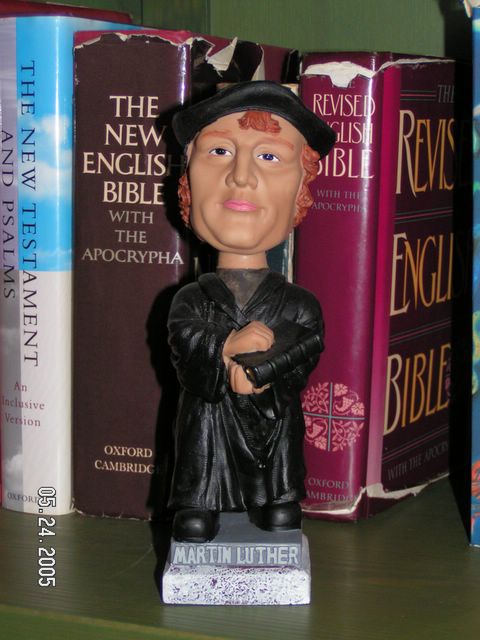
Because Playmobil came out with a "cute" Martin Luther figurine which sold out almost immediately.  Mostly this presents us with an excuse for pictures, like this one contrasting the usual visage of Luther with his much more appealing figurine:


Or this one, which gets at the historical Luther:


Well, the Nazis didn't exactly invent anti-Semitism out of whole cloth.

Still, I can understand why this version of Luther wasn't as popular:


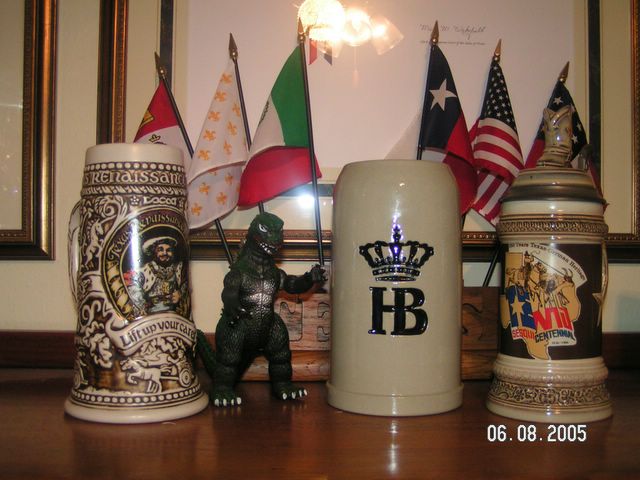
Now, if I'd just posed Luther next to a beer stein, instead of Godzilla:


Ash Wednesday 2015


I

Because I do not hope to turn again
Because I do not hope
Because I do not hope to turn
Desiring this man's gift and that man's scope
I no longer strive to strive towards such things
(Why should the aged eagle stretch its wings?)
Why should I mourn
The vanished power of the usual reign?

Because I do not hope to know again
The infirm glory of the positive hour
Because I do not think
Because I know I shall not know
The one veritable transitory power
Because I cannot drink
There, where trees flower, and springs flow, for there is nothing again

Because I know that time is always time
And place is always and only place
And what is actual is actual only for one time
And only for one place
I rejoice that things are as they are and
I renounce the blessed face
And renounce the voice
Because I cannot hope to turn again

Consequently I rejoice, having to construct something
Upon which to rejoice

And pray to God to have mercy upon us
And I pray that I may forget
These matters that with myself I too much discuss
Too much explain
Because I do hot hope to turn again
Let these words answer
For what is done, not to be done again
May the judgement not be too heavy upon us

Because these wings are no longer wings to fly
But merely vans to beat the air
The air which is now thoroughly small and dry
Smaller and dryer than the will
Teach us to care and not to care
Teach us to sit still.

Pray for us sinners now and at the hour of our death
Pray for us now and at the hour of our death.

(VI)

Blessed sister, holy mother, spirit of the fountain, spirit of the garden,
Suffer us not to mock ourselves with falsehood
Teach us to care and not to care
Teach us to sit still
Even among these rocks,
Our peace in His will
And even among these rocks
Sister, mother
And spirit of the river, spirit of the sea,
Suffer me not to be separated

And let my cry come unto Thee.


--T.S. Eliot, "Ash Wednesday," The Complete Poems and Plays 1909-1950 (New York: Harcourt, Brace & World, 1971), pp. 60-61, 67)