Friday, March 17, 2017

Watching the monkey joylessly dance his tired routine

Then?

We're looking into it very, very strongly. At a certain point in time I'll be revealing some interesting things," Trump said on CNN's American Morning.

Trump first claimed earlier this month he had sent investigators to Obama's home state in an effort to find out if the president was indeed born there, as he says he was and several media organization's independent investigations have confirmed.

"I have people that have been studying it and they cannot believe what they're finding," Trump told NBC then.

But Trump has since offered few details about the on-the-ground investigation and, in the interview with CNN Thursday, wouldn't specifically say if it had uncovered new details.

"You'll be very surprised," he said when asked by CNN's Ali Velshi if his investigators have found anything.

Or now?

Carlson: So on March 4th, 6:35 in the morning, you’re down in Florida, and you tweet, the former administration wiretapped me, surveilled me, at Trump Tower during the last election. How did you find out? You said, I just found out. How did you learn that?

Trump: Well, I’ve been reading about things. I read in, I think it was Jan. 20th, a New York Times article where they were talking about wiretapping. There was an article. I think they used that exact term. I read other things. I watched your friend Bret Baier the day previous where he was talking about certain very complex sets of things happening, and wiretapping. I said, wait a minute, there’s a lot of wiretapping being talked about. I’ve been seeing a lot of things. Now, for the most part, I’m not going to discuss it, because we have it before the committee and we will be submitting things before the committee very soon that hasn’t been submitted as of yet. But it’s potentially a very serious situation.

Carlson: Why not wait to tweet about it until you can prove it? Don’t you devalue your words when you can’t provide evidence?

Trump: Well, because the New York Times wrote about it. Not that I respect the New York Times. I call it the failing New York Times. But they did write on Jan. 20th using the word wiretap. Other people have come out with…

Carlson: Right, but you’re the president. You have the ability to gather all the evidence you want.

Trump: I do. I do. But I think that frankly we have a lot right now. And I think if you watch—if you watched the Bret Baier and what he was saying and what he was talking about and how he mentioned the word “wiretap,” you would feel very confident that you could mention the name. He mentioned it. And other people have mentioned it. But if you take a look at some of the things written about wiretapping and eavesdropping… and don’t forget I say wiretapping, those words were in quotes. That really covers—because wiretapping is pretty old-fashioned stuff—but that really covers surveillance and many other things. And nobody ever talks about the fact that it was in quotes, but that’s a very important thing. But wire tape covers a lot of different things. I think you’re going to find some very interesting items coming to the forefront over the next two weeks.

If anything, really, he's gotten worse in 6 years.  He's tripping all over himself in that interview to avoid saying anything substantive while still trying to appear to say something substantive.   What, for example, do those last two sentences mean?  Reading his thoughts through the fillings in his teeth?  Watching his popcorn pop through the microwave oven turned camera?  Alien abductions and out of body experiences (if "wiretapping" covers "a lot of different things," what things, and how different?)?  That dance really won't last much longer.

Of Meat and Men

Nope; never been there, not planning to go there.  I'm sure it's good, 
but I'm not making a four hour drive to Austin to get up early the next day
 and spend all morning waiting for a plate of BBQ.
  I know places where the wait is shorter and the meal just as good.

My favorite BBQ place as a kid was a place somewhere between Dallas and Tyler, on the old highway before I-20 was the way to get to Dallas (or maybe I-20 was there, and we just liked the alternative once in a while.  I was a kid; what did I know?).  It was a room covered in iron objects:  farm implements and household tools long since replaced by electronics and 'technology.'  It was as much an "antique" store as BBQ place.  It wasn't a "restaurant."  BBQ wasn't served in "restaurants."

And the place smelled like the inside of a pit smoker.  It was stained with smoke, because there was no separation of the pit and the dining room.  There's a place kind of like it, still, in Luling, just south of Lockhart.  The pit is in the center of the room, in a separate room; you go in there to order, to soak up the smell of the pit before you sit down to eat.  This place was all pit.

And it never had a line out the door.  Nobody arrived hours before opening time and waited anxiously in hopes the meat didn't run out.  This place kept regular hours, and served regular customers as they arrived; or people like us, travelers from point A to point B, who disdained the interstate for "local color" (as we would call it now).

Now people think standing in line for BBQ means it's a great meal.  But it's still BBQ.  In Texas that means brisket (didn't even know that until a few years ago; just knew it was beef, not pork.  BBQ chicken meant grilled chicken cooked with bottled sauce poured on it while it cooked.  But really BBQ was beef.), served with sides like potato salad and pinto beans and white bread (preferably from a plastic bag, not homemade).  It is not gourmet dining.

In fact, there's a BBQ place near me, and the guy who runs it opened a new steak place, just to show off his Cordon Bleu chops (he has the training!).  His BBQ is widely praised (people stand in line for it), but he said he wanted to show he could cook really good food.  Not just, in other words, BBQ.

BBQ is good food. It's comfort food. That doesn't mean it's really good food, though.  Cordon Bleu level cooking is probably worth making a reservation for.  BBQ isn't.  It was never meant to be.

There's something un-Texan about swooning over BBQ.  After all, the commercial iteration of it started in stores in Central Texas, where the store owner threw extra meat on the grill to smoke (so it would be tender, and so it would cook by itself), and sold it at lunch time for an easy sandwich that was hot and tasty.  But Texas BBQ is like Texas chicken-fried steak:  it takes a tough piece of meat and renders it edible.  Chicken-fried steak comes from wienerschnitzel (strong German heritage in Central Texas), but it doesn't use veal; you'd ruin veal to make it chicken-fried (a restaurant in Austin actually tried it once.  Clearly they were Yankees thinking to bring some "class" to Texas comfort food.  Clearly, too, they had lost their way.  That restaurant is long gone.).  BBQ is the same way; good for what it cooks, but haute cuisine it ain't.

This is not to say I don't like BBQ.  I've been known to drive 4 hours one way to get to my favorite BBQ restaurant (bad BBQ, which is all around me, isn't worth spitting on).  So I shouldn't disdain people who stand in line for four hours, I suppose.  But I like driving; I don't like standing in line.  Besides, Texans have driven long distances for a good meal since we had cars.  Standing in line sounds like something they do in New York City.

So what did I do yesterday?  Drove an hour to a BBQ restaurant, then waited outside in line for an hour.  The wait was marketing.  The restaurant cleverly set the serving line (like almost any BBQ joint I've ever been to, it had a serving line) just inside the door.  The dining room was 1/4 full; there were more people outside than in.  But you had to stand outside until getting in, then stand and wait until the server could cut and load your plate (cafeteria style), and then pay and sit down.  The line indicated, not massive and unfillable demand, but rather like a Trump rally, an effort to provide a good street view (and it is on a busy street).  It was good food, worth the wait (although the wait was, as I say, imposed by the management), but it was still BBQ.

There is good BBQ, and there is bad BBQ.  The good stuff takes some skill to cook, but it's not Michelin class skills; not even Cordon Bleu or CIA (Culinary Institute, not the spies) level skill.  Bad BBQ is poorly cooked meat drowned in bad sauce.  Good BBQ is worth traveling for and waiting for, but like good chicken fried steak, it can't really be raised above its level.  Good BBQ is brisket; it's sausage; it's ribs; it's even turkey (which has replaced chicken) (and it can be pork; some of the best BBQ I ever had in Central Texas was pork.  It was a BBQ revelation; but it was still just BBQ).  But honestly, it doesn't raise those ingredients the way even good Cajun food does.  It's BBQ.

The resurgence of BBQ in Texas is a good thing.  Good BBQ is always to be welcomed, and for awhile good BBQ was almost a ghost of my childhood.  As long as it never becomes the next cronut, or starts being served by soup nazis, we'll be fine.

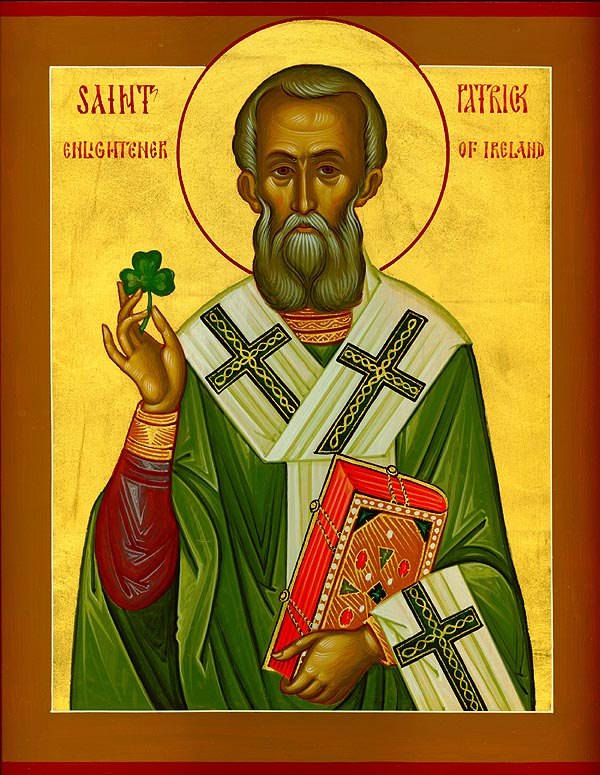
St. Patrick's Day 2017


I arise today through a mighty strength, the invocation of the Trinity, through belief in the Threeness, through confession of the Oneness of the Creator of creation.

I arise today through the strength of Christ with his Baptism, through the strength of His Crucifixion with His Burial through the strength of His Resurrection with His Ascension, through the strength of His descent for the Judgement of Doom.

I arise today through the strength of the love of Cherubim in obedience of Angels, in the service of the Archangels, in hope of resurrection to meet with reward, in prayers of Patriarchs, in predictions of Prophets, in preachings of Apostles, in faiths of Confessors, in innocence of Holy Virgins, in deeds of righteous men.

I arise today, through the strength of Heaven; light of Sun, brilliance of Moon, splendour of Fire, speed of Lightning, swiftness of Wind, depth of Sea, stability of Earth, firmness of Rock.

I arise today, through God's strength to pilot me: God's might to uphold me, God's wisdom to guide me, God's eye to look before me, God's ear to hear me, God's word to speak for me, God's hand to guard me, God's way to lie before me, God's shield to protect me, God's host to secure me: against snares of devils, against temptations of vices, against inclinations of nature, against everyone who shall wish me ill, afar and anear, alone and in a crowd.

I summon today all these powers between me (and these evils): against every cruel and merciless power that may oppose my body and my soul, against incantations of false prophets, against black laws of heathenry, against false laws of heretics, against craft of idolatry, against spells of witches, smiths and wizards, against every knowledge that endangers man's body and soul.

Christ to protect me today against poisoning, against burning, against drowning, against wounding, so that there may come abundance in reward.

Christ with me, Christ before me, Christ behind me, Christ in me, Christ beneath me, Christ above me, Christ on my right, Christ on my left, Christ in breadth, Christ in length, Christ in height, Christ in the heart of every man who thinks of me, Christ in the mouth of every man who speaks of me, Christ in every eye that sees me, Christ in every ear that hears me.

Thursday, March 16, 2017

Noises off

First, the fun parts of the Court's opinion:

The illogic of the Government’s contentions is palpable. The notion that one can demonstrate animus toward any group of people only by targeting all of them at once is fundamentally flawed. The Court declines to relegate its Establishment Clause analysis to a purely mathematical exercise. See Aziz, 2017 WL 580855, at *9 (rejecting the argument that “the Court cannot infer an anti-Muslim animus because [Executive Order No. 13,769] does not affect all, or even most, Muslims,” because “the Supreme Court has never reduced its Establishment Clause jurisprudence to a mathematical exercise. It is a discriminatory purpose that matters, no matter how inefficient the execution” (citation omitted)). Equally flawed is the notion that the Executive Order cannot be found to have targeted Islam because it applies to all individuals in the six referenced countries. It is undisputed, using the primary source upon which the Government itself relies, that these six countries have overwhelmingly Muslim populations that range from 90.7% to 99.8%.12 It would therefore be no paradigmatic leap to conclude that targeting these countries likewise targets Islam. Certainly, it would be inappropriate to conclude, as the Government does, that it does not.

Further:

A review of the historical background here makes plain why the Government wishes to focus on the Executive Order’s text, rather than its context. The record before this Court is unique. It includes significant and unrebutted evidence of religious animus driving the promulgation of the Executive Order and its related predecessor.  For example—

In March 2016, Mr. Trump said, during an interview, “I think Islam hates us.” Mr. Trump was asked, “Is there a war between the West and radical Islam, or between the West and Islam itself?” He replied: “It’s very hard to separate. Because you don’t know who’s who.”

SAC ¶ 41 (citing Anderson Cooper 360 Degrees: Exclusive Interview With Donald Trump (CNN television broadcast Mar. 9, 2016, 8:00 PM ET), transcript available at https://goo.gl/y7s2kQ)). In that same interview, Mr. Trump stated: “But there’s a tremendous hatred. And we have to be very vigilant. We have to be very careful. And we can’t allow people coming into this country who have this hatred of the United States. . . [a]nd of people that are not Muslim.”

Pay attention, there will be a quiz:

The Government appropriately cautions that, in determining purpose, courts should not look into the “veiled psyche” and “secret motives” of government decisionmakers and may not undertake a “judicial psychoanalysis of a drafter’s heart of hearts.” Govt. Opp’n at 40 (citing McCreary, 545 U.S. at 862). The Government need not fear. The remarkable facts at issue here require no such impermissible inquiry. For instance, there is nothing “veiled” about this press release: “Donald J. Trump is calling for a total and complete shutdown of Muslims entering the United States.[]” SAC ¶ 38, Ex. 6 (Press Release, Donald J. Trump for President, Donald J. Trump Statement on Preventing Muslim Immigration (Dec. 7, 2015), available at https://goo.gl/D3OdJJ)). Nor is there anything “secret” about the Executive’s motive specific to the issuance of the Executive Order:
Rudolph Giuliani explained on television how the Executive Order came to be. He said: “When [Mr. Trump] first announced it, he said, ‘Muslim ban.’ He called me up. He said, ‘Put a commission together. Show me the right way to do it legally.’”  SAC ¶ 59, Ex. 8. On February 21, 2017, commenting on the then-upcoming revision to the Executive Order, the President’s Senior Adviser, Stephen Miller, stated, “Fundamentally, [despite “technical” revisions meant to address the Ninth Circuit’s concerns in Washington,] you’re still going to have the same basic policy outcome [as the first].” SAC ¶ 74.

These plainly-worded statements, made in the months leading up to and contemporaneous with the signing of the Executive Order, and, in many cases, made by the Executive himself, betray the Executive Order’s stated secular purpose. Any reasonable, objective observer would conclude, as does the Court for purposes of the instant Motion for TRO, that the stated secular purpose of the Executive Order is, at the very least, “secondary to a religious objective” of temporarily suspending the entry of Muslims. See McCreary, 545 U.S. at 864.

The court included a footnote in that discussion:

14There are many more. See, e.g., Br. of The Roderick and Solange MacArthur Justice Center as Amicus Curiae in Supp. of Pls.’ Mot. for TRO, ECF No. 204, at 19-20 (“It’s not unconstitutional keeping people out, frankly, and until we get a hold of what’s going on. And then if you look at Franklin Roosevelt, a respected president, highly respected. Take a look at Presidential proclamations back a long time ago, 2525, 2526, and 2527 what he was doing with Germans, Italians, and Japanese because he had to do it. Because look we are at war with radical Islam.”)

And here is the response from Donald Trump, President of the United States:

“This ruling makes us look weak ― which, by the way, we no longer are, believe me. Just look at our borders,” Trump told a crowd at a campaign-style rally in Tennessee. “We are going to fight this terrible ruling. We’re going to take our case as far as it needs to go, including all the way up to the Supreme Court. We are going to win.”

And regarding the new ban:

“It’s a watered-down version of the first one,” Trump said of his new ban. “And let me tell you something: I think we ought to go back to the first one and go all the way, which is what I wanted to do in the first place.” 

As Marielena HincapiĆ©, executive director of the National Immigration Law Center, said:  “He should just continue talking, because he is making our arguments for us.”

Not really something you want to hear about a President who will someday be negotiating international agreements.

As if the label "Me Generation" wasn't iron-clad evidence enough


We know that when people were born is important, and determines inalterably what those people will grow up to act like.

We know this because we used to see it (long, long ago) on paper placemats in Chinese restaurants, where we are told the year of our birth relates us to an animal, and to absolutely everyone else born that year, or in some other year much later.

We know this because the astrology column in newspapers (longer ago than the placemats) told us what our day would be like, based on our date of birth in the calendar year (and the stars and planets, apparently), no matter what year we were born.  And our date of birth told us what personality traits we would have, whether we wanted them or not.

We know this because we invented the category of "generations" for the "Baby boom generation."  Which required us to carry those categories forward (everybody deserves a category!) and then backward (the WWII "generation" was the "Builders" until Tom Brokaw decided they were the "Greatest") to about WWI.  People before that were not "generations," they were just dead, because they were nobody's grandparents or great-grandparents, except in name only (not in living memory).

So it goes.

And now this nonsense leads someone to call at least 70 million people born between the entirely scientific and well-established by irrefutable reasoning years of 1946-1964 (or is it simply 18 years and the neat inversion of numbers that appeals?) to be sociopaths.  Because "Me Generation," why else?  (Besides, 18 years is a "generation," because:  Webster's.  Why else?)

Which cannot include people born in 1945, or in 1965, because that would be silly.  Consult your Chinese restaurant placemat for why.

Second Thursday in Lent--2017


One dies in full prosperity,
being wholly at ease and secure,
his loins full of milk
and the marrow of his bones moist.

Another dies in bitterness of soul,
never having tasted of good.
They lie down alike in the dust,
and the worms cover them.

Job 21:23-26

Do not be afraid when some become rich,
when the wealth of their houses increases
For when they die they will carry nothing away;
their wealth will not go down after them.
Though in their lifetimes they count themselves happy
--for you are praised when you do well for yourself--
they will go to the company of their ancestors;
who will never again see the light.

Psalm 49:  16-19

Oh, to whom shall I make my moan
For to go with me in that heavy journey?
First Fellowship said he would with me gone;
His words were very pleasant and gay,
But afterward he left me alone.
Then spake I to my kinfolk, all in despair,
And also they gave me words fair;
They lacked no fair speaking,
But all forsook me in the ending.
That went I to my Goods, that I loved best,
In hope to have comfort, but there had I least;
For my Goods sharply did me tell
That he bringeth many into hell.
Then of myself I was ashamed,
And so I am worthy to be blamed;
Thus may I well myself hate.
Of whom shall I now counsel take?
I think that I shall ever speed
Till that I go to my Good Deeds.
But, alas, she is so weak
That she can neither go nor speak;
Yet will I venture on her now.
My Good Deeds, where be you?

--"Everyman," Fifteenth Century

Death is the ultimate liminal experience, the final frontier we all cross but from which no traveler returns.  We are all about our boundaries, about who we are and are not, and so we fear the other:  the homosexual, the black, the Latino, the Asian, the poor, the rich, transgendered, educated, foolish, wise, ignorant.  We fear the contagion of the other, we fear becoming what we think we are not, and most of all we fear death, the becoming of what none of us are:  not alive.  We fear it so much it has become the standard rebuttal of religious belief:  that all religions arose from a fear of death, from a denial of the ultimate fact of life to which everyone is subject.  It is accepted so casually now it might as well be a fact of the universe, like genes or the speed of light.  No one doubts it is the wellspring of religion, even though fear of death is not Christian at all.

In Christianity, death is just another liminal experience.  But it is not definitional; it is not a boundary that sets out who we are, like sexual desire has become.  It is more important now that fictional characters be declared homosexual, or transgendered, or bi-sexual, than that they actually be gay or lesbian or bi- or trans-.  When religious conservatives declared Bert and Ernie gay, Frank Rich pointed out they were puppets, they had no genitals:  they couldn't be gay.  But sexual preference is now a boundary, an identifier, a definition of who you are, so comic book characters who never so much as hold hands, are now lesbians or gay because the story line says so.  It is not necessary to engage in sex in order to be defined by sexual desire. It doesn't matter what you do; what matters is what others say about you, how they define you; or how you tell them to define you.

So defining religion as a fear of death is a way for the non-religious to define, and dismiss, the religious.  But death is not a defining characteristic of Christianity at all, any more than a comic book character is now truly homosexual because the dialogue (but never the action!), says so.

There was this rich man, who wore clothing fit for a king and who dined lavishly every day.  This poor man, named Lazarus, languished at his gate, all covered with sores.  He longed to eat what fell from the rich man's table.  Dogs even used to come and lick his sores.  It so happened that the poor man died and was carried away by the heavenly messengers to be with Abraham.  The rich man died too, and was buried.

From Hades, where he was being tortured, he looked up and saw Abraham a long way off and Lazarus with him.  He called out, 'Father Abraham, have pity on me!  Send Lazarus to dip the tip of his finger in water to cool my tongue, for I am in torment in these flames.'

But Abraham said, 'My child, remember that you had good fortune in your lifetime, and Lazarus had it bad.  Now he is being comforted here, and you are in torment.  And besides all this, a great chasm has been set between us and you, so that even those who want to cross over from there to you cannot, and no one can cross over them that side to yours.'

But he said, 'Father, I beg you then, send him to my father's house--after all, I have five brothers--so he can warn them not to wind up in this place of torture.'

But Abraham says, 'They have Moses and the prophets; why don't they listen to them?'

'But they won't do that, father Abraham,' he said.  'However, if someone appears to them from the dead, they'll have a change of heart.'

(Abraham) said to him, 'If they won't listen to Moses and the prophets, they won't be convinced even if someone were to rise from the dead.'

--Luke 16:19-31, SV

Lazarus is not defined by death, any more than the rich man is.  Even truth and justice and morality are not defined by death, as Abraham points out.  Lazarus and the rich man trade places, but the point is not the justice of a reversal of roles, the final comeuppance that occurs after death, but the answer to Tolstoy's question: how should we then live?  If the universe is just, if the universe is moral, then the lesson is clear.  If the universe is amoral, however, and unjust, if the final end of all things is merely a return to the state of primordial chaos upon which order was once imposed, then this story is about death, and about being afraid of justice after you die.  But without a moral order, there is nothing to be afraid of, no chance of suffering the fate of the rich man.  And with a moral order, there is no justification for the suffering of Lazarus.

Which is the point, isn't it?


Wednesday, March 15, 2017

"Co-ed head; enter at your own risk"


I wonder about the French.

I've been binge-watching on Netflix, a bad habit at my age.  Trouble is, so many TV shows on Netflix are so interesting, if only because they aren't American.  No, this is not reverse snobbery about the "superiority" of Europe over the Colonies; but foreign shows are fascinating because they are a window (albeit a fictional one) into other lands.  Take this example:

The show in question is "Spiral," a police procedural that focusses on the French police (a small cadre) and French lawyers and judges.  The French have a decidedly non-Anglo-Saxon (that's how they identify what they don't want to emulate) legal system, with investigating judges who interview witnesses and oversee police investigations and otherwise decide who is going to be charged and with what crime.  No, it's cool; a completely separate set of judges try the cases; but all the judges ask questions and run the investigations or trials, completely contrary to the American system where judges run the courtroom only (even the judges in "Rumpole" are more active than American judges are allowed to be), and trials are conducted by the lawyers (a system one character, a judge, denounces as class-based, since the quality of the trial and the legal defense depends on ability to pay.  It's not a perfect critique, but he has a point.).

But that's beside the point.  Along about season 3, I began to notice the police, a squad led by a woman and including other female officers, were in and out of the same bathroom all the time (looked the same, anyway).  Men walked in on the captain of their squad, she walked in on them; never in compromising positions, mind.  Everybody was always at the sinks.  But nobody raised an eyebrow.  Nobody said "What are you doing in here?"  I even expected it, the first time; by the third time I realized:  this is normal in France.

And in this country, we fear that men will enter ladies' restrooms and, if not assault them there (in the least private place for an assault imaginable), will at least "invade their privacy."  At least the Texas Senate fears it.

Not that I'm advocating for unisex bathrooms; but honestly, this is a cultural matter, not a physiological or even criminal one.  It's just kind of funny to see how casual the French are about it.

Or mature.  I still think Garrison Keillor was right, that the French are the most mature people on the planet.  About some things, anyway.

Monday, March 13, 2017

Is there even any argument?


Rep. Steve King of [correction:  Iowa] is a racist.  Period.  End of discussion.

The interview above, subsequent to the tweet before, is supposed to raise questions about whether Rep. King is a racist or just says racist things.  The New York Times calls it "an apparent endorsement of white nationalism," because it's not about race, because it's never about race.  Besides, it's so indecent to call a white man who isn't from the South or a member of a militia group a racist.  It's just not the done thing.

Slate says you have to examine Mr. King's words closely to realize he's a racist.  No, you don't.

Steve King is a racist.  Period.  End of discussion.

His words, which aren't really new at all (the Times gets that right; King does have "a history of making inflammatory statements viewed by many as insensitive or outright racist." Well, some people say, anyway....), are clearly racist.  How else can they be interpreted?  He says in the interview it's not about "blood," which is nice, because the rest of the world gave up on royalty in the blood ages ago, good to know he's up to date.  But to shift to "culture" away from "blood" is not to shift anything at all.  It's the shift of Richard Dawkins, who used to wonder in public why Nobel Prize winners in the sciences never came from African and most Asian countries.  Culture, donchaknow?  That's all Dawkins meant; the superiority of culture.

Or kulchur, as Pound identified it.  King and Dawkins wouldn't know the difference.  Culture is just the more accepted in polite circles term for "blood" in conversations about "civilization" and what endangers it (hint!  People like Steve King and Richard Dawkins!).  The terms are synonyms, not subtle but distinct differences.

You don't need a weatherman to know which way the wind blows, and you don't need a Baedeker to know the lay of the land in Steve King's mind.  He may aver he isn't being racist in his pronouncements, but that's merely to say he wants to pass in polite society as someone who knows which knife to use at table.  Plenty of well-bred racists, too, however.  And Steve King isn't all that particularly well-bred.

But he is a racist.  Period.  End of discussion.

Sunday, March 12, 2017

"...led by their greed to hate the law...."

No, not directly relevant, but of a piece with the times. 

House Speaker Paul Ryan (R-WI) said on Sunday that he can't say how many people will lose health coverage under the Republican bill to repeal the Affordable Care Act, as it's "up to people" to acquire coverage "if they want it."

"The one thing I'm certain will happen is CBO will say, well, gosh, not as many people will get coverage. You know why? Because this isn't a government mandate," Ryan told ABC's John Dickerson. "You get it if you want it. That's freedom."

"How many people are going to lose coverage?" Dickerson asked.

"I can't answer that question. It's up to people," Ryan said. "People are going to do what they want to do with their lives."

I honestly think that if Paul Ryan could eliminate Medicare and repeal the federal law requiring uninsured people be treated upon presentation at an ER, he would do it, and leave the poor to die of their poverty.

"That's freedom."

Even Tom Cotton says:  "I'm afraid that if they vote for this bill, they're going to put the House majority at risk next year."  A consummation devoutly to be wished.

History: Ancient and Modern

When the rich began to offer larger rents and drove out the poor, a law was enacted forbidding the holding by one person of more than five hundred acres of land. For a short time, this enactment gave a check to the rapacity of the rich and was of assistance to the poor, who remained in their places on the land they had rented. But later on the rich men, by means of fictitious personages, transferred these rentals to themselves and finally held most of the land openly in their own names. Then the poor, who had been ejected from their land, no longer showed themselves eager for military service and neglected the bringing up of children, so that soon all Italy was conscious of a dearth of freemen and was filled with gangs of foreign slaves, by whose aid the rich cultivated their estates, from which they had driven away the free citizens. Tiberius, on being elected tribune of the people, took the matter directly in hand. With the people crowding around the rostrum, he took his stand there and pleaded for the poor. "The wild beasts that roam over Italy," he would say, "have every one of them a cave or lair to lurk in. But the men who fight and die for Italy enjoy the common air and light, indeed, but nothing else. Houseless and homeless, they wander about with their wives and children. And it is with lying lips that their imperators exhort the soldiers in their battles to defend sepulchers and shrines from the enemy. For not a man of them has a hereditary altar, not one of all these many Romans an ancestral tomb, but they fight and die to support others in wealth and luxury, and though they are styled masters of the world, they have not a single clod of earth that is their own.

--Plutarch*

The reign of Tiberius coincides with the years in which Jesus of Nazareth was alive.  That whole "first shall be last and last first" in the basilea tou theou takes on a distinctly contemporary cast when put in the context of "ancient" history.  Well, that and the words of Jesus in Q (i.e., Matthew and Luke):   "And Jesus said to him:  "Foxes have dens, and the birds of the sky have nests; but the son of Adam has nowhere to lay his head."(Luke 9:58, SV).

Is it an accident that this same pericope in Luke is followed by:

To another he said, "Follow me."
But he said:  "Let me first go and bury my father."
Jesus said to him:  "Leave it to the dead to bury their own dead; but you, go out and announce God's imperial rule."  (Luke 9:59-60, SV)
But it was same as it ever was:

He did not, however, draw up his law by himself, but took counsel with the citizens who were foremost in virtue and reputation, among whom were Crassus the pontifex maximus, Mucius Scaevola the jurist, who was then consul, and Appius Claudius, his father-in-law. And it is thought that a law dealing with injustice and rapacity so great was never drawn up in milder and gentler terms. For men who ought to have been punished for their disobedience and to have surrendered with payment of a fine the land which they were illegally enjoying, these men it merely ordered to abandon their injust acquisitions upon being paid their value, and to admit into ownership of them such citizens as needed assistance.  But although the rectification of the wrong was so considerate, the people were satisfied to let bygones be bygones if they could be secure from such wrong in the future; the men of wealth and substance, however, were led by their greed to hate the law, and by their wrath and contentiousness to hate the lawgiver, and tried to dissuade the people by alleging that Tiberius was introducing a re-distribution of land for the confusion of the body politic, and was stirring up a general revolution.

The soldiers, says Tiberius, had no reason to defend the sepulchers and shrines of others from "the enemy."  Styled "masters of the world, they have not a single clod of earth that is their own."  His speech, Plutarch says, was moving; but the status quo was not on the emperor's side.  Given that atmosphere under Tiberius, the reasons for the governor of Palestine to execute the man from Nazareth as a threat to the Pax Roman suddenly becomes a bit clearer.


*Plutarch was alive (45-120 C.E.) during the time the gosopels were written , but Q was assembled between 40 and 80 C.E., so it isn't likely Plutarch was an influence, or a source.  And the story of this law, which turns into a clash between Tiberius and Octavius, includes a "Brooks Brothers" riot and voter fraud, as well as astro-turfing.  There is, indeed, nothing new under the sun.

(Purely for fun, compare the account of Tiberius, emperor of Rome, and his failure to move Roman culture on a fundamental issue, and Rand's fictional John Galt, a man so important to the world he can, like Atlas, shrug and move mountains.  In reality, no one is that important, not even emperors.  Rome, in its collective effort, has had a huge and continuing impact on human history.  Then again, so did Jesus of Nazareth.  Go figure.)

Saturday, March 11, 2017

Who is John Galt?


So in the end, it’s not that Paul Ryan doesn’t understand health insurance. And it’s not that he doesn’t understand math well enough to know that the numbers don’t add up to a sufficient “replacement” for Obamacare. That’s because what Ryan is “repealing” and “replacing” isn’t a health care bill ― he’s swapping out the moral universe that gave birth to the Affordable Care Act with the one that he prefers. One in which the state rewards affluence and punishes those who fail to achieve it. One in which the very notion of redistributing money from the well-off to the poor for the purpose of health care provision is a mortal sin. Properly reconfiguring the universe along these moral guidelines is, to Ryan’s mind, an “act of mercy.”

IOW, the moral universe of an Ayn Rand acolyte.

Saturday of the First Week of Lent-2017


Then the Lord said, “How great is the outcry against Sodom and Gomorrah and how very grave their sin! 21 I must go down and see whether they have done altogether according to the outcry that has come to me; and if not, I will know.”

22 So the men turned from there, and went toward Sodom, while Abraham remained standing before the Lord.[a] 23 Then Abraham came near and said, “Will you indeed sweep away the righteous with the wicked? 24 Suppose there are fifty righteous within the city; will you then sweep away the place and not forgive it for the fifty righteous who are in it? 25 Far be it from you to do such a thing, to slay the righteous with the wicked, so that the righteous fare as the wicked! Far be that from you! Shall not the Judge of all the earth do what is just?” 26 And the Lord said, “If I find at Sodom fifty righteous in the city, I will forgive the whole place for their sake.” 27 Abraham answered, “Let me take it upon myself to speak to the Lord, I who am but dust and ashes. 28 Suppose five of the fifty righteous are lacking? Will you destroy the whole city for lack of five?” And he said, “I will not destroy it if I find forty-five there.” 29 Again he spoke to him, “Suppose forty are found there.” He answered, “For the sake of forty I will not do it.” 30 Then he said, “Oh do not let the Lord be angry if I speak. Suppose thirty are found there.” He answered, “I will not do it, if I find thirty there.” 31 He said, “Let me take it upon myself to speak to the Lord. Suppose twenty are found there.” He answered, “For the sake of twenty I will not destroy it.” 32 Then he said, “Oh do not let the Lord be angry if I speak just once more. Suppose ten are found there.” He answered, “For the sake of ten I will not destroy it.”

Genesis 18:20-32

Incline us, O God, to think humbly of ourselves, to be saved only in the examination of our own conduct, to consider our fellow creatures with kindness, and to judge of all they say and do with the charity which we would desire from them ourselves.

--Jane Austin, Eighteenth Century

God has just told Abraham for the third time that he will have a son, even though he's too old and Sarah is too old.  Sarah laughs with joy at the thought, even as she doubts it could happen, and when God tells her she has laughed she denies it, but God says:  "You did laugh."

And then God tells Abraham about Sodom and Gomorrah; their sin is not what we think it is, though. It is inhospitality.  But that's Genesis 19; this is Genesis 18, and Abraham bargains with God.

God's grace is infinite, but so also is God's justice, and one does not negate the other.
--Erich Auerbach

It is, in the end, a story of forgiveness, and a story of justice.  The scriptural story is full of tales of forgiveness; but where that forgiveness does not relieve oppression.....well, oppression can never be forgiven.

"Do not be so confident of forgiveness that you add sin to sin."  Sirach 5:5

Then again, for the sake of 10, God promised not to destroy Sodom and Gomorrah; so where were the 10?  The question is a Biblical one, too:  "Is it I, Lord?"

Friday, March 10, 2017

Same song, seventy-third verse.....

City mouse v. country mouse:

"To rural Americans, sometimes it seems our taxes mostly go to making city residents live better. We recognize that the truth is more complex, particularly when it comes to social programs, but it’s the perception that matters — certainly to the way most people vote." 

I mean:  seriously.  This dichotomy is practically as old as the country itself.  Certainly as old as the 19th century, when cities as we know them today began to arise and differentiate themselves, and the differentiation came to America.  Poe caught it.  His story about "The Man of the Crowd" was about the more frightening aspects of the new American experience of "big cities" (tiny by our modern standards, but big by 19th century American standards).  Poe didn't invent horror out of whole cloth, and he didn't deal exclusively in Gothic tropes (many of which he invented, but that's by the bye).

I grew up on '30's and '40's cartoons about the city mouse v. the country mouse.  Sherwood Anderson and Edgar Lee Masters made their fame on the distinction between urban and rural, and then John Updike did it all again.  We've always wobbled back and forth between cities as Sodom and Gomorrah and cities as bastions of progress and civilization, while the rural areas were the heartland of gentlemen farmers and noble yeoman, or backwaters of inbred hicks represented by the Snopes family (we so easily overlook Faulkner's affection for and honesty about the Snopes.  I mean, they're hicks, right?).

So here we are again.  Except now "it's the perception that matters."  As if something else mattered once upon a time.

The arguments of the Rude Pundit and Southern Beale may be emotionally satisfying, but that's about all they are.  If I need to listen to "blue-collar America" (i.e., white people without college degrees), it's only because I also need to listen to black America and brown America and Asian America, and Native America (hello!), and so on.  But honestly:  "We don't get our news from conspiracy theorists and liars," when the "we" is the "American left"?  Glenn Greenwald, according to comments at Salon anyway, does a fire sale business trading in the idea of the "deep state" that is going to make us all Republicans one day.  Oddly enough, a "deep state" indistinguishable from the one the Trump White House believes in.  So which group is it again who doesn't get their "news from conspiracy theorists and liars"?

Maybe we need to reset this conversation by starting without all the finger-pointing.  I mean, I agree, why doesn't the media think the problem is that we should explain liberalism to them, the Trump voters?  But if we're gonna start here:

 Ultimately, though, it won't matter. Because despite every fucking word to the contrary, the real problem is that those who voted for Trump are racist. They are sexist. They are Islamophobic. They are ignorant. 

We'll never get started at all.

Thursday, March 09, 2017

First Thursday in Lent-2017


If we look for spiritual recompense
let us perform our good deeds in secret;
let us not proclaim them in the streets,
but keep them hidden in our hearts.
The the one who sees the secrets of all will reward us for our abstinence.
Let us complete the Fast,
not with a sad countenance,
but praying in the inner chamber of our souls;
and without ceasing, let us cry:
Our Father in heaven,
lead us not into temptation, we pray,
but deliver us from the evil one.

--Byzantine Vespers

Prayer is our subject today.  Prayer and how to do it, and why do do it, and what it means.  "Pray without ceasing," Paul tells us.  There are practical directives for that, a most impractical command.  Prayer is connected to the fast; so fasting needs prayer, and perhaps prayer sometimes needs fasting.  But the fast need not be merely food; it can be abstinence from evil itself.  We pray, as Christians, to be delivered by God from the evil one.  It is sometimes true that means deliverance from ourselves.

When we pray, we do not pray for ourselves alone.  We do not say "My Father, who art in heaven" or, "Give me this day my daily bread"; we do not ask for our own trespasses alone to be forgiven; and when we pray that we may be delivered from evil, we are not praying only for ourselves either.

Our prayer is for the general good, for the common good.  When we pray we do not pray for our own single selves; we pray for all God's people, because they and we are one.

--Cyprian of Carthage, Third century

Pray for peace and grace and spiritual food,
For wisdom and guidance, for all these are good,
But don't forget the potatoes.

--J.T. Pettee

Rejoice always, pray without ceasing, give thanks in all circumstances; for this is the will of God in Christ Jesus for you.

--1 Thessalonians 5:16-18

Everyone stops at the "Pray without ceasing" and wonders what that could mean.  There are answers practical and metaphysical, but no one stops at "rejoice always" and wonders what that could mean; or if the former could lead to the latter, and both to giving thanks in all circumstances.  But the purpose of Lent; or, let's say, a purpose of Lent, is to consider these things.  If we rejoice always, for what are we rejoicing, and how do we do that?  If you can answer that, maybe praying without ceasing begins to make more sense; and if you do both, giving thanks in all circumstances suddenly seems childishly simple.

I used to tell my congregation that Sunday in worship was not the "filling station" where you got your spiritual and emotional tank topped off again so you had fuel to get through another week.  That was backwards, I said; it meant you needed God once a week, and the rest of the time you were fine on your own.  Rather, I said, in worship you should encounter the living God of Abraham, Moses, and Jesus.  The famous throne room scene in Isaiah 6 is the acknowledged model of Christian worship, right down to the pipe organ meant to replicate the voices of the seraphim (my congregation's German roots included opening every worship service, once upon a time, with the hymn "Holy, Holy, Holy."  It was not just because they had always done it that way.).  You do not lightly enter the presence of the living God; and if you enter into the experience of worship, if you open yourself to the possibility of the presence of God there, and experience it, you aren't charged up for a week until your batter runs down.  Your perspective on the world will change, your relationship to the world will change.

You may not rejoice always, pray without ceasing, and give thanks in all circumstances because of that; but you'd be a lot closer than if you just expect prayer to be something that is answered, and worship to give you something to get through the week.

And don't forget the potatoes....


Tuesday, March 07, 2017

The Usual Suspects


I've been writing and re-writing this post, because it's hard to get a handle on it.  I mean, the very idea that Rep. Schiff is right is a big pill to swallow.  But if you start there, the rest of this makes sense.  Starting with Sen. Sasse:

Nebraska Sen. Ben Sasse, a frequent Trump critic, said the President should publicly release the FISA Court order that would have been needed if his phones were legally tapped by the government. And, if Trump believes his phones were illegally monitored, he "should explain what sort of wiretap it was and how he knows this," Sasse said in a statement. "We are in the midst of a civilization-warping crisis of public trust, and the President's allegations today demand the thorough and dispassionate attention of serious patriots," Sasse said. "A quest for the full truth, rather than knee-jerk partisanship, must be our guide if we are going to rebuild civic trust and health."

Charlie Pierce argues the sentiment behind that statement is that somehow, someway, the GOP must pin this debacle on Obama.  But that's SOP in D.C.  Until sometime long after the Saturday Night Massacre, the GOP in Congress was still trying to blame the accusers or anybody but Nixon for Watergate.  So, yeah, that's in the air; but Sasse is still not wrong.  We do need "a quest for the full truth."   There are also plenty of arguments on the web about how Trump is distracting us with his wild tweets.  But he isn't that Machiavellian, and this isn't a situation where only the pure of heart (or ideology) have insight.  The problem is not the President's critics;  the problem is the President:

The president, a spokeswoman said on ABC’s This Week, didn’t come up with the storyline out of thin air. He was echoing reports from "multiple news outlets."

"Everybody acts like President Trump is the one that came up with this idea and just threw it out there," said deputy press secretary Sarah Huckabee Sanders on March 5. "There are multiple news outlets that have reported this."
All those news outlets that deal in fake news; except when they conveniently don't.  So where did the President get his information?

Also on Monday, Sanders told NBC’s Today show that she didn’t know how Trump came believe that Obama had tapped his phones.

“I haven’t had the chance to have the conversation directly with the President and he’s at a much higher classification than I am, so he may have access to documents that I don’t know about,” she said, asked if Trump had read about wiretapping in media reports.

He doesn't have to tell you what he knows, though!  He's the President!

"Let me answer that globally," [Kellyanne Conway] said. "He is the President of the United States. He has information and intelligence that the rest of us do not. And that's the way it should be for Presidents."

Which is curious, because people who actually understand how government works, like James Comey and Trey Gowdy, don't think there's anything to support these claims at all.   But what's going on here, again, is not what the President knows and when he knows it, or even how does he know it.  The problem is:  does the President understand he's the President?

"I don’t view it as the Obama team," Gowdy said. "I don't think the FBI is the Obama team, and I don't think the men and women who are career prosecutors at DOJ belong to any team other than a blindfolded woman holding a set of scales."

"We have certain tools that this country needs to keep us safe, and it is great and wise and prudent and legal for those tools to be used lawfully and appropriately,” Gowdy continued. “If they're not used lawfully and appropriately, there is a paper trail and we'll be able to find it out.”

He noted that Obama is not President any more.

“So any information that the current Department of Justice has that suggests the previous Department of Justice acted inappropriately, they are welcome to release it," Gowdy said.

A sentiment Josh Marshall underlines and adds an exclamation point to:

The President says this happened. He says he has the evidence. He knows it happened. If he knows it happened, there's nothing to investigate. The President has plenary power to declassify and publicize anything he wants. Anything. He can do it by the book or he can do it basically by fiat with no one involved at all.
Or, as Michael Hayden told Fox & Friends:

“It looks as if the President just for a moment forgot that he was President,” Hayden continued. “Why didn’t he simply use the powers of the presidency to ask the acting director of national intelligence, the head of the FBI, to confirm or deny the story he apparently read from Breitbart the evening before?”

“President Trump, in order to clear this up, could he demand to see this? Again, it would be unprecedented, but we’re in unprecedented circumstances," Hayden said.

And we're back to that whole "how government works" thing again:

"[Obama] wouldn't even be involved," Hayden said. "You stay way back from this because of the separation of powers."

And then there's the question of relying on Twitter, while we're at it:

George Washington University political historian Matt Dallek noted that Trump’s wiretapping allegations, like Spicer’s statement, were issued on Twitter.

“There’s something deeply unserious about it, except for the fact that it’s coming from the President of the United States," he told TPM. "That’s not how it works, and that’s not how the system was designed.”
As well as the whole stepping-on-his-own....tie; yeah, let's go with "tie":

Yet in this case, according to White House press secretary Sean Spicer, Trump is requesting that congressional intelligence committees “exercise their oversight authority to determine whether executive branch investigative powers were abused in 2016” as part of their investigation into Russian interference in the presidential election and contacts between Russian operatives and Trump staffers. So the request attracts even more attention to a storyline that the Trump administration has repeatedly dismissed as “fake news.”

Because there's something fundamentally Constitutional in operation here:

“The investigative power of committee is a congressional tool, not a presidential tool. That the President would assume that he could essentially demand or dictate to Congress that they change the focus of an investigation is I think pretty much unprecedented," Bruce Miroff, an expert on the U.S. presidency at the University of Albany, explained. "And it is a reminder again that, to put it bluntly, Trump doesn’t understand the separation of power system.”

“You’re seeing the limits of his authority right now,” Josh Huder of Georgetown University’s Government Affairs Institute told TPM. “In terms of what he can tell Congress to do, he’s reached the maxed out potential for that.”

Or is he acting within the limits of his conceptual universe?

On Monday morning, the New York Times’ Maggie Haberman sent out a series of tweets that, taken together, said this:

Despite Trump's public insistence while at Mar-a-Lago that he will be proven right re wiretaps, he's sounded less certain in private convos. Remember—Trump knows little about the mechanics of government, as well as separation of powers. He has assumed exec branch is not that dissimilar to how he ran Trump Tower, where he was known to tape calls etc.
I don't think the problem is that Trump is crazy like a fox and the media is too easily distracted by the next shiny story.  Trump's tweets last weekend have only focussed more attention on the Russia connection.  Trump sails blithely on to crap like this:


Because he's watching FoxNews, not because he's cleverly manipulating the media to allow him to actually function as a President.  The problem here is:  "We must accept possibility that @POTUS does not know fact from fiction, right from wrong. That wild claims are not strategic, but worse."  And accepting responsibility means, in part, looking clearly at what Trump is saying, and why he is saying it.  And it's not just because he gets his information from unreliable sources.

Monday, March 06, 2017

First Monday of Lent 2017


IS this a fast, to keep
      The larder lean?
            And clean
From fat of veals and sheep?

Is it to quit the dish        5
      Of flesh, yet still
            To fill
The platter high with fish?

Is it to fast an hour,
      Or ragg’d to go?        10
            Or show
A downcast look and sour?

No; ’tis a fast to dole
      Thy sheaf of wheat,
            And meat,        15
Unto the hungry soul.

It is to fast from strife,
      From old debate
            And hate;
To circumcise thy life.        20

To show a heart grief-rent;
      To starve thy sin,
            Not bin;
And that’s to keep thy Lent.

"Lent," by Robert Herrick

"Let us fast in such a way that we lavish our lunches upon the poor, so that we may not store up in our purses what we intended to eat, but rather in the stomachs of the poor."--Caesarius of Arles, Sixth century

I post these things to try to remind myself it is Lent; and of some of the importance of Lent.  Lent is really the great season of the church, and long season,  the season of repentance and reflection on sin, the season of confession and atonement.  I'm surprised it wasn't taken up at some point by the Protestants, especially those sects that wanted to be more Calvinist than the Calvinists, who wanted to repent like the Baptisers at every revival.  Then again, Lent is an institutional method, and Protestants have long emphasized personal piety as a way to reject organizational spirituality.

So it goes; and so it is.  I find Lent useful as a method of self-examination, as long as the examination is honest and fruitful, not light and passing or degrading and demeaning.  We are not called to regret our every sin, but neither are we called to treat them as peccadilloes.

I really need to work on my ability to fast; but maybe if I can't physically fast, I can at least fast from those habits of the heart that keep my bowels from being filled with mercy and compassion; and really, until that sentence, it's easy to forget the following wasn't written yesterday:

You will perhaps say that, by this means, I encourage people to be beggars.  But the same thoughtless objection may be made against all kinds of charities, for they may encourage people to depend upon them.  The same may be said against forgiving our enemies, for it may encourage people to do us hurt.  The same may be said even against the goodness of God, that, by pouring blessing on the evil and on the good, on the just and on the unjust, evil and unjust people are encouraged in their wicked ways.  The same may be said against clothing the naked, or giving medicines to the sick, for that may encourage people to neglect themselves and be careless of their health.  But when the love of God dwellers in you, then it has enlarged your heart, and filled you with bowels of mercy and compassion, you will make no more such objections as these.

--William Law, Eighteenth Century

When the man comes around.....


Actually, the song used over the ending credits.  It fits here, too.

It turns out the buzz on Logan is settling around the weltanschaaung of the premise, more so than the plot itself.  (If you have no interest in such films, I'll try not to bore you with details; if you are interested in the movie, well, as they said at Vulture, don't continue reading if you don't want to be oriented.  I like that so much better than "spoiler alert!").

The movie is one of those ways movies can improve on comic books.  Not only do real human beings look ridiculous in yellow and blue stretch suits with huge projections off the head (Batman has enormous ears in the comics, virtually no ears in the movies and on TV; Captain America and Thor have helmets with wings projecting off of them, for pity's sake.  The former are canary wings compared to the latter's eagle sized appurtenances,  but neither has any such appendages in the movies), but actors get old (only Hugh Jackman has played "Wolverine" in the movies, and he started 13 years ago; there have been completely different actors for the same characters in several "X-Men" movies) and movies don't need a character to live forever (well, except for James Bond).  So where comic books have to do "alternative" stories (the idea dates back to my childhood) where things can happen that can't happen to a comic hero you want to keep making money from for decades (Superman died more than once before the infamous "Death of Superman" that made the headlines and the basis for the ending of "Batman v. Superman"), movies can simply wrap the whole thing up if they choose.

That's supposed to be the plot line of Logan;  it's 2029, and it's time for him to die.  Interestingly, that's not the most interesting part of the plot.  Let me steal a little here from Vulture; two different articles, but it will speed the pace of the analysis.  First, my thesis, nicely limned by David Edelstein:

My freak-out isn’t just about what happens to the characters. It’s the country in which they live and die that ushers in the nightmares. If this is the superhero movie that most accurately evokes how we live now, we’re in even more trouble than I thought.

Then, a concise summary of the context of the story:

Much like Alfonso Cuarón’s Children of Men — a movie to which Logan owes an enormous debt — this is a world that has entered a spiritual and economic slump a long time before the start of our story, leading people to more or less give up on inventing things and thinking about brighter futures. Everyone, including Logan, is drifting through life, their goals minor and their pleasures basic.

Like Children of Men, its vision of the future has political teeth. In passing, we see massive lines of Latino deportees at an intimidating border wall. The mutant minority has mostly died out, and a Limbaugh-esque radio host says he’s sick of talking about their extinction. We learn of an American biotech firm that’s exploiting the uneven relationship between the U.S. and Mexico by setting up a lab conducting horrific experiments south of the border. Their victims are overwhelmingly black and brown — but so are nearly all of the non-Wolverine heroes of the movie. As is true of most great X-Men stories, the film is a story about the forgotten, the desperate, and the marginalized finding strength in one another. Logan is a superpowered protest against Trumpism — and a chillingly effective one, at that.
That reference to the border is important.  The movie opens outside El Paso, from which Logan turns his car (he's a limo driver, don't think too hard about it) south to Mexico, where Professor Xavier is being held in some rusted industrial ruins (for his own good; again, we'll step lightly over plot details just because they aren't really relevant here).  Never did the idea of south as "down" and north as "up" (with all the negative and positive connotations those directions have) seem more important to a movie.  That abandoned industrial park, a haven because it is isolated and obscure, becomes a trap simply because it is isolated and obscure:  and because American power comes calling.

American power, in this case, is a fleet of black SUV's, some heavily armed, carrying very heavily armed and muscled men (who are, of course, quickly dispatched; like any movies divorced from reality, there is never a limit of mercenaries willing to die at the hands of our heroes, and never any doubt more will rise up to replace them.  Honestly, the kill rate these people suffer; how much money is enough for that?  Anyway.....), accompanied by Mexican police/soldiers/somebody.  What is clear is that the Mexican government takes orders from the white men, and the white men are not government employees.  They work for the corporation which is the villain in this movie.

Well, you expect battle scenes and fight scenes, and there are several review which will tell you how gory those scenes are, so let's move on.  The key point is location (Mexico, the northern, sparsely populated desert, somewhere outside Juarez) and the evil but immensely powerful corporation which employees an army of Navy SEALS, apparently.  They are almost all burly, crew-cut white guys, anyway.  That's not an accident, as we'll see.

So then the action moves north as our heroes flee the bad guys.  For reasons that don't quite make sense except that Logan is not heading for North Dakota yet (there are reasons for fleeing to North Dakota, but don't worry about them now), the next big set piece is in Oklahoma City, which now has a Harrah's Hotel/Casino (a sign of U.S. decadence?  It doesn't serve much more purpose in the film, except to give an otherwise sleepy town a building that would draw crowds of people in the middle of the day.).  You can get to North Dakota from El Paso, but Oklahoma City ain't exactly on the way there.  But don't think about it, it doesn't really matter.  It's the casino in OK City that's the point.  Because after that, it's off to Kansas and the cornfields being watched over by machines of loving grace.

We learn that because of a family that befriends our travelers, to their unfortunate demise (spoiler!).  Giant machines, seen in outline and lit by klieg lights, toil in the fields of corn being raised, the farmer/friend tells Logan, to make corn syrup (high fructose corn syrup!) to sugar drinks no one needs (Michael Bloomberg was right!).  These evil corn producers want the farmer/friend's land, you see, which makes them doubly evil.

It's alright, the minions of the corporation are rednecks who end up dead, ironically at the hands of the evil villain corporation (literally).  But clearly American has gone completely off the rails and is interested now only in sugary drinks and vacuous entertainment (gambling!  In the heartland!), and even salt of the earth Americans (the only blacks in the film, IIRC, save for one child "mutant"; I'll explain later), are slaughtered by....well, an evil mutant.

You knew there was one.

Eyes on the prize, though; it's the chase through America again which drives the story, as Logan tries to get to North Dakota.  He finally arrives, and there is another big fight, and the bad guys are all killed (no surprise there; how else was it gonna end?) and there is redemption.  And our heroes (new ones, by now) escape to the safety of Canada, where they are assured of asylum.  Because it was America, and the evil villain corporation (who was in cahoots with the American government) who killed all the mutants but Wolverine and Xavier.

The same evil corporation which used mutant genetic material to clone new mutants, deep in Mexico (where American money buys you anything you want, and governments don't interfere), who become our new heroes fleeing to the safety of rational, compassionate, humane, and non-xenophobic, or even mutant-phobic, Canada.  While there is a "big, beautiful" wall with Mexico, one assumes there is no such wall with Canada (a little surprising they haven't built one, to keep us out by then).

It's the settings that matter here, as Edelstein alluded.  Mexico is corrupt and essentially lawless, and American money buys whatever it wants there (including women to be wombs for mutant children, women who are then disposed of and no one the wiser, because, Mexico, ya know?), and Canada (which we never see) is the land of cool calm and rational humanity; and in between?  America, which has sold its birthright for a mess of corn syrup and one-armed bandits (no, not the villain who gets his from the kids in the end; slot machines).  American corporations may run fiefdoms in Mexico, but they have no reach into Canada.  Apparently.

Abraham Riesman writes: " The good guys aren’t just fighting to save the world, but to prove that it’s worth saving."  Ironically, the way to save the world in Logan is to head north; not north from Mexico, but north from North Dakota.   The way to save the world is north, and not north to Alaska. The way to save the world is to flee the land of the free and the home of the brave, because our heroes (the cloned mutants from Mexico) are not welcome there.  Which yeah, is sad, because in the end, they are only kids.

The children of men, you might even say.  And if that accurately invokes who we are now, as a nation, well......

Sunday, March 05, 2017

Calling Message Control. Come in, Message Control!

The conservatives on the MTP panel this morning (forgive me, I've been sick this week, that's my excuse and I'm stickin' to it!) allowed that Trump at least lacked message control.


That's a "lack of message control" the way a drunk passed out at the wheel of a speeding car is "not fully in control of the vehicle."  There isn't even a message in those tweets, just sheer blithering lunacy.  To begin with, if Obama personally ordered the wiretapping of Trump Tower, and such wiretapping was conducted, that would indicate government corruption on a scale that would make Watergate look like a Sunday school lesson.  It's simply impossible to imagine the layers of government that would have to be complicit in that act, and none of them would leak the information?  Or simply refuse to so grossly disobey the laws?

And then the idea that any U.S. government official who had any contact with any Russian government official at any time means Trump's staff is exonerated.  And don't get me started on a tweet about needing a "good lawyer" from a man who hires the Attorney General of the United States.

Friday, March 03, 2017

So much for that "pivot"

I sort of figured this was just Trump mouthing off; "Crazy Uncle President*," as Charlie Pierce described him.

But this one:


Does he understand he's the President?  And if he wants to start an investigation, this is not the way to do it (setting aside any veracity of the claim, which Nancy Pelosi addressed:)

Seriously:  does the man understand what his role is?  Does he understand how this whole "government" thing works?

Starting with gopher wood


6 When men began to multiply on the face of the ground, and daughters were born to them, 2 the sons of God saw that the daughters of men were fair; and they took to wife such of them as they chose. 3 Then the Lord said, “My spirit shall not abide in man for ever, for he is flesh, but his days shall be a hundred and twenty years.” 4 The Nephilim were on the earth in those days, and also afterward, when the sons of God came in to the daughters of men, and they bore children to them. These were the mighty men that were of old, the men of renown.

5 The Lord saw that the wickedness of man was great in the earth, and that every imagination of the thoughts of his heart was only evil continually. 6 And the Lord was sorry that he had made man on the earth, and it grieved him to his heart. 7 So the Lord said, “I will blot out man whom I have created from the face of the ground, man and beast and creeping things and birds of the air, for I am sorry that I have made them.” 8 But Noah found favor in the eyes of the Lord.


9 These are the generations of Noah. Noah was a righteous man, blameless in his generation; Noah walked with God. 10 And Noah had three sons, Shem, Ham, and Japheth.

11 Now the earth was corrupt in God’s sight, and the earth was filled with violence. 12 And God saw the earth, and behold, it was corrupt; for all flesh had corrupted their way upon the earth. 13 And God said to Noah, “I have determined to make an end of all flesh; for the earth is filled with violence through them; behold, I will destroy them with the earth. 14 Make yourself an ark of gopher wood; make rooms in the ark, and cover it inside and out with pitch. 15 This is how you are to make it: the length of the ark three hundred cubits, its breadth fifty cubits, and its height thirty cubits. 16 Make a roof[a] for the ark, and finish it to a cubit above; and set the door of the ark in its side; make it with lower, second, and third decks. 17 For behold, I will bring a flood of waters upon the earth, to destroy all flesh in which is the breath of life from under heaven; everything that is on the earth shall die. 18 But I will establish my covenant with you; and you shall come into the ark, you, your sons, your wife, and your sons’ wives with you. 19 And of every living thing of all flesh, you shall bring two of every sort into the ark, to keep them alive with you; they shall be male and female. 20 Of the birds according to their kinds, and of the animals according to their kinds, of every creeping thing of the ground according to its kind, two of every sort shall come in to you, to keep them alive. 21 Also take with you every sort of food that is eaten, and store it up; and it shall serve as food for you and for them.” 22 Noah did this; he did all that God commanded him.

It is worth recalling, this early in Lent, that the story of Noah is one of the stories of God's salvation repeated in the Easter Vigil, where it contributes to the service of water and the symbolism of the Christian baptism.  But there's another symbol:  I used to point to the rafters thrusting up to hold the peaked roof of the church where I preached; they were a common enough style of exposed rafters popular in church architecture for a time.  I would remind my congregation that the place in the church where they sat was the nave, and the reference to things nautical was not an accident.  Turn those rafters over, I'd say, put that peaked roof down, and you have a ship; a ship that contains us all, on the waters of life, just as Noah's Ark did.

Thursday, March 02, 2017

Eating a full dinner


"Such exercises as fasting cannot have their proper effect unless our motives for practicing them spring from personal meditation.  We have to think what we are doing, and the reasons for our action must spring from the depths of our freedom, and be enlivened by the transforming power of Christian love.  Otherwise, our self-imposed sacrifices are likely to be pretenses, symbolic gestures without real interior meaning.  Sacrifices made in this formalistic spirit tends be mere acts of external routine performed in order to exorcise interior anxiety and not for the sake of love.  In that case, however, our attention will tend to fix itself upon the insignificant suffering which we have piously elected to undergo, and to exaggerate it in one way or the other, either to make it seem unbearable, or else to make it seem more heroic than it actually is.  Sacrifices made in this fashion would be better left unmade.  It would be more sincere as well as more religious to eat a full dinner in a spirit of gratitude that to make some picayune sacrifice of part of it, with the feeling that one is suffering martyrdom."

--Thomas Merton


"When the stomach is full, it is easy to talk of fasting."

--Jerome, fourth century