Sunday, December 09, 2018

Second Sunday of Advent: 2018


Malachi 3:1-4
3:1 See, I am sending my messenger to prepare the way before me, and the Lord whom you seek will suddenly come to his temple. The messenger of the covenant in whom you delight--indeed, he is coming, says the LORD of hosts.

3:2 But who can endure the day of his coming, and who can stand when he appears? For he is like a refiner's fire and like fullers' soap;

3:3 he will sit as a refiner and purifier of silver, and he will purify the descendants of Levi and refine them like gold and silver, until they present offerings to the LORD in righteousness.

3:4 Then the offering of Judah and Jerusalem will be pleasing to the LORD as in the days of old and as in former years.

Luke 1:68-79
1:68 "Blessed be the Lord God of Israel, for he has looked favorably on his people and redeemed them.

1:69 He has raised up a mighty savior for us in the house of his servant David,

1:70 as he spoke through the mouth of his holy prophets from of old,

1:71 that we would be saved from our enemies and from the hand of all who hate us.

1:72 Thus he has shown the mercy promised to our ancestors, and has remembered his holy covenant,

1:73 the oath that he swore to our ancestor Abraham, to grant us

1:74 that we, being rescued from the hands of our enemies, might serve him without fear,

1:75 in holiness and righteousness before him all our days.

1:76 And you, child, will be called the prophet of the Most High; for you will go before the Lord to prepare his ways,

1:77 to give knowledge of salvation to his people by the forgiveness of their sins.

1:78 By the tender mercy of our God, the dawn from on high will break upon us,

1:79 to give light to those who sit in darkness and in the shadow of death, to guide our feet into the way of peace."

Philippians 1:3-11
1:3 I thank my God every time I remember you,

1:4 constantly praying with joy in every one of my prayers for all of you,

1:5 because of your sharing in the gospel from the first day until now.

1:6 I am confident of this, that the one who began a good work among you will bring it to completion by the day of Jesus Christ.

1:7 It is right for me to think this way about all of you, because you hold me in your heart, for all of you share in God's grace with me, both in my imprisonment and in the defense and confirmation of the gospel.

1:8 For God is my witness, how I long for all of you with the compassion of Christ Jesus.

1:9 And this is my prayer, that your love may overflow more and more with knowledge and full insight

1:10 to help you to determine what is best, so that in the day of Christ you may be pure and blameless,

1:11 having produced the harvest of righteousness that comes through Jesus Christ for the glory and praise of God.

Luke 3:1-6
3:1 In the fifteenth year of the reign of Emperor Tiberius, when Pontius Pilate was governor of Judea, and Herod was ruler of Galilee, and his brother Philip ruler of the region of Ituraea and Trachonitis, and Lysanias ruler of Abilene,

3:2 during the high priesthood of Annas and Caiaphas, the word of God came to John son of Zechariah in the wilderness.

3:3 He went into all the region around the Jordan, proclaiming a baptism of repentance for the forgiveness of sins,

3:4 as it is written in the book of the words of the prophet Isaiah, "The voice of one crying out in the wilderness: 'Prepare the way of the Lord, make his paths straight.

3:5 Every valley shall be filled, and every mountain and hill shall be made low, and the crooked shall be made straight, and the rough ways made smooth;

3:6 and all flesh shall see the salvation of God.'"
Again with the covenant. But you have to start there, or the rest doesn't make any sense. You have to start there, or the story is completely out of context and becomes an empty vessel for whatever meaning you want to pour into it. And what kind of story is that?

So: again, with the covenant. It's not a very American thing, either, covenants. Obligations to others make us uncomfortable. Christmas, the season to remember the birth of the man who told us who our neighbor is, is largely a family affair in America, an occasion to remind us of the importance of hearth and home and blood relations. We have no equivalent in American Christmas literature or lore to the vision of "Ignorance" and "Want" as two starving children cowering under the robes of the Ghost of Christmas Present, no tale that reminds us of even the cry of Jacob Marley that "mankind was my business!" Business is business, and Christmas is about business and family in America, not covenants that bind nations together with obligations that far exceed adhering to certain laws or rituals.

Hey ho, nobody home, meat nor drink nor money have I none
Yet shall we be merry, hey ho, nobody home.
Hey ho, nobody home, meat nor drink nor money have I none
Yet shall we be merry, hey ho, nobody home.
Hey ho, nobody home.

Soal, a soal, a soal cake, please good missus a soul cake.
An apple, a pear, a plum, a cherry,
Any good thing to make us all merry,
One for Peter, two for Paul, three for him who made us all.

God bless the master of this house, and the mistress also
And all the little children that round your table grow.
The cattle in your stable and the dog by your front door
And all that dwell within your gates
We wish you ten times more.

Soal, a soal, a soal cake, please good missus a soul cake.
An apple, a pear, a plum, a cherry,
Any good thing to make us all merry,
One for Peter, two for Paul, three for him who made us all.

Go down into the cellar and see what you can find
If the barrels are not empty we hope you will be kind
We hope you will be kind with your apple and strawber’
For we’ll come no more a ’soalin’ till this time next year.

Soal, a soal, a soal cake, please good missus a soul cake.
An apple, a pear, a plum, a cherry,
Any good thing to make us all merry,
One for Peter, two for Paul, three for him who made us all.

The streets are very dirty, my shoes are very thin.
I have a little pocket to put a penny in.
If you haven’t got a penny, a ha’ penny will do.
If you haven’t got a ha’ penny then God bless you.

Soal, a soal, a soal cake, please good missus a soul cake.
An apple, a pear, a plum, a cherry,
Any good thing to make us all merry,
One for Peter, two for Paul, three for him who made us all.

Now to the lord sing praises all you within this place,
And with true love and brotherhood each other now embrace..
This holy tide of christmas of beauty and of grace,
Oh tidings of comfort and joy.
The lyrics of that Peter, Paul, and Mary song are classic English folk lyrics for Christmas. They have almost no counterpart in American history. Christmas in England, of course, included a long history of noblesse oblige, something unknown to "independent" Americans. As Penne Restad points out, the English would sing "Christmas is coming,/ the geese are getting fat,/ won't you please put a penny/in the old man's hat?" while Americans "skipped past recent histories and took the singer to Biblical times" in songs such as "O Little Town of Bethlehem." Our Christmas focuses on family, not on society. Those we embrace in brotherhood are already our brothers; or our sisters; by and large.

There are lots of reasons for Christmas to be this way in America. But when someone asks: "Isn't there anyone who can tell me what Christmas is all about?!", we generally answer with the domestic scene of the manger and the donkey and the oxen and the shepherds: and so seldom notice that the manger is hardly a home setting, and that shepherds usually stink, as do sheep, and nobody brought any gifts that night, although probably family was around, and accepted the strangers as welcome guests.

Look at Zechariah's song again: there's nothing in there that is even remotely domestic. It's about the covenant: the promise of God to the children of Abraham, the people of Israel. It's about the fulfillment of that promise. It's about us, but "us" means everybody in the group, at once, together. It doesn't mean the nuclear family or the extended family around the Christmas tree; or if it is about family, it's about a family that extends much further than any family we've ever been a part of.

"Blessed be the Lord God of Israel, for he has looked favorably on his people and redeemed them.
He has raised up a mighty savior for us in the house of his servant David, as he spoke through the mouth of his holy prophets from of old, that we would be saved from our enemies and from the hand of all who hate us.
Thus he has shown the mercy promised to our ancestors, and has remembered his holy covenant, the oath that he swore to our ancestor Abraham, to grant us that we, being rescued from the hands of our enemies, might serve him without fear, in holiness and righteousness before him all our days.
"Hey, ho, nobody home....." Holiness? Righteousness? And without fear? And what is this salvation? One who "will sit as a refiner and purifier of silver, and he will purify the descendants of Levi and refine them like gold and silver, until they present offerings to the LORD in righteousness." Present offerings? Wait a minute? What about the Christmas presents? What about the stockings and the tree? Is somebody really gonna get coal and switches this year? Really? And what is this "crying out in the wilderness" stuff? Who goes out to the wilderness to get a message? If someone cries out in the wilderness and there's no one around to hear them, do they make a sound?

Soal, a soal, a soal cake, please good missus a soul cake.
An apple, a pear, a plum, a cherry,
Any good thing to make us all merry,
One for Peter, two for Paul, three for him who made us all.
We don't have traditions like that in our Christmas, but we know about them. We sing the songs, we listen to the stories, we know about the cries of Jacob Marley and the redemption of Ebenezer Scrooge. We know Christmas is connected somehow to St. Nicholas; that in some way he became, or might as well have become, Santa Claus. And we know all that tradition of gift giving is not merely pre-Christian, that it has some ecclesiastical warrant, somewhere in the history between that birth we celebrate, and now. We know gift giving is not just about family, because the gift given that makes us celebrate again was not given to us as family; but it was given to us all the same. We know this, and we appreciate Paul's prayer "that your love may overflow more and more with knowledge and full insight to help you to determine what is best, so that in the day of Christ you may be pure and blameless, having produced the harvest of righteousness that comes through Jesus Christ for the glory and praise of God," even though we don't much think of love leading to knowledge and insight anymore, unless it is about how important the beloved is to us, personally; individually. Even though we don't like to think that we need to produce a harvest of righteousness, whether it comes through Jesus Christ or anybody else. We know Christmas is supposed to be preceded by a refining fire; but we prefer to precede it with decorations and happy songs that remind us of sleigh rides we've never known, or ancient cities we've only imagined: anything besides the here and now.

But the herald who cried out in the wilderness to prepare the way is still in the wilderness, and his voice still carries to us where we are; wherever we are. And as if that were not miracle enough, his voice compels us to look beyond the bonds of family, to extend the season of Christmas as far as we extend the celebration of Thanksgiving: to turn, not in towards those we know, but out to those we are obliged to. To see that our faith is part of the covenant, and the covenant is part of our obligation to each other. And that that, is what Christmas is really all about.

Amen.

Saturday, December 08, 2018

Denial is not a river in Egypt

This is a reference to something Trump retweeted earlier:

As Vox pointed out the first time, not a word of that tweet is true; and the chanting seems to have been in the streets of London, cheering on someone in a rubber Trump mask dancing on top of a bus.  Doubtful the people in Paris are chanting in English, or that Charlie Kirk is fluent in French.


The really sad part, however, is that Trump is looking to an invented view of a country rioting because Macron is closer to Trump than not (too close for some in France), and relying on an invented story to give him succor and reassurance.  He's so despairing now (without knowing how to express, or even experience, that despair) that he's looking for affirmation from imaginary foreigners.  "Love France."

I don't think they return the affection.  This is a bad situation that's only going to get worse.  Maybe this, too, is something to prepare for; not the way of the Lord, but the way of all flesh.

Advent 7 2018: The Day of the Lord


ALONE, alone, about a dreadful wood
Of conscious evil runs a lost mankind,
Dreading to find its Father lest it find
The Goodness it has dreaded is not good:
Alone, alone, about our dreadful wood.

Where is that Law for which we broke our own,
Where now that Justice for which Flesh resigned
Her hereditary right to passion, Mind
His will to absolute power? Gone. Gone.
Where is that Law for which we broke our own?

The Pilgrim Way has led to the Abyss.
Was it to meet such grinning evidence
We left our richly odoured ignorance?
Was the triumphant answer to be this?
The Pilgrim Way has led to the Abyss.

We who must die demand a miracle.
How could the Eternal do a temporal act,
The Infinite become a finite fact?
Nothing can save us that is possible:
We who must die demand a miracle.

--W.H. Auden

...

Where is that Law for which we broke our own? "How could the Eternal do a temporal act,/ the Infinite become a finite fact?" I would put that against Richard Rorty and the legion of on-line atheists who seem to firmly believe that through science and technology, as I originally put it, "that the Eternal [which is science, having replaced "God"] can do a temporal act, and we, through our military power and hubris, can rearrange nations [and cultures] and usher in a "new world order," a secular "kingdom of heaven," if you like. Seems to me we have all agreed that "the Infinite [can] become a finite fact," and we avidly sent our youngest and poorest off to die in order to realize that dream.

And now we pay the price for it.

Woe betide those who long for the day of the Lord!
What will the day of the Lord mean to you?
It will be darkness, not light;
it will be as when someone runs from a lion,
only to be confronted by a bear,
or as when he enters his house
and leans with his hand on the wall,
only to be bitten by a snake.
The day of the Lord is indeed a day of darkness, not light
a day of gloom without a ray of brightness.

I spurn with loathing your pilgrim feasts;
I take no pleasure in your sacred ceremonies;
When you bring me your grain-offerings I shall not accept them,
nor pay heed to your shared-offerings of stall-fed beasts.
Spare me the sound of your songs;
I shall not listen to the strumming of your lutes.
Instead let justice flow on like a river and righteousness like a never-failing torrent.

--Amos 5:18-24, REB

Friday, December 07, 2018

The President is a Dumbass

In the end, this has something to do with Christmas; at least.

Let's just let Twitter answer this:


And yes, the White House really believes what the President tweeted:


Advent 6 2018: Wake the F*ck Up!


As to the times and the seasons, my dear people, you have no need to have anything written to you.  For you yourselves know that the day of the Lord will come like a thief in the night.  When people say, "There is peace and security," then sudden destruction will come on them as labor pangs upon a woman with child, and there will be no escape.  But you are not in darkness, my dear people, for that day to surprise you like a thief.  For you are all children of light and children of the day; we are not of the night or darkness.  So then let us not sleep, as others do, but let us keep awake and be sober.  For those who sleep sleep at night, and those who get drunk get drunk at night.  But, since we belong to the day, let us be sober, and put on the breastplate of faith and love, and for a helmet the hop of salvation.  For God has not destined us for wrath, but to obtain salvation through our Lord Jesus Christ, who died for us so that whether we wake or sleep we might live with him.  Therefore encourage one another and build one another up, just as you are doing.

--1 Thessalonians 5: 1-11

We Interrupt this Advent

to give you a long look inside the mind of a sitting President (please note this is a complete set in the chronology in which they were published):
It is a comfort that "China talks are going well."  We can only assume that's not a statement on Christmas plates in the White House.

“I will be honest with you, it troubles me that the American people seem to want to know so little about issues, that they are satisfied with a 128 characters,."

--Rex Tillerson, former Secretary of State

Adding: and in case you thought our President wasn't VERY busy remembering Pearl Harbor or running the country!

War On Christmas 2018


Sympathy for the poor and outcast is so unseasonal!  And hearkening back to Matthew, one could easily say the Massacre of the Innocents is a political statement.  So either God is a liberal, or God hates Christmas.  Hard to know which.....

Thursday, December 06, 2018

St. Nicholas Day 2018: Soon, and all too soon


The richest 2 per cent of adults own more than half the world’s wealth, according to the most comprehensive study of personal assets.

Among the largest economies, Britain boasted the third-highest average wealth of $126,832 (£64,172) per adult, after the United States and Japan, a United Nations development research institute found.

Those with assets of $500,000 could consider themselves to be among the richest 1 per cent in the world. Those with net assets of $2,200 per adult were in the top half of the wealth distribution.

Although global income was distributed unequally, the spread of wealth was more skewed, according to the study by the World Institute for Development Economics Research of the UN University.

“Wealth is heavily concentrated in North America, Europe and high-income AsiaPacific countries. People in these countries collectively hold almost 90 per cent of total world wealth,” the report said.

Researchers defined wealth as the value of physical and financial assets minus debts.

The richest 10 per cent of adults accounted for 85 per cent of assets. The bottom 50 per cent of the world’s adults owned barely 1 per cent of global wealth.
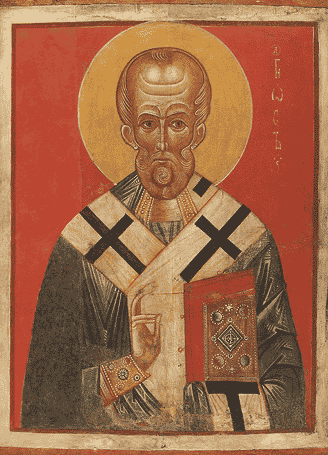
SAINT Nicholas. Day of death: (according to the martyrology) December 6, about 360. Grave: originally at Myra; since 1087 at Sari in Italy. Life (highly legendary): Nicholas was born at Patara in Asia Minor to parents who, having long been childless, had petitioned God with many prayers. Already as a youth Nicholas became noted for his zeal in helping the unfortunate and oppressed. In his native city there lived a poor nobleman who had three marriageable daughters; he could not obtain a suitor for them because he could offer no dowry. The contemptible idea struck him to sacrifice the innocence of his daughters to gain the needed money. When Nicholas became aware of this, he went by night and threw a bag containing as much gold as was needed for a dowry through the window. This he repeated the second and third nights. During a sea voyage he calmed the storm by his prayer; he is therefore venerated as patron of sailors. On a certain occasion he was imprisoned for the faith. In a wonderful way he later became bishop of Myra; his presence is noted at the Council of Nicaea. He died a quiet death in his episcopal city, uttering the words: "Into your hands I commend my spirit."

Nicholas is highly venerated in the East as a miracle worker, as "preacher of the word of God, spokesman of the Father." --Pius Parsch


O you who love festivals,
Come gather and sing the praises
of the fair beauty of bishops,
The glory of the fathers,
The fountain of wonders and great protector
of the faithful.

Let us all say: Rejoice, 0 guardian of the people of Myra,
Their head and honored counsellor,
The pillar of the church which cannot be shaken.
Rejoice, 0 light full of brightness
That makes the ends of the world shine with wonders.

Rejoice, 0 divine delight of the afflicted,
The fervent advocate of those who suffer from injustice.
And now, 0 all-blessed Nicholas,
Never cease praying to Christ our God
For those who honor the festival of your memory
With faith and with love.--Orthodox Liturgy

"What keeps you from giving now? Isn't the poor person there? Aren't your own warehouses full? Isn't the reward promised? The command is clear: the hungry person is dying now, the naked person is freezing now, the person in debt is beaten now-and you want to wait until tomorrow? "I'm not doing any harm," you say. "I just want to keep what I own, that's all." You own! You are like someone who sits down in a theater and keeps everyone else away, saying that what is there for everyone's use is your own. . . . If everyone took only what they needed and gave the rest to those in need, there would be no such thing as rich and poor. After all, didn't you come into life naked, and won't you return naked to the earth?

"The bread in your cupboard belongs to the hungry person; the coat hanging unused in your closet belongs to the person who needs it; the shoes rotting in your closet belong to the person with no shoes; the money which you put in the bank belongs to the poor. You do wrong to everyone you could help, but fail to help."

Basil
4th Century

"The large rooms of which you are so proud are in fact your shame. They are big enough to hold crowds--and also big enough to shut out the voices of the poor....There is your sister or brother, naked, crying! And you stand confused over the choice of an attractive floor covering."--Ambrose, 4th Century

A voyce from heven to erth shal com:
"Venite ad iudicium."

This voyce both sharp and also shryll
Shal be herd from heven to hell; All mydle erthe it shall fulfyll:
"Venite ad iudicium."

"Venite" is a blyssed song
For them that for joye dooth longe
And shall forsake paynes strong:
"Venite ad iudicium."

Glad in hert may they be
Whan Chryst sayeth, "Venite;
Ye blyssed chyldren, come to me,
Into vitam eternam.

"Whan I hongred, ye gave me meat;
Ye clothed me agaynst the heat;
In trouble ye dyde me not forget;
Venite ad iudicium.

"Ye socoured me at your doore
And for my sake gave to the poore;
Therfore wyll I you socoure;
Venite ad iudicium."

Sory in hert may they be
That hereth this hevy worde: "Ite;
Ye cursed chyldren, go fro me,
Into ignem eternum.

"Whan for nede that I dyde crye,
Comfortlesse ye lete me dye;
Therfore now I you deny;
Venite ad iudicium.

"For by me ye set no store,
Ye shall abye ryght dere therfore
In hell with devyls for evermore;
Venite ad iudicium."

Marana tha. Come, Lord Jesus. But not before Christmas. We have a lot of shopping still to do.

13,568,229: number of dollar millionaires in 2000
499: number of dollar billionaires in 2000

Wednesday, December 05, 2018

Advent 4:2018: Apocalypse, or Revelation?


APOCALYPSE is the cry of the helpless, who are borne passively by events which they cannot influence, much less control. The cry of the helpless is often vindictive, expressing impotent rage at reality. Apocalyptic rage is a flight from reality, a plea to God to fulfill their wishes and prove them right and the other wrong. Apocalyptic believers could hardly think the saying, "Go, make disciples of all nations," was addressed to them. Had apocalyptic believers dominated the church since the first century, there would have been no missions to unbelievers, no schools, no hospitals, no orphanages, no almsgiving. The helpless cannot afford to think of such enterprises; they can only await the act of God, and then complain because that act is so long delayed. The gospels and epistles rather tell the believers that they are the act of God. (John L. McKenzie)

The Good Place: How is the Kingdom of Heaven like that?


(Ed. note:  this whole subject deserves more attention than I had time to give it here.  So true of so many things in life, eh?  The point was, or was meant to be, what responsibility the rest of us, as believers, have to counter the ideas supporting the Vox article.  Kind of lost my way on that one.)

There's an interesting assumption here, one appropriate to the season of Advent (or any liturgical season):  what is "religion"?

But what makes The Good Place so fascinating is that it manages to be a show about the afterlife that is, nevertheless, not about religion. It takes seriously the demands of moral and ethical philosophy; the show’s emotional heart lies not in Chidi and Eleanor’s budding romantic relationship, but in the notion that they can become better people. It also plays the metaphysical framework surrounding the characters — the existence of God or other deities, and the actual structure of the universe — for laughs. (emphasis mine)
There is evangelical/fundamentalist Christianity, which is certainly concerned with do's and don'ts, mostly in what other people do that the "Christian" doesn't want them to do (I use quotes because evangelical/fundamentalists are hardly the exclusive brand of Christianity they think they are).  Once you are "saved," this brand holds, your morality is no longer a concern, except as you present a proper facade to others, a role model for them to follow (as long as inquiry is not made too closely into how you treat your friends, family, business relationships, or if you keep your consumption of alcohol mostly private).  So the idea that religion does not take "seriously the demands of moral and ethical philosophy" is a bit understandable; but it's also incredibly blinkered.

It’s the disconnect between The Good Place’s serious approach to ethics and lighthearted approach to metaphysics that makes the show such a powerful and affecting watch in an era in which one in three millennials no longer affiliate with an organized religion. The Good Place is, at its core, about goodness, not God. It’s a show about heaven and hell, but it’s also incredibly, tellingly secular.
The show is secular, and that's fine.  It's not a production of the Catholic Church, after all, or a mainstream Protestant denomination (ah, for the days of Davey and Goliath.  Well, not really....).  But is the reason one in three millenials no longer affiliate with organized religion really because organized religion is, at its core, about God and not about goodness?  Yeah, I can cite more than a few good examples of that being seemingly true; but do evangelicals and fundamentalists speak for us all?  And is complaining about that presumption really of any value?

Part of the problem is one of definition.  Take this assertion, for example:

Traditional questions of theology — Does God exist? Is God good? Why does a loving God allow evil in the world? — never come up in the Good Place.

But those are not tradition questions of theology; those are traditional questions of philosophy of religion.  True, they do come up in the Christian scriptures:  notably in the Wisdom books of the Hebrew scriptures (Job, especially); as well as in the words of the prophets (Jeremiah and Isaiah come to mind) as well as the Psalmist ("My God, my God!  Why have you forsaken me?"); but they are not theological questions as theology is defined and understood.  Maybe it's a minor point of definition, but the distinctions need to be clear.  However, in the context of the TV show, God is not what matters:

According to showrunner Michael Schur, this is intentional. “I stopped doing research [on world religions] because I realized it’s about versions of ethical behavior, not religious salvation,” he told the Hollywood Reporter before the show premiered. “The show isn’t taking a side, the people who are [in the Good Place] are from every country and religion.”

This much is truer than Burton seems to realize.  The fundamental question is Tolstoy's question:  "How should we then live?"  If we understand the words and lessons of Jesus of Nazareth as trying to answer that question, rather than answer the question "Are you saved?" (the ubiquitous religious question of my childhood, from the people who weren't members of my church/denomination), then you are actually closer to the interests (as I would argue, anyway) of Christianity; as well as, I agree, the religions of the world.  So the question is not, what are the use of world religions, but:  what is a "religion"?

The show cares about what we do on earth, not what’s stored up in heaven.

 The Kingdom of God is like this

A trader sold all his merchandise to buy a single pearl

(But how is the Kingdom of God like that?)

John Dominic Crossan, The Essential Jesus (New York: HarperSanFranciscso, 1994, 1st ed.), p. 93

For heaven's imperial rule is like a proprietor who went out the first thing in the morning to hire workers for his vineyard.  After agreeing with the workers for a silver coin a day he sent them into the vineyard.

And coming out around 9 a.m. he saw others loitering in the marketplace, and he said to them 'You go into the vineyard too, and I'll pay you whatever is fair.'  So they went.

Around noon he went out again, and at 3 p.m., and repeated the process.  About 5 p.m. he went out and found others loitering about and says to them, 'Why did you stand here idle the whole day?'

They reply, 'Because no one hired us.'

He tells them, 'You go into the vineyard as well.'

When evening came the owner of the vineyard tells his foreman:  'Call the workers and pay them their wages starting with those hired last and ending with those hired first.'

Those hired at 5 p.m. came up and received a silver coin each.  Those hired first approached thinking they would receive more.  But they also got a silver coin apiece.  They took it and began to grumble against the proprietor.  'These guys hired last worked only an hour but you have made them equal to us who did most of the work during the heat of the day.'

In response he said to one of them, 'Look, pal, did I wrong you?  You did agree with me for a silver coin, didn't you?  Take your wage and get out!  I intend to treat the one hired last the same way I treat you.  Is there some law forbidding me to do with my money as I please?  Or is your eye filled with envy because I am generous?'


The last will be first and the first last."(Matthew 20:1-16, SV)

Jesus said to him, "If you wish to be perfect, make your move, sell your belongings and give (the proceeds) to the poor and you will have treasure in heaven.  And then come, follow me!"

When the young man heard this advice, he went away dejected since he possessed a fortune.

Jesus said to his disciples, "I swear to you, it is very difficult for the rich to enter Heaven's domain.  And again I tell you, it's easier for a camel to squeeze through a needle's eye, than for a wealthy person to get into God's domain."

When the disciples heard this, they were quite perplexed and said, "Well, then, who can be saved?"

Jesus looked them in the eye and said to them, "For mortals this is impossible; for God, everything's possible."

In response Peter said to him, "Look at us, we left everything to follow you!  What do we get out of it?"

Jesus told them, "I swear to you, you who have followed me, when the son of Adam is seated on his throne of glory in the renewal (of creation), you also will be seated on twelve thrones and sit in judgment on the twelve tribes of Israel.  And everyone who has left homes of brothers or sisters or father or mother or children or farms, on my account, will receive a hundred times as much and inherit eternal life.  Many of the first will be last, and of the last many will be first."

Matthew 19: 21-30, SV

“Come for water, all who are thirsty;
Though you have no money, come, buy grain and eat;
Come, buy wine and milk,
Not for money, not for a price.
Why spend your money for what is not food,
Your earnings on what fails to satisfy?
Listen to me and you will fare well,
You will enjoy the fat of the land.
Come to me and listen to my words,
Hear me and you will have life:
I shall make an everlasting covenant with you
To love you faithfully as I have loved David.
I appointed him a witness to peoples,
And you in turn will summon nations you do not know,
And nations that do not know you will hasten to you,
Because the Lord your God, Israel’s Holy One, has made you glorious.—Isaiah 55:1-5 (REB)

Happy is he that hath the God of Jacob for his help, whose hope is in the Lord his God:
Which made heaven and earth, the sea, and all that therein is: w hich keepeth truth forever:
Which executeth judgment for the oppressed: which giveth food to the hungery. The Lord looseth the prisoners:
The Lord openeth the eyes of the blind: the Lord raiseth them that are bowed down: the Lord loveth the righteous:
The Lord preserveth the strangers; he relieveth the fatherless and widow; but the way of the wicked he turneth upside down.
The Lord shall reign forever, even thy God, O Zion, unto all generations. Praise ye the Lord.

After a while the stream dried up, for there had been no rain in the land. Then the word of the Lord came to him: “Go now to Zarephath, a village of Sidon, and stay there; I have commanded a widow there to feed you.’ He went off to Zarephath, and when he reached the entrance to the village, he saw a widow gathering sticks. He called to her, ‘Please bring me a little water in a pitcher to drink.’ As she went to fetch it, he called after her, ‘Bring me, please, a piece of bread as well.’ But she answered, “As the Lord your God lives, I have no food baked, only a handful of flour in a jar and a little oil in a flask. I am just gathering two or three sticks to go and cook it for my son and myself before we die.’ ‘Have no fear,’ Elijah said, ‘go and do as you have said. But first make me a small cake from what you have and bring it out to me, and after that make something for your son and yourself. For this is the word of the Lord the God of Israel: The jar of flour will not give out, nor the flask of oil fail, until the Lord sends rain on the land.’ She went and did as Elijah had said, and there was food for him and for her family for a long time. The jar of flour did not give out, nor did the flask of oil, as the word of the Lord foretold through Elijah. 1 Kings 17:7-16 (REB)

Or again, is there any woman with ten silver coins, who if she loses one, wouldn’t light a lamp and sweep the house and search carefully until she finds it? When she finds it, she invites her friends and neighbors over and says ‘Celebrate with me, because I have found the silver coin I had lost.’ Luke 15:8-9 (SV)

Is there any one of you who owns a hundred sheep and one of them gets lost, who wouldn’t leave the ninety-nine in the wilderness, and go after the one that got lost until he finds it? And when he finds it, he lifts it upon his shoulders, happy. Once he gets home, he invites his friends and neighbors over, and says to them, ‘Celebrate with me, because I have found my lost sheep.’ Luke 15:4-6 (SV)

A younger son requested and received his inheritance, went abroad, and wasted it all. Destitute in the midst of famine, he envied the swill of the swine he tended.

The younger son
I will return home where servants eat their fill
I will say to my father
I have sinned against you and God
I am not worthy to be your son
I will be your hired servant

The father saw him even before he reached the house, ran out, embraced, and kissed him.

The younger son
“I have sinned against you and God
I am not worthy to be your son”

The father

“Bring robes, and shoes, and a ring
Prepare a great feast
My lost son is found, my dead son is back.”

The elder son returned at evening form working in the fields, heard the sounds of music, and asked a servant what was happening.

The servant

“Your brother is back and your father feasts him”

He was angry, refused to enter the banquet hall, and complained when his father came out to speak with him

The elder son

“I, who have always obeyed you, have never received a feast
He, who has disgraced you, receives one now”

The father

“You are with me always and mine is yours forever
But now is the time for feasting
Your lost brother is found, your dead brother is back” (John Dominic Crossan, The Essential Jesus)

Woe to him who says,
"I shall build myself a spacious palace
with airy roof chambers and
windows set in it.
It will be paneled with cedar
and painted with vermilion."
Though your cedar is so splendid,
does that prove you a king?
Think of your father: he ate and drank,
dealt justly and fairly; all went well with him.
He upheld the cause of the lowly and poor;
then all was well.
Did not this show he knew me? says the Lord.
But your eyes and your heart are set on naught but gain, set only on the innocent blood you can shed,
on the cruel acts of tyranny you perpetrate.  (Jeremiah 22: 14-17 (REB))

When the son of Adam comes in his glory, accompanied by all his messengers, then he will occupy his glorious throne.  Then all peoples will be assembled before him, and he will separate them into groups, much  as a shepherd separates sheep from goats.  He'll place the sheep to his right and the goats to his left. Then the king will say to those at his right, 'Come, you who have the blessing of my Father, inherit the domain prepared for you from the foundation of the world.  You may remember, I was hungry and you gave me something to eat; I was thirsty and you gave me something to drink; I was a foreigner and you showed me hospitality; I was naked and you clothed me; I was ill and you visited  me; I was in prison and you came to see me.'

Then the righteous will say to him, 'Lord, when did we see you hungry and gave feed you or thirsty and give you a drink? When did we notice that you were a foreigner and extend hospitality to you?  Or naked and clothed you? When did we find you ill or in prison and come to visit you?'

And the king will respond to them, 'I swear to you, whatever you did for the most inconspicuous members of my family, you did for me as well.'

Next he will say to those at his left, 'You, condemned to the everlasting fire prepared for the devil and his messengers, get away from me!  You too may remember, I was hungry and you didn't give me anything to eat; I was thirsty and you refused me a drink; I was a foreigner and you failed to extend hospitality to me; naked and you didn't clothe me; ill and in prison and you didn't visit me.'

Then they will give him a similar reply: 'Lord, when did we notice that you were hungry or thirsty or a foreigner or naked or ill or in prison, and did not attempt to help you?'

He will then respond, 'I swear to you, whatever you didn't do for the most inconspicuous members of my family, you didn't do for me.'

The second group will then head for everlasting punishment, but the virtuous for everlasting life.  (Matthew 25: 31-46, SV)

A large selection; but how many of those are about salvation in the Great Hereafter, and how many of them directly address Tolstoy's question:  "How should be then live?"

What is religion, if not about that question?

Tuesday, December 04, 2018

Advent 3: 2018: "And I Feel Fine"


"Advent then is dedicated to the last things, to death, judgment, heaven and hell, but above all to Jesus' glorious coming to complete his Easter work.  The church goes so far as to set aside an entire season to the end of the world and the final coming of the Lord, so important a part of the faith does she consider these truths."

--Charles K. Riepe

Conditor alme siderum


The birth of Jesus the Anointed took place as follows:  While his mother Mary was engaged to Joseph, but before they slept together, she was found to be pregnant by the holy spirit.  Since Joseph her husband was a good man and did not wish to expose her publicly, he planned to break off the engagement quietly.

While he was thinking about these things, a messenger of the Lord surprised him in a dream with these words:  "Joseph, descendant of David, don't hesitate to take Mary as your wife, since the holy spirit is responsible for her pregnancy.  She will give birth to a son and you will name him Jesus.  this means 'he will save his people from their sins.' "  All of this happened so the prediction of the Lord given by the prophet would come true:

Behold a virgin will conceive a child
and she will give birth to a son,
and they will call him Emmanuel.

(which means "God with us").

Joseph got up and did what the messenger of the Lord told him; he took his wife.  He did not sleep with her until she had given birth to a son.  Joseph named him Jesus.--Matthew 1:18-25, SV.

The nativity stories are, indeed, two separate stories; and they were not originally widely known outside their communities (the one for Luke's gospel, the one for Matthew's) until a universal church was established, a far different entity than the house churches Paul planted.  Scholars call these stories examples of material from "special Luke" and "special Matthew" because they are unique in the canon, where much of Luke and Matthew is from Mark or a separate conjectured document, "Q".  John's gospel stands apart though, as I've argued, not that far apart.

But Biblical scholarship is not the issue here; story-telling is.  Luke's narrative, the one everyone loves and remembers Linus reciting, is about shepherds and angels, about the Christchild born in a feeding trough among the humblest of peasants (his parents were just above the shepherds in the social-economic pecking order).  Matthew's story is different:  it's about the recognition of the nations, especially their recognition of the kingly role of the Messiah.  But Matthew's story is also, from the very beginning, about death.  We used to remember that; the relic of our remembrance is the number of recordings (I have one on almost every Christmas choral album I own) of the Coventry carol, the lullaby of the weeping mothers over the deaths of their children on the orders of Herod.  That's what that picture above is about.  The story is from Matthew, but the shadow of death hangs over the narrative from the beginning.

Joseph is visited by the angel in Matthew's story; Luke again upends social expectations because Gabriel first appears to Zechariah, the priest, but the priest is struck dumb for his response to the angel.  Mary, a woman, is visited, and she responds in a way that uplifts her.  In Matthew the annunciation to Joseph makes him decide to set the marriage aside.  When I was a child this confused me; "marriage" meant a wedding ceremony, but the relationship between Joseph and Mary was closer to a modern engagement.  Still, it was more binding than that, because we've lost the concept of a breach of promise; we even let people out of marriage much more easily than even in my childhood.  Mary and Joseph were "married" in the sense of betrothal, and bound together as man and wife; of course Mary's pregnancy would mean the "death" of that marriage, and shame on Joseph because he had been cuckolded.  Joseph's sainthood rests almost entirely (at least from Biblical accounts) on his response:  he resolves to end the marriage quietly, rather than bring penury on Mary.  An unmarried mother would be more than the mother of a bastard; she would be a beggar, probably a prostitute, her only chance to make any money.  There is a certain death-in-life sentence hanging there, which Joseph wants to mitigate.  But neither does he want to raise another man's child.  There is a lot going on in these few sentences, and none of it good for Mary, or Joseph. So far, this is not a heart-warming family tale for the children to gather 'round and hear.  I remember my childhood and the adults, my father included, trying to explain this part to me, and moving on quickly to the star and the shepherds because they couldn't.  If not death, there is darkness here, and the story grows darker as it moves along.

Jesus was born in Bethlehem, in Judea, when Herod was king.  Astrologers from the East showed up in Jerusalem just then.  "Tell us," they said, "where the newborn king of the Judeans is.  We have observed his star in the east and have come to pay him homage."

When this news reached King Herod, he was visibly shaken, and all Jerusalem along with him.  He called together all the ranking priests and local experts, and pressed them for information.  "Where is the Anointed supposed to be born?"

They replied, "At Bethlehem in Judea."  This is how it is put by the prophet:

And you, Bethlehem, in the province of Judah,
you are by no means least among the leaders of Judah.
Out of you will come a leader
who will shepherd my people, Israel.

Then Herod called the astrologers together secretly and ascertained from them the precise time the star became visible.  Then he sent them to Bethlehem with these instructions  "Go make a careful search for the child.  When you find out where he is, report to me so I can come and pay him homage."

They listened to what the king had to say and continued on their way.

And there guiding them on was the star they had observed in the East; it led them forward until it came to a standstill above where the child lay.  Once they saw the star, they were beside themselves with joy.  And they arrived at the house and saw the child with his mother Mary.  They fell down and paid him homage.  Then they opened their treasure chests and presented him with gifts:  gold and incense and myrrh.  And because they had been alerted in a dream not to return to Herod, they journeyed back to their own country by a different route.

After they had departed, a messenger of the Lord appeared in a dream to Joseph, saying "Get ready, take the child and his mother and flee to Egypt.  Stay there until I give you instructions.  You see, Herod is determined to hunt the child down and destroy him."

So Joseph got ready and took the child and his mother under cover of night and set out for Egypt.  There they remained until Herod's death.  This happened so the Lord's prediction spoken by the prophet would come true:  "Out of Egypt I have called my son."

When Herod realized he'd had been duped by the astrologers, he was outraged.  He then issued a death warrant for all the male children in Bethlehem and surrounding region two years old and younger.  This corresponded to the time that he had learned from the astrologers.  With this event the prediction made by Jeremiah the prophet came true:

In Ramah the sound of mourning and bitter grieving was heard:
Rachel weeping for her children.
She refused to be consoled:
they were no more.

After Herod's death, a messenger of the Lord appeared in a dream to Joseph in Egypt;  "Get ready, take the child and his mother, and return to the land of Israel; those who were seeking the child's life are dead."

So he got ready, took the child and his mother, and returned to the land of Israel.  He heard that Archelaus was the King of Judea in the place of his father Herod; as a consequence, he was afraid to go there.  He was instructed in a dream to go to Galilee; so he went there and settled in a city called Nazareth.  So the prophecy uttered by the prophets came true:  "He will be called a Nazorean."--Matthew 2: 1-23, SV

The magi, the astrologers, come to Bethlehem, seeking the child because reading the stars has revealed to them that a new king has been born.  Matthew here is making the story a cosmic event, based on the idea that a new star indicates the birth of a new and important person.  The star that guides them to the home of Mary and Joseph doesn't show up until after they go to Herod; a reasonable choice for strangers looking for a new prince.  When it turns out Herod has no children born in the last two years, they are guided by a quite fantastic star directly to the home of the Holy Family.  The star is the heavenly messenger who twice tells Joseph what to do at critical junctures in the narrative.  This time it has to put the travelers on the right path.  Nativity scenes and Christmas plays mash these events into the Lukan narrative and make it all happen on one night; but in Matthew's story Jesus' actual birth is uneventful, and two years later the "Wise Men" arrive bearing gifts.  Very, very significant gifts; very, very clearly symbolic gifts.

Gold is the recognition of a king.  Funny the Holy Family didn't live the high life on it; the gold is almost a McGuffin; it disappears from the story the moment it is mentioned.  The other two gifts would be downright disturbing to the parents:  frankincense and myrrh.  Nobody told me as a child that these were not just perfumes, but used on the corpses of the wealthy to hide the stench of death and decay (the same reason we embalm corpses now, and for the tradition of burial six feet underground).  The gifts are not meant to be literal, any more than the visit of the Magi is meant to be historical (nor the Star of Bethlehem meant to be physical, despite the best efforts of planateria and science centers each year to "explain" the star).  They are symbols in Matthew's narrative, meant to convey the themes of his gospel.  Jesus is unique not because Mary is a virgin, a woman who has never had intercourse, but because he comes directly from God.  The gifts are symbolic recognition and even assertion of his royal lineage (Matthew's gospel opens with Jesus' descent from King David), and of his crucifixion and death.  The resurrection means nothing if Jesus never died.  The gifts of frankincense and myrrh foreshadow, for Matthew's original audience, the story to come.

As does the aftermath of the visit, the Massacre of the Innocents.  The children die in a slaughter of almost Hollywood proportions (faceless nameless deaths meant to convey the character of the villain more than shock the conscience of the audience), all to underline the danger to Jesus and the Holy Family.  If Jesus is not mortal, there is no danger to him; if he is not human, he cannot die, and the resurrection is an empty boast.  The Holy Family may be blessed by God, they may be, in the words of Rufus Wainwright, "each one quite odd/a mensch, a virgin, and a God," but if Jesus is not human there is no point to the entire gospel.  That humanity is underscored by the Massacre:  this is the deadly world those without temporal power live in.  Jesus is not only human, Jesus is powerless.  The Family escapes only because an angel warns them, and they manage to make it into Egypt just as Herod's soldiers come calling with swords drawn.  Even if the event (like Luke's census) is invented rather than historical, it serves the narrative purpose:  God is involved in history, but is not running history, not, at least, on the quotidian level.  This is not a tale for children at all.  It suits better all those internet memes about stories with themes we can now find disturbing.  Looked at closely this is not a story for children at all.  Small wonder we fold the star into Luke, and ignore the rest of what Matthew has to say.  Because Matthew is saying what the medieval period learned all too well:  in the midst of life, we are in death.  And the best indicator of life and humanity, is the ability to die.  Jesus is God.  Jesus is mortal.  Death awaits all mortals. Death threatens Jesus, directly, from the very beginning.

And the story doesn't end until Herod dies. Only then is Joseph told it's safe to return, but fear of death makes him return, not to Galilee, but to Nazareth.  Death drives the first two chapters of Matthew; a narrative foreshadowing of the end of the gospel, and a thematic reminder that this is the story of a human being, no matter how much he was also God.

Definitely not a story for children.  Small wonder Linus went with the Lukan version.

Monday, December 03, 2018

A Mensch, a Virgin, and a God


So, the point I was making about evangelical Christianity and soteriology as the only point of Christ's existence; well, here it is in a Xmas nutshell:

So the migrants making their way to America, demanding an entry they’ve not legally earned, are practically one and the same with Jesus Christ — with the birth of the savior to the world?

It’d sure be nice if those who knew least about Christianity would quit trying to tell Christians about Christianity.

It’d sure be great if those who have no clue about the true meaning of Christmas quit trying to define its meanings to those who do have a clue.

Christmas is about the birth of Jesus, the savior sent by God to ultimately die for humanity’s sins.

Reclassifying it as some sort of social justice day of remembrance for the poor and needy is a lie. Trying to draw comparisons between the plight of of Mary, who couldn’t find room at an inn and was therefore, with husband Joseph at her side, forced to give birth on a bed of straw, in a manger — as ordained by God — and with the pursuits of migrants to find a home, by legal means or otherwise, in America, is a bit whacked.

What is "whacked" is presuming your particular theology is the only form of Christianity all Christians adhere to; and those who don't (does Chris Cuomo consider himself a Christian?) "should quit trying to tell Christians about Christianity."  But the interesting point here is the assertion:

Christmas is about the birth of Jesus, the savior sent by God to ultimately die for humanity’s sins.

We can argue about what Christmas is "about," because there are two:  the one celebrated by the church, and the one celebrated by the world (I'm betting her Christmas looks no different from anyone else's Christmas in America, be they Christians of her stripe or not).  But the idea that Christmas is about Christ being born so he can die.  Well, the gospel of Matthew puts death at the core of its nativity tale, and Luke ends his with the pending death of Simeon and the prophecy that a sword will pierce Mary's heart, also.  That prophecy is read as a metaphorical sword, assuming she lives to see her first born executed as a political threat to the Pax Romana.  Still, even most Christmas carols praise, not the Savior who died, but the Lord who came.  Advent is about preparation for the Messiah, not preparation for the burial.  Jumping that quickly from Christmas to Easter can make you dizzy.

But it's the delimiting, the narrowing, the belittling of the four gospels, that is breathtaking.  If we only had Paul's accounts, focussed on the eucharist and the resurrection, this might be justified.  But then we wouldn't have Christmas, because we wouldn't have Matthew and Luke's gospels.  And Matthew's gospel tells us that even Jesus was a refugee, fleeing to another country because he faced certain death in his own.  The trip to Bethlehem in Luke is simply an internal displacement for the benefit of the ruling powers (the source of the "plight" not being God's will at all); the flight into Egypt is a more direct parallel to the plight of the immigrants on the California border.  Of course, that depends on how you frame the stories:

One is a story of hope and love and, oh yes, the birth of our savior. The other? A human struggle for economic opportunity.
The adult Jesus actually has a lot to say about "economic opportunity."  But the stories of the birth of Jesus have a lot to say about temporal power and how it can be used abusively.  The Holy Family flee to Egypt for the very reasons immigrants to this country are, by law, allowed asylum:  because they face death where they are.  Imagine if, in Matthew's story, the Egyptians had closed their borders.  The flight is to a country beyond the reach of Herod and Rome.  If the way was barred, what then?

This is exactly what the Christmas story is about.  If they don't preach it in Cheryl Chumley's church, that doesn't make the story any less significant.

It just means she needs some Christians to explain Christianity to her.

Advent 1: 2018 Martyrs of El Salvador


Thirty years ago today Sr.s Dorothy Kazal, Ita Ford, Maura Clark and Jeanne Donovan were tortured, raped and murdered in El Salvador by American trained terrorists because they were working for the most basic civil rights of poor people.--Anthony McCarthy


It was yesterday, but that was the First Sunday of Advent.  It's been nearly 40 years ago, now.  that opening quote is from 2010.  Nothing else important, however, has changed.

I repeat this every year. This post is largely as I wrote in in 2008. I preached from this story when I had a pulpit and used it, probably unwisely, in a sermon when I was invited to a pulpit in Advent. It is volatile stuff, and repetition had dulled me to that. It shouldn't be repeated enough to dull one; just enough to make one sensitive to the world, and to the message of Advent.

In the world, Advent means precious little; frantic for Christmas to come and go, the world is in a hurry. To the liturgical church, though, Christmas doesn't begin until December 24th, and it doesn't end until January 6th, on Epiphany. And before it ends, it will include two days of death: the Massacre of the Innocents, and the first Christian Martyr, St. Stephen. I mention that because Advent is actually akin to Lent, not to "December" on the American calendar. It is a time of preparation for shattering change, not for celebration of consumer excess.

This highlights a distinction I think needs to be made, between Christianity, and Christendom. It's an old distinction, but, like the Massacre of the Innocents and the death of Stephen right after Christmas, little acknowledged or its importance understood.

As I type this, I'm listening to a Christmas mix of my own devising, and Joni Mitchell is singing "River." That's the tone I'm going for, if it helps.

This is from Memory of Fire: Volume III, Century of the Wind, by Eduardo Galeano, tr. Cedric Balfrage, Pantheon, 1988.

"ARCHBISHOP Romero offers her a chair. Marianela prefers to talk standing up. She always comes for others, but this time Marianela comes for herself. Marianela Garda Vilas, attorney for the tortured and disappeared of EI Sal-vador, does not come this time to ask the archbishop's solidarity with one of the victims of D' Aubuisson, Captain Torch, who burns your body with a blowtorch, or of some other military horror specialist. Marianela doesn't come to ask help for anyone else's investigation or denunciation. This time she has something personal to say to him. As mildly as she can, she tells him that the police have kid-napped her, bound, beat, humiliated, stripped her-and that they raped her. She tells it without tears or agitation, with her usual calm, but Archbishop Romero has never before heard in Marianela's voice these vibrations of hatred, echoes of disgust, calls for vengeance. When Marianela finishes, the archbishop, astounded, falls silent too.

"After a long silence, he begins to tell her that the church does not hate or have enemies, that every infamy and every action against God forms part of a divine order, that criminals are also our brothers and must be prayed for, that one must forgive one's persecutors, one must accept pain, one must. . . Suddenly, Archbishop Romero stops.

"He lowers his glance, buries his head in his hands. He shakes his head, denying it all, and says: 'No, I don't want to know.'

" 'I don't want to know,' he says, and his voice cracks.

"Archbishop Romero, who always gives advice and comfort, is weeping like a child without mother or home. Archbishop Romero, who always gives assurances, the tranquilizing assurance of a neutral God who knows all and embraces all-Archbishop Romero doubts.

"Romero weeps and doubts and Marianela strokes his head."

This is the First week of Advent. In Christianity, we are told to watch. We are watching for the apocalypse. We are waiting in faith, faith not so much in certainty as "acting-as-if in great hope." Hope is supposed to be what we desire; Advent reminds us hope is also for what we need, whether we really want it, or not.

Sunday, December 02, 2018

First Sunday of Advent 2018


Jeremiah 33:14-16

33:14 The days are surely coming, says the LORD, when I will fulfill the promise I made to the house of Israel and the house of Judah.

33:15 In those days and at that time I will cause a righteous Branch to spring up for David; and he shall execute justice and righteousness in the land.

33:16 In those days Judah will be saved and Jerusalem will live in safety. And this is the name by which it will be called: "The LORD is our righteousness."

Psalm 25:1-10
25:1 To you, O LORD, I lift up my soul.

25:2 O my God, in you I trust; do not let me be put to shame; do not let my enemies exult over me.

25:3 Do not let those who wait for you be put to shame; let them be ashamed who are wantonly treacherous.

25:4 Make me to know your ways, O LORD; teach me your paths.

25:5 Lead me in your truth, and teach me, for you are the God of my salvation; for you I wait all day long.

25:6 Be mindful of your mercy, O LORD, and of your steadfast love, for they have been from of old.

25:7 Do not remember the sins of my youth or my transgressions; according to your steadfast love remember me, for your goodness' sake, O LORD!

25:8 Good and upright is the LORD; therefore he instructs sinners in the way.

25:9 He leads the humble in what is right, and teaches the humble his way.

25:10 All the paths of the LORD are steadfast love and faithfulness, for those who keep his covenant and his decrees.

1 Thessalonians 3:9-13
3:9 How can we thank God enough for you in return for all the joy that we feel before our God because of you?

3:10 Night and day we pray most earnestly that we may see you face to face and restore whatever is lacking in your faith.

3:11 Now may our God and Father himself and our Lord Jesus direct our way to you.

3:12 And may the Lord make you increase and abound in love for one another and for all, just as we abound in love for you.

3:13 And may he so strengthen your hearts in holiness that you may be blameless before our God and Father at the coming of our Lord Jesus with all his saints.

Luke 21:25-36
21:25 "There will be signs in the sun, the moon, and the stars, and on the earth distress among nations confused by the roaring of the sea and the waves.

21:26 People will faint from fear and foreboding of what is coming upon the world, for the powers of the heavens will be shaken.

21:27 Then they will see 'the Son of Man coming in a cloud' with power and great glory.

21:28 Now when these things begin to take place, stand up and raise your heads, because your redemption is drawing near."

21:29 Then he told them a parable: "Look at the fig tree and all the trees;

21:30 as soon as they sprout leaves you can see for yourselves and know that summer is already near.

21:31 So also, when you see these things taking place, you know that the kingdom of God is near.

21:32 Truly I tell you, this generation will not pass away until all things have taken place.

21:33 Heaven and earth will pass away, but my words will not pass away.

21:34 "Be on guard so that your hearts are not weighed down with dissipation and drunkenness and the worries of this life, and that day catch you unexpectedly,

21:35 like a trap. For it will come upon all who live on the face of the whole earth.

21:36 Be alert at all times, praying that you may have the strength to escape all these things that will take place, and to stand before the Son of Man."


What is a 'day'? Sidereal? The period of time between sunrise and the next sunrise? The 24 hours between midnights? How odd is that, that day ends and begins while we sleep. How, then, do we know the day has come? Because we believe the clocks? The calendars? The sun?

We know these things, but how do we know? We may not 'believe', yet the most common, everyday occurences which order our lives, are the matters of greatest faith. When is it midnight? When is it a new day? Without clocks, how do we know? Without calendars, how are we sure? And why do we accept that clocks and calendars are right? Who told us it was so?

So the day that is coming, the day that we will know the kingdom of God is near: what 'day' is that? And is it a day for all of us, a cosmic day, a universal day? Is it a sidereal day, one to be noted in red on a calendar for generations unborn to learn? Or is it an internal day, a personal day, a day you, or I, or someone in particular, will always remember, even if no one else noticed anything.

My friend in high school kept a calendar, and the year he married it was full of important dates related to his wedding day. His was in June, mine in May. Though he was in my wedding party, and I was his Best Man, nothing was recorded on my wedding date in his calendar. So one day I wrote on it: "Absolutely nothing happening" on the date of my planned wedding. And later he gave me a book of photographs from the wedding, photos he had taken. He titled the little book: "A day on which absolutely nothing happened." It did, of course. It changed my life, and the lives of my friends, and of my family and my wife's family. But was it a day? Did it matter to anyone except those involved? Could it be knowing the kingdom is near is like that?

Look again at what Jesus says:

"There will be signs in the sun, the moon, and the stars, and on the earth distress among nations confused by the roaring of the sea and the waves. People will faint from fear and foreboding of what is coming upon the world, for the powers of the heavens will be shaken. Then they will see 'the Son of Man coming in a cloud' with power and great glory. Now when these things begin to take place, stand up and raise your heads, because your redemption is drawing near."
The Son of Man will be seen coming in a cloud...well, that's what they will say. And when these things take place, stand up. After? or before? And how will it come, again? Signs in the moon, sun, stars? No; like the leaves on the fig tree. Like an annual occurrence you can read from experience, so will the coming of the Son of Man be. Except it will be unexpected and something no one has experienced, and so unlike anything you've ever known, and it will mean not the end of the time but that the kingdom of God is near. But the kingdom of God is already here. And surely it would be an apocalypse, a revelation (it is all that the Greek word means), to even know that kingdom was near, much less to know it was already and always here. And the Son of Man? How will you know it is the Son of Man?

Perhaps because he will look like that Magritte painting above. That's how Magritte imagined him. Perhaps he will look like that. Why not? It has a certain logical symbolism about it. Why could not God make it so? If the signs are going to be as simple as reading the leaves on a fig tree, who can say how the Son of Man will appear? Will you know him? Are you sure? What makes you think you can read the signs? Those in the sun and the moon and the stars seem to portend evil and great things. But the leaves on a fig tree? Doesn't anybody know what those mean? So which signs do we read? The cartoonish omens from a bad movie? Or the quotidian ones that indicate all is as it was before, and will be again? Is the Son of Man who we will recognize? Or who we will wonder about? And will the kingdom of God come in power and be forced on all the unbelievers, like every other kingdom humanity has ever known? Or will it be different this time? Is the Lord who is our righteousness going to establish a reign like the Pax Romana? Is the kingdom of God the imposition of the ultimate cosmic power?

Or is it the return of summer? The Psalmist says God is the one who instructs the student. Paul tells the church at Thessalonia that he prays for God to direct them. Where is the hand of God in this, the hand that coerces and commands and controls and brooks no argument? Where is the "Biblical" God of the "Old Testament" in "righteous anger" that we all know is the "real" God of Christianity, or at least of those "old" books of the Bible?

Why is Jesus telling us we can read the times as easily as we can read tree leaves? And notice what he warns us about:

"Be on guard so that your hearts are not weighed down with dissipation and drunkenness and the worries of this life, and that day catch you unexpectedly, like a trap. For it will come upon all who live on the face of the whole earth. Be alert at all times, praying that you may have the strength to escape all these things that will take place, and to stand before the Son of Man."
This is an advent text, which means it is about keeping awake. That is the first call of the church every time the liturgical year comes around and begins again. Keep awake! And Jesus warns us not to get lost in the quotidian, "the worries of this life." He doesn't warn us against the dangers of war and earthquake and famine and cosmic disaster. He warns us against daily living, not "2012." Nations "confused by the roaring of the sea and the waves" is not a prediction of hurricanes and tsunamis: it's a mockery of how easily disturbed we are, how lightly we are thrown off our comforts. The sea and the waves always roar. If we are confused by them, whose fault is that? There are always signs in the sun and the moon and the stars, but what do they really mean? The Mayan calendar stops at 2012 because they cycle of their calendar ends then, not because time comes to an end. What signs are you reading? Those you think are in the stars? Or what the new leaves on the tree mean?

"Be alert at all times, praying that you may have the strength to escape all these things that will take place, and to stand before the Son of Man." It's a joke, not an admonition. A joke worthy of a Magritte painting, which allows you stand before the "Son of Man." What are you waiting for, the kingdom of God to come near? It's here. Proclaim it! What are you waiting for, God to act first? God has! The adventus is coming, it's only four weeks away. It returns every year at this time, have you not heard, have you not seen? What are you waiting for, a reason to act? You have it! Act now, avoid the rush, beat the crowds to the manger! What are you waiting for, a sign from the trees?

This could be the day. Or it could be another day on which absolutely nothing happened. The choice is yours. If you would be awake, be awake to that. And be aware the Son of Man could come looking like a surrealist painting. After all, it's almost a dream concept.

Amen.

Saturday, December 01, 2018

Yes, it is too soon


My strongest memory of George H.W. Bush (aside from Dana Carvey's impersonation) is his pardon of the Iran-Contra figures on his way out the door, a pardon eclipsing even Ford's pardon of Nixon because Bush was saving his own ass, and everybody knew it.  However, and it's a weak defense, I only mention it today because of the graceless articles on Vox today. (And these are merely representative, I'm sure there are more out there.)*

I'm sure the demand to be topical and au courant mean those articles must be published now or never. If that's the case, I vote for "never." It isn't, though. There will be time for the full picture of the man. I would like to see that pardon talked out thoroughly, especially as it calls into question the wisdom of the pardon power, which seems to have done more harm than good in this century (at least in the hands of Republican Presidents). That would be a worthwhile discussion, and even another creditable contribution to our national life by the late Mr. Bush. But that discussion is not for today; today is for mourning and respect for the dead and the family of the dead.

Common decency and humanity demands no less. Time enough for criticism and honest assessment. For now the wisdom of the admonition is not to be dismissed: do not speak ill of the dead.

If nothing else, one day your family will be grateful to be shown as much respect.

*There are: Slate wants in on the act, too:


Considering the subject is obituaries, even though they "probe" his personal life by mentioning it (he was married, he loved his wife, he made parachute jumps), it is improper, apparently, to fail to mention the sexual assault and harassment allegations against him in what amounts to a eulogy.  There is a time and place for such information, and an obituary is not it.  I doubt they mention his pardons, either (I haven't seen anyone bring them up), even though, from a Constitutional (not to mention current events) point of view, I think those are far more relevant, and far less subject to challenge as to whether or not they happened.  Still, I would not fault an obituary that didn't mention them.  There is a time and place, and speaking ill of the dead is as uncivil as Donald Trump refusing the opportunity to retract his assaults on the deceased.  "The dead" here meaning the recently dead; when they become truly historical figures, their honest assessments can be made.

The Sociopathic White House


Wow. 

Mr. Trump looks for people who share his disregard for the truth and are willing to parrot him, “even if it’s a lie, even if they know it’s a lie, and even if he said the opposite the day before,” said Gwenda Blair, a Trump biographer. They must be “loyal to what he is saying right now,” she said, or he sees them as “a traitor.”

Campaign aides often echoed Mr. Trump’s pronouncements knowing they were false. People joined the top levels of his administration with the realization that they would be expected to embrace what Mr. Trump said, no matter how far from the truth or how much their reputations suffered.

Interestingly, this article includes an ad inviting readers to "explore the issues from both sides of the aisle."  What does this issue look like from the other side of the aisle, I wonder?

It really doesn't matter how many supporters Trump has or how much of the GOP base thinks Trump is doing God's work.

One Of These Things Is Not Like The Other


One of these things just doesn't belong:

With Donald Trump, it’s always about the money. He is not going to sit in the White House and watch his business empire suffer the same fate as Paul Manafort, who forfeited $46 million to the government as part of his plea deal. He’ll resign with an assurance that he is pardoned for his crimes in the Russia investigation, the same way Nixon resigned with a pardon for his crimes in Watergate.

So Russiagate isn’t that different from Watergate after all. They will end up with the same end game.

Except Richard Nixon wasn't under investigation for state crimes or state tax fraud.  Mike Pence could pardon Trump, a la Ford and Nixon, but that would not end Trump's legal woes, or offer any greater protection to this business empire than it has now.

Nor would it do any more good for the GOP than Ford's pardon of Nixon did.  Unless the Democrats re-elect another good man but feckless politician like Jimmy Carter.